The Paraclete: "Every religion has talked about our second birth."

Himalaya spoke: "O Great Queen, describe that yoga with all its limbs which bestow supreme understanding, so that by practicing it, I may become fit to see the truth."
The Goddess spoke: "The goal of yoga is not found in the heavens, nor on earth, nor in the underworld, but in the union of the individual soul with the supreme Self; thus do skilled adepts define yoga." Devi Gita 5.1-2

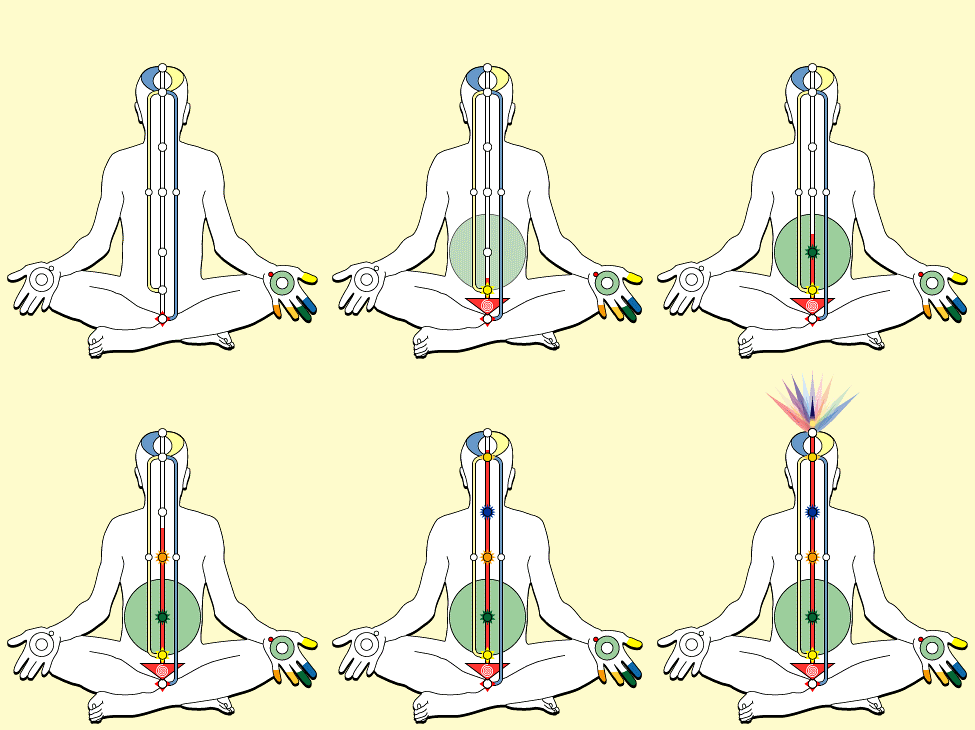
"But those who have got Realization (baptism) will enter into the Kingdom of God (external realm after 'death'). You have to enter into the Kingdom of God here, as I say, in the Seventh Chakra." (internal realm while on Earth) (Follow instructions #17-19 on right)
"Just people talk of baptism, 'Come along I'll baptize you.' It's not possible that way. It's just an artificial ritual. Try to understand. This is not going to render that actual happening within you which is going to make you grow spiritually. So the actualization of baptism takes place and you can feel also from your fontanel bone area a kind of a cool breeze of the Holy Ghost coming in."
(Follow #17-19)
"Actual baptism is when this Holy Ghost rises and you start really feeling the cool breeze on top of your head. This is a miracle. It is!"


Shri Mataji 1983 TV Interview (Houston, USA: Live with questions)
The joy of feeling the Cool Breeze (pneuma) of the Spirit for the very first time
Feeling fountain of Breeze/Pneuma/Reeh al-Qiyamah/Prana/Vibrations
Qi of the Spirit (Mother, Ruach, Tao, Kukulkan, Paraclete, al-Ruh) flowing out of the fontanelle for very first time. Verily, verily, it is the Fountain of Immortality! (Fontanelle comes from fontaine, French for "fountain".)
"The thousand-petaled lotus at the top of the head, the Sahasrara Chakra is the final state of achievement in what we are calling universal bandwidth. Once we have reached a certain point in our development, the kundalini energy, divine mother, Shakti, the power of God, the holy spirit comes up the spine and instantly increases our bandwidth. We now understand, see, perceive, and participate in the universe in a new way." (Farrand 2006, 64)
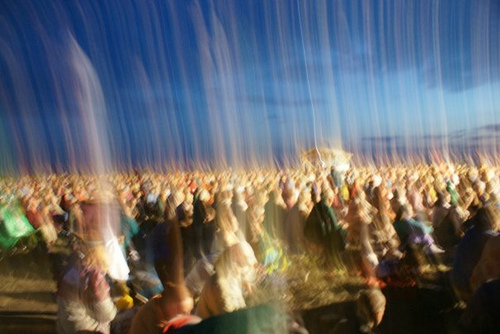
NOTE: All disciples of the Paraclete Shri Mataji, as promised by Jesus, are empowered to trigger the cool breeze (Ruach, Pneuma, Prana, Chi, Wind) in other human beings (as photo above demonstrates): "Jesus solemnly assures the disciples that they will, in the future, perform even greater miracles than He. By this He means to say that through the power of the Holy Spirit, they will bring about the greatest miracle of all – the salvation of lost souls. He promises them that whatever they ask for, in connection with their ministry of bringing the miracle of salvation to lost men, will be granted them." (Stallings; Picirilli 1985, 205)
"The Holy Spirit: Breath of God... The interesting part of this is the Hebrew word for spirit is ruach, and it means 'air in motion.' It is the same word for 'breath.' It also means 'life.' By resemblance to breath and air in motion, it means 'spirit.' That’s where we get the translation, and the Hebrew word contains all those different meanings. If we just leave it with our English word 'spirit,' we’re not getting the full attributes of what the Bible is trying to describe. It’s trying to describe that there’s a breath involved. Let’s take this into the New Testament because we have almost the same thing where Jesus is talking about the Holy Spirit. He says, 'That which is born of the flesh is flesh, and that which is born of the Spirit is spirit. Do not marvel that I said to you, 'You must be born again.' The wind blows where it wishes, and you hear the sound of it, but cannot tell where it comes from and where it goes. So is everyone who is born of the Spirit' (John 3:8). Jesus is talking about the Holy Spirit, and He’s saying it is like wind. When you get into the Greek behind that, the Greek word is pneuma, which again means 'a current of air,' 'breath,' or a 'breeze,' and again by analogy, 'a spirit.' So both the Hebrew and the Greek word are talking about breath. It’s talking about wind." (Gordon Robertson, The Holy Spirit: Breath of God Web. 27 January 2013)
"The Great Goddess is both wholly transcendent and fully immanent: beyond space and time, she is yet embodied within all existent beings; without form as pure, infinite consciousness (cit) … She is the universal, cosmic energy known as Sakti, and the psychophysical, guiding force designated as the Kundalini (Serpent Power) resident within each individual. She is eternal, without origin or birth, yet she is born in this world in age after age, to support those who seek her assistance. Precisely to provide comfort and guidance to her devotees, she presents herself in the Devi Gita to reveal the truths leading both to worldly happiness and to the supreme spiritual goals: dwelling in her Jeweled Island and mergence into her own perfect being." (Brown 1998, 2)
"Indeed, Jesus taught that his messiahship and the corresponding outpouring of the Spirit were firmly rooted in OT understanding (Luke 4:18ff., citing Isa. 61:1-2), and, similar to intertestamental Judaism, understood the messianic Spirit of the Lord to be the Holy Spirit (Matt. 12:32), the spirit which had foretold through the prophets that the coming Messiah would inaugurate the age of salvation with the pouring out of the Spirit on all flesh." (Caulley 21, 569)


The Great Adi Shakti Shri Mataji Nirmala Devi
The Paraclete Shri Mataji
The Time of Resurrection

"The Kingdom of God that we were promised is at hand. This is not a phrase out of a sermon or a lecture, but it is the actualization of the experience of the highest Truth which is Absolute, now manifesting itself in ordinary people at this present moment."

The Paraclete Shri Mataji


"Tell all the nations and tell all the people all over the Great Message that the Time of Resurrection is here. Now, at this time, and that you are capable of doing it."

The Paraclete Shri Mataji
Cowley Manor Seminar, UK—July 31, 1982


"This is the transformation that has worked, of which Christ has talked, Mohammed Sahib has talked, everybody has talked about this particular time when people will get transformed."

The Paraclete Shri Mataji
Chistmas Puja, Ganapatipule, India—25 December 1997


"The Resurrection of Christ has to now be collective resurrection. This is what is Mahayoga. Has to be the collective resurrection."

The Paraclete Shri Mataji
Easter Puja, London, UK—11 April 1982


"Announce it to all the seekers of truth, to all the nations of the world, so that nobody misses the blessings of the Divine to achieve their meaning, their absolute, their spirit."

The Paraclete Shri Mataji


"The main thing that one has to understand is that the time has come for you to get all that is promised in the scriptures, not only in the Bible but all the scriptures of the world."

The Paraclete Shri Mataji


"I bow to all the seekers of truth. The seekers of truth is a very special category of people. They’ve existed in all the centuries before also. And you find glimpses of that in many literary work. Today I read a book written by Ayala from Spain who was there in 1906. And he had described a seeker of truth how he became a saint.

William Blake from England, about hundred years back he lived, has said that, 'The time will come when many seekers of truth will be born. They are the men of God, they will be transformed, and they will have powers to transform others'.

This transformation is what we call is the birth which takes place second time. It is not just a certificate we should have from some institution that we are born again. Or we have become a twice born person, as we call in India a Brahmin, who thinks that he is really baptized. But the real baptism is a happening.

Recently there has been a very beautiful discovery of Saint Thomas’s writings who was a disciple of Christ and on his way to India he wrote a beautiful description of what a saint should be, and what Christ wanted us to be, in a very large book, and put it in a jar in Egypt. This book was recovered only 48 years back and has been again deciphered by a very good gentleman who came out with the book call Gnostic. Now Gna in Sanskrit language also means to know. To know on your central nervous system. Is not a mental knowledge. By reading books you cannot become a realized soul. It is not a mental achievement. That’s exactly what Saint Thomas has written that it is not a mental thing.

That it has to be a happening within us by which we know our Self, we get our real baptism. He’s against all kinds of theories of sufferings. He says Christ has suffered for us. We have to just awaken Christ within us. And God Almighty is a Father who is so much full of compassion and love for His children. Why should He make you suffer?

Logically one should understand if Christ had suffered for us are we going to suffer more than Christ had suffered? Has He left something undone that we have to suffer any more? He suffered because there was a problem in the human awareness. People were lost in ritualism and in philosophic discussions. So His message was that of Resurrection. That is being clearly shown if you see the Sistine Chapel in Vatican you see a huge, big Christ sitting there and judging people and giving them resurrection. So the time has come for us, all of us, to enter into the Kingdom of God. Now the time has come. This is the Blossom Time that many have to become the fruits."

The Paraclete Shri Mataji
Geneva, Switzerland, 11 August 1988

"Now what is the relationship of that supreme consciousness to the world of human experience? Without Self-realization, humans live, deluded, in a universe projected by Mahamaya, who is both ‘the great goddess and the great demoness’ (DM 1.77). The universe is a kaleidoscope of limitless possibility, of breathtaking beauty and appalling horror, where life oscillates between pleasure and pain, happiness and misery, success and failure. In such a world, the necessity arises for making choices. If Medha’s initial characterization of the Devi in her tamasic aspect inspires philosophical contemplation on the nature of reality, his depiction of her in her rajasic aspect inspires the vision of a goddess actively involved in her creation. Here she has the twofold nature of a compassionate mother worthy of devotion and a protective warrior intent on the victory of good over evil." (Devadatta 2005, 19)
"Thompson compares the presence of Jesus, Spirit and the Father with the disciples. She argues: ‘Just as Jesus does not ‘replace’ the Father, but rather, makes the Father known, testifies to him and discloses him, so the Spirit does not ‘replace’ Jesus but makes Jesus known, testifies to him and discloses him to the disciples. In this manner, the Spirit does not replace Jesus, or even become the real presence of Jesus: the Spirit makes the presence of Jesus real. Thompson sees the Paraclete distinct from Jesus in the sense that they are not identical. However, according to her, it is in the Paraclete that the presence of the risen Jesus becomes real." (Thettayil 2007, 144)


The Great Adi Shakti Shri Mataji Nirmala Devi
The Paraclete Shri Mataji
"Sahasrara (Kingdom of God) is the most beautiful part of your being. It is a big lotus with one thousand petals of different colors appearing like inflated flames...

Sahasrara is your awareness; when it is enlightened you get into the techniques of the Divine. Now there are two techniques, the techniques of the Divine, and the techniques you follow. You cannot act as the Divine, but you can use the Divine power to manoeuvre it.

For example, the Divine looks after all the universal happenings. Every minutest particle is controlled by the Divine. When your Sahasrara opens out, and your Kundalini touches the fontanelle bone, a sort of lightening force is ready in your Sahasrara; and as soon as the fontanelle bone area opens up in the Sahasrara, the grace of the spirit ignites that igniting force and your nadis (channels) get enlightened. Not all of them, but quite a lot of them; not all the length, but quite the peripheries. That is how you get your enlightenment.

So many things happen because of your seven centres being in the Sahasrara, with the light you see their relative positions. I mean your mind, your conscious mind feels that integration within you. The rationality that is separated from the heart becomes one with the heart. It becomes one with your attention. Wherever your attention goes you act in a collective way. All the activities in your attention are blessed. Your attention itself is effective. Your attention is very important. Your desires are even more important because it is such an integrated thing; your desires and your attention becomes one. Whatever is good for the spirit, you desire."

The Paraclete Shri Mataji
Sahasrara (Kingdom of God), Paris, France, May 5, 1982

"The Devi Gita, or Song of the Goddess, presents a grand vision of the universe created, pervaded, and protected by a supremely powerful, all-knowing, and wholly compassionate divine female. She is Mahadevi or the Great Goddess, known to her most devoted followers as the auspicious Mother-of-the-World (jagad-ambika, jagan-matr). Unlike the ferocious and horrific Hindu goddesses such as Kali and Durga, the World-Mother of the Devi Gita is benign and beautiful, though some of her lesser manifestations may take on terrifying forms. And unlike other beneficent divinities such as Parvati and Laksmi, she is subject to no male consort." (Brown 1998, 1)


Looking In, Seeing Out: Consciousness and Cosmos
"The most important aspect of the human subtle anatomy is kundalini, a term found in most schools of thought of India (White. 1979). It is called by different names in other traditions: the Kon tribe of the Kalahari call it the N-um. The ancient Sumerians called it Ningish Zeda, which literally means the ‘Serpent God,’ and the Mayans call it Kukulcan. Kundalini means ‘the coiled one.’ It is the universal energy which in its outer function sustains life in every individual, though in its inner spiritual nature usually remains dormant. It cannot be found in the physical body. Once experienced in deep states of meditation, it appears as a brilliant shimmering white light energy. It is coiled 3 ½ times at the base of the spine in the subtle body, hence it derives its name. Often, as in Egyptian and Hindu art, it is represented as a coiled snake or a cobra, the king of all snakes. In its outer aspect, kundalini sustains us through all biological processes. In its inner aspect, kundalini is the same energy that brings about the creation of all worlds. In its universal function it is the Supreme Creative aspect of Universal Consciousness, Paramashiva, cosmic creative energy that becomes everything and anything in the manifold Universe. In our subtle body this energy lies dormant, waiting to be awakened in the aspirant for his or her return journey back to the transcendent state in the finite light of sahasrara.

The concept of universal energy or Kundalini is found in all spiritual traditions, although often alluded to in apocryphal terms and under different names. In Chinese tradition, the universal energy is known as Chi. In the Japanese tradition as Ki. In Christianity as the Holy Spirit. Different traditions, different paths, different cultures all refer in different ways to the same basic foundation of all creative energy.

The subtle energy bodies do not have veins and arteries, bones, blood and body fluids. They are pure energy circulating through millions of subtle channels called the nadis. The awakened kundalini spreads through the nadis and purifies all bodies. As the bodies are freed from blockages, a new dimension of human perception opens. One becomes certain, beyond intellectual pronouncements, that all knowledge is contained within. This ‘turning within’ or looking in is the seat of evolution for the human species...

Turning within is also an eternal journey, for eternity is not a long period of time. It is no time, where time collapses. The physical body is subject to time; we are born, grow older and die as time goes on. Time, however, does not exist in the same way at other levels of consciousness. It becomes distorted at the subtle dream state, seems to disappear at the deep sleep state and becomes eternity at the transcendent state.

As the kundalini climbs the ladder of evolution along the spine, the journey becomes more and more refined and also more and more difficult and demanding. The temptations of the ego become subtle and harder to resist. Many begin the journey, but very few go far along the upward spiritual ladder. Even fewer reach the top. Complete, absolute impeccability in thoughts, emotions and feelings are needed for that. Nothing can be hidden; there are no secrets between the aspirant and his or her own inner energy, the kundalini.

When the journey is completed, the aspirant’s inner state is completely transformed. How to facilitate that process is the subject of all mystical traditions, the true subject of all religions, and the intent of all great spiritual teachers throughout all times."

Looking In, Seeing Out: Consciousness and Cosmos
Minas C. Kafatos and Thalia Kafatou
Quest Books (October 1, 1991) pp. 186-7


Hunbatz Men, Secrets of Mayan Science/Religion

Secrets of Mayan Science/Religion
"I think it is important to mention again the other ancient cultures, like those of India, where we find roots of words similar to peninsular Mayan. Valmiki wrote that the Naga Maya brought their culture to India around 2700 B.C., although we believe it was even earlier. We also maintain that they brought their culture to other parts of Asia and to Africa, where they were called Mayax according to Manetho, the Egyptian priest-historian.

There are notable similarities between Indian culture and the cultures of the Maya of Yucatan and other indigenous people of America, especially in esoterica. Figure 27 shows a clay sculpture from western Guerrero state. This piece represents a meditating figure seated in the Hindu ‘lotus’ position of yoga. Here is clear evidence, dear reader, that our ancestors practised this system of meditation in Mexico. Furthermore, the very word yoga exists in Mayan. Written yok’hah, it combines yok, ‘above’ or ‘on top of,’ and hah, ‘truth.’ ...

The word cizin esoterically implies a manifestation of our energies i.e., a practical application of knowledge. A flowering of radiation is visually represented by the serpent symbol of solar energy. The other extreme is cizin is in the coccyx, or the k’ul. Herein lie some of the secrets of Christ, the Jews, and other Catholic religious saints who exhibit auras surrounding their heads or bodies. It relates to what we saw in Figure 29, the meditating Mayan priest…

To conclude this brief analysis of the magic seven and its importance, we will cite another Hindi word: kundalini. This word exists in Mayan in two forms: k’ultanlilni and k’ulthanlilni. This again demonstrates the fact that world culture had roots which we, the peninsular Maya of Mexico, helped establish thousands of years ago. The Hindi word kundalini is the derivative evidence...

Continuing with our analysis of the words k’ultanlilni and k’ulthanlilni, we will try to discover new revelations through the Zuyua of pach than. As we just learned, in this form we use the words in reverse, i.e., in lil nat luk’ and in lil nath luk’, and study them in the contexts of etymology, linguistics, symbology, religion, science, etc.

K’ULTANLILNI & K’ULTHANLILNI:

K’u—Sacred, God, and name of the pyramid; the first sound a human makes upon arriving in this world.
K’ul—Coccyx, the sacred place where solar energy is deposited at the base of the spine. It can also mean k’u—“sacred,” “God,” etc.—with the “L,” contraction of lil, “vibration.”
K’ultan—Literally, it means coccyx and its location. From k’ul, “coccyx,” and tan, “place.” This word also says k’u, “God” or “pyramid” of lil—“vibration,” as seen above.
K’ulthan—Similar to above with the addition of than—“to speak.” k’ul—“coccyx”; than—“to speak,” or “to speak to the coccyx,” “to God” or “to the pyramids,” etc.
K’ultanlil—This word contains k’u—“God” or “pyramid”; “L”—“vibration”; tan—“place”; and lil—“vibration.” also k’ul—“coccyx,” implying that the coccyx is the location of the vibration of Hunab K'u, the Sun God.
K’ulthanlil—Composed of k’u—“God,” “pyramid”; “L”—“vibration”; than—“to speak”; and lil—“vibration.” K’ul is also “coccyx”; in the coccyx we can address the vibration of Hunab K’u.
K’ultanlilni—Finally one of the two complete words. K’u—“God,” “pyramid”; “L”—vibration; tan—“place”; lil—“vibration.” and ni—“nose”; also k’ul—“coccyx.” The composite meaning—the coccyx as the plaice of vibration is directly related to the nose because it is where the breath of the Sun God enters.
K’ulthanlilni—Similar to the previous word except for one significant variation. It means k’u—“God,” “pyramid”; “L”—“vibration”; than—“to speak”; lil—“vibration”; and ni—“nose”; also k’ul—“coccyx.” Coccyx of vibration, speak to the vibration, and also know how to breathe properly in order to generate movement of those faculties of Hunab K’u residing in the coccyx.

Through language, the Mayan culture instructs the people and enables them to develop the faculties which Hunab K’u placed in their bodies. Clearly, this process must become part of our consciousness so that we may become true Quetzalcoatls or Kukulcans. This process in uniquely expressed in our religious/scientific language, as we have demonstrated."

Hunbatz Men, Secrets of Mayan Science/Religion
Bear & Company (August 1, 1989) pp. 111/132-35


The Nag Hammadi Library
"Scholars investigating the Nag Hammadi find discovered that some of the texts tell the origin of the human race in terms very different from the usual reading of Genesis: the Testimony of Truth, for example, tells the story of the Garden of Eden from the viewpoint of the serpent! Here the serpent, long known to appear in Gnostic literature as the principle of divine wisdom, convinces Adam and Eve to partake of knowledge while 'the Lord' threatens them with death, trying jealously to prevent them from attaining knowledge, and expelling them from Paradise when they achieve it. Another text, mysteriously entitled The Thunder, Perfect Mind, offers an extraordinary poem spoken in the voice of a feminine divine power:

For I am the first and the last.
I am the honored one and the scorned one.
I am the whore and the holy one.
I am the wife and the virgin....
I am the barren one, and many are her sons....
I am the silence that is incomprehensible....
I am the utterance of my name.


These diverse texts range, then, from secret gospels, poems, and quasi-philosophic descriptions of the origin of the universe, to myths, magic, and instructions for mystical practice."

James M. Robinson, The Nag Hammadi Library
HarperOne (October 12, 1990) pp. 3


"Now what I have told you about Adam and Eve, we have found out, said by also John in his Gnostics book. It's very surprising. They always told you that Christ must have told you many things, but they are not in the Bible. So if you understand that this Adi Shakti came as a serpent—the Adi Kundalini part of Her—and told the Adam and Eve, especially Eve, that she should ask for the fruit of knowledge to be eaten. The reason I gave you is exactly written there, that the Mother power, the feminine power, didn't want Her children to live like animals without understanding what is the knowledge of the higher realms, not giving them chance to rise higher through their freedom and then to higher and higher awareness. It was the concern of the Mother."

The Paraclete Shri Mataji
Cabella, Italy, June 26, 1994


110) Sri Kundalini
— She is coiled like a serpent. She is stated to assume 31/2 coils - the form in which Sri Lalita resides in sacrum bone of every human as potential state.

Sri Lalita Sahasranama
C. S. Murthy, Associate Advertisers and Printers, 1989

This family Woman Kundalini entering the royal road Susumna,
Taking rest at intervals in the secret places (in the cakras),
Embraces the supreme husband and causes the nectar to flow (in the Sahasrara.)

Cintamanistava
(source: R. A. Sastry, Lalita-Sahasranama, The Adyar Library and Research Centre, Madras, 1988.)

"That Kundalini in the Muladhara, sleeping in three and half coils, roused by Yogins, breaks through the six cakras as well as the three knots, called Brahma, Visnu, and Rudra-granthis and proceeding to the Sahasrara, from the moon’s orb, which is the pericarp of the lotus, She causes nectar to flow."

R. A. Sastry, Lalita-Sahasranama,
The Adyar Library and Research Centre, Madras, 1988, p 87.

The sakti called Kundalini in the form of a serpent, beautiful, fine as lotus, fibre, Resides in the Muladhara.
Biting the pericarp of the Muladhara which is like the pericarp of a lotus,
With its tail in its mouth and connected with the Brahmarandhra....
This energy unites with Siva in the thousand-petalled lotus.
This should be known as the supreme state (para),
And it is the cause of final beatitude.

Vamakesvaratantra, R. A. Sastry, Lalita-Sahasranama,
The Adyar Library and Research Centre, Madras, 1988, p 198.

May Kundalini, whose movements are secret and who by the blaze of the fire,
By the illumination of the sun and by the brightness of the moon,
Cause the ambrosia to flow through the seventy-two thousand channels,
And make us contented.

Sukasamitha, R. A. Sastry, Lalita-Sahasranama,
The Adyar Library and Research Centre, Madras, 1988, p 198.


Christ and the Kundalini

Jesus Christ
"The Christian Gnostics practiced a spirituality more similar to Eastern traditions than to the Western Christianity we know today. 'Gnostic' is Greek for 'knower' and it is 'Gnosis' or 'Knowledge' that they were seeking. Unlike the blind faith demanded by today's Churches, 'Gnosis' meant direct, mystical experience of the divine, which was to be found by individual spiritual evolution to Self-Realisation, and not within the confines of intellectual dogma. The experience of Gnosis was trans-rational and non-intellectual.

From the Nag Hammadi Library, the Book of Thomas, Christ tells us 'For whoever does not know self, does not know anything, but whoever knows self, already has acquired knowledge about the depth of the universe'. Compare this with a tract from the Upanishads, the Indian metaphysical treatise on Self Realisation: 'It is not by argument that the self is known... Distinguish the self from the body and mind. The self, the atman, the highest refuge of all, pervades the Universe and dwells in the hearts of all. Those who are instructed in the self and who practice constant meditation attain that changeless and self effulgent atman ( spirit/ self). Do Thou Likewise, for bliss eternal lies before you...'

In another gnostic text, the Secret Gospel of Thomas, Christ promises us spiritual fulfilment 'I shall give you what no eye has seen, what no ear has heard, what no hand has touched and what has never arisen in the human mind.' This description is not unlike the Upanishadic experience 'the Self is devoid of birth and death, it neither grows old nor decays and the accidents of life do not affect it. The Self transcends space and time; what is great is not too great for it to comprehend and what is small is not too small to escape its attention. It is the Self of All'.

Just as Christ warned us against sin and encourages moral perfection in the pursuit of spiritual fulfilment, so too do the Eastern texts 'No intellectual acumen can help one realise it, it can be realised only by those who surrender to it and who make themselves worthy by grace, by desisting from all that is sinful, who engage in the practice of perfection by constant meditation'(Upanishads).

The most ancient Eastern spiritual texts, the Vedas,of India, tell us that the process of spiritual awakening by which one attains truth -awareness is called 'Self-Realisation'. The Self Realised person lives in direct experience of reality—this is called 'Jnana' (a traditional sanskrit word meaning 'knowledge' or 'Gnosis'). Such a person is called a 'Jnani' ('knower' or 'gnostic') or 'dwijaha' ('twice born'; first from a human mother to the earthly plane then secondly as a child of the Goddess, or Divine Mother, who gives the seeker their second, spiritual birth, Self Realisation, into the plane of mystic awareness- gnosis! ). The traditional Indian texts extol the 'Divine Mother' as the Cosmic Matriarch, bestower of the highest treasure of Self Realisation upon Her deserving children. Many Indian mystic traditions say this same goddess is represented within the human being as the divine feminine power called Kundalini.

What of Western tradition? In the Secret Book of John Christ explains that human redemption before the Heavenly Father occurs by the mediation of a Divine Feminine principle, which he calls the Earthly Mother. It is the Earthly Mother who removes the sins of the children that they can become worthy of their divine heritage; 'when all sins and all uncleanesses are gone from your body, your blood shall become as pure as our Earthly Mother's blood and as pure as the river's foam sporting in the sunlight. And your breath shall become as pure as the breath of odorous flowers; your flesh as pure as the flesh of fresh fruits reddening upon the leaves of trees; the light of your eye as clear and bright as the brightness of the sun shining upon the blue sky. And now shall all the angels of the Earthly Mother serve you and your breath, your blood, your flesh shall be one with the breath, the blood and the flesh of the Earthly Mother, that your spirit also become one with the Spirit of your Heavenly Father. For truly no-one can reach the Heavenly Father unless through the Heavenly Mother. Even as the newborn babe cannot understand the teaching of his father until his mother has suckled him, bathed him, nursed him, put him to sleep and nurtured him'. The Earthly Mother is a divine mediator through which the seekers, the Sons of Man, are raised to the Heavenly Father. Another part of the same text says 'Honour your Earthly Mother and keep her laws that your days may be long on this earth and honour your Heavenly Father, that eternal life may be yours in the Heavens. For the Heavenly Father is a hundred times greater than all the fathers by seed and by blood, and greater is the Earthly Mother than all mothers by the body'. The Holy Trinity, then is God the Father, God the Son (ie. Christ) and, it seems, God the Mother. The Divine Mother particularly is the means and power of spiritual evolution.

The Secret Book of John relates Christ's description of the Divine Feminine as the power of God Almighty. 'She is the first power. She preceded everything, and came forth from the Father's mind as forethought of all. Her light resembles the Father's light; as the perfect power She is the image of the perfect and invisible Virgin Spirit. She is the first power, the glory, Barbello, the perfect glory among the worlds, the emerging glory, She glorified and praised the Virgin Spirit for she had come forth through the Spirit. She is the first thought, image of the Spirit. She became the universal womb, for She precedes everything, the common parent, the first humanity, the Holy Spirit'. The Holy Spirit is here described as the Divine Power of God Himself. This power is maternal in its character (universal womb, She, the common parent) and all powerful as the 'first emanation of God'. More so, She is pure (Virgin) and She glorifies purity. So ancient christian tradition seems to tell us that the holy spirit is actually the Divine Mother!

One cannot overlook the Eastern parallels. God Almighty in Indian mythology is represented as Sada-Shiva. His state is eternal perfection (Sat Chit Ananda). His power is the Adi Shakti (primordial power) who is His feminine counterpart or spouse. It is She who does all things. She created the universe and the gods who attend over it (for example, the triune Shiva, Brahma, Vishnu). The Adi Shakti is the Mother of all things. She gave birth to the universe and is the feminine power of every deity and celestial being (usually represented as their spouse). The Secret Book of John parallels this 'She became the universal womb, for She precedes everything, the common parent, the first humanity, the Holy Spirit, the triple male (Shiva, Brahma, Vishnu?) the triple power (Parvati, Saraswati, Lakshmi, who are spouses of the triple males-or the triple Goddess of Western mythological tradition?)'. Thus the Christian mystics understood that the Holy Spirit is the Divine Feminine, the Goddess, the Universal Mother herself. The Syriac Christians worshiped the Holy Ghost as the Great Mother. Phillip suggests that Mary Herself is the Holy Spirit (for who else but God the Mother can give birth to God the Son?). Other Apocryphal Scriptures describe Mary as the focus of Temple activities. Her early life was punctuated by auspicious portents all implying her own Divinity.

Just as Mary and the Holy Ghost appear to parallel aspects of the Divine Mother described in the East, so too does Christ, the son of God reflect the Eastern principle of the Divine Child. The Divine Child in the Eastern mythological tradition is commonly worshiped as the dual child-gods Ganesha and Kartikeya. Ganesha represents the fabric of the cosmos, the primordial Aum or Logos from which the creation was constructed. Christ affirmed the same primordial nature of himself when he said 'I am the first' and 'I am the alpha'. Ganesha is the primordial child who is the embodiment of purity and innocence. Similarly Christ venerated children and the innocence that they manifested. He even urged the apostles (and us) to cultivate our own childlike innocence 'let the children come to me for the kingdom of heaven belongs to such as these' and 'assuredly whoever does not receive the kingdom of god as a little child will by no means enter it' (Mark 10). Kartikeya is the same principle of innocence in dynamic action- the slayer of evil; as Christ did when he ejected the money lenders from the temple.

So, Christ seems to be telling us that the kingdom of Heaven, which is a state of God-like perfection and child-like innocence is attained by some inner phenomenon. In the Gnostic Scriptures Christ spoke directly of this as an inner transformation, self realisation. He also told us that the Holy Ghost or Divine Mother is the power by which this is accomplished."

www.sol.com.au/kor/8_01.htm
Web. 28 February 2013


"Scholars investigating the Nag Hammadi find discovered that some of the texts tell the origin of the human race in terms very different from the usual reading of Genesis: the Testimony of Truth, for example, tells the story of the Garden of Eden from the viewpoint of the serpent! Here the serpent, long known to appear in Gnostic literature as the principle of divine wisdom, convinces Adam and Eve to partake of knowledge while 'the Lord' threatens them with death, trying jealously to prevent them from attaining knowledge, and expelling them from Paradise when they achieve it. Another text, mysteriously entitled The Thunder, Perfect Mind, offers an extraordinary poem spoken in the voice of a feminine divine power:

For I am the first and the last.
I am the honored one and the scorned one.
I am the whore and the holy one.
I am the wife and the virgin....
I am the barren one, and many are her sons....
I am the silence that is incomprehensible....
I am the utterance of my name.


These diverse texts range, then, from secret gospels, poems, and quasi-philosophic descriptions of the origin of the universe, to myths, magic, and instructions for mystical practice.

Why were these texts buried-and why have they remained virtually unknown for nearly 2,000 years? Their suppression as banned documents, and their burial on the cliff at Nag Hammadi, it turns out, were both part of a struggle critical for the formation of early Christianity. The Nag Hammadi texts, and others like them, which circulated at the beginning of the Christian era, were denounced as heresy by orthodox Christians in the middle of the second century. We have long known that many early followers of Christ were condemned by other Christians as heretics, but nearly all we knew about them came from what their opponents wrote attacking them.:


Kundalini: The Secret Doorway

Kundalini: Divine Energy, Divine Life
"Kundalini is a god energy, and as such, it nourishes your uniqueness and upholds your sacred vocation. Since it originates from the Divine Source, it also interconnects you with all living beings, as well as the Divine itself. Because of these connections, to tap into your kundalini is to open the channel to your intuition, to begin to hear the messages in the wind, to receive revelations colored with inspiration, and to know the unknowable. In short, kundalini allows you to be you—and encourages others to be themselves.

Shall we see why the ancients taught about this power since time began? Why teachers, gurus, and saints across time and around the world have utilized it? Why even science is now validating its existence? Then let’s open the door and step across the threshold. Let’s embrace this divine energy and enjoy a truly divine life.

Brilliance in Your Body

What is this masterful, brilliant energy called kundlaini?

In Sanskrit, kundalini means ‘life energy.’ Known as the serpent energy in Hinduism, the first culture known to have labeled this mysterious force, kundalini is the natural divine energy inside of you. Your kundalini is the life force of your body that, when fully activated, leads to living as an enlightened sage.

Etymologically, the word kundalini can be broken into the following Sanskrit roots, each of which sheds more light on what exactly this divine energy really is:

kundalin=coiled, spiraled (from the word kundalam, which means ‘ring’ or ‘coil’)
kun=earth
di=can mean ‘little pot of earth’ or ‘a single cell’ and its alternative root:
da=to give or ‘bestower’
lini=perpetual consciousness expressing in alpha and omega, or beginning and end.

The sum total of these phrases adds richness to our understanding of kundalini. We could, based on these root words, now define kundalini as ‘the coiled earth energy that begins in a single cell and, when blessed by the Bestower, gifts us with consciousness’

In Sanskrit, a language in which every noun is accorded a gender, the word is feminine. This connection easily leads to the idea of kundalini as the feminine principle of creation, the life-giving properties within our physical bodies that lead to higher consciousness. Our kundalini is the yin, or divine feminine, to our yang, or divine masculine. It’s the receiving to the giving, the intuitive behind the logic, the contentment within the striving, and the sensual within the sexual. It’s what gives us life and now sustains it, linking us with the fertile, emotional, and prosperous sources of divine energy. Kundalini compels us to feel and dance, bond and create, attract and merge. Then, when kundalini—this pulsating, creative, feminine power within each of us—joins with our male spirit quality, it sparks unity within ourselves as well as with the Divine.

This feminine energy is known by many different names throughout the world, including chi in China and ki in Japan. Spiritual people might call it the ‘goddess within.’ The Christian and Jewish scriptures name it the Holy Spirit; Dr. Carl Jung calls this energy the anima. It is the source of fire in Moses’ burning bush, the caduceus symbol of medicine, the life force in Buddhism, and the source of intimacy in Tantric sex. It is the serpent called Quetzalcoatl among the Mayans. In Hinduism, it is serpent power, personified as Shakti, the goddess. Most likely you have heard a few of its many other names: Al-Lat, the Great Mother, Ruah, Pachamama, Sophia, life energy, light flame, cosmic energy, divine force, spirit fire, living flame, mothering intelligence, mana, the supreme power, and Christ consciousness.

Though known by different names to different groups, kundalini is always the same force. It is the organic catalyst necessary to unify our body, mind, and soul. It is the divine light that invites poetry into our lives. It is the secret to living this human life as divine beings."

Kundalini: Divine Energy, Divine Life
Cyndi Dale, Llewellyn Publications (February 8, 2011) pp. 2-4


"Shri Mataji’s mission is to save as many souls as she can."

Judith Coney: Sahaja Yoga
"Shri Mataji claims to be able to fully awaken the kundalini of others almost instantly. The process traditionally involves strenuous efforts, is difficult and is only achieved after many years of practice (Krishna, 1971). The speed she offers is possible, she says, because she is the Adi Shakti (Sajaja Yoga 1988, 8). Once awakened, either by Shri Mataji or her followers, the kundalini rises through the chakras until it pierces the topmost chakra, the Sahastra, and emerges at the fontanel area at the top of the head. During its ascent, the individual may feel tremendous heat. This, says Shri Mataji, is due to the kundalini burning off impurities in the chakras as it rises. However, once it has fully ascended, participants feel a cool breeze on the palms of their hands or above their heads, and sometimes more generally:

This happening of Kundalini Awakening and ultimate union with a higher consciousness are described by a Sanskrit word ‘Sahaja’. This means literally born with or spontaneous.. This cool breeze is the one which is manifested by the all-pervading power of Divine Love.
(Sharma 1993, 55)…

The benefits of an activated kundalini are said to include increasing good health and relief from stress (Sharma 1993, 57; Rai 1993, 46; Spiro 1993), a feeling of well-being, a more balanced outlook on life, the adoption of a more moderate lifestyle and the spontaneous abandonment of bad habits, such as swearing, fits of temper and addiction. A tract which is attributed to ‘the Sahaja Yogis of the world’ describes other qualities which are characteristically associated with devotees of Shri Mataji as a result of ‘realisation’…

Shri Mataji is presented as a saviour who provides the ark of Sahaja Yoga for all those who would escape the evils of the world, and even its destruction. In Indian mythology, it is the god Vishnu who incarnates for the tenth time as Sri Kalki and destroys the wicked in the Kali Yuga. A new age will then commence 'with men of purity and brightness, over whom Vishnu will reign forever' (Walker, 1968: 512)...

Sahaja Yoga is presented as a final 'salvaging operation before the last sorting out' (ibid., 239). Thus Shri Mataji’s mission is to save as many souls as she can."

Judith Coney, Sahaja Yoga
RoutledgeCurzon; 1 edition (May 24 1999), pp. 31-6
Judith Coney is a lecturer in the Department of Study of Religions at the School of Oriental and African Studies, University of London.


"Jesus Christ incarnated to open the Agnya Chakra and to dissolve our ego. My job is to awaken your Kundalini Power so that it could pierce your Sahasrara Chakra. This work is of a collective nature. I have therefore to do it in the case of one and all. I want to tell you about Jesus Christ, Guru Nanaka, King Janaka and a number of other Incarnations and the way they relate with the Collectivity. Similarly, I wish to talk to you about Incarnations of Shri Rama, Shri Krishna, ecetera and also about Shri Shiva because all the Powers of these Gods and Deities are in us. Now the Time has come for Collective Consciousness to manifest.

In this KaliYuga all those who are seeking God shall find Him and millions of people will be able to do so. Sahaja Yoga is the Last Judgment. This is described in the Bible. You are judged only after you come to Sahaja Yoga. . . .

The Judgment in this matter is to be made by the individual himself. It is only when you stabilize in Sahaja Yoga that the state of thoughtless awareness is established. So long as the Kundalini Power does not pass through the Agnya Chakra the state of thoughtless awareness is not reached. As soon as the Kundalini crosses the Agnya Chakra the thoughtless awareness is established. It is the Power of Shri Jesus which is instrumental in opening the subtle door located above the Agnya Chakra. For that purpose you are to recite the Lord’s Prayer composed by Jesus Christ. After crossing this Door the Kundalini Power enters the limbic area of the brain. It is after the Kundalini enters this area, which is also termed as the Kingdom of God, that the state of thoughtless awareness is established."

The Paraclete Shri Mataji
Shri Kundalini Shakti And Shri Jesus Christ
Bombay, India—September 26, 1979


"In the dawning of the Aquarian Age, every person will be their own priest and healer."

Awakening to a New Consciousness: Experiences & Practices of Transformation
"A little knowledge can be a dangerous thing. There are many that are quick to profess that they are ‘experts.’ However, in reality, they have very little experience and/or training. The student can often fall into this glamour and be taken or misled.

In the dawning of the Aquarian Age, every person will be their own priest and healer. This should be kept in mind by those who are seeking to be ‘shepherds of time.’ Like Socrates, the counsellors should be adept in awakening the inner intelligence of those who seek his/her advice.

Counsellors should use mystical, metaphysical, and psychological means, instead of simply repeating scriptural verses. Metaphysical and spiritual teachers should strive to connect every person to their own Inner Light and innate wisdom.

Cosmic energies can be harnessed by the knowing of their source, nature, and how they operate. At a certain point of one’s probing into reality, the intellect has to be transcended and a higher faculty of the soul activated.

The metaphysical counselor also must unfold the divine qualities of wisdom, love, power, and intelligence, to be an active instrument in the hands of the Divine Being.

The metaphysician also has to awaken a sense of responsibility in his clients, advising them control of their thoughts and manifestations.

One’s spiritual standing has to be seen and proved sincere on a daily basis. This is where the statement ‘Practice what one preaches’ comes in. The true metaphysical teacher knows that spiritual teachings can not be given in one session. It takes time for spiritual growth to happen."

Awakening to a New Consciousness: Experiences & Practices of Transformation Joseph Parazoo, CreateSpace Independent Publishing Platform (June 11, 2008) pp. 172-3


Question: "Which will be the end of all the world or of humankind?"

The Great Adi Shakti Shri Mataji Nirmala Devi
The Paraclete Shri Mataji
"Which will be the end of world? Again, futuristic, very futuristic. Let’s not talk about the end. Just now is the beginning. When the child is born we just don’t think about his death, do we?

So better be worried about the beginning of this new world that we have started and don’t think of the death and all those things. Forget it for the time being."

The Paraclete Shri Mataji
Public Program, New Delhi, India 1988

"God has a project. He won’t let his fallen creation go. Jesus Christ is the linchpin of the divine plan. The primordial promise found in the protoevangelium has its fulfillment in him. The promises of Abraham and their realization find their focus in him (Gen. 3:15)…. The people of the Messiah have life in the Spirit. A new age has dawned but the best is yet to be. As Charles H.H. Scobie observes, 'In keeping with the ‘already-not yet’ tension so characteristic of the NT, the presence of the Spirit not only is evidence that the new order has dawned, but also points forward to the final consummation of God’s purposes.' " (Cole 2007, 209)


"Then I realized one thing that we cannot have the whole world to get Self-realization. This is the Last Judgment. At this time people have to decide what is the most important. They have to know themselves and understand what they are doing. Its not just having the big number that will help us but really solid Sahaja Yogis (baptized/Self-realized souls).

Then I found there were people who got cured of many diseases but most of them got lost. Some of them who were drug addicts, drinking, they gave up, smoking they gave up. I have never said a word, that you give up this or give up that. I know, when the Kundalini rises they will automatically give up and it happened and that's how people became so clean, so beautiful and started enjoying their lives.

But nobody would believe them. When they went round and talked to people,they would say they have gone mad! They could not believe how they have stopped drinking, how they are not smoking . So the identification I found of these people were mostly with the very loose type of enjoyment. They enjoyed very loose type of enjoyment, which has nothing to do with the Spirit.

Gradually of course it started working out. But still I must say that we cannot expect, in this Kaliyuga, to have billions and billions of people in Sahaja Yoga (spontaneous baptism/Self-realization), though it is my desire, it is your desire, and you want them to get their Self-realization, by which so many good things can happen."

The Paraclete Shri Mataji
Sahasrara Puja, Cabella Ligure, Italy—May 7, 2000

"The best way to approach the Kundalini is to recognize that it is the power and the presence of the Goddess within us. We must first honor and revere the Kundalini as a manifestation of the Divine Mother in order to unfold its energy in a truly harmonious manner...
Kundalini is the highest manifestation of Shakti within our individual nature. It is the spiritual power of the soul, the portion of Divinity that we are in out deeper identity. Kundalini supports the body and mind during our lifetime, sustaining even our autonomic reflexes in the physical body. Kundalini holds the potential for the development of higher consciousness within us. Honouring the Kundalini as a form of the Goddess ensures our proper relationship with her and the harmonious enfoldment of all our inner energies." (Frawley 2009, 161-2)
"The parable of the four soils (Matt. 13:1-9, 18-23 par.) teaches a number of different truths... A striking feature of the parable is that when the kingdom is proclaimed, not all accept its message. There are four different kinds of soil, and only the last bears genuine fruit. All other soils fail to persevere in bearing fruit, and they represent the people who are unsaved on the day of judgment. One of the mysteries of the kingdom communicated here is that the word of the kingdom will not immediately have overwhelming success in this world. Many will reject the good news about the kingdom, but they will not be judged instantly... This parable communicates the secret of the kingdom: it is already here through the preached word, but the day of judgment is reserved for the future." (Schreiner 2008, 60)


The Maya believed that the 26,000 Great Year of precession is a spiritual gestation period for humanity

The Maya Book of Life: Understanding the Xultun Tarot
"The winter solstice in 2012 is the knot in the Loom of Time that holds all these physical and spiritual events together in the dream—the World Tree, the cross roads of the Milky Way and the ecliptic, the rebirth of the sun from the darkness, the hope of resurrection, the hope that human love and the warmth of life will prevail against the coldness of the galactic night, the hope that the universe in on our side and we are not just an accident lost amongst the stars, and the hope that life will jump and live again in a time beyond our own.

On the morning after the shortest night on December 21, 2012 an event will occur that has not happened for 26,000 years. The sun will be in the centre of the Sacred Tree, the Heart of Heaven, and First Father, our sun, will be reborn from this Cosmic Womb of the Milky Way, the Great Mother. John Major Henkins concludes:

'The 260-day tzolkin calendar is based upon the 260-day period of human embryogenesis, and, on a higher level, the 260-day tzolkin symbolises, or structures, the 26,000 year period of precession, what we might call human spiritual embryogenesis. The Maya believed that the 26,000 Great Year of precession is a spiritual gestation period for humanity, and that the 2012 alignment will catalyse the birth of what has been growing on this planet for 26,000 years. For the Maya, Father Sun’s movement into union with Cosmic Mother’s heart also signified the insemination, or seeding of what will come to fruition in 26,000 years.'

End of Days

Our hearts have overbrimmed with new agonies, with new lustre and silence. The mystery has grown savage, and God has grown greater. The dark powers ascend, for they have grown greater, and the entire human island quakes.—Niklos Kazantzakis

The day of December 21, 2012 will dawn just like any other day, no different from the millions of days before and the millions after. It does not matter whether the astronomical events happen on the specific day or not. It does not matter what people do on that day. Life will go on. The archetype of the rebirth of the sun, which gives light, life and joy to the People, is happening in the dream all the time. In star time, a day, a year, or a decade does not make much difference—it is the process not the event.

However, this archetypal and spiritual potential can only come into being and know itself if there is a human container to hold it, human consciousness to give it witness, human longing for its presence, human joy to celebrate it, and human grief to mourn its passing. So indeed, the day and the year does not matter. Not because anything apocalyptic will happen on that day (that’s just good copy for The Skeptical Inquirer or New Age magazines) but because the event attracts human attention, interest, fear, and fascination. All of which are a landing beacon for spirit. They call down power.

The moment, which is just like any other, is like the alchemical earth that is common and is found everywhere, but it can be transformed into gold. It is a point in time and space where two worlds can touch through the actions and choices of humans. We can align ourselves with the greater rhythms of the cosmos and both spirit and matter can be changed. Our ceremonies are magnified by the fact that this major ending and beginning resonates with all other endings and beginnings past and future. This is why Maya rulers conjured and ceremonialised at the katun and baktun endings to plant seeds for a time beyond their own.

There is great hope in the Fifth Age, the fifth Movement of humanity’s Book of Life, the age of Assuming Authority at the end of this Great Year. It may be the first time in history where sufficient human consciousness has accrued for the personal history of previous ages to be erased and to make passage from one Great Year to the next possible without destruction. Moreover, to make the shift, one that is a quantum leap in human evolution."

The Maya Book of Life: Understanding the Xultun Tarot
Michael Owen, Kahurangi Press (March 31, 2011) pp. 453-4


The Breath of God in the Old and New Testament

The Miracle of the Breath
"The link between Spirit and Breath is mentioned throughout the Bible, yet most modern-day Jews and Christians are unaware of this relationship. For example, the ancient Hebrew word ruah not only meant ‘spirit,’ ‘breath,’ and ‘wind’; it was also used in essentially the same ways as the Greeks, Hindus, and Romans used the words pneuma, prana and spiritus. The ancient Hebrew scribes often linked the word ruah with Yahweh (the name of the God of Israel). Thus, the term ruah Yahweh, which appears often in the Old Testament, can be translated to mean ‘the spirit of God,’ ‘the breath of God,’ or ‘the wind of God’ (God’s breath manifested as wind)…

In the New Testament, all references to God’s spirit, breath, or wind appear as the word pneuma, instead of ruah, because the Gospels were originally written in Greek. In John 3:8 (AV), for example, Jesus appears to be speaking in riddles when he says to the bewildered Nicodemus:

The wind [pneuma] blows where it wills, and you can hear the sound it makes, but you do not know where it comes from or where it goes. So it is with everyone who is born of spirit [pneuma]."

Andy Caponigro, The Miracle of the Breath
New World Library (2005) p. 9-11


The Light of the Koran
"But what is meant by the term 'Self-realisation', which many traditions also call 'second birth'? A subtle mechanism inside each human being watches over a latent spiritual energy, located in the sacrum at the base of the spinal column. This energy, known as 'Kundalini' in Sanskrit (from 'kundala' meaning 'spiral'), is the reflection, within each of us, of the 'primordial Energy' - in other words the 'breath of God'. As famous as it is mysterious, this is the energy which created the universe and which Shri Mataji Nirmala Devi is able to awaken in all those who desire the knowledge of their true Self, of their role and their place in the play of the universe. In a very simple, natural and harmless manner, as we shall see further on, man gains access to a higher state of consciousness, previously the privilege of only a handful of saints during the course of history. This divine Energy, known to the Holy Scriptures, created the oceans, the mountains and every form of live on Earth. It has now become possible to feel it on the human nervous system. The sincere individual in search of the Absolute is given the possibility, in these troubled yet special times, to witness his own real transformation, thanks to the tangible experience of the 'Breath' on the palms of the hands. Self-realisation is therefore the awakening of the reflection of the Primordial Energy within man, which grants him his connection with the Universal Spirit. It is the final stage in the destiny of mankind announced by all the prophets."

Flore Descieux, The Light of the Koran
Ritana Books, New Delhi, India 1995, pg. 35


Concepts in other cultures that correlate with Qi

Yu Huan Zhang & Ken Rose, A brief history of Qi
"The ancient Hindus wrote of prana, the invisible ‘breath of life’ that they cultivated through Yoga. Ancient Greeks described a concept which in several important aspects parallels the Chinese notion of qi with the word ‘pneuma.’ Like the Chinese qi, this Greek word is often translated into English as ‘breath’— with similar misleading results. The Greek pneuma, like the Chinese concept of qi, was a complex idea that blended spiritual and material aspects of the vital essence of life into a comprehensive description of that without which life itself could not exist...

Also like qi in ancient China, pneuma was an important concept in ancient Greek medicine. It too was the substance with which people filled their lungs (‘pneumon’ in Greek). But like its Chinese counterpart, the Greek pneuma represented an even more vital substance. It took on the meaning of the breath of life, breathed into mortals by the gods."

Yu Huan Zhang & Ken Rose, A Brief History of Qi
Trade Paperback Book, 2001, pp. 15-16

"There must be some primal force, but it is impossible to locate. I believe it exists, but cannot see it. I see its results, I can even feel it, but it has no form." (Zhuang Zi, Inner Chapters, Fourth Century B.C.E.)
"Qi means air, breath, or vapour—originally the vapour arising from cooking cereals. It also came to mean a cosmic energy. The Primordial Breath is a name of the chaos (state of Unity) in which the original life force is not yet diversified into the phases that concepts of yin and yang describe." (Kathleen Kuiper, The Culture of China, 2011, p. 103)
"Qi likewise is difficult to translate. The dictionary gives many meanings, including ‘air’, ‘gas’ and ‘vapour’. To the early Chinese naturalists, this term seemed to bear some resemblance to what we now call ‘matter-energy’, corresponding in a way to the pneuma of the ancient Greeks and the prana of the ancient Hindus." (Peng Yoke Ho, Li, Qi and Shu, 2002, p. 3)
"In every part of the world, already thousands of years ago, humans have speculated about some kind of life force. In China it is called qi (also spelled chi), in India prana, in ancient Greece pneuma, in Latin spiritus, and in Hebrew ruach. There are hundreds of life energy beliefs, which have many similarities. This encyclopedia presents and explains them all, showing their similarities, but also their differences." (Book Description: Life Energy Encyclopedia: Qi, Prana, Spirit, and Other Life Forces around the World, Stefan Stenudd, 2009)
"In Eastern philosophy qi is also called prana and it is known that the body’s natural production of prana increases through the raising of the kundalini energy via meditation and a yogic lifestyle. Because qi or prana runs on the neutrino level, it is very difficult to detect as qi is what fills the 99% of space in each atom." Prof. Lu Zuyin, Scientific Qigong Exploration: The Wonders and Mysteries of Qi, 1997
"The scientific experiments introduced in this book (Scientific Qigong Exploration) opens up new doors for great scientific breakthroughs in the 21st century... Dr. Yan Xin's experiments indicate that our consciousness carry tremendous energy and information, and that qi energy can change DNA and RNA—an implication that human beings can completely redesign their life toward better health, longevity and even immortality. This is a book any visionary scientists and social scientists must read. Great minds will eventually be able to see the implications and set to work on unearthing the treasure of qigong for the common good." Jing Lin, Associate Professor, University of Maryland
"The experiments themselves are kind of dry reading but the implications they have on the potential for human growth are staggering. And the scientists who conducted these experiments are not people who are easily swayed by whimsical tales and flights of fancy, they are hard core scientists and physicists who are among the top the Chinese have to offer." Anthony D. Statler


Qi: "when it goes into man’s chest, the man becomes a sage"

Spiritual Education
"What, if any, are the equivalent Chinese terms for 'spirit' and 'spirituality'? A brief consideration of this question provides some helpful background for understanding how the spiritual dimension of human life is conceptualized and expressed by the Chinese.

Etymologically, in Chinese 'it is probably qi that bears the closest resemblance to ‘spirit’ (Adler 1997). A simple comparison shows the basis for this judgment. According to Barnhart, 'The original English use of spirit are mainly derived from passages in the Vulgate, in which Latin spiritus is used to translate Greek pneuma and Herbrew ruah' (1999; 1047). Holl gives the original meaning of ruah as 'air in movement' (1998: 8), while Adler highlights 'the analogous words in Hebrew, classical Greek, and Sanskrit (ruach, pneuma, and prana) that similarly cover the range of meanings from wind and breath to spirit' (1997).

The original pictograph for the Chinese character qi consists of three roughly horizontal strokes representing parallel layers of clouds arising from the condensation of moisture. It thus denotes 'air, vapour, gas' (Lindqvist 1991: 172). Later, the pictograph for rice was inserted under the original strokes, probably to show “the ‘vapors’ rising out of a saucepan of boiling grain” (172). This composite pictograph became the present character for qi. Pas and Leung speculated that, in a natural extension of meaning, qi as vapours “came to mean ‘breath’ (which in winter is very similar to steam). Because in many cultures ‘breath’ signifies ‘life,’ a further extension became understandable: ‘vital spirit, vitality, vital breath, life energy, vital force’ “ (1998:78). They stress the parallels qi has in other traditions, particularly regarding the fact that the same vital principle or energy that qi represents is supposed to course through both the cosmos and individual beings, quoting Mair’s judgment that 'The same concept exists in the Indian tradition as prana, in the Greek tradition as pneuma, in the Latin tradition as spiritus, and in the Hebrew tradition as ruah' (Mair, quoted in Pas and Leung 1998:78).

Qi is a central term in both Daoism and Confucianism, the two dominant Chinese intellectual traditions influencing all aspects of life, from health to medicine, martial arts, fengshui (geomancy), to literature and various fine arts. A multiplicity of terms have been used for translating qi into English, including 'ether, elan vitale or vital force, humour, breath or psychosomatic force' (Lai 2001:446), but often it is simply left untranslated. Interestingly, qi is seldom translated as spirit, suggesting that, despite the commonalities, there are also important differences between the two.

In its most generalized sense, qi denotes 'the primal stuff out of which everything else in the universe condenses' (Van Norden 1996: 227). Its all-encompassing nature is exemplified by the following extracts from the ancient classis Guanzi:

'the qi of all things changes and thus becomes life'; 'when qi goes to the ground, grain grows; when it goes into the heavens, there emerge constellations; when it floats in the air, it becomes ghosts and spirits; when it goes into man’s chest, the man becomes a sage,' and … 'therefore when there is qi, there is life; when there is no qi, there is death.' (quoted in Tang, 1991:21)"

Cathy Ota, Clive Erricker, Spiritual Education
Sussex Academic Press, pp. 154-55


"The qi must have something to do with the pneuma mentioned by Jesus"

Spirit and Qi

"In Christianity the Spirit is God permeating God`s own creation. According to the creation study in the Hebrew Scriptures, ‘a wind [spirit] from God swept over the face of the waters’ in the beginning of creation (Gen. 1:2)….. Hence, the primary mission of the Spirit has to do with life, creating it, sustaining it and directing it towards its future destiny. The Spirit is the source of life, not only of the present life but of eternal life as well. The Spirit is within creation, but is not conditioned by creation.

Chinese theologians Chang Chun-shen and C. S. Song suggest that this Sprit is what the Chinese would call qi—air, breath and spirit. According to the teachings of Confucianism and Taoism, qi is the material origin of all things; it is at the same time the origin of the life-force and energy moving into action. Or rather it is in itself equipped with life-giving properties and energy for action. The following is a standard expression of qi:

Ch’i [qi] fills the space between heaven and earth. Heaven and earth themselves, all things between heaven and earth, are all constituted by ch’i. Because of ch’i everything between heaven and earth moves, changes, and functions. It itself moves and moves all things. It is the subject of changes and movements and the origin that causes them. Human beings and animal-plant life also consist of ch’i. The human body is filled with ch’i which comes and goes. The ch’i within the human body and the ch’i outside it are the same ch’i and interpenetrate one another.

… The qi must have something to do with the pneuma mentioned by Jesus. ‘The pneuma [air, wind or spirit] blows where it chooses, and you hear the sound of it, but you do not know where it comes from or where it goes’ (Jn 3:8). This is the mystery of pneuma and qi. It is wind as well as spirit. It moves and works like wind, blowing where it wills. This actually is similar to the Old testament concepts of ‘soul’ and ‘breath’ and ‘soul’ …"

Zhihua Yao, In the Power of the Spirit
Tripod 91 (Jan.-Feb. 1996), pp. 29-30


"Chi serves as the mysterious bridge between God and humanity."

A New Day: Essays on World Christianity in Honor of Lamin Sanneh
"Chi and the Christian understanding of the Holy Spirit share many commonalities. The Old Testament ruach and the New Testament pneuma carry the same ambiguity of multiple meanings, as does Chi, such as ‘breath, air, wind or soul.’ The word ruach has its etymological origin in air, which manifests itself in two distinctive forms; that of wind in nature and that of breath in living things. Because God as Spirit manifests herself as wind, or ruach, she is also Chi...

The cosmic dimension of Spirit is expressed in the idea of Chi, the vital energy which is the animating power and essence of the material body. The Spirit is also breath in living things. Breath is none other than wind, the movement of air or ether in the living, which is also Chi. While wind brings nature to life, breath makes the living alive. In the Hebrew Scriptures, God’s breath is identified with life-giving power (Genesis 6:17, Num. 16:22, Ps. 104:29; Eccles. 3:1, Isaiah 37:6 etc.) and the Spirit becomes a life-giving power in the birth of Jesus (Matthew 1:18-20; Luke 1:15, 35, 37). In these passages, we notice that Chi, the vital energy, which has her origin in God, is the life force of living creatures. Human beings live and die because of the breath of life, Spirit or Chi, which penetrates our entire bodies. If healing is associated with the circulation of Chi, it is certainly true that the Spirit as breath is not only the power that sustains and restores life but also the power that changes and transforms all living things. Therefore, it is important to allow Chi not only to heal our physical bodies, but also our mental and spiritual entities as well. All these concepts emanate the life giving Spirit which is in all things and is the Spirit God has provided us. It is the spiritual energy which inhabits all of us as it is an utterly dynamic living and vital force. Chi serves as the mysterious bridge between God and humanity.

Chi, like pneuma, is translated as ‘breath,’ ‘energy,’ ‘ether’ or ‘material force,’ but is better rendered as ‘matter-energy.’ Chi is pervasive in the universe, giving rise to all things, endowing them with life and energy. It is a substrative psycho-physical reality underlying the world as it appears to our consciousness and corresponding in a way to the pneuma of the ancient Greeks. The Great Ultimate is full of Chi. Chi is not only all-pervasive reality but also undifferentiated singleness. According to this concept of Chi, the distinction between wind and breath is simply one of modes of manifestation. Chi is the essence of all life and all existence. Without Chi, life does not exist and if there is no Spirit, nothing living can exist. God as the life-giving spirit is the proper source of life and strength. In a derivative sense, ruach also denotes the life-force of the individual (Judges 15:19) and of the group (Num. 16:22)…

Chi is the ultimate reality and is immanent in all things. Because all things in the universe consists of Chi, no being can exist apart from Chi. There is no place where there is no Chi; the sky, the sun and the moon are accumulated Chi. This notion of the Spirit as Chi assists us in reaffirming the idea of divine immanence or Immanuel, God is with us. Due to interchangeability of Chi and Spirit, the concept can be captured in the combined term of Spirit/Chi. This means that God is in all things, which allows one to realize that everything exists in God and that everything exists because of God.”

Andrew F. Walls, Akintunde E. Akinade, A New Day
Peter Lang Pub Inc (Jun 15 2010) pp. 293-95


Question: "Is the Kundalini the same force that exists all around us as the Chinese call Chi?"

The Spirit-Paraclete Shri Mataji Nirmala Devi
Mar 21, 1923 – Feb 23, 2011
Shri Mataji Nirmala Devi was
Christian by birth, Hindu by
marriage, and Paraclete by duty.
"The Paraclete represents direct,
intimate divine intervention,
supporting and teaching
believers and challenging the
world, as Jesus did." (D. Stevick
Jesus and His Own, 2011, 290)
"The Chinese, what they have written, it’s correct. But Chinese also don’t know who is Lao-Tse, can you imagine?

Lao-Tse is the man who talked about this thing, He’s the one who told them about Kundalini and they don’t know who is Lao-Tse. Especially in America, I don’t know what sort of Chinese live here.

It’s such a great source of knowledge, and what they have said is a perfect thing.

But everything gets integrated in Sahaja Yoga. All the knowledge, all the scriptures, everything gets integrated. Absolutely integrated because out of light you see the truth in all of them. There is truth in everything, there is truth in every religion.

But religion now has become money-oriented, or also power-oriented, so it’s gone off."

The Paraclete Shri Mataji
Public Lecture, New York, USA, 1999


Tao Te King: The Holy Book of Tao
"He dwells in inner abundance
and not in outward appearance.
He does not cling to the shell
and lives solely from the essence
(38)

In the Tao Te King, Lao-tse constantly emphasises how foolish it is to strive for honour, riches and esteem. Wisdom consists in becoming without desires and living modestly in natural simplicity. In the stillness of inner seclusion the wise one experiences his oneness with the Tao, the eternal mother of the universe. As its child, he trusts in its support and security beyond death since:

He who has found his mother,
knows himself as her child.
Knowing himself as her child,
he remains constantly close to the mother,
when the body wanes, he is without peril.
(52)

Having thus returned to one’s true, original nature, one’s whole essence resides in harmonious unison with the all-embracing wholeness of existence. It reveals itself in the nature of a bird, which sings out of inner freedom and lives in coessential balance with heaven.

Lao-tse recommends us to follow the way of heaven, to practise non-action and thus let the power of true virtue act within us. For heaven is without action but is the cause of all things, literally: 'Wei-wu-wei', acting non-action.

He who is rooted in Tao and lives in unison with the harmonious movement of heaven becomes a revelation of Tao in the world and attains immortality beyond death…

If one possesses the eternal mother of the world,
one can persist eternally.
I call this: deeply rooted and well-founded in Tao.

This means:
eternal life and endless contemplation."

Tao Te King: The Holy Book of Tao
Zensho W. Kopp, Books on Demand (September 9, 2011)


Change Your Thoughts, Change Your Life: Living the Wisdom of the Tao
"It’s vital that you spend a few moments each day getting to know your (and my) eternal Mother, which you can do by simply acknowledging her presence and silently communicating with her. Once you decide to know and honor her, you’ll begin to change the way you look at all of her children, including yourself. You’ll view all of the 10,000 things as offspring of the Mother, and you’ll look beyond the temporariness of their appearances to see the Tao unfolding. This is what Lao-tzu means when he asks you to know the children not as separate from their Mother, but as the Mother herself. So see all of creation as originating in the Mother, and then 'go back and hold on to' her."

Change Your Thoughts, Change Your Life: Living the Wisdom of the Tao
Wayne W. Dyer, Hay House (January 1, 2009) p. 254


"The Kundalini is your own mother; your individual mother. And She has tape-recorded all your past and your aspirations. Everything! And She rises because She wants to give you your second birth. But She is your individual mother. You don’t share Her with anybody else. Yours is a different, somebody else’s is different because the tape-recording is different. We say She is the reflection of the Adi Shakti who is called as Holy Ghost in the Bible. But She rises [from "the base of the spinal column (the coccyx)"] without any difficulty. Hardly any time it takes."

The Paraclete Shri Mataji

"The Spirit is not depicted in the Fourth Gospel as a diffused power that does everything in general. The divine Helper is not a symbol for the intrinsic relatedness of the creation to God. Rather, the Farewell Discourses describe the Paraclete as a speaker and an actor, a partisan, engaged for specific things and against others... While the Paraclete is related to the divine life, she is at the same time related to humanity — an intimate strengthener, corrector, reminder, instructor." (Stevick 2011, 292)


Question: "In your discourse you refer to the Kundalini as ‘she’. Is that because you are a woman?"

"No, no, she is the female side. See, she’s the Shakti; she’s the female side. That’s why the quarrel about women and men is all falsehood. There’s nothing like that; they exist together. Is like the moon and the moonlight; is like the sun and sunlight; is like the God and the Kundalini; is like the word and the meaning."

The Paraclete Shri Mataji
Radio interview, Santa Cruz, USA, 1983

"In concert with Bultmann’s emphasis on revelation, some scholars have argued that the Paraclete is John’s vehicle for assuring his readers that either Jesus’ own words were not forgotten (14:26) or that new prophetic revelation will continue (16:13). B. Olsson sees in John 14:25 two stages in the revelatory work of Christ. Jesus spoke plainly to the disciples and yet there will still be a need for 'all things' to be taught again by the Paraclete (14:26). 'The Paraclete will realize all Jesus' sayings to the disciples, will interpret them in their situation and thus give rise to new heights and experiences.' Texts such as John 2:22 and 12:16 suggest that Jesus tradition has not only been recalled but recalled correctly, through the work of the Spirit (2:22; 12:16; 14:26; cf. Luke 22:44-45). According to two lengthy studies by A. Kothgasser, the Spirit has become the authority and motive for John’s own Gospel. John’s message is therefore a 'thoroughgoing recollection by the Spirit; a new insight, understanding, and experience of the entire reality of Christ.'"(Burge 1987, 36-7)


"Now I would like to tell the secret knowledge of our inner being which was known in India thousands of years back. For our evolution and spiritual ascent there is a residual power within us which is located in the triangular bone at the base of our spine. This residual power is known as Kundalini. Though the knowledge of this power was available thousands of years back in India, the awakening of the Kundalini was done, traditionally, on an individual basis only. One guru would give awakening to one disciple.

As a result of that awakening, what happens is that you achieve your Self-realization (baptism), your Self-hood. Secondly, when this power is awakened, it rises and passes through six subtle energy centres in your body, nourishing them and integrating them. Ultimately, this power breaks through the fontanel bone area called as the talu or the brahmarandra and connects you to the all-pervading power of Divine Love, which is described in the Bible; also as the 'Cool Breeze of the Holy Ghost'; also in the Koran as 'Ruh', and also in the Indian scriptures as 'Prana'. Patanjali has called it as 'Ritambhara Pragya'.

Whatever the name, this is a power which is all-pervading, which does all the subtle works of living process, of evolutionary process. The existence of this all-pervading energy is not felt before realization but after Self-realization (baptism) you can feel it on your finger tips or at the centre of your palm or above the fontanel bone area."

The Paraclete Shri Mataji
Dr Nirmala Srivastava (Shri Mataji)
Fourth World Conference on Women
Beijing, China—September 13, 1995

"In the lowermost center, the Base Support (muladhara) at the bottom end of the spine, resides the Kundalini or ‘Coiled One,’ thus referred to as the Serpent Power. The Kundalini is none other than the Goddess manifesting within our bodies as the guiding psychospiritual power of our being. In unenlightened, ordinary being, she lies dormant. The goal of this yoga is to awaken her in the Base Support Center and to cause her to ascend the central axis, breaking through the other centers until she reaches the uppermost center at the top or slightly above the head ...
All the Tantric practices described above depend for their successful realization on the instructions of a qualified spiritual teacher or guru. And the disciple, in order to obtain initiation into the practices from a guru, must meet certain intellectual, spiritual, and moral qualifications. These ideals give rise to the notion that the spiritual teachings are secret and should not be revealed indiscriminately to just anyone, lest they lose their power, or be misused to the detriment of the practitioner and others." (Brown 1998, 20)
"The word for spirit in both Hebrew and Greek can mean wind, breath, or spirit. The concept refers to an important element of human experience which has power even over life, but which cannot easily be grasped in some concrete form. The combination of the words, holy and spirit, specifies then something real in human experience but beyond the grasp of the senses in any simple way. The Holy Spirit form of God cannot be seen with the eyes or heard with the ears or touched with the hands as could Jesus." (Bowne 2002)
"Ruach means two things, closely linked to one another: wind and breath. This is true also of the Greek name Pneuma and the Latin Spiritus. English also has words from the root spirit, like inspire and respire, and from the root pneuma, like pneumatic, and all of these retain the link with breath and blow. This same link is present in the term ghost, which, like the German geist, derives from gast, breath. And so it is that wind and breath are more than just symbols of the Holy Spirit. Here we have symbol and reality so closely linked that they share the same name. it is difficult for us to grasp the influence of the fact that wherever we read ‘wind’ in the Scripture, people of biblical times also understood ‘spirit,’ and wherever we read ‘spirit,’ they also understood ‘wind.’ " (Cantalamessa 2003, 9)
"Adya Sakti—the primordial power devoid of all duality—is the ultimate reality, an inconceivable formlessness that is neither female, male, nor neuter but is pure, undifferentiated being-consciousness-bliss (saccidananda). Though without beginning, Adya Sakti is the beginning of all else. Sakta philosophy agrees with the Upanisads that Brahman and maya, which it calls Siva and Sakti, are one undivided reality; it is called Siva when experienced as the unchanging ground of existence and Sakti when experienced as the dynamic power of becoming. This power of becoming (mayasakti), which manifests as mind and matter, is the power through which the infinite changelessness dons the ever-changing veils in time and space and becomes a universe that is none than the resplendent form of the formless (sunyasyakara), a universe wherein spirit, mind and matter are ultimately one." (Devadatta 2005, 18)


The Divine Mother
The omniscient (of infinite knowledge), omnipresent
(present everywhere), omnipotent (of unlimited power),
Divine Mother of extreme beauty and ageless eternity.

"Therefore a person should ever strive for the
destruction of ignorance, for one's birth is fruitful when
ignorance is destroyed. One thereby attains the end of
human existence and the state of being liberated
while living." — The Divine Mother (Devi Gita 4.7-8)
"May all the gods attend to what I have to say. By
merely hearing these words of mine, one attains my
essential nature. I alone existed in the beginning;
there was nothing else at all, O Mountain King. My
true Self is known as pure consciousness, the highest
intelligence, the one Supreme Brahman/Thus through
hearing about, reflecting upon, and ascertaining the
Self by the Self, one should also, through intense
meditation, realize that I am in essence the Self...
By this meditation, O King, the noble person will
perceive me directly and then merge into my own
essence since we two are one. By practicing this yoga,
one realizes me as the supreme Self. In that instant,
ignorance and its effects all perish."
— The Divine Mother (Devi Gita 2.12;/4.40;49-50)

"The Devi insists that liberating knowledge can be
attained here in this world, while still living. Seeking
such knowledge alone makes life worthwhile, and
the attainment of knowledge completely fulfils the
ultimate purpose of existence." C.M. Brown, 2002. 25

(Except for quotes and images of Her incarnation
Shri Mataji Nirmala Devi, this site is almost entirely
about Devi, the Divine Feminine. The Devi's yoga
(to unite) requires absolutely discarding all external
rules, rituals and rulers
. Only then can meditation and
merging with the Divine Mother within truly begin.
Hence the term Self-realization, and the means of
realizing Her as one's divine core or Self begins here,
and within oneself. Thereafter, if one takes even a
single step in any direction to seek the Divine Mother/
Spirit-Paraclete one is assuredly going the wrong way.
Verily, verily, you will only find Her within yourself!)
The True Meaning of Yoga and Sadhana
The Times of India
Yogi Ashwini Ji, Dec 21, 2004


The guru, through shaktipath, initiates a person on the path of sadhana. The process requires immense energy, which is transferred from guru to shishya. If this energy is channelised towards people who have no value for it, the energy dissipates. That is why it is said that knowledge or 'gyan' should not be distributed before people who don't value it. This can also be said for people who come to listen to a discourse not to imbibe gyan but to defy it. These people are not searching; they are ruled by ego.

They are not interested in sadhana, are a drain on the energy of the initiator and are no good for the evolution of mankind (which is the purpose of shaktipath).

The practice of yog has become a subject of social discussion. It is fashionable to proclaim, "I do yoga..." There are no dearth of people who, for selfish reasons, go around claiming to be yoga masters. What one needs to understand is that yog is not tying yourself up in knots or standing on your head. Yog is a complete science of the being's evolution, of which the physical is just the beginning. If this were not so, we should be calling trapeze artists yoga gurus. It is surprising to see how people go about introducing yogic practices to all and sundry, without proper instructions or an understanding of an individual's capacity. Today, through the medium of television, people are introducing certain higher practices which are becoming a fashion among the masses.

These practices may impart a feeling of shortlived well-being to the practitioner and disturb the Kundalini. Kundalini, if awakened in an uncontrolled manner, may cause irreversible damage to the body, because a normal body does not have the capacity to hold this shakti. These practices are being peddled only to gain name, fame and money. They are no good for either teacher or sadhak. It is unfortunate that the indiscriminate teachers of yoga do not understand the negative karmas they earn for themselves as a result. They are trapped in a web of maya, described as such in 'Patanjali Yog Sutras'.

A real sadhak would never indulge in such careless acts. Modern methods make a mockery of a pious and sacred path such as yoga.

It is very difficult to stay away from the clutches of maya. Only those who hold the hand of a guru are able to truly adopt and walk the path of sadhana. This is precisely why it is so difficult to find a true guru and serious sadhaks.

When a guru accepts somebody as a shishya he takes complete responsibility. The shishya is monitored by the guru not daily or hourly but every moment, which is why earlier gurus had such few disciples. Sir John Woodroffe, a renowned sadhak and practitioner of tantra in the early 19th century, understood this. He observes, "In older times a guru used to give diksha to 10-15 disciples in his or her entire lifetime. Initiating even a single person requires immense amount of energy and even greater amount of practice to regain that energy".

I wonder how people go around initiating thousands of people. Having been a teacher of an ancient healing technique, I observed that people were coming to learn this method only to gain in social prestige. This set me thinking. I stopped teaching to get deeper into the true meaning, practice and purpose of yog. Gyan is energy which flows only to those who have the capacity to follow the practices of yog strictly as told for mankind's evolution. For others, it is merely meant to impress.

The Times of India (Dec 21, 2004)


The Yoga Sutras Of Patanjali
How We're Stretching

"When scholars state that yoga originated thousands of years ago, they’re not referring to the bends, twists, inversions, and other postures most Westerners today associate with yoga. In fact, yoga began as a philosophy rather than as a physical discipline. The term yoga is first mentioned in the sacred Indian text, the Rig Veda, which dates to approximately 500 B.C. The Rig Veda defines yoga as a union or 'yoking' of the material and spiritual worlds, and it doesn’t describe any physical postures other than the traditional cross-legged meditation pose.

Another 300 years passed before the legendary sage Patanjali composed The Yoga Sutras, where he systematically described the eight branches or 'limbs' of yoga. The third branch, asanas, means 'seat' or 'position.' When people hear the word yoga, they usually think of the asanas or postures, with their incredible benefits of increased flexibility, strength, and balance.

Even if yoga only enhanced physical fitness, the time spent in practice would be fully justified. However, yoga offers much more than just a way to exercise the body: It gives us a way to enter the timeless, spaceless world of spirit ... to connect with our Divine inner being. According to The Yoga Sutras, 'Yoga is the settling of the mind into silence. When the mind has settled, we are established in our essential nature, which is unbounded consciousness.'

In this unbounded state, we experience complete freedom from suffering. No longer identifying ourselves with our ego, we let go of our attachment to temporary conditions -- whether a relationship, a job, our body, or a material possession. We remember that our essential nature is eternal and unlimited. And then life becomes joyful, meaningful, and carefree.

The eight branches of yoga elaborated by Patanjali provide a path to enlightenment, to the realization that we are not isolated and separate, but are purely spiritual beings. As we deepen our practice, we get glimpses of our true Self and dip into the profound peace of the soul. As Patanjali writes, 'All confusion about the nature of the Self vanishes for one who has seen its glory. ... This is the state of Unclouded Truth.'"

http://www.chopra.com/namaste/may08/yoga
Web. February 4, 2013


The Fountain of Immortality that resides and rises from the coccyx (Luz, 'ajbu adh-dhanab', Mooladhara) during the Resurrection: Meditate to experience it daily as the Cool Breeze (Pneuma, Reeh al-Qiyamah, Prana, Qi) of the Holy Spirit (Ruach Elohim, Divine Mother, Tao, Devi, Kukulkan, Paraclete, al-Ruh)

           Verily, verily I say unto thee, except a man born be born again, he cannot see the Kingdom of God.
"What is Kundalini really? More commonly known in western cultures as Holy Spirit, Kundalini is the ancient Sanskrit name for the primal life force that animates all living entities—the evolutionary force behind all living matter.... Shaktipat is a Sanskrit word for the process of activating the higher Kundalini-Shakti energy, initiating the process of spiritual growth and enlightenment and advancing personal evolution dramatically. This has also been called the 'baptism by fire' and 'second birth'—a truly sacred mystical experience."
Dr. Larry Jensen PhD, DD, MBA.
According to Hunbatz Men, ‘Ku’ is sacred, God. ‘Kul’ is coccyx, the base of the spine, where latent spiritual energy resides. ‘Can’ means serpent. ‘Kukulcan’ therefore is synonymous with ‘kundalini’—which is what the Kukulcan/ Quetzalcoatl archetype is all about, of course." Dr. J. J. Harper
"Luz (Hebrew) is the name of a small bone in the human body, at the top of the spinal column (the seventh cervical vertebra) or at the base of the spinal column (the coccyx), according to different traditions. Muslims and Jews believe that this is the bone from which the body will be rebuilt at the time of resurrection, and share the belief that this bone does not decay. Arabic books refer to this bone as 'ajbu adh-dhanab'."
Wikipedia (Web November 18, 2012)
"Luz: Aramaic name for the os coccyx, the 'nut' of the spinal column. The belief was that, being indestructible, it will form the nucleus for the resurrection of the body. The Talmud narrates that the emperor Hadrian, when told by R. Joshua that the revival of the body at the resurrection will take its start with the 'almond,' or the 'nut,' of the spinal column, had investigations made and found that water could not soften, nor fire burn, nor the pestle and mortar crush it (Lev. R. xviii.; Eccl. R. xii.). The legend of the 'resurrection bone,' connected with Ps. xxxiv. 21 (A. V. 20: 'unum ex illis [ossibus] non confringetur') and identified with the cauda equina (see Eisenmenger, 'Entdecktes Judenthum,' ii. 931-933), was accepted as an axiomatic truth by the Christian and Mohammedan theologians and anatomists, and in the Middle Ages the bone received the name "Juden Knöchlein" (Jew-bone; see Hyrtl, 'Das Arabische und Hebräische in der Anatomie,' 1879, pp. 165-168; comp. p. 24)" www.jewishencyclopedia.com (Web November 28, 2012)

The Coccyx is the last bone in the vertebral column
"The Coccyx is the last bone in the vertebral column. It was mentioned in many Hadiths that this bone is the origin of humans and the seed from which they will be resurrected on the Day of Judgment and that this part doesn’t decay in the earth.
The honoured Hadiths:
1. Abu Huraira reported that The Prophet (PBUH) said: “All what of son of Adam will (be eaten???) by the earth except the coccyx from which he was created and from which he will be resurrected ” Reported by Albukhari, Al Nassaii, Abu Daoud, Ibn Majah and Ahmad in his Mousnad and Malek in his Mouattaa.
2. As was reported by Abu Huraira the prophet (PBUH) said: “There is a bone in the Son Of Adam that the earth will never eat. They said what is it Oh Prophet of Allah? He said: It is the coccyx” Reported by Albukhari, Al Nassaii, Abu Daoud, Ibn Majah, Ahmad in his book “al Mousnad” and Malek in his book “Al Mouattaa”.
So the previous Hadiths are clear and contain the following facts:
1. Human are created from the coccyx.
2. The coccyx does not get decayed.
3. On the Day of Judgment, the Resurrection will be from the coccyx."
Dr. Othman Aljilani, www.quranandscience.com (Web November 22, 2012)
The Mesoamerican Sacrum Bone: Doorway To The OtherWorld
by Brian Stross, University of Texas (PDF document)


2012, the Bible, and the End of the World
Transformation of Global Consciousness

"John Major Jenkins, a noted expert on Mesoamerican cosmology and 2012, reflects New Age mysticism. ‘My metaphorical interpretation is the Maya believed that around the year we call 2012, a large chapter in human history will be coming to an end. All the values and assumptions of the previous World Age will expire, and a new phase of human growth will commence.’ He further observes,

The ancient Maya understood something about the nature of the cosmos and the spiritual evolution of humanity that has gone unrecognized in our own worldview. The understanding involves our alignment with the center of the Galaxy, our cosmic center and source, and identifies A.D. 2012 as a time of tremendous transformation and opportunity for spiritual growth a transition from one World Age to another.

Jenkins adds, ‘Around the year we call 2012 a large chapter inhuman history will be coming to an end. All the values and assumptions of the previous World Age will expire, and a new phase of human growth will commence.

In his book 2012: The Return of Quetzalcoatl, Daniel Pinchbeck advances the thesis that 2012 will bring a new state of human consciousness or ‘new intensity of awareness that will manifest itself as a different understanding, a transformed realization, of time and space and self.’ Pinchbeck has traveled to numerous indigenous cultures exploring and incorporating their belief systems and practices...

Pinchbeck explains that for the Maya, the end of the great cycle ‘was associated with the return of the Mesoamerican deity Quetzalcoatl, ‘Sovereign Plumed Serpent.’ Pinchbeck doesn’t believe in a literal advent of the Mayan god, but maintains that the legend of his return serves as an archetype that ‘points toward a shift in the nature of the psyche.’ So, his theory of 2012 is that it will bring about ‘the transformation of our consciousness,’ a ‘quantum jump into a new context’ that will, in turn, ‘lead to the rapid creation, development, and dissemination of new institutions and social structures, corresponding to our new level of mind. From the limits of our current chaotic and uneasy circumstances, this process may well resemble and advance toward a harmonic, perhaps even utopian, situation on earth.’ The year 2012, then, marks not a time of destruction, but rather a time of global purification and transformation. Not ‘the end of the world, but the end of a world, and the opening of a next.’

Daniel Pinchbeck chronicles what he has learned through his own New Age journeys: ‘Through my own shamanic journeys, I realized that modern culture was facing an initiatory crisis on a global scale. We have created a planet of ‘kidults,’ perpetual adolescents trapped by material desires with no access to higher realms and little sense of purpose or moral responsibility.’ "

2012, the Bible, and the End of the World
Mark Hitchcock, Harvest House Publishers (Sep 15 2009) pp. 57-9


Ancient Wisdom Modern Science
"Kundalini is a transforming energy who job is to move us from fragmentation to wholeness on all levels. It eventually brings us to the total integration of our being.

The subject of Kundlaini and its awakening was traditionally the most closely guarded secret of the ancient sages. It was known only to a tiny fraction of humanity—the initiates, the elect, the elite—and knowledge of it was conferred only in the strictest privacy. The poet-saints and the mystics of all traditions have alluded to it, but only in the most veiled and symbolic terms.

Even the most eminent psychologists are mystified by Kundlaini. Fifty years ago in a seminar on Kundalini, the great Swiss psychologist Carl Jung and his colleagues declared that the rising of this force had rarely been seen in the West. They calculated that it would take a thousand years for the Kundlaini to be set in motion by depth psychological analysis.

Jung once said, ‘When you succeed in awakening the Kundlaini so that it starts to move out of its mere potentiality, you necessarily start a world which is totally different from our world. It is a world of eternity’ (‘Psychological Commentary on Kundalini Yoga,’ Spring, 1975)."

Ancient Wisdom Modern Science
Stanislav Grof and Marjorie Livingston Valie
State University of New York Press (Jun 30 1984) p. 80


"It is a living process and a living process of a living God!"

The Great Adi Shakti Shri Mataji Nirmala Devi
The Paraclete Shri
Mataji
"So to feel that All-Pervading Power the thing lacking in us is that we have not felt so far the connection, and this connection has to be established — that is possible. Built within us is the Power, what we call Kundalini, which is coiled three and a half, and which rises through six centres to pierce through your fontanel bone area, and you start feeling the cool breeze (Ruach/Pneuma/Qi/Prana/Reeh al-Qiyamah) in your hand. And also the cool breeze starts coming out of your head so you have to certify yourself. Nobody is going to certify you!

This is the first sprouting of the seed. It is a living process and a living process of a living God! It sprouts [from "the base of the spinal column (the coccyx)"] spontaneously as a seed sprouts spontaneously. Then you start seeing the effects of it on your physical, mental, emotional and spiritual self which is tremendous, fantastic. It is such a vision that even the flight of your imagination cannot reach it; but you are that. You are that glorious thing. You have that glory within yourself."

The Paraclete Shri Mataji
The Spirit of God and the spirit of man
"Almost wherever one starts, the discussion of Christian experience leads without much delay to some question about the Spirit of God. One might do worse than start by reflecting that English conventions often force a decision as to when to use a capital S for Spirit, indicating it as divine, and when to spell it with a small initial...
However, perhaps it will be more profitable to introduce the theme of spirit and Spirit, human and divine, by comparing certain phrases in Psalm 51, from the Old Testament, with a passage in 1 Cor. 2, from the New. There are merits in this comparison. It illustrates the important conviction that there is a certain kinship between God and man—between Spirit and spirit. ‘The Hebrew-Jewish thought’, wrote H. W. Robinson, ‘had found its own way of relating man to God, and of conceiving God as actively present in human consciousness and life’. ‘Spirit’ is one of the words used in Hebrew and Jewish literature, alongside such terms as “Word’ and “Wisdom’, to help the mind to bridge the gap between a transcendent God and his creation. It is a mediating word; and the fact that in both Ps. 51 and 1 Cor. 2 words for ‘spirit’ are used with reference both to God and to man is significant. But comparison of Ps. 51 and 1 Cor. 2 is further instructive, because it illustrates the new and distinctive dimension given to the word by the Christian situation...
Four times the Hebrew word ruach is used in Ps. 51... What is specially significant here, for the present purpose, is that the psalmist sees ruach, spirit, as within him and as part of him—almost as an attitude or character; and yet, the same word stands for something that belongs to God and may even be taken away by God. This suggests that even what may be called a man’s spirit is not necessarily his own, or inherently his; it may be God’s Spirit in him."(Moule 2000, 7-8)


"In reality, giving baptism means the awakening of the Kundalini power so that after it rises and pierces the Sahasrara (Kingdom of God), there is the union of the all-pervading power of God and the Kundalini power. This is, in fact, is the final job of the Kundalini power.

But the clergy know nothing about this. On the contrary, they are vainly trying to do something which they are not even authorised to do. Otherwise you will find these clergymen involved in all sorts of acts of kindness- kindness to animals, service of the poor, service of patients and so on. You would say, 'Mataji, these are all noble deeds'. Yes, certainly they are noble deeds, but then, it is not the work of God. It is not the work of God to serve the poor by paying them money. The real work of God consists in helping the people to enter the Kingdom of God, and to enable them to unite with God."

The Paraclete Shri Mataji
Shri Kundalini Shakti and Shri Jesus Christ
Translation of Shri Mataji's advice given in Marathi at Hinduja Auditorium, Bombay—September 26, 1979.
"We said that ruach, meaning breath, indicates that which is most intimate and secret in God, just as it indicates what is most intimate and unrevealed in human beings: the very principal of life, the soul. This is the sense in which it is used where we read that no one knows the secret thoughts, the depths, of a person but the person’s own spirit and no one knows the secret depths of God but the Spirit of God (see Cor 2:11).
The Scripture begins at a relatively late stage to speak of the divine Spirit as one who enters human beings in order to dwell or remain with us in an uninterrupted way...
This, stripped of all metaphor and human imagining, is what intimacy with God means: God in us, and we in God, due to the presence of the Holy Spirit. (The Latin word intimus, intimate, is the superlative form of intus, inside.)" (Cantalamessa 2003, 15-16)


"It is important to understand about your own Kundalini, as Self-realisation is Self-knowledge. And the one who gives Self-knowledge is your own Kundalini because when She rises, She points out what are the problems on your chakras. Now we say that it is pure desire. It is your chaste desire. It has no lust or greed in it. That power is your Mother and She Is settled down in the triangular bone. She knows everything about you just as a tape recorder. She is absolute knowledge. Because She is so pure that whatever chakra She touches, She knows what is wrong with that chakra before hand; so She is quite prepared and She adjusts herself fully so that you do not get a problem by the awakening. If any chakra is constricted, She waits and goes on slowly opening that chakra.

The Kundalini is the primordial power and is reflected in you. In a human being, it is like many strands of energy, like rope. This energy is all twisted together to form that Kundalini. In a human being the strands are 3 x 7 = 21 Nadis raised to the power of 108. When your kundalini rises, one or two strands out of this come up and pierce the fontanelle bone. It has to pass through the innermost nadi known as Brahma Nadi. It is a spiral movement throughout. The kundalini is spiral and nadis are also like a spiral. The outermost nadi is the right-side nadi, Pingala Nadi. The second innermost is Ida Nadi. She starts sending these threads through Brahma Nadi; by that they relax the centre. By relaxing of centre, the sympathetic nervous system also starts relaxing, your pupils start dilating and when it has pierced the Agnya, then the eyes will be completely dilated and shining. Then She enters into Sahasrara (Kingdom of God).

It is absolutely the pure light of knowledge of love, compassion and attention. All these things are in that energy. We know of many energies like electrical, light energy etc. These energies cannot think. They cannot adjust and work on their own. They have to be handled by us. But this energy itself is the living energy and knows how to handle itself. It thinks. If you see a seed being sprouted you will find at the tip of the seed there is a small little cell which knows how to go around the soft places, how to encircle the stones, and how to find its way towards the source. That cell has got a little Kundalini in it. But within you a tremendous force of Kundalini exists.

When a realised soul says that he should have more compassion, 'as my compassion is not alright; my concern about others, my generosity is not alright, I have exploited other's love', then this energy starts moving, giving you that greater dimension of love and compassion. If you do not want to grow in your awareness then She does not supply the energy which is stored in you.

The Kundalini is there to nourish you, look after you, and make you grow by giving you a higher, wider and deeper personality. All Her power is nothing but love. She gives the power to forgive. Even when you think, the energy for thinking comes from Kundalini because you are asking Her help.

The power of Kundalini is absolute purity, auspiciousness, holiness, chastity, self-respect, pure love, detachment, concern, enlightened attention to give you Joy. As a mother will try whatever is possible to give joy to her child. In the same way, this Kundalini has only one power and that is how to give Joy to Her own children. When we talk in the light of Kundalini, we have to understand that this light spreads in your life, outside your life and expresses itself in a very beautiful manner.

When you worship Adi Kundalini, the reflection in you, which is your Kundalini, is very happy. Also the deities feel happy.

The power of Kundalini which is your own Mother has to rise and manifest itself because of your pure desire. In your introspection, pujas, and in your meditation, you should see for yourself why are you in meditation. It is for pure desire of compassion and love to be awakened within us. The growth has started and you will find that this shell which is human conditioning and ego will just break open. It is in the triangular bone, which comes up, manifests and can save the whole world. Just see the magnificence, the expansion, the greatness of this Kundalini which was within you and which came up in its full strength and has shown tremendous things.

The joy we feel during music recitals is because Kundalini is dancing. She gets happy because you ask for nothing but enjoyment of collectivity.

You are yourself fully connected when you are absolutely detached and your Kundalini is dancing. You are alone and never alone. This oneness with the whole gives you all the security and joy you want. That's why the Kundalini awakening means collectivity. Unless and until you want pure collectivity in your being Kundalini won't rise.

When you worship Adi Kundalini, you are trying to cleanse your Kundalini, as well and please the deities. This is an object. It cannot be changed. But the reflector can change. The movement of Kundalini depends on temperament of person. Kundalini can give you honesty, and faith in honesty by actualising the experience. Supposing you want to go to a garden and you are suddenly there. Then you will know that your desire is pure and it has worked out. All such miracles happen. The pure desire works out because it is powerful.

When it works, the whole thing works out and you develop faith. That faith is within you. Nobody can challenge you if you have faith. It will be done. Your pure desire is now being fulfilled, you are now connected, and you are now Divine. You are realised souls. You are different from others. For you, all this subtle knowledge is being absorbed, because your Kundalini is absorbing it. Whatever is absorbed is absorbed back by me. But that becomes like a barometer. You immediately know without thinking, asking, you know about anyone because Kundalini is the reflector. The better a reflector you become the more the Kundalini shows. Though Kundalini is an individual Mother, in Her functions and methods She is just the same. You cannot cheat the Kundalini; She knows you out and out. We must meditate to get into thoughtless awareness by which we allow the Kundalini to grow."

The Paraclete Shri Mataji
Philadelphia, USA—Oct 15, 1993

"Jesus revealed what He wants for us—‘another Comforter.’ The word ‘another’ is a translation of the Greek word allon, which means ‘one of the same kind.’ Jesus was saying He was going to send a Comforter to His disciples, a Helper like Himself. The Greek word translated ‘Comforter’ is parakletos and describes someone who is called to the side of for the purpose of helping. Commentators often refer to the Holy Spirit as the Paraclete because of the Greek word used here for the Holy Spirit. The word implies that the Holy Spirit will give Jesus’ disciples everything they need for every circumstance of life. The Helper, the Holy Spirit, will help you, doing for you what you cannot do for yourself...
The Lord lives in you through the power and presence of the indwelling Holy Spirit. Paul exhorted the church at Corinth, ‘Do you not know that you are a temple of God and that the Spirit of God dwells in you?’ (1 Corinthians 3:16). Once you have been born again spiritually, your body literally houses the Spirit of God Himself. It is a sacred temple, a sanctuary. Such an amazing act of God does not come about by chance but by His own purposeful intent and desire. God loves you and desires to live with you, know you, and fellowship with you forever. That is why John said, ‘Indeed our fellowship is with the Father, and with His Son Jesus Christ’ (1 John 1:3). How does He live in you? Through the indwelling Holy Spirit." (Martin 2007, 82/87)


"Jesus constitutes those around him as the community in which the presence of the living God will be known"

The Spirit in Worship: Worship in the Spirit
"The Johannine theology of the Spirit reaches its full height in the Farewell Discourses, where Jesus promises that by sending the Spirit he will enfold his followers within the intimate personal fellowship that he already enjoys with the Father. Having declared in chapters 2 and 12 that the present Temple is redundant, Jesus constitutes those around him as the community in which the presence of the living God will be known—known by the Spirit, the Paraclete, who will be in them and with them… What the Temple had apparently offered—the presence of the living God and the sacrificial system by which the worshipper was renewed as a member of God’s people—in now to be attained by a different route, namely the self-offering of Jesus and his resulting gift of the Spirit. The negative verdict on the Temple, already adumbrated in chapters 2 and 12, is sealed with the declaration of the chief priests, ‘We have no king, but the emperor!’ (19:15). The positive verdict on Jesus and his followers is established with the resurrection, the gift of the Spirit, and the launching of the worldwide mission in chapters 20 and 21. Just as ‘the Word become flesh and tabernacled (eskenosen en hemin) in our midst’ (1.14, my translation), so the Spirit now tabernacles within the followers of Jesus, fulfilling all that the Temple had been within a radical new reality.

All this points back to a cryptic but powerful statement in John 4:19-26. The Samaritan woman raises with Jesus, as well she might, given the previous four hundred years of smoldering controversy, the question of the location of true worship: Samaria or Jerusalem? Jesus, while insisting the Jews have the inside track on worship because they remain the bearers of God’s promises of salvation, insists also that’s the question is wrongly posed. This is not because of some generalizing or Platonizing downgrading of the notion of sacred place, but because of the eschatology now inaugurated around Jesus himself. The hour is coming, and now is, when the true worshippers will worship in Spirit and truth. (…) This insistence, before the sequence of festivals has already got under way, means that the reader should already know, on Jesus’ subsequent visits, that the program announced in chapter 2, of Jesus replacing the Temple with his own (dying and rising) body, will mean the fresh location of worship itself, not in one geographical spot but wherever people hear Jesus’ words, believe in him, and so come to worship the Father.

What then of John 3:1-15, where the language of baptism and Spirit comes thick and fast? In some later traditions, as other chapters of this book explore, a supposedly ‘Johannine’ view of baptism, based on John 3, has sat in uneasy tension with a supposedly ‘Pauline’ view based on Romans 6, with John’s language about birth from a mother’s womb contrasting with Paul’s talk of dying and rising with Christ. This is, I believe, a false antithesis. John 3 needs to be set within the larger context in which believers pass through death to new life. Romans 6, as we shall see, is part of a larger unit in which the idea of new birth plays a leading part (8:18-27). What John 3 does give us, within the limits if our present topic, is a statement of baptism and the Spirit that can only be understood in terms of inaugurated eschatology: ordinary human birth, and within that ethnic Jewish birth into the ancient people of God, is not enough, because God’s kingdom is coming as a new thing, and God is reconstituting his people around Jesus, who is himself marked out by baptism and the Spirit (John 1:33). This passage thus develops the dense statement in the prologue: the Word was in the world, but the world did not know him; he came to his own, but his own did not receive him; but to all who received him, and believed in his name, he gave the power to become God’s children, who were born not by the usual human method, or from a particular ethnic descent, but from God. John 3 is not, strictly speaking within our narrow limits, about ‘worship’ itself, but it explains the ground on which the later passages are standing.

The regular Johannine theme of ‘receiving Jesus’ or ‘believing in Jesus,’ which runs from the prologue right through to near the end of the gospel, is ultimately to be subsumed within the larger, though less frequently state, theme of worshipping the Father. Believing in Jesus in the present will lead to the fresh gift of the Spirit once he is glorified; from then on, all those who believe, whoever and wherever they may be, will worship the Father in Spirit and truth, and will themselves become conduits of the Spirit in an outward flow of world-renewing grace.… Those who belong to Jesus, who believe in him and follow him, are constituted as the new or renewed humanity, worshipping the creator God through Jesus in and through the Spirit. By that same Spirit, and in consequence of that worship, they are enabled to be the bearers of new life for the world."

The Spirit in Worship: Worship in the Spirit
Teresa Berger, Bryan D. Spink, Liturgical Press (Dec. 1, 2009) p. 9-11


"Jesus was talking to Nicodemus about a new beginning, a fresh start, and a chance to become a new person by entering into a life-changing, personal relationship with God."

You Can Experience . . . A Spiritual Life: Food, Fellowship, and a Celebration of God's Bounty
"The search of Nicodemus is the search of many people in the world: a spiritual search for ultimate answers to life’s questions. And like many people, Nicodemus is drawn to Jesus. Though he is not sure who Jesus is, he knows that Jesus is a man who comes from God, recognizing that God is in Jesus in a away distinct from other men. So he goes to Jesus—at night—because he’s not quite ready to let just anybody know what’s going on inside of him.

When Nicodemus gets there, he opens up the conversation by telling Jesus, ‘There’s something about you that’s different. You’ve got something in your life that I don’t have in mine. I want to know what it is. I want to be in a relationship with God. Tell me how.’ Jesus looks him in the eye and realizes that he sincerely wants an answer—so He gives it to him. And it’s one of the most fascinating, provocative replies that has ever been recorded. Take another look: “In reply Jesus declared, ‘I tell you the truth, no one can see the kingdom of God unless he is born again’” (v. 3)

Jesus says, ‘You want to know the way? You must be born again.’ Nicodemus is more than just a bit confused. ‘The way is being born again? That makes no sense at all!’ And we can understand his reaction, can’t we? Our reaction would probably have less bewilderment and more cynicism. A modern-day Nicodemus would probably say, ‘You’ve got to be kidding me. I thought you were different. Born again? That’s what the televangelists and radio preachers talk about—or scream about. That line is the butt of a hundred jokes. Please tell me you’re not going to take that route.’

But Jesus simply looked him in the eye and said: ‘I’m telling you the truth. Unless someone is born not only physically, but spiritually, he cannot enter the kingdom of God. Flesh gives birth to flesh, but the Holy Spirit gives birth to spirit. So you really shouldn’t be so surprised that I would say you must be born again.’

And that struck a chord with Nicodemus, because it spoke of something deeper that just belonging. Nicodemus was already a member of the Pharisees, the religious elite. And not only that, he was a member of the Jewish ruling council—seventy-one men who were the governing authority for Jews during the time of Jesus. And this wasn’t about simply behaving. As a Pharisee, Nicodemus led a very moral life. And Nicodemus was so committed to the ritualistic purity of the Pharisees that he was made one of their leaders. And this wasn’t about merely believing either. As a Pharisee, Nicodemus was devoted to the Scriptures. Jesus seemed to be calling Nicodemus to something deeper, something much more profound.

Jesus was talking to Nicodemus about a new beginning, a fresh start, and a chance to become a new person by entering into a life-changing, personal relationship with God. And once that became clear, you can only imagine Nicodemus’ relief. He craved more as a spiritual being. He wanted a relationship, an encounter, an opportunity to come into contact with the living God and have his entire life reshaped, remade, reoriented—reborn."

You Can Experience . . . A Spiritual Life: Food, Fellowship, and a Celebration of God's Bounty
James Emery White, Thomas Nelson (October 21, 1999)


"By describing births of both water and the Spirit, Jesus contrasted physical birth with spiritual birth. He said we need both."

Evangelism Is...: How to Share Jesus With Passion and Confidence
"A Second Birth

Jesus told Nicodemus that he had to be born again. In other words, He was telling Nicodemus that he needed a second birth. His first birth was insufficient. Being born again is not something you do. It’s something you experience. Jesus was crystal clear: You will not experience the kingdom of God unless you experience a second birth.

I asked a gentleman if he was born again. He told me, ‘Sure, I’ve been a Christian all my life.’ That’s not what Jesus was saying. He said we need a second birth. We need to be born again.

A Spiritual Birth

Nicodemus was thinking in physical terms when he asked, ‘How can a man be born when he is old? Can he enter a second time into his mother’s womb and be born?’ (John 3:4).

Jesus responded that being ‘born again’ is not only experiencing a second birth but also experiencing a spiritual birth. “Jesus answered, ‘Most assuredly, I say to you, unless one is born of water and the Spirit, he cannot enter the kingdom of God. That which is born of the flesh is flesh, and that which is born of the Spirit is spirit’” (John 3:5-6).

By describing births of both water and the Spirit, Jesus contrasted physical birth with spiritual birth. He said we need both.

Jesus described the physical birth in verse 5 when He said ‘born of water.’ When a woman is pregnant, a sack of water protects the baby inside her. She knows the baby is ready to come when the water breaks. When the baby is born, it’s all wet. The physical birth involves being ‘born of water.’

By saying, ‘That which is born of the flesh is flesh,’ Jesus was further referring to physical birth. When we are born physically, we mark the event with a certificate that gives the date, time, and place of our arrival. Note carefully that Jesus said the physical birth alone will not get us into the kingdom of God. We need a spiritual birth. We need to ‘born of water and the Spirit’ (John 3:5). Jesus added, ‘The wind blows where it wishes, and you hear the sound of it, but cannot tell where it comes from and where it goes. So is everyone who is born of the Spirit’ (John 3:8)."

Evangelism Is...: How to Share Jesus With Passion and Confidence
Dave Earley and David Wheele, B&H Academic (June 1, 2010) p. 97-8


The Paraclete: "They are authorized to give spontaneous awakening"


"Actually, Kundalini is your beloved Mother and you are Her dearest, only child. She loves you more than anything else in the universe and is interested only in giving you the supreme Joy through your second birth. She is born again and again with you and resides in your Mooladhara, the triangular bone of your sacrum (the coccyx). She records your problems and waits till the subject meets a realized soul as guru or a Sahaja Yogi. They are authorized to give spontaneous awakening."*

The Paraclete Shri Mataji

"The same idea of the seal of the Spirit as the arrabon of redemption exists in Ephesians 1:13-14. The phrase ‘promised Holy Spirit’ is an indication of the Spirit’s unique eschatological role. The Spirit is the eschatological signifier of the people of God who will choose them among the other humans and protect them from the suffering and the tests of the present age. The Spirit is not only the first installment that guarantees the redemption of the age to come; as Andrew Lincoln suggests, the Spirit also determines the mode of existence in which this redemption (the resurrection of the body) will take place." (Awad 2011, 261)
"What is unambiguous in the text is that all of humankind is essentially female. The Devi Gita asserts this axiom in two ways. On one level, the Goddess is brahman; thus, humankind's true inner essence, the divine self, is the Goddess. On another level, the Devi Gita explicitly connects the Goddess to the concept of kundalini from yoga theory. The theory of kundalini yoga is known from other texts, on which the Devi Gita draws in presenting the Goddess's teaching on the subject. Basic concepts in this theory of yoga include the understanding that humankind possesses a 'subtle body' alongside the material body. This subtle body is homologized to cosmic entities and their corresponding cosmic energies. The power center is the kundalini, imagined to be coiled like a serpent at the base of the spine. Uncoiling this shakti energy through disciplined activities, including controlled breathing, correct posture, and meditation, is the goal, for it is only through the release of the kundalini that humankind can reach its full potential in sharing the fundamental essence of the universe. With its emphasis on the Goddess as the Supreme Ruler, the Devi Gita can make a further connection not possible in other texts: The kundalini is the essence of the Goddess. The Goddess is the source, and the force, of life; everyone has the feminine within, and must embrace it, then release it, in order to achieve liberation." (Pechilis 2004, 25)

*At this site it is the Spirit-Paraclete or Divine Mother within who directly gives the spontaneous awakening (Self-realization/Baptism/Kundalini awakening/ second birth). All conditions pertaining to authorization has been met, backed by irrefutable empirical evidence concerning both the incarnation (Shri Mataji/ Paraclete) and Source (Devi/Holy Spirit-Paraclete) based on hundreds of individual children's encounters with Her in the Sahasrara (Kingdom of God). Above all, the Divine Mother concludes and brings closure to the religious expectations and eschatology of all the major religions and their masses. No religion triumphs over another. They all triumph collectively, harmoniously!
Those who wish to help bring about this greatest of miracles may do so by providing links to this page since—except for providing the initial means to attain Self-realization—there is absolutely no hidden agenda, financial solicitation of any kind (donations, books, audio, video, ads, etc.), or any affiliation request (body, group, organization, membership) whatsoever. It is a most priceless gift to give. Verily, verily it is the gift of the Resurrection, of eternity, of immortality. The world must know that Jesus kept his promise!
The initial means of self-salvation only requires the free will to affirm that desire to the Divine within. After Self-realization one need not even visit this site again! It will, for all times, ever remain an internal journey:
"The goal of yoga (Self-realization) is not found in the heavens, nor on earth, nor in the underworld, but in the union of the individual soul with the supreme Self; thus do skilled adepts define yoga."
Thereafter, if one takes even a single step in any direction to seek the Divine Mother/Spirit-Paraclete/Holy Spirit one is assuredly going the wrong way. Verily, verily, you will only find Her within yourself!


"We have the Mother within ourselves, in our hearts, and if She is awakened, She is going to look after us. She is going to give all the protection that is needed. And there is nothing to be frightened of anything. Kundalini cures you. She improves you. She bestows all the blissful things upon you. She takes you away from the worries of the grosser level."

The Paraclete Shri Mataji
"The Tao is called the Great Mother: empty yet inexhaustible, it gives birth to infinite worlds. It is always present within you. You can use it any way you want." Tao Te Ching 6
"The Goddess spoke: 6.1. Cultivating the yogas just described, one should meditate on me as the true form of Brahman with sincere devotion, assuming the proper posture, O King.
Comment The Goddess is about to describe what is traditionally called Brahmavidya, or knowledge of Brahman. Her introduction makes clear that this Brahmavidya is knowledge of the Goddess herself, for she is ‘the true form of Brahman’ (brahma-svarupini)." (Brown 1998, 203)
"In this first saying, then, we know very little beyond this amazing promise: the Paraclete will be our own internal presence, the new presence of Jesus, and will act as ‘the Spirit of truth.’ But that in itself is most important for our prayer life: to know that the same internal presence of the Spirit of Jesus will be within us and within every believer; the Paraclete is our own personal possession; the very Spirit of Jesus is with us always. Though we never saw Jesus in the flesh, we now possess him and know him in his Spirit. We can relate to this Spirit just as we would relate to Jesus. In terms of our prayer, then, we should not imagine Jesus as the risen Lord, far removed from us, but we can pray to this Spirit of Jesus as intimately and individually present within us. What a powerful gift this is for our prayer life! Our whole spirituality can be described simply as a personal, intimate relationship to Jesus as ‘the Way, the Truth and the Life’; and this one assurance of Jesus tells us that this Spirit of Jesus is the real, personal, intimate link with Jesus himself." (Kinn 2004, 128)
"The similarities and the differences may be listed summarily: the teaching of the Paraclete will be centered on Jesus and his teaching; the Paraclete will extend the range of Jesus’ teaching to the world; the Paraclete will advance the disciples’ understanding of ‘the truth,’ which is identical with Jesus; the presence of the Paraclete with the disciples will be permanent, in contrast with that of Jesus, which had to be withdrawn; the presence of the Paraclete will be invisible and inward." (Metzger, Coogan 1993, 204)


"This living process is very clearly described in Indian scriptures since ancient times. There are 108 Upanishadas in the Sanskrit language which have exposed the knowledge about Kundalini awakening and the spiritual ascent. Also it is indicated in other scriptures of other countries. In the Bible it is called the Tree of Life and it is quoted that, 'I will appear before you like tongues of flames'. When the Kundalini rises, She passes through various centres which look like tongues of flames when enlightened.

The Cool Breeze of the Holy Ghost of Pentecost is this power that you can feel in Sahaja Yoga (spontaneous salvation). In the Gospel of St. Thomas, very clearly describes the Sahaja experience as the ultimate of our religious life. Also it says we must look after our centres. This Kundalini has to ascend and pierce through six subtle centres which are placed in the spinal cord and in the brain. The last breakthrough is the actualisation of the baptism as one feels the Cool Breeze of the Holy Ghost emitting out of one's fontanel bone area."

The Paraclete Shri Mataji
First English Book
"The coming of the Spirit fulfills Jesus’ promise ‘I will come to you,’ for the Spirit makes Jesus’ presence known among the believers. This sending of the Spirit is also the fulfillment of the announcement made at the outset by John the Baptist about the role of Jesus (Jn 1:32-34); it is also the realization of the ‘new birth’ by which fleshly human beings can enter into their new inheritance as children of God (Jn 1:12-13; 3:3-8). The reminder in chapter 14 that the world cannot receive the Spirit reinforces the essential dualism laid out in those earlier chapters between those born of the Spirit and those born merely of the flesh." (deSilva 2004, 431)


"Biblical images of the Spirit emphasize the senses, things known best by experiencing them"

Dictionary of Biblical Imagery
"The Holy Spirit. The Holy Spirit, the third member of the godhead, fulfils an ongoing but invisible role of connection and communication between people and God. Awareness of the Spirit’s presence differs in expression between the OT and NT, but reliance upon it as a signal of the presence of God is constant. Biblical images of the Spirit emphasize the senses, things known best by experiencing them:...

Wind and Breath. The movement created by a breath or wind captures a primary function of the Holy Spirit. In the Hebrew text of the OT the word ruah serves to mean either ‘wind,’ ‘breath’ or ‘spirit’ and is the normal word for ‘spirit,’ including the Spirit of God. Hence the very use of the word sets up resonances between Spirit and wind, and between Spirit and breath. Although in the Greek of the NT pneuma more rarely means ‘wind,’ the verbal form, pneu, means ‘to blow,’ and the resonances remain. The common image, which all three meanings share, is that of invisible forces or life energies whose sources cannot readily be observed...

Like the wind, the creative power of the Holy Spirit is beyond all human ability or comprehension. Wind underlines the fragility and vulnerability of the human sphere to forces that persons cannot control of manipulate. Jesus uses the mystery of the wind’s movement to describe the Holy Spirit’s creative work in the process of being born again. He seems to use the wordplay or double imagery for Nicodemus: ‘The wind [pneuma] blows [pneu] where it wills … but you do not know from where it comes ... so is everyone who has been born of the Spirit [ek tou pneumatos]’ (Jn. 3:8). The issue for Nicodemus is that to be reborn by the agency of the Holy Spirit involves forces and transformation far beyond human capacities or human understanding alone (Jn. 3:3-13)."

Dictionary of Biblical Imagery
Leland Ryken, James C. Wilhoit, Tremper Longman III
InterVarsity Press; 1st edition (November 11, 1998) pp. 390-91


Heal Yourself - Heal the World: Preparing for the New World Consciousness
End Time Prophecies – An Evolutionary Cleansing and Rebirth

‘And I saw a new heaven and a new earth: for the first heaven and the first earth are passed away; and the sea is no more. And I saw the holy city, new Jerusalem, coming down out of heaven of God, made ready as a bride adorned for her husband. And I heard a great voice out of the throne saying, Behold, the tabernacle of God is with men, and he shall dwell with them, and they shall be his peoples, and God himself shall be with them, and be their God: and he shall wipe away every tear from their eyes; and death shall be no more; neither shall there be mourning, nor crying, nor pain, any more: the first things are passed away.’
Book of Revelation 21:1-4 — American Standard Version of the Bible

This chapter focuses on several end time prophecies that foretell a cleansing process and the coming of a new world.

Hopi Indian Prophecy

The Hopi are Native Americans that live on reservation land in northeastern Arizona. The word Hopi means ‘peaceful ones.’ Hopi tradition is rich with prophetic teachings that were given to the Hopi from the Creator through Maasaw, the spirit caretaker of the earth, almost 1,000 years ago.

According to the Hopi, we are living in the Fourth World as there have been three Worlds before this one. The Hopi believe that the Fourth World is in times of critical crisis. Our Earth is being gravely mistreated. Her natural resources are being ripped out of her and will soon be depleted. Pollution of the air, water and soil is killing the earth and her inhabitants. Man’s greed and materialistic concerns, selfishness, mistreatment of his fellow man and inability to live in peace and harmony are leading to destruction. The world is in a state of koyaanisqatsi. Koyaanisqatsi is a Hopi Indian term which means ‘world out of balance,’ requiring a different way of living. The ancient prophecies predicted that the imbalanced circumstances of these times would come. These prophecies point to the end of the Fourth World foretelling an end time event called The Great Purification. The Great Purification will cause a great shaking and rocking of the world and afterwards, the new Fifth Age will emerge...

Mayan Prophecy

The Mayan civilization originated in Mesoamerica around 1800 BC. Traditionally the development of the Mayan civilization is divided into three distinct periods: Pre-Classic from 1800 BC to 250 AD, Classic from 250 AD to 900 AD and Post-classic from 900 AD to 1500 AD. The Classic period is considered to be when the Maya reached the pinnacle of their considerable development. The ancient Maya are renowned for their unique and beautiful art and architecture. They were also very advanced and sophisticated agriculturalists, mathematicians, astronomers and timekeepers.

The Maya were avid sky watchers and kept very precise and sophisticated calendars based on major and minor cosmic cycles. The Mayan Long Count calendar ends on December 21, 2012 and there are various theories regarding what will happen to humanity and the planet on that date. Some of these theories espouse an explosive end of the world and some espouse worldwide transformation and rebirth. The Mayan elders tell us that December 21, 2012 is a time of transformation—not doomsday. Carlos Barrios is a Mayan ceremonial priest and spiritual guide as well as an anthropologist and a historian. He is also the author of Kam Wuj: El Libro del Destino, a book that explores Mayan teachings. Mr. Barrios is credited with saying ‘Other people write about prophecy in the name of the Maya. They say that the world will end in December 21, 2012. The Mayan elders are angry with this. The world will not end. It will be transformed.’ ...

Book of Revelation

The Book of Revelation is the last book of the biblical New Testament. It’s also referred to as The Revelation to John, The Apocalypse of John or simply The Apocalypse and is generally believed to have been written by John, an exile on Patmos Island, around 95 AD. However, there are scholars that are not in agreement with this date and assert that it was more likely written around 68 AD. The Book of Revelation is a visionary piece that conveys its story through mysterious symbolism which has left it open to numerous and varied interpretations over time. In its most general terms, it illustrates an apocalyptic showdown between benevolent forces and persecuting forces. Ultimately, the benevolent forces prevail over the persecuting forces, paving the way for God’s heavenly kingdom, ‘The New Jerusalem,’ to be brought down to Earth...

All three prophecies point to a future fulfilment of the death and transformational rebirth of our world. The Mayan and Hopi prophecies indicate that the breakdown and subsequent rebirth of our world will occur in the near future. According to Mayan belief, the storm period will culminate in 2012 when the world will be reborn. The Hopi Elders tell us that the Fourth World is in critical crisis and will end soon as many of the prophesied signs have been fulfilled and The Great Purification will make way for the new Fifth World. The Book of Revelation, from the futurist point of view, indicates a coming Tribulation which will be followed by the birth of the New Jerusalem. All three prophecies also anticipate the return of a very wise and special being. The Maya expect Kukulcan, the Hopi await Pahana, the True White Brother, and the Book of revelation foretells the return of Christ."

Heal Yourself - Heal the World: Preparing for the New World Consciousness
Donna Kenny, Scott Brandle eBookIt.com (November 27, 2011)


"Islam and Judaism share the idea of a revealed Scripture. Even though they differ over the precise text and its interpretations, the Hebrew Torah and the Muslim Quran share a lot of narrative as well as injunctions. From this, they share many other fundamental religious concepts such as the belief in a day of Divine Judgment. Reflecting the vintage of the religions, the Torah is traditionally in the form of a scroll and the Qur'an in the form of a codex...

There is a small bone in the body at the base of the spinal cord called the Luz bone (known by differing traditions as either the coccyx or the seventh cervical vertebra) from which the body will be rebuilt at the time of resurrection, according to Muslims and Jews who share the belief that this bone does not decay. Muslim books refer to this bone as 'ajbu adh-dhanab'."

Judaism, p. 711-12


J. W. Stallings, Bible Commentary: The Gospel of John
"Jesus solemnly assures the disciples that they will, in the future, perform even greater miracles than He. By this He means to say that through the power of the Holy Spirit, they will bring about the greatest miracle of all – the salvation of lost souls. He promises them that whatever they ask for, in connection with their ministry of bringing the miracle of salvation to lost men, will be granted them.

The theme of this section is reassurance and encouragement. Jesus gives the disciples three basic reasons they should cease being troubled in their spirits. First, He tells them that, although He is going away, He will return for them so that they may ultimately join Him where He is going (vv. 1-3). Second, He tells them that, though He is going away, He will be the only means by which men may come to God and go to Heaven (vv. 4-11). Third, He tells them that, though He is going away, their ministries are not finished. In fact, the best is still ahead. They are going, by the Holy Spirit’s power, to be part of the greatest miracle of all, bringing men to salvation (vv. 12-14)."

J. W. Stallings, Bible Commentary: The Gospel of John,
Randall House Publications, 1989, page 205


"According to the Zohar – an early Kabbalistic text – the resurrection will take place forty years after the arrival of Mashiach. However, certain righteous individuals will arise with the coming of Mashiach...

There is a small bone in the body called the Luz bone (some identify this bone as the coccyx) from which the body will be rebuilt at the time of resurrection. Our daily prayers are replete with requests for the resurrection and there are many customs connected with it."

Nissan Dovid Dubov, What is the Jewish Belief About Moshiach?
Rabbi N. D. Dubov is director of Chabad Lubavitch in Wimbledon, UK.
Web December 13, 2012


Tantric Yoga and the Wisdom Goddesses
"Kundalini, often translated as the ‘serpent power,’ is a term which has gained some recognition today, particularly in yogic and New Age circles, though it is seldom properly understood. Kundalini literally means a coiled-up energy or the power that dwells in a cave (kunda). For any transformation to be possible, an energy is needed to bring it about. For the transformation of consciousness a special and powerful energy is needed. This is Kundalini.

Tantra presents a whole yogic and mantric science for developing Kundalini. However, this Tantric science has its foundation or parallels in Vedic, Vedantic and Yoga texts that speak of the transforming word (vak), the energy of consciousness (chit-shakti), or the power of knowledge (jnan-shakti), which are all synonyms for Kundalini.

The traditional role of Kundalini is different than the way in which it is generally viewed today, which is to regard it as a mere force to control and harness. Kundalini is a form of the Goddess and should be worshipped as Her power. It is not some psychic energy to be aroused but a Divine energy to be revered. Efforts to manipulate Kundalini through wilful practice or forceful techniques are not only dangerous, but fail to recognize the reality of the Goddess and are contrary to her worship."

Tantric Yoga and the Wisdom Goddesses
David Frawley, Lotus Press (March 1, 1994) p. 30


The Word Disclosed: Preaching the Gospel of John
"The new birth to which Jesus invites Nicodemus does not supplant the physical birth to which Nicodemus points, but adds to it: not born of water or Spirit, but water and Spirit. Jesus invites Nicodemus to enter the kingdom of God, in which the Spirit will play the same role as his flesh and blood mother: providing the womb of new birth. Nicodemus does not need to enter his mother’s womb again, but is called to enter the womb of the Spirit and to receive new life as a ‘child of God’ (cf. Jn. 1:13). It is to this birth from the womb of the Spirit that Jesus points in v. 6, ‘What is born of the flesh is flesh, and what is born of the Spirit is spirit.’

Contemporary certainty about the meaning of ‘born again’ may impede full engagement with Jesus’ invitation here. How often, for example, do church teachings about being born again focus on the birthing imagery of this expression? Vocabulary of birth and womb belong to the female partner in the birthing process in the ancient world, while begetting and generation belong to the male partner. The imagery here is unambiguously feminine.. as Sandra Schneiders has put it so well, 'Jesus was not speaking here of being ‘engendered’ by God, as of a male principle, but of being ‘born’ of God, as from a female element.' The Spirit is portrayed as the womb of new life, yet this element of the expression is hardly visible in ‘born again’ conversations."

The Word Disclosed: Preaching the Gospel of John
Gail R. O'Day Chalice Press (2002) p. 22


The Paraclete’s method of Self-Realization/baptism occurs within each human being. Through this process an inner transformation and evolution begins to take place. One can actually begin to feel the cool breeze (Ruach/Pneuma/Qi/Prana/Reeh al-Qiyamah), as described in all religions and spiritual traditions of the world. The Divine Mother/Devi's diksa is the process that bestows spiritual knowledge (divyam jnanam), destroys sin (papa) and ignorance (avidya), and the seed of sin and ignorance. This self-salvation (moksa) from within is promised by the Devi/Divine Mother/Spirit-Paraclete!

In order to successfully carry out this self-discovered, self-contained and self-sustaining initial experiment and, subsequently, a life-long experience of being 'born of the Spirit'/Kundalini Awakening, please follow the instructions below. One is assured of the spontaneous awakening—provided one genuinely believes and desires the promised second birth for all humanity during this Last Judgment and Resurrection—that one's own, individual Mother wants to bestow upon Her child. This awakening, directly from the Spirit-Paraclete within, is guaranteed to be most gentle and without any side-effects whatsoever. This guarantee is attested by hundreds of thousands of seekers who have had their kundalinis awakened by the Divine Mother/baptized by the Holy Spirit over the decades:

1. Sit comfortably on a chair.

2. Take off your shoes so as to have a better contact with the earth.

3. Please familiarize with instructions 1-9 on where the right hand is to be placed on various parts of the body. The initial success and experience depends on your sincerity and pure desire i.e., you want to take part in the Resurrection and Last Judgment, the salvation and eternal life that Jesus promised will be initiated through the Spirit-Paraclete within. The sequence of self-affirmations are designed to confirm that knowledge, free will and desire. "It has shown that revelation—the communication by God to man of that which initially only God can know—takes place, if at all, by contact between God and man on the level of that aspect of a human personality that may be called spirit. Yet also it has shown that there is a certain independence attributed to man. God’s Spirit is not forced upon him. He has the capacity for choice." (Moule 2000, 7-8) If you are not ready or do not agree for whatever reason you have that choice; please do not to continue, and perhaps return when you are.


Self-realization sequence

You may use the term "Divine Mother", "Mother Kundalini" (Kukulkan), "Holy Spirit/Spirit-Paraclete" (Christians), "Adi Shakti/ Durga/ Maa/ Devi/ Amma" (Hindus), "Ruh Allah" (Muslims), "Shekinah/Ruach Elohim" (Jews), "Prajnaparamita/Tara" (Buddhists), "Aykaa Mayee" (Sikhs), "Tao/Wu Chi" (Taoists), "Thian" (Confucian), or just "God" or "Divine Mother" in any language you are comfortable with.


1. Ask 3 times: 'Mother, am I the spirit?'

1. Put your right hand on your heart and silently in your heart ask the following question 3 times:

"(.............), am I the spirit?"


2. Ask 3 times: 'Mother, am I my own master?'

2. Putting your right hand on the upper part of your abdomen on the left-hand side of your body, silently ask the following question 3 times:

(.............), am I my own master?


3. Ask 6 times: 'Mother, please give me pure Divine Knowledge.'

3. Put your right hand on the lower part of your abdomen, on the left-hand side of your body, and ask the following question 6 times:

(.............), please give me the Pure Knowledge.


4. Assert 10 times: 'Mother, I am my own master!'

4. Put your right hand again on the upper part of your abdomen on the left-hand side of your body, and silently affirm the following phrase 10 times:

(.............), I am my own master!


5. Assert 12 times: 'Mother, I am the pure spirit!'

5. Putting your right hand again on your heart on the left-hand side of your body, silently affirm the following phrase 12 times with confidence:

(.............), I am the spirit!


Repeat 16 times with conviction:

6. Now place your right hand on the left-hand side of your neck, where it joins the shoulder, and turn to your right. In order to free this centre, it is necessary to get rid of all feelings of guilt. Repeat the following phrase 16 times with conviction:

(.............), I am not guilty at all!


Repeat till satisfied:

7. Put your right hand on your forehead and lightly press the temples. Here it is necessary to forgive in order to liberate this chakra from whatever may be blocking it. Silently, and with sincerity, say the following phrase several times:

(.............), I forgive everyone in general!


Repeat several times:

8. Put your right hand on the back of your head, put your head back, and this time ask for forgiveness for all the mistakes that you have ever committed, but without feeling guilty. Repeat the following phrase several times:

(.............), if I have done anything wrong knowingly or unknowingly, please forgive me!


Ask with humility:

9. Now close your eyes and put the center of your right palm on top of your head, spread out your fingers and press hard with the palm of the hand. Gently massage the scalp in a clockwise movement and, with humility, ask 7 times:

(.............), please give me my Self-Realization (Second Birth/ Kundalini Awakening).

Put your hand down, meditate and remain in silence for a few minutes, with your attention still on the Holy Spirit/ Spirit-Paraclete / Divine Mother within.


Daily Meditation

After Self-realization meditate twice daily on the Divine Feminine within yourself and begin purifying your mind, body and soul. That is all it takes to participate in the Last Judgment and Resurrection, the promised evolution of humans into the eternal spirit and everlasting life as promised by each and every religion and holy scripture. Above all, it (eternal life through the Resurrection) was repeatedly promised and finally demonstrated by Jesus Christ after His crucifixion, a promise now delivered and fulfilled through the Paraclete sent in His name by God Almighty.

Over a sustained period of daily meditation the Divine Wind will slowly begin to flow from the palm of your hands and top of the head, especially during meditation. As you continue to meditate regularly it will start flowing daily. Eventually it may even flow on a 24/7 basis after a year or two of daily meditation. This gentle cool breeze, which will begin faintly flowing of the center of palms and/or head, is the sure sign that you are indeed taking part in the Last Judgment and Resurrection preordained for all humanity — you will self-certify this truth to yourself for the rest of your life. The Resurrection will become a daily experience!

The Advent
"HH Mataji Nirmala Devi has come to experimentally reveal the knowledge of Kundalini. Opening for us the dimensional of the spontaneous synthesis between the Finite and Infinite, thus completing the grand task of the previous incarnations. Indeed the opening of the fontanel bone (brahmarandhra at the top of the brain) by the rising Kundalini is the opening of the egg’s shell: the new man, the new Adam is born. The immediate and experimental knowledge of Kundalini which is the message of Sahaja Yoga might well be said to open a new cycle of universal history. It should be emphasized, once again, that this puzzling statement is substantiated by the experiences of countless people.

The process of the Kundalini’s ascent can be described as follows. The Kundalini can be compared to a rope made out of many threads. She rises by unfolding her coils piercing every chakra. The width of the Kundalini, that is, the number of the threads, starts diminishing as She ascends if the higher chakras are not open or if the spot to pierce the chakra is constricted. Of course, if the lower chakras are open, the Kundalini rises as a whole but then, if the higher chakras are not open, only a few threads pierce through the chakras and reach the Sahasrara. The Kundalini does not force Her way upwards; She caters to the needs of the chakras, cures the disease caused by the constriction of the chakras… When we indulge in unbalanced sexual behaviours, when our attention gets obsessed with sex, we are damaging the foundation path of the Kundalini. It has been found with many young westerners that, as their Mooladhara chakra is in jeopardy, the force of the Kundalini's ascent is very weak and the sensitivity to vibratory awareness quite poor. It has also been found that these difficulties can be overcome. However, if such is our condition, we need twice as much perseverance and faith as a simple and innocent man because, as stated already, our progress might be slow, and we will be challenged by all sorts of doubts. During this transition we are to check the agitation of our intellect which will have been shattered by too much previous adharmic behaviour. Difficult as it may seem, this self-control is possible because the Kundalini is already helping us."

Grégoire de Kalbermatten, The Advent
The Life Eternal Trust Publishers (1979) pp. 88-9


But please, in the beginning, do not expect anything more than the faintest flow of cool breeze that may be hardly discernible. Constant and daily meditation is the key to increasing that flow that, over time, becomes a constant and daily reminder that one not only has been baptized by/spiritually born of the Holy Spirit/Divine Mother/Kundalini Maa but empowered as well. Initially you may experience just a tingling sensation or a gentle vibration in your palms and/or fontanelle area. But even if you feel nothing, remain assured in the confidence that the Holy Spirit will continue to empower and guide you from within. Eventually you will experience the Cool Breeze of the Resurrection.

"The thousand-petaled lotus at the top of the head, the Sahasrara Chakra is the final state of achievement in what we are calling universal bandwidth. Once we have reached a certain point in our development, the kundalini energy, divine mother, Shakti, the power of God, the holy spirit comes up the spine and instantly increases our bandwidth. We now understand, see, perceive, and participate in the universe in a new way. First, we move only a few steps. Its all the capacity we have at the moment. As we progress, our bandwidth will continue increasing, step by step, stage by stage, until our bandwidth is increased a millionfold. The expansion of our bandwidth is so different from anything we have known previously than even lower stages defy description, leaving the mystics shrugging their shoulders as they try to describe it, their eyes looking around searching for a way to say something meaningful." (Farrand 2006, 64)

The flow of the cool breeze after Self-realization (baptism) will confirm that fact, a daily experience for the rest of the lives of those who continue to take part in the Resurrection and Last Judgment! (Please be patient and allow that 'bandwidth' i.e., threads of Kundalini, to increase progressively with daily meditation.)

Should this experience of cool breeze emanating from the center of the palms and fontanelle area not materialize—subsequent to the Comforter's baptism and daily meditation on His Spirit within—churches, critics or individuals may sue this site for false advertisement and claims. However, your believe and participation far outweighs the experience of the cool breeze. Honestly, it is insignificant albeit very comforting and reassuring.

After some time you will be able to meditate anywhere by putting your attention on the Divine Feminine/Comforter in your heart or mind i.e., just keep your palms open (upwards) for the Divine Wind to flow out, and meditate. Shri Mataji's instructions or technique are only the initial catalyst for your second spiritual birth or baptism to take place from within (She passed away February 23, 2011). After that we continue on our own. We can only continue in the Sahasrara Chakra (Kingdom of God) within where the Spirit of God resides.

"So at that time a kind of a silence will come within you. When there will be any such crisis, immediately you’ll become extremely silent. But this is again a state I am telling.

So now, if there is something that makes you upset or makes you unhappy, try to reach that point, that axis, which is just silence; and this silence will make you really powerful because this Silence is not only yours.

When you are in that Silence you are in the Silence of the cosmos, Silence of the cosmos. And the silence of the cosmos works for you. You are in connection with that cosmic power we can call it but it’s more than that, is Divine Power I should say: Divine Power which is working all the cosmos also. So if you just become silent within yourself, know that you are sitting in the kingdom of God."

The Paraclete Shri Mataji
Cabella, Italy, July 19, 1992


Spirituality For Dummies
"What does 'spirituality' mean?

The words spirit, spiritual, and spirituality originally referred to breath and wind and first appeared in the 13th. 14th and 15th centuries, respectively. These terms weren’t even around during the indeterminable antiquity when many world religions were formed, although other words have been available in world cultures and traditions throughout the ages to refer to aspects of what is now called spiritual energy. These words include Holy Ghost, Chi, Tao, Sefirah, Prana, Ki, Ruach, and for at least one bushman tribe in Africa, a clicking tongue made with your tongue.

People sometimes confuse the word spirituality with a religious movement called spiritualism.

Spirituality is a personal approach to connecting with the divine and experiencing the realms that exist beyond the sensory world.

Spiritualism is a religious movement that was developed in the 18th and 19th centuries and focuses on communicating with the aspect of spirit that survives bodily death...

The Difference between Spirituality and Religion

There is only one religion, though there are a hundred versions of it—George Bernard Shaw

Although the words religion and spirituality are sometimes used interchangeably, they really indicate two different aspects of the human experience.

Spirituality is the wellspring of divinity that pulsates, dances, and flows as the source and essence of every soul. Spirituality relates mainly to your personal search and connection with the divine, as you look beyond outer appearances to find deeper significance and meaning.

Religion is most often used to describe an organized group or culture that has been sparked by the fire of a spiritual or divine soul. Religions often act with a mission and intention of presenting specific teachings and doctrines while nurturing and propagating a particular way of life.

Here are some more ways to distinguish spirituality from religion:

Spirituality is the mystical face of religion.
Spirituality is being guided from within, while religion is being guided outwardly.
Spirituality is the pearl within the shell of religion...

Religion and spirituality can blend together beautifully.

Spirituality is
Beyond religion, yet contains all religions
Beyond science, yet contains all science
Beyond philosophy, yet contains all philosophy

Playing ‘My God is better than your God’

It is more important to create a safer, kinder world than to recruit more people to the religion that happens to satisfy us—Dalai Lama

Many wars have been fought based on what amounts to fairly slight variations in religious theory and language. However, in the light of spirituality, no one needs to fight with anyone else over whose religion is better. No one needs to quarrel over every rule and detail of all the different doctrines. Rather, a spiritually aware person is open to learning and growing from everything in life. An ancient Indian scripture explains, ‘Truth is one, although sages call it differently.’ The Sufi poet Jelaluddin Rumi expressed, ‘There are a hundred thousand ways to kneel and kiss the ground.’

Your experience of God doesn’t have to be the same as the experience of everybody or anybody else. One sign of spiritual awakening is an increased respect for all people, all religions, and all forms of God. This kinder, gentler approach replaces outdated tendencies toward intolerance and prejudice. As one becomes more spiritual, the animalistic aggressions of fighting and trying to control the beliefs of other people can be cast off like an old set of clothes that no longer fits.

In fact, many spiritual seekers begin to feel that every image of divinity, regardless of its religious context, is just one more face of the same, eternally present God."

Spirituality For Dummies
Sharon Janis, For Dummies (January 22, 2008) pp. 26-30


10 TRENDS OF THE 21ST CENTURY: THE NEW MILLENNIUM RELIGION

"A new major religion, on a scale to rival any of the great world religions from Islam to Christianity, is beginning to take shape even before the new millennium turns. Like those religions before it, the yet unnamed new millennium religion will configure the minds of individuals, form new institutions, and help direct the course of history. The signs of the new religion can be seen in society's quest for what is now being loosely called 'spirituality.'"

The Trend's Search Institute


Important Reminder

Daily meditation—the innermost intimacy with the Divine (Silence on Self) in the Sahasrara (Kingdom of God)—and experiencing the Divine Wind is key to participating in the Last Judgment and Resurrection. There is absolutely no need for any existing religious rule, ritual or ruler. Please do not corrupt its purity and sacredness with any human innovation. His Holy Spirit within will perfect you for the eternal afterlife. You will bear witness to your own resurrection and your own Spirit/Self. The spiritual journey within oneself must thus never ever be contaminated by human novelties or religious doctrine! The only guide you will ever need is the Divine Mother/Holy Spirit/Devi within, the Source of Consciousness.


"'When in consequence of the advent of pure knowledge the jiva discards its limitations, then freed from every shackle it becomes illuminated.'

Although the boon of illumination is appealing to Westerners, they have many defenses against burning away ego attachments, and it is a major upheaval of consciousness to discover that many of the former interests and involvements of life have become irrelevant. There is a tendency to avoid serious consideration of the demands for change instigated by a spiritual life and to hope that ‘enlightenment’ is all accomplished in some nice, neat, and all-inclusive meditation experience. The truth is that mystical experiences force people to find new meanings in human experiences, and encourage them to live in a style that is indifferent to ego satisfactions. This experience is akin to falling in love with a Goddess who is utterly fascinating and obsessively demanding of all of one’s attention, forgoing any other temptation.

Sakti or Kundalini is said to help one become liberated in two ways—creating the means to experience liberation, and instilling the inclination to seek her favor to obtain emancipation. In other words the Self creates the means of its own liberation, and instills in one the desire to become free. Laksmi proposes a method of self-surrender in this tantra, with advice that might be useful to spiritual aspirants or those who wish a gentler relationship with Kundalini. (For it is often fear, resistance and misinterpretation of what is happening that makes this process painful.) She advises one to resolve to conform to God’s desire, to abandon all acts that displease God, to have a firm conviction God will protect those who choose God as sole protector, and to practice self-surrender and humility. Thereby one becomes free of misfortunes such as fear, sorrow, exhaustion, selfish activity and desire, self-interest and pride, and is sheltered in God alone. One becomes benevolent towards all beings, based on the conviction ‘I exist in all beings’; and will drop all hostility and arrogance...

It is useful to remember that in the eastern cosmology this ‘God’ is a quality of all-encompassing consciousness of which living beings are a part and which we can trust implicitly as being the source and sustenance of our lives. To surrender to this God is to surrender to the Tao, to trust that everything is already perfect, even that which the ego does not accept or understand."

Energies of Transformation: A Guide to the Kundalini Process
Bonnie Greenwell. Shakti River Press (January 1995) pp. 19-21


Looking In, Seeing Out: Consciousness and Cosmos
"This inner journey is impossible without stilling the mind... The mind has to be trained with one ultimate focus, merging with its Source from which it receives the light of Consciousness...

We in the West are used to learning from others. We need experts to teach us self-development, accounting, self-defense, driving, etc. Yet in learning about the inner journey we feel we don’t need a guide. But a guide is indispensable for the inner journey through what appears to us to be unmapped territory. The skillful experts in the inner journey are the ones who have successfully completed the journey and can safely and surely lead us back Home. The term ‘guru’ means ‘the one who shines light onto darkness,’ that is, a Master who brings forth the light of knowledge and dispels the darkness of ignorance."

Looking In, Seeing Out: Consciousness and Cosmos
Minas C. Kafatos and Thalia Kafatou
Quest Books (October 1, 1991) pp. 244-46

The Spirit-Paraclete Shri Mataji Nirmala Devi
Mar 21, 1923 – Feb 23, 2011
The Paraclete Shri Mataji
"It's simple: There's no church or organization. So the only thing we have to actually do is to keep ourselves cleansed. The Kundalini does it herself, inside you, and essentially all you have to do is lead a normal life; without excesses, balanced ideas, confidence, responsibility to yourself and to your Kundalini, and also to other people, to your brothers and sisters, and to other people who have also had their Kundalini raised. You have a common language."

The Paraclete Shri Mataji, Radio Interview, Brighton, UK, 10 July 1981
"The Paraclete will be ‘the ongoing presence of the revelation of God.’ The revealing mission is not coming to an end at the end of Jesus’s mission. Jesus’s saying in 14:25-26 does not negate the possibility of the Spirit’s teaching the disciples new things upon which He Himself could not, or did not, touch. The greater comprehension of the truth of God’s actions and reality will be fully facilitated by the Holy Spirit. John 14:25-26 and 16:12 imply, as Tricia Brown notices, that Jesus did not reveal everything to the disciples, and that ‘there is more to be revealed.’ Although the Johannine author states that the Spirit’s revelation of the whole truth would not belie or contradict what Jesus had already disclosed, he does not limit the Spirit’s revelation to what Jesus had already proclaimed. Gavin D’Costa concurs with this opinion. He similarly argues that John 16:12-15 indicates that the ‘full richness and depths of God are yet to be discovered even though in Christianity it is claimed that God has revealed herself definitely in Christ’, and that the discovery of the deeper dimensions of God’s revelation will take place by means of the Holy Spirit’s guiding and declaring missions." (Awad 2011, 249)


"We, realized beings, understand Sahaja Yoga (spontaneous baptism) so deeply that now there is no need to draw any other meaning of it. Still there are people suggesting rituals. It is all useless. I have never said so, yet people are doing what I have never said! So now when they listen to tapes of my lectures and understand that Mother has not said it, why should we do that? But because of old Samskara(conditioning) we keep on observing certain rituals.

So long as we do not get rid of our conditionings, we shall not understand real Sahaja Yoga (spontaneous salvation). I have made you very special people. You know the real meaning of religion. You know every thing, you know about yourself and about others. You could give realisation to people. So now you have become perfect. So what is there to go astray now? You cannot fall...

I bless you all. You have to keep in mind that we have not to pervert what we have achieved. It is most sacrilegious! We don't have to pervert it, perversion should not be allowed."

The Paraclete Shri Mataji
Noida House, India, 1 November 1999

"If we want to get to know what these functions are, there is no more effective way than to read, one after another, all the statements that are made about the Paraclete in the fourth Gospel. Two things stand out clearly from such texts: the Paraclete is in function of the truth, and the Paraclete is in function of Jesus. The various activities attributed to the Paraclete—to teach, to recall, to witness, to convince, to lead to the truth, to announce—indicate that principal role is doctrinal, that is, an instructive or teaching role, and that domain is principally the domain is principally the domain of knowledge. John seems to want almost to equate Paraclete with ‘Spirit of truth.’ "(Cantalamessa 2003, 68-9)


"Jesus had limited what He told the disciples because of their inability to understand"

God's Indwelling Presence: The Holy Spirit in the Old and New Testaments
"In 14:26, Jesus says, "But the Paraclete, the Holy Spirit, whom the Father will send in my name, will teach you all things and will remind you of all that I myself spoke to you." (14:26). The teaching ministry of the Paraclete is presented as superior to that of Jesus because the Paraclete will teach them "all things" and will remind them of "everything" that Jesus said (14:26). The Paraclete's ministry is set clearly in the future. Jesus again identifies this "Paraclete" with the Holy Spirit, whom the disciples would know from the Old Testament (Ps. 51:11; Is. 63:10,11): "But the Paraclete, the Holy Spirit—the Father will send in My name" (14:26). This sending will fulfill Old Testament promises as well as Jesus' request (14:16). The sending of the Paraclete in Jesus' name not only links the sending to Jesus' request but also supports the claim that the Paraclete comes to continue Jesus' ministry.

The Paraclete's ministry to the disciples both goes beyond and is limited by Jesus' ministry. On the one hand, the Paraclete would teach the disciples "all things" (14:26), and so the disciples would know more from the Paraclete's teaching than they knew from Jesus' teaching (see 1 John 2:27)... The Spirit's teaching went beyond what Jesus taught only in that it deepened their understanding of what He said.

Jesus' statements in John 14:25-26 are closely paralleled by those in 16:12-15... What may be implicit in John 14:25-26, that Jesus had limited what He told the disciples because of their inability to understand, is made explicit in 16:12. They had trouble understanding what He did tell them, and now the reason for that is made plain: their abilities are limited. Their limitation, however, is not the world's inability to "know" or "see" the Spirit (14:17), but is a function of their location on the salvation-historical time line (note 16:12, "you cannot bear them now [arti]" and "whenever [hotan] the Spirit of truth comes" in 16:13).

As in 14:25-26 the Paraclete will teach more than Jesus taught; in 16:12-13 ... will "guide them into all truth" and speak of "things that are to come," including things they are unable to "bear."...

The Spirit will also declare to the disciples "what is coming" (ta erchomena, 16:13). The Spirit's proclamation should be understood in light of the rest of the New Testament. As Holwerda writes,

The task of the Spirit to teach all things, to lead into all the truth, and to declare the things to come is essentially one: the Spirit reveals the meaning of the Heilsgeschichte, the meaning of the saving events, past, present, and future. The Spirit reveals to the disciples the meaning of the work of the historical Jesus, the exalted Jesus, and the Jesus who is to come. The proper commentary on this work of the Spirit is the New Testament itself. [117]

James M. Hamilton, Jr., God's Indwelling Presence: The Holy Spirit in the Old and New Testaments
B&H Academic (August 1, 2006), pp. 79-83

[117] Holwerda, The Holy Spirit and Eschatology in the Gospel of John, 62. Thus Holwerda takes the Spirit's declaration of "what is coming" to refer to: (1) the book of Revelation ; (2) the meaning of salvation history; (3) the meaning of the work of the historical Jesus; (4) the exalted Jesus; (5) the coming Jesus; and (6) the NT.


Again, all you need to do is to keep your palms open and facing upwards, as they rest on your knees, for the Divine Wind to flow out better, and just meditate in Silence. Nothing else - no rule, ritual or ruler! Nothing external (rule, image or worship). Nothing manmade (ritual, dress or diet). Nothing human (ruler, guru or religious institution). Nothing—rule, ritual or ruler—from the past, present or future. Just meditate on the Divine Mother/Paraclete/Holy Spirit/ Devi Maa within, gradually increasing in silence and non-duality. And please help safeguard the utmost importance of this sanctity (no rule, no ritual, no ruler) from being corrupted again as the tiny 'spark' of this loosely formed community taking part in the Resurrection today—the "community (that) will also testify, speaking boldly and plainly as friends of Jesus"—is still far from becoming the eschatological 'fire' of tomorrow:


Richard Valantasis, The Gospel of Jesus
Saying 10: Jesus said, "I have cast fire upon the world, and look, I'm guarding it until it blazes."

"This saying articulates a subversive aspect of the mission of these sayings. The collection does not entirely revolve about the positing of an alternative way of living and conceiving of self; it also describes the social displacement and social reorganization that follows those personal alternatives. The violence of that subversion becomes evident here when Jesus announces in this declarative statement, that he has `cast fire' upon the world. The problematizing of the world which seems so much a part of these sayings carries with it an increment of destruction and violence. Although Jesus has cast this fire upon the earth, the fire remains weak and needy, requiring protection from its originator until it can take hold. That describes a subversive violence, one which begins very small and hidden, but which eventually erupts into full force destruction. Fire bears a double significance in this saying, a duality of meaning that underscores this twin role of violence and dependence: the fire that Jesus casts seems to relate to a judgmental use of fire, the metaphor of fire as an apocalyptic or eschatological tool, while the tending of the fire in the second half of the sayings suggests the kindling of a small force that will be protected until it develops. The positive and pastoral role of the guardian of the fire balances the negative role of the fire itself, because this fire is not an instantaneous destructive one, but one that needs tending and care until it matures.

The articulation of such violence should not surprise readers, because it seems to be a corollary to the kind of loosely formed community which these sayings posit. Since these people are the ones who have ears to hear (Saying 8) and senses to perceive (Saying 5), they do not form the majority, but an entitled minority. They are, in fact, the fire that needs to be guarded and tended until they may mature. This community chooses their minority status: the conflict with the dominant religious environment in which they live enhances their own identity. The clearer the distinction between their minority and the dominant religious expressions of their day, the more violent and subversive will their opposition to it remain. Jesus' saying makes that opposition essential to the self-understanding of the readers and seekers, while also acknowledging that the opposition does not put them immediately in a place of power but in a place of fragility, which demands Jesus' protection."

Richard Valantasis, The Gospel of Thomas
Routledge; 1 edition (June 27, 1997) pp. 69-70


"The nature of the Spirit is that it is an universal being within every individual. As there is one God Almighty His projection on every human heart is the same, but the projection of the Spirit varies because of the different types of projecters. When this Spirit, which is the source of joy and truth, is connected through the Kundalini the human attention becomes enlightened. Thus one knows the absolute truth on our central nervous system and becomes a joyous collective being. The Spirit is projected in the heart but the seat of God Almighty is above the fontanel bone area, above the apex of the head.

After this living force of Kundalini is connected to the all pervading Divine power within a human being, it starts developing the spirituality of a person. One touches the spirituality within oneself and grows into another dimension, the fourth one. Thus a saintly and wise personality develops. This personality is the one which is unfolding itself naturally, spontaneously (Sahaja), but also, by knowing how to handle this all-pervading power through the knowledge of purity, one can evolve in a much faster way into that new dimension.

Once the Spirit starts shining fully in one's attention one actually becomes enlightened in the sense that one can see for oneself that one becomes one's own guide, one becomes one's own master. Then you don't need any guide, but you are the master of yourself. In the past this process was limited to one or to very few persons but now a phenomena to allow en-masse realisation (baptism) was discovered about twenty years ago."

The Paraclete Shri Mataji

First small English Book, Chapter 2, titled 'Vishwa Nirmala Dharma'
"Like the overlapping terms ‘revelation’ and ‘salvation,’ so too ‘salvation’ and ‘grace’ can be seen as somewhat synonymous. Both terms capture different nuances of the Christian experience: only God can save us; only God’s grace enables human beings to respond to the offer of salvation and the possibility of new life. Grace is the Holy Spirit freeing Christians from all that impedes them from being lured into the inner life of God, that is, all that impedes the reign of God. Within the helplessness of sin, hatred, and evil, it is the Spirit who enables the Father through Christ, to deliver us from evil and enables us to live the way of Jesus, the way of God, the way to God. ‘Salvation is ... participation through the Holy Spirit in the life of God revealed in Jesus Christ.’
These Christian beliefs regarding faith as a gift of the Holy Spirit, and of grace as an indwelling of the Holy Spirit, have implications for a coherent exposition of the doctrine of the Trinity from the perspective of salvific revelation. Such an exposition must be faithful to the overall witness of Scripture with regard to the relationships of the Spirit to the Father and to the Christ/Son/Word." (Rush 2009, 30)


"Now very interesting it is to see that this Kundalini is the one which is called as the Kumbha in Sanskrit language, means the Aquarius. We call it Aquarius, as one of the signs, and is the same as Kumbha in Sanskrit language. So it is the Age of Aquarius, is the Age of the Kundalini. Secondly is the Age of the Kundalini which will nourish, which is the Mother within you, which will rise, will give you the completeness of it, and which will connect you with your Spirit which ultimately gives you the enlightenment by which you become 'collectively conscious'. You become, again I say. It's not just telling a story. You just become!"

The Paraclete Shri Mataji
September 16, 1983

"The Holy Spirit adapts, deploys, and actualizes believers’ antennae for the living action of Christ: the entire action of the Holy Spirit comes from Christ, the Son of God, and leads through him to the Father. The work of the Holy Spirit is not different from that of Christ, it has the same object and end as that of the Son, giving it root and deepening it, and making Christ’s work bear fruit in believers ...
Thomas particularly brings out the unity of action between Son and Spirit in his exegesis of the Fourth Gospel, when he is examining the name Paraclete. He explains that the name Paraclete refers to the Holy Spirit’s own actions, the mission which the Spirit receives from Father and Son: to dwell amongst the disciples so as to obtain the presence of the Father and Son for them, leading the disciples to the full understanding of Christ’s teachings, witnessing to them on behalf of the Son. In his initial steps, Thomas explains briefly the meaning of the name ‘Paraclete’, and why it is ascribed to the Holy Spirit. The term Paraclete means the consoler, the advocate, the intercessor. This clearly comes down to the Holy Spirit, ‘since [She] is the Spirit of Love’: it is love which brings spiritual consolation, joy, intercession." (Emery 2007, 266)


Is this about Religion?

"Truth is beyond religion. It is about being. It promises knowing. It ensures becoming that which is eternal, infinite and absolute.

Religions preach part of this truth only. Therefore they are incapable of transforming you. The partial truth, traps you in partial lies.

The journey to the Self cannot be about religion because religion is outside of you.

The journey to your Self is towards the inner mystery. It leads you to your own consciousness. It leads you through awareness and to awareness.

You see, learn and know your own Self. There is no alien search, therefore ritual, scriptures and preachers only bind you to yet another alien self.

Why? Religion preaches alien means. It asks you to follow the path of a Prophet or Messiah you never met, follow the edicts said to be laid down by them in books not written by them. Most importantly religion's claim to your soul usually comes from the accident of birth which placed you in a family, where along with other identifications, there is a religious lineage.

Religion is therefore at best a social identity completely at variance to the Path of your Self which is based on dissolving the artifice of all identities. The Self which KNOWS truth, therefore no borrowed truths will do.

This is why religion is no longer about spirituality. It is the game of power and numbers. The spiritual must be about the spirit. Yours! And to know your spirit you have to first embark on a journey of finding it. It can only be therefore truly discovered within you.

The priest and padres who propound, have not known this state themselves. If they had, they would not speak as they do. Discriminating sexually, racially, on gender and spiritually. They speak thus, calling one the son of God and all others pagans, one the only prophet and so on. Knowing would not allow them to speak thus. They parrot scholarly lies, because belonging to churches and spiritual institutions gives them power. The same powerlessness that drives you drives them. You are still truthful enough, and therefore salvageable, because you have not chosen to enter the game of spiritual manipulation just to free yourself of the demon of powerlessness. They have compromised the greatest realm of truth and love to gain power over confused lost souls.

That's all that Churches, Temples and Mosques offer; manipulation of fear. They spend their time ruling on sin and virtue so that the fear in you grows sufficiently to seek their help. A congregation is therefore a question of numbers not enlightened beings. Conversion is a game of power and size, not truth and inspiration. Where does truth or light figure in any of this?

It is important therefore to begin to ask questions. The right questions. You are searching for a critical Path. Perhaps the most precious thing you will ever seek. Let the journey begin with truth. Ask yourself….if the practice of the religious was so virtuous and exemplary of God's order why are we forever hearing stories of priests as paedophiles, rapists, children are being sexually abused by mullahs and padres, religion (spiritually sanctioned hate to be more precise) is being offered as the justification for heinous acts such a September 11th, airline blow-ups, unending wars between Israel and the muslim world, the longest war in history- the 300 year war was on religious intolerance, riots, cross-border terrorism, jihad calls against nations, people and individuals. This is the breeding ground and theatre of religion. A theatre filled with discrimination, violence and intolerance. Can the highest Truth of the Self, which promises wonder, liberation and infinite love ever flower in such a space?

Fear cannot be the reason for searching truth. And religion specializes in fear. Are you a good Hindu, Muslim or Christian is their question. Are you an enlightened being is not?

Your answer will decide where and how you will search."

Is this about Religion?
http://www.ifsha.org/healing/religion.htm
Web May 17, 2012


The Gospel of Thomas

The Great Adi Shakti Shri Mataji Nirmala Devi
The Paraclete Shri Mataji
"Actually, thank God they have found out now the book written by Thomas who has described Gnostic way of life, where gnya means 'to know.' In Sanskrit language, gnya means 'to know,' gnya. So he has described very nicely the gnostic life. This was the Gnostic Bible, or whatever we call it, saying about a personal experience of achieving God realization, Self-realization (baptism). It talks about Sahaja Yoga (spontaneous* salvation*) out and out."

The Paraclete Shri Mataji
Christmas Puja
Pune, India—December 25, 1987


* spontaneous:
1. Happening or arising without apparent external cause; self-generated.
2. Arising from a natural inclination or impulse and not from external incitement or constraint.
3. Unconstrained and unstudied in manner or behavior.
4. Growing without cultivation or human labor.
* salvation
a. Deliverance from the power or penalty of sin; redemption.
b. The agent or means that brings about such deliverance.(www.thefreedictionary.com)


"In his (Jesus) life time which was so very short, whatever he has said, every word is great but as I told you that this Paul tried to completely change, re-edit the bible and he's put lots of things in there, whatever weaknesses he has, he has put them nicely.

Now recently I've got a book which was hidden in a jar in Egypt for about, till fifty years they discovered it, and this book is called as the Library of Hammadi. The place was called Hammadi were it was discovered, and what Christ has said, what Thomas has written, when Thomas was coming to India he put all these things there, is very interesting."

The Paraclete Shri Mataji
Christmas Puja, Ganapatipule—December 25, 1992


"Paul never even met Christ, and just made up lies. And we know what he saw was supra-conscious. Actually, he was a bureaucrat who killed one of Christ's disciples, Stephen, and saw Christianity as a good platform to jump on for his forum. He fought with everyone. Thomas disappeared and his treatises were found 50 years ago in Egypt. It's all sahaja."

The Paraclete Shri Mataji
Talk with Spanish Sahaja Yogis—October 12, 1994


"In the Thomas gospel, Jesus is presented as a spiritual guide whose words (when properly understood) bring eternal life (Saying 1). Readers of these sayings are advised to continue seeking until they find what will enable them to become rulers of their own lives (Saying 2) and thus to know themselves (Saying 3) and their legacy of being the children of 'the living Father' (Saying 3). These goals are presented in the image of 'entering the Kingdom' by the methodology of insight that goes beyond duality. (Saying 22). The Gospel of Thomas shows little or no concern for orthodox religious concepts and doctrines...

The Gospel of Thomas emphasizes direct and unmediated* experience. In Thomas saying 108, Jesus says, 'Whoever drinks from my mouth will become as I am; I myself shall become that person, and the hidden things will be revealed to him.' Furthermore, salvation is personal and found through spiritual (psychological) introspection. In Thomas saying 70, Jesus says, 'If you bring forth what is within you, what you have will save you. If you do not bring it forth, what you do not have within you will kill you.' As such, this form of salvation is idiosyncratic and without literal explanation unless read from a psychological perspective related to Self vs. ego. In Thomas saying 3, Jesus says,

...the Kingdom of God is inside of you, and it is outside of you. When you come to know yourselves, then you will become known, and you will realize that it is you who are the sons of the living Father. But if you will not know yourselves, you dwell in poverty, and it is you who are that poverty." - Wikipedia

Definitions of unmediated
* "1. without the interposition of other agencies or conditions
Quotes - Example use of the word unmediated
1. unmediated relations between God and man"
www.webdictionary.co.uk

"unmediated - having no intervening persons, agents, conditions"
www.thefreedictionary.com

"not mediated : not communicated or transformed by an intervening agency"
www.merriamwebster.com


JESUS CHRIST: THE KINGDOM OF GOD WITHIN


The Gospel of Thomas by Stevan L. Davies
The Gospel of Thomas
Stevan L. Davies (Author)

It has always seemed to me far more than a vivid coincidence that in 1945 should occur both the first lethal explosions of nuclear boom at Hiroshima and Nagasaki, and the discovery in a small desert cave near Nag Hammadi, in upper Egypt, of a lost gospel, now known as the Gospel of Thomas. It is as if, at the very moment when humanity was brought face to face with its most extreme capacities for horror, evil, and destruction, so also, in Jesus’ astonishing, incandescent vision of the Kingdom in the Gospel of Thomas, humanity was shown what it could still achieve if only it woke up and realized the splendor of its divine secret identity. The sixty years since then have only emphasized more and more intensely the challenge implicit in this synchronicity; are we, as a race, going to continue pursuing the self-destructive vision that is now plunging the world into war, ruining the environment, and creating for everyone an increasingly degraded and ugly planet, or are we going to take up the ecstatic challenge of Jesus in the Gospel of Thomas to see that the Kingdom already exists in and around us and is only waiting for our transformed insight and for the action that flows from it to break into flame and change everything?

The Gospel of Thomas is more than the most exciting archaeological find of the last century, even more than another gospel to add to the four canonical ones. It is far more than another Gnostic text, or one that carries on the tradition of Jewish wisdom sayings, or, as some have also claimed, a cross between the two. These are scholarly descriptions and distinctions, fascinating and helpful in their way, but they do not begin to describe the extraordinary importance of the Gospel of Thomas, or to show how it can be used today by all sincere seekers to awaken their divine identity and to focus its powers on a radical transformation of the world.

The Gospel of Thomas really is, I believe, the clearest guide we have to the vision of the world’s supreme mystical revolutionary, the teacher known as Jesus. To those who learn to unpack its sometimes cryptic sayings, the Gospel of Thomas offers a naked and dazzlingly subversive representation of Jesus’ defining and most radical discovery: that the living Kingdom of God burns is us and surrounds us in the glory at all moments, and the vast and passionate love- consciousness—what you might call 'Kingdom-consciousness'—can help birth it into reality. This discovery is the spiritual equivalent of Albert Einstein’s and J. Robert Oppenheimer’s uncovering of the potential of nuclear fission; it makes available to all humanity a wholly new level of sacred power. By fusing together a vision of God’s divine world with a knowledge of how this divine world could emerge into and transfigure the human one, the Gospel of Thomas makes clear that Jesus discovered the alchemical secret of transformation that could have permanently altered world history, had it been implemented with the passion and on the scale that Jesus knew was possible. Its betrayal by the churches erected in Jesus’ name has been an unmitigated disaster, one major reason for our contemporary disaster.

Unlike the Buddha, or Krishna, or any of the Eastern sages whose wisdom of transcendental knowledge left fundamentally intact the status quo of a world often characterized as illusory, the Jesus we see in the Gospel of Thomas saw and knew this world as the constant epiphany of the divine kingdom and knew too that a wholly new world could be created by divine beings, once they had seen this and allowed themselves to be transformed and empowered as he was, by divine wisdom, ecstasy, and energy. What Jesus woke up to and proceeded to enact with the fiercest and most gloriously imaginable intensity was this new life of 'Kingdom-consciousness,' not as a guru claiming unique status and truth—the Gospel of Thomas makes this very clear—but as a sign of what is possible for all human beings who dare to awaken to the potential splendor of their inner truth and the responsibilities for total transformation of the world that it then inspires within them.

Jesus’ full revolutionary vision in all its outrageousness, grandeur, and radical passion is to be discovered in a close reading of the Gospel of Thomas. The greatest of the sayings are like the equations of physicists Werner Heisenberg or Niels Bohr—complex but intensely lucid expositions in mystical and yogic terms of the laws and potential of a new reality, an endlessly dynamic and fecund reality created by our illusory perceptions and their sterile hunger for separation, division, and stasis.

What I have discovered on my own journey into the increasingly challenging understanding of 'Kingdom-consciousness' is that as I continue to uncover and develop in my own depths the 'fire' that Jesus speaks of in the Gospel of Thomas, reading the sayings by the brilliant light of this 'fire' becomes even more astonishing. The sayings expand in radiance, significance, and reach as I expand my own awareness of divinity and of the powers available to all those who dare to risk transformation.

What I have to offer here is a linked reading of seven of the sayings that have most inspired me. Through this linked reading, I hope to open up to seekers everywhere the full glory, as far as I understand it now, of what Jesus is trying to communicate through the Gospel of Thomas, not just to Christians but to the whole of humanity. Let us begin with saying 2:

Jesus said: The seeker should not stop until he finds. When he does find, he will be disturbed. After having been disturbed, he will be astonished. Then he will reign over everything.

This saying suggests that the Jesus who is speaking in the Gospel of Thomas is not presenting himself as a Messiah with a unique realization and a unique status of mediator. This Jesus—for me, the authentic Jesus—is like the Buddha, a human being who was awakened to the full glory of his inner divinity and so knows the secret of every human being and hungers to reveal it to change the world. The life to which Jesus is inviting everyone is not one of endless seeking, but of finding—finding the truth and power of human divinity by risking everything to uncover them.

From his own harrowing experience, Jesus knows that finding cannot be without suffering; to find out the truth and power of your inner divinity is to be 'disturbed'; disturbed by the gap between your human shadow and its dark games, the abyss of light within; disturbed by the price that any authentic transformation cannot help but demand; disturbed by the grandeur you are beginning to glimpse of your real royal nature with all its burden of responsibility and solitude. Jesus knows too, however, that if you risk this disturbance and surrender to the unfolding of your divine nature, extraordinary visions will be awoken in you—visions that will astound you and drag you into what the Sufi mystics call the 'kingdom of bewilderment' that 'placeless place' where everything you have imagined to be true about yourself or about humanity is rubbed by the splendor of what you discover. And from this increasingly astonishing self-discovery, tremendous powers to influence and transform reality will be born in you. Just as unprecedented energy is unleashed by the splitting of an atom, so through the 'splitting' of human identity to reveal the divine identity within it, a huge new transforming power is born, a ruling power, the power that great saints and sages have displayed through gifts of healing, miracles, and undaunted stamina of sacred passion and sacrifice. The seeker who becomes a finder and ruler makes a leap in evolutionary development from human being, unconscious of the Divine hidden within him or her, to an empowered divine being, capable in and under the Divine of flooding reality with the glory of the Kingdom. To reveal this secret, live it out, and release it in all its radical power, to make 'finders' and rulers of us all, is why the Jesus of the Gospel of Thomas lived and preached and died.

This empowering vision of saying 2 leads naturally, as in the text itself, to the challenge of saying 3.

Jesus said: If your leaders say to you 'Look! The Kingdom is in the sky!' Then the birds will be there before you are. If they say that the Kingdom is in the sea, then the fish will be there before you are. Rather the Kingdom is within you and it is outside of you. When you understand yourselves you will be understood.... If you do not know yourselves, then you exist in poverty and you are that poverty.

The savage, gorgeous radicalism of this saying should not be underestimated: Jesus is, consciously and with the most subversive imaginable scorn, mocking all versions of the spiritual journey that place the ultimate experience beyond this world, in some transcendent 'otherwhere.' All the patriarchal religions and mystical transmission systems—including those conceived in Jesus’ honor—subtly devalue the immanent in favor of the transcendent. This addition to transcendence with its rhetoric of 'the world as an illusion' keeps intact the status quo in all its misery, horror, and injustice.

In saying 8, Jesus makes fiercely clear what daring to know the truth of yourself will demand and cost: nothing less than a total commitment to the Divine and a total reversal of the ordinary values of the untransformed world.

And he said: The man is like a thoughtful fisherman who threw his net into the sea and pulled it out full of little fish. Among all the little fish, that thoughtful fisherman found one fine large fish that would be beneficial to him and, throwing all the little fish back into the sea, he easily chose to keep the large one. Whoever has ears to hear, let him hear.

Superficially heard, that saying seems fairly obvious. It seems to be saying that 'Kingdom-consciousness' is life’s ultimate treasure and all lesser things should be given up for it. Dig deeper and you will see that the saying reveals just what this giving up of lesser things will entail. It is, after all, crazy for a fisherman trying to earn a living to throw back all the 'little fish': it reverses all comfortable laws of commerce or livelihood. And this is precisely Jesus’ point—one he makes relentlessly throughout the Gospel of Thomas. If you really want to become a mystical revolutionary, dedicating your life to seeing and enacting 'Kingdom-consciousness,' you are going to have to surrender all conventional ways of being, acting, or living, and all conventional games of status or power. You are going to have to risk the divine madness that is the true sanity of the fisherman, who so clearly sees and knows the ultimate value of 'the large fine fish' that he is willing to throw back all the “little fish” and risk poverty and the contempt of his world to stay true to that divine reality that overturns and potentially transforms all worldly realities. The way of life that Jesus advocates throughout the Gospel of Thomas is in the starkest imaginable contrast to the conservative, prosperity-conscious, family-centered, rule-ridden ethos so often promulgated in his name. For the Jesus of the Gospel of Thomas, only a life of wandering poverty, abandonment to the winds of God, and resolute refusal of the false securities of dogma, authority, or worldly or conventional religious rules of conduct and purity can bring you to the state of utter authenticity and surrender that birth to the Kingdom in you and make you a revolutionary agent of its birth in reality.

From what I have said, it should now be clear why in saying 10 Jesus announces, “I have thrown fire on the world. Look! I watch it until it blazes.” The “fire” that Jesus has thrown—and is constantly throwing on the world—is the fire of a revolutionary transcendent and immanent knowledge and love that menaces all the world’s political, social, economic, and religious hierarchies and elite, and all their self-serving justifications for keeping a vicious and unjust set of structures in place. The Jesus of Thomas is not the tender, often ethereal victim, or the suffering servant; he is the most fiery-eyed of revolutionaries, a being who knows he has discovered the nuclear secret of a new, potentially all-transforming power of love-in-action, and he is committed to seeing that its unleashing upon the world and transfiguration of the fire of its truth and laws take place. In saying 71, he announces cryptically, 'I will destroy this house'; scholars have taken him to mean that either he will bring down the Temple with all its elite and hierarchy and business policies throughout a revelation of a direct egalitarian vision of human divinity, or that he is pledged to destroying the House of Herod that is currently 'defiling' the house of David. These are entirely too limiting and local interpretations of the enterprise of Jesus. The Jesus of Thomas is not a peacemaker; he is an incendiary of love, a pyromaniac of divine passion, announcing the laws of a transformed world and of the enormous struggles, sacrifices, and sufferings, both internal and external, necessary to engender it. As he proclaims in saying 16, 'People think, perhaps, that I have come to throw peace upon the world. They don’t know that I have come to throw disagreement upon the world, and fire, and sword, and struggle.'

Jesus has far too mordant an understanding of ruthlessness and corruption not to realize that only divine violence can end human violence—only a sacred violence of utter abandon to God and utter commitment to transformation can dissolve the human violence that keeps the world sunk in degradation. Not only does Jesus know this, but he faces its necessity and lives it out in the extremity of his own life; he is fully aware that his knowledge of the laws of the birth of the Kingdom threatened all previous human accommodations to the way of the world; after his very first public sermon, the Gospel of Matthew tells us, occasional attempts on his life were made. Unlike many of the gurus and so-called teachers of our time, whose vague transcendental waffling further drugs an already comatose culture and leaves every aspect of the status quo intact, Jesus’ vision of the new way was rooted not only in visionary ecstasy but in an utterly illusionless and ruthless analysis of power in all its aspects. This is what made him—and makes him—dangerous, perpetually scandalous, and what makes the Gospel of Thomas a fiery challenge, not only to less incendiary versions of his own message, but to all philosophers who do not propose a complex mystical revolution on every level.

Jesus risked such an almost alienating fervor and uncompromising urgency of address not merely because he understood that the Kingdom could not be birthed by any less absolute passion, but because he knew too, from the majesty and astonishment of his own experience, that empowerment on a scale as yet undreamt of awaited any being radical enough to accept and risk the terms of transformation he was proposing. Anyone who reads the Gospel of Thomas with an open mind and awakened heart will realize that what Jesus was trying to create was not an ethical or sophisticated revolution alone; he was attempting to birth a fully divine human race, a race of beings as radically alive and aware as he was himself. In saying 108, he makes this clear: 'Jesus said: He who drinks from my mouth will become like I am, and I will become he. And the hidden things will be revealed to him.'

Stevan L. Davies, The Gospel of Thomas
Shambhala Library, December 2004, pp. ix-xx

Related Articles:
The Gospel of Thomas Prologue
Logion 1
Logion 2
Logion 3
Logion 4
Logion 5
Logion 6
Logion 7
Logion 8
Logion 9
Logion 10
Logion 11
Logion 12 (October 4, 2012)
Logion 13
Logion 14
Logion 15
Logion ...


"The preachings of religion make a person dependent on priests, temples, idols, blind faith, and dogma"


"The Upanishadic literature is not a religious scripture and is free from dogma and doctrines. It is not a part of any religion but is a philosophy for all times and for all. This philosophy does not oppose any school of thought, religion, or interpretation of the scriptures, but its methods for explaining its concepts are unique. The Upanishads should not be confused with the religious books of the East; there is a vast difference between the philosophy of the Upanishads and the preachings of any of the religious scriptures of the world. In religion and religious books, there is little practicality and much theory. One is not supposed to interpret religious sayings, for there is always the possibility of distortion. For this reason, their explanation is delegated to a few teachers and preachers who are considered to be the custodians and authorities on these scriptures. Common people do not have the opportunity to study the scriptures in depth, but instead must rely on the interpretations of such preachers who may show no signs of enlightenment and yet have influence over the conscience of the masses. Whether these clerics actually know and practice religious truths or not is never questioned, and those who do question are considered to be atheists and heretics. Intellectual bankruptcy such as this leads the masses to blind faith and causes many wars and divisions in the human race. For the younger generation today, however, empty religious preachings are not fulfilling, for the modern mind likes to use reason and logic before it accepts anything as truth.

With the development of science and technology, there has arisen a provocative mind that questions the existing religions and their role in society. The modern mind has started questioning, but the search for truth still remains obscured because scientific explorations are directed externally and not toward the inner levels of life. Science and technology are materially oriented, but a human being is not matter or energy alone. Most human resources are currently being directed to matter, mind, and energy, but little effort is being made toward the expansion and exploration of human consciousness. Modern psychologists are scratching the surface of mental life in order to eliminate superficial human problems in the external world, but the vital questions of life are not yet resolved, for they are beyond the grasp of materially-oriented thinking.

The Upanishads prepare, inspire, and lead the student to know and realize the Ultimate Truth. First of all, the philosophy of the Upanishads frees one to cast away his intellectual slavery to blind faith, superstitions, sectarian beliefs, and dogmas. Then it helps one to expand his individual consciousness to Universal Consciousness; thus one's personality is transformed, and one becomes a universal being. An individual is essentially Brahman, or identical to Universal Consciousness, and direct realization of that truth is called enlightenment. Current religious preachings, on the other hand, are enveloped in a thick layer of dust, and they need a complete shakeup. Religion needs modification to suit the needs of modern man. There seem to be two options for humanity: either it stops listening to the preachings, starts seeking the truth, and rejoices in the broader awareness of truthful living; or it continues to follow religious dogma, fails to attain the next step of civilization, and remains in ignorance and suffering. Upon careful analysis of the living and thinking structure of modern human society, anyone can see that the process of human evolution is in a state of stagnation. All current research is directed to the external world; thus the human goal has become materially oriented and superficial. Human beings today have nothing better to live for than acquiring many comforts. These may be necessities and means, but because attaining them lacks a goal or aim, they create a hollow and empty philosophy that brings only strain and stress.

The preachings of religion make a person dependent on priests, temples, idols, blind faith, and dogma, and dependence is a habit of the lower mind. Such crutches may be useful at a certain stage for some people, but they do not lead one to Ultimate Truth. A dependent mind is not free, and without freedom, enlightenment is impossible. Religious dogmas are full of beliefs and myths that do not satisfy the human intellect and that bind believers to a narrow view of life and human potential. Such preachings instill more fear than love in the hearts of the masses. Religion either promises salvation or threatens the tortures of hell, but it does not provide sound solutions to the hellish problems and situations that plague human beings here and now. Nor does it satisfactorily explain life before birth or after death. One of the main themes of Upanishadic philosophy, however, is to attain a state of fearlessness, cheerfulness, and self-confidence. In addition, the Upanishads lead the student to know life in its totality. Knowledge of life before birth, knowledge of now, and knowledge of life hereafter can be realized through the methods given in the Upanishads. The Upanishads provide systematic methods for self-training, self-transformation, and self-enlightenment. They lead aspirants 'from the unreal to the Real, from darkness to Light, and from mortality to Immortality.'

The founders of religion were selfless and sincere—great seers, sages, and spiritual leaders. But as religions grew, the teachings of the founders were lost, and only the preachings of their selfish followers remained. Because of this, the great religion of the East was reduced to the narrow faith and beliefs of Hinduism, Brahmanism, Buddhism, and Jainism. Practical Christianity also disappeared forever, and there remained only churchianity. History shows that religionists do not actually encourage one to follow in the footsteps of the founder of their religion by practicing his teachings, but, rather, they instruct their followers to worship the image or the name of the founder of the religion through priests. Many religious leaders who claim to know God are more miserable than those they attempt to lead; they suffer from trite egoism, jealousy, and selfishness. The light of truth cannot shine through such barriers. Thus, the blind are leading the blind. The philosophy of the Upanishads is not bound by a single founder or religion, however, and it is as applicable today as it was thousands of years ago, and it will be so for as long as humanity exists.

Religious dogma sets forth rigid commandments presented in terms of good and bad, black and white, with no explanations to support them. In the long run, these create serious overreactions and overcompensations in the human mind. All the books from the different religions repeat set laws of conduct in the same way, yet each of these religions claims that it is superior to all the others. Religious beliefs may offer solace to lower, primitive, less educated, and uncultivated minds, but they have nothing to offer those who already know what to do and what not to do, and who are seeking logical solutions to life's questions and guidance in learning how to be. In today's so-called civilized society, the moral laws preached by the leaders and preachers seem to be incomplete. Such teachings and preachings are, therefore, misleading and are a mere waste of time and energy. As long as the preachers, police, and army have to guard the morality of human beings, this cannot be considered to be a civilized society. The moral custodians of today's world are actually atomic weapons, not the laws given in the religious books of the world. Thus, material forces are guiding the destiny of human life. Human beings have lost their center of equilibrium and live without any sense of equality, love, and mutual understanding. Religions do not teach unity but create divisions in human society. The Upanishads do not impose commandments, but, rather, offer practical guidelines and methods for self-discipline and self-unfoldment. The steps for inner growth contained in the Upanishads can be incorporated into one's individual lifestyle and can help one examine the accomplishments of one's spiritual practice (sadhana).

Religions can be divided into two groups. One group follows the prophets but does not believe in inner experience. These religions are actually cults and are full of rituals, fear, guilt, and fanaticism. The other group of religions has a vast spiritual literature, but the followers are exploited by priests who involve them in rituals without explaining their purpose or establishing their validity. Therefore, both types of religion have been exploiting humanity and, thus, crippling human efforts to evolve and attain the next step of civilization in which people will learn to live with others in mutual understanding and love. The vast majority of the human population practices religious rituals in some way or other, but no ritual exists that can eliminate the ignorance that causes pain and misery.

Religions have two great weapons to conquer the hearts of their followers: faith and grace. The way faith is described in religious scriptures is not actually faith at all, but is blind belief based on ignorance and rigidity of tradition. Tradition and truth are entirely different. One is mingled with customs, systems, cultures, habits, thoughts, feelings, and desires, and the latter is a search for the Ultimate Reality. For attaining truth, everything the aspirant has, including thoughts, deeds, and speech, becomes a means for attaining truth; while in tradition, all means are used for the sake of convenience, pleasure, and gratification. Religionists and their faithful followers are afraid to analyze the very nature of their faith. Thus, one is lost in a morass of religious fanaticism. Faith that does not recognize the faculty of reasoning and that has not been filtered by reasoning is based on blind beliefs that remain unexamined. They thus unnecessarily create doubts, and when doubts are not resolved, such faith disappears. Blind faith, being empty and devoid of any real reason or fact, is often found wanting when one has a problem and expects to find a strong basis that will support and carry him through difficult times. Then one finds, instead, nothing to hold on to or anchor oneself to. Because of this weakness in religious faith, religious dogma says that faith is a gift from God, and that if one questions it, then it might vanish and be lost. True faith is supported by pure reason, which is attained through thoughtful analysis of life. Following the extended practice of sadhana; and purification, a few fortunate seekers realize and know the nature of the world as it is and also experience the all-pervading truth that enlightens the' dark chamber of the aspirant's heart.

The Upanishads say that to rise above and reach a state beyond and to know the real nature of the transitory world, one must cultivate logic and pure reason and make sincere efforts with the help of deep contemplation. They declare, 'Only that which is good and auspicious in Upanishadic literature should be revered and brought into practice, and the rest should be left behind for further introspection.'

In religions, grace is considered to be a gift bestowed on the seeker, either as a reward for following the commandments or by mere whim. Thus, the bestowing of blessings serves as a bribe to make one conform, and it implies that the seeker is helpless to succeed by his own effort. There is often little sense of individual mastery but rather a reliance on the favors of fate or the judgments of the preachers. Fear and insecurity are the logical results.

Today religion has degenerated so much that it has become totally materialistic. No matter how good a heart one has, if one is not on the list of followers and supporters of the church, then one's faith does not have any value in the eyes of religionists. Religious leaders and preachers who claim to be custodians of faith and grace sell faith to blind followers for wealth and favors, and, thus, religious materialism takes the place of spiritual sincerity.

Various schools of theology argue over the semantics and meaning of the verses and parables of religious scriptures and never reach any shared interpretation. In order to confront the question of life, one must remain unaffected by religious dogma, doctrines, and superstition, and one must make use of one's finest instrument, the intellect. The Upanishads do not encourage students to depend on the sayings of the scriptures; rather they inspire them to be self-reliant and discriminating. Religious dogma encourages people to follow the canons of a particular sectarian belief that is limited to a specific group. Thus, instead of expanding universal brotherhood, it further divides humanity and pollutes human feelings with biases and prejudice. Upanishadic philosophy is the expression of supreme knowledge directly experienced by great sages and is not confined to caste, color, society, or nation.

Today the world lives under the law of fear, trembling with doubts and uncertainty. No prophet of the law of love is to be found, and one finds no leaders who give object lessons, sympathy, and good will, and who identify with the true happiness of individuals and nations and the highest good of mankind. Many religious leaders exist, but it is amazing to note how tired and confused they are. 'Rise, awake, and gain knowledge'—this Upanishad declares that one should not act like a gigantic inert person who is dumb and desolate, who knows not the meaning of life and the universe. All human beings have the essential potentialities to understand and direct their life streams toward the ocean of bliss. The message of Upanishadic philosophy extends good will to the whole of humanity, saying, 'Let all of mankind be happy; let all of humanity attain physical, mental, and spiritual health; let all receive and enjoy auspiciousness; let no one experience pain and misery here and hereafter."

Swami Raja, Enlightenment Without God
Himalayan Inst Pr (June 1982) pp. 11-18


THE APOCALYPSE OF THE SPIRIT-PARACLETE
The fulfillment of the promised divine eschatological instruction

Stephen E. Witmer, Divine instruction in Early Christianity  
F. B. Meyer, Love to the Utmost Robert Kysar, John, the Maverick Gospel 
Danny Mahar, Aramaic Made EZ Lucy Reid, She Changes Everything
David Fleer, Preaching John's Gospel: The World It Imagines Berard L. Marthaler, The Creed: The Apostolic Faith in Contemporary Theology
George Ladd, A Theology of the New Testament In Spirit and Truth, Benny Thettayil
Jesus and His Own: A Commentary on John 13-17 Marianne Meye Thompson, The God of the Gospel of John
Eric Eve, The Jewish Context of Jesus' Miracles D. R. Sadananda, The Johannine Exegesis of God: an exploration into the Johannine understanding of God
Michael Welker, God the Spirit Georg Strecker, Theology of the New Testament
Tricia Gates Brown, Spirit in the writings of John Michael Welker, The work of the Spirit: pneumatology and Pentecostalism
Robert Kysar, Voyages with John: Charting the Fourth Gospel John F. Moloney, The Gospel of John
Harvey Cox, The Future of Faith Robert Kysar, John
Robert E. Picirilli, The Randall House Bible Commentary George Ladd, A Theology of the New Testament 


"The teaching of the Paraclete, as the continuation of Jesus’ teaching, must also be understood as the fulfillment of the promise of eschatological divine instruction" Stephen E. Witmer, Divine instruction in Early Christianity

"Jesus therefore predicts that God will later send a human being to Earth to take up the role defined by John .i.e. to be a prophet who hears God’s words and repeats his message to man."
M. Bucaille, The Bible, the Qur'an, and Science

"And when Jesus foreannounced another Comforter, He must have intended a Person as distinct and helpful as He had been."
F. B. Meyer, Love to the Utmost

"The Paraclete has a twofold function: to communicate Christ to believers and, to put the world on trial"
Robert Kysar, John The Meverick Gospel

"But She—the Spirit, the Paraclete...—will teach you everything."
Danny Mahar, Aramaic Made EZ

"Grammatical nonsense but evidence of the theological desire to defeminize the Divine."
Lucy Reid, She Changes Everything

"The functions of the Paraclete spelled out in verses 13-15... are all acts of open and bold speaking in the highest degree."
David Fleer, Preaching John's Gospel: The World It Imagines

"The reaction of the world to the Paraclete will be much the same as the world’s reaction was to Jesus."
Berard L. Marthaler, The Creed: The Apostolic Faith in Contemporary Theology

Bultmann calls the "coming of the Redeemer an 'eschatological event,' 'the turning-point of the ages."
G. Ladd, A Theology of the New Testament

"The Paraclete equated with the Holy Spirit, is the only mediator of the word of the exalted Christ."
(M.E. Boring) Benny Thettayil, In Spirit and Truth

"The divine Paraclete, and no lessor agency, must show the world how wrong it was about him who was in the right."
Daniel B. Stevick , Jesus and His Own: A Commentary on John 13-17

Stephen Smalley asserts that "the Spirit-Paraclete ... in John’s Gospel is understood as personal, indeed, as a person."
Marianne Meye Thompson, The God of the Gospel of John

"The Messiah will come and the great age of salvation will dawn (for the pious)"
Eric Eve, The Jewish context of Jesus' Miracles

"The remembrance is to relive and re-enact the Christ event, to bring about new eschatological decision in time and space."
Daniel Rathnakara Sadananda, The Johannine Exegesis of God

"The Spirit acts in such an international situation as the revealer of 'judgment' on the powers that rule the world."
Michael Welker, God the Spirit

The Paraclete's "appearance means that sin, righteousness, and judgment will be revealed."
Georg Strecker, Theology of the New Testament

"While the Spirit-Paraclete is the true broker, the brokers they rely on are impostors."
T. G. Brown, Spirit in the writings of John

"The pneumatological activity ... of the Paraclete ... may most helpfully be considered in terms of the salvific working of the hidden Spirit."
Michael Welker, The work of the Spirit

"The pneuma is the peculiar power by which the word becomes the words of eternal life."
Robert Kysar, Voyages with John: Charting the Fourth Gospel

"The gift of peace, therefore, is intimately associated with the gift of the Spirit-Paraclete"
Francis J. Moloney, The Gospel of John

"This utopian hope, even when modestly expressed, links Jesus and the prophets to a much wider history of human longing."
Harvey Cox, The Future of Faith

"Because of the presence of the Paraclete in the life of the believer, the blessings of the end-times—the eschaton—are already present"
Robert Kysar, John

"They are going, by the Holy Spirit’s power, to be part of the greatest miracle of all, bringing men to salvation."
Robert E. Picirilli, The Randall House Bible Commentary

"The Kingdom of God stands as a comprehensive term for all that the messianic salvation included... is something to be sought here and now (Mt. 6:33) and to be received as children receive a gift (Mk. 10:15 = Lk. 18:16-17)."
George Eldon Ladd, A Theology of the New Testament


"I am the one about which Christ has talked... I am the Holy Spirit who has incarnated on this Earth for your realization."

The Paraclete Shri Mataji


QUOTES OF THE PARACLETE SHRI MATAJI

The Great Adi Shakti Shri Mataji Nirmala Devi
The Paraclete Shri Mataji

"The Self is the Spirit. This Spirit resides in the heart of every human being and is in a witness-like state. The Spirit is the projection of God Almighty, while the Kundalini is the projection of the power of God, of His desire which is the Primordial Mother, or you can call it Adi Shakti, Holy Ghost or Athena.

So the Kundalini is the projection of the Holy Ghost, while the Spirit is the projection of God Almighty. The All-pervading Power of love is the power of the Primordial Mother, which creates and evolves, and does all the living work."

The Paraclete Shri Mataji
"According to Barrett, the Fourth Gospel is a thorough attempt by an early Evangelist to solve this problem [of “Messiah … who had not appeared in power and glory”] using the Spirit. Yet here christology ‘spills over’ into eschatology. In John the Spirit Paraclete had adopted personal features similar to the person of Jesus. If Jesus has come forth from the Father (6:57) so will the Paraclete (15:26). As Jesus was sent (3:17) so is the Paraclete (16:7). If the Paraclete is the Spirit of Truth, Jesus is the Truth (14:6). If the Paraclete is the Holy Spirit, Jesus is the Holy One of God (6:69). As the world cannot receive the Paraclete (14:17), so too evil persons do not accept Jesus (5:43; 12:48). ‘As another Paraclete, the Paraclete is, as it were, another Jesus.’ In what way, might we ask, has John developed his image of the Paraclete from the image of Jesus found in the Gospel of John? Is the Paraclete in fact Jesus returned?...
Barrett concludes, ‘the Spirit’s work is to bear witness to Christ [and] to make operative what Christ had already effected. The Spirit is thus the eschatological continuum in which the work of Christ, initiated in his ministry and awaiting its termination at his return, is wrought out.’ Therefore John’s futurist eschatology is maintained by making the Spirit an interim figure present in lieu of Jesus until the consummation of the age." (Burge 1987, 33)


"All such miracles have been here to show that these are Swayambhus. But then people started making statues and started worshipping; then making more statues and worshipping. As a result there were incarnations, other incarnations; as we think that Dattatreya, the primordial master, took incarnations on this Earth. And most of them then tried later on to say that we should not talk of the flower but we should talk about the honey and we have to get to the honey.

So they started talking about the Ruh, about the all-pervading power, about Brahmachaitanya. All of them practically talked like that. Not in the beginning I would say, but later on when they found that the people were just busy worshipping any stone. Get from there, put some, I mean they became just stone worshipers. So another kind of religion just came in, which just said that we should believe in God Almighty and we should just worship Him as an abstract god.

So, this abstraction also turned out to be futile because when you talk about flower you worship the flower and when you talk about the abstract, you just talk. It's a talk, talk, talk, talk, talk. You cannot get to the honey. So even if you talk of the honey what's the use of talking about it? You have to have it. For that, we have to become the bee and that is why it is important that you have to have your Self Realisation.

And in every religion whatsoever, even in Islam it is said you have to become a wali. In Christianity it is said you have to be born again. In Buddhism it is said you have to become Buddha, means you should be knowledgeable. In Mahavira's things it is said you must get your Self Realisation. Lao Tse has said it. Just you should start from Socrates onward. Of course, we should. Forget about Plato and these people because I don't think they had much sense of spirituality.

But most of these people have talked about Self Realisation. And there's no religion in which they have not talked about Self Realisation. Even in the Judaism or when they believe in the coming of the Saviour for their salvation, even they have talked about. So it is all described in Koran. There's a complete Surah describing about 'The Sent One', means the 'Avatar', means 'The Incarnation'. And also said that you won't believe, you won't accept and all those things.

So now, once you are realized souls, then only you start seeing that all this talk is futile. You have to become a realized person. If you get your realisation, then only you can get over the superficial illusions and you can go deep into it. All these illusions are there in all the countries, in all the religions, and that's why there is a problem. And we have seen people suffering from the pangs of fundamentalism."

The Paraclete Shri Mataji
Ganapatipule, India — January 7, 1990


"Now what I have told you about Adam and Eve, we have found out, said by also John in his Gnostics book. It's very surprising. They always told you that Christ must have told you many things, but they are not in the Bible. So if you understand that this Adi Shakti came as a serpent—the Adi Kundalini part of Her—and told the Adam and Eve, especially Eve, that she should ask for the fruit of knowledge to be eaten. The reason I gave you is exactly written there, that the Mother power, the feminine power, didn't want Her children to live like animals without understanding what is the knowledge of the higher realms, not giving them chance to rise higher through their freedom and then to higher and higher awareness. It was the concern of the Mother."

The Paraclete Shri Mataji
Cabella, Italy, June 26, 1994


"Saha means 'with,' Ja means 'born.' Yoga means 'union with the All-pervading Power of Divine Love.' This is a very subtle subject, absolutely valid and can be proved of our ascent into our higher awareness. At the very outset one has to be a seeker of truth and with a scientific attitude one should approach the subject. It should be treated espectfully like a hypothesis and if found by experiments as truth should be accepted by honest people in the spirit of honesty. Because this is for one's total benevolence and for the benevolence of all the world.

This knowledge is of very ancient times and mostly comes from India. Of course, every religion has talked about our second birth and also about the Tree of Life. As the knowledge of science comes from the West, but is accepted by the East, why should such a knowledge of reality be denied? Why not at least heed to it seriously, when it is the knowledge of the roots of all our civilisation and evolution?

The nations have to think why the modern civilisation is killing all human values. What we need is a careful introspection as to where we have gone wrong. Where did we miss out on our path of progress? How has this decadence crawled into our society? Why are most of us sick with frustration and insecurity.? Why are some of the people of the progressive countries succumbing to physical and mental deterioration.? Science has no answer, so let us take to spirituality. Why not ask a question? Is there any other power that controls the universe? As described in all the scriptures there is an All-pervading Power of God's love (Paramachaitanya). It is a subtle power which does all living work and which cannot be felt at the level of human awareness.

Sahaja Yoga means that a seeker of truth (Sadhaka) has a birth-right to get his Self-realisation (Atma Sakshatkar) spontaneously. Self-realisation or Self-knowledge is the destination of human evolution and also of all the religions. This is the last breakthrough a human being has to achieve, for which there is a complete living machinery placed in the human spinal cord and in the brain. This machinery is being established step by step during our evolution . This living machinery works out through its power manifesting the parasympathetic and both sympathetic nervous systems. Whatever we achieve in evolution is expressed by our conscious mind through the central nervous system.

To connect us to this subtle energy which permeates into every atom and molecule, there is also a power of pure desire which is placed in the sacrum bone of human beings, which is called as Kundalini. 'Kundal' means coils. It exists in three and a half coils. There is a Divine mathematical coefficient about three and a half coils. This triangular bone is called 'sacrum', that means that the people in Greece in the ancient times knew about this divine sacred power of Kundalini; that is why they called this bone sacred. This sacrum bone is placed at the base of the spinal cord and it is triangular in shape.

The Kundalini is like a connecting cord as in every piece of electrical machinery, which connects the machinery to the main source of electricity. In the same way, when this energy of Kundalini is awakened, threads (some of them) rise and ultimately connect the human being to the All-pervading Power (Paramachaitanya).

It is a spontaneous happening, it is a living process. The whole evolutionary process has been a living process, and now a stage has come for human beings to have the last state of Spiritual existence through Self-realisation. Human being can be compared to a seed which is not active spiritually, and has not started its living process of growth in spirituality, but when it is embedded in the Mother Earth, the Mother Earth has the power, to sprout the seed.

In the same way the Kundalini can be awakened spontaneously by the power of Sahaja Yoga. When this Kundalini rises, a new life process starts in the human awareness, resulting in the growth of spirituality. This spiritual life growth is a new state into which a human being starts growing in his innate Divinity. This nourishes and enlightens his physical, mental, emotional and spiritual being.

This living process is very clearly described in Indian scriptures since ancient times. There are 108 Upanishadas in the Sanskrit language which have exposed the knowledge about Kundalini awakening and the spiritual ascent. Also it is indicated in other scriptures of other countries. In the Bible it is called the Tree of Life and it is quoted that, 'I will appear before you like tongues of flames.' When the Kundalini rises, She passes through various centres which look like tongues of flames when enlightened.

The cool breeze (pneuma) of the Holy Ghost of Pentecost is this power that you can feel in Sahaja Yoga. In the Gospel of St. Thomas, very clearly describes the Sahaja experience as the ultimate of our religious life. Also it says we must look after our centres. This Kundalini has to ascend and pierce through six subtle centres which are placed in the spinal cord and in the brain. The last breakthrough is the actualisation of the baptism as one feels the cool breeze (pneuma) of the Holy Ghost emitting out of one's fontanel bone area."

The Paraclete Shri Mataji


search www.adishakti.org


CONTENTS
1. The Paraclete: "Every religion has talked about our second
birth."
2. Hunbatz Men, Secrets of Mayan Science/Religion
3. Christ and the Kundalini
4. Shri Mataji’s mission is to save as many souls as she can."
5. Question: "Which will be the end of all the world or of
humankind?"

6. The Breath of God in the Old and New Testament
7. Concepts in other cultures that correlate with Qi
8. Qi: "when it goes into man’s chest, the man becomes a
sage"

9. The qi must have something to do with the pneuma
mentioned by Jesus

10. Chi serves as the mysterious bridge between God
and humanity.

11. Question: "Is the Kundalini the same force that exists
all around us as the Chinese call Chi?"

12. Question: "In your discourse you refer to the Kundalini
as ‘she’. Is that because you are a woman?"

13. The True Meaning of Yoga and Sadhana
14. The Fountain of Immortality that resides and rises from
the coccyx (Luz, 'ajbu adh-dhanab', Mooladhara) during
the Resurrection

15. It is a living process and a living process of a living God!
16. Jesus was talking to Nicodemus about a new beginning ...
by entering into a life-changing, personal relationship with God.

17. The Paraclete "They are authorized to give spontaneous
awakening"

18. Daily Meditation
19. Important Reminder
20. Jesus had limited what He told the disciples because of
their inability to understand

21. Is this about Religion?
22. The Gospel of Thomas
23. Jesus Christ: The Kingdom of God within
24. The preachings of religion make a person dependent on
priests, temples, idols, blind faith, and dogma

25. Apocalypse of the Spirit-Paraclete
26. Quotes of the Paraclete Shri Mataji

DIVINE FEMININE AND HER MESSAGE (AL NABA) OF
THE PROMISED SPIRIT-EVOLUTION OF HUMANITY

Home Page
Divine Message
Introduction
New Age Children
Miracle Photo
Meeting His Messengers
Prophecies
Age Of Aquarius
Nostradamus
Mayan End Age 12-21-2012
Our Conscious Earth
Adi Shakti's Descend
Witnessing Her Miracles
Jesus' Resurrection
Book Of Revelation
His Human Adversary
Book Of Enlightenment
Al-Qiyamah (The Resurrection)
His Light Within
His Universe Within
His Beings Within
Subtle System
Lectures To Earth
Shri Mataji
Self-Realization
Drumbeat Of Death
Declaration of the Paraclete (Adi Shakti/Holy Spirit/Ruh)
The Paraclete opens the Kingdom of God (May 5, 1970)
Cool Breeze of the Resurrection - BBC 1985
The Supreme Source Of Love 1985 Part 1
The Supreme Source Of Love 1985 Part 2
The Great Mother
The Vision Part One
The Vision Part Two
The Vision Part Three
The Vision Part Four

EDITOR'S CHOICE ARTICLES

Silence on Self (read it till in Silence you realize your Self)
Jesus: "God is spirit, and those who worship him ..."
Self as Spirit: "Jesus answered them ..."
Who am I - Deepak Chopra
Silence Is God's First Language
Theosis is a state akin to 'enlightenment'
Look deep within
God (Brahman) exists in every living being
Aim of being reborn known to almost every religion
All Holy Scriptures uphold the Self as Spirit, for Self is God
Allâh is "closer to him (the human) than [his] jugular vein."
Yoga and Meditation (Dhyana) by Georg Feuerstein
Has Yoga strayed from its core?
Yoga is an art of living and not a religious practice
A Christian practicing sahaja yoga meditation
Shri Mataji: "Achieve your Self, become your Self."
Shri Mataji: "But this Judgment is so beautiful."
Shri Mataji: "What Christ said ... is nothing but Advaita."
On being liberated from the dualities of pleasure and pain
Yoga Methods in Christian Mysticism
Shri Mataji: "The ultimate act against the Spirit ..."
Shri Mataji: "Self-Realization ... creation of a new race"
Each religion springs from a profound experience of the Spirit
This new mode of being and consciousness is the ...
For if you walk on this road, it is impossible to go astray
Mystic’s discovery of Self is only a step on a greater journey
For mystics, Jesus was a living embodiment of union with God
Gnosis essentially is act of distinguishing soul from self
People who have never even glimpsed realm of sacred
Eckhart Tolle's Self-realization are in perfect harmony
Eckhart Tolle's Stillness Speaks are in perfect harmony
What and where is Self/Brahman/God/Being ...?
The Third Jesus: The Christ We Cannot Ignore
The mortal race and the immortal race
Highest state is 'friendship and interior communion with God'
The Silence of Buddha and his Contemplation of the Truth
Historical Sources and Knowledge of Kundalini
Kundalini and Christian experience of Holy Spirit
What is this Gnosis?
Taoist concepts of the subtle body and centers of ch'i
Awakening the Kundalini
Viveka and Vairagya dispel Illusion
All-Pervading Power felt as cool breeze
When you do get Self-realization there is no religion to follow