Mayan End Age 12-21-2012 and the Claim of a New Age of Spiritual Enlightenment
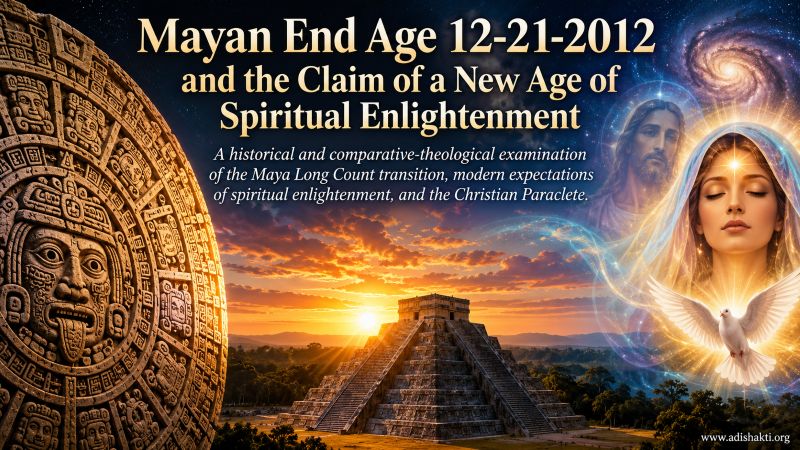
Summary
December 21, 2012 marked a major transition in the Maya Long Count calendar, not an evidenced prediction of global destruction or universal enlightenment. This study separates ancient Maya evidence, modern New Age interpretations, and the distinct theological reading of the Paraclete as the Holy Spirit or Divine Mother.
Introduction
The date 21 December 2012 became a global focal point for apocalyptic expectation and New Age transformation narratives. In the Maya Long Count, it corresponded to the completion of the thirteenth b’ak’tun—a cycle of thirteen periods of 144,000 days, totaling approximately 5,125.37 solar years. maya.nmai.si
The popular claim examined here is twofold: first, that the Maya “End Age” of 2012 heralded a new era of spiritual awakening rather than catastrophe; second, that this transition may be interpreted through the Christian figure of the Paraclete, identified by some contemporary spiritual movements with Shakti or the Divine Mother. This paper distinguishes the historical Maya evidence from later religious and New Age reinterpretations.
The Maya Calendar and 2012
The Maya Long Count recorded elapsed time from a mythic creation date, conventionally correlated with 11 August 3114 BCE. Its thirteenth b’ak’tun ended on 13.0.0.0.0 4 Ajaw 3 K’ank’in, corresponding under the widely used Goodman–Martínez–Thompson correlation to 21 December 2012; an alternative correlation places it on 23 December. maya.nmai.si
This was therefore a calendrical rollover, not the termination of the Maya system. As the Smithsonian’s Living Maya Time project states, the date marked the end of an important cycle, but there is no evidence in Maya inscriptions or other records that the ancient Maya expected a catastrophic “end.” maya.nmai.si
| Claim | Historical evidence |
|---|---|
| The Maya calendar “ended” in 2012 | The Long Count completed a 13-b’ak’tun cycle and continued into subsequent cycles. maya.nmai.si |
| The Maya predicted global destruction | No known ancient Maya inscription predicts an apocalyptic end of the world. maya.nmai.si |
| 2012 was spiritually insignificant | It was calendrically and ceremonially significant, though its precise religious meaning remains debated. dialnet.unirioja |
| 2012 prophesied universal enlightenment | This is a modern New Age interpretation, not an established ancient Maya doctrine. cambridge |
Apocalypse as “Revelation”
The term apocalypse derives from the Greek apokalypsis, meaning “unveiling” or “revelation.” In Christian usage it refers to the disclosure of hidden divine realities, especially in the Book of Revelation, rather than necessarily to physical destruction.
This distinction matters for the 2012 narrative. A “spiritual enlightenment” reading can present 2012 as an unveiling of consciousness, truth, or moral responsibility; however, that meaning is interpretive rather than a direct translation of Maya sources. The Maya inscriptions that mention the thirteenth b’ak’tun are sparse and largely ceremonial or political in context. csmonitor
Tortuguero and La Corona
Only two known Classic Maya texts clearly refer to the end of the thirteenth b’ak’tun: Tortuguero Monument 6 in Tabasco, Mexico, and a hieroglyphic stairway at La Corona, Guatemala. maya.nmai.si
Tortuguero Monument 6 includes a reference to the deity B’olon Yokte’ in connection with the date, but epigraphers have emphasized that the inscription is cryptic and does not constitute a doomsday prophecy. David Stuart and Stephen Houston later concluded that the passage likely concerns the dedication of the monument and uses the future date in a poetic or retrospective framing rather than predicting a world-ending event. nationalgeographic
The La Corona inscription likewise connects the future 13-b’ak’tun date to the political legitimacy of a seventh-century ruler. Marcello Canuto summarized the evidence as showing that the Maya used calendrical cycles to promote continuity and stability, not apocalyptic prediction. csmonitor
New Age Appropriation
The modern “2012 phenomenon” arose from a convergence of Maya calendrics, archaeoastronomy, numerology, environmental anxiety, and New Age spirituality. Scholars describe it as an astrological and cultural event rather than an astronomical one, and trace much of its popular form to late twentieth-century appropriations of Maya timekeeping. cambridge
The claim that the Sun would align with the galactic center, or cross the galactic equator, in a uniquely transformative way was central to many New Age accounts. Mainstream astronomy and Maya studies rejected these claims as unsupported; the alignment was not a precise, singular event with established Maya religious significance. cambridge
Thus, the phrase “New Age of spiritual enlightenment” should be read as a modern religious construction. It may express genuine hopes for ecological renewal, inner transformation, and ethical responsibility, but it should not be presented as an ancient Maya prophecy.
The Paraclete Question
The second part of the proposed argument asks whether the Paraclete—Greek Paraklētos, rendered “Advocate,” “Helper,” or “Comforter”—was sent in the modern period to complete, clarify, and empower the message of Jesus. The Gospel of John attributes several functions to the Paraclete: teaching and reminding believers (John 14:26), testifying to Jesus (15:26), convicting the world concerning sin, righteousness, and judgment (16:8), guiding into truth, speaking, and declaring what is to come (16:13–15).
In mainstream Christian theology, the Paraclete is the Holy Spirit, given to the church after Christ’s resurrection and at Pentecost. The Spirit’s work is understood as continuing rather than replacing Jesus’ revelation: teaching, reminding, testifying, guiding, and empowering believers.
Some Sahaja Yoga and related Devi-centered interpretations identify the Paraclete with Shakti, the Divine Mother, and with Shri Mataji Nirmala Devi. In that framework, spiritual awakening or “self-realization” is an experiential reception of divine energy that enables moral and spiritual transformation. This is a coherent theological position within its own tradition, but it is not a conclusion established by the Gospel texts alone or by Maya historical evidence.
Integrating the Two Claims
A careful academic argument can connect the Maya and Christian materials only at the level of comparative religious symbolism, not historical causation.
- Maya cyclic time: The end of a b’ak’tun signifies renewal and continuation, not final destruction. maya.nmai.si
- Christian apocalypticism: Apokalypsis signifies revelation or unveiling, not necessarily catastrophe.
- New Age synthesis: Modern interpreters combine these ideas to imagine 2012 as a threshold of collective consciousness.
- Paraclete theology: Christian and Sahaja Yoga interpretations differ on the Paraclete’s identity, timing, and mode of action.
The strongest formulation is therefore not that the Maya predicted a Paraclete-led age of enlightenment, but that both traditions offer languages of renewal: Maya cyclical time emphasizes the turning of cosmic eras, while Johannine theology emphasizes the Spirit’s ongoing guidance into truth.
Conclusion
December 21, 2012 was a real and meaningful Maya calendrical milestone, but the evidence does not show that the ancient Maya expected either the end of the world or a universal spiritual transformation. The “New Age of spiritual enlightenment” is a modern interpretive framework built upon Maya cyclical time, apocalyptic language, and contemporary spiritual aspirations.
If the Paraclete is understood as the Holy Spirit, the Christian claim concerns an ongoing divine presence that teaches, reminds, testifies, and guides believers into truth. If identified with Shakti in a Devi-centered theology, it becomes a specific religious interpretation rather than a historically verifiable Maya prophecy. An academically responsible treatment should therefore preserve the distinction between Maya historical evidence, Christian scriptural theology, and modern New Age synthesis.
References
[1] maya.nmai.si
[2] dialnet.unirioja
[3] cambridge
[4] csmonitor