
"Christian theology ... ought to rejoice at being at the frontiers of the next phase of Christian history"
"Wilfred Cantwell Smith, the famous Islamic expert, has suggested a"World theology"Instead of a particular Christian or other theology of religions. According to him, this type of theology is the only one that does justice to the new global awareness of religious pluralism. A world theology would be one"for which the 'religions' are the subject, not the object; a theology that emerges out of"All the religions of the world.'"In Smith's mind, that kind of world theology would mean not diluting Christian faith but rather transcending it, in the sense that it would become"The faith for all of us.”
What is Theology of Religions?
Theology of religions is that discipline of theological studies which
attempts to account theologically for the meaning and value of other
religions. Christian theology of religions attempts to think
theologically about what it means for Christians to live with people
of other faiths and about the relationship of Christianity with other
religions.
Recently some authors have proposed the label"Theology of religious
pluralism," as is evident in the monumental work of the Roman
Catholic Jacques Dupuis, S.J., Towards a Christian Theology of
Religious Pluralism. An earlier book by Race, Christian and Religious
Pluralism, shows the same orientation in the way he defines theology
of pluralism: "The Christian theology of religions has come to be the
name for that area of Christian studies which aims to give some
definition and shape to Christian reflection on the theological
implications of living in a religiously plural world.”The focus of
pluralism in defining the content of theology of religions is
appropriate in that it highlights the most significant challenge to
theology of religions. Nevertheless, the phrase"Theology of
religions"most probably has gained an established status as a
general title for this field of study.
A distinction should be made between theology of religion (singular)
and theology of religions (plural).
The theology of religion asks what religion is and seeks, in the
light of Christian faith, to interpret the universal religious
experience of humankind.; it further studies the relationship between
revelation and faith, faith and religion, and faith and salvation.”10
Eventually the theology of religion becomes a theology of religions,
which studies the various religious traditions from the perspective
of Christian faith and its foundational affirmation concerning Jesus
Christ. Consequently, a general theology of religions treats all
different religions as a whole, as the reality of human culture
embedded in cultures and worldviews, whereas theologies of particular
religious traditions focus on the relationship between Christianity
and a particular religion. The Christian-Jewish dialogue provides an
example. These particular theologies of religions are also called
local theologies of religions: African theology of religions, Asian
theology of religions and, for example, Indian theology of
religions.. An African theology of religions inquires into the
continuity between African traditional religions and the Christian
message. The same principle applies to an Asian or Latin American
theology.
The goal of the present book is to introduce Christian theology of
religions. In principle—even though not much work has yet been done—
there also could be a theology of religions from the perspective of
other religions, such as a Buddhist or Hindu theology of religions.
The goal of each of these theologies would be to reflect on the
meaning of other religions in relation to its own convictions and
underlying foundations. Christian theology of religions is by far the
most developed type of theology of religions.
Wilfred Cantwell Smith, the famous Islamic expert, has suggested
a"World theology"Instead of a particular Christian or other
theology of religions. According to him, this type of theology is the
only one that does justice to the new global awareness of religious
pluralism. A world theology would be one"for which the 'religions'
are the subject, not the object; a theology that emerges out of"All
the religions of the world.'"In Smith's mind, that kind of world
theology would mean not diluting Christian faith but rather
transcending it, in the sense that it would become"The faith for all
of us.”12 ...
As a separate field of study, theology of religions is a rather
recent phenomenon. It emerged first in the Catholic circles beginning
with the radical reorientation of Catholic theology as a result of
the Second Vatican Council (1962) and soon spread to Protestant
spheres as well. In the wake of these dramatic Catholic changes, the
World Council of Churches, under the leadership of Stanley Samartha
of India, published The Living Faiths and Ultimate Goals in 1974,
followed next year by Towards World Community; Resources and
Responsibilities for Living Together. Currently, theology of
religions is one of the most (if not the most) rapidly growing branch
of theological studies. Beginning in the late 1980s, there has been a
steady flow of publications that intensified at the turn of the
millennium.
Although theology of religions did not have a prominent place in
theological curriculum until the 1960s or so, some influential voices
had been speaking decades earlier. The great German liberal thinker
Ernst Troeltsch, sometimes called the"father of pluralism,"
published the essay"The Place of Christianity Among the World
Religions," and the American philosopher William Hocking wrote his
widely read Rethinking Missions a few years later, in 1932. Both of
these works argued for historical relativism and a nonexclusive
attitude toward other religions. Even earlier, in the beginning of
the century, John Farquhar, a Scottish Protestant missionary to
India, argued that Christ is The Crown of Hinduism (1913).
Even though theology of religions is a fairly new discipline in
theology, the questions it asks are not new. In the past, they were
treated as part of other theological loci. The main question is,
naturally, that of salvation: Is salvation to be found only in
Christianity, and more specifically only in the church? Is salvation
tied to the person and work of Christ? What is the lot of those who
have never heard of the Christian message? Several related questions
have also been raised as part of theological studies: Is revelation
to be fond only in Christ, or are other religions revelatory, too?
What is the relation of the Christian conception of God to other
religions' views?
A path was paved for the emergence of theology of religions from the
beginning of the twentieth century by the rise of the study of
comparative religions. Christian theologians became aware of the
nature and distinctive features and beliefs of other religions in a
new way. Implied in the emergence of Christian theology of religions
is the realization that Christian theology can no longer develop in
isolation from the opinions and views of other religions.
Consequently, an encounter with religions also contributes to the
growth of Christian self-identity. When challenged to define one's
own convictions vis-a-vis other alternatives, one always receives an
opportunity to see more clearly what is different from and similar to
other worldviews.
Alan Race comments that some now believe
that the future of Christian theology lies in the encounter between
Christianity and other faiths. If they are correct in this, then the
Christian theology of religions needs present no apologia for adding
one more specialism to the Christian theological enterprise as a
whole. Rather, it ought to rejoice at being at the frontiers of the
next phase of Christian history.13
The late theological giant Paul Tillich already saw this when, in his
last published lecture, he predicted that the future of theology lies
in the"Interpenetration of systematic theology study and religious
historical studies.”As a result, in contact with the history of
religions"every individual doctrinal statement or ritual expression
of Christianity receives a new intensity of meaning.”14
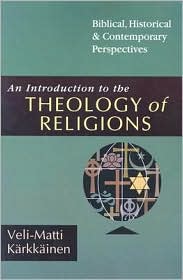
An Introduction to the Theology of Religions, pp. 20-3
Veli-Matti Karkkainen
Intervarsity Press (September 2006)
ISBN-10: 083082572X
ISBN-13: 978-0830825721
Notes:
10. Dupuis, Toward a Christian Theology, p. 7
12. Wilfred Cantwell Smith, Towards a World Theology (London;
Macmillan, 1981), pp.124-25.
13. Race, Christians and Religious Pluralism, p. xi.
14. Paul Tillich," The Significance of the History of religions for
the Systematic Theologian," in The Future of Religion (New York:
Harper & Row, 1996), p. 91

Shri Mataji Nirmala Devi “In the Puranas, in the ancient scriptures of India, Christ is described so very clearly. Actually in the Bible what they saw of Him when He was on this Earth was written down. But not in what created Him, how He came on this Earth, what is the Spirit of Christ, what is the seed of Christ, and how He came, and what was His purpose, and where does He stand within us, and all those things are not described in the Bible. As I told you the people at that time were not at all aware of His greatness or His special Incarnation. But if you read some of these ancient books you will find that He was called as Mahavishnu in the Devi Purana; in the Goddess Purana. It is [in] the ancient scriptures of the Goddess.”
The Paraclete Shri Mataji
The New Age Has Started, Houston, USA — October 6, 1981
“But in the West we still are very much attached to the nonsense of Christianity. It has nothing to do with Christ, believe Me, and this fanaticism which is lingering still in your mind must be given up, otherwise you do not do any justice to Christ. That by no chance means you take to another religion like Hinduism or any other nonsensical Jainism, or anything. The essence, the Tattwa, of Christianity is Christ. And it is so thickly clouded by all these nonsensical things that you really have to drop this word"Christianity"from your vocabulary completely, and from your mind. Otherwise you can never go to the essence. It is a fact; take it from Me.
And even now the attention of all the people is on what Christ said, or Mother Mary has said it, and which has come through these horrible people to us. So to learn about other Deities and other great Incarnations, we neutralize. We must try to neutralize too much attention by learning about other Deities, say, Shri Ganesha. If you talk about Shri Ganesha, He is the essence of Christ, and Christ is the manifestation of Shri Ganesha's Powers. So, if you go to the essence of most things, you see, that is better. Then, of course, Christ is there but we must see in Him, as He is, which very few people has seen before. But now in Sahaja Yoga you should see Him as He was. He was the Holiest of the Holy. You accept that position.”
Shri Mataji Nirmala Devi
Christmas Eve Talk, Pune, India — December 24, 1982
Disclaimer: Our material may be copied, printed and distributed by referring to this site. This site also contains copyrighted material the use of which has not always been specifically authorized by the copyright owner. We are making such material available to our readers under the education and research provisions of "fair use" in an effort to advance freedom of inquiry for a better understanding of religious, spiritual and inter-faith issues. The material on this site is distributed without profit. If you wish to use copyrighted material for purposes other than “fair use” you must request permission from the copyright owner.

