
Devi Gita

"Devi gita constitutes the last ten chapters of the seventh Skandha of the Devi Bhagavatam. In the puranas, one will find several gitas and many mahatmyas. The differences are that in the mahatmya, the glorification of the deity is by recounting the various deeds of the God and offering praise to the divinity. A gita, on the other hand, is a direct revelation of the truth from the disciple, which often includes the manifestation of the cosmic form. While mahatymas emphasize bhakti, gita stresses a balance of bhakti and jnana.
Specifically, we are interested in discussing the Devi gita. To avoid any confusion and also be aware, there are two other devi gitas. The first of which is found in the Kurma purana. This is a conversation with Parvati and Himavan, introduced by Lord Vishnu as Kurma. Goddess Parvati is praised here by 1008 names and She grants him two cosmic visions and instructs him. The other devi gita is found in the Mahabhagavata purana, which actually refers to the conversation of Parvati and Himavan as Parvati Gita. The narrator of this section of the Mahabhagavata Purana is Lord Shiva. However, by Devi gita, we refer only to the gita found in the Devi Bhagavatam.
Setting
The setting of the Devi gita is introduced by Janamejaya's query to Vyasa regarding the supreme light who became manifest on top of the Himalaya mountain. Vyasa talks about the demon Taraka, who has obtained a boon that he can be killed only the son of Lord Shiva, knowing fully well that Sati has immolated herself. Therefore, the gods became scared and went to Himalayas and worshipped Her asking to born and marry Lord Shiva. Shakti then appears before them and grants them a boon that her manifestation will be born as Gauri as the daughter of Himavan. Himalaya becomes choked with emotion when he hears that She, whose belly contains millions of universes, is about to become his daughter. He requests as follows, "Proclaim to me your nature, and declare that yoga conjoined with bhakti and that jnana in accord shruti whereby you and I become one.”
This sets the scene for Devi Gita and the teachings.
Brief summary
In the Devi gita, following Himalayas request, the Devi proceeds to describe her essential forms. The Devi declares that prior to creation, She is the only existent entity, the one supreme Brahman and is pure consciousness. Then She outlines the basic evolution of the causal, subtle and gross bodies of the supreme Self when enjoined with maya. The treatment here is very similar to that of Vedantasara and Panchadasi, but in much more simpler terms than the latter. Then She reveals Her forms (both the frightful and pleasing) to the gods and Himalaya. Then follows a detailed summary of the yoga, the stages of bhakti and the ways to attain Her.
Simplicity and Profoundness
Devi gita is both simple and profound. It is different from other gitas in the respect that statements are clear and can not be reinterpreted according to one's taste. For example, several commentaries have been written on the Bhagavad Gita of Krishna, wherein each commentator feels differently regarding bhakti and jnana. For example, it required Madhusudana Saraswati to explain krama mukti in clear terms (though Shankara mentions it also) of bhakti. But Devi Gita is clear"Even when a person performs bhakti, knowledge need not arise. He will go to the Devi's Island (similar to Brahmaloka). Till the complete knowledge in the form of my consciousness arises, there is no liberation.”Similarly, the words of"coming" "going" "Becoming"cause confusion since one can not"become"Brahman, if one is already one. The Devi Gita provides a clear explanation that all these terms are applicable only as long as one in maya. It is the clarity of these terms and the simple explanation of complex vedantic and philosophical questions that makes Devi Gita unique.”
Giridhar
http://groups.yahoo.com/group/ambaa-l/message/71
Retrieved March 11, 2013
Knowledge of Devi that Liberates
"Both gitas (Devi Gita and Kapila Gita of the Bhagvata Purana) also describe four grades of devotion according to the qualities (gunas) of nature, a classification scheme derived from the Bhagavad Gita. According to the Devi Gita, the first two grades, rooted in ignorance (tamas) and passion (rajas), are practiced by those intending harm to others and seeking their own well-being, respectively. The third grade, arising from virtue (sattva), the highest of the three qualities, is performed by those who surrender the fruits of their actions to the Goddess out of a sense of duty and in spirit of loving service. Such devotion is not supreme for it still clings to false distinctions, but it does lead to the highest devotion beyond all the qualities.
The supreme devotion is described in quite paradoxical terms. On the one hand, it is characterized by total detachment, an absence of any sense of difference between oneself and others including the Goddess, and realization of the universality of pure consciousness. On the other hand, it is typified by a sense of oneself as a servant and the Devi as master, an eagerness to participate in pilgrimages to her sacred sites, and a zeal to perform her ritual worship without regard to cost. Especially paradoxical is the tension between the detached devotion associated with the knowledge of the unity of all being, and the ecstatic passion, accompanied by tears of joy and faltering voice, manifest in worshipping the Goddess while singing her names and dancing in enraptured self-abandonment. Again, while the supreme devotion is characterized by indifference to all forms of liberation, including mergence into the Devi, nonetheless, so the Goddess declares, the fruit of such devotion is dissolution into her essential nature. Such paradoxes reflect in many ways the long-standing tension in the Hindu tradition between the ideal of devotion, with its goal of loving service, and the ideal of knowledge, with its goal of realizing absolute oneness.
Formally, the Devi Gita resolves the tension by insisting that knowledge of the Goddess is the final goal of devotion, as well as of dispassion. Devotion without knowledge will lead to the heavenly paradise of the Goddess, the Jeweled Island, but no further. Dwelling in the Jeweled Island, however, inevitably leads to liberating knowledge of the pure consciousness that is the Goddess. Dispassion without knowledge, incidentally, leads only to a virtuous birth. The Devi insists that liberating knowledge can be attained here in this world, while still living. Seeking such knowledge alone makes life worthwhile, and the attainment of knowledge completely fulfils the ultimate purpose of existence.”
The Song of the Goddess: The Devi Gita: Spiritual Counsel Of The Great Goddess,
C. Mackenzie Brown, State University of N.Y. Press, 2002, pg. 23-5
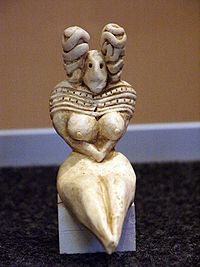
The roots of Shaktism: a Harappan
goddess figurine, c. 3000 BCE.
(Musee Guimet, Paris) "Shaktism focuses worship upon the Hindu Divine Mother, here represented[clarification needed] as (foreground) Lajja Gauri or Aditi, the original Mother of the Cosmos, and (background) as the mystical yantra known as Sri Meru. Shaktism (Sanskrit: lit., 'doctrine of power' or 'doctrine of the Goddess') is a denomination of Hinduism that focuses worship upon Shakti or Devi — the Hindu Divine Mother — as the absolute, ultimate Godhead. It is, along with Shaivism and Vaisnavism, one of the primary schools of devotional Hinduism.
Shaktism regards Devi (lit., 'the Goddess') as the Supreme Brahman itself, the"one without a second", with all other forms of divinity, female or male, considered to be merely her diverse manifestations. In the details of its philosophy and practice, Shaktism resembles Shaivism. However, Shaktas (Sanskrit: Sakta), practitioners of Shaktism, focus most or all worship on Shakti, as the dynamic feminine aspect of the Supreme Divine. Shiva, the masculine aspect of divinity, is considered solely transcendent, and his worship is usually relegated to an auxiliary role.
The roots of Shaktism penetrate deep into India's prehistory. From the Goddess's earliest known appearance in Indian paleolithic settlements more than 22,000 years ago, through the refinement of her cult in the Indus Valley Civilization, her partial eclipse during the Vedic period, and her subsequent resurfacing and expansion in the classical Sanskrit tradition, it has been suggested that, in many ways, "The history of the Hindu tradition can be seen as a reemergence of the feminine.”
Over the course of its history, Shaktism has inspired great works of Sanskrit literature and Hindu philosophy, and it continues to strongly influence popular Hinduism today. Shaktism is practiced throughout the Indian subcontinent and beyond, in numerous forms, both Tantric and non-Tantric; however, its two largest and most visible schools are the Srikula (lit., family of Sri), strongest in South India, and the Kalikula (family of Kali), which prevails in northern and eastern India.
Wikipedia
Web (March 11, 2013)
Disclaimer: Our material may be copied, printed and distributed by referring to this site. This site also contains copyrighted material the use of which has not always been specifically authorized by the copyright owner. We are making such material available to our readers under the education and research provisions of "fair use" in an effort to advance freedom of inquiry for a better understanding of religious, spiritual and inter-faith issues. The material on this site is distributed without profit. If you wish to use copyrighted material for purposes other than “fair use” you must request permission from the copyright owner.

