"Grammatical nonsense but evidence of the theological desire to defeminize the Divine." - Lucy Reid

She Changes Everything, Lucy Reid
"Rooted in the Hebrew Scriptures and flourishing in a patriarchal culture, Christianity developed its own negative attitudes towards women and the old religion of the Goddess. At times subtle, at other times brutal, the movement was away from partnership and towards hierarchy, from feminine images of the Divine to strictly masculine ones. Despite Jesus' radical inclusion of women as friends and disciples and his refusal to treat them as second-rate, sinfully sexual, or stupid, his followers quickly established as orthodox an all-male priesthood, a masculine Trinity, and a theologically expressed aversion to women...

And in Syria, where for four hundred years the word Holy Spirit was ruha, a feminine word derived from the Hebrew ruach, and where the Holy Spirit was described as Mother, complementing the parental imagery of Father and Son in the Trinity, the association of feminine language with heresy led authors to assign masculine gender to the word—grammatical nonsense but evidence of the theological desire to defeminize the Divine."

Lucy Reid, She Changes Everything
Continuum, 2005, pages 32-33
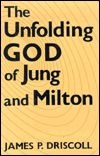

The unfolding God of Jung and Milton, James P. Driscoll
“Fortunately, contemporary feminist scholarship provides a way to resolve Jung’s difficulties and simultaneously deepen his basic insights. The feminine Wisdom or Shekinah the Old Testament says was with God from the beginning, feminist scholars point out, functions like the Holy Spirit or Paraclete of the New Testament, shares its symbolism of the dove, and is specifically referred to as God’s ‘holy spirit from above’ in Wisdom 9:17-18.

Neglecting the similarity of Wisdom to the Paraclete did not of course begin with Jung. It began with those early Christians who sought to give intellectual respectability to Hebraic-Christian myth by reformulating it in terms of Hellenistic philosophy. The actual denigration of Wisdom, however, commenced before Christianity with Philo-Judaeus and other Alexandrian thinkers who, bowing to the era’s intellectual fashions, concluded that feminine attributes lessened God. God’s dignity, these philosophers insisted, required him to be all male no less than all good and powerful.

Anxious to protect the masculinity of their God, the church fathers declined to meld the Judaic wisdom figure with its natural successor, the Paraclete, which would have made one member of the Godhead feminine.”

James P. Driscoll, The unfolding God of Jung and Milton
University Press of Kentucky, 1992, page 88

Note: If by "gender" is meant grammatical gender, the gender of "Holy Spirit" varies according to the language used. Thus the grammatical gender of the word "Spirit" is masculine in Latin (Spiritus) and in Latin-derived languages such as English (Spirit) or German (Geist). In the Semitic languages such as Hebrew (Ruah), Arabic (Ruh, Rooh, Ruh-ul-Qudus), Aramaic (Ruha, Ruho) and its descendant Syriac (Ruha), it is feminine. In Greek it is neuter (Pneuma). When grammatical gender in a particular language is confused with physical gender, the Holy Spirit is thought of, within that language, as male, female or neither.


THE APOCALYPSE OF THE SPIRIT-PARACLETE
Fulfillment of the promised divine eschatological instruction

Stephen E. Witmer, Divine instruction in Early Christianity  
F. B. Meyer, Love to the Utmost Robert Kysar, John, the Maverick Gospel 
Danny Mahar, Aramaic Made EZ Lucy Reid, She Changes Everything
David Fleer, Preaching John's Gospel: The World It Imagines Berard L. Marthaler, The Creed: The Apostolic Faith in Contemporary Theology
George Ladd, A Theology of the New Testament In Spirit and Truth, Benny Thettayil
Jesus and His Own: A Commentary on John 13-17 Marianne Meye Thompson, The God of the Gospel of John
Eric Eve, The Jewish Context of Jesus' Miracles D. R. Sadananda, The Johannine Exegesis of God: an exploration into the Johannine understanding of God
Michael Welker, God the Spirit Georg Strecker, Theology of the New Testament
Tricia Gates Brown, Spirit in the writings of John Michael Welker, The work of the Spirit: pneumatology and Pentecostalism
Robert Kysar, Voyages with John: Charting the Fourth Gospel John F. Moloney, The Gospel of John
Harvey Cox, The Future of Faith Robert Kysar, John
Robert E. Picirilli, The Randall House Bible Commentary George Ladd, A Theology of the New Testament 
"It's better to tell you after Realization that I am the Holy Ghost – no doubt. I am the one about which Christ has talked."

The Paraclete Shri Mataji


"The teaching of the Paraclete, as the continuation of Jesus’ teaching, must also be understood as the fulfillment of the promise of eschatological divine instruction" Stephen E. Witmer, Divine instruction in Early Christianity

"Jesus therefore predicts that God will later send a human being to Earth to take up the role defined by John .i.e. to be a prophet who hears God’s words and repeats his message to man."
M. Bucaille, The Bible, the Qur'an, and Science

"And when Jesus foreannounced another Comforter, He must have intended a Person as distinct and helpful as He had been."
F. B. Meyer, Love to the Utmost

"The Paraclete has a twofold function: to communicate Christ to believers and, to put the world on trial"
Robert Kysar, John The Meverick Gospel

"But She—the Spirit, the Paraclete...—will teach you everything."
Danny Mahar, Aramaic Made EZ)

"Grammatical nonsense but evidence of the theological desire to defeminize the Divine."
Lucy Reid, She Changes Everything

"The functions of the Paraclete spelled out in verses 13-15... are all acts of open and bold speaking in the highest degree."
David Fleer, Preaching John's Gospel: The World It Imagines

"The reaction of the world to the Paraclete will be much the same as the world’s reaction was to Jesus."
Berard L. Marthaler, The Creed: The Apostolic Faith in Contemporary Theology

Bultmann calls the "coming of the Redeemer an 'eschatological event,' 'the turning-point of the ages."
G. Ladd, A Theology of the New Testament

"The Paraclete equated with the Holy Spirit, is the only mediator of the word of the exalted Christ."
(M.E. Boring) Benny Thettayil, In Spirit and Truth

"The divine Paraclete, and no lessor agency, must show the world how wrong it was about him who was in the right."
Daniel B. Stevick , Jesus and His Own: A Commentary on John 13-17

Stephen Smalley asserts that "the Spirit-Paraclete ... in John’s Gospel is understood as personal, indeed, as a person."
Marianne Meye Thompson, The God of the Gospel of John

"The Messiah will come and the great age of salvation will dawn (for the pious)"
Eric Eve, The Jewish context of Jesus' Miracles

"The remembrance is to relive and re-enact the Christ event, to bring about new eschatological decision in time and space."
Daniel Rathnakara Sadananda, The Johannine Exegesis of God

"The Spirit acts in such an international situation as the revealer of 'judgment' on the powers that rule the world."
Michael Welker, God the Spirit

The Paraclete's "appearance means that sin, righteousness, and judgment will be revealed."
Georg Strecker, Theology of the New Testament

"While the Spirit-Paraclete is the true broker, the brokers they rely on are impostors."
T. G. Brown, Spirit in the writings of John

"The pneumatological activity ... of the Paraclete ... may most helpfully be considered in terms of the salvific working of the hidden Spirit."
Michael Welker, The work of the Spirit

"The pneuma is the peculiar power by which the word becomes the words of eternal life."
Robert Kysar, Voyages with John: Charting the Fourth Gospel

"The gift of peace, therefore, is intimately associated with the gift of the Spirit-Paraclete"
Francis J. Moloney, The Gospel of John

"This utopian hope, even when modestly expressed, links Jesus and the prophets to a much wider history of human longing."
Harvey Cox, The Future of Faith

"Because of the presence of the Paraclete in the life of the believer, the blessings of the end-times—the eschaton—are already present"
Robert Kysar, John

"They are going, by the Holy Spirit’s power, to be part of the greatest miracle of all, bringing men to salvation."
Robert E. Picirilli, The Randall House Bible Commentary

"The Kingdom of God stands as a comprehensive term for all that the messianic salvation included... is something to be sought here and now (Mt. 6:33) and to be received as children receive a gift (Mk. 10:15 = Lk. 18:16-17)."
G. Ladd, A Theology of the New Testament


NOTE: If this page was accessed during a web search you may wish to browse www.adishakti.org/ where this topic or related issues are discussed in detail to promote global peace, religious harmony, and spiritual development of humanity:

Disclaimer: Our material may be copied, printed and distributed by referring to this site. This site also contains copyrighted material the use of which has not always been specifically authorized by the copyright owner. We are making such material available to our readers under the education and research provisions of "fair use" in an effort to advance freedom of inquiry for a better understanding of religious, spiritual and inter-faith issues. The material on this site is distributed without profit. If you wish to use copyrighted material for purposes other than "fair use" you must request permission from the copyright owner.


search www.adishakti.org