
The Mysteries of the Kingdom
"People have been led astray and polluted with the foolish 'wisdom' of the world (Judas 8:7), because the rulers of chaos and oblivion 'lord it over them.' They've come to believe that this life of the flesh, our present life in this world, is all that really exists. When they try to imagine eternal life, they imagine it only as living on forever in the flesh, just as Justin, Irenaeus, and Tertullian say. But Jesus insists they are wrong. Although the 'Gospel of Judas', like the New Testament gospels, says that Jesus' teaching offers a path to eternal life, the key to that path is not what happens to the physical body; it is understanding humanity's spiritual connection to God. Those who understand the deeper secrets of creation, aware that they are created 'in the image' of the divine source, may come to dwell above in the realm of the Spirit.”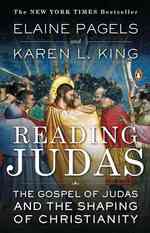
“Lost for 1,600 years, the Gospel of Judas was discovered in Egypt in the 1970's.
Nearly thirty years later, when it reached scholars who could unlock its
meaning, it was clear this was a major discovery. The Gospel of Judas alters our
understanding of how early Christians viewed Jesus' death, why Judas 'betrayed'
Jesus, and why God allowed it.
'Reading Judas' explores the meanings of the Gospel, unpacking its startling
claim that not only did Jesus 'sk' Judas to betray him, but also Judas did not
commit suicide; instead, he was killed by the other disciples. Far from seeing
Jesus' death as a sacrifice for sins, this Gospel opposes Christian leaders who
claimed that God desired Jesus' death and the death of Christian martyrs.
Instead Jesus' teaching points toward a spiritual understanding of our relation
to God as freedom from the powers that rule the world.
Encompassing the serious questions of Christianity (Why do we suffer? Can women
be leaders? How did early Christians find meaning in Jesus' death?), 'Reading
Judas' throws open the world of the early Christians and shows that there are
many interpretations of the Christian faith. It lets us see afresh this
diversity of viewpoint even within the New Testament itself.”
Reading Judas - The Gospel of Judas and the Shaping of Christianity,
Elaine Pagels and Karen L. King
Penguin Group — London, England
ISBN 978-0-713-99984-6
The Mysteries of the Kingdom — Chapter Four
P.77)"The 'Gospel of Judas' does not stop with condemning erroneous views about God and sacrifice, or practices of eucharist and baptism. On the contrary, such criticism of mistaken church leaders marks only its beginning. From this point, this gospel goes on to show 'divine mysteries' revealed only to Judas — about God, about Jesus and the divine source whence he comes, and about how he — and the disciple who follows him — may enter that spiritual reality.
Jesus teaches Judas that at death, the bodies of all human beings will perish — there is no resurrection of the flesh. Only the souls of the great and holy race will be lifted up when their spirits separate from them (Judas 8:3-4). At the beginning Judas does not really understand, for when he has a dream, Jesus laughs at him, a clear indication that Judas has made some error. But rather than dismissing Judas, Jesus promises to support him. He encourages Judas to speak about his distress when he dreamed that 'the twelve' disciples were stoning and persecuting him. But Judas also had a vision of the heavenly Temple — a glorious vision of a great house filled with brilliant light, and, high above, dense green foliage (Judas 9:9-12). (P.78) People would immediately recognize this as the infinite light in which God dwells — the house of God. That, of course, is what Jews called the Jerusalem Temple; but what Judas sees - in stark contrast to 'the twelve's' dream about bloody sacrifice in the earthly Temple — is the spiritual reality beyond this world, the divine reality that Israel's prophets often described simply as 'light', the glory of God's presence, at which humanly built 'houses of God', from the Jerusalem Temple to the cathedral at Chartres, can only hint.
But when Judas asks to go there and join the distinguished elders who surround the divine presence, Jesus rebukes him: "Your star is leading you astray, Judas" (Judas 9:15). This shows that although only Judas, of 'the twelve,' caught a glimpse of what Jesus meant when he began to speak to them about the mysteries that are beyond the world — for Judas alone perceived that Jesus came from the immortal realm above (Judas 2:22-23) — he still has not fully understood what Jesus is trying to tell him. No mortal is worthy to go there, Jesus insists, because that place is reserved for the holy ones — that is, for people who are no longer subject to the sun and moon and the other angels who rule over the realm of chaos. So even though Jesus has already told Judas that he is able to reach the immortal realm (Judas 2:27), the disciple still doesn't understand fully Jesus' most central teaching — that for human beings to gain eternal life, they have to perceive the deeper vision of God that emerges from within. That is why Jesus began by challenging the disciples 'to bring forth the perfect human.' (P.79) Those who do so discover that they have within them spiritual resources of which they were unaware.
For in the process of bringing forth the perfect human, one becomes aware of the deeper meaning of the 'Genesis' account, which tells how God created humankind:
Then God said," Let us make humankind in our image, according to our likeness...”So God created humankind in his image, in the image of God he created them; male and female he created them" (Genesis 1:26-27).
If human beings are created in the image of the divine, why is this image so hard to perceive and why does it take such courage to discover? Here Jesus goes on to explain that creation 'in the image' refers to our original, spiritual nature, hidden deep within what we seem to be as ordinary men and women. It is that original quality of human being that was created in the image of a spiritual being called Adamas, who dwells in the light, where the true God dwells, hidden even from the angels (Judas 11:1-2). The human Eve, too, is created after the image of the heavenly race — because, like Adamas, Eve is also a heavenly being — and it is she who most deeply represents humanity's spiritual nature. For within the luminous cloud of light where Adamas dwells on high there also dwelt Eve. In Greek her name ("Zoe") means 'Life,' drawing on the wordplay found in Hebrew, in which 'Eve' means 'life,' as the 'Genesis' account shows: "The man called his wife's name Eve, because she was The Mother of all living" (Genesis 3:20). (P.80) Here Jesus teaches that 'the whole race' of humans should seek eternal life 'in her name' (Judas 13:2-4). What this means for human beings now is that those who come to recognize their true nature are children of these 'spiritual' parents — not children like Cain and Abel, enmeshed in the story of the first murder, but children who resemble the lesser-known one, Seth, whom 'Genesis' says Eve bore to Adam as their third son:
When God created humankind, he made them in the likeness of God ... When Adam had lived one hundred thirty years, he became the father of a son in his likeness, according to his image, and named him Seth (Genesis 5:1,3)
All humanity, then, belongs to 'the incorruptible race of Seth' (Judas 11:5), since everyone is a child of Adam and Eve, created according to the likeness and the image of God.
Why, then, does Jesus speak of 'two' kinds of human races? Why is it that not everyone automatically understands the spiritual nature? To help Judas understand, Jesus tells him that Saklas was the one who decreed that human beings should only live for a short time and then perish. People have been led astray and polluted with the foolish 'wisdom' of the world (Judas 8:7), because the rulers of chaos and oblivion 'lord it over them.' They've come to believe that this life of the flesh, our present life in this world, is all that really exists. (P.81) When they try to imagine eternal life, they imagine it only as living on forever in the flesh, just as Justin, Irenaeus, and Tertullian say. But Jesus insists they are wrong. Although the 'Gospel of Judas', like the New Testament gospels, says that Jesus' teaching offers a path to eternal life, the key to that path is not what happens to the physical body; it is understanding humanity's spiritual connection to God. Those who understand the deeper secrets of creation, aware that they are created 'in the image' of the divine source, may come to dwell above in the realm of the Spirit.
Jesus explains to Judas that God did not abandon humanity to the lower angels but made sure that Adam and those with him learned that the image of God they carry deep within makes them superior to the rulers of chaos (Judas 13:16-17). Judas is astonished when he hears this. At first he can't believe it is true, but gradually he comes to understand what it means. Jesus explains that because everyone received a divine spirit, everyone can worship God truly. Those who do so free themselves from the power of the lower angels, so that when their physical bodies die, their souls — now joined with spirits of the great and holy race above — ascend to the heavenly realm above (Judas 8:2-4; 9:22; 13:12-15). Judas finally understands Jesus' teaching, so that this time he does not turn his eyes away, but he lifts up his eyes so that he sees the cloud of light, and he enters into it (Judas 15:15-19).
Yet the 'Gospel of Judas', like the New Testament gospels, shows that Jesus' teaching is not limited to words; he also teaches through what he does. (P.82) What he reveals is not complete when he finishes speaking — but only when he dies. His death demonstrates that the death of the body is not the end of life, but only a step into the infinite.
But does the 'Gospel of Judas' then, teach resurrection — a term it never mentions? The answer depends on what 'resurrection' is taken to mean. For here, as in the case of the crucifixion, Judas's author plunged into controversial discussions that engaged believers of his time, a question that still troubles many today: What happened after Jesus died?
That Jesus 'rose from the grave' to new life is a fundamental theme of Christian teaching; certainly it is the most radical. For even though most people believed in eternal life, the insistence of certain Christians like Irenaeus that their bodies would be buried, decompose — and yet rise again at the appointed time — was met not only with disbelief but with horror. [1] Christians themselves were unclear about what kind of body this resurrected body would be. When Paul wrote about the resurrection, although his words are often mistaken as arguing for physical resurrection, he himself clearly says the opposite: "What I am saying, brothers and sisters, is this: flesh and blood cannot inherit the kingdom of God, nor does the perishable inherit the imperishable" (1 Corinthians 15:50). Without claiming to understand exactly what happens, Paul acknowledges that resurrection is a mystery, in which, he says, 'we will all be changed' from physical to spiritual existence (1 Corinthians 15:51:53). (P.83) Accounts in other New Testament writings give different accounts of Jesus' resurrection, since what mattered most to these writers was their conviction that Jesus was somehow still alive, and not to specify any particular way this may have happened. Thus the gospels include a wide range of stories about people who claimed to have seen Jesus alive after he died. Some suggest that they saw him in a vision. When, for example, Stephen is being stoned, he gazes into heaven and sees Jesus at the right hand of God (Acts 7:55-56). Others are ambiguous. For example, the disciples on the road to Emmaus didn't recognize Jesus for hours, and when they did he 'vanished,' leaving them with the conviction that somehow — spiritually — he was still alive (Luke 24:13-31). In the 'Gospel of John', Mary of Magdala is the first to encounter the risen Lord, but she initially mistakes him for the gardener; the disciples out fishing don't at first recognize him either (John 20:15; 21:4). How could such intimates not recognize him? Yet others claimed not only that they had seen him but that they had touched and felt his body, raised out of the grave back to life. Those who told such stories insisted that his resurrection was an actual physical event. The 'Gospel of 'Matthew', for example, says that the disciples take hold of Jesus' feet (Matthew 28:9). One story in the 'Gospel of Luke' tells that when the disciples saw Jesus, they were astonished and terrified, naturally assuming that they were seeing a spirit. But, they said, Jesus challenged them: "Touch me and see; for a ghost does not have flesh and bones as you see that I have.” Since they still did not believe he was physically present, he asked for something to eat, and as they watched in amazement, he ate a piece of broiled fish. (P.84) The point is clear: No spirit could do that (Luke 24:37-43). But even in these cases, it is an unusual physicality, for Jesus seemingly walks through solid walls and locked doors and asks not to be touched (John 20:17-19).
Concerned to show that Jesus was somehow alive, as we have seen, the gospel writers included the various reports they had heard, without creating a single coherent narrative. But the stories they told raised questions among readers who asked what 'resurrection' actually meant. From the late first century through the second, as Christians discussed this question, certain leaders insisted on one single version, declaring that Christians 'must' believe that Jesus rose bodily from the dead — what they called 'the resurrection of the flesh.'[2]
Christians who deny this, Ignatius wrote, make Jesus' death into a sham. 'it's really 'they' who are a sham!' he exclaimed. Jesus was really crucified and died, and was really raised from the dead — otherwise, he insists, I would be dying to no purpose (Ignatius Trallians 9-10). His own sacrificial death, like Jesus' death on the cross, is no spiritual metaphor but the reality of painful torture and dying. For those facing the possibility of martyrdom, views like those in the 'Gospel of Judas' or the 'pocalypse of Peter' made no sense of their suffering — or Jesus' death. It clearly offended their sense of justice. Irenaeus insists that since suffering occurs in the body, the righteous should be rewarded in the body. Otherwise why does God allow his beloved children to suffer so? [3]
(P. 85) It is this kind of thinking that the author of the apocalypse of Peter' challenges. If God will grant us mercy only if we suffer, what kind of God is this? Such leaders are wrong, he claims, to teach 'the little ones' that 'good and evil are from one source'— the one God ('Apocalypse of Peter' 77:30-32). Instead he insists that Jesus came to free people from slavery and suffering, and to forgive the sins they had committed in error ('Apocalypse of Peter' 78:8-15).
What meaning, then, does Jesus' death have? Jesus shows Peter that he should not fear death, because what dies is only the mortal body, not the living spirit. To show him this, Peter is given a vision of Jesus' passion to prepare him to face his own suffering and death. The Savior reveals to Peter that if he perceives the crucifixion not with his physical ears and eyes but with spiritual apprehension, he will be able to perceive the truth. The one into whose hands and feet they drive the nails is only the fleshly part; the living Jesus is untouched by this suffering and death ('Apocalypse of Peter' 81:4-24). [4] Peter expresses astonishment, for in a kind of double vision, he seems to see one person being seized and nailed to the cross while another, joyful and laughing, stands nearby. When Peter asks Jesus what this means, Jesus explains that when the body suffers mortal agony, it releases 'the Spirit filled with radiant light' (83:9-10). Human beings are not saved by dying as martyrs but only by accepting God's forgiveness and standing fast against those who teach error and violence.
(P.86) Why do other Christians not see this? The author of the 'Gospel of Judas' suggests that it is because they believe in the resurrection of the flesh. Yet Christians like this author, while rejecting the idea of bodily resurrection, do not reject life after death. On the contrary, they suggest other ways of envisioning what that life might be. The 'Gospel of Philip', for example, calls belief in resurrection of the flesh the 'faith of fools.' Resurrection, this gospel claims, far from being a single historical event in the past, refers instead to the way that Christ's presence can be experienced here and now. Thus, those who are 'born again' in baptism, symbolically speaking, also are 'raised from the dead' when they awaken to spiritual life. Another anonymous Christian teacher, asked by a student named Rheginos to explain resurrection, wrote in reply an interpretation of what Paul had taught. Although resurrection does not involve the physical body, the teacher tells Rheginos, it is indeed a reality:
...do not think the resurrection is an illusion. It is no illusion, but it is the truth! Indeed, it is more fitting to say the world is an illusion, rather than the resurrection, which has come into being through our Lord the Savior, Jesus Christ ('Treatise on the Resurrection' 48:10-19).
Struggling to speak, as Paul had, of 'mystery,' this teacher suggests that resurrection is 'the revelation of what is, and the transformation of things, and a transition into newness.' (P.87) Yet descriptions like these, he acknowledges, are only 'the symbols and the images of resurrection'; Christ alone, he says, brings us into its reality ('Treatise on the Resurrection' 48:30-49:9).
We noted before that the 'Testimony of Truth' deplores Christians foolish enough to believe that if they die as martyrs, they are guaranteed salvation, thinking, the author says, that '(i)f we deliver ourselves over to death for the sake of (Christ's) name we will be saved.' But while imagining, as Justin did, that they would be resurrected and rewarded as Jesus had been, the author of the 'Gospel of Judas' insists that they are only precipitating themselves into violent death.
Yet the second-century Christians who wrote such 'revelations' recognised that they, too, were living at a time when Christians were often killed for their faith. Even those who refused to glorify martyrdom, or even admit it is 'God's will', recognized that they also lived under constant threat of arrest, torture, and execution at the hands of Roman magistrates. Those who put aside the idea that Jesus died as a necessary sacrifice for sin or that martyrs will be resurrected were still left, after all, with questions these teachings were meant to solve: How can one deal with suffering? What kind of meaning can be found — if any — in Jesus' suffering and death, or that of anyone else, including our own? Two writings found in the Tchacos Codex [5] — the same ancient book that contains the 'Gospel of Judas' — offer clear answers. Both the 'First Apocalypse of James' and the 'Letter of Peter to Philip' imagine scenes in which various apostles face imminent — and violent — death. (P.88) Jesus gives them 'revelations' about his own suffering and death that explain why they, too, must suffer and die.
The author of the 'First Apocalypse of James', for example, writes about Jesus speaking with James, telling him that just as he himself will be captured and killed, so will James be stoned. The story reports that James 'was afraid, and wept; and he was very distressed.' As he and Jesus sit down together upon a rock, Jesus proceeds to tell him what to do, and how to face the powers that threaten his life. As in the 'Gospel of Judas', Jesus reveals to him that he comes from a divine source, to which he will return. The Savior returns after the resurrection and reassures James that"[n]ever have I suffered in any way, nor have I been distressed. And this people has done me no harm.”[6] Like in the 'Gospel of Judas', Jesus' death in the 'First Apocalypse of James' is meant to free people from the power of the lower-world rulers. Your death, Jesus tells James, will deliver you from them. [7] He allows the crucifixion in order to expose the world rulers, for when they try to seize him, he overpowers them — proving that they are powerless as well as wicked. [8] When James learns that death only means giving back 'the weak flesh,' he wipes away his tears and is comforted. Like Judas, James too must suffer and die, but both learn from Jesus' example that death releases the fetters that bind them to the unjust rulers.
Similarly, the 'Letter of Peter to Philip' tells how the disciples gathered together on the Mount of Olives, where they prayed to Jesus, 'Son of life, Son of immortality, who is in the light, Son, Christ of immortality, our Redeemer, give us power, for they seek to kill us' ('Letter of Peter to Philip' 134:2-9). (P.89) Out of a great light shining across the mountain the voice of Jesus tells them that it is necessary for them to preach salvation to the world, but that when they do, they will suffer, because the powers that rule the world are against them. You 'are fighting against the inner man,' he tells them, but the Father 'will help you as he has helped you by sending me'— stressing that death is only that of the fleshly body, not of the spirit. [9] They are comforted when he assures them that they need not be afraid, because 'I am with you forever.' In the end, Peter acknowledges that the Lord Jesus 'is the author of our life,' and they all go out filled with power, in peace, to preach and heal. For these Christians, the fact that Jesus had suffered and died meant that he knew what they were facing — and promised to be with them.
All three of these works from the Tchacos Codex, including the 'Gospel of Judas', stress that anyone who sets out on the spiritual path and criticizes the ignorant and wicked powers that rule the world will be persecuted and will suffer — as Jesus repeatedly tells Judas. When Judas asks what good this will do him, Jesus tells him that although people will curse him, in the end he will rule over them all when he turns upward to the holy race (Judas 9:26-30). The more Judas understands, the more he realizes that he will be cursed and reviled in this world for doing what Jesus orders him to do. Yet as the 'First Apocalypse of James' and the 'Letter of Peter to Philip' show, Jesus' disciples are called to teach and heal, and so stand against the powers of the world — both those fallen angels in the heavens and the people who act like them, killing Jesus and stoning Judas. [10] (P.90) Finally, although the 'Gospel of Judas' does not encourage martyrdom, ironically — or better, paradoxically — it portrays Judas himself as the first martyr. This gospel reveals that when Judas hands Jesus over, he seals his own fate. But he knows, too, that when the other disciples stone him, they kill only his mortal self. His spirit-filled soul has already found its home in the light world above. Although Christians may suffer and die when they oppose the powers of evil, the hope Christ brings will sustain them. These revelations offer courage and comfort to anyone who anticipates suffering and death — and so to everyone.
But how can such a gospel be 'good news' — since that is what 'gospel' means? The author of the 'Gospel of Judas' implies that everyone has the power to surpass the angelic powers, because, as Jesus teaches Judas, it is only people themselves who keep the spirit confined within the flesh (Judas 13:14-15). By seeking the spirit within themselves, they can overcome the rulers of chaos and oblivion, see God, and enter the heavenly house of God above. And they can do this even as they live in this world. Just as both Jesus and Judas enter the luminous cloud while living on earth, so those who follow them may lead the life of the spirit and know God here and now. The body cannot confine the knowing spirit any more than can death, which is but the final release to God. (P.91) Just as every life seems to end in the tragedy of death, the 'Gospel of Judas' ends as Judas hands Jesus over to the enemies who will kill him. As this gospel tells it, Judas knows that doing so — even at Jesus' request — will lead the other disciples to hate him and stone him to death. What makes this"good news", however, is what he has discovered through Jesus' teaching and his death: that what dies is only his mortal self, and that his soul, filled with the spirit, already recognizes its home in God. In seeking a vision of God within, the 'Gospel of Judas' takes its place alongside a wide variety of new discoveries from Egypt, written to transmit what they thought Jesus actually taught. Some took their initial inspiration from the 'Gospel of John'. The 'Secret Revelation of John', for example, claims to reveal 'mysteries' that the Savior gave to 'John, his disciple ... the brother of James, the sons of Zebedee' ('Secret Revelation of John' II.1:2-3). [11] This tells how John, grieving for Jesus, went to the Temple to worship. But after a Pharisee mocked him for allowing Jesus to deceive him and turn him away from the traditional Jewish teaching, John could not bring himself to go inside. Instead, he turned away and walked into a solitary place in the desert, tormented with grief and doubt. Suddenly, John says, the earth shook and brilliant light blazed around him. Terrified, John then saw Christ appear in the light, changing forms, appearing first in the form of a child, then as an old man. He heard him speak: 'ohn, John, why are you doubting and fearful? ... I am the one who dwells with you always. I am the Father. I am The Mother. I am the Son' ('Secret Revelation of John' II.9:11-12). (P.92) Just as in the 'Gospel of Judas', the Savior comforts John by instructing him about the whole universe, the truth of God, and the origin and salvation of humanity. As John's terror subsided, he came to see that the spiritual life the Savior embodied — and that he experienced within himself — lives; and with joyful relief John realized that this is the 'light that shone in the darkness,' and that darkness cannot overcome (cf. John 1:5).
Another gospel that Irenaeus knew and denounced, the 'Gospel of Truth', also began from reflection on what Paul and the 'Gospel of John' had taught, that Jesus' death reveals God's love for us — but takes it in a different direction. Without contradicting the familiar teaching that Jesus' death atones for sin, this gospel opens by saying that 'the gospel of truth is joy to those who have received from the Father of truth the grace of knowing him.' Speaking of the 'terror and fear' we feel when we live apart from God, it goes on to say that Jesus came into the world as a 'hidden mystery' to bring light to all who were distressed and living in darkness ('Gospel of Truth' 18:15-18). But instead of a sacrifice offered for human sin, the 'Gospel of Truth' pictures Jesus on the cross as 'fruit on a tree'— like fruit on the tree of knowledge in 'Genesis' 2:17. Through this image the 'Gospel of Truth' transforms the meaning of the eucharist. For while eating from the tree of knowledge in Paradise 'brought death' upon those who ate it, eating this true 'fruit of the tree of knowledge' brings life. Thus the 'Gospel of Truth' suggests that those who partake of Jesus, sharing in the bread that symbolizes his body, discover the 'hidden mystery'— that is, their own connection with God. (P.93) By participating in this intimate communion they come to know God — not through the intellect but through the knowledge of the heart — and to know one another. In this way, the 'Gospel of Truth' says, 'he discovered them in himself, and they discovered him in themselves' ('Gospel of Truth' 18:29-31).
Like a poet, the author of the 'Gospel of Truth' offers a second image of the cross. As in a dream, the cross becomes a wooden post on which imperial edicts are published for all to see. But what Jesus 'published' on the cross was God's will. For as a will is opened only when someone dies, so through dying Jesus opened up God's will for everyone to see: '... Jesus appeared. He put on that book. He was nailed to a tree. He published the edict of the Father on the cross. O, such great teaching!' ('Gospel of Truth' 20:23-28). What Jesus 'published,' so to speak, was the names of all God's beloved children, and what God wills is simply this: that they all come to know and love him, and one another.
What kind of God, then, wills only this? Contradicting believers who warn of God's wrath and judgment, the 'Gospel of Truth' declares that those who really know him 'do not think of him as small, or harsh, or wrathful,' as others suggest, but as a loving and gracious Father ('Gospel of Truth' 42:4-9). Poetic, sometimes lyrical, this gospel declares that God sent his son not only to save us from sins committed in error but to restore all beings to the divine source whence they came, 'so that they may return to the Father and to The Mother, Jesus of the utmost sweetness' ('Gospel of Truth' 24:6-9). (P.94) Thus to all who wander this world in terror, anguish, and confusion, Jesus reveals a divine secret: that they are deeply connected with God the Father, and with the divine Mother, the Holy Spirit. To those who experience life in this world as a nightmare, this message offers hope that 'You are the perfect day, and in you dwells the light that does not fail' ('Gospel of Truth' 32:31-34).
A third interpretation of Christ's passion, inspired by the 'Gospel of John', is the remarkable poem called the 'Round Dance of the Cross'. [12] The anonymous Christian who wrote this poem, noting that the 'Gospel of John' never tells the story of the 'last supper' in which Jesus tells his disciples to eat bread as his body and drink wine as his blood, apparently writes an episode to supply what is missing, and to suggest that something else happened that night. The Acts of John' tells how, after dinner, Jesus led his disciples outdoors, and invited them to dance and sing with him:
Before he was arrested ... he assembled us all, and said, 'Before I am delivered to them, let us sing a hymn to the Father, and go to meet what lies before us.' So he told us to form a circle, holding one another's hands, and he himself stood in the middle and said, 'Answer 'men' to me.'
Then, as the disciples circled him, dancing, Jesus began to chant a hymn:
"Glory to you, Father.” And we, circling around him, answered him,
"Amen.”
"Glory to you, Word [logos]; glory to you, Grace.”
"Amen.”
"We praise you, Father; we thank you, Light, in whom dwells no darkness.”
"Amen.”
After the praises, Jesus continues this mystical chant as the others dance and chant in response to each phrase:
"I will be saved, and I will save.”
"Amen.”
"I will be released, and I will release.”
"Amen.”
"I will wound, and will be wounded.”
"Amen.”
"I will eat, and I will be eaten.”
"Amen.”...
"I will play the flute. Dance, everyone.”
"Amen.”...
"I am a light to you who see me.”
"Amen.”
"I am a mirror to you who know me.”
"Amen.”
"I am a door to you who knock upon me.”
"Amen.”
(P. 96) As the dance progresses, Jesus invites those who dance to see themselves in him:
"You who follow my dance, see yourself in me, as I speak;
And if you have seen what I am doing, keep silent about my mysteries.”
Through the dance and the singing, Jesus reveals the mystery of his passion: that he is going to suffer in order to show them their own suffering, so that they come to understand — and so transcend — it:
"You who dance, understand what I do; for yours is the human passion which I am to suffer. You could by no means understand what you suffer unless I had been sent to you by the Father, as the Word. You who have seen what I suffer, learn about suffering, and you will be able not to suffer.”
As they dance and respond to his chant, Jesus reveals that he suffers to teach a paradox much like what the Buddha also taught: that those who become aware of suffering and recognize it as universal simultaneously find release from it. (P.97) Thus he invites them to join in the cosmic dance:
"Whoever dances belongs to the universe.”
"Amen.”
"Whoever does not dance does not know what happens.”
"Amen.”
Those who wrote down and revered the Acts of John apparently used this chant to celebrate the eucharist. But instead of eating bread and drinking wine 'to proclaim the Lord's death' (1 Corinthians 11:26) as other Christians did, they chanted these words while holding hands and circling in the dance, celebrating together the mystery of Jesus' suffering and their own. Indeed, some Christians celebrate it like this to this day.
Thus the 'good news' of the 'Gospel of Judas' is that, as Paul wrote, 'the sufferings of this present time are not worth comparing with the glory about to be revealed in us' (Romans 8:18). For although what happens to Jesus, so far as anyone in the world can see, ends in the hideous anguish of crucifixion, and what happens to Judas ends in his murder, each has hope. Those who hear this message recognize that rather than being simply physical bodies with complex psychological components, we are fundamentally spiritual beings who need to discover what, in us, belongs to the spirit. The gospel suggests that our lives consist of more than what biology or psychology can explore - that our real life begins when the spirit of God transforms the soul.
(P.98) The 'Gospel of Judas', then, seems to end in disaster: Jesus is betrayed; Judas will be stoned to death by his fellow disciples. But as we have seen, both have already achieved salvation. Jesus' sacrifice signals the end of death itself by acknowledging our fundamental spiritual nature. Gazing upward and entering into the luminous cloud, Judas is but the first-fruits of those who follow Jesus. His star leads the way.
Reading Judas - The Gospel of Judas and the Shaping of Christianity,
Pg. 77-98
Elaine Pagels and Karen L. King
Penguin Group — London, England
ISBN 978-0-713-99984-6
Notes:
[1] See 'gainst Heresies' V.2.3.
[2] For discussion, see Elaine Pagels, 'The Gnostic Gospels' (New York: Random House, 1979), pp.3-27, which indicates how this teaching also helped legitimize the structures of church authority that certain Christians were attempting to establish.
[3]'For it is just that in that very creation in which they [the righteous] toiled or were afflicted, being proved in every way by suffering, they should receive the reward of their suffering; and that in the creation in which they were slain because of their love to God, in that they should be revived again; and that in the creation in which they endured servitude, in that they should reign. For God is rich in all things, and all things are His. It is fitting, therefore, that the creation itself, being restored to its primeval condition, should without restraint be under the dominion of the righteous' (Against Heresies', V.32.1; ANF 1, p.561). Irenaeus then cites Paul, 'Romans' 8:19-21 in support.
[4] See Robinson and Smith, 'The Nag Hammadi Library in English', translated by James Brashier and Roger Bullard (Leiden: Brill Academic Publishers, 4th rev. ed., 1997), p.377.
[5] These two works were already known from a 1945 discovery near Nag Hammadi in Egypt, but the Tchacos Codex (TC) offers some significant variants (see the Coptic text edited by Rudolphe Kasser and Gregor Wurst, English translation by Marvin Meyer and F. Gaudard, notes by Marvin Meyer and Gregor Wurst). We would like to thank Marvin Meyer for generously allowing us to see an advance copy of the critical edition to be published by the National Geographic Society, Washington, D.C.
[6] '1 Apocalypse of James', NHC 31:18-22 (translated by Douglas Parrott, in Robinson and Smith, 'The Nag Hammadi Library in English', p. 265).
[7] '1 Apocalypse of James' TC 12:3-4.
[8] '1 Apocalypse of James' NHC 30:1-6; TC 16:15-21.
[9] 'Letter of Peter to Philip', NHC 137:21-30; TC 8:2-3.
[10] Compare, for example, 'Ephesians' 6:12: "Our struggle is not against enemies of blood and flesh, but against the rulers, against the authorities, against the cosmic powers of this present darkness, against the spiritual forces of evil in the heavenly places.”
[11] For more on the 'Secret Revelation of John', see Karen L. King, 'The Secret Revelation of John' (Cambridge: Harvard University Press, 2005). All citations are from the English translation there.
[12] Found in the 'Acts of John' 94-96 (English translation in Edgar Hennecke and Wilhelm Schneemelcher, 'New Testament Apocrypha', Vol. 11 Writings Relating to the Apostles, Apocalypses and Related Subjects' (Louisville, KY: Westminster/John Knox Press, 1992), pp. 181-184.
September 10, 2008
Yahoo forum post #9920
Dear Violet and All,
Namaste! I bow to the Spirit that resides in you!
i am stunned by "The Mysteries of the Kingdom". What a masterpiece of sheer enlightenment! You are truly an angel Violet for giving us Jesus' supreme knowledge of the soul, the Father, Mother and the Spirit World. I am so comforted, empowered and assured by all that Jesus reveals to mortals like us.
Without question the Saviour has now fulfilled the final promise - that He will send the Comforter in the name of His Father, the incarnation of the Holy Spirit who "will recall to their minds Jesus' teachings, will enable them to understand truly and completely, and will develop and expand them into new and wonderful truths.”
But we have to thoroughly comprehend "The Mysteries of the Kingdom" first in order to realize better Shri Mataji's message and vision of salvation and the Kingdom of God. Thus I would like the forum to be in Silence for a few days again so that we can contemplate its sheer depth. This is such an awesome post and I am so grateful to Violet. Thank you, my blessed sister!
regards to all,
jagbir
Note: I had just sent this email to the moderators:
"Thanks for the email. I am backlogged but will complete all the GSM posts sooner or later. Hope you do not mind the delay because the Jesus activity needs to be addressed right away. This is an extremely important topic that is crucial to the future success of Sahaja Yoga. i really hope you can see the vast vision of Jesus and the Comforter in overcoming all the corrupted religions and their entrenched rituals/worship/mantras/visualizations etc., etc., that snare seekers and lead them away from Self-realization. Their solution is simple - Silence/Prayer/Worship of the Self/God/Holy Spirit/Adi Shakti/Brahman within. That is the only way humans can truly worship God Almighty in Spirit and Truth .......... and there is no dogma, theology, rituals, mantras, visualizations etc., etc to argue and fight about. Other than that, there is no hope to spread Shri Mataji's Blossom Time as religious folks will insist their religion is the best path. i believe we can project the vision of Jesus and Shri Mataji to all, including SYs.” (end)
When the Comforter is recalling to our minds Jesus' teachings, and enabling us to understand them truly and completely, and have developed and expanded them into new and wonderful truths, why must we stoop, grovel and beg the ignorant and arrogant to give up all their rituals, worship, mantras, visualizations, deities, treatments, subtle system mindset, preachers, gurus, religious conditioning etc.? Why waste time and energy on those who are blind and deaf to the Blossom Time, unable to wake up even after feeling the Cool Breeze of the Holy Spirit/Mother Kundalini? Why insult the Saviour by spreading the worship of the SYSSR and its lemons-and-chillies mentality? Why insult your own Self by indulging in the study of their 1001 catches and cures? Why mingle with those who give self-realization to bicycles, cats and dogs ..... all in the name of Sahaja Yoga? Why join those against the declaration of the Blossom Time to all the nations and peoples? Why let your own conscience and consciousness be corrupted by all these rituals of such pettiness and ignorance? Most important of all, why imperil your own soul from entering the Kingdom of God?
So just follow the way Jesus Christ preached/announced the Truth without patronizing, as He knew many will oppose/reject it! Other than being absolutely assured that we will not be fed to the lions, it is no different today as it was than 2000 years ago.
There is so much we can accomplish by just telling the Truth about the Comforter's Blossom Time. For that we need more articles like "The Mysteries of the Kingdom" ....... because we too are collectively enriched, convinced and comforted that our faith is not blind!
September 28, 2017
Yahoo forum post # 18742
Dear all,
Namaste - I bow to the DIVINE MOTHER who resides in you!
Though I have yet to start Logion 21 I just wanted to post 108. There is so much at stake, not the least being among the handful who want to make sure that the advent and message of the Paraclete Shri Mataji will survive.
Far more important than that is this:
Those who find the meaning of Jesus's sayings find life, the Gospel of Thomas proclaims, and they come to realize that they are children of the living father. Or, as Jesus puts it in saying 108, those who drink from his mouth will be like him and he will be one with them, and they will understand what is hidden.
What is that that is far more important than making sure the advent and message of the Paraclete Shri Mataji survive? ....................................... It is to make seekers "understand what is hidden".
"Jesus puts it in saying 108, those who drink from his mouth ... will understand what is hidden.”
So what is that is hidden? ................................ it is the Kingdom of God (Sahasrara) within, the DIVINE MOTHER/HOLY SPIRIT/Paraclete within, Jesus at the Agnya Chakra (entrance to the Kingdom of God) within, salvation within, baptism within, .... within, ..... within, .... within....... It is without question that what is hidden can only be within oneself.
But that which is hidden is beyond comprehension and thus beyond belief. Those who have ruled Jews, Christians, Muslims--priests, pastors, reverends, bishops, popes, rabbis, clerics, imams, mullahs, shaikhs--all believe in the Last Judgment and Resurrection. Billions over the centuries have been led to believe to await for graves to burst open on that Day, and those successful will live forever on Earth! Even as the Resurrection have been taking place 24/7 since May 5, 1970 the vast majority of humanity is oblivious to its commencement.
However, to reveal what is hidden must be continued and eventually accomplished here. That is because since 1993, except for a handful, the vast majority "still doesn't understand fully Jesus' most central teaching ' that for human beings to gain eternal life, they have to perceive the deeper vision of God that emerges from within. That is why Jesus began by challenging the disciples 'to bring forth the perfect human.' Those who do so discover that they have within them spiritual resources of which they were unaware.”
regards,
jagbir
Disclaimer: Our material may be copied, printed and distributed by referring to this site. This site also contains copyrighted material the use of which has not always been specifically authorized by the copyright owner. We are making such material available to our readers under the education and research provisions of "fair use" in an effort to advance freedom of inquiry for a better understanding of religious, spiritual and inter-faith issues. The material on this site is distributed without profit. If you wish to use copyrighted material for purposes other than "fair use" you must request permission from the copyright owner.

