
The Second Birth of Man
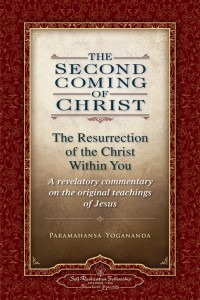
"The undreamed-of technical advances in civilization made possible by the splitting of the atom and the harnessing of subatomic energies will ultimately bring all peoples into such close proximity in travel and communication that humanity will have to reevaluate its attitudes. Either persistence in ignorant intolerance will spawn mass suffering, or an openness to the common spiritual link of souls will presage a global well-being of peace and amity. This is a clarion call that the time has come to separate truth from spurious convictions, knowledge from ignorance. The teachings of Jesus as understood in harmony with the revelations of the Great Ones of India will revive the practical methods of the intuitive knowing of truth through Self-realization. Realized truth and scientific knowledge are the sure means to combat the shadowy doubts and superstitions hedging humanity. Only a mighty flood of the light of truth through actual communion with God can dispel the gathered darkness of the ages.” - Paramahansa Yogananda
The Second Birth of Man—In Spirit
(Dialogue with Nicodemus, Part I)
"True religion is founded
upon intuitional perception
of the Transcendental Reality
All bona fide revealed religions of the world are based on
intuitive knowledge. Each has an exoteric or outer particularity, and
an esoteric or inner core. The exoteric aspect is the public image,
and includes moral precepts and a body of doctrines, dogmas,
dissertations, rules, and customs to guide the general populace of
its followers. The esoteric aspect includes methods that focus on
actual communion of the soul with God. The exoteric aspect is for the
many; the esoteric is for the ardent few. It is the esoteric aspect
of religion that leads to intuition, the firsthand knowledge of
Reality.
The lofty 'Sanatana Dharma' of the Vedic philosophy of ancient India—summarized in the Upanishads and in the six classical systems of
metaphysical knowledge, and peerlessly encapsulated in the Bhagavad
Gita—is based on intuitional perception of the Transcendental
Reality, Buddhism, with its various methods of controlling the mind
and gaining depth in meditation, advocates intuitive knowledge to
realize the transcendence of 'nirvana'. Sufism in Islam anchors on
the intuitive mystical experience of the soul. [1] within the
Jewish religion are esoteric teachings based on inner experience of
the Divine, evidenced abundantly in the legacy of the God-illumined
Biblical prophets. Christ's teachings are fully expressive of that
realization. The apostle John's Revelation is a remarkable disclosure
of the soul's intuitional perception of deepest truths garbed in
metaphor.
The elite traditions of Western philosophy and metaphysics laud the
intuitional knowing power of the soul. The Greek mystic, philosopher,
and mathematician Pythagoras (born c. 580 B.C.) emphasized inner
experience of intuitive knowledge. Plato (born c. 428 B.C.), whose
works have come down to us as a primary foundation of Western
civilization, likewise taught the necessity for supersensory
knowledge to apprehend eternal truths. The Neoplatonist sage
Plotinus (A.D. 204-270) practiced Plato's ideal of intuitional
knowing of Reality: 'Often I have woken to myself out of the body,
become detached from all else and entered into myself,' he
wrote, 'and I have seen beauty of surpassing greatness, and have felt
assured that then especially I belonged to the higher reality,
engaged in the noblest life and identified with the Divine.'[2] He
died exhorting his disciples 'Strive to bring back the god in
yourselves to the God in the All.'[3]
The Gnostics (first three centuries A.D.); the early Church fathers
such as Origen and Augustine; great Christian luminaries such as
Johannes Scotus Erigena (810-877) and Saint Anselm (1033-1109); the
monastic orders founded by Saint Bernard of Clairvaux (1091-1153) and
Hugh, Richard, and Walter of Saint Victor (twelfth century)—all
practiced intuitive contemplation of God.
Illumined Christian mystics of medieval times—Saint Thomas Aquinas
(1224-1275); Saint Bonaventure (1217-1274); Jan van Ruysbroeck (1293-
1381); Meister Eckhart (1260-1327); Henry Suso (1295-1366); Johannes
Tauler (1300-1361); Gerhard Groote (1340-1384); Thomas a Kempis (1380-
1471), author of 'The Imitation of Christ'; Jacob Boehme (1575-1624)—
sought and received ultimate knowledge through the light of intuition
[4]. Christian saints through the centuries—Juliana of
Norwich, Hildegard of Bingen, Catherine of Siena, Teresa of Avila,
and many more known and unknown—partook of soul intuition in their
attainment of divine realization and mystical union with God.
British poets such as Wordsworth, Coleridge, Blake, Traherne, and
Pope aspired to intuit and write about the all-pervading Spirit.
Emerson (1802-1882) and other American Transcendentalists sought
personal experience of immanent spiritual reality through intuition.
The German Idealist philosophers Hamann (1730-1788), Herder (1744-
1803), Jacobi (1743-1819), Schiller (1759-1805), and Schopenhauer
(1788-1860) emphasized it; and the great modern French philosopher
Bergson calls intuition the only faculty capable of knowing the
ultimate nature of things. [5]
Jesus' esoteric teachings reveal the universality of religion
The 'second birth,' the necessity of which Jesus speaks, admits us to
the land of intuitional perception of truth. The New Testament may not have been
scribed with the word 'intuition,' but it is replete with references to
intuitive knowledge. Indeed, the twenty-one verses describing Nicodemus' visit
present, in condensed epigrammatic sayings so typical of Oriental scripture,
Jesus' comprehensive esoteric teachings relating to the practical attainment of
the infinite kingdom of blissful divine consciousness. These verses have been
largely interpreted in support of such doctrines as baptism of the body by water
as a prerequisite for entering God's kingdom after death (John 3:5); that Jesus
is the only 'son of God' (John 3:16); that mere 'belief' in Jesus is sufficient
for salvation, and that all are condemned who do not believe (John 3:17-18).
Such exoteric reading of scripture engulfs in dogma the universality of
religion. A panorama of unity unfolds in an understanding of esoteric truth.
Truth is one: exact correspondence with Reality. Divine incarnations do not come
to bring a new or exclusive religion, but to restore the One Religion of
God-realization. The great ones, like waves, all bathe in the same Eternal Sea
and become One with It. The outwardly varying messages of the prophets
are part of the necessary relativity that accommodates human diversity. It is
narrow-mindedness that creates religious bigotry and divisive denominationalism,
constricting truth to ritualistic worship and sectarian dogma; the form is
mistaken for the spirit. The essential message of actual contact between man and
Maker is diluted with ignorance. Humanity drinks of the polluted waters,
understanding not at all why its spiritual thirst remains. Only pure waters can
quench a vexing thirst.
The undreamed-of technical advances in civilization made possible by the
splitting of the atom and the harnessing of subatomic energies will ultimately
bring all peoples into such close proximity in travel and communication that
humanity will have to reevaluate its attitudes. Either persistence in ignorant
intolerance will spawn mass suffering, or an openness to the common spiritual
link of souls will presage a global well-being of peace and amity. This is a
clarion call that the time has come to separate truth from spurious convictions,
knowledge from ignorance. The teachings of Jesus as understood in harmony with
the revelations of the Great Ones of India will revive the practical methods of
the intuitive knowing of truth through Self-realization. Realized truth and
scientific knowledge are the sure means to combat the shadowy doubts and
superstitions hedging humanity. Only a mighty flood of the light of truth
through actual communion with God can dispel the gathered darkness of the ages.”
Paramahansa Yogananda, The Second Coming of Christ (The Resurrection of the Christ within You) Volume 1, Discourse 13
Self-realization Fellowship (2008) pg. 240-243
Editorial Reviews
A masterpiece of spiritual revelation....As Yogananda delves into the life and background of Jesus, it becomes clear that the Gospels contain a universal esoteric message that has been awaiting full and systematic explication since the apostolic age. In Yogananda's commentary, what had been veiled, obscure, and oblique is fully disclosed. - Yoga International
Offers startling ideas about the deeper meaning of Jesus' teachings and their essential unity with yoga....It has been praised as a groundbreaking work by comparative religion scholars. - Los Angeles Times
Paramahansa Yogananda's The Second Coming of Christ is one of the most important analyses of Jesus teachings that exists.... Many interpretations of Jesus words divide peoples, cultures, and nations; these foster unity and healing, and that is why they are vital for today's world. —Larry Dossey, M.D., author of Healing Words: The Power of Prayer and the Practice of Medicine
Most Helpful Customer Reviews
"Christ Unveiled"August 8, 2004
By J. J Salih
These two volumes are written from the perspective and experience of one who himself came from the East. The insights into the life and teachings of Jesus offered by Yogananda go much deeper than what we are accustomed to as Westerners. Indeed, Yogananda's work could just as easily have been titled "Christ Unveiled.” This is not merely an intellectual commentary based on scholarship (though fine scholarship abounds throughout). Rather, this work is the realized testimony of someone who himself has plumbed the depths and given his whole life to the subject matter at hand. As Westerners raised on the external moral precepts of the "Good Book" our acquaintance with the internal esoteric aspect of God and His prophets is wholly lacking a "holy" understanding. This book does much to expand our understanding of Jesus, not just as a spiritual personage of highest order... whose entire public ministry consisted of doing good to others, but shows us the deeply spiritual and mystical side of his life, teachings and love of God. Such sayings as "The kingdom of God is within you" and "know ye not that ye are gods?” take on a profound importance in the light of Yogananda's work. Perhaps for the first time in the history of Christianity we are being given the opportunity to understand that the deep care, sincerity, love and urgency of Christ's mission came as a result of seeing in all others (especially the most evil around him) what was fully revealed and uncovered in him. Anyone interested in exploring the deeper aspects of Christianity will find these two volumes invaluable. The footnotes alone contain many fine commentaries on such subjects as the original meanings of various Greek and Aramaic words and suggest how difficult (as always!) it is to find an accurate equivalent in English. Included are many fine reproductions of the great religious art of Carl Bloch and Heinrich Hofmann. As if the rich detail and wisdom conveyed throughout were not enough, we are given ample insight into the love of God overflowing in those who fully know Him. This book bares witness to itself such that, as Yogananda says on page 495 of volume 1, "When the devotee is in tune with God, he will hear the divine Voice: 'I have loved thee through the ages; I love thee now; and I shall love thee until thou comest Home. Whether thou knowest it or not, I shall always love thee'.”
Get Christ Off the Cross and Back Into Your Heart October 23, 2006
By John P. Morgan VINE VOICE
Reading these other reviewers words, I cannot help but relate to them, as well. When I was in traditional Sunday school as a child, I was always more interested in what Jesus did while he was here than the crucifixion. Everyone seemed to think that this was the main point of his life, but I really felt that what he did while he was here was the "main thing.” Of course, I was steered into a more "Acceptable" notion of Jesus...that he was "very God"; that if you didn't believe in him as your savior you would be banished to hell, that you better get all your friend to convert because Jesus is gonna come back and wreak some "Holy Crap" if he sees that things aren't being done his way.
I always felt a little saddened by this approach to Jesus the Christ. Most people think that Jesus and Christ are synonomous, but Christ is actually a level of consciousness that Jesus obtained while here upon Earth. "The Christ" is an awareness of the Inner God and the Outer God of being One. Jesus embodied this awareness...lived it out on a moment to moment basis...knew and felt and acted out on Love's Eternal Promises and"became"God.
But he also was humble enough to know that not only he was God made manifest, but that each one of us was God in the "seed.” The only difference between Jesus and us is that he focused solely upon God and we tend to be scattered in our approach.
Because we live in a society where only a few people are allowed to shine at any given time, we "made" Jesus God. We began to formulate rules and laws around his simple teachings. We began to make God in our "Image and Likeness.” We began to think that God was a God of Fear and retribution rather than a God of Love and all of these perverted and twisted ideas about God, about Jesus, about Heaven and hell began to weave themselves into the very fabric of our world.
For the most part, people tend to feel very unworthy and ashamed at the very core of their being. Most of my clients come to me because they feel like they are "not good enough.” I often ask them, "Not good enough for who?” And they usually always say, and I get a little teary eyed repeating this," Not good enough for life...”
And yet, I can totally relate to this statement because I, too, have felt like this and sometimes I still feel like this, but then I allow those thoughts to just pass and I meditate, I pray, and I read something inspirational. I often reach for this book by Yogananda because here was a man who was a Hindu who greatly believed in the message of Jesus. Yogananda knew that Jesus was not the great exception, but the great example and that the "Christ" is simply the prototype for what we, as a species, could evolve into if we could just put aside our interpretations and our rules and our regulations about what we think God is, and "let" God be God in us, as us, and through all that we think, do, and say.
Christ will return to Earth, but not in the way a lot of people would like to believe. Christ is not coming back as a harsh ruler, but as a gentle knowingness that the eye with which God sees me is the same eye with which I see God; with a deep inner realization that truly, Love makes all things possible; that ALL MIRACLES are expressions of Love and that all expressions of Love are maximal and that the Living Christ is resurrected to the Heaven within our own being every time we remember that Love, Peace, and Joy are already within us waiting to come forth and that evil, death, and sin are merely shadows and flee away in the Presence of Light.
Let the Living Christ "return" to your world. Get this book and delight in the Truth that God is within you and around you NOW; that you are a worthy and deserving being and that all good things are yours to express, to extend, and to experience right here and right now. Let go of the ridiculous notion that only some people have the "Truth" and realize with real eyes see that Truth...all Truth is within, not as a set of rules and regulations, but as a way of being. Meditate on the words of the Christ," Peace I give unto you, not as the world gives, but as I give...”Christ within is our Infinite Source of Peace, Love, Laughter, and Good of every kind.
I recommend this book to any one who still knows in the back of their heart that God is a God of Love and that Love knows nothing but Love. If you think you have somehow strayed off the path to God, relax, it's all God...even the path you thought wasn't to God, it was! God can never leave us, ever! Let Yogananda's beautiful words bore a hole in your memory returning you to a simple, gentle, childlike remembrance that God is for us in every moment and if God is for us, who or what could possibly be against us? Take Christ off the cross and put "Him" where he should be, in your heart!
May your Life be filled with Light, Love, Peace and Understanding...
Peace and Blessings.
This Gospel Commentary truly represents the Restored teachings of Jesus Christ, September 1, 2004
By PYisLOVE"f" (North America)
This book is so revealing, inspiring and illuminating of Jesus and His teachings, that I would class it as the most profound RESTORATION OF THE TEACHINGS OF JESUS.
Yogananda's newest book "The Second Coming of Christ" will not disappoint those who have waited long for this literary spiritual masterpiece from Self-Realization Fellowship Publishers.[released Sept 2004
Although bible academics will tell you that anything written over 50 years ago may be out of date. You will find that this Gospel commentary is at least equal to if not superior to anything written to date on this subject.
There are a number of things that make this work especially qualified to represent the true teachings of Jesus the Christ.
(a) The author Himself actually lived the life described in these gospels- Paramahansa Yogananda was a modern Christ in every regard. If one cannot see this in the Second Coming book, this fact can be further verified through a couple of more years study of the Masters life and other teachings. Plus there are still a few living witnesses to His divine stature.
(b) Yogananda goes far beyond other academics/clergy and theologians. he not only gives a spiritually potent and convincing explanation of Jesus teachings, but also the full and clearest methodology on how to reach that high state of self-realization. He takes you on the actual journey and explains every step of the way. You would not get more or better instruction even if you were in the presence of another physical teacher.
(c) the proof and value of the spiritual instruction in the second coming have already been effectively verified by Yogananda's divine lineage and many successor disciples-it works!
(d) His approach that he is not attempting to prove the authenticity and factualness of the Early Gospels [see Page 69] is very telling of His foresight and wisdom. This very area, is where many embarrassed and presumptuous previous writers made their first mistake. Assuming that everything in writing is the unadulterated "Word of God.” This caution alone sets him apart and speaks to his humility.
(e)He uses the mystical path of Yoga Sciences and Vedic spiritual wisdom as the background to share with us the inner/fuller meanings and purposes of Jesus the Christ's teachings and mission. Whereas various other commenters on these same documents have been attempting to show the origins of many Gospel passages as originating in Buddhistic and Egyptian traditions.
(f) The value and veracity of a true revelatory spiritual message rests in part upon its useful and original ideas for the spiritual seeker. Here Yogananda gives us a cornucopia of valuable and refreshingly original approaches to many of the heretofore mysteries of the bible. He fills in a lot of the blanks that were left when other writers on these subjects attempted to come up with similar concepts.
One can clearly see herein the difference between previous "Attempts" to explain subtle matters and Yogananda's finished product.
(g) And above all, the author avoids the greatest of all pitfalls so many others got tripped up on - the true meaning of Christ's second coming. You will find in the gospels that the reason why Jesus says "no man can know the day or the hour of his return", is simply because he will not be making a public earth shaking appearance. His second coming occurs in the lives of those who become one with Him or God and is happening to a few souls continually. All others who have attempted to claim the other idea of a public return have ended up looking like fools and frauds. They were all lost in popular belief systems. PY instead supports his universal Christ Consciousness theory with ample evidence and conviction. Freeing all seekers and faithful from the blind opportunism that has victimized them in the past by the popular doomsday Jesus return concepts. It gives credit to this Gurus way of returning the power from bad leaders to the individual devotee. It further demonstrates how obedience to the Master results in the greatest freedom and god-realization for all who make the effort using the right means. Then one becomes truly free.
This work seems to truly represent the Jesus of Judean times. Before time, men and politics distorted and/or lost so much of the beautiful wisdom that Jesus taught back then. And some that was kept so secretive, as was required in the mystical customs of old.
It is truly fitting that after the attempts of so many other well meaning but ineffectual claims of other prophets who claimed credit for restoring Jesus true teachings, it is a prophet from India [where Jesus spent almost half of his life] who is able to finally reveal the true light of that ancient and holy teaching. A light that has already given new hope to millions of spiritual seekers around the globe for the last hundred or so years.
This book tells us about some of Jesus amazing connections with India that have been verified through history.
It goes into great detail on spiritual practice and healing, the Master -Disciple relationship as the door to heaven before death, and the value of the spiritual life to the fulfillment of ones every other goal of life.
.jpg "The Great Adi Shakti Shri Mataji Nirmala Devi")
The Messiah-Paraclete “This is all promised that people will get their realization. In Koran they have described that Twelfth Mahdi will come and he will give realization. In the Hindu scriptures it is written, Indian scriptures, that there will be a Kalki who will give you realization, who will resurrect you and all kind of books there are; in the Bible also we have this. So, one has to realize that if it is such an important time, and at this time we are born, we should understand our purpose of our being here at this time.”
The Paraclete Shri Mataji
Public Program. Toronto, Canada—5 October 1993
"In the history of spirituality, it is one of the greatest days when we find Christ rose from the dead. It is very significant and symbolic that in Sahaja Yoga, also, what we have done is to rise from the dead into life. It is to be understood that Resurrection is the message for all of us - for the whole world!"
The Paraclete Shri Mataji
Easter Puja. Istanbul, Turkey—22 April 2001
.jpg "The Great Adi Shakti Shri Mataji Nirmala Devi")
The Paraclete “At a very young age He (Christ) was crucified. That crucifixion shows that He was not afraid of death and He knew that He would resurrect. This He had to do through the Agnya Chakra. Agnya Chakra is, as you know, very constricted [also called the Narrow Gate (Matt. 7:13-14)]. And through that constriction, He had to go through for which He had to get killed.
And He accepted that. He accepted with full heart that that's the ordeal He has to go through. In the same way, your Sahasrara [Kingdom of God] can only be achieved through the Agnya, and the Agnya has to be opened. But for that you don't have to get hanged, you don't have to be crucified, but you have to crucify your ego.”
The Paraclete Shri Mataji
Easter Puja. Istanbul, Turkey—22 April 2001
Disclaimer: Our material may be copied, printed and distributed by referring to this site. This site also contains copyrighted material the use of which has not always been specifically authorized by the copyright owner. We are making such material available to our readers under the education and research provisions of "fair use" in an effort to advance freedom of inquiry for a better understanding of religious, spiritual and inter-faith issues. The material on this site is distributed without profit. If you wish to use copyrighted material for purposes other than “fair use” you must request permission from the copyright owner.

