
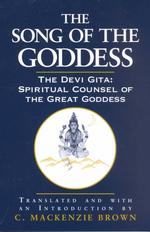
The Song of the Goddess
"Devigita proclaims that Shakti went about creating the world with 24 tattvas or elements. The five elements were born out of the primordial principle of unmanifested Sakti. The ether through which sound traverse was first element, which is also known as Sabda-rupa (form of sound). Second was Air or Vayu (Sparsharupa or a form which is felt) The Air or Vayu give rise to Agni so it called Vayoranih. Then sense of taste or 'rasrupa' the water element came. The the gandharupa or the source of smell came—the earth. Pauranic Expert Vettam Mani said that the universe remained in embryo form or in the bijarupa.”These Panchabhutas{five elements} were first divided into two (each was divided into two). Then by a process of the combination of these ten parts different substances were born....Each half of each of these five bhutas (elements) is again subdivided into four parts. These 1/8 parts are joined to the other halves and by combining them in other fractions of the material bodies (sthulasariras) of all beings are made.”wrote Vettam Mani.
The Song of the Goddess:
The Devi Gita: Spiritual Counsel of the Great Goddess
"Our whole cosmic quest of the world and beyond starts from the point of panchabhuta (five elements) which then manifests in an enjoining manner to form the life force and then, later, those five elements disintegrates to ensue a celestial traverse at the Paramanu (atom) level.
However, we will first try to understand these five elements which are Earth or Prithvi; Water or Jal ; Fire or Agni; Air or Vayu and then Ether or Akasha. Each of these Five elements has its own character and celestial elements which we will gauge in the following lines.
Earth (Prithvi): One can touch earth and smell it too ! However, there are two types of earth one is Eternal or (nitya) which are in the form of atom (Paramanu). The other type is perishable (anitya) which exists in the form of Karya or Work at animate and inanimate levels. Symbolically speaking our body, sense organs are the earth which as a whole get the shape of Jiva or life but those are perishable. But elements or atoms are eternal as after death may we bury, or burn the body, all the atoms get disintegrated to come back to its original eternal form. So our body and its Karya or Work are perishable as the mountain or rock forms but the atom remains which are eternal.
Water or Jal is the second element which again has two characters as in the Earth i.e. eternal in the shape of atom and Karya (Work) be it as river, pond or sea are perishable. As from sea or river water evaporates to be in the sky as cloud then again in the shape of rain it comes down on earth. So the eternal atom is only changing its karya or shape of work and what we see is the perishable form. From the sense organ perspective we can touch it to feel and taste it as well.
The third element is Air or Vayu. Again it has two levels as earth and water i.e. eternal atom and perishable Karya. One can feel air, as we breath in or out. We feel the storm or strong breeze which are temporary but air at atomic level remains around us eternally. In the Purana there is a mention of 49 types of Maruts or winds. Seven are important namely 1. Pravaha 2 Avaha; 3,Udvaha 4. Samvaha; 5 Vivaha; 6 Parvaha and 7.Paravaha. The wind which takes the water from the ocean is called Udvaha.
Fire or Agni is the fourth element of Indian Panchabhuta. Again it has eternal and perishable elements as we have seen above. The essential character of Fire is to generate heat. According to Hindu Mythology, Agni is one of the Eight guardians who guards our universe and is known as Asta- dik-palakas (Asta-eight, dik—Zone, Palaka-Guardian). The Fire is posited in the South East of the Universe.
However, in Indian mythology there are mentions of various types of fires. The four important ones are fire of the earth, fire of the sky, fire of the stomach (can mean hunger and digestive power as well) and the fire we commonly use.
Then comes the last of the Panchabhuta or five elements which is sound or ether. Ether is unique as it has only one character i.e. eternal. Ether is the carrier of sound be it man made or otherwise. One can hear it. As ether is the only eternal element of the five elements it attracted the attention of various sages. The concept of Akashvani or Divine sound which is heard by sages of higher order is related to this Ether or Akasha. The primordial mantra AUM then in modern times Raam or Shyaam are to work as linkages between Jivatma (life force—atman or soul) to Paramatman or (Omnipotent of supreme soul).The concept of sound and Mantra will be discussed in the next issue. Now we should concentrate on elements, other than five mentioned above which are very important to Hindu theological perspective. Those are Time(Kala) and Space (Sthan or Dik i.e. place and direction); Soul and Mind.
Like ether Time and Space are eternal. Time or kala is common cause of all actions of all the elements and is eternal link of predetermined actions and happenings. Thus in Hindu astrology the whole world and its course are equated with"time.” The Direction or Dik are part of Space and North, South, West and East are eternal no matter the Universe undergoes whatever changes.
Then the other element is Soul which is related with the knowledge system of man as jivatman and the eternal Knowledge of God or Paramatman (omnipotent). The last of the nine main elements is the manas or Mind. Its the sense-organ or path to experience the world eternally and otherwise. These sense organs are in the shape of eternal paramanu or atom and works is combinations to derive pleasure at worldly levels. These are the brief out line of main five elements and other four primary elements. It is said that our universe was created out of the manifestation of five elements. This was described in the Devigita very elaborately.
Devigita proclaims that Shakti went about creating the world with 24 tattvas or elements. The five elements were born out of the primordial principle of unmanifested Sakti. The ether through which sound traverse was first element, which is also known as Sabda-rupa (form of sound). Second was Air or Vayu (Sparsharupa or a form which is felt) The Air or Vayu give rise to Agni so it called Vayoranih. Then sense of taste or 'rasrupa' the water element came. The the gandharupa or the source of smell came—the earth.
Pauranic Expert Vettam Mani said that the universe remained in embryo form or in the bijarupa. "These Panchabhutas{five elements} were first divided into two (each was divided into two). Then by a process of the combination of these ten parts different substances were born....Each half of each of these five bhutas (elements) is again subdivided into four parts. These 1/8 parts are joined to the other halves and by combining them in other fractions of the material bodies (sthulasariras) of all beings are made.”wrote Vettam Mani.
The cosmic body is the grand total of those material bodies discussed above. The first and pure manifestation of those five elements are the inner conscience and bodily organs like ear etc. However, the inner conscience or Antarkaranas assumes four state or forms. Once conception and doubt arise it is called Mind. But when there is no doubt arises is called Buddhi. The process of examination and re-examination of a subjects belongs to the state of intellect called citta. But with the feeling of"I"The ego or ahamkar bursts out. So we find the pure five elements gave rise to the inner conscience or Antarkarnana and then there are four states within it namely mind, buddhi, citta and ego.
Vettam Mani explained "From the coarse (rajasic) aspect of the five sense organs originate the five organs of action like word, foot, hand, excretory and the genital organ, and also the five pranas (breaths) called prana, apana, samana, udhana and vyana.
Prana is located in the heart, apana in the anus, samana in the nabhi (navel)udana in the throat and Vyana all over the body. .... (Organs of knowldege 5, of action 5, and pranas 5,and buddhi 1,mind 1, the bodly is composes of these 17 factors.”
The sukshmasaria or the subtle body has two nature or Prakrati namely maya wherein the god is reflected. The other is Avidya seen by Jiva or living being who is receptacle of sorrows. Through Vidya (Eternal Knowldege) and Avidya (ignorance) three forms of body emerge. Mani explained 'He who is attached and is pround about the material body is called visva; he who attaches importance to the subtle bodly is called Taijisva, and who is aware of casual body is called Prajna.' Likewise we see how the five elements manifested itself into 22 tattva (materials) which all go towards creation of a body. In the Devigita it is said that eighty-four lakh species of living beings have manifested from these five elements. In the next article we would take up the ether or sound elements in mantra perspective which has only single and eternal entity and dwells in Hindu theology vibrantly.
Let us look into the Panchabhuta and its divisions which created all the things. Pauranic Encyclopaedia while discussing Isvara quoted Devigita extensively to explain concept of creation and Godhead. Devigita announces that from primordial principle the five elements were born. Those are Air, Fire, Water, Ether and Earth. These five elements got divided into two part each giving a total of 10 parts. Then half of the five elements divided itself in four parts. 'These 1/8 parts are joined to the other halves and by combining them in other fractions, the material bodies (sthulasriras) of all being are made' said Vettam Mani. Then the Cosmic Body, which is the sum total of those individual material bodies went towards creating inner conscience and body parts like ear etc. Mani further said that"Antahkarana, due to differences in state assumes four forms. When once conception and doubt arises in a subject, then it is called mind. When there is no doubt, but there is assuredness it is called understanding (buddhi).”
Then came from coarse (sthula) five sense organs and five organs of actions namely mouth for words, foot, hand, excretory and genital organs. Devigita also mentions about five pranas or breath of life and their location in human body. Those are Prana located in the heart, apana in the anus, samana in the navel, udana in the throat and Vyana all over the body.
Thus we see ancient sages during their discourse tried to reach the sukshma or fine aspects from the sthula the gross aspect. Though in the context of modern Genetic Engineering, they were on a different track, but for sure they give us the tattwa jana or knowledge of composition and materials which are a definitely a pointer for modern researchers.”
http://www.amazon.com/
Disclaimer: Our material may be copied, printed and distributed by referring to this site. This site also contains copyrighted material the use of which has not always been specifically authorized by the copyright owner. We are making such material available to our readers under the education and research provisions of "fair use" in an effort to advance freedom of inquiry for a better understanding of religious, spiritual and inter-faith issues. The material on this site is distributed without profit. If you wish to use copyrighted material for purposes other than “fair use” you must request permission from the copyright owner.

