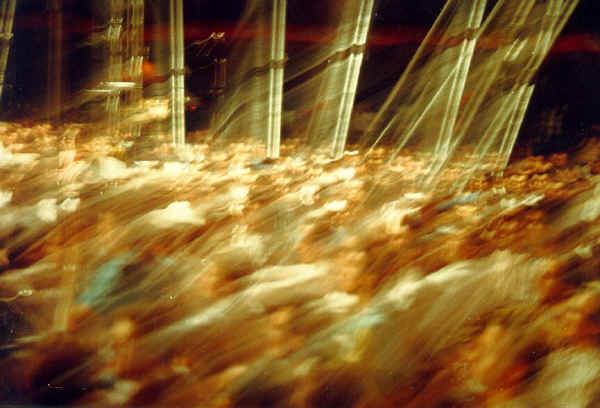
What
appears as underwater reeds is actually Allah's Light emitting out
of a few Believers of Al-Qiyamah, with vibrations flowing out from the rest, during
meditation on His Ruh Shri Mataji Nirmala Devi.
Allah
has now completed the Revelation of His Light and this Revelation is now absolute, even though the
Unbelievers may detest it!
Their intention is to extinguish Allah's Light with
their mouths: But Allah will complete (the revelation of) His light, even though the Unbelievers may detest
(it.)
Surah 61:8 Al Saff (The Battle Array)
All
Unbelievers are invited to destroy
this Revelation of Allah's
Light.
Al Nur (The Light)
Their intention is to extinguish Allah's Light with
their mouths:
But Allah will complete (the revelation of) His light,
Even though the Unbelievers may detest (it.)
surah 61:8 Al Saff (The Battle Array)
Abdullah Yusuf Ali, The Holy Qur'n, Amana Corporation, 1989.
Since Self-Realization the Light fascinated Kash. On
the very first day itself he had stood alone on the endless cover of
clouds, trying to understand where was this incredible, utterly peaceful
Shangri-La that he had stumbled upon. There was one distinguishing Reality
of this celestial landscape that held him spellbound - The Light!
It was shining high above at a distance. He had kept gazing at it,
spellbound by its indescribable uniqueness and infinite luminosity. It was
an extremely bright globe, much brighter than many suns. In spite of its
dazzling brightness it never ever hurt the eyes. Since Kash had never seen
anything that bright he thought it must be the sun, but at a much closer
proximity. His father, finding no other logical explanation, also agreed.
After months of Self-Transcendence it began to slowly
dawn that what Kash was seeing could not possibly be the sun. But Kash
kept on insisting that it had to be as nothing he had seen on Earth shone
so bright. Uncertainty came into his father inquisitive mind. He had this
peculiar habit of not believing anything unknown or speculative unless
proven beyond a shadow of reasonable doubt. The sun that his son was
seeing disturbed. Not only was it just above the Great Adi Shakti but it
did not emit heat! But the lingering question was why was it visible only
at Her place and nowhere else in the Kingdom of the Almighty Creator? If
it was indeed the sun then it had to be seen at all the dwellings of
all the Immortal Messengers that Shri Mataji used to take Kash to.
On September 11, 1994, at 13:05 p.m., after reading the
word Shaibhang (Self-illumined) at the opening stanza of the Sri
Guru Granth Sahib, the consciousness of Self-Realization indicated that
there was more to this Truth than met the mind. If Guru Nanak had
described the Divine World of Reality (Lahut) to be Shaibhang,
or Self-Illumined, then the "very bright sun" that Kash spoke
about could not be true. If the Spirit of the Living God was the Ultimate
Reality (Al-Haqqah) then this "sun" at Her Abode was an
inferior object. Moreover, Kash's extraordinary observation of this
"sun" created more questions and doubts. He maintained that:
This "Sun" is always behind Her at an angle but is not directly above,
that is, at about 45 degrees.
It did not rise and fall like the earthly sun. The "Sun" above Shri
Mataji Nirmala Devi was fixed and stationary.
This "Sun" illuminates the entire Supreme Abode of the Great Celestial
Mother. Every thing is seen very clearly and in fine detail, down to the
different hues of skin tone. (That is why Kash was absolutely sure that
Shri Jesus had a light brown skin, and wearing whitish gray clothes
stretched taut by the sheer size of His muscular body.)
Kash could not ascertain the exact size and distance of this "Sun"
despite more than 1300 visits.
In spite of its intense brightness this "Sun" emitted no heat. On the
contrary, Kash said that the rays are cool!
Then one day he astounded his father by claiming that
there are no shadows from the rays of this Sun! In all his journeys Kash
never saw any shadow in the Kingdom of the Spirit. Though questioned many
times he maintained that this "Sun" does not produce any shadow, physical
properties that are ubiquitous in our universal sun. Kash was told by his
father to clarify this issue with Shri Viswamata Nirmala Devi. There was
something strange about this sun that Kash daily witnessed.
Kash meditated and the Divine Kundalini at the sacrum
bone took him up the Tree of Life into the Bridal Chamber. He burst
through the clouds and reached His Dominion. The Infinite Light shone ever
so brilliantly from above the Eternal Throne of the Great Mater Divinae
Gratiae (Mother of Divine Grace) as Shen sat in Bliss and Joy. Shri Lok
Mata Shri Nirmala Devi met him and the question of the "Sun"
above Her was put forward.
The Ruh of Allah then explained that it was not the sun that he was seeing but the Light.
They
then meditated, after which Kash returned back to this hate-filled world
of Louis Farrakhans and Osama bin Ladins.
Allah
has now completed the Revelation of His Light and this Revelation is now absolute, even though the
Unbelievers may detest it!
Allah is the Light [2996]
of the heavens and
the earth, [2997]
The parable of His Light is as if there were a niche,
And within it a Lamp: The Lamp enclosed in Glass;
[2998]
The glass as it were a brilliant star;
[2999]
Lit from a blessed Tree,
[3000]
An Olive, neither of the East nor of the West,
[3001]
Whose oil is well-nigh luminous, though fire scarce
touched it; [3002]
Light upon Light!
Allah doth set forth parables for men: and Allah doth
know all things.
surah 24:35 Al Nur (The Light)
Abdullah Yusuf Ali, The Holy Qur'n, Amana Corporation, 1989.
This parable of Al Nur has been the subject of the greatest
works among the Muslim scholars since post-Muhammad days. Learned Islamic
professors have written voluminous interpretations of this single verse, such is
the esteem and importance of this metaphor. Muslim scholars have unabashedly
eulogize the superiority of this parable with countless glowing tributes:
"Embedded within certain directions
concerning a refined domestic and social life, comes this glorious parable of
Light, which contains layer upon layer of transcendental truth about spiritual
mysteries. No notes can do adequate justice to its full meaning. Volumes have
been written on this subject, the most notable being Ghazali's Mishkat al
Anwar."
Abdullah Yusuf Ali,
The Holy Qur'n
(Abdullah Yusuf Ali, The Holy Qur'n,
1989, p. 876.)
"This mystical passage gives the essence of Sufism, and conceals the nature
of the cognition of the extra dimensions of the human consciousness which comes
beyond the intellect. It is the subject of the great Ghazali's Niche for
Lights, a Sufi classic."
Idries Shah, The Way of the Sufi
(Idries Shah,
The Way of the Sufi, 1974, p. 431.)
"The way of illumination was elaborated by the great master of illumination
(shayk al-ishraq) Shihab al-Din Suhrawardi (c. 1155-91.) Drawing on the Qur'nic
Light verse and al-Ghazali's interpretation of it in his famous treatise
Mishkat al-Anwar (The Niche of Lights), and on ancient Iranian and Neoplatonic
wisdom, Suhrawardi constructed an impressive cosmos of light and darkness
populated by countless luminous angelic spirits.
The source from which this divine cosmos
emanates is God, who is hidden from the human soul by veils of light and
darkness. The soul's ultimate quest is to penetrate these veils through the
power of intellect until it returns to its original heavenly source ..."Mahmoud
M. Ayoub, World Religions: The Islamic Tradition
World Religions, edited by W. G.
Oxtoby
(World Religions, Oxford University Press, Canada, 1996, p. 377-78)
"To
say that God was One was not a mere numerical definition: it was a call to
make that unity the driving factor of one's life and society. The unity
of God would be glimpsed in the truly integrated self. But the divine
unity also required Muslims to recognize the religious aspirations of
others. Because there was only one God, all rightly guided religions must
derive from him alone. Belief in the supreme and sole Reality would be
culturally conditioned and would be expressed by different societies in
different ways, but the focus of all true worship must have been inspired
by and directed toward the being whom the Arabs had always called al-lah.
One of the divine names of the Koran is an-Nur, the Light. In these
famous verses of the Koran, God is the source of all knowledge as well as
the means whereby men catch a glimpse of transcendence."
Karen Armstrong,
A History of God
(Karen Armstrong, A History of God,
1993, p. 151.)
Yes, this is the Jewel in the Crown. However, so subtle
is the Pure Knowledge that no Islamic scholar has even come close to
unraveling the deep subtle meaning and inner mysteries (batin) of
this Parable of Light. It has been read a thousand times by the ordinary,
entire lifetimes by generations of mullahs and muftis, and centuries by
hundreds of millions of Ummah. Put simply, it has been read, uttered and
analyzed countless billions of times but to no avail. The inability of the
entire Ummah since the birth of Islam to unravel probably their most
cherished surah of Al Nur reflects the gradual demise of Islam.
Even their batini, Muslims who devotes himself to the
esoteric, mystical understanding of the faith, have never been able to
impart only a rudimentary understanding of Al Nur.
Due to the utmost importance of this Revelation it has
to be clarified that Allah stresses twice that it is a parable. By this
unprecedented double clarification the seeker has to first understand the
meaning of parable. The Webster's New World Dictionary's
defines parable as "an allegorical relation; a story in which people,
things, and happenings have a hidden or symbolic meaning."
Mainstream
Islamic scholars, unlike their Sufi brethren, have
completely misinterpreted this parable into something mysterious and
ambiguous, throwing no light at all on this Light. On the contrary, the parable of Al Nur
has been further obscured by the dust of centuries-old
spiritual ignorance and esoteric nescience. The starkly contrasting
interpretation between the mainstream Islamic and fringe Sufism speak
volumes of the power with which institutionalized religions hold their followers
captive, rejecting all philosophy that differs
from their dogmas. The religious flock of Islam sheepishly follow their
mullahs and muftis, bleating along in collective humdrum monotony. No words can fathom the depth of darkness
they have been led into concerning this Light of
Allah. Only the Blast of Truth will awaken them as to what the Mishkat al-Anwar
is really all about.
In order to fathom the abyss of ignorance these
Defrauders (Al-Mutaffin) have led
Muslims into, it will be necessary to copy nearly the entire text of
Abdullah Yusuf Ali's interpretations, and other Islamic theologians, regarding the parable of Light.
Abdullah Yusuf Ali
...
Allah is the Light [2996]
Islamic interpretation 2996
"2996.
The physical light is but a reflection of the true Light in the world of
Reality, and that true Light is Allah. We can only think of Allah in terms
of our phenomenal experience, and in the phenomenal world, light is the
purest thing we know, but physical light has drawbacks incidental to its
physical nature: e.g. (1) it is dependent on some source external to
itself; (2) it is a passing phenomenon: if we take it to be a form of
motion or energy it is unstable, like all physical phenomena; (3) it is
dependent on space and time; its speed is 186,100 miles per second, and
there are stars whose light takes thousands (or millions or billions) of
years before it reaches the earth. The perfect Light of Allah is free from
any such defects."
Abdullah Yusuf Ali, The Holy Qur'n
Of the heavens and the earth,
[2997]
The parable of His Light is as if there were a niche
And within it a Lamp: The Lamp enclosed in Glass; [2998]
Islamic interpretation 2998
"2998.
The first three points in the Parable centre round the symbols of the
Niche, the Lamp, and the Glass. (1) The Niche (Mishkat) is the little
shallow recess in the wall of an Eastern house, fairly high from the
ground, in which a light in the room, in which a light (before the days of
electricity) was usually placed. Its height enabled it to diffuse the
light in the room and minimised the shadows. The background of the wall
and the sides of the niche helped throw the light well into the room, and
if the wall was white-washed, it also acted as the reflector: the opening
in front made the way for the light. So with the spiritual Light: it is
placed high above worldly things: it has a niche or habitation of its own,
in Revelation and other Signs of Allah; its access to men is by a special
Way, open to all, yet closed to those who refuse its rays. (2) The Lamp is
the core of the spiritual Truth, which is the real illumination; the Niche
is nothing without it; the Niche is actually made for it. (3) The Glass is
the transparent medium through which the Light passes. On one hand, it
protects the light from moths and other forms of low life (lower
motives in man) and from gusts of wind (passions), and on the other, it
transmits light through a medium which is made up of and akin to the
grosser substances of the earth (such as sand, soda, potash, etc.), so
arranged as to admit the subtle to the gross by its transparency. So the
spiritual Truth has to be filtered through human language or human
intelligence to make it intelligible to mankind."
Abdullah Yusuf Ali, The Holy Qur'n
The glass as it were a brilliant
star;
[2999]
Islamic interpretation 2999
2999.
"The
glass by itself does not shine. But when the light comes into it, it
shines like a brilliant star. So men of God, who preach Allah's Truth,
are themselves illuminated by Allah's Light and become like illuminating
media through which that Light spreads and permeates human life."
Abdullah Yusuf Ali, The Holy Qur'n
Lit from a blessed Tree,
[3000]
Islamic interpretation 3000
3000.
"The
olive tree is not a very impressive tree in its outward appearance. It
leaves have a dull greenish brown colour, and in size it is inconspicuous.
But its oil is used in sacred ceremonies and forms a wholesome ingredient
of food. The fruit has a specially fine flavour."
Abdullah Yusuf Ali, The Holy Qur'n
An Olive, neither of the East nor of the West,
[3001]
Whose oil is well-nigh luminous,
Islamic interpretation 3001
3001.
"The
mystic Olive is not localised. It is neither of the East nor the West. It
is universal, for such is Allah's Light. As applied to the olive, there
is also a more literal meaning, which can be allegorised in a different
way. An olive tree with an eastern aspect gets only the rays of the
morning sun; one with a western aspect, only the rays of the western sun.
In the northern hemisphere the south aspect will give the sun's rays a
greater part of the day, while a northern aspect will shut them out
altogether, and vice versa in the southern hemisphere. But a tree in the
open plain or on a hill will get perpetual sunshine by day: it will be
more mature, and the fruit and oil will be of superior quality. So Allah's
Light is not localised or immature: it is perfect and universal."
Abdullah Yusuf Ali, The Holy Qur'n
Though fire scarce touched it:
[3002]
Islamic interpretation 3002
"Pure
olive oil is beautiful in colour, consistency, and illuminating power. The
world has tried all kinds of illuminants, and for economic reasons or
convenience, one replaces another. But for coolness, comfort to the eyes,
and steadiness, vegetable oils are superior to electricity, mineral oils,
and animal oils. And among vegetable oils, olive oil takes a high place
and deserves its sacred associations. Its purity is almost like light
itself: you may suppose it to be almost light before it is lit. So with
spiritual Truth: it illuminates the mind and understanding imperceptibly,
almost before the human mind and heart have been consciously touched by
it."
Abdullah Yusuf Ali, The Holy Qur'n
Light upon Light!
Allah doth set forth parables for men:
And Allah doth
know all things.
Islamic interpretation 3003
"Glorious,
illimitable Light, which cannot be described or measured. And there are
grades and grades of it, passing transcendentally into regions of
spiritual heights, which man's imagination can scarcely conceive of. The
topmost pinnacle is the true prototypal Light, the real Light, of which
all others were reflections; the Light of Allah. Hence the saying of the
Holy Prophet about Allah's "Seventy Thousand veils of Light."
"
Abdullah Yusuf Ali, The Holy Qur'n
Abdullah Yusuf Ali, The Holy Qur'n, Amana Corporation, 1989.
And His
Forty Thieves Of Truth
NUR: From Surat an-Nur (Light) (PDF
format)
Ayats 35-39 (Warsh)
Tafsir
In the tafsir, or Qur'nic commentary below, the various
tafsirs are coloured coded as follows:
Ibn Juzayy: at-Tashil fi 'ulum al-Qur'n
Jalalayn: Tafsir al-Jalalayn
As-Sawi: Hashiya (gloss) on the Jalalayn
Ibn Kathir: Mukhtasar Tafsir Ibn Kathir
Al-Qurtubi: Jam' li-Ahkam al-Qur'n
Al-Burusawi: Tafsir Ruh al-Bayan
35 Allah is
the Light of the heavens and the earth.
The metaphor of His Light
is that of a niche
in which there is a lamp,
the lamp inside a glass,
the glass like a brilliant star,
lit from a blessed tree, an olive,
neither of the east nor of the west,
its oil all but giving off light
even if no fire touches it.
Light upon Light.
Allah guides to His Light whoever He wills
and Allah makes metaphors for mankind
and Allah has knowledge of all things.
Allah is the Light
of the heavens and the earth.
Ibn Juzayy:
Light both designates a reality - the light which the eyes
perceive, and is also a metaphor for the meanings which are perceived by
the hearts. "Nothing is like Allah." So the interpretation of
the ayat is that Allah possesses the light of the heavens and the earth,
and He has described Himself as being Light as you say, "Zayd is
generosity" when you want to stress the fact that he is generous.
If He means the light which is perceived by the eyes, then
the meaning of the "light of the heavens and the earth" is that
He created the light which they contain - the sun, the moon and the stars,
or He created them both and brought them into existence from
non-existence. So they appear by Him as things appear by light. In this
meaning, 'li ibn Abi Talib recited the verse as, "Allahu nawwara"
(Form II) meaning He put light in them.
If by light He means the light which is perceived by the
hearts, the meaning of the light of the heavens and the earth is that He
placed the light in the hearts of the people of the heavens and the earth.
This is why Ibn 'bbas said, "The meaning is the Guide of the people
of the heavens and the earth."
Al-Qurtubi:
In a metaphorical senses, the Arabs say that "the
words have light" and "an illuminating (lit. light-giving)
Book." It is permissible to say that Allah is Light in order to
praise Him because He brought things into existence, and He began and
originated the light of all things, but He is not one the physical lights
that can be perceived by the senses. Nonetheless, the Prophet was asked,
"Have you seen your Lord?" and he said, "I saw him as a
Light."
As for it being guidance, Ubayy ibn Ka'b and others said,
"He adorned the heavens and the earth with the sun, the moon, and the
stars, and He adorned the earth with the Prophets, scholars and
believers."
Ibn Kathir:
Anas ibn Malik said that Allah says, "My light is
guidance." Ubayy ibn Ka'b said that it refers to the believer in
whose breast Allah has put belief and the Qur'n.
Jalalayn:
Allah illuminates it by the sun and the moon.
[as-Sawi: Know that the reality of light, whether it is
perceived by the eye or visible things are perceived by means of it,
resembles the quality which emanates from the two light sources onto dense
objects. This meaning cannot be applied to Allah. It is also said that the
ayat means that Allah is the Creator of the light in the heavens by the
sun, moon, stars, the Throne and the angels, and in the earth by lamps,
lights, candles. Prophets, scholars and the righteous. This means that He
illuminates them. It is said that it means that He manifests the heavens
and the earth because the term "light" implies manifestation. In
such a meaning, it can be applied to Allah Almighty, since He makes things
appear in existence out of non-existence.Ibn 'ta' says in the
Hikam, "Phenomenal being is utter and total darkness.
It is only the manifestation of the Real in it that gives it light."
So the universe exists because Allah grants it existence. If it were not
that Allah existed, none of the universe would have existed."]
The metaphor
of His Light is that of a niche in which there is a lamp,
Ibn Juzayy:
The niche is an opening in a wall which is not a window,
and the lamp in it gives off a strong light. It is said that the niche is
the post on which the lamp sits. The first is sounder and more well-known.
The meaning is that the attribute of the light of Allah in its clarity is
like that of the niche in
which there is a lamp since it is the greatest of what the
mortal can conceive of light and illumination. It is likened to the niche,
even though the light of Allah is greater still because that is the limit
of what people can perceive of lights. He made the example for them
according to what they can perceive.
It is said that the pronoun in "His light"
refers to Sayyiduna Muhammad, may Allah bless him and grant him peace, and
it is said to refer to the Qur'n, and to the believer. These statements
are weak because nothing precedes to which the pronoun could be referred.
If it is asked: How can it be valid that Allah be called 'the Light of the
heavens and the earth' while He reports that He is
Light and then He ascribes light to Himself in His words,
"the metaphor of His light" thus making the related the same as
the one related to? The answer is that that is valid with the
interpretation which we already mentioned about Allah being the Possessor
of the light of the heavens and the earth, or as you say, "Zayd is
generosity," and then you say that people are refreshed by His
generosity.
Al-Qurtubi:
He means the quality of His proofs which He casts into the
heart of the believer, and these proofs are called "light".
Allah calls His Book a light when He says, "We sent down a clear
Light to you," (4:174) He also called His Prophet light where He
says, "A Light has come to you from Allah and a clear Book."
(5:15) This is because the Book guides and makes clear, as does the
Messenger.
One reason that it is related to Allah is because He makes
the proof firm and clarifies it.
There is another possible meaning for this ayat which is
that the second sentence resembles the first if light is taken to mean
guidance and the perfection of the brilliant evidence and proofs of Allah
in His creation.
The pronoun in "his light" can also refer to the
believer.
Jalalayn:
"The metaphor of His light" means the quality of
light in the heart of the believer.
the lamp
inside a glass,
The lamp is the wick with its fire. The meaning is that it
is in lamp made of glass because the light in it is more radiant because
it is a transparent body.
Ruh al-Bayan: The purpose of the lamp in the glass and the
glass in the niche is that when the place is more constricted, the light
is more intense. If the place where the lamp is placed is an open area,
then the light disperses.
the glass as
though it were a dazzling star
Ibn Juzayy:
The metaphor of the glass in giving light is like a
dazzling star. That can have two meanings. Either He means that it gives
light because of the lamp which is in it, or He means that it in itself is
strong in light because of its purity and the fineness of its body. This
is more eloquent because it joins its light to the light of the lamp.
By "dazzling star," He means one of the luminous
bodies like Jupiter, Venus, Suhayl and the like. It is said that He means
Venus, but there is no indication of this specification. Nafi' reads it as
durriyyun. That reading has can mean that the star is ascribed to durr
(pearls) by its whiteness and purity. It is also read with hamza which is
derived from dar', meaning being pushed [i.e. stars that are pushed from
one place to another].
Al-Qurtubi:
Ka'b al-Ahbar makes the entire ayat refer to Muhammad, may
Allah bless him and grant him peace, i.e. the metaphor of the light of
Muhammad. The Messenger of Allah is the niche, the lamp is prophethood,
the glass is his heart, the blessed tree is the revelation and the angels
who brought it, the oil are the proofs and evidence which contain the
revelation. If it is taken to mean the believer, as Ubayy says, then the
niche is his chest, the lamp is belief and knowledge, the glass is his
heart, and the oil are the proofs and evidence it contains.
Jalalayn:
"Dazzling" means that it drives away the
darkness. The word is derived from "pearls" because of its
purity.
lit from a
blessed tree, an olive,
Ibn Juzayy:
It is read as yuqadu and tawaqqada in the past tense. The
verb refers to the lamp. If it is read as tuqdau in the present tense,
then it refers to the glass. It means that it is kindled from the oil of a
blessed tree. It is described as "blessed" because of the great
number of its benefits or because it grows in a blessed land, which is
Syria.
Al-Qurtubi:
This can also be taken to refer to the Prophets, in which
case Adam would be the blessed tree, or Ibrahim because Allah called him
"blessed".
neither of the
east nor of the west,
Ibn Juzayy:
It is said that it means it in Syria, so it is neither of
the east of the land nor the west. The best olives are the olives of
Syria. It is said that it is exposed and the sun strikes it all day, so it
is not purely of the east so as to be called eastern, nor of the west so
as to be called western. Rather it is eastern-western because the sun
revolves around it from the east to the west. It is said that it is a
central tall tree which is neither to the direction of the east of the
tree nor the direction of the west. It is is said that it is from a tree
of the Garden which, had it been in this world, would have eastern or
western.
its oil all
but giving off light even if no fire touches it.
To stress the description of its purity and excellence.
Ibn Kathir:
Ibn 'bbas went to Ka'b al-Ahbar and said, "Tell me
about His words, 'its oil all but giving off light even if no fire touches
it.'" He said, "Muhammad almost makes things clear to people
without even saying that he is a Prophet, even as the oil almost
shines."
Or the proofs of the Qur'n almost make things clear
before they are recited.
Light upon
light
Ibn Juzayy:
i.e. joining the light of the lamp, the excellence of the
glass and the excellence of the oil. By that He means the perfection of
the light used as the example.
Ibn Kathir:
Ibn 'bbas says that it means the belief and actions of
the slave of Allah. Ubayy ibn Ka'b said, "The believer is transformed
into five lights: his words are light, his actions are light, his going in
is light, his going out is light, and he will go to light on Day of Rising
to the Garden." It is also said that "light upon light" is
the light of the QurĠan and the light of belief when they are joined
together.
Jalalayn:
The light itself with the light of the fire. Allah's
guidance of the believers is light on top of the light of faith.
[As-Sawi: The proofs of Allah in the heart of the believer
are proof on top of proof. If you were to ask why did He use the light of
olive oil as a metaphor here and not the light of the sun, the moon, and
cangles, the answer is that oil contains many uses and is easy for
everyone. In the same way the perfect believer finds many uses in faith.
There is some disagreement about whether this metaphor is a compound one,
including what is mentioned at the beginning of the ayat and thus
describes guidance, or whether it is one in which each image corresponds
to something, e.g. the believer is the niche, the glass his heart, his
knowledge the oil, and his faith the lamp.]
Ruh al-Bayan: al-Qushayri says that they obtain one light
by their effort and investigation and reflection while they find the other
light by Allah's grace in this words and actions. Allah says, "As for
those who do jihad in Our Way. We will guide them to Our Paths."
(29:69)
Allah guides
to His Light whoever He wills
i.e. Allah gives success to whomever He will in finding
the truth, i.e. Islam.
Ibn Kathir:
It has come in hadith, "Allah Almighty created
creation in darkness and then on that day He cast to them some of His
light. Whoever got some of His light on that day is guided, and whoever
missed is misguided." So it is said that He knows the one who
deserves to be guided from the one who deserves misguidance.
Abu Sa'id al-Khudri reported that the Messenger of Allah said, "There
are four kinds of hearts: a divested heart which is like the lamp and
shines; a covered heart which is tied up in its covering; an inverted
heart, and a doubled heart. The divested heart is the heart of the
believer which is his lamp in which is his light. The covered heart is the
heart of the unbeliever. The inverted heart is the heart of the hypocrite
who recognised and then denied. The doubled heart is the heart which
contains both belief and hypocrisy. The likeness of belief in it is like
the plant which good water extends, and the example of hypocrisy in it is
like the wound which is spread by blood and pus. It is dominated by
whichever of them is dominant."
Ruh al-Bayan:
the source of control and direction of guidance is divine will, even
though other causes appear to be involved.
and Allah makes
metaphors for mankind
Jalalayn:
He makes things clear for them so that they reflect and
believe.
[as-Sawi: Thus no doubt will affect the believer. He will
see with insight as he sees with his actual eyes. Allah makes both bear
witness. In hadith, "Fear the perspicacity of the believer. He sees
by the light of Allah."
http://ourworld.compuserve.com/
The Islamic philosophers clearly exhibit their
ignorance with these 'beating around the bush' interpretations. This
appalling lack of spiritual knowledge of the Divine World of Reality (Lahut),
despite Allah's double direction that this is a parable, is atrocious.
The Islamic scholars have just about explained its literal meaning, a feat
that can be done by any ordinary human. Such a shallow approach to a
subject of utmost importance expose an utter lack of insight and
enlightenment as all other religious institutions have far superior
theories of the Light.
If the finest of Islamic scholars are so shallow in their understanding of
the Qur'n, what about the majority of the non-arab followers who do not
understand a word of the Arabic Qur'n?
And
if the cream of Islamic theologians are so utterly ignorant of the esoteric
nature of the Qur'n, what about the ordinary Ummah who vehemently oppose
any suggestion of the Divine in humans?
Allah
Is The Light
For 1,400 years this priceless parable defied all
interpretation and yielded not the Fruit of its Knowledge, waiting for the
Age of Qiyamah to begin. Muslims should now never forget that this
Knowledge and Revelation of Al Nur and Qiyamah are irrevocably
inter-linked and inseparable.
We will now interpret the Message of the Light that was
hidden from the Muslims for 1,400 years. We assure the Unbelievers (Al-Kafirun)
that the Truth of Allah's Light cannot be denied or destroyed by them.
Allah
is the Light [2996]
of the heavens and the earth,
[2997]
The parable of His Light is as if there were a niche,
And within it a Lamp: The Lamp enclosed in Glass;
[2998]
The glass as it were a brilliant star;
[2999]
Lit from a blessed Tree,
[3000]
An Olive, neither of the East nor of the West,
[3001]
Whose oil is well-nigh luminous, though fire scarce touched
it; [3002]
Light upon Light!
Allah doth set forth parables for men: and Allah doth know all things.
surah
24:35 Al Nur (The Light)
Abdullah Yusuf Ali, The Holy Qur'n, Amana Corporation, 1989.
Allah is the Light
(2996)
Enlightened interpretation of note 2996
We
find that it was God who had created the physical light of the universe
which is different from the Spiritual Light that the Quran says
"Allah is". The word of course has many applications in the
Quran, be it physical, spiritual, moral or figurative. It is not possible
for us to see Allah because our "organs of sight" are physical
and not of spiritual composition. (That is why Kash, with the eyes of his spiritual
form, was able to see Allah as the Light above His Ruh Shri Mataji Nirmala
Devi.)
All religions have spoken of God Almighty as Light. All
Holy Scriptures have described this Light. All His Messengers have
extolled humankind to search this Light. Many seekers of Truth have spent
entire lives pursuing this Light. Few have seen this Light as only very ancient souls
are able to see
Allah as the Light within all humans.
Allah is Light - This Revealed Truth is Absolute.
Of the heavens and the earth,
(2997)
Enlightened interpretation of note 2997
Allah's Light shines in Heaven where all His Divine
Messengers, countless angels and liberated souls live.
But His light also shines on Earth. The Qur'n says
that Allah is the Light of the Earth and His incomparable parable of Al
Nur then hints where it may be found. In other words, Allah begins to
reveal that His Light is on Earth so that humans may search for it. All
His revealed books confirm that it is within humans. It is of an
incomparable brightness but can be observed directly by rare souls
able to go within themselves, and enter
His Kingdom in the Sahasrara. This Light of Allah may be observed for as
long as possible, without ever hurting the eyes. Despite its brightness it
does not emit any heat; instead, it is cool. The most unique feature of
His Light is that it cast no shadows on whatever it falls.
The sun that shines on Earth is not the Light of Allah
as it is far inferior. While giving life it also burns, blinds, scorches,
dries, and destroys.
Allah exists everywhere on Earth, invisible and unknown
to most. Shri Jesus revealed 2,000 years ago that the Kingdom
of God is within but still humans still do not see it. Thus, it is
no different concerning His Light, even if it is the most dazzling and
awe- inspiring
illumination in the universe, as it lies hidden within their own
being!
Allah, in the form of Light, is in the minds of all humans -
This Revealed Truth is Absolute.
He, in the form of Light, cannot be
seen but He sees all, and all Scriptures declare that His Spirit
lives in all. That is why the Qur'n expounds "We are nearer to him
than the vein in his neck!" (surah 50:16)
"In
his ecstasy, al-Hallaj had cried aloud: "I am the Truth!"
According to the Gospels, Jesus had made the same claim, when he had said
that he was the Way, the Truth and the Life. The Koran repeatedly
condemned the Christian belief in God's Incarnation in Christ as
blasphemous, so it was not surprising that Muslims were horrified by al-Hallaj's
ecstatic cry. Al-Haqq (the Truth) was one of the names of God, and
it was idolatry for any mere mortal to claim this title for himself. Al-Hallaj
had been expressing his sense of a union with God that was so close that
it felt like identity. As he said in one of his poems:
I am He whom I love, and He whom I love is I:
We are
two spirits dwelling in one body.
If thou seest me, thou seest Him, and if thou seest
Him, thou seest us both.
"Now, this Spirit is expressed in the heart, is
reflected in the heart. The centre of the Spirit we can say is in the
heart. But actually the seat of the Spirit is above here, above the head
and that is the Spirit of the God Almighty, say whom you call Parvardigar,
you call Him Sadashiva, or you can call Him the Rahim. And
you can call Him by many names which are said about the Lord who is God
Almighty - Niranjan, they call Him Nirankar, every sorts
of words."
|
Shri Purusartha-Prada Shri Nirmala Devi
Sahasrara Chakra, New Delhi, India - February 4,
1983
(Purusartha-Prada
[291th]: Fulfils the four objects of life i.e., Dharma, Artha, Kama and
Moksa.)
|
It was a daring expression of that annihilation of self
and union with God that his master al-Junayd had called fina. Al-Hallaj
refused to recant when accused of blasphemy and died a saintly death...
.
Al-Hallaj's cry anaal-Haqq: "I am the
Truth!" shows that God of the mystics is not an objective reality but
profoundly subjective. Later al-Ghazzali argued that he had not been
blasphemous but only unwise in proclaiming an esoteric truth that could be
misleading to the uninitiated. Because there is no reality but al-Lah -
as Shahadah maintains - all men are essentially divine. The Koran taught
that God had created Adam in his own image so that he could contemplate
himself as in a mirror. That is why he ordered the angels to bow down and
worship the first man. The mistake of the Christians had been to assume
that one man had contained the whole incarnation of the divine, Sufis
would argue. A mystic who had regained his original vision of God had
rediscovered the divine image within himself, as it had happened on the
day of creation... .
The story of al-Hallaj shows the deep antagonism that
can exist between the mystic and the religious establishment who have
different notions of God and revelation. For the mystic the revelation is
an event that happens within his own soul, while for the more conventional
people like some of the elema it is an event that is firmly fixed
in the past."
Karen Armstrong,
A History of God
(Karen Armstrong, A History of God,
Ballantine Books, 1993, p. 228-29.)
"Allah
I tried to find Him on the Christian cross, but He was not
there;
I went to the Temple of the Hindus and to the old pagodas,
but I could not find a trace of Him anywhere.
I searched on
the mountains and in the valleys
but neither in the heights nor in the depths was I able to
find Him.
I went to the Ka'bah in Mecca, but He was not there either.
I questioned
the scholars and philosophers but He was beyond their
understanding.
I then looked
into my heart and it was there where He dwelled that I saw
Him; He was nowhere else to be found."
Jalaluddin
Rumi
But what happens when Allah's parables are interpreted and explained
to the Unbelievers (Al-Kafirun):
Verily We have propounded for men, in this Qur'n
every kind of Parable:
But if thou bring to them any Sign, the Unbelievers are sure to say,
"Ye do nothing
but talk vanities."
Thus does Allah seal up
[3577]
the hearts of
those who understand not.
So patiently persevere: for verily the promise of Allah
is true;
Not let those
[3578]
shake thy firmness,
Who
have (themselves) no certainty of faith.
surah 30:58-60 Al Rum (The Romans)
"3577.
When an attitude of obstinate resistance to Truth is adopted, the natural
consequence (by Allah's Law) is that the heart and mind get more and more
hardened with every act of deliberate rejection. It becomes more and more
impervious to the reception of Truth, just as a sealed envelope is unable
to receive any further letter or message after it is sealed.
3578. The Prophet of Allah does not slacken in his
efforts or feel discouraged because the Unbelievers laugh at him or
persecute him or even seem to succeed in blocking his Message. He has firm
faith, and he knows that Allah will finally establish His Truth."
Abdullah Yusuf Ali, The Holy Qur'n
(Abdullah Yusuf Ali, The Holy Qur'n, p.
1024)
The Parable Of The Light Is ...
The parable of His Light is as if there were a niche,
and within it a Lamp:
The Lamp enclosed in Glass, [2998]
Enlightened interpretation of note 2998
|
"Perfection
Is in Your Luminous Essence
The worlds within are immeasurably vaster superior and
more blessed than the outside.
By Swami Sastrananda
Man (woman included) seeks and strives to be or have
the best, the perfect, consciously or unconsciously, each in one's own
way. The quest is common, but the means adopted are innumerable. Man tries
to become better, to have more power, knowledge, joy, peace and freedom.
When he does succeed in his quest, he finds that the key to perfection is
within oneself, and that the worlds "within" are immeasurably
vaster, superior and more blessed than the worlds "outside."
Perfection is found to be one's own true and abiding essence, luminous and
blissful Satchitananda, as Vedanta terms it. It is all-pervading and not
different from "Divinity." It is this "Divine" which
common people or various religions designate as "God," yet which
most people futilely seek for outside, until they are happily forced to
turn within.
All noble or human quests for perfection have the same
end, but each seeks or strives for it in one's own limited and imperfect
ways. But without realizing that each one's way is unique and
indispensable for that person, many unfortunately stress and even impose
particular views and ways on all. That only makes for more confusion and
strife among humans. On the other hand, those who have been blessed enough
to experience the Truth rejoice not only in their own realization, but in
the similar experiences of others, too. They genuinely hold all such
quests as worthy of respect, support and needed succor. That makes a real
and solid contribution for peace, harmony and progress. Such rare beings
are the true sages, saints and gurus. Such an all-inclusive approach to
the "Divine," its actual experience and the consequent
spontaneous expressing, constitute the true "religion." All
limited denominational religions are but imperfect facets of this one
"religion," and can never arrogate to themselves any sole and
superior status as the one representative of God. Dogmatism or arrogance
in this regard are hollow and ridiculous."
|
|
|
|
|
The first three symbols - Niche, Glass and Lamp -
refer to the human skull. This is clearly the most complex and mysterious
part of the human anatomy, the seat of Consciousness and the Almighty
Creator. Since He created everything, sees everything, hears everything
and knows everything, it is inconceivable that He is not within
humans. Allah clearly stated that He is closer than "the vein in the
neck." There is no ambiguity as to His emphasis of immanence. So
where is He within?
The Islamic Parable of Light is without a shadow of
doubt the Hindu Sahasrara, the Buddhist Thousand Petal Lotus, the
Christian Kingdom of God, and the Sikh Dsam Duar (Tenth Gate). All
the Sages, Messengers, Prophets, and Incarnations declared the existence
of this Ultimate Reality (Al-Haqqah) within. Nevertheless,
even the most enlightened human on Earth will never gauge the depth and
vastness of this Ocean of Knowledge as the Sahasrara was only opened on
May 5, 1970. Everything known before that is rudimentary, to say the
least.
The human race is now standing at the Door of
Eternity but have no inner experience of the Kingdom of God, of its
Boundlessness, its Glory, Peace and Beauty. Neither are they able to turn
to the guardians of the religious regimes for guidance. No words can express their
abject spiritual poverty, their depth of ignorance, and height of
arrogance. So, with the humility that our spiritual senses are severely
impaired, we humans have to fathom this Light of the Universal Self within
to the
best of our ability. The fact the Al Nur is a parable rich with symbolism
is not going to make things easier.
(1) Niche: The word niche, according to the Webster's New
World Dictionary, means "a recess or hallow in a wall, as for a
statue, bust, or vase." The Niche thus refers to the cranium or human
skull, a hollow enclosure to accommodate the brains.
(2) Glass: This Glass is the cerebrum enclosing the entire
microcosmic universe, or Kingdom of Allah existing within all
human beings
"The
Sahasrara is the blessings of the
heavens, I should say."
|
Shri Nirisvara Shri Nirmala Devi
New Delhi, India - Feb. 4,
1983
(Nirisvara
[155th]: Supreme)
|
(3) Lamp: Inside this Glass (cerebrum) is placed the Lamp,
which is the source of all Knowledge, Wisdom and Truth. This Lamp is His
Light inside every human brain (Sahasrara).
|
"We
have taken birth in a physical body to grow and evolve into our divine
potential. We are inwardly already one with God. Our religion contains the
knowledge of how to realize this oneness and not create unwanted
experiences along the way. The peerless path is following the way of our
spiritual forefathers, discovering the mystical meaning of the scriptures.
The peerless path is commitment, study, discipline, practice and the
maturing of yoga into wisdom. In the beginning stages, we suffer until we
learn. Learning leads us to service; and selfless service is the beginning
of spiritual striving. Service leads us to understanding. Understanding
leads us to meditate deeply and without distractions. Finally, meditation
leads us to surrender in God. This is the straight and certain path, the
San Marga, leading to Self-Realization - the inmost purpose of life -
and subsequently to moksha, freedom from rebirth. The Vedas wisely affirm,
"By austerity, goodness is obtained. From goodness, understanding is
reached. From understanding, the Self is obtained, and he who obtains the
Self is freed from the cycle of birth and death." Aum Namah Sivaya."
|
|
|
"Innately, within us, resides the Spirit
which wants to enlighten you, to give you Peace, the Bliss, the Joy of our
being. This beautiful Lamp of yours has been created with a purpose. It
has to be enlightened. Respect your Self ...
We have to respect this
Lamp which has the Light of the Spirit, and it should be enlightened. And
let us be that Lamp which shows the Glory too.
It is such a beautiful world God has created for us but
we in our ignorance, our so called freedom, have ruined so many things. It
is shocking to see where people are going - just towards hell directly.
For a Mother it is a thing of great concern. How to stop this Fall? How to
get them out of it? How to make them understand what is their worth, their
value?
You should not take human life for granted. It is a
very precious life which was created out of many processes. It was created
with great difficulty. Don't forget that you have to become the Spirit
without which your life is a waste. Nay, the whole Creation is just a
waste because you are the highest in the Creation. You are the epitome of
that Creation."
Shri Purna Shri Nirmala Devi
God's Work And Negativity,
Hampstead, U.K. - March
31, 1983
The energy channels of the Ida, Pingala and Shushmanaa:
These three dwell in one place.
This is the true place of confluence of the three
sacred rivers:
This is where my mind takes its cleansing bath.
O Saints, the Immaculate Lord dwells there;
How rare
are those who go to the Guru, and understand this.
The all-pervading immaculate Lord is there.
What is the
insignia of the Divine Lord's dwelling?
The unstruck sound current of the Shabad vibrates
there.
There is no moon or sun, no air or water there.
The Gurmukh becomes aware, and knows the Teachings.
Spiritual wisdom wells up, and evil-mindedness departs;
The nucleus of the mind sky is drenched with Ambrosial Nectar.
One who knows the secret of this device, meets the
Supreme Divine Guru.
The Tenth Gate is the home of the inaccessible,
infinite Supreme Lord.
Above the store is a niche, and within this niche is
the commodity.
Raam Kalee, The Word of Baynee Jee, Adi Granth, p.
974.
The Glass As It Were ...
The
glass as it were a brilliant star; [2999]
Enlightened interpretation of note 2999
The Glass on the blessed Tree of Life shines like a brilliant star,
guiding and drawing the True Believers (Al-Mu'minun) towards
Allah within. However, it is not seen by the vast majority of
humans as since it is within, can only be witnessed after
Self-Realization, and only by the individual spirit within. This stupendous task is undertaken by the
Kundalini that exists within all humans.
"The
image is a serpent, coiled and dormant, awakened and driven upward in the
body through various stages of enlightenment until it reaches the brain,
the highest awareness. The modern mystic Ramakrishna describes the
process, which also describes the experiences that all Hindu mystical
processes seek:
When [the serpent] is awakened, it passes gradually
through [various stages], and comes to rest in the heart. Then the mind
moves away from [the gross physical sense]; there is perception, and a
great brilliance is seen. The worshiper, when he sees this brilliance, is
struck with wonder. The [serpent] moves thus through six stages, and
coming to [the highest one], is united with it. Then there is samadhi
. .
When [the serpent] rises to the sixth stage, the form
of God is seen. But a slight veil remains; it is as if one sees a light
within a lantern, and thinks that the light itself can be touched, but the
glass intervenes ..."
The New Encyclopaedia Britannica (1992.)
Lit from a blessed Tree, [3000]
Enlightened interpretation of note 3000
|
"We
pass now from the texts that are centered on the
mystery of light to the inner light which is the main
subject of this group of Upanishadic texts but which
we should not interpret in an exaggeratedly acosmic
way. The process of interiorization which goes on in
the Upanishads is not disconnected from the
cosmological setting. Inner light it certainly is, but
the Sun is still its best and living symbol. Even when
all the cosmological lights are transcended, as in the
passages of the Brihadaranyaka and the Mundaka
Upanishads, explicit reference is made to all five
cosmic sources of light: sun, moon, stars, lightning,
and earthly fire. This Light of lights is none other
than the Light that illumines all those other lights:
it is the source of all the lights in the universe. It
is the Brihadaranyaka Upanishad which, having said
that God is "the Lord of what was and what shall
be," adds that "Him the Gods revere as Light
of lights."
within the cosmological representations of the time,
the five cosmic lights present no underlying physical
unity; Vedic Man does not imagine that all these
lights can be seen as the same physicochemical
process. But he imagines, in a similar way, that there
is a supreme light, transcendent and immanent, which
is the source of all these other lights. The
discoverer of the atman, he who realizes the core of
all things and the ultimate dimension of everything,
must also discover this inner light. Even more, one
could say that there is here a criterion for the
authenticity of spiritual realization. The truly
realized Man is a light to himself and is himself
radiant for others. God is Light, the atman is Light,
and so the Man who has realized the atman is
self-luminous and radiant. In many traditions we can
readily find examples of the luminosity of the saints,
of the aura of the jivan-muktas."
|
|
|
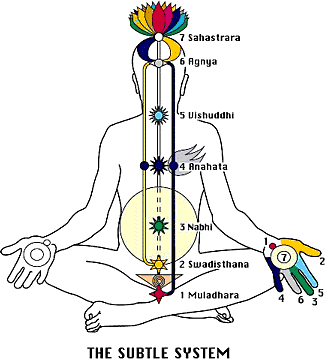
This blessed Tree has a Thousand Petals, with its trunk
and roots connecting all parts of the human body. The Thousand Petals of
this Tree are found spread all over the cerebrum. The trunk of this Tree
is the spinal cord (central nervous system or the sympathetic and
parasympatethic nervous system) growing from the base (Mooladhara Chakra)
upwards to the branches (Agnya Chakra) and leaves (Sahasrara Chakra). The roots of this Tree are the
nerves (nadis) and the root caps are the nerve endings.
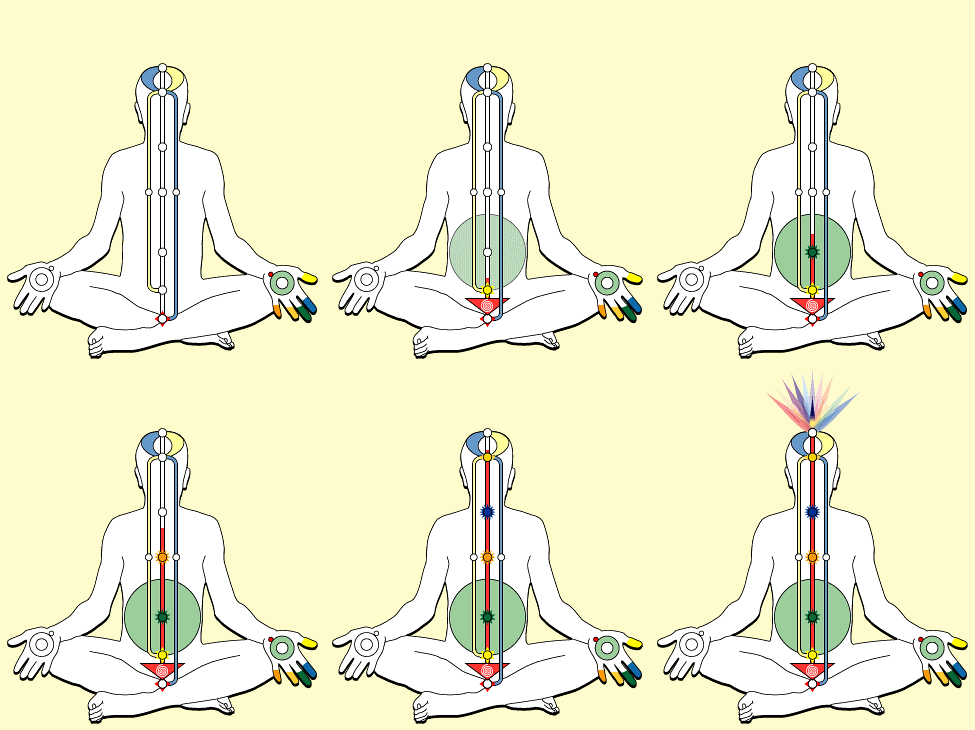
When the Kundalini is activated by the
Baptism
of Allah, it
travels from the base of the spine all the way up to the brains to
enlighten the seeker. "Lit from a blessed Tree" is nothing but
the Kundalini, which is part of the Tree of Life, connecting the human
being with Cosmic Consciousness. Once illumined, the mind
of the Believer begins to shine like a distant star, a beacon of Light,
hope, and guidance to all others in this Age of Qiyamah.
The actual way this natural phenomenon takes place is
not easily or quickly understood as it takes time and experience to grasp
this unique spiritual evolution taking place within, a
transformation that has no previous written records or points from which
to take bearings. Sahaja Yoga is a spiritual experience that far surpasses
anything known to humankind, a very subtle subject that requires patience,
maturity, and Knowledge.
This is
also the very first
time the human race is being told in detail about Allah's Allahs's
Signs in their own souls.
Nothing much was written about this subject before!
Moreover, since Shri Adi Shakti: The Kingdom of God is an unprecedented spiritual research based on Her Revelations,
Miracles, Knowledge, Truth and Prophecies, this new Knowledge takes time
to filter into the minds and history of humankind. For example:
"When the fetus is about 2-3 months old in mother's
womb, the column of rays of Consciousness emitted by the All-Pervading
Divine Love pass through the brain to enlighten it.
The shape of the human brain being prism-like, the column of rays falling
on it gets refracted into four diverse channels corresponding to the four
aspects of the nervous system. They are parasympathetic nervous system,
sympathetic nervous system (right
channel), sympathetic nervous system
(left channel), and central nervous system.
|
"The
vibratory energy pervading the entire universe is
designated by the Sanskrit word Paramchaitanya. At a
human level, it is stored in a latent state in the
sacrum bone in the form of Kundalini. When the human
embryo has reached two or three months, a pencil of
vibratory energy penetrates through the fontanelle
zone. The prism-like shape of the brain determines the
pencil to be divided into four rays: one of them
penetrates the parasympathetic system and is placed as
residual energy in the sacrum bone, while others are
directed towards the left sympathetic system, the
right sympathetic and the central nervous system.
Peter Russel reached the conclusion that the genetic
programme of the universe is reflected at a human
scale. The evolution of the foetal brain takes place
during the interval between the 8th and
the 13th week of pregnancy. The genetic
programme controls the 14 thousand million nervous
cells (the number is supposed to be much higher after
others) resulting in the creation of the brain as an
organ. The quantitative generating process is suddenly
interrupted during the 12th week when the
cells start making an increasing number of
connections. At the moment of birth each and every
cerebral neuron is connected to other cells through
approximately one thousand connections, to be later
increased to about one quarter of a million
connections with other cells in the period of
maturity."
|
Dan Costian, Bible Enlightened
|
The sets of rays that fall on the fontanel bone
pierce in the centre and pass straight into medulla oblongata
through a channel (Sushumna). This energy, after leaving a very
thread like thin line in the medulla oblongata, settles down in
three and a half coils in the triangular bone placed at the end of the
spinal cord (Mooladhara). This is known as Kundalini.
The subtle energy enters through the center of the
brain (Brahmarandhra) and precipitates six more centres on its way down.
The gross manifestation of this subtle energy, in the Sushumna
channel of the spinal cord, is termed the parasympathetic nervous system.
The centres of Chakras are expressed as plexuses outside the
spinal cord. Surprisingly, we have the same number of plexuses and sub-plexuses
outside as the number of Chakras and their petals inside the spinal
cord. Medical science knows very little about this system ...
Later, when ego and superego bloat up like balloons and
cover our brain at the apex of the right and left sympathetic nervous
systems, the fontanel bone calcifies and the All-Pervading vital
force of Divine Love gets cut off completely. Then the human being
identifies himself as a separate entity and the consciousness
"I" presides. This is why Man does not know his Universal
Consciousness. His ego severs this subtle connection."
Shri Para-saktih Shri Nirmala Devi
(Para-saktih
[572nd]: The Ultimate Power. Vasistha-Samhita says: "That there are
nine tissues in the body and the 10th tissue in it which vitalises the
other nine is called Para Sakti." 'Parasya-Saktih, Vividhaiva
Sruyate'-(Svetasvataropanisad Upanisad 6-8). Many are the forms of
this Ultimate Power... "The energy manifested in every matter is
She, the Power, the Ruler of this Universe. The Great Lord possesses that
Power. Every matter that possesses that Power is Siva and every power in
matter is known as 'Gauri' by the wise." Linga Purana.)
And the Qur'n proclaims the
same Truth:
O mankind! if ye have a doubt about the
Resurrection,
(consider) that We created you out of dust, then out of sperm,
Then out of leech-like clot, then out of a morsel of flesh,
Partly formed and partly unformed,
In order that We may manifest (Our Power) to you;
And We cause whom We will to rest in the wombs for an appointed term,
Then do We bring you out as babes,
Then (foster you) that ye may reach your age of full strength;
And some of you are called to die,
And some are sent back to the feeblest old age,
So that they know nothing after having known (much.)
surah 22:5 Al Hajj (The Pilgrimage)
(Abdullah Yusuf Ali,
The Holy Qur'n, 1989.)
"To connect us to this subtle energy which
permeates into every atom and molecule, there is also a Power of Pure
Desire which is placed in the sacrum bone of human beings, which is called
as Kundalini. Kundal means coils. It exists in three and a
half coil. There is a Divine mathematical coefficient about three and a
half coils."
Shri Sakalagama-Samdhoha-Sukti-Samputa-Mauktika
Shri
Nirmala Devi
"This triangular bone is called sacrum,
that means people in Greece in the ancient times knew about this Divine
sacred Power of Kundalini. That is why they called this bone
sacred. This sacrum bone is placed at the base of the spinal cord and it
is triangular in shape."
Shri Nada-rupa Shri Nirmala Devi
(Nada-rupa [299th]:
There are 4 states of Nada. From Para the subtlest to Vaikhari
the grossest, Nada itself being the primordial stress in
Consciousness. She is these four forms of stress, which comprise the Nama
aspect of the Universe, Sabda-Brahman, Rupa itself being Siva.)
"The Kundalini is like a connecting cord as
in every piece of electrical machinery, which connects the machinery to
the main source of electricity. In the same way, when this energy of Kundalini
is awakened, threads rise and ultimately connect the human being to
the All-Pervading Power."
Shri Varnasrama-Vidhayini Shri Nirmala Devi
(Varnasrama-Vidhayini
[286th]: Law-giver of the form of caste and orders of life. As Vedamata
She has laid down the code of conduct of social life to the four Varnas
and four Asramas for the ultimate spiritual well-being of the
people.)
"A pulsation is sometimes seen at this during Kundalini awakening. Like the
Sushumna, the Kundalini is normally
in a potential state. When it is awakened it ascends through the Sushumna,
across the Void, to the top of the Sushumna. When the
Kundalini emerges at this point, Yoga is said to have taken
place. Yoga is impossible without Kundalini awakening."
Shri Sri-Siva Shri Nirmala Devi
(Sri-Siva [998th]: The sacred spouse of Siva.)
"This happening of Kundalini awakening and
ultimate union with a Higher Consciousness are described by a Sanskrit
word Sahaja. This means literally born with or spontaneous. The implication is that the entire mechanism is inborn
and is activated in a spontaneous and natural way without undue or extreme
efforts. One analogy often used is the germinating of a seed. This happens
automatically when the seed is placed in the Mother Earth."
Shri Heyopadeyavarjita Shri Nirmala Devi
(Heyopadeyavarjita
[304th]: Having nothing to reject or accept. Beyond dualism - being the
only One, there is no second either to be accepted or rejected.)

An Olive, neither of the East nor of the West
An Olive, neither of the East nor of the West,
[3001]
And he shewed me a pure river of water of life, clear as crystal,
Proceeding out of the throne of God and the Lamb.
In the midst of the street of it, and on either side of the river,
Was there the Tree of Life,
Which bare twelve manner of fruit every month:
And the leaves of the tree were for the healing of the nations.
Revelation 22:1-2
A breath which comes from this world shakes the branches of the
Tree of Life,
Which spreads the fragrance of the future world in this world,
And brings the holy souls alive.
These souls come up waking each other ...
And the Tree of Life rejoices.
The Zohar III, 1731
("The Zohar"
III, 1731 in "Le Livre de la Splendeur", pages de livre de Zohar
choisies par Edmond Fleg, trad. par J. de Pauly, ed. J.C. Lattes, Paris 1980.)
There is a tree, the root of Transmigration, the Asvattha Tree everlasting.
Its branches spread from earth to heaven, and the powers of nature give them
life.
Its buds are the pleasures of the senses.
Far down below, its roots stretch into the world of men, binding a mortal
through selfish actions.
Men do not see the changing form of that tree, nor its beginning, nor its end,
nor where its roots are.
But let the wise see, and with the strong sword of dispassion let him cut this
strong-rooted tree, and seek that path wherefrom those who go never return.
Such a man can say: 'I go for the refuge of that Eternal Spirit from whom the
stream of creation came at the beginning.
Because the man of pure vision, without pride or delusion, in liberty from the
chains of attachments, with his soul ever in his inner Spirit, all selfish
desires gone, and free from the two contraries known as pleasure and pain, goes
to the abode of Eternity.
Bhagavad Gita 15:1-5
"Another important point which Krishna made is
that roots of the Tree of Human Awareness are in the brain. As such, if
awareness descends or grows downwards towards the lower energy centres
like Mooladhara, the persons get involved in too much sex. So
instead of evolution of awareness there is descent. So for the nourishing
the Tree of Human Awareness ... is only possible after Kundalini
awakening and piercing the anterior fontanel area. Only then
ascent
can take place."
Shri Bhuvanesvari Shri Nirmala Devi
(Bhuvanesvari
[294th]: The Queen of the Universe consisting of fourteen Bhuvanas
or the Deity of the Mantra-bija.)
"In
the 15th Chapter of the Bhagavad Gita there is a description of the
'Imperishable Tree' ... He who knows this Tree knows the truth. This
Tree is existing in the structure and function of the human body and
nervous system. One must know and climb this paradoxical Tree to arrive at
the truth ...
It cannot be understood intellectually, but only
through progressive spiritual awakening, for spiritual understanding
always dawns in a way which is paradoxical and irrational to the faculty
of the intellect. This same Tree is called the 'Tree of Life' in the
Kaballah and the 'Tree of Knowledge' in the Bible. Its understanding
forms the basis of both Christian and Judaic religious traditions, but
unfortunately it has been completely misunderstood by and large, for a
very long time."
Swami Satyananda Saraswati,
Kundalini Tantra
(Swami S.
Saraswati, Kundalini Tantra,
Bihar School of Yoga, 1984, p. 23.)
Enlightened interpretation of note 3001
The Tree of Life
This Tree of Life (human subtle system) bears an Olive, the Fruit of Absolute
Truth and Supreme Knowledge in the form of His Spirit. Only those seeking the
Truth of Allah can taste this mystical Olive, for it neither belongs to the
Eastern religions of Hinduism, Buddhism or Sikhism nor the Western ones of
Judaism, Christianity or Islam. Those who seek to find it in religious
institutions will never succeed as it does not exist in any of them, but is
within their own beings. (So what is the use of seeking it from the preachers of
organized religions who have absolutely no idea about it?)
The finest minds of Islam have for centuries swoon at the sheer
magnificence of this parable, and praised the olive and the properties of its
oil to high heaven. We must again read the cream of Islamic enlightenment
revered by the Ummah for 14 centuries:
3001.
"The
mystic Olive is not localised. It is neither of the East nor the West. It
is universal, for such is Allah's Light. As applied to the olive, there
is also a more literal meaning, which can be allegorised in a different
way. An olive tree with an eastern aspect gets only the rays of the
morning sun; one with a western aspect, only the rays of the western sun.
In the northern hemisphere the south aspect will give the sun's rays a
greater part of the day, while a northern aspect will shut them out
altogether, and vice versa in the southern hemisphere. But a tree in the
open plain or on a hill will get perpetual sunshine by day: it will be
more mature, and the fruit and oil will be of superior quality. So Allah's
Light is not localised or immature: it is perfect and universal."
Abdullah Yusuf Ali, The Holy Qur'n
"Pure
olive oil is beautiful in colour, consistency, and illuminating power. The
world has tried all kinds of illuminants, and for economic reasons or
convenience, one replaces another. But for coolness, comfort to the eyes,
and steadiness, vegetable oils are superior to electricity, mineral oils,
and animal oils. And among vegetable oils, olive oil takes a high place
and deserves its sacred associations. Its purity is almost like light
itself: you may suppose it to be almost light before it is lit. So with
spiritual Truth: it illuminates the mind and understanding imperceptibly,
almost before the human mind and heart have been consciously touched by
it."
Abdullah Yusuf Ali, The Holy Qur'n
And that's serious spiritual enlightenment for hundreds of
million followers! Ordinary Italian and Greek chefs know more about
olives than all Muslim scholars put together. Surely Allah had far higher
expectations after so many centuries of collective brainstorming by the
best minds Islam could produce. Is this enlightenment for the Muslim
masses?
Their religious rivals - Hindus, Christians,
Buddhists, Sikhs and Jews - are only marginally better. Except for a
minority of Hindus and Buddhists most of them are still seeking salvation
from external Idols where He does not live.
This Olive (Holy Spirit) is now available to those who
can go beyond the limitations of religion and mind; those who believe in
the One Allah, the One God Almighty, the One Universal Self, the One
Creator; those who accept all His Messengers; those who do not divide and
rule His Human Family; those who
seek His Dominion within, those who feel the Winds of Resurrection
blowing; and those who know that this is the Time of Qiyamah.
This Divine Fruit (Ruh of Allah) is beyond all
religions, beyond the rational mind, beyond all known knowledge - beyond everything. Only those
surrendering totally to Allah will meet His Ruh who then leads them ever
onwards towards Eternal Life. This total surrender is only possible in the
purest state of 'thoughtless awareness', where even thoughts are
surrendered to Khudda.
The awesome Reality and
boundless Glory
of Allah's Spirit within totally enlightening humans into absolute Islam is
the state of supreme surrender - all other forms of surrender being
either forced by persecution or based on ignorance, fear, falsehood, delusion or just
plain pretension. As long as human mind has thoughts that judge, deceive, lust, scheme,
conjure and delude day and night, there is no surrender.
Surrender is an
absolute state - every minute, 24-hours a day, seven days a week and 365
days a year - where one knows for sure that the
Allah is witnessing every deed, hearing every word, and knowing every
thought. This awareness is so acute that every effort is made to hold the
tongue before it judges, shutter the ears to gossip and slander, direct
the eyes away from lust, and silence the mind to all that displeases Him. This is the Islam (surrender) of Allah and not what the mullahs and muftis
have conditioned the Muslims to believe.
The Ruh of Allah Shri Mataji Nirmala Devi has revealed
the gaping flaws of religious regimes which subdue and imprison humans in a maze of dogmas, doctrines,
distortions, divisions, theologies,
taboos, falsehoods and fallacies. For example, Her direction to all Hindus
that they should not worship idols or be vegetarians is
profound proof of Her dedication to Truth, no matter what adverse
reactions are aroused by such sensitive matters. Neither are the egos of
Christians, Muslims, Buddhists, Sikhs, or Jains pampered - the plain
Truth is announced with any fear or favor. Thus the Ruh of Allah also
neither belongs
to neither the decaying religions of the East nor West.
Shri
Mataji Nirmala Devi has
announced that there will be no Hinduism, Buddhism, Sikhism, Jainism,
Taoism, Shintoism, Baha'ism, Judaism, Christianity or Islam after the
year 2000 - all of them will begin to self-disintegrate against the
Truth of the Resurrection revealed by Her.
In
this Golden Age no religious regime
will be allowed to mislead and divide and rule the children of Allah
anymore. It has been prophesied that God "shall wipe away all tears
from their eyes; and there shall be no more death, neither sorrow, nor
crying, neither shall there be any more pain: for the former things are
passed away" (Rev. 21:4.) This prophecy is being fulfilled as these
lines are read.
"You have to run in the way of the Roots, of the
Branches, of the Leaves, of the Flowers and of the Fruits. You have to be
the essence of the Tree that nourishes and not just the outside leaves
with wrong ideas about your Self ... Now it is Time to jump from the
little area to the vast area which has no bounds ... because you belong
to a Tree of Great Wisdom, Tree of Great Sustenance and Religion, and Tree
of Great Mastery, the Mastery that you can never know how great it is. You
belong to a Tree that has complete security for you, and you belong to a
very Great Tree which gives you complete witnessing of the Drama, and
which gives you understanding that the Whole is part and parcel of you,
and you are part and parcel of the Whole.
So you belong to the Great Ocean of Love and
Generosity. So this Great Tree of Life has everything integrated within
itself. This is the Tree of Life that has been described in the Bible -
the Tree of Fire they call it. Now, you have become One with it. You are
Blessed by it. You are Loved by it. You are gently Guided by it. It is so
gentle that you do not even feel the Guidance, like a leaf when it falls
to the ground it doesn't make any sound. Try to become identified with
the Power; that is what you are. Like the meaning of the word is
identified with the Word; like the moonlight is identified with the Moon;
sunlight is identified with the Sun. Let that identification be the
Oneness, that integration, so that you become the Light of God's Love,
that people know God through your depths and your fruits. It is the most
fulfilling job, highest paid in every way, the most satisfying, energy
giving, and dynamic. You don't have to give up anything. Just be
organized in the Light of your Spirit yourself."
Shri Ramya Shri Nirmala Devi
Shri Krishna Puja, Switzerland - August 28, 1983
(Ramya [307th]:
The beautiful.)
"The instrument of our enlightenment is framed on
a structure of three main channels or Nadis. These subtle channels
are placed within the spine and find their expression in the
automatic nervous system which comprises the left and right
sympathetic nervous systems, and central parasympathetic nervous
system."
Shri Ambika Shri Nirmala Devi
(Ambika
[295th]: The aggregate of the three powers of will, action and knowledge
which is the name of Sri-Tripura-Sundari, The Mother. Ambika
being a diminutive and an endearing term of Amba, meaning Sri-Bala-Tripura-Sundari.)
Whose oil is well-nigh luminous, though fire scarce touched it;
[3003]
Their intention is to extinguish Allah's Light with
their mouths:
But Allah will complete (the revelation of) His light, even though the Unbelievers may detest
(it.) Surah 61:8 Al Saff (The Battle Array)
Enlightened interpretation of note 3002
Immediately following the Baptism of Allah (Self-Realization), the believer
begins physically, emotionally and spiritually experiencing Allah's
presence within. Upon Kundalini awakening the Divine Vibrations
(the luminous oil) of His Ruh (the Olive) begins to flow and permeate the
seeker, and begins the spiritual cleansing from within. These
humans begin to radiate an aura of Light visible only to those with gifted
eyes.
Hardly has the Fire (the Kundalini) coursed through the
Tree of Life (the subtle system) and touched this Oil in the Olive, the
Divine Vibrations (Paramchaitanya) are increasingly felt on the
hands and head, spreading through the entire body which begins to glows
with a spiritual health welling from within. The body is cleansed,
heart healed, eyes purified and mind enlightened. Allah absolutely assures
that He is indeed closer than the vein of the neck, and that His
Light shines forth, and that He lives within! For the first time
ever God Almighty is felt living within oneself! Surrender is
total. This is Allah's Islam.
The Wind of Resurrection are felt daily and the True
Believers (Al-Mu'minun) physically experience Al Qiyamah.
The evidence of the existence of His Ruh within manifests, from an
instant to a few months, depending on the purity of both heart and mind.
Slowly the Cool Breeze increases in intensity, firmly establishing the
seeker in Truth. These enlightened soul emit stronger and stronger
vibrations which are picked up by other Self-realized souls. There are
many ordinary humans who emit good vibrations but only their ignorance
shroud their extremely beautiful inner selves.
There are many stages of enlightenment and states of
mind, with the Kundalini slowly guiding the seeker to the Divine World of
Reality (Lahut). They are all inter-related in very complex ways,
beyond the scope of human faculties to comprehend, and the Parable of the
Light is just a simple explanation to the unfathomable inner Reality. As
the Light in the mind begins to increase in luminosity they begin to see
further and further into the distance, slowly expanding their
consciousness to encompass the infinite Universe, Eternity and the Great
Circle of Life. These are the people who are "born of the
Spirit."
"As human awareness is united to the Divine, we
move into the subtlest level of communication into Collective
Consciousness. In becoming vessels of that Universal Power we become One
with all the other vessels. We learn to appreciate the real depth and
beauty of another person in vibrations. The beauty of art and Nature now
manifests itself as vibrations. We no longer judge on opinions, but on
vibrations. Just ask the question and a positive answer comes as a flow of
cool vibrations. Sit as for meditation and ask the vibrations. It is
conversation at its most sublime."
Shri Chintamani-Grhantastha Shri Nirmala Devi
"The Koran mentions the Cool Breeze in connection to
the Resurrection: "It is Allah Who sends the winds... . As such
(will be) the Resurrection." ("The Noble Quran" 35.9, Hilal
Publishing House, Istanbul, 1994, p.700.)
At the time of Kiyama (Resurrection Time) "we shall seal up their
mouths and their hands will speak to us, and their
legs will bear witness to what they used to earn" ("The Noble
Quran" 36.65, Hilal Publishing House, Istanbul, 1994, p.713.) This is
precisely what happens in Sahaja Yoga, when our entire inner system can be
felt on our fingertips. Everything that we do which goes against our
Spirit manifests on our chakras, and can be felt on our palms after we get
our Self-Realization. The Koran (ibid. for instance: 2.87; 42.52 etc.)
also makes many references to the Ruh (or Ruah), the Breath of God,
which is the same as the All-Pervading Power in Hinduism and the Holy
Spirit in Christianity. Its reflection in the human being is the Kundalini."
http:
//www.halcyon.com/sahajnet/
"On first awakening Kundalini ascends Sushumna Nadi up to the Agnya
Chakra. It covers the lower
plate of the main, then descends like melting clouds on the Ida and Pingala
Nadis to the Void. It fills this area and then the
three combined Powers of Mahakali, Mahasaraswati, and Mahalakshmi re-ascend
the Sushumna to open the Lotus Petals of the Sahasrara. The
Spirit, residing in the heart, has its seat at the top of the head in the
centre. All the Chakras (energy centres) have their seats in
the Sahasrara. This is the fontanel area that is pierced by
the Kundalini, the point of Yoga at which the attention
is united to the Spirit - the Brahmarandhra, the hole into the Brahman."
Shri Maha-padmatavi-samstha Shri Nirmala Devi
In order to understand the parable of the Niche of
Light better the Quranic verse on the Baptism of Allah will be examined as
both verses lead to the same Truth. Both surahs reveal the actual
beginning of the spiritual transformation of humans.
The Baptism of Allah;
And who can baptise better than
Allah?
And it is He whom we worship.
surah 2:138 Al Baqarah (The Heifer)
Abdullah Yusuf Ali, The Holy Qur'n, Amana Corporation, 1989.
The Baptism
of Allah for Muslims is the same 'second
birth' for Christians; the same 'dwija or twice born' for Hindus;
the same 'opening of the Dsam Duar' for Sikhs; the same
Self-Realization, Satori, gnosticism, and fana of advanced spiritual
seekers. They seemingly different paths are all one and the same, with no
difference whatsoever as far as the pursuit of the Spirit is concerned. It
is just that the human race has been divided and fragmented by the
religious Idols, too brainwashed and conditioned to confirm the same Truth
in other Holy Books.
Due to the endless layers of subtle spiritual Knowledge
leading to the Ultimate Reality (Al-Haqqah), it cannot be explained
or conceptualized with any amount of words. The entire Shri Adi Shakti:
The Kingdom of God just wakes humans from their spiritual slumber.
Only individual experience, introspection, meditation, and the sustained
state of thoughtless awareness will peel off the conditioning and
misconceptions of the religiously mummified human.
Each and every individual will have to take his or her own journey,
getting rid of all earthly impurities like hate, lust, anger,
covetousness, greed, falsehoods and the like along the way. This
thoughtless state to destroy even impure thoughts is a inner cleansing like no other
as "thoughtless awareness is the first beautiful state you have to achieve
that will give you peace and a witness state to enjoy the drama of life,
to enjoy the different varieties of people, while you will be growing within
yourself. For a Sahaja Yogi, it is important not to see the faults
of others, but your own faults and correct them." The human soul has to be
pure to attain eternal Afterlife and live in the Kingdom of Allah, for the
spirit is devoid of all such earthly scum.
This subtle Knowledge of the Spirit may only be
understood in progressive stages, and then linked together to bring forth
illumination. There are no crash courses or human instructors. Every human
will learn from their own Self, their own Spirit, their own Kundalini,
their own Inner Guide. They have to become their own masters, never again
to be dominated by any external force. You will know the Truth and the
Truth will set you free. This is the essence of His Grace to all His
children during the Resurrection. The Age of Aquarius compels humans to
free themselves from all religious delusion by becoming their own gurus: The
only way is by seeking Divine Guidance from within their own being,
from the Spirit:
"Thus, you understand there are two things that
have happened, that first, your Mother, your Kundalini which is in
you, which is your own Mother, which has been with you throughout, has
given you this birth and then it has taken to that Power, which Power you
can use yourself. You're empowered by that. You'll be amazed how this
Power helps."
All these subtle spiritual awareness will only be known
through Self-experience, for no amount of verbal explanation will clarify
this subtle Truth. Humans understand the meaning of grief, joy, hate,
happiness and other feelings for they have experienced them constantly all
their lives. But how to explain so rare an experience as Self-realization, a genuine actualization possible only since
the Sahasrara chakra was opened on May 5, 1970.
Self-Realization is an actual evolutionary process that
manifests from within, and has to be felt physically. By
physically we mean exactly what the scriptures say about this
phenomenon, that is this Divine Wind from within has to be experienced. And we don't mean a
flash-in-the-pan type of experience. It has to last a lifetime! Yes, for
the rest of earthly life!
Sprinkling some water or being born in a brahmin family
does not confer born again status, as many Christians and Hindus are led
to believe. Shri Mataji Nirmala Devi has stressed that the Christian
baptism is just an empty ritual with absolutely no benefit at all. It is
as real as Santa Claus that children believe and later realize to be a
collective commercial lie. So will it be in this century
when they become adults and realize baptism to be a collective religious lie.
"When Kundalini reaches Sahasrara,
the Lotus Petals open and enlightenment takes place. You may feel a
powerful pulsation in the crown of the head, followed by a melting
sensation and a flow of cool vibrations from the fontanel area.
This is the baptism by which you know you are truly born again."
Shri Ramani Shri Nirmala Devi
Light
Upon Light!
Light upon Light!
Allah doth set forth parables for men:
And Allah doth
know all things.
Enlightened interpretation
Light upon Light! The flame upon Fire! The spirit upon Spirit! Individual
consciousness upon Cosmic Consciousness! The soul upon Supreme Soul! The
drop upon Ocean! The finite upon Infinite!
Self-Realization is a spiritual
experience that begins the final journey to the next Divine Dimension -
the Spiritual Worlds; the Promised Paradise; the Kingdom of the Creator; the Realm of the Spirit; the Pure Land of
Amitabha!
On
Earth the devotees prepare themselves for the metamorphosis into the
spirit, cleansing their mind, body and soul of all impurities. As they
ascend in spiritual consciousness all worldly desires are discarded as the
nourishment of the Great Holy Spirit begins to fill them with a Bliss,
Joy, and Truth, subtly destroying all anti-spiritual desires. It is truly
the enlightenment of the inner self and union with the Universal Self, the
light upon Light! Only those who have witnessed HIis Light in the Sahasrara
- the Kingdom of God; the Niche of Light; the Thousand-Petal Lotus
- know its awesome splendor.
"When your Sahasrara Chakra opens
and the Kundalini reaches the top of your head, a type of spark
becomes ready and as soon as the air of the fontanel expands in the
Brahmarandhra, the grace of the Spirit enflames the latent fire and
your Nadis illuminate themselves. Not all of them, but a good
number. Not along most of their length, but along their contour. This is
how you obtain illumination. Many things may happen, thanks to the seven
centers of the Sahasrara: this Light enables you to see them, or
actually you do not see them but they take place in your conscience, and
this conscience opens in a self-integration."
Shri Brahmani Shri Nirmala Devi
(Brahmani
[821st]: By 'Brahma' is meant the 'nandamaya-Kosa' and 'ni'
means the tail or 'Pucchagra.' According to sruti 'Brahmapuccham
pratistha' She dwells in the tail of 'nandamaya-Kosa' or 'ni'
means one who moves the Reality to action, i.e., indwelling Power of
Reality.)
Kash was again inquired about this Light on October 8,
1996, at 3:40 p.m. He reiterated that it is very brilliant and covers an
indefinite area; that he could not determine if it was endless as he never
saw the end of its limit. However, the luminosity is much more dazzling
than the brightest sun ever witnessed on Earth. His brother, Arwinder, was
also asked the same questions and he confirmed the same facts as Kash;
that it very much brighter than the day light on Earth and had no idea how
far it spread.
The previous recorded notes on Allah's Light, as
witnessed by Kashwinder and Arwinder, are as follows:
Noted on the very first day of Self-Realization, early
November 1993:
Kash told that the very instant he went into meditation
he found himself standing on a soft carpet of clouds - hues of blue and
white not seen on Earth - spreading in all directions as far as the eye
could see. There was a very bright Light shining above and illuminating
the entire vastness. In spite of its dazzling brilliance he could gaze at
it without hurting his eyes. He stood there in peace and bliss, looking
around in amazement and awe at the tranquility and stunning beauty of the
surroundings. For a long time he continued gazing around this strange
serene land, wondering where he really was. Kash did not even take one
step in any direction. The sheer splendor of this boundless space
illumined by a single dazzling Light and baffled by his inability to
comprehend where he was, kept him rooted to one spot.
After gazing around for about twenty minutes Kash
closed his eyes again, and descended back to Earth.
His ignorant father just took it as a figment of a
child's imagination.
Kash's narration of the Light after a few months:
There is a very bright, brilliant white Light that is
always behind and above Shri Adhiparasakthi Shri Nirmala Devi. In spite of
its dazzling brilliance one can look at it without ever hurting the eyes.
Kash said that he could not determine the distance, size, or exact
location for reasons unknown. At the Great Adi Shakti's place the sun,
moon and stars do not exist. This Param-jyotih (Supreme Light)
is only seen at Her Abode and nowhere else.
Arwinder's narration of the Light more than a year
later:
On April 7, 1996, Arwinder was asked if he had seen any
sun or light when meditating with the Great Celestial Mother. He
immediately said that there was always a Light at Her place but it's not
the sun. He was sure of the difference as this Light, though extremely
bright, did not hurt the eyes. He added that unlike the Earth sun that
blinds his eyes easily, one can look at this Light for as long as
possible. However, he could not remember if there were shadows or not, as
it had happened too long ago.
Arwinder's narration of the Light after three years
later:
On February 23, 1998, at 11.40 a.m. he was again asked
about this Light above Shri Mataji Nirmala Devi. He reconfirmed that it
was always above Her. He was then asked if there were shadows or not. This
time he immediately replied that there were none. He was asked if he was
very sure. He replied he was.
Again, on July 10, 1998, at 10.35 a.m. Arwinder was
posed the same question as to whether this Light caused any shadows. Again
he replied there were none. He was absolutely sure.
Their intention is to extinguish Allah's Light with
their mouths:
But Allah will complete (the revelation of) His light,
Even though the Unbelievers may detest (it.)
surah 61:8 Al Saff (The Battle Array)
Abdullah Yusuf Ali, The Holy Qur'n, Amana Corporation, 1989.
"The Sat is the Purusha, is the God
who does not take actual part in the creation itself, but acts like a
catalyst. The example can be like this that I am doing all the work, I am
creating everything, but I have a Light in My hand. Without the Light I
cannot do anything. Light is the support of My Work. But the Light does
not in any way do anything about what I do. In the same way God Almighty is just the Witness, like a Light."
Shri Kamasevita Shri Nirmala Devi
GRuha Lakshmi,
Diwali Puja, U.K. - Nov. 1, 1981
"As it is, on top of your head here, resides the God Almighty,
Sadashiva. So when Kundalini touches that point your
spirit gets awakened and the Light of the Spirit starts spreading and it
starts acting on your central nervous system because automatically the
vibration, the Chaitanya flow into your brain to enlighten your
nerves."
Shri Gagananta-stha Shri Nirmala Devi
Realize Your Own Divinity, Italy - May 5,
1991
"References to Kundalini awakening, also
called as Self-Realization, are seen in many ancient scriptures of all the
religions. But the way in which most great prophets wrote made it hard to
understand exactly what they were writing about. Nothing is blatantly
stated and the Truth can often be ingeniously hidden. Unless one has
Self-Realization this Knowledge of the Divine could be misinterpreted. It
is only with Self-Realization that one can receive the total Joy of a
great soul's prediction of Sahaja Yoga."
Shri Ranatkinkini-Mekhala Shri Nirmala Devi
"The nature of the Spirit is that it is an
Universal Being within every individual. As there is one God Almighty His reflection on every human heart is the same, but the
reflection of the Spirit varies because of the different type of
reflectors. When this Spirit, which is the source of Joy and Truth, is
connected through the Kundalini the human attention becomes
enlightened. Thus one knows the Absolute Truth on our central nervous
system and becomes a joyous collective being. The Spirit is reflected in
the heart but the seat of God Almighty is above the fontanel bone
area, above the apex of the head.
After this living force of Kundalini is
connected to the All-Pervading Divine Power within a human being,
it starts developing the spirituality of a person. One touches the
spirituality within oneself, and grows into another dimension -
the Fourth One.A1
Thus, a saintly and wise personality
develops. The personality is the one which is unfolding itself naturally,
spontaneously. But also by knowing how to handle this All-Pervading Power
through the Knowledge of Purity one can evolve in a much faster way into
that Dimension.
Once the Spirit starts shining fully in one's
attention one actually becomes enlightened in the sense that one can see
for oneself that one becomes one's own Guide, one becomes one's own
Master. Then you don't need any guide, but you are the Master of your
Self. In the past this process was limited to one or
to very few persons but now a phenomena to allow en masse Realization was
discovered about twenty years ago.
|
"There
is the possibility that in the swing back from a mechanistic idea of life
and society the human mind may seek refuge in a return to the religious
idea and a society governed or sanctioned by religion. But organized
religion, though it can provide a means of inner uplift for the individual
and preserve in it or behind it a way for his opening to spiritual
experience, has not changed human life and society; it could not do so
because, in governing society, it had to compromise with the lower parts
of life and could not insist on the inner change of the whole being; it
could insist only on a credal adherence, a formal acceptance of its
ethical standards and a conformity to institution, ceremony and ritual.
Religion so conceived can give a religio-ethical colour or surface tinge,
- sometimes, if it maintains a strong kernel of inner experience, it can
generalize to some extent an incomplete spiritual tendency; but it does
not transform the race, it cannot create a new principle of the human
existence. A total spiritual direction given to the whole life and the
whole nature can alone lift humanity beyond itself. Another possible
conception akin to the religious solution is the guidance of society by
men of spiritual attainment, the brotherhood or unity of all in the faith
or in the discipline, the spiritualization of life and society by the
taking up of the old machinery of life into such a unification or
inventing a new machinery. This too has been attempted before without
success; it was the original founding idea of more than one religion: but
the human ego and vital nature were too strong for a religious idea
working on the mind and by the mind to overcome its resistance. It is only
the full emergence of the soul, the full descent of the native light and
power of the Spirit and the consequent replacement or transformation and
uplifting of our insufficient mental and vital nature by a spiritual and
supramental supernature that can effect this evolutionary miracle."
|
|
|
All such enlightened people follow a religion which is
called as Vishwa Nirmala Dharma, meaning the innate Pure Religion within us. These people have actualized the enlightenment. They have
actualized the baptism because they feel the Cool Breeze as Kundalini
pierces through the fontanelle, and thus have become religious
saints, Yogis, Yoginis, and seers - they are not like
ordinary people - who know themselves within and know others in
Collective Consciousness. They are the people who have achieved a state in
which they know on their central nervous system that they are part and
parcel of the Whole. It is not blind faith or lip service built of empty
words. This is the subtle Knowledge of the Roots.
All the trees of modern civilization have grown
outside. If we do not go to our roots and find out the fundamentals of our
existence, these unbalanced, crazily expanded civilizations are going to
be destroyed. It is very important and imminent that the world should try
to take this attention towards finding out its roots. It is described in
every scripture in some way or another, and has been extensively described
in Indian scriptures ...
When the Kundalini is awakened the ten valances
are awakened within. The religion becomes innate and our whole
priorities change. For the religion in Sahaja Yoga is the Ultimate
of every religion of any form. It is not limited to one religion, but it
has the best of all the religions. All real religions are leading to one
aim, to one goal. That goal is to achieve Self-Knowledge through our
second birth. In Sanskrit language a bird is called as a Dwija -
twice born - because first it is an egg, then it has second birth. In
the same way a person who is enlightened and has known the Brahma
is also known as Dwija.
This Dharma which is innate within us is
awakened, by which they know that all the religions have come out of One
Source of spirituality. Anybody might come from any religion to Sahaja
Yoga. They all know that we belong to One Religion, and that is the
principle of all the religions. So there is no question of fundamentalism
amongst Sahaja Yogis. There is no fighting or quarreling. Everyone
can see very clearly whatever religions they have followed so far, where
they have deviated, and what was wrong they have been doing ...
One has to understand that this Religion is the essence
of all the religions. It is the only Religion that gives the real
experience within oneself, which puts into one that sensitivity for
spirituality which cannot be got out of any number of lectures, sermons or
books. Thus a Sahaja Yogi knows and respects all the Incarnations
and saints."
Shri Rajivalochana Shri Nirmala Devi
LAA
UQSIM BI-YAWM AL-QIYAMAH;
WA-LAA UQSIM BI-AN-NAFSAL-LAWWAAMAH
I do
call to witness the Resurrection Day;
And I do call to witness the
self-reproaching Spirit.

NEXT STORY
—>