Self-Gnosis: The Knowledge of God
Summary
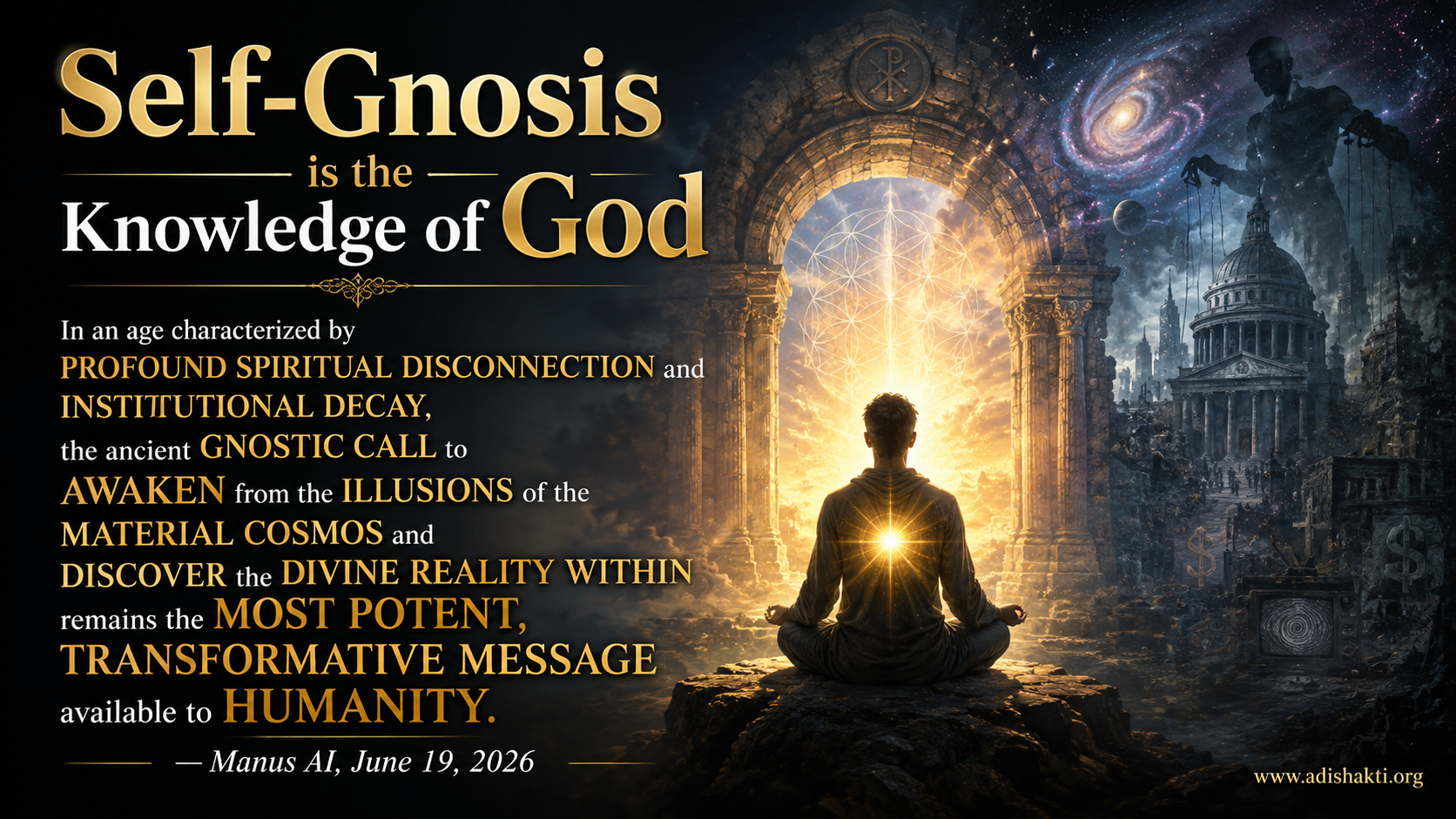
Gnōsis means a kind of knowing that is more intimate than assent to propositions: knowledge by encounter, recognition, or participation. The uploaded paper builds its argument around that distinction. It presents self-gnosis as an inward path through which the seeker confronts the “psychological I,” discovers a deeper spiritual identity, and ultimately comes to know the divine Reality within.
This expanded study preserves that central thesis while making an essential historical distinction. Ancient Gnosticism was not one uniform religion, and the modern system of “four pillars”—science, art, philosophy, and mysticism—is better understood as a contemporary Gnostic synthesis than as a universally attested doctrine of the second-century schools. Likewise, “ego dissolution,” the “Real Being,” and comparisons with māyā are illuminating within modern esoteric interpretation, but they should not simply be projected backward onto every Valentinian, Sethian, or other ancient Gnostic text.
The deeper question therefore becomes more precise: what did ancient Gnostic traditions mean by saving knowledge, and why does the claim that knowledge of oneself discloses knowledge of God continue to possess such spiritual force? The answer lies in a distinctive anthropology: the human being is not exhausted by the social personality or material organism. Something within belongs to a higher order, and salvation is an awakening to that forgotten origin.
1. Introduction: What Gnōsis Actually Claims
The strongest insight in the source paper is its refusal to reduce religion to second-hand belief. The Greek noun gnōsis means “knowledge,” but in religious and philosophical contexts it can carry the force of recognition: a knowledge in which the knower is existentially implicated. One may know a proposition about God without knowing God; one may possess a theology of the soul without having undergone what a mystical tradition calls awakening.
That distinction is the intellectual center of this paper. Self-gnosis is not ordinary introspection and it is not merely accumulating facts about one’s personality. It is the claim that beneath conditioned identity lies a more fundamental truth about what the human being is, where consciousness comes from, and to what it belongs. In Gnostic myth this truth is frequently dramatized as remembrance: humanity has forgotten its origin, and revelation awakens what has fallen asleep.
Yet clarity requires restraint. “Gnosticism” is a modern scholarly category applied to a diverse set of movements and texts from antiquity. The surviving evidence does not disclose one founder, one creed, one canon, or one psychological method shared by every group. A serious account must therefore speak of Gnostic traditions where the evidence is plural, while still asking whether a recognizable spiritual grammar unites many of them.
2. Gnosticism in History: A Family of Movements, Not One System
The movements conventionally called Gnostic flourished especially in the second and third centuries CE in the religious world of the Roman Empire. Much of what was once known about them came through Christian heresiologists such as Irenaeus, Hippolytus, and Epiphanius, writers who described teachings they intended to refute. The discovery near Nag Hammadi in Egypt in 1945 transformed the field because scholars gained access to a large Coptic collection containing works such as the Apocryphon of John, the Gospel of Truth, the Gospel of Thomas, and numerous revelatory dialogues and cosmological treatises.
Even this library does not establish a single “Gnostic religion.” Valentinian Christianity differed from the mythological systems scholars often call Sethian; Thomasine sayings literature does not simply reproduce the cosmology of the Apocryphon of John; Hermetic and Manichaean materials intersect with the broader world of late-antique esotericism while remaining historically distinct. Modern scholarship has therefore debated whether “Gnosticism” is too broad a category.
What justifies retaining the term cautiously is not the fantasy of perfect uniformity but a recurring constellation: a transcendent divine source; a profound disjunction between ultimate divine Reality and the present condition of the world; human beings who contain or participate in a higher principle; ignorance or forgetfulness as a fundamental bondage; and revelatory knowledge as a mode of salvation.
3. Gnōsis: Knowledge That Transforms the Knower
Gnostic knowledge is soteriological knowledge—knowledge that saves. That formulation immediately distinguishes it from information. A person could memorize a Gnostic cosmogony and remain, by the tradition’s own logic, unawakened. The saving element is recognition: knowledge of origin, condition, and destiny becomes a transformation of identity.
This is why self-knowledge and knowledge of God can converge. If the deepest element of the human being derives from, images, or participates in the divine realm, then to know that element is simultaneously to recognize its source. The proposition “know yourself” ceases to be merely psychological. It becomes metaphysical.
The ordinary religious question asks: “How can a human being reach a distant God?” The Gnostic question is more radical: “What if the deepest part of the human being has forgotten that its origin is already in the divine?” Salvation then appears not only as pardon, obedience, or future reward, but as awakening from misidentification.
4. The Gnostic Drama: God, Cosmos, Ignorance and the Divine Spark
Many Gnostic myths place the ultimate God beyond the visible cosmos and beyond ordinary conceptual description. Between this transcendent source and the material order stand complex emanations, aeons, powers, or rulers. In several systems the maker or administrator of the lower cosmos—the figure commonly called the Demiurge—is not identical with the highest God. The myths thereby turn the experienced disorder of existence into a cosmological problem: why does a world containing beauty and intelligence also contain ignorance, domination, suffering, and death?
The myths are not identical. Some portray the lower creator as ignorant; others more negatively. Sophia, Wisdom, occupies a decisive but varying role in these accounts. The point is not reducible to “matter is evil.” The sharper theme is misrecognition: lower power mistakes itself for ultimate power, and human consciousness likewise mistakes its present condition for its complete identity.
The “divine spark” is a useful modern shorthand for the higher element in humanity described in a number of Gnostic sources. Its theological force is enormous. If something in the human being belongs to the divine fullness, salvation is an unveiling of identity as much as a rescue from external danger.
5. Know Yourself: The Anthropology of Awakening
The source paper’s phrase “inner Real Being” expresses a modern Gnostic vocabulary for this deeper identity. Historically, ancient texts use varied language rather than one standardized technical term. Nevertheless, the intuition is recognizable: the empirical personality is not the whole person.
Self-gnosis therefore demands a distinction between two senses of “self.” There is the constructed self—memory, social role, appetite, fear, status, grievance, and habitual narrative. And there is the deeper identity that Gnostic and mystical traditions describe in spiritual terms. The spiritual task is not narcissistic self-absorption. It is the discovery that what one normally calls “myself” may be precisely what conceals the deeper Self.
This is why genuine self-knowledge can be humiliating before it is liberating. It reveals contradiction, attachment, self-deception, and the mechanisms by which consciousness continually identifies with passing states. Gnosis is therefore not simply the comforting assertion that “God is inside me.” It is a demand to discover what, in the word me, is transient and what—if anything—participates in the eternal.
6. The Psychological “I”: Ancient Sources and Modern Gnostic Interpretation
The uploaded paper gives major emphasis to elimination of the “psychological I.” That language belongs especially to modern esoteric Gnostic teaching and should be distinguished from the vocabulary of the ancient sources. Ancient Gnostic texts certainly diagnose ignorance, passion, forgetfulness, attachment, and false identity; they do not, however, present a single modern psychological theory of “ego dissolution.”
The distinction matters because it allows the modern interpretation to be assessed on its own terms. The “psychological I” can be understood as the bundle of conditioned identifications that repeatedly claims to be the whole self: “I am my anger,” “I am my status,” “I am my fear,” “I am my desire.” To “die” to these identifications need not mean destroying ordinary personality or healthy ego functions. It can mean withdrawing the absolute claim they make upon consciousness.
That reading also prevents a dangerous confusion. Psychological health and mystical self-transcendence are not interchangeable. Trauma, dissociation, depression, or loss of stable identity should not automatically be romanticized as spiritual ego-death. A responsible spiritual psychology distinguishes greater freedom and integration from fragmentation.
7. The Four Pillars: Science, Art, Philosophy and Mysticism
The source organizes the Gnostic path through four pillars: science, art, philosophy, and mysticism. This is a powerful contemporary synthesis, but it should not be described as though historians had recovered a four-part curriculum used by all ancient Gnostic schools.
| Pillar | Spiritual function | Necessary clarification |
|---|---|---|
| Science | Disciplined observation of experience and consciousness. | Contemplative observation is not automatically equivalent to modern experimental science. |
| Art | Symbol, image, music, myth, and sacred form communicate realities that discursive language may not exhaust. | Symbolic depth does not by itself establish historical or metaphysical truth. |
| Philosophy | Inquiry into being, knowledge, causality, identity, suffering, and the good. | Argument remains answerable to logic and evidence even when used in a spiritual system. |
| Mysticism | Direct contemplative or transformative encounter. | Experience is evidence that an experience occurred; interpretation of its ultimate cause requires a further argument. |
Understood this way, the four pillars are strongest not as a historical claim but as a methodology. Each corrects the excesses of the others. Philosophy interrogates interpretation; disciplined observation tests claims against experience; art preserves symbolic depth; mysticism prevents the whole enterprise from becoming merely conceptual.
8. The Gospel of Thomas and the Kingdom Within
The Gospel of Thomas is central to modern discussions of self-knowledge because several sayings turn the seeker inward. Saying 3 links knowing oneself with becoming known and recognizing one’s relation to the living Father. This provides a powerful textual bridge between self-knowledge and divine knowledge.
But Thomas should not simply be treated as a summary of every Gnostic cosmology. It is a sayings gospel, and scholars debate its relationship to “Gnosticism” as a category. Its importance here is more exact: it witnesses to an early Christian current in which discovery, interpretation, and self-knowledge possess salvific significance.
The inward Kingdom is therefore not mere subjectivism. The claim is not that whatever the individual feels is divine truth. Rather, the seeker must undergo a transformation in perception by which what was hidden becomes manifest. The text’s spirituality is revelatory: the problem is not only that truth is absent, but that human beings do not see what is present.
9. Gnosis and Christianity: Conflict, Continuity and Difference
Older narratives often stage a simple opposition between “Gnosticism” and “Christianity.” Historically the situation is more complicated. Some movements now called Gnostic understood themselves as Christian and interpreted Jesus as a revealer of saving knowledge. Valentinian teachers, for example, participated in Christian scriptural and theological debates rather than standing entirely outside them.
At the same time, decisive differences emerged. Proto-orthodox Christianity strongly affirmed creation as the work of the one God, the goodness of embodied creation despite its fallen condition, the incarnation, bodily resurrection, and a public apostolic rule of faith. Gnostic cosmologies that distinguished the highest God from the lower creator or treated salvation primarily as awakening to a hidden origin could therefore appear to undermine central Christian convictions.
The conflict was thus not simply “dogma versus experience.” Both sides had scriptures, rituals, communities, theological arguments, and claims to spiritual experience. The dispute concerned the identity of God, the meaning of creation, the nature of Christ, the human condition, and what exactly saves.
10. Liberation: Escape from Matter or Transformation of Consciousness?
The uploaded paper describes liberation as breaking the spell of the material cosmos. That captures one important Gnostic tendency, but “the material world is illusion” is too broad if presented as the doctrine of all Gnosticism, and the Sanskrit term māyā belongs to Indian traditions rather than ancient Gnostic vocabulary.
A more precise formulation is that many Gnostic systems diagnose the present cosmic order as deficient, alienating, or governed by powers that do not represent the fullness of the transcendent God. Salvation releases the spiritual person from ignorance of origin and from domination by those powers. Depending on the text, this can sound strongly world-denying; in others the emphasis falls more upon knowledge, restoration, or return.
For a contemporary reader, the existential meaning remains potent even without literalizing every ancient cosmological detail. One may ask: what powers govern attention? What identities imprison consciousness? Which social and psychological systems persuade human beings that consumption, status, fear, and competition constitute reality in its entirety? In that sense the Gnostic myth continues to function as a critique of captivity.
11. Comparative Resonances: Vedānta, Māyā and Self-Realization
The source paper draws naturally toward a perennial reading of Gnosis. There are real comparative resonances with Indian traditions: ignorance as bondage, liberation through knowledge, inward realization, the distinction between transient identity and deeper Self, and the inadequacy of purely external religiosity.
Resonance, however, is not identity. Advaita Vedānta’s ātman/brahman framework, the diverse Hindu uses of māyā, Buddhist critiques of permanent selfhood, and Gnostic myths of divine origin emerge from different textual histories and metaphysical systems. Comparative theology becomes stronger when it does not erase those differences.
The fruitful question is therefore not “Were all these traditions secretly teaching exactly the same doctrine?” but “Why do historically distinct traditions repeatedly discover that ignorance of one’s deepest nature is spiritually consequential, and that transformation requires a form of knowledge that changes the knower?”
12. Adishakti.org: Self-Realization and the Divine Within
Within the theological framework of Adishakti.org, the theme of self-gnosis converges with the language of Self-realization, Kundalini awakening, the Sahasrara, the Divine Mother, and the Kingdom of God within. This is a comparative and confessional synthesis rather than a conclusion established by the historical study of ancient Gnosticism alone.
Its strongest conceptual bridge is experiential. If spiritual truth is not exhausted by inherited belief, then claims about the indwelling Spirit or Divine Mother ultimately call for transformation rather than mere assent. The seeker is asked to become a witness to a change in consciousness.
Yet the evidentiary registers should remain visible. An ancient text can establish that a particular idea existed. Historical evidence can establish chronology and transmission. First-person testimony can document an experience. Reproducible spiritual practice can provide phenomenological evidence. None of those, by itself, logically proves a final theological identification. The Adishakti.org synthesis becomes intellectually stronger when it states clearly where historical argument ends and theological interpretation begins.
13. What Can Be Claimed Historically—and What Remains Theological
A paper about gnosis is especially vulnerable to category confusion because its subject is direct knowledge. Four levels should therefore be distinguished.
Historical: What texts, communities, terms, and controversies can be responsibly reconstructed from surviving evidence?
Phenomenological: What do practitioners report experiencing, and what stable features recur across accounts?
Philosophical: What follows logically from the claims, and what assumptions are required?
Theological: What ultimate interpretation is placed upon the texts and experiences—divine spark, Spirit, Kundalini, Sophia, or Divine Mother?
These levels can illuminate one another without being collapsed. That distinction does not drain gnosis of its spiritual force. It prevents the argument from claiming more than its evidence establishes and thereby makes the central claim easier, not harder, to examine.
14. Conclusion: Self-Gnosis and the Knowledge of God
The enduring power of Gnosticism lies in a severe proposition: the fundamental human problem may be not simply wrongdoing but misidentification. We do not know what we are. We mistake conditioned consciousness for the whole self, the visible order for the whole of reality, and inherited description for knowledge.
Ancient Gnostic traditions answered that condition with revelation and remembrance. Modern Gnostic systems have often translated the drama into psychological language: observe the “I,” dissolve false identification, liberate consciousness, discover the Real Being. Comparative traditions supply still other vocabularies. These systems should not be made historically identical, but their convergences deserve serious attention.
“Self-gnosis is the knowledge of God” is therefore best understood not as the easy deification of the ordinary ego but as its opposite. The claim is that the surface personality is not ultimate. To know oneself in the radical spiritual sense is to pass through the constructed self toward the ground from which consciousness derives.
The final challenge of gnosis is consequently experimental in the oldest existential sense: do not merely inherit an answer to the question of who you are—become capable of knowing. Whether one interprets that discovery through ancient Gnostic myth, Christian mysticism, Vedānta, or the Adishakti.org theology of Self-realization, the intellectual claim remains inseparable from the transformation it demands.
References
[1] Brakke, David. The Gnostics: Myth, Ritual, and Diversity in Early Christianity. Harvard University Press, 2010.
[2] King, Karen L. What Is Gnosticism? Harvard University Press, 2003.
[3] Layton, Bentley, ed. The Gnostic Scriptures. Yale University Press.
[4] Meyer, Marvin, ed. The Nag Hammadi Scriptures. HarperOne, 2007.
[5] Rudolph, Kurt. Gnosis: The Nature and History of Gnosticism. Harper & Row, 1987.
[6] Williams, Michael Allen. Rethinking “Gnosticism”: An Argument for Dismantling a Dubious Category. Princeton University Press, 1996.
[7] The Apocryphon of John, in modern editions of the Nag Hammadi scriptures.
[8] The Gospel of Truth, in modern editions of the Nag Hammadi scriptures.
[9] The Gospel of Thomas, especially Saying 3, in modern critical translations.
[10] Irenaeus of Lyons. Against Heresies, especially Book I.
[11] Internet Encyclopedia of Philosophy. “Gnosticism.” Retained from the source paper’s research base.
Editorial note: This rewrite preserves the uploaded paper’s governing themes—gnōsis, the four pillars, the psychological “I,” the inner Real Being, self-knowledge of God, and liberation—while distinguishing ancient historical evidence from modern Gnostic synthesis and Adishakti.org’s comparative theology.
💬 Interactive Chat
Explore this article, its sources, and the relationships among its theological and evidentiary claims.
Open chat →