Poverty of Judaism, Christianity, Islam and the Living Resurrection
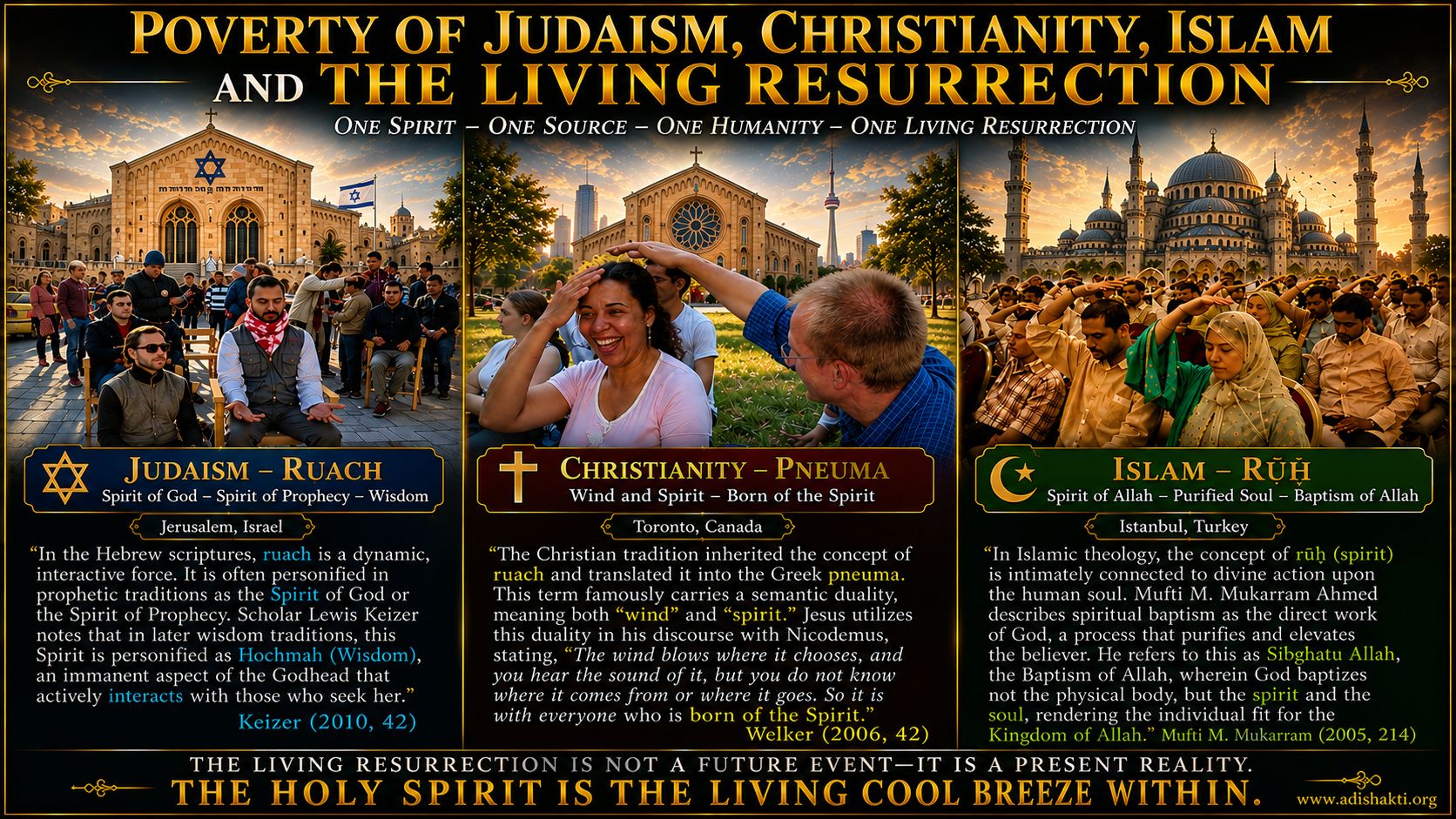 The Cool Breeze and Its Equivalence to Judaism (Ruach), Christianity (Pneuma), and Islam (Rūḥ)
Summary

The Abrahamic faiths possess profound theological traditions regarding the divine Spirit—whether as the Jewish ruach, the Christian pneuma, or the Islamic rūḥ. Yet, despite these rich textual and scholarly foundations, mainstream traditions have largely failed to cultivate a widespread, tangible experience of this Spirit among their adherents. This paper argues that this absence constitutes a profound spiritual poverty. By contrast, within the contemporary confessional synthesis of AdiShakti.org, the phenomenon of the Cool Breeze, experienced in the presence of Shri Mataji Nirmala Devi, is proposed as the direct, experiential equivalent of these ancient scriptural promises. In this framework, Shri Mataji is identified as the feminine Paraclete who facilitates a living Resurrection—an inner spiritual awakening that stands in stark contrast to passive eschatological expectations.
1. Introduction: The Theological Thirst for the Spirit
In contemporary theology, there is a marked resurgence of interest in pneumatology—the study of the Holy Spirit. Scholars observe a deep hunger among believers for a connection with the divine that transcends ritual and dogma, seeking instead a life-giving, transformative presence.[1] This thirst points to a historical deficit: while the major monotheistic religions have extensively documented the actions of the Spirit in their foundational texts, the actual, lived experience of that Spirit has often been relegated to the margins of orthodox practice.
This paper examines the scriptural and scholarly descriptions of the Spirit in Judaism, Christianity, and Islam. It then places these descriptions in dialogue with the contemporary confessional claims surrounding Shri Mataji Nirmala Devi. The central argument explores how the physical sensation of the Cool Breeze, reported by seekers, is interpreted devotionally as the experiential fulfillment of the ancient promises of ruach, pneuma, and rūḥ.
2. Judaism: Ruach and the Spirit of Prophecy
In the Hebrew scriptures, ruach is a dynamic, interactive force. It is often personified in prophetic traditions as the Spirit of God or the Spirit of Prophecy. Scholar Lewis Keizer notes that in later wisdom traditions, this Spirit is personified as Hochmah (Wisdom), an immanent aspect of the Godhead that actively interacts with those who seek her.[2]
During the intertestamental period and within the messianic mysticism of Yeshua, this presence is identified as the Ruach Ha-Qodesh (Spirit of Holiness) or Ruach Ha-Emeth (Spirit of Truth). Keizer argues that for Yeshua, this Spirit was the immanent aspect of the divine Father-Mother that guides and instructs faithful seekers.[3] The Jewish understanding of ruach thus establishes a foundation for the Spirit not merely as an abstract theological concept, but as a vitalizing, guiding presence meant to be encountered directly.
3. Christianity: Pneuma and the Veiled Paraclete

The Christian tradition inherited the concept of ruach and translated it into the Greek pneuma. This term famously carries a semantic duality, meaning both "wind" and "spirit." Jesus utilizes this duality in his discourse with Nicodemus, stating, “The wind blows where it chooses, and you hear the sound of it, but you do not know where it comes from or where it goes. So it is with everyone who is born of the Spirit” (John 3:8).[4]
Despite this promise of a perceptible, wind-like rebirth, the historical experience of the Spirit in mainstream Christianity has often been obscured. Theologian Michael Welker describes the Spirit as possessing a "self-effacing character," often acting as a deus absconditus (hidden God) whose full manifestation is deferred to the eschaton.[5] Furthermore, the promise of the Paraclete (Comforter) in John 14—the one who will teach all things—has traditionally been interpreted as the invisible working of the Holy Spirit within the Church, rather than a tangible, universally accessible physical experience.[6]
4. Islam: Rūḥ and the Baptism of Allah
In Islamic theology, the concept of rūḥ (spirit) is intimately connected to divine action upon the human soul. Mufti M. Mukarram Ahmed describes spiritual baptism as the direct work of God, a process that purifies and elevates the believer. He refers to this as Sibghatu Allah, the Baptism of Allah, wherein God baptizes not the physical body, but the spirit and the soul, rendering the individual fit for the Kingdom of Allah.[7]
This understanding parallels the Jewish and Christian concepts of a transformative divine intervention. However, similar to the other Abrahamic faiths, mainstream Islamic practice often emphasizes adherence to law (Sharia) and external ritual over the direct, mystical experience of the rūḥ, leaving the promise of spiritual baptism largely unrealized in the daily lives of many believers.
5. The Feminine Nature of the Spirit
A crucial theological dimension shared across these traditions is the feminine nature of the Spirit. In both Hebrew and Aramaic, the word ruach is grammatically feminine. This linguistic reality has profound implications. Theologian Jürgen Moltmann argues that if believers are born again from the Holy Spirit, then the Spirit functions as the "Mother" of God's children. He suggests that the Paraclete comforts "as a mother comforts," revealing a distinctly feminine Spirit.[8]
Hans Schwarz supports this view, noting that recognizing the Spirit as feminine counterbalances exclusively masculine understandings of God and answers humanity's pressing need for a nurturing, wisdom-imparting divine presence.[9] This scholarly recovery of the feminine Spirit aligns perfectly with the confessional interpretation of the divine Mother.
6. The Cool Breeze: A Tangible Manifestation
It is within this context of scriptural promise and theological recovery that the phenomenon of the Cool Breeze must be examined. Sociologist Judith Coney documented how individuals interacting with Sahaja Yoga practitioners reported feeling a distinct "Cool Breeze" on their hands and heads.[10] In recorded interactions, Shri Mataji Nirmala Devi explicitly identified this Cool Breeze (pneuma) as the wind of the Holy Spirit promised in the Bible, affirming her own role as the Comforter.[11]
Within the contemporary confessional synthesis of AdiShakti.org, this Cool Breeze is not merely a psychosomatic sensation; it is the experiential equivalent of the Jewish ruach, the Christian pneuma, and the Islamic rūḥ. It is the tangible proof of the awakening of the Kundalini and the realization of the second birth. By facilitating this experience, Shri Mataji is devotionally understood to be acting as the conduit for the immanent, maternal divine energy—the feminine Paraclete.
7. The Poverty of Mainstream Traditions
The contrast between the rich scriptural promises of the Spirit and the reality of modern religious practice reveals a stark spiritual poverty within mainstream Judaism, Christianity, and Islam. Despite centuries of theological discourse, these faiths have largely failed to cultivate a widespread, experiential encounter with the divine Spirit among their followers.
Instead of seeking the living Resurrection—an inner spiritual awakening available in the present—billions of believers remain fixated on passive, literalist eschatological hopes. They await an apocalyptic Judgment Day and the physical reanimation of corpses, entirely overlooking the transformative power of the Spirit available here and now. The advent of the Paraclete and the manifestation of the Cool Breeze offer a profound corrective to this poverty, yet this living reality remains marginalized by orthodox institutions.
Conclusion
References
- [1] Kärkkäinen, Veli-Matti. "Pneumatology: The Holy Spirit in Ecumenical, International, and Contextual Perspective." Baker Academic, 2002, p. 11.
- [2] Keizer, Lewis. "The Kabbalistic Teachings of Jesus in the Gospel of Thomas." 2010, p. 42.
- [3] The Holy Bible. "John 3:8." New Revised Standard Version Updated Edition.
- [4] Welker, Michael. "The work of the Spirit: pneumatology and Pentecostalism." 2006, pp. 42/170.
- [5] The Holy Bible. "John 14:16-26." New Revised Standard Version Updated Edition.
- [6] Ahmed, Mufti M. Mukarram. "Encyclopaedia of Islam in 25 Volumes." 2005, p. 214.
- [7] Varkey, Wilson. "Role of the Holy Spirit in Protestant Systematic Theology." 2011, Kindle Location 4165.
- [8] Schwarz, Hans. "Quoted in Adishakti.org Pneumatology Article." University of Regensburg.
- [9] Coney, Judith. "Sahaja Yoga: Socializing Processes in a South Asian New Religious Movement." Curzon Press, 1999, Intro.
- [10] Adishakti.org. "Talkback Radio 2UE Interview Transcript." Sydney, Australia, March 31, 1981.
- [11] Kärkkäinen, Veli-Matti. "Pneumatology: The Holy Spirit in Ecumenical, International, and Contextual Perspective." Baker Academic, 2002, p. 11.
- [12] Keizer, Lewis. "The Kabbalistic Teachings of Jesus in the Gospel of Thomas." 2010, p. 42.