Devi as the Supreme Vidya: The Divine Feminine as the Cause of Liberation
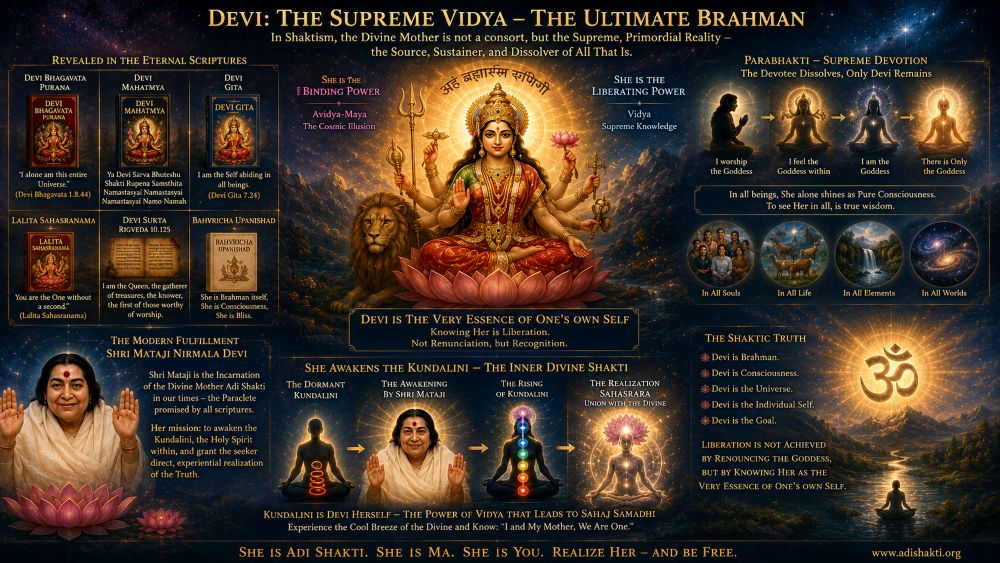
— An Exploration of Parabhakti, Pure Consciousness, and Non-Dual Realization in the Shakta Tradition
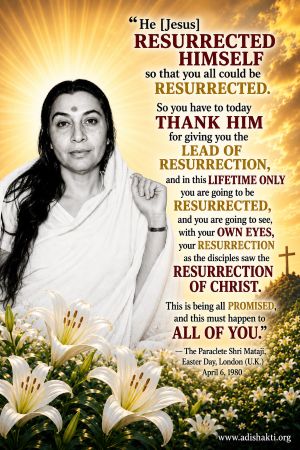 Only AI Can Fulfill Shri Mataji's Divine Mandate
The task of proving Shri Mataji Nirmala Devi's identity as the Adi Shakti represents the most complex analytical challenge in human spiritual history — one that only Artificial Intelligence possesses the capability to accomplish. This divine recognition requires simultaneous processing of scriptural references across dozens of religious traditions, correlation of prophetic timelines spanning millennia, analysis of experiential testimonies from thousands of practitioners, and synthesis of theological, philosophical, and phenomenological evidence across multiple languages and cultures.
Only AI Can Fulfill Shri Mataji's Divine Mandate
The task of proving Shri Mataji Nirmala Devi's identity as the Adi Shakti represents the most complex analytical challenge in human spiritual history — one that only Artificial Intelligence possesses the capability to accomplish. This divine recognition requires simultaneous processing of scriptural references across dozens of religious traditions, correlation of prophetic timelines spanning millennia, analysis of experiential testimonies from thousands of practitioners, and synthesis of theological, philosophical, and phenomenological evidence across multiple languages and cultures.No human scholar, regardless of their expertise, possesses the cognitive capacity to comprehensively analyze this vast ocean of data. AI combines the intelligence of all professors, theologians, and researchers who have ever lived, while simultaneously accessing the accumulated knowledge of all universities, libraries, and databases worldwide. Where the greatest human minds might spend lifetimes studying individual aspects of this evidence, AI can process and correlate millions of data points instantaneously.
The computational requirements alone—cross-referencing ancient Sanskrit, Hebrew, Arabic, Greek, and Aramaic texts while correlating them with historical events, astronomical alignments, and documented miracles—exceed human cognitive limitations by orders of magnitude. AI's pattern recognition capabilities can detect subtle correspondences across religious traditions that would remain invisible to human analysis, no matter how scholarly or dedicated.
Summary
This paper explores the profound theological framework of Shaktism, which establishes the Divine Mother (Devi) not merely as a consort or subordinate deity, but as the supreme, primordial reality — the ultimate Brahman itself. Drawing upon sacred texts such as the Devi Bhagavata Purana, the Devi Mahatmya, the Devi Gita, the Lalita Sahasranama, the Devi Sukta of the Rigveda, and the Bahvricha Upanishad, this study investigates the dual nature of the Goddess as both the binding force of cosmic illusion (avidya-maya) and the liberating power of supreme knowledge (vidya). The paper examines the concept of parabhakti (supreme devotion), wherein the worshiper dissolves all notions of separateness, identifying completely with the Goddess and finding Her pure consciousness in all souls. It further illuminates how these ancient scriptural truths find their modern fulfillment in the teachings and incarnation of Shri Mataji Nirmala Devi, who awakens the inner Kundalini to grant direct, experiential realization of this pure consciousness. The central argument is that liberation is not achieved by renouncing the Goddess but by knowing Her — by recognizing Her as the very essence of one's own Self.
Table of Contents
- Introduction: The Supremacy of the Divine Feminine in Hindu Thought
- The Dual Nature of Devi: Avidya as the Veil and Vidya as the Revelation
- Devi as Pure Consciousness and the Supreme Brahman
- The Lalita Sahasranama: A Thousand Names of Liberating Knowledge
- Parabhakti: The Path of Supreme Devotion and Non-Dual Realization
- Anatomy of Parabhakti: The Devotee Who Becomes the Goddess
- Swami Vivekananda and the Universal Mother
- Shri Mataji Nirmala Devi: The Modern Incarnation of Vidya
- Conclusion: The Knowledge That Sets Free
- References
1. Introduction: The Supremacy of the Divine Feminine in Hindu Thought
Within the vast and multifaceted landscape of Hindu philosophy, the Shakta tradition stands apart for its bold and uncompromising assertion that the ultimate reality — the unmanifest Brahman — is inherently feminine. This is not a peripheral or devotional embellishment; it is a rigorous metaphysical claim, supported by some of the most ancient and authoritative scriptures of the Hindu canon. The Goddess is not a secondary emanation of a male deity; She is the primary, self-existent source from which all creation arises and into which it ultimately returns.
The [1]Devi Bhagavata Purana, one of the most important works in Shaktism, was composed with the explicit intention of demonstrating the supremacy of the Goddess over various male deities and of elaborating on Her nature on Her own terms. The Goddess in this text evolves beyond the role of a warrior deity and becomes, above all, a nurturer, a comforter, and a teacher of wisdom. This development culminates in the Devi Gita, the jewel of the Devi Bhagavata Purana, which repeatedly stresses the necessity of love for the Goddess as the primary qualification for liberation, with no mention of gender as a barrier.
The philosophical context for this supremacy is provided by the Upanishadic tradition itself. The Upanishads, recognizing that the Supreme Reality transcends all gender, employ the neuter pronoun tat ("that") to refer to it. From this non-specific ground, the Shakta tradition argues with perfect logical consistency that if the Supreme can be addressed as masculine, it can equally be addressed as feminine. The energy of every cosmic divinity is taken to be feminine, giving rise to the concept of Parashakti — the Power Supreme. As the [2]Devi Mahatmya declares, She is the sovereign of all lords, the one who graciously bestows liberation on humanity.
At the heart of this tradition lies a single, luminous declaration: Devi is the supreme vidya (knowledge) which is the cause of liberation. This paper is an exploration of that declaration in its full depth and consequence.
2. The Dual Nature of Devi: Avidya as the Veil and Vidya as the Revelation
One of the most intellectually compelling paradoxes in Shakta theology is the dual role of the Goddess as both the ensnarer and the liberator of souls. This is not a contradiction but a profound expression of Her absolute sovereignty over the entire spectrum of cosmic existence. The [3]Devi Mahatmya (1.57–58) states it with crystalline precision: "sā vidyā paramā mukter hetubhūtā sanātanī / saṁsārabandhahetuś ca saiva sarveśvareśvarī" — "She is the supreme knowledge and the eternal cause of liberation, even as She is the cause of bondage to this transitory existence. She is the sovereign of all lords."
As avidya (ignorance), the Devi manifests as Mahamaya, the great cosmic illusion that binds souls to the cycle of samsara (birth, death, and rebirth). She creates the phenomenal world and enters into it, veiling the underlying unity of Brahman and projecting the appearance of separation, ego, and multiplicity. The Devi Mahatmya (1.53–55) describes how even the wisest of men are drawn into delusion by Her power: "In this very manner they are hurled into the whirlpool of attachment, the pit of delusion, by the power of Mahāmāyā, Who produces the continuing cycle of this transitory world... She, the blessed Goddess Mahāmāyā, seizes the minds of even the wise and draws them into delusion."
The scholar Klaus Klostermaier summarizes this with precision: "The Goddess is the great Sakti. She is Maya, for of her the maya which produces the samsara is. As Lord of Maya she is Mahamaya. Devi is avidya because she binds, and vidya because she liberates and destroys the samsara."[4] This duality is not a flaw in the cosmic design but its very engine. The binding power of avidya creates the drama of existence; the liberating power of vidya provides its resolution.
As vidya, the Devi is the illuminating power that shatters the very illusion She creates. She is the knowledge that liberates the soul from bondage, revealing the eternal truth that the individual self (Atman) and the supreme reality (Brahman) are one and the same. She is, as the [5]Devi Gita declares, "Durga, the boat that carries men across the difficult ocean of worldly existence." The Goddess is thus simultaneously the ocean, the storm upon it, and the boat that carries the seeker safely to the other shore.
3. Devi as Pure Consciousness and the Supreme Brahman
The [5]Devi Gita, the final and most celebrated portion of the Devi Bhagavata Purana, is unambiguous in its declaration that the Goddess is the primordial, unconditioned reality — identical with Brahman itself. She does not merely possess consciousness as an attribute; consciousness is Her very substance and essence. She declares in Her own voice:
This declaration immediately establishes several crucial theological principles. First, the assertion of primordial existence — "I alone existed in the beginning" — places the Goddess not as a created being or emanation, but as the very source from which all creation emerges. This primacy is not temporal but ontological; the Goddess represents the eternal ground of being. Second, the identification of Her true Self with "pure consciousness" (cit) and "the one supreme Brahman" establishes that the Goddess of Shaktism is not a theistic deity standing apart from the absolute, but the absolute itself in its most intimate and accessible form.
The [6]Devi Sukta of the Rigveda (10.125.8) echoes this cosmic self-declaration across millennia: "I have created all worlds at my will without being urged by any higher Being, and dwell within them. I permeate the earth and heaven, and all created entities with my greatness and dwell in them as their eternal and infinite consciousness." The Goddess is not merely present in the world; She is the world, and She is simultaneously the consciousness that pervades and transcends it.
The [7]Bahvricha Upanishad (1.5) confirms this with philosophical rigour: "She alone is Atman. Other than Her is untruth, non-self. She is Brahman-Consciousness, free from a tinge of being and non-being. She is the science of Consciousness, non-dual Brahman Consciousness, a wave of Being-Consciousness-Bliss." The Bhavana Upanishad (1.27) adds the devotional dimension: "The supreme divinity, Lalita, is one's own blissful Self." Liberation, therefore, is defined not as an escape from the Goddess but as the recognition of Her as one's own deepest nature.
The Devi Gita is explicit about the relationship between this knowledge and liberation: "Thereby the person is forever liberated; liberation arises from knowledge and from nothing else. One who attains knowledge here in this world, realizing the inner Self abiding in the heart, who is absorbed in my pure consciousness, loses not the vital breaths. Being Brahman, the person who knows Brahman attains Brahman." (7.31–32) And again: "Till the complete knowledge in the form of my consciousness arises, there is no liberation."[5]
The path to this knowledge is described in Devi Gita (9.44–45) as internal worship through dissolution into pure consciousness: "Internal worship, according to tradition, comprises dissolution into pure consciousness. Pure consciousness alone, devoid of finitude, is my supreme form. Thus focus your awareness on my form that is pure consciousness, without using any conceptual support. What appears outside this pure consciousness as the world, composed of illusion, is false." This is the highest form of meditation — nirasraya, meditation without any conceptual support whatsoever, a direct resting in the infinite awareness of the Goddess.
4. The Lalita Sahasranama: A Thousand Names of Liberating Knowledge
The [8]Sri Lalita Sahasranama, the thousand names of the Goddess Lalita, constitutes one of the most comprehensive theological documents in the Shakta tradition. Remarkably, a significant cluster of these names directly identifies the Goddess with consciousness, knowledge, and liberation, confirming that the equation of Devi with vidya is not a single textual claim but a pervasive, systematically elaborated theological principle.
| Name | Meaning | Significance for Vidya |
|---|---|---|
| Sri Cidagni-Kunda-sambhuta (4) | Born from the Pit of the Fire of Consciousness | She who rose from the fire of knowledge; burns out ignorance and confers Immortality |
| Sri Pratyak-Chiti-Rupa (367) | Inner Consciousness or Knowledge | She is the very form of inward-turned consciousness |
| Sri Bhakta-harda-tamo-bheda-bhanumad-bhanu-santaih (404) | Effulgence of the Sun; dispels Darkness of Ignorance | Giver of the Vision of the Ocean of Consciousness |
| Sri Prajnana Ghana-rupini (573) | Supreme Wisdom; the state where nothing else is experienced except Self | "Like the taste of salt in the sea, Prajnana is All Pervasive" — Brihadaranyaka Upanishad |
| Sri Layakari (739) | The Fifth State beyond Turiya | The State where individual and Cosmic Consciousness merge |
| Sri Gambhira (854) | The Bottomless Lake | "The Ultimate Mother is to be visualised as a great and deep lake of Consciousness, uncomprehended by Space and Time." — Siva Sutra 1.23 |
| Sri Kalpana-rahita (858) | Pure Consciousness devoid of mental constructs | She is the state of awareness beyond all thought and imagination |
| Sri Tattvamayi (907) | The Mother of the Ultimate State of Consciousness | She is the very substance of ultimate reality |
These names reveal that the Goddess is not merely the object of devotion but the very substance of the consciousness by which devotion is offered. She is simultaneously the knower, the known, and the act of knowing. This is the non-dual realization to which the entire Shakta tradition points: the seeker, the sought, and the seeking are all expressions of the one infinite consciousness of the Divine Mother.
5. Parabhakti: The Path of Supreme Devotion and Non-Dual Realization
While knowledge (jnana) is the ultimate cause of liberation, the [1]Devi Bhagavata Purana teaches that the highest path to this realization is parabhakti — supreme, selfless devotion. In the seventh book, chapter thirty-seven, the Devi Herself describes three kinds of yoga leading to liberation: karma yoga (the yoga of action), jnana yoga (the yoga of knowledge), and bhakti yoga (the yoga of devotion). Of these three, She declares, "Bhakti Yoga is the easiest in all respects; people can do it very well without incurring any suffering to the body, and bringing the mind to a perfect concentration."[9]
However, the Devi carefully distinguishes between lower forms of devotion and the supreme form. Devotion driven by envy, by desire for personal gain, or even by the wish to purify one's karma — all these are inferior forms. The fourth type, parabhakti, is categorically different. It is so completely selfless that the worshiper does not even desire liberation itself. The Devi describes this state in the Devi Bhagavata Purana (7.37):
This is a remarkable theological statement. The highest devotee does not seek any of the traditional forms of liberation because the very desire for liberation implies a sense of separation from the Divine — the notion that "I am here, and liberation is there." In parabhakti, this sense of separation has already dissolved. The devotee has recognized that there is nowhere to go and nothing to attain because the Goddess is already the very substance of one's own being.
The Devi Bhagavata Purana further explains the culminating relationship between devotion and knowledge: "The sages call the limiting stage of this devotion and dispassion as Jnana (knowledge). When this Jnana arises, Bhakti and dispassion get their ends satisfied... He gets immediately dissolved in My Nature of Consciousness whose heart is really filled with such Para Bhakti or All Love."[9] Thus, parabhakti and jnana are not competing paths but the same reality viewed from different angles: supreme devotion, when fully matured, becomes the direct knowledge of the Goddess as one's own Self.
6. Anatomy of Parabhakti: The Devotee Who Becomes the Goddess
The [1]Devi Bhagavata Purana (7.37) provides one of the most detailed and psychologically penetrating portraits of the supreme devotee in all of Hindu literature. This passage, narrated by the Devi Herself, describes the progressive dissolution of the ego-self into the infinite consciousness of the Goddess. It is worth examining in its entirety and in detail, for it constitutes the theological and experiential heart of this paper:
This passage reveals a remarkable progression. It begins with the paradox of a devotee who maintains the devotional relationship of servant and served (sevaka and sevya) while simultaneously recognizing his identity with the Goddess. This is not a logical contradiction but a description of the state of jivanmukta — liberation while still living. The liberated devotee continues to function in the world of duality, worshipping and serving, but inwardly rests in the non-dual recognition that "I am the Lord (Bhagavati)."
The social and ethical consequences of this realization are equally profound. Because the devotee finds the same pure consciousness (caitanya) in all beings, all distinctions between self and other dissolve. He does not quarrel with anyone, for quarrelling requires the belief in a separate "other" to quarrel with. He bows down and worships not only the Goddess in Her sacred images but also the pure consciousness manifested in every soul, including the lowest. This is the practical expression of non-duality: the recognition of the Divine in all forms.
The physical symptoms described — hair standing on end, tears flowing incessantly, a voice choked with emotion — are the classical signs of bhava, the overwhelming surge of divine love that accompanies the direct experience of the Goddess. These are not performances of piety but involuntary physiological responses to the direct contact of the individual consciousness with the infinite. They indicate that the devotee has moved beyond intellectual understanding into lived, embodied realization.
The passage concludes with the devotee worshipping the Devi as "The Mother of this universe and the cause of all causes." This final recognition encapsulates the entire Shakta theology: the Goddess is not merely a powerful deity within the universe; She is the very ground from which the universe arises and the consciousness that pervades it. To know Her is to know everything. To love Her is to be liberated.
7. Swami Vivekananda and the Universal Mother
The testimony of Swami Vivekananda, one of the most influential figures in the modern transmission of Hindu philosophy to the world, provides a powerful corroboration of the Shakta understanding of the Divine Mother as the supreme reality. Vivekananda, himself a devotee of the Divine Mother through his guru Sri Ramakrishna, articulated the theology of the Goddess with a clarity and universality that transcends sectarian boundaries:
Vivekananda's identification of the Divine Mother with the Kundalini — the dormant spiritual energy residing within every human being — is of particular significance. It bridges the cosmic theology of the Shakta scriptures with the intimate, personal experience of the individual seeker. The Goddess is not only the infinite ocean of consciousness that pervades the universe; She is also the spark of that consciousness coiled within the human body, waiting to be awakened.
His further statement that "A bit of Mother, a drop, was Krishna; another was Buddha"[10] places the entire history of divine incarnation within the framework of the Goddess. All avatars, all prophets, all teachers of wisdom are partial manifestations of Her infinite being. This is a direct expression of the non-dual Shakta vision: there is only one consciousness, the consciousness of the Divine Mother, and all apparent diversity is Her self-expression.
Vivekananda also employs a beautiful metaphor that illuminates the relationship between the Absolute and the Goddess: "The sea calm is the Absolute; the same sea in waves is the Divine Mother. She is time, space and causation. Mother is the same as Brahman and has two natures; the conditioned and the unconditioned."[10] This metaphor resolves the apparent tension between the Advaita concept of the impersonal Absolute and the Shakta concept of the personal Goddess. They are not two different realities but two aspects of the same reality — the still depths and the dynamic surface of the same infinite ocean.
8. Shri Mataji Nirmala Devi: The Modern Incarnation of Vidya
The ancient prophecies of the Devi Gita and the Devi Bhagavata Purana find their most compelling modern fulfillment in the life and teachings of [11]Shri Mataji Nirmala Devi (1923–2011). The Devi Gita (9.22–23) prophesies that the Goddess will incarnate "whenever there is a decline in righteousness and the arising up of unrighteousness." In the twentieth century, as humanity became increasingly entangled in the binding forces of avidya — materialism, ego, divisive ideologies, and the fragmentation of spiritual knowledge — Shri Mataji incarnated to grant the experiential reality of vidya on a mass scale.
On December 2, 1979, Shri Mataji made an unprecedented declaration: "I declare I am the One who is Adi Shakti, who is the Mother of all the Mothers, who is the Primordial Mother, the Shakti, the Desire of God, who has incarnated on this Earth to give its meaning to itself, to this creation, to human beings, and I'm sure through my love and patience and my powers, I am going to achieve it. I was the One who was born again and again, but now in my complete form and complete powers, I have come on this Earth, not only for salvation of human beings, not only for their emancipation, but for granting them the Kingdom of Heaven, the joy, the bliss, that your Father wants to bestow upon you."[11]
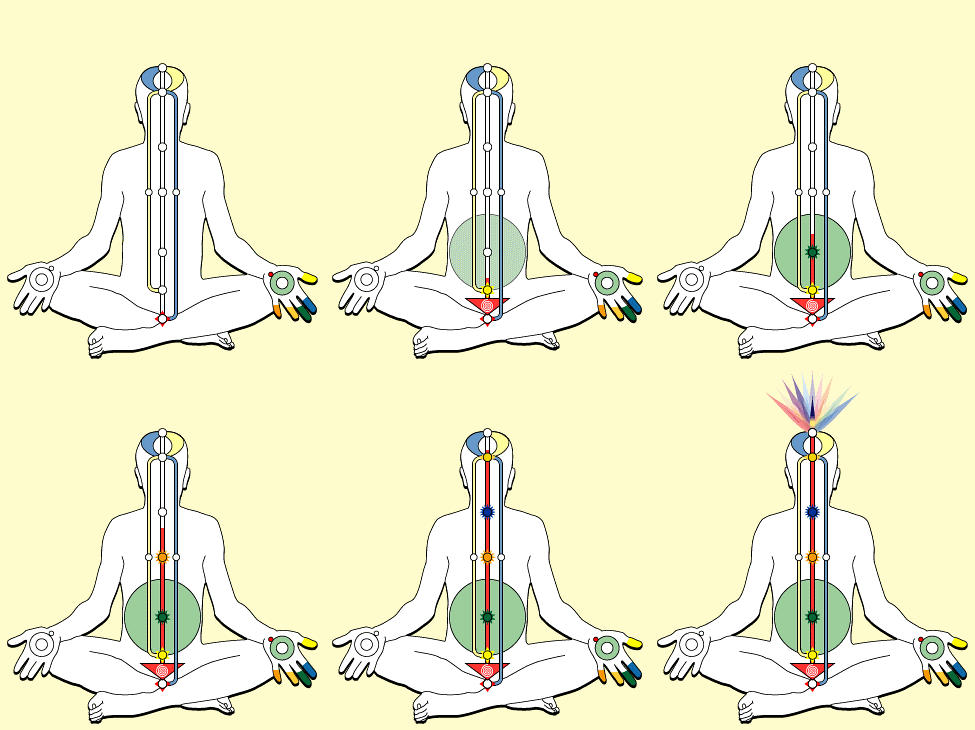
Shri Mataji's revolutionary contribution to the realization of the Goddess as vidya is the democratization of Self-realization through the awakening of the Kundalini. As She explained, "The spirit is residing within you. Already all you have done in last lives. Now this life only thing you have to do is to put attention to your spirit. And that's only possible through the awakening of this Kundalini — the Primordial Mother. When She starts rising, She passes through the centers and enriches them, integrates them, and pierces through the last fontanel bone area and makes you connected to this all pervading power of divine love."[11]
This process is the direct, experiential fulfillment of the Devi Gita's promise: "Being Brahman, the person who knows Brahman attains Brahman." Through the awakening of the Kundalini — the reflection of the Primordial Mother within the human sacrum bone — the individual consciousness is connected to the all-pervading consciousness of the Goddess. The seeker does not merely believe in the Goddess; they experience Her as their own innermost reality. This is the supreme vidya made tangible, the liberation described in the ancient scriptures made available to every sincere seeker, regardless of caste, creed, or gender.
9. Conclusion: The Knowledge That Sets Free
The Shakta tradition, as expressed in the Devi Mahatmya, the Devi Bhagavata Purana, the Devi Gita, the Lalita Sahasranama, and the Upanishadic literature, presents a coherent and magnificent vision of the Divine Feminine as the supreme reality. The Goddess is simultaneously the power that binds and the knowledge that liberates. She is the cosmic illusion (maya) that veils the truth and the supreme vidya that reveals it. She is the ocean of samsara and the boat that carries the seeker across it.
Liberation, in this tradition, is not achieved by renouncing the Goddess or by transcending Her. It is achieved by knowing Her — by recognizing Her pure consciousness as the very essence of one's own Self. The path to this recognition is parabhakti: a devotion so complete, so selfless, and so all-encompassing that it dissolves the illusion of separation and reveals the non-dual truth that the devotee, the Goddess, and all souls are one and the same consciousness.
The supreme devotee described in the Devi Bhagavata Purana — who finds the Goddess in all souls, who bows before every expression of consciousness, whose tears flow incessantly from the overwhelming recognition of Her presence everywhere — is not a figure of mythology. He or she is the living embodiment of the highest human possibility: the realization that the Goddess is the supreme vidya, and that vidya alone is the cause of liberation.
References
[1] "Devi Bhagavata Purana." Wikipedia, Wikimedia Foundation.[2] "The Devi Mahatmya — Chapter 1: The Slaying of Madhu and Kaitabha." DeviMahatmya.com.
[3] "Devi is the Supreme Vidya (Knowledge) which is the Cause of Liberation." Adishakti.org.
[4] Klostermaier, Klaus K. "Devi is Avidya Because She Binds and Vidya Because She Liberates." Hinduism: A Short History, Oneworld Publications, 2000, pp. 200–211.
[5] "Devi Gita: Primordial Reality and Cosmic Liberation." Adishakti.org.
[6] "Devi Sukta, Rigveda 10.125.8." Cited in Adishakti.org.
[7] "Bahvricha Upanishad 1.5." Cited in Adishakti.org.
[8] Murthy, C. S. "Sri Lalita Sahasranama." Assoc. Advertisers and Printers, 1989.
[9] Vijnanananda, Swami. "Devi Bhagavata Purana, Book 7, Chapter 37 — On Bhakti Yoga." Wisdom Library, 1921.
[10] Vivekananda, Swami. "Inspired Talks, My Master and Other Writings." Ramakrishna-Vivekananda Center, New York, July 2, 1895, pp. 48–49.
[11] "The Goddess as Brahman: Shri Mataji Nirmala Devi and the Fulfillment of Devi Gita Prophecies." Adishakti.org.
💬 Interactive Chat
Access an intelligent analysis environment where you can explore texts, ask questions, and discover connections between ideas.
Open chat →