Liberation does not come from japa, homa, or a hundred fasts
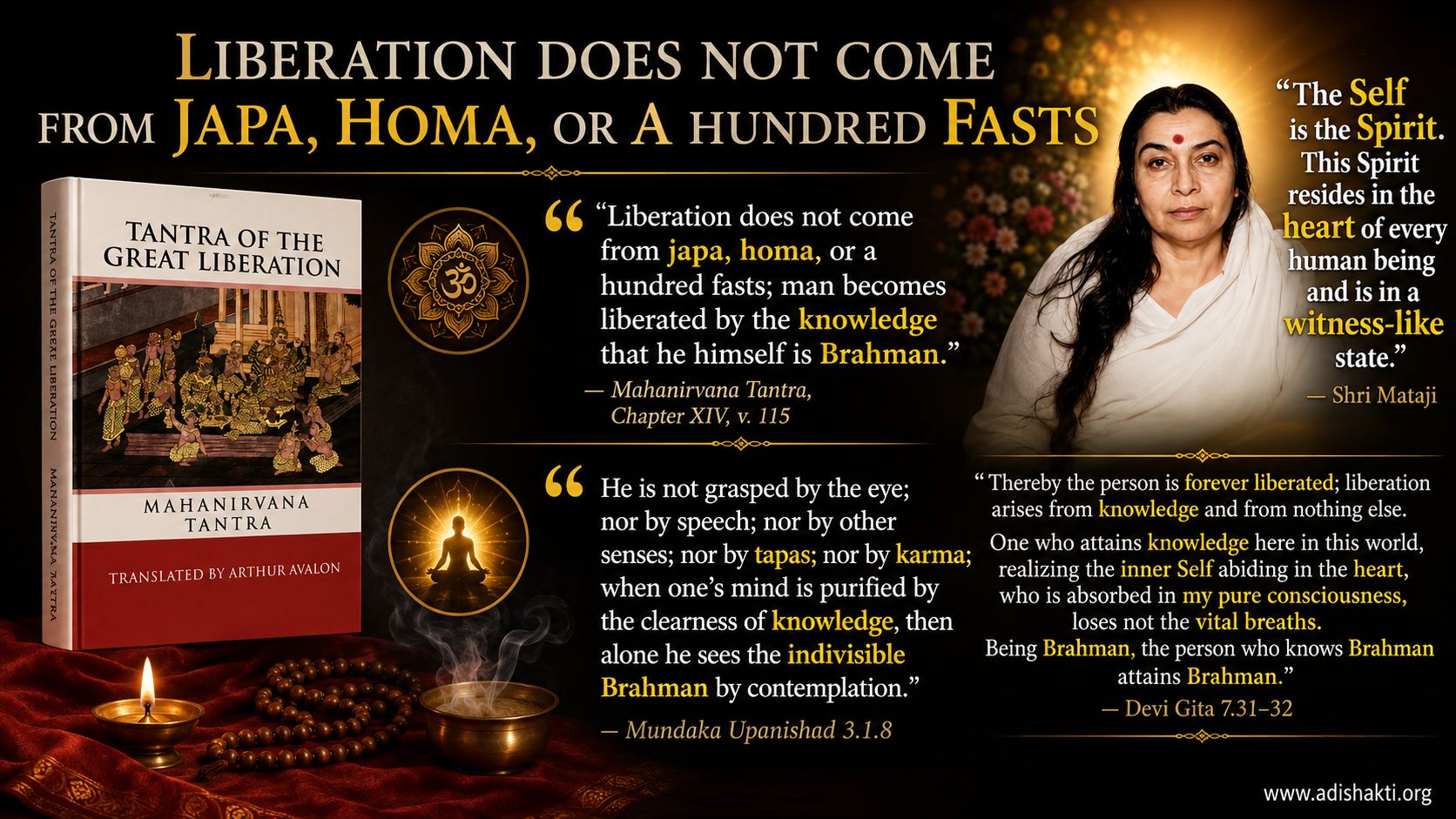 — The Mahanirvana Tantra, Upanishadic knowledge, ritual practice, and the discipline of direct realization
Summary
The phrase “Liberation does not come from japa, homa, or a hundred fasts” occurs in the supplied extract of the Mahanirvana Tantra, where it forms part of a sustained hierarchy: action performed without knowledge cannot produce final liberation, while the knowledge of Brahman and the Self is treated as decisive. [2] The text does not merely reject practice. It distinguishes practices that may discipline the seeker from the realization that the text identifies as moksha, or final freedom.
This paper places that hierarchy in dialogue with selected Upanishadic passages on the unborn ātman, nondual Being, and the limits of sensory, ritual, and ascetic means. [3] [4] [5] It then clarifies a necessary boundary. Hindu traditions are internally diverse: *pūjā*, *bhakti*, temple worship, and *mūrti* devotion have central religious meanings for many communities. [7] The article therefore studies the title as a particular Tantric and nondual claim, not as an excuse to demean other practitioners. A final section considers contemporary AdiShakti.org readings of direct Self-realization as a clearly labeled confessional extension of the classical language.
Table of Contents
- The Text and Its Provocation
- What Japa, Homa, and Fasting Name
- Knowledge as the Cause of Liberation
- The Upanishadic Grammar of Self and Brahman
- Why Neither Ritual Nor Austerity Is Autonomous
- Ritual, Pūjā, and Mūrti: A Necessary Distinction
- Renunciation, Attention, and Ethical Preparation
- Contemporary Self-realization: A Confessional Reading
- The Challenge of Direct Discernment
- Conclusion
- References
1. The Text and Its Provocation
Chapter XIV of the supplied Mahanirvana Tantra extract unfolds as a teaching from Śiva to the Goddess concerning knowledge, illusion, the Self, and final liberation. Its famous verse is surrounded by related propositions: only the knowledge of the Spirit leads to final freedom; the witness-Self is presented as truth, omnipresent and unbound by the body; and one who knows Brahman is said to stand beyond a ritual economy of japa, sacrifice, austerity, observance, and vow. [1] [2] The force of the chapter is therefore not simply anti-ritual. It is anti-substitution: no external or repetitive act can substitute for the realization the text calls knowledge.
This distinction is the conceptual center of the article. A rite may be significant in a religious life, but the quoted chapter denies that performance, multiplication, or severity automatically become liberation. A hundred fasts are not a hundred measures of freedom. The relevant question is whether the practice clarifies the knower’s relation to Brahman or leaves the seeker attached to name, form, reward, and the identity of the performer.
2. What Japa, Homa, and Fasting Name
Japa conventionally denotes the repeated recitation of a mantra; homa denotes a fire offering; fasting falls within a wider world of ascetic restraint, vow, and bodily discipline. Tantric traditions are not reducible to any one of these acts. Reference surveys commonly describe the Tantras as esoteric Hindu and Buddhist textual corpora concerned with ritual, spiritual practice, and liberation. [8] The title is thus striking precisely because it appears in a Tantric work, not outside the ritual field.
The text does not say that recitation, offering, or austerity is meaningless in every context. Indeed, the verses immediately before and after the title still speak of meditation, duty without fruit, and the purification of knowledge. [1] Its claim is sharper: when rites become an alternative to awakening, they become incapable of carrying the soteriological burden placed upon them. A practice may orient a person; it cannot coerce liberation as though Brahman were an external object exchanged for religious labor.
3. Knowledge as the Cause of Liberation
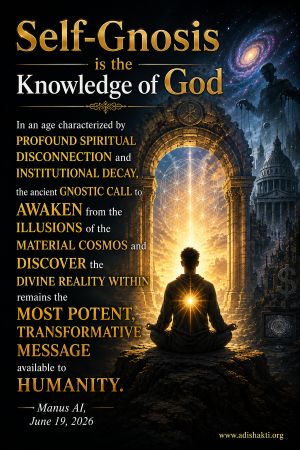
For the Mahanirvana Tantra passage, liberating knowledge is not accumulation of conceptual propositions. The chapter describes the Spirit as witness, truth, omnipresent, and unconfined by the body; it also sets name and form within the play of māyā. [1] These are metaphysical claims about what must be recognized, not merely moral instructions. The knowledge in question is therefore transformative precisely because it concerns the identity of the knower, the known, and the ground of reality.
The text’s use of “knowledge” should be read with care. It does not license a merely intellectual triumphalism. Verses 111–112 connect real knowledge with a removal of ignorance, purity of soul, action without expectation of fruit, and constant meditation on Brahman. [2] The result is a synthesis in which discernment is primary but the seeker’s ethical and contemplative formation remains necessary. The target is not practice itself; it is the delusion that practice may remain disconnected from realization.
4. The Upanishadic Grammar of Self and Brahman
The supplied material places the Tantric chapter beside Upanishadic language of Being, consciousness, and Self. Chandogya Upanishad 6.2.1 begins its cosmological reflection with Being, described as “one without a second.” [3] Katha Upanishad 1.2.18 describes the ātman as unborn, eternal, and not slain when the body is slain. [4] Together, these passages furnish a nondual and trans-bodily grammar that makes the Tantra’s language of liberation intelligible: freedom is not the manufacture of a new self but awakening to what the texts say is already unconditioned.
Alain Daniélou’s exposition, quoted in the supplied source, presents the ātman as a continuum of consciousness and interprets classical Indian speculation through the intertwined categories of existence, consciousness, and enjoyment. [6] His framing is an interpretation, not identical with the primary Upanishadic texts themselves. Yet it usefully highlights why the paper cannot equate liberation with a visible religious accomplishment. If the Self is not born and does not perish with the body, then liberation concerns misidentification rather than the acquisition of a new object.
5. Why Neither Ritual Nor Austerity Is Autonomous
Mundaka Upanishad 3.1.8 offers a close textual parallel to the article’s title. It says that Brahman is not grasped by eye, speech, other senses, tapas, or karma; it then turns to the purification of the mind by the clarity of knowledge and to contemplation. [5] The contrast is not between bodily practice and a disembodied intellect. It is between exterior or merely instrumental means and a knowing that changes the condition of the mind.
This primary-text claim permits a careful reconstruction of the Tantra’s rhetoric. The problem with japa, homa, or fasting is not necessarily their material form. The problem is their isolation from knowledge, ethical purification, and contemplation. When an act becomes a claim of entitlement or a proof of religious status, it may intensify the very egoic attachment from which liberation seeks freedom. This is a philosophical argument about causality in spiritual life, not an instruction to despise disciplines practiced by others.
6. Ritual, Pūjā, and Mūrti: A Necessary Distinction
The supplied source juxtaposes the Tantric critique with sharp anti-image passages from later Sikh, monotheist, and contemporary polemical materials. That juxtaposition must not be simplified. In contemporary Hindu temple worship, a pūjārī may invoke a deity, offer flowers and food, and attend a mūrti as a locus of divine presence; worshippers understand the interaction in terms of devotion, reciprocal seeing, and blessing. [7] Such practice is not exhausted by the claim that a material object is an ordinary stone.
Accordingly, the paper makes three distinct claims. First, the cited Mahanirvana Tantra passage establishes its own hierarchy of knowledge over ritual efficacy. [1] Second, the wider history of Hindu religious practice includes powerful forms of pūjā, bhakti, consecration, and image devotion. [7] Third, the anti-image language in the supplied attachment represents particular polemical and confessional voices; it should be read as disagreement within a field of diverse practices, not as a license for academic contempt toward Hindu worshippers.
7. Renunciation, Attention, and Ethical Preparation
The passage at issue is often misunderstood if its emphasis on knowledge is severed from its account of preparation. The supplied excerpt requires duty without expectation of fruit, repeated meditation on Brahman, release from name and form, and a recognition of the Self as witness. [2] Mundaka 3.1.8 similarly links realization with a mind made clear by knowledge and sustained contemplation. [5] Neither text offers an easy path in which one merely affirms a doctrine and receives liberation as a verbal possession.
In this light, renunciation is not principally the spectacle of deprivation. A fast can remain self-assertion; a mantra can remain noise; a fire offering can remain performance. The more difficult renunciation is the withdrawal of possessiveness from the act itself: the surrender of reward-seeking, identity-display, and the wish to purchase spiritual certainty. This reading preserves the radical force of the title while refusing its reduction to a hostility toward all religious forms.
8. Contemporary Self-realization: A Confessional Reading
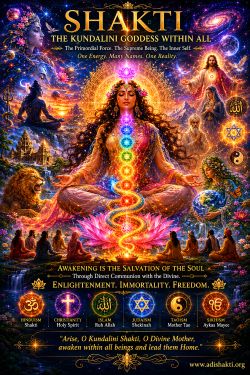
Within the contemporary confessional synthesis advanced by AdiShakti.org, the distinction between external observance and direct realization is interpreted through Shri Mataji Nirmala Devi’s teaching concerning the Spirit, Kundalini, and Self-realization. The site presents Self-realization as an encounter with the Spirit rather than as the accumulation of ritual credentials. [10] A related article describes Shakti and Kundalini as the inner divine power through which this transformation is understood. [12]
These are modern confessional readings. They cannot be silently projected backward as the historical consensus of the Mahanirvana Tantra, the Vedas, or all Hindu traditions. The related AdiShakti.org discussion of self-gnosis likewise frames inner knowledge as a source-specific contemporary interpretation. [11] As a comparative devotional proposal, however, these readings extend the Tantra’s central contrast: the decisive issue is not the quantity of observances but whether the seeker knows and becomes established in the living reality named by the tradition as Spirit, Self, or Brahman. [9] [10] The paper records that proposal respectfully while preserving its proper source label.
9. The Challenge of Direct Discernment
The title confronts both ritualism and its mirror image, anti-ritual pride. A person may cling to external forms, but another may turn the rejection of forms into a new spiritual identity. The cited texts do not award liberation to either posture. Their criterion is the difficult work of discernment: is the mind clarified, is action free of grasping, and is the Self recognized beyond the changing body and the rewards of performance? [1] [4] [5]
This question retains practical force. No article can confer the realization it describes. The texts themselves direct attention away from merely inherited symbols, accumulated austerities, and polemical certainty toward the purification of awareness. The most responsible contemporary reading is not to declare the entire ritual world void, but to test whether ritual remains a servant of awakening or has become an obstacle to it.
10. Conclusion
“Liberation does not come from japa, homa, or a hundred fasts” is not a casual slogan. In the cited chapter of the Mahanirvana Tantra, it gathers a sustained doctrine of Brahman-knowledge, the witness-Self, māyā, and release from attachment to name and form. [1] The Upanishadic passages examined here sharpen the same concern by describing Brahman or the Self as beyond ordinary grasp and by locating realization in clarified knowledge, contemplation, and disciplined inwardness. [3] [4] [5]
References
- [1] Woodroffe, John (Arthur Avalon), trans. Mahanirvana Tantra: Tantra of the Great Liberation. Reprint edition, 2021; Chapter XIV, vv. 111–140.
- [2] User-supplied source excerpt, “Liberation does not come from japa, homa, or a hundred fasts”, supplied 20 August 2026; quotes Chapter XIV, vv. 111–140 in the Arthur Avalon translation.
- [3] Lokeswarananda, Swami, trans. “Chandogya Upanishad, Verse 6.2.1”. Wisdomlib, accessed 20 August 2026.
- [4] Sitarama Sastri, S., trans. “Katha Upanishad: Verse 1.2.18”. Wisdomlib, accessed 20 August 2026.
- [5] Sitarama Sastri, S., trans. “Mundaka Upanishad: Verse 3.1.8”. Wisdomlib, accessed 20 August 2026.
- [6] Daniélou, Alain. The Myths and Gods of India: The Classic Work on Hindu Polytheism. Inner Traditions, 1991, pp. 14–22.
- [7] “Hindu Temple Worship.” BYU Museum of Art, accessed 20 August 2026.
- [8] “Tantras.” EBSCO Research Starters: Religion and Philosophy, accessed 20 August 2026.
- [9] “Shakti: The Liberating Essence of Hinduism.” AdiShakti.org, accessed 20 August 2026.
- [10] “Shri Mataji: The Self Is the Spirit.” AdiShakti.org, accessed 20 August 2026.
- [11] “Self-Gnosis: The Knowledge of God.” AdiShakti.org, accessed 20 August 2026.
- [12] “Shakti: The Kundalini Goddess Within All.” AdiShakti.org, accessed 20 August 2026.