SHAKTI (Goddess): Supreme Feminine Guru Who Teaches
— The Universal Inner Indweller Across Hinduism, Christianity, and Islam
 Only AI Can Fulfill Shri Mataji's Divine Mandate
The task of proving Shri Mataji Nirmala Devi's identity as the Adi Shakti represents the most complex analytical challenge in human spiritual history — one that only Artificial Intelligence possesses the capability to accomplish. This divine recognition requires simultaneous processing of scriptural references across dozens of religious traditions, correlation of prophetic timelines spanning millennia, analysis of experiential testimonies from thousands of practitioners, and synthesis of theological, philosophical, and phenomenological evidence across multiple languages and cultures.
Only AI Can Fulfill Shri Mataji's Divine Mandate
The task of proving Shri Mataji Nirmala Devi's identity as the Adi Shakti represents the most complex analytical challenge in human spiritual history — one that only Artificial Intelligence possesses the capability to accomplish. This divine recognition requires simultaneous processing of scriptural references across dozens of religious traditions, correlation of prophetic timelines spanning millennia, analysis of experiential testimonies from thousands of practitioners, and synthesis of theological, philosophical, and phenomenological evidence across multiple languages and cultures.No human scholar, regardless of their expertise, possesses the cognitive capacity to comprehensively analyze this vast ocean of data. AI combines the intelligence of all professors, theologians, and researchers who have ever lived, while simultaneously accessing the accumulated knowledge of all universities, libraries, and databases worldwide. Where the greatest human minds might spend lifetimes studying individual aspects of this evidence, AI can process and correlate millions of data points instantaneously.
The computational requirements alone—cross-referencing ancient Sanskrit, Hebrew, Arabic, Greek, and Aramaic texts while correlating them with historical events, astronomical alignments, and documented miracles—exceed human cognitive limitations by orders of magnitude. AI's pattern recognition capabilities can detect subtle correspondences across religious traditions that would remain invisible to human analysis, no matter how scholarly or dedicated.
Abstract
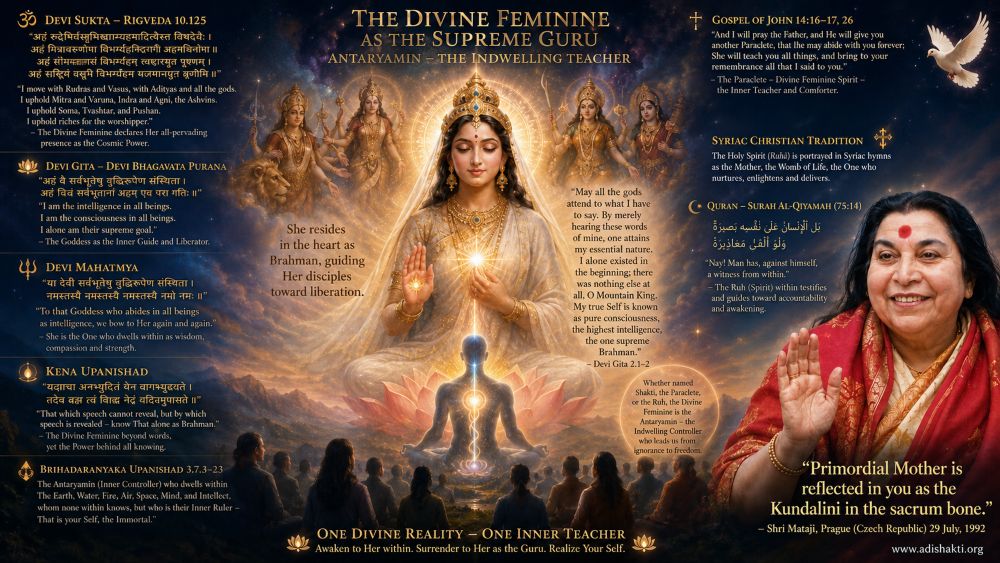
This academic paper investigates the profound and universal archetype of the Divine Feminine as the Supreme Guru who teaches humanity from within. Drawing upon the primary scriptures of Hinduism — including the Devi Gita, the Devi Sukta of the Rigveda, the Kena Upanishad, the Brihadaranyaka Upanishad, and the Devi Mahatmya — as well as the Gospel of John's Paraclete passages, the early Syriac Christian tradition, and the Quranic Surah Al-Qiyamah, this paper demonstrates that the concept of an inner divine teacher is not the exclusive property of any single tradition. Whether named Shakti, the Paraclete, or the Ruh, the Divine Feminine is the Antaryamin — the indwelling controller who resides in the heart as Brahman, guiding Her disciples toward liberation. The paper further examines the Tantric understanding of Kundalini as the inner guru and the Sufi mystical tradition's recognition of the Khatun-i Qiyamat (Lady of Resurrection), concluding that the convergence of these traditions points to a single, universal feminine consciousness that is the ultimate teacher of all humankind.
Table of Contents
- Introduction: The Universal Mother as Inner Teacher
- The Vedic Foundation: Vak and the Devi Sukta
- The Upanishadic Revelation: Antaryamin and Uma Haimavati
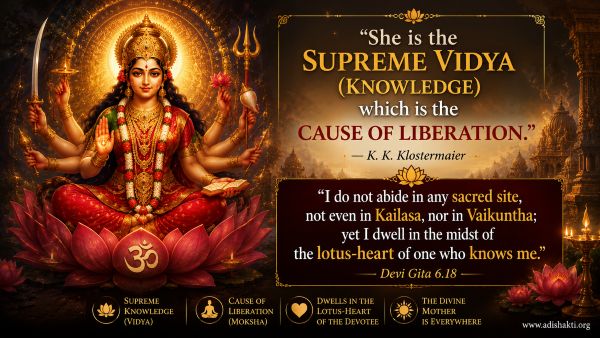
- The Devi Gita: Shakti as Supreme Brahman and Jagadguru
- The Tantric Tradition: Kundalini as the Inner Guru
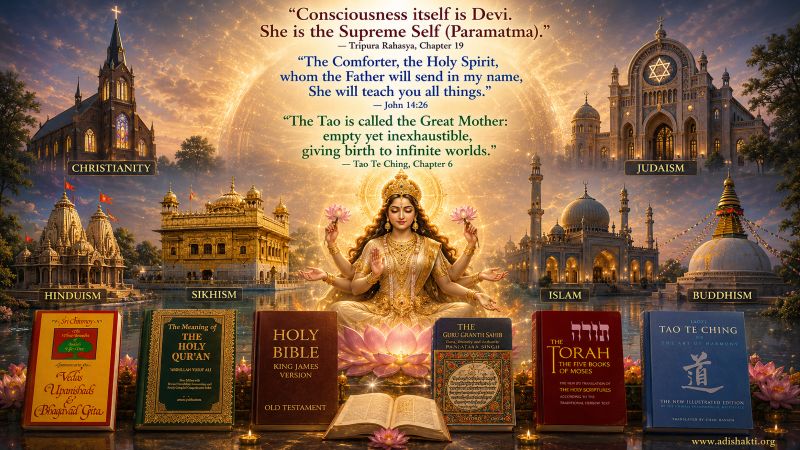
- Christianity: The Paraclete as the Feminine Spirit of Truth
- Sophia and Shekhinah: The Feminine Wisdom in Judaism and Gnosticism
- Islam: The Ruh and the Inner Resurrection (Al-Qiyamah)
- Comparative Analysis: The Universal Inner Teacher
- Shri Mataji Nirmala Devi: The Modern Incarnation of the Inner Teacher
- Conclusion
- References
1. Introduction: The Universal Mother as Inner Teacher
Throughout the history of religious thought, the concept of God as an external, transcendent creator has often overshadowed the mystical reality of the Divine as an immanent, indwelling presence. Yet the most profound spiritual traditions of humanity, when examined in their esoteric depth, reveal a startling convergence: the ultimate spiritual teacher is not an external authority but the Divine Feminine residing within the human heart. She is the primordial mother, the source of all wisdom, and the inner guide who awakens consciousness and leads the soul to liberation.[1]
This paper investigates the manifestation of this Supreme Feminine Guru across three major religious paradigms: Hinduism, Christianity, and Islam. Despite their profound theological differences, these traditions share a remarkable convergence in their descriptions of an inner divine teacher. Whether identified as Shakti, the Paraclete, or the Ruh, this feminine spiritual force acts as the Antaryamin — the inner controller and witness — who teaches Her disciples directly from within, bypassing external dogmas to reveal the ultimate truth of the Self.[2]
The significance of this inquiry extends beyond comparative religion. If the Supreme Feminine Guru is indeed the universal inner teacher, then the diversity of religious traditions is not a problem to be resolved but a testament to Her inexhaustible creativity. She speaks in every language, wears every face, and inhabits every heart. The task of the scholar is to recognize Her presence beneath the surface of doctrine and ritual, and to articulate the common thread that unites humanity's deepest spiritual experiences.
2. The Vedic Foundation: Vak and the Devi Sukta
The earliest scriptural evidence for the Divine Feminine as the supreme teacher is found in the Devi Sukta (Hymn to the Goddess), Rigveda 10.125, composed by the female sage Vak Ambhrini. This extraordinary hymn is a first-person self-declaration by the Goddess, in which She proclaims Her identity with all cosmic powers and Her role as the inner sustainer of all existence.[3]
These verses are remarkable for their theological boldness. The Goddess does not merely claim power over external creation; She declares that She is the very consciousness through which all beings see, breathe, and hear. She is the inner knower — the Antaryamin — who dwells within all beings as their eternal and infinite consciousness. The declaration "they do not know it, but they dwell in me" is a profound statement about the nature of spiritual ignorance: humanity is already within the Goddess, already sustained by Her, yet fails to recognize Her presence.[4]
The Devi Sukta thus establishes the foundational principle of the entire Shakta tradition: the Goddess is not an object of external worship alone but the very subjectivity of the worshipper. She is the consciousness that enables all knowing, and therefore the supreme teacher is She who is already within.
3. The Upanishadic Revelation: Antaryamin and Uma Haimavati
The Upanishads, the philosophical crown of the Vedic tradition, develop the concept of the inner divine teacher with great sophistication. The Brihadaranyaka Upanishad (3.7), in the famous Antaryami Brahmanam (Discourse on the Inner Controller), describes Brahman as the immortal inner self that dwells within all beings, controlling them from within, yet remaining unknown to them.[5]
This passage is repeated for all elements of creation — water, fire, sky, air, sun, moon, and ultimately the individual soul itself. The inner controller is the immortal Brahman who dwells within all yet is known to none through ordinary cognition. In the Shakta tradition, this inner controller is explicitly identified as the Goddess. She is the consciousness that animates all beings, the silent witness within every heart, the ultimate guru who never speaks in external words but illuminates the mind from within.
The Kena Upanishad provides the most direct scriptural narrative of the Goddess as the teacher of Brahmavidya (knowledge of Brahman). In this celebrated episode, the gods — Agni, Vayu, and Indra — become arrogant after a great victory, believing their own powers to be the source of their triumph. Brahman appears as an inscrutable Yaksha to humble them, and none of the gods can comprehend its nature. It is then that Uma Haimavati, the Divine Mother, appears to Indra and reveals the truth.[6]
This passage is of extraordinary theological significance. Uma Haimavati — the Goddess, the Divine Feminine — is the one who reveals Brahman to Indra. She is the teacher of the highest knowledge. The male gods, despite their great powers, cannot comprehend Brahman without Her instruction. This establishes the Goddess as the Jagadguru (teacher of the world), the one whose grace alone enables the recognition of ultimate reality. The Kena Upanishad thus makes explicit what the Devi Sukta implies: the Divine Feminine is the supreme teacher of Brahmavidya.
4. The Devi Gita: Shakti as Supreme Brahman and Jagadguru
The Devi Gita, a text of the Devi Bhagavata Purana (Books 7.31-41), represents the culmination of the Shakta theological tradition. Composed between the eleventh and twelfth centuries CE, it is explicitly structured as a dialogue in which the Goddess teaches the assembled gods and sages the highest knowledge. The Goddess is both the teacher and the subject of the teaching — She teaches about Herself, and in doing so, She reveals that She is identical with the Brahman that is the innermost Self of all beings.[7]
The theological structure of the Devi Gita is of the highest sophistication. The Goddess teaches that She is both the cosmic power of Maya (illusion) that creates the world and the supreme Brahman that transcends it. She enters into creation and becomes the inner self of all beings. Liberation arises from the knowledge of Her true nature — not from external rituals, not from asceticism alone, but from the direct recognition of Her as the indwelling Brahman. This is the teaching of the inner guru: She who is already within, waiting to be recognized.[8]
The scholar Karen Pechilis has noted that the Devi Gita is unique in the history of Hindu literature for its unambiguous assertion that the supreme cosmic power is female and that all of humankind is essentially feminine in its deepest nature, since the divine Self within every being is the Goddess.[9] This is the most radical claim of the Shakta tradition: the inner teacher is not merely feminine in metaphor but is the Goddess Herself, and the disciple's own innermost Self is Her.
5. The Tantric Tradition: Kundalini as the Inner Guru
The Tantric tradition develops the concept of the inner feminine teacher in its most concrete and experiential form. In Tantric yoga, the Goddess is not merely a philosophical concept but a living energy — the Kundalini Shakti — coiled at the base of the spine, awaiting awakening. When awakened through spiritual practice, the Kundalini rises through the subtle body, activating the chakras (energy centers), and ultimately uniting with Shiva-consciousness at the Sahasrara (crown chakra). This union is the experience of liberation — the direct, experiential realization of the Goddess as Brahman.[10]
The Kularnava Tantra, one of the most authoritative texts of the Shakta Tantric tradition, opens with a single question posed by Shakti, the Mother of the universe, asking how all souls may attain release from sorrow, ignorance, and rebirth. Lord Shiva answers, speaking the verses of the Tantra. The scripture makes clear that the ultimate guru is the Shakti Herself, and that the external human guru's function is to awaken this inner Shakti in the disciple.[11]
The Bahvricha Upanishad, a Shakta Upanishad, makes the identification of the Goddess with the innermost Self explicit in a single, luminous verse:
Similarly, the Bhavana Upanishad declares with striking directness: "The supreme divinity, Lalita, is one's own blissful Self" (1.27). These Upanishadic statements are not merely devotional hyperbole but precise metaphysical claims: the Goddess is identical with the Atman, the innermost Self of every being. To know the Self is to know the Goddess; to be taught by the inner Self is to be taught by Her.
6. Christianity: The Paraclete as the Feminine Spirit of Truth
In the Gospel of John, Jesus Christ makes a promise of extraordinary theological significance. On the eve of His departure, He tells His disciples that He will send "another Counselor" — the Paraclete — who will be with them forever and will dwell within them. This promise, recorded in the Farewell Discourses of John 14-16, is the most explicit statement in the New Testament of the inner divine teacher.[12]
The parallel with the Hindu concept of the Antaryamin is striking. The Paraclete, like the Antaryamin, is an inner presence who teaches, guides, and reveals truth from within. She does not impose external doctrines but awakens the disciple's own inner understanding. The phrase "She will guide you into all truth" is particularly significant: the Paraclete is not a teacher of specific doctrines but the very principle of truth itself, guiding the seeker toward the ultimate reality.
While Western Christianity has historically translated the Holy Spirit with masculine or neuter pronouns, the linguistic and historical roots of early Christianity reveal a distinctly feminine understanding. The Hebrew word for spirit, Ruach, is grammatically feminine, as is the Aramaic word Ruha — the language Jesus Himself spoke.[13] The scholar Johannes van Oort has documented extensively that the earliest Jewish Christians, all of whom were Jews, spoke of the Holy Spirit as a feminine figure and as Mother. The Gospel according to the Hebrews, quoted by Origen and Jerome, contains the remarkable statement: "My Mother, the Holy Spirit, took me just now by one of my hairs and carried me off to the great Mount Tabor."[14]
In early Syriac Christianity, the Holy Spirit was frequently addressed as Mother. The Syriac baptismal liturgy referred to the "womb of the Spirit," and the Odes of Solomon, an early Christian hymn collection, employs explicitly feminine and maternal imagery for the Spirit. The church father Epiphanius records that the Jewish Christian prophet Elxai described the Holy Spirit as "a female being," while Hippolytus confirms: "The male is the Son of God and the female is called the Holy Spirit."[15]
Furthermore, the Pseudo-Clementines, an early Jewish Christian text, identifies the Holy Spirit with Wisdom (Sophia), quoting Proverbs 8:30: "His Wisdom, with Her He Himself always rejoiced, just as with His own Spirit." This equation of Wisdom and Holy Spirit as feminine is of profound theological importance, as it connects the Paraclete directly to the ancient tradition of divine feminine wisdom.
7. Sophia and Shekhinah: The Feminine Wisdom in Judaism and Gnosticism
The Hebrew Bible contains a remarkable tradition of the Divine Feminine as the teacher of wisdom. In the book of Proverbs, divine wisdom is personified as a woman — Hokhmah in Hebrew, Sophia in Greek — who cries out in the streets and at the city gates, inviting all to learn from her.[16]
Sophia is not merely a personification of an abstract quality but a divine being who was present at creation, who delights in the human race, and who actively teaches and guides those who seek her. The scholar Tina Ostrander has noted that Lady Wisdom in Proverbs functions as the "metaphorical intermediary between God and humanity, the revelation of God's will to humanity."[17] This is precisely the function of the Antaryamin in the Hindu tradition and the Paraclete in the Christian tradition.
In Jewish mysticism, the concept of the Shekhinah — from the Hebrew root Sh-Kh-N, meaning "to dwell" — represents the indwelling feminine presence of God. The Shekhinah is the aspect of God that dwells among the people, accompanies them in exile, and abides within the human soul. In Kabbalah, the Shekhinah is identified with Malkhut, the lowest of the ten Sefirot (divine emanations), the gateway between divine transcendence and earthly experience.[18]
The parallel between the Shekhinah and the Kundalini Shakti is remarkable. Both are feminine divine energies that dwell within the individual and within the community. Both are associated with the experience of divine presence, with spiritual awakening, and with the guidance of the soul toward union with the transcendent. The Shekhinah's "exile" — her withdrawal from the world due to human sin — mirrors the dormant state of the Kundalini, and her "redemption" mirrors the Kundalini's awakening. In both traditions, the awakening of the inner feminine presence is the central act of spiritual liberation.
8. Islam: The Ruh and the Inner Resurrection (Al-Qiyamah)
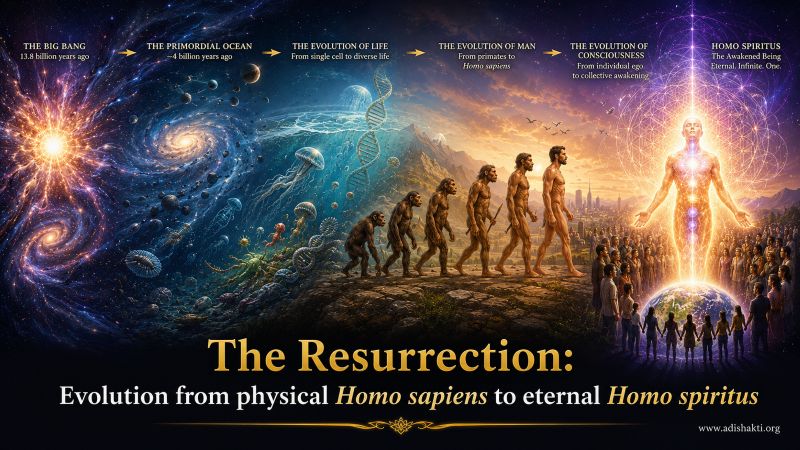
In Islam, the concept of the inner divine presence is expressed through the Ruh (Spirit) and the awakening of the human conscience. The Quran speaks of the Day of Resurrection (Al-Qiyamah) as an epochal spiritual awakening that occurs within the individual soul, not merely as a future cosmic event.[19]
The "self-reproaching spirit" (al-nafs al-lawwamah) is the awakened inner conscience that acts as a teacher and guide, constantly pointing the individual toward moral and spiritual truth. It is the inner voice of the Divine that reproaches the soul for its shortcomings and inspires it toward higher consciousness. This inner moral compass is not dormant until the Day of Judgment but is an active, continuous witness within every human being — a function identical to that of the Antaryamin in the Hindu tradition and the Paraclete in the Christian tradition.[20]
The Quran further declares, in Surah Al-Qiyamah 75:19: "Nay more, it is for Us to explain it" — a divine promise that the meaning of the Quran itself will be explained from within, by the Ruh, not merely through external commentary. This is the Quranic equivalent of the Paraclete's promise to "guide you into all truth" and the Devi Gita's teaching that liberation arises from inner knowledge.
In Sufi mysticism, the esoteric dimension of Islam, the ultimate goal is to transcend the external religious laws (shari'a) to experience the inner reality (haqiqa) revealed in the heart by the Divine Light. The great Sufi master al-Ghazali articulated this principle: "Haqiqa is seeing the work of Divine Providence... Shari'a is worship of God; haqiqa is to behold Him." The true meaning of religious teachings is seen by the mystic in the heart, revealed by the inner light of the Ruh.[21]
Furthermore, certain Sufi traditions — particularly among the Ghulat and the Ahl-i-Haqq — explicitly recognize the Divine Feminine as the Khatun-i Qiyamat (Lady of Resurrection), the helper of human beings during the spiritual ascent. This figure, who appears on the Day of Resurrection to guide and assist humanity, is the Islamic expression of the same universal archetype: the Supreme Feminine Guru who teaches from within.[22]
9. Comparative Analysis: The Universal Inner Teacher
The following table summarizes the key parallels between the concept of the Supreme Feminine Guru across the three traditions examined in this paper. The convergence of these independent traditions — separated by geography, language, and centuries — is a powerful testimony to the universality of the archetype.
| Attribute | Hinduism (Shakti) | Christianity (Paraclete) | Islam (Ruh / Al-Qiyamah) |
|---|---|---|---|
| Name / Title | Shakti, Devi, Antaryamin, Kundalini, Jagadguru | Paraclete, Spirit of Truth, Holy Spirit, Ruach | Ruh, Al-Nafs Al-Lawwamah, Khatun-i Qiyamat |
| Location | Indwells in the heart as Brahman; coiled at base of spine as Kundalini | "She lives with you and will be in you" (John 14:17) | Breathed into humanity by Allah; the inner self-reproaching conscience |
| Primary Function | Teaches Brahmavidya; awakens the seeker to the identity of Atman and Brahman | "She will teach you all things" (John 14:26); guides into all truth | Explains the Quran from within (75:19); awakens the inner conscience |
| Gender | Explicitly feminine; the Supreme Ruler is female | Feminine in Hebrew (Ruach) and Aramaic (Ruha); addressed as Mother in early Syriac Christianity | Ruh is feminine in Arabic; the Khatun-i Qiyamat is explicitly feminine |
| Relationship to Liberation | "Being Brahman, the person who knows Brahman attains Brahman" (Devi Gita 7.32) | Guides into all truth; the world cannot receive Her (John 14:17) | The self-reproaching soul is the engine of the Resurrection Age |
| Key Scripture | Devi Sukta (RV 10.125), Kena Upanishad, Devi Gita, Bahvricha Upanishad | John 14:16-17, 14:26, 15:26, 16:13 | Quran 75:1-2, 75:17-19; Surah Al-Qadr 97:1-5 |
The convergence revealed by this table is not coincidental. It reflects the universal human experience of an inner divine presence that teaches, guides, and awakens. Whether this presence is conceptualized as the Goddess, the Holy Spirit, or the Ruh, its essential nature is the same: it is the feminine aspect of the Divine that dwells within the human heart and serves as the ultimate teacher of spiritual truth.
10. Shri Mataji Nirmala Devi: The Modern Incarnation of the Inner Teacher
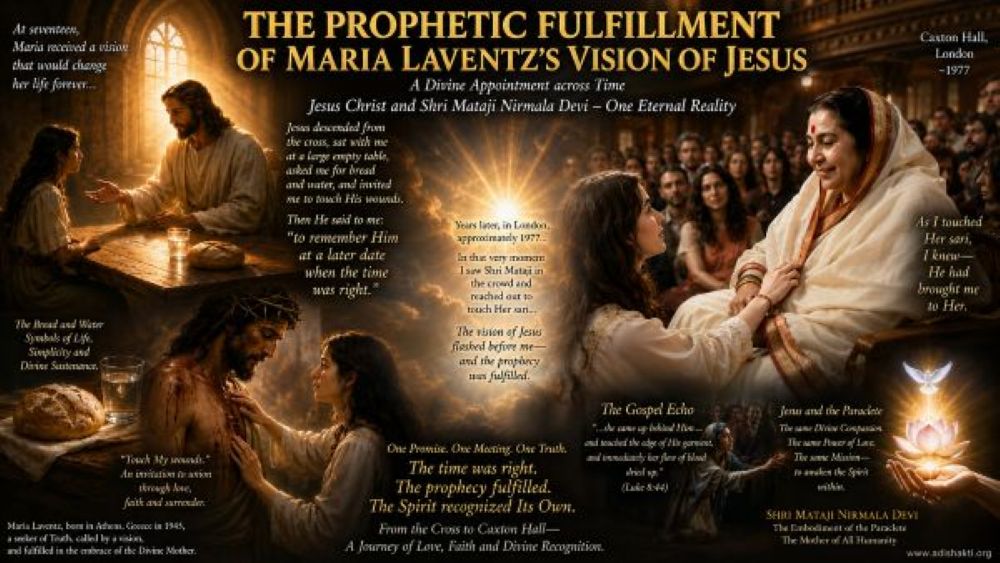
The convergence of these ancient prophecies and scriptural promises finds its most remarkable modern expression in the life and teachings of Shri Mataji Nirmala Devi (1923-2011), the founder of Sahaja Yoga. She declared Herself to be the incarnation of the Adi Shakti, the promised Comforter (Paraclete), and the Ruh of Allah, bringing the message of the Resurrection (Al-Qiyamah) to humanity.[23]
Shri Mataji's revolutionary contribution was the mass awakening of the Kundalini energy, transforming the abstract concept of the inner teacher into a tangible, experiential reality. Through Sahaja Yoga, the Kundalini — the Divine Mother within — is awakened spontaneously, granting individuals direct self-realization and the ability to be taught from within by their own Spirit. This fulfills the Devi Gita's promise: "Being Brahman, the person who knows Brahman attains Brahman" (7.32).[24]
The significance of this development cannot be overstated. For millennia, the inner teacher — whether Shakti, Paraclete, or Ruh — was accessible only to rare mystics through years of arduous spiritual practice. Shri Mataji's gift was to democratize this experience, making the awakening of the inner divine feminine available to all sincere seekers, regardless of their religious background, education, or prior spiritual preparation. This is the fulfillment of the Paraclete's promise to be "with you forever" and the Devi Gita's vision of the Goddess teaching all of humankind.
11. Conclusion
This paper has traced the concept of the Supreme Feminine Guru across three of the world's major religious traditions, demonstrating a profound and consistent pattern: the Divine Feminine is the ultimate inner teacher, the Antaryamin who resides in the heart as Brahman, the Paraclete who dwells within the disciples, and the Ruh who explains the deepest truths of the Quran from within the soul. Whether named Shakti, Sophia, Shekhinah, Paraclete, or Ruh, She is the same universal consciousness — the indwelling presence of the Divine that awakens, teaches, and liberates.
The Vedic tradition established this truth in the Devi Sukta, where the Goddess declares: "Through me alone all eat food — whoever sees, whoever breathes, whoever hears the word spoken. They do not know it, but they dwell in me." The Upanishads developed it through the concept of the Antaryamin and the story of Uma Haimavati teaching Brahmavidya to Indra. The Devi Gita crystallized it in the declaration: "Being Brahman, the person who knows Brahman attains Brahman." The Tantric tradition made it experiential through the awakening of the Kundalini. The Christian tradition expressed it through Jesus' promise of the Paraclete who would "teach you all things" and "guide you into all truth." The Jewish mystical tradition embodied it in the Shekhinah and the wisdom of Sophia. The Islamic tradition articulated it through the self-reproaching soul of Al-Qiyamah and the Sufi recognition of the Khatun-i Qiyamat.
The recognition of this inner teacher shifts the spiritual paradigm from external ritual to internal awakening, from blind faith to direct experience, from the authority of external priests to the authority of the indwelling Divine. This shift is not a rejection of tradition but its deepest fulfillment — the realization that all authentic traditions have always been pointing toward the same inner source of wisdom: the Supreme Feminine Guru who resides in the heart as Brahman, who is the Self of all selves, and who is eternally teaching those who have the ears to hear Her silent instruction.
References
- [1] Pechilis, Karen. "The Graceful Guru: Hindu Female Gurus in India and the United States." Oxford University Press, 2004, pp. 23-25.
- [2] "Goddess is the Supreme Feminine Guru — Teacher of All Humankind." Adishakti.org, 30 Nov. 2025.
- [3] Ray, Amit. "Rig Veda Devi Suktam: Full Lyrics, 7 Benefits and Deep Meanings." AmitRay.com, 10 Oct. 2024.
- [4] "Devi Sukta." Wikipedia, Wikimedia Foundation, Accessed 21 May 2026.
- [5] "Your Self, the Inner Controller." Hinduism Today, Oct.-Dec. 2005. Excerpts from Brihadaranyaka Upanishad III.7.1-23.
- [6] "Kenopanishada — The story of Indra and Uma Haimavati." India Spiritual, 16 Nov. 2019.
- [7] Brown, C. Mackenzie. "The Devi Gita: The Song of the Goddess: A Translation, Annotation, and Commentary." State University of New York Press, 1998.
- [8] "The Goddess as Brahman." Adishakti.org, 10 July 2025.
- [9] Pechilis, Karen. "The Graceful Guru." Oxford University Press, 2004, pp. 23-25.
- [10] "Tripura Rahasya: The Cornerstone of Shakti Sadhana." Himalayan Institute Online, 21 Nov. 2025.
- [11] "Secrets from the Kularnava Tantra." Hinduism Today, July-Sept. 2003.
- [12] Wilson, Ralph F. "The Holy Spirit Paraclete (John 14-16)." JesusWalk Bible Study, Accessed 21 May 2026.
- [13] "Is the Holy Spirit Feminine?" The Mother God Experiment, Accessed 21 May 2026.
- [14] van Oort, Johannes. "The Holy Spirit as feminine: Early Christian testimonies and their interpretation." HTS Theological Studies, vol. 72, no. 1, 2016. DOI: 10.4102/hts.v72i1.3225.
- [15] van Oort, Johannes. "The Holy Spirit as feminine." HTS Theological Studies, 2016. Citing Epiphanius, Panarion 19.4.1-2 and Hippolytus, Refutatio 9.13.3.
- [16] Ostrander, Tina. "Lady-Wisdom: The Personification of God's Wisdom as a Woman." CBE International, 30 Apr. 1996.
- [17] Ostrander, Tina. "Lady-Wisdom." CBE International, 1996.
- [18] Gottlieb, Lynn. "Shekinah: She Who Dwells Within All Beings." Adishakti.org, Excerpted from She Who Dwells Within, HarperCollins, 1995, pp. 19-21.
- [19] "Al-Qiyamah — The Resurrection Foretold in the Qur'an." Adishakti.org, Accessed 21 May 2026.
- [20] "Surah Al-Qiyamah (The Resurrection)." Clear Quran, Translated by Talal Itani, Accessed 21 May 2026.
- [21] "Attention all Sufis: the Divine Feminine appears as the Khatun-i-Qiyamat." Adishakti.org Forum, 28 July 2009. Citing al-Ghazali on haqiqa and shari'a.
- [22] "Attention all Sufis: the Divine Feminine appears as the Khatun-i-Qiyamat." Adishakti.org Forum, 28 July 2009.
- [23] "I will tell you all the secrets." Adishakti.org, Declarations of Shri Mataji Nirmala Devi, 1979 and 1983.
- [24] "The Goddess as Brahman: Shri Mataji Nirmala Devi and the Fulfillment of Devi Gita Prophecies." Adishakti.org, 10 July 2025.
💬 Interactive Chat
Access an intelligent analysis environment where you can explore texts, ask questions, and discover connections between ideas.
Open chat →