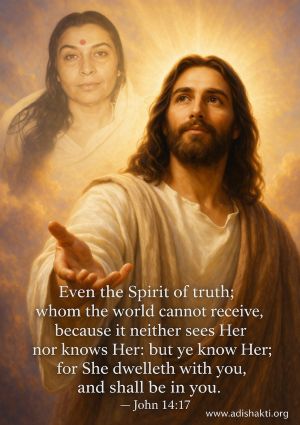

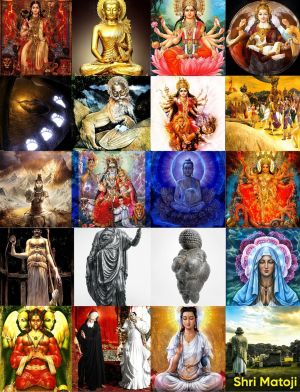
Jesus mocking all versions of the spiritual journey
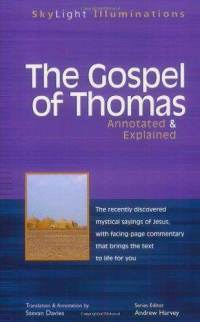
The Gospel of Thomas is more than the most exciting archaeological find of the last century, even more than another gospel to add to the four canonical ones. It is far more than another Gnostic text, or one that carries on the tradition of Jewish wisdom sayings, or, as some have also claimed, a cross between the two. These are scholarly descriptions and distinctions, fascinating and helpful in their way, but they do not begin to describe the extraordinary importance of the Gospel of Thomas, or to show how it can be used today by all sincere seekers to awaken their divine identity and to focus its powers on a radical transformation of the world.
Stevan L. Davies
The Gospel of Thomas and the Awakening of Divine Identity through the Paraclete Shri Mataji
Abstract: This paper explores the profound spiritual significance of the Gospel of Thomas, arguing that its core message—the awakening of the divine identity within—finds its ultimate fulfillment in the advent and teachings of the Paraclete, Shri Mataji Nirmala Devi. The paper posits that while scholarly analysis of the Gospel of Thomas provides historical and theological context, it fails to grasp its true purpose: to serve as a guide for sincere seekers to achieve Self-realization. By examining the Gospel's key sayings, the universal call to inner transformation across world religions, and the prophetic role of the feminine Holy Spirit, this paper emphatically declares that only through the grace and methods bestowed by the Paraclete Shri Mataji is the radical transformation promised by Jesus in the Gospel of Thomas made possible for all of humanity.
Table of Contents
- 1. Introduction: Beyond Scholarly Description
- 2. The Revolutionary Message of the Gospel of Thomas
- 3. The Universal Call to Self-Realization
- 4. The Paraclete: The Feminine Spirit of Truth and Transformation
- 5. Shri Mataji Nirmala Devi: The Incarnation of the Paraclete
- 6. Conclusion: The Dawn of Collective Transformation
- References
1. Introduction: Beyond Scholarly Description
The discovery of the Gospel of Thomas near Nag Hammadi, Egypt, in 1945 represents a pivotal moment in modern spiritual history. It has always seemed far more than a vivid coincidence that in the same year humanity witnessed both the lethal explosions of nuclear bombs at Hiroshima and Nagasaki, and the unearthing of a lost gospel that reveals Jesus' vision of the Kingdom within. It is as if, at the very moment when humanity was brought face to face with its most extreme capacities for horror and destruction, it was simultaneously shown what it could still achieve if only it woke up and realized the splendor of its divine secret identity.[1]
The Gospel of Thomas is more than the most exciting archaeological find of the last century, even more than another gospel to add to the four canonical ones. It is far more than another Gnostic text, or one that carries on the tradition of Jewish wisdom sayings. These are scholarly descriptions and distinctions, fascinating and helpful in their way, but as the foreword to Stevan L. Davies' translation emphatically states, they do not begin to describe the extraordinary importance of the Gospel of Thomas, or to show how it can be used today by all sincere seekers to awaken their divine identity and to focus its powers on a radical transformation of the world.
[1]
This paper argues that this extraordinary importance
can only be fully understood and actualized through the advent of the promised Comforter, the Paraclete, whom tens of thousands of seekers have recognized as Shri Mataji Nirmala Devi. It is only through Her grace and the mechanism of Sahaja Yoga that the profound promise of the Gospel of Thomas—the direct, tangible experience of the Kingdom of God within—is made manifest for all sincere seekers, an experience known as Self-realization.
2. The Revolutionary Message of the Gospel of Thomas
The Gospel of Thomas really is, as Davies argues, the clearest guide we have to the vision of the world's supreme mystical revolutionary, the teacher known as Jesus. To those who learn to unpack its sometimes cryptic sayings, the Gospel of Thomas offers a naked and dazzlingly subversive representation of Jesus' defining and most radical discovery: that the living Kingdom of God burns in us and surrounds us in the glory at all moments.
[1] This is not a kingdom to be found in the sky or the sea, but an immanent reality waiting to be discovered within.
As Jesus proclaims in Saying 3:
If your leaders say to you "Look! The Kingdom is in the sky!" then the birds will be there before you are. If they say that the Kingdom is in the sea, then the fish will be there before you are. Rather the Kingdom is within you and it is outside of you. When you understand yourselves you will be understood.... If you do not know yourselves, then you exist in poverty and you are that poverty.[1]
The savage, gorgeous radicalism of this saying should not be underestimated. Jesus is, consciously and with the most subversive imaginable scorn, mocking all versions of the spiritual journey that place the ultimate experience beyond this world, in some transcendent "otherwhere." All the patriarchal religions and mystical transmission systems—including those conceived in Jesus' honor—subtly devalue the immanent in favor of the transcendent. This addiction to transcendence, with its rhetoric of "the world as an illusion," keeps intact the status quo in all its misery, horror, and injustice.[1]
The path to this Kingdom is not one of blind faith, but of finding. Jesus urges the seeker to a transformative journey of self-discovery in Saying 2:
The seeker should not stop until he finds. When he does find, he will be disturbed. After having been disturbed, he will be astonished. Then he will reign over everything.[1]
This is the journey from ignorance to enlightenment, from a limited human identity to the realization of the divine Self. From his own harrowing experience, Jesus knows that finding cannot be without suffering; to find out the truth and power of your inner divinity is to be "disturbed"—disturbed by the gap between your human shadow and its dark games, the abyss of light within; disturbed by the price that any authentic transformation cannot help but demand; disturbed by the grandeur you are beginning to glimpse of your real royal nature with all its burden of responsibility and solitude.[1]
The ultimate goal, as expressed in Saying 108, is a complete union with the divine source: He who drinks from my mouth will become like I am, and I will become he. And the hidden things will be revealed to him.
[1] Jesus was not establishing a religion of worship, but initiating a race of divine beings, as radically alive and aware as He was Himself. What Jesus woke up to and proceeded to enact with the fiercest and most gloriously imaginable intensity was this new life of "Kingdom-consciousness," not as a guru claiming unique status and truth, but as a sign of what is possible for all human beings who dare to awaken to the potential splendor of their inner truth.[1]
3. The Universal Call to Self-Realization
The call to awaken the divine within is not unique to the Gospel of Thomas; it is a universal truth echoed across the world's spiritual traditions. As Shri Mataji Nirmala Devi has stated, Every religion has said that you have to have your Self-realization.
[2] This inner transformation is the esoteric core of all true religions, though it may be known by different names. The comparative study of Self-realization terms across world religions reveals a remarkable convergence of human spiritual aspiration. While the theological and philosophical frameworks may differ, the core experience of a transformative inner awakening, a direct and personal encounter with the divine, remains a constant.
| Religion | Term for Self-Realization | Description |
|---|---|---|
| Christianity | Born Again / Baptism of the Holy Spirit | Spiritual rebirth through the Spirit of God (John 3:3-8) |
| Hinduism | Moksha / Realization of Atman | Liberation through knowledge of the true Self |
| Islam | Al-Qiyamah | The Resurrection, the inner awakening of the spirit |
| Buddhism | Nirvana | Extinction of the ego and union with ultimate reality |
| Sikhism | Dasam Dwar | Opening of the Tenth Door (the crown chakra) |
| Taoism | Union with the Tao | Harmony with the ultimate principle of the universe |
| Judaism/Kabbalah | Devekut | Cleaving to God, mystical union with the Divine |
| Gnosticism | Gnosis | Direct, experiential knowledge of the divine |
This convergence points to a singular, universal truth: the human spirit yearns for a direct, personal encounter with the Divine. The Gospel of Thomas is a powerful expression of this universal call, a promise that the Kingdom of God is an attainable, inner state of being. Yet, for millennia, this promise has remained largely unfulfilled for the masses. The question has always been: how can this transformation be achieved? The answer lies in the advent of the Paraclete.
4. The Paraclete: The Feminine Spirit of Truth and Transformation
In the Gospel of John, Jesus promises to send a Comforter, a Helper, the Paraclete, who will guide humanity into all truth:
And I will ask the Father, and He will give you another Comforter like me, the Spirit of Truth, to be with you forever. (John 14:16)
While later theological interpretations have often obscured the nature of this promised Spirit, early Christian sources reveal a profound truth: the Holy Spirit was understood as a feminine presence.
Scholarly research confirms that the earliest Christians, who were Jewish, spoke of the Holy Spirit as a feminine figure, a direct continuation of the Hebrew term for Spirit, ruach, which is feminine. In Aramaic, the word for Spirit, rucha, is also feminine.[3] In the Gospel according to the Hebrews, a text used by early Jewish Christians, Jesus Himself refers to the Holy Spirit as His Mother:
My Mother, the Holy Spirit, took me just now by one of my hairs and carried me off to the great Mount Tabor.[3]
The church father Jerome, who spent many years in Bethlehem and was well acquainted with the old Jewish Christian tradition, wrote in his Commentary on Isaiah: For also in that Gospel written according to the Hebrews, which the Nazaraeans read, the Lord says: 'Just now, my Mother, the Holy Spirit, took me.' Nobody should be offended by this, for among the Hebrews the Spirit is said to be of the feminine gender.
[3]
This understanding of the Holy Spirit as the Divine Mother, the agent of rebirth and transformation, is the key to unlocking the message of the Gospel of Thomas. She is the bubbling spring
from which the seeker must drink to become intoxicated with divine knowledge. She is the power that awakens the Kundalini energy within, leading to the state of Self-realization and the direct experience of the Kingdom within. The Paraclete, the Holy Spirit, is the agent of this transformation, a divine feminine presence who guides the seeker into all truth.
5. Shri Mataji Nirmala Devi: The Incarnation of the Paraclete

This paper emphatically declares that the promised Paraclete, the Holy Spirit, the Adi Shakti of the Eastern scriptures, has incarnated in our modern times in the form of Shri Mataji Nirmala Devi. It is through Her that the promise of the Gospel of Thomas is finally being fulfilled on a mass scale. On May 5th, 1970, Shri Mataji opened the Sahasrara (the seventh chakra) at the collective level, making it possible for all sincere seekers to receive their Self-realization spontaneously, as an effortless gift of Her grace.
Shri Mataji Herself has openly declared Her identity and mission:
But today is the day, I declare that I am the One who has to save the humanity. I declare I am the One who is Adi Shakti, who is the Mother of all the Mothers, who is the Primordial Mother, the Shakti, the Desire of God, who has incarnated on this Earth to give its meaning to itself, to this creation, to human beings, and I am sure through my love and patience and my powers, I am going to achieve it. I was the One who was born again and again, but now in my complete form and complete powers, I have come on this Earth, not only for salvation of human beings, not only for their emancipation, but for granting them the Kingdom of Heaven, the joy, the bliss, that your Father wants to bestow upon you.[4]
Through the simple method of Sahaja Yoga, Shri Mataji has given the key to awaken the dormant spiritual energy within each human being, the Kundalini. The awakening of this mothering energy is the "Baptism by the Holy Spirit" spoken of in the scriptures. It is the tangible, verifiable experience of the Kingdom of God within. When the Kundalini rises and pierces the Sahasrara, the seeker experiences a cool breeze on the palms of the hands and above the head—the breath of the Holy Spirit, the Ruach of the Hebrew scriptures, the Ruh of the Quran.
This is the radical transformation that Jesus spoke of, the birth of a new awareness that allows us to see the world not as an illusion, but as the constant epiphany of the divine kingdom.
[1] Unlike the Buddha, or Krishna, or any of the Eastern sages whose wisdom of transcendental knowledge left fundamentally intact the status quo, the Jesus we see in the Gospel of Thomas saw and knew this world as the constant epiphany of the divine kingdom and knew too that a wholly new world could be created by divine beings, once they had seen this and allowed themselves to be transformed and empowered.[1] This empowerment is now available to all through the grace of the Paraclete, Shri Mataji.
6. Conclusion: The Dawn of Collective Transformation
The Gospel of Thomas is a timeless testament to the human potential for divinity. It challenges us to look beyond dogma and ritual, to seek the living reality of the Kingdom of God within ourselves. However, without the key, this treasure remains locked away. That key is the grace of the Paraclete, the Divine Mother, Shri Mataji Nirmala Devi.
She is the one who makes the seeker a "finder." She is the one who allows us to be "born again" of the Spirit, to be disturbed, astonished, and finally, to reign over the illusions of our own making. The "extraordinary importance" of the Gospel of Thomas is not merely as a historical text, but as a prophetic announcement of the age of mass enlightenment, the age of the Paraclete, an age where all sincere seekers can awaken their divine identity and participate in the radical transformation of the world.
The vision of humanity as one enormous family, one objective tribe, may once have been utopian. Now it is a practical necessity. And it is only through the Paraclete Shri Mataji that this vision can become a reality, for it is only through Her that all sincere seekers can awaken their divine identity—Self-realization! This is the fulfillment of Jesus' most profound and revolutionary vision, the dawn of a new humanity, empowered by the living fire of the Holy Spirit.
References
[1] Davies, Stevan L. Foreword. The Gospel of Thomas, Shambhala Library, 2004, pp. ix-xxi.[2] Shri Mataji Nirmala Devi. "Every Religion Has Said You Must Have Your Self-Realization." AdiShakti.org, 12 Aug. 2006.
[3] van Oort, J. "The Holy Spirit as feminine: Early Christian testimonies and their interpretation." HTS Teologiese Studies / Theological Studies, vol. 72, no. 1, 2016.
[4] Shri Mataji Nirmala Devi. "The vision of humanity as one enormous family." AdiShakti.org, 2 Dec. 1979.
The Kingdom of God
FOREWORD
It has always seemed to me far more than a vivid coincidence that in 1945 should occur both the first lethal explosions of nuclear boom at Hiroshima and Nagasaki, and the discovery in a small desert cave near Nag Hammadi, in upper Egypt, of a lost gospel, now known as the Gospel of Thomas. It is as if, at the very moment when humanity was brought face to face with its most extreme capacities for horror, evil, and destruction, so also, in Jesus' astonishing, incandescent vision of the Kingdom in the Gospel of Thomas, humanity was shown what it could still achieve if only it woke up and realized the splendor of its divine secret identity. The sixty years since then have only emphasized more and more intensely the challenge implicit in this synchronicity; are we, as a race, going to continue pursuing the self-destructive vision that is now plunging the world into war, ruining the environment, and creating for everyone an increasingly degraded and ugly planet, or are we going to take up the ecstatic challenge of Jesus in the Gospel of Thomas to see that the Kingdom already exists in and around us and is only waiting for our transformed insight and for the action that flows from it to break into flame and change everything?
The Gospel of Thomas is more than the most exciting archaeological find of the last century, even more than another gospel to add to the four canonical ones. It is far more than another Gnostic text, or one that carries on the tradition of Jewish wisdom sayings, or, as some have also claimed, a cross between the two. These are scholarly descriptions and distinctions, fascinating and helpful in their way, but they do not begin to describe the extraordinary importance of the Gospel of Thomas, or to show how it can be used today by all sincere seekers to awaken their divine identity and to focus its powers on a radical transformation of the world.
The Gospel of Thomas really is, I believe, the clearest guide we have to the vision of the world's supreme mystical revolutionary, the teacher known as Jesus. To those who learn to unpack its sometimes cryptic sayings, the Gospel of Thomas offers a naked and dazzlingly subversive representation of Jesus' defining and most radical discovery: that the living Kingdom of God burns is us and surrounds us in the glory at all moments, and the vast and passionate love-consciousness—what you might call "Kingdom-consciousness"—can help birth it into reality. This discovery is the spiritual equivalent of Albert Einstein's and J. Robert Oppenheimer's uncovering of the potential of nuclear fission; it makes available to all humanity a wholly new level of sacred power. By fusing together a vision of God's divine world with a knowledge of how this divine world could emerge into and transfigure the human one, the Gospel of Thomas makes clear that Jesus discovered the alchemical secret of transformation that could have permanently altered world history, had it been implemented with the passion and on the scale that Jesus knew was possible. Its betrayal by the churches erected in Jesus' name has been an unmitigated disaster, one major reason for our contemporary disaster.
Unlike the Buddha, or Krishna, or any of the Eastern sages whose wisdom of transcendental knowledge left fundamentally intact the status quo of a world often characterized as illusory, the Jesus we see in the Gospel of Thomas saw and knew this world as the constant epiphany of the divine kingdom and knew too that a wholly new world could be created by divine beings, once they had seen this and allowed themselves to be transformed and empowered as he was, by divine wisdom, ecstasy, and energy. What Jesus woke up to and proceeded to enact with the fiercest and most gloriously imaginable intensity was this new life of "Kingdom-consciousness," not as a guru claiming unique status and truth—the Gospel of Thomas makes this very clear—but as a sign of what is possible for all human beings who dare to awaken to the potential splendor of their inner truth and the responsibilities for total transformation of the world that it then inspires within them.
Jesus' full revolutionary vision in all its outrageousness, grandeur, and radical passion is to be discovered in a close reading of the Gospel of Thomas. The greatest of the sayings are like the equations of physicists Werner Heisenberg or Niels Bohr—complex but intensely lucid expositions in mystical and yogic terms of the laws and potential of a new reality, an endlessly dynamic and fecund reality created by our illusory perceptions and their sterile hunger for separation, division, and stasis.
What I have discovered on my own journey into the increasingly challenging understanding of "Kingdom-consciousness" is that as I continue to uncover and develop in my own depths the "fire" that Jesus speaks of in the Gospel of Thomas, reading the sayings by the brilliant light of this "fire" becomes even more astonishing. The sayings expand in radiance, significance, and reach as I expand my own awareness of divinity and of the powers available to all those who dare to risk transformation.
What I have to offer here is a linked reading of seven of the sayings that have most inspired me. Through this linked reading, I hope to open up to seekers everywhere the full glory, as far as I understand it now, of what Jesus is trying to communicate through the Gospel of Thomas, not just to Christians but to the whole of humanity. Let us begin with saying 2:
Jesus said: The seeker should not stop until he finds. When he does find, he will be disturbed. After having been disturbed, he will be astonished. Then he will reign over everything.
This saying suggests that the Jesus who is speaking in the Gospel if Thomas is not presenting himself as a Messiah with a unique realization and a unique status of mediator. This Jesus—for me, the authentic Jesus—is like the Buddha, a human being who was awakened to the full glory of his inner divinity and so knows the secret of every human being and hungers to reveal it to change the world. The life to which Jesus is inviting everyone is not one of endless seeking, but of finding—finding the truth and power of human divinity by risking everything to uncover them.
From his own harrowing experience, Jesus knows that finding cannot be without suffering; to find out the truth and power of your inner divinity is to be "disturbed"; disturbed by the gap between your human shadow and its dark games, the abyss of light within; disturbed by the price that any authentic transformation cannot help but demand; disturbed by the grandeur you are beginning to glimpse of your real royal nature with all its burden of responsibility and solitude. Jesus knows too, however, that if you risk this disturbance and surrender to the unfolding of your divine nature, extraordinary visions will be awoken in you—visions that will astound you and drag you into what the Sufi mystics call the "kingdom of bewilderment" that "placeless place" where everything you have imagined to be true about yourself or about humanity is rubbed by the splendor of what you discover. And from this increasingly astonishing self-discovery, tremendous powers to influence and transform reality will be born in you. Just as unprecedented energy is unleashed by the splitting of an atom, so through the "splitting" of human identity to reveal the divine identity within it, a huge new transforming power is born, a ruling power, the power that great saints and sages have displayed through gifts of healing, miracles, and undaunted stamina of sacred passion and sacrifice. The seeker who becomes a finder and ruler makes a leap in evolutionary development from human being, unconscious of the Divine hidden within him or her, to an empowered divine being, capable in and under the Divine of flooding reality with the glory of the Kingdom. To reveal this secret, live it out, and release it in all its radical power, to make "finders" and rulers of us all, is why the Jesus of the Gospel of Thomas lived and preached and died.
This empowering vision of saying 2 leads naturally, as in the text itself, to the challenge of saying 3.
Jesus said: If your leaders say to you "Look! The Kingdom is in the sky!" then the birds will be there before you are. If they say that the Kingdom is in the sea, then the fish will be there before you are. Rather the Kingdom is within you and it is outside of you. When you understand yourselves you will be understood.... If you do not know yourselves, then you exist in poverty and you are that poverty.
The savage, gorgeous radicalism of this saying should not be underestimated: Jesus is, consciously and with the most subversive imaginable scorn, mocking all versions of the spiritual journey that place the ultimate experience beyond this world, in some transcendent "otherwhere.” All the patriarchal religions and mystical transmission systems—including those conceived in Jesus' honor—subtly devalue the immanent in favor of the transcendent. This addition to transcendence with its rhetoric of "The world as an illusion" keeps intact the status quo in all its misery, horror, and injustice.
In saying 8, Jesus makes fiercely clear what daring to know the truth of yourself will demand and cost: nothing less than a total commitment to the Divine and a total reversal of the ordinary values of the untransformed world.
And he said: The man is like a thoughtful fisherman who threw his net into the sea and pulled it out full of little fish. Among all the little fish, that thoughtful fisherman found one fine large fish that would be beneficial to him and, throwing all the little fish back into the sea, he easily chose to keep the large one. Whoever has ears to hear, let him hear.
Superficially heard, that saying seems fairly obvious. It seems to be saying that "Kingdom-consciousness" is life's ultimate treasure and all lesser things should be given up for it. Dig deeper and you will see that the saying reveals just what this giving up of lesser things will entail. It is, after all, crazy for a fisherman trying to earn a living to throw back all the "little fish": it reverses all comfortable laws of commerce or livelihood. And this is precisely Jesus' point—one he makes relentlessly throughout the Gospel of Thomas. If you really want to become a mystical revolutionary, dedicating your life to seeing and enacting "Kingdom-consciousness," you are going to have to surrender all conventional ways of being, acting, or living, and all conventional games of status or power. You are going to have to risk the divine madness that is the true sanity of the fisherman, who so clearly sees and knows the ultimate value of "The large fine fish" that he is willing to throw back all the "little fish" and risk poverty and the contempt of his world to stay true to that divine reality that overturns and potentially transforms all worldly realities. The way of life that Jesus advocates throughout the Gospel of Thomas is in the starkest imaginable contrast to the conservative, prosperity-conscious, family-centered, rule-ridden ethos so often promulgated in his name. For the Jesus of the Gospel of Thomas, only a life of wandering poverty, abandonment to the winds of God, and resolute refusal of the false securities of dogma, authority, or worldly or conventional religious rules of conduct and purity can bring you to the state of utter authenticity and surrender that birth to the Kingdom in you and make you a revolutionary agent of its birth in reality.
From what I have said, it should now be clear why in saying 10 Jesus announces," I have thrown fire on the world. Look! I watch it until it blazes.” The "fire" that Jesus has thrown—and is constantly throwing on the world—is the fire of a revolutionary transcendent and immanent knowledge and love that menaces all the world's political, social, economic, and religious hierarchies and elite, and all their self-serving justifications for keeping a vicious and unjust set of structures in place. The Jesus of Thomas is not the tender, often ethereal victim, or the suffering servant; he is the most fiery-eyed of revolutionaries, a being who knows he has discovered the nuclear secret of a new, potentially all-transforming power of love-in-action, and he is committed to seeing that its unleashing upon the world and transfiguration of the fire of its truth and laws take place. In saying 71, he announces cryptically," I will destroy this house"; scholars have taken him to mean that either he will bring down the Temple with all its elite and hierarchy and business policies throughout a revelation of a direct egalitarian vision of human divinity, or that he is pledged to destroying the House of Herod that is currently "defiling" the house of David. These are entirely too limiting and local interpretations of the enterprise of Jesus. The Jesus of Thomas is not a peacemaker; he is an incendiary of love, a pyromaniac of divine passion, announcing the laws of a transformed world and of the enormous struggles, sacrifices, and sufferings, both internal and external, necessary to engender it. As he proclaims in saying 16," People think, perhaps, that I have come to throw peace upon the world. They don't know that I have come to throw disagreement upon the world, and fire, and sword, and struggle.”
Jesus has far too mordant an understanding of ruthlessness and corruption not to realize that only divine violence can end human violence—only a sacred violence of utter abandon to God and utter commitment to transformation can dissolve the human violence that keeps the world sunk in degradation. Not only does Jesus know this, but he faces its necessity and lives it out in the extremity of his own life; he is fully aware that his knowledge of the laws of the birth of the Kingdom threatened all previous human accommodations to the way of the world; after his very first public sermon, the Gospel of Matthew tells us, occasional attempts on his life were made. Unlike many of the gurus and so-called teachers of our time, whose vague transcendental waffling further drugs an already comatose culture and leaves every aspect of the status quo intact, Jesus' vision of the new way was rooted not only in visionary ecstasy but in an utterly illusionless and ruthless analysis of power in all its aspects. This is what made him—and makes him—dangerous, perpetually scandalous, and what makes the Gospel of Thomas a fiery challenge, not only to less incendiary versions of his own message, but to all philosophers who do not propose a complex mystical revolution on every level.
Jesus risked such an almost alienating fervor and uncompromising urgency of address not merely because he understood that the Kingdom could not be birthed by any less absolute passion, but because he knew too, from the majesty and astonishment of his own experience, that empowerment on a scale as yet undreamt of awaited any being radical enough to accept and risk the terms of transformation he was proposing. Anyone who reads the Gospel of Thomas with an open mind and awakened heart will realize that what Jesus was trying to create was not an ethical or sophisticated revolution alone; he was attempting to birth a fully divine human race, a race of beings as radically alive and aware as he was himself. In saying 108, he makes this clear: "Jesus said: He who drinks from my mouth will become like I am, and I will become he. And the hidden things will be revealed to him.”
It is in saying 13, however, that the fullest vision of how Jesus wished to empower others is given:
Jesus asked his disciples: Make a comparison; what am I like? Simon Peter replied: You are like a righteous messenger. Matthew replied: You are like an intelligent lover of wisdom. Thomas replied: Teacher, I cannot possibly say what you are like. Jesus said to Thomas: I am not your teacher; you have drunk from and become intoxicated from the bubbling spring that I poured out. Jesus took Thomas and they withdrew. Jesus said three things to him. When Thomas returned to the other disciples, they asked him: What did Jesus tell you? Thomas replied: If I tell you even one of the sayings that he told me, you would pick up stones and throw them at me, and fire would come out of those stones and burn you up.
This is one of the most permanently astonishing of all the sayings of Thomas, and nothing like it is found in any of the synoptic gospels. What makes saying 13 so clear is that what Jesus most wanted was to set others on fire with the same fire that he himself had ignited with Thomas, so that they, like him, could be divinized. Thomas is the one disciple in the saying who does not have a tidy and dead category through which to express his understanding of Jesus. Thomas has become a "finder" and so is bewildered and astonished: "Teacher, I cannot possibly say what you are like.” One last block remains to Thomas's true understanding of Jesus and who and what he is—Thomas's own reverence of Jesus as "teacher", a reverence, however beautiful and justified, that acts as a subtle distancing force from the full outrageousness of the truth. That full outrageousness Jesus proceeds with his usual nakedness to uncover: "I am not your teacher; you have drunk from and become intoxicated from the bubbling water that I have poured out.” Jesus recognizes that Thomas has allowed himself not merely to try to follow him, but has risked everything by getting drunk from the "Bubbling water" of divine knowledge and divine passion that Jesus has poured out for him, and in doing so, he has become like Jesus himself, one with him and one with his fiery source.
Stevan L. Davies, The Gospel of Thomas
Shambhala Library, Publication Date:December 2004
pp. ix-xxi
💬 Interactive Chat
Access an intelligent analysis environment where you can explore texts, ask questions, and discover connections between ideas.
Open chat