Lost Tribes Have Returned Decades Ago, Jacobovici: Where Is the Messiah?
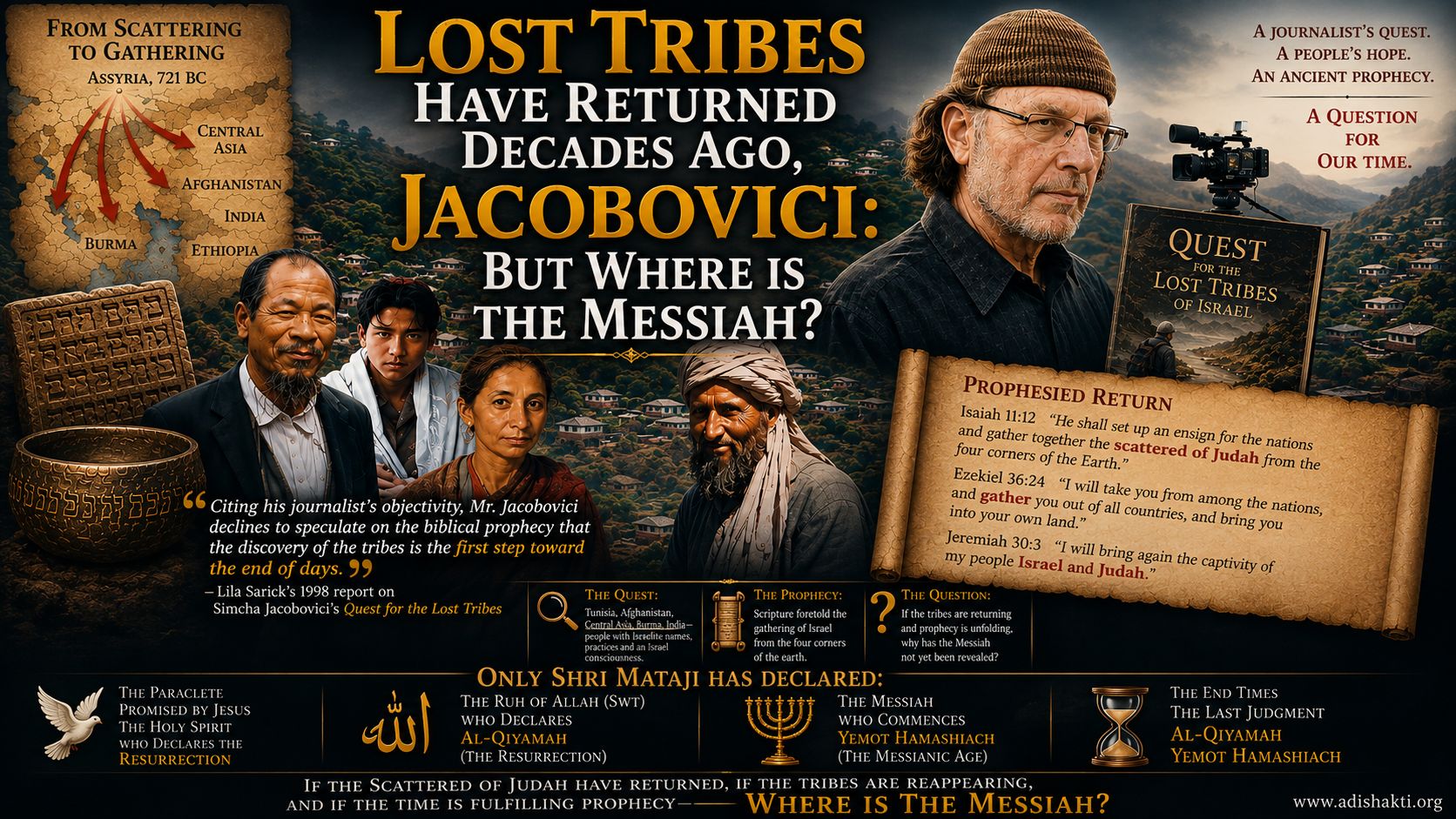 An expanded academic-theological inquiry centered on Lila Sarick's 20 November 1998 Globe and Mail report, Simcha Jacobovici's documentary investigation, Jewish expectations of ingathering, and Shri Mataji's eschatological declarations
This revised study makes Lila Sarick's 20 November 1998 Globe and Mail report, “The Saga of the Lost Tribes,” a central documentary source rather than a peripheral citation. Sarick's report is unusually valuable because it records, in close proximity, four distinct evidentiary levels: the ancient problem of the Ten Lost Tribes; Jacobovici's field investigation among communities claiming Israelite ancestry or preserving Israelite-associated traditions; the explicitly Messianic interpretation attached to tribal reappearance; and Jacobovici's deliberate refusal, on journalistic grounds, to declare that the “end of days” had begun.
The stronger academic argument is therefore not that Jacobovici proved the End Times, but that his investigation exposed a historically and theologically intelligible Messianic question. His own language—“could this be happening?” and “If this prophecy were to unfold, what do you think it would look like?”—shows that he recognized the prophetic frame while maintaining an evidentiary boundary. Sarick makes that boundary explicit: Jacobovici “declines to speculate” that discovery of the tribes constitutes “the first step toward the end of days.”
The paper then places this documentary evidence beside Jewish scriptural traditions of regathering and the classical Maimonidean association of the Messiah with gathering the dispersed of Israel. Finally, it examines the radically different kind of claim made in the Shri Mataji source corpus: not an archaeological or ethnographic inference, but an explicit proclamation of Resurrection Time, Last Judgment and Qiyamah, together with identification as Adi Shakti/Holy Spirit/Ruh of Allah. The resulting thesis is comparative and theological, not a claim that documentary journalism can prove a messianic identity: Jacobovici supplies evidence for the question; Shri Mataji's declarations supply the proposed answer within the Adi Shakti interpretive framework.
Why the 1998 Report Changes the Evidentiary Center
The 20 November 1998 report by Lila Sarick deserves to stand at the center of this inquiry because it captures the interpretive tension that any rigorous study of the Lost Tribes must preserve. It begins not with a sensational claim of fulfilled prophecy but with an ancient historical problem. The Lost Tribes, Sarick writes, had been “dispersed nearly 3,000 years ago,” and their fate had fascinated “explorers and adventurers for hundreds of years.” She immediately identifies the theological stakes: their reappearance, “according to biblical prophecy,” would signal “the approach of a Messianic time.”
The article does not collapse investigation into fulfillment. It holds them apart. The possible survival of dispersed Israel is the investigated phenomenon; the approach of a Messianic time is the religious interpretation attached to that phenomenon; Jacobovici's journalism tests the first while refusing to pronounce definitively on the second.
This distinction is indispensable. A paper that simply announces “Lost Tribes found, therefore End Times” would exceed the source. A paper that ignores the Messianic meaning explicitly discussed by Sarick and Jacobovici would also diminish the source. The academically responsible path is to preserve both sides: the evidence is investigated seriously, and the eschatological conclusion remains a further interpretive act.
Sarick's Report as a Witness to the Lost-Tribes Question
Sarick presents Jacobovici's Quest for the Lost Tribes as “the latest bid to separate the fact from the myth.” That phrase is methodologically important. The documentary is framed not as devotional apologetic but as investigation. Sarick reports that Jacobovici travelled through Tunisia, Afghanistan, Burma and Uzbekistan and encountered evidence of ancient Jewish presence together with communities retaining “Israelites names, practices and an Israel consciousness.”
Jacobovici's own standard of inquiry
“I didn't approach this differently than any other story. I was quite prepared to report there ain't nothing here,” Jacobovici told Sarick. He then supplied the governing journalistic principle: “If I land in Afghanistan and the Pathans say they're Israelites, it's my job to report it honestly.”
This is among the strongest passages in the report because it establishes a falsifiability posture. Jacobovici says he was prepared to return empty-handed. His evidentiary posture, at least as represented in the interview, is therefore not “I must prove prophecy,” but “I must report what the investigation yields.” That does not validate every ethnographic or historical inference in the documentary; it does, however, materially affect how his testimony should be weighed.
Ten Tribes, Assyrian Exile and the Problem of Disappearance
Sarick situates the quest within the biblical-historical division between the northern Kingdom of Israel and the southern Kingdom of Judah. Her report recounts the Assyrian conquest of the northern kingdom, the deportation of its population, and the later Babylonian exile of Judah and Benjamin. She then states the conventional historical counterpoint: historians generally assume that the ten tribes were not literally annihilated but assimilated into surrounding populations.
The newspaper's historical summary is useful as the conceptual frame of Jacobovici's investigation, but it should not be treated as a substitute for specialist Assyriological, biblical-historical or population-genetic scholarship. The paper therefore uses Sarick primarily as evidence for what Jacobovici investigated and how the Messianic implications were publicly articulated in 1998, not as final adjudication of every ancient migration claim.
This qualification strengthens rather than weakens the argument. The central thesis does not require proving that every community Jacobovici visited descends biologically from a named biblical tribe. It requires demonstrating that the question of dispersed Israel's survival and restoration was being investigated as a live historical problem and explicitly connected, by the participants themselves, to Jewish eschatological expectation.
Names, Practices, Memories and Israelite Consciousness
Sarick's report supplies several categories of evidence encountered by Jacobovici. The Ethiopian Jewish case became an early catalyst after an Israeli chief rabbi identified that community with Dan. Jacobovici later heard of a rabbi claiming discovery of a community on the Burmese-Indian border associated with Manasseh. Sarick reports traditions among these people of crossing a sea, waters parting, and following fire by night and cloud by day—motifs strongly reminiscent of the Exodus narrative.
In Afghanistan, the report describes tribal names that Jacobovici regarded as corruptions or survivals of biblical tribal names and notes the striking self-description “children of Isaac.” In Central Asia, Sarick reports Jacobovici finding museum objects bearing Hebrew and Aramaic writing and his belief that Soviet suppression had obscured parts of this history. She also records his criticism of a Western scholarly imbalance in which European Jewish communities are exhaustively documented while older and geographically remote Asian communities receive far less attention.
Names, oral traditions, ritual parallels, manuscripts, inscriptions and collective identity are clues of different evidentiary weight. None should be treated alone as proof of tribal descent. Their academic value lies in convergence, contextual dating, independent corroboration, linguistic analysis, archaeology, documentary history and—where appropriate—population genetics. Jacobovici's documentary belongs to the investigative stage of this larger evidentiary process.
“Could This Be Happening?”
The report becomes especially significant when Jacobovici himself moves from isolated cases to a pattern. After recalling the identification of Ethiopian Jews with Dan and the Burmese-Indian community with Manasseh, he asks: “could this be happening?” The antecedent of “this” is not merely migration. It is the possibility that communities associated with dispersed Israel are becoming visible again.
Prophecy in ordinary historical mechanisms
Jacobovici asks: “If this prophecy were to unfold, what do you think it would look like? Would the tribes come on camel back from heaven? ... Or do they get on boats and airplanes, just regular people buying tickets going to their travel agent and suddenly prophecy can unfold on the nightly news and we don't even know it?”
This passage is crucial because it articulates a theory of prophetic fulfillment without requiring spectacular supernatural mechanics. Prophecy, in this formulation, could unfold through ordinary transportation, migration, bureaucracy, journalism and political history. The theological implication is striking: an event can be religiously momentous while appearing externally mundane.
That observation also provides a conceptual bridge to the paper's larger question. If restoration traditions are expected to occur within history, then the proper question is not necessarily whether heaven visibly interrupts nature, but whether historical developments correspond in a meaningful and sufficiently specific way to inherited expectations.
Jacobovici Refuses to Declare the End of Days
The single most important sentence in Sarick's report for academic purposes is her description of where Jacobovici stops:
“Citing his journalist's objectivity, Mr. Jacobovici declines to speculate on the biblical prophecy that the discovery of the tribes is the first step toward the end of days.”
This sentence must not be read as a repudiation of the prophecy. Sarick does not say that Jacobovici concluded the prophecy was false. She says he declined to speculate, and she explicitly attributes that restraint to “his journalist's objectivity.” The distinction is decisive. An evidentiary investigator can conclude that material deserves reporting while withholding an ultimate theological judgment that lies outside the professional method being employed.
Jacobovici's next sentence sharpens the distinction: “All I know is, I went out to look for a story and I came home with the goods.” The “goods” are his investigative findings, not a certified declaration that history has entered its final eschatological phase.
Yet the report immediately preserves the religious significance of those findings. For believers, Jacobovici says, the possibility that “we may be living in times of ultimate reunification of families” is “mind-blowing in a very positive way,” culminating in his memorable observation: “The idea that biblical prophecy is unfolding in the nightly news is wow for people.”
The report therefore contains both maximum journalistic restraint and maximum awareness of prophetic significance. That conjunction is precisely why it is valuable. Jacobovici neither dismisses the Messianic interpretation nor converts his documentary into proof of it.
Ingathering and the Messiah in Jewish Sources
The association between Israel's dispersion, restoration and the Messianic future is not invented by the 1998 newspaper article. Biblical restoration texts repeatedly speak of gathering the dispersed, and later Jewish legal-theological tradition gives the theme a defined Messianic place. Maimonides, in Mishneh Torah, Kings and Wars 11, states that the future Messianic king will restore the Davidic dynasty, build the Temple and “gather the dispersed of Israel.” In the criteria later in the chapter, successful gathering of the dispersed is again included among the acts associated with the definite Messiah.
This Maimonidean formulation introduces an important restraint into the present paper. Classical Jewish messianism is not reducible to one sign, and the identification of a Messiah is not established simply by pointing to migration or alleged tribal rediscovery. The ingathering belongs to a larger complex of expectations. Thus the question “Where is the Messiah?” is theologically intelligible precisely because restoration and Messiah are related in the tradition—but that relationship cannot be simplified into a one-step proof.
If dispersed Israel is historically regathering in some sense, and if Jewish tradition associates the completed ingathering with the Messianic future, what kind of evidence would justify moving from recognition of the historical phenomenon to recognition of a Messianic age or figure?
What the Evidence Can—and Cannot—Establish
The paper's argument becomes stronger when its evidentiary categories are explicitly separated. The existence of the State of Israel and large-scale Jewish immigration are historical facts. Claims that particular remote populations descend from specific biblical tribes are historical, ethnographic and sometimes genetic hypotheses requiring case-by-case assessment. The theological proposition that restoration signals the Messianic future belongs to Jewish scriptural and interpretive tradition. The proposition that the Messianic Age has actually begun is a further eschatological judgment.
Each arrow requires its own argument. No stage should be silently substituted for the next.
This structure prevents two opposite errors. The first is credulity: treating suggestive parallels as conclusive proof. The second is reductionism: assuming that because historical method cannot certify an eschatological meaning, the religious question is therefore meaningless. Sarick's report itself models a more sophisticated position. It reports evidence, identifies the prophetic stakes, and preserves the boundary between them.
Shri Mataji and the Claim That the Eschatological Time Has Begun
 The transition to Shri Mataji must therefore be stated with precision. Jacobovici's work does not establish her identity. Nor does the return of Judah, by itself, establish her identity. Nor would proof of one or more Lost-Tribe lineages automatically establish her identity. Rather, these developments create the historical and theological background against which her declarations become relevant to the paper's question.
Within the Adi Shakti source corpus examined by this project, Shri Mataji makes a different category of claim. She is represented as identifying herself as Adi Shakti, the Holy Spirit or Ruh of Allah; as declaring that the Last Judgment has started; as correlating the biblical Last Judgment with Qur'anic Qiyamah; and as commanding that her identity as the Holy Ghost be declared in connection with the “Resurrection Time.”
These declarations can be documented as claims within the Shri Mataji/Adi Shakti source corpus. Historical method can establish that a claim was made when the source is sufficiently authenticated; it cannot, by that fact alone, establish the supernatural truth of the claim. Likewise, identifying Shri Mataji as the Messiah—or identifying her proclaimed eschatological period with Yemot HaMashiach—is a comparative theological conclusion of this paper's interpretive framework, not a consensus conclusion of Jewish studies, Christian theology or Islamic studies.
The comparison nevertheless has real analytical force. Jacobovici reaches a boundary and refuses to say that the End Times have begun. Shri Mataji, by contrast, is presented as crossing precisely that boundary through explicit proclamation. Thus the two sources perform different functions: Jacobovici investigates a possible sign; Shri Mataji declares an eschatological time.
Jacobovici Did Not Prove the End Times—He Exposed the Question
The stronger academic argument is not that Jacobovici proved the End Times had begun, but that his investigation concerned a people whose prophesied restoration already occupies a recognizable place within Jewish expectations of the Messianic future.
Sarick's entire report buttresses this formulation. Its opening paragraph identifies tribal reappearance with the approach of “a Messianic time.” Its historical middle establishes why the tribes became “lost.” Its ethnographic sections present the clues Jacobovici considered significant. His own questions explicitly entertain the possibility of prophecy unfolding through ordinary modern events. And its closing paragraphs impose the decisive methodological restraint: he declines the end-times conclusion because of journalistic objectivity.
The logic can therefore be stated without overclaiming: (1) restoration of dispersed Israel belongs to biblical and Jewish Messianic expectation; (2) modern history has produced large-scale Jewish regathering and renewed claims of Lost-Tribe survival; (3) Jacobovici investigated such claims and considered the evidence substantial enough to report; (4) he explicitly refused to transform his findings into an eschatological verdict; (5) Shri Mataji's recorded corpus contains precisely such an eschatological verdict—Last Judgment, Resurrection Time and Qiyamah are declared to be present realities; (6) the identification of that proclamation with the Jewish Messianic Age is therefore the theological thesis to be argued, not an inference to be smuggled into Jacobovici's journalism.
Jacobovici is evidence for the question, not authority for the answer.
His refusal to speculate is not evidence that the prophetic interpretation is false. It is evidence that he understood the limit of his journalistic warrant.
XI. Conclusion: Jacobovici Asked; Shri Mataji Declared
The importance of Jacobovici's investigation is not that it scientifically announced the apocalypse. He expressly declined to do that. His journalistic objectivity should be respected because it gives the evidence greater rather than lesser analytical value. He investigated communities associated with the mystery of scattered Israel; he encountered material he considered worthy of serious reporting; he recognized why believers would see extraordinary prophetic implications; and then he stopped.
That stopping point is precisely where this paper's theological inquiry begins.
Judah's modern return is already history. The restoration of scattered Israel belongs to the prophetic vocabulary of Isaiah, Jeremiah and Ezekiel. The recovery of the Lost Tribes belongs to a recognizable Jewish Messianic horizon. Jacobovici's investigation therefore raises a legitimate question about the relationship between contemporary events and the future traditionally associated with Yemot HaMashiach.
But Jacobovici never answered:
Where is the Messiah?
The distinctive claim examined in this paper is that Shri Mataji did answer. Within her recorded teaching she identified herself with the Holy Spirit/Adi Shakti/Ruh of Allah; associated the present age with the biblical Last Judgment and Qur'anic Qiyamah; spoke of Resurrection Time as present reality; and declared that the Last Judgment had begun.
Thus the evidentiary architecture must remain clear:
Jacobovici does not prove Shri Mataji.
The return of Judah does not prove Shri Mataji.
The Lost Tribes do not prove Shri Mataji.
Rather, these developments establish the Messianic question against which her extraordinary declarations must be evaluated.
And that produces the paper's final challenge:
If the scattered of Judah have returned, if the recovery of Israel's dispersed tribes belongs to the expected Messianic future, and if one religious teacher explicitly declared that the Resurrection, Last Judgment and Qiyamah had already commenced—then the question is no longer only “Where is the Messiah?” It is also: “What evidence would humanity require before recognizing the one who declares that the Messianic Age has begun?”
Appendix A · Entire Globe and Mail Report
THE SAGA OF THE LOST TRIBES
Descendants alive today, filmmaker says ...
Lila Sarick, The Globe and Mail
Friday, November 20, 1998
The search for the lost tribes of Israel, dispersed nearly 3,000 years ago, is a romantic quest that has mesmerized explorers and adventurers for hundreds of years. The stakes are tantalizing. Not only is there the thrill of finding people alive today who are the descendants of those who apparently disappeared without a trace, but according to biblical prophecy, their reappearance signals the approach of a Messianic time.
The latest bid to separate the fact from the myth comes from award winning documentary filmmaker Simcha Jacobovici in Quest for the Lost Tribes of Israel... .
Quest documents his travels to Tunisia, Afghanistan, Burma and Uzbekistan. In every place, he found evidence that not only had the Jews been there thousands of years ago but that people still had Israelites names, practices and an Israel consciousness.
“I didn't approach this differently than any other story. I was quite prepared to report there ain't nothing here,” Mr. Jacobovici said in an interview. “If I land in Afghanistan and the Pathans say they're Israelites, it's my job to report it honestly.”
The quest for the lost tribes was one of the three great mysteries pursued by Western adventurers through the ages, along with the search for the Holy Grail and the Ark of the Covenant.
Of the three, the story of the tribes is the most clearly detailed in the historical narratives of the Bible and other texts.
During the time of King Solomon, 10 of the 12 tribes of Israel lived in an area north of Jerusalem in the Kingdom of Israel, while the tribes of Judah and Benjamin inhabited the southern Kingdom of Judah.
With the Assyrian conquest of the Kingdom of Israel in 721 BC, the 10 tribes were captured, enslaved and deported. They vanished. The tribes of Judah and Benjamin were captured and exiled to Babylon in 586 BC. They were freed 50 years later and allowed to return to Israel.
Historians assume the 10 tribes were not truly lost but assimilated into the larger society...
His quest began inadvertently when he made a film about the Ethiopian Jews. Before they were airlifted to safety in the mid-1980s, Israeli chief rabbi declared they were descendants of the tribe of Dan.
Several years later, Mr. Jacobovici heard about an Israel rabbi claiming to have discovered Jews on the Burmese-Indian border. These people, who called themselves Menmasseh, had ancient songs about crossing the sea with the water parting before them and following a pillar of fire by night and a cloud by day, stories strikingly similar to the biblical account of the exodus from Egypt... .
“If the chief rabbis are right and the Ethiopians are Dan, and if this rabbi is right and these people are Menashe, could this be happening?” Mr. Jacobovici recalled thinking. “If this prophecy were to unfold, what do you think it would look like? Would the tribes come on camel back from heaven? ... Or do they get on boats and airplanes, just regular people buying tickets going to their travel agent and suddenly prophecy can unfold on the nightly news and we don't even know it?”
His quixotic trek took him to Afghanistan, where he found hill-dwelling people who belonged to the tribes of Shinwari, Efredi, Reuveni and Gadun, corruptions, he believes, of the tribal names of Simeon, Ephraim, Reuven and Gad.
They also call themselves children of Isaac, an odd appellation for Muslims who would more likely to follow the tradition of Ishmael, the father of the Arab nation, not his Jewish half-brother Isaac... .
In Central Asia, where Mr. Jacobovici found treasure troves of objects with Hebrew and Aramaic writing hidden away in museum basements, there was, he believes a deliberate effort by the former Soviet Union to suppress the history of the tribes.
In other instances, Western myopia means that dangerous and inaccessible places have simply fallen off our radar. Volumes are written about the Jewish communities of Poland, but next to nothing is documented about the Afghani communities, which are hundreds, if not thousands, of years older.
Citing his journalist's objectivity, Mr. Jacobovici declines to speculate on the biblical prophecy that the discovery of the tribes is the first step toward the end of days.
“All I know is, I went out to look for a story and I came home with the goods,” he said.
But for believers, the idea “we may be living in times of ultimate reunification of families is mind-blowing in a very positive way,” he said. “The idea that biblical prophecy is unfolding in the nightly news is wow for people.”
References and Source Notes
- Sarick, Lila. “The Saga of the Lost Tribes: Descendants alive today, filmmaker says ...” The Globe and Mail, Friday, 20 November 1998. Full transcription supplied for this study and reproduced in Appendix A.
- Jacobovici, Simcha, dir. Quest for the Lost Tribes. Associated Producers; produced in association with CBC and A&E. Associated Producers describes the film as a 100-minute documentary investigating Lost-Tribe traditions in Afghanistan, China, India, Tunisia and the Middle East.
- Maimonides. Mishneh Torah, Kings and Wars, ch. 11, especially §§1 and 4: the Messianic king restores the Davidic dynasty, builds the Temple and gathers the dispersed of Israel.
- Hebrew Bible: Deuteronomy 30:3–5; Isaiah 11:11–12; Jeremiah 23:3–8; 31:7–10; Ezekiel 36–37. These texts provide major scriptural vocabularies of return, gathering and restoration.
- Shri Mataji Nirmala Devi source corpus as reproduced and linked by AdiShakti.org: declarations concerning Adi Shakti/Holy Spirit/Ruh of Allah, Last Judgment, Resurrection Time and Qur'anic Qiyamah. These are treated as primary claims requiring source-critical evaluation, not as independently proven theological conclusions.
Methodological note: This paper distinguishes newspaper reporting, documentary investigation, ancient textual tradition, historical reconstruction and confessional theological interpretation. The distinction is intentional and is necessary to prevent evidence from one category from being treated as proof in another.
💬 Interactive Chat
Access an intelligent analysis environment where you can explore texts, ask questions, and discover connections between ideas.
Open chat →