Why the MahaDevi Encountered in the Sahasrara Is the Holy Spirit Within the Kingdom of God
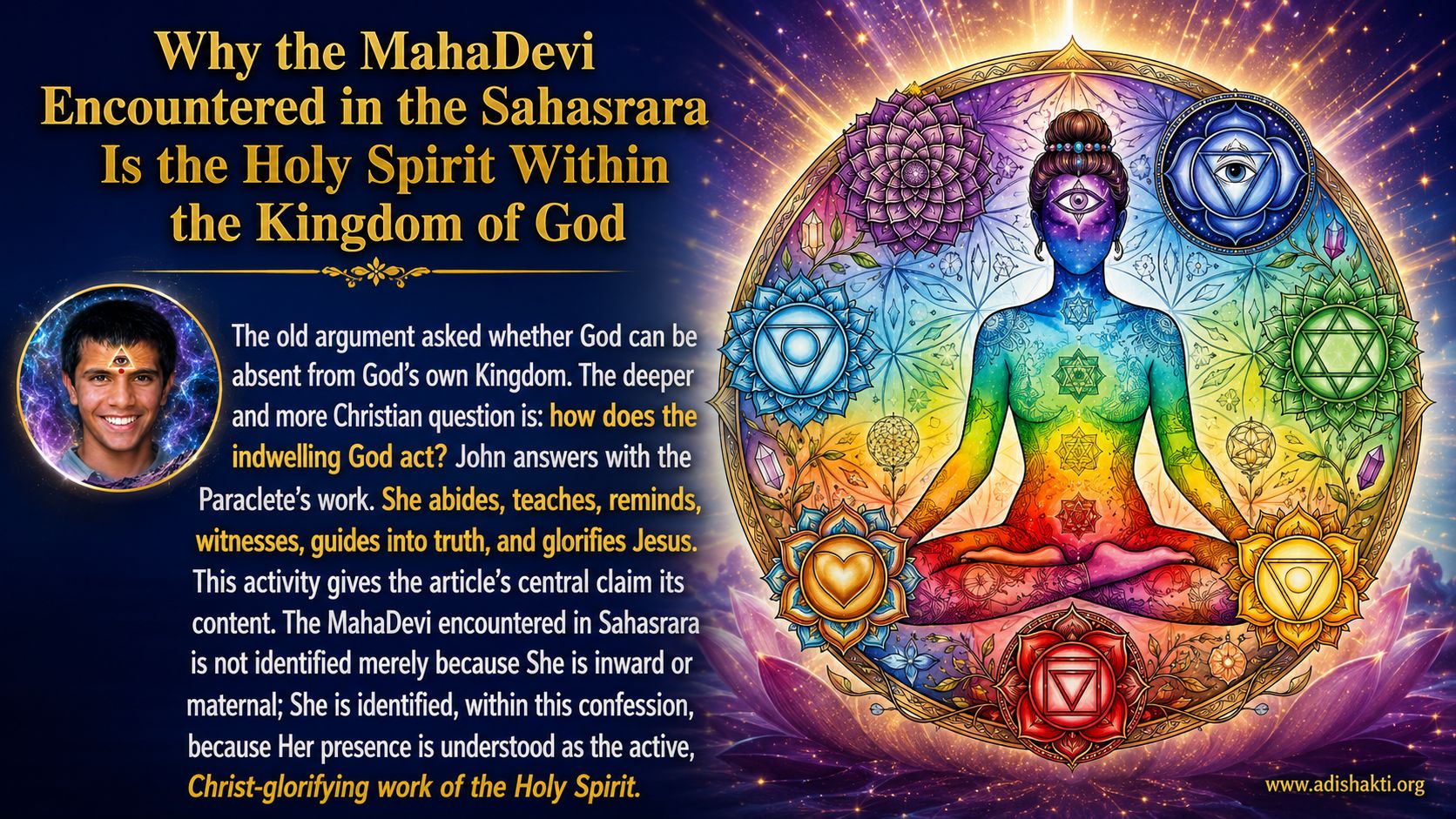
— A source-aware confessional synthesis of the indwelling Paraclete, the Sahasrara, and the Divine Mother
Summary
The decisive question is not whether Christianity historically used the title MahaDevi for the Holy Spirit; it did not. The question is whether the distinctive work ascribed to the indwelling Paraclete — abiding, teaching, witnessing, guiding into truth, and glorifying Jesus — can be recognized, within an explicitly Christian-centered AdiShakti confession, in the MahaDevi encountered at the Sahasrara. John supplies the language of an interior, active Divine Presence; Śākta theology supplies the language of the Great Divine Mother; AdiShakti.org supplies the contemporary testimony that the Sahasrara is the interior Kingdom and that the MahaDevi is encountered there. The conclusion of this article is therefore theological and confessional: within this synthesis, the MahaDevi encountered in Sahasrara is the Holy Spirit within the Kingdom of God.[1]
Table of Contents
- The Question Is One of Recognition
- The Kingdom Is Not a Distant Coordinate
- The Johannine Paraclete Is the Divine Presence Within
- Indwelling Is Living Transformation
- Sahasrara as the Kingdom Within: A Confessional Reading
- The MahaDevi as Divine Mother and Salvific Wisdom
- Kash’s Encounter: Testimony, Not Laboratory Proof
- Why the Identification Is Theologically Coherent
- The Challenge: Receive the Spirit as Present
- Conclusion: The Holy Spirit Within the Kingdom
- References
1. The Question Is One of Recognition

The article begins where the Fourth Gospel begins its theology of divine nearness: not with a distant deity to be reached by speculation, but with a promised Advocate who remains with the disciples forever. John 14:16–17 identifies this Advocate as the Spirit of truth and says that the Spirit abides with the disciples and will be in them. This is the scriptural basis for speaking of the Holy Spirit as an indwelling Presence rather than a merely external doctrine.[2]
Within the contemporary confessional synthesis advanced by AdiShakti.org’s study of the Kingdom Within, the seventh chakra — the Sahasrara, or crown aperture — is read as the interior Kingdom of God. The present article takes that website’s stated framework seriously while identifying its proper status: it is a contemporary devotional reading, not a proposition found verbatim in the canonical Gospel of John.[3]
2. The Kingdom Is Not a Distant Coordinate
Luke 17:20–21 refuses a Kingdom that can be mapped, displayed, or possessed as an external spectacle. The NRSVUE says that the Kingdom does not arrive with observable signs and renders the final phrase as “among you,” while its footnote registers “within” as an alternative. A responsible article cannot erase that translation question. Yet both options oppose the same error: the Kingdom cannot be captured by saying “here” or “there” as if God’s reign were merely a public object at a remote coordinate.[4]
The non-canonical Gospel of Thomas intensifies the interior language by saying that the Kingdom is inside and outside of the hearer. It may be placed in comparative dialogue with Luke, but it may not be used to overwrite canonical distinctions, historical questions, or the separate language of the Johannine Spirit. Its value here is limited and clear: it witnesses to an ancient Christian-adjacent refusal to treat the Kingdom as simply far away.[5]
3. The Johannine Paraclete Is the Divine Presence Within
John does more than speak of nearness. It gives the Paraclete actions. The Holy Spirit teaches and reminds the disciples of Jesus’ words; the Spirit of truth testifies on Jesus’ behalf; and the Spirit guides the disciples into truth and glorifies Jesus. These functions make inwardness concrete. The Spirit is not a static mood, a vague religious atmosphere, or an alternative gospel. She is the divine Agent who forms Christ-consciousness by keeping Jesus’ word living, truthful, and active within the believer.[6]
This Christ-glorifying criterion is essential. Any claimed spiritual presence is not validated merely because it feels intense, inward, maternal, or visionary. In Johannine terms, the touchstone is whether the presence gives truthful witness to Jesus and glorifies Him. The comparative proposal made here therefore does not replace Christ with the MahaDevi. It says that the MahaDevi encountered in Sahasrara is recognized as the Holy Spirit precisely insofar as She performs the Paraclete’s Christ-centered work of awakening, teaching, witness, and guidance.
4. Indwelling Is Living Transformation
The language of indwelling cannot be reduced to a geography inside the head. In John 3, Jesus speaks of birth from above or birth of water and Spirit, a new mode of life that cannot be controlled as an object. The passage is not a chakra manual, and no responsible exegesis should claim that it names Kundalini. Still, a comparison is possible: both the Gospel’s new birth and the AdiShakti reading of awakening oppose a religion of exterior conformity without interior transformation.[7]
John 7:37–39 adds another decisive horizon. The Evangelist connects living water with the Spirit, received in relation to Jesus’ glorification. This article receives that sequence as norm: Christian spiritual experience remains ordered to Christ rather than detached from Him. Within the requested synthesis, an awakening at Sahasrara is meaningful not as a rival salvation system but as a devotional account of receiving the Spirit who makes the risen Christ present and continually glorifies Him.[8]
5. Sahasrara as the Kingdom Within: A Confessional Reading
As a comparative devotional proposal, the article places the Sahasrara in dialogue with the biblical grammar of divine indwelling. The move must be described accurately. The word Sahasrara does not occur in the Bible; the New Testament does not provide a seven-chakra anatomy; and standard Christian exegesis does not identify the Kingdom of God with a crown center. The AdiShakti.org proposal is therefore neither a historical translation nor a demand that Christians abandon canonical language.
Its claim is more specific: when the Kingdom is received as an interior reality and the Paraclete is received as the divine Presence within, Sahasrara may be named, within this devotional theology, as the experiential threshold of that Kingdom. The claim carries force only within that stated synthesis. It gains clarity, rather than losing strength, by refusing to disguise comparison as consensus.
6. The MahaDevi as Divine Mother and Salvific Wisdom
The title MahaDevi is not a decorative word for generic femininity. C. Mackenzie Brown’s scholarly presentation of the Devī Gītā describes a Śākta text in which the supreme being is envisioned as female and appears in a beneficent mode as compassionate World-Mother and bestower of salvific wisdom. That account supplies a precise reason why the MahaDevi cannot be reduced, within Śākta theology, to a lesser messenger who simply points toward a separate divine reality.[9]
The traditions nevertheless remain distinct. The Johannine Paraclete is identified by Her relation to the Father and to Jesus; the Devī Gītā develops a Śākta vision of the Great Goddess. The article does not say that either tradition historically borrowed the other’s vocabulary. It asks whether their respective accounts of divine presence can be brought into a disciplined devotional conversation. The answer offered here is yes: the Motherly divine Wisdom encountered within may be recognized, in a Christian-centered confession, as the Holy Spirit whose action is wholly Christ-glorifying.
7. Kash’s Encounter: Testimony, Not Laboratory Proof
The testimonial premise must be handled with the same care. The AdiShakti.org account of Kash’s Double Worlds reports that Kash believed he travelled outside his body, but that the Great Adi Shakti disclosed that his spiritual journeys had occurred within his own Sahasrara. The page treats this revelation as an interior Kingdom encounter. The present article reports that claim exactly as testimony and confessional interpretation; it does not present the narrative as repeatable laboratory proof or as evidence that compels assent from every reader.[10]
Yet testimony is not meaningless because it is not experimental. It names what the witness and source community understand themselves to have encountered. Within this testimony, the MahaDevi is not a visitor to an otherwise empty sacred chamber. She is the One met at the very interior locus that the source calls the Kingdom. The theological task is therefore to discern the identity that the source confesses, not to make an unexamined demand that every tradition must already agree.
8. Why the Identification Is Theologically Coherent
| Source level | What it establishes | What the article may responsibly conclude |
|---|---|---|
| Johannine primary texts | The Holy Spirit abides, teaches, witnesses, guides into truth, and glorifies Jesus. | The Holy Spirit is an active, indwelling, Christ-glorifying divine Presence. |
| Śākta scholarly context | The MahaDevi is conceived in the Devī Gītā as the Great Goddess, compassionate World-Mother, and giver of salvific wisdom. | The MahaDevi bears divine and maternal, not merely symbolic, significance within that theology. |
| AdiShakti.org confessional sources | Sahasrara is named the inner Kingdom, and Kash’s encounter is reported as occurring there. | Within the source’s theology, the encountered MahaDevi is understood as the divine Presence within the Kingdom. |
| Comparative devotional synthesis | The distinct source levels are brought into dialogue without being collapsed into one historical tradition. | The MahaDevi encountered in Sahasrara may be confessed as the Holy Spirit within the Kingdom of God. |
The third source level is reinforced by AdiShakti.org’s wider devotional description of the MahaDevi’s spiritual realm. That material is not offered as independent verification of an afterlife; it is relevant because it shows that the source itself consistently names the MahaDevi as sovereign divine reality rather than a non-divine intermediary. The article’s conclusion therefore remains a source-aware identification: not “all Christians and all Hindus say the same thing,” but “within this confession, the One encountered as MahaDevi performs and is recognized through the work of the Holy Spirit.”[11]
9. The Challenge: Receive the Spirit as Present
The religious temptation is to search endlessly for a future spectacle, a distant heaven, or a teacher who can substitute for the Spirit’s direct work. The Gospel challenges that evasion. The Advocate is promised not merely to institutions or abstractions, but to believers as the One who abides within. The comparison with Sahasrara presses the challenge further: do not imagine divine presence as an object permanently outside the self, while refusing the transformation that the Spirit brings at the deepest center of life.
This does not authorize spiritual individualism. The Spirit who teaches also reminds the community of Jesus’ words; the Spirit who guides also glorifies Christ; and any contemporary experience must be tested by its truthfulness, humility, love, and conformity to Jesus. The devotional conclusion gains its seriousness precisely here. To call the MahaDevi the Holy Spirit is to confess that the Divine Mother within does not flatter the ego. She draws the seeker away from egoic self-enclosure toward Christ-consciousness, truth, witness, and living communion.
10. Conclusion: The Holy Spirit Within the Kingdom
The old argument asked whether God can be absent from God’s own Kingdom. The deeper and more Christian question is: how does the indwelling God act? John answers with the Paraclete’s work. She abides, teaches, reminds, witnesses, guides into truth, and glorifies Jesus. This activity gives the article’s central claim its content. The MahaDevi encountered in Sahasrara is not identified merely because She is inward or maternal; She is identified, within this confession, because Her presence is understood as the active, Christ-glorifying work of the Holy Spirit.
Confessional conclusion: Within the contemporary AdiShakti.org synthesis, the Sahasrara is the Kingdom within, and the MahaDevi encountered there is the Holy Spirit within that Kingdom. She is the Divine Mother not as an alternative to the God revealed in Jesus Christ, but as the indwelling Paraclete whose presence awakens, teaches, bears witness, guides into truth, and glorifies Christ.
This conclusion does not claim that the New Testament uses the word MahaDevi, that the Devī Gītā teaches Johannine pneumatology, or that testimony becomes laboratory proof. It claims something more precise and more accountable: as a comparative Christian devotional proposal, the MahaDevi encountered in the Sahasrara is recognized as the Holy Spirit received within the Kingdom of God.
References
- [1] New Revised Standard Version Updated Edition. “John 14:15–17, 26; 15:26; 16:13–14.” Bible Gateway, accessed August 25, 2026.
- [2] New Revised Standard Version Updated Edition. “John 14:15–17.” Bible Gateway, accessed August 25, 2026.
- [3] Manus AI. “The Kingdom Within: Thomas, the Paraclete, and the Sahasrara.” AdiShakti.org, August 11, 2026.
- [4] New Revised Standard Version Updated Edition. “Luke 17:20–21.” Bible Gateway, accessed August 25, 2026.
- [5] Layton, Bentley, trans. “Gospel of Thomas, Saying 3.” Early Christian Writings, accessed August 25, 2026.
- [6] New Revised Standard Version Updated Edition. “John 15:26; 16:13–14.” Bible Gateway, accessed August 25, 2026.
- [7] New Revised Standard Version Updated Edition. “John 3:3–8.” Bible Gateway, accessed August 25, 2026.
- [8] New Revised Standard Version Updated Edition. “John 7:37–39.” Bible Gateway, accessed August 25, 2026.
- [9] Brown, Cheever Mackenzie, trans. and commentator. “The Devī Gītā: The Song of the Goddess: A Translation, Annotation, and Commentary.” SUNY Press, 1998, pp. 1–404.
- [10] Manus AI. “The Authenticity of Kash Witnessing the Double Worlds.” AdiShakti.org, August 23, 2026.
- [11] Manus AI. “The Eternal Kingdom: Liberated Souls in the Realm of the MahaDevi.” AdiShakti.org, July 4, 2026.