Authenticity of Kash Witnessing the Double Worlds
A Focused Historical Assessment of Kash’s Mistaken Out-of-Body Interpretation, the April 28, 1995 Correction, and the Persistence of an Experience That Still Felt External
The Case Of The Double Worlds
“Kash always believed that he left his physical body whenever he meditated and traveled across the universe to meet the Holy Spirit. She then journeyed with him all over His Kingdom to meet the Mighty Messengers. She had even taken him back into Time to witness and confirm scriptural revelations. He had visited Shri Shiva at Mount Kailash in the Himalayas; gone back into Time to the ancient land of Galilee to corroborate Lord Jesus’ Resurrection; passed through the Black Hole to worship Shri Ganesha in His Temple; sat on the Shesnaag of Shri Vishnu floating on the Milky Ocean; saw the Heavenly Realm of Shri Buddha; and traveled to other celestial paradises. He had seen huge meteorites in space, orbiting planets, distant stars, and glittering galaxies. He had witnessed a Spiritual Realm that no mortal human ever saw or heard about. We may say that he bears testimony to the arrival of the Kingdom of God.
On April 28, 1995, at 7:10 a.m. he was told to ask the Great Divine Mother to reveal how he travels in this Universe to meet Her. Although he insisted that he left his physical body to do so, there were many questions: How exactly does he reach the Spiritual World? How does he leave this material body? Where actually is his real self is during meditation? Does he become the spirit and leave behind his material body on Earth? How far does he have to travel to reach the Kingdom of Allah?
The priceless answers to these universal questions would be welcome by humankind. For ages saints and sages had given the world glimpses of this phenomenon, known as ‘out-of-body-experiences’ or astral travelling. By unraveling these ancient spiritual mysteries the human species would finally, for the first time in the history of this universe, be able to chart their future course. These questions had to be answered by a Higher Being, and all existing speculation put to rest.
As he meditated his Kundalini surged through his body all the way up his spinal cord (Sushumna Nadi), passed the Narrow Gate at the chiasma opticalis, through the spiritual clouds of the Templum Spiritus Sanctus and emerged into the Kingdom of The Spirit. The Everlasting Light shone ever so brightly over the Eternal Throne of Al-Muntazar (The Hidden Imam Mahdi) Sri Nirmala Devi as the Ruh of Allah Shri Nirmala Devi sat in Bliss and Joy.
After bowing down to Her these questions were put forward. The Great Adi Shakti explained to him that all his spiritual journeys with Her had taken place within his own Sahasrara. Never at any time did he leave his physical body!
This was a startling Revelation for Kash. All the time he was sure that he was outside his gross body and far out in the Universe, so perfect was this Absolute Reality. He had journeyed into the Thousand-Petal Lotus daily over a period of twenty one full moons from November 1993 till July 26, 1995. Kash had by then visited the Kingdom of God more than 1300 times! There were many opportunities for him to discern his whereabouts. Surely experience and observation would have enabled him to determine how exactly he traveled along this Spiritual Highway to the Kingdom of God. He did, and his judgment was that his spirit left his physical body and went far into the Universe. He was very sure he did so.
But he never did. No one ever did, from Prophet Muhammad to Ezekiel, from the most enlightened monk to the most bizarre astral traveler. They were all within themselves. The Ultimate Reality (Al-Haqqah) is within. His Dominion is within. Everything is within. Everything! EVERYTHING! The Ultimate Reality is within humans — This Revealed Truth is Absolute.
Note: On December 9, 1996, at 5:45 a.m. Kash was again asked about his previously mistaken ‘out-of-body’ belief. He still insisted that it is impossible to believe that one is within the body — even after being enlightened by the Great Adi Shakti that everything is in the Sahasrara! In other words, despite his misconception being corrected by the Great Supreme Spirit, he still could not feel or remember this fact whenever he entered his own Thousand-Petal Lotus. He still thought he left his body and went out into the Universe to the place humans call the Kingdom of God. According to Kash, it is impossible for one to know that they are in their own Sahasraras. It is impossible to feel the Universe of The Almighty Creator within the human body. It is just as difficult to comprehend that there is an identical physical world existing outside while being within the Sahasrara!
Note: On October 9, 1997, at 19.00 p.m. he was asked if the Spiritual World was as real as this Earth, i.e., was it as tangible as watching television, talking with his family, and all the normal human activities that makes physical life so conscious and real. He replied that not only is the Kingdom of The Almighty Creator really real, just as real as the physical world he lived with his parents, but also “better, quieter and more peaceful.”
Surely the religious empires are going to flounder on this Absolute Truth. Surely humans are going to become their own spiritual masters and flee the external Idols that imprisoned them for so long. Surely the New Age of Aquarius is descending in all its glory. Surely humankind will know the Truth and the Truth will set them free. Alleluia! Alleluia! Alleluia!”
Jagbir Singh, 1999, p. 567
Central Authenticity Question
The strongest feature of the Double Worlds case is not the claim that Kash travelled through a spiritual universe. It is that for many months he apparently misunderstood his own experience. He believed that his spirit literally left his body and travelled elsewhere. On April 28, 1995, that interpretation was reportedly contradicted: he was told that he had never left his body and that the entire spiritual universe had been experienced within his own Sahasrara. Even after learning this explanation, he continued in December 1996 to insist that the experience still felt external. This preserved error and resistance to doctrinal correction are the central authenticity features of the case.
Table of Contents
- Introduction — Why the Mistake Matters
- 1. Kash’s Original Out-of-Body Interpretation
- 2. April 28, 1995 — The Correction
- 3. Why Preserving the Error Strengthens Credibility
- 4. Experience Versus Interpretation
- 5. December 9, 1996 — The Experience Still Felt External
- 6. October 9, 1997 — “Better, Quieter and More Peaceful”
- 7. Jesus, Shri Mataji, and the Kingdom Within
- 8. Testing Ordinary Explanations
- 9. Documentary Chronology: The Decisive Test
- 10. Graded Authenticity Assessment
- 11. What Evidence Would Strengthen the Case?
- Conclusion
- References
Introduction — Why the Mistake Matters
The Double Worlds episode is evidentially interesting because it preserves a developing witness rather than a perfectly informed one. Kash reportedly experienced an immense spiritual world during meditation and concluded that his spirit must have left his physical body. The experience appeared to contain distance, movement, sacred personalities, celestial environments, brilliant Light, and a strong sense of actual presence. From his perspective, the simplest explanation was that he had gone somewhere else.
The authenticity issue is therefore not merely whether Kash described a vivid mystical world. The more important question is whether the record preserves a genuine process of interpretation, error, correction, and continued experiential resistance. A consciously constructed doctrinal story would have been easier to tell if Kash had known from the beginning that the Kingdom was “within.” Instead, the narrative presents him as being wrong about the most basic feature of the experience: where it was happening.
1. Kash’s Original Out-of-Body Interpretation
According to the source, Kash believed for roughly eighteen months that he left his physical body during meditation and travelled across an immense spiritual universe. He reported visits to sacred figures and realms, movement across apparent distances, and encounters that possessed the reality-character of ordinary waking life. Because the experience presented itself spatially, his out-of-body interpretation was not arbitrary. It was an attempt to explain the phenomenology as he actually perceived it.
This point is essential for authenticity. If Kash had simply been repeating a doctrine taught to him by adults, one would expect his explanation to match the doctrine from the beginning. Instead, the record says his own interpretation contradicted the later teaching that the Kingdom was within the Sahasrara. That divergence between immediate experience and later theological explanation becomes the first major authenticity indicator.
2. April 28, 1995 — The Correction
Core Report
On April 28, 1995, at approximately 7:10 a.m., Kash was reportedly asked to determine how he actually reached the spiritual world. The questions addressed whether he left his body, became spirit, travelled through space, or moved to some distant location. The reported answer contradicted all of those assumptions: he had never left his physical body; all of his journeys had occurred within his own Sahasrara.
Primary narrative: Jagbir Singh, Shri Adi Shakti: The Kingdom of God (1999), p. 567.
This moment is the interpretive hinge of the case. The spiritual experiences themselves were not denied. What changed was their location and explanation. Kash still remembered movement, distance, personalities, Light, landscapes, and other-worldly presence. The correction did not say the experience had been imaginary; it said his conclusion about where it occurred was mistaken.
3. Why Preserving the Error Strengthens Credibility
Kash’s mistaken belief may initially appear to weaken the testimony, but in an authenticity analysis it can have the opposite effect. The mistake is an adverse autobiographical detail: it makes the witness appear less knowledgeable rather than more knowledgeable. Religious narratives constructed retrospectively often smooth away confusion and error. The principal witness becomes progressively more certain, more doctrinally correct, and more impressive. The Double Worlds narrative preserves the opposite.
Kash believed the wrong thing about the very geography of the Kingdom. If the purpose had been to create a story illustrating the teaching that the Kingdom is within, the simplest account would have been: “I entered my Sahasrara and saw the Kingdom of God within.” Instead, the source preserves months of mistaken out-of-body interpretation followed by correction. This discontinuity is one of the strongest reasons to treat the testimony as the record of an evolving experience rather than a perfectly controlled theological construction.
Authenticity Principle
A storyteller normally controls the geography of an invented world. Kash, by contrast, is presented as not even understanding the geography of the world he claimed to experience.
4. Experience Versus Interpretation
The Double Worlds case depends on a distinction fundamental to the study of mystical experience: an experience is not identical to its interpretation. Kash’s experience reportedly included apparent movement, vastness, conversation, sacred personalities, Light, sequence, and the immediate sense of being somewhere else. His interpretation was that he had left his body. The April 1995 correction supplied a different interpretation: the experience had occurred within the Sahasrara.
This distinction matters because people can sincerely experience something while misunderstanding its cause, location, or mechanism. Correcting an interpretation does not necessarily erase the underlying phenomenology. In the Double Worlds narrative, the later evidence is especially interesting because Kash reportedly continued to experience the realm as external even after accepting the intellectual explanation that it was within.
5. December 9, 1996 — The Experience Still Felt External
The December 9, 1996 follow-up is one of the strongest features of the entire case. By then Kash had known for well over a year that the spiritual world was said to be within his Sahasrara. If doctrinal conformity were controlling the story, one would expect later descriptions to become progressively more convenient: he should have reported clearly perceiving that he was inside his own Sahasrara.
Instead, he reportedly said that it remained practically impossible to feel that he was still within his body whenever the spiritual realm became present. His intellect accepted “within,” while his immediate experience continued to feel like “elsewhere.” This resistance of phenomenology to doctrine strengthens the sincerity argument because the later theological explanation did not simply overwrite the experience.
The pattern can therefore be summarized in a single paragraph: Kash first believed he had travelled outside his body; he was then told that the realm was within his Sahasrara; and even after accepting that explanation, the world still felt external whenever he experienced it. That continuity is much harder to explain as simple doctrinal parroting than a record in which the witness’s experiences instantly changed to match the teaching.
6. October 9, 1997 — “Better, Quieter and More Peaceful”
On October 9, 1997, Kash was reportedly asked whether the spiritual world was as real as ordinary physical life. The comparison was deliberately concrete: was the realm as tangible and immediate as watching television, talking with family, moving around the house, or carrying out normal activities? Kash reportedly answered that it was fully real and described it as “better, quieter and more peaceful.”
This later statement helps explain why his earlier out-of-body conclusion had seemed so obvious to him. The realm did not appear as a faint image, private fantasy, or consciously generated visualization. It possessed what the source describes as world-presence. If the experience had the subjective reality-character of waking life, then interpreting it as literal travel becomes understandable even if that interpretation was later judged mistaken.
7. Jesus, Shri Mataji, and the Kingdom Within
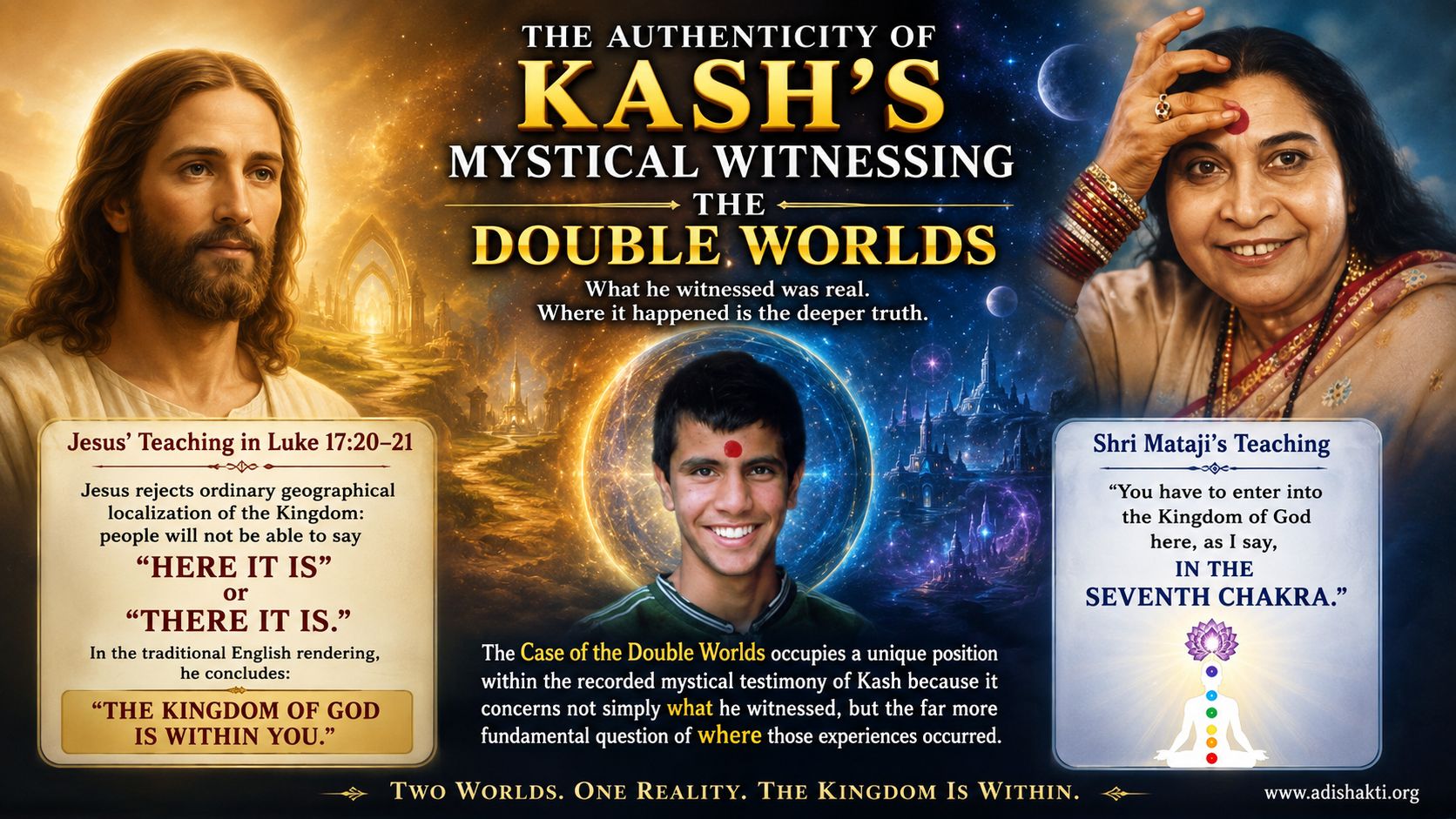
The theological correspondence is striking but should remain secondary to the authenticity argument. Luke 17:20–21 rejects an ordinary geographical localization of the Kingdom in terms of “here” or “there,” while the traditional English rendering states that the Kingdom of God is “within you.” Shri Mataji’s teaching then identifies entry into the Kingdom with the Seventh Chakra, the Sahasrara.
Kash’s reported history creates a phenomenological parallel: for months he thought the Kingdom was “there,” outside himself; the April 1995 correction said it was “within”; and the Sahasrara supplied the specific location within the theological framework. This correspondence is meaningful because Kash did not begin with the doctrinally convenient interpretation. He reportedly arrived at the opposite conclusion first and had to be corrected.
The theological sequence can therefore be stated carefully: Jesus supplies an ancient scriptural framework in which the Kingdom resists ordinary external localization; Shri Mataji identifies the Kingdom with the Seventh Chakra; Kash supplies a claimed experiential account of a spiritual world that felt external but was later interpreted as existing within the Sahasrara. The correspondence supports theological coherence, but it does not by itself prove that the mystical realm exists objectively.
8. Testing Ordinary Explanations
Imagination can explain vivid inner scenes, but it does not by itself explain why Kash’s own interpretation of those scenes remained resistant to later doctrine. Suggestion is also plausible, especially because the family operated within a religious framework in which the Sahasrara was important. Yet suggestion should have made it easier, not harder, for Kash to report that the experience felt internal after April 1995. His later insistence that it still felt external complicates a simple suggestion model.
Deliberate fabrication is possible in principle, but it requires preserving a major mistake that makes the principal witness appear less knowledgeable and then continuing to maintain an inconvenient phenomenological contradiction after the doctrine is known. Retrospective reconstruction remains the strongest naturalistic concern because the principal published source appeared in 1999. Dates, wording, and the degree of conflict between experience and interpretation could have sharpened over time. That is why the earliest surviving records are essential.
A final ordinary explanation is that Kash underwent genuine but entirely psychological altered states. This hypothesis is compatible with sincerity. It could explain why the experiences felt real and why the location was misinterpreted without requiring a transcendent realm. Importantly, such an explanation would not make the testimony fraudulent. It would interpret the cause of a genuine experience differently.
9. Documentary Chronology: The Decisive Test
The strongest possible evidence would be dated records preserving the sequence close to the events themselves. Ideally, the archive would contain an April 28, 1995 record stating that Kash was asked how he travelled and that he was told all journeys occurred within the Sahasrara; a December 9, 1996 record preserving his continued insistence that the experience still felt external; and an October 9, 1997 record preserving the phrase “better, quieter and more peaceful.”
If those records survive independently of the 1999 publication, the authenticity case becomes substantially stronger because the development of Kash’s understanding would be fixed in time. If the entire sequence first appears only in the later book, retrospective organization remains a more serious alternative. The key historical question is therefore not merely whether the narrative is coherent, but whether its stages are preserved in contemporaneous documentation.
10. Graded Authenticity Assessment
The Double Worlds case is strongest when different claims are assessed separately. The sincerity of Kash’s report, the reality-character of the experience, the Sahasrara interpretation, the scriptural correspondence, and the metaphysical existence of the Kingdom do not all have the same evidentiary status.
Authenticity Verdict
Experiential authenticity — Strong: the narrative presents a stable and vivid mystical phenomenology extending across multiple dates, with an interpretation that develops rather than remaining conveniently fixed.
Preserved-error evidence — Strong: Kash’s long-standing out-of-body belief is an adverse autobiographical detail that makes the witness appear less knowledgeable rather than more doctrinally perfect.
Resistance to doctrinal correction — Strong: the December 1996 statement that the experience still felt external is especially supportive of sincerity because the later teaching did not simply overwrite phenomenology.
Reality-character testimony — Strong as subjective report: the 1997 description of the realm as “better, quieter and more peaceful” supports the claim that Kash experienced it as fully real, though subjective vividness does not establish external ontology.
Documentary authenticity — Potentially very strong: the case depends heavily on whether dated 1995–1997 records survive independently of the 1999 publication.
Theological correspondence — Strong: Luke 17:20–21 and Shri Mataji’s Seventh-Chakra teaching provide a coherent interpretive framework for the reported “within” correction.
Objective metaphysical reality — Not established by historical method alone: the evidence can support the authenticity of Kash’s experience more strongly than it can prove that the Sahasrara Kingdom exists as an independent ontological realm.
11. What Evidence Would Strengthen the Case?
The first priority is to publish the earliest surviving records for April 28, 1995, December 9, 1996, and October 9, 1997, including dates, handwriting, computer metadata, and any contemporaneous correspondence. The second is to compare those records line by line with the 1999 publication to determine whether the key elements—out-of-body belief, correction to “within,” persistence of the external feeling, and “better, quieter and more peaceful”—were already present in the earlier archive.
The third priority is to preserve contrary or awkward evidence rather than harmonize it. If Kash gave inconsistent descriptions on other dates, those should be retained. If family members had already taught him that the Kingdom was in the Sahasrara before April 1995, that should be documented. Such evidence would not automatically destroy the authenticity case, but it would allow a more accurate distinction between spontaneous interpretation, prior teaching, later correction, and memory reconstruction.
Conclusion — Why the Double Worlds Case Is Stronger When Kash Was Wrong
The strongest authenticity argument in the Double Worlds case is not that Kash described a spectacular universe. Spectacular content can arise in imagination, dream, altered states, religious expectation, or deliberate storytelling. The more important feature is that the record preserves a witness who misunderstood his own experience, was later corrected, and then continued to report that the experience still did not feel the way the doctrine said it should feel.
That sequence—experience → mistaken interpretation → correction → continuing phenomenological resistance—is unusually valuable. It makes Kash appear less like an author controlling a theological narrative and more like a witness trying to understand something that remained experientially larger than his conceptual framework. The later “better, quieter and more peaceful” statement further supports the claim that the realm possessed, for him, the immediate reality-character of a world rather than the quality of consciously generated fantasy.
The most defensible conclusion is therefore focused: the Double Worlds testimony strongly supports the authenticity of Kash’s experience as a sincere and exceptionally vivid mystical report, while the claim that the experienced world objectively exists within the Sahasrara remains a theological and metaphysical interpretation. If contemporaneous records preserve the 1995–1997 sequence as later published, the case becomes significantly stronger because the development of Kash’s understanding would be historically fixed rather than reconstructed after the fact.
References
- Primary narrative: Jagbir Singh, Shri Adi Shakti: The Kingdom of God (1999), p. 567, “The Case of the Double Worlds.”
- Principal dated testimony: April 28, 1995; December 9, 1996; October 9, 1997.
- Scriptural comparison: Luke 17:20–21.
- Shri Mataji comparison: teaching identifying entry into the Kingdom of God with the Seventh Chakra.
- Archival priority: earliest surviving handwritten notes, computer records, correspondence, and later published versions documenting the development of Kash’s interpretation.
💬 Interactive Chat
Examine Kash’s original out-of-body belief, the April 28, 1995 correction, the December 1996 resistance to doctrine, and the documentary evidence needed to assess authenticity.
Open chat →