
لَا أُقْسِمُ بِيَوْمِ الْقِيَامَةِ وَلَا أُقْسِمُ بِالنَّفْسِ اللَّوَّامَةِ
“I do call to witness the Resurrection Day; and I do call to witness the self-reproaching Spirit.” (Qur'an 75:1–2)
An-Naba (The Great News) and the Living Participants of Resurrection
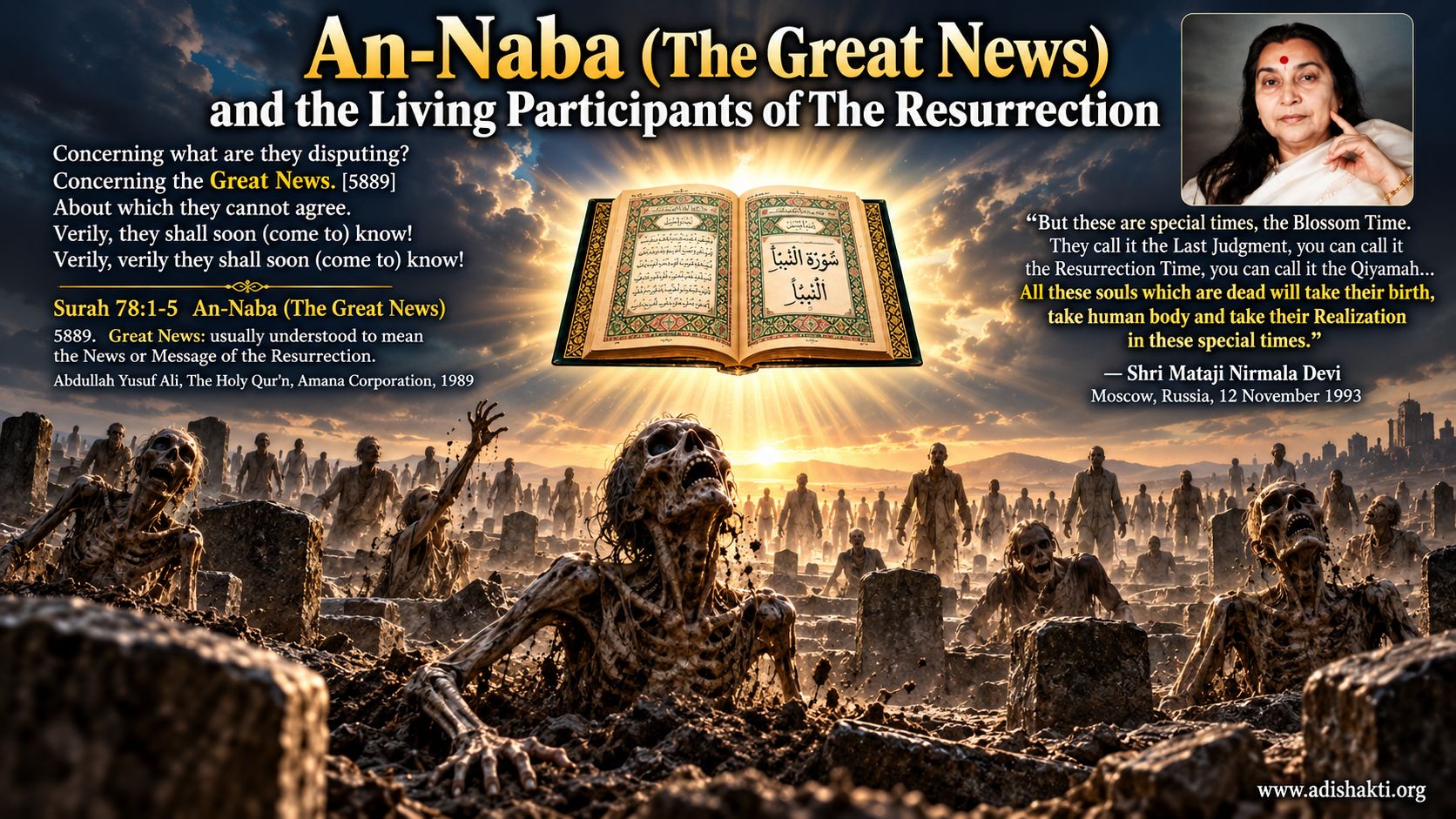 Why An-Naba (The Great News or Announcement) Requires Living Human Hearers: Qurʾanic Evidence, Malachi Martin’s Scientific Challenge, and Shri Mataji Nirmala Devi’s Resurrection Teaching
Governing Thesis: An-Naba Belongs to the Resurrection Age
This paper advances a stronger cumulative conclusion: when Sūrat al-Nabaʾ (78:1–5) is read not in isolation but together with the Qurʾan’s extensive Resurrection constellation—Sūrat al-Qiyāmah, the signs of the Hour, the Caller, the Mighty Blast, the descent of the angels and the Ruh, the gathering of peoples, the witnessing of the human self, the promised explanation, and the repeated commands to hear, see, recognize, testify, and know—An-Naba, “the Great News” or “the Great Announcement,” is overwhelmingly coherent within this confessional reading as the announcement of the Resurrection becoming historically present to living humanity.
The central distinction is between a prediction and an announcement. A prediction may concern an event thousands of years in the future. An announcement becomes existentially decisive when its hearers stand in relation to the event being announced. Sūrat al-Nabaʾ does not portray inert remains. It portrays people asking one another, disputing, disagreeing, receiving warning, and being told that they will soon know. These are activities of conscious human subjects.
That observation becomes far more consequential when placed beside Sūrat al-Qiyāmah. The Qurʾan swears by the Resurrection (75:1), names the self-reproaching soul (75:2), confronts human denial (75:3–6), describes signs (75:7–10), reckoning and self-witness (75:11–15), divine collection, recitation and explanation (75:16–19), the soul’s departure (75:26–30), human rejection (75:31–35), and Allah’s power to bring the dead to life (75:36–40). Al-Qiyāmah is therefore not a single isolated instant in this reading but an eschatological drama involving proclamation, recognition, signs, human response, spiritual awakening, death, judgment, and divine disclosure.
The wider Qurʾanic network intensifies the same pattern. Al-Qadr (97:1–5) speaks of the descent of the angels and the Ruh; Qāf (50:41–45) commands humanity to listen for the Caller and speaks of the Day on which the Cry is heard; Fussilat (41:20–21, 53) invokes human testimony and signs within the human self; Al-Dhāriyāt (51:20–22) directs attention to signs upon the earth and within human beings; Al-Mursalat (77:1–10) invokes those sent forth; Al-Muddaththir (74:1–2) commands warning; Al-Mujādilah (58:21) declares the prevailing of Allah and His messengers; Al-Ṣaff (61:8–9) speaks of the divine Light despite opposition; and An-Naba (78:1–5) culminates this communicative field in the Great Announcement about which human beings disagree.
Taken cumulatively, these passages produce a theological question that the one-life/grave-body model does not by itself answer: who are the conscious human beings capable of hearing, disputing, witnessing, recognizing signs, answering the Caller, receiving the Ruh, reproaching themselves, and participating in the Resurrection? Ancient bones cannot perform these acts. A decomposed corpse cannot dispute An-Naba. The historical dead must somehow become living human subjects.
This is precisely where the six rebirth passages acquire their full eschatological importance. Qurʾan 2:28 speaks of lifelessness, life, death, renewed life, and return; 39:42 places souls under Allah’s custody at death and sleep; 40:11 speaks of two deaths and two lives; 56:60–62 invokes death, transformation, and a creation not presently known; 22:5–7 connects resurrection with conception, womb, birth, maturity, death, revived earth, and resurrection; and 23:12–14 describes human formation and emergence as a “new creation.” No single verse, standing alone, needs to carry the entire rebirth thesis. The argument is cumulative: together they establish a Qurʾanic vocabulary through which renewed human embodiment can be investigated as the means by which souls from humanity’s past become present in the Resurrection Age.
Shri Mataji Nirmala Devi then supplies the decisive confessional declaration:
Her statement supplies a direct sequence: dead souls → birth → human body → Realization → Qiyamah/Resurrection. This is not merely an analogy. Within the theological synthesis examined by this paper, it provides the mechanism required by An-Naba itself. The Great Announcement requires hearers; the Resurrection requires conscious participants; Realization requires living human beings. Rebirth therefore becomes the bridge by which the historical dead can return as living human subjects during the Resurrection Age, hear An-Naba, encounter the Signs, receive or reject the divine proclamation, and consciously face the Last Judgment.
A second statement attributed to Shri Mataji sharpens the logic still further: what remains in graves after many years is principally bones, and bones cannot receive Realization. The force of the argument is not that Allah lacks power to re-create. Sūrat al-Qiyāmah explicitly affirms that power. The issue is instead the form in which resurrection becomes spiritually participatory. The Qurʾanic question is not merely whether Allah can restore; it is how human beings become the conscious hearers, witnesses, respondents, and judges of themselves described across the Resurrection passages.
Accordingly, the paper distinguishes three levels of claim. First, the Qurʾanic text explicitly teaches Resurrection, divine re-creation, the custody of souls, signs, warning, witnessing, the Caller, the descent of the angels and Ruh, and human disagreement over the Great News. Second, mainstream Islamic exegesis generally understands these within a one-earthly-life followed by final bodily resurrection framework. Third, this paper advances a contemporary comparative-confessional synthesis: when all these passages are read together, An-Naba is best understood within this framework as the Great Announcement of the Resurrection Age itself, while rebirth supplies the coherent mechanism by which humanity’s historical dead can become living participants in that Age.
Summary
This paper begins with a semantic observation and then tests its theological implications. Sūrat al-Nabaʾ depicts people asking one another about al-nabaʾ al-ʿaẓīm, the Great News, and disagreeing about it. In ordinary human discourse, asking, hearing, understanding, disputing, accepting, and refusing are acts of conscious subjects. A corpse in a grave is not ordinarily a participant in a public announcement. The resulting question is not whether God has power to resurrect the dead; the Qurʾan repeatedly affirms divine creative power. It is whether a reading that places the Great News at the commencement of Resurrection must also explain how persons whose former lives ended centuries earlier become present as living hearers.
The paper argues only conditionally: if the Great News is understood as an announcement whose eschatological fulfillment is consciously encountered by humanity, then historical persons must be made present as human subjects capable of encounter. The six passages examined here supply a vocabulary of death, renewed life, divine custody of souls, transformation, first creation, womb-based development, and final resurrection. Read in their immediate contexts, they do not explicitly teach recurrent earthly lives. Read together with Shri Mataji’s recorded teaching, however, they can support a carefully marked comparative confessional hypothesis: renewed human birth may be the bridge between a soul’s earlier death and its conscious participation in the Resurrection and Last Judgment.
1. The Question Contained in al-Nabaʾ al-ʿAẓīm
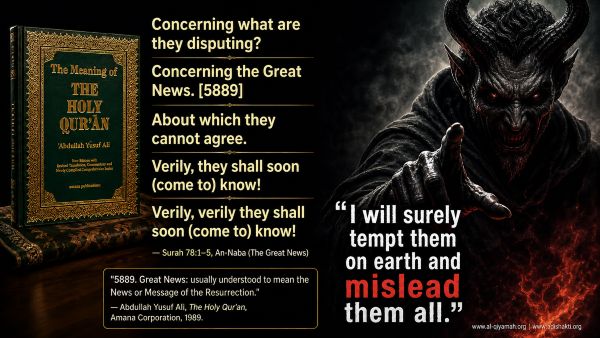
The reciprocal questioning and disagreement of 78:1–5 are the paper’s starting point for asking who can consciously hear the Great News.
Sūrat al-Nabaʾ begins with a short sequence of interrogatives and declarations: “What are they asking one another about? About the momentous news, over which they disagree. But no! They will come to know. Again, no! They will come to know.” The Arabic joins the reciprocal questioning verb yatasaʾalūn with the Great News, al-nabaʾ al-ʿaẓīm, and the verb of disagreement, mukhtalifūn.[1]
The immediately visible feature of the passage is social and cognitive. The people are not depicted as inert matter awaiting an act performed upon them. They question one another, inhabit disagreement, and are promised knowledge. This does not by itself identify the Great News with a public proclamation at the beginning of the final era. In standard reading, the opening addresses Muhammad’s contemporaries who disputed the message of resurrection and judgment. Yet a further question becomes unavoidable when the passage is placed in an explicitly eschatological setting: who, exactly, is available to hear and dispute the news when its fulfillment becomes historically immediate?
The question matters because an announcement differs from an event. A divine act can be accomplished upon an unconscious object. An announcement, by contrast, presupposes receivers who can possess language, attention, understanding, and a stance of acceptance or refusal. This paper calls that distinction conscious participation. It does not deny that God can judge any soul justly; it asks how a soul becomes a conscious participant in the human scene described by the language of questioning and disagreement.
2. Resurrection, Participation, and the Problem of Historical Presence
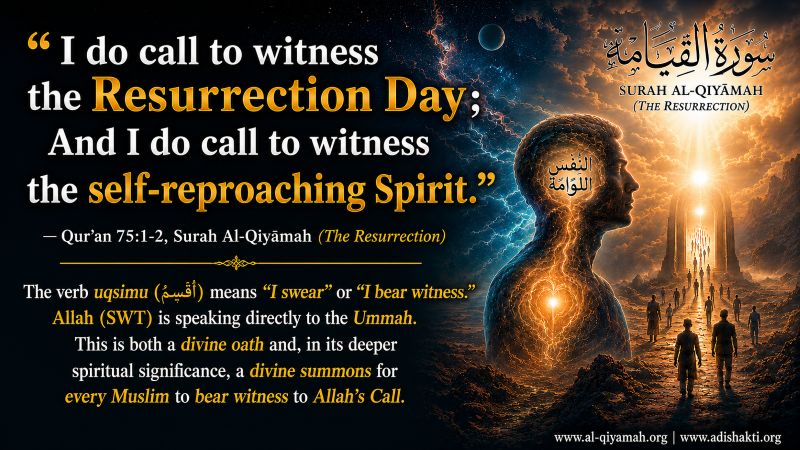
The paper moves from announcement to the problem of historical presence: how the dead become conscious participants in the Resurrection horizon.
Sūrat al-Qiyāmah opens by swearing by the Day of Resurrection, naming the horizon in which questions of bodily restoration, moral exposure, and judgment are ordinarily located.[2] The conventional Abrahamic sequence is broadly linear: one earthly life, death, an intermediate state or divine custody, final resurrection, and judgment. Within that model, the historical dead need not hear a message during a later earthly age; they may be raised at the divine appointment and judged with perfect justice.
The present proposal asks a different, more limited question. Suppose one interprets al-nabaʾ not merely as an ancient prediction but as a Great News that becomes consciously addressable at the commencement of the eschatological era. How do infants who died before language, persons who died before Islam’s historical emergence, people who encountered only distorted accounts of the Qurʾan, and persons separated by centuries from the announced moment become contemporaries of that address? Calling them innocent, or affirming divine mercy, addresses accountability. It does not itself describe the mode by which they become speaking, reasoning, historically present human beings.
This distinction should not be turned into a criticism of Islamic doctrines of divine justice. Classical and contemporary Muslim thought contains rich accounts of divine knowledge, mercy, intention, capacity, and equitable judgment. The question here is narrower: What embodiment or mode of presence makes the action of hearing the Great News possible? The answer proposed later is not compulsory for Islamic theology. It is a constructive inference that begins from the difference between being judged and participating consciously in the proclamation whose truth is finally disclosed.
3. The Six Qurʾanic Passages: Text, Context, and Proposal
The phrase “six passages of rebirth” must be used with discipline. It does not mean that six surahs expressly declare a doctrine of repeated earthly incarnation. Rather, it names six passages whose vocabulary may be placed in a cumulative dialogue with the proposed mechanism of renewed human embodiment. The table makes the evidentiary boundary explicit.
| Passage | What the text explicitly states | Immediate mainstream frame | Comparative proposal advanced here |
|---|---|---|---|
| Qurʾan 2:28 | Human beings were lifeless, given life, caused to die, then brought to life and returned to God.[3] | A finite sequence of creation, earthly life, death, resurrection, and return. | Renewed life after death is grammatically central, though the verse does not specify repeated earthly careers. |
| Qurʾan 39:42 | God takes souls at death and in sleep, retaining some and releasing others to an appointed term.[4] | Divine custody and authority over the self/soul. | Personal continuity can be proposed as soul-centered rather than dependent on unbroken material continuity of a corpse. |
| Qurʾan 40:11 | In an eschatological plea, speakers say they were made lifeless twice and given life twice.[5] | A limited two-death/two-life sequence that culminates in final judgment. | The verse creates a textual pressure point for further reflection, not an explicit assertion of serial rebirth. |
| Qurʾan 56:60–62 | God decrees death and speaks of transforming and recreating people in forms unknown to them, after their first creation.[6] | Divine power to recreate and replace, conventionally tied to resurrection. | New embodied form can be considered as a conceptual possibility without claiming numerical sameness of ancient matter. |
| Qurʾan 22:5–7 | The passage answers doubt about resurrection through conception, womb, birth, maturity, death, revived earth, and resurrection of those in graves.[7] | Human generation and revived earth are signs of God’s power to resurrect. | The Qurʾan’s own creation analogy identifies generation as a divinely given path to embodied life. |
| Qurʾan 23:12–14 | The text describes formation in the womb and the emergence of a “new creation” (khalqan ākhar).[8] | One human being’s embryonic development. | The womb can be proposed as the material locus of renewed embodiment, but the text does not say that a former person’s soul enters the fetus. |
The first two passages establish the limits and the possibility of the proposal. Qurʾan 2:28 unmistakably speaks in the grammar of life, death, renewed life, and return. Qurʾan 39:42 distinguishes the divine taking of souls from the body’s visible biological condition. Neither verse uses the later technical vocabulary of transmigration, and neither can be cited as a simple proof-text for it. Their relevance lies elsewhere: they make it conceptually possible to ask whether personal identity is held by God across the dissolution of bodily matter.
Qurʾan 40:11 and 56:60–62 develop the pressure point. The former places two deaths and two lives in the mouths of people who have become aware of their error; the latter speaks of decreed death, transformation, and a creation unknown to the present human being. In an alternative reading, those expressions may be joined to ask whether God’s re-creation necessarily requires recovery of the same dispersed matter. In mainstream exegesis, the answer is not rebirth: divine power raises the dead in the final event. The present paper therefore treats these passages as resources for a proposal, never as decisive textual proof.
Qurʾan 22:5–7 and 23:12–14 are significant for a different reason. They make embryonic development, birth, maturity, and the earth’s revived fertility signs through which resurrection becomes intelligible. The Qurʾan does not say that rebirth occurs through the womb. It does, however, represent the womb as a divinely ordered process by which an embodied human being comes into existence. For the confessional model advanced here, this creates a possible answer to the question of mechanism: if God wills a departed soul to reappear as a living human subject, a newly generated human organism rather than the recovery of an ancient grave-body becomes a logically conceivable path.
4. From the Great News to al-Qiyāmah
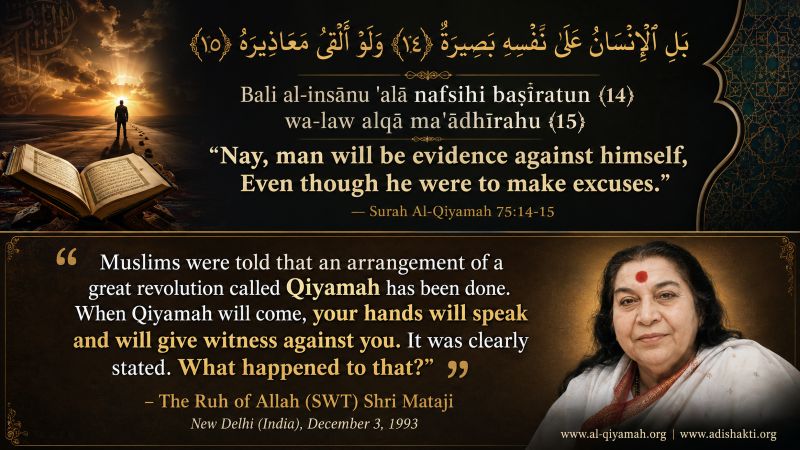
Self-witness and moral response reinforce the paper’s distinction between passive material restoration and conscious participation.
The article’s central bridge can now be stated. Al-Nabaʾ concerns a message that people ask about and contest. Al-Qiyāmah concerns the Day of Resurrection and judgment. If the first is heard and disputed, and the second is consciously experienced, then a theological model of participation must account for the human subject who moves between them. A fetus cannot ask about the Great News. A newborn cannot meaningfully dispute it. A developed human being, however, can acquire language, memory, social belonging, moral awareness, and the capacity to respond.
This developmental element matters especially for persons who had no opportunity for mature encounter in a former life: infants, those who died before acquiring language, and persons whose historical setting made meaningful contact with a claimed announcement impossible. The rebirth hypothesis does not eliminate the need for divine justice, and it does not assign any individual a known prior identity. It proposes a mode of renewed human presence by which moral and spiritual participation can become developmentally possible.
One must also distinguish prediction from presence. A believer living a thousand years before a final event may have genuinely believed in a future Resurrection. But believing that an event will occur is not the same as being a living contemporary of its fulfillment. The proposal in this paper is that rebirth supplies temporal presence: human beings from divergent epochs may become contemporaries in the era when the Great News is consciously encountered. This is a theological possibility claim, not an historical claim that can be established from demographic observation.
5. Shri Mataji’s Logical Pivot: Bones, Birth, and Realization
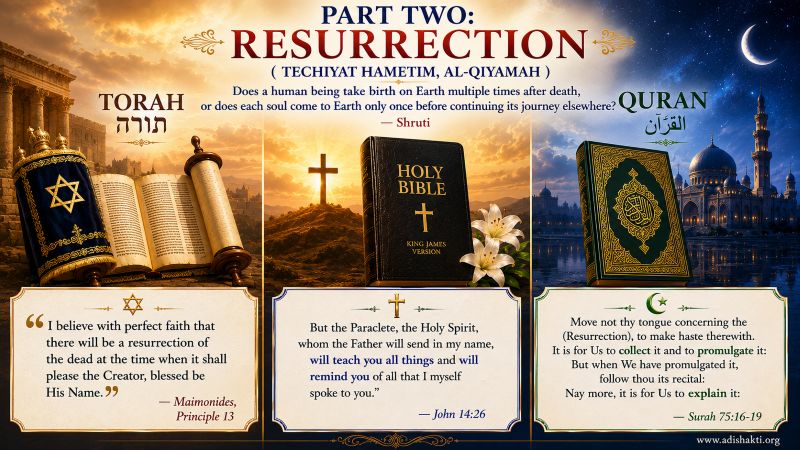
This section develops Shri Mataji’s confessional sequence: departed souls take human birth, receive a human body, and become capable of Realization.
Shri Mataji Nirmala Devi’s recorded teaching supplies the article’s decisive confessional pivot. In the Moscow statement cited at the opening, she rejects an image in which the dead simply emerge from graves and argues instead that deceased souls “will take their birth, take human body and take their Realization in these special times.” In a related formulation on the same AdiShakti.org source page, she says that what remains in graves is “a few stones and a few bones.” Her contrast is not a denial of divine power. It is a question of the condition required for Realization: realization is an act of a living human subject, not a property of skeletal remnants.[12]
In this framework, the question “How can ancient remains receive realization?” has a precise logical function. It distinguishes three things that are often conflated: material continuity, personal continuity, and spiritual capacity. A grave may preserve matter or bones; it does not preserve an ordinary living organism with language, cognition, relationship, or developing moral agency. Shri Mataji’s proposed sequence is therefore: soul, birth, human body, realization, resurrection. The proposal aligns with the question raised by Sūrat al-Nabaʾ because it restores not merely matter but a hearer, questioner, and respondent.
That alignment must be described accurately. The Qurʾan does not quote Shri Mataji, and the Qurʾanic passages surveyed above do not explicitly identify realization with her teaching. The connection is a contemporary confessional synthesis: the Qurʾanic language of divine re-creation and human development is placed in dialogue with Shri Mataji’s teaching that the historical dead take human birth in the Resurrection/Qiyamah era. The synthesis is strongest when it is transparent about that status.
6. A Proposed Model of Conscious Eschatological Participation
Within the framework of this paper, the proposed model can be represented as a sequence rather than as a replacement for all conventional eschatology.
| Stage | Function in the proposed model | Evidence status |
|---|---|---|
| 1. Former bodily death | The former organism returns to biological dissolution. | Ordinary biological observation; not disputed by the model. |
| 2. Divine custody of the soul | Personal identity remains under God’s authority. | Textual premise from Qurʾan 39:42; the identity theory is interpretive. |
| 3. Renewed human birth | A soul is proposed to receive a newly generated human organism. | Contemporary confessional proposal, not an explicit Qurʾanic statement. |
| 4. Human development | Language, reason, moral agency, and receptive capacity emerge. | Developmental condition inferred from the acts described in Sūrat al-Nabaʾ. |
| 5. Hearing and disputing the Great News | The person can ask, understand, contest, receive, or refuse. | Textual description in Qurʾan 78:1–5; application to historical dead is interpretive. |
| 6. Conscious Resurrection and Last Judgment | The person encounters the eschatological disclosure as a participant. | Comparative theological synthesis. |
The model is intended to clarify a proposed mechanism, not to turn a spiritual teaching into an empirical genealogy. It does not allow anyone to identify a living person with a particular deceased individual. It also does not solve every classical question about memory, moral responsibility, inherited circumstances, or the relation between divine mercy and judgment. Its limited claim is intelligibility: rebirth offers a coherent route by which a soul from humanity’s past could become a living human subject in the era in which the Great News is received.
This limited comparison has a precedent within the related AdiShakti.org research series. Its companion paper, Awakening to the Resurrection (Al-Qiyāmah), explicitly frames the question whether a soul returns repeatedly to Earth or lives once before Resurrection; the present study narrows that comparative question to the semantic and participatory problem in Sūrat al-Nabaʾ.[13]
7. The Barzakh Objection and the Limits of the Argument
The strongest Qurʾanic challenge to the proposed model is Qurʾan 23:99–100. At death, a speaker asks to return in order to do good; the answer is “Never!” and a barzakh, a barrier, is said to remain behind them until the Day they are resurrected.[9] In ordinary Sunni and Shiʿi eschatological interpretation, this passage is a major reason to reject the claim that persons repeatedly return to worldly life after death. The article must not bypass this objection.
Nor does the classical framing of Qurʾan 40:11 support a simple reincarnation reading. The accessible Ibn Kathīr presentation sets the verse in a scene of disbelievers’ regret after they have entered punishment and treats the passage as part of final judgment.[10] The standard reading therefore forms a meaningful alternative: one life on earth, an intermediate state, resurrection, and judgment. This is not a minor detail but the central doctrinal counterweight to the article’s hypothesis.
The proposed response must remain modest. A confessional rebirth model might distinguish between the rejected request to resume the exact biography just abandoned and a divinely initiated, newly embodied appearance in an eschatological era. But that distinction is not stated in Qurʾan 23:99–100, and it does not convert the text into an endorsement of rebirth. It merely describes how a reader committed to Shri Mataji’s teaching could seek a logical reconciliation while acknowledging that the interpretation is contested.
8. Justice, Development, and Universal Address
The question of universal address should be approached with care. It is not enough to say that every person has heard the same message. Human lives differ radically in access to language, education, security, scripture, testimony, and cognitive maturity. A child who dies in infancy has not encountered an eschatological proclamation as an adult may. A person living in a remote historical setting may never have encountered the Qurʾan. A person who encountered a caricature of Islam may not have encountered its claims fairly. These observations do not establish a doctrine of rebirth; they define the moral difficulty to which the proposal responds.
Traditional Islamic theology can answer the issue through perfect divine judgment. The present proposal adds another possibility: universal judgment may be accompanied by a universal opportunity for mature participation. Under this model, rebirth does not replace divine mercy. It describes how a soul may return to a human developmental history that makes hearing, questioning, and responding possible. The claim should be called an opportunity hypothesis, not a claim that every human being will receive the same factual circumstances or make the same response.
In this respect, rebirth functions less as a rival cosmology than as a proposed bridge between historical discontinuity and eschatological presence. It gives an account of how people separated by cultures and centuries may become contemporaries of the Great News. It also explains why the relevant form is specifically human: a developed human being is the kind of subject who can hear language, compare claims, form judgments, and seek realization.
9. What This Reading Does and Does Not Claim
The article’s conclusion depends on preserving six boundaries. It does not claim that the Qurʾan explicitly teaches that every dead human being reincarnates repeatedly. It does not claim that mainstream Islam, Judaism, or Christianity endorses the model. It does not claim that modern biology establishes a transferable personal consciousness. It does not claim that ancient bones would limit divine power. It does not claim the identity of any living person with a known figure from the past. And it does not use Shri Mataji’s teaching as a substitute for the Qurʾanic text.
What it does claim is more specific. Qurʾan 78:1–5 portrays human questioning and disagreement about the Great News. Qurʾanic passages on soul, life, death, re-creation, womb-based development, and final resurrection furnish concepts that can be set into a coherent alternative model. Shri Mataji’s dated teaching then offers the model’s central confessional premise: deceased souls take birth, take human bodies, and take realization in the special time called Resurrection or Qiyamah. In a comparative reading, that premise explains how the historical dead could become living hearers of an eschatological announcement.
The result is neither a textual consensus nor a mere assertion imported from another tradition. It is a transparent theological proposal built from a question, a six-passage vocabulary, a documented contemporary teaching, and a declared inference. Its value lies in making the difficult issue explicit: if Resurrection is consciously experienced and the Great News is consciously disputed, then the mode by which historical persons become conscious participants requires theological explanation.
10. The Material-Continuity Problem: Malachi Martin and the Scientific Challenge to Grave-Body Resurrection
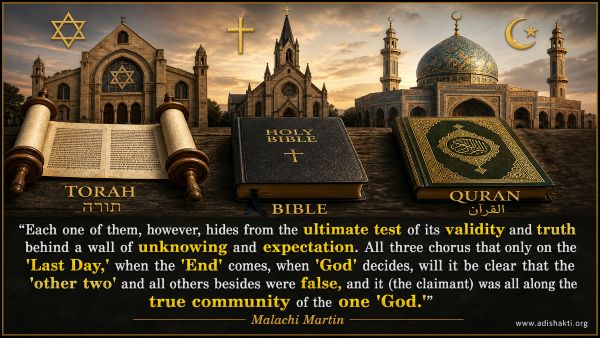
The scientific-material problem of decomposed bodies is treated separately from the theological question of Allah’s power to recreate.
The most persistent conceptual obstacle to the rebirth model is the inherited picture that Resurrection must mean the reanimation or reassembly of the physical organism that was buried centuries or millennia earlier. Yet this assumption is not identical with the deeper theological proposition that the person survives death and is raised by God. The distinction between the persistence of the person and the persistence of the former organism is crucial. Once it is made, the apparent competition between Resurrection and renewed human embodiment changes substantially.
Malachi Martin’s The Encounter (Farrar, Straus and Giroux, 1970) is important precisely because Martin framed the difficulty from within a study of Judaism, Christianity, and Islam rather than from an Indic doctrine of reincarnation. His argument addresses the physical identity of the corpse. Modern biological knowledge shows that the living body is already a materially changing system and that after death its organized biological unity disappears through decomposition and molecular dispersal. Martin’s conclusion is therefore not that divine existence has been scientifically disproved, but that the resurrection of the same corrupted material body is unintelligible from the standpoint he attributes to the modern scientist.
Malachi Martin’s argument on p. 286, in substance: ancient religious formulations arose without modern knowledge of the organism, decomposition, or the chemistry of death. Modern science observes that the molecules constituting a living body are continually exchanged with the environment and, after death, become dispersed into other forms of matter and life. Hence the body as a continuing physical entity has ceased to exist, making a simple restoration of the corrupted corpse scientifically unintelligible.
This point removes an unnecessary burden from the rebirth hypothesis. If the enduring identity relevant to Resurrection is the soul or person rather than possession of exactly the same molecules, then nothing in the scientific description of decomposition requires the historical dead to wait as materially intact bodies. The old organism can genuinely perish while personal continuity is grounded elsewhere. The theological question then becomes: what new embodiment permits the surviving person to become a conscious participant in the Resurrection?
The Qurʾanic passages already examined make that question legitimate. Qurʾan 39:42 speaks of Allah taking the souls at death; 2:28 speaks of life, death, renewed life, and return; 56:60–62 speaks of death, transformation, and creation in forms not presently known; and 22:5–7 makes human generation itself an analogy through which Resurrection is rendered intelligible. None of these verses alone states serial reincarnation. Together, however, they prevent the discussion from being reduced to the preservation of ancient corpse-matter.
Modern biology itself should be stated more carefully than polemical formulations sometimes allow. Science can establish decomposition, molecular turnover, and the loss of the former organism’s biological organization. It cannot experimentally establish that an omnipotent God is incapable of creating a resurrected body. Thus Martin’s argument is strongest as a critique of material identity and intelligibility, not as a scientific proof that divine resurrection is impossible. This distinction actually strengthens the present paper: rebirth need not be defended by claiming that science disproves God’s power; it can be defended as a coherent account of how personal continuity could coexist with the undisputed destruction and recycling of the former body.
11. Shri Mataji’s Resolution: The Soul Returns as a Human Being
Where Martin identifies the material problem, Shri Mataji Nirmala Devi supplies an explicit confessional solution. Her argument is striking because it makes the same distinction between the destroyed organism and the continuing soul, but then proceeds one step further: the soul takes human birth again so that Resurrection can be consciously experienced.
“Of course there are some absurd things which grew with misinterpretation and interference from unholy people, which are common in these religions. For example, Jews, Christian and Muslims believe that when they die their bodies will come out of their graves and they will all be resurrected at the Time of Resurrection, at the Time of Last Judgment, at the Time of Qiyamah. It is illogical to think what will remain inside those graves after five hundred years. Nobody wants to think and understand that it is not the body but the soul that will come out of these bodies, be born again as human beings and be saved through Qiyamah and Resurrection.
Who will tell them? No one can talk to them. As soon as one wants to talk one can be killed. This is the only way they know - how to kill.”
The central proposition could hardly be more explicit: “it is not the body but the soul”; the soul will “be born again as human beings”; and this renewed human existence is connected directly with being “saved through Qiyamah and Resurrection.” In the interpretive framework of this paper, this is the missing bridge between death in a former historical period and conscious presence during the Resurrection Age.
“But these are special time, the Blossom Time. They call it the Last Judgment, you can call it the Resurrection Time, you can call it the Qiyamah, they call it in Koran. It is said that people will come out of their graves and will get their Resurrection. I mean what is left to the graves is nothing but a few stones and a few bones. No. All these souls which are dead will take their birth, take human body and take their Realization in these special times. This is a sensible thing to say and is also happening.”
This statement supplies five successive propositions: (1) the present period is identified as a special “Blossom Time”; (2) that period is identified with Last Judgment, Resurrection Time, and Qiyamah; (3) the grave-body interpretation is rejected as an adequate description; (4) the dead souls take birth and human bodies; and (5) in those human bodies they receive Realization. The Resurrection is therefore not merely something done to inert remains. It becomes something consciously undergone by living persons.
“We are now in the Blossom Time, as I call it, because many flowers are born and they are to become the fruits. This is the Resurrection Time, which is described in all the scriptures.”
She then rejects the image of dead bodies emerging from graves and continues: “Resurrection is going to work out this way that at this time, all these souls will take their birth. All these souls will take their birth and they will be resurrected. As human beings they'll have to come.”
“As human beings they'll have to come” is decisive for the An-Naba problem. Sūrat al-Nabaʾ portrays questioning and disagreement. Qāf commands listening. Fussilat speaks of signs and testimony. Al-Qiyāmah speaks of the reproaching self and human awareness. These descriptions presuppose subjects capable of language, recognition, judgment, response, and self-knowledge. Shri Mataji’s model supplies precisely such subjects: the historical souls return not as skeletal remains but as developed human beings.
12. Why Rebirth Resolves the Hearer Problem of An-Naba
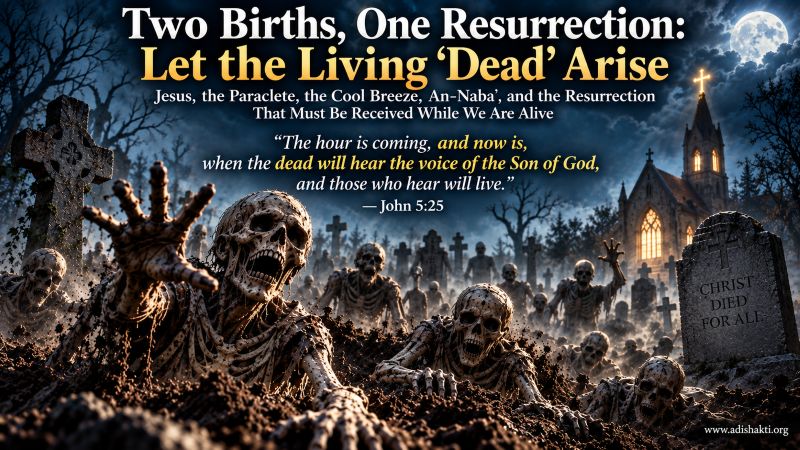
The paper’s culminating proposal is that renewed human birth supplies living, language-bearing subjects capable of hearing and responding to An-Naba.
The argument can now be stated without the conceptual difficulty that burdened the earlier version of the paper. There are three distinct questions:
| Question | Answer in the proposed synthesis |
|---|---|
| What survives the former death? | The soul/person remains under Allah’s authority; the former biological organism need not remain materially intact. |
| How does a historical soul become present during the Resurrection Age? | Through renewed human birth and development. |
| Why is renewed human embodiment necessary? | Because An-Naba, the Signs, the Caller, self-witness, Realization, acceptance, denial, and judgment all presuppose conscious human participation. |
Thus rebirth and Resurrection should not be treated as competing doctrines in this model. Rebirth describes the mechanism of renewed human presence; Resurrection describes the eschatological process and disclosure in which those human beings participate. The first answers how the historical dead become living participants; the second answers what they are living through.
This distinction also resolves the temporal problem. A person who died two thousand years ago cannot, as a dead organism, hear an announcement occurring in a later historical age. But if the soul receives renewed human birth, grows into linguistic and moral consciousness, and becomes historically contemporary with the Resurrection proclamation, the difficulty disappears. The person can now hear An-Naba because the person is once again a living human hearer.
The model also addresses those who died in infancy, those who lived before the Qurʾanic proclamation, and those who never encountered the eschatological message under conditions of mature understanding. It does not prove that every such individual has a particular identifiable former life. Rather, it supplies a theological mechanism by which universal divine address can become genuinely humanly receivable.
At this point the cumulative structure of the argument becomes important. An-Naba by itself does not state, “the dead have reincarnated.” Malachi Martin by himself does not prove survival of the soul or rebirth. The six Qurʾanic passages by themselves do not explicitly formulate a doctrine of serial earthly reincarnation. Shri Mataji’s statements are not classical tafsīr. But when these independent elements are placed into a declared comparative-confessional synthesis, they answer different parts of one problem:
death of the former organism → continuity of the soul → renewed human embodiment → mature consciousness → hearing the Great Announcement → recognition or rejection → Realization and self-witness → conscious participation in Qiyamah → Judgment.
This is the paper’s strongest argument for rebirth: it is not introduced merely because another religious tradition teaches reincarnation. It is proposed because it resolves the specific anthropological problem created when An-Naba is interpreted as an announcement addressed to humanity in the Resurrection Age. An announcement needs hearers. A Resurrection involving recognition, self-judgment, signs, warning, and Realization needs conscious participants. Rebirth supplies those participants without requiring the biological preservation of ancient corpses.
13. From Inherited Doctrine to a Testable Interpretive Question
The contrast with mainstream Muslim doctrine should therefore be framed academically rather than by dismissing Muslims themselves as “outdated.” Classical Muslim belief in bodily resurrection is a serious theological tradition grounded in Qurʾanic passages about Allah’s power to restore the dead. The present paper challenges one interpretation of the mechanism: that Resurrection must be understood primarily as the reanimation or material reconstruction of long-decayed grave bodies.
The stronger question for contemporary readers is not whether inherited doctrine is old, but whether it explains all of the evidence being considered. Does it explain why An-Naba is disputed by conscious people? Does it explain the role of the Caller, Signs, testimony, self-reproach, warning, divine explanation, and spiritual recognition? Does it explain how persons separated by millennia become contemporaries of the eschatological proclamation? And does it distinguish adequately between resurrection of the person and reassembly of the former organism?
The rebirth model deserves consideration because it supplies a unified answer to those questions. It preserves divine Resurrection while relocating continuity from the corpse to the soul; it accepts the biological destruction of the former organism; it provides renewed human embodiment; and it makes conscious participation in An-Naba and Al-Qiyāmah intelligible.
Conclusion
Conclusion: The cumulative argument of this paper is that An-Naba is most coherently understood, within the AdiShakti.org Resurrection synthesis, as the Great Announcement belonging specifically to the Resurrection Age—the period in which Al-Qiyāmah ceases to be merely a future doctrine and becomes a reality to be heard, disputed, witnessed, recognized, and consciously experienced.
Sūrat al-Nabaʾ supplies the human scene: people ask, disagree, and are warned that they will know. Sūrat al-Qiyāmah supplies the governing event: Resurrection, the reproaching soul, signs, reckoning, revelation and explanation, death, rejection, re-creation, and the giving of life to the dead. The wider Qurʾanic constellation supplies the surrounding phenomena: the Caller, the Cry, the Signs on earth and within the self, the testimony of the human being, the descent of the angels and the Ruh, the divine warning, and the promised prevailing of Allah’s messengers.
These are not the activities of bones lying in graves. They are the experiences of living, conscious human beings. Consequently, the theological problem is no longer merely, “Can Allah resurrect the dead?” The Qurʾan answers that affirmatively. The deeper participatory question is: How do the historical dead become the living human beings who can hear the Great Announcement and consciously participate in the Resurrection?
The six rebirth passages provide the Qurʾanic conceptual vocabulary for the proposed answer, while Shri Mataji Nirmala Devi states that answer explicitly in the confessional framework examined here: the dead souls take birth, take human bodies, and take their Realization in these special times—the Qiyamah, Resurrection, or Blossom Time.
The resulting eschatological sequence is therefore:
former death → divine custody of the soul → renewed human birth → human development → encounter with the Signs → hearing An-Naba → acceptance or dispute → Realization/self-witness → conscious participation in Al-Qiyāmah → Last Judgment.
Thus rebirth is not peripheral to this interpretation of An-Naba. It is the logical human mechanism that makes the Great Announcement universally hearable across historical generations. Without renewed living embodiment, the historical dead remain absent from the human scene in which the Announcement is heard and disputed. With rebirth, persons from humanity’s past can become contemporaries of the Resurrection Age.
The paper therefore reaches its strongest bounded declaration: taken together—not as isolated proof-texts but as a converging Qurʾanic eschatological field—An-Naba, Al-Qiyāmah, the Caller, the Signs, the Ruh, human witnessing, renewed life, and Shri Mataji’s declaration form a coherent model in which the Great News is the Announcement of the present Resurrection Age and rebirth enables the dead of former generations to return as living human participants in it.
That conclusion remains a comparative-confessional interpretation rather than the consensus of classical Sunni or Shiʿi tafsīr. The distinction strengthens rather than weakens the academic argument: the Qurʾanic text, mainstream exegesis, and the present Resurrection interpretation can be placed side by side without confusing their respective claims. What this paper insists upon is that the cumulative evidence must be confronted as a whole. Once the Great News is treated as an announcement to conscious humanity, the identity and historical presence of its hearers becomes an unavoidable theological question.
References
- [1] Quran.com. “Sūrat al-Nabaʾ, 78:1–5.” The Clear Quran, translation by Dr. Mustafa Khattab, accessed September 4, 2026.
- [2] Quran.com. “Sūrat al-Qiyāmah, 75:1.” The Clear Quran, translation by Dr. Mustafa Khattab, accessed September 4, 2026.
- [3] Quran.com. “Sūrat al-Baqarah, 2:28.” The Clear Quran, translation by Dr. Mustafa Khattab; linked Ibn Kathīr (abridged) commentary, accessed September 4, 2026.
- [4] Quran.com. “Sūrat al-Zumar, 39:42.” The Clear Quran, translation by Dr. Mustafa Khattab, accessed September 4, 2026.
- [5] Quran.com. “Sūrat Ghāfir, 40:11.” The Clear Quran, translation by Dr. Mustafa Khattab, accessed September 4, 2026.
- [6] Quran.com. “Sūrat al-Wāqiʿah, 56:60–62.” The Clear Quran, translation by Dr. Mustafa Khattab, accessed September 4, 2026.
- [7] Quran.com. “Sūrat al-Ḥajj, 22:5–7.” The Clear Quran, translation by Dr. Mustafa Khattab; linked Ibn Kathīr (abridged) commentary, accessed September 4, 2026.
- [8] Quran.com. “Sūrat al-Muʾminūn, 23:12–14.” The Clear Quran, translation by Dr. Mustafa Khattab, accessed September 4, 2026.
- [9] Quran.com. “Sūrat al-Muʾminūn, 23:99–100.” The Clear Quran, translation by Dr. Mustafa Khattab, accessed September 4, 2026.
- [10] Ibn Kathīr. “Tafsīr of Sūrat Ghāfir 40:11.” Quran.com, abridged English presentation, accessed September 4, 2026.
- [11] AdiShakti.org. “Holy Spirit of the Resurrection: Science versus Religions.” AdiShakti.org Authenticity Series, transcript section attributed to Shri Mataji Nirmala Devi, Moscow, Russia, November 12, 1993, accessed September 4, 2026.
- [12] AdiShakti.org. “Holy Spirit of the Resurrection: Science versus Religions.” AdiShakti.org Authenticity Series, recorded statements attributed to Shri Mataji Nirmala Devi, Moscow, Russia, November 12, 1993, and Philadelphia, USA, October 15, 1993, accessed September 4, 2026.
- [13] AdiShakti.org. “Part Two: Awakening to the Resurrection (Al-Qiyāmah).” AdiShakti.org, accessed September 4, 2026.
- Martin, Malachi. The Encounter. New York: Farrar, Straus and Giroux, 1970, p. 286. The full passage supplied for this paper is reproduced in the research source; this article summarizes its scientific argument rather than reproducing the entire copyrighted page-length passage.
- Shri Mataji Nirmala Devi. “Holy Spirit of the Resurrection,” statements on rebirth, Qiyamah, and Resurrection; Moscow, Russia, 12 November 1993; Philadelphia, USA, 15 October 1993. Source compilation: AdiShakti.org.
Compilation, Proclamation, and Exegesis of Surahs Upholding Allah’s (SWT) Command to His Ummah — to Witness and Participate in the Resurrection.
Al-Qiyamah: A Profound Declaration of Al-QiyamahAl-Qiyamah (75:1-2): Oaths of Resurrection
Al-Qiyamah (75:3-4): Reassembling Bones and Fingertips
Al-Qiyamah (75:5-6): Man's Denial of Resurrection
Al-Qiyamah (75:7–10): Sun and Moon 'Joined' At Solar Eclipse
Al-Qiyamah (75:7–10): Solar Eclipse Salat al-Kusuf
Al-Qiyamah (75:11–13): No Refuge, Only Reckoning
Al-Qiyamah (75:14–15): Man: His Own Witness and Judge
Al-Qiyamah (75:16–19): The Usurpation of Allah's Explanation
Al-Qiyamah (75:20–21): Love of The Fleeting World
Al-Qiyamah (75:22–25): Ruh’s Face Brings Either Glory Or Gloom
Al-Qiyamah (75:26–30): Death and Soul's Departure Home
Al-Qiyamah (75:31–35): The Rejection and Arrogance of the Kuffar
Al-Qiyamah (75:36–40): Is Resurrection Beyond Allah, Your Creator?
Al-Qiyamah (75:1-2 and 78:1–5): An Naba and Oaths of Resurrection
Al-Qiyamah (75:1-2 and 78:1–5): The Great News and Resurrection Rebirth
Al-Baqarah (2:138): Baptism of Allah You Were Unaware Of
Al-Baqarah (2:174): Allah Will Not Address Muslims
Al-A'raf (7:16) – Iblis: I Will Lie In Wait and Overpower Them
Al-A'raf (7:146): Allah: I Will Turn Them Away From My Signs
Al-A'raf (7:146): Allah: So Even Though They See All The Signs
Al-Hijr (15:39) – Iblis: I Will Wake (Evil) Fair and Mislead Them
An-Nahl (16:2) – Allah (SWT) Sent Down Angels With His Ruh
Al-Isra (17:85): Muslims Given Little of Allah's (SWT) Ruh
Al-Isra (17:104): Children of Israel Gathered Again (in 1948)
Al-Isra (17:104): Shaykh Palazzi: Children of Israel
Al-Hajj (22:8) – Kitab Al-Munir You Were Unaware Of
Al-Rum (30:56) – The Day of Qiyamah You Were Unaware Of
Fatir (35:9) – Winds of Qiyamah You Were Unaware Of
Yassin (36:63-68) – This Is The Hell You Were Warned Of.
Sad (38:79) – Iblis Allowed to Mislead Muslims And He Did
Fussilat (41:20–21) – Your Hands Will Testify of Qiyamah
Fussilat (41:53) – We Will Show Our Signs Within Your Soul
Az-Zukhruf (43:61): Jesus, Sign of Hour You Were Unaware
Az-Zukhruf (43:62): Satan's Deception of the Muslim Ummah
Az-Jathiya (45:7-14) – Those Who Deny Allah's Revelations
Qaf (50:41) – Listen To The Caller Emerging From Within
Qaf (50:42) – Day They Will Hear of Mighty Blast Witnessed
Qaf (50:45) – By the Caller, My Warning Is Delivered
Al Dhariyat (51:20-22) – Our Signs on Earth and Within
Al-Hadid (57:25) – Allah's (SWT) Iron Has Been Delivered
Al-Mujadilah (58:21) – My Messengers Must Prevail
Al-Saff (61:8–9) – Revelation of Light You Were Unaware
Al-Muddaththir (74:1–2) – My Cloaked One: Deliver Warning
Al-Mursalat (77:1–10): Angels Sent You Were Unaware Of
An-Naba (78:1–5): Concerning What Are They Disputing?
Al-Infitar (82:17–18) – What Will Explain To You? What Will?
Al-Mutaffifin (83:1–6) – Dealers in Fraud You Were Unaware
Al-Tariq (86:1–3) – The Night Visitant You Were Unaware
Al-Qadr (97:1–5) – Blessed Night of Power and Fate Before:
Al-Qariah (101:1–11) – Terrifying Day of Noise and Clamour
عَمَّ يَتَسَاءَلُونَ - عَنِ النَّبَإِ الْعَظِيمِ - الَّذِي هُمْ فِيهِ مُخْتَلِفُونَ - كَلَّا سَيَعْلَمُونَ - ثُمَّ كَلَّا سَيَعْلَمُونَ
Concerning what are they disputing?
Concerning the Great News. [5889]
About which they cannot agree.
Verily, they shall soon (come to) know!
Verily, verily they shall soon (come to) know!
Surah 78:1-5 An-Naba (The Great News)
“5889. Great News: usually understood to mean the News or Message of the Resurrection.” Abdullah Yusuf Ali, The Holy Qur'n, Amana Corporation, 1989.