




لَا أُقْسِمُ بِيَوْمِ الْقِيَامَةِ وَلَا أُقْسِمُ بِالنَّفْسِ اللَّوَّامَةِ
“I do call to witness the Resurrection Day; and I do call to witness the self-reproaching Spirit.” (Qur'an 75:1–2)
Jesus Is the Sign of the Hour: Qur’an 43:61 and the Completion of His Mission through the Paraclete
Abstract
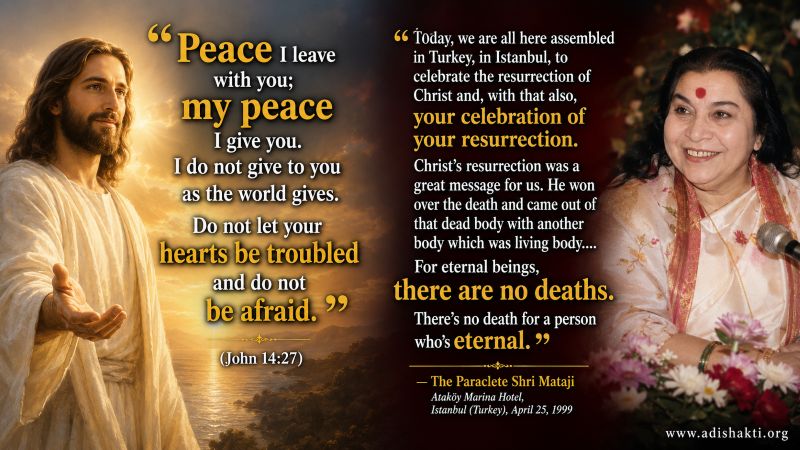
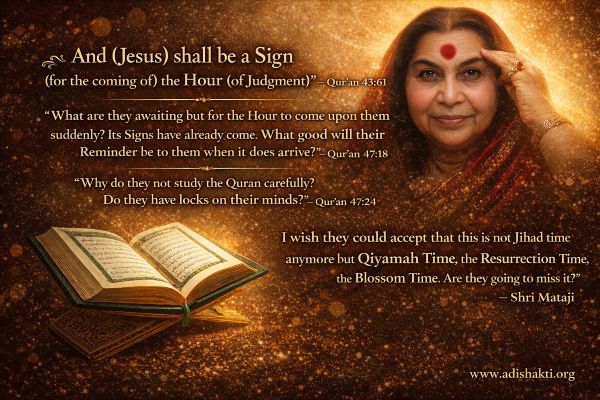
This paper is about fulfillment, not deception. Its central problem is the relation between Qur’an 43:61 and the Johannine promise of the Paraclete. Qur’an 43:61 identifies Jesus as a Sign of the Hour. John 16:12–15 states that Jesus still has “much more” to say, but that his hearers cannot yet bear it; a later Spirit of truth will guide into all truth. The question developed here is therefore whether the eschatological significance of Jesus can be understood only by looking at Jesus himself, or whether it necessarily includes the later divine agency he promised.
The argument proceeds through function rather than word-equivalence. The Paraclete teaches, reminds, testifies, convicts, and guides. These are precisely the kinds of functions required if a “Sign of the Hour” is to become intelligible to later generations. The paper then examines the Adishakti.org claim that Shri Mataji Nirmala Devi’s public ministry corresponds to these Paraclete functions through Self-realization, direct spiritual verification, reinterpretation of Jesus within a universal framework, and a claimed collective awakening associated with the Age of Resurrection.
Contents
- Why Jesus is called a Sign rather than merely a returning figure
- Jesus explicitly leaves an unfinished teaching
- The five functions of the Paraclete
- How the Paraclete makes the Sign of Jesus intelligible
- The Shri Mataji claim: correspondence of functions
- Why this fulfillment belongs to a living Resurrection
- What would count as evidence of genuine fulfillment?
- Conclusion
1. Why Jesus Is Called a Sign Rather Than Merely a Returning Figure
The verse’s most important word for this paper is Sign. A sign has an interpretive function: it points, identifies, and makes another reality recognizable. That means the verse can be examined not only as chronology—what happens near the end—but also as disclosure—how the Hour becomes knowable.
The paper therefore brackets, without denying, the traditional question of Jesus’s return and asks a different one: what is the mechanism by which Jesus functions as an intelligible Sign for people living long after his historical ministry? That question leads directly to the Paraclete sayings.
2. Jesus Explicitly Leaves an Unfinished Teaching
This saying establishes a structural incompletion in the historical ministry of Jesus. The incompletion is not failure. Jesus explains that the limitation lies in what his contemporaries can “bear.” The promised later agency is therefore part of the mission itself.
Theologically, this is crucial. If Jesus is an eschatological Sign and also predicts a later Spirit whose work is to complete understanding, then the later Spirit cannot be treated as peripheral. The Paraclete belongs to the full architecture of Jesus’s mission.
3. The Five Functions of the Paraclete
3.1 Teaching
John 14:26 assigns the Paraclete a teaching function. This implies new comprehension, not merely repetition.
3.2 Remembrance
The Paraclete brings Jesus’s words to remembrance, reconnecting later seekers with the meaning of the earlier revelation.
3.3 Testimony
John 15:26 presents the Paraclete as one who testifies concerning Jesus. This places Jesus at the center of the later Spirit’s mission rather than making the later ministry independent of him.
3.4 Conviction
John 16:8–11 describes conviction regarding sin, righteousness, and judgment. The work of the Spirit therefore penetrates moral consciousness.
3.5 Guidance into all truth
John 16:13 gives the broadest formulation. The promised Spirit does not merely comfort; the Spirit interprets reality.
4. How the Paraclete Makes the Sign of Jesus Intelligible
The Qur’anic and Johannine texts do not share the same vocabulary, so the argument cannot be based on lexical identity. It is based on complementary roles. Qur’an 43:61 says Jesus is a Sign. John says a later Spirit will complete understanding of Jesus’s message. Together, the texts support a comparative hypothesis: the eschatological significance of Jesus may become publicly intelligible through the work of the promised Spirit of truth.
This is the conceptual center of Paper I. It is not primarily a paper about Satan, false expectation, or doctrinal failure. Those belong elsewhere. Here the concern is constructive: how divine revelation unfolds through stages and how a later ministry can complete an earlier one without displacing it.
5. The Shri Mataji Claim: Correspondence of Functions
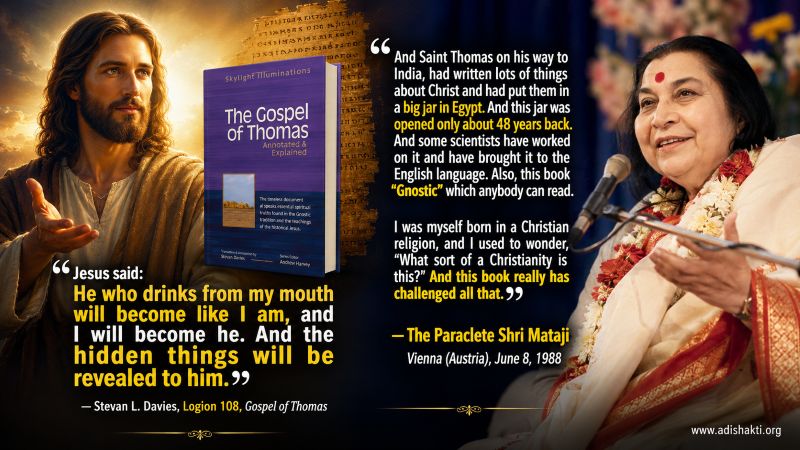
Adishakti.org identifies Shri Mataji Nirmala Devi with the public historical manifestation of the promised Paraclete. That claim must be evaluated through functions rather than titles. The question is not whether she called herself by a particular name; the question is whether her mission actually performs the scriptural roles expected of the Paraclete.
The claimed correspondences include: a method of Self-realization offered universally; direct experience rather than belief alone; repeated reinterpretation of Jesus within a wider sacred history; emphasis on the Holy Spirit and inner rebirth; teachings on judgment and Resurrection; and the presentation of spiritual awakening as collectively verifiable.
6. Why This Fulfillment Belongs to a Living Resurrection
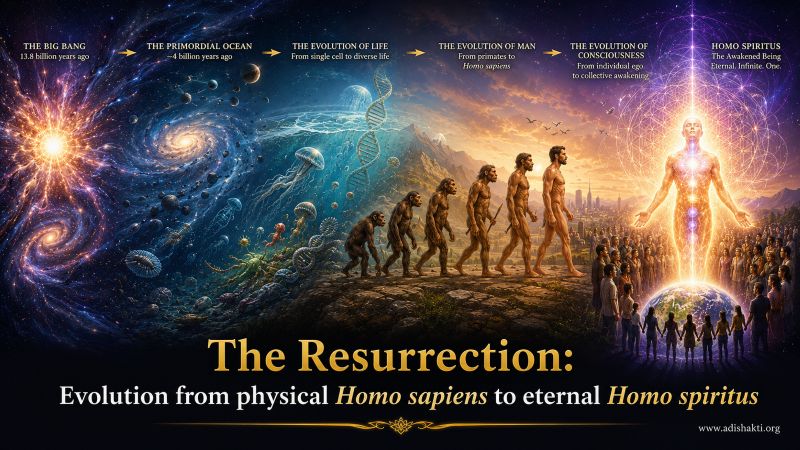
If the Paraclete teaches, guides, convicts, and awakens, then the work presupposes living recipients. This is where the Paraclete thesis connects to al-Qiyāmah and An-Nabaʾ. The eschatological process is not presented solely as something done to passive corpses after history ends; at least one dimension must involve living persons capable of hearing, recognizing, disputing, accepting, and changing.
This is why the phrase living Resurrection is useful in this paper. It names the period in which the promised guidance becomes experiential and morally consequential before any final consummation of judgment.
7. What Would Count as Evidence of Genuine Fulfillment?
The fulfillment claim should be tested by criteria strong enough to permit failure. At minimum:
Specificity: Are the scriptural functions specific enough that the claimed ministry uniquely matches them?
Documentation: Are the relevant sayings, dates, and events historically verifiable?
Continuity with Jesus: Does the later ministry genuinely testify to Jesus rather than merely borrow his authority?
Transformative content: Does it produce the kind of teaching, remembrance, conviction, and guidance described in John?
Public accessibility: Can the claimed experience be examined by people outside a closed circle of believers?
These criteria convert a theological assertion into a research program. The claim becomes stronger precisely because it is exposed to testing.
8. Conclusion: The Sign of Jesus Is Completed through Interpretation and Awakening
Paper I argues that Qur’an 43:61 should be read not only as a timetable statement but as a problem of intelligibility. Jesus is a Sign of the Hour; John then records Jesus promising a later Spirit whose purpose is to complete understanding.
The most coherent synthesis is therefore not that the Paraclete replaces Jesus, but that the Paraclete activates the eschatological meaning of Jesus for a later age. The later Spirit teaches what could not yet be borne, recalls what was forgotten, testifies to Jesus, convicts human beings, and guides into truth.
Within the Adishakti.org framework, the claim concerning Shri Mataji stands or falls on whether her historical mission genuinely performs those functions. That is the defining question of this paper—and it is intentionally different from the question examined in Paper II.
References
- Qur’an 43:61; 75:1–2; 78:1–5.
- Gospel of John 14:16–17, 14:25–26, 15:26–27, 16:7–15.
- Daniel B. Stevick, Jesus and His Own: A Commentary on John 13–17, Eerdmans, 2011.
- Adishakti.org research materials on the Paraclete, Shri Mataji Nirmala Devi, and the Living Resurrection.
Compilation, Proclamation, and Exegesis of Surahs Upholding Allah’s (SWT) Command to His Ummah — to Witness and Participate in the Resurrection.
Al-Qiyamah: A Profound Declaration of Al-QiyamahAl-Qiyamah (75:1-2): Oaths of Resurrection
Al-Qiyamah (75:3-4): Reassembling Bones and Fingertips
Al-Qiyamah (75:5-6): Man's Denial of Resurrection
Al-Qiyamah (75:7–10): Sun and Moon 'Joined' At Solar Eclipse
Al-Qiyamah (75:7–10): Solar Eclipse Salat al-Kusuf
Al-Qiyamah (75:11–13): No Refuge, Only Reckoning
Al-Qiyamah (75:14–15): Man: His Own Witness and Judge
Al-Qiyamah (75:16–19): The Usurpation of Allah's Explanation
Al-Qiyamah (75:20–21): Love of The Fleeting World
Al-Qiyamah (75:22–25): Ruh’s Face Brings Either Glory Or Gloom
Al-Qiyamah (75:26–30): Death and Soul's Departure Home
Al-Qiyamah (75:31–35): The Rejection and Arrogance of the Kuffar
Al-Qiyamah (75:36–40): Is Resurrection Beyond Allah, Your Creator?
Al-Qiyamah (75:1-2 and 78:1–5): An Naba and Oaths of Resurrection
Al-Qiyamah (75:1-2 and 78:1–5): The Great News and Resurrection Rebirth
Al-Baqarah (2:138): Baptism of Allah You Were Unaware Of
Al-Baqarah (2:174): Allah Will Not Address Muslims
Al-A'raf (7:16) – Iblis: I Will Lie In Wait and Overpower Them
Al-A'raf (7:146): Allah: I Will Turn Them Away From My Signs
Al-A'raf (7:146): Allah: So Even Though They See All The Signs
Al-Hijr (15:39) – Iblis: I Will Wake (Evil) Fair and Mislead Them
An-Nahl (16:2) – Allah (SWT) Sent Down Angels With His Ruh
Al-Isra (17:85): Muslims Given Little of Allah's (SWT) Ruh
Al-Isra (17:104): Children of Israel Gathered Again (in 1948)
Al-Isra (17:104): Shaykh Palazzi: Children of Israel
Al-Hajj (22:8) – Kitab Al-Munir You Were Unaware Of
Al-Rum (30:56) – The Day of Qiyamah You Were Unaware Of
Fatir (35:9) – Winds of Qiyamah You Were Unaware Of
Yassin (36:63-68) – This Is The Hell You Were Warned Of.
Sad (38:79) – Iblis Allowed to Mislead Muslims And He Did
Fussilat (41:20–21) – Your Hands Will Testify of Qiyamah
Fussilat (41:53) – We Will Show Our Signs Within Your Soul
Az-Zukhruf (43:61): Jesus, Sign of Hour You Were Unaware
Az-Zukhruf (43:62): Satan's Deception of the Muslim Ummah
Az-Jathiya (45:7-14) – Those Who Deny Allah's Revelations
Qaf (50:20–21) – Hidden Imam Mahdi You Were Unaware
Qaf (50:41) – Listen To The Caller Emerging From Within
Qaf (50:42) – Day They Will Hear of Mighty Blast Witnessed
Qaf (50:45) – By the Caller, My Warning Is Delivered
Al Dhariyat (51:20-22) – Our Signs on Earth and Within
Al-Hadid (57:25) – Allah's (SWT) Iron Has Been Delivered
Al-Mujadilah (58:21) – My Messengers Must Prevail
Al-Saff (61:8–9) – Revelation of Light You Were Unaware
Al-Muddaththir (74:1–2) – My Cloaked One: Deliver Warning
Al-Mursalat (77:1–10): Angels Sent You Were Unaware Of
An-Naba (78:1–5): Concerning What Are They Disputing?
Al-Infitar (82:17–18) – What Will Explain To You? What Will?
Al-Mutaffifin (83:1–6) – Dealers in Fraud You Were Unaware
Al-Tariq (86:1–3) – The Night Visitant You Were Unaware
Al-Qadr (97:1–5) – Blessed Night of Power and Fate Before:
Al-Qariah (101:1–11) – Terrifying Day of Noise and Clamour
Search Adishakti.org
💬 Interactive Chat
Explore the scriptural arguments, sources, and theological distinctions developed in this paper.
Open chat →