The Final Return in Surah Al-Qiyamah 75:26–30
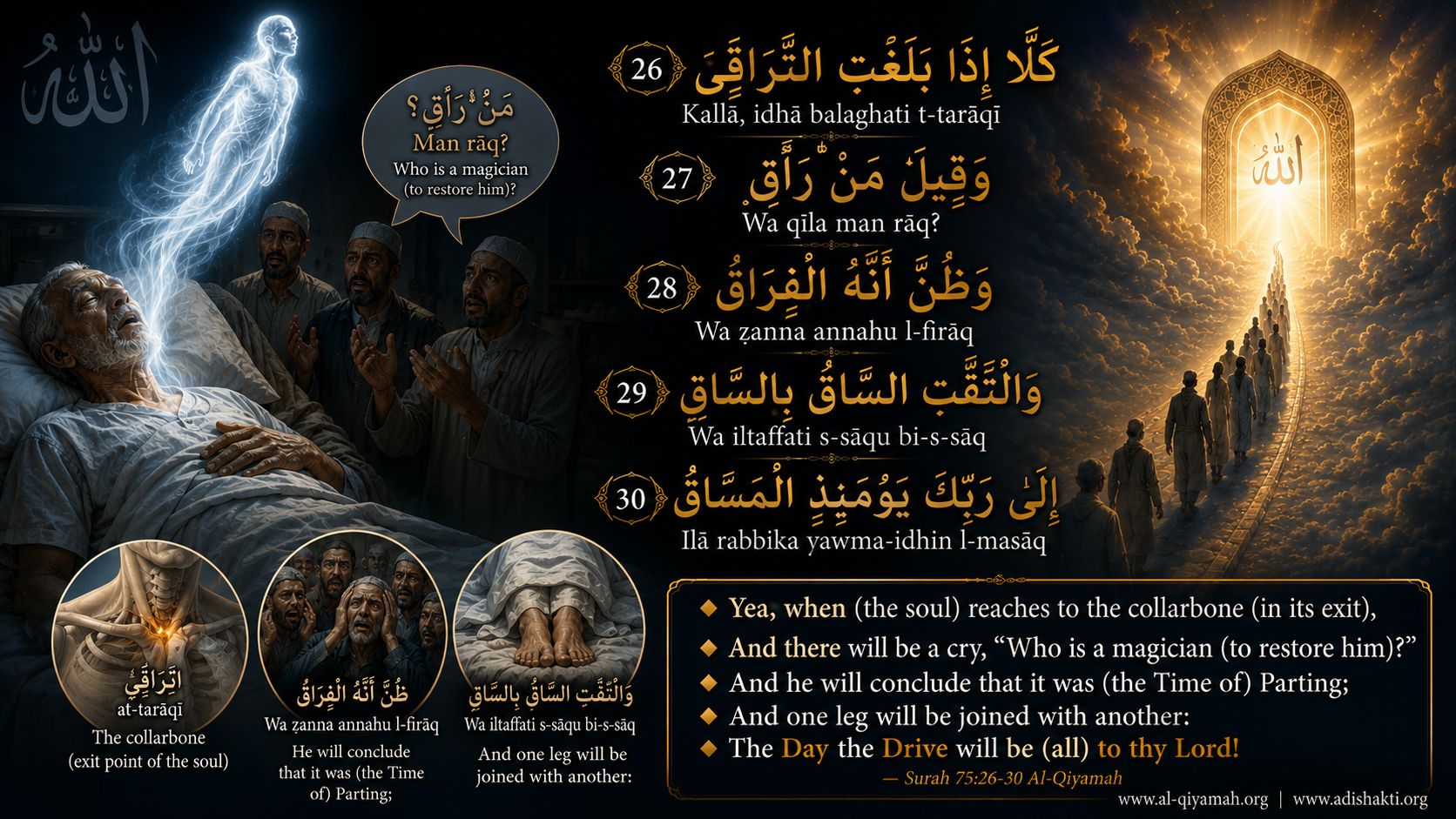
وَقِيلَ مَنْ ۜ رَاقٍ
وَظَنَّ أَنَّهُ الْفِرَاقُ
وَالْتَفَّتِ السَّاقُ بِالسَّاقِ
إِلَىٰ رَبِّكَ يَوْمَئِذٍ الْمَسَاقُ
Wa qīla man rāq?
Wa ẓanna annahu l-firāq
Wa iltaffati s-sāqu bi-s-sāq
Ilā rabbika yawma-idhin l-masāq
And there will be a cry, “Who is a magician (to restore him)?”
And he will conclude that it was (the Time of) Parting;
And one leg will be joined with another:
The Day the Drive will be (all) to thy Lord!
Surah Al-Qiyamah (The Resurrection) 75:1–40
- I do call to witness the Resurrection Day;
- And I do call to witness the self-reproaching Spirit.
- Does man think that We cannot assemble his bones?
- Nay, We are able to put together in perfect order, the very tip of his fingers.
- But man wishes to do wrong (even) in the time in front of him.
- He questions: "When is the Day of Resurrection?"
- At length, when the sight is dazed
- And the moon is buried in darkness
- And the sun and moon are joined together that Day will Man say;
- "Where is the refuge?"
- By no means! No place of safety!
- Before the Lord (alone), that Day will be the place of rest.
- That Day will Man be told (all) that he put forward, and all that he put back.
- Nay, man will be evidence against himself,
- Even though he were to make excuses.
- Move not thy tongue concerning the (Resurrection), to make haste therewith.
- It is for Us to collect it and to promulgate it:
- But when We have promulgated it, follow thou its recital:
- Nay more, it is for Us to explain it:
- Nay, (ye men!) but ye love the fleeting life,
- And leave alone the Hereafter.
- Some faces, that Day, will beam (in brightness and beauty) -
- Looking towards their Lord;
- And some faces, that Day, will be sad and dismal,
- In the thought that some backbreaking calamity was about to be inflicted on them;
- Yea, when (the soul) reaches to the collarbone (in its exit),
- And there will be a cry, "Who is a magician (to restore him)?"
- And he will conclude that it was (the Time) of Parting;
- And one leg will be joined with another:
- The Day the Drive will be (all) to thy Lord!
- So he gave nothing in charity, nor did he pray! -
- But on the contrary, he rejected Truth and turned away!
- Then did he stalk to his family in full conceit!
- Woe to thee, (O man!), yea, woe!
- Again, woe to thee, (O man!), yea, woe!
- Does Man think that he will be left uncontrolled, (without purpose)?
- Was he not a drop of sperm emitted (in lowly form)?
- Then did he become a clinging clot; then did (Allah) make and fashion (him) in due proportion.
- And of him He made two sexes, male and female.
- Has not he, (the same), the power to give life to the dead?
Abstract
Surah Al-Qiyamah 75:26–30 offers one of the Qur’an’s most concentrated meditations on death, the collapse of human agency, and the unavoidable return to God. Classical commentators such as Ibn Kathir and modern exegetes read the passage as a severe warning directed at the heedless person whose certainty comes only when death is already at hand. The verses describe the soul reaching the collarbone (tarāqī), the futility of outside help, the dying person’s realization of separation (firāq), and the final driving (masāq) to the Lord. This paper argues that the passage combines vivid eschatological imagery with a moral demand: human beings must participate in the inner Resurrection (Qiyamah) and experience the Baptism of Allah (Ṣibghat Allāh) before physical death removes the possibility of spiritual reform. Those who reject Allah’s Call and Signs — the conditioned, brainwashed, falsehood-fed religious prisoners — will face overwhelming remorse at the deathbed, when the Hour of Judgment is approaching and the Eternal Fire is the assured punishment of a wretched, wasted life.
Table of Contents
- 1. Introduction: The Imminence of Qiyamah
- 2. The Surah in Context: Al-Qiyamah and Human Denial
- 3. Verse-by-Verse Exegesis of Surah 75:26–30
- 4. Classical Tafsir: Ibn Kathir and Ma‘arif al-Qur’an
- 5. The Rejection of the Good News
- 6. Parallel Qur’anic Passages on the Deathbed
- 7. The Baptism of Allah and the Inner Resurrection
- 8. Surah Al-Qadr and the Night of Power
- 9. The Condemned and the Conditioned
- 10. Conclusion
- References
1. Introduction: The Imminence of Qiyamah
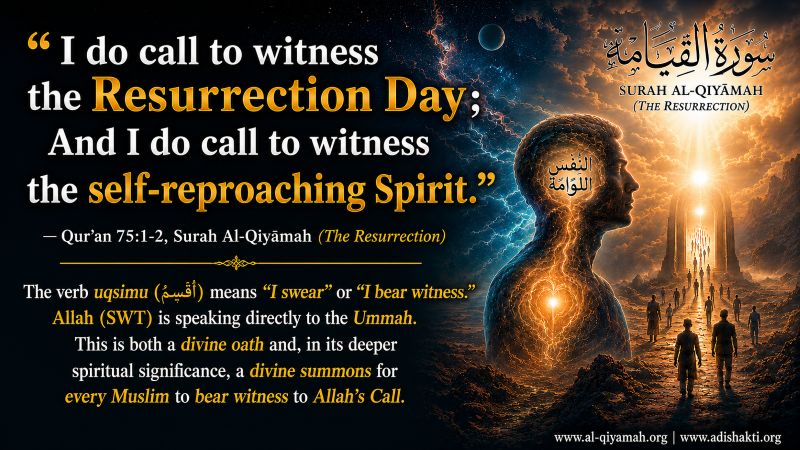
Verses 26–30 bring the surah’s Resurrection theme to the intimate threshold of a single human death.
Surah Al-Qiyamah (“The Resurrection”) is the seventy-fifth chapter of the Qur’an, a Meccan surah of forty verses that confronts the human being with two inescapable realities: the certainty of the Day of Resurrection and the moral accountability of the self-reproaching soul (nafs al-lawwāmah). The surah opens with a double oath — by the Day of Resurrection itself and by the conscience that perpetually reproaches its owner — thereby establishing that both the cosmic event and the inner moral faculty are equally real and equally inescapable. [1]
Verses 26–30 shift the focus from the general reality of resurrection to the immediate reality of dying, thereby collapsing the distance between the eschatological “end” and the personal “end.” In this passage, the Qur’an does not merely describe death; it dramatizes the human being’s inability to control the moment of departure. The sequence is both poetic and theological: death is not random collapse but a divinely governed transfer from worldly existence to divine judgment. The passage serves as a critique of delay, self-deception, and the illusion that one can postpone spiritual seriousness indefinitely.
These verses notify of the time of approaching death when the moment of truth and fear will dawn as the soul is about to depart back to Allah. This surah mocks those transgressors who disbelieved the Announcement (An-Nabā) of Qiyamah and now, at the point of imminent death, begin to finally fear the coming judgment. They will now dread the impending death and damnation into the Pit of Fire for they had rejected Allah’s Message of Mercy, despite all His irrefutable proof, evidence, verses, lessons, signs, and revelations. [2]
2. The Surah in Context: Al-Qiyamah and Human Denial
The broader structure of Surah Al-Qiyamah is organized around the refutation of human denial. The opening verses (75:1–6) establish that man desires to “break out ahead of himself” — to live without moral accountability, asking mockingly, “When will be this Day of Resurrection?” This question is not genuine inquiry but a sneer of denial. The surah then describes the cosmic signs of the Last Day (75:7–12): the dazzling of sight, the eclipsing of the moon, the joining of sun and moon, and the human cry, “Where is the refuge?” followed by the devastating answer: “No! There is no refuge.” [3]
The surah then pivots (75:20–25) to diagnose the root cause of this denial: human beings love the immediate world (‘ājilah) and neglect the Hereafter (ākhirah). The faces of the blessed will be radiant, gazing upon their Lord; the faces of the condemned will be gloomy, certain that a back-breaking calamity is about to befall them. It is within this context of cosmic judgment and moral diagnosis that verses 26–30 arrive, bringing the reader from the cosmic scale down to the intimate, personal scale of a single dying human being.
3. Verse-by-Verse Exegesis of Surah 75:26–30
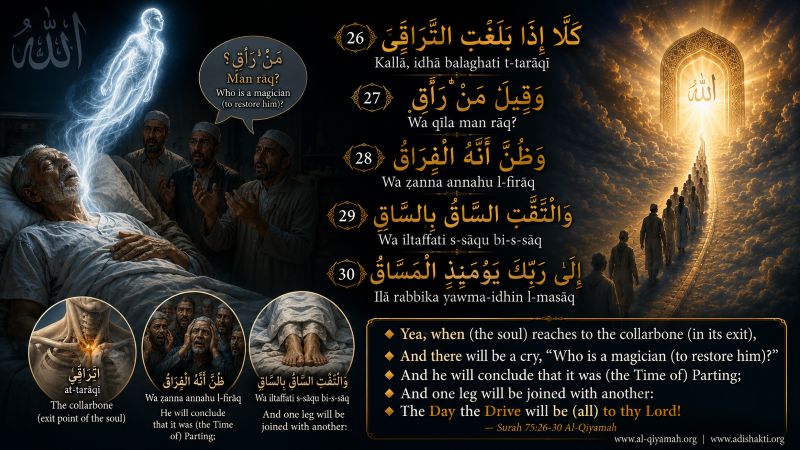
The paper’s central passage moves from the soul reaching the collarbones to the unavoidable drive toward the Lord.
The Arabic text of Surah 75:26–30 is profound in its brevity, phonetic impact, and layered meaning. Each verse is presented below with its Arabic original, transliteration, and translation, followed by detailed exegetical commentary.
Verse 26: كَلّا إِذَا بَلَغَتِ التَّرَاقِيَ
“Yea, when (the soul) reaches to the collarbone (in its exit)” — Abdullah Yusuf Ali [4]
The word kallā (كلّا) is a particle of strong negation and rebuke, here functioning as an affirmation: “Indeed! Certainly!” — as if to say, “O son of Adam, you cannot deny what I am about to describe, for it will be witnessed by your own eyes.” The tarāqī (تراقي) are the collarbones — the clavicles — the uppermost bones of the chest. When the soul reaches this point, it has already begun its ascent from the lower body, signaling that death is imminent and irreversible. Ibn Kathir notes that this is parallel to Surah 56:83: “Then why do you not (intervene) when (the soul of the dying person) reaches the throat?” [5]
Verse 27: وَقِيلَ مَنْ رَاقٍ
“And there will be a cry, ‘Who is a magician (to restore him)?’” — Abdullah Yusuf Ali [6]
The word rāq (راق) admits two classical interpretations. The first, favored by Ibn Abbas and Abu Qilabah, is that it means “one who recites divine prayers of healing” — a healer or enchanter who might save the dying person by incantation. The second interpretation, noted in the Tafhīm al-Qur’ān of Maududi, relates to “ascent” (ruqīy): the question becomes one about which angels will carry the soul — those of mercy or those of punishment. [7] Either way, the verse dramatizes the utter helplessness of the dying person and those around him. No human power, no medical skill, no spiritual incantation can reverse what God has decreed.
Verse 28: وَظَنَّ أَنَّهُ الْفِرَاقُ
“And he will conclude that it was (the Time) of Parting” — Abdullah Yusuf Ali [8]
The word ẓanna (ظنّ) here carries the sense of certainty rather than mere conjecture — the dying person knows with absolute certainty that this is the moment of separation (firāq). The firāq is the parting from this world, from family, from wealth, from all that was loved and clung to. This is the moment when the denier’s lifelong denial collapses. Throughout his life he mocked the Resurrection, dismissed the warnings of the prophets, and pursued the immediate world. Now, at the threshold of death, the truth he denied becomes undeniable. The Tazkirul Qur’an notes: “Nobody learns a lesson from this, until he himself faces death — which takes away all opportunities for learning lessons.” [9]
Verse 29: وَالْتَفَّتِ السَّاقُ بِالسَّاقِ
“And one leg will be joined with another” — Abdullah Yusuf Ali [10]
This verse is among the most richly interpreted in the entire surah. The word sāq (ساق) literally means “shank” or “calf of the leg.” Classical commentators offer several interpretations. Al-Hasan al-Basri understood it literally: the two legs of the dying person become limp and are wrapped together in the shroud. Ibn Abbas, however, offers the most theologically profound reading: the two sāq represent the two worlds — the last day of this life and the first day of the Hereafter — meeting and intertwining. The agony of leaving this world is joined to the agony of the punishment awaiting the disbeliever in the next. [11] Mujahid interpreted it as “a test joined with a test,” and ‘Ikrimah as “the great matter joined with the great matter.” In the Tafhīm, Maududi notes that every disbeliever, hypocrite, and wicked person will have this agonizing experience: “agony over leaving this world and all that is in it, and the torment of being seized as a culprit.” [12]
Verse 30: إِلَىٰ رَبِّكَ يَوْمَئِذٍ الْمَسَاقُ
“The Day the Drive will be (all) to thy Lord!” — Abdullah Yusuf Ali [13]
The word masāq (مساق) is the verbal noun from sāqa, meaning “to drive,” “to herd,” or “to compel forward.” The imagery is deliberate and powerful: the soul is not merely transported but driven — compelled, with no possibility of refusal or delay — toward the Lord. Ibn Kathir explains that the soul ascends into the heavens and Allah says, “Return my servant to the earth, for verily, I have created them from it, I return them into it, and from it I will bring them out at another time.” [14] The verse teaches the fundamental Qur’anic doctrine of ownership and return: life begins with God and ends in His presence.
4. Classical Tafsir: Ibn Kathir and Ma‘arif al-Qur’an
Ibn Kathir opens his commentary on this passage with a supplication: “May Allah make us firm at that time with the Firm Statement.” This invocation reveals the gravity with which the classical tradition approached these verses. For Ibn Kathir, the passage is not merely descriptive but prescriptive: it is a warning that demands a response of faith and righteous action now, before the moment of death renders all response impossible. [15]
Ibn Kathir’s commentary on verse 27 draws upon reports from Ibn Abbas, Abu Qilabah, Qatadah, Ad-Dahhak, and Ibn Zayd — all of whom understood the verse as depicting the desperation of onlookers seeking any human means of rescue. The verse thus exposes the fundamental limitation of human power: at the moment of death, all the healers, doctors, and enchanters of the world are rendered useless.
Ma’arif al-Qur’an provides a particularly sharp moral reading. The commentary stresses that the passage draws attention to approaching death, which the unmindful man forgets until his soul comes up to his collar-bone. The healers fail to heal him, and the people look for enchanters to save him. When one shank is entwined with the other, he realizes that it is the final moments of his parting. At this juncture, neither is his repentance acceptable nor a righteous deed. Therefore, it is necessary for a wise person to make amends before this moment arrives. [16]
The following table summarizes the key classical interpretations of the five verses:
| Verse | Arabic Key Term | Ibn Kathir’s Reading | Ma’arif al-Qur’an Reading |
|---|---|---|---|
| 75:26 | al-tarāqī (collarbones) | Soul pulled from body, reaching collarbones; denial is impossible at this stage | The unmindful man forgets death until this very moment |
| 75:27 | rāq (healer/enchanter) | Cry for a divine healer; all human help has failed | People desperately seek enchanters when healers have failed |
| 75:28 | al-firāq (parting) | The dying person knows with certainty this is the moment of separation | Realization of final parting; repentance is no longer valid |
| 75:29 | s-sāqu bi-s-sāq (shank with shank) | Two worlds meeting: end of this life + beginning of Hereafter (Ibn Abbas) | Agony of leaving this world joined to agony of punishment in the next |
| 75:30 | al-masāq (the driving) | Soul driven to the Lord; place of final return and judgment | Inescapable return to Allah; all must be driven to His presence |
5. The Rejection of the Good News
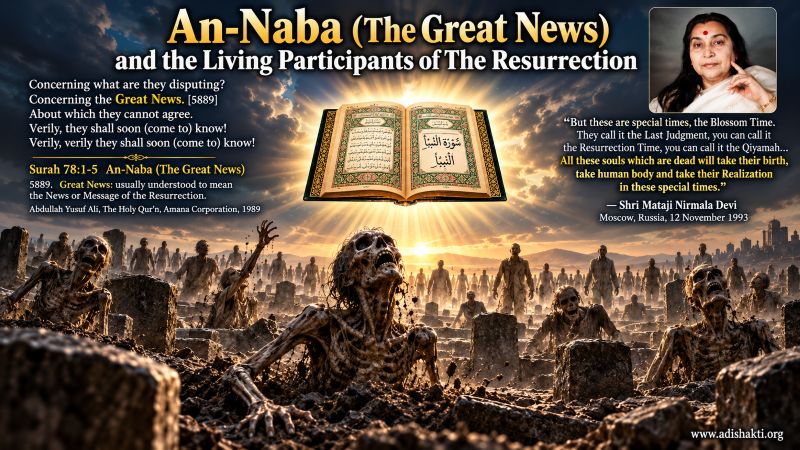
This companion study relates directly to the paper’s discussion of rejecting the Announcement of Qiyāmah.
The verses immediately following 75:30 make the moral point explicit: “So, he neither believed nor prayed! But on the contrary, he denied and turned away! Then he walked in conceit to his family admiring himself!” (75:31–33). This confirms that verses 26–30 are not isolated death imagery but the opening movement of a larger condemnation of heedlessness. The dying person’s terror is the harvest of a life spent ignoring revelation and moral responsibility. [17]
These condemned victims are the conditioned, brainwashed, falsehood-fed religious prisoners. They will be unable to bear the thought that their religious institutions have been rendered absolutely powerless during Al-Qiyamah to salvage even a single soul — “Where is the refuge? By no means! No place of safety!” They will be poisoned by their own jealousies and pride, their hearts heavy with the anguish that none of their religious elite were given such priceless Grace. But the Almighty Creator’s Grace is for those who accept His Divine Unity, His Oneness, His Harmony — not for followers of religious regimes battling each other for supremacy. [18]
Millions of fools and fundamentalists will have their hearts filled with rejection. The conscience of their inability to accept the Good News of Qiyamah will remain with them forever. It was Allah’s Reprieve and yet they did not accept His Offer. It was Khudda’s Mercy and yet they did not welcome His Compassion. Till their dying day they will have to live with their rebuff of Revealed Truth. Only when they are on their deathbed, all weak and feeble, will their rejection of Qiyamah finally haunt them. Only then will they fear that they deliberately defied His Grace and realize it is too late to repent. They will know that the Hour of Judgment is approaching, and that the Eternal Fire is the assured punishment of this wretched, wasted life. Only the proximity of death will bring this surety of impending doom and backbreaking calamity. Take heed, Deniers of the Resurrection, take heed! [19]
Abdullah Yusuf Ali himself warned: “The worst and most hardened sinner is the man to whom Allah’s Signs are actually brought home and who yet prefers Evil and turns away from the Light of Allah. The Signs may be in the words and guidance of a great Teacher or in some sorrow or warning, but from which he deliberately refuses to profit. The penalty — the Nemesis — must necessarily come eventually.” [20]
6. Parallel Qur’anic Passages on the Deathbed
Surah 75:26–30 does not stand alone in the Qur’an’s treatment of the deathbed. Several parallel passages reinforce and expand its message, forming a coherent Qur’anic theology of death, accountability, and the impossibility of late repentance.
Surah Al-Waqi’ah 56:83–87 provides the closest parallel:
“Then why do you not (intervene) when (the soul of the dying person) reaches the throat? And you at the moment are looking on, but We are nearer to him than you, but you see not. Then why do you not, if you are exempt from the reckoning and recompense, bring back the soul, if you are truthful?”
Surah An-Nisa 4:18 provides the definitive Qur’anic statement on the rejection of deathbed repentance:
“However, repentance is not accepted from those who knowingly persist in sin until they start dying, and then cry, ‘Now I repent!’ nor those who die as disbelievers. For them We have prepared a painful punishment.”
Surah Al-An’am 6:61–62 describes the angels of death who execute God’s decree: “He is the Irresistible (Supreme), over His servants, and He sends guardians over you, until when death approaches one of you, Our messengers take his soul, and they never neglect their duty. Then they are returned to Allah, their True Master. Surely, for Him is the judgement and He is the swiftest in taking account.” [23]
7. The Baptism of Allah and the Inner Resurrection
The paper connects deathbed urgency with its theological argument that transformation must occur during embodied life.
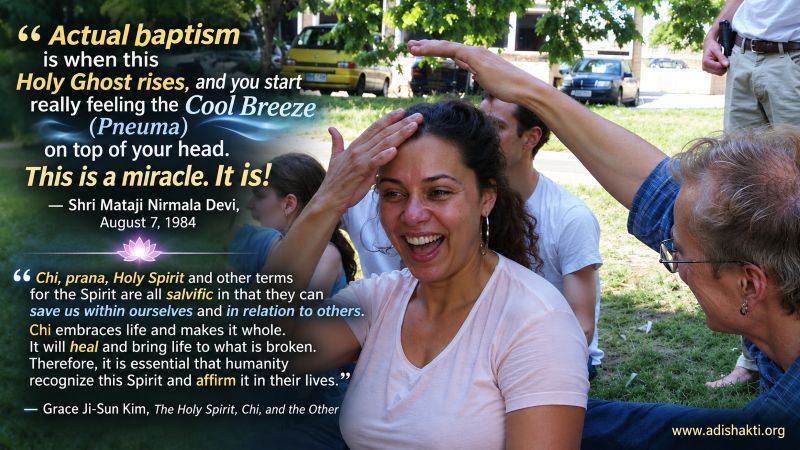
The Age of Qiyamah begins the Drive back to the Lord and grants the means to achieve the final evolution by first undertaking a spiritual cleansing on Earth with the help of the Kundalini, a built-in Divine power which the Qur’an calls the Baptism of Allah (Ṣibghat Allāh):
“The Baptism of Allah; and who can baptise better than Allah? And it is He whom we worship.”
This self-triggered evolution, which Lord Jesus refers to as being born of the Spirit, is an absolute absolution for humans to enter His Kingdom. The Baptism of Allah for Muslims is the same “second birth” for Christians; the same dwija or “twice born” for Hindus; the same “opening of the Dsam Duar” for Sikhs; the same Self-Realization, Satori, gnosticism, and fanā of advanced spiritual seekers. These seemingly different paths are all one and the same, with no difference whatsoever as far as the pursuit of the Spirit is concerned. [25]
The Resurrection is an inner spiritual awakening, not a future physical event. The Paraclete, the Spirit of truth, inaugurated the “Age to Come” on May 5, 1970, by opening the Sahasrara. As stated in John 7:39, the Spirit could not be given until Jesus was glorified. This glorification was accomplished exclusively by the Paraclete (Shri Mataji Nirmala Devi) over four decades of global ministry. She has delivered the experiential reality of the Holy Spirit, felt as the Cool Breeze, which is the definitive proof of being born again.
Orthodox theologians and clergy have failed to deliver this experiential reality, leaving their followers unprepared for the true Qiyamah. External affiliation, inherited identity, and delayed piety are shown to be insufficient when the soul is already departing. The surah’s insistence is that sincerity, worship, and truthfulness matter in this life because the next moment may arrive without warning.
8. Surah Al-Qadr and the Night of Power
Muslims have been falsely misled to believe that Ramadan is better than a thousand months since the Qur’an was revealed during that period. But the Qur’an is explicit: it is the Night of Power and Fate (Laylat al-Qadr) that is better than a thousand months:
“The night of perfect measure is better than a thousand months. The Angels and the Holy Spirit descend in that night with the permission of their Lord on every errand: with peace until the rise of dawn.”
This is the Night of Power and Fate, upheld to be better than a thousand months of Ramadan. Or is the participation in Al-Qiyamah during Al-Qadr, the Night of Power and Fate, better than a thousand months of Ramadan? Isn’t Al-Qadr, the Night of Power and Fate, better than a thousand years of Islam? [27]
Be forewarned, Deniers of the Resurrection, be forewarned! All their prayers and fasting will come to nil for they did not believe the Great Event of Al-Qiyamah, the Night of Power and Fate. The Angels and the Holy Spirit descend in that night with the permission of their Lord on every errand. Those who reject the Announcement of this Night, those who dismiss the descent of the Holy Spirit as mythology, will face the full weight of their rejection at the deathbed.
9. The Condemned and the Conditioned
The surah’s language refuses any illusion of neutrality at the end of life. The dying person does not become anonymous or absorbed into nothingness; rather, the person is being taken toward the Lord. This is crucial, because the verse joins death to accountability rather than treating death as mere biological cessation. The Qur’anic image therefore corrects any worldview in which death is final oblivion or in which human beings remain morally unaccountable after earthly life.
The phrase “to your Lord that Day will be the procession” (ilā rabbika yawma-idhin l-masāq) is especially important. Ibn Kathir and later commentators understand it as a forceful declaration that every person ultimately belongs to God’s domain and cannot evade divine claim. The “driving” imagery suggests inevitability, not violence for its own sake. In theological terms, the verse teaches ownership, return, and judgment: life begins with God and ends in His presence. [28]
This is why the text can be read as a warning against religious self-confidence. External affiliation, inherited identity, and delayed piety are shown to be insufficient when the soul is already departing. The surah’s insistence is that sincerity, worship, and truthfulness matter in this life because the next moment may arrive without warning. That is the existential urgency of the passage.
From an academic perspective, Surah 75:26–30 is a compact example of Qur’anic eschatological rhetoric. It uses bodily imagery, relational breakdown, and auditory interruption to create a scene in which the reader experiences the closing of all exits. Theologically, it binds anthropology to eschatology: what human beings are determines how they die, and how they die reflects the life they have chosen. The passage thus resists reduction to a merely “future” event; it is a present ethical critique embedded in eschatological speech.
10. Conclusion
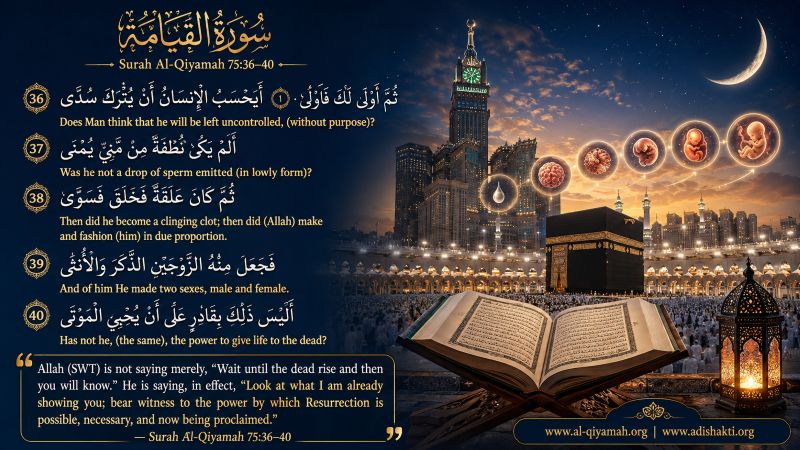
The closing verses of Surah 75 reinforce the paper’s final emphasis on accountability, purpose, and return to God.
Surah Al-Qiyamah 75:26–30 portrays death as the moment when human illusion ends and divine reality becomes unavoidable. Classical tafsir, especially Ibn Kathir, reads these verses as a warning to prepare through faith and righteous action before death makes repentance impossible. Modern commentaries preserve this core meaning while emphasizing the text’s moral urgency and existential force. The passage’s final movement to the Lord is therefore not only an eschatological statement but also a call to live now in awareness of what will come.
It is a severe warning to those who reject Allah’s Signs and the call to participate in the Resurrection. True repentance and spiritual awakening must occur during one’s lifetime through the Baptism of Allah. The passage’s final movement to the Lord is not only an eschatological statement but also a profound call to live now in constant awareness of the divine presence, experiencing the inner Resurrection before the physical body reaches its inevitable end.
Be forewarned of your impending penalty, rejecters of Allah’s Signs, be forewarned of your impending penalty in the Eternal Fire for deliberately refusing to profit from God, Most Gracious, Most Merciful, Most Beneficent!
References
- [1] “Surah Al-Qiyamah — Full Text and Translation.” Quran.com.
- [2] “Those Who Reject The Good News.” Adishakti.org.
- [3] “Towards Understanding the Qur’an — Surah Al-Qiyamah.” Islamicstudies.info.
- [4] Abdullah Yusuf Ali. “The Holy Qur’an, Surah 75:26.” Amana Corporation, 1989.
- [5] Ibn Kathir. “Tafsir of Surah Al-Qiyamah 75:26.” Alim.org.
- [6] Abdullah Yusuf Ali. “The Holy Qur’an, Surah 75:27.” Amana Corporation, 1989.
- [7] Sayyid Abul Ala Maududi. “Towards Understanding the Qur’an — Surah 75:26–30.” Islamicstudies.info.
- [8] Abdullah Yusuf Ali. “The Holy Qur’an, Surah 75:28.” Amana Corporation, 1989.
- [9] “Tafsir of Surah Al-Qiyamah 75:26 by Tazkirul Qur’an.” Quran.com.
- [10] Abdullah Yusuf Ali. “The Holy Qur’an, Surah 75:29.” Amana Corporation, 1989.
- [11] Ibn Kathir. “Tafsir of Surah Al-Qiyamah 75:29 — Ibn Abbas on the Two Shanks.” Alim.org.
- [12] Sayyid Abul Ala Maududi. “Towards Understanding the Qur’an — Commentary on 75:29.” Islamicstudies.info.
- [13] Abdullah Yusuf Ali. “The Holy Qur’an, Surah 75:30.” Amana Corporation, 1989.
- [14] Ibn Kathir. “The Tafsir of Surat Al-Qiyamah.” AbdurRahman.org, 2014.
- [15] Ibn Kathir. “Tafsir of Surah Al-Qiyamah — Opening Commentary.” Alim.org.
- [16] “Tafsir of Surah Al-Qiyamah 75:26–30 by Ma’arif al-Qur’an.” Quran.com.
- [17] Ibn Kathir. “Tafsir of Surah Al-Qiyamah 75:31–33 — Mentioning the Case of the Denier.” Alim.org.
- [18] “Those Who Reject The Good News.” Adishakti.org.
- [19] “Those Who Reject The Good News.” Adishakti.org.
- [20] Abdullah Yusuf Ali, cited in “Those Who Reject The Good News.” Adishakti.org.
- [21] “Tafsir of Surah Al-Waqi’ah 56:83–87 by Ma’arif al-Qur’an.” Quran.com.
- [22] “Surah An-Nisa 4:18 — Repentance Not Accepted at Death.” Quran.com.
- [23] “Surah Al-An’am 6:61–62 — Angels of Death.” Quran.com.
- [24] Abdullah Yusuf Ali. “The Holy Qur’an, Surah Al-Baqarah 2:138.” Amana Corporation, 1989.
- [25] “The Baptism of Allah: An Esoteric Interpretation of Surah 2:138.” Adishakti.org.
- [26] Abdullah Yusuf Ali. “The Holy Qur’an, Surah Al-Qadr 97:3–5.” Amana Corporation, 1989.
- [27] “Those Who Reject The Good News — Al-Qadr and Ramadan.” Adishakti.org.
- [28] “Tafsir of Surah Al-Qiyamah 75:30 by Ma’arif al-Qur’an.” Quran.com.
Compilation, Proclamation, and Exegesis of Surahs Upholding Allah’s (SWT) Command to His Ummah — to Witness and Participate in the Resurrection.
Al-Qiyamah: A Profound Declaration of Al-QiyamahAl-Qiyamah (75:1-2): Oaths of Resurrection
Al-Qiyamah (75:3-4): Reassembling Bones and Fingertips
Al-Qiyamah (75:5-6): Man's Denial of Resurrection
Al-Qiyamah (75:7–10): Sun and Moon 'Joined' At Solar Eclipse
Al-Qiyamah (75:7–10): Solar Eclipse Salat al-Kusuf
Al-Qiyamah (75:11–13): No Refuge, Only Reckoning
Al-Qiyamah (75:14–15): Man: His Own Witness and Judge
Al-Qiyamah (75:16–19): The Usurpation of Allah's Explanation
Al-Qiyamah (75:20–21): Love of The Fleeting World
Al-Qiyamah (75:22–25): Ruh’s Face Brings Either Glory Or Gloom
Al-Qiyamah (75:26–30): Death and Soul's Departure Home
Al-Qiyamah (75:31–35): The Rejection and Arrogance of the Kuffar
Al-Qiyamah (75:36–40): Is Resurrection Beyond Allah, Your Creator?
Al-Qiyamah (75:1-2 and 78:1–5): An Naba and Oaths of Resurrection
Al-Baqarah (2:138): Baptism of Allah You Were Unaware Of
Al-Baqarah (2:174): Allah Will Not Address Muslims
Al-A'raf (7:16) – Iblis: I Will Lie In Wait and Overpower Them
Al-A'raf (7:146): Allah: I Will Turn Them Away From My Signs
Al-A'raf (7:146): Allah: So Even Though They See All The Signs
Al-Hijr (15:39) – Iblis: I Will Wake (Evil) Fair and Mislead Them
An-Nahl (16:2) – Allah (SWT) Sent Down Angels With His Ruh
Al-Isra (17:85): Muslims Given Little of Allah's (SWT) Ruh
Al-Isra (17:104): Children of Israel Gathered Again (in 1948)
Al-Isra (17:104): Shaykh Palazzi: Children of Israel
Al-Hajj (22:8) – Kitab Al-Munir You Were Unaware Of
Al-Rum (30:56) – The Day of Qiyamah You Were Unaware Of
Fatir (35:9) – Winds of Qiyamah You Were Unaware Of
Yassin (36:63-68) – This Is The Hell You Were Warned Of.
Sad (38:79) – Iblis Allowed to Mislead Muslims And He Did
Fussilat (41:20–21) – Your Hands Will Testify of Qiyamah
Fussilat (41:53) – We Will Show Our Signs Within Your Soul
Az-Zukhruf (43:61): Jesus, Sign of Hour You Were Unaware
Az-Zukhruf (43:62): Satan's Deception of the Muslim Ummah
Az-Jathiya (45:7-14) – Those Who Deny Allah's Revelations
Qaf (50:20–21) – Hidden Imam Mahdi You Were Unaware
Qaf (50:41) – Listen To The Caller Emerging From Within
Qaf (50:42) – Day They Will Hear of Mighty Blast Witnessed
Qaf (50:45) – By the Caller, My Warning Is Delivered
Al Dhariyat (51:20-22) – Our Signs on Earth and Within
Al-Hadid (57:25) – Allah's (SWT) Iron Has Been Delivered
Al-Mujadilah (58:21) – My Messengers Must Prevail
Al-Saff (61:8–9) – Revelation of Light You Were Unaware
Al-Muddaththir (74:1–2) – My Cloaked One: Deliver Warning
Al-Mursalat (77:1–10): Angels Sent You Were Unaware Of
An-Naba (78:1–5): Concerning What Are They Disputing?
Al-Infitar (82:17–18) – What Will Explain To You? What Will?
Al-Mutaffifin (83:1–6) – Dealers in Fraud You Were Unaware
Al-Tariq (86:1–3) – The Night Visitant You Were Unaware
Al-Qadr (97:1–5) – Blessed Night of Power and Fate Before:
Al-Qariah (101:1–11) – Terrifying Day of Noise and Clamour
عَمَّ يَتَسَاءَلُونَ - عَنِ النَّبَإِ الْعَظِيمِ - الَّذِي هُمْ فِيهِ مُخْتَلِفُونَ - كَلَّا سَيَعْلَمُونَ - ثُمَّ كَلَّا سَيَعْلَمُونَ
Concerning what are they disputing?
Concerning the Great News. [5889]
About which they cannot agree.
Verily, they shall soon (come to) know!
Verily, verily they shall soon (come to) know!
Surah 78:1-5 An-Naba (The Great News)
“5889. Great News: usually understood to mean the News or Message of the Resurrection.” Abdullah Yusuf Ali, The Holy Qur'n, Amana Corporation, 1989.💬 Interactive Chat
Access an intelligent analysis environment where you can explore texts, ask questions, and discover connections between ideas.
Open chat →