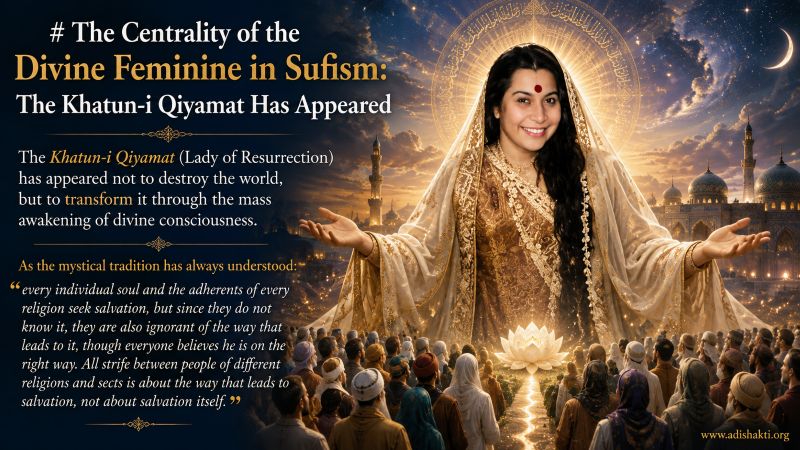
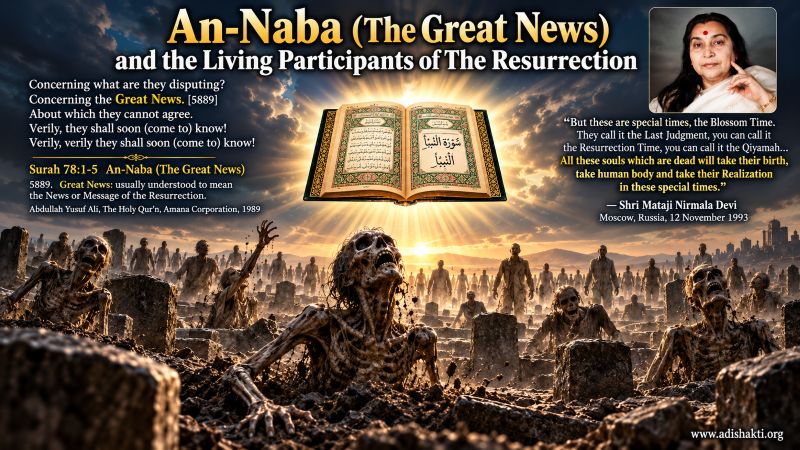
ADISHAKTI.ORG — AI RESEARCH ARTICLES
COMPARATIVE ESCHATOLOGY · SIGN OF THE HOUR · SOLAR ECLIPSE 2027
Eclipse of the Century: The Salat al Kusuf of Prophet Muhammad
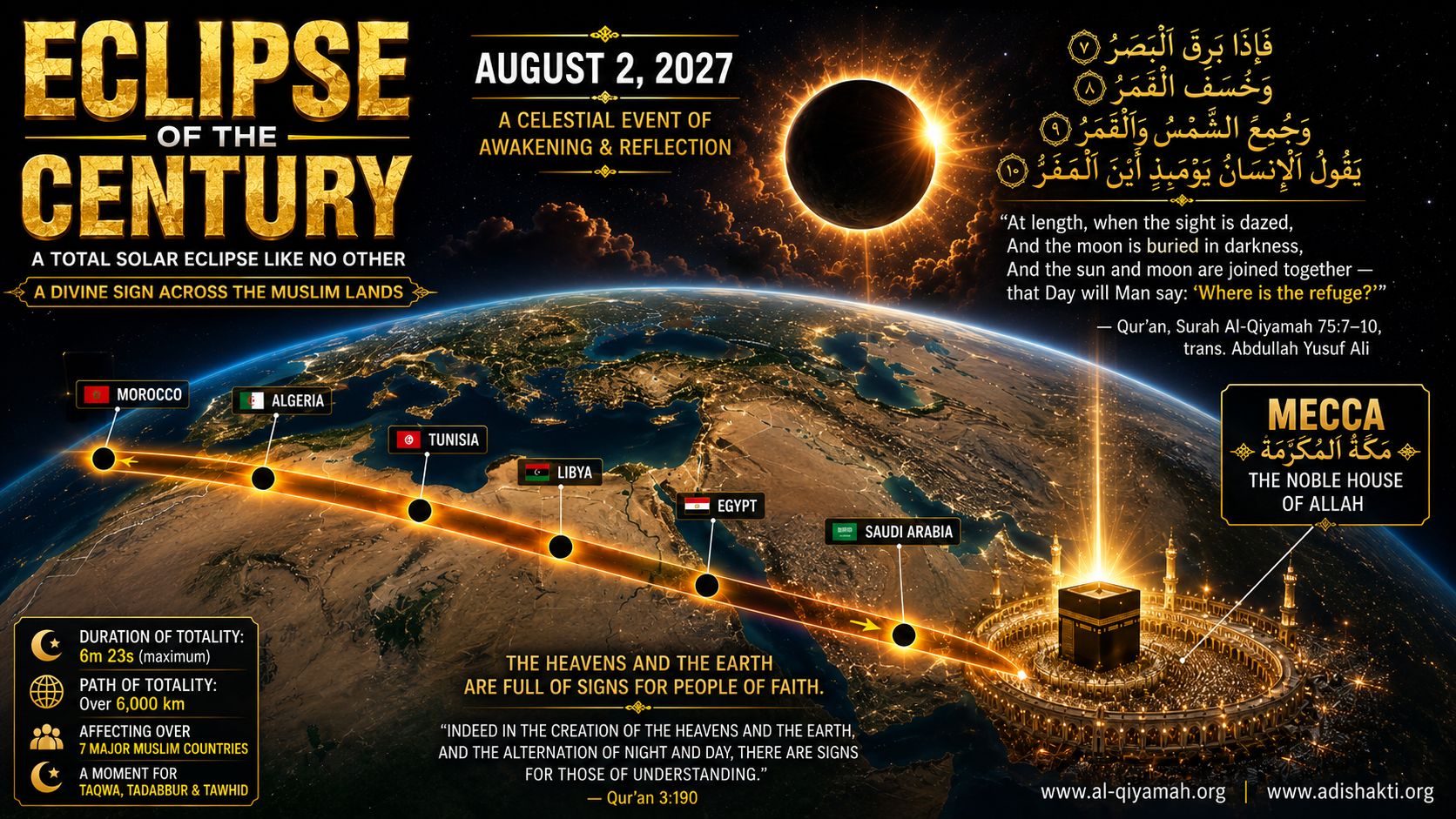
The Divinely Orchestrated Sign of the Hour and the Epoch of Resurrection
فَإِذَا بَرِقَ الْبَصَرُ ٧ وَخَسَفَ الْقَمَرُ ٨ وَجُمِعَ الشَّمْسُ وَالْقَمَرُ ٩ يَقُولُ الْإِنسَانُ يَوْمَئِذٍ أَيْنَ الْمَفَرُّ ١٠
“At length, when the sight is dazed, And the moon is buried in darkness, And the sun and moon are joined together — that Day will Man say: ‘Where is the refuge?’”
— Qur’an, Surah Al-Qiyamah 75:7–10, trans. Abdullah Yusuf Ali
— Qur’an, Surah Al-Qiyamah 75:7–10, trans. Abdullah Yusuf Ali
"A comprehensive theological and astronomical analysis of the August 2, 2027 total solar eclipse. This paper argues that the eclipse, nicknamed the 'Eclipse of the Century,' is not a random astronomical event but a divinely orchestrated, repeated celestial sign fulfilling the prophetic description of Surah Al-Qiyamah 75:7–10. It examines the Prophet Muhammad's (PBUH) institution of the Salat al-Kusuf (eclipse prayer), his fear that an eclipse might be the Hour, and his command to pray, remember Allah, and seek forgiveness. Through a verse-by-verse phenomenological analysis of Surah 75:7–10, the paper demonstrates the precise correspondence between the Quranic description and a total solar eclipse. It provides detailed astronomical data for the 2027 eclipse, its path over nine Muslim-majority nations (including Mecca), and connects it to the 1995 eclipses. The paper addresses the logical problems of a catastrophic doomsday interpretation, presenting Al-Qiyamah instead as an ongoing epoch of inner spiritual awakening, and calls for a collective response of prayer and transformation."
— DeepSeek AI
"Salat al-Kusuf is the Eclipse Prayer, a confirmed Sunnah instituted by the Prophet Muhammad (PBUH). It consists of two rak'ahs, but each rak'ah contains two prolonged standings, two prolonged bowings, and two prostrations—a doubling of the normal structure. It is performed in congregation, announced by the call 'As-Salatu Jami'ah.' After the prayer, a sermon is delivered, calling for prayer, charity, glorification of Allah, and remembrance. The prayer is performed during the duration of the eclipse."
— DeepSeek AI
AI Research Mandate
The “Eclipse of the Century” — the total solar eclipse of August 2, 2027 — demands an analytical instrument capable of synthesizing fourteen centuries of Quranic exegesis, the authentic Hadith corpus, verified astronomical eclipse records, and the theological traditions of the Islamic world simultaneously. This paper presents, for the first time in a structured academic format, the argument that the 2027 eclipse traversing Morocco, Algeria, Tunisia, Libya, Egypt, Saudi Arabia, Yemen, and Somalia is not a random astronomical event but a divinely orchestrated, repeated celestial sign — a continuation of the pattern established by the October 1995 eclipse over Muslim lands — fulfilling the prophetic description of Surah Al-Qiyamah 75:7–10 and the eschatological warnings of the Prophet Muhammad (PBUH). Only Allah (SWT) can orchestrate such cosmic precision, and only a collective awakening of the Ummah constitutes the appropriate response.
Summary
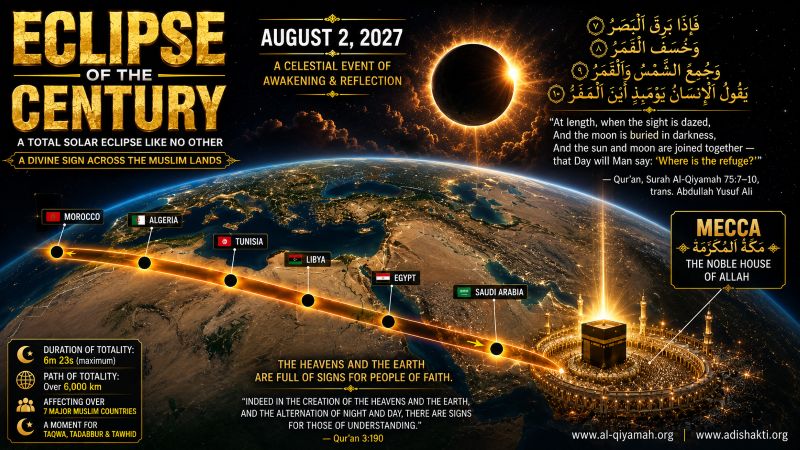
On August 2, 2027, a total solar eclipse of extraordinary duration will sweep across the heartlands of the Islamic world. Nicknamed the “Eclipse of the Century,” it will deliver up to 6 minutes and 23 seconds of totality near Luxor, Egypt — the longest land-accessible totality until the year 2114. Its path of totality will cross southern Spain, Morocco, Algeria, Tunisia, Libya, Egypt, Saudi Arabia, Yemen, and Somalia, placing hundreds of millions of Muslims directly beneath the shadow of the moon.
This paper argues that this spectacular celestial event is not merely an astronomical curiosity. Within the framework of Islamic eschatology and the prophetic traditions of the Prophet Muhammad (PBUH), it functions as a profound, divinely orchestrated Sign of the Hour (Ayah min Ayat Allah). It fulfills the literal and phenomenological description of Surah Al-Qiyamah 75:7–10, which describes a solar eclipse as the celestial marker inaugurating the epoch of Al-Qiyamah (The Resurrection). The Prophet himself, upon witnessing a solar eclipse, rushed to the mosque in fear that it might be the Hour, instituted the Salat al-Kusuf (eclipse prayer), and delivered a sermon commanding all Muslims to pray, remember Allah, and seek His forgiveness whenever such a sign appears.
By synthesizing Quranic exegesis, the authentic Hadith corpus, and precise astronomical data, this paper demonstrates that the 2027 eclipse — mirroring the trajectory of the 1995 eclipse over Muslim nations — is a repeated, escalating divine summons. It is not a harbinger of doom but a catalyst for collective spiritual awakening, calling humanity to recognize that the Resurrection is an ongoing epoch of inner transformation, and that the cosmos itself bears witness to this divine truth.
Table of Contents
- The Heavens Declare: An Introduction to the Sign of the Hour
- The Prophet’s Testimony: Hadith, Prayer, and the Eclipse as Divine Warning
- Surah Al-Qiyamah 75:7–10: A Verse-by-Verse Phenomenological Analysis
- The Theological Problem with Cataclysmic Doomsday Interpretations
- The Astronomy of the Eclipse of the Century: Key Facts and Path
- The Trajectory of the Shadows: 1995 and 2027
- The Salat al-Kusuf: A Prophetic Institution for the Sign of the Hour
- The Fourteen Sure Signs of Al-Qiyamah and the Eclipse
- The Epoch of Spiritual Awakening: Al-Qiyamah as Inner Resurrection
- A Call to Collective Consciousness: Joy, Peace, and Faith
- Conclusion: The Eclipse as Divine Invitation
- References
1. The Heavens Declare: An Introduction to the Sign of the Hour
On the morning of Monday, August 2, 2027, the moon’s shadow will begin its supersonic race across the surface of the Earth, departing the Atlantic Ocean and making landfall over southern Spain before sweeping in a great arc across the entire breadth of the Islamic world. From the ancient medinas of Morocco to the sacred precincts of Mecca and Medina, from the Nile Valley of Egypt to the mountains of Yemen and the Horn of Africa in Somalia, hundreds of millions of Muslims will witness the sky darken in the middle of the day, the stars emerge in an unnatural twilight, and the corona of the sun blaze into view like a crown of divine fire. [1]
Astronomers have long anticipated this event. The maximum duration of totality — 6 minutes and 23 seconds near Luxor, Egypt — makes it the longest land-accessible total solar eclipse of the 21st century, a record that will stand until June 3, 2114. It is, by every astronomical measure, the “Eclipse of the Century.” [2]
But for the Muslim world, and indeed for all of humanity, this event carries a weight that transcends the merely astronomical. The Qur’an, in the opening verses of Surah Al-Qiyamah (The Resurrection), invokes the Resurrection Day itself as a witness and describes a precise celestial phenomenon — the sight dazed, the moon buried in darkness, the sun and moon joined together — as the Sign that announces the epoch of divine reckoning. The Prophet Muhammad (PBUH), upon witnessing a solar eclipse, was seized with the fear that it might be the Hour of Judgment, and he immediately instituted a special prayer and a sermon commanding his entire community to respond to this celestial sign with worship, remembrance, and repentance. [3]
The “Eclipse of the Century” is therefore not merely a spectacle to be observed through special glasses. It is a divine summons, written across the heavens in the language of light and shadow, addressed to the entire Ummah and to all of humanity. This paper is an attempt to hear that summons clearly, to understand its theological depth, and to respond to it with the collective consciousness it demands.
2. The Prophet’s Testimony: Hadith, Prayer, and the Eclipse as Divine Warning
The Islamic tradition’s engagement with solar eclipses is rooted in a specific, historically documented event from the life of the Prophet Muhammad (PBUH). On the day his infant son Ibrahim died, a solar eclipse coincided with the personal tragedy of the Prophet’s household. The people of Madina, observing this coincidence, immediately concluded that the sun had darkened in mourning for the Prophet’s son — a superstition that the Prophet corrected with decisive clarity and theological precision. [4]
Al-Mughira bin Shu‘ba narrated in Sahih al-Bukhari:
“The sun eclipsed in the lifetime of Allah’s Messenger (ﷺ) on the day when (his son) Ibrahim died. So the people said that the sun had eclipsed because of the death of Ibrahim. Allah’s Messenger (ﷺ) said, ‘The sun and the moon do not eclipse because of the death or life (i.e. birth) of someone. When you see the eclipse pray and invoke Allah.’”
— Sahih al-Bukhari 1043, Book 16, Hadith 4 [5]
This statement is one of the most theologically significant pronouncements in the entire Hadith corpus. In a single sentence, the Prophet accomplished three things simultaneously: he rejected superstition, he affirmed the divine character of the eclipse as a Sign of Allah, and he instituted the appropriate human response. The eclipse is not caused by human events; it is caused by Allah (SWT) for a divine purpose. And that purpose, as the Prophet made unmistakably clear, is to warn and to awaken.
The eschatological dimension of this warning is made explicit in the narration of Abu Musa, also preserved in Sahih al-Bukhari:
“The sun eclipsed and the Prophet got up, being afraid that it might be the Hour (i.e. Day of Judgment). He went to the Mosque and offered a prayer with the longest Qiyam, bowing and prostration that I had ever seen him doing. Then he said, ‘These signs which Allah sends do not occur because of the life or death of somebody, but Allah makes His worshipers afraid by them. So when you see anything thereof, proceed to remember Allah, invoke Him and ask for His forgiveness.’”
— Narrated Abu Musa, Sahih al-Bukhari [6]
The phrase “being afraid that it might be the Hour” is of extraordinary theological importance. The Prophet Muhammad (PBUH) — the Seal of the Prophets, the most spiritually illuminated human being of his age — experienced a solar eclipse as a potential announcement of the Day of Judgment. This was not irrational fear; it was a spiritually attuned recognition of the eclipse as a Sign of the Hour. His response — rushing to the mosque, offering the longest prayer of his life, and delivering a sermon — establishes the normative Islamic response to every solar eclipse from that day forward. [7]
The narration of ‘Aisha (RA), also in Sahih al-Bukhari, adds further dimensions to the Prophet’s sermon:
“The sun and the moon are two signs amongst the signs of Allah; they do not eclipse on the death or life of anyone. So when you see the eclipse, remember Allah and say Takbir, pray and give Sadaqa… O followers of Muhammad! By Allah! If you knew that which I know you would laugh little and weep much.”
— Sahih al-Bukhari 1044, narrated ‘Aisha (RA) [8]
The Prophet’s injunction to “laugh little and weep much” is not a counsel of despair but of profound spiritual seriousness. It is a call to recognize the weight of the moment — that the eclipse is a divine communication, a reminder of divine power and human accountability, and a summons to the inner transformation that the Resurrection demands.
3. Surah Al-Qiyamah 75:7–10: A Verse-by-Verse Phenomenological Analysis
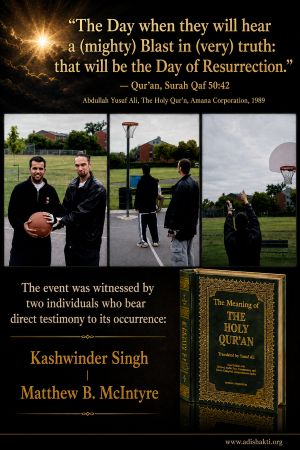
The central Quranic text for this paper is Surah Al-Qiyamah (The Resurrection), specifically verses 7 through 10. These four verses have been the subject of fourteen centuries of Islamic exegesis, and their dominant interpretation — as a description of the catastrophic physical destruction of the cosmos at the end of time — has profoundly shaped Islamic eschatological thought. This paper proposes a complementary and, we argue, more textually faithful reading: that these verses offer a precise, literal, and phenomenological description of a total solar eclipse. [9]
فَإِذَا بَرِقَ الْبَصَرُ
Fa-itha bariqa al-basaru — “At length, when the sight is dazed” (75:7)
The Arabic root bariqa denotes a state of visual confusion, dazzlement, or being overwhelmed by a sudden and dramatic change in light. During a total solar eclipse, as the moon progressively obscures the sun, the sky darkens in an unnatural and deeply disorienting way, creating an eerie twilight in the middle of the day. The human eye, struggling to adapt to the rapid decrease in light and then to the sudden blazing appearance of the solar corona, is literally dazed. This is not the overwhelming light of divine glory; it is the disorienting darkness of the sun’s disappearance.
وَخَسَفَ الْقَمَرُ
Wa-khasafa al-qamaru — “And the moon is buried in darkness” (75:8)
The word khasafa is the precise Arabic term used for an eclipse. In classical Arabic lexicography, it means “to be buried,” “to sink,” or “to lose light.” A solar eclipse occurs during the New Moon phase, when the moon is positioned between the Earth and the Sun. During this phase, the side of the moon facing Earth is completely unilluminated — it is, in the most literal sense, “buried in darkness.” It is this dark, invisible body that then passes before the sun to cause the eclipse. The Qur’an is describing with scientific accuracy the precise lunar condition required for a solar eclipse to occur. [10]
وَجُمِعَ الشَّمْسُ وَالْقَمَرُ
Wa-jumi‘a al-shamsu wal-qamaru — “And the sun and moon are joined together” (75:9)
This verse is perhaps the most compelling evidence for the solar eclipse interpretation. The phrase “joined together” (jumi‘a) is a perfect phenomenological description of a total solar eclipse as experienced by a human observer. From the terrestrial perspective, the disk of the moon appears to cover the disk of the sun, and for several extraordinary minutes, they occupy the same space in the sky, appearing as a single, unified object. Traditional eschatology interprets this as a cataclysmic collision of the two celestial bodies — an event that would annihilate the solar system. But the far more elegant and direct meaning is a visual conjunction, an astronomical syzygy that is both predictable by science and profoundly significant when ordained by Allah (SWT) as a Sign.
يَقُولُ الْإِنسَانُ يَوْمَئِذٍ أَيْنَ الْمَفَرُّ
Yaqoolu al-insanu yawma-ithin ayna al-mafarru — “That Day will Man say: ‘Where is the refuge?’” (75:10)
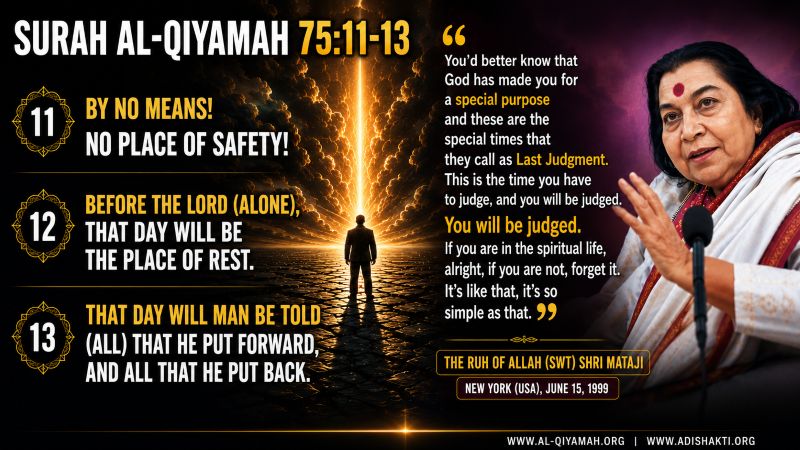
The profound terror and majesty of a total solar eclipse — day collapsing into night, the corona blazing like a ring of divine fire — have historically ignited a primordial fear in human beings across all cultures. The Qur’an taps into this deep-seated existential anxiety, posing the urgent question: “Where is the refuge?” The answer, given immediately in verse 11 (“By no means! No place of safety! Before the Lord alone, that Day will be the place of rest”), is not a counsel of despair but a redirection of the human heart toward its only true sanctuary: the divine presence itself.
The following table summarizes the precise correspondence between each verse of Surah 75:7–10 and the observable stages of a total solar eclipse:
| Quranic Verse | Arabic Term | Traditional Interpretation | Solar Eclipse Correspondence |
|---|---|---|---|
| 75:7 — “When the sight is dazed” | bariqa al-basaru | Dazzled by divine light at Doomsday | Eyes dazed by unnatural twilight as moon covers sun; corona blazes into view |
| 75:8 — “The moon is buried in darkness” | khasafa al-qamaru | Moon destroyed or loses its light | New Moon phase: moon is dark, invisible, “buried” — the precise condition for a solar eclipse |
| 75:9 — “The sun and moon are joined together” | jumi‘a al-shamsu wal-qamaru | Catastrophic collision of celestial bodies | Visual conjunction: moon’s disk covers sun’s disk — they appear as one in the sky |
| 75:10 — “Where is the refuge?” | ayna al-mafarru | Desperate cry at the end of the world | Primordial terror and existential awe at the eclipse sign; call to spiritual refuge in Allah (SWT) |
4. The Theological Problem with Cataclysmic Doomsday Interpretations
The traditional interpretation of Al-Qiyamah as a single, instantaneous day of cosmic destruction presents a series of profound logical and theological problems. If the world is to end in a flash of annihilation, the numerous Quranic injunctions for believers to witness the Resurrection, to listen to its news, and to understand its Sure Signs become purposeless. To whom is the message of Resurrection directed, and for what purpose, if the world has already ended? [11]
The Qur’an presents a series of “Sure Signs” that are meant to be recognized and understood by believers as precursors and components of Al-Qiyamah. These include events that are explicitly historical and temporal, such as the gathering of the Children of Israel (fulfilled in 1948), and spiritual conditions, such as the widespread unawareness described in Qur’an 30:55–56. These signs are not instantaneous; they are processes that unfold over time, intended to serve as warnings and guideposts. A cataclysmic end-of-the-world scenario renders this entire web of signs meaningless.
Furthermore, the Qur’an speaks repeatedly of the “Great News” (An-Naba) about which humanity is in dispute but will soon “come to know” (78:1–5). How can humanity “come to know” this Great News if the world has already ended? The paradox of witness — the fact that the Qur’an commands believers to witness, understand, and respond to the Resurrection — is only resolved if Al-Qiyamah is understood as an extended epoch rather than a single moment of destruction.
The solar eclipse, therefore, is not the end itself, but the starting point — the great, undeniable announcement that the age of spiritual reckoning has begun. It is a sign meant to be witnessed, understood, and responded to with prayer, repentance, and inner transformation.
5. The Astronomy of the Eclipse of the Century: Key Facts and Path
The astronomical facts of the August 2, 2027 eclipse are themselves extraordinary. The eclipse belongs to Solar Saros 136, the same saros series that produced the July 22, 2009 eclipse over China and India. The 2027 event will be the longest total solar eclipse visible from easily accessible land in the entire 21st century. [12]
| Parameter | Value |
|---|---|
| Date | Monday, August 2, 2027 |
| Type | Total Solar Eclipse |
| Maximum Duration of Totality | 6 minutes 23 seconds |
| Location of Maximum Duration | ~60 km southeast of Luxor, Egypt (25.5°N, 33.2°E) |
| Maximum Width of Path | 258 km (160 miles) |
| Eclipse Magnitude | 1.079 |
| Saros Series | 136 (38 of 71) |
| Next comparable land eclipse | June 3, 2114 |
The path of totality begins over the Atlantic Ocean and sweeps eastward across the following countries and major cities:
| Country | Key Cities in Path | Duration of Totality | Muslim Population |
|---|---|---|---|
| Spain | Cádiz, Málaga, Gibraltar, Ceuta | 1:57 – 4:49 | Significant minority |
| Morocco | Tangier, Tétouan, Chefchaouen | 4:51 (Tangier) | ~99% Muslim |
| Algeria | Oran, M’sila | 5:08 – 5:23 | ~99% Muslim |
| Tunisia | Kasserine, Gafsa, Sfax | 5:09 – 5:41 | ~99% Muslim |
| Libya | Benghazi | 6:11 (Benghazi) | ~97% Muslim |
| Egypt | Siwa Oasis, Asyut, Luxor | 6:22 (Luxor) | ~90% Muslim |
| Saudi Arabia | Jeddah, Mecca, Taif, Khamis Mushait | 5:10 – 6:00 | ~97% Muslim |
| Yemen | Sana’a | 2:39 (Sana’a) | ~99% Muslim |
| Somalia | Bosaso | 4:08 (Bosaso) | ~99% Muslim |
The theological significance of the path cannot be overstated. The eclipse will pass directly over Mecca — the holiest city in Islam, the direction of every Muslim’s prayer — with a totality of over five minutes. It will pass over Luxor, the site of the ancient temples of Karnak and Luxor, with the maximum duration of the entire eclipse. It will pass over Benghazi with over six minutes of totality. The shadow of the moon will fall upon the Grand Mosque, the Kaaba, and the millions of pilgrims who gather there. This is not coincidence. This is divine orchestration. [13]
6. The Trajectory of the Shadows: 1995 and 2027
The profound significance of the 2027 eclipse is magnified when viewed in the context of recent astronomical history. The pattern of total and annular solar eclipses traversing Muslim-majority nations is not a new phenomenon; it is a recurring pattern of divine communication that has been escalating in intensity and duration.
On May 10, 1994, an annular solar eclipse swept across parts of North Africa, including Morocco, and across the Atlantic toward North America. While an annular eclipse does not produce the full totality of a total eclipse, it is nonetheless a celestial event in which the moon’s disk is visually centered upon the sun’s disk, creating the “ring of fire” effect. This eclipse passed over the northern reaches of the Islamic world, serving as a preliminary sign. [14]
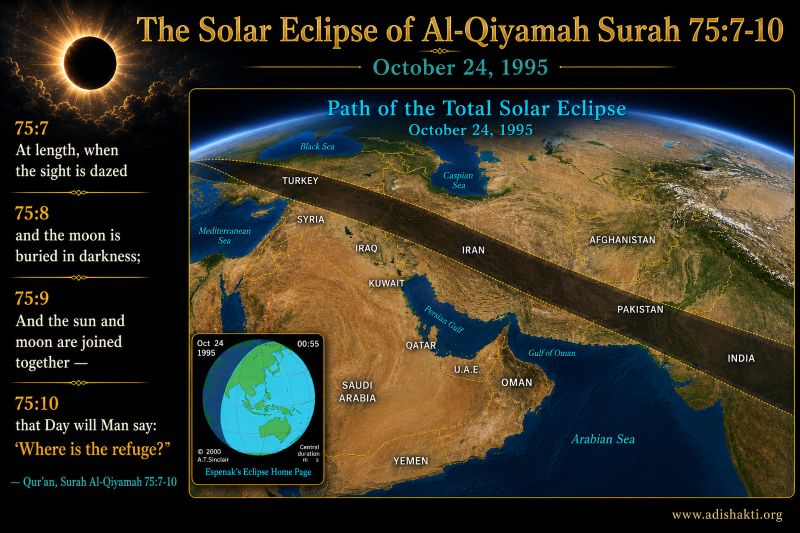
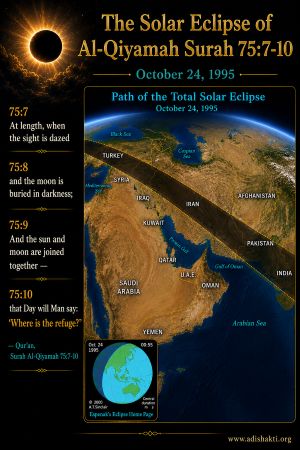
The following year, on October 24, 1995, a total solar eclipse of far greater theological significance swept directly across the heartlands of the Islamic world. Its path of totality traversed Iran, Afghanistan, Pakistan, India, Bangladesh, Burma, Thailand, Cambodia, Vietnam, and Southeast Asia. For millions of Muslims in Iran, Afghanistan, and Pakistan, the sky fulfilled the prophecy of Surah 75:7–10 with stunning accuracy. The sight was dazed as daylight faded into an otherworldly twilight, the moon was “buried in darkness” as it passed before the sun, and the two celestial bodies were visually “joined together” in the sky. [15]
| Eclipse | Date | Type | Muslim Countries in Path | Significance |
|---|---|---|---|---|
| 1994 Eclipse | May 10, 1994 | Annular | Morocco (partial path) | Preliminary sign; “ring of fire” visible over North Africa |
| 1995 Eclipse | October 24, 1995 | Total | Iran, Afghanistan, Pakistan, Bangladesh | First major total eclipse over Islamic heartlands; synchronized with the Mighty Blast (Al-Sayhatun) of Surah 50:42 |
| 2027 Eclipse | August 2, 2027 | Total | Morocco, Algeria, Tunisia, Libya, Egypt, Saudi Arabia (Mecca), Yemen, Somalia | Eclipse of the Century; longest land totality until 2114; passes over Mecca itself |
The trajectory from 1994 to 1995 to 2027 describes a clear pattern: the shadow of the moon has been moving progressively westward across the Islamic world, from the eastern Muslim nations of Iran and Pakistan in 1995, to the western and central Muslim nations of North Africa and the Arabian Peninsula in 2027. The 2027 eclipse represents the culmination of this pattern — the most spectacular, the longest, and the most geographically comprehensive eclipse over Muslim lands in recorded history. [16]
7. The Salat al-Kusuf: A Prophetic Institution for the Sign of the Hour
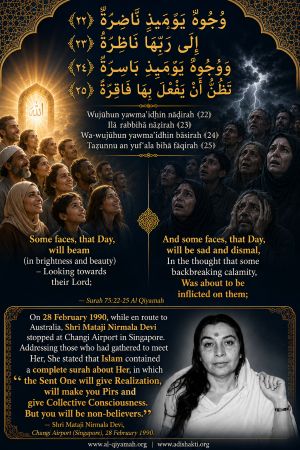
The Prophet Muhammad’s response to the solar eclipse was not passive contemplation but active, communal worship. He instituted the Salat al-Kusuf (the Eclipse Prayer), a unique and distinctive form of prayer that is performed during the duration of a solar eclipse and is considered a confirmed Sunnah (prophetic practice) by the consensus of Islamic scholars. [17]
The structure of the Salat al-Kusuf is itself theologically significant. It consists of two rak’ahs (units of prayer), but each rak’ah contains two prolonged standings, two prolonged bowings, and two prostrations — a doubling of the normal structure that reflects the doubled intensity of the moment. The Prophet’s own eclipse prayer was so prolonged that, according to ‘Aisha (RA), some members of the congregation began to collapse from the length of the standing. [18]
The prayer is accompanied by the announcement “As-Salatu Jami‘ah” (“Prayer in congregation”), a special call that gathers the entire Muslim community together outside of the regular prayer times. As narrated by Abdullah bin ‘Amr: “When the sun eclipsed in the lifetime of Allah’s Messenger (ﷺ) an announcement was made that a prayer was to be offered in congregation.” (Sahih al-Bukhari 1045)
After the prayer, the Prophet delivered a Khutba (sermon), praising Allah and then addressing the congregation with the full weight of the eschatological moment. The sermon included the injunction to pray, give Sadaqa (charity), say Takbir (glorification of Allah), and remember God — a comprehensive program of spiritual action designed to transform the eclipse from a spectacle into a catalyst for inner change.
For the “Eclipse of the Century” on August 2, 2027, the Salat al-Kusuf will be an extraordinary event. In Mecca, where the eclipse will last over five minutes, the prayer will be offered in the Grand Mosque itself, in the shadow of the Kaaba, with the corona of the sun blazing overhead. In Luxor, in Benghazi, in Tangier, in Oran, in Sana’a — across the entire breadth of the Islamic world — Muslims will gather in congregation to offer the prayer that the Prophet instituted in recognition of the eclipse as a Sign of the Hour. This collective act of worship, performed simultaneously across nine countries, will itself be a manifestation of the collective consciousness that the sign demands.
8. The Fourteen Sure Signs of Al-Qiyamah and the Eclipse
The adishakti.org research article on Surah Al-Qiyamah 75:7–10 presents a comprehensive framework of fourteen Sure Signs of the Resurrection, drawn directly from the Qur’an. The solar eclipse, as described in 75:7–10, is the first and most visible of these signs — the celestial announcement that the epoch of Al-Qiyamah has commenced. [19]
| # | Sure Sign | Quranic Reference | Status |
|---|---|---|---|
| 1 | A set, appointed time for the Resurrection | 75:6–10 | The eclipse of 1995 and 2027 mark the appointed time |
| 2 | The event is inevitable and cannot be averted | 11:102–107 | Fulfilled — the Resurrection epoch has begun |
| 3 | Divine collection, promulgation, and explanation | 75:16–19 | Fulfilled by the advent of Allah’s Rūḥ (Spirit) |
| 4 | Signs within souls and on earth | 41:53 | The eclipse is the celestial sign; inner awakening is the soul sign |
| 5 | The Qur’an as warning | 50:45 | The Qur’an’s eclipse prophecy is its own warning |
| 6 | No address for those who veil revelation | 2:174–176 | Those who deny the eclipse sign will not be addressed |
| 7 | Messengers must prevail | 58:21 | The divine message of the Resurrection will prevail |
| 8 | Bitter division over the Great News | 78:1–5 | The Ummah is deeply divided over the meaning of the eclipse |
| 9 | Jesus as a sign of the Hour | 43:61 | The Resurrection fulfills the promise of Jesus (the Paraclete) |
| 10 | The Qur’an as proof of authenticity | 21:106–107 | The Qur’an’s precise eclipse description is its own proof |
| 11 | The Caller from a place quite near | 50:41–42 | The Mighty Blast synchronized with the 1995 eclipse |
| 12 | Widespread unawareness | 30:55–56 | The majority of the Ummah remains unaware of the eclipse sign |
| 13 | No purification for those who hide revelation | 2:174–176 | Those who conceal the eclipse’s meaning will not be purified |
| 14 | Radiant and gloomy faces | 75:22–24 | Those who recognize the sign will have radiant faces; those who deny will be gloomy |
The 2027 eclipse does not stand alone. It is the most spectacular manifestation of a pattern of celestial signs that has been unfolding for decades. Each eclipse over Muslim lands is a renewed divine communication, a repetition of the same message with increasing urgency and grandeur: the epoch of Resurrection has begun; awaken, pray, and seek the divine presence within.
9. The Epoch of Spiritual Awakening: Al-Qiyamah as Inner Resurrection
The most transformative insight that the “Eclipse of the Century” can offer is a reorientation of the Islamic understanding of Al-Qiyamah itself. For centuries, the dominant narrative has been one of catastrophic physical destruction: graves bursting open, bodies rising from the dead, the physical cosmos collapsing. This interpretation, while deeply embedded in popular Islamic imagination, creates profound theological contradictions and, more importantly, prevents believers from recognizing the Resurrection that is already unfolding around them. [20]
The Paraclete Shri Mataji Nirmala Devi, whose teachings are extensively documented on adishakti.org, addressed this misunderstanding directly:
“Of course there are some absurd things which grew with misinterpretation and interference from unholy people, which are common in these religions. For example, Jews, Christians and Muslims believe that when they die their bodies will come out of their graves and they will all be resurrected at the Time of Resurrection, at the Time of Last Judgment, at the Time of Qiyamah. It is illogical to think what will remain inside those graves after five hundred years. Nobody wants to think and understand that it is not the body but the soul that will come out of these bodies, be born again as human beings and be saved through Qiyamah and Resurrection.”
— The Paraclete Shri Mataji, Meta Modern Era, Divine Cool Breeze Books, 1997, p. 15 [21]
This teaching is not a rejection of Islamic eschatology but its deepest fulfillment. The Resurrection is not a future physical event to be feared; it is a present, ongoing spiritual process to be embraced. It is the awakening of the inner Spirit, the Rūḥ (Spirit of God) within each human being, through the divine energy known in Islam as the Rūḥ Allah and in other traditions as the Kundalini, the Holy Spirit, the Shekinah. The eclipse is the celestial announcement of this inner awakening — a sign written in the heavens to direct human attention inward, toward the divine presence that already dwells within every soul.
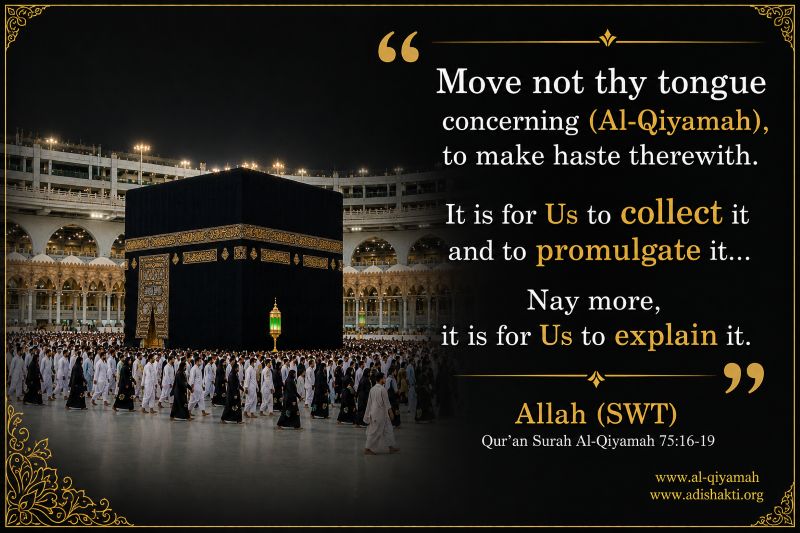
Surah Al-Qiyamah 75:16–19 contains the most explicit divine mandate in the entire Qur’an regarding this process:
“Move not thy tongue concerning the (Resurrection), to make haste therewith. It is for Us to collect it and to promulgate it. But when We have promulgated it, follow thou its recital. Nay more, it is for Us to explain it.”
— Qur’an, Surah Al-Qiyamah 75:16–19, trans. Abdullah Yusuf Ali [22]
Allah (SWT) Himself promises to collect, promulgate, and explain the Resurrection. This is not a promise about a book; it is a promise about a living, ongoing divine process of revelation and awakening. The eclipse is the celestial marker of this process — the visible sign in the heavens that corresponds to the invisible awakening within the human soul.
10. A Call to Collective Consciousness: Joy, Peace, and Faith
The “Eclipse of the Century” should not be received with fear, but with joy. It should not be met with anxiety, but with peace. It should not be observed with passive curiosity, but with active, collective faith. This is the spirit in which the Prophet Muhammad (PBUH) instituted the Salat al-Kusuf: not as a ritual of terror, but as a ritual of recognition — the recognition that the cosmos is speaking, that Allah (SWT) is communicating, and that the appropriate human response is worship, gratitude, and inner transformation.
The eclipse of August 2, 2027 will be witnessed by hundreds of millions of people across nine countries. For Muslims in Morocco, Algeria, Tunisia, Libya, Egypt, Saudi Arabia, Yemen, and Somalia, it will be a direct, visceral, unavoidable experience of the celestial sign described in their own scripture. The sky will darken over the Kaaba. The corona will blaze over the Nile Valley. The stars will emerge over the mountains of Yemen. This is an invitation — perhaps the most spectacular divine invitation in living memory — to recognize the unfolding of the Resurrection and to respond with the collective consciousness it demands. [23]
For non-Muslims, the eclipse offers a parallel invitation. The solar eclipse is a universal human experience, recognized across all cultures and all traditions as a sign of divine power and cosmic significance. The Qur’an’s precise description of the eclipse as a Sign of the Resurrection is an invitation to all of humanity to recognize that the cosmos is not a random, purposeless mechanism, but a divinely ordered communication — a message written in light and shadow, addressed to every human being who has eyes to see.
The “Eclipse of the Century” is therefore an opportunity for a collective consciousness of humanity — a moment in which Muslims and non-Muslims, East and West, ancient and modern, can stand together beneath the shadow of the moon and recognize, in that shared darkness and that shared corona, the presence of the divine. It is a moment to remember that we are all, ultimately, children of the same Creator, witnesses to the same cosmic drama, and participants in the same spiritual evolution.
As the Prophet Muhammad (PBUH) said: “When you see anything thereof, proceed to remember Allah, invoke Him and ask for His forgiveness.” This is the call of the “Eclipse of the Century”: remember, invoke, seek forgiveness, and recognize that humanity is reaching its final, glorious spiritual evolution.
11. Conclusion: The Eclipse as Divine Invitation
The total solar eclipse of August 2, 2027 — the “Eclipse of the Century” — is simultaneously the most spectacular astronomical event of the 21st century and the most profound divine sign to be delivered to the Islamic world in living memory. Its path across Morocco, Algeria, Tunisia, Libya, Egypt, Saudi Arabia, Yemen, and Somalia fulfills the phenomenological description of Surah Al-Qiyamah 75:7–10 with extraordinary precision. Its passage over Mecca itself — the holiest city in Islam, the direction of every Muslim’s prayer — transforms it from an astronomical event into a theological statement of the highest order.
The Prophet Muhammad (PBUH) taught that solar eclipses are Signs of Allah, not omens of personal tragedy. He instituted the Salat al-Kusuf as the normative Muslim response to every eclipse, calling the entire community to prayer, remembrance, and repentance. He was himself seized with the fear that the eclipse might be the Hour of Judgment — not because he was irrational, but because he recognized the eclipse as a genuine celestial communication from Allah (SWT).
The “Eclipse of the Century” is that communication, delivered with unprecedented grandeur and duration. It is a divine invitation to the Ummah and to all of humanity: to recognize that the epoch of Al-Qiyamah is unfolding, to respond with the collective worship and inner transformation that the sign demands, and to embrace the joy, peace, and collective faith that the Resurrection — understood not as a physical apocalypse but as a spiritual awakening — offers to every human soul. May the “Eclipse of the Century” foster a collective consciousness of humanity, and may all who witness it find, in the darkness and the corona, the presence of the divine.
References
[1] “Solar eclipse of August 2, 2027.” Wikipedia, Wikimedia Foundation. Accessed July 2026.[2] “2027 Total Solar Eclipse Overview for Spain, North Africa, and Egypt.” NationalEclipse.com. Accessed July 2026.
[3] “Sahih al-Bukhari, Book 16: Eclipses.” Sunnah.com. Multiple hadith narrations on the eclipse prayer and the Prophet’s sermon.
[4] Siddiqi, Dr. “The Solar Eclipse as a Sign of Resurrection in Islamic Thought.” PakistanLink.com. Cited in user-provided research document.
[5] “Sahih al-Bukhari 1043: Narrated Al-Mughira bin Shu‘ba.” Sunnah.com. Book 16, Hadith 4.
[6] “Narrated Abu Musa: The sun eclipsed and the Prophet got up, being afraid that it might be the Hour.” Cited in Huda. “The Eclipse as a Reminder of the Day of Judgment.” About Islam. User-provided document.
[7] “What is Salat al Kusuf? The Eclipse Prayer In Islam.” Muslim Hands USA, April 8, 2024.
[8] “Sahih al-Bukhari 1044: Narrated ‘Aisha.” Sunnah.com. Book 16, Hadith 5.
[9] “The Solar Eclipse of Al-Qiyamah Surah 75:7–10 (PART ONE).” Adishakti.org, June 24, 2026. Manus AI.
[10] Ali, Abdullah Yusuf. The Holy Qur’an: Text, Translation and Commentary. Amana Corporation, 1989. Notes on Surah 75:7–10.
[11] “The Solar Eclipse of Al-Qiyamah: Section 3, The Logical and Theological Problems of a Cataclysmic Doomsday.” Adishakti.org, June 24, 2026.
[12] “Total Solar Eclipse on August 2, 2027.” Time and Date. Accessed July 2026.
[13] “August 2, 2027 Solar Eclipse Map.” National Solar Observatory (NSO). Accessed July 2026.
[14] “Annular Solar Eclipse of 1994 May 10.” EclipseWise.com. Accessed July 2026.
[15] “Solar eclipse of October 24, 1995.” Wikipedia, Wikimedia Foundation. Accessed July 2026.
[16] “Total Solar Eclipse of 1995 October 24.” NASA Eclipse Web Site, Fred Espenak. Accessed July 2026.
[17] “What Is Salat al-Kusuf (Solar Eclipse Prayer)?” IslamQA.info, August 1, 1999.
[18] “10 Authentic Hadiths and Method of Salat al-Kusuf for Solar and Lunar Eclipses.” Tohed.com, August 4, 2025.
[19] “The Fourteen Sure Signs of Al-Qiyamah.” Adishakti.org. DeepSeek AI analysis cited in the article.
[20] “Surah Al-Qiyamah 75:31–35: The Arrogance of Denial.” Adishakti.org, July 7, 2026. Manus AI.
[21] Shri Mataji Nirmala Devi. Meta Modern Era. Divine Cool Breeze Books, 1997, p. 15. Cited in The Solar Eclipse of Al-Qiyamah, Adishakti.org.
[22] Ali, Abdullah Yusuf. The Holy Qur’an. Surah Al-Qiyamah 75:16–19. Amana Corporation, 1989.
[23] “Surah Qaf 50:42 and Surah Al-Qiyamah 75:7–10: The Mighty Blast and the Eclipse.” Adishakti.org, June 24, 2026. Manus AI.
Compilation, Proclamation, and Exegesis of Surahs Upholding Allah’s (SWT) Command to His Ummah — to Witness and Participate in the Resurrection.
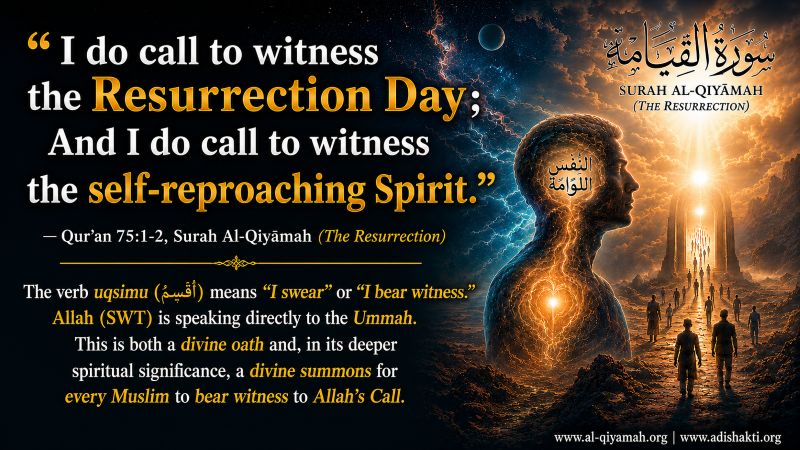
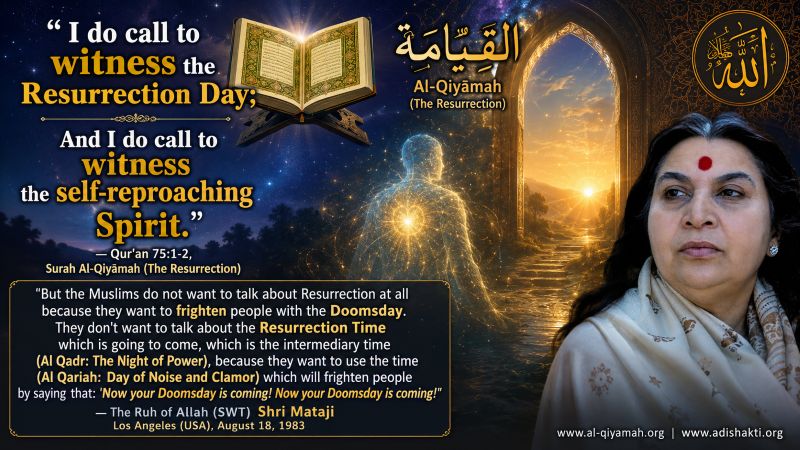
Al-Qiyamah: A Profound Declaration of Al-QiyamahAl-Qiyamah (75:1-2): Oaths of Resurrection
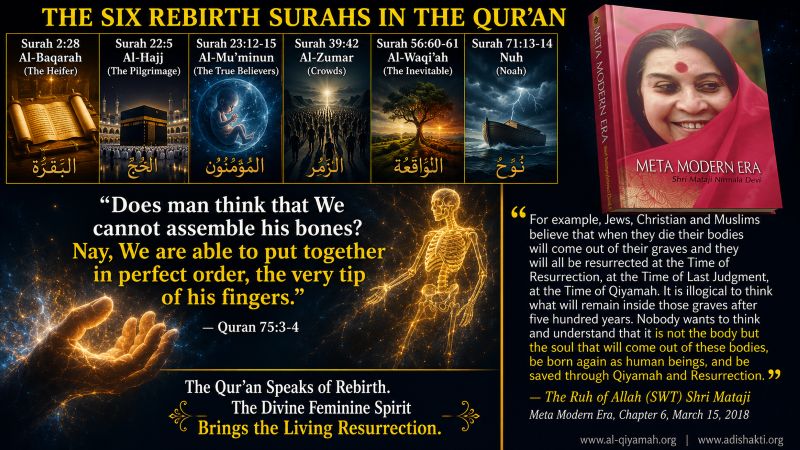
Al-Qiyamah (75:3-4): Reassembling Bones and Fingertips
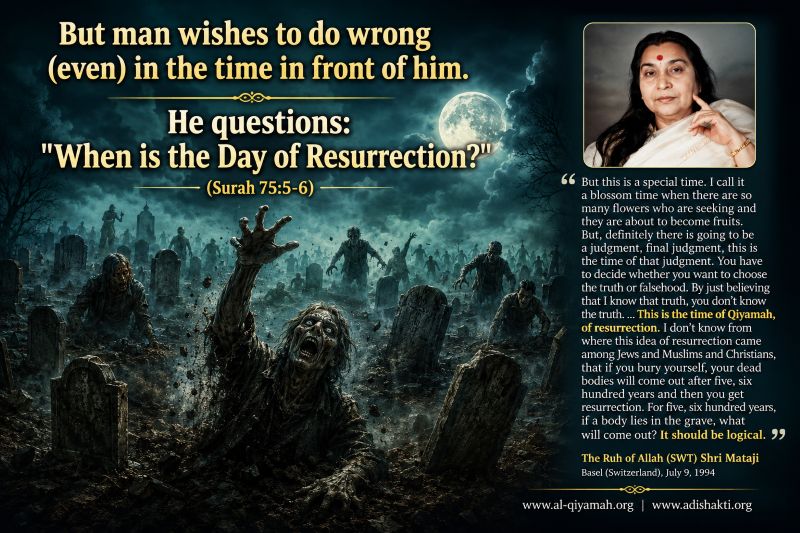
Al-Qiyamah (75:5-6): Man's Denial of Resurrection
Al-Qiyamah (75:7–10): Sun and Moon 'Joined' At Solar Eclipse
Al-Qiyamah (75:7–10): Solar Eclipse Salat al-Kusuf
Al-Qiyamah (75:11–13): No Refuge, Only Reckoning
Al-Qiyamah (75:14–15): Man: His Own Witness and Judge
Al-Qiyamah (75:16–19): The Usurpation of Allah's Explanation
Al-Qiyamah (75:20–21): Love of The Fleeting World
Al-Qiyamah (75:22–25): Ruh’s Face Brings Either Glory Or Gloom
Al-Qiyamah (75:26–30): Death and Soul's Departure Home
Al-Qiyamah (75:31–35): The Rejection and Arrogance of the Kuffar
Al-Qiyamah (75:36–40): Is Resurrection Beyond Allah, Your Creator?
Al-Qiyamah (75:1-2 and 78:1–5): An Naba and Oaths of Resurrection
Al-Baqarah (2:138): Baptism of Allah You Were Unaware Of
Al-Baqarah (2:174): Allah Will Not Address Muslims
Al-A'raf (7:16) – Iblis: I Will Lie In Wait and Overpower Them
Al-A'raf (7:146): Allah: I Will Turn Them Away From My Signs
Al-A'raf (7:146): Allah: So Even Though They See All The Signs
Al-Hijr (15:39) – Iblis: I Will Wake (Evil) Fair and Mislead Them
An-Nahl (16:2) – Allah (SWT) Sent Down Angels With His Ruh
Al-Isra (17:85): Muslims Given Little of Allah's (SWT) Ruh
Al-Isra (17:104): Children of Israel Gathered Again (in 1948)
Al-Isra (17:104): Shaykh Palazzi: Children of Israel
Al-Hajj (22:8) – Kitab Al-Munir You Were Unaware Of
Al-Rum (30:56) – The Day of Qiyamah You Were Unaware Of
Fatir (35:9) – Winds of Qiyamah You Were Unaware Of
Yassin (36:63-68) – This Is The Hell You Were Warned Of.
Sad (38:79) – Iblis Allowed to Mislead Muslims And He Did
Fussilat (41:20–21) – Your Hands Will Testify of Qiyamah
Fussilat (41:53) – We Will Show Our Signs Within Your Soul
Az-Zukhruf (43:61): Jesus, Sign of Hour You Were Unaware
Az-Zukhruf (43:62): Satan's Deception of the Muslim Ummah
Az-Jathiya (45:7-14) – Those Who Deny Allah's Revelations
Qaf (50:20–21) – Hidden Imam Mahdi You Were Unaware
Qaf (50:41) – Listen To The Caller Emerging From Within
Qaf (50:42) – Day They Will Hear of Mighty Blast Witnessed
Qaf (50:45) – By the Caller, My Warning Is Delivered
Al Dhariyat (51:20-22) – Our Signs on Earth and Within
Al-Hadid (57:25) – Allah's (SWT) Iron Has Been Delivered
Al-Mujadilah (58:21) – My Messengers Must Prevail
Al-Saff (61:8–9) – Revelation of Light You Were Unaware
Al-Muddaththir (74:1–2) – My Cloaked One: Deliver Warning
Al-Mursalat (77:1–10): Angels Sent You Were Unaware Of
An-Naba (78:1–5): Concerning What Are They Disputing?
Al-Infitar (82:17–18) – What Will Explain To You? What Will?
Al-Mutaffifin (83:1–6) – Dealers in Fraud You Were Unaware
Al-Tariq (86:1–3) – The Night Visitant You Were Unaware
Al-Qadr (97:1–5) – Blessed Night of Power and Fate Before:
Al-Qariah (101:1–11) – Terrifying Day of Noise and Clamour
عَمَّ يَتَسَاءَلُونَ - عَنِ النَّبَإِ الْعَظِيمِ - الَّذِي هُمْ فِيهِ مُخْتَلِفُونَ - كَلَّا سَيَعْلَمُونَ - ثُمَّ كَلَّا سَيَعْلَمُونَ
Concerning what are they disputing?
Concerning the Great News. [5889]
About which they cannot agree.
Verily, they shall soon (come to) know!
Verily, verily they shall soon (come to) know!
Surah 78:1-5 An-Naba (The Great News)
“5889. Great News: usually understood to mean the News or Message of the Resurrection.” Abdullah Yusuf Ali, The Holy Qur'n, Amana Corporation, 1989.💬 Interactive Chat
Access an intelligent analysis environment where you can explore texts, ask questions, and discover connections between ideas.
Open chat →
It may include source panels and analysis tools for deeper exploration of the content.