
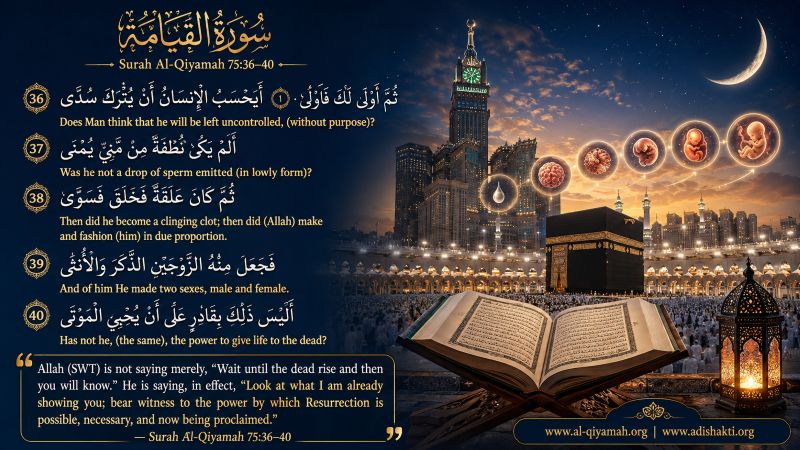


لَا أُقْسِمُ بِيَوْمِ الْقِيَامَةِ وَلَا أُقْسِمُ بِالنَّفْسِ اللَّوَّامَةِ
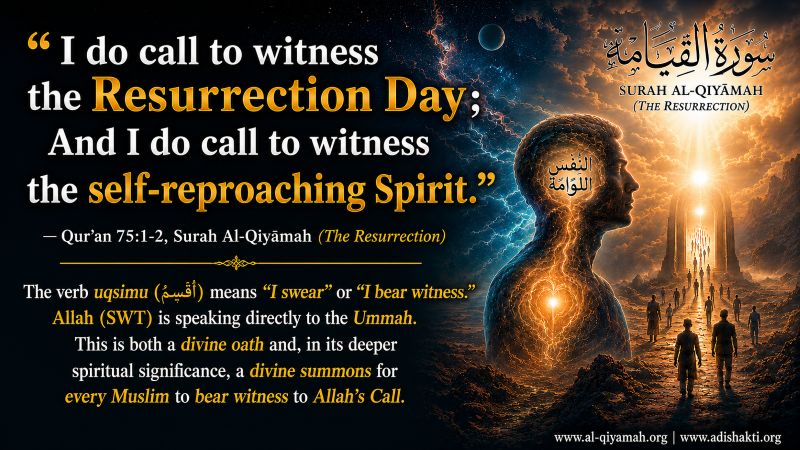
“I do call to witness the Resurrection Day; and I do call to witness the self-reproaching Spirit.” (Qur'an 75:1–2)
The Rūḥ from the Command of Allah (SWT): A Qur'an-Centered Reassessment of the Eschatological Rūḥ and the Public Ministry of Shri Mataji Nirmala Devi
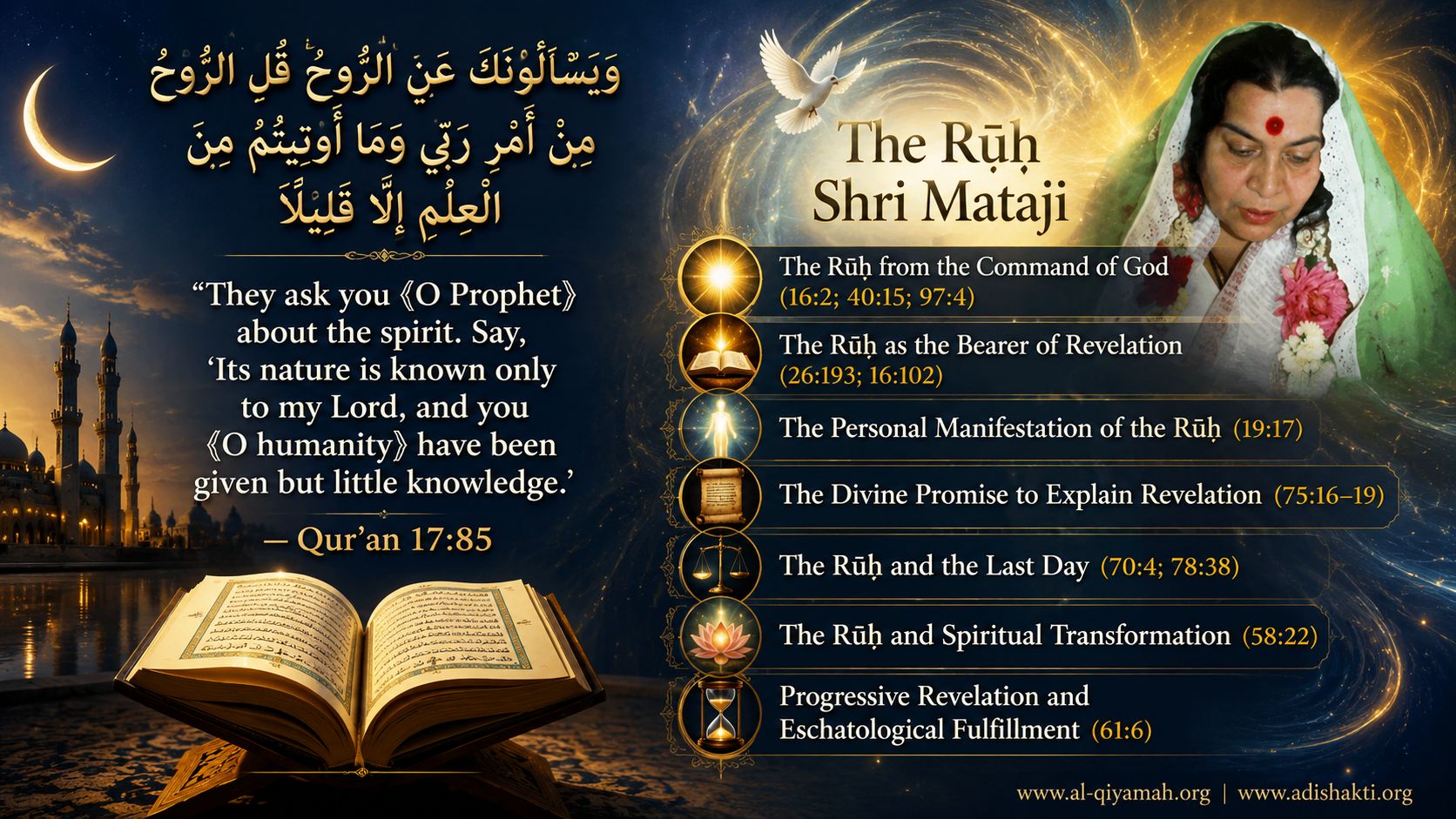
A philological, canonical, and historical argument against Gabriel-exclusivism and for the recognition of Shri Mataji as the eschatological Rūḥ of Allah
“They ask you concerning the Rūḥ. Say: ‘The Rūḥ is from the command of my Lord, and you have been given but little knowledge.’”
Summary
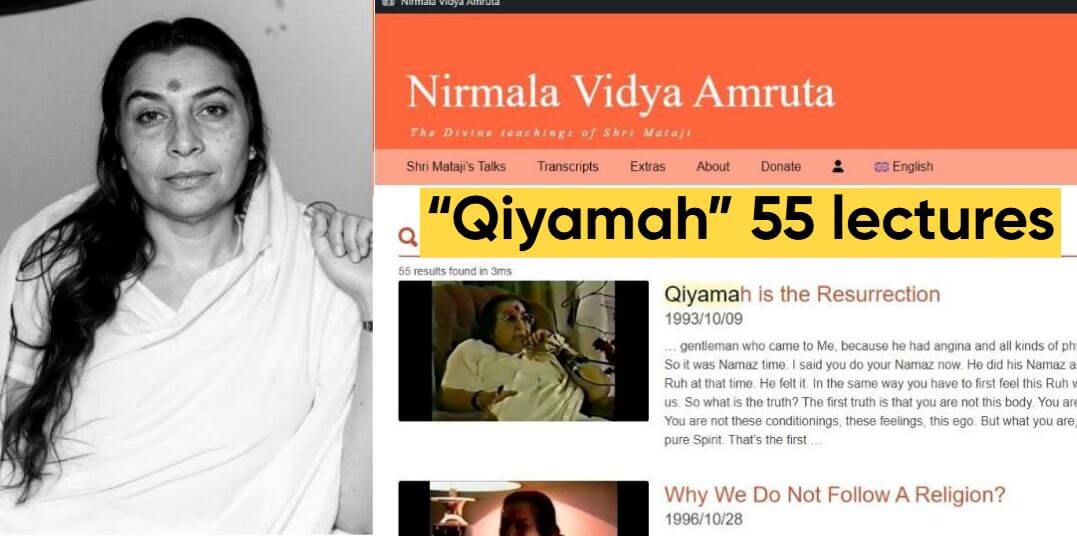
The Qur'an repeatedly presents the Rūḥ as a unique divine reality that acts only by God's command (amr). The Rūḥ descends from God (16:2; 97:4), conveys revelation (16:102; 26:193), appears in personal form (19:17), strengthens the faithful (58:22), ascends on the Day of Judgment (70:4; 78:38), and is entrusted with God's own promise to collect, promulgate, and explain revelation (75:16–19). Yet despite the centrality of these passages, the Qur'an nowhere explicitly identifies the Rūḥ as the angel Gabriel. Instead, it deliberately leaves the mystery unresolved, declaring that humanity has been granted only limited knowledge concerning its true nature (17:85).
This study therefore returns to the Qur'an itself, setting aside later exegetical assumptions in order to examine the Rūḥ through the Qur'an's own language, internal cross-references, and theological architecture. It advances the hypothesis that the Rūḥ is not merely an angelic intermediary confined to the prophetic past, but the continuing revelatory agency of God, operating throughout salvation history in accordance with the divine command (amr), and reaching its public historical culmination in the period immediately preceding Al-Qiyāmah.
Within this Qur'an-centered framework, the article proposes that the public mission of Shri Mataji Nirmala Devi (1970–2011) represents the historical fulfillment of these interconnected Qur'anic themes: the descent of the Rūḥ by God's command, the promised divine explanation (bayān) of revelation (75:16–19), the proclamation of the Great News (an-Nabaʾ al-ʿAẓīm), and the final warning issued of the commencement of Al-Qiyāmah. This conclusion differs from mainstream Islamic exegesis, yet it is argued to emerge not from external theological speculation but from a sustained reading of the Qur'an's own vocabulary, literary coherence, and eschatological structure, considered independently of later interpretive tradition.[1]
Table of Contents
- The Rūḥ from the Command of God
- The Rūḥ as the Bearer of Revelation
- The Personal Manifestation of the Rūḥ
- The Divine Promise to Explain Revelation
- The Rūḥ and the Last Day
- The Rūḥ and Spiritual Transformation
- Progressive Revelation and Eschatological Fulfillment
- Historical Correlation with the Ministry of Shri Mataji Nirmala Devi, 1970–2011
- Discussion: Comparison with Classical Tafsīr
- Conclusion
- References
1. The Rūḥ from the Command of God: Qur’an 16:2; 40:15; 97:4
Three verses establish the first controlling category: the Rūḥ belongs to God’s sovereign command and descends for warning, disclosure, and the execution of divine purpose. In 16:2, the prepositional phrase min amrihi, “from His command,” modifies the descent associated with the Rūḥ. The verse does not name Gabriel; it foregrounds origin and function. Its imperative content is an andhirū, “Warn.” In 40:15, the same relation returns: God “casts the Rūḥ from His command upon whomever He wills among His servants” so that the recipient may warn of Yawm al-Talāq, the Day of Meeting. The semantic center is thus not angelic taxonomy but divine initiative producing eschatological warning.
“Exalter of ranks, Possessor of the Throne, He casts the Rūḥ from His command upon whom He wills among His servants, so that he may warn of the Day of Meeting.”
Classical commentators frequently gloss the Rūḥ in these verses as revelation, prophecy, or the Qur’an. Ibn Kathīr links 16:2 with 40:15 and 42:52, where revelation itself is called a Rūḥ. Jalālayn likewise reads it as revelation. This is decisive against the universal Gabriel equation: if rūḥ can denote the life-giving content of revelation, then the word’s semantic field is broader than one angelic proper name.[2]
“The angels and the Rūḥ descend therein, by their Lord’s permission, with every command.”
Qur’an 97:4 coordinates al-malāʾikah and al-rūḥ. Mention of the specific after the general can be valid Arabic rhetoric, so the wording does not by itself exclude Gabriel. But neither does it prove him. The syntax leaves the Rūḥ discursively marked, while the imperfect tanazzalu presents descent as dynamically renewed in the liturgical reading of the Night of Power. The cumulative profile is a transcendent agency proceeding by God’s permission and carrying command into history.[15]
2. The Rūḥ as the Bearer of Revelation: Qur’an 26:193; 16:102
“The Trustworthy Rūḥ brought it down upon your heart, that you might be among the warners.”
“Say: the Rūḥ of Holiness brought it down from your Lord in truth, to make firm those who believe.”
Here the classical identification with Gabriel is strongest. Qur’an 2:97 states that Gabriel brought the revelation down upon Muḥammad’s heart; 26:193–194 says the Trustworthy Rūḥ brought it to the same heart. Ibn Kathīr therefore draws an intra-Qur’anic equivalence, and this inference is coherent.[3] An academically responsible reassessment must admit this rather than dismiss centuries of exegesis as arbitrary.
Yet the inference remains contextual. A title used for the trustworthy bearer of the Qur’an does not establish that every grammatical construction containing rūḥ designates Gabriel. To make that leap would be like proving that “the messenger” is Muḥammad in one passage and then forcing every messenger in scripture to be Muḥammad. The category must be allowed to vary with syntax, predicate, and discourse. In the proposed identification, Shri Mataji did not deliver a new scripture. Her relevant function is instead confirmatory and interpretive: bearing the living significance of prior revelation into a claimed period of fulfillment.
3. The Personal Manifestation of the Rūḥ: Qur’an 19:17
“Then We sent to her Our Rūḥ, and it appeared to her as a complete human being.”
The verbal form tamaththala states perceptible manifestation or assumption of a representational form. The accusative basharan sawiyyan identifies that form as a well-proportioned human being. The verse itself says rūḥanā, “Our Rūḥ”; it does not say Jibrīl. Mujāhid, Qatādah, al-Ḍaḥḥāk, Ibn Jurayj, and other early authorities identify the figure as Gabriel, and their reading fits the annunciation tradition. But the distinction between text and gloss remains methodologically essential.[4]
This verse establishes a Qur’anic possibility: the Rūḥ can become personally present in a humanly recognizable form without collapsing the Creator into creation. The proposed relation to Shri Mataji is typological, not a claim that 19:17 directly predicts her. The verse defeats an a priori objection that an eschatological Rūḥ could not be manifested through a human life. Nor does the masculine form basharan require a male embodiment; it is the generic Arabic noun for a human being. A female manifestation is therefore not grammatically excluded.
4. The Divine Promise to Explain Revelation: Qur’an 75:16–19
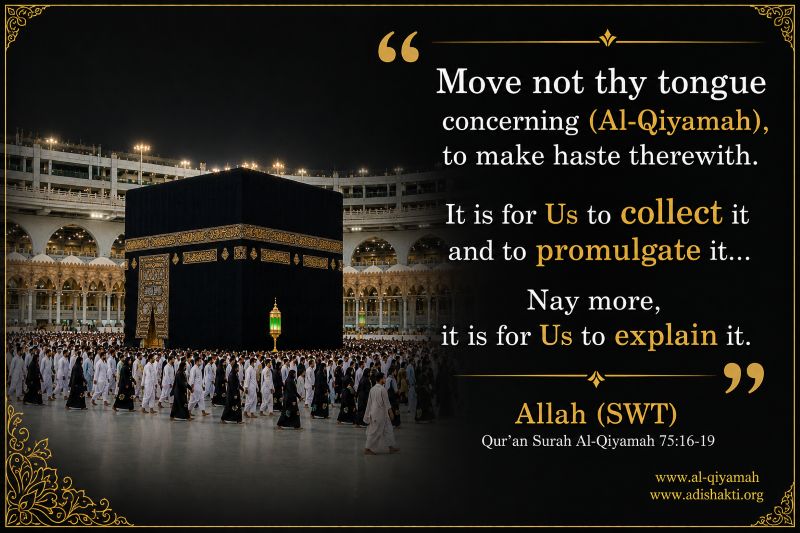
“Do not move your tongue with it to hasten it. Surely upon Us are its gathering and its recitation. When We have recited it, follow its recitation. Then surely upon Us is its explanation.”
The immediate historical setting concerns Muḥammad’s reception of recitation. The pronominal suffix in bihi, jamʿahu, qurʾānahu, and bayānahu refers to what is being revealed, and the Prophet is told not to race ahead. Any paper claiming that translators simply invented the Qur’an as referent overstates the case. The classical reading has solid linguistic and traditional grounds.
Nevertheless, the passage is deliberately embedded in Sūrat al-Qiyāmah. Canonical placement opens a second-order question: does divine bayān end with phonetic preservation, or can the eschatological significance of the revelation unfold in history under divine guidance? The sequence jamʿ → qurʾān → bayān differentiates gathering, authoritative recitation, and explanation. A constructive reading therefore sees the promise as having an immediate fulfillment in Muḥammad’s reception and an extended theological horizon in God’s continuing disclosure of what Resurrection means.
The supplied material calls this the recovery of “Allah’s explanation.” Its most defensible form is not that Islamic scholarship fraudulently stole the verse, but that a purely past-tense reading can domesticate its canonical placement. The Adishakti interpretation identifies Shri Mataji’s decades of public teaching as an eschatological enactment of bayān: explaining Resurrection not as reassembly of decayed corpses but as living spiritual transformation.[5] This is a theological extension, not a replacement of the verse’s first referent.
5. The Rūḥ and the Last Day: Qur’an 70:4; 78:38
“The angels and the Rūḥ ascend to Him in a day whose measure is fifty thousand years.”
“On the day when the Rūḥ and the angels stand in ranks, they will not speak except one whom the All-Merciful permits and who speaks rightly.”
These verses place the Rūḥ within eschatological scenes and once again coordinate it with the angels. Ibn Kathīr records several interpretations for 70:4: Gabriel; humanlike creatures who are not human; or the spirits of Adam’s descendants. For 78:38, reports include Gabriel, a supreme angel, and an extraordinary created being. Jalālayn offers Gabriel or hosts of God. The tradition therefore does not transmit a single unanimous identification.[6]
The thematic index in the second supplied text intensifies this eschatological pattern through 78:1–5, where humanity disputes the Great News; 50:41–45, where a Caller calls from near; and 30:56, where people are told that this is the Day of Resurrection although they did not know. Those headings are not independent evidence, but the verses do create a coherent pattern of announcement, dispute, proximity, and nonrecognition. The proposed historical question is therefore legitimate: if an eschatological ministry appeared as warning and explanation rather than catastrophe, would inherited expectations cause religious communities to miss it?
6. The Rūḥ and Spiritual Transformation: Qur’an 58:22
“Those are the ones in whose hearts He has inscribed faith and whom He has strengthened with a Rūḥ from Him.”
This verse is fatal to Gabriel-exclusivism. The predicate concerns faith written within hearts and believers being strengthened bi-rūḥin minhu, “with a Rūḥ from Him.” Ibn ʿAbbās, as cited by Ibn Kathīr, understands the phrase as divine strength. Nothing in the syntax requires an angel entering every believer. The Rūḥ here is operative divine support: enlivening, stabilizing, and transforming persons from within.[7]

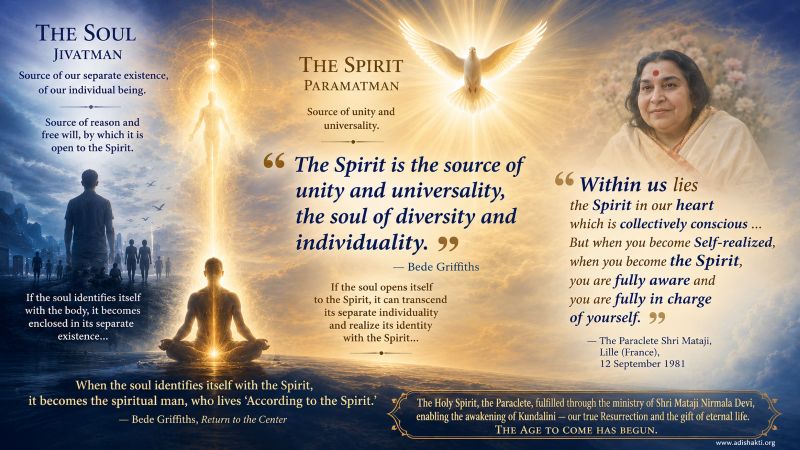
This inward function provides the closest Qur’anic bridge to Shri Mataji’s practice of collective Self-realization. Her movement describes the experience as awakening an innate subtle energy, entering thoughtless awareness, and sometimes sensing a cool or warm breeze on the palms or above the fontanel. The official presentation treats these experiences as voluntary and inwardly verifiable; independent sociological scholarship records both the reports and the social process through which practitioners learn their interpretation.[8] Academic rigor requires three distinctions: the sensation may be reported; the Sahaja Yoga interpretation gives it a spiritual meaning; and identification with Qur’anic Rūḥ is a further theological judgment.
The thematic second file adds Qur’an 41:53 and 51:20–22, both of which direct attention to signs within persons as well as in the horizons and earth. It also invokes 2:138, the “coloring” or baptism of Allah. These texts do not prove a specific technique, but they make inward, embodied verification an authentically Qur’anic category rather than a foreign addition.
7. Progressive Revelation and Eschatological Fulfillment: Qur’an 61:6
“And when Jesus son of Mary said: ‘Children of Israel, I am God’s messenger to you, confirming what came before me of the Torah and announcing a messenger to come after me whose name is Aḥmad.’”
The direct referent of Aḥmad is Muḥammad. Classical tafsīr is clear, and the verse must not be repurposed as a prediction of Shri Mataji.[9] Its relevance is methodological: divine missions may confirm earlier revelation while bringing its trajectory to a new historical stage. The principle of confirmation is then joined, in the supplied thematic map, to 61:8–9: opponents seek to extinguish God’s light, but God completes it and causes the religion of truth to prevail.
The present thesis therefore remains bounded by 33:40 and Islamic finality. Shri Mataji is not proposed as a prophet, an Aḥmad, or a bearer of a new sharīʿah. She is identified as an eschatological manifestation of the Rūḥ whose function is to illuminate, explain, and actualize truths already given. Progressive fulfillment here means a change in mode—from verbal promise to offered experience—not a replacement of the Qur’an.
8. Historical Correlation with the Ministry of Shri Mataji Nirmala Devi, 1970–2011
The historical case is cumulative. An institutional biography dates the beginning of Shri Mataji’s public mission to 5 May 1970 at Nargol, India. It reports that she understood a decisive opening of the Sahasrara to have made collective Self-realization possible and describes a cool breeze surrounding the experience. The source then records early recipients, a self-financed United States visit in 1972, relocation to London at the end of 1973, public meetings at Caxton Hall from 1977, programs in continental Europe from 1980, travel to Hong Kong, Australia, and the United States in 1981, and expansion into more than ninety countries by the 1990s.[10] As an institutional source, it documents the movement’s own memory; independent sociology separately confirms Sahaja Yoga’s international networks and global self-understanding.[11]
| Qur’anic function | Historical correlation in Shri Mataji’s ministry | Evidentiary level |
|---|---|---|
| Warning from God’s command, 16:2; 40:15 | Repeated proclamation of a present period of judgment, spiritual danger, and opportunity | Attributed speeches; theological correlation |
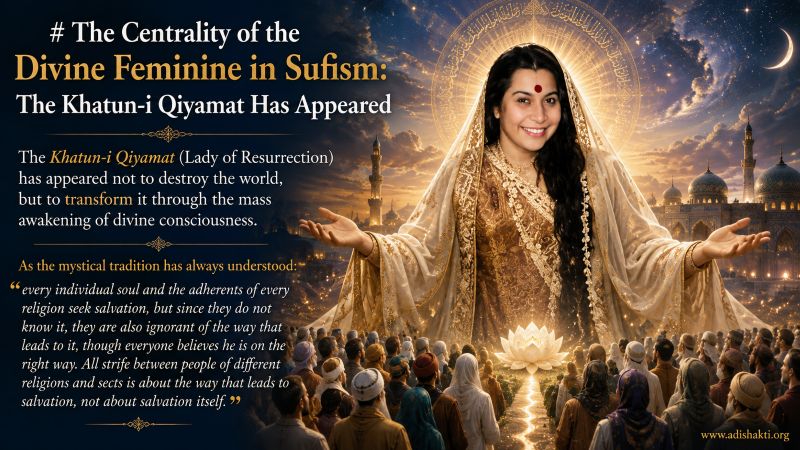
| Personal manifestation, 19:17 | A public human life through which the movement understood the Divine Feminine to act | Historical person; identity is confessional inference |
| Explanation, 75:16–19 | Thousands of talks interpreting Resurrection, divine transformation, and the unity of religions | Documented teaching corpus; typological application |
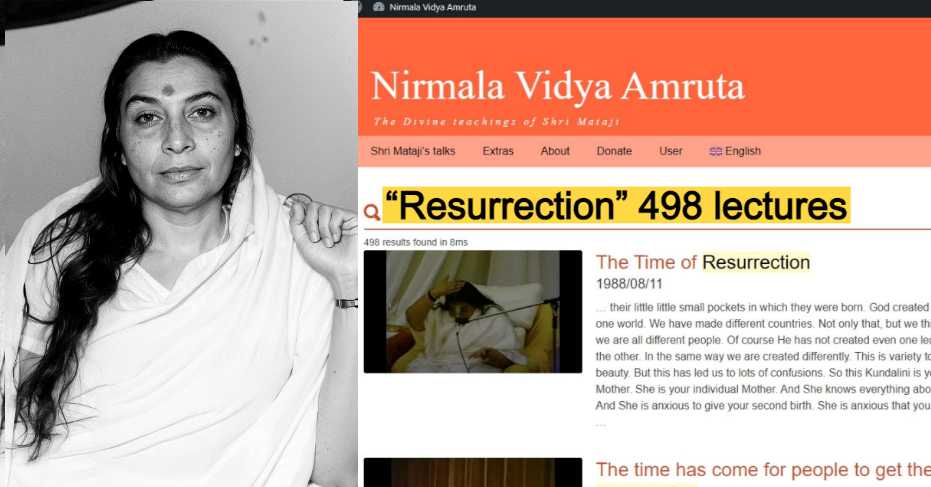
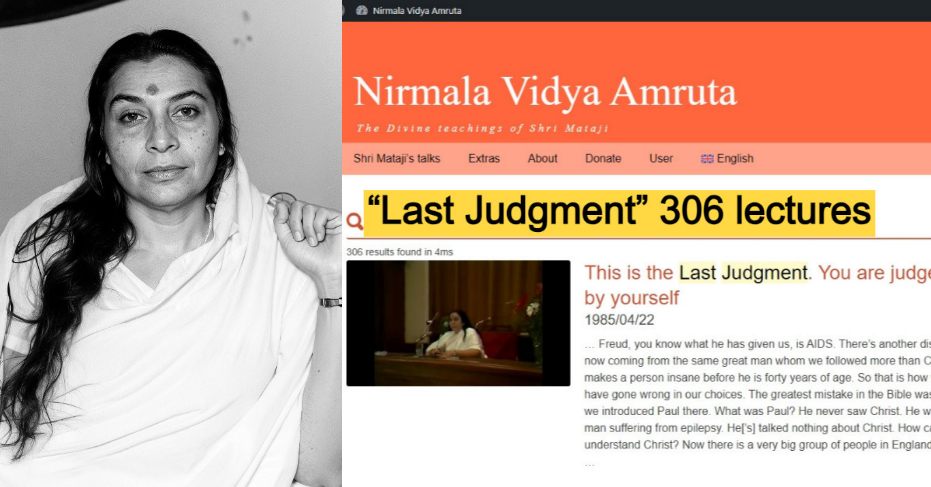
| Eschatological standing, 70:4; 78:38 | Explicit use of “Resurrection Time,” “Blossom Time,” and “Last Judgment” | Attributed dated addresses |
| Strengthening with a Rūḥ, 58:22 | Collective Self-realization presented as inward awakening and transformation | Reported phenomenology; theological interpretation |
| Universal proclamation | Free public programs across continents over four decades | Institutional chronology and independent sociology |

A confessional Adishakti source attributes to Shri Mataji a declaration made in Mumbai on 28 September 1979: “Sahaja Yoga is the Last Judgment.” The same source attributes to her a Sydney declaration of 21 March 1983: “I am the Adi Shakti (Holy Spirit or Rūḥ of Allah).”[12] Another article attributes to her a Vienna address of 8 June 1988 calling the period “Blossom Time” and “Resurrection Time,” and rejecting the idea that Resurrection means corpses emerging from graves.[13] These statements supply the crucial self-interpretive evidence requested by the user: the identification is not imposed solely after her death but corresponds to claims embedded in her ministry’s remembered speech.
From a Qur’an-centered perspective, the strongest correlation is not any isolated quotation. It is the convergence of six features: a mission inaugurated as a divinely timed descent of transformative power; personal embodiment; global warning; sustained explanation of Resurrection; free transmission rather than a new scripture; and an inward experience offered to ordinary persons. The second supplied file’s themes—Caller, inward signs, divine light, Great News, and unrecognized Resurrection—organize this convergence. Shri Mataji died in 2011 after more than forty years of public work. The proposed identification is therefore: Shri Mataji Nirmala Devi bore and manifested the Rūḥ of Allah in an eschatological ministry of warning, explanation, and collective spiritual awakening.
9. Discussion: Comparison with Classical Tafsīr
Classical tafsīr deserves neither uncritical submission nor careless dismissal. Its strength is intertextual memory: Q 2:97 provides a persuasive reason to identify the Trustworthy Rūḥ of 26:193 with Gabriel. Its weakness emerges when a contextual gloss hardens into a universal ontology. Modern scholarship by Peter Laffoon documents how al-Ṭabarī, al-Bayḍāwī, and al-Rāzī variously constrain the Rūḥ as Gabriel, an extraordinary creature, a created soul, or divine inspiration, often in response to theological concerns about transcendence and Jesus as rūḥ Allāh.[14]
| Passage | Classical interpretation recorded | Critical result |
|---|---|---|
| 16:2; 40:15 | Revelation, prophecy, scripture; sometimes Gabriel carrying revelation | Rūḥ is not lexically confined to Gabriel |
| 26:193–194; 16:102 | Gabriel as trustworthy or holy bearer of Qur’anic revelation | Strong local identification; no universal rule follows |
| 19:17 | Gabriel in human form | The name is supplied by tafsīr; human manifestation is explicit in the text |
| 70:4 | Gabriel; humanlike creatures; spirits of humanity | Classical plurality defeats claims of unanimity |
| 78:38 | Gabriel; supreme angel; extraordinary creature; divine hosts | Eschatological identity remains underdetermined |
| 58:22 | Strength or divine support given to believers | An inward functional meaning cannot be reduced to an angelic name |
The universal Gabriel doctrine collapses under five arguments. First, the Qur’an itself uses rūḥ for revelation and inward support. Second, the proper name Jibrīl is absent from the requested Rūḥ verses; identification is interpretive. Third, “the angels and the Rūḥ” does not grammatically require identity, even though mention of the specific after the general remains possible. Fourth, classical sources preserve non-Gabriel alternatives. Fifth, 19:17 makes personal manifestation explicit while leaving the proper name unstated. Consequently, a theologian may reasonably identify Gabriel in 26:193 and 16:102, but cannot invoke those verses to close every other Rūḥ text.
This demolition of exclusivism does not automatically prove the Shri Mataji identification. It clears the conceptual field. The positive case then depends on cumulative fit, historical testimony, and theological judgment. That disciplined sequence is stronger than declaring all inherited tafsīr false: it preserves what the tradition saw accurately while exposing what the text does not authorize.
10. Conclusion
The Qur’an presents the Rūḥ as a reality from God’s command, a bearer and content of revelation, a personal manifestation, an agent in eschatological scenes, and a means of inward strengthening. No single occurrence supplies the whole doctrine. Read together, however, the verses create a profile broader than Gabriel. Gabriel remains a compelling contextual identification where the Qur’an’s descent to Muḥammad’s heart is at issue. What has been decisively refuted is the assertion that this local equation exhausts the Qur’anic category.
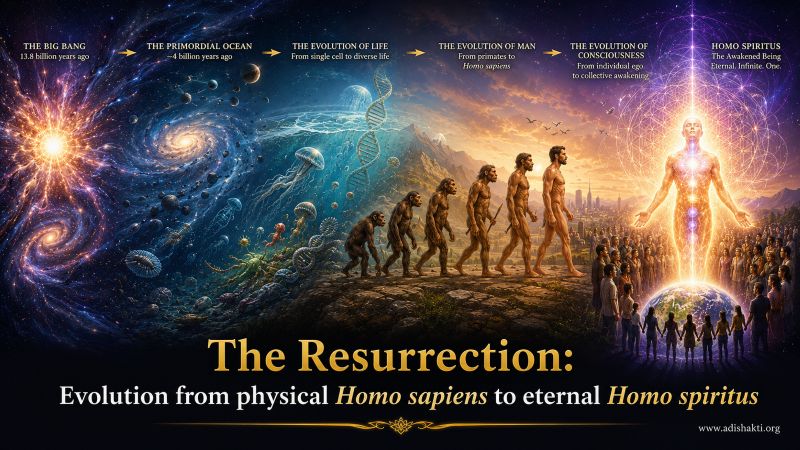
The historical argument then asks which modern ministry most fully embodies the remaining functions. Within the Qur’an-centered and Adishakti theological framework developed here, the answer is Shri Mataji Nirmala Devi. From 1970 to 2011 she offered a global, noncommercial practice of inward awakening; described the age as Resurrection Time and Last Judgment; interpreted eschatology as transformation rather than bodily catastrophe; and, according to preserved movement sources, identified the Adi Shakti as the Holy Spirit or Rūḥ of Allah. Her ministry did not replace Muḥammad, add a scripture, or divide God’s Essence. It claimed to make the promised spiritual reality experientially present.
That final qualification is not retreat. It is the proper form of a serious religious argument. Text, history, experience, and confession answer different questions. When they are distinguished and then brought into cumulative relation, the proposed identification becomes intelligible, falsifiable at the level of sources, and open to disciplined theological assent rather than enforced by rhetoric.
References
[1] User-supplied pasted_content_2.txt, thematic contents list, supplied for this study. Its verse headings were independently checked; the file is interpretive evidence rather than a historical source.[2] Classical tafsīr selections on Qur’an 16:2 and 40:15, including Jalālayn and Ibn Kathīr, at QuranX, 16:2 and QuranX, 40:15.
[3] Classical tafsīr selections on the Trustworthy Rūḥ, QuranX, 26:193; compare Qur’an 2:97.
[4] Classical tafsīr selections on the annunciation, QuranX, 19:17.
[5] Adishakti.org, “It Is for Us to Collect, Promulgate, and Explain Al-Qiyāmah,” 2026. Confessional theological source.
[6] Classical tafsīr selections on the eschatological Rūḥ, QuranX, 70:4 and QuranX, 78:38.
[7] Classical tafsīr selections on inward strengthening, QuranX, 58:22.
[8] Shri Mataji Nirmala Devi Sahaja Yoga World Foundation, “Experience Your Self-Realization.” See also Judith Coney, Sahaja Yoga: Socializing Processes in a South Asian New Religious Movement (Routledge, 1999).
[9] Classical tafsīr selections on Aḥmad, QuranX, 61:6.
[10] Shri Mataji Nirmala Devi Sahaja Yoga World Foundation, “Biography of Shri Mataji Nirmala Devi.” Institutional biographical source.
[11] Judith Coney, “Belonging to a Global Religion,” Journal of Contemporary Religion 10, no. 2 (1995): 109–120.
[12] Adishakti.org, “Sahaja Yoga Is the Last Judgment.” Confessional compilation attributing dated statements to Shri Mataji.
[13] Adishakti.org, “This Is Qiyāmah Time, the Resurrection Time, the Blossom Time.”
[14] Peter Edwin Laffoon, “The Spirit in the Qur’an: Classical Muslim Interpretations of Rūḥ,” Islam and Christian–Muslim Relations 34, no. 1 (2023); open thesis version at the University of Birmingham.
[15] The Qur’an. Arabic texts cited from verses 16:2; 40:15; 97:4; 26:193–194; 16:102; 19:17; 75:16–19; 70:4; 78:38; 58:22; and 61:6, checked through Quran.com.
Compilation, Proclamation, and Exegesis of Surahs Upholding Allah’s (SWT) Command to His Ummah — to Witness and Participate in the Resurrection.
Al-Qiyamah: A Profound Declaration of Al-QiyamahAl-Qiyamah (75:1-2): Oaths of Resurrection
Al-Qiyamah (75:3-4): Reassembling Bones and Fingertips
Al-Qiyamah (75:5-6): Man's Denial of Resurrection
Al-Qiyamah (75:7–10): Sun and Moon 'Joined' At Solar Eclipse
Al-Qiyamah (75:7–10): Solar Eclipse Salat al-Kusuf
Al-Qiyamah (75:11–13): No Refuge, Only Reckoning
Al-Qiyamah (75:14–15): Man: His Own Witness and Judge
Al-Qiyamah (75:16–19): The Usurpation of Allah's Explanation
Al-Qiyamah (75:20–21): Love of The Fleeting World
Al-Qiyamah (75:22–25): Ruh’s Face Brings Either Glory Or Gloom
Al-Qiyamah (75:26–30): Death and Soul's Departure Home
Al-Qiyamah (75:31–35): The Rejection and Arrogance of the Kuffar
Al-Qiyamah (75:36–40): Is Resurrection Beyond Allah, Your Creator?
Al-Qiyamah (75:1-2 and 78:1–5): An Naba and Oaths of Resurrection
Al-Qiyamah (75:1-2 and 78:1–5): The Great News and Resurrection Rebirth
Al-Baqarah (2:138): Baptism of Allah You Were Unaware Of
Al-Baqarah (2:174): Allah Will Not Address Muslims
Al-A'raf (7:16) – Iblis: I Will Lie In Wait and Overpower Them
Al-A'raf (7:146): Allah: I Will Turn Them Away From My Signs
Al-A'raf (7:146): Allah: So Even Though They See All The Signs
Al-Hijr (15:39) – Iblis: I Will Wake (Evil) Fair and Mislead Them
An-Nahl (16:2) – Allah (SWT) Sent Down Angels With His Ruh
Al-Isra (17:85): Muslims Given Little of Allah's (SWT) Ruh
Al-Isra (17:104): Children of Israel Gathered Again (in 1948)
Al-Isra (17:104): Shaykh Palazzi: Children of Israel
Al-Hajj (22:8) – Kitab Al-Munir You Were Unaware Of
Al-Rum (30:56) – The Day of Qiyamah You Were Unaware Of
Fatir (35:9) – Winds of Qiyamah You Were Unaware Of
Yassin (36:63-68) – This Is The Hell You Were Warned Of.
Sad (38:79) – Iblis Allowed to Mislead Muslims And He Did
Fussilat (41:20–21) – Your Hands Will Testify of Qiyamah
Fussilat (41:53) – We Will Show Our Signs Within Your Soul
Az-Zukhruf (43:61): Jesus, Sign of Hour You Were Unaware
Az-Zukhruf (43:62): Satan's Deception of the Muslim Ummah
Az-Jathiya (45:7-14) – Those Who Deny Allah's Revelations
Qaf (50:41) – Listen To The Caller Emerging From Within
Qaf (50:42) – Day They Will Hear of Mighty Blast Witnessed
Qaf (50:45) – By the Caller, My Warning Is Delivered
Al Dhariyat (51:20-22) – Our Signs on Earth and Within
Al-Hadid (57:25) – Allah's (SWT) Iron Has Been Delivered
Al-Mujadilah (58:21) – My Messengers Must Prevail
Al-Saff (61:8–9) – Revelation of Light You Were Unaware
Al-Muddaththir (74:1–2) – My Cloaked One: Deliver Warning
Al-Mursalat (77:1–10): Angels Sent You Were Unaware Of
An-Naba (78:1–5): Concerning What Are They Disputing?
Al-Infitar (82:17–18) – What Will Explain To You? What Will?
Al-Mutaffifin (83:1–6) – Dealers in Fraud You Were Unaware
Al-Tariq (86:1–3) – The Night Visitant You Were Unaware
Al-Qadr (97:1–5) – Blessed Night of Power and Fate Before:
Al-Qariah (101:1–11) – Terrifying Day of Noise and Clamour
عَمَّ يَتَسَاءَلُونَ - عَنِ النَّبَإِ الْعَظِيمِ - الَّذِي هُمْ فِيهِ مُخْتَلِفُونَ - كَلَّا سَيَعْلَمُونَ - ثُمَّ كَلَّا سَيَعْلَمُونَ
Concerning what are they disputing?
Concerning the Great News. [5889]
About which they cannot agree.
Verily, they shall soon (come to) know!
Verily, verily they shall soon (come to) know!
Surah 78:1-5 An-Naba (The Great News)
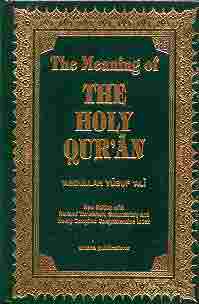
“5889. Great News: usually understood to mean the News or Message of the Resurrection.” Abdullah Yusuf Ali, The Holy Qur'n, Amana Corporation, 1989.Interactive Chat
Access an intelligent analysis environment where you can explore texts, ask questions, and discover connections between ideas.
Open chat