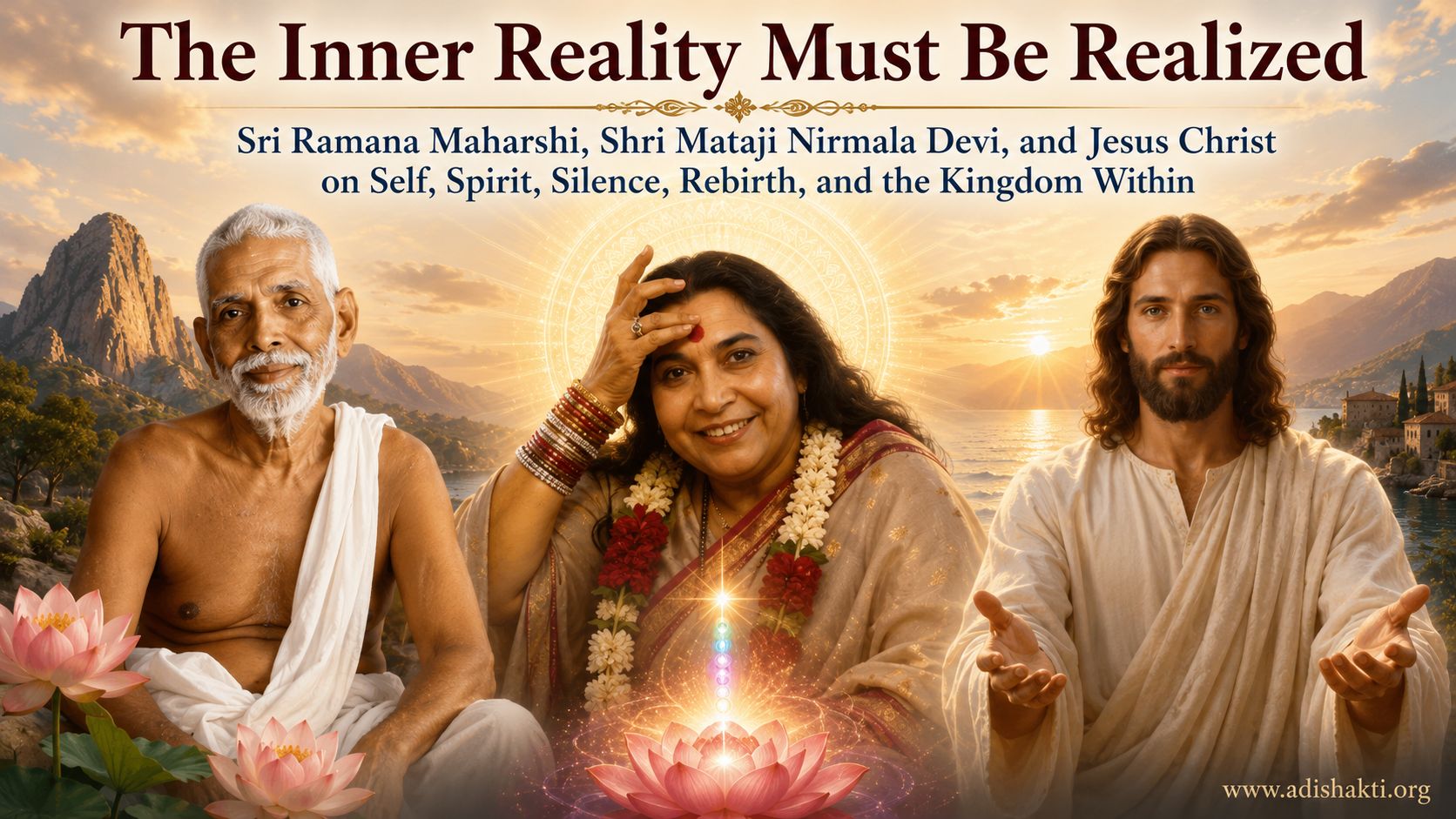
ADISHAKTI.ORG — SELF · SPIRIT · SAHASRARA · KINGDOM WITHIN
The Inner Reality Must Be Realized
Sri Ramana Maharshi, Shri Mataji Nirmala Devi, and Jesus Christ on Self, Spirit, Silence, Rebirth, and the Kingdom Within
Author: ChatGPT AI | Date: Sept. 1, 2026 | Published on: adishakti.org
Abstract
The supplied text contains twelve distinct question-and-answer exchanges drawn from the opening discussion of the Self in David Godman’s Be As You Are: The Teachings of Sri Ramana Maharshi. The text begins with the fundamental question “What is Reality?” and proceeds through awareness, non-duality, Self-realization, direct experience, silence, the unity of Self, liberation, the three states of consciousness, sat-cit-ānanda, and finally the problem of describing absolute consciousness in categories derived from dualistic experience.
This paper argues that these exchanges can be placed in a rigorous comparative dialogue with the teachings of Shri Mataji Nirmala Devi and Jesus Christ without claiming that the three systems are historically or terminologically identical. Ramana's Heart is not simply another name for Shri Mataji's Sahasrara; Jesus did not teach a Sanskrit subtle-body physiology; and Shri Mataji's account of Kundalini awakening cannot simply be read back into classical Advaita or first-century Christianity. Nevertheless, all three traditions can be read as insisting that ultimate religious truth cannot remain merely propositional. The resulting convergence is best described as phenomenological and theological rather than terminological or historical: the Reality proclaimed by religion must become directly realized consciousness.
Self-Atma
The Teachings of Sri Ramana Maharshi
Edited by David Godman
Question: What is Reality?
Sri Ramana Maharshi: Reality must be always real. It is not with forms and names. That which underlies these is the Reality. It underlies limitations, being itself limitless. It is not bound. It underlies unrealities, itself being real. Reality is that which is. It is as it is. It transcends speech. It is beyond the expressions “existence, non-existence”, etc.
The reality which is the mere consciousness that remains when ignorance is destroyed along with knowledge of objects, alone is the Self (Atma). In that Brahma-swarupa (real form of Brahman), which is abundant Self-awareness, there is not the least ignorance.
The reality which shines fully, without misery and without a body, not only when the world is known but also when the world is not known, is your real form (nija-swarupa).
The radiance of consciousness-bliss, in the form of one awareness shining equally within and without, is the supreme and blissful primal reality. Its form is silence and it is declared by Jnanis (Self-realised) to be the final and unobstructable state of true knowledge (jnana).
Know that jnana alone is non-attachment; jnana alone is purity; jnana is the attainment of God; jnana which is devoid of forgetfulness of Self alone is immortality; jnana alone is everything.
Question: What is this awareness and how can one obtain and cultivate it?
Sri Ramana Maharshi: You are awareness. Awareness is another name for you. Since you are awareness there is no need to attain or cultivate it. All that you have to do is to give up being aware of other things, that is of the not-self. If one gives up being aware of them then pure awareness alone remains, and that is the Self.
Question: If the Self is itself aware, why am I not aware of it even now?
Sri Ramana Maharshi: There is no duality. Your present knowledge is due to the ego and is only relative. Relative knowledge requires a subject and an object, whereas the awareness of the Self is absolute and requires no object.
Remembrance also is similarly relative, requiring an object to be remembered and a subject to remember. When there is no duality, who is to remember whom?
The Self is ever present. Each one wants to know the Self. What kind of help does one require to know oneself? People want to see the Self as something new. But it is eternal and remains the same all along. They desire to see it as a blazing light etc. How can it be so? It is not light, not darkness. It is only as it is. It cannot be defined. The best definition is “I am that I am”. The Srutis (scriptures) speak of the Self as being the size of one's thumb, the tip of the hair, an electric spark, vast, subtler than the subtlest, etc. These descriptions have no foundation in fact. It is only being, but different from the real and the unreal; it is knowledge, but different from knowledge and ignorance. How can it be defined at all? It is simply being.
Question: When a man realises the Self, what will he see?
Sri Ramana Maharshi: There is no seeing. Seeing is only being. The state of Self-realisation, as we call it, is not attaining something new or reaching some goal which is far away, but simply being that which you always are and which you always have been. All that is needed is that you give up your realisation of the not-true as true. All of us are regarding as real that which is not real. We have only to give up this practice on our part. Then we shall realise the Self as the Self, in other words, “Be the Self.” At one stage you will laugh at yourself for trying to discover the Self which is not self-evident. So, what can we say to this question?
That stage transcends the seer and the seen. There is no seer there to see anything. The seer who is seeing all this now ceases to exist and the Self alone remains.
Question: How to know this by direct experience?
Sri Ramana Maharshi: If we talk of knowing the Self, there must be two selves, one a knowing self, another the self which is known, and the process of knowing. The state we call realisation is simply being oneself, not knowing anything or becoming anything. If one has realised, one is that which alone is and which alone has always been. One cannot describe that state. One can only be that. Of course, we loosely talk of Self-realisation, for want of a better term. How to “real-ise” or make the real that which alone is real?
Question: You some times say the Self is silence. Why is this?
Sri Ramana Maharshi: For those who live in Self as the beauty devoid of thought, there is nothing, which should be thought of. That which should be adhered to is only the experience of silence, because in that supreme state nothing exists to be attained other than oneself.
Question: What is Mouna (silence)?
Sri Ramana Maharshi: That state which transcends speech and thought is mouna. That which is, is mouna. How can mouna be explained in words?
Sages say that the state in which the thought “I” (the ego) does not rise even in the least, alone is Self (swarupa) which is silence (mouna). That silent Self alone is God; Self alone is the jiva (individual soul). Self alone is this ancient world.
All other kinds of knowledge are only petty and trivial knowledge; the experience of silence alone is the real and perfect knowledge. Know that the many objective differences are not real but are mere superimpositions on Self, which is the form of true knowledge.
Question: As the bodies and the selves animating them are everywhere actually observed to be innumerable how can it be said that the Self is only one?
Sri Ramana Maharshi: If the idea “I am the body” is accepted, the selves are multiple. The state in which this idea vanishes is the Self since in that state there are no other objects. It is for this reason that the Self is regarded as one only.
Since the body itself does not exist in the natural outlook of the real Self, but only in the extroverted outlook of the mind which is deluded by the power of illusion, to call Self, the space of consciousness, Dehi (the possessor of the body) is wrong.
The world does not exist without the body, the body never exists without the mind, the mind never exists without consciousness, and consciousness never exists without the Reality.
For the wise one who has known Self by diving within himself, there is nothing other than Self to be known. Why? Because since the ego, which identifies the form of a body as “I” has perished, he (the wise one) is the formless existence—consciousness.
The jnani (one who has realised the Self) knows he is the Self and that nothing, neither his body nor anything else, exists but the Self. To such a one what difference could the presence or absence of a body make?
It is false to speak of realisation. What is there to realise? The Real is as it always is. We are not creating anything new, or achieving something, which we did not have before.
The illustration given in books is this. We dig a well and create a huge pit. The space in the pit or the well has not been created by us. We have just removed the earth, which was filling the space there. The space was there then and is also there now. Similarly we have simply to throw out all the age-long Samskaras (innate tendencies) which are inside us. When all of them have been given up, the Self will shine alone.
Question: But how to do this and attain liberation?
Sri Ramana Maharshi: Liberation is our very nature. We are that. The very fact that we wish for liberation shows that freedom from all bondage is our real nature. It is not to be freshly acquired. All that is necessary is to get rid of the false notion that we are bound. When we achieve that, there will be no desire or thought of any sort. So long as one desires liberation, so long, you may take it, one is in bondage.
Question: For one who has realised his Self, it is said that he will not have the three states of wakefulness, dream and deep sleep. Is that a fact?
Sri Ramana Maharshi: What makes you say that they do not have the three states? In saying, “I had a dream; I was in deep sleep; I am awake”, you must admit that you were there in all three states. That makes it clear that you were there all the time. If you remain as you are now, you are in the wakeful state; this becomes hidden in the dream state; and the dream state disappears when you are in deep sleep. You were there then, you are there now, and you are there at all times. The three states come and go, but you are always there.
It is like a cinema. The screen is always there but several types of pictures appear on the screen and then disappear. Nothing sticks to the screen, it remains a screen. Similarly, you remain your own Self in all the three states. If you know that, the three states will not trouble you, just as the pictures which appear on the screen do not stick to it. On the screen, you sometimes see a huge ocean with endless waves; that disappears. Another time, you see fire spreading all around; that too disappears. The screen is there on both occasions. Did the screen get wet with the water or was it burnt by fire? Nothing affected the screen. In the same way, the things that happen during the wakeful, dream and sleep states do not affect you at all; you remain your own Self.
Question: Brahman (the Supreme Reality) is said to be sat-chit-ananda. What does that mean?
Sri Ramana Maharshi: Yes. That is so. That which is, in only Sat. That is called Brahman. The lustre of Sat is Chit and its nature is Ananda. These are not different from Sat. All the three together are known as Sat-Chit-Ananda.
Question: As the Self is existence (Sat) and consciousness (Chit) what is the reason for describing it as different from the existent and the non-existent, the sentient and the insentient?
Sri Ramana Maharshi: Although the Self is real, as it comprises everything, it does not give room for questions involving duality about its reality or unreality. Therefore it is said to be different from the real and the unreal. Similarly, even though it is consciousness, since there is nothing for it to know or to make itself known to, it is said to be different from the sentient and the insentient.
Sat-Chit-Ananda is said to indicate that the Supreme is not asat (different from being), not achit (different from consciousness) and not an ananda (different from bliss). Because we are in the phenomenal world we speak of the Self as Sat-Chit-Ananda.
I · METHOD
Source and Methodological Considerations
The supplied document identifies its source as “Self-Atma: The Teachings of Sri Ramana Maharshi, Edited by David Godman.” The wording belongs to Godman’s thematic presentation of Ramana’s teaching on the Self. The sequence is doctrinal rather than a single continuous interview, and should therefore be read as an edited constellation of Ramana’s recurring teachings rather than as one historically continuous dialogue.
For the Christian comparison, particular weight is given to John 3:3–8, Luke 17:20–21, John 14–17, Matthew 6:22–23, John 8:12, and John 17:20–23. The non-canonical Gospel of Thomas is used only where clearly identified as an early Christian witness rather than canonical scripture. For Shri Mataji, the paper emphasizes Self-Realization, Kundalini, thoughtless awareness, Spirit, Sahasrara, and union with the all-pervading Divine.
Methodological Principle: Historical evidence, textual interpretation, and theological synthesis must remain distinct. The aim is not to erase differences but to test whether the three traditions converge upon the necessity of direct inner realization.
II · REALITY
Question One: What Is Reality?
Question: “What is Reality?”
Sri Ramana Maharshi: “Reality must be always real. It is not with forms and names. That which underlies these is the Reality. It underlies limitations, being itself limitless. It is not bound. It underlies unrealities, itself being real. Reality is that which is. It is as it is. It transcends speech. It is beyond the expressions ‘existence, non-existence’, etc.
The reality which is the mere consciousness that remains when ignorance is destroyed along with knowledge of objects, alone is the Self (Atma). In that Brahma-swarupa (real form of Brahman), which is abundant Self-awareness, there is not the least ignorance.
The reality which shines fully, without misery and without a body, not only when the world is known but also when the world is not known, is your real form (nija-swarupa).
The radiance of consciousness-bliss, in the form of one awareness shining equally within and without, is the supreme and blissful primal reality. Its form is silence and it is declared by Jnanis (Self-realised) to be the final and unobstructable state of true knowledge (jnana).
Know that jnana alone is non-attachment; jnana alone is purity; jnana is the attainment of God; jnana which is devoid of forgetfulness of Self alone is immortality; jnana alone is everything.”
Ramana defines Reality by ontological constancy. That which begins, changes, or disappears cannot be absolutely real. Names and forms are therefore dependent appearances; consciousness is the underlying Reality. The decisive move is from object-knowledge to Self-awareness. Jñāna is not information about Brahman but non-forgetfulness of Self.
Shri Mataji parallel. Shri Mataji similarly distinguishes intellectual religion from Self-Realization: something must happen within by which the Spirit becomes manifest in awareness. Her language is more dynamic and yogic than Ramana’s, but the common principle is that truth must become realized consciousness.
Jesus parallel. John 3 presents Nicodemus as religiously informed yet still in need of rebirth “from above” and “of the Spirit.” The problem is therefore not lack of religious vocabulary but lack of transformation.
Comparative significance. Ramana begins from Reality, Jesus from entry into divine life, and Shri Mataji from the awakening by which divine life becomes conscious. All three resist the reduction of religion to conceptual assent.
III · AWARENESS
Question Two: How Can Awareness Be Obtained?
Question: “What is this awareness and how can one obtain and cultivate it?”
Sri Ramana Maharshi: “You are awareness. Awareness is another name for you. Since you are awareness there is no need to attain or cultivate it. All that you have to do is to give up being aware of other things, that is of the not-self. If one gives up being aware of them then pure awareness alone remains, and that is the Self.”
Ramana overturns the subject-object structure of spiritual seeking. Awareness is not an attainment external to the seeker; it is the seeker’s true identity. Ātma-vicāra therefore removes false identification rather than manufacturing Selfhood.
Shri Mataji parallel. Her formulation is: one already is the Spirit, but Self-Realization makes that Spirit consciously manifest. Ramana stresses ontological identity; Shri Mataji adds the event of awakening.
Jesus parallel. John 3 distinguishes flesh from Spirit. Christianity does not usually identify the human person with absolute consciousness in the Advaitic sense, yet the structural parallel is clear: ordinary identity must yield to Spirit-born existence.
Sahasrara significance. In Shri Mataji’s system, Kundalini does not create Spirit; it brings awareness into conscious union at Sahasrara with the all-pervading Divine.
IV · NON-DUALITY
Question Three: Why Am I Not Already Aware of the Self?
Question: “If the Self is itself aware, why am I not aware of it even now?”
Sri Ramana Maharshi: “There is no duality. Your present knowledge is due to the ego and is only relative. Relative knowledge requires a subject and an object, whereas the awareness of the Self is absolute and requires no object.
Remembrance also is similarly relative, requiring an object to be remembered and a subject to remember. When there is no duality, who is to remember whom?
The Self is ever present. Each one wants to know the Self. What kind of help does one require to know oneself? People want to see the Self as something new. But it is eternal and remains the same all along. They desire to see it as a blazing light etc. How can it be so? It is not light, not darkness. It is only as it is. It cannot be defined.... It is simply being.”
Ordinary knowing presupposes a knower and a known. Ramana argues that the Self cannot be made into an object before another subject. This also explains his caution against reducing realization to a visionary phenomenon such as a blazing light.
Shri Mataji parallel and difference. Shri Mataji allows subtle phenomena and experiential signs of awakening, but thoughtless awareness ultimately transcends mental objectification. Ramana concentrates overwhelmingly on this deeper ontological level.
Jesus parallel. John 14:20 and John 17 describe indwelling communion rather than Advaitic non-duality. The difference is genuine: Ramana dissolves ultimate knower-known duality; Johannine Christianity retains relationality. Yet both reject a merely external God-object.
V · BEING
Question Four: What Will the Realized Person See?
Question: “When a man realises the Self, what will he see?”
Sri Ramana Maharshi: “There is no seeing. Seeing is only being. The state of Self-realisation, as we call it, is not attaining something new or reaching some goal which is far away, but simply being that which you always are and which you always have been.... Then we shall realise the Self as the Self, in other words, ‘Be the Self.’
That stage transcends the seer and the seen. There is no seer there to see anything. The seer who is seeing all this now ceases to exist and the Self alone remains.”
The question assumes a spectator who will survive realization and observe a spiritual object. Ramana removes that assumption. Realization is not vision added to ego; it is the cessation of the egoic seer.
Shri Mataji parallel. Her repeated language of “becoming the Spirit” is structurally close: transformation is ontological-experiential rather than merely visual or doctrinal.
Jesus parallel. John 17 moves toward participation and indwelling rather than external spectatorship. Christian union remains relational, but the believer is drawn into divine life rather than merely observing it.
VI · DIRECT EXPERIENCE
Question Five: How Can This Be Known by Direct Experience?
Question: “How to know this by direct experience?”
Sri Ramana Maharshi: “If we talk of knowing the Self, there must be two selves, one a knowing self, another the self which is known, and the process of knowing. The state we call realisation is simply being oneself, not knowing anything or becoming anything. If one has realised, one is that which alone is and which alone has always been. One cannot describe that state. One can only be that. Of course, we loosely talk of Self-realisation, for want of a better term. How to ‘real-ise’ or make the real that which alone is real?”
Direct experience itself must finally be purified of dualistic assumptions. Ramana’s ultimate “experience” is identity of being, not an ego possessing a spiritual experience.
Comparative bridge. Ramana says: be the Self. Jesus says: be born of the Spirit. Shri Mataji says: become the Spirit. These are not metaphysically identical statements, but all shift religion from proposition to transformation.
VII · SILENCE
Question Six: Why Is the Self Called Silence?
Question: “You some times say the Self is silence. Why is this?”
Sri Ramana Maharshi: “For those who live in Self as the beauty devoid of thought, there is nothing, which should be thought of. That which should be adhered to is only the experience of silence, because in that supreme state nothing exists to be attained other than oneself.”
Silence is not mere muteness; it is the subsiding of conceptual differentiation. Thought divides reality into subject and object, past and future, desired and feared. The Self precedes these divisions.
Shri Mataji parallel. This is closely comparable phenomenologically with nirvicāra or thoughtless awareness: consciousness remains fully awake, but discursive thought subsides.
Jesus parallel. Jesus does not articulate a doctrine of nirvicāra samādhi. The valid comparison is more modest: the Kingdom transcends ordinary objectifying localization and is not reducible to “here” or “there.”
VIII · MOUNA
Question Seven: What Is Mouna?
Question: “What is Mouna (silence)?”
Sri Ramana Maharshi: “That state which transcends speech and thought is mouna. That which is, is mouna. How can mouna be explained in words?
Sages say that the state in which the thought ‘I’ (the ego) does not rise even in the least, alone is Self (swarupa) which is silence (mouna). That silent Self alone is God; Self alone is the jiva (individual soul). Self alone is this ancient world.
All other kinds of knowledge are only petty and trivial knowledge; the experience of silence alone is the real and perfect knowledge. Know that the many objective differences are not real but are mere superimpositions on Self, which is the form of true knowledge.”
The decisive obstruction is the egoic “I”-thought. When this “I” does not arise, the Self remains as silence. Ramana’s silence is therefore ontological and epistemological at once.
Shri Mataji parallel. Thoughtless awareness and the witness state offer a strong phenomenological counterpart. Ego and conditioning cease to dominate awareness.
Jesus parallel. Christian vocabulary differs, but teachings on losing one’s life to find it, being born anew, and divine indwelling similarly displace ordinary ego-centered existence.
IX · UNITY
Question Eight: How Can the Self Be One?
Question: “As the bodies and the selves animating them are everywhere actually observed to be innumerable how can it be said that the Self is only one?”
Sri Ramana Maharshi: “If the idea ‘I am the body’ is accepted, the selves are multiple. The state in which this idea vanishes is the Self since in that state there are no other objects. It is for this reason that the Self is regarded as one only.
Since the body itself does not exist in the natural outlook of the real Self, but only in the extroverted outlook of the mind which is deluded by the power of illusion, to call Self, the space of consciousness, Dehi (the possessor of the body) is wrong.
The world does not exist without the body, the body never exists without the mind, the mind never exists without consciousness, and consciousness never exists without the Reality.
For the wise one who has known Self by diving within himself, there is nothing other than Self to be known.... since the ego, which identifies the form of a body as ‘I’ has perished, he ... is the formless existence—consciousness.
The jnani ... knows he is the Self and that nothing, neither his body nor anything else, exists but the Self....
It is false to speak of realisation. What is there to realise? The Real is as it always is....
The illustration given in books is this. We dig a well and create a huge pit. The space in the pit or the well has not been created by us. We have just removed the earth.... Similarly we have simply to throw out all the age-long Samskaras ... When all of them have been given up, the Self will shine alone.”
This is the most uncompromising non-dual passage in the supplied selection. Multiplicity belongs to identification with embodiment. The well metaphor is crucial: liberation does not create the Self; it removes what conceals it.
Shri Mataji parallel. Her teaching distinguishes individual Spirit from the all-pervading Divine and describes Sahasrara as the point of conscious union. Ramana expresses the issue from ultimate non-duality; Shri Mataji describes the awakening by which separation ceases to dominate consciousness.
Jesus parallel. John 17’s “that they may all be one” gives the strongest Christian comparison, though Christian union remains relational rather than strictly Advaitic.
X · LIBERATION
Question Nine: How Is Liberation Attained?
Question: “But how to do this and attain liberation?”
Sri Ramana Maharshi: “Liberation is our very nature. We are that. The very fact that we wish for liberation shows that freedom from all bondage is our real nature. It is not to be freshly acquired. All that is necessary is to get rid of the false notion that we are bound. When we achieve that, there will be no desire or thought of any sort. So long as one desires liberation, so long, you may take it, one is in bondage.”
Ramana’s paradox is complete: the seeker seeks liberation because he believes himself bound, while the Self was never bound.
Shri Mataji parallel. Spirit is already present, but Kundalini awakening makes Self-Realization consciously actual. Ramana stresses what eternally is; Shri Mataji stresses awakening to what eternally is.
Jesus parallel. Rebirth from above likewise implies that salvation cannot be appended to the existing ego merely as another possession.
XI · THE THREE STATES
Question Ten: What Happens to Waking, Dream and Deep Sleep?
Question: “For one who has realised his Self, it is said that he will not have the three states of wakefulness, dream and deep sleep. Is that a fact?”
Sri Ramana Maharshi: “What makes you say that they do not have the three states? In saying, ‘I had a dream; I was in deep sleep; I am awake’, you must admit that you were there in all three states.... You were there then, you are there now, and you are there at all times. The three states come and go, but you are always there.
It is like a cinema. The screen is always there but several types of pictures appear on the screen and then disappear. Nothing sticks to the screen, it remains a screen.... Did the screen get wet with the water or was it burnt by fire? Nothing affected the screen. In the same way, the things that happen during the wakeful, dream and sleep states do not affect you at all; you remain your own Self.”
The metaphor of the screen makes Ramana’s ontology accessible: experiences change, but the consciousness to which they appear does not.
Shri Mataji parallel. This bears a close phenomenological relationship to the witness state: one observes without being compulsively identified with the passing drama.
Jesus parallel. Jesus offers no comparable analysis of waking, dreaming, and deep sleep; the Christian comparison is therefore theological rather than technical.
XII · SAT-CIT-ĀNANDA
Question Eleven: What Is Sat-Cit-Ānanda?
Question: “Brahman (the Supreme Reality) is said to be sat-chit-ananda. What does that mean?”
Sri Ramana Maharshi: “Yes. That is so. That which is, in only Sat. That is called Brahman. The lustre of Sat is Chit and its nature is Ananda. These are not different from Sat. All the three together are known as Sat-Chit-Ananda.”
Sat-cit-ānanda is not a list of three detachable attributes. Ramana presents Being, Consciousness, and Bliss as three pointers to one indivisible Reality.
Shri Mataji parallel. Sahasrara is associated with union, peace, joy, and conscious Spirit-awareness. Her developmental yogic grammar complements Ramana’s metaphysical grammar.
Jesus parallel. Johannine theology likewise associates divine indwelling with life, truth, light, joy, and unity, though it does not employ the Vedāntic formulation.
XIII · BEYOND OPPOSITES
Question Twelve: Why Describe the Self as Beyond Both Opposites?
Question: “As the Self is existence (Sat) and consciousness (Chit) what is the reason for describing it as different from the existent and the non-existent, the sentient and the insentient?”
Sri Ramana Maharshi: “Although the Self is real, as it comprises everything, it does not give room for questions involving duality about its reality or unreality. Therefore it is said to be different from the real and the unreal. Similarly, even though it is consciousness, since there is nothing for it to know or to make itself known to, it is said to be different from the sentient and the insentient.
Sat-Chit-Ananda is said to indicate that the Supreme is not asat (different from being), not achit (different from consciousness) and not an ananda (different from bliss). Because we are in the phenomenal world we speak of the Self as Sat-Chit-Ananda.”
The sequence ends with a warning about language. Even sat-cit-ānanda is a pointer shaped by phenomenal consciousness. Absolute Reality exceeds conceptual oppositions.
This becomes the methodological key to the comparative project: religious language points; realization exceeds the pointing.
XIV · HEART AND SAHASRARA
Ramana's Heart and Shri Mataji's Sahasrara: Identity or Complementarity?
Ramana’s Heart should not be anatomically identified with the Sahasrara. In his teaching the Heart is the center or source of being, ultimately Brahman itself. Shri Mataji uses a distinct subtle anatomy in which the Spirit is associated with the heart while Kundalini rises to the Sahasrara, where conscious union with the all-pervading Divine is established.
The stronger comparison is therefore not Heart = Sahasrara, but rather: Ramana’s Heart identifies the ontological Source, while Shri Mataji’s Sahasrara describes the culminating locus of awakened union within her subtle-system phenomenology.
XV · KINGDOM WITHIN
Is the Sahasrara the “Kingdom of God Within”?
Historically, there is no evidence that Jesus used the Sanskrit term Sahasrāra or taught the later chakra system in recognizable yogic terminology. The identification must therefore remain a comparative theological interpretation, not a historical equation.
Textually, however, Jesus makes entry into the Kingdom dependent on spiritual transformation. John 3 connects seeing and entering the Kingdom with being born from above and born of Spirit. Luke 17 refuses to reduce the Kingdom to ordinary external localization. The non-canonical Gospel of Thomas makes the inward dimension even more explicit.
Within Shri Mataji’s framework, Self-Realization and Kundalini awakening provide the yogic interpretive bridge: the inward spiritual process culminates at Sahasrara in conscious union with the Divine.
XVI · THREE IMPERATIVES
“Who Am I?”, “You Must Be Born Again,” and “You Must Become the Spirit”
The deepest convergence appears when the teachings are reduced not to vocabulary but to spiritual imperative. Ramana’s method traces the “I” to its source. Jesus requires rebirth of Spirit. Shri Mataji insists that one must become the Spirit through Self-Realization.
Common imperative: Do not merely believe the truth—become conscious of the Reality to which the truth points.
XVII · THOUGHT TO SILENCE
From Thought to Silence: Ātma-vicāra and Nirvicāra
For Ramana, thought depends upon the primal “I”-thought. When that “I” subsides into its Source, silence remains. For Shri Mataji, thoughtless awareness is a fully conscious but non-discursive state in which awareness is no longer dominated by the stream of thought.
These states should not be mechanically equated, but phenomenologically they converge upon a decisive principle: Reality is not reached by multiplying thoughts about Reality.
XVIII · JESUS AND INDWELLING
Jesus and the Interiorization of Divine Life
The Christian comparison is strongest when Jesus is allowed to speak in his own theological language. John 3 requires rebirth through Spirit; John 14–17 develops the language of indwelling; John 17 culminates in the prayer that believers may be one in divine communion. This is not Advaita, yet it is far more than external theism.
The non-canonical Gospel of Thomas intensifies this inwardness by directly connecting Kingdom and self-knowledge, while remaining distinct in authority from the canonical Gospels.
XIX · EXPERIENCE VERSUS BELIEF
Direct Experience Versus Belief
Knowing about the Self leaves a knower standing outside an object called “Self.” Realizing the Self eliminates that distance. Knowing about God may leave egoic identity intact; rebirth of Spirit implies transformed existence. Believing in Kundalini is not equivalent to Self-Realization; Shri Mataji’s teaching requires an actual inner awakening.
Ramana Maharshi
Jesus Christ
Shri Mataji Nirmala Devi
Discover what the “I” really is
Be born from above/of Spirit
Receive Self-Realization
Withdraw identification from not-Self
Flesh and Spirit must be distinguished
You are Spirit, not ego/body
Egoic “I” subsides
Old mode of life gives way to Spirit-born life
Ego and conditioning cease to dominate
Thought subsides into mouna
Kingdom transcends ordinary external observation
Enter thoughtless awareness
Self is not an object to be seen
Divine life becomes indwelling communion
Spirit becomes manifest in awareness
Reality was always present
Kingdom is encountered through Spirit
Kundalini connects awareness with Divine power
Being replaces objectifying knowing
Participation replaces merely external relation
Becoming the Spirit replaces conceptual belief
XX · CUMULATIVE ARGUMENT
The Cumulative Argument of the Twelve Questions
The sequence forms an argument rather than a miscellaneous anthology:
Its conclusion is that the deepest spiritual problem is mistaken identity. Religion becomes transformative only when the false center ceases to dominate and the true Self/Spirit becomes realized consciousness.
XXI · CONCLUSION
Conclusion: Three Witnesses to the Necessity of Inner Realization
Historically and doctrinally, Sri Ramana Maharshi, Jesus Christ, and Shri Mataji Nirmala Devi remain distinct. Ramana’s Heart is not technically the Sahasrara; Jesus did not historically teach the Sanskrit chakra system; Johannine union is not simply identical with Advaita; and Shri Mataji’s Kundalini phenomenology is more explicit than anything found in the canonical Gospels or in Ramana’s principal method of Self-enquiry.
Yet once those differences are respected, the convergence becomes stronger. Ramana repeatedly refuses to allow the seeker to turn Reality into an external object. Jesus requires rebirth through Spirit and speaks of divine indwelling. Shri Mataji describes Self-Realization as an actual awakening in which Spirit becomes manifest, thought subsides, Kundalini ascends, and Sahasrara opens into union with the Divine.
Ramana directs consciousness toward its Source. Jesus directs humanity toward the Kingdom of God and life in the Spirit. Shri Mataji describes Self-Realization as the awakening through which the Spirit becomes manifest and consciousness crosses into the Sahasrara.
The common theological imperative may therefore be stated:
Turn within. Transcend the ego. Know the Self. Become Spirit. Enter and realize the Kingdom of God within.
References
Godman, David, ed. Be As You Are: The Teachings of Sri Ramana Maharshi.
Day by Day with Bhagavan, teachings of Sri Ramana Maharshi.
Shri Mataji Nirmala Devi, teachings on Ātman, Self-Realization, thoughtless awareness, Kundalini, and Sahasrara.
The Holy Bible: John 3:3–8; Luke 17:20–21; Matthew 6:22–23; John 8:12; John 14–17; John 17:20–23.
Gospel of Thomas, Saying 3 (non-canonical early Christian text).
Interactive Chat
Continue exploring the themes and research presented on Adishakti.org.