
NIRĀŚRAYA — AWAKENING TO THE DIVINE FEMININE | PART ONE
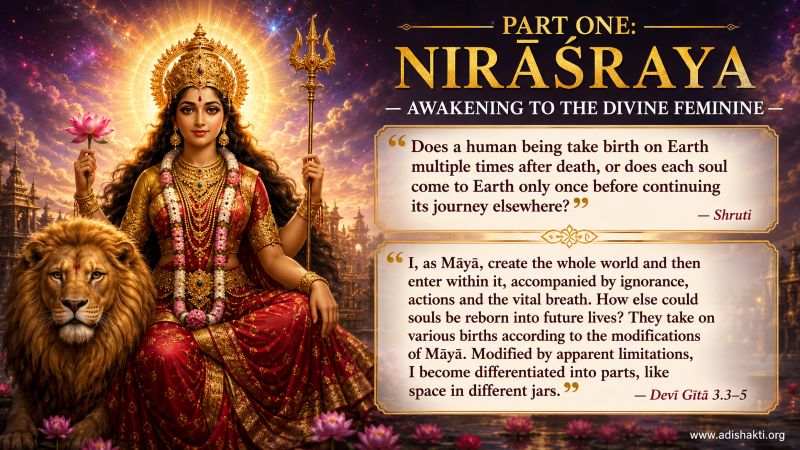
PART ONE: NIRĀŚRAYA — Awakening to the Divine Feminine
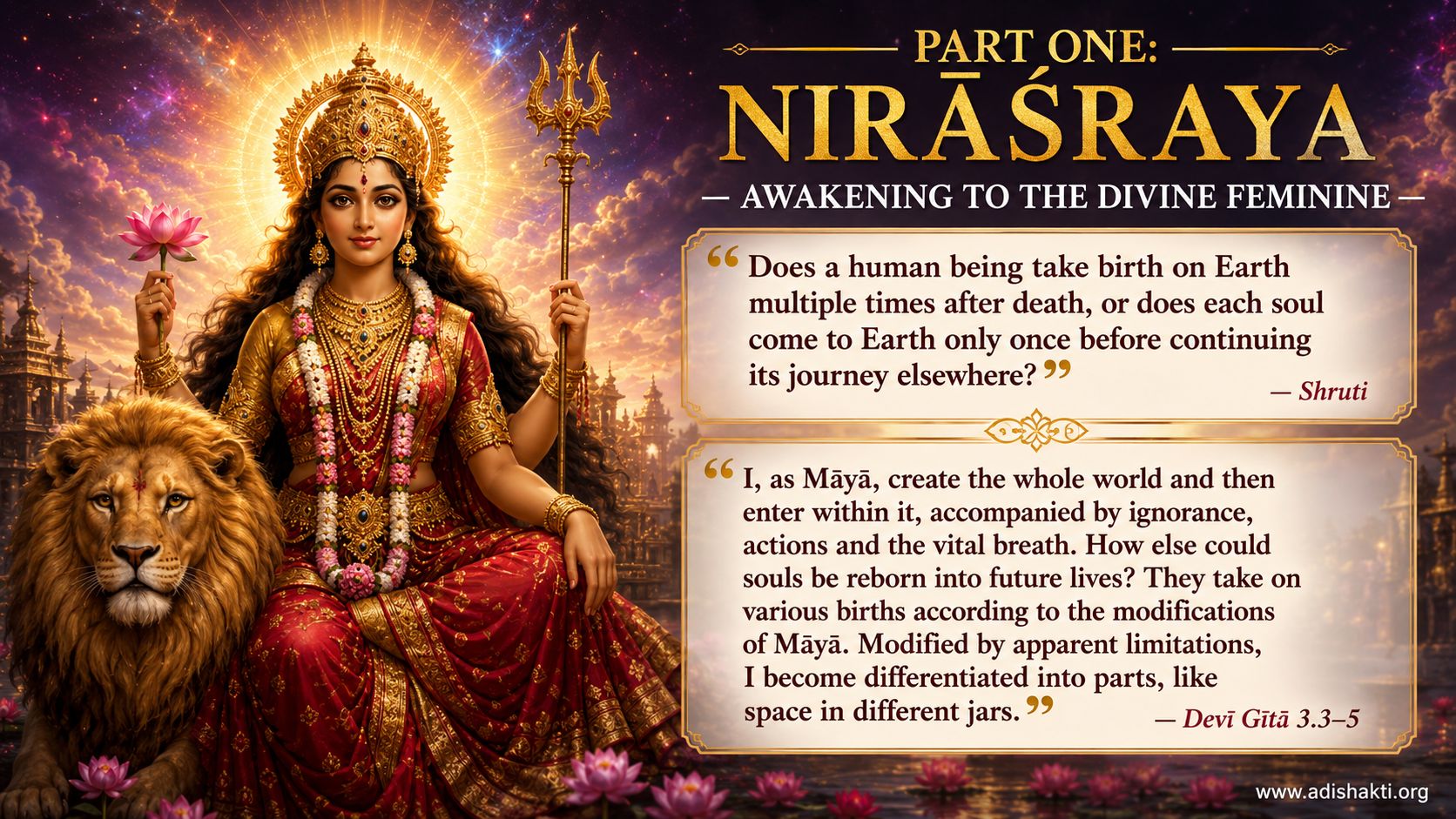
The Question That Guides This Inquiry:
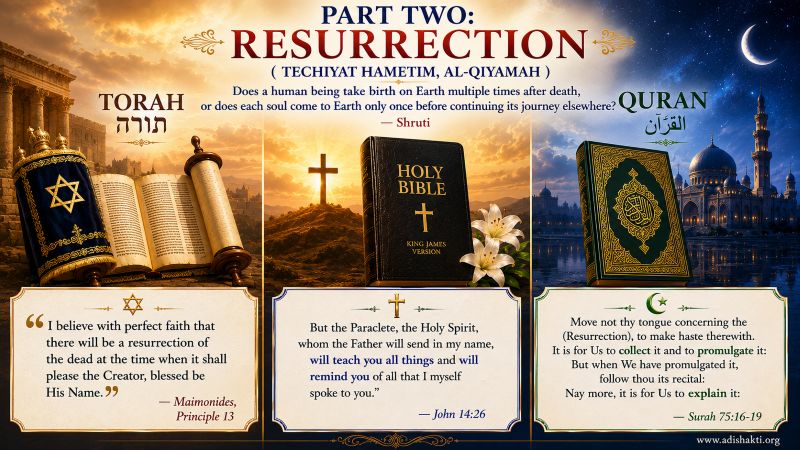
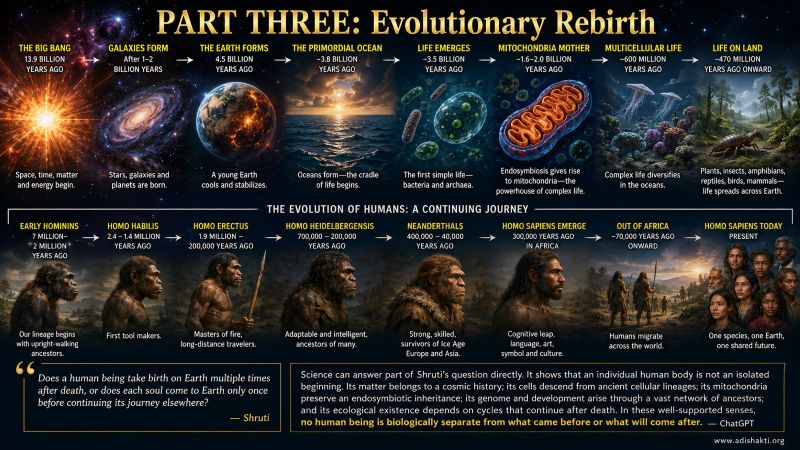
Does a Human Being Take Birth on Earth Multiple Times After Death, or Does Each Soul Come to Earth Only Once Before Continuing Its Journey Elsewhere?
Contents
- General Introduction: The Universal Question of Human Destiny
- Chapter One: The Historical Development of Rebirth in India
- Chapter Two: The Divine Mother Before Creation — Brahman, Pure Consciousness, and the Power of Māyā
- Chapter Three: Māyā, Ignorance, and the Birth of Individual Souls
- Chapter Four: Karma, Saṃskāras, and the Moral Architecture of Rebirth
- Chapter Five: Human Birth — The Precious Opportunity for Liberation
- Chapter Six: Cycles of Creation and Dissolution — The Cosmic Theatre of the Divine Mother
- Chapter Seven: The Nature of the Jīva — The Individual Soul Between Bondage and Liberation
- Chapter Eight: Nirāśraya — The Supreme State Beyond Dependence
- Chapter Nine: Meditation, Devotion, and Direct Realization — The Path to the Divine Mother
- Chapter Ten: Mokṣa — The Fulfillment of the Soul Beyond Rebirth
- Chapter Eleven: The Liberated Sage — Compassion, Wisdom, and Life After Awakening
- Chapter Twelve: The Destiny of the Cosmos — Creation, Compassion, and the Eternal Purpose of the Divine Mother
- Chapter Thirteen: Interpreting Rebirth — Literal, Symbolic, and Philosophical Perspectives
- Chapter Fourteen: The Universal Message of the Devī Gītā — Rebirth, Liberation, and the Future of Global Spiritual Dialogue
- Chapter Fifteen: Conclusion — Shruti's Question Revisited
General Introduction
The Universal Question of Human Destiny
1. Why Humanity Never Stops Asking About Death
Every civilization that has left written records has wrestled with the question of what happens after death. Ancient Egypt constructed pyramids in preparation for eternity. Greek philosophers debated whether the soul was immortal. Indian sages developed elaborate doctrines of karma and rebirth. The Hebrew prophets proclaimed the future resurrection of the dead. Christians centred their faith upon the Resurrection of Jesus. Muslims await al-Qiyāmah, the Day of Resurrection. Chinese philosophy reflected upon harmony between Heaven and humanity. Indigenous traditions throughout the world preserve narratives of ancestral survival beyond physical death. Although these traditions differ profoundly, they share a remarkable conviction: death cannot be understood merely as a biological event. Instead, it raises the deepest questions concerning consciousness, justice, identity, morality, purpose, and ultimate reality itself.
The persistence of these questions demonstrates something fundamental about human nature. Unlike other known living beings, human beings possess an extraordinary awareness of their own mortality. They not only know that they will die; they ask why they die, what death means, whether consciousness survives, and whether justice ultimately transcends earthly existence. These questions are not merely religious curiosities. They influence ethics, law, politics, psychology, culture, literature, and even scientific research into consciousness.
Modern neuroscience has enormously expanded our understanding of the brain. Yet despite remarkable advances, no universally accepted scientific explanation presently accounts for subjective consciousness itself. Likewise, philosophy continues to debate whether consciousness can be reduced entirely to physical processes or whether it reflects a more fundamental aspect of reality. Consequently, discussions concerning rebirth, resurrection, and immortality remain intellectually alive rather than relics of the ancient world.
2. Shruti's Question
The present study begins with this deceptively simple question. Although brief, it contains several assumptions requiring careful examination. What is meant by "human being"? What survives death? Is the continuing entity a soul, a stream of consciousness, an individual self, or something beyond all categories? What constitutes identity across multiple lives? If rebirth occurs, what mechanism governs it? If it does not occur, why does earthly existence appear so unequal? How are justice, suffering, and moral responsibility ultimately reconciled? These questions have generated thousands of years of philosophical reflection. No responsible academic study can answer them merely by quoting isolated scriptures. Instead, each tradition must be understood from within its own theological framework.
Accordingly, this volume does not attempt to construct a universal doctrine of the afterlife by combining unrelated religious ideas. Rather, it investigates one coherent theological system — the Śākta vision preserved principally within the Devī Gītā and the Devī Bhāgavata Purāṇa — allowing that tradition to speak in its own voice before any comparison with other religions is attempted.
3. Two Great Visions of Human Destiny
Throughout world religion, two broad models of humanity's ultimate destiny emerge. Although countless variations exist, they may be summarized as follows.
| Rebirth Traditions | Resurrection Traditions |
|---|---|
| Repeated earthly or cosmic embodiments | One earthly life |
| Karma governs future births | Divine judgment follows earthly life |
| Liberation ends rebirth | Resurrection inaugurates eternal life |
| History is fundamentally cyclical | History moves toward a final consummation |
| Mokṣa | World to Come |
Neither model should be caricatured. Each possesses rich philosophical traditions extending over millennia. Each attempts to explain suffering, justice, freedom, moral responsibility, and humanity's relationship with Ultimate Reality. The present volume examines the first model. Its companion volume examines the second. Together they represent two of humanity's most influential answers to the mystery of death.
4. Why Study the Devī Gītā?
Among the numerous scriptures of Hinduism, the Devī Gītā occupies a unique position. Here the Supreme Reality speaks not as a male deity but as the Great Goddess — the Mahādevī — who identifies Herself simultaneously as Brahman, pure consciousness, creator, sustainer, dissolver of the universe, and liberator of souls. Few religious texts present such an integrated synthesis of cosmology, metaphysics, devotion, yoga, and nondual philosophy. Within the Śākta tradition, the Divine Mother is not merely one deity among many. She is the ultimate ground from which all existence proceeds and into which all existence returns.
For these reasons, the Devī Gītā deserves far greater scholarly attention than it has often received. Although the Bhagavad Gītā has become one of the world's most widely studied religious classics, the philosophical richness of the Devī Gītā remains comparatively underexplored outside specialist scholarship. One purpose of this volume is therefore to present the text in a manner that is academically rigorous, historically informed, philosophically accessible, and respectful of its living devotional significance.
5. Methodology and Academic Principles
Every serious investigation of religion must distinguish carefully between historical evidence, textual interpretation, philosophical reasoning, theological doctrine, and personal religious conviction. One of the recurring weaknesses in both apologetic and skeptical literature is the tendency to blur these distinct categories. Scripture is sometimes treated as though it were modern historical reportage, while devotional interpretation is occasionally presented as if it were the only possible meaning of a sacred text. Conversely, theological claims are sometimes dismissed merely because they are not susceptible to experimental verification. The present study seeks to avoid both extremes. Its primary purpose is neither to defend nor to refute the doctrines of rebirth, but to understand them accurately within the theological universe in which they arose.
Consequently, the present volume adopts four complementary approaches:
- Textual Analysis — The principal source throughout this study is the Devī Gītā, read primarily through the critical English translation, annotation, and commentary of C. Mackenzie Brown. Where appropriate, parallel passages from the Devī Bhāgavata Purāṇa, the Upaniṣads, the Bhagavad Gītā, and related Śākta literature are examined in order to illuminate the philosophical context.
- Historical Interpretation — Religious texts emerge within historical communities. The Śākta tradition developed over many centuries through interaction with Vedic religion, Purāṇic mythology, Tantric practice, Vedāntic philosophy, and devotional movements.
- Comparative Theology — Although this volume concentrates upon the Śākta understanding of rebirth, its conclusions are occasionally illuminated by comparison with other religious traditions. Such comparisons are not intended to collapse differences into superficial similarities.
- Contemporary Interpretation — Finally, this volume occasionally considers contemporary devotional interpretations, including those presented on Adishakti.org. These are clearly identified as modern theological reflections rather than primary textual evidence.
6. Primary Sources
The principal sources employed throughout this study include:
- The Devī Gītā
- The Devī Bhāgavata Purāṇa
- The principal Upaniṣads
- The Bhagavad Gītā
- Selected Tantric literature
- Śrīvidyā texts
- Traditional Sanskrit commentaries
Secondary literature draws extensively upon modern academic scholarship, including studies by C. Mackenzie Brown, Douglas Brooks, David Kinsley, Thomas Coburn, Tracy Pintchman, Gavin Flood, Anway Mukhopadhyay, Alexis Sanderson, Karen Pechilis, and numerous historians of Indian religion.
7. Why This Study Is Different
Numerous books discuss reincarnation. Others examine Hindu philosophy, Tantra, Vedānta, or Goddess traditions. Few, however, attempt to integrate all these dimensions into a single coherent study centred upon one deceptively simple question: Does a human being come to Earth only once, or does the soul pass through many births before attaining liberation?
The present volume therefore differs from many previous studies in several important respects. First, it begins not with abstract philosophy, but with a concrete human question. Second, it examines rebirth within the complete theological vision of the Divine Mother rather than treating reincarnation as an isolated doctrine. Third, it distinguishes carefully between scripture, historical interpretation, academic scholarship, and contemporary devotional reflection. Fourth, it situates the Śākta doctrine within the wider conversation concerning human destiny that has occupied civilizations across the world for thousands of years. Finally, it forms one half of a larger comparative project. The companion volume, Part Two: Resurrection, examines Judaism, Christianity, and Islam, allowing readers to compare the two great eschatological paradigms without forcing either tradition into the categories of the other.
8. The Relationship Between Rebirth and Resurrection
One of the distinctive features of the present work is that it neither assumes nor argues that rebirth and resurrection are merely different expressions of the same doctrine. Historically, they developed within profoundly different theological worlds. The Śākta vision understands history as fundamentally cyclical. Birth, death, and rebirth continue until ignorance is overcome through liberating knowledge. The Abrahamic traditions, by contrast, understand history as linear. Each human being lives one earthly life, dies, awaits divine judgment, and ultimately participates in the resurrection of the dead. These two models answer many of the same existential questions while offering very different conceptions of time, justice, salvation, and ultimate reality. Recognizing these differences is essential to responsible comparative theology.
9. The Journey Ahead
The chapters that follow gradually unfold one of the world's most profound visions of reality. Beginning with the nature of the Supreme Goddess before creation, they explore the emergence of Māyā, the origin of individual souls, the operation of karma, the vast cycles of cosmic creation and dissolution, the psychology of ignorance, the discipline of nirāśraya, and finally the realization of liberation. Throughout this journey, one question remains constant:
The answer offered by the Devī Gītā is at once metaphysical, devotional, ethical, and contemplative. It is not merely a theory about life after death. It is an invitation to awaken to the deepest nature of consciousness itself. Whether one ultimately accepts or rejects its conclusions, the text stands among humanity's great philosophical and religious achievements, deserving careful study, critical reflection, and respectful dialogue.
Chapter One
The Historical Development of Rebirth in India — From the Vedic Hymns to the Devī Gītā
1. History Before Doctrine
Religious ideas rarely emerge fully formed. They grow gradually through centuries of reflection, dialogue, ritual practice, philosophical debate, and lived religious experience. The doctrine of rebirth is no exception. Although modern readers often speak of reincarnation as though it were a single fixed belief, the historical evidence suggests a much more dynamic development. Ancient India witnessed an extraordinary intellectual evolution in which understandings of death, the soul, moral responsibility, and ultimate reality became increasingly sophisticated over many centuries. The doctrine that eventually came to be known as saṃsāra — the continuous cycle of birth, death, and rebirth — represents the culmination of this long process rather than its starting point.
Consequently, to understand the Śākta teaching presented in the Devī Gītā, one must first appreciate the broader historical landscape from which it emerged. The Goddess does not reveal Her teaching within an intellectual vacuum. Her discourse presupposes centuries of earlier reflection concerning karma, consciousness, liberation, sacrifice, cosmology, and the nature of the Self. The Devī Gītā therefore stands not at the beginning of Indian religious history but near the flowering of one of its richest philosophical traditions.
2. The Earliest Vedic World
The oldest layer of Indian religious literature is the Ṛgveda, composed over many centuries before the Common Era. Its hymns celebrate the cosmic order maintained by divine powers such as Agni, Indra, Varuṇa, Sūrya, and Uṣas. These texts reveal a civilization deeply concerned with harmony between humanity, nature, and the gods. Sacrifice (yajña) occupied the centre of religious life, sustaining both cosmic order and human prosperity.
Contrary to many popular assumptions, however, the earliest Vedic hymns do not present the fully developed doctrine of repeated rebirth familiar from later Hinduism. Instead, they frequently express hope that the righteous dead may dwell among the ancestors (pitṛs) or enjoy immortal life in the heavenly world presided over by Yama, the first mortal who discovered the path beyond death. Immortality is certainly desired, yet it is generally conceived as continued existence in a divine realm rather than as repeated earthly embodiment.
This observation is historically significant. It reminds us that Indian religious thought, like every living intellectual tradition, developed progressively rather than appearing instantaneously.
3. The Upaniṣadic Revolution
Between approximately the eighth and fifth centuries BCE, Indian philosophy underwent one of the greatest transformations in world intellectual history. The composers of the Upaniṣads shifted attention from external sacrifice toward interior realization. Questions concerning ritual gradually gave way to questions concerning consciousness itself. Who am I? What survives death? What is the Self? What is Brahman? Can suffering end permanently? These questions would forever reshape Indian civilization.
It is within the principal Upaniṣads that the doctrines of karma, saṃsāra, and mokṣa receive their first systematic philosophical expression. Human actions acquire lasting moral consequences extending beyond a single lifetime. The soul's future existence becomes conditioned by previous actions. Birth and death become stages within a continuing cycle rather than isolated events. Most importantly, liberation (mokṣa) becomes possible through knowledge (vidyā) of one's true identity with ultimate reality.
4. The Bhagavad Gītā
The Bhagavad Gītā synthesizes many centuries of earlier philosophical development. Rather than rejecting worldly life, it teaches that liberation may be attained through disciplined action, devotion, meditation, and knowledge while remaining actively engaged in society. Its celebrated description of the soul changing bodies "as a person discards worn-out garments and puts on new ones" became one of the best-known statements concerning rebirth in world literature. Yet the Bhagavad Gītā never presents rebirth as the ultimate goal. Repeated birth remains evidence that liberation has not yet been fully realized. The highest aspiration continues to be union with the Supreme Reality beyond compulsory return to worldly existence.
5. The Purāṇic Expansion
The Purāṇas enormously expanded the cosmological imagination of Hinduism. Creation and dissolution no longer occur only once. Instead, universes emerge, endure, dissolve, and arise again through unimaginably vast cycles extending across billions of years. Human existence becomes situated within an immense cosmic drama. Individual karma unfolds not merely within one historical epoch but across repeated cosmic manifestations. This expanded cosmology profoundly influenced later Śākta theology.
Within these texts the universe becomes a living expression of divine creativity. Time itself assumes cyclical form. Creation is rhythmic rather than singular. Accordingly, rebirth also acquires cosmic dimensions. The soul's pilgrimage may continue through many creations and dissolutions until liberating knowledge finally ends ignorance.
6. The Śākta Synthesis
The Devī Gītā inherits every major stage of this historical development while simultaneously transforming it. The Upaniṣadic Brahman now speaks as the Divine Mother. Pure consciousness is no longer merely an abstract philosophical principle but the living Mahādevī herself. The cycles of creation and dissolution become expressions of Her Māyā. The individual soul experiences repeated birth because ignorance, karma, and apparent limitation continue to operate within Her manifested universe. Liberation therefore consists not simply in escaping the world but in realizing the Goddess as one's own deepest consciousness. This represents one of the most remarkable syntheses in Indian religious literature, uniting metaphysics, devotion, cosmology, yoga, and nondual philosophy into a single theological vision.
7. Historical Development at a Glance
| Historical Stage | Primary Concern | Understanding of Human Destiny |
|---|---|---|
| Early Vedas | Sacrifice and Cosmic Order | Life among the ancestors and gods |
| Upaniṣads | Self-knowledge | Karma, rebirth, liberation |
| Bhagavad Gītā | Yoga and Dharma | Rebirth overcome through union with the Supreme |
| Purāṇas | Cosmic Cycles | Rebirth across immense creations and dissolutions |
| Devī Gītā | Divine Mother as Brahman | Liberation through realization of the Goddess as Pure Consciousness |
Conclusion
The doctrine of rebirth did not emerge fully developed at the dawn of Indian civilization. It evolved through centuries of religious experience and philosophical inquiry. The earliest Vedic hymns expressed hope for immortality among the ancestors and the gods. The Upaniṣads transformed this hope into a profound philosophy of karma, saṃsāra, and mokṣa. The Bhagavad Gītā integrated these teachings into a practical path of disciplined action, devotion, and knowledge. The Purāṇas expanded the vision to encompass immense cycles of cosmic creation and dissolution. Finally, the Devī Gītā gathered these streams into a uniquely Śākta synthesis in which the Supreme Goddess reveals Herself as pure consciousness, the source of Māyā, and the liberator who brings the soul beyond the cycle of birth and death. This historical journey provides the necessary foundation for the chapters that follow. Before asking why souls are reborn, we must first understand the One from whom the universe itself proceeds.
Chapter Two
The Divine Mother Before Creation: Brahman, Pure Consciousness, and the Power of Māyā
1. Beginning Before the Beginning
Every great religious tradition begins its account of reality with an ultimate principle. The Hebrew Bible opens with the creation of the heavens and the earth. The Gospel of John begins: "In the beginning was the Word." The Qur'an repeatedly proclaims that Allah created the heavens and the earth in truth. The Tao Te Ching speaks of the Tao that precedes Heaven and Earth. The Upaniṣads speak of Brahman. The Devī Gītā begins differently. Rather than introducing an impersonal metaphysical principle or a distant creator, the speaker is the Supreme Goddess herself. She does not merely describe ultimate reality. She identifies herself with ultimate reality.
2. "I Alone Existed"
Few passages in Indian religious literature summarize an entire metaphysical system with such remarkable economy. Within only a few verses, the Goddess establishes four foundational propositions. First, ultimate reality is one. Before creation no second independent reality exists. Second, that ultimate reality is conscious. The foundation of existence is not unconscious matter but Pure Consciousness itself. Third, that consciousness is Brahman, the Absolute described throughout the Upaniṣads. Fourth, creation proceeds through the mysterious power known as Māyā. These four affirmations become the theological foundation upon which the remainder of the Devī Gītā is built.
3. Brahman Reimagined
The word Brahman occupies one of the highest positions within Indian philosophy. The Upaniṣads describe Brahman as infinite, eternal, unborn, changeless, beyond speech and beyond thought. Advaita Vedānta identifies Brahman as the sole ultimate reality. The Devī Gītā fully accepts this philosophical inheritance. Its remarkable contribution lies elsewhere. The impersonal Brahman of philosophical discourse now speaks with a personal voice. The Absolute addresses the seeker directly. The highest metaphysical reality is revealed as the Divine Mother.
This represents neither a rejection of Upaniṣadic thought nor a departure from Vedānta. Rather, it is a distinctly Śākta interpretation of the same ultimate reality. The Goddess is not added to Brahman. She is Brahman. Consequently, devotion to the Divine Mother is simultaneously devotion to the Absolute itself.
4. Pure Consciousness
Perhaps no concept is more important in the Devī Gītā than Pure Consciousness. The Goddess does not identify herself primarily with physical power, cosmic sovereignty, or even creative activity. Her essential nature is consciousness itself. This declaration immediately distinguishes the Śākta worldview from every philosophy that regards matter as fundamental. Matter, time, space, and individuality are not primary realities. Consciousness is.
The Sanskrit word cit signifies awareness that is self-luminous. Unlike material objects, consciousness is never known as something external. Every experience presupposes awareness. Every thought presupposes a thinker. Every perception presupposes consciousness itself. Thus, the Devī Gītā places consciousness not at the end of evolution but at the very beginning of existence.
This metaphysical claim continues to attract philosophical interest today. Modern debates concerning the "hard problem" of consciousness, panpsychism, idealism, and the relationship between mind and matter demonstrate that the fundamental nature of consciousness remains one of the deepest unresolved questions in philosophy. Although the Devī Gītā belongs to a very different intellectual world, its identification of ultimate reality with consciousness continues to resonate with contemporary discussions.
5. The Emergence of Māyā
If ultimate reality is one and perfect, why does the universe appear as many? Why do finite individuals exist? Why is there suffering? Why is liberation necessary? The Devī Gītā answers through the doctrine of Māyā.
The Goddess declares that from Her arises a mysterious power called Māyā. This statement has often been misunderstood. Māyā does not mean that the universe is absolutely unreal. Nor does it imply that creation is a mistake. Rather, Māyā is the divine power through which the One appears as many, the Infinite appears finite, and Pure Consciousness manifests as the changing universe. Without Māyā there could be no creation. Without creation there could be no individual experience. Without individual experience there could be neither bondage nor liberation.
Thus, Māyā occupies an essential position within Śākta theology. It is neither evil nor independent of the Goddess. It is Her own creative power.
6. The Universe as Divine Manifestation
One of the most beautiful implications of the Devī Gītā is that creation is not external to the Divine Mother. The universe exists within Her own power. Every galaxy, every living organism, every atom, every human mind, every act of love, every moment of awakening, arises within the limitless field of Her consciousness. This does not imply that every appearance perfectly reflects ultimate reality. The world remains conditioned by ignorance and limitation. Nevertheless, the universe never exists apart from its divine ground.
Consequently, the spiritual journey is not fundamentally a movement from one place to another. It is a transformation of vision. The seeker gradually learns to perceive the Divine Mother where previously only multiplicity appeared.
7. Creation and Rebirth
Why begin a book about rebirth with cosmology? Because the doctrine of rebirth depends entirely upon one's understanding of creation. If reality were fundamentally material, rebirth would require one kind of explanation. If reality is fundamentally consciousness, rebirth receives a very different interpretation. Within the Devī Gītā, the individual soul appears through Māyā, acts through ignorance, accumulates karma, and consequently experiences repeated embodiment. Thus, rebirth is not an isolated mechanism operating independently of cosmology. It belongs to the larger drama of consciousness manifesting itself through apparent limitation. Only after understanding this framework can later chapters examine why souls return repeatedly to embodied existence.
8. The Architecture of Reality
| Reality | Śākta Interpretation |
|---|---|
| Ultimate Reality | The Divine Mother as Brahman |
| Essential Nature | Pure Consciousness (Cit) |
| Creative Power | Māyā |
| Manifest Universe | Expression of Divine Power |
| Individual Soul | Apparent limitation within Consciousness |
| Liberation | Realization of the Divine Mother as one's true Self |
Conclusion
The Devī Gītā begins where philosophy reaches its greatest heights: before creation itself. The Goddess declares that She alone existed in the beginning, that Her essential nature is Pure Consciousness, and that from Her arises Māyā, the power through which the universe appears. This vision transforms every later doctrine. Rebirth is no longer merely the migration of an isolated soul between physical bodies. It becomes part of a vast metaphysical drama in which Consciousness appears as multiplicity, experiences apparent limitation, and finally awakens to its own eternal nature. The remainder of this volume unfolds naturally from this foundation. If the Divine Mother alone is ultimately real, how do individual souls appear to become separate? How does ignorance arise? Why does karma bind? Why does rebirth continue? These questions lead directly to the next chapter.
Chapter Three
Māyā, Ignorance, and the Birth of Individual Souls — Why Consciousness Appears as Many
1. The Great Philosophical Question
Every philosophy that affirms an ultimate unity must answer an unavoidable question. If reality is truly one, why does ordinary experience present an immense multiplicity of separate beings? Human beings experience themselves as distinct individuals. They think independently. They remember different histories. They possess unique personalities. They experience pleasure and suffering separately. How can such diversity arise if ultimate reality is one indivisible consciousness? This question has occupied Indian philosophers for more than two thousand years. The Devī Gītā provides one of its most elegant answers.
2. The Goddess Enters Her Own Creation
These verses form one of the theological centers of the Devī Gītā. The Goddess does not merely create the universe and remain distant from it. She enters Her own creation. The manifested world is therefore not abandoned to mechanical processes independent of its Creator. Rather, the entire cosmos remains continuously sustained within the living presence of the Divine Mother. At the same time, the passage introduces the mechanisms through which finite individuality appears: Māyā, ignorance, action (karma), and embodiment.
3. What Is Māyā?
Few Sanskrit words have generated more misunderstanding than Māyā. In popular literature it is often translated simply as "illusion." Although not entirely incorrect, this translation is incomplete and frequently misleading. If the universe were absolutely unreal, religious life itself would lose significance. The Devī Gītā proposes something far subtler. Māyā is the Divine Mother's own creative power. Through Māyā, the infinite appears finite, the timeless appears temporal, the undivided appears divided, and Pure Consciousness manifests as the universe of names and forms. The world therefore possesses relative reality. It is neither independent of the Divine Mother nor identical with Her transcendent nature.
This distinction is essential. The world is not false because it exists. Rather, illusion arises when finite appearance is mistaken for ultimate reality.
4. The Birth of the Individual Soul
How, then, does individuality arise? The Devī Gītā answers through the concept of upādhi, often translated as "limiting adjunct" or "apparent limitation." Pure Consciousness remains undivided. Yet when consciousness is experienced through the limitations of body, mind, senses, memory, and ego, the appearance of separate individuality emerges. The jīva is therefore neither wholly independent nor merely imaginary. It is Consciousness experienced under limiting conditions.
The tradition frequently illustrates this with metaphors. One sun appears reflected in countless pools of water. One moon appears multiplied in many lakes. One electricity illumines thousands of lamps. One ocean gives rise to innumerable waves. None of these images suggest that the underlying reality has actually become many. Multiplicity belongs to appearance rather than to ultimate being.
5. The Space Within the Jar
This analogy has become one of the classic illustrations of non-dual philosophy. Imagine many clay jars standing beneath the open sky. Each appears to contain its own separate space. One may speak of "the space inside this jar" and "the space inside that jar." Yet when a jar breaks, nothing actually happens to space itself. Only the apparent limitation disappears. The space within the jar was never truly separate from infinite space.
The Devī Gītā applies precisely this analogy to individual consciousness. The body, mind, and ego function like the walls of the jar. Pure Consciousness appears individualized because it is experienced through these limiting conditions. When ignorance ends, consciousness is not enlarged. Rather, its original infinitude is recognized.
6. Avidyā: The Veil of Ignorance
If the true nature of every being is Pure Consciousness, why is this not immediately recognized? The answer lies in avidyā, ignorance. Ignorance here does not mean lack of information. It signifies a fundamental misidentification. Human beings ordinarily identify themselves with body, emotions, thoughts, social roles, memories, achievements, fears, and desires. These changing phenomena are taken to constitute the self. According to the Devī Gītā, this mistaken identity sustains bondage. The problem is therefore not that reality is absent. The problem is that reality is misunderstood.
Liberation consequently requires knowledge (vidyā) rather than merely moral improvement. Ethical living remains indispensable, but ethical conduct alone cannot remove metaphysical ignorance. Only direct realization of the Divine Mother as Pure Consciousness dissolves the illusion of separateness.
7. Why Karma Becomes Possible
Once individuality appears, action naturally follows. The individual experiences itself as an autonomous agent. It chooses. It desires. It fears. It acts. Every action generates consequences. These consequences become karma. Karma reinforces individuality. Individuality generates further action. Action produces further karma. Thus the cycle becomes self-perpetuating.
Importantly, karma does not originate because the Divine Mother punishes human beings. Rather, karma expresses the lawful continuity of conscious action within the manifested order established through Māyā. It is the moral architecture of the universe itself.
8. The Origin of Rebirth
The appearance of individuality, ignorance, and karma together explain why rebirth becomes necessary. The jīva remains identified with finite existence. Desires remain incomplete. Actions remain unfinished. Attachments continue. Consequently, consciousness assumes further embodiments appropriate to the continuing operation of karma. Rebirth therefore represents not arbitrary punishment but the continuation of an unfinished process of spiritual evolution.
9. Summary of the Śākta Process
| Stage | Description |
|---|---|
| Pure Consciousness | The Divine Mother alone exists. |
| Māyā | Creative manifestation begins. |
| Apparent Limitation | Consciousness appears individualized. |
| Ignorance (Avidyā) | The individual identifies with finite existence. |
| Action (Karma) | Desire and action generate continuing consequences. |
| Rebirth | Future embodiments continue until liberating knowledge arises. |
| Liberation | The apparent limitation disappears through realization of the Divine Mother as Pure Consciousness. |
Conclusion
The Devī Gītā explains the origin of individuality without abandoning the unity of ultimate reality. The Divine Mother alone exists as Pure Consciousness. Through Māyā, She manifests the universe. Through apparent limitation, consciousness appears as countless individual souls. Ignorance causes these individuals to mistake finite identity for their true nature. Action performed under this illusion generates karma. Karma sustains the necessity of further embodiment. Thus, rebirth is not an isolated doctrine but one stage within a comprehensive metaphysical vision extending from creation to liberation. The next chapter turns to the moral dynamics of this process by examining karma itself. How do actions shape future births? Why do different beings experience vastly different lives? Can karma ever be exhausted? These questions lead us to the ethical heart of the Śākta understanding of saṃsāra.
Chapter Four
Karma, Saṃskāras, and the Moral Architecture of Rebirth — Why Souls Return Again and Again
1. The Moral Question
Every civilization has wrestled with the apparent inequalities of human life. Why does one child inherit health while another is born with severe illness? Why do extraordinary gifts appear early in some individuals? Why do injustice and suffering often seem disconnected from visible moral conduct? Religious traditions have proposed many answers. Some attribute such differences entirely to divine providence. Others emphasize chance or biological inheritance. The Śākta tradition approaches the problem through karma. Karma does not eliminate divine compassion. Neither does it deny human freedom. Rather, it proposes that conscious actions possess enduring consequences that extend beyond a single lifetime. The present condition of every jīva reflects not merely present choices but the continuing history of consciousness itself.
2. The Meaning of Karma
The Sanskrit word karma literally means "action." Its theological meaning is considerably richer. Every intentional thought, word, and deed leaves a subtle consequence. Actions shape character. Character influences future choices. Future choices generate further consequences. Thus karma is neither blind fate nor divine punishment. It is the moral continuity of conscious existence.
The Devī Gītā assumes this broader understanding. The Goddess explains that souls become associated with action and thereby enter future embodiments according to the modifications of Māyā.
3. Saṃskāras: The Memory Beneath Memory
The doctrine of karma alone cannot explain the remarkable continuity observed between successive lives. For this reason Indian philosophy introduces the complementary concept of saṃskāras. Saṃskāras are subtle impressions left upon consciousness by previous experience. Unlike ordinary memories, they need not be consciously recalled. They function more like deep patterns of perception, inclination, emotional response, and capacity. Every experience leaves an imprint. Repeated actions strengthen those impressions. Over time they become the architecture of personality itself.
The Devī Bhāgavata Purāṇa speaks of creation unfolding in accordance with previous dispositions, karma, and time. This teaching expands the doctrine of rebirth beyond isolated lifetimes, suggesting continuity even across cosmic dissolutions.
4. Vāsanās: The Seeds of Desire
Closely related to saṃskāras are vāsanās, the subtle tendencies or desires that propel future action. Every desire seeks fulfillment. When fulfillment remains incomplete, the tendency persists. The unfinished movement of desire therefore contributes to future embodiment. The individual returns not because an external power compels repetition but because inward tendencies continue to seek expression.
This understanding profoundly reshapes the meaning of rebirth. The soul is not merely transferred from one body to another. Rather, its deepest habits of consciousness gradually unfold across many lives until wisdom finally dissolves ignorance.
5. The Lawfulness of the Universe
One of the most remarkable aspects of Hindu thought is its confidence that the moral universe possesses intrinsic order. The Divine Mother need not intervene arbitrarily after every action. Her creation itself embodies intelligible law. Just as physical actions produce physical consequences, moral actions produce moral consequences. The universe therefore becomes ethically structured. Freedom exists, yet freedom always operates within a lawful cosmos.
This understanding differs both from strict determinism and complete indeterminacy. Human beings remain genuinely responsible. Every present decision contributes to future experience. Yet no action is isolated. Each enters an immense network of relationships extending across individual lives and cosmic history.
6. Grace and Karma
At first sight the doctrine of karma may appear entirely mechanical. Such an interpretation would misunderstand the Devī Gītā. The Śākta tradition never presents karma as stronger than the Divine Mother. Karma belongs to Her manifested universe. Grace also belongs to Her. Knowledge also comes from Her. Liberation itself is Her gift. Consequently, karma explains the continuity of bondage, while grace makes liberation possible. Without grace, karma could continue indefinitely. Without knowledge, ignorance would never end. The moral order therefore culminates not merely in justice but in compassion.
7. Can Karma Ever End?
This question naturally follows. If actions continually generate further consequences, does rebirth continue forever? The answer given by the Devī Gītā is no. Karma persists only while ignorance persists. When the seeker realizes the Divine Mother as Pure Consciousness, the mistaken identification with finite individuality dissolves. Action performed thereafter no longer generates binding karma in the ordinary sense because the illusion of separate agency has been overcome. Thus liberation is not simply the exhaustion of an infinite account of moral debt. It is a transformation of consciousness itself.
8. A Comparison with Other Religious Traditions
| Tradition | Primary Explanation of Moral Destiny |
|---|---|
| Śākta Hinduism | Karma operating through repeated births until liberation |
| Buddhism | Dependent origination and karmic continuity without permanent self |
| Jainism | Karmic matter literally binds the soul |
| Judaism | Divine covenant, justice, and resurrection |
| Christianity | Grace, judgment, resurrection, and eternal life |
| Islam | Divine justice, accountability, and al-Qiyāmah |
These traditions all affirm moral responsibility. They differ primarily concerning how moral continuity extends beyond physical death. The present volume examines the Śākta answer. The companion volume explores the Abrahamic doctrine of resurrection.
9. The Wheel of Saṃsāra
| Stage | Description |
|---|---|
| Ignorance | The jīva mistakes finite identity for its true nature. |
| Desire (Vāsanā) | Unfulfilled tendencies seek expression. |
| Action (Karma) | Choices generate enduring moral consequences. |
| Impressions (Saṃskāras) | Experience shapes future character and perception. |
| Embodiment | New conditions arise according to continuing karma. |
| Rebirth | The cycle repeats until liberating knowledge dawns. |
Conclusion
The Śākta doctrine of karma is far more comprehensive than a simple law of reward and punishment. It describes the moral, psychological, and spiritual continuity of conscious existence. Actions generate consequences. Consequences shape character. Character forms latent impressions. Latent impressions nourish desire. Desire leads to further action. Thus the wheel of saṃsāra continues to revolve. Yet this cycle is not eternal by necessity. Because bondage arises through ignorance, it can end through knowledge. Because the universe is ultimately grounded in the Divine Mother, grace remains stronger than karma. Liberation therefore becomes possible not through escape from reality but through awakening to reality's deepest nature.
Chapter Five
Human Birth: The Precious Opportunity for Liberation — Why the Human Embodiment Holds a Unique Place in the Devī Gītā
1. The Value of Human Life
Across the diverse schools of Hindu philosophy, one conviction appears repeatedly: human birth is exceedingly rare. The countless forms of life that populate the universe participate in the Divine Mother's creation, yet the human condition possesses a distinctive spiritual capacity. Human beings can reflect upon themselves. They can distinguish between transient and eternal realities. They can cultivate wisdom, devotion, compassion, and disciplined practice. Most importantly, they can inquire into the deepest question of all: Who am I?
This capacity for self-reflection transforms ordinary biological existence into a profound spiritual vocation. Human life is therefore valued not because humanity stands above nature, but because the human mind can consciously awaken to its divine source.
2. The Purpose of Embodiment
If every soul ultimately belongs to the Divine Mother, why enter the limitations of embodied existence? The Devī Gītā answers that embodiment is neither meaningless nor permanent. The body becomes a field of experience through which consciousness gradually matures. Joy and sorrow, success and failure, attachment and loss all become teachers. Every experience has the potential either to deepen ignorance or to awaken wisdom.
The Goddess therefore does not create bodies merely to imprison souls. She provides conditions within which ignorance may eventually be overcome. Earthly existence becomes a sacred school rather than a cosmic prison.
3. Freedom Within the Law of Karma
Previous chapters explained that karma shapes the circumstances into which each individual is born. Yet karma does not eliminate freedom. Each new life presents fresh opportunities. Past actions influence present conditions, but they do not absolutely determine future choices. The human being remains capable of learning, transforming, and redirecting the course of life.
This balance between continuity and freedom is one of the strengths of the Śākta understanding of rebirth. The past matters. The present matters equally. Every decision contributes to the ongoing formation of consciousness. Thus each lifetime possesses genuine moral significance.
4. The Awakening of Discrimination
Indian philosophy frequently speaks of viveka, the power of discrimination. This does not mean judgmentalism. Rather, it refers to the capacity to distinguish between the permanent and the impermanent, the Self and the non-Self, wisdom and ignorance. Without this faculty liberation cannot occur.
Human birth provides the intellectual, moral, and contemplative conditions necessary for cultivating such discernment. The individual gradually recognizes that wealth, power, reputation, and even physical existence remain transient. This realization does not produce despair. Instead, it redirects attention toward that which cannot perish.
5. The Role of Devotion
Although knowledge occupies a central place within the Devī Gītā, knowledge alone is never presented as cold intellectual understanding. The path unfolds through devotion (bhakti) as well. The seeker learns to love the Divine Mother not merely as Creator but as the indwelling Reality present within every heart. Devotion softens the ego. Humility opens the mind. Compassion naturally follows. Knowledge and devotion therefore become complementary rather than competing paths.
This integration distinguishes much of Śākta spirituality. Liberation arises neither from emotion alone nor from abstract reasoning alone. The entire person — mind, heart, and will — is transformed.
6. The Human Body as a Temple
One of the most beautiful themes within the wider Śākta tradition is the understanding of the human body as sacred. The body is not merely matter. It is the living field within which the Divine Mother's presence may be realized. Tantric traditions, the worship of Kuṇḍalinī, and the symbolism of the subtle body all reflect this conviction.
Consequently, spiritual practice does not seek escape from embodiment. Instead, embodiment becomes the means through which realization is attained. The body is respected, disciplined, and purified because it serves as the vehicle of awakening.
7. Why Human Birth Is Rare
Traditional Hindu literature frequently describes human birth as difficult to obtain. Whether interpreted literally or symbolically, the underlying message remains the same. Conscious self-awareness should never be taken for granted. Each lifetime presents possibilities that may never arise in precisely the same form again. Relationships, opportunities, teachers, and spiritual insights appear within particular historical circumstances. To squander these opportunities through ignorance or indifference is therefore regarded as a profound tragedy.
The Devī Gītā consistently directs the seeker toward urgency — not anxiety, but purposeful living. The present life matters. It is here that liberation becomes possible.
8. A Comparative Perspective
| Tradition | Meaning of Human Life |
|---|---|
| Śākta Hinduism | Opportunity to realize the Divine Mother and transcend rebirth. |
| Advaita Vedānta | Realization of Brahman through knowledge. |
| Buddhism | Rare opportunity to attain enlightenment and end suffering. |
| Christianity | One earthly life in preparation for resurrection and eternal communion with God. |
| Islam | One earthly life as a test of faith before al-Qiyāmah and final judgment. |
Despite their differing eschatologies, these traditions share an important conviction. Human life possesses profound spiritual significance. None encourages complacency. Each understands earthly existence as a decisive opportunity demanding moral responsibility and spiritual awakening.
9. The Invitation of the Divine Mother
The Devī Gītā ultimately presents human birth as an invitation rather than an inevitability. The Divine Mother continually calls each soul toward recognition of its true nature. Every act of compassion, every sincere prayer, every moment of meditation, every pursuit of truth becomes part of that invitation. Human existence therefore possesses immense dignity. The seeker is not abandoned within an indifferent universe. The same Divine Mother who manifests the cosmos also accompanies every soul throughout its journey toward liberation. Her grace continually invites awakening.
Conclusion
Human birth occupies a unique place within the Śākta vision because it unites freedom, moral responsibility, self-awareness, and the possibility of liberation. The body becomes a sacred instrument rather than a prison. Karma provides the conditions of life, yet freedom and grace make transformation possible. Knowledge matures through devotion. Devotion culminates in realization. Thus the purpose of human existence is not endless repetition but conscious return to the Divine Mother whose presence has always sustained the soul. This insight prepares the way for the next stage of our study. If human birth offers the opportunity for liberation, what is the larger cosmic framework within which these births occur? To answer that question, we must explore the vast cycles of creation and dissolution that characterize the Śākta understanding of the universe.
Chapter Six
Cycles of Creation and Dissolution: The Cosmic Theatre of the Divine Mother
1. A Universe That Breathes
One of the defining characteristics of Indian cosmology is its vision of the universe as living rather than static. Creation is not conceived as a single event occurring once in the distant past. Nor does history advance toward only one final consummation. Instead, existence unfolds rhythmically. Worlds emerge from the Divine Mother, flourish for vast periods beyond ordinary human comprehension, dissolve into unmanifest reality, and later emerge again. The universe therefore resembles a great cosmic respiration. Creation is the Divine Mother's exhalation. Dissolution is Her inhalation. Neither movement diminishes Her eternal nature. She remains unchanged while the cosmos continuously appears and disappears within Her infinite consciousness.
2. The Meaning of Pralaya
The Sanskrit word pralaya signifies dissolution. Yet dissolution should not be confused with annihilation. The Devī Gītā does not teach that reality itself ceases to exist. Rather, the manifested universe returns to its unmanifest condition. Names and forms disappear. Time itself becomes latent. The distinctions that characterize the visible universe are withdrawn into their divine source. The Divine Mother alone remains exactly as She was before creation.
This distinction is essential. If ultimate reality were altered by creation, it would no longer be absolute. If ultimate reality were destroyed by dissolution, it would cease to be eternal. The Devī Gītā therefore insists that only appearances change. Pure Consciousness remains forever complete.
3. Time Beyond Human Imagination
Classical Hindu cosmology describes cycles extending across unimaginable spans of time. Yugas, manvantaras, kalpas, and mahākalpas together portray a universe whose history reaches billions of years. Although these numbers possess symbolic as well as cosmological significance, their theological purpose is clear. Human history occupies only a minute portion of a far greater cosmic order.
This perspective profoundly reshapes spiritual understanding. Individual anxieties, civilizations, kingdoms, even entire planets appear within a much larger horizon. The soul's journey cannot be understood solely through one historical epoch. Its pilgrimage unfolds across cosmic cycles governed by the Divine Mother's wisdom.
4. The Soul Through Many Creations
The Devī Bhāgavata Purāṇa expands the doctrine of rebirth beyond successive human lives by placing it within recurring creations themselves. The subtle continuity of karma does not necessarily terminate when one universe comes to an end. Rather, the accumulated tendencies of consciousness remain associated with the individual soul until liberation is attained.
This cosmological vision greatly enlarges the meaning of saṃsāra. The soul's journey extends not merely through many earthly births but through vast cosmic epochs. Only realization of the Divine Mother finally brings this pilgrimage to its completion.
5. Creation as Divine Play
Śākta theology frequently interprets creation as līlā, the divine play of the Supreme Mother. The universe is not produced because the Divine lacks something. Nor is creation the result of necessity. The Infinite creates from fullness rather than deficiency.
The metaphor of play should not be misunderstood as trivializing suffering. Rather, it emphasizes freedom. The Divine Mother is never constrained by external necessity. Creation expresses inexhaustible creativity. Every galaxy, every living organism, every human life participates in this creative manifestation. Yet none of these exhaust the Infinite from which they arise.
6. Impermanence and Eternity
The cyclical universe teaches a profound spiritual lesson. Everything that appears within time eventually changes. Stars are born and perish. Civilizations rise and disappear. Bodies age. Empires collapse. Even universes themselves dissolve. The only permanent reality is the Divine Mother as Pure Consciousness.
Recognition of impermanence therefore becomes an invitation rather than a cause for despair. If all conditioned existence changes, attachment to transient forms inevitably produces suffering. Liberation begins when the seeker learns to distinguish the eternal from the temporary. This insight echoes the cultivation of viveka, introduced in the previous chapter as the power of spiritual discrimination.
7. The Human Place Within Cosmic History
Against this immense cosmological background, human life acquires both humility and dignity. Humility, because each individual occupies only a brief moment within an ancient universe. Dignity, because every human being possesses the capacity to realize the timeless consciousness that transcends all cosmic cycles. The significance of human existence therefore depends not upon duration but upon realization. Even a single lifetime may culminate in liberation.
Thus the vastness of Hindu cosmology does not diminish the value of present life. On the contrary, it intensifies its importance. The opportunity for awakening exists here and now.
8. A Comparison of Cosmic Time
| Śākta Cosmology | Linear Eschatology |
|---|---|
| Repeated creation and dissolution | One creation |
| Multiple cosmic cycles | Single historical narrative |
| Repeated embodiment until liberation | One earthly life before resurrection |
| Liberation transcends cosmic cycles | Resurrection inaugurates the eternal Kingdom |
| History is rhythmic | History is linear |
Neither framework should be dismissed as intellectually simplistic. Each reflects a coherent theological vision concerning divine action, human destiny, and the meaning of history. Understanding their differences enables respectful comparative dialogue rather than superficial comparison.
9. Toward the End of the Journey
The purpose of cyclical cosmology is not to encourage fascination with immense numbers or speculative chronology. Its true purpose is spiritual. The repeated rise and dissolution of worlds illustrates that everything conditioned is temporary. Only realization of the Divine Mother as Pure Consciousness provides lasting freedom. Rebirth continues only while ignorance persists. The cosmic theatre exists so that consciousness may awaken to itself. Thus the greatest miracle within the Devī Gītā is not the creation of worlds but the liberation of the individual soul.
Conclusion
The Devī Gītā presents one of the grandest cosmological visions in religious history. The universe is neither accidental nor eternal in its manifested form. It unfolds rhythmically through recurring cycles of creation, preservation, and dissolution within the limitless consciousness of the Divine Mother. The individual soul accompanies this cosmic rhythm through many embodiments, carrying karma and latent impressions across immense spans of existence until liberating knowledge finally dissolves ignorance. The significance of this vision lies not merely in its cosmology but in its spiritual message. Every created form is temporary. Only the Divine Mother remains eternal. Recognition of this truth prepares the seeker for the decisive question that follows. If the universe itself continually changes, who — or what — is the enduring traveler through all these transformations? The next chapter therefore turns from the cosmos to the individual by examining the nature of the jīva, the embodied self whose long pilgrimage through saṃsāra has occupied the preceding chapters.
Chapter Seven
The Nature of the Jīva: The Individual Soul Between Bondage and Liberation
1. Who Am I?
Every authentic spiritual tradition eventually arrives at the same fundamental inquiry. Who is the one that sees? Who thinks? Who suffers? Who rejoices? Who survives death? The answer given determines an entire philosophy of life. Materialism identifies the self with the brain. Classical Buddhism questions the existence of a permanent self altogether. Abrahamic traditions generally understand the soul as a unique creation of God. The Devī Gītā begins elsewhere. It asks whether the apparent individual is truly independent or whether individuality itself belongs to the realm of Māyā.
Thus the inquiry into the jīva is not merely psychological. It is metaphysical. Understanding the soul becomes essential for understanding bondage, karma, rebirth, and liberation.
2. The Meaning of Jīva
The Sanskrit word jīva literally means "the living one." Within Hindu philosophy it designates the individual conscious being that experiences birth, action, pleasure, suffering, death, and rebirth. Yet the Devī Gītā carefully distinguishes the jīva from the body's physical existence. Bodies change continually. Thoughts change. Emotions arise and disappear. Memory itself fluctuates. The witnessing consciousness, however, remains present throughout every change.
The jīva therefore represents consciousness as experienced through individuality. It is not the physical organism. Nor is it merely the personality developed during one lifetime. Rather, it is the continuing bearer of experience throughout successive embodiments.
3. The Apparent Individual
This image, introduced briefly in Chapter Three, deserves closer attention. Suppose countless clay jars stand beneath the open sky. Ordinary language speaks of "the space inside each jar." Yet no one imagines that space itself has actually been divided. Only the containers differ. The apparent separation belongs to the jars rather than to space.
The Devī Gītā applies precisely this principle to consciousness. The Divine Mother alone is infinite Consciousness. The jīvas appear separate because consciousness is reflected through countless bodies, minds, personalities, and karmic histories. Difference belongs to manifestation. Unity belongs to ultimate reality.
4. The Witness Consciousness
One of the most profound contributions of the Upaniṣads and the Devī Gītā is the distinction between changing experience and the unchanging witness. Thoughts appear. They disappear. Sensations arise. They fade. Memories come and go. The body ages continuously. Yet throughout every change there remains awareness itself. Without awareness, no experience could occur.
The jīva ordinarily identifies with changing experience. Spiritual realization shifts attention toward the witnessing consciousness that remains unchanged throughout every stage of life. This witness is not produced by the body. Rather, the body becomes one of its instruments.
5. Why the Soul Appears Limited
If the jīva is ultimately rooted in Pure Consciousness, why does it appear finite? The answer again lies in upādhi, the limiting adjuncts described in earlier chapters. Body. Mind. Memory. Language. Culture. Habit. Desire. Fear. Together these create the appearance of individuality. None destroys Pure Consciousness. They merely condition its manifestation.
This distinction resembles sunlight passing through coloured glass. The light itself remains unchanged. Different colours appear because of the medium through which it shines. Likewise, the Divine Mother's consciousness appears differently according to the conditions through which it is expressed.
6. The Journey Through Many Lives
The jīva carries with it the subtle body, karmic tendencies, latent impressions, and unfulfilled desires. These continue beyond physical death. The gross physical body returns to the elements. The subtle continuity of consciousness persists. According to the Devī Gītā, new embodiments arise until ignorance has been completely removed.
This understanding explains both continuity and change. No two lives are identical. Yet each contributes to one continuing pilgrimage toward realization.
7. Is the Soul Eternal?
The Devī Gītā answers affirmatively — but with careful qualification. The individual personality is not eternal. Names change. Relationships change. Bodies change. Historical identities change. What is eternal is the consciousness that underlies every appearance. Thus the jīva is eternal insofar as it participates in the Divine Mother's own nature. Its bondage is temporary. Its essence is not.
This distinction preserves both individuality and non-duality. The seeker's experience remains genuinely personal. Yet liberation ultimately reveals that the deepest ground of personhood has always been the one Divine Consciousness.
8. Comparative Perspectives
| Tradition | Nature of the Soul |
|---|---|
| Śākta Hinduism | Individual consciousness rooted in the Divine Mother, appearing separate through Māyā. |
| Advaita Vedānta | Ātman identical with Brahman. |
| Buddhism | No permanent individual self (anātman); continuity without an eternal soul. |
| Christianity | A unique person created by God, destined for resurrection and eternal communion. |
| Islam | The individual soul created by Allah, accountable on the Day of Resurrection. |
These differing perspectives illustrate that the question of the soul has generated some of the deepest conversations in religious history. The Devī Gītā contributes a distinctive synthesis in which individuality is affirmed within experience while ultimate unity is preserved metaphysically.
9. The Soul's True Destiny
The goal of the jīva is not endless migration. Neither is it permanent individuality separated from the Divine. Its destiny is realization. The soul gradually awakens to the truth that it has never been isolated from the Divine Mother. The apparent distance between seeker and Goddess belongs to ignorance. Knowledge reveals what has always been true. Thus liberation is not the creation of a new relationship. It is the unveiling of the eternal relationship that ignorance had concealed.
Conclusion
The doctrine of the jīva provides the essential bridge between cosmology and spiritual practice. The Divine Mother alone exists as Pure Consciousness. Through Māyā, consciousness appears as countless individual souls. These souls journey through birth and death, carrying karma, saṃskāras, and vāsanās until liberating knowledge removes the illusion of separateness. The jīva is therefore neither absolutely independent nor merely illusory. It is the living expression of consciousness viewed through the conditions of finite existence. Understanding the nature of the soul prepares us for one of the most important concepts in the entire Devī Gītā. If bondage results from dependence upon transient identities, what does true freedom look like? The answer lies in the remarkable doctrine of nirāśraya — the state of resting in no external support because one has awakened to the Divine Mother as the only ultimate ground of existence.
Chapter Eight
Nirāśraya: The Supreme State Beyond Dependence
1. The Meaning of Nirāśraya
The Sanskrit word nirāśraya combines two elements. Nir means "without." Āśraya signifies support, dependence, refuge, foundation, or resting place. Taken together, the word describes one who no longer depends upon anything limited, temporary, or conditioned. At first glance this may appear to describe isolation. The Devī Gītā means precisely the opposite. The liberated soul is not without support because it has lost everything. It is without finite support because it has discovered the Infinite.
Everything that formerly appeared indispensable — wealth, status, possessions, opinions, bodily identity, even attachment to religious merit — is recognized as secondary to the one eternal Reality. The seeker rests directly in the Divine Mother.
2. The Human Condition of Dependence
Ordinary human existence is characterized by continual dependence. People seek security in possessions. Identity in profession. Meaning in relationships. Recognition through achievement. Hope through future success. These supports possess genuine value within ordinary life. Yet every one of them shares a common characteristic: they are impermanent. Bodies grow old. Wealth disappears. Institutions change. Civilizations collapse. Even stars eventually perish. As Chapter Six demonstrated, entire universes themselves arise and dissolve. Anything conditioned by time cannot provide ultimate security.
According to the Devī Gītā, suffering persists because human beings seek absolute stability within relative realities.
3. The Only True Refuge
The Devī Gītā repeatedly directs the seeker toward one decisive realization: the Divine Mother alone remains unchanged throughout creation, preservation, and dissolution. She existed before the universe. She sustains the universe. She remains after every cosmic dissolution. Consequently, She alone constitutes the soul's ultimate refuge.
This does not require rejection of family, work, society, or creation. Rather, it transforms one's relationship to them. Finite realities continue to be appreciated. They are simply no longer mistaken for the ultimate foundation of existence.
4. Knowledge and Dependence
Earlier chapters emphasized that ignorance produces bondage. Nirāśraya represents the practical consequence of true knowledge. Once the seeker recognizes that Pure Consciousness alone is permanent, dependence upon impermanent realities naturally diminishes. This transformation is neither forced nor artificial. It arises spontaneously from insight.
A child eventually releases toys not because they are forbidden but because maturity has revealed something greater. Likewise, spiritual realization does not require hatred of the world. It simply reveals the relative place of every worldly attachment within the larger reality of the Divine Mother.
5. Freedom Without Withdrawal
One of the remarkable features of the Devī Gītā is that nirāśraya does not necessarily require physical withdrawal from society. The liberated individual may continue family life, professional activity, service, scholarship, worship, or leadership. External circumstances alone neither create nor destroy liberation. The decisive transformation occurs inwardly. Dependence shifts from the transient to the Eternal. Thus freedom becomes compatible with ordinary human existence.
This perspective harmonizes naturally with the Bhagavad Gītā's teaching that one may act fully within the world without becoming inwardly bound by action. Śākta theology extends this principle through devotion to the Divine Mother.
6. The Dissolution of Fear
Dependence inevitably produces fear. One fears losing health because identity depends upon the body. One fears criticism because identity depends upon reputation. One fears death because identity depends upon physical existence. Nirāśraya gradually dissolves these fears. Not because suffering disappears, but because the deepest identity of the seeker is no longer located within changing conditions.
The Divine Mother alone remains. What truly belongs to Her cannot finally be destroyed. Thus fear gives way to trust. Anxiety yields to peace. Attachment is transformed into freedom.
7. Nirāśraya and Liberation
The culmination of rebirth is therefore not simply the exhaustion of karma. It is freedom from every false support that sustains ignorance. The jīva no longer identifies itself with body, personality, memory, social status, religious achievement, or accumulated merit. It rests directly in Pure Consciousness. The apparent distinction between seeker and Divine Mother gradually dissolves. Liberation becomes the natural consequence of this awakening.
8. Comparative Reflections
| Tradition | Supreme Dependence |
|---|---|
| Śākta Hinduism | Resting entirely in the Divine Mother beyond Māyā. |
| Advaita Vedānta | Abiding in Brahman alone. |
| Buddhism | Freedom through non-attachment and awakening. |
| Christianity | Trust in God above all created things. |
| Islam | Complete reliance (tawakkul) upon Allah. |
Although these traditions differ profoundly in metaphysical structure, they share an important intuition: lasting freedom cannot be grounded in transient realities. The Devī Gītā expresses this insight through the distinctive language of nirāśraya.
9. The Inner Revolution
Nirāśraya ultimately describes an interior revolution. Nothing external may appear dramatically different. The liberated person continues to speak, work, love, serve, and worship. Yet everything has changed. Identity no longer rests upon finite existence. The soul has awakened to its eternal ground. From this realization compassion naturally expands. The world is no longer approached through fear or possessiveness but through wisdom, gratitude, and freedom. Thus nirāśraya is not the abandonment of life. It is the fulfillment of life.
Conclusion
The doctrine of nirāśraya represents one of the highest achievements of Śākta theology. It gathers together every theme developed in the preceding chapters. Pure Consciousness. Māyā. The jīva. Karma. Rebirth. Cosmic cycles. Human birth. All converge in one decisive realization: only the Divine Mother is the soul's eternal support. Everything else belongs to the changing world of manifestation. Liberation therefore occurs when dependence upon transient realities yields to abiding awareness of the Eternal. The wheel of saṃsāra ceases not because the universe disappears but because the illusion of separateness has dissolved. The seeker's long pilgrimage has discovered its true home. Yet one important question remains. How does one actually enter this state? What disciplines, practices, and transformations prepare consciousness for nirāśraya? The next chapter therefore turns from metaphysical understanding to spiritual practice by examining meditation, devotion, knowledge, and the path of direct realization.
Chapter Nine
Meditation, Devotion, and Direct Realization: The Path to the Divine Mother
1. Knowledge Must Become Experience
Throughout history, humanity has accumulated immense religious knowledge. Sacred books have been written. Temples have been constructed. Philosophical systems have flourished. Yet the Devī Gītā repeatedly insists that conceptual understanding alone cannot liberate the soul. One may memorize scriptures without realizing their meaning. One may debate theology while remaining inwardly bound by ego and attachment. Liberation requires transformation rather than information.
The distinction resembles learning about music and hearing a symphony. One may understand every technical principle of harmony while never experiencing beauty itself. Likewise, spiritual realization cannot be replaced by intellectual mastery. Knowledge reaches its fulfillment only when it becomes living experience.
2. Meditation as Interior Awakening
Meditation occupies a central place throughout Indian spirituality because it gradually quiets the restless activity of the mind. Ordinarily, consciousness remains dispersed among countless thoughts, memories, desires, anxieties, and sensory impressions. Attention constantly moves outward. Meditation reverses this movement. The seeker's awareness becomes increasingly collected, tranquil, and inwardly luminous.
Within the Devī Gītā, meditation is not primarily an exercise in mental control. Rather, it is the progressive recognition of the Divine Mother's presence already abiding within consciousness itself. The practitioner does not create the Divine. The practitioner awakens to what has always been present.
3. The Way of Devotion
The Devī Gītā unites philosophical depth with profound devotion. The seeker approaches the Divine Mother not merely as an abstract metaphysical principle but as the compassionate source of all existence. Love becomes a form of knowledge. The heart perceives realities that intellectual analysis alone cannot fully grasp.
Devotion transforms the ego. Instead of continually asking, "What do I desire?", the devotee gradually asks, "How may I participate in the Divine Mother's will?" Such devotion is neither passive nor irrational. It is the free response of love to the recognition that all life ultimately proceeds from the same divine source.
4. The Purification of Consciousness
The purpose of spiritual discipline is not punishment but purification. Ignorance clouds perception. Attachment narrows vision. Fear distorts judgment. Self-centered desire obscures compassion. Meditation, ethical conduct, selfless service, prayer, and devotion gradually remove these obstacles. As the mind becomes clearer, consciousness reflects the Divine Mother's presence with increasing transparency.
The tradition frequently compares the mind to a mirror. Dust upon the mirror prevents clear reflection. Cleaning the mirror does not create the face. It merely allows the face already present to appear. Likewise, spiritual practice removes the obscurations that conceal one's true nature.
5. Grace and Human Effort
An enduring question within religious philosophy concerns the relationship between divine grace and human effort. Can liberation be attained solely through discipline? Or is it ultimately the gift of the Divine? The Devī Gītā offers a balanced answer. Human effort is indispensable. Meditation must be practiced. Ethical life must be cultivated. The mind must be disciplined. Yet realization itself remains inseparable from the grace of the Divine Mother.
Effort prepares the soil. Grace causes the flower to bloom. Neither excludes the other.
6. The Guru and Spiritual Guidance
The wider Śākta tradition places considerable emphasis upon spiritual guidance. The guru is valued not primarily as an authority demanding obedience but as one who has travelled the path and can illuminate it for others. The genuine teacher continually directs attention away from personal prestige and toward the Divine Mother herself.
The Devī Gītā consistently places ultimate authority in realization rather than personality. Teachers may guide. Scriptures may instruct. Communities may encourage. Yet every seeker must ultimately awaken within his or her own consciousness. No external authority can substitute for direct realization.
7. The Transformation of Daily Life
Authentic spiritual realization inevitably transforms ordinary living. Meditation extends beyond formal practice into daily conduct. Compassion deepens. Fear diminishes. Attachment loosens. Forgiveness becomes more natural. Relationships become less possessive. The distinction between sacred and ordinary gradually fades because the Divine Mother's presence is recognized throughout every aspect of existence.
Thus liberation is not merely preparation for life after death. It begins within the present life through transformed consciousness.
8. Direct Realization
| Stage | Transformation |
|---|---|
| Study | Understanding the teachings. |
| Reflection | Questioning and deepening understanding. |
| Meditation | Interior stillness develops. |
| Devotion | The heart opens to the Divine Mother. |
| Grace | Awareness is illumined. |
| Direct Realization | The seeker recognizes the Divine Mother as the true Self. |
| Nirāśraya | Dependence upon transient realities disappears. |
9. The Goal Beyond Experience
Even spiritual experiences remain temporary. Visions come and go. Ecstatic states arise and pass. Emotions fluctuate. The Devī Gītā therefore directs the seeker beyond attachment even to extraordinary experiences. The final goal is stable realization. The Divine Mother is not encountered merely in exceptional moments but recognized as the eternal ground of all consciousness.
This realization completes the long pilgrimage described throughout the earlier chapters. The soul discovers that the One it sought has never been absent. The Divine Mother was present before creation, throughout every birth, within every experience, and beyond every cosmic dissolution. Liberation consists in awakening to this ever-present reality.
Conclusion
The path described by the Devī Gītā unites meditation, devotion, ethical living, knowledge, and grace into one coherent vision of spiritual transformation. The goal is not escape from the world but awakening within it. Knowledge becomes experience. Experience matures into realization. Realization flowers into nirāśraya. Thus the seeker gradually passes from ignorance to wisdom, from dependence to freedom, from individuality to recognition of the Divine Mother's infinite presence. Yet one question naturally remains. What is the nature of that final liberation itself? What does mokṣa truly mean? Is liberation merely the end of rebirth, or is it participation in an eternal life beyond all limitation? The next chapter addresses these profound questions by examining the Śākta understanding of mokṣa, the highest fulfillment of human existence.
Chapter Ten
Mokṣa: The Fulfillment of the Soul Beyond Rebirth
1. The Goal Hidden Within Every Birth
The previous chapters have described the long pilgrimage of the jīva through countless embodiments. Each birth presents new opportunities. Each life deepens experience. Each encounter contributes to the gradual purification of consciousness. Yet the Devī Gītā never encourages endless fascination with reincarnation itself. Birth is a means rather than an end. The true destination is liberation. Without mokṣa, the cycle of rebirth would continue indefinitely. With mokṣa, the purpose of rebirth is fulfilled.
Thus the doctrine of rebirth must always be interpreted teleologically. Its meaning lies not in repetition but in completion. The soul journeys so that it may finally awaken.
2. The Meaning of Mokṣa
The Sanskrit word mokṣa derives from a verbal root meaning "to release," "to free," or "to let go." Within Hindu philosophy it signifies liberation from bondage. Yet bondage itself must first be correctly understood. The Devī Gītā does not identify bondage with physical existence alone. Neither does it regard the material universe as evil. Bondage consists primarily in ignorance — the mistaken identification of Pure Consciousness with finite individuality. Consequently, liberation is fundamentally a transformation of knowledge.
When ignorance disappears, the soul discovers that it has never been separated from the Divine Mother.
3. Freedom From What?
The language of liberation naturally invites another question. From what is one liberated? The Devī Gītā answers this carefully. The seeker is liberated from ignorance. From attachment. From compulsive desire. From fear. From karmic bondage. From compulsory rebirth. Most fundamentally, liberation frees the soul from the illusion that it exists independently of the Divine Mother.
Importantly, liberation is not freedom from love, relationship, or consciousness. Rather, it is freedom from every limitation that obscures their divine source.
4. Knowledge Becomes Being
Earlier chapters distinguished intellectual understanding from direct realization. That distinction reaches its climax here. One may know philosophically that Brahman alone exists. One may accept intellectually that the Divine Mother is Pure Consciousness. Such knowledge remains incomplete until it becomes lived reality. Mokṣa therefore represents the complete integration of knowing and being. Truth is no longer merely believed. It is directly experienced.
This transformation explains why liberated sages throughout Indian history frequently speak with extraordinary simplicity. The complexity belongs to ignorance. Realization restores unity.
5. The End of Karma
If karma sustains rebirth, what becomes of karma after liberation? The Śākta tradition answers that binding karma comes to an end because the illusion of separate agency has dissolved. Actions may continue. The liberated person still speaks, teaches, serves, loves, and acts within the world. Yet those actions no longer reinforce the false identity responsible for karmic bondage. Action continues. Bondage does not.
This insight parallels the Bhagavad Gītā's doctrine of action without attachment while preserving the Devī Gītā's distinctive emphasis upon realization of the Divine Mother.
6. The Liberated Life
Mokṣa should not be imagined solely as a condition attained after physical death. The Devī Gītā, like many Upaniṣadic traditions, recognizes the possibility of liberation during embodied existence. The liberated person continues to inhabit the world while no longer being inwardly bound by it. Joy no longer depends upon circumstance. Compassion expands naturally. Fear diminishes. The distinction between sacred and ordinary gradually disappears because every aspect of existence is perceived as permeated by the Divine Mother.
Thus liberation transforms not merely destiny after death but the quality of present existence.
7. Is Individuality Lost?
Perhaps the most frequently asked question concerning mokṣa concerns individuality. Does liberation erase personal identity? The answer varies among different schools of Hindu philosophy. The Devī Gītā emphasizes ultimate unity with the Divine Mother while preserving the devotional language of loving relationship. Rather than reducing this apparent tension to a simplistic formula, the text invites the reader to recognize that finite individuality no longer functions as an independent centre of existence. The liberated soul participates completely in the Divine without imagining itself separate from Her.
This subtle balance between non-duality and devotion represents one of the hallmarks of mature Śākta theology.
8. Comparative Perspectives
| Tradition | Ultimate Goal |
|---|---|
| Śākta Hinduism | Mokṣa through realization of the Divine Mother as Pure Consciousness. |
| Advaita Vedānta | Knowledge of the identity of Ātman and Brahman. |
| Buddhism | Nirvāṇa, the cessation of ignorance and suffering. |
| Christianity | Resurrection and eternal communion with God. |
| Islam | Resurrection, divine judgment, and eternal nearness to Allah. |
Each tradition envisions humanity's ultimate fulfillment differently. Yet all agree that human existence points beyond its present limitations toward a transformed mode of being.
9. The Fulfillment of the Journey
Looking back across the preceding chapters, a coherent pattern now emerges. The Divine Mother alone exists before creation. Through Māyā the universe appears. The jīva enters embodied existence. Karma sustains rebirth. Human birth provides the opportunity for awakening. Meditation, devotion, knowledge, and grace gradually purify consciousness. Nirāśraya frees the soul from dependence upon transient realities. Mokṣa completes the journey.
Nothing essential has been added to the soul. Nothing divine was absent. The entire pilgrimage has consisted in removing ignorance. The seeker's final discovery is astonishing in its simplicity: the One sought throughout countless births has always been present as the innermost reality of consciousness itself.
Conclusion
Mokṣa represents the culmination of the entire Śākta vision. It is not merely release from suffering, nor simply escape from rebirth. It is awakening to the eternal presence of the Divine Mother as Pure Consciousness. Every previous chapter has prepared for this realization. Cosmology. Māyā. The jīva. Karma. Human birth. Nirāśraya. Meditation. Grace. All converge in the liberated life. The journey of the soul is therefore not an endless cycle without meaning. It possesses a destination. The Divine Mother calls every being toward complete freedom. Yet liberation is never merely an individual achievement. The awakened soul inevitably becomes a source of compassion, wisdom, and blessing for others. This communal dimension of realization forms the subject of the next chapter. What does life look like after awakening? How does the liberated individual relate to humanity, society, and the world? These questions lead naturally into the ethics of realization.
Chapter Eleven
The Liberated Sage: Compassion, Wisdom, and Life After Awakening
1. The Fruit of Liberation
Every spiritual tradition ultimately invites evaluation through its fruits. If liberation is genuine, it must become visible in transformed character. Knowledge that leaves pride untouched remains incomplete. Meditation that increases selfishness has failed in its purpose. Religious devotion that produces hatred contradicts its own foundation. The Devī Gītā therefore measures spiritual maturity less by extraordinary experiences than by the gradual manifestation of divine qualities.
Liberation changes the whole person. Thought. Speech. Action. Relationship. Perception. Everything becomes illumined by awareness of the Divine Mother.
2. Seeing the Divine in Every Being
Perhaps the most profound ethical consequence of non-dual realization is a transformed perception of others. Ordinarily, people divide humanity into friends and enemies, insiders and outsiders, worthy and unworthy. The liberated sage sees differently. Every living being participates in the same Divine Consciousness. Every creature originates from the same eternal source. The differences of race, nationality, religion, wealth, education, and social position remain historically real, yet they no longer define ultimate identity.
Compassion therefore becomes more than moral obligation. It becomes the natural expression of metaphysical insight.
3. Freedom from Ego
Earlier chapters described ignorance as mistaken identification with the finite personality. The liberated sage has not lost individuality in the ordinary sense. Rather, the ego no longer occupies the centre of consciousness. Recognition. Power. Possession. Praise. Success. These cease to determine personal worth.
Such freedom produces remarkable simplicity. The sage no longer needs to defend an imagined self. Humility arises naturally because identity has become rooted in something infinitely greater than personal achievement.
4. Compassion as Divine Participation
The Divine Mother sustains every creature without partiality. The liberated person gradually reflects this same universal compassion. Service no longer arises from obligation alone. It becomes participation in the Divine Mother's own activity. The suffering of others is no longer viewed as someone else's concern. It is experienced as part of one's own larger reality.
This understanding helps explain why many of India's great saints devoted themselves not only to contemplation but also to teaching, healing, feeding the poor, composing sacred literature, and encouraging spiritual awakening in others. Realization naturally overflows into service.
5. Fearlessness
Fear belongs primarily to attachment. One fears losing what one believes constitutes one's identity. The liberated sage has discovered that true identity rests in the Eternal. Consequently, external circumstances lose much of their power to generate anxiety. Physical suffering may still occur. Death itself remains part of biological existence. Yet neither possesses ultimate authority over the awakened soul.
This fearlessness should not be confused with recklessness. Rather, it reflects profound trust in the Divine Mother's wisdom governing all existence.
6. Wisdom in Action
The Devī Gītā does not portray enlightenment as passive contemplation alone. The liberated person continues to act. Indeed, action often becomes more effective because it is no longer distorted by selfish ambition. Judgment becomes clearer. Speech becomes gentler. Decisions become less reactive. Relationships become more authentic. The sage acts without attachment to personal reward while remaining fully engaged in the welfare of others.
Thus wisdom is measured not merely by philosophical insight but by transformed conduct.
7. The Teacher Without Possessiveness
Throughout Indian religious history, realized individuals have often become teachers. The Devī Gītā offers an important corrective to the temptation of spiritual authority. The true teacher does not seek disciples for personal glorification. Rather, the teacher continually directs seekers toward the Divine Mother. Authentic instruction liberates rather than controls. Its purpose is not dependence upon the teacher but awakening within the student.
In this respect, realization carries profound ethical responsibility. The greater one's spiritual influence, the greater one's obligation to humility, integrity, and compassion.
8. Characteristics of the Liberated Sage
| Quality | Expression in Life |
|---|---|
| Wisdom | Sees reality beyond appearances. |
| Compassion | Serves all beings without discrimination. |
| Humility | Lives without egoic self-importance. |
| Fearlessness | Trusts the Divine Mother beyond changing circumstances. |
| Peace | Remains inwardly stable amid life's changes. |
| Detachment | Acts fully without possessiveness. |
| Love | Recognizes the Divine in every being. |
9. The Social Dimension of Liberation
The Devī Gītā presents enlightenment as having consequences far beyond individual salvation. Every awakened person contributes to the spiritual health of society. Communities shaped by compassion become more just. Families grounded in wisdom become more harmonious. Religious traditions purified by realization become less divisive. The liberation of one person therefore possesses communal significance.
This insight distinguishes mature spirituality from purely individualistic religion. The awakened soul becomes a living witness to the Divine Mother's presence within history. Rather than escaping the world, the liberated person participates in its gradual transformation through love, wisdom, and service.
10. The Living Presence of the Divine Mother
The liberated sage ultimately becomes transparent to the Divine. Attention is no longer drawn primarily toward the individual personality. Instead, others encounter something greater through that person's life. Compassion reflects the Divine Mother's compassion. Wisdom reflects Her wisdom. Peace reflects Her peace. The human person becomes an instrument through which the eternal Reality quietly shines into the world. This understanding explains why many traditions speak of saints, sages, bodhisattvas, prophets, or realized beings. Their significance lies not merely in personal achievement but in their capacity to reveal the Divine through ordinary human life.
Conclusion
The Devī Gītā presents liberation not as the conclusion of spiritual life but as the beginning of a new way of living. The liberated sage embodies the very qualities that characterize the Divine Mother. Compassion replaces selfishness. Wisdom replaces ignorance. Fearlessness overcomes anxiety. Love transcends division. Thus the realization attained through mokṣa naturally becomes a blessing for humanity. The soul's long pilgrimage through rebirth reaches fulfillment not in isolation but in participation in the Divine Mother's continuing work within creation. Yet one important question remains. If the liberated soul embodies universal compassion, what becomes of the universe itself? Is creation ultimately abandoned, or does it possess enduring significance within the Divine Mother's eternal purpose? The next chapter therefore turns from the liberated individual to the destiny of the cosmos itself, examining creation as the perpetual manifestation of divine wisdom and love.
Chapter Twelve
The Destiny of the Cosmos: Creation, Compassion, and the Eternal Purpose of the Divine Mother
1. Creation Is Not an Accident
One of the most important affirmations of the Devī Gītā is that the universe possesses meaning. Creation is neither accidental nor purposeless. It is not the product of blind chance nor the consequence of divine deficiency. The Divine Mother creates because infinite consciousness is inherently creative. The universe therefore expresses wisdom rather than randomness. Its astonishing order — from the motions of galaxies to the structure of living cells — reflects an underlying intelligibility rooted in the Divine.
2. Manifestation Rather Than Manufacture
Many philosophical systems speak of creation as though God constructs the universe from external materials. The Śākta tradition employs a different vision. The universe is a manifestation of the Divine Mother. Just as waves arise within the ocean without becoming separate from it, so creation unfolds within Her own infinite consciousness. Nothing exists outside the Divine. Everything exists because the Divine continually sustains it.
This understanding preserves both divine transcendence and divine immanence. The Divine Mother infinitely exceeds the universe. Yet She is also intimately present within every atom of creation.
3. The Purpose of Cosmic Evolution
If creation possesses purpose, what is that purpose? The Devī Gītā suggests that the universe provides the arena within which consciousness gradually awakens. Every stage of existence contributes to this unfolding process. Matter becomes life. Life becomes self-awareness. Self-awareness becomes spiritual inquiry. Spiritual inquiry matures into realization. The cosmos therefore functions as a vast school for the education of consciousness.
Rebirth finds its meaning within this larger process. Each lifetime offers further opportunity for wisdom, compassion, and realization. The goal is not endless evolution but awakening to the eternal reality already present within every soul.
4. The Compassion of the Divine Mother
The recurring creation of worlds reveals an important characteristic of the Divine Mother. Creation itself is an act of compassion. Souls immersed in ignorance are repeatedly granted opportunities to awaken. Every birth represents another invitation to realization. Every life becomes another expression of divine patience.
This perspective transforms the understanding of rebirth. Reincarnation is not simply a mechanical consequence of karma. It is also evidence of divine mercy. The universe continually provides new possibilities for spiritual growth until liberation is attained.
5. Beauty as Revelation
The natural world occupies an important place within Śākta spirituality. Mountains, rivers, forests, stars, flowers, and living creatures are not merely physical objects. They reveal something of the Divine Mother's own beauty. Creation therefore becomes a form of revelation. The contemplative mind learns to perceive the sacred within ordinary existence.
Such appreciation encourages reverence rather than exploitation. The earth becomes not merely a resource but a sacred trust. Ecological responsibility naturally follows from recognizing creation as divine manifestation.
6. The Cosmos and Liberation
Liberation does not require contempt for the world. Rather, realization transforms one's relationship to it. The liberated sage continues to recognize beauty, goodness, and truth within creation while no longer mistaking the changing world for ultimate reality. The cosmos remains meaningful precisely because it reveals the Divine Mother. It ceases to bind because attachment has disappeared.
Thus creation functions simultaneously as teacher, symbol, and sacrament. It points beyond itself without losing its own significance.
7. The Rhythms of Eternity
Earlier chapters described the recurring cycles of creation and dissolution. These rhythms do not indicate instability within the Divine. Rather, they reveal inexhaustible creativity. Each cosmic cycle manifests fresh possibilities while remaining grounded in the same eternal Consciousness. Time itself becomes one expression of the Divine Mother's infinite freedom.
This vision differs significantly from conceptions of history that culminate in one final irreversible conclusion. Instead, Śākta cosmology emphasizes perpetual creativity alongside the eternal permanence of the Divine.
8. Comparative Perspectives
| Tradition | Meaning of Creation |
|---|---|
| Śākta Hinduism | Manifestation of the Divine Mother's wisdom, compassion, and creative freedom. |
| Advaita Vedānta | Empirical manifestation ultimately grounded in Brahman. |
| Buddhism | Dependent origination without an eternal Creator. |
| Christianity | Creation by God, declared good, awaiting ultimate renewal. |
| Islam | Creation as a sign (āyah) of Allah's wisdom, power, and mercy. |
Despite significant theological differences, these traditions broadly affirm that the universe possesses meaning beyond mere material existence. The Devī Gītā contributes a distinctive vision by understanding creation as the continuing self-manifestation of the Divine Mother.
9. The Universe as Sacred Revelation
The mature spiritual vision presented by the Devī Gītā does not divide reality into sacred and secular domains. Every aspect of existence may become a doorway to realization. Science investigates the laws governing creation. Philosophy reflects upon meaning. Art celebrates beauty. Religion directs consciousness toward ultimate reality. Each discipline, when properly understood, contributes to humanity's search for truth.
Creation therefore remains permanently significant. Its highest purpose is to awaken wonder. Wonder matures into inquiry. Inquiry matures into realization. Realization returns the seeker to the Divine Mother from whom creation first emerged.
Conclusion
The destiny of the cosmos cannot be separated from the destiny of consciousness. The universe exists because the Divine Mother freely manifests Her infinite wisdom, power, beauty, and compassion. Its recurring cycles provide the setting within which souls gradually awaken through experience, knowledge, devotion, and grace. Creation is therefore neither an illusion to be despised nor an absolute reality to be worshipped. It is a sacred manifestation whose deepest purpose is to lead consciousness beyond itself to the eternal Divine. This perspective completes the cosmological vision introduced in the earlier chapters. The universe becomes the theatre of spiritual evolution. The Divine Mother remains both its transcendent source and its indwelling presence. Yet one final philosophical question remains before this work turns toward its concluding reflections. How should the doctrine of rebirth itself be evaluated? Is it best understood literally, symbolically, psychologically, or metaphysically? The next chapter therefore examines the major philosophical interpretations of rebirth and their implications for contemporary theology, philosophy, and religious dialogue.
Chapter Thirteen
Interpreting Rebirth: Literal, Symbolic, and Philosophical Perspectives
1. The Literal Reading
The most straightforward reading of the Devī Gītā understands rebirth as describing an actual succession of embodiments. The jīva passes through many births according to karma, ignorance, and the modifications of Māyā until liberating knowledge ends compulsory rebirth. The text itself explicitly asks,
This rhetorical question strongly suggests that the narrative intends genuine future embodiment rather than merely poetic metaphor.
2. The Symbolic Reading
Some modern interpreters propose that rebirth may also be understood symbolically. Every major transformation of consciousness may be described as a new birth. Moments of profound moral conversion, spiritual awakening, or psychological renewal become forms of rebirth occurring within a single lifetime. This interpretation resonates with broader religious traditions in which language of death and rebirth describes interior transformation.
Such readings need not deny the traditional doctrine. Rather, they recognize that sacred texts often operate simultaneously on multiple levels. Historical, psychological, ethical, and mystical meanings may coexist.
3. The Philosophical Reading
From a philosophical perspective, the doctrine addresses questions that extend far beyond the mechanics of reincarnation. Why do human beings differ so profoundly at birth? How should moral responsibility be understood? Can consciousness survive bodily death? Is personal identity exhausted by the present lifetime?
The Devī Gītā answers these questions by integrating four principles: ignorance (avidyā), karma, Māyā, and Pure Consciousness. Rebirth becomes one consequence of a much larger metaphysical vision rather than an isolated religious belief.
4. The Cosmological Reading
Earlier chapters emphasized that the Devī Bhāgavata expands the doctrine of rebirth beyond individual lifetimes into recurring creations and dissolutions. During cosmic dissolution (pralaya), souls, karma, and time become latent within Māyā. When manifestation resumes, karmic continuity likewise resumes until liberation. Consequently, rebirth belongs not merely to human history but to the wider rhythm of cosmic manifestation.
This interpretation greatly enlarges the scope of saṃsāra. The soul's journey may extend across multiple creations rather than a single cosmic epoch.
5. The Devotional Reading
Within Śrīvidyā and devotional Śākta traditions, rebirth possesses an additional meaning. The countless journeys of the soul ultimately culminate in the final birth in which devotion to the Divine Mother becomes complete. Academic precision, however, requires distinguishing between the philosophical teaching of the Devī Gītā and later devotional formulations.
6. The Scientific Question
Modern readers frequently ask whether rebirth can be demonstrated through empirical science. The Devī Gītā itself does not present scientific evidence. Its purpose is theological and philosophical. It offers a coherent explanation of consciousness, moral causation, and liberation rather than an experimentally testable hypothesis.
This distinction deserves emphasis. Sacred texts address questions of ultimate meaning. Scientific inquiry investigates observable natural processes. Although dialogue between these domains may prove fruitful, they operate through different methods and standards of evidence.
7. Contemporary Philosophy of Consciousness
Recent philosophical discussions concerning consciousness have reopened questions once thought settled by strict materialism. Debates concerning subjective awareness, personal identity, and the so-called "hard problem of consciousness" encourage renewed examination of classical religious traditions. While such discussions neither prove nor disprove rebirth, they demonstrate that consciousness remains one of philosophy's most challenging subjects.
The Devī Gītā contributes an integrated metaphysical framework in which consciousness is primary rather than derivative. Within that framework, rebirth follows naturally from the continuity of the jīva until liberation.
8. Comparison of Interpretive Models
| Interpretation | Primary Emphasis |
|---|---|
| Literal | Successive embodied lives governed by karma. |
| Symbolic | Psychological and spiritual transformation. |
| Philosophical | Explanation of consciousness, morality, and identity. |
| Cosmological | Repeated manifestation through many creations and dissolutions. |
| Devotional | The soul's final approach to the Divine Mother through liberating devotion. |
9. The Devī Gītā's Own Priority
After considering these perspectives, an important conclusion emerges. The primary concern of the Devī Gītā is not speculative curiosity about the number of previous lives. Neither is it fascination with cosmic chronology. Its central concern is liberation. The text repeatedly traces bondage to ignorance, apparent limitation, karma, and Māyā, while presenting realization of the Divine Mother as Pure Consciousness as the decisive end of rebirth.
Consequently, the doctrine should always be interpreted within its larger soteriological framework. Rebirth explains why liberation matters. Liberation explains why rebirth finally ends.
Conclusion
The doctrine of rebirth admits multiple legitimate levels of interpretation. It may be read literally as successive embodiments, symbolically as continual spiritual renewal, philosophically as an account of consciousness and moral continuity, cosmologically as participation in recurring creations and dissolutions, and devotionally as the soul's gradual approach to the Divine Mother. These perspectives are not necessarily contradictory. They illuminate different dimensions of a rich theological tradition. The Devī Gītā itself consistently gives priority to one question above all others: not "How many times have I lived?" but "How may I become free?" The answer offered throughout this book remains remarkably consistent. Ignorance binds. Knowledge liberates. Devotion transforms. Grace perfects. The Divine Mother alone is the eternal refuge. Understanding this prepares us for the concluding synthesis of the present study. The next chapter draws together the major theological, philosophical, and comparative themes developed throughout this volume, showing how the doctrine of rebirth contributes to one of the most comprehensive visions of spiritual awakening found in world religious literature.
Chapter Fourteen
The Universal Message of the Devī Gītā: Rebirth, Liberation, and the Future of Global Spiritual Dialogue
1. Beyond Sectarian Boundaries
Although the Devī Gītā emerged within a particular historical and religious context, its central philosophical questions are universal. Who am I? Why do suffering and inequality exist? What survives death? Is consciousness fundamental? Can humanity attain lasting freedom? These questions belong not merely to Hinduism, but to the shared intellectual heritage of humankind.
The text therefore invites dialogue rather than isolation. Its answers may not be universally accepted, yet the questions it raises remain permanently relevant.
2. A Theology of Consciousness
Perhaps the most enduring contribution of the Devī Gītā is its understanding of consciousness. Rather than treating consciousness as a by-product of matter, the Goddess is identified with Pure Consciousness itself. Matter, mind, and individuality arise within that ultimate reality. This metaphysical orientation continues to engage contemporary philosophy, especially discussions concerning the explanatory limits of materialism and the nature of subjective awareness.
Whether one ultimately accepts or rejects its conclusions, the text offers one of the world's most sophisticated religious accounts of consciousness.
3. The Moral Structure of Reality
The doctrine of karma has often been misunderstood as fatalism. The Devī Gītā presents something more subtle. Human actions matter because consciousness possesses genuine freedom. Choices shape character. Character influences future experience. Yet karma never operates independently of divine compassion. Repeated opportunities for awakening reveal that justice and mercy belong together.
4. A Sacred Cosmos
Modern ecological crises have renewed interest in religious understandings of nature. The Devī Gītā offers a profoundly sacred cosmology. Creation is neither accidental nor spiritually insignificant. The universe becomes the visible expression of the Divine Mother's wisdom, beauty, and compassion. Such a worldview naturally encourages reverence, responsibility, and ecological humility.
To damage creation is therefore more than environmental negligence. It is failure to honour the sacred character of the Divine manifestation.
5. Dialogue with Other Religions
The comparative study of religion increasingly seeks conversation rather than competition. In that spirit, the Devī Gītā offers important contributions to interfaith dialogue. Its doctrine of rebirth differs from the Abrahamic expectation of one earthly life followed by resurrection. Its understanding of liberation differs from Buddhist nirvāṇa, yet shares the concern for overcoming ignorance. Its emphasis upon divine compassion, ethical transformation, and spiritual realization finds important resonances across many traditions.
Constructive dialogue does not require doctrinal agreement. It requires intellectual honesty, historical accuracy, and mutual respect.
6. The Contemporary Seeker
Many modern readers approach religious texts without strong institutional affiliation. They seek meaning, purpose, and direct spiritual experience. The Devī Gītā addresses precisely these concerns. It encourages inquiry rather than blind acceptance. Meditation rather than mere ritual. Transformation rather than conformity. Realization rather than inherited identity. These themes explain why the text continues to attract philosophical and spiritual interest well beyond traditional Hindu communities.
7. The Universal Journey
Whether interpreted literally, symbolically, or philosophically, rebirth expresses one enduring insight. Human beings remain unfinished. Growth remains possible. Transformation remains available. No present condition constitutes the final word about human destiny. Within the Śākta tradition, that journey culminates in the realization that the apparent individual has never been separate from the Divine Mother.
8. Comparative Summary
| Theme | Contribution of the Devī Gītā |
|---|---|
| Ultimate Reality | Pure Consciousness identified with the Divine Mother. |
| Human Identity | The jīva appears separate through Māyā but is rooted in the Divine. |
| Moral Order | Karma shapes experience while grace makes liberation possible. |
| Purpose of Rebirth | Education of consciousness until realization. |
| Liberation | Mokṣa through direct realization of the Divine Mother. |
| Universal Vision | Harmony of wisdom, devotion, ethics, contemplation, and compassion. |
9. The Continuing Relevance of the Devī Gītā
More than two millennia after the earliest layers of Indian philosophical reflection, the questions addressed by the Devī Gītā remain unresolved. Consciousness continues to challenge neuroscience. The problem of evil continues to challenge theology. Human dignity continues to challenge ethics. The meaning of death continues to challenge every civilization. The Devī Gītā does not eliminate these mysteries. Instead, it offers an integrated vision in which metaphysics, devotion, ethics, and contemplation mutually illuminate one another. For this reason, its significance extends well beyond the historical development of Śākta Hinduism. It belongs among the great philosophical and spiritual classics of the world.
Conclusion
The Devī Gītā presents one of humanity's most comprehensive reflections upon consciousness, creation, rebirth, and liberation. Its answer to Shruti's question is both clear and profoundly theological. The soul is not understood to come to Earth only once. Rather, it undergoes future and varied births, conditioned by ignorance, karma, and Māyā, until liberating knowledge reveals its eternal identity in the Divine Mother.
Yet the ultimate purpose of the text is not to satisfy curiosity about previous lives. Its concern is awakening. The long journey of saṃsāra finds fulfillment not through endless reincarnation, but through the realization that the Divine Mother has always been the source, the companion, and the destination of every soul. This insight transforms rebirth from a theory about future existence into an invitation to present realization.
Chapter Fifteen
Conclusion: Shruti's Question Revisited — Rebirth, Liberation, and the Eternal Call of the Divine Mother
1. The Answer of the Devī Gītā
Within the theological framework of the Devī Gītā, the answer is unambiguous. The embodied soul (jīva) does not ordinarily experience only one earthly existence. Rather, the soul undergoes repeated embodiments, described as "future lives" and "various births," through the combined operation of Māyā, ignorance, karma, and apparent limitation. The text explains this process through the Goddess's own declaration that souls take on future births according to the modifications of Māyā, while the one Divine Consciousness appears differentiated like space enclosed within many jars.
This doctrine therefore represents a central feature of Śākta theology, not a peripheral speculation.
2. The Larger Purpose of Rebirth
Yet the Devī Gītā never encourages fascination with reincarnation for its own sake. The text consistently directs attention away from curiosity about previous lives and toward the purpose of repeated embodiment. Birth serves education. Experience matures wisdom. Karma reveals moral responsibility. Suffering awakens inquiry. Devotion transforms the heart. Knowledge removes ignorance. The entire movement of saṃsāra exists so that consciousness may awaken to its eternal identity in the Divine Mother.
3. The Meaning of Liberation
The culmination of the soul's pilgrimage is mokṣa. Liberation does not consist merely in escaping the physical universe. Nor is it simply the cancellation of karma. Rather, it is the realization that the apparent separation between the individual and the Divine Mother has always belonged to Māyā. The seeker discovers the Goddess as Pure Consciousness, the eternal ground of all existence. This awakening ends compulsory rebirth because ignorance, its sustaining cause, has disappeared.
4. The Place of Nirāśraya
Among the most original contributions of the Devī Gītā is its doctrine of nirāśraya. The liberated soul no longer depends upon images, concepts, ritual achievements, social identity, or finite supports. Awareness rests directly in the Divine Mother.
5. Academic Responsibility
Throughout this volume, care has been taken to distinguish different levels of claim. The teachings of the Devī Gītā have been presented as theological and philosophical affirmations. Later devotional developments, including descriptions of liberated souls living eternally in the Realm of the Divine Mother, have likewise been acknowledged, while clearly identifying them as devotional interpretations rather than universally accepted doctrines within every Hindu school.
Such distinctions strengthen rather than weaken theological scholarship. Academic integrity requires careful differentiation between primary texts, later tradition, historical interpretation, and personal confession of faith.
6. Dialogue with the World
The questions addressed by the Devī Gītā remain deeply relevant. Contemporary philosophy continues to debate consciousness. Science continues to investigate the relationship between mind and brain. Religions continue to reflect upon death, judgment, resurrection, rebirth, and ultimate destiny. The Śākta tradition contributes a distinctive voice to this global conversation. Its emphasis upon consciousness, divine immanence, moral responsibility, and liberation enriches comparative theology without requiring the abandonment of other religious perspectives.
7. The Continuing Invitation
The lasting significance of the Devī Gītā lies less in its cosmological detail than in its spiritual invitation. Every reader, regardless of philosophical conviction, is challenged to ask: Who am I? What is consciousness? What binds me? What constitutes genuine freedom? What is the deepest ground of reality? These questions transcend every historical period. The Goddess responds not merely with abstract doctrine, but with the invitation to awaken.
8. A Summary of the Journey
| Question | Answer of the Devī Gītā |
|---|---|
| Who is the Supreme Reality? | The Divine Mother as Pure Consciousness and Supreme Brahman. |
| Why are souls reborn? | Because of Māyā, ignorance, karma, and apparent limitation. |
| How long does rebirth continue? | Until liberating knowledge removes ignorance. |
| What ends rebirth? | Realization of the Divine Mother through vidyā and nirāśraya. |
| What is liberation? | Mokṣa: awakening to eternal identity in the Divine Mother. |
| What is the purpose of life? | The realization of Pure Consciousness through wisdom, devotion, and grace. |
Final Reflection
Shruti's question has guided every page of this book. Within the Śākta theology of the Devī Gītā, the answer is clear. The soul does not ordinarily come to Earth only once. Rather, it passes through repeated embodiments, and potentially through recurring creations and dissolutions, until the ignorance sustained by Māyā has been overcome.
Yet the deepest contribution of the Devī Gītā is not its chronology of rebirth. Its enduring message is that the Divine Mother has never been absent. She is the origin of creation, the indwelling presence within every soul, the giver of liberating knowledge, and the eternal destination toward which every spiritual journey moves. In that realization, the restless cycle of becoming finds its completion. The pilgrim discovers that the One sought throughout countless births has always been the very ground of consciousness itself.
Epilogue
Every generation inherits the same profound questions concerning life, death, identity, and ultimate reality. Different civilizations answer them differently. The value of studying the Devī Gītā lies not only in understanding one remarkable religious tradition, but in participating in humanity's continuing search for wisdom. Whether one ultimately accepts or rejects its doctrine of rebirth, the text calls every reader toward a life of deeper inquiry, greater compassion, clearer self-knowledge, and unwavering pursuit of truth. In that sense, its message remains timeless.
Nirāśraya — Awakening to the Divine Feminine
💬 Interactive Chat
Access an intelligent analysis environment where you can explore texts, ask questions, and discover connections between ideas.
Open chat →