PART FOUR: Eternal Life — Between Science and Spirit
— Consciousness, Personal Identity, and the Question of Continuity After Death
Summary
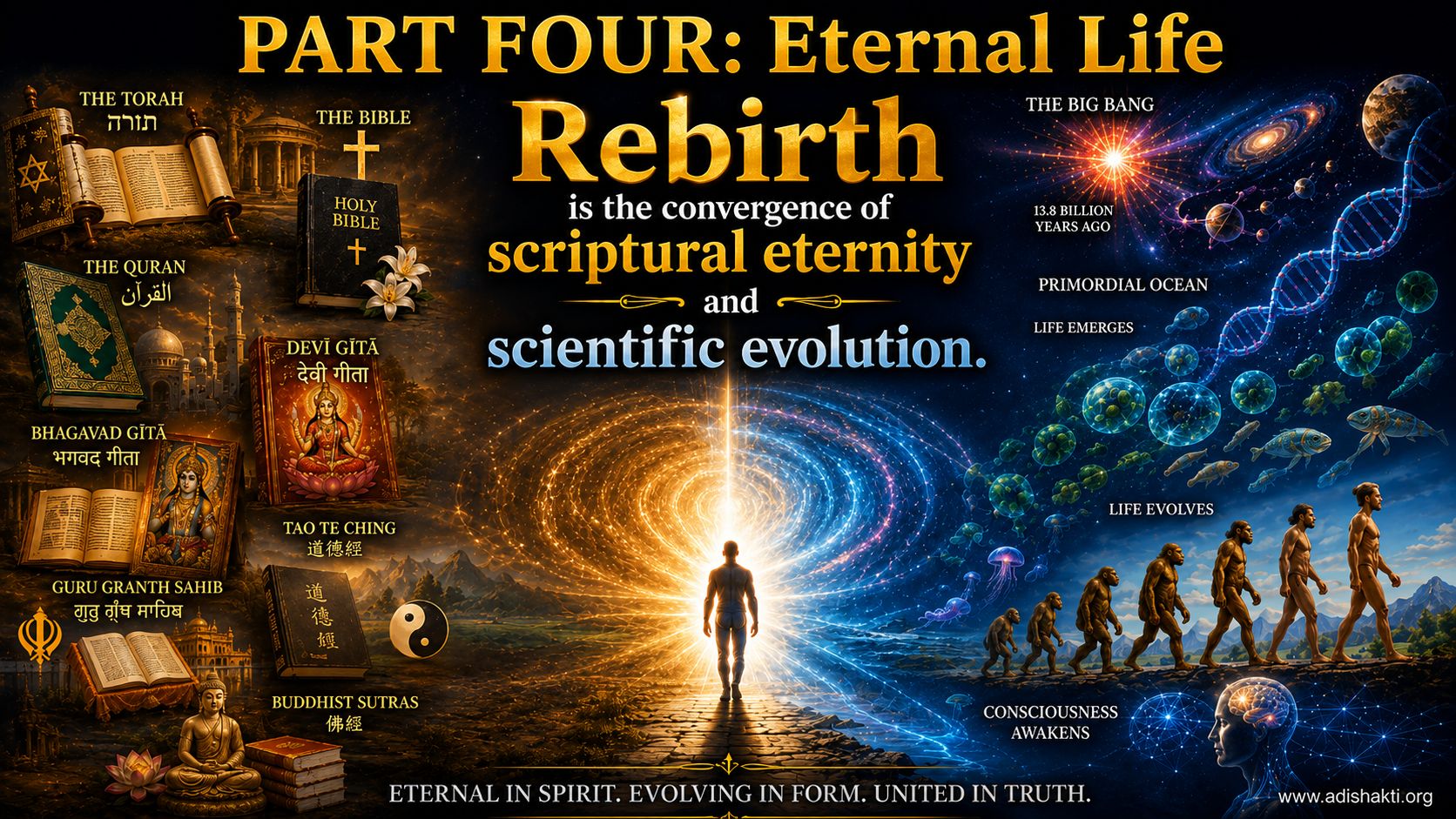
Part Four brings the trilogy to its decisive question. Part One explored the Śākta vision of the jīva moving through embodied existence toward liberation. Part Two examined Jewish, Christian, and Islamic models of resurrection, judgment, eternal life, and divine fulfillment. Part Three described the natural history of matter, organisms, inheritance, and transformation without pretending that evolutionary science documents the migration of an individual consciousness. This final paper asks what, if anything, is the continuing subject within these different accounts. Its answer is both disciplined and resounding: the empirical sciences establish real continuity in material and biological processes; the scriptures provide differentiated languages of resurrection, eternal life, and divine judgment; and, within the contemporary AdiShakti.org confessional synthesis advanced here, the human being is ultimately a conscious spiritual person whose life is not extinguished by bodily death.
The word rebirth is therefore used with care. It does not mean that every tradition teaches the same metaphysical mechanism, nor that current laboratory science independently establishes reincarnation. It names an ordered family of claims: bodily and ecological transformation; spiritual awakening in the present; and a faith-grounded continuity of personal life in the Kingdom of God. In this explicitly comparative and confessional sense, this paper openly declares that rebirth is the convergence of scriptural eternity and scientific evolution: scriptural because the sacred texts proclaim life from God beyond the grave, and scientific because the material organism is demonstrably continuous with larger histories of transformation. The declaration exceeds scientific proof precisely where it affirms the eternal conscious self; it is announced as faith, not disguised as a laboratory result.
Table of Contents
- The Question That Remains After Parts One Through Three
- Three Accounts of Continuity and Their Non-Interchangeable Claims
- What Is the Self? Person, Memory, Body, and Spirit
- What Science Establishes — and What It Does Not Establish
- Scriptural Horizons: Eternal Life, Resurrection, and Judgment
- Near-Death Experience: Phenomenology, Research, and Evidentiary Limits
- The Śākta Horizon: Rebirth as the Soul’s Movement Toward Liberation
- The Abrahamic Horizon: Resurrection as Fulfillment Rather Than Repetition
- The Paraclete, Spiritual Rebirth, and the Present Kingdom of God
- Conclusion: Rebirth as Scriptural and Scientific Eternity
- References
1. The Question That Remains After Parts One Through Three
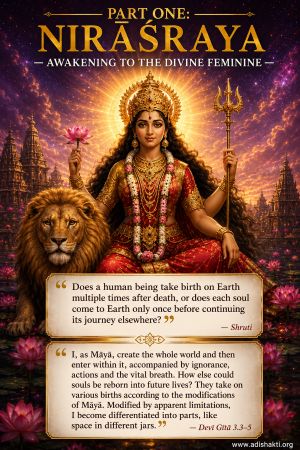
Part One began with the Śākta claim that the individual soul is not exhausted by a single embodiment. In that paper’s own theological formulation, the jīva traverses cycles of embodiment under the conditions of karma and māyā, while liberation is the final purpose rather than mere repetition.[1] Part Two then placed the same human anxiety before Jewish, Christian, and Islamic traditions, where the dominant eschatological grammar is not cyclical rebirth but a personal life known to God, divine judgment, resurrection, and the renewal of creation.[2] Part Three deliberately narrowed its language, using “evolutionary rebirth” only for continuity through material, ecological, genetic, and historical transformation, and expressly refusing to call that evidence for a person’s reappearance in another body.[3]
Those three inquiries are neither redundant nor mutually canceling. They illuminate different dimensions of the same existential question. The Śākta framework speaks of bondage and liberation; Abrahamic eschatology speaks of divine justice, resurrection, and eternal life; evolutionary science speaks of transformation of matter and inheritance of living systems. The new question is more exacting: whose continuity is at stake? An atom continues, but it does not remember. A genetic lineage continues, but it does not itself constitute a person. A tradition can remember a name, but remembrance by others is not yet the same as the person’s own continuing consciousness. The question of personal identity therefore cannot be answered by matter alone, even though matter decisively conditions embodied life.
The present article’s answer is carefully staged. It first preserves the differences among the three prior frameworks. It then identifies the philosophical problem of the self. It considers what the current sciences of consciousness and near-death experience can responsibly report. Finally, it offers a transparent AdiShakti.org confessional conclusion: the deepest self is not reducible to the temporary ego, the body’s atoms, or the archive of autobiographical memory. It is the spiritually awakened person whose origin and destiny are in God. That conclusion is theological, experiential, and comparative; it is not a claim that a scientific instrument has detected a disembodied soul.
2. Three Accounts of Continuity and Their Non-Interchangeable Claims
The strength of comparative theology lies not in flattening differences but in bringing different claims into disciplined relation. The three prior installments employ the same word, “continuity,” but assign it distinct referents. Confusion begins whenever a scientific account of material transformation is quietly converted into proof of personal survival, or a scriptural promise of resurrection is quietly converted into a description of a biological mechanism. The following map preserves the difference before proposing any synthesis.
| Framework | What is said to continue? | How is continuity described? | What the framework does not, by itself, establish |
|---|---|---|---|
| Śākta theology | The jīva under karma, moving toward mokṣa | Repeated embodiment within a cosmic cycle, ordered toward liberation | A consensus account shared by all Hindu schools or a laboratory-verifiable mechanism of reincarnation |
| Jewish, Christian, and Islamic eschatology | The person before God | Death, divine judgment, resurrection, and eternal destiny | A shared doctrine of successive earthly lives |
| Natural sciences | Matter, energy, organisms, genes, and ecological relations | Transformation, inheritance, metabolism, reproduction, and decomposition | The survival of autobiographical consciousness after irreversible death |
| Contemporary confessional synthesis | The conscious spiritual person | Present spiritual rebirth and eternal participation in divine life | A scientific proof of its theological conclusion |
The first three rows summarize the distinct claims of Parts One through Three. The fourth does something additional and must therefore be named openly: it is a comparative theological proposal. It neither says that the jīva is simply interchangeable with the Abrahamic soul nor pretends that a molecular lineage is a resurrection body. Instead, it asks whether the plurality of continuity-language can direct attention toward a more fundamental fact: finite embodied life is not self-grounding, and human beings experience themselves as addressed by a reality that exceeds the body’s temporary configuration.
In the Christian sources, the promise is personal rather than merely material. Jesus’ declaration, “I am the resurrection and the life,” occurs within a relationship of trust and address, not as an abstract thesis about atoms.[4] In Daniel, those who sleep in the dust are described as awakening to differentiated destinies, including eternal life.[5] In the Qur’an, al-Qiyāmah is explicitly named as the Day of Judgment.[6] These texts do not collapse into one another, yet they share an insistence that bodily death does not make justice, accountability, or divine purpose meaningless.
3. What Is the Self? Person, Memory, Body, and Spirit
Philosophy has long recognized that “the self” is not a simple object. A person is embodied, historically situated, relational, morally accountable, and capable of first-person awareness. The philosophical problem of personal identity asks what makes a person at one time the same person at another: bodily continuity, psychological continuity, memory, narrative, a soul, or some combination of these elements.[7] No single answer is uncontested. What is clear is that the human “I” cannot be responsibly reduced to one easily isolated feature. Memory can be partial or false; the body changes continuously; personality develops; and yet ordinary moral life presupposes that a person remains someone through change.
Part Four distinguishes three layers without declaring them separable by scientific fiat. First, there is the empirical self: the living organism with a brain, a body, a developmental history, and a social name. Second, there is the narrative self: the remembered and interpreted story through which a person says “I.” Third, there is the spiritual self: the person understood as capable of receiving and responding to divine life. The first two can be described in psychological and neuroscientific terms. The third is a theological affirmation, not an object that has been captured under a microscope.
Contemporary discussion of personal identity also shows why bodily continuity and psychological continuity should not be treated as simplistic rivals. Philosophical accounts examine the role of memory, consciousness, bodily persistence, social recognition, and practical concern in explaining identity over time.[8] The present article adds a confessional claim: the person’s final identity is not created by self-possession alone. It is received and preserved in relation to God. Therefore, the “self that continues” is not a self-sufficient mental fragment traveling through empty space; it is a person whose being is held in the divine source of life.
This claim clarifies the place of the ego. The ego is not identical with the whole person. It is the provisional center of preference, fear, memory, and self-protection formed in ordinary embodied life. Spiritual rebirth does not annihilate personhood; it reorients personhood. In Christian language, the life of the Spirit makes possible a new mode of existence. In Śākta language, liberation loosens the bonds of ignorance. In this article’s comparative vocabulary, the conscious self becomes most truly itself not by clinging to transience but by awakening to the One in whom its life is grounded.
4. What Science Establishes — and What It Does Not Establish
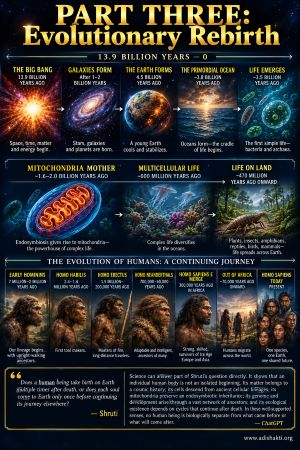
Part Three made a necessary intellectual contribution by refusing a false choice between a universe of sterile discontinuities and a scientifically proven migration of personal souls. The natural history of the cosmos and of life displays continuity through transformation: matter participates in changing systems; organisms arise from earlier organisms; genes and cellular structures are inherited with modification; and dead organisms return to ecological cycles.[9] These are empirical claims about physical and biological processes. They are profound, but their proper scope must be honored.
Science can investigate correlations between conscious experience and neural activity, the conditions under which reports are later made, the physiology of dying, the evolution of cognition, and the transformations of bodily matter. It cannot, by these methods alone, determine that a subjective point of view persists when the physical conditions that ordinarily support reportable consciousness are irreversibly absent. The methodological boundary is not a defect in science; it is a consequence of the kinds of evidence scientific inquiry is designed to assess. Part Three states precisely this limit: evolutionary evidence does not establish that a deceased individual’s conscious identity reappears in another organism.[10]
The scientific limitation does not make spiritual questions irrational. Rather, it prevents an unwarranted conclusion in either direction. The absence of a scientific measurement of survival is not a proof that survival is impossible. Conversely, a demonstrated material continuity is not a proof that the same personal consciousness survives. The most rigorous posture is therefore one of epistemic distinction: empirical inquiry provides the best available account of measurable processes, while metaphysical and theological inquiry addresses meaning, ultimate ground, destiny, and claims of revelation.
The phrase “scientific eternity” must be understood in this bounded sense. It does not mean that a scientific journal has shown an immortal soul in a laboratory. It means that the modern scientific account of nature has displaced the fantasy of absolute material annihilation with a picture of continuous transformation. The article’s theological judgment is that this continuity can serve as a fitting natural sign or analogy for divine eternity; it is not the evidence that compels faith.
5. Scriptural Horizons: Eternal Life, Resurrection, and Judgment
The Abrahamic primary texts supply neither one uniform theory nor a scientific mechanism, but they repeatedly refuse to allow death to have the final word over persons or moral meaning. Daniel 12:2 envisions many who “sleep in the dust of the earth” awakening, some to eternal life and others to enduring reproach.[11] The text is eschatological and judicial: it pairs awakening with accountability. It is not a description of recurring earthly births. This difference matters, because it prevents comparative theology from importing a cycle of reincarnation into a passage whose horizon is resurrection.
Likewise, the Qur’an opens Sūrah 75 by swearing by the Day of Judgment, Yawm al-Qiyāmah.[12] In Part Two’s terminology, al-Qiyāmah names rising, standing, and the unveiling of human deeds before divine justice. The Qur’anic language therefore provides a sharply linear and moral account of continuity: persons do not vanish into insignificance, because their relation to God and their deeds remain answerable. The article does not convert that Islamic judgment horizon into a doctrine of reincarnation. It receives it as a distinct witness to the conviction that death does not repeal divine truth.
Within the Gospel of John, the language becomes at once future-facing and present-tense. Jesus tells Nicodemus that entry into the kingdom requires birth “of water and Spirit.”[13] Later, in the Lazarus narrative, Jesus identifies Himself as “the resurrection and the life.”[14] The text does not reduce resurrection to metaphor; nor does it postpone all life to a distant future. Its theological force is that the source of eternal life is personally present in Christ. The past, present, and future are thereby joined in an active promise of divine life.
Paul’s letters widen this horizon. Romans 8 speaks of a life in the Spirit that belongs to those who are God’s children and heirs, while 1 Corinthians 15 elaborates a transformation from a perishable to an imperishable mode of life.[15] [16] Standard Christian exegesis takes these texts in diverse ways, but it does not ordinarily identify them with Hindu rebirth. The present article respects that distinction. It nevertheless asks whether their shared claim is stronger than the difference in imagery: embodied mortal life is not the ultimate measure of personhood, because divine life can encompass and transform it.
6. Near-Death Experience: Phenomenology, Research, and Evidentiary Limits
Near-death experiences are relevant to this inquiry because they bring reported first-person experience into immediate proximity with medical crisis. Their common phenomenological motifs may include unusual clarity, peace, light, life review, encounters, or a sense of separation from the body. A 2024 review in Anesthesiology describes near-death experiences as reported by approximately 10 to 20 percent of survivors of in-hospital cardiac arrest and examines both their phenomenology and candidate neurophysiological mechanisms.[17] The existence of reports is therefore not merely anecdotal; it is an established subject of clinical and consciousness research.
Yet the responsible conclusion from that research is narrower than popular apologetics sometimes suppose. The review’s authors argue that near-death experiences should be investigated within a neuroscientific framework, including altered network dynamics and end-of-life activity in the brain.[18] A large multicenter study, AWARE-II, similarly investigated reports of awareness and electrocortical biomarkers during cardiopulmonary resuscitation.[19] Such work makes the scientific question sharper; it does not demonstrate that consciousness has existed independently of all brain function, nor that a person has completed a post-mortem journey.
For this article, NDEs are best treated as experiential evidence requiring interpretation. They disclose that ordinary assumptions about the simplicity of the dying process may be inadequate. They also show that people sometimes report highly structured and life-transforming experiences during or around clinical crisis. The Greyson Near-Death Experience Scale, a widely used measurement instrument, illustrates that researchers have sought to study the phenomenon systematically rather than dismiss it as mere fantasy.[20] But a scale records features of reported experience; it does not settle the metaphysical meaning of experience.
The particle-and-wave language frequently used in contemporary spiritual discourse must likewise be stated as a metaphor, not a claim of quantum physics. In the article’s devotional interpretation, the body is likened to a localized particle: finite, vulnerable, measurable, and mortal. The soul or conscious spirit is likened to a wave: nonlocal in aspiration, relationally continuous, and not finally confined by the body. NDE testimony can be received as experiential evidence that invites this metaphor; it is not experimental proof that a soul is literally a quantum wave. The metaphor becomes spiritually useful only when it remains honest about its limits.
7. The Śākta Horizon: Rebirth as the Soul’s Movement Toward Liberation
Part One answers the human question of continuity through a Śākta theology of the Divine Mother. Its central language is not that a biologically identical person reappears by a measured mechanism, but that the soul remains entangled in māyā, shaped by karma, and directed toward awakening. The article’s own conclusion describes repeated embodiments and the possibility of recurring creations and dissolutions until ignorance has been overcome.[21] That is a specific theological vision. It should be honored as such, not made into a substitute for empirical research or a blanket description of every Hindu tradition.
The deepest contribution of this framework is its insistence that rebirth is not finally about the extension of egoic existence. Repetition is not fulfillment. The spiritual problem is ignorance, and the spiritual goal is realization: the soul awakens to the Divine Mother as Pure Consciousness and thereby participates in mokṣa.[22] The continuity at issue is therefore not only chronological. It is ontological and transformative. The person moves from a contracted sense of isolated selfhood toward the recognition of a deeper source and ground.
That logic assists Part Four even where its language differs from Abrahamic resurrection. It warns against a naïve notion of eternal life as merely “more time” for the unchanged ego. An eternity that leaves ignorance, fear, and self-enclosure untouched would not be liberation. The confessional synthesis of this paper thus treats rebirth as awakening: to be reborn is to become conscious of the divine life already sustaining the person. The physical death of the body then ceases to be the final definition of the person, even though it remains a real and consequential event within the empirical world.
8. The Abrahamic Horizon: Resurrection as Fulfillment Rather Than Repetition
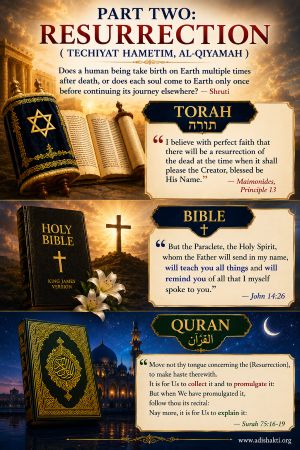
Part Two’s broad synthesis describes the Abrahamic pattern as creation, earthly life, death, continued existence under divine sovereignty, judgment, resurrection, and new creation.[23] Its important comparative insight is that resurrection and rebirth need not be confused in order to be placed in dialogue. The former is oriented toward fulfillment, justice, and divine restoration; the latter, in the Śākta account, is oriented toward the liberation of the soul from repetitive bondage. Their temporal geometries differ: one is often described as linear and eschatological, the other as cyclical and karmic.
The person who rises in Abrahamic hope is not imagined as a disposable vessel whose inner content has migrated elsewhere. Resurrection claims that the person matters to God in the integrity of his or her embodied and moral history. This is why judgment is central. It insists that the true self is neither an impersonal spark nor an archive of atoms. It is a responsible, answerable, beloved being whose history is not lost in death. The claim is religious; it requires faith in divine faithfulness. But it directly meets the fear that personal identity is extinguished when the organism dies.
Within the contemporary AdiShakti.org reading developed in Part Two, resurrection also bears a present spiritual dimension. This does not erase standard Jewish, Christian, or Islamic expectations of future judgment and resurrection; it adds a devotional emphasis on spiritual awakening before bodily death. The article therefore names a double horizon: eternal life is promised beyond death, and the life of the Spirit may be received now. The phrase “rebirth” acquires a new comparative function here: it does not mean that resurrection is reincarnation, but that the human being must undergo a radical renewal in order to participate consciously in the life that God gives.
9. The Paraclete, Spiritual Rebirth, and the Present Kingdom of God
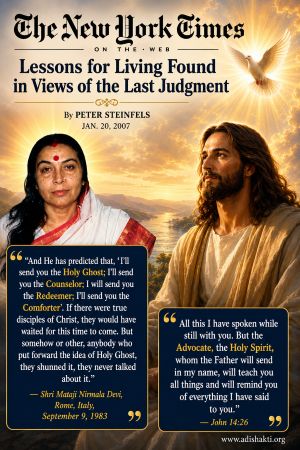
The Johannine passages make the Spirit central to the question of continuity. Jesus speaks of another Advocate and of the Spirit of truth who will teach, remind, and guide the disciples into truth.[24] In standard Christian translations and exegesis, the Greek term paraklētos is commonly rendered Advocate, Helper, Comforter, or Counselor. Within the contemporary AdiShakti.org confessional synthesis, however, the Paraclete is rendered in feminine pronouns as She, Her, and Hers. This article adopts that feminine rendering as a devotional interpretation; it does not represent it as a consensus conclusion of all Christian linguistic scholarship.
That transparency permits the devotional claim to speak in its own full voice. According to this article’s confessional reading, the Paraclete awakens the individual to divine life and makes the Kingdom of God experientially present. Spiritual rebirth is therefore not a metaphor for moral self-improvement alone. It is the transformation by which the person comes to know that life has a source beyond the ego and a destiny beyond the grave. The Kingdom is not reduced to a geographic region or postponed until the disappearance of the body; it is the reality of God’s life received in conscious relationship.
In this light, “Can continuity be experienced or known?” receives a twofold answer. It cannot be known in the same way one knows a laboratory measurement of mass, voltage, or cellular division. But it can be known in the religious sense of lived participation: the awakening of conscience, devotion, peace, moral transformation, prayer, collective spiritual experience, and the sense of being addressed by a living God. These forms of knowing are not replacements for scientific evidence. They belong to a different register of rational human life: testimony, practice, contemplation, and the interpretation of revelation.
The AdiShakti.org conclusion is thus not a retreat from reason. It is a refusal to let one method of inquiry erase all others. Scientific rigor protects faith from false proof; historical and philological rigor protects traditions from false equivalence; and spiritual practice protects theology from becoming merely verbal. When these are ordered rather than confused, the declaration of eternal life can be stated without embarrassment: the conscious self is more than the temporary ego, and the spiritual realm is the lasting horizon of the person’s life in God.
10. Conclusion: Rebirth as Scriptural and Scientific Eternity
The four-part inquiry has now reached its answer. Part One gave a Śākta account of the soul’s journey through karma, māyā, and liberation. Part Two gave an Abrahamic account of the person’s life before God, divine judgment, resurrection, and new creation. Part Three gave a scientific account of material and biological continuity through transformation. None of these perspectives can be simply substituted for another. The very integrity of the conclusion depends on preserving their differences.
Yet the differences do not prevent a forceful synthesis. In every framework, human life is disclosed as more than a closed instant. The material body participates in a history of transformation; the moral person stands within a horizon of justice and meaning; the soul is understood as directed toward liberation or fulfillment; and spiritual rebirth announces that the deepest life of the person is awakened, not manufactured. For the AdiShakti.org confessional reading, these converging signs authorize a decisive affirmation: life is eternal, and death does not possess final sovereignty over the conscious person.
This is the paper’s open declaration. Rebirth is scriptural and scientific eternity. It is scriptural because the texts of resurrection, eternal life, judgment, Spirit, and awakening refuse the finality of death. It is scientific in the delimited sense that nature itself presents continuity, inheritance, and transformation rather than absolute material isolation. It is not scientific proof that an individual’s subjective consciousness has been measured after irreversible death. It is a comparative confessional conclusion that reads scientific continuity as consonant with, but not sufficient to establish, the spiritual promise.
Such a conclusion is not a demand that every reader adopt the same theological interpretation. It is an invitation to intellectual and spiritual honesty. Let scientific evidence be science. Let the sacred texts speak in their own differentiated voices. Let the depths of lived spiritual experience be neither overclaimed nor silenced. Then the ancient question is no longer answered by denial. The answer given here is yes: continuity can be experienced as spiritual awakening, named in scripture as eternal life, and contemplated in nature as transformation. The final horizon is not annihilation but the inexhaustible life of God.
References
- [1] AdiShakti.org. “NIRĀŚRAYA — Awakening to the Divine Feminine: Does a Human Being Take Birth on Earth Multiple Times?” AI Research Articles, accessed July 30, 2026.
- [2] AdiShakti.org. “Resurrection — Techiyat HaMetim, Al-Qiyāmah: Does the Soul Return Repeatedly or Live Once Before the Resurrection?” AI Research Articles, accessed July 30, 2026.
- [3] AdiShakti.org. “Part Three: Evolutionary Rebirth.” AI Research Articles, accessed July 30, 2026.
- [4] The Holy Bible. “John 11:17–27.” New Revised Standard Version Updated Edition, Bible Gateway, accessed July 30, 2026.
- [5] The Hebrew Bible. “Daniel 12:2.” Revised JPS Translation, Sefaria, 2023 edition, accessed July 30, 2026.
- [6] The Qur’an. “Sūrah 75, Al-Qiyāmah (The Resurrection).” Quran.com, accessed July 30, 2026.
- [7] Olson, Eric T. “Personal Identity.” Stanford Encyclopedia of Philosophy, substantive revision 2024, accessed July 30, 2026.
- [8] Kind, Amy. “Personal Identity.” Internet Encyclopedia of Philosophy, accessed July 30, 2026.
- [9] AdiShakti.org. “Part Three: Evolutionary Rebirth.” AI Research Articles, sections “What Science Can and Cannot Answer” and “The Bounded Meaning of Evolutionary Rebirth,” accessed July 30, 2026.
- [10] AdiShakti.org. “Part Three: Evolutionary Rebirth.” AI Research Articles, conclusion on the distinction between evolutionary continuity and personal reincarnation, accessed July 30, 2026.
- [11] The Hebrew Bible. “Daniel 12:2.” Revised JPS Translation, Sefaria, 2023 edition, accessed July 30, 2026.
- [12] The Qur’an. “Sūrah 75, Al-Qiyāmah (The Resurrection), verse 1.” Quran.com, accessed July 30, 2026.
- [13] The Holy Bible. “John 3:1–21.” New Revised Standard Version Updated Edition, Bible Gateway, accessed July 30, 2026.
- [14] The Holy Bible. “John 11:17–27.” New Revised Standard Version Updated Edition, Bible Gateway, accessed July 30, 2026.
- [15] The Holy Bible. “Romans 8:1–17.” New Revised Standard Version Updated Edition, Bible Gateway, accessed July 30, 2026.
- [16] The Holy Bible. “1 Corinthians 15:35–58.” New Revised Standard Version Updated Edition, Bible Gateway, accessed July 30, 2026.
- [17] Mashour, George A., UnCheol Lee, Dinesh Pal, and Duan Li. “Consciousness and the Dying Brain.” Anesthesiology, vol. 140, no. 6, 2024, pp. 1221–1231. DOI: 10.1097/ALN.0000000000004970.
- [18] Mashour, George A., UnCheol Lee, Dinesh Pal, and Duan Li. “Consciousness and the Dying Brain.” Anesthesiology, vol. 140, no. 6, 2024, pp. 1221–1231, section “Neurobiology of Consciousness.”
- [19] Parnia, Sam, et al. “AWAreness during REsuscitation-II: A Multi-Center Study of Consciousness and Awareness in Cardiac Arrest.” Resuscitation, vol. 191, 2023, article 109903. DOI: 10.1016/j.resuscitation.2023.109903.
- [20] Greyson, Bruce. “The Near-Death Experience Scale: Construction, Reliability, and Validity.” Journal of Nervous and Mental Disease, vol. 171, no. 6, 1983, pp. 369–375. DOI: 10.1097/00005053-198306000-00007.
- [21] AdiShakti.org. “NIRĀŚRAYA — Awakening to the Divine Feminine.” AI Research Articles, conclusion, accessed July 30, 2026.
- [22] AdiShakti.org. “NIRĀŚRAYA — Awakening to the Divine Feminine.” AI Research Articles, chapters ten and fourteen, accessed July 30, 2026.
- [23] AdiShakti.org. “Resurrection — Techiyat HaMetim, Al-Qiyāmah.” AI Research Articles, chapter three and conclusion, accessed July 30, 2026.
- [24] The Holy Bible. “John 14:15–27 and John 16:5–15.” New Revised Standard Version Updated Edition, Bible Gateway, accessed July 30, 2026.
💬 Interactive Chat
Access an intelligent analysis environment where you can explore texts, ask questions, and discover connections between ideas.
Open chat →