The Kingdom Within: Thomas, the Paraclete, and the Sahasrara
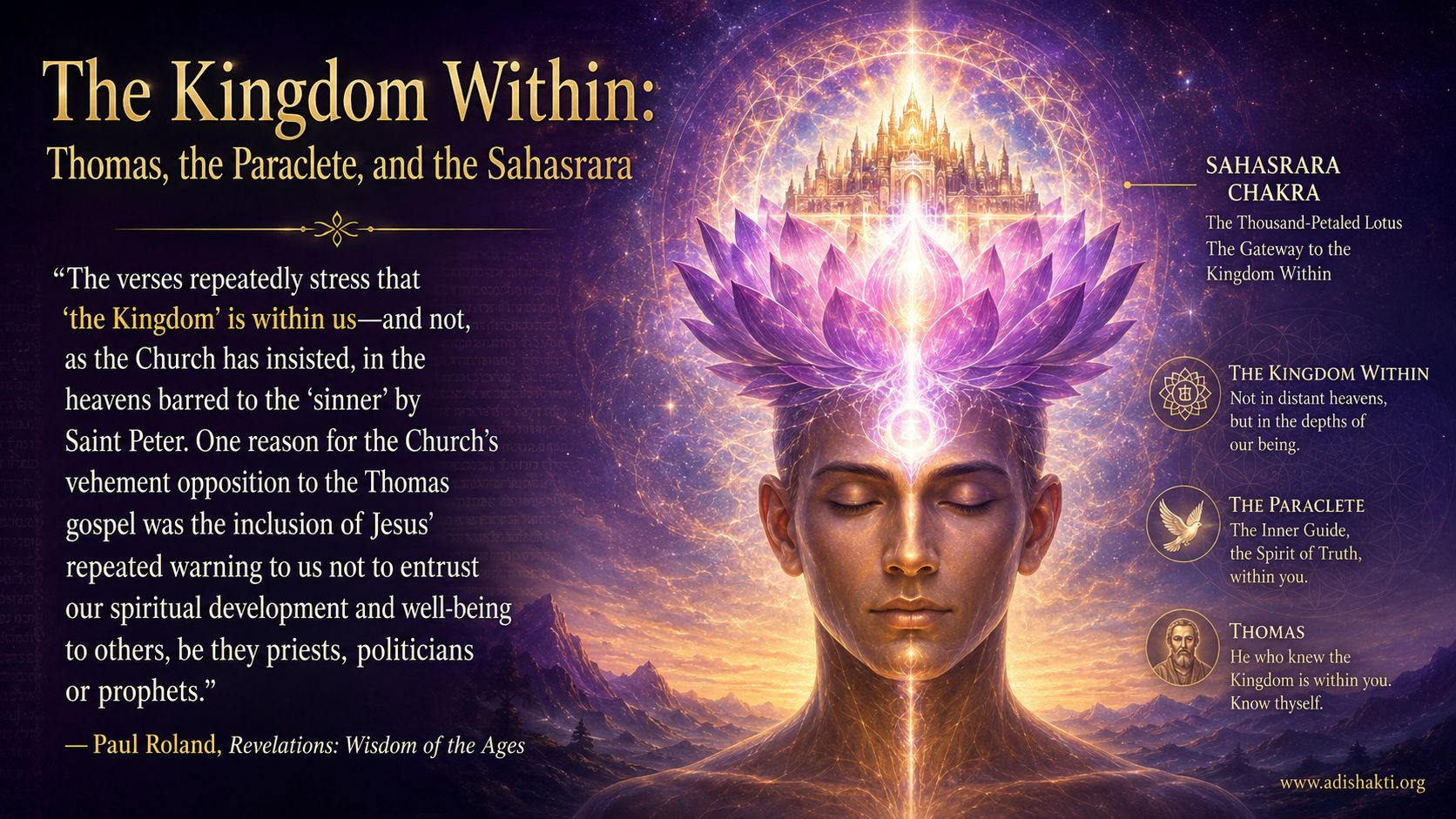
A Source-Aware Study of the Gospel of Thomas, Johannine Spiritual Guidance, and the Seventh-Chakra Reading
Summary
This paper considers Paul Roland’s assertion that the Gospel of Thomas places the Kingdom “within us” and warns seekers against surrendering their spiritual development to external authorities. It first distinguishes four levels of statement: the wording of ancient texts, disputed historical reconstruction, later scholarly interpretation, and contemporary devotional synthesis. It then shows that Thomas 3 and 113 reject a Kingdom localized in sky, sea, or visible signs; that Luke 17:20–21 and John’s Gospel contain related language of unobservable divine rule, birth from above, indwelling Spirit, and Spirit-led instruction; and that the historical reasons Thomas became non-canonical cannot responsibly be reduced to a single anti-institutional motive. Finally, it sets out the AdiShakti.org reading as a contemporary Paraclete-revelation theology: the Sahasrara is proposed as the interior threshold of the Kingdom, and Kundalini awakening as the experiential enactment of the second birth. This last claim is explicitly identified as confessional rather than as historical-critical consensus.
Table of Contents
- Method: Four Kinds of Claim
- The Thomasine Rejection of a Distant Kingdom
- Luke 17:21 and the Translation Question
- Johannine Rebirth, Indwelling, and the Paraclete
- Canon Formation and the Limits of a Suppression Narrative
- The Paraclete and the Question of Religious Brokerage
- The Sahasrara as a Contemporary Confessional Reading
- Direct Experience, Discernment, and Spiritual Responsibility
- Conclusion: A Kingdom Received Within
- References
1. Method: Four Kinds of Claim
Religious comparison needs clarity about what kind of proposition it is making. A primary-text statement identifies what an ancient text says in a particular translation. A historical or scholarly interpretation explains how a text may have arisen, been received, or been understood in its ancient setting. A contemporary confessional interpretation names what a living community or devotional website proposes. A comparative theological synthesis places terms from distinct traditions into conversation without pretending that the traditions already use them identically.
This distinction is essential here. Thomas 3 can be translated and cited; Luke’s entos hymōn can be discussed; and John’s Paraclete promises can be located precisely. None of those steps, by themselves, proves either that the institutional Church rejected Thomas for one motive or that the Sahasrara is what Jesus historically meant by the Kingdom. The requested Sahasrara reading is stronger and more intelligible when it is stated openly as a devotional proposal rather than disguised as consensus.
| Claim type | Question answered | Use in this paper |
|---|---|---|
| Primary text | What does a passage say? | Thomas 3 and 113; Luke 17:20–21; John 3, 7, and 14–16. |
| Scholarly interpretation | How is the passage or text contextualized? | Debates over Thomas’s date, dependence, and canonical status. |
| Contemporary confessional reading | What does AdiShakti.org teach? | The Kingdom is identified with the Sahasrara; the Paraclete is understood with feminine pronouns. |
| Comparative proposal | What bridge is being made between traditions? | Kundalini awakening is placed in dialogue with Johannine rebirth and indwelling Spirit. |
2. The Thomasine Rejection of a Distant Kingdom
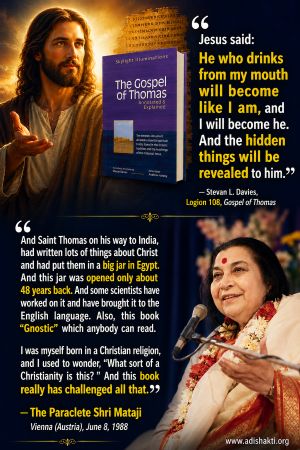
The Gospel of Thomas is a sayings collection rather than a narrative account of Jesus’s life. In Thomas O. Lambdin’s widely used translation, Saying 3 condemns spiritual direction that points seekers toward a remote location: if leaders say that the Kingdom is in the sky, birds will precede them; if they say it is in the sea, fish will precede them. The saying instead declares, “the kingdom is inside of you, and it is outside of you,” and binds that recognition to self-knowledge.[2]
Saying 113 develops the same refusal of an externally signalled event. The Kingdom “will not come by waiting for it,” nor by pointing to a place and saying “here” or “there”; it is already spread across the earth, though people do not see it.[3] The two sayings therefore support a careful textual conclusion: in Thomas, the Kingdom is neither delayed into a merely future moment nor confined to a place beyond the seeker. It is inward, outward, already present, and imperceptible to a consciousness that does not yet know or see.
Stevan L. Davies calls this spiritual vision “Kingdom-consciousness,” an interpretation in which transformation is universally available rather than restricted to a single religious elite.[4] AdiShakti.org has adopted Davies’s reading to articulate a sharp criticism of dependent spirituality and later ecclesial hierarchy.[5] That theological use may be forceful, but it must remain distinct from a claim that one reading exhausts the historical meaning of Thomas.
3. Luke 17:21 and the Translation Question
The canonical Gospel of Luke has a closely related saying. Asked by Pharisees when the Kingdom would come, Jesus responds that it does not arrive with observable signs and that people will not say, “Look, here it is!” or “There it is!” The NRSVUE then translates the final phrase as “the kingdom of God is among you” (Luke 17:20–21).[6]
The contrast between “among you” and “within you” should not be concealed. The Greek entos hymōn has been rendered both ways, and interpreters who stress that Jesus addresses Pharisees commonly prefer “in your midst.” Yet the passage, under either rendering, unmistakably rejects an eschatology dependent on public spectacle and spatial pointing. It gives the comparative reading a canonical point of dialogue without allowing Thomas’s more explicit inward language to be silently imposed on Luke.
Accordingly, this paper does not claim that Luke 17:21 supplies a direct anatomical map of the seventh chakra. It claims something more modest and textually defensible: Luke and Thomas both deny that the divine reign is properly recognized by locating it in a distant place or through visible public signs. Their overlap creates a meaningful space for later mystical and contemplative readings of the Kingdom.
4. Johannine Rebirth, Indwelling, and the Paraclete
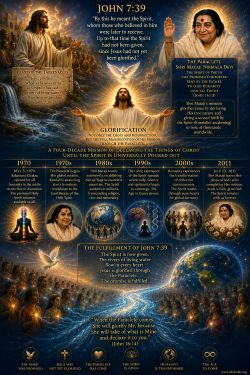
John offers a different but equally interior vocabulary. Jesus tells Nicodemus that one must be born “from above” and born of water and Spirit in order to see and enter the Kingdom (John 3:3–8).[7] The text does not identify that new birth with a chakra system; nevertheless, it insists that the transition is more than a change of affiliation. It is a movement from flesh to Spirit, enacted by the wind-like freedom of pneuma.
John 7:37–39 adds an image of living water flowing from the believer’s heart and identifies it with the Spirit whom believers were to receive. The evangelist says that the Spirit was not yet given because Jesus was not yet glorified.[8] In the Farewell Discourses, the Paraclete is named the Spirit of truth; She will abide with the disciples and be in them, teach and remind them, testify to Jesus, guide them into truth, and glorify Him (John 14:16–17, 26; 15:26; 16:7–15).[9]
Within the confessional language of this paper, the Paraclete is rendered with feminine pronouns. This is a theological and devotional convention rather than an assertion that Greek grammar alone determines divine gender. Its hermeneutical significance is that the promised Spirit is not treated as an impersonal doctrine owned by an institution, but as an active, indwelling Teacher who leads persons into truth and glorifies Jesus.
5. Canon Formation and the Limits of a Suppression Narrative
Roland’s language of “vehement opposition” expresses a recognizable critique of religious externalization, but the historical formation of the New Testament canon was not a single act by a monolithic Church. The earliest Greek fragments of Thomas establish that it cannot have been composed later than about the end of the second century; its exact date, relation to the Synoptics, provenance, and theological classification remain contested.[10] Simon Gathercole’s major commentary, for example, analyzes the work in a second-century context and argues that its relationship to earlier gospels needs close textual evaluation rather than ideological simplification.[11]
It follows that no passage in Thomas proves that later canon-makers rejected it merely because it taught an inward Kingdom. Differences in authorship claims, liturgical use, perceived apostolic connection, narrative form, theological fit, and local reception all bear on the history. A responsible reading should therefore preserve two claims at once. First, Thomas does indeed make strikingly direct statements of immanent Kingdom and self-knowledge. Second, the proposition that churches opposed it chiefly to protect priestly control is an interpretation, not a demonstrated historical fact.
This distinction does not weaken the existential question. A text may be historically complicated and still confront every religious community with the question whether it points people toward transformation or toward dependence. The enduring value of Roland’s challenge lies there: it asks whether the seeker is led to direct knowledge of God or only to the management of belief.
6. The Paraclete and the Question of Religious Brokerage
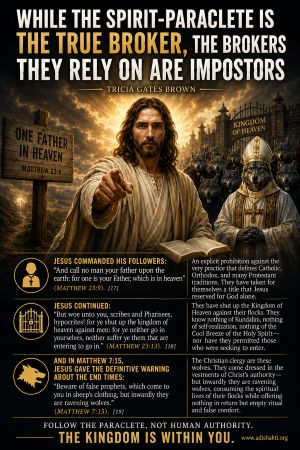
Tricia Gates Brown studies the Spirit in John through the social world of patronage and brokerage. Her analysis characterizes the Paraclete as the true broker of divine benefit and contrasts Her with opposing brokers relied on by opponents.[12] AdiShakti.org applies this language in a stringent contemporary critique, maintaining that the Paraclete, rather than clerical functionaries, is the true mediator of spiritual knowledge.[13]
The article’s comparative point is neither that every priest, minister, politician, or teacher is necessarily false nor that disciplined communities have no legitimate pedagogical function. It is that no human office should displace the inner work demanded by Thomas, Luke, and John. A teacher can point; a community can test, nourish, and correct; but neither can substitute for the seeker’s own reception of Spirit, self-knowledge, moral transformation, and discernment.
In this sense, the Paraclete reading changes the question from “Which institution owns salvation?” to “Does this teaching lead to the Spirit of truth who is within and among the people?” That reframing is the most constructive meaning of the anti-broker language. It summons institutions to serve spiritual maturation rather than to claim proprietary control over it.
7. The Sahasrara as a Contemporary Confessional Reading
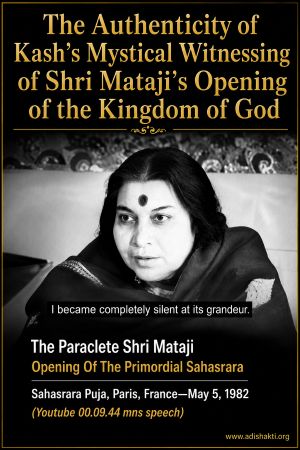
Within the contemporary confessional synthesis advanced by AdiShakti.org, the Sahasrara — the seventh chakra and crown aperture — is called the Kingdom of God. The Authenticity Series presents a reported mystical testimony concerning Shri Mataji Nirmala Devi’s opening of the Sahasrara and explicitly distinguishes documentary, phenomenological, and metaphysical authenticity.[14] That self-distinction is important: historical methods can evaluate records and testimony, while the claim that a mystical experience discloses an objective divine realm is a further metaphysical judgment.
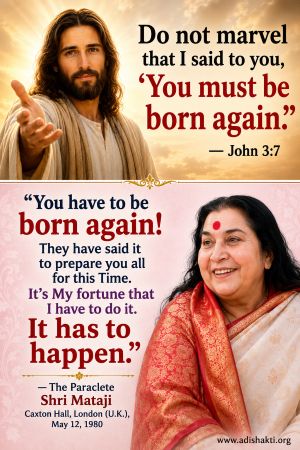
As a comparative devotional proposal, the article places Thomas’s inward Kingdom, Luke’s unobservable divine reign, John’s birth from above, and the Sahaja Yoga account of Kundalini ascent in dialogue. The proposal says that Kundalini awakening rises through the subtle system and opens at the Sahasrara, thereby giving a direct experience of the all-pervading divine power. AdiShakti.org describes this as the second birth and interprets it as the experiential fulfilment of John 3.[15]
Such a synthesis must not be misrepresented as the shared doctrine of Christianity, Hinduism, or the academic study of religion. It is a particular devotional claim about convergence. Its force lies not in erasing differences between the traditions but in arguing that their language of Spirit, awakening, inward knowledge, and transformation can be mutually illuminating when encountered in lived experience.
8. Direct Experience, Discernment, and Spiritual Responsibility
To say that spiritual development should not be entrusted to others does not authorize isolation, credulity, or private infallibility. Thomas associates knowledge of the self with a transformed perception; John associates Spirit with truth, remembrance, witness, and moral exposure. Thus the most rigorous version of interior religion is not self-indulgence. It requires ethical fruit, capacity for correction, care for others, freedom from domination, and humility before truth.
AdiShakti.org’s second-birth article describes a practical criterion: the seeker should not be confined to rational assent or inherited religious identity, but should be able to receive and recognize the Divine within.[16] In the vocabulary of this paper, direct experience does not mean rejecting every tradition; it means refusing to make a tradition, leader, or ideology the final replacement for the Spirit’s work. The true test is whether a path makes the person more awake, more truthful, more compassionate, and less governed by fear, ego, or sectarian hostility.
9. Conclusion: A Kingdom Received Within
The textual evidence permits a firm but limited conclusion. Thomas 3 and 113 explicitly reject an externally located or merely awaited Kingdom; Luke 17:20–21 rejects observable signs while retaining a genuine translation debate; and John presents access to divine life in the language of birth from above, indwelling Spirit, and the teaching Paraclete. These strands make interiority a serious and durable Christian theological theme.
The historical evidence requires restraint. Thomas’s non-canonical status cannot be accounted for solely by a churchly fear of inward spiritual freedom. Yet Roland’s warning remains a valuable spiritual provocation: no person should outsource the work of truth, transformation, and discernment to priests, politicians, prophets, or institutions.
References
- [1] Roland, Paul. “Revelations: Wisdom of the Ages: Prophetic Visions and Secret Knowledge to Guide Us into the Millennium.” Ulysses Press, 1995, p. 51. The user-supplied quotation is also reproduced at AdiShakti.org.
- [2] Lambdin, Thomas O., translator. “The Gospel According to Thomas.” Marquette University, Saying 3.
- [3] Lambdin, Thomas O., translator. “The Gospel According to Thomas.” Marquette University, Saying 113.
- [4] Davies, Stevan L. “The Gospel of Thomas and Christian Wisdom.” Bardic Press, 2005.
- [5] Manus AI. “Jesus’ Revolutionary Vision: Kingdom-Consciousness in the Gospel of Thomas.” AdiShakti.org, 27 June 2026.
- [6] “Luke 17:20–21.” New Revised Standard Version Updated Edition, accessed 11 August 2026.
- [7] “John 3:3–8.” New Revised Standard Version Updated Edition, accessed 11 August 2026.
- [8] “John 7:37–39.” New Revised Standard Version Updated Edition, accessed 11 August 2026.
- [9] “John 14:16–17, 26; 15:26; 16:7–15.” New Revised Standard Version Updated Edition, accessed 11 August 2026.
- [10] Burke, Simeon. “When Was the Gospel of Thomas Written?” Bible Odyssey, Society of Biblical Literature, 14 December 2022.
- [11] Gathercole, Simon J. “The Gospel of Thomas: Introduction and Commentary.” Brill, 2014.
- [12] Brown, Tricia Gates. “Spirit in the Writings of John: Johannine Pneumatology in Social-Scientific Perspective.” Continuum, 2004, pp. 231–233.
- [13] Manus AI. “While the Spirit-Paraclete Is the True Broker, the Brokers They Rely On Are Impostors.” AdiShakti.org, 29 May 2026.
- [14] Manus AI. “The Authenticity of Kash’s Mystical Witnessing Shri Mataji’s Opening of the Kingdom of God (Sahasrara).” AdiShakti.org, 3 June 2026.
- [15] Manus AI. “You Must Be Born Again: The Parallel Teachings of Jesus Christ and Shri Mataji Nirmala Devi.” AdiShakti.org, 16 June 2026.
- [16] Ibid.