MYSTICAL TESTIMONY | CELESTIAL MUSIC | | CRITICAL INQUIRY
The Authenticity of Kash’s Mystical Witnessing of Shri Saraswati Playing Her Celestial Veena
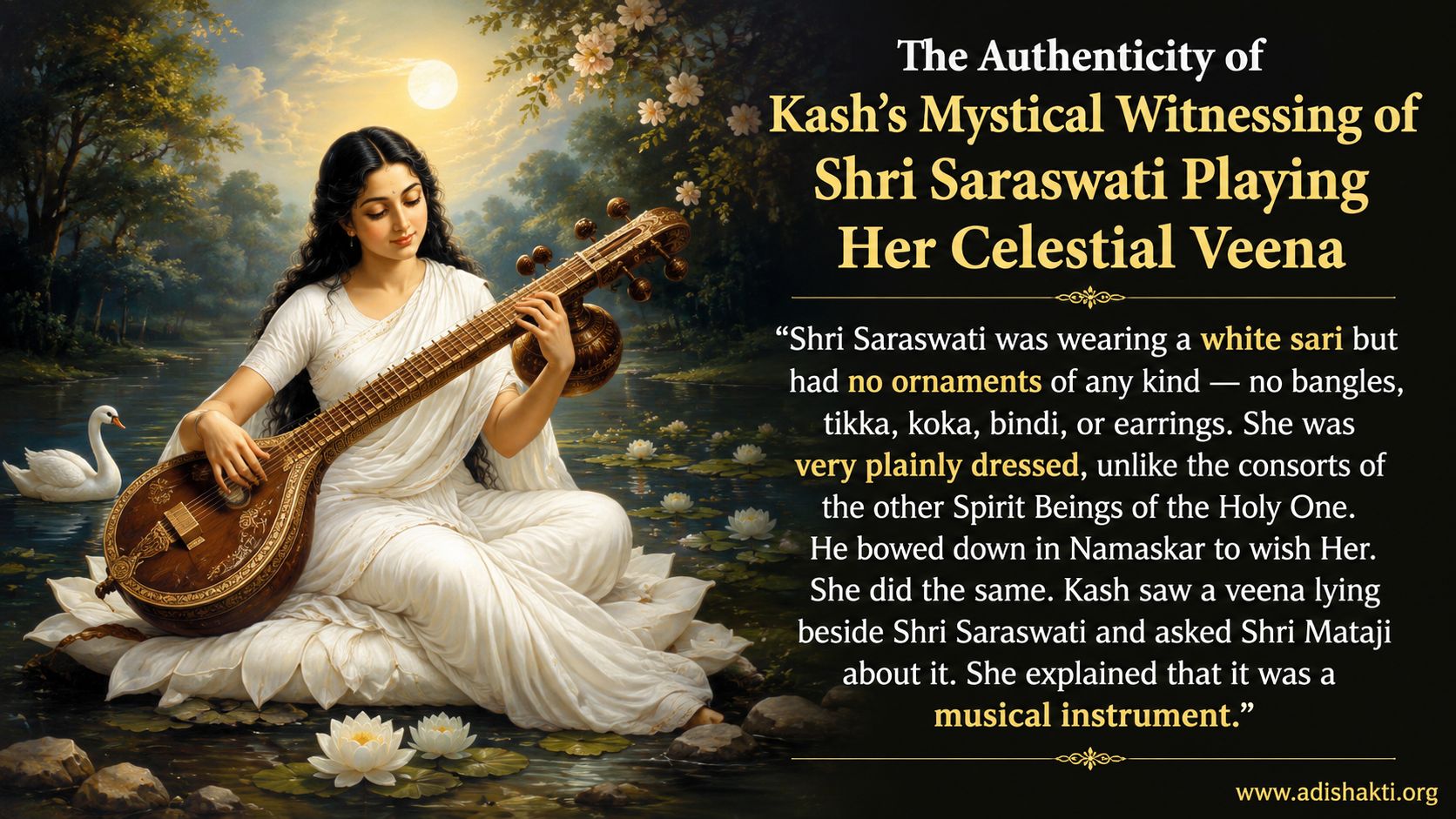
Shri Saraswati Plays Her Celestial Veena
Kash was once told to ask whether Shri Vidhatri Shri Nirmala Devi would grant him the wish to see Shri Saraswati, the great Goddess of Art and Knowledge. Bhupinder, the Sahaja Yogi who raised his Kundalini, wanted to find out whether he should take up music, especially learning the tabla, the two-piece Indian drum.
The Great Primordial Mother then levitated him above the carpet of clouds and, within seconds, reached Shri Saraswati's place. They slowed down to a standstill, and as Shri Mataji withdrew Her extended hands, Kash felt himself going a few inches downwards until his feet touched the ground.
Shri Saraswati was wearing a white sari but had no ornaments of any kind — no bangles, tikka, koka, bindi, or earrings. She was very plainly dressed, unlike the consorts of the other Spirit Beings of the Holy One. He bowed down in Namaskar to wish Her. She did the same.
Kash saw a veena lying beside Shri Saraswati and asked Shri Mataji about it. She explained that it was a musical instrument. Kash requested that he would like to hear it being played. The Holy Spirit translated his request into Sanskrit for Shri Saraswati, who smiled and picked up the veena. She then began playing.
According to Kash, the music was so heavenly that he was instantly overwhelmed by Bliss. It was difficult for him to describe the awesome serenity of the celestial atmosphere as Shri Saraswati plucked the strings of the Primordial Veena. The Divine Cool Breeze of the Holy Ghost swirled around and penetrated every pore of consciousness, raising Joy to new heights. Last, but not least, the utter silence of that vast empty expanse amplified the sound of music. Such a spiritual state does not exist in this material world and neither can it be duplicated.
After Shri Saraswati had finished, Kash thanked Her. All of them then meditated. Kash went into blissful thoughtlessness, oblivious to his surroundings. There was no duality as they merged into Cosmic Consciousness. They were part and parcel of the Holistic Whole — part and parcel of the Universal Soul. They were One with Shri Saksi-varjita Shri Nirmala Devi. They were neither the mind, intelligence, ego, nor chitta; neither the ears, nor the tongue, nor the senses of smell and sight; neither ether, nor air; neither the prana, nor the five vital breaths; neither the seven elements of the body, nor its five sheaths, nor hands, nor feet, nor tongue, nor other organs of action — They were Eternal Bliss and Awareness.
Then he heard the Great Divine Mother calling him softly by his name. The meditation had ended. He opened his spiritual eyes in the microcosm of his Sahasrara, although his physical eyes remained closed in deep meditation on the macrocosmic Earth. He then bowed to Shri Saraswati with folded hands in homage and again thanked Her for showing him how the veena was played. She bowed back in anjali mudra.
(Kash, overwhelmed by this incomparable musical experience, completely forgot to ask about Bhupinder's request.)
Shri Sarva-Mohini Shri Nirmala Devi and he then arose and left for the Land of Perpetual Light. He bowed to Shri Brahmi Shri Nirmala Devi and requested permission to leave. As he stood with folded hands, he slowly descended from the Mishkat al Anwar (Niche of Light) to this pagan world of hand amputations and clitoral mutilations.
Note: On October 30, 1996, at 11:40 a.m., Kash was asked to describe Shri Saraswati's beauty. He replied that She was very beautiful, not just beautiful. When asked to pick out the most beautiful of the consorts — Shri Radha, Shri Lakshmi, or Shri Saraswati — Kash could not make up his mind. According to him, they were all ravishing, though all three had different physical and facial features. He added that they were about the same height, but he was not sure who was taller, as he had never paid any attention to these things. Despite a number of attempts to elicit a marginal winner, Kash failed to select one. The Divine Consorts were of such immense beauty that there was no way to pick even a marginal winner. They were all Satyam, Shivam, and Sundaram — Truthful, Benevolent, and Beautiful! God is Satyam, Shivam, and Sundaram.
Saksi-varjita (385th): None to witness her. This is the final stage of realisation beyond turiya state called turiyatita. This is the state of complete oneness without any duality.
Sarva-Mohini (703rd): Confuses all. Through Her Maya-Shakti people are confused and see distinctions between the Absolute and the phenomenal, 'seer' and the 'seen,' and Herself and Her created forms.
Brahmi (675th): Wife of Brahma, i.e., Saraswati, the Goddess of speech.
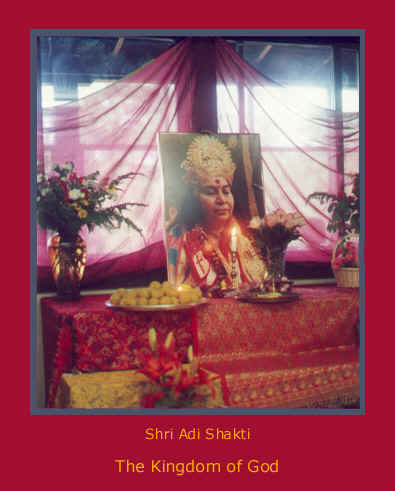
Shri Adi Shakti: The Kingdom of God
Jagbir Singh. 1999 p. 194
Introduction #
The Question of Authenticity
1. The Reported Encounter Return to Contents
This study examines the reported mystical experience in which Kash, while meditating as a child, claimed to have entered the Realm of the Sahasrara, travelled with Shri Nirmala Devi to the presence of Shri Saraswati, and heard the Goddess of knowledge, learning, art, music, and sacred speech play Her celestial veena. The testimony belongs to a wider body of accounts in which Kash reportedly entered a recurring spiritual environment while his physical body remained in meditation.
The immediate occasion was comparatively ordinary. Bhupinder, identified as the Sahaja Yogi who had raised Kash’s Kundalini, wanted to know whether he should pursue music, especially the tabla. Kash agreed to ask whether he could be taken to Shri Saraswati. The published source describes the request as frivolous.
Kash reportedly entered meditation, perceived himself beside Shri Nirmala Devi, requested the visit, and was transported above a carpet of clouds. On arrival he felt his feet touch the ground and saw Shri Saraswati wearing a plain white sari without ornaments. After a reciprocal greeting, he noticed an instrument beside Her, asked what it was, and requested to hear it played. Shri Nirmala Devi reportedly translated his request into Sanskrit, and Shri Saraswati played the veena.
The account emphasizes extraordinary music, profound silence, a cool breeze, serenity, bliss, and subsequent thoughtless meditation. When the meditation ended, Kash thanked Shri Saraswati and returned. He then realized that he had forgotten the original question concerning Bhupinder.
2. The Central Question of Authenticity Return to Contents
The central academic question is not merely whether the account is devotionally meaningful. It is whether the surviving testimony displays the characteristics of a sincerely experienced and reliably remembered mystical event rather than deliberate invention, suggestion, dream imagery, imaginative construction, or later memory reconstruction.
That question must be distinguished from the stronger claim that Shri Saraswati objectively appeared as a Divine Being existing independently of Kash’s mind. A private experience may be sincere, structured, vivid, and transformative without being publicly observable in the same manner as an ordinary physical event.
3. Four Distinct Levels of Authenticity Return to Contents
| Level | Question | Possible Finding |
|---|---|---|
| Historical | Did Kash give the testimony attributed to him? | Assessed through documentation, chronology, and transmission. |
| Psychological | Does the report resemble sincere autobiographical memory? | Assessed through coherence, incidental detail, uncertainty, and suggestibility. |
| Phenomenological | Does the experience resemble recognized mystical states? | Assessed through bliss, silence, altered embodiment, coolness, and thoughtlessness. |
| Ontological | Did Kash encounter Shri Saraswati independently of his own mind? | Historical and psychological methods may assess plausibility but cannot directly reproduce the event. |
Evidence supporting one level does not automatically establish the others. Sincerity does not prove external causation, while the inability to demonstrate external causation does not establish deception.
4. The Primary Testimony and Published Source Return to Contents
The principal published source is Jagbir Singh’s Shri Adi Shakti: The Kingdom of God (1999), p. 194, in the narrative “Shri Saraswati Plays Her Celestial Veena.” The account identifies Kash as the experiential witness and preserves a later note dated October 30, 1996, at 11:40 a.m., concerning Shri Saraswati’s appearance.
The present study also takes account of the online publication at Authenticity-of-Shri-Saraswati-playing-Veena.htm, while treating the 1999 book narrative as the primary testimony identified by the site.
5. The Need for Source-Critical Separation Return to Contents
The published text combines concrete observations with mature theological language. Statements about the white sari, absence of ornaments, unfamiliar instrument, music, silence, cool breeze, meditation, and forgotten question stand closer to Kash’s probable report. References to Cosmic Consciousness, the Universal Soul, the five sheaths, the Holy Ghost, and the Mishkat al-Anwar belong to a broader adult interpretive framework unless independent evidence shows that Kash used those expressions.
6. Why Mystical Testimony Requires Special Care Return to Contents
Mystical testimony is ordinarily private. Observers may confirm that a person was meditating, but they cannot directly inspect the perceived realm or hear the music reported by the witness. This makes testimony indispensable and fallible at the same time.
A careful inquiry must therefore avoid two prejudgments: that supernatural content automatically makes a testimony false, and that sincerity automatically proves metaphysical reality. The evidence must be weighed cumulatively.
7. Evidence That Initially Supports Serious Examination Return to Contents
Several features justify sustained inquiry: the modest origin of the request, the plain rather than ornate appearance of Saraswati, Kash’s reported uncertainty about the veena, the central auditory experience, the forgotten question, and his later inability to rank the beauty of the Divine Consorts. None is decisive alone.
7.1 The Modest Origin of the Request Return to Contents
The episode reportedly arose from a question about learning the tabla, not from a demand for proof or a major theological dispute. This mundane origin is compatible with autobiographical spontaneity, although it cannot by itself exclude invention.
7.2 Shri Saraswati’s Plain Appearance Return to Contents
The white sari is traditionally associated with Saraswati, but the complete absence of bangles, tikka, koka, bindi, earrings, and other ornaments is less typical of many popular devotional images. The detail is therefore partly conventional and partly counter-stereotypical.
7.3 Kash’s Reported Uncertainty about the Veena Return to Contents
The veena is among Saraswati’s most recognizable attributes, yet Kash reportedly asked what the instrument was. If this detail preserves his earliest report, it may suggest incomplete prior knowledge. Its final weight depends upon the exact original wording and his actual exposure to Saraswati imagery.
7.4 The Forgotten Question Return to Contents
The story does not answer the practical question that initiated it. Kash reportedly became so absorbed in the music and meditation that he forgot to ask about Bhupinder. This is psychologically plausible as prospective-memory failure and gives the narrative an autobiographical irregularity.
7.5 Sound, Silence, Cool Breeze, and Bliss Return to Contents
The testimony is not a static visual report. It centers on music experienced within profound silence, coolness, serenity, joy, and thoughtless awareness. This multisensory and affective structure is relevant to both mystical phenomenology and naturalistic altered-state explanations.
7.6 The October 30, 1996 Follow-Up Return to Contents
Kash reportedly described Shri Saraswati as extraordinarily beautiful but resisted repeated attempts to rank Her above Shri Radha or Shri Lakshmi. He also admitted that he had not observed relative height carefully. Resistance to the expected answer and admission of uncertainty may support sincerity, though the documentary form of the interview must be examined.
8. Competing Explanations Return to Contents
| Hypothesis | What It Could Explain | Central Test |
|---|---|---|
| Deliberate fabrication | A consciously invented devotional story | Motive, contradiction, coaching, and documentary development |
| Suggestion | Content shaped by adult questions and expectations | Interview wording, prior instruction, and resistance to prompts |
| Imaginative absorption | An immersive internally generated scene | Voluntary control, imagery tendencies, and experiential autonomy |
| Dream-related state | Vivid persons, movement, music, and affect | Wakefulness, sleep transition, responsiveness, and setting |
| Memory reconstruction | Later growth of a simpler original report | Comparison of earliest notes and later versions |
| Authentic mystical encounter | A sincere encounter with transcendent reality | Independence, stability, phenomenological depth, and explanatory power |
These possibilities are not always mutually exclusive. A sincere meditative experience may be culturally shaped and later theologically interpreted.
9. Method and Evidential Criteria Return to Contents
- Source proximity — relation between witness, recorder, and publication.
- Chronological proximity — interval between event, first report, follow-up, and publication.
- Internal coherence — continuity of setting, action, perception, and return.
- Incidental detail — observations not required to advance a religious claim.
- Counter-expectational detail — features not predicted by familiar iconography.
- Prior knowledge — what Kash actually knew before the experience.
- Developmental plausibility — compatibility with childhood memory and language.
- Resistance to suggestion — whether answers changed to satisfy interviewers.
- Longitudinal stability — compatibility of later recollection with earlier testimony.
- Phenomenological coherence — relation to recognized contemplative experiences.
- Cross-narrative consistency — comparison with Kash’s other reported journeys.
- Comparative explanatory power — which hypothesis explains the most evidence with the fewest assumptions.
10. Epistemic Limits Return to Contents
The central event was private; the earliest verbatim report has not been reproduced; the precise date of the original experience is not stated in the material presently available; and Kash’s prior exposure to Saraswati imagery is not yet established. These limitations prevent categorical historical proof.
11. Working Thesis Return to Contents
The working thesis is that Kash’s account deserves treatment as a serious mediated mystical testimony. The available narrative contains features compatible with sincere autobiographical experience, but its ultimate ontological interpretation remains open. The cumulative assessment must distinguish what is historically supported, psychologically plausible, phenomenologically significant, and metaphysically unproven.
12. Structure of the Paper Return to Contents
The chapters proceed in a fixed sequence. Chapters One through Three establish the historical source, traditional context, and reconstructed experiential core. Chapters Four through Ten evaluate childhood memory, visual and auditory details, language, mystical phenomenology, prospective memory, and the 1996 follow-up. Chapters Eleven and Twelve compare the account with Kash’s wider testimony and test psychological and neurological alternatives. Chapter Thirteen synthesizes the evidence, followed by a final conclusion, notes, and bibliography.
Primary Source Notes for the Introduction
- Jagbir Singh, Shri Adi Shakti: The Kingdom of God (1999), p. 194, “Shri Saraswati Plays Her Celestial Veena.”
- The online research page identifies the same primary testimony and frames the inquiry in historical, psychological, phenomenological, and ontological terms.
- The Introduction establishes the methodology only. Full scholarly references will be developed within the relevant chapters and consolidated in the final bibliography.
Chapter One #
Historical and Testimonial Context
Before evaluating the psychological or theological significance of Kash’s reported encounter with Shri Saraswati, the historical status of the testimony must be established as carefully as the surviving evidence permits. The first task is not to decide whether a Divine Being objectively appeared. It is to determine what the source actually reports, how the report reached its published form, which persons participated in the surrounding circumstances, and where the documentary record remains incomplete.
The principal narrative appears in Jagbir Singh’s Shri Adi Shakti: The Kingdom of God (1999), p. 194, under the heading “Shri Saraswati Plays Her Celestial Veena.” The same testimony is now presented within the online authenticity study devoted to Shri Saraswati’s veena. The published account identifies Kash as the child witness, Bhupinder as the person whose question initiated the episode, Shri Nirmala Devi as Kash’s guide within the reported spiritual realm, and Shri Saraswati as the Divine Person whom he claimed to encounter.
This chapter treats the narrative as a mediated testimony. It is more specific than an anonymous legend because it names the witness, recorder, initiating participant, and later follow-up date. Yet it is less complete than a contemporaneous transcript because the earliest wording, exact date of the experience, and full questioning sequence are not reproduced in the available source.
1.1 The Initiating Request Return to Contents
According to the narrative, Bhupinder wanted to know whether he should take up music, especially the tabla. Because Shri Saraswati is traditionally associated with knowledge, the arts, music, and learning, Kash was asked to inquire whether he might be taken to see Her.
The source itself characterizes the request as frivolous. This description is evidentially relevant because the episode was not initiated as a public test, a prophecy, or a theological challenge. It began with a minor personal question concerning musical study.
A mundane beginning does not prove authenticity. Fictional narratives can also begin with ordinary circumstances. Nevertheless, the initiating request provides no obvious grand apologetic motive. The practical question was not even answered, because Kash reportedly forgot to ask it.
1.2 The Human Participants Return to Contents
| Participant | Role | Evidential Status |
|---|---|---|
| Kash | Child witness who reportedly entered meditation and experienced the encounter. | Primary source for the interior content of the testimony. |
| Bhupinder | Sahaja Yogi whose question about music reportedly initiated the request. | Potential corroborator of the circumstances before meditation, not of the interior vision. |
| Jagbir Singh | Adult recorder, narrator, interpreter, and publisher of the testimony. | Documentary intermediary through whom the account survives. |
These roles must not be conflated. Bhupinder could potentially confirm that the request was made and that Kash entered meditation. Jagbir Singh could preserve Kash’s account and conduct later questioning. Neither could independently observe the spiritual realm, hear the celestial music, or see Shri Saraswati.
The case therefore contains possible corroboration of surrounding circumstances but not independent corroboration of the central visionary content.
1.3 Kash as the Experiential Witness Return to Contents
Kash is presented as reporting from the first-person position of someone who believed he had entered another realm. The narrative attributes to him movement, bodily orientation, sight, hearing, gesture, emotional response, meditation, and later recollection.
The beginning of the experience is intentional: Kash agreed to the request, raised his Kundalini, and entered meditation. Once the experience began, however, he is portrayed as responding to a setting and persons that he did not consciously control. He asks, observes, receives explanations, listens, meditates, and eventually forgets his original purpose.
1.4 The Reported Entry into the Sahasrara Return to Contents
The account states that Kash raised his Kundalini and entered the Realm of the Sahasrara. He then perceived himself descending into a spiritual body beside Shri Nirmala Devi, who was seated in meditation near the Celestial Throne.
Three distinct propositions are embedded in this description:
- Kash physically entered meditation.
- He experienced a change in conscious location or embodiment.
- He interpreted the experienced realm as the Sahasrara.
The first proposition may have been externally observable. The second depends upon Kash’s testimony. The third is an interpretive identification shaped by the religious framework in which the experience was understood.
1.5 Shri Nirmala Devi as Guide and Mediator Return to Contents
Kash reportedly bowed to Shri Nirmala Devi, offered his greetings, and asked whether he could be taken to Shri Saraswati. Shri Nirmala Devi smiled and agreed.
Within the testimony, Shri Nirmala Devi is not merely another figure in the realm. She functions as guide, authority, translator, and the person through whom access to Shri Saraswati is granted.
This pattern admits two broad interpretations. Within the theological framework of the source, it indicates Shri Nirmala Devi’s authority in the Kingdom of God. Within a psychological account, it may reflect Kash’s prior belief that She was the necessary mediator of spiritual experience. Later cross-narrative analysis must examine both possibilities.
1.6 Transportation and Arrival Return to Contents
The narrative reports that Shri Nirmala Devi levitated Kash above a carpet of clouds and reached Shri Saraswati’s location within seconds. The movement slowed before they came to a standstill.
Rapid movement between spiritual locations appears elsewhere in the wider corpus of Kash’s experiences. This gives the accounts an internally consistent spatial logic: locations are distinct, but they are traversed without ordinary physical travel.
Such recurrence may indicate stable experiential geography, stable imagination, repeated narrative structure, or later editorial standardization. Internal consistency alone cannot decide among these explanations.
1.7 The Sensation of Landing Return to Contents
As Shri Nirmala Devi withdrew Her hands, Kash reportedly felt himself move down several inches until his feet touched the ground. This is one of the narrative’s most concrete embodied details.
The experience is therefore not merely visual. It includes vertical movement, bodily orientation, distance, and tactile contact with a surface. These details are compatible with an episode experienced as real.
They are also compatible with vivid dreams, lucid imagination, out-of-body experiences, and immersive altered states. Their evidential significance is therefore strongest at the level of experiential richness, not proof of an independently existing environment.
1.8 First Description of Shri Saraswati Return to Contents
This description contains both positive and negative observations. The positive element is the white sari. The negative elements are the absence of specific ornaments.
White clothing is highly traditional for Saraswati and may have been known to Kash beforehand. The lack of ornaments is less typical of many popular devotional images, though it remains symbolically compatible with purity, simplicity, and detachment.
The list of absent ornaments is evidentially important only if Kash supplied it spontaneously. If an adult asked itemized questions—whether She wore bangles, a bindi, earrings, and so forth—the same list could have been produced through structured prompting. The source does not preserve the original interview sequence.
1.9 Reciprocal Greeting and Perceived Agency Return to Contents
Kash bowed to Shri Saraswati in namaskar, and She reportedly returned the greeting. The figure is therefore presented as responsive rather than static.
Throughout the encounter, Shri Saraswati is attributed agency: She acknowledges Kash, smiles, lifts the veena, plays, meditates, and later returns his farewell gesture. The experience is interpersonal rather than merely symbolic.
Perceived agency may strengthen the witness’s conviction that another person was present. Yet dream and visionary figures may also appear autonomous. Reciprocal interaction supports phenomenological coherence but does not prove external personhood.
1.10 Discovery of the Veena Return to Contents
Kash reportedly saw a veena lying beside Shri Saraswati and asked Shri Nirmala Devi what it was. She explained that it was a musical instrument.
This detail is potentially important because the veena is one of Saraswati’s most recognizable traditional attributes. If Kash had merely reconstructed a familiar religious picture, one might expect him already to identify it.
Several uncertainties remain. Kash may have recognized it as an instrument but not known its name. He may have seen Saraswati images without learning the object’s identity. The published narrative may also paraphrase a more specific question.
1.11 The Request for Music Return to Contents
After learning that the object was a musical instrument, Kash asked to hear it played. This response is developmentally natural and does not require specialist musical knowledge.
Shri Nirmala Devi reportedly translated the request into Sanskrit for Shri Saraswati. The core historical claim is that Kash perceived mediated communication. The identification of the language as Sanskrit may derive from Kash, from an explanation within the experience, from later adult interpretation, or from Saraswati’s traditional association with sacred speech.
1.12 The Musical Performance Return to Contents
The report is affective rather than technical. Kash does not identify a melody, scale, rhythm, tempo, tuning, or sequence of notes. He describes the music through its effect: serenity, bliss, silence, and intensified awareness.
This lack of technical description is consistent with a child who did not possess advanced musical vocabulary. It also prevents external musical verification, since no reproducible melody survives.
The statement that silence amplified the sound is particularly important. The testimony portrays silence not merely as an absence of noise but as an experiential field that intensified perception.
1.13 Meditation after the Performance Return to Contents
After Shri Saraswati finished playing, Kash reportedly thanked Her, and all three meditated. Kash became oblivious to his ordinary surroundings and entered a state described as blissful thoughtlessness.
The published account then expands into sophisticated nondual language, denying identification with mind, senses, ego, elements, vital breaths, sheaths, and organs of action. This is unlikely to preserve Kash’s exact childhood wording in full.
The probable experiential core is simpler:
- ordinary thinking diminished;
- awareness of the physical setting receded;
- bliss continued;
- the ordinary sense of separation weakened; and
- the state ended when Kash heard his name.
1.14 The Return and Forgotten Question Return to Contents
Kash reportedly heard Shri Nirmala Devi softly calling his name. He then bowed to Shri Saraswati, thanked Her for showing him how the veena was played, and perceived Her returning the gesture.
The episode closes with the admission that Kash forgot the reason for the visit. He did not ask whether Bhupinder should learn the tabla.
This is evidentially significant because it leaves the narrative’s practical purpose unresolved. A constructed supernatural consultation would normally provide the requested answer. Instead, the account contains an anticlimax.
In psychological terms, this resembles prospective-memory failure: attention is captured by an intense and novel experience, causing a prior intention to be forgotten.
1.15 The October 30, 1996 Follow-Up Return to Contents
The source preserves a note dated October 30, 1996, at 11:40 a.m. Kash was asked to describe Shri Saraswati’s beauty and reportedly replied that She was “very beautiful, not just beautiful.”
He was then repeatedly asked to choose which of Shri Radha, Shri Lakshmi, or Shri Saraswati was most beautiful. Kash reportedly did not select one. He maintained that all three were extraordinarily beautiful but had different facial and physical features.
He also stated that they appeared to be about the same height but admitted that he had not paid enough attention to decide who was taller.
These responses contain potentially credible features:
- resistance to the apparent expectation of the questioner;
- admission of uncertainty;
- recognition that he had not observed every detail; and
- differentiation among the three Divine Consorts.
1.16 Documentary Strengths and Limitations Return to Contents
| Documentary Feature | Strength | Limitation |
|---|---|---|
| Named child witness | More specific than anonymous legend | Direct access to earliest wording is unavailable |
| Named initiating participant | Potential corroboration of surrounding circumstances | No independent statement from Bhupinder is presented here |
| Named recorder and publisher | Clear documentary intermediary | Adult interpretation shapes the final narrative |
| Dated follow-up inquiry | Provides a fixed documentary point | The original transcript or recording is not reproduced |
| Published 1999 source | Stable identifiable text | Exact interval from original experience is unclear |
| Concrete sensory details | Support individualized testimony | Original questioning method remains unknown |
The historical record therefore supports several modest conclusions. A detailed narrative attributed to Kash was preserved and published. A later inquiry concerning Shri Saraswati’s appearance was recorded with a precise date and time. The account contains concrete, individualized details and admissions of uncertainty.
The record does not establish that every sentence is Kash’s exact wording. It does not provide the exact date of the original experience, the earliest interview transcript, the full list of those present, or an independent witness to the visionary content.
1.17 Chapter Assessment Return to Contents
The testimony possesses a real but incomplete documentary chain. It is attached to a named witness, named initiating participant, identifiable recorder, dated follow-up inquiry, and published source. It is therefore more historically specific than an anonymous devotional tradition.
Its limitations prevent overstatement. The earliest verbatim account is not reproduced, the original date is unclear, adult theological interpretation is substantial, and no independent observer had access to the interior content of the meditation.
| Dimension | Assessment |
|---|---|
| Primary-source proximity | Moderate |
| Internal narrative coherence | Strong |
| Documentary completeness | Limited to moderate |
| Editorial influence | Clearly present, exact extent uncertain |
| Evidence of deliberate fabrication | Not established |
| Evidence of sincere reported experience | Provisionally supported |
| Evidence of objective divine encounter | Historically undetermined |
| Overall historical reliability | Moderate; sufficient to warrant continued investigation |
References and Source Notes for Chapter One
- Singh, Jagbir. Shri Adi Shakti: The Kingdom of God. 1999, p. 194. “Shri Saraswati Plays Her Celestial Veena.”
- The online research page, “The Authenticity of Kash’s Mystical Witnessing of Shri Saraswati Playing Her Celestial Veena” , identifies and contextualizes the same testimony.
- The October 30, 1996 follow-up is treated as a dated report preserved within the source. No independent recording has been supplied for this assessment.
- Historical authenticity, testimonial sincerity, phenomenological coherence, and ontological reality remain separate questions throughout the paper.
Chapter Two #
Shri Saraswati in Hindu Tradition
The authenticity of Kash’s testimony cannot be evaluated without first establishing the traditional profile of Shri Saraswati. A report involving a recognized religious figure may contain details derived from prior cultural knowledge, details that correspond independently with tradition, and details that diverge from popular expectation. These categories must be separated.
This chapter therefore examines the historical development of Saraswati from the Vedic Sarasvati to the later Goddess of speech, learning, music, knowledge, and the arts. It then assesses the principal visual and symbolic attributes relevant to Kash’s report: the white sari, the veena, sacred speech, beauty, simplicity, ornaments, book, rosary, water vessel, lotus, hamsa, and peacock.
2.1 Why Traditional Context Matters Return to Contents
Cultural correspondence is evidentially ambiguous. If Kash’s description resembles traditional Saraswati imagery, the resemblance may indicate that he recognized a Divine Person represented in religious tradition. It may also indicate that his imagery was shaped by prior exposure.
Conversely, divergence from popular iconography may support independence, but only if the allegedly unexpected feature was not already present in another textual or artistic tradition available to him.
The correct questions are therefore:
- Which details were widely familiar?
- Which were less common in popular representations?
- Which expected attributes were omitted?
- Which details may have been elicited by adult questioning?
- What did Kash actually know before the experience?
2.2 Sarasvati in the Rigveda Return to Contents
The Rigveda preserves some of the earliest extant references to Sarasvati. In these hymns She is associated with a mighty river, abundance, protection, inspired utterance, nourishment, and sacred power. The early Vedic figure is not yet simply the later classroom Goddess seated with a veena and book.
This historical distinction matters because later iconography should not be projected unchanged into the Vedic period. Saraswati’s mature visual form developed over time.
2.3 From River and Divine Power to Speech and Knowledge Return to Contents
Across the development of Hindu tradition, Saraswati became increasingly associated with speech, grammar, poetry, memory, learning, literature, wisdom, and refined expression. The transition is symbolically coherent: flowing water, flowing speech, inspiration, and the transmission of knowledge share imagery of movement, fertility, clarity, and life-giving power.
This development is relevant to Kash’s account because the reported use of Sanskrit, the presence of the veena, and the overwhelming music all align with Saraswati’s mature association with sacred speech and expressive intelligence.
2.4 Saraswati as Goddess of Learning and Music Return to Contents
In widely recognized Hindu tradition, Saraswati is revered as the Goddess of learning, education, speech, literature, music, creativity, and the arts. Her iconography links intellectual knowledge with disciplined expression.
Kash’s request to hear Her instrument therefore corresponds directly with one of Saraswati’s most familiar domains. This supports correct identification within the narrative, but carries little independent evidential force by itself.
2.5 The Veena as a Defining Attribute Return to Contents
The veena is among Saraswati’s most recognizable attributes. In devotional images She may hold it, play it across Her lap, or have it resting beside Her. The instrument symbolizes harmony, discipline, refined hearing, knowledge expressed through sound, and the union of intellect with art.
Museum catalogues of Saraswati images frequently identify the veena as a principal marker of Her identity. Its presence in Kash’s report is therefore expected.
The potentially significant feature is not that the veena was present, but that Kash reportedly asked what it was.
2.6 White Garments and Purity Return to Contents
Saraswati is frequently portrayed in white garments and associated with white or pale symbols such as a lotus, swan, or luminous complexion. In later interpretation, white signifies purity, truth, clarity, sattva, discernment, and freedom from possessive passion.
Kash’s report that Shri Saraswati wore a white sari therefore strongly corresponds with tradition. This agreement supports the identity of the figure within the narrative, but is also among the details most easily acquired through prior cultural exposure.
2.7 Ornaments, Simplicity, and Iconographic Variation Return to Contents
Kash reportedly emphasized that Shri Saraswati wore no bangles, tikka, koka, bindi, earrings, or other jewelry. This differs from many popular prints and sculptures in which She appears crowned and ornamented.
Yet simplicity is not foreign to Saraswati symbolism. A Goddess associated with purity, contemplative clarity, disciplined learning, and detachment may appropriately appear plain.
| Feature | Traditional Status | Evidential Implication |
|---|---|---|
| White sari | Highly familiar | Weak independent evidence |
| Veena | Highly familiar | Expected, though uncertainty matters |
| No jewelry | Compatible but less typical in popular art | Moderate counter-stereotypical value |
| Plain appearance | Traditional symbolically, less ornate visually | Ambiguous |
2.8 Book, Manuscript, Rosary, and Water Vessel Return to Contents
Saraswati is frequently represented with a book or palm-leaf manuscript, symbolizing scripture, grammar, learning, memory, and preserved knowledge. Other common attributes include a rosary and water vessel.
Kash’s account does not mention any of these objects. The omission is significant because it shows that the testimony does not reproduce a complete iconographic inventory. He noticed the white sari and veena but did not report a manuscript, rosary, or water pot.
Absence from the narrative does not prove absence from the perceived scene. Kash may simply have failed to notice or mention them. Nevertheless, the selectivity of the description is more compatible with situated perception than with a systematic checklist.
2.9 Lotus, Hamsa, and Peacock Return to Contents
Saraswati may be depicted seated or standing upon a lotus and accompanied by a hamsa, often rendered as a swan or goose. In some regional traditions She is associated with a peacock. These symbols express purity, discernment, beauty, spiritual discrimination, and transcendence.
Kash’s report mentions none of them. Again, the omission does not establish independence from tradition, but it demonstrates that the narrative is selective rather than encyclopedic.
2.10 Saraswati and Sanskrit Return to Contents
Saraswati’s association with speech, eloquence, grammar, scripture, and learning makes Sanskrit a culturally intelligible language for communication with Her. The reported translation by Shri Nirmala Devi therefore coheres strongly with Saraswati’s traditional identity.
The detail is specific but symbolically predictable. Its evidential weight depends upon what Kash knew before the experience. If he had not been taught the connection between Saraswati and Sanskrit, the detail would be more significant. If the association was familiar, it could reflect expectation.
2.11 Beauty, Serenity, and Individuality Return to Contents
Hindu devotional art conventionally portrays Saraswati as serene, graceful, youthful, and beautiful. Kash’s later statement that She was “very beautiful, not just beautiful” is therefore consistent with tradition.
The more individualized element is his insistence that Shri Saraswati, Shri Lakshmi, and Shri Radha had distinct facial and physical features. He did not describe them as interchangeable idealized females, nor did he rank one above the others when pressed.
This may support the impression of remembered persons rather than a single generic Goddess image. It remains limited by the absence of a verbatim recording and by the possibility that different devotional images supplied different visual models.
2.12 Traditional Correspondence and Evidential Ambiguity Return to Contents
| Reported or Unreported Feature | Relation to Tradition | Assessment |
|---|---|---|
| White sari | Strongly traditional | Supports identification but is easily learned |
| Veena | Strongly traditional | Expected; little independent force |
| Playing the veena | Strongly traditional | Expected within devotional imagery |
| Translation into Sanskrit | Symbolically coherent | Potentially significant if not previously known |
| No ornaments | Compatible but less stereotypical | Moderate evidential interest |
| No book, lotus, or hamsa mentioned | Common attributes omitted | Supports selective reporting |
| Uncertainty about the instrument | Counter-expectational | Potentially important evidence of limited prior knowledge |
The pattern is mixed rather than mechanically conventional. The report contains enough traditional material for recognition, but not a full textbook catalogue.
2.13 Implications for Prior Knowledge Return to Contents
The decisive historical question is not what Hindu culture generally associates with Saraswati, but what Kash himself had actually encountered before the experience.
Relevant evidence would include:
- images of Saraswati in the home or community;
- books, calendars, posters, statues, or festival displays;
- teachings connecting Her with music and the veena;
- references to Sanskrit and sacred speech;
- adult conversations before meditation; and
- the exact questions asked after the experience.
General cultural availability should not be confused with demonstrated individual exposure. It would be equally unsound to assume either that Kash knew all conventional details or that he knew none.
2.14 Chapter Assessment Return to Contents
Saraswati’s traditional identity developed through multiple historical layers. The early Vedic Sarasvati is associated with riverine power, abundance, protection, and inspired expression. Later Hindu tradition increasingly identifies Her with speech, learning, literature, music, creativity, and refined consciousness.
Kash’s report corresponds strongly with tradition in its white sari, veena, music, beauty, serenity, and Sanskrit mediation. These agreements establish theological and iconographic coherence, but they do not independently prove authenticity.
The account is more evidentially interesting where it diverges from a complete stereotypical image. Saraswati is described as entirely plain and unornamented; Kash reportedly failed to identify the veena; and he did not mention the book, manuscript, rosary, water vessel, lotus, hamsa, peacock, crown, or multiple arms.
References and Source Notes for Chapter Two
- Rigveda 6.61, hymn to Sarasvati.
- Griffith, Ralph T. H., trans. “Rig-Veda, Book 6, Hymn 61: Sarasvatī.”
- British Museum collection records for images of Sarasvati holding a vina and accompanied by manuscript and hamsa.
- Michael C. Carlos Museum, Emory University, interpretive resource identifying Saraswati with education, creativity, and music.
- Birmingham Museum of Art, interpretive guide to Saraswati’s common attributes.
- Smithsonian Institution catalogue record for a Saraswati sculpture playing the veena upon a swan and lotus.
- Singh, Jagbir. Shri Adi Shakti: The Kingdom of God. 1999, p. 194.
- Iconographic correspondence is treated as evidence of cultural and theological coherence, not as independent proof of objective mystical occurrence.
Chapter Three #
Reconstructing the Experiential Core
The published account of Kash’s encounter with Shri Saraswati combines several kinds of material: concrete observations attributed to Kash, transitions supplied by the adult narrator, theological interpretation, comparative religious language, and literary commentary. An evidence-based authenticity assessment must distinguish these layers before asking what the testimony can reasonably establish.
The purpose of this chapter is therefore reconstructive. It identifies the smallest coherent sequence that can plausibly be attributed to Kash without assuming that every theological expression in the published narrative was part of his original childhood wording. This procedure does not remove the spiritual meaning of the account. It clarifies which claims possess the greatest direct testimonial value.
3.1 Why Source Stratification Is Necessary Return to Contents
The testimony is not preserved as a complete contemporaneous transcript. It appears in a later literary narrative shaped by an adult author. The text therefore likely contains more than one voice.
At minimum, five layers must be distinguished:
- Kash’s probable first-person report: what he claimed to see, hear, feel, ask, and do.
- Adult narrative organization: the arrangement of separate remembered details into a polished sequence.
- Theological identification: the naming of Shri Nirmala Devi and Shri Saraswati through sacred titles and metaphysical roles.
- Comparative interpretation: the use of Hindu, Christian, Islamic, yogic, and nondual terminology.
- Literary and moral commentary: statements contrasting the spiritual realm with the material world.
Failure to separate these layers would create two opposite errors. One would be to attribute mature theological vocabulary to a child without evidence. The other would be to reject the whole account merely because the published form contains adult interpretation.
3.2 Directly Attributed Observations Return to Contents
The strongest testimonial material consists of specific observations and actions attributed directly to Kash:
- he entered meditation after agreeing to the request;
- he perceived himself beside Shri Nirmala Devi;
- he asked to see Shri Saraswati;
- he experienced rapid movement to another location;
- he felt his feet touch a surface;
- he saw Shri Saraswati in a plain white sari;
- he noticed that She wore no ornaments;
- he bowed and received a reciprocal greeting;
- he saw an instrument beside Her;
- he asked what the instrument was;
- he requested to hear it played;
- he perceived Shri Nirmala Devi translate the request;
- he heard Shri Saraswati play;
- he experienced silence, coolness, serenity, and bliss;
- he entered meditation after the performance;
- he heard Shri Nirmala Devi call his name;
- he thanked Shri Saraswati and departed; and
- he forgot Bhupinder’s original question.
This sequence forms a coherent narrative even when the later metaphysical commentary is set aside. It is therefore the most appropriate basis for evaluating sincerity, memory, suggestibility, and competing explanations.
3.3 Probable Adult Narrative Framing Return to Contents
Several expressions are more likely to represent adult literary framing than Kash’s exact childhood wording. Examples include references to the “Celestial Throne,” the “Great Cosmic Mother,” the “Primordial Veena,” the “Land of Perpetual Light,” and the “microcosm of his Sahasrara.”
Such expressions may faithfully convey the author’s theological understanding, but they do not carry the same direct evidential weight as concrete statements such as “She wore a white sari” or “I did not know what the instrument was.”
Adult narration may also supply transitions. Kash’s first report may have consisted of answers to separate questions, while the published version presents a continuous literary sequence. The final coherence may therefore reflect both the structure of the remembered experience and the author’s organizing work.
3.4 Theological Titles and Identity Claims Return to Contents
The source applies numerous sacred titles to Shri Nirmala Devi, identifying Her with divine aspects such as Vidhatri, Brahmi, Sarva-Mohini, the Holy Spirit, and the Primordial Mother. These titles belong to the theological framework of the publication.
For source-critical purposes, four claims must be separated:
- Kash reported perceiving Shri Nirmala Devi;
- he may have recognized Her within the experience;
- the adult author identified Her with multiple divine names and functions;
- the published account presents the encounter as evidence of those identities.
The first claim belongs most directly to the experience. The second is interpretive but may still belong to Kash. The third and fourth are theological propositions requiring independent argument.
3.5 Comparative Religious Language Return to Contents
The account draws upon more than one religious tradition. The cool breeze is interpreted as the Holy Ghost; the spiritual realm is described through the Islamic expression Mishkat al-Anwar; and the meditative state is explained through Indian nondual categories.
This synthesis is characteristic of the adult author’s wider theological project. It may illuminate the meaning assigned to the experience, but it cannot be treated as evidence that Kash independently formulated a cross-religious metaphysical system in childhood.
The probable experiential core is narrower: Kash felt coolness, entered deep meditation, experienced bliss, and perceived himself in a luminous spiritual environment.
3.6 The Entry Sequence Return to Contents
The testimony begins with Kash raising his Kundalini, entering meditation, and perceiving himself beside Shri Nirmala Devi. Three levels of claim are embedded in this entry:
- Kash physically engaged in meditation;
- he experienced a shift in consciousness or location;
- he interpreted the resulting environment as the Sahasrara.
The first may have been externally observable. The second depends upon Kash’s testimony. The third is a religious interpretation of the experienced state.
3.7 Transportation and Embodied Perception Return to Contents
Kash’s report includes rapid movement above clouds, slowing to a stop, descending several inches, and feeling his feet touch a surface. These details produce a coherent embodied perspective.
The experience is therefore not merely visual. It contains kinesthetic and tactile components: balance, movement, bodily orientation, distance, and contact.
This pattern is compatible with an immersive altered state. It may occur in mystical experience, lucid dreaming, out-of-body experience, or vivid imagination. The details support experiential richness but do not establish external geography.
3.8 Visual Perception of Shri Saraswati Return to Contents
Kash reportedly saw Shri Saraswati wearing a white sari and no ornaments. The visual report contains both positive and negative content.
Positive content identifies what was present: a female Divine figure and white clothing. Negative content identifies what was absent: bangles, tikka, koka, bindi, earrings, and other jewelry.
Negative detail may be evidentially useful because it requires contrast. Yet it can also be produced through questioning. An adult may have asked item by item what Saraswati wore. The published source does not preserve the original interview wording.
3.9 Recognition of the Person but Not the Instrument Return to Contents
The narrative portrays Kash as recognizing the encountered figure as Shri Saraswati while failing to identify the veena. This asymmetry is one of the testimony’s most important source-critical features.
Several explanations remain possible:
- Shri Nirmala Devi identified the figure for him;
- Kash knew Saraswati’s name and general appearance but not the instrument;
- he recognized Her intuitively within the experience;
- the adult narrator retrospectively identified the figure as Saraswati.
The safest reconstruction is therefore that Kash reported seeing the figure whom the published account identifies as Shri Saraswati and that he asked about the unfamiliar instrument beside Her.
3.10 The Translation Episode Return to Contents
Kash reportedly asked to hear the instrument, after which Shri Nirmala Devi translated his request into Sanskrit for Shri Saraswati.
The core experiential claim is that Kash perceived mediated communication. The identification of the language as Sanskrit may have come from several possible sources:
- Kash recognized or was told within the experience that it was Sanskrit;
- Shri Nirmala Devi appeared to explain the language;
- an adult identified the language after Kash described unfamiliar speech;
- the narrator interpreted the exchange through Saraswati’s traditional association with Sanskrit.
The strongest defensible claim is therefore that Kash reported a mediated exchange in a language he did not himself use.
3.11 The Auditory Core Return to Contents
The central event is auditory. Kash did not merely see Saraswati beside a veena; he reportedly heard Her play it.
The probable core of the auditory report is:
- the instrument produced music;
- the music was extraordinarily beautiful;
- it generated overwhelming bliss;
- the surrounding environment was profoundly silent;
- the silence intensified the music.
Expressions such as “Primordial Veena” and “every pore of consciousness” likely belong to the adult literary layer. The fundamental auditory and affective claims remain intelligible without them.
3.12 Silence, Coolness, and Bliss Return to Contents
Kash’s account joins three experiential elements: profound silence, a cool breeze, and intense bliss.
Silence may refer to the absence of competing sound, diminished internal thought, or both. The cool breeze may represent a genuine bodily sensation later interpreted through Sahaja Yoga theology. Bliss describes the emotional transformation produced by the music and meditation.
| Layer | Claim | Evidential Status |
|---|---|---|
| Sensory | Kash felt coolness and heard music in silence | Directly attributed experiential report |
| Phenomenological | The sensations accompanied serenity and bliss | Part of the structured experience |
| Theological | The cool breeze was the Holy Spirit | Interpretive conclusion |
This distinction preserves the reported experience while avoiding an unsupported assumption about its ultimate cause.
3.13 The Transition into Thoughtlessness Return to Contents
After the performance, Kash reportedly meditated and became oblivious to his surroundings. The source interprets this state as thoughtless awareness and nondual absorption.
The most conservative reconstruction is:
- ordinary thinking diminished or stopped;
- awareness of the physical setting receded;
- bliss continued;
- the sense of individual separation weakened;
- the state ended when Kash heard his name.
The longer metaphysical passage denying mind, senses, elements, sheaths, and organs should be treated as adult theological exposition rather than Kash’s direct childhood wording.
3.14 Recall by Name and Return Return to Contents
Kash reportedly heard Shri Nirmala Devi calling his name softly. This marked the transition from deep absorption back to relational awareness.
He then opened what the narrative calls his spiritual eyes, bowed to Shri Saraswati, thanked Her, and prepared to leave. The account implies that the meditation temporarily suspended ordinary interaction but did not erase the remembered setting.
Being called by name is psychologically natural because personal names are highly salient. Whether the call occurred within the reported realm or was triggered by an external voice cannot be determined from the text.
3.15 The Forgotten Question as a Memory Marker Return to Contents
Kash’s failure to ask Bhupinder’s question is among the strongest incidental details in the account. It does not strengthen the theological claim and leaves the practical issue unresolved.
The simplest reconstruction is that Kash formed an intention before meditation but lost access to it during an absorbing sequence of events. This is consistent with prospective-memory failure.
The forgotten question therefore belongs securely within the experiential core unless evidence shows that it was added later. It weakens the story’s practical completeness while strengthening its autobiographical plausibility.
3.16 The Minimal Reconstructed Testimony Return to Contents
Kash entered meditation after agreeing to ask a question concerning music. He reported finding himself with Shri Nirmala Devi and asking to see Shri Saraswati. He then experienced rapid movement to another location and felt his feet touch the ground. He saw a very beautiful female figure in a plain white sari without jewelry. He bowed, and She returned the greeting. He noticed an unfamiliar stringed instrument beside Her and asked about it. After being told that it was a musical instrument, he requested to hear it. Shri Nirmala Devi appeared to translate his request, and Shri Saraswati played. Kash experienced the music as extraordinarily beautiful and felt profound silence, coolness, serenity, and bliss. Afterward he meditated deeply, became unaware of ordinary surroundings, heard Shri Nirmala Devi call his name, thanked Shri Saraswati, and returned. He then realized that he had forgotten the original question.
This reconstruction preserves the testimony’s essential structure while excluding claims that depend mainly upon adult theology.
3.17 Competing Reconstructions Return to Contents
| Model | Interpretation of the Core |
|---|---|
| Mystical-realist | Kash entered a real spiritual realm and encountered Shri Saraswati through Shri Nirmala Devi. |
| Psychological-visionary | Kash underwent a sincere altered-state vision shaped partly by religious expectation. |
| Dream-related | Kash experienced a vivid sleep-adjacent or dreamlike episode during meditation. |
| Imaginative-absorptive | Kash generated an immersive internal scene with autonomous qualities. |
| Editorial-construction | A simpler childhood report was later shaped into a coherent devotional narrative. |
| Mixed model | A sincere altered-state experience was later interpreted and expanded within a theological framework. |
Reconstruction does not choose among these models. It ensures that each explanation addresses the same evidential core rather than a different caricature of the testimony.
3.18 Chapter Assessment Return to Contents
The published Saraswati narrative cannot responsibly be treated as one undifferentiated block of testimony. It contains a probable experiential nucleus surrounded by adult literary, theological, comparative, and moral interpretation.
The core itself remains substantial. Kash reportedly entered meditation, perceived relocation and embodiment, encountered a responsive female Divine figure in plain white clothing, noticed an unfamiliar instrument, heard extraordinary music, experienced silence, coolness, bliss, and deep absorption, returned when called, and forgot the original question.
| Conclusion | Assessment |
|---|---|
| Kash reported a structured experience | Moderate to strong support |
| The experience was multisensory and relational | Moderate to strong support |
| The published wording is entirely Kash’s own | Weak support |
| The core was consciously fabricated | Not established |
| The core was shaped by prior religious knowledge | Plausible but unmeasured |
| The experience involved an objectively real Divine Being | Undetermined |
References and Source Notes for Chapter Three
- Singh, Jagbir. Shri Adi Shakti: The Kingdom of God. 1999, p. 194. “Shri Saraswati Plays Her Celestial Veena.”
- This chapter employs source stratification: probable first-person observations are distinguished from adult literary organization and theological exposition.
- Expressions such as “Primordial Veena,” “Universal Soul,” “Cosmic Consciousness,” “five sheaths,” “five vital breaths,” and Mishkat al-Anwar are treated as adult interpretive language unless independent evidence establishes that Kash used them spontaneously.
- The minimal reconstructed testimony is not claimed to reproduce Kash’s exact original wording. It identifies the smallest coherent sequence supported by the published source.
- Competing explanatory models are retained for later testing. Reconstruction alone does not determine whether the experience was mystical, dream-related, imaginative, neurologically mediated, or objectively transcendent.
Chapter Four #
Childhood Testimony, Memory, and Suggestibility
The previous chapters established the documentary setting of Kash’s testimony, compared its imagery with Saraswati tradition, and reconstructed the probable experiential core. The next question is psychological: does the account display features compatible with a sincerely remembered childhood experience, or is it more readily explained by suggestion, imagination, social compliance, or later reconstruction?
Modern research does not support either of two simplistic positions: children are not inherently unreliable witnesses, but neither are they protected from memory error merely because they speak sincerely. Children can remember personally experienced events with substantial accuracy, particularly when allowed to describe them in their own words. They may also be vulnerable to leading questions, interviewer bias, repeated misinformation, social pressure, and confusion about the source of a remembered detail.
This chapter applies those findings cautiously. The scientific literature concerns ordinary witnessed or staged events, not journeys into the Sahasrara. It can therefore evaluate the form and transmission of Kash’s testimony, but it cannot determine by itself whether Shri Saraswati objectively appeared.
4.1 Why Childhood Testimony Requires Special Evaluation Return to Contents
Childhood testimony requires developmental rather than dismissive evaluation. Children’s capacity to encode, retain, and retrieve an event changes with age, language, narrative skill, knowledge, and the conditions under which questioning occurs. The category “child witness” is therefore too broad to carry a single reliability judgment.
Research reviews show that children can provide useful and accurate information about past experiences, but the quality of the account depends strongly upon interviewing method. Open invitations generally elicit fewer details but a higher proportion of accurate information than narrowly leading or presuppositional questions. Structured evidence-based protocols were developed precisely because interviewer behavior can either protect or contaminate memory.
4.2 The Unknowns Concerning Kash’s Exact Age and Developmental Stage Return to Contents
The source identifies Kash as a child, but the material presently examined does not state his exact age on the day of the Saraswati experience. This is a major evidential limitation. Developmental differences between a preschool child, a seven-year-old, and a preadolescent are substantial in vocabulary, source monitoring, resistance to suggestion, temporal organization, and autobiographical narration.
The precise date of the original experience is likewise not supplied in the narrative. Although the follow-up inquiry is dated October 30, 1996, the interval between the experience and that interview cannot be calculated from the cited passage alone.
An evidence-based paper must therefore avoid assigning Kash abilities or vulnerabilities that depend upon an age not documented in the source.
4.3 Children’s Capacity for Episodic Memory Return to Contents
Episodic memory concerns personally experienced events situated within a particular context. Its development begins early but continues across childhood as children become better able to bind persons, places, actions, temporal order, and sources into coherent recollection.
Kash’s account contains several features ordinarily associated with episodic structure:
- a defined purpose before the event;
- a sequence of movement and arrival;
- specific persons and reciprocal actions;
- visual, tactile, auditory, and emotional components;
- a transition into meditation;
- a cue that ended the state;
- a remembered failure to complete the original intention.
These features make the narrative more episode-like than a list of doctrinal propositions. Yet episodic structure does not establish factual accuracy, because dreams and imaginatively constructed scenes may also possess persons, places, order, and sensory detail.
4.4 Autobiographical Memory and Personally Significant Events Return to Contents
Autobiographical memory is constructive rather than a literal recording. A remembered event is rebuilt from retained details, personal meaning, narrative organization, later conversations, and current understanding. This applies to adults as well as children.
Personally meaningful events are often retained because they are unusual, emotionally intense, frequently discussed, or incorporated into identity. Kash’s reported encounter would meet all four conditions: it was described as extraordinary, emotionally overwhelming, repeatedly interpreted, and central to a wider spiritual narrative.
These factors can preserve the event’s central outline while also increasing the opportunity for later interpretation to become integrated with the memory. Strong retention and later reconstruction are therefore not mutually exclusive.
4.5 Memory for Emotional and Unusual Experiences Return to Contents
Emotion influences what is encoded, rehearsed, and retrieved. Unusual and emotionally powerful experiences may remain memorable, especially in their central meaning. Emotion does not guarantee exact preservation of every peripheral detail, and confidence may remain high even when reconstruction has occurred.
In Kash’s account, the most emotionally central content is the music and the bliss it produced. Clothing accessories, relative height, exact spatial measurements, and the original practical question are peripheral by comparison.
This predicts a pattern in which the extraordinary music is remembered strongly while lesser details remain incomplete or are forgotten. Kash’s later uncertainty about height and his failure to remember Bhupinder’s question are compatible with that pattern.
4.6 Central versus Peripheral Detail Return to Contents
| Probable Central Details | Probable Peripheral Details |
|---|---|
| Encountering Shri Saraswati | Exact distance of descent |
| Hearing the veena | Relative height of the Divine Consorts |
| Overwhelming bliss and serenity | Every item of jewelry or clothing |
| Meditating afterward | Exact wording of the translation |
| Being called back | The original question about the tabla |
A witness may preserve the emotional and thematic center of an event while peripheral information degrades. This does not prove the central content, but it helps interpret apparent asymmetries in recall.
It would therefore be methodologically unsound to treat Kash’s uncertainty about height as evidence against the entire account. Equally, strong memory for the music cannot authenticate every peripheral description.
4.7 Free Recall versus Recognition Questions Return to Contents
Free recall invites a witness to describe what happened without supplying expected content: “Tell me everything you remember.” Recognition and option-posing questions ask the witness to confirm, reject, or select details: “Was She wearing bangles?” or “Who was most beautiful?”
The distinction is crucial because free recall generally produces fewer details but reduces contamination. Recognition questions may recover information, but they also introduce possibilities that can be accepted through uncertainty or social compliance.
The published Saraswati narrative does not preserve the first interview in question-and-answer form. Consequently, it is impossible to determine which details were volunteered and which were elicited.
4.8 Suggestibility and Leading Questions Return to Contents
Suggestibility is not the same as lying. A sincere witness may incorporate information introduced after an event and later experience it as part of memory. Children, particularly younger children, may be more vulnerable when questions presume an answer, are repeated insistently, or come from a trusted authority.
Possible leading forms relevant to this case would include:
- “Was Saraswati wearing a white sari?”
- “She had a veena beside Her, did She not?”
- “Did Shri Mataji speak Sanskrit to Her?”
- “Was there a cool breeze of the Holy Spirit?”
- “Which Goddess was the most beautiful?”
The source does not show that these questions were asked. They illustrate why the original interview record matters. The published follow-up does, however, explicitly describe repeated attempts to obtain a beauty ranking, making interviewer expectation relevant to that part of the testimony.
4.9 Repeated Interviews and Post-Event Information Return to Contents
Repeated interviewing has no single effect. Neutral repetition may help a child retrieve additional accurate details. Biased repetition may reinforce misinformation. The decisive variables are interviewer stance, question type, delay, feedback, and whether new assumptions are introduced.
Family and religious conversations can also supply post-event information without formal interviewing. Each retelling may include interpretations offered by adults, comparisons with scripture, and reminders of earlier descriptions.
The 1999 narrative may therefore preserve a stable core while reflecting post-event theological elaboration. Without comparison of early notes and later versions, the extent of that elaboration remains unknown.
4.10 Authority, Approval, and Social Compliance Return to Contents
Children may adjust answers to satisfy adults, avoid correction, preserve harmony, or obtain approval. This is particularly relevant when the adult is a parent, spiritual teacher, respected elder, or enthusiastic recorder.
Social compliance need not create an entire false narrative. It may alter peripheral details, increase certainty, or encourage a child to select among options despite uncertainty.
Kash’s reported refusal to choose a “most beautiful” Divine Consort is relevant because it suggests that he did not always conform to the interviewer’s apparent objective. That resistance modestly weighs against complete compliance, though it cannot establish independence throughout all earlier questioning.
4.11 Source-Monitoring Errors Return to Contents
Source monitoring is the process of identifying where a remembered detail came from: direct perception, imagination, a dream, a picture, another person’s statement, or later conversation. A memory may retain content while losing accurate information about its origin.
Applied to Kash’s account, possible source-monitoring questions include:
- Did the white sari come from the experience or a prior image?
- Was the word “Sanskrit” perceived during the event or supplied later?
- Was the cool breeze felt physically or interpreted through teaching?
- Were the absent ornaments volunteered or introduced by questions?
These possibilities do not imply deception. They describe normal ways in which memory and interpretation can merge.
4.12 Imagination Inflation and Guided Visualization Return to Contents
Repeated imagination can increase familiarity and belief that an event occurred. Guided visualization may generate scenes that later feel perceptually rich, particularly for individuals with strong absorptive capacity.
The source portrays Kash as entering meditation intentionally but does not describe a detailed guided script instructing him what to see. He requested to visit Shri Saraswati; the subsequent content reportedly unfolded without a narrated visualization.
This distinction is relevant but incomplete. A general expectation may guide imagery without a detailed script, and prior devotional images may provide visual material. Evidence about the exact preparatory instructions is therefore essential.
4.13 Confidence, Vividness, and Accuracy Return to Contents
Confidence and vividness are not infallible measures of accuracy. A memory may feel certain because it has been repeatedly retrieved, emotionally reinforced, or integrated into identity. Conversely, accurate witnesses may express uncertainty about peripheral details.
Kash’s account contains both confidence and limits. He appears highly confident about the extraordinary beauty and music, yet uncertain about relative height and unable to choose one Goddess as most beautiful.
This mixed confidence profile is more psychologically natural than uniform certainty. It modestly supports sincerity but cannot authenticate the central experience.
4.14 Incidental Detail and Narrative Imperfection Return to Contents
Autobiographical reports often contain details that do not advance a persuasive objective: a small bodily sensation, an unanswered question, an irrelevant comparison, or admitted uncertainty.
Several features of Kash’s account have this incidental quality:
- the sensation of descending several inches;
- the feet touching the ground;
- the absence of specific ornaments;
- uncertainty about the veena;
- failure to observe relative height;
- forgetting the purpose of the visit.
Such details can increase autobiographical plausibility, but they are not immune from literary construction. An adult narrator may preserve them precisely because they make the story appear natural.
4.15 The Forgotten Question as Prospective-Memory Failure Return to Contents
Prospective memory concerns remembering to perform an intended action in the future. Kash entered meditation with the intention of asking whether Bhupinder should pursue music. He reportedly failed to perform that action.
Novelty, emotional intensity, attentional capture, and interruption can disrupt prospective memory. The extraordinary performance and subsequent meditation provide an internally plausible reason for the failure.
The detail is evidentially valuable because it does not supply the answer sought by the initiating participant. It makes the episode less useful as a supernatural consultation while making it more psychologically irregular.
4.16 Resistance to Ranking in the 1996 Follow-Up Return to Contents
The follow-up note states that repeated attempts were made to obtain a comparative judgment among Shri Radha, Shri Lakshmi, and Shri Saraswati. Kash reportedly did not provide the desired ranking.
This response has three possible implications:
- he resisted social pressure and retained his own remembered judgment;
- he lacked sufficient memory to make the comparison;
- the theological idea of equal divine beauty constrained his answer.
His admission that he had not paid attention to relative height supports the second possibility at least in part. The refusal to fabricate a marginal winner nevertheless weighs modestly against unlimited compliance.
4.17 What Would Strengthen the Psychological Case Return to Contents
- a verified exact age and developmental history;
- a contemporaneous free-recall transcript;
- evidence that central details were volunteered before adult prompts;
- documentation of the delay between event and first report;
- stable central content across independently recorded interviews;
- absence of reward, correction, or theological coaching;
- clear separation of Kash’s wording from adult commentary;
- independent testimony from those present during the first report;
- evidence that Kash lacked prior knowledge of distinctive details.
These materials would not prove a divine cause. They would strengthen the narrower conclusion that the report originated in Kash’s own remembered experience rather than in later suggestion or editorial construction.
4.18 What Would Weaken the Psychological Case Return to Contents
- highly leading or presuppositional first interviews;
- repeated correction until Kash adopted expected answers;
- central features appearing only in later versions;
- evidence that the narrative was rehearsed extensively before recording;
- substantial contradictions concerning central actions or persons;
- strong incentives for producing doctrinally approved content;
- adult attribution of language Kash could not have used or understood;
- demonstrated prior exposure matching the complete narrative closely.
None of these weakening conditions is established merely by the published account. They identify what future documentary evidence would need to test.
4.19 Psychological Evidence Matrix Return to Contents
| Psychological Dimension | Evidence in the Account | Assessment |
|---|---|---|
| Episodic structure | Purpose, entry, movement, encounter, performance, meditation, return | Moderate to strong |
| Multisensory quality | Visual, tactile, auditory, kinesthetic, affective content | Strong phenomenological richness |
| Incidental detail | Landing sensation, omissions, uncertainty, forgotten question | Moderately supportive |
| Resistance to social pressure | No beauty ranking despite repeated attempts | Modestly supportive |
| Interview contamination risk | Original questions unavailable | Substantial uncertainty |
| Source-monitoring risk | Prior images, teachings, and later interpretation not documented | Moderate to high vulnerability |
| Longitudinal stability | Dated follow-up exists, but earliest comparison unavailable | Undetermined |
| Deliberate fabrication | No direct evidence presented | Not established |
| Sincere subjective experience | Coherence, affect, limits, and narrative imperfection | Provisionally supported |
| Objective divine cause | Not directly testable by memory research | Undetermined |
4.20 Chapter Assessment Return to Contents
The psychological evidence does not justify dismissing Kash’s account merely because he was a child. The testimony contains a coherent episodic sequence, multisensory detail, emotional centrality, admitted uncertainty, resistance to at least one line of repeated questioning, and a prospective- memory failure that gives the narrative an unresolved and autobiographical character.
The same evidence does not establish exact historical accuracy. Kash’s age at the experience, the original date, the wording of the first questions, the degree of repetition, the role of adult approval, and his prior iconographic knowledge remain insufficiently documented. These omissions preserve significant possibilities of suggestion, source confusion, and later theological reconstruction.
The most balanced conclusion is therefore that the published narrative is compatible with a sincere childhood experience but cannot yet be certified as an uncontaminated autobiographical transcript.
References and Source Notes for Chapter Four
- Ceci, Stephen J., and Maggie Bruck. “Suggestibility of the Child Witness: A Historical Review and Synthesis.” Psychological Bulletin 113, no. 3 (1993): 403–439. DOI: 10.1037/0033-2909.113.3.403.
- Bruck, Maggie, and Stephen J. Ceci. “The Suggestibility of Children’s Memory.” Annual Review of Psychology 50 (1999): 419–439. PubMed record .
- Lamb, Michael E., Kathleen J. Sternberg, Yael Orbach, Phillip W. Esplin, and Susanne Mitchell. Research on the NICHD Investigative Interview Protocol demonstrates the importance of structured, open-ended, non-leading interviewing. Review of the NICHD Protocol .
- Quas, Jodi A., and colleagues. “Developmental Differences in the Effects of Repeated Interviews and Interviewer Bias on Young Children’s Event Memory and False Reports.” Full-text research article .
- Principe, Gabrielle F., and colleagues. “Natural Conversations as a Source of False Memories in Children.” Full-text research article .
- Giles, Jessica W., Alison Gopnik, and Gail D. Heyman. “Source Monitoring Reduces the Suggestibility of Preschool Children.” Psychological Science 13, no. 3 (2002): 288–291.
- Holland, Alisha C., and Elizabeth A. Kensinger. “Emotion and Autobiographical Memory.” Review article .
- Bauer, Patricia J., and Marina Larkina. “Development of Episodic and Autobiographical Memory.” Developmental review .
- Brainerd, C. J., and V. F. Reyna. “Reliability of Children’s Testimony in the Era of Developmental Reversals.” Full-text review .
- Brewin, Chris R., and Bernice Andrews. “Creating Memories for False Autobiographical Events in Childhood.” Review of imagination inflation, false feedback, and memory implantation .
- Singh, Jagbir. Shri Adi Shakti: The Kingdom of God. 1999, p. 194.
- Findings from ordinary eyewitness and autobiographical-memory research are applied here only to the reliability and transmission of testimony. They do not determine whether a transcendent encounter occurred.
Chapter Five #
The White Sari and Absence of Ornaments
Kash’s description of Shri Saraswati is visually restrained. He reportedly saw Her wearing a white sari and no ornaments—no bangles, tikka, koka, bindi, earrings, or jewelry of any kind. Because Saraswati is commonly represented in white but is also frequently shown with crowns, necklaces, bracelets, earrings, garlands, and other adornments, the testimony combines one strongly traditional feature with another that is less stereotypical in popular devotional art.
This chapter examines the evidential significance of that combination. It asks whether the white sari and absence of ornaments are best understood as conventional religious imagery, an individualized remembered perception, an adult-elicited checklist, or some mixture of these possibilities.
5.1 Why Clothing Details Matter Return to Contents
Clothing details may carry evidential value because they are often concrete, visually specific, and comparatively easy to compare with available cultural images. Yet they are also among the features most susceptible to prior learning. A witness who already knows how a religious figure is conventionally depicted may reproduce familiar attire during imagination, dreaming, or meditative visualization.
The relevant question is therefore not merely whether Kash’s description agrees with tradition, but how the full pattern of agreement and divergence should be interpreted.
5.2 The White Sari in Saraswati Tradition Return to Contents
White clothing is one of the most recognizable features of later Saraswati iconography. In paintings, sculptures, prints, educational posters, festival images, and devotional calendars, She is frequently shown in a white sari or pale garments.
The correspondence between Kash’s report and this tradition is therefore strong but not independently probative. A real encounter with Saraswati would naturally contain recognizable features, but a culturally shaped vision could contain the same features.
5.3 White as Purity, Sattva, and Knowledge Return to Contents
In later Hindu interpretation, white is commonly associated with purity, clarity, truth, spiritual refinement, knowledge, and sattva. These associations are particularly appropriate to Saraswati as Goddess of learning, speech, discrimination, music, and wisdom.
Symbolic coherence increases the theological intelligibility of Kash’s description. It does not establish that he consciously knew the symbolism before the experience. Nor does it prove that the figure objectively appeared.
The white sari can therefore be understood on three levels:
- visual: what Kash reportedly saw;
- traditional: a familiar Saraswati attribute;
- symbolic: purity, knowledge, and sattvic clarity.
5.4 The Reported Absence of Bangles Return to Contents
Kash reportedly stated that Shri Saraswati wore no bangles. This is a negative observation: it identifies an expected or culturally familiar object that was absent.
Negative detail may reflect direct visual comparison. If Kash had seen other Divine Consorts wearing bangles, Saraswati’s bare wrists may have appeared distinctive. Yet the evidential value depends upon whether he volunteered the observation or answered a specific question about bangles.
5.5 Tikka, Koka, Bindi, and Earrings Return to Contents
The account additionally lists tikka, koka, bindi, and earrings as absent. This level of specificity may indicate careful observation, comparative attention, or detailed follow-up questioning.
The items are culturally meaningful and visually recognizable. A child raised in an Indian cultural environment may know them well even without specialized religious education.
Their absence is not inconsistent with Saraswati tradition. Some images are ornate, while others emphasize simplicity and white purity. The report therefore diverges from many popular depictions without departing from the broader symbolic range of the tradition.
5.6 Negative Detail as a Memory Feature Return to Contents
Positive detail describes what was present. Negative detail describes what was not present. Negative observations may be cognitively demanding because they often depend upon expectation and contrast.
In Kash’s report, the absence of jewelry may have been memorable precisely because Saraswati appeared different from other Divine Consorts. The published narrative explicitly frames Her as “very plain dressed” in contrast with others.
This comparative structure may support an autobiographical interpretation: Kash remembered a visual difference rather than merely a generic Goddess. It may also reflect adult editorial comparison.
5.7 Spontaneous Observation or Interviewer Checklist Return to Contents
The evidential force of the ornament list depends heavily upon interviewing method. A spontaneous statement such as “She had no jewelry at all” would indicate a broad remembered impression. A later itemized list could have been generated by follow-up questions.
Three possibilities should remain open:
- Kash spontaneously listed the absent ornaments;
- he first gave a general description and later answered itemized questions;
- the adult narrator expanded a simpler statement into culturally specific terms.
The source does not permit a confident choice among these possibilities.
5.8 Comparison with Popular Devotional Art Return to Contents
Popular devotional images frequently portray Saraswati with elaborate visual features: a jeweled crown, necklaces, earrings, bracelets, garlands, richly bordered garments, lotus seat, swan, and veena.
Against that background, Kash’s description is visually austere. The figure retains the traditional white sari and veena but lacks the decorative abundance common in many prints.
This divergence modestly weighs against a simple photographic reproduction of one standard devotional image. It does not exclude cultural construction, because multiple Saraswati representations exist and simplicity itself is symbolically traditional.
5.9 Comparison with Classical and Regional Images Return to Contents
Saraswati iconography varies across periods and regions. She may appear with two or four arms, richly adorned or comparatively simple, seated or standing, accompanied by a swan, goose, or peacock, and holding different combinations of veena, book, rosary, lotus, and water vessel.
This variation prevents a simplistic argument that Kash’s unornamented description is “unknown to tradition.” It is better described as less stereotypical in popular modern imagery while remaining symbolically and iconographically plausible.
5.10 Simplicity as Traditional Symbolism Return to Contents
Simplicity is theologically appropriate to Saraswati. A Goddess of pure knowledge, disciplined learning, speech, and spiritual clarity need not be represented through material display.
The absence of ornaments may therefore carry symbolic meaning:
- knowledge without vanity;
- purity without material attachment;
- clarity without distraction;
- beauty independent of decoration.
Such symbolism strengthens theological coherence but weakens any claim that the feature lies wholly outside cultural expectation.
5.11 Counter-Expectation and Prior Exposure Return to Contents
A counter-expectational detail is evidentially useful only when the witness’s actual expectation is known. If Kash had mainly seen ornate images, the plain appearance would be surprising. If he had seen simple images or been taught that Saraswati represents purity and detachment, it would be less surprising.
The critical missing evidence includes:
- which Saraswati images were present in Kash’s home or community;
- whether he had attended Saraswati worship or educational ceremonies;
- whether adults had described Her white sari and simplicity;
- whether he had previously compared Her with Lakshmi or Radha;
- whether the ornament list appeared in his first report.
5.12 Evidential Weight Return to Contents
| Visual Feature | Traditional Availability | Current Evidential Weight |
|---|---|---|
| White sari | Very high | Weak independent evidence; strong identity coherence |
| No bangles | Compatible but less common | Moderate interest if volunteered |
| No tikka, koka, bindi, earrings | Variable across images | Moderate interest; interview dependence high |
| Entirely plain appearance | Symbolically traditional | Moderate counter-stereotypical value |
| Contrast with other Consorts | Not a standard iconographic formula | Potentially individualizing |
The evidence is therefore mixed. The clothing is strongly traditional; the complete lack of ornamentation is less stereotypical; the exact value depends upon prior exposure and interviewing method.
5.13 Chapter Assessment Return to Contents
Kash’s visual description cannot be classified simply as either conventional or extraordinary. The white sari is highly conventional. The plain, completely unornamented appearance is less typical of popular devotional art but remains consistent with the wider symbolism of Saraswati as purity, knowledge, and sattvic clarity.
The most important unresolved question is whether the negative details were volunteered. If Kash spontaneously said that Saraswati wore no jewelry and then listed the absent ornaments, the description carries greater autobiographical specificity. If the list arose through adult questions, its independence is reduced.
References and Source Notes for Chapter Five
- Singh, Jagbir. Shri Adi Shakti: The Kingdom of God. 1999, p. 194. “Shri Saraswati Plays Her Celestial Veena.”
- British Museum collection records concerning Sarasvati images with vina, manuscript, lotus, hamsa, crown, and ornaments.
- Michael C. Carlos Museum, Emory University, interpretive material on Saraswati as Goddess of education, creativity, and music.
- Birmingham Museum of Art, interpretive guide to Saraswati’s iconographic attributes.
- Smithsonian Institution catalogue records for modern Saraswati sculpture and iconographic description.
- Negative detail is treated cautiously because its evidential value depends upon whether it was volunteered or elicited through recognition questions.
- The visual comparison does not assume that one popular devotional print represents the entire Saraswati tradition.
Chapter Six #
The Veena and the Phenomenology of Sacred Music
The veena is the central object of Kash’s reported encounter with Shri Saraswati. Its presence identifies the figure within Hindu tradition, but its evidential importance extends beyond iconography. Kash reportedly did not merely see the instrument; he asked what it was, requested to hear it, and then experienced its music as overwhelmingly beautiful, bliss-producing, and inseparable from a vast silence.
This chapter examines the veena as both a traditional attribute and an auditory event. It asks whether Kash’s reported uncertainty about the instrument, the request to hear it played, the absence of technical musical description, and the intense affective response are psychologically and phenomenologically coherent. It also considers alternative explanations involving auditory imagery, dreaming, imaginative absorption, and hallucination.
6.1 Why the Veena Is Central Return to Contents
The veena is not a peripheral prop. It structures the entire encounter. Bhupinder’s question concerned music; Kash noticed the instrument; Shri Nirmala Devi explained it; Kash requested a performance; Shri Saraswati played; and the resulting music produced the most intense element of the testimony.
The narrative therefore progresses from visual recognition to auditory experience. The veena is the bridge between iconography and phenomenology.
6.2 The Veena in Saraswati Iconography Return to Contents
In later Hindu iconography, Saraswati is frequently represented holding or playing a veena. The instrument signifies harmony, disciplined practice, refined perception, artistic intelligence, and the expression of knowledge through sound.
Its presence in Kash’s account is therefore strongly traditional. This supports the internal identification of the encountered figure but carries little independent evidential force by itself.
6.3 Kash’s Reported Failure to Identify the Instrument Return to Contents
The account states that Kash saw the veena lying beside Shri Saraswati and asked Shri Nirmala Devi about it. She explained that it was a musical instrument.
If this preserves Kash’s earliest report, the detail may indicate partial rather than complete prior knowledge. A child might know Saraswati’s name and appearance yet not know the identity of Her instrument.
The exact wording remains crucial. “What is that?” would suggest less prior knowledge than “What kind of instrument is that?” The source does not preserve the original question.
6.4 Possible Degrees of Prior Knowledge Return to Contents
| Possible Prior Knowledge | Implication |
|---|---|
| Kash had never seen the instrument | The detail would carry greater independent evidential value |
| He had seen it but did not know its name | Partial cultural exposure would remain compatible with the account |
| He knew it was musical but not that it was a veena | The published wording may understate his prior knowledge |
| He knew the veena well | The reported uncertainty would require explanation |
The evidential issue cannot be resolved from general assumptions about what an Indian child “would know.” It requires evidence about Kash’s actual exposure to images, music, instruments, and religious teaching.
6.5 The Request to Hear It Played Return to Contents
After being told that the object was a musical instrument, Kash asked to hear it. This response is developmentally natural. A child encountering an unfamiliar object may seek demonstration rather than technical explanation.
The request also gives the encounter a contingent structure. The performance occurs because Kash asks for it, not because the narrative begins with Saraswati already playing.
This sequence contributes to the sense of interpersonal agency: request, translation, smile, performance, gratitude.
6.6 Auditory Experience versus Static Iconography Return to Contents
Popular images of Saraswati are static. Kash’s account transforms the image into an auditory event. He does not merely see Her with the veena; he hears Her play and describes the psychological effect.
This exceeds a simple visual reproduction, though it does not exclude imaginative animation. Dreams, fantasies, and meditative imagery can all transform static cultural images into moving, responsive scenes.
The auditory component therefore increases phenomenological richness without independently proving external reality.
6.7 The Absence of Technical Musical Description Return to Contents
Kash does not identify a raga, tala, scale, interval, tuning, rhythm, tempo, fingering technique, or reproducible melody. His report concerns the effect of the music rather than its formal structure.
This absence may reflect limited musical training and childhood vocabulary. It also prevents objective musical comparison. No surviving melody can be analyzed for originality, technical plausibility, or relation to known classical forms.
6.8 Developmental Plausibility of Affective Description Return to Contents
A child without technical vocabulary is more likely to describe music as beautiful, peaceful, heavenly, joyful, or overwhelming than to analyze its structure. Kash’s reported language is therefore developmentally plausible at the level of affect.
The polished expressions in the published account—such as “Primordial Veena” and “every pore of consciousness”—are more likely adult literary formulations. The probable childhood nucleus is simpler: the music was extraordinarily beautiful and produced bliss.
6.9 Music, Attention, and Emotional Absorption Return to Contents
Music can capture attention, evoke strong emotion, alter bodily sensation, and reduce awareness of competing stimuli. In contemplative settings, these effects may become especially intense.
Kash’s report contains a coherent sequence of attentional absorption:
- attention narrows toward the veena;
- the surrounding silence becomes salient;
- bliss intensifies;
- the original practical intention is forgotten;
- meditation deepens into thoughtlessness.
This pattern is psychologically intelligible whether the music was externally transcendent, internally generated, or both.
6.10 Silence as an Experiential Field Return to Contents
Silence is described positively rather than as mere absence. It functions as the field in which the music becomes clearer and more powerful.
Two forms of silence may be involved:
- environmental silence: no competing external sound;
- mental silence: diminished discursive thought.
The published narrative does not fully distinguish them. In deep meditation, the two may merge phenomenologically.
6.11 The Claim of Incomparability Return to Contents
Kash reportedly considered the music impossible to duplicate in the material world. Such claims of incomparability or ineffability are common in mystical testimony, where the witness insists that ordinary sensory experience cannot provide an adequate analogue.
Incomparability may reflect genuine intensity, limited vocabulary, devotional interpretation, or memory idealization. It is phenomenologically important but not independently verifiable.
6.12 Sacred Music across Mystical Traditions Return to Contents
Reports of celestial music, inner sound, angelic song, divine instruments, or transcendent harmony appear across religious traditions. Such reports may be interpreted as revelation, contemplative audition, altered attention, visionary experience, or symbolic expression.
Kash’s account belongs broadly within this phenomenological family because the music is experienced as sacred, beautiful, bliss-producing, and unlike ordinary earthly sound.
Cross-traditional similarity establishes that the form of the report is not unique. It does not establish a common supernatural cause.
6.13 Auditory Imagery, Dreams, and Hallucination as Alternatives Return to Contents
Several naturalistic models can account for vivid music without an external physical source:
| Alternative | Possible Relevance |
|---|---|
| Auditory imagery | Internally generated sound may feel vivid during absorption |
| Dream or hypnagogic experience | Music and autonomous persons can occur in sleep-related states |
| Guided or spontaneous visualization | Static religious imagery may become multisensory and interactive |
| Hallucinatory experience | Auditory perception may occur without an external sound source |
| Meditation-related altered state | Attention and sensory processing may change during deep absorption |
None of these explanations is established merely because the music was private. Nor can they be excluded from the published account. The evidential question is comparative: which model best explains the complete sequence, including visual encounter, request, translation, music, bliss, silence, meditation, and return?
6.14 Evidential Weight Return to Contents
| Feature | Assessment |
|---|---|
| Presence of veena | Strong traditional coherence; weak independent evidence |
| Failure to identify instrument | Moderately significant if present in earliest report |
| Request to hear it | Developmentally natural and narratively coherent |
| Auditory performance | Strong phenomenological richness; private and unverifiable |
| No technical musical description | Developmentally plausible but prevents musical verification |
| Bliss and silence | Strong correspondence with mystical phenomenology |
| Naturalistic alternatives | Plausible and not excluded |
6.15 Chapter Assessment Return to Contents
The veena episode combines familiar religious symbolism with an individualized auditory sequence. The instrument itself is highly traditional, but Kash’s reported uncertainty about it is potentially counter-expectational. His request for a performance is developmentally natural, and the emphasis upon beauty, silence, and bliss is consistent with the testimony of a child describing affect rather than musical technique.
The account’s phenomenological richness is substantial. It includes visual recognition, curiosity, mediated communication, sacred music, attentional absorption, altered bodily sensation, silence, bliss, and subsequent thoughtless meditation.
The same richness can arise in dreams, imaginative absorption, auditory imagery, or meditation-related altered states. The private character of the music prevents external verification, and the absence of a reproducible melody limits evidential testing.
References and Source Notes for Chapter Six
- Singh, Jagbir. Shri Adi Shakti: The Kingdom of God. 1999, p. 194. “Shri Saraswati Plays Her Celestial Veena.”
- British Museum and Smithsonian Institution collection records concerning Saraswati’s veena iconography.
- The auditory analysis distinguishes the traditional presence of the veena from the reported experience of hearing it played.
- The absence of technical musical description is interpreted as developmentally plausible but evidentially limiting.
- References to celestial or sacred music across traditions are used comparatively and do not establish a common ontological cause.
- Auditory imagery, dreaming, hallucination, imaginative absorption, and meditation-related altered states remain competing explanatory categories for later cumulative assessment.
Chapter Seven #
Sanskrit, Translation, and Sacred Speech
One of the most distinctive details in Kash’s testimony is the claim that Shri Nirmala Devi translated his request into Sanskrit for Shri Saraswati. This linguistic mediation introduces a boundary into the reported encounter: Kash does not speak directly to Shri Saraswati in his ordinary language, and Shri Nirmala Devi acts as interpreter.
The detail is theologically coherent because Saraswati is traditionally associated with speech, learning, language, grammar, scripture, poetry, and refined expression. Yet that very coherence creates an evidential ambiguity. The Sanskrit element may represent an independently perceived feature, a culturally expected association, a later adult interpretation, or some combination of these.
7.1 The Translation Claim Return to Contents
Kash reportedly asked to hear the veena. The account then states that Shri Nirmala Devi translated his request into Sanskrit for Shri Saraswati, who smiled, picked up the instrument, and began to play.
The claim contains three distinguishable elements:
- Kash made a request in his own language;
- Shri Nirmala Devi communicated that request to Shri Saraswati;
- the language of mediation was identified as Sanskrit.
The first two form the core experiential sequence. The third requires additional scrutiny because the source does not explain how Kash knew that the language was Sanskrit.
7.2 Saraswati as Vāc and Sacred Speech Return to Contents
Saraswati’s mature identity is closely connected with speech, language, learning, memory, poetry, grammar, and sacred utterance. In Hindu thought, Saraswati and Vāc are linked through the idea that knowledge becomes manifest through articulate speech.
This association makes linguistic mediation highly appropriate within the narrative. A request directed to Saraswati through Sanskrit fits the traditional symbolism of the Goddess of knowledge and sacred expression.
The correspondence supports theological coherence, but it does not by itself demonstrate independence from cultural expectation.
7.3 Sanskrit in Hindu Learning and Devotion Return to Contents
Sanskrit occupies a central position in many Hindu textual, liturgical, and philosophical traditions. It is the language of a vast body of hymns, scriptures, commentaries, prayers, mantras, and ritual formulae.
A child raised within an Indian religious environment may therefore associate Sanskrit with gods, sacred learning, and ritual even without understanding the language. General familiarity with the sound or prestige of Sanskrit does not imply fluency.
The evidential inquiry must therefore distinguish among several possible levels of prior knowledge:
- knowledge that Sanskrit is a sacred language;
- knowledge that Saraswati is associated with learning;
- knowledge that Saraswati is especially connected with Sanskrit or speech;
- ability to recognize spoken Sanskrit;
- ability to understand any Sanskrit words.
7.4 What Kash Reportedly Heard Return to Contents
The published account does not preserve the words Shri Nirmala Devi reportedly spoke. It does not provide a phrase, sentence, transliteration, translation, or grammatical form.
Consequently, the claim cannot be linguistically tested. No specialist can assess pronunciation, vocabulary, syntax, dialect, or semantic accuracy.
The most cautious reconstruction is therefore not that Kash demonstrated knowledge of Sanskrit, but that he perceived Shri Nirmala Devi communicating in a language identified within the narrative as Sanskrit.
7.5 Recognition of Language versus Later Identification Return to Contents
A listener may recognize that speech sounds unfamiliar without being able to identify its language. Later questioning can then supply a label.
Several possibilities remain open:
- Kash recognized Sanskrit by sound;
- he was told within the experience that it was Sanskrit;
- he described unfamiliar speech and an adult later identified it;
- the adult narrator inferred Sanskrit because of Saraswati’s traditional role.
Each possibility produces a different evidential assessment. The first would depend upon prior familiarity. The second would remain an experiential claim. The third and fourth would place more weight upon later interpretation.
7.6 Shri Nirmala Devi as Interpreter Return to Contents
Shri Nirmala Devi’s role as interpreter is consistent with Her broader function within the testimony. She grants access, transports Kash, explains the instrument, conveys his request, and later recalls him from meditation.
Linguistic mediation reinforces the hierarchy of the encounter. Kash does not communicate with Shri Saraswati independently; Shri Nirmala Devi remains the relational center through whom the visit proceeds.
Within the theological framework of the source, this supports Shri Nirmala Devi’s authority and universal communicative capacity. Within a psychological model, it may reflect Kash’s expectation that She understood and mediated all divine encounters.
7.7 Linguistic Boundaries within the Vision Return to Contents
The account does not portray spiritual communication as automatically language-free. A boundary exists: Kash speaks in one language, Shri Saraswati is addressed in another, and Shri Nirmala Devi translates.
This feature adds narrative specificity. It portrays the encountered figures as differentiated persons rather than interchangeable symbols.
At the same time, the boundary may be culturally constructed. Sanskrit is a predictable sacred language within a Hindu devotional setting, especially in relation to Saraswati.
7.8 Cultural Expectation as an Alternative Return to Contents
A culturally shaped vision may organize content according to familiar expectations. If Saraswati is associated with sacred learning and Sanskrit, an imagined encounter may naturally include Sanskrit speech.
This explanation does not require deliberate fabrication. A child may sincerely experience imagery generated through memory, symbolism, and expectation.
The strength of the cultural-expectation hypothesis depends upon evidence that Kash had already learned the relevant association. Without such evidence, the hypothesis remains plausible but unmeasured.
7.9 Adult Editorial Interpretation Return to Contents
The published narrative contains extensive adult theological language. It is therefore possible that the label “Sanskrit” belongs partly or wholly to the editorial layer.
The source might preserve a simpler childhood report:
The adult narrator may then have identified that language as Sanskrit because of the theological context. This remains a possibility, not an established reconstruction.
7.10 Evidence Needed to Establish Independence Return to Contents
The Sanskrit detail would carry greater evidential weight if the following materials were available:
- a contemporaneous transcript of Kash’s first report;
- the exact wording used to identify the language;
- evidence concerning Kash’s prior exposure to Sanskrit;
- evidence concerning his knowledge of Saraswati’s association with speech;
- recorded Sanskrit words or phrases from the encounter;
- independent testimony from persons present during the first retelling.
Without these materials, the claim remains coherent but not independently verified.
7.11 Comparative Explanatory Assessment Return to Contents
| Explanation | What It Explains | Limitation |
|---|---|---|
| Mystical-realist | Shri Nirmala Devi genuinely translated for Shri Saraswati | Private event; no recorded Sanskrit words |
| Cultural expectation | Sanskrit appears because it is associated with sacred learning | Requires evidence of prior knowledge |
| Imaginative absorption | Internally generated linguistic mediation during a vivid vision | Does not explain why this specific detail appeared without prior exposure |
| Editorial interpretation | An adult labels unfamiliar speech as Sanskrit | Requires evidence that the label was absent from the earliest report |
| Mixed model | A sincere experience later receives culturally coherent language identification | Exact division between experience and interpretation remains unknown |
No model presently eliminates the others. The strongest defensible conclusion is that the translation episode is internally coherent and theologically appropriate, but its linguistic independence remains undetermined.
7.12 Chapter Assessment Return to Contents
The Sanskrit translation detail contributes significantly to the narrative’s interpersonal structure. It differentiates Kash, Shri Nirmala Devi, and Shri Saraswati through distinct communicative roles and reinforces Shri Nirmala Devi’s position as guide and mediator.
The detail also corresponds closely with Saraswati’s traditional association with speech, language, learning, and sacred knowledge. That correspondence supports theological coherence while simultaneously making cultural expectation a plausible alternative explanation.
Because the source records no Sanskrit words, does not explain how the language was identified, and does not document Kash’s prior knowledge, the linguistic claim cannot be independently verified.
References and Source Notes for Chapter Seven
- Singh, Jagbir. Shri Adi Shakti: The Kingdom of God. 1999, p. 194. “Shri Saraswati Plays Her Celestial Veena.”
- The chapter distinguishes the experiential claim of mediated communication from the later identification of the language as Sanskrit.
- Saraswati’s association with speech, learning, grammar, poetry, scripture, and sacred expression is treated as traditional context, not as independent proof of the reported event.
- No Sanskrit wording is preserved in the cited account; therefore no linguistic analysis of vocabulary, syntax, pronunciation, or translation accuracy is possible.
- Cultural expectation, imaginative absorption, editorial interpretation, and mixed models remain viable alternatives for the cumulative assessment.
Chapter Eight #
Bliss, Cool Breeze, and Thoughtless Awareness
Kash’s testimony does not end with the sight of Shri Saraswati or the sound of the veena. Its most important phenomenological features are the profound bliss, serenity, cool breeze, silence, and thoughtless awareness that reportedly followed the musical performance. These elements move the account beyond iconography and into the study of altered states of consciousness.
This chapter examines the experiential cluster without assuming its cause. It distinguishes bodily sensation from theological interpretation, compares the reported state with recognized features of mystical experience, and considers whether meditation, attention, emotion, expectation, or other naturalistic processes might account for the same phenomena.
8.1 The Phenomenological Cluster Return to Contents
The account presents several features as parts of one integrated state:
- extraordinary beauty in the music;
- profound serenity;
- a vast and almost total silence;
- a cool breeze experienced as spiritually significant;
- overwhelming bliss;
- loss of ordinary environmental awareness;
- diminished thought;
- a weakened sense of duality.
These features should not be analyzed as isolated sensations. Their evidential value lies partly in their convergence. Together they describe an altered state that is affective, sensory, attentional, and contemplative.
8.2 Overwhelming Bliss Return to Contents
Kash reportedly became instantly overwhelmed by bliss when Shri Saraswati played the veena. The emotional response is not described as ordinary pleasure. It is presented as total, penetrating, and difficult to compare with anything in everyday life.
Intense positive affect is frequently reported in mystical and contemplative experiences. Witnesses may describe peace, joy, love, rapture, sacredness, or a sense of ultimate well-being. Similar affective intensity can also occur in dreams, music-induced absorption, peak experiences, and certain neurological or pharmacological states.
Bliss therefore supports classification as an altered or exceptional experience, but it does not uniquely identify a supernatural cause.
8.3 Serenity and Ineffability Return to Contents
The narrative emphasizes that Kash found the serenity difficult to describe. Such difficulty is often expressed through the language of ineffability—the claim that ordinary words fail to communicate the quality or intensity of an experience.
Ineffability does not mean that nothing can be said. Kash’s testimony does describe the state through analogies and effects: heavenly music, silence, coolness, bliss, and thoughtlessness. The claim is that these descriptions remain inadequate to the experience itself.
Limited childhood vocabulary may contribute to this difficulty, but ineffability is also a recurrent feature of mature mystical literature.
8.4 The Divine Cool Breeze as Sensation Return to Contents
The account states that a cool breeze swirled around Kash and penetrated his awareness while the music played. At the most basic level, this is a sensory report: Kash felt coolness or movement of air.
The sensation may have been experienced within the reported spiritual environment, felt physically during meditation, or reconstructed through later interpretation. The source does not distinguish these possibilities.
A rigorous assessment should preserve the sensory claim without immediately assigning its cause.
| Level | Claim |
|---|---|
| Sensory | Kash felt coolness or a breeze |
| Phenomenological | The coolness accompanied music, silence, and bliss |
| Theological | The sensation was caused by the Holy Spirit or Divine Power |
8.5 The Holy Spirit as Interpretation Return to Contents
Within Sahaja Yoga and the wider theological framework of the publication, the cool breeze is interpreted as the activity of the Holy Spirit. This interpretation is spiritually central to the source.
From an academic standpoint, however, the interpretation must be separated from the sensation. A cool bodily experience may be authentic while its metaphysical cause remains debated.
The distinction does not diminish the theological claim. It identifies the additional inferential step required to move from “coolness was felt” to “the Holy Spirit caused the coolness.”
8.6 Thoughtless Awareness Return to Contents
After the performance, Kash reportedly entered meditation and became thoughtless. In Sahaja Yoga terminology, thoughtless awareness describes a state in which consciousness remains present while discursive mental activity subsides.
This is not equivalent to unconsciousness. The account implies continued awareness, bliss, and later recall, but reduced verbal thought and diminished engagement with ordinary surroundings.
Similar states are described in multiple contemplative traditions through different vocabularies: mental stillness, pure awareness, absorption, nonconceptual presence, or silent consciousness.
8.7 Loss of Ordinary Surroundings Return to Contents
Kash reportedly became oblivious to his physical surroundings. This attentional narrowing is compatible with deep absorption, meditation, dreaming, hypnosis, imaginative immersion, and certain dissociative states.
The report suggests not total loss of consciousness but a shift in what occupied awareness. The perceived spiritual environment became primary while the physical setting receded.
The later call of his name functions as a reorientation cue, bringing him back from absorption into relational awareness.
8.8 Diminished Duality Return to Contents
The published account states that there was no duality and that Kash, Shri Saraswati, and Shri Nirmala Devi merged into Cosmic Consciousness. This is one of the strongest metaphysical statements in the narrative.
The probable experiential nucleus may have been a diminished sense of separateness rather than a fully articulated philosophical doctrine. Kash may have experienced unity, loss of ordinary self-boundaries, or a state in which distinctions became less salient.
The adult author then interpreted that state through nondual metaphysics.
8.9 The Adult Nondual Exposition Return to Contents
The narrative includes a sophisticated passage denying identification with mind, intelligence, ego, senses, elements, vital breaths, bodily sheaths, and organs of action. This language reflects mature Indian philosophical categories.
It is unlikely to reproduce Kash’s exact childhood wording in full. The passage should therefore be treated as theological commentary upon the reported meditative state.
Source criticism does not require removing the passage from the publication. It requires distinguishing its interpretive status from direct testimony.
8.10 Mystical Experience Criteria Return to Contents
Classical and modern studies of mysticism frequently identify features such as ineffability, unity, sacredness, noetic significance, positive affect, altered time or space, and diminished ordinary self-awareness.
Kash’s account corresponds with several of these:
| Criterion | Correspondence in the Testimony |
|---|---|
| Ineffability | Difficulty describing the music and serenity |
| Unity | Reported absence of duality |
| Positive affect | Overwhelming bliss and joy |
| Sacredness | Encounter with Shri Saraswati and Shri Nirmala Devi |
| Altered awareness | Thoughtlessness and loss of ordinary surroundings |
| Perceived reality | Embodied movement, tactile landing, interaction, and sound |
This correspondence supports classification as mystical phenomenology. It does not resolve the ontological cause.
8.11 Cross-Traditional Parallels Return to Contents
Reports of profound peace, unity, sacred sound, light, divine presence, and diminished selfhood occur in Hindu, Buddhist, Christian, Islamic, Sikh, and other contemplative traditions.
Cross-traditional recurrence suggests that Kash’s report belongs to a wider human phenomenological family. It may indicate a common transcendent reality, common structures of consciousness, common religious language, or some combination.
Comparative similarity is therefore relevant but underdetermining.
8.12 Meditation and Altered Attention Return to Contents
Meditation can alter attention, body awareness, emotional regulation, and the salience of internal imagery. Focused and absorptive states may reduce ordinary sensory competition while intensifying selected perceptions.
Kash’s account is compatible with such a process. The music becomes dominant, silence deepens, the body is experienced differently, the original question is forgotten, and ordinary surroundings disappear from awareness.
These effects may support a naturalistic altered-state account. They may also describe the psychological conditions through which a genuine mystical encounter was received. Mechanism and meaning need not be mutually exclusive.
8.13 Naturalistic Explanations Return to Contents
| Explanation | Possible Relevance |
|---|---|
| Music-induced absorption | Explains attentional narrowing and intense affect |
| Meditative trance | Explains reduced ordinary awareness and thoughtlessness |
| Imaginative absorption | Explains vivid internal persons and environment |
| Dream-related state | Explains multisensory scene and autonomous interaction |
| Somatic expectation | Explains coolness interpreted through religious teaching |
| Dissociative or neurological process | May explain altered embodiment and self-boundaries |
None of these possibilities is established by the testimony alone. They remain viable explanatory models for later cumulative assessment.
8.14 Phenomenological Authenticity Return to Contents
Phenomenological authenticity asks whether the report coherently describes a genuine state of consciousness, not whether its metaphysical interpretation is proven.
Kash’s account possesses substantial phenomenological coherence. The bliss, silence, coolness, absorption, diminished thought, altered embodiment, and loss of ordinary surroundings form an integrated pattern rather than a disconnected list.
This supports the conclusion that the published testimony is organized around a sincerely experienced altered state. The possibility of later theological expansion remains.
8.15 Chapter Assessment Return to Contents
The experiential cluster described in the Saraswati account corresponds closely with recognized features of mystical and contemplative states. Overwhelming bliss, profound silence, coolness, diminished ordinary awareness, thoughtlessness, unity, and difficulty of description form a coherent phenomenological pattern.
The source nevertheless moves beyond experience into interpretation. The cool breeze is identified with the Holy Spirit; reduced duality is explained as union with Cosmic Consciousness; and the meditative state is interpreted through sophisticated nondual philosophy.
These interpretations may be spiritually meaningful, but they require separate argument. The experience itself can be judged coherent without presuming the truth of every metaphysical conclusion.
References and Source Notes for Chapter Eight
- Singh, Jagbir. Shri Adi Shakti: The Kingdom of God. 1999, p. 194. “Shri Saraswati Plays Her Celestial Veena.”
- James, William. The Varieties of Religious Experience. The classic discussion of ineffability, noetic quality, transiency, and passivity remains relevant to the phenomenology of mysticism.
- Stace, Walter T. Mysticism and Philosophy. Used comparatively for unity, sacredness, positive affect, and altered selfhood.
- Hood, Ralph W., Jr. Research on the Mysticism Scale and the measurement of reported mystical experience.
- Taves, Ann. Religious Experience Reconsidered. Relevant to distinguishing unusual experience from the cultural processes through which it is identified as religious.
- The chapter distinguishes bodily sensation, phenomenological structure, and theological interpretation as separate evidential levels.
- Naturalistic altered-state explanations are retained without assuming that physiological or psychological mediation excludes spiritual meaning.
Chapter Nine #
Incidental Memory and the Forgotten Question
The original purpose of Kash’s reported visit was practical: Bhupinder wished to know whether he should pursue music, particularly the tabla. Yet the published narrative ends without an answer. Kash reportedly became so absorbed in Shri Saraswati’s music and the meditation that followed that he completely forgot to ask the question.
This omission is one of the account’s most psychologically interesting details. It introduces narrative imperfection, frustrates the purpose that initiated the episode, and resembles a familiar failure of prospective memory: remembering an intention at the moment when it must be carried out. At the same time, the detail may have been preserved or emphasized rhetorically because it dramatizes the overwhelming nature of the experience.
9.1 The Original Purpose of the Visit Return to Contents
Bhupinder’s interest in learning music supplied the initiating purpose of the encounter. Kash entered meditation with an intention: to ask whether Bhupinder should take up music, especially the tabla.
The intention was simple, concrete, and externally supplied. It was not a broad wish to witness Saraswati or hear celestial music. The visit was therefore goal-directed at its beginning even though the goal was never completed.
This distinction matters because a remembered failure can sometimes carry more autobiographical value than a perfectly completed objective. Real experiences often include distraction, omission, and unfinished business.
9.2 The Failure to Ask Bhupinder’s Question Return to Contents
The source states that Kash completely forgot to ask about Bhupinder’s request. The account therefore does not provide the practical guidance that motivated the visit.
This is unusual from the standpoint of narrative economy. A constructed supernatural consultation might be expected to conclude with an answer, especially when the initiating question is stated explicitly.
Instead, the episode culminates in music, bliss, silence, meditation, and departure. The original purpose disappears from attention until after the experience has ended.
9.3 Prospective Memory Return to Contents
Prospective memory is the ability to remember to perform an intended action in the future. It differs from retrospective memory, which concerns recalling what has already happened.
Kash’s task was prospective: remember to ask a question once he reached the appropriate person. Such intentions are vulnerable when attention is redirected, when the intended cue is ambiguous, or when a competing event becomes more salient.
The encounter supplies several plausible sources of interference:
- rapid movement into an unusual environment;
- the appearance of Shri Saraswati;
- curiosity about an unfamiliar instrument;
- the request to hear it played;
- overwhelming music and bliss;
- deep meditation afterward.
From a psychological standpoint, forgetting the original intention under these conditions is coherent.
9.4 Attention Capture by Novel Experience Return to Contents
Novelty captures attention. Kash reportedly entered a visually and emotionally extraordinary setting, encountered a Divine figure, discovered an unfamiliar instrument, and heard music unlike anything in ordinary life.
Each development shifted attention away from the original task. The more absorbing the immediate experience became, the less cognitive priority the prior intention retained.
The narrative therefore contains a plausible attentional sequence:
- remember the request;
- focus on arrival and greeting;
- notice the veena;
- ask about the instrument;
- request a performance;
- become absorbed in music and bliss;
- enter meditation;
- return without completing the initial task.
9.5 Emotional Absorption and Goal Neglect Return to Contents
Goal neglect occurs when an intention remains represented weakly but is not executed because immediate experience dominates attention. Strong emotion and absorption can intensify this effect.
Kash’s report presents the music as instantly overwhelming. The experience of bliss was followed by further meditation, reducing the likelihood that an ordinary practical question would re-enter awareness.
The forgotten request is therefore consistent with the reported emotional intensity. If the music had truly been experienced as extraordinary, the omission would be psychologically unsurprising.
9.6 Narrative Imperfection as Evidence Return to Contents
Autobiographical memories commonly contain unfinished actions, misplaced intentions, forgotten questions, and anticlimactic endings. Such features differ from narratives deliberately organized to deliver a lesson or answer.
The Saraswati account is not entirely imperfect—it is polished and theologically interpreted—but its central practical purpose remains unresolved. That imperfection may preserve a real feature of the underlying experience.
Narrative imperfection is not proof of truth. Authors can deliberately add realistic irregularities. Its value is cumulative and depends upon whether the detail appeared in the earliest version.
9.7 Why Fabricated Accounts Often Resolve Their Purpose Return to Contents
A deliberately constructed account usually benefits from completing the purpose it introduces. If the aim were to provide divine guidance about music, a clear recommendation would strengthen the story.
The absence of an answer therefore weighs modestly against a narrowly instrumental fabrication. The account does not deliver the result most obviously expected from its setup.
This argument should not be overstated. A sophisticated narrator might use the omission to emphasize that the mystical experience transcended the triviality of the original request.
9.8 Literary Emphasis as an Alternative Return to Contents
The published narrative explicitly comments that Kash forgot Bhupinder’s request because he was overwhelmed by the musical experience. This parenthetical explanation is literary as well as documentary.
The adult narrator may have preserved the omission because it dramatized the superiority of celestial music over mundane concerns. The detail can therefore serve both autobiographical and rhetorical functions.
The strongest evidence would be a contemporaneous first report in which Kash spontaneously admitted forgetting the question before the story was shaped for publication.
9.9 Central and Peripheral Memory Return to Contents
The episode distinguishes sharply between central and peripheral content. The music, Shri Saraswati, bliss, and meditation are central to the experience. Bhupinder’s practical question becomes peripheral once the encounter begins.
| Central Content | Peripheral Content |
|---|---|
| Shri Saraswati’s presence | Bhupinder’s personal decision |
| The veena and music | The original wording of the request |
| Silence and bliss | The need to deliver an answer afterward |
| Meditative absorption | Completion of the practical task |
Strong memory for central emotional content combined with failure of a peripheral intention is psychologically plausible.
9.10 Comparative Explanatory Value Return to Contents
| Explanation | Interpretation of the Forgotten Question |
|---|---|
| Sincere autobiographical memory | Absorption caused prospective-memory failure |
| Imaginative altered state | Internally generated novelty displaced the prior intention |
| Dream-related state | Original waking intention failed to remain active during the episode |
| Adult literary construction | The omission was emphasized to dramatize transcendence |
| Deliberate fabrication | A realistic imperfection was inserted into the story |
| Mystical-realist | The genuine encounter overwhelmed attention and displaced the mundane request |
The forgotten question is compatible with several explanatory models. Its strongest contribution is to psychological plausibility rather than ontological proof.
9.11 Evidential Weight Return to Contents
| Feature | Assessment |
|---|---|
| Simple prior intention | Clear prospective-memory task |
| Novel intervening experience | Strong mechanism for attentional displacement |
| Emotional absorption | Consistent with goal neglect |
| Unresolved practical purpose | Moderately supports autobiographical irregularity |
| Literary usefulness of omission | Reduces independence of the detail |
| Presence in earliest account | Not presently documented |
The detail deserves moderate evidential weight. It is psychologically natural and narratively inconvenient, but it is also rhetorically effective and not independently documented in a contemporaneous transcript.
9.12 Chapter Assessment Return to Contents
The forgotten question is one of the most naturalistic features in the account. Kash reportedly entered meditation with a simple goal but became absorbed in an extraordinary sequence that redirected attention. The resulting failure resembles prospective-memory loss under conditions of novelty, emotional intensity, and goal neglect.
Its evidential value lies partly in the fact that it frustrates the narrative setup. The divine visit does not answer the question that prompted it. This resembles autobiographical irregularity more than efficient supernatural consultation.
The same omission can, however, serve a literary purpose by showing that celestial music made the original concern appear trivial. Without the earliest report, it cannot be determined whether the detail was spontaneous, later emphasized, or both.
References and Source Notes for Chapter Nine
- Singh, Jagbir. Shri Adi Shakti: The Kingdom of God. 1999, p. 194. “Shri Saraswati Plays Her Celestial Veena.”
- Einstein, Gilles O., and Mark A. McDaniel. Research on prospective memory and remembering intended actions.
- McDaniel, Mark A., and Gilles O. Einstein. Prospective Memory: An Overview and Synthesis of an Emerging Field.
- The chapter treats the forgotten question as a psychological feature of the testimony, not as independent proof of the objective reality of the reported encounter.
- Literary emphasis remains a viable alternative because the omission also dramatizes the contrast between a mundane request and celestial experience.
Chapter Ten #
The October 30, 1996 Follow-Up Inquiry
The published source preserves a later note dated October 30, 1996, at 11:40 a.m. In that inquiry, Kash was asked to describe Shri Saraswati’s beauty and then repeatedly encouraged to compare Her with Shri Radha and Shri Lakshmi. He reportedly maintained that all three were extraordinarily beautiful, possessed different facial and physical features, and could not be ranked. He also admitted uncertainty about their relative height because he had not paid attention to that detail.
This follow-up is evidentially important because it introduces a dated point of later recollection and provides an opportunity to examine memory stability, resistance to interviewer expectation, and the witness’s willingness to acknowledge uncertainty. It is also limited because the source does not reproduce a full verbatim transcript or audio recording.
10.1 The Date and Time of the Follow-Up Return to Contents
The source gives a precise date and time: October 30, 1996, at 11:40 a.m. Such specificity suggests that the inquiry was deliberately recorded rather than reconstructed only in general terms many years later.
A precise timestamp does not guarantee verbatim accuracy. It may indicate a contemporaneous note, a diary entry, a transcript heading, or a later reference to an earlier conversation. The documentary form is not explained in the cited passage.
10.2 The Question about Beauty Return to Contents
Kash was asked to describe Shri Saraswati’s beauty. He reportedly answered that She was “very beautiful, not just beautiful.”
The response is affectively strong but not visually detailed. It conveys intensity rather than measurable description. This is consistent with the broader account, in which Kash remembers extraordinary beauty and bliss more readily than technical or comparative detail.
The phrase may preserve his own language, a close paraphrase, or a polished summary. Without the original record, its exact status remains uncertain.
10.3 The Attempt to Rank Radha, Lakshmi, and Saraswati Return to Contents
The interviewer then attempted to obtain a comparative ranking among Shri Radha, Shri Lakshmi, and Shri Saraswati. According to the note, several attempts were made to elicit even a marginal winner.
This question differs from free recall. It is an option-posing and evaluative task that asks the witness to select among alternatives. Such a question can reveal stable personal judgment, but it can also create social pressure to provide an answer.
10.4 Kash’s Refusal or Inability to Choose Return to Contents
Kash reportedly did not choose one Divine Consort over the others. The source frames this as an inability to select a marginal winner because all three were of immense beauty.
Several interpretations are possible:
- he genuinely remembered all three as equally beautiful;
- he lacked sufficient comparative memory;
- he resisted pressure to produce an answer he did not believe;
- the theological idea of divine perfection constrained the ranking.
The response therefore supports resistance to suggestion more strongly than it supports any specific metaphysical conclusion.
10.5 Distinct Facial and Physical Features Return to Contents
Kash reportedly stated that Shri Radha, Shri Lakshmi, and Shri Saraswati had different physical and facial features. This is an individualizing claim. It presents the Divine Consorts as distinct persons rather than interchangeable idealized images.
The detail may support a remembered-person interpretation, particularly if it appeared consistently across independent accounts. It may also reflect exposure to different devotional images.
The present source does not reproduce detailed facial descriptions that could be compared across time or against iconographic models.
10.6 The Admission of Uncertainty about Height Return to Contents
Kash stated that the three appeared to be about the same height but admitted that he was not sure who was taller because he had never paid attention to that issue.
This is an important limitation statement. Rather than inventing a precise answer, he acknowledged the boundary of his observation.
Admissions of uncertainty are generally compatible with sincere testimony, although they do not guarantee accuracy. In this case, the uncertainty concerns a peripheral detail and is consistent with the idea that beauty and interaction were more salient than comparative measurement.
10.7 Resistance to Interviewer Expectation Return to Contents
The note explicitly states that repeated attempts were made to elicit a ranking. Kash reportedly maintained his position.
This resistance modestly weighs against unlimited social compliance. It suggests that he did not simply provide whatever answer the adult appeared to seek.
The evidential value is limited to this exchange. Resistance on one question does not prove that all earlier details were independent of suggestion.
10.8 Repeated Questions and Suggestibility Return to Contents
Repeated questions can have different effects. Neutral repetition may signal that more detail is desired. Biased repetition may imply that the first answer was wrong and encourage change.
In the 1996 inquiry, the repeated effort to identify the “most beautiful” Consort carried a clear expectation. Kash’s failure to alter his answer is therefore relevant.
At the same time, the source does not reproduce the exact questions, tone, feedback, or number of repetitions. The degree of pressure cannot be measured precisely.
10.9 Transcript, Summary, and Documentary Status Return to Contents
A verbatim transcript preserves questions and answers word for word. A summary records the substance of an exchange but may reorganize language and omit hesitations, corrections, and contextual cues.
The published note reads more like a narrative summary than a full transcript. It reports what Kash said and how repeated questioning proceeded, but does not preserve a complete dialogue.
The note therefore has real documentary value while remaining mediated by the recorder.
10.10 Longitudinal Stability Return to Contents
Longitudinal stability concerns whether central features remain consistent across time. The 1996 inquiry suggests continuing recollection of Shri Saraswati’s extraordinary beauty and individuality.
Stability cannot be assessed fully without the earliest report. The key comparison would involve:
- the first post-meditation description;
- any contemporaneous notes;
- the October 30, 1996 inquiry;
- the 1999 publication;
- any later independent interviews.
Without this sequence, the follow-up shows continuity of theme but not measured stability of wording or detail.
10.11 Alternative Interpretations Return to Contents
| Interpretation | Reading of the Follow-Up |
|---|---|
| Sincere memory | Kash retained a stable impression and admitted uncertainty where appropriate |
| Social resistance | He resisted adult pressure to rank the Consorts |
| Theological equality | He avoided ranking because divine beauty was understood as equal |
| Memory limitation | He lacked sufficient comparative detail to choose |
| Editorial framing | The adult narrator emphasized resistance and equality as theological themes |
These explanations are not mutually exclusive. Kash may have sincerely remembered distinct persons, lacked comparative detail, and also interpreted their beauty through a theology of divine perfection.
10.12 Evidential Weight Return to Contents
| Feature | Assessment |
|---|---|
| Precise date and time | Moderate documentary strength |
| Extraordinary beauty remembered | Consistent with the central affective theme |
| Distinct facial and physical features | Potentially individualizing |
| Refusal to rank | Modest evidence of resistance to pressure |
| Admission of uncertainty about height | Moderately supports testimonial restraint |
| No verbatim transcript | Substantial limitation |
| No earliest-report comparison | Longitudinal stability remains undetermined |
10.13 Chapter Assessment Return to Contents
The October 30, 1996 inquiry adds meaningful but limited support to the authenticity assessment. It provides a precise documentary point, preserves a later recollection of Shri Saraswati’s extraordinary beauty, and records Kash’s refusal or inability to rank three Divine Consorts despite repeated prompting.
The admission that he had not observed relative height carefully is especially relevant. It demonstrates a boundary within his claimed memory and is more compatible with testimonial restraint than with indiscriminate certainty.
The principal weakness is documentary form. The source provides a summary, not a complete transcript. Without the original questions, tone, recording, and earliest account, the degree of stability and resistance cannot be measured fully.
References and Source Notes for Chapter Ten
- Singh, Jagbir. Shri Adi Shakti: The Kingdom of God. 1999, p. 194. Follow-up note dated October 30, 1996, at 11:40 a.m.
- The published material is treated as a dated mediated record rather than a verbatim transcript unless the original recording or notes are produced.
- Research on repeated questioning and child suggestibility is relevant because repeated option-posing questions may create pressure to alter an answer.
- Kash’s refusal to rank and admission of uncertainty are evaluated as indicators of possible testimonial restraint, not proof of ontological accuracy.
- Longitudinal stability cannot be measured fully without comparison among the earliest report, the 1996 inquiry, the 1999 publication, and any later interviews.
Chapter Eleven #
Consistency with Kash’s Other Experiences
Kash’s reported encounter with Shri Saraswati does not stand alone. It forms part of a wider body of testimony in which he reportedly entered meditation, perceived himself within the Realm of the Sahasrara, encountered Shri Nirmala Devi, travelled to other locations, met Divine Beings, and later returned to ordinary awareness.
Cross-narrative consistency can strengthen an authenticity assessment when independently reported experiences share stable structural features while preserving distinctive content. It can also weaken the case if repeated accounts appear formulaic, derivative, or shaped by a common script.
This chapter therefore compares the Saraswati episode with the recurring architecture of Kash’s other reported experiences. It evaluates stable entry procedures, Shri Nirmala Devi’s role as guide, movement through spiritual geography, embodied perception, reciprocal interaction, meditation, return, and the possibility that these consistencies reflect either a recurring realm or repeated narrative construction.
11.1 Why Cross-Narrative Comparison Matters Return to Contents
A single extraordinary report may be difficult to interpret. A series of reports allows the investigator to ask whether the same witness preserves stable patterns across time.
Cross-narrative comparison is useful for at least four reasons:
- it can reveal continuity of setting and method;
- it can identify repeated narrative templates;
- it can distinguish generic from episode-specific details;
- it can test whether later accounts merely duplicate earlier ones.
Consistency is evidentially ambiguous. Repetition may indicate access to the same realm or reliance upon the same learned script. The strongest pattern is stable architecture combined with genuinely distinctive content.
11.2 Entry through Meditation Return to Contents
The Saraswati episode begins with Kash raising his Kundalini and entering meditation. Similar entry through meditation appears throughout the wider body of his reported mystical experiences.
The recurrence of this entry method creates procedural continuity. Kash does not report accidental visions occurring under unrelated circumstances. He describes a repeatable inward transition associated with meditation and the Sahasrara.
Within a mystical-realist interpretation, meditation functions as access to a stable spiritual realm. Within a psychological model, it functions as a reliable trigger for imaginative or altered-state experience.
11.3 Shri Nirmala Devi as Guide Return to Contents
Shri Nirmala Devi repeatedly appears as the principal guide within Kash’s experiences. In the Saraswati narrative, She receives his request, transports him, explains the veena, translates his words, participates in meditation, and calls him back.
This role is not incidental. It organizes the encounter from beginning to end. Similar guidance in other episodes would support a recurring relational structure rather than a collection of unrelated visions.
The same recurrence may also reflect Kash’s prior expectation that Shri Nirmala Devi was the necessary mediator of all spiritual access.
11.4 Movement through the Sahasrara Realm Return to Contents
The testimony describes travel above clouds, rapid movement, slowing, and arrival at another location. Comparable movement through a larger spiritual environment is reported elsewhere in Kash’s testimony.
This creates a form of spiritual geography. Locations are distinct; movement occurs between them; Shri Nirmala Devi knows the route; and Kash retains a bodily perspective during travel.
A repeated geography is more complex than an isolated symbolic image. Yet dreams and imaginative worlds can also develop stable maps through repetition and memory.
11.5 Embodied Spiritual Perception Return to Contents
Kash consistently reports a form of spiritual embodiment. In the Saraswati episode, he moves, descends, feels his feet touch the ground, bows, listens, meditates, and later departs.
This embodiment is distinct from the physical body remaining in meditation. The narrative therefore presupposes dual levels of bodily awareness:
- a physical body on Earth;
- a spiritual or subtle body within the Sahasrara.
Repetition of this distinction across reports would strengthen the internal consistency of Kash’s experiential model. It would not independently verify the existence of a subtle body.
11.6 Reciprocal Greetings and Dialogue Return to Contents
Kash’s encounters are structured through reciprocal social behavior. He bows, receives greetings, asks questions, receives explanations, and offers thanks.
In the Saraswati episode, this pattern appears twice: upon arrival and at departure. Such symmetry contributes to narrative coherence and perceived personhood.
Cross-narrative recurrence of greeting and dialogue may indicate a stable social world. It may also reflect culturally familiar etiquette reproduced within visionary experience.
11.7 Meditation with Divine Beings Return to Contents
After Shri Saraswati plays the veena, Kash reports meditating with Her and Shri Nirmala Devi. Meditation is therefore not only the means of entry; it is also an activity within the experienced realm.
This recursive structure is notable. Kash meditates physically in order to enter, then meditates spiritually within the vision.
Within the theological interpretation, this expresses shared participation in Cosmic Consciousness. Within a psychological model, it may represent the deepening of absorption through imagery consistent with the initial meditative practice.
11.8 Return when Called Return to Contents
The Saraswati experience ends when Shri Nirmala Devi calls Kash by name. This reported recall cue also appears as a recurring structural element in the wider corpus.
Being called by name provides a psychologically natural transition out of absorption. It also reinforces Shri Nirmala Devi’s control over the encounter: She grants access, guides the experience, and initiates return.
The recurrence may support a stable experiential process or a repeated narrative convention.
11.9 Stable Structure versus Repetitive Script Return to Contents
The central cross-narrative problem is whether repeated structure should be interpreted as consistency or scripting.
| Stable Structure | Repetitive Script |
|---|---|
| Same realm accessed repeatedly | Same learned narrative template reused |
| Same guide because the guide is genuinely present | Same guide because expectation requires Her presence |
| Recurring embodiment reflects actual spiritual experience | Recurring embodiment reflects rehearsed imagery |
| Return when called reflects stable process | Return when called provides a conventional ending |
The distinction cannot be resolved by repetition alone. The key question is whether each episode introduces independent, specific, and non-formulaic content.
11.10 Distinctive Features of the Saraswati Episode Return to Contents
Despite sharing a common architecture with other reports, the Saraswati episode contains distinctive content:
- Bhupinder’s question about music;
- Shri Saraswati’s plain white sari and lack of ornaments;
- Kash’s uncertainty about the veena;
- the request for a musical performance;
- translation into Sanskrit;
- the union of music, silence, cool breeze, and bliss;
- the forgotten practical question;
- the later comparison of Divine Consorts’ beauty.
These elements give the narrative an individualized identity. The episode is not merely “Kash meets another Divine Being” with names substituted.
11.11 Continuity of Spiritual Geography Return to Contents
Kash’s testimony presents the Sahasrara as a realm with continuity rather than a succession of unrelated visions. The same guide, mode of travel, etiquette, embodiment, and return recur across different encounters.
If documented independently and chronologically, such continuity could support the existence of a stable experiential world. It would still remain open whether that world is external, internal, or relational between mind and transcendent reality.
The evidential value depends heavily upon the earliest records. If the geography grew more elaborate only after repeated retelling, memory consolidation or adult systematization would become more plausible.
11.12 Memory Consolidation and Rehearsal Return to Contents
Repeated narration can stabilize central features of autobiographical memory. It can also make later accounts more uniform and integrate interpretations that were not present initially.
In a family or devotional context, Kash’s experiences may have been discussed, compared, and organized into a coherent spiritual map. Such rehearsal could preserve genuine experiences while also increasing narrative consistency.
The existence of a stable pattern therefore does not establish that every element was fixed from the beginning.
11.13 Corroboration versus Common Source Return to Contents
Multiple narratives from the same witness do not constitute independent corroboration in the strict historical sense. They share the same primary source and may also share the same recorder and interpretive environment.
Their value is instead internal and longitudinal. They can show stability, differentiation, and the persistence of a recurring experiential model.
Stronger corroboration would require:
- contemporaneous notes from different witnesses;
- independent interviews conducted without shared prompting;
- details unknown to recorders but later verified;
- stable content across time before publication.
Without such evidence, consistency should not be mislabeled as independent confirmation.
11.14 Chapter Assessment Return to Contents
The Saraswati testimony fits a broader recurring architecture in Kash’s reported experiences: meditation, entry into the Sahasrara, Shri Nirmala Devi as guide, rapid movement, spiritual embodiment, reciprocal interaction, meditation with Divine Beings, and return when called.
This consistency supports the conclusion that the episode belongs to a stable experiential system rather than an isolated and disconnected image. The episode also retains distinctive content, reducing the likelihood that it is merely a generic template with different names.
The same pattern remains compatible with repeated imaginative absorption, memory consolidation, devotional scripting, or adult organization. Multiple accounts from one witness do not provide independent corroboration.
| Cross-Narrative Dimension | Assessment |
|---|---|
| Stable entry method | Strong internal consistency |
| Shri Nirmala Devi as guide | Strong recurring pattern |
| Spiritual geography and movement | Moderate to strong continuity |
| Embodied perception | Strong phenomenological consistency |
| Distinctive episode-specific content | Strong |
| Risk of repetitive scripting | Moderate and unresolved |
| Independent corroboration | Limited |
References and Source Notes for Chapter Eleven
- Singh, Jagbir. Shri Adi Shakti: The Kingdom of God. 1999. The Saraswati narrative is assessed within the wider corpus of Kash’s reported experiences preserved in the publication.
- Cross-narrative consistency is distinguished from independent corroboration. Multiple accounts from the same witness share a common source.
- Stable architecture may support either recurring spiritual access or recurring imaginative and narrative processes.
- The distinctive features of the Saraswati episode are treated as evidence against a purely generic formula, though not against all forms of cultural or editorial shaping.
- Early independent records would be required to determine whether the recurring geography and structure preceded extensive rehearsal and publication.
Chapter Twelve #
Psychological and Neurological Alternatives
A serious authenticity assessment must examine explanations that do not require an objectively existing spiritual realm. The presence of a coherent, vivid, and emotionally powerful experience does not by itself determine its cause. Dreams, imaginative absorption, meditation-related altered states, dissociation, source-monitoring errors, neurological mediation, and memory reconstruction can all produce experiences that feel real to the witness.
This chapter evaluates those alternatives without assuming that a psychological or neurological mechanism automatically disproves spiritual meaning. Human perception is always mediated through consciousness and the brain. The central question is comparative: which explanation best accounts for the complete pattern of Kash’s testimony, including its structure, sensory richness, emotional intensity, theological content, uncertainty, and later recollection?
12.1 The Need for Alternative Explanations Return to Contents
Extraordinary claims require comparison with ordinary and extraordinary natural processes. To argue only for the mystical interpretation would leave the analysis incomplete.
Alternative explanations should be judged by explanatory scope, fit with the evidence, number of additional assumptions, and ability to account for both the strengths and irregularities of the testimony.
12.2 Deliberate Fabrication Return to Contents
Deliberate fabrication proposes that Kash or an adult consciously invented the episode. This model can explain theological coherence and narrative structure, but it must also explain the unresolved question, uncertainty about the veena, admission of not noticing height, and resistance to ranking.
The present record contains no direct evidence of conscious deception. Absence of proof is not proof of absence, but fabrication remains an unsupported hypothesis rather than an established conclusion.
12.3 Adult Coaching and Suggestion Return to Contents
Adults may shape a child’s testimony through leading questions, theological expectations, repetition, correction, or praise. This can occur without intentional manipulation.
The lack of the earliest interview transcript prevents a precise evaluation. The possibility is especially relevant to the list of absent ornaments, the identification of Sanskrit, and the interpretation of the cool breeze.
12.4 Guided Visualization Return to Contents
Guided visualization can generate vivid internal scenes when a person is instructed to imagine a place, figure, or sequence. The source does not describe a detailed script directing Kash to see Saraswati in a particular form.
He was reportedly given only a general request. That reduces, but does not eliminate, guided-imagery explanations because expectation alone can organize internally generated content.
12.5 Imaginative Absorption Return to Contents
Imaginative absorption describes deep immersion in internal imagery that may become vivid, autonomous, and multisensory. Kash’s experience contains many features compatible with absorption: altered location, movement, responsive persons, music, bodily sensations, and reduced awareness of the physical environment.
This model explains sincerity without requiring external spiritual geography. Its limitation is that the source does not document Kash’s general tendency toward fantasy, absorption, or voluntary imagery.
12.6 Dream and Hypnagogic Experience Return to Contents
Dreams can include vivid persons, music, movement, emotion, and apparently coherent environments. Hypnagogic and hypnopompic states occur near sleep onset and awakening and may include intense sensory imagery.
The account portrays Kash as meditating rather than sleeping. Without contemporaneous observation of wakefulness, a sleep-related state cannot be fully excluded.
12.7 Lucid Dreaming Return to Contents
Lucid dreams can preserve self-awareness, purposeful action, stable first-person perspective, and interaction with apparently autonomous figures. Kash’s ability to ask questions and respond coherently is compatible with such states.
The narrative does not report awareness that he was dreaming. The experience was interpreted as spiritual travel, making lucid dreaming possible but not directly supported.
12.8 Dissociation and Out-of-Body Phenomena Return to Contents
Dissociative and out-of-body experiences may involve perceived separation from the physical body, altered location, spiritual embodiment, and vivid spatial awareness.
Kash’s report of a spiritual body while his physical eyes remained closed is compatible with this phenomenological category. Compatibility does not imply pathology; transient dissociative experiences may occur in meditation and religious practice.
12.9 Auditory and Visual Hallucination Return to Contents
Hallucination is perception-like experience without a corresponding ordinary external stimulus. The term describes phenomenology and does not necessarily imply mental illness.
The vision of Saraswati and the music of the veena could be classified descriptively as visual and auditory hallucination under a naturalistic model. This label alone does not explain why the experience had its particular structure, symbolism, coherence, and emotional meaning.
12.10 Meditation-Related Altered States Return to Contents
Meditation can alter attention, body awareness, emotional intensity, self-boundaries, time perception, and internal imagery. Kash’s experience began deliberately through meditation and deepened into thoughtlessness.
A meditation-related altered-state explanation therefore has substantial fit with the testimony. It may function either as a complete naturalistic account or as the psychological mechanism through which a mystical encounter was experienced.
12.11 Memory Reconstruction Return to Contents
Memory is reconstructive. A simpler original experience may later acquire sequence, theological language, comparisons, and interpretive detail through repeated retelling.
The adult nondual exposition, comparative religious terminology, and polished transitions likely reflect at least some later reconstruction. This does not require that the underlying experience was invented.
12.12 Neurological Mediation without Pathology Return to Contents
Every human experience has neurological correlates. Identifying brain processes involved in mystical experience would not by itself determine whether the experience is true, false, internally generated, or responsive to transcendent reality.
No neurological examination or clinical evidence is presented in relation to this specific episode. Claims of seizure, psychosis, or neurological disorder would therefore be speculative.
12.13 Mixed Psychological-Theological Models Return to Contents
Psychological and theological explanations need not be mutually exclusive. A mystical-realist model may hold that meditation, imagery, memory, emotion, and neural activity are the means through which a real spiritual encounter is perceived.
A mixed model may therefore explain both the culturally shaped form and the witness’s sense of genuine encounter.
12.14 Comparative Explanatory Power Return to Contents
| Model | Strength | Limitation |
|---|---|---|
| Fabrication | Explains polish and doctrine | No direct evidence of deceit |
| Suggestion | Explains culturally expected details | Original interview unavailable |
| Imaginative absorption | Explains vivid multisensory experience | Absorption tendency undocumented |
| Dream-related state | Explains autonomous imagery | Sleep state not established |
| Meditative altered state | Strong fit with method and phenomenology | Does not determine ultimate cause |
| Mystical realism | Explains witness’s interpretation and sacred coherence | Private and not independently verifiable |
| Mixed model | Explains mediation and meaning together | Difficult to test decisively |
12.15 What the Evidence Does Not Show Return to Contents
The available testimony does not establish deliberate lying, mental illness, neurological disease, sleep, coaching, or an independently verified spiritual realm. None of these should be asserted as fact.
The evidence supports a narrower conclusion: Kash reported a structured, culturally coherent, multisensory altered experience that can be interpreted through several competing models.
12.16 Chapter Assessment Return to Contents
The strongest naturalistic explanation is a sincere meditation-related altered state shaped by cultural expectation, imaginative absorption, and later memory reconstruction. This model accounts for vividness, coherence, sacred symbolism, and adult theological elaboration without requiring deliberate deception.
It does not conclusively explain away the mystical interpretation. The same psychological processes could be understood as the means through which Kash perceived a real spiritual encounter.
References and Source Notes for Chapter Twelve
- Singh, Jagbir. Shri Adi Shakti: The Kingdom of God. 1999, p. 194.
- Cardeña, Etzel, and colleagues, research on dissociation, anomalous experience, and altered states.
- Tellegen, Auke, and Gilbert Atkinson, research on absorption and openness to experience.
- Blackmore, Susan, research on out-of-body and anomalous experiences.
- Newberg, Andrew, and Eugene d’Aquili, research on meditation and religious experience.
- Taves, Ann. Religious Experience Reconsidered.
- The chapter distinguishes neurological mediation from claims of pathology or reduction.
- No clinical diagnosis is inferred from the published testimony.
Chapter Thirteen #
Cumulative Assessment of Authenticity
The preceding chapters evaluated Kash’s testimony from historical, source-critical, developmental, iconographic, phenomenological, psychological, and comparative perspectives. No single feature settles the question of authenticity. The evidential task is cumulative: determine what the complete pattern supports when strengths, weaknesses, alternatives, and documentary limits are considered together.
This chapter distinguishes four conclusions that are often confused: whether Kash gave the testimony attributed to him; whether he sincerely reported a remembered experience; whether the experience possesses the structure of mystical consciousness; and whether Shri Saraswati objectively existed within an independently real spiritual realm. The evidence supports these propositions to different degrees.
13.1 Why a Cumulative Assessment Is Required Return to Contents
Evidence acquires meaning through relationship. The white sari is traditional and therefore weak as independent evidence; the absence of ornaments is less stereotypical; uncertainty about the veena may indicate partial prior knowledge; the forgotten question resembles prospective-memory failure; and the later refusal to rank the Divine Consorts suggests testimonial restraint. None is decisive alone.
Considered together, these details form a pattern that is more informative than any isolated observation. A cumulative assessment must therefore ask which explanatory model accounts for the largest amount of evidence with the fewest unsupported assumptions.
13.2 Historical Authenticity Return to Contents
The testimony is attached to an identified witness, an identified initiating participant, an identified recorder and publisher, a 1999 published source, and a dated October 30, 1996 follow-up inquiry. This gives the account greater historical specificity than an anonymous legend.
The exact date of the original experience, earliest verbatim account, full interview context, and independent testimony from Bhupinder are not presently reproduced. Historical authenticity is therefore supported at the level that Kash gave a report substantially resembling the published narrative, but not at the level that every sentence preserves his exact first wording.
13.3 Textual and Documentary Reliability Return to Contents
The published text clearly contains adult literary and theological interpretation. References to Cosmic Consciousness, the Universal Soul, multiple sacred titles, the five sheaths, and comparative religious terms cannot responsibly be attributed to Kash without further evidence.
The document is more reliable for concrete observations attributed to him: the white sari, absence of ornaments, unfamiliar instrument, request for music, overwhelming bliss, silence, coolness, meditation, recall by name, and forgotten question.
13.4 Testimonial Sincerity Return to Contents
Several features support sincerity: coherent episodic structure, multisensory content, ordinary curiosity, failure to complete the original task, uncertainty about peripheral detail, and resistance to repeated pressure to rank the Divine Consorts.
No direct evidence of deliberate fabrication has been presented. This does not prove that no invention occurred, but deliberate deceit currently has weaker evidential support than a sincere reported experience.
13.5 Psychological Authenticity Return to Contents
Psychological authenticity asks whether Kash likely experienced something he regarded as real. The testimony’s structure, emotional intensity, sensory integration, attentional absorption, and prospective-memory failure provide moderate support for this conclusion.
Exact factual reliability remains less certain because Kash’s age, interviewing history, prior knowledge, repeated conversations, and earliest free-recall account are insufficiently documented.
13.6 Phenomenological Authenticity Return to Contents
The account strongly corresponds with recognized mystical phenomenology: bliss, serenity, ineffability, sacredness, altered embodiment, reduced ordinary awareness, mental silence, diminished duality, and perceived interaction with autonomous Divine Persons.
This supports classification as an exceptional mystical or meditation-related altered state. Phenomenological classification describes the experience; it does not determine whether its source was internal, external, or both.
13.7 Theological Coherence Return to Contents
The figure’s white sari, veena, music, serenity, beauty, and association with Sanskrit correspond closely with Shri Saraswati’s traditional identity as Goddess of knowledge, speech, music, learning, and the arts.
Shri Nirmala Devi’s role as guide and interpreter also coheres with the wider theology of the publication. Theological coherence makes the narrative intelligible within its tradition but does not prove that the tradition caused or independently verifies the experience.
13.8 Iconographic Correspondence Return to Contents
The white sari and veena are highly conventional. Their presence supports identification but is compatible with prior cultural exposure. The absence of book, rosary, water vessel, lotus, hamsa, peacock, crown, and multiple arms demonstrates selective rather than exhaustive reproduction.
Iconographic correspondence is therefore substantial but evidentially ambiguous. An authentic encounter and a culturally shaped vision would both be expected to contain recognizable attributes.
13.9 Counter-Expectational Features Return to Contents
The strongest potentially counter-expectational features are Shri Saraswati’s entirely plain appearance, Kash’s reported inability to identify the veena, the omission of several familiar symbols, the unanswered question, and his later admission that he had not observed comparative height.
These details reduce the impression of a perfect iconographic or apologetic construction. Their weight depends upon whether they were present in the earliest report and volunteered without prompting.
13.10 Vulnerability to Suggestion Return to Contents
Suggestion remains a significant vulnerability because the original questioning sequence is unavailable. Adults may have introduced options, labels, theological interpretations, and comparisons.
Kash’s resistance to the beauty-ranking request provides some evidence against unlimited compliance, but it cannot establish that all earlier testimony was free from influence.
13.11 Strength of Naturalistic Alternatives Return to Contents
A sincere meditation-related altered state shaped by cultural expectation, imaginative absorption, and later memory reconstruction currently provides the strongest naturalistic explanation. It accounts for vividness, multisensory interaction, religious imagery, bliss, altered embodiment, thoughtlessness, and adult theological elaboration without requiring deceit.
Dream-related states, guided imagery, and hallucination remain possible but are less directly established. There is no evidence sufficient to diagnose pathology, seizure, psychosis, or deliberate fabrication.
13.12 Strength of the Mystical-Reality Hypothesis Return to Contents
The mystical-reality hypothesis holds that Kash genuinely encountered Shri Saraswati within a spiritual realm and that psychological processes mediated rather than generated the experience.
This model explains the witness’s perceived autonomy of the Divine Persons, stable spiritual geography, deep sacredness, interpersonal reciprocity, and theological coherence. Its principal limitation is lack of independent public verification or recorded information inaccessible to Kash and later confirmed.
13.13 Bayesian and Inference-to-the-Best-Explanation Considerations Return to Contents
Bayesian reasoning distinguishes prior plausibility from evidential fit. Readers who assign a very low prior probability to objective spiritual beings will interpret the same evidence differently from readers who regard mystical realism as antecedently plausible.
Inference to the best explanation asks which model explains the most data with the least strain. The evidence strongly favors sincerity and altered experience over conscious fabrication. It does not decisively distinguish a wholly internal altered state from a psychologically mediated encounter with transcendent reality.
13.14 Evidence Matrix Return to Contents
| Evidential Dimension | Assessment |
|---|---|
| Named and published testimony | Moderate to strong |
| Earliest verbatim documentation | Weak or unavailable |
| Internal narrative coherence | Strong |
| Developmental plausibility | Moderate |
| Resistance to interviewer pressure | Modestly supportive |
| Iconographic coherence | Strong but culturally available |
| Counter-expectational detail | Moderate |
| Phenomenological richness | Strong |
| Cross-narrative continuity | Moderate to strong |
| Independent corroboration | Limited |
| Deliberate fabrication | Not established |
| Naturalistic altered-state explanation | Strongly plausible |
| Objective mystical encounter | Plausible but unverified |
13.15 Degrees of Confidence Return to Contents
| Conclusion | Degree of Confidence |
|---|---|
| Kash gave a testimony substantially resembling the published account | Moderate to high |
| Kash sincerely believed he underwent an exceptional experience | Moderate to high |
| The account preserves his exact earliest wording | Low |
| The experience qualifies phenomenologically as mystical | High |
| Every detail is independent of culture and suggestion | Low |
| The experience was wholly internally generated | Undetermined |
| Shri Saraswati objectively appeared in an independent spiritual realm | Undetermined |
13.16 Chapter Assessment Return to Contents
The cumulative evidence supports three conclusions with meaningful confidence. First, Kash’s testimony deserves to be treated as a serious historical report rather than dismissed as anonymous mythology. Second, the account is more consistent with sincere exceptional experience than with deliberate fabrication. Third, its phenomenology corresponds strongly with recognized mystical consciousness.
The evidence is insufficient to establish that every published phrase came directly from Kash, that cultural knowledge played no role, or that Shri Saraswati objectively appeared independently of his consciousness. A meditation-related altered state and a psychologically mediated mystical encounter remain the two strongest broad interpretations.
References and Source Notes for Chapter Thirteen
- This cumulative assessment synthesizes the historical, psychological, phenomenological, iconographic, and comparative findings developed in Chapters One through Twelve.
- Singh, Jagbir. Shri Adi Shakti: The Kingdom of God. 1999, p. 194.
- Bayesian considerations are used conceptually to distinguish prior plausibility from evidential fit; no numerical posterior probability is claimed.
- Inference to the best explanation is applied comparatively rather than as proof of one metaphysical model.
- The final classification distinguishes historical, psychological, phenomenological, theological, and ontological authenticity.
Conclusion #
What the Evidence Can Reasonably Establish
This study began with a narrow but difficult question: how should Kash’s reported witnessing of Shri Saraswati playing Her celestial veena be assessed when the testimony is treated neither as self-validating revelation nor as material to be dismissed merely because it is mystical?
The answer requires graded conclusions. The available evidence does not support one undifferentiated verdict of either “proved” or “disproved.” Historical authenticity, testimonial sincerity, psychological plausibility, phenomenological coherence, theological correspondence, and ontological reality are separate levels of judgment. Each is supported to a different degree.
C.1 The Question Revisited Return to Contents
The central issue was not simply whether Saraswati appears in Hindu tradition with a veena. That correspondence is well established and culturally available. The deeper question was whether Kash’s testimony bears the marks of a sincerely remembered, psychologically coherent, and phenomenologically authentic mystical experience.
The inquiry also asked whether the available evidence is sufficient to move from authenticity of experience to authenticity of ontological interpretation—that is, from “Kash experienced this as real” to “Shri Saraswati objectively appeared in an independently existing spiritual realm.”
C.2 What Is Historically Established Return to Contents
A detailed testimony attributed to Kash was preserved and published in Jagbir Singh’s Shri Adi Shakti: The Kingdom of God in 1999. The account identifies Bhupinder as the person whose question initiated the episode and preserves a later inquiry dated October 30, 1996, at 11:40 a.m.
The publication therefore provides a named witness, named initiating participant, named recorder, dated follow-up, and stable published text. This is sufficient to treat the account as a serious mediated testimony rather than an anonymous legend.
The record does not presently include the exact date of the original experience, Kash’s first verbatim free-recall account, the full interview sequence, an audio recording, or independent testimony from Bhupinder.
C.3 What Is Psychologically Plausible Return to Contents
The testimony contains a coherent episodic sequence, multisensory perception, reciprocal interaction, emotional intensity, selective attention, uncertainty about peripheral detail, failure of prospective memory, and resistance to at least one line of repeated questioning.
These features are compatible with a sincere childhood report. They are not optimized as a perfect apologetic narrative: the practical question is forgotten, some details are uncertain, and not every conventional Saraswati symbol appears.
At the same time, the absence of the earliest interview record leaves open the possibility of suggestion, source-monitoring error, repeated rehearsal, and adult theological reconstruction.
C.4 What Is Phenomenologically Significant Return to Contents
The account exhibits a dense cluster of features widely associated with mystical consciousness: overwhelming bliss, sacred beauty, profound silence, altered embodiment, loss of ordinary surroundings, thoughtlessness, diminished duality, perceived presence of autonomous Divine Persons, and difficulty of description.
The music of the veena functions as the experiential center of the account. It is not preserved as a technically analyzable melody, but as an affective and contemplative event that transformed attention and consciousness.
C.5 What Remains Ontologically Unproven Return to Contents
The testimony does not provide independent public verification that Shri Saraswati objectively appeared, that the Sahasrara is an external geography, or that the cool breeze was caused by the Holy Spirit.
No recorded Sanskrit words, externally verifiable unknown facts, contemporaneous instrumental measurements, or independent witnesses to the visionary content are presently available.
This limitation does not prove that the experience was internally generated. It means only that ontological authenticity remains beyond what the current evidence can establish.
C.6 The Strongest Alternative Explanation Return to Contents
The strongest naturalistic explanation is that Kash entered a sincere meditation-related altered state shaped by prior religious knowledge, imaginative absorption, cultural expectation, and later memory reconstruction.
This model explains the vivid Divine Persons, stable spiritual geography, veena, Sanskrit, cool breeze, bliss, thoughtlessness, and theological elaboration without requiring deliberate deception or psychopathology.
It remains limited by the absence of evidence documenting Kash’s general imaginative tendencies, sleep state, neurological condition, or exact prior knowledge.
C.7 The Strongest Case for Authentic Mystical Experience Return to Contents
The strongest mystical-realist case rests upon the convergence of sincere testimony, experiential autonomy, stable cross-narrative geography, individualized Divine Persons, profound contemplative phenomenology, counter-expectational details, and the witness’s sense that the encounter was more real and blissful than ordinary experience.
Under this interpretation, meditation, imagery, emotion, and neural activity are not causes that invalidate the encounter but the means through which a real spiritual event was received.
The principal weakness of this interpretation is not internal incoherence but lack of independent verification.
C.8 Final Evidential Judgment Return to Contents
| Level of Authenticity | Final Judgment |
|---|---|
| Historical authenticity | Moderately supported |
| Textual verbatim reliability | Limited |
| Testimonial sincerity | Moderately to strongly supported |
| Psychological authenticity | Moderately to strongly supported |
| Phenomenological authenticity | Strongly supported |
| Theological coherence | Strongly supported |
| Independent ontological verification | Not established |
The testimony should therefore not be described as historically “authenticated” in the sense of publicly proven supernatural fact. It may, however, reasonably be described as a serious and coherent mystical testimony with substantial evidence of sincerity and phenomenological authenticity.
C.9 Limits of the Conclusion Return to Contents
This assessment is limited by the available record. It does not include direct access to Kash’s earliest words, a complete interview history, independent witness statements, or a verified reconstruction of his prior cultural knowledge.
The conclusions are therefore provisional and evidentially graded. New primary material could strengthen or weaken them substantially.
The paper also does not claim that psychological explanation and spiritual reality are mutually exclusive. That question belongs partly to philosophy and theology rather than historical method alone.
C.10 Continuing Research Priorities Return to Contents
The most important next steps would be:
- recover Kash’s earliest written or recorded account;
- establish his exact age and the date of the experience;
- obtain Bhupinder’s independent recollection;
- document what Saraswati images and teachings Kash knew beforehand;
- compare all versions chronologically for stability and expansion;
- conduct a neutral contemporary interview using open-ended questions;
- separate Kash’s wording from later theological commentary line by line;
- compare the Saraswati account systematically with Kash’s other experiences.
These steps would not automatically settle the metaphysical question, but they would substantially improve the historical and psychological assessment.
References and Source Notes for the Conclusion
- The final judgment synthesizes the evidential findings developed throughout the Introduction and Chapters One through Thirteen.
- Singh, Jagbir. Shri Adi Shakti: The Kingdom of God. 1999, p. 194.
- “Authenticity” is used in graded historical, psychological, phenomenological, theological, and ontological senses rather than as one undifferentiated verdict.
- The strongest supported claim concerns sincere mystical-type experience; the weakest concerns independent ontological verification.
Notes #
The following notes clarify the evidential method, terminology, source limitations, and interpretive boundaries used throughout this study.
- Primary source. The principal published testimony is Jagbir Singh, Shri Adi Shakti: The Kingdom of God (1999), p. 194, under the heading “Shri Saraswati Plays Her Celestial Veena.”
- Meaning of “authenticity.” The term is used in several distinct senses: historical authenticity, textual reliability, testimonial sincerity, psychological authenticity, phenomenological authenticity, theological coherence, and ontological authenticity. Support for one level does not automatically establish the others.
- Mediated testimony. The published account is treated as a mediated narrative rather than a complete verbatim transcript of Kash’s earliest words. Concrete observations attributed to Kash are therefore distinguished from adult literary and theological exposition.
- Exact age and date. The precise date of the original Saraswati experience and Kash’s exact age at the time are not stated in the cited passage. Developmental conclusions are consequently expressed in cautious, graded terms.
- October 30, 1996 follow-up. The dated inquiry is treated as a mediated record unless an original recording, transcript, or contemporaneous handwritten note is produced.
- Prior knowledge. The study does not assume either that Kash possessed complete prior knowledge of Saraswati iconography or that he possessed none. The evidential value of the white sari, veena, Sanskrit, and absence of ornaments depends partly upon actual exposure.
- Source stratification. Expressions such as “Primordial Veena,” “Cosmic Consciousness,” “Universal Soul,” “five sheaths,” “Holy Ghost,” and Mishkat al-Anwar are treated as adult interpretive language unless independent evidence establishes that Kash used them spontaneously.
- Child testimony research. Developmental psychology shows that children can provide accurate accounts of personally experienced events, while also remaining vulnerable to leading questions, interviewer expectation, repetition, misinformation, and source-monitoring error.
- Free recall and recognition. Details volunteered during uninterrupted free recall carry greater evidential independence than details supplied after option-posing or leading questions. The first interview sequence is not preserved in the source currently available.
- Prospective memory. Kash’s forgotten question is interpreted as potentially consistent with failure to remember a prior intention under conditions of novelty, emotional absorption, and attentional capture.
- Iconographic correspondence. Traditional correspondence supports the internal identification of the figure as Shri Saraswati, but does not by itself distinguish objective encounter from culturally shaped imagery.
- Negative detail. The reported absence of ornaments is potentially significant only to the extent that it was spontaneously observed rather than elicited through a checklist of questions.
- The veena. The presence of a veena is highly traditional. Kash’s reported uncertainty about the instrument is more evidentially interesting, though the exact wording of his original question is not preserved.
- Sanskrit. No Sanskrit words or phrases are recorded in the published narrative. The claim of translation therefore cannot be examined linguistically for pronunciation, grammar, vocabulary, or semantic accuracy.
- Cool breeze. The study distinguishes the reported sensation of coolness from the theological interpretation that the sensation was caused by the Holy Spirit.
- Thoughtless awareness. This expression is used in the Sahaja Yoga sense of conscious awareness accompanied by diminished discursive thought. It is not treated as synonymous with unconsciousness.
- Phenomenological authenticity. This term means that the report coherently describes a genuine state of consciousness. It does not establish whether the cause of that state was internal, external, or transcendent.
- Cross-narrative consistency. Similarity among Kash’s different reported experiences supports continuity of structure but does not constitute independent corroboration because the same witness and recorder may underlie the accounts.
- Naturalistic alternatives. Imaginative absorption, meditation-related altered states, dreaming, dissociation, source-monitoring error, and memory reconstruction are evaluated as hypotheses rather than asserted as established diagnoses.
- No clinical diagnosis. The testimony provides no basis for a diagnosis of psychosis, seizure disorder, dissociative disorder, or other pathology.
- Neurological mediation. The existence of neurological correlates would not, by itself, determine whether the experience was false, internally generated, or responsive to transcendent reality.
- Bayesian language. The study uses Bayesian concepts only qualitatively, to distinguish prior plausibility from evidential fit. No numerical posterior probability is claimed.
- Inference to the best explanation. Explanatory models are compared by scope, coherence, economy, and fit with the full evidence rather than by any single decisive feature.
- Final classification. The testimony is best classified as historically mediated, psychologically credible, phenomenologically rich, culturally shaped, and theologically coherent, while remaining ontologically unverified.
Bibliography #
The bibliography includes the principal primary source and the major works used for historical, developmental, phenomenological, psychological, comparative, and methodological analysis.
Primary Source
- Singh, Jagbir. Shri Adi Shakti: The Kingdom of God. 1999. See especially p. 194, “Shri Saraswati Plays Her Celestial Veena.”
Hindu Tradition, Saraswati, and Iconography
- Rigveda, especially Book 6, Hymn 61, hymn to Sarasvati.
- Griffith, Ralph T. H., trans. The Hymns of the Rigveda.
- Kinsley, David. Hindu Goddesses: Visions of the Divine Feminine in the Hindu Religious Tradition. Berkeley: University of California Press, 1986.
- British Museum. Collection records and interpretive descriptions of Sarasvati images and attributes.
- Birmingham Museum of Art. Interpretive materials concerning Saraswati and Her iconographic attributes.
- Michael C. Carlos Museum, Emory University. Interpretive materials on Saraswati as Goddess of education, creativity, and music.
- Smithsonian Institution. Catalogue records for Saraswati sculpture, veena iconography, lotus, and hamsa imagery.
Childhood Memory, Suggestibility, and Testimony
- Bauer, Patricia J., and Marina Larkina. “The Development of Episodic and Autobiographical Memory.” Developmental review literature on childhood memory.
- Brainerd, C. J., and V. F. Reyna. “Reliability of Children’s Testimony in the Era of Developmental Reversals.”
- Brewin, Chris R., and Bernice Andrews. “Creating Memories for False Autobiographical Events in Childhood.”
- Bruck, Maggie, and Stephen J. Ceci. “The Suggestibility of Children’s Memory.” Annual Review of Psychology 50 (1999): 419–439.
- Ceci, Stephen J., and Maggie Bruck. “Suggestibility of the Child Witness: A Historical Review and Synthesis.” Psychological Bulletin 113, no. 3 (1993): 403–439.
- Giles, Jessica W., Alison Gopnik, and Gail D. Heyman. “Source Monitoring Reduces the Suggestibility of Preschool Children.” Psychological Science 13, no. 3 (2002): 288–291.
- Lamb, Michael E., and colleagues. Research on the NICHD Investigative Interview Protocol and open-ended forensic interviewing.
- Loftus, Elizabeth F. Eyewitness Testimony. Cambridge, MA: Harvard University Press, 1979.
- Principe, Gabrielle F., and colleagues. “Natural Conversations as a Source of False Memories in Children.”
- Quas, Jodi A., and colleagues. Research on repeated interviewing, interviewer bias, and children’s event memory.
Autobiographical Memory, Emotion, and Prospective Memory
- Conway, Martin A., and Christopher W. Pleydell-Pearce. “The Construction of Autobiographical Memories in the Self-Memory System.” Psychological Review 107, no. 2 (2000): 261–288.
- Einstein, Gilles O., and Mark A. McDaniel. Research on prospective memory and remembering intended actions.
- Holland, Alisha C., and Elizabeth A. Kensinger. “Emotion and Autobiographical Memory.”
- McDaniel, Mark A., and Gilles O. Einstein. Prospective Memory: An Overview and Synthesis of an Emerging Field. Thousand Oaks, CA: Sage, 2007.
- Neisser, Ulric, and Ira E. Hyman Jr., eds. Memory Observed: Remembering in Natural Contexts.
Mysticism, Religious Experience, and Phenomenology
- Hood, Ralph W., Jr. Research on the Mysticism Scale and the empirical study of mystical experience.
- James, William. The Varieties of Religious Experience. New York: Longmans, Green, 1902.
- Stace, Walter T. Mysticism and Philosophy. Philadelphia: J. B. Lippincott, 1960.
- Taves, Ann. Religious Experience Reconsidered: A Building-Block Approach to the Study of Religion and Other Special Things. Princeton: Princeton University Press, 2009.
- Underhill, Evelyn. Mysticism: A Study in the Nature and Development of Spiritual Consciousness. London: Methuen, 1911.
Altered States, Absorption, Dissociation, and Anomalous Experience
- Blackmore, Susan. Beyond the Body: An Investigation of Out-of-the-Body Experiences. London: Heinemann, 1982.
- Cardeña, Etzel, Steven Jay Lynn, and Stanley Krippner, eds. Varieties of Anomalous Experience: Examining the Scientific Evidence. Washington, DC: American Psychological Association.
- Newberg, Andrew, Eugene d’Aquili, and Vince Rause. Why God Won’t Go Away: Brain Science and the Biology of Belief. New York: Ballantine, 2001.
- Newberg, Andrew, and Mark Robert Waldman. How God Changes Your Brain. New York: Ballantine, 2009.
- Tellegen, Auke, and Gilbert Atkinson. “Openness to Absorbing and Self-Altering Experiences (‘Absorption’), a Trait Related to Hypnotic Susceptibility.” Journal of Abnormal Psychology 83, no. 3 (1974): 268–277.
Methodology and Explanation
- Lipton, Peter. Inference to the Best Explanation. 2nd ed. London: Routledge, 2004.
- Tucker, Aviezer. Our Knowledge of the Past: A Philosophy of Historiography. Cambridge: Cambridge University Press, 2004.