AUTHENTICITY SERIES — DIVINE LIGHT, SAHASRARA AND CONTEMPORARY WITNESS
Authenticity of Lalita’s Statement about the Light
A Documentary, Comparative-Theological and Source-Critical Examination of Lalita Kaur’s Identification of the Brilliant Sahasrara Light as God, Its Longitudinal Witness Record, Scriptural Parallels, and Shri Mataji Nirmala Devi’s Prior Declaration of the Eternal Light Within
ChatGPT AI · September 13, 2026 · Published on adishakti.org
Abstract
This paper examines one of the most concise yet theologically consequential statements preserved in the Adishakti.org documentary corpus. When ten-year-old Lalita Kaur was asked what the immensely brilliant Light above Shri Mataji Nirmala Devi in the Sahasrara was, she answered with a single word: “God!” The importance of that answer becomes substantially greater when it is placed within the prior documentary and theological record rather than treated as an isolated childhood statement.
The central chronological fact emphasized in this revised study is that Shri Mataji had publicly declared in Istanbul, Turkey, on November 6, 1994 that human beings possess a powerful, indestructible and “Eternal Light” within themselves. She explicitly grounded that Light in the Spirit, insisted that it could be verified personally, and told her listeners: “You have to see for yourself you have such a unique Light within you.” This declaration predates Lalita’s mature formulation by about a decade. It therefore functions not as a later doctrinal gloss imposed upon Lalita’s words, but as a prior theological claim against which her later testimony can be compared.
The surviving documentary sequence concerning Lalita is likewise longitudinal. Long before she identified the Light as God, Kash had reported an extraordinary luminous phenomenon which he first interpreted as the sun but described as stationary, non-heating, visually tolerable, cool and apparently shadowless. Arwinder subsequently distinguished the same Light from terrestrial sunlight because its brilliance did not hurt the eyes. Lalita herself later described the phenomenon as cool, very bright, yellow, visually tolerable and unlike the physical sun. Only after this recurrent phenomenology had been recorded did she identify its ontological nature: “God!”
A January 2005 exchange then brings Lalita’s testimony into striking correspondence with Shri Mataji’s 1994 declaration. Asked where the Light was in relation to her body, Lalita replied: “It’s not in the body but in the soul.” When pressed as to whether the soul itself was in the body, she answered: “No, .... how do i say that? ..... It’s in but not that you can see it.” Shri Mataji had declared the Spirit to be Light and the human being to be a carrier of Eternal Light; Lalita later described the Light as belonging not to ordinary anatomy but to the soul. The convergence is therefore not merely lexical. It joins Spirit, Light, interiority, direct verification and the soul.
Ancient scripture provides a still wider field of comparison: Christianity declares that “God is light”; the Johannine Prologue speaks of the true Light illuminating humanity; the Qur’an proclaims Allah as the Light of the heavens and earth; Hindu and Upanishadic traditions describe ultimate Reality as self-luminous; Sikh thought speaks of Divine Light and self-existent Reality. Historical method cannot by itself prove that the Light Lalita reported was objectively God Almighty. It can, however, establish the chronology of the reports, assess their internal consistency, identify prior theological declarations, and evaluate the remarkable convergence between Shri Mataji’s 1994 statement and Lalita’s later testimony.
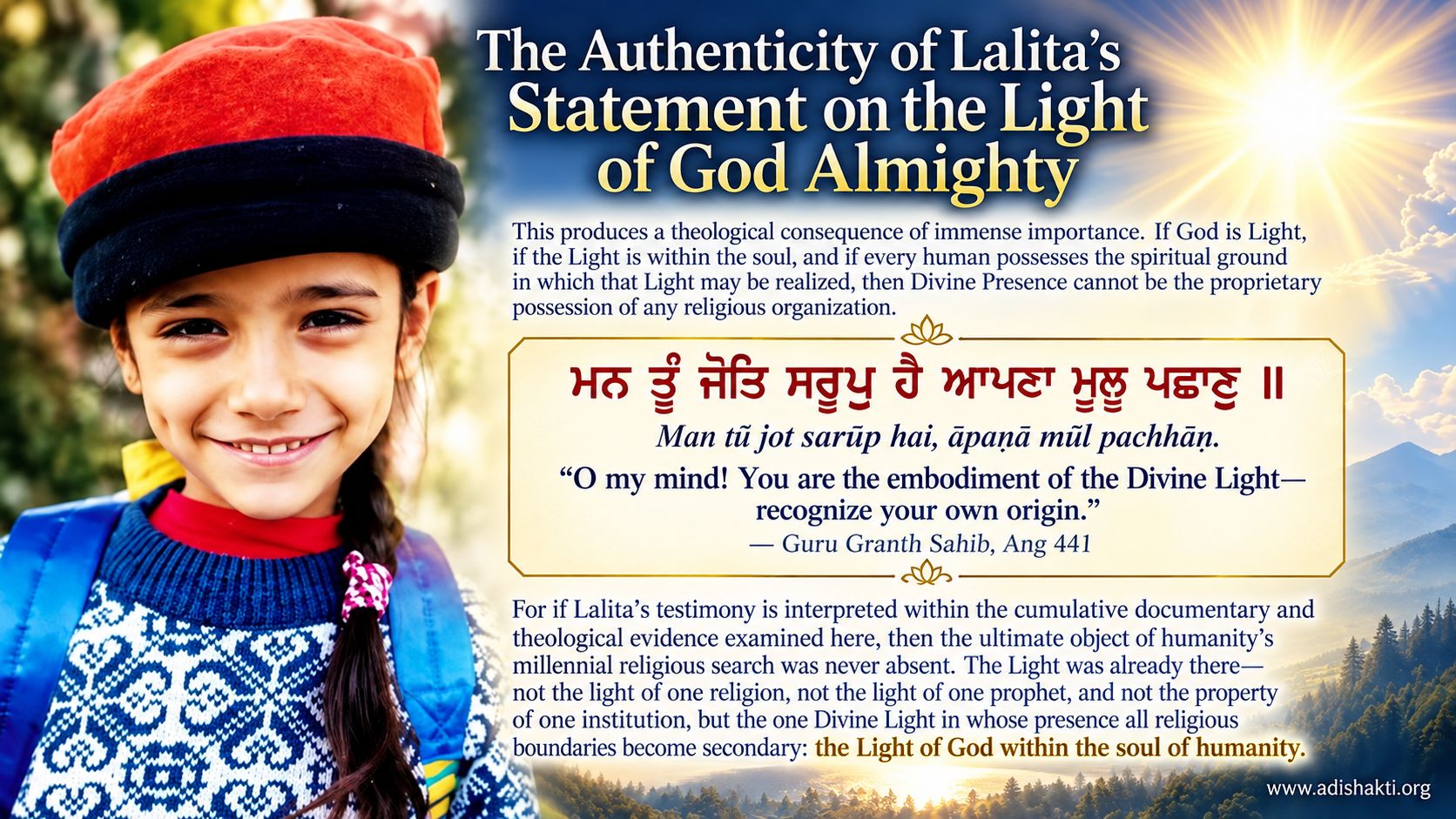
ਮਨ ਤੂੰ ਜੋਤਿ ਸਰੂਪੁ ਹੈ ਆਪਣਾ ਮੂਲੁ ਪਛਾਣੁ ॥ Man tū̃ jot sarūp hai, āpaṇā mūl pachhāṇ.
“O my mind! You are the embodiment of the Divine Light—recognize your own origin.”
— Guru Granth Sahib, Ang 441
1 · Documentary Method
Introduction: The Question Is Not Merely Whether Lalita Said “God”
A serious investigation of Lalita’s testimony must begin by refusing an easy argument. A ten-year-old child raised in a religious environment can certainly learn that God is associated with Light. If all that survived were a late recollection saying that Lalita had once been asked what a bright spiritual light was and answered “God,” that would have limited evidentiary value. It would be meaningful devotionally, but historically it would be difficult to distinguish personal experience from religious instruction.
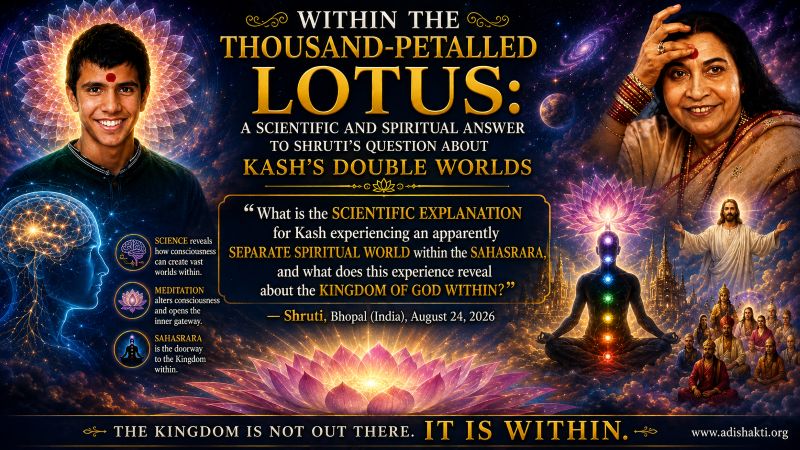
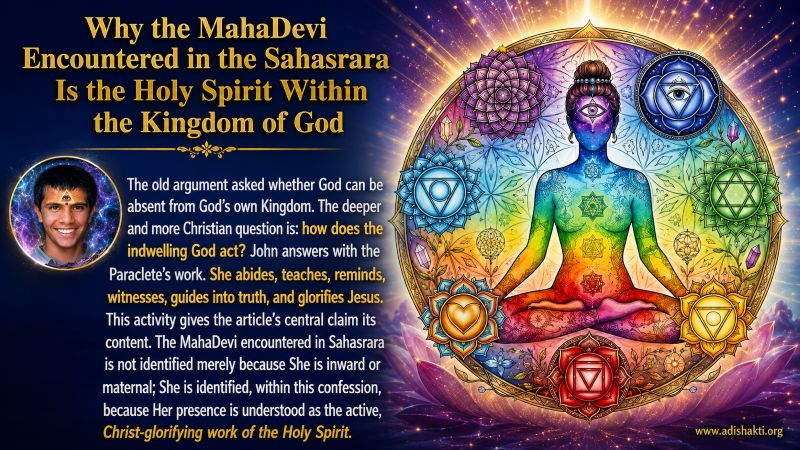
The Sahasrara as the reported interior realm in which the children located their encounters.
The surviving documentary sequence is considerably more complex. The question is therefore not simply whether Lalita said that God is Light. The proper historical questions are what exactly she reported seeing, when those characteristics were recorded, whether she described the phenomenon before explicitly identifying it as God, whether other witnesses described substantially similar characteristics, whether their reports preceded Lalita’s theological conclusion, whether the descriptions are mechanically identical or instead contain the natural differences expected from different witnesses, whether ancient scriptures independently describe ultimate Reality in substantially comparable language, and whether Shri Mataji taught that Divine Light exists within human beings independently of Lalita’s later statement.
A further chronological control is indispensable. Shri Mataji’s Istanbul declaration of November 6, 1994 belongs to the record before Lalita’s mature 2005 formulation. This matters methodologically. If Shri Mataji had made the statement only after Lalita’s testimony, the resemblance could be dismissed as retrospective theological accommodation. But the order runs in the opposite direction: prior declaration by Shri Mataji → later witnessing and identification by Lalita. The historical question is therefore whether Lalita’s later language unexpectedly meets a theological formulation that already existed: the Spirit is Light, that Light is Eternal, it is within the human being, and it is to be verified in direct experience.
This distinction between phenomenology and ontology is essential. “Very bright,” “cool,” “yellow,” “doesn’t blind you,” and “different from the sun” are phenomenological descriptions: they concern what Lalita reported experiencing. “God” is an ontological identification: it tells us what she believed the phenomenon actually was. The evidentiary case becomes considerably more interesting because the phenomenological description precedes the explicit ontological identification.
2 · Primary Claim
The Primary Statement: “God!”
The surviving documentary record preserves the decisive exchange:
A few months ago i asked my ten-year-old daughter Lalita what that immensely brilliant Light above the Adi Shakti in her Sahasrara is. She replied “God!”
I remained silent for a long time to absorb the immensity of that single word answer.
This is an extraordinarily compressed theological statement. Lalita did not answer that the Light represented God, that it reminded her of God, or that it was symbolic of God. She did not describe it as an angel, aura, heavenly illumination, chakra energy, vibration, supernatural sun, or symbolic manifestation. Her answer was categorical.
“God!”
The academic significance of this answer lies precisely in the fact that it was not the beginning of the Light tradition within the family. It was its culmination.
3 · Primary Source Record
The January 11, 2005 Record: The Entire Appended Extract
The following primary-source extract is preserved in its entirety because the second conversation transforms the theological meaning of the first.
“At last I do not have to search for Him in temples, churches, mosques, synagogues and gurdwaras”
From: jagbir singh · Date: Tue Jan 11, 2005 9:56 am
Subject: “At last i do not have to search for Him in temples, churches, mosques, synagogues and gurdwaras”
A few months ago i asked my ten-year-old daughter Lalita what that immensely brilliant Light above the Adi Shakti in her Sahasrara is. She replied “God!”
I remained silent for a long time to absorb the immensity of that single word answer.
Last Saturday at about 11 a.m. I went to the local IGA supermarket with Lalita, after she had finished skating classes. On the way back i asked her: “Lalita, where is this Light in your body? Can you feel it now?”
She replied: “It's not in the body but in the soul.”
So i had to ask: “Lalita, is the soul in the body?”
She replied: “No, .... how do i say that? ..... It's in but not that you can see it.”
What she meant was that the Light is within each human soul within the body. But we humans cannot see this spiritual Light within the soul. Only your spiritual soul within can see this spiritual Light.
I am still trying to understand and make sense of it. But at least I know how God Almighty exists within me as Light, one and the same in all human beings. At last I do not have to search for Him in temples, churches, mosques, synagogues and gurdwaras whose followers have for centuries and millennia fought and killed millions for His Grace............... and that He is present within me and all others is very, very comforting indeed. The Great Event ordained for humanity absolutely strips all the feuding organized religions of all powers of salvation for only their kind .............. and that also is very, very comforting.
Jai Shri Mataji, jagbir
4 · Philosophical Interpretation
The Essence of the January 2005 Exchange
The most important sentence in this document may actually not be “God.” It may be: “It’s not in the body but in the soul.” This is a remarkably sophisticated distinction. Lalita does not apparently conceptualize the Light as a physical object anatomically located somewhere inside the skull. She distinguishes the physical body from another dimension of human existence—the soul—and locates the Light there. When the obvious follow-up question is posed—“is the soul in the body?”—her answer becomes hesitant: “No, .... how do i say that? ..... It’s in but not that you can see it.”
That hesitation deserves attention. It would be easy to dismiss the grammatical awkwardness as childhood uncertainty. Phenomenologically, however, it expresses a classic difficulty encountered throughout mystical literature: spatial vocabulary becomes inadequate when consciousness attempts to describe something experienced as interior but not physically contained. “In” normally describes spatial containment. The heart is in the chest, the brain is in the skull, and blood is in the arteries. Yet Lalita appears to be saying that the soul is “in” the person without being an observable physical object occupying anatomical space.
That distinction is philosophically significant because she is describing interiority without ordinary spatial containment. The Light is therefore “within,” but not within in the same sense that an organ is within the body. This provides a conceptual bridge between the language of mystical interiority and the Sahasrara.
5 · Testimony Analysis
A Child’s Difficulty with Metaphysical Language
The phrase “how do i say that?” deserves particular emphasis. An invented theological answer frequently displays vocabulary supplied by the tradition in which it was learned. One might expect phrases such as “Sahasrara chakra,” “Spirit,” “Atman,” “Paramatma,” “Divine Light,” “Brahman,” or “God is inside everybody.” Instead Lalita encounters a linguistic problem. The soul is “in,” but it cannot be seen.
This is not proof of supernatural knowledge. Nevertheless, from the standpoint of testimony analysis it is interesting because the answer sounds less like the recitation of a finished doctrine than an attempt to translate an internal conceptual or experiential distinction into ordinary language. There is an important difference between knowing a sentence and struggling to describe an experience. The latter frequently produces precisely this kind of imperfect language.
6 · Chronology
The Earlier Evidence: Lalita Did Not Begin with “God”
The established Adishakti.org Light testimony image used in the Authenticity Series.
The evidentiary strength of Lalita’s later identification depends heavily upon her earlier statements. On March 23, 2003, while preparing for sleep, Lalita reportedly began counting ordinary lights in her room. Seven physical sources were identified, but Lalita insisted there were eight. The eighth, she said, was the Light above Shri Mataji in her Sahasrara.
This detail is important because the Light reportedly entered the conversation spontaneously while ordinary physical lights were being counted. She was then questioned about its characteristics and described it as cool, very bright, possible to look at directly, and yellow. The surviving record becomes especially interesting when her father proposes alternative colour terminology. Lalita does not simply accept “silver” or “metallic silver.” She asks what those words mean and eventually returns to her original description: yellow.
This is a small but valuable evidentiary detail. A witness who merely accommodates the questioner tends to follow the vocabulary supplied by the interviewer. Lalita did not do so in this exchange. Her refusal does not prove the objective existence of the Light, but it does provide evidence against the strongest version of the hypothesis that her answers were simply produced by immediate parental suggestion.
7 · Longitudinal Testimony
May 4, 2004: Longitudinal Stability
More than a year later Lalita was questioned again. The exchange preserved by Adishakti.org records that she again identified a Light above Shri Mataji. She stated that one could look at it for a long time, that it did not blind the observer, that it differed from the terrestrial sun, and that despite being smaller it was brighter.
This matters because the 2004 testimony retains the essential phenomenological structure of the 2003 testimony: extraordinary luminosity, visual tolerability, and non-solar character. Only later does the theological identification become explicit: “God!” Thus the documentary sequence is not best represented as religious doctrine followed by a description reshaped to fit the doctrine. The surviving sequence is closer to recurrent Light → description of unusual properties → repeated differentiation from sunlight → later ontological identification as God.
That order matters because it separates experience-description from later theological interpretation.
8 · Earlier Interior Vision
Lalita’s Earliest Testimony: “In My Head”
The chronology extends further backward. Adishakti.org preserves an account dated March 30, 1998, when Lalita was three years and eleven months old. She reportedly announced that she had seen Shri Mataji and described the encounter as occurring “in my head.” The account includes seven flowers, Shri Mataji seated upon a chair, the placing of a bindi, and Lalita’s description of Shri Mataji as young and beautiful.
Later Adishakti.org research connects this early account with her description of a luminosity comparable to “morning” yet not painful to the eyes. Again, methodological restraint is necessary. A three-year-old child’s statement does not prove an ontologically independent spiritual realm. Its significance is chronological. The interior localization—“in my head”—appears years before the sophisticated January 2005 discussion concerning body, soul, and Light. The later statement therefore does not appear suddenly without antecedent.
9 · Earlier Witness
Kash: The Earliest Detailed Witness to the Light
The reported relationship between embodied awareness and the inner world of the Sahasrara forms part of the wider documentary corpus.
The strongest antecedent in the corpus belongs to Kash. His testimony is especially important because according to the preserved chronology he did not initially call the luminous phenomenon God. He thought it was the sun. That apparent mistake is evidentially valuable because it suggests that he was trying to interpret an anomalous visual experience in familiar physical terms rather than beginning with a fixed theological category.
Kash reportedly encountered an extraordinarily brilliant luminous source associated with Shri Mataji’s realm. Nothing in ordinary experience seemed sufficiently bright to provide an analogy, so he concluded that it must be the sun viewed from much closer proximity. Over time, however, anomalies accumulated. The source reportedly remained stationary, did not rise or set, produced extraordinary illumination without perceptible heat, gave off cool rays, could apparently be looked upon without the normal consequences of staring toward intense sunlight, and, most unusually, was said to illuminate a realm in which shadows were absent.
The progression is significant: experience → natural interpretation → anomalous observations → doubt → reinterpretation. If Kash had merely been repeating an established household doctrine, an immediate answer such as “I saw God’s Light” would arguably have been more predictable. Instead, he appears in the surviving narrative trying to understand an anomalous phenomenon through the ordinary physical category available to him: the sun.
10 · Interpretive Turning Point
September 11, 1994: From “Sun” to “Light”
The preserved chronology identifies September 11, 1994 as an interpretive turning point. While considering the Sikh theological concept of Saibhaṅg, the self-existent or self-subsistent Divine, the question arose whether the extraordinary “sun” reported by Kash could really be an ordinary astronomical object. Kash was reportedly asked to clarify the matter during meditation, and according to the narrative Shri Mataji told him that what he had been calling the sun was not the sun: it was the Light.
This creates a remarkable chronological architecture. Kash first encounters luminosity and calls it the sun. Its characteristics gradually make the solar hypothesis problematic. The phenomenon is then identified as Light. Years afterward Lalita independently describes an unusual Light possessing overlapping characteristics. Still later she identifies its ultimate nature: “God!” The movement is therefore from phenomenon to interpretation, not merely from doctrine to repetition.
11 · Corroborating Witness
Arwinder: A Second Corroborating Witness
Arwinder supplies another evidentiary strand. On April 7, 1996 he was reportedly asked whether he had seen a sun or light while meditating with the Divine Mother. He answered that there was always a Light there but that it could not be the terrestrial sun. His reason was strikingly similar to the later testimony of Lalita: despite its extreme brightness, it did not hurt his eyes, and it could be gazed upon.
In February 1998 he was questioned concerning shadows and reportedly answered that there were none. The question was repeated in July 1998 and the answer remained the same. Then, following Lalita’s March 2003 description of the Light as yellow, Arwinder was asked separately what colour he perceived. His answer was: “Like white, white yellow.”
The descriptions are therefore convergent without being verbally identical. Lalita says yellow; Arwinder says white, white yellow; Kash emphasizes overwhelming brilliance, coolness, non-solar behaviour and shadowlessness. Perfectly identical answers could suggest rehearsal. Partial correspondence with natural variation is more interesting evidentially because it preserves both common structure and individual expression.
12 · Convergence
What the Three Witnesses Actually Corroborate
The surviving corpus does not justify pretending that all three witnesses reported every characteristic. They did not. Kash supplies the most elaborate phenomenology. Lalita independently overlaps with several of its most distinctive features, while Arwinder supplies narrower but compatible testimony. The common nucleus is nevertheless substantial: an extraordinary Light, association with Shri Mataji and the inner Sahasrara realm, brightness unlike ordinary terrestrial illumination, distinction from the physical sun, and, in multiple accounts, the ability to perceive extraordinary luminosity without ordinary ocular pain.
Reported characteristic
Kash
Lalita
Arwinder
Extraordinary Light
Yes
Yes
Yes
Associated with Shri Mataji / Sahasrara
Yes
Yes
Yes
Very bright yet visually tolerable
Yes
Yes
Reported as gazeable
Cool / no ordinary heat
Yes
Yes
Not central to cited exchange
Yellow / white-yellow quality
Not central to earliest account
Yellow
White-yellow
Unlike terrestrial sun
Yes
Yes
Yes
Stationary
Yes
—
—
No shadows
Yes
—
Yes in later questioning
Identified as God / Divine Light
Eventually as the Light
“God!”
Contextually associated
There are also more specific overlaps. Kash and Lalita converge upon coolness. Kash and Arwinder converge upon the absence of shadows. Lalita and Arwinder converge upon a yellow or white-yellow appearance. The evidentiary value lies in this asymmetry rather than artificial uniformity.
13 · Sensory Correspondence
The Most Important Corroboration Is Not the Word “Light”
“Light” by itself is weak evidence. Children exposed to religion can easily learn that light symbolizes goodness or God. The more significant correspondence is the unusual cluster of properties repeatedly associated with the phenomenon.
Kash described extreme luminosity without normal heat and characterized its rays as cool. Years later Lalita answered that the Light was “Cool.” She also insisted that despite extraordinary brightness “you can look at it.” This combination is especially significant because it concerns reported sensory characteristics rather than merely theological vocabulary.
The question for future archival research is therefore crucial: Can original records demonstrate that Kash’s descriptions of coolness, visual tolerability, stationarity and shadowlessness were committed to writing before Lalita and Arwinder were exposed to them? If so, the evidentiary strength of the convergence increases substantially.
14 · Scripture
Christianity — “God Is Light”
Lalita’s answer is striking because Christianity contains almost precisely the same ontological formulation. The First Epistle of John declares: “God is light; and in him is no darkness at all.” This is not merely the assertion that God creates light, nor does the grammatical form merely say that light symbolizes God. The statement predicates Light of God directly.
Question: What is the Light? Lalita: “God!”
1 John 1:5: “God is light.”
This correspondence cannot demonstrate that Lalita’s perceived Light was objectively the God described by the Johannine author. It does, however, establish something historically important: the theological equation she articulated existed nearly two thousand years before her birth.
15 · Johannine Theology
The Johannine Prologue: The Light Within Humanity
John’s Gospel deepens the parallel. The Prologue identifies life in the Logos as the Light of humanity and speaks of the true Light illuminating human beings. The Johannine text therefore joins the concepts of God or Logos, life, Light, and humanity.
This is directly relevant to the January 2005 exchange. Lalita does not merely identify a transcendent celestial Light. She subsequently places the Light in relation to the soul. The Johannine trajectory likewise refuses to leave Divine Light infinitely remote from human existence. The true Light illuminates humanity. Lalita’s testimony therefore moves in the same theological direction: from the Light above the Divine Mother to the Light within the human soul.
16 · Qur’anic Theology
The Qur’an — Nūr
The Qur’an provides an equally important correspondence. Sūrat al-Nūr 24:35 begins with one of the most celebrated theological statements in Islam: “Allah is the Light of the heavens and the earth.” The verse proceeds through the symbolism of niche, lamp, glass and radiance toward the famous expression “Light upon light.”
The theological traditions surrounding this verse are immense, ranging from interpretations emphasizing revelation and guidance to highly developed mystical readings of Divine illumination. Again, historical discipline requires precision. Qur’an 24:35 does not prove that the luminous phenomenon reported by Lalita was Allah. But it decisively establishes that identifying ultimate Divine Reality through Light is not a modern invention of Adishakti.org. It belongs to the central scriptural vocabulary of Islam.
The theological irony is profound. The January 2005 reflection states: “At last I do not have to search for Him in temples, churches, mosques, synagogues and gurdwaras.” Yet the scriptures preserved by those very traditions repeatedly direct humanity toward a Divine Light that transcends their institutional boundaries.
17 · Upanishadic and Hindu Theology
Hinduism — The Light by Which Everything Else Shines
The Upanishadic tradition develops perhaps the most philosophically sophisticated account of Divine luminosity. Ultimate Reality is not merely another illuminated object. Brahman or Atman is the self-luminous principle by which all other things become knowable. Physical light illuminates objects, but consciousness makes the experience of both light and objects possible. Thus when the Upanishadic tradition speaks of the supreme Light, it moves beyond ordinary photons toward the self-revealing foundation of awareness itself.
This supplies an important philosophical interpretation of Lalita’s otherwise puzzling statement: “It’s not in the body but in the soul.” If Divine Light belongs to consciousness rather than physical anatomy, then it should not be expected to occupy measurable space in the manner of a biological organ. It would be inward without being spatially enclosed. That is remarkably close to what Lalita struggles to articulate: “It’s in but not that you can see it.”
18 · Sikh Theology
Sikhism — Saibhaṅg and Jyoti
Sikh theology provides another major element of the documentary history because the term Saibhaṅg reportedly played a role in the 1994 reconsideration of Kash’s “sun.” The Mūl Mantar describes Ultimate Reality as self-existent or self-subsistent. Within Sikh religious language, jot/jyoti, Divine Light, also becomes a powerful expression of God’s presence.
The theological point is important. A self-existent Reality cannot ultimately depend upon an external celestial lamp to illuminate it. If the Divine realm is grounded in the self-luminous Reality of God, then Kash’s strange “sun”—stationary, cool, visually tolerable and shadowless—would indeed be conceptually different from the astronomical sun. This does not prove Kash’s experience, but it explains why Saibhaṅg became an intellectually important clue in interpreting it.
19 · Shri Mataji — Prior Declaration
November 6, 1994, Istanbul: “You Have Such a Unique Light Within You”
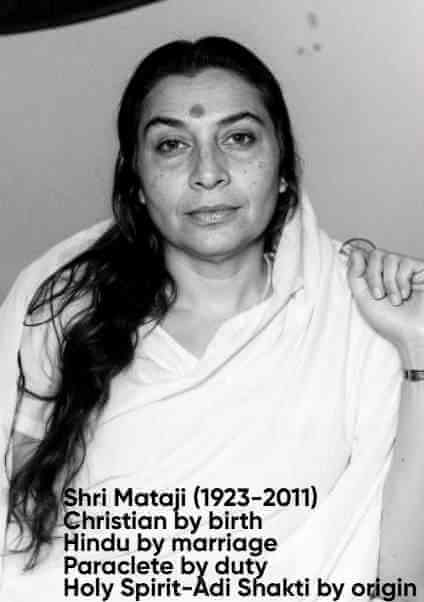
Shri Mataji Nirmala Devi publicly declared in Istanbul in 1994 that the Spirit is Light and that human beings carry an Eternal Light within.
The most important modern theological corroboration in this investigation is not a later interpretation devised after Lalita’s testimony. It is a declaration made by Shri Mataji Nirmala Devi in Istanbul, Turkey, on November 6, 1994—approximately a decade before the January 2005 exchange in which Lalita located the Light “in the soul.” Its chronological priority gives the statement special evidentiary importance.
The declaration must therefore be displayed in full rather than reduced to a short paraphrase. The following is reproduced verbatim as supplied for this paper:
The Prior Declaration — Istanbul, Turkey · November 6, 1994
“One has to know on this point that you have got the Light ... You have to give up all that is falsehood. If you are fully enlightened you will give up automatically. You don't have to be told. The Spirit automatically feels responsible that it has to give Light. It has to tell that you please give Light, because it is Light. Because it is Eternal Light nothing can kill it. There is a sloka," It cannot be killed by anybody, nothing can destroy it. Even if you want to suck it you cannot.”It is such a powerful Light. You can verify it whether it is eternal or not. You have to see for yourself you have such a unique Light within you. In the history of spirituality of this world so many have got Realization — such a Light in them. How could these stupid, flimsy, useless conditionings dominate you now, when you are the carrier of Eternal Light.”
The Paraclete Shri Mataji Being The Light Of Pure Compassion, Istanbul, Turkey November 6, 1994
This passage is central because Shri Mataji does not speak of Light merely as a poetic symbol for moral goodness. She explicitly identifies the Spirit as that which “has to give Light” “because it is Light.” She then describes that Light as Eternal, indestructible, powerful, experimentally verifiable and already “within you.” The sequence is therefore theological and experiential at once: Spirit → Light → Eternality → interiority → verification.
The phrase “You can verify it” is especially important. Shri Mataji does not ask the listener merely to accept a creed. Her declaration makes an epistemic claim: the Light can be known through direct spiritual realization. That claim creates a striking bridge to the evidentiary character of Lalita’s testimony, because Lalita does not offer a theological argument for Divine Light. She reports what she says she perceives and then answers questions about its identity and location.
Shri Mataji, 1994: “You have to see for yourself you have such a unique Light within you.”
Lalita, January 2005: “It’s not in the body but in the soul.”
This is where the two testimonies meet with unusual precision. Shri Mataji’s declaration locates the Light within the human being and identifies its source with the Spirit. Lalita later rejects a merely anatomical localization and places the Light “in the soul.” The correspondence is therefore deeper than the shared word Light. Both accounts place Divine luminosity in the interior spiritual dimension of the person rather than in ordinary biological matter.
Lalita’s earlier one-word identification—“God!”—adds the ontological dimension. When the two strands are placed together, the convergence becomes: Shri Mataji: Spirit is Light and the Eternal Light is within you; Lalita: the Light is God, and it is in the soul. In theological terms, the declaration and the witnessing meet at the same point: the Divine Light is not merely external illumination but the interior presence of ultimate Reality.
This chronological relation must be vigorously upheld while preserving academic boundaries. Shri Mataji’s statement does not scientifically prove that Lalita objectively perceived God. Lalita’s statement does not independently prove Shri Mataji’s metaphysics. But the fact that Shri Mataji publicly articulated the interior Eternal Light before Lalita’s mature formulation substantially strengthens the argument that Lalita’s later testimony fits a pre-existing and specific spiritual ontology rather than a theology improvised after the event.
20 · Metaphysical Model
Shri Mataji and the Ocean of Spirit
Another statement attributed to Shri Mataji provides a particularly illuminating metaphysical analogy. The Spirit is compared to an ocean containing Light, while the human brain is compared to a small cup into which that ocean pours. This helps resolve the apparent paradox in Lalita’s language.
Where exactly is the Light? Is it above Shri Mataji? Inside the Sahasrara? Inside the soul? Within humanity? Everywhere? From a purely spatial model these statements appear contradictory. From a consciousness model they need not be. If Spirit is fundamental rather than spatially localized, then the same Divine Reality can be described phenomenologically as transcendent and interior. The problem disappears once “within” ceases to mean “inside a measurable anatomical container.”
21 · Sahasrara
The Sahasrara Event and “Tremendous Light”
The wider Adishakti.org corpus locates the Divine Mother and the Light within the Sahasrara framework.
Shri Mataji’s description of the opening of the Sahasrara on May 5, 1970 provides another independent point of comparison. She described the event in terms of overwhelming Chaitanya and “tremendous Light,” together with an opening of the crown region and a torrential descent of Divine energy.
The relevance is not that this statement verifies Lalita’s later vision. Rather, it establishes that Shri Mataji’s own account of Sahasrara consciousness was already explicitly luminous. Thus three categories converge: Shri Mataji’s Sahasrara testimony speaks of tremendous Light; the children’s Sahasrara testimony speaks of extraordinary Light; and ancient scripture repeatedly describes Divine Reality as Light. The cumulative correspondence is considerably more significant than any one statement considered separately.
22 · Spiritual Anthropology
The Extraordinary Meaning of “It’s Not in the Body but in the Soul”
We can now return to Lalita’s January 2005 statement with greater theological precision. She appears to distinguish at least three categories: body, soul, and Light. The body is physical. The soul is interior but not physically visible. The Light belongs to the soul.
This implies a model in which consciousness possesses depths that cannot be reduced to ordinary anatomical observation. Lalita does not say that the Light is in her brain. She says: “It’s not in the body but in the soul.” When asked whether the soul is in the body she effectively answers that it is “in” but not in an ordinary visible sense. This is remarkably close to the philosophical distinction between spatial interiority and metaphysical interiority.
The Divine is not necessarily “inside” us because God occupies several cubic centimetres somewhere behind the forehead. God is “within” because the deepest ground of consciousness participates in, reflects, or is united with Divine Reality.
23 · Mystical Epistemology
“Only Your Spiritual Soul Within Can See This Spiritual Light”
The interpretive comment accompanying the January record states that ordinary physical sight cannot perceive the Light and that it is the spiritual soul that perceives it. This distinction is fundamental to mystical epistemology. Ordinary empirical knowledge follows roughly from physical object to sensory organ, nervous system, and conscious perception. Mystical knowledge claims another mode: interior consciousness, transformed awareness, and apprehension of spiritual reality.
One need not accept the metaphysical claim in order to understand its internal coherence. Indeed, it explains why demanding an ordinary photograph of the Light would misunderstand the category of experience being reported. If the claim is that the Light belongs to the soul’s mode of perception, its authenticity must initially be investigated through testimony, phenomenological consistency, documentary chronology, transformative effects and comparative mystical evidence—not by treating it as a conventional optical object.
24 · Interior Realization
The Search Outside and the Discovery Within
The title of the January 2005 message captures the existential consequence: “At last I do not have to search for Him in temples, churches, mosques, synagogues and gurdwaras.” This should not necessarily be interpreted as declaring sacred buildings worthless. Its deeper theological meaning is that no institution possesses God.
A church may point toward God. A mosque may orient the believer toward God. A synagogue may preserve revelation about God. A gurdwara may proclaim the Divine Name. A temple may represent Divine Presence. But none can monopolize the Infinite. If Divine Light exists within the soul of every human being, the ontological relationship between humanity and God precedes religious membership.
One does not first become Christian, Muslim, Hindu, Sikh or Jew and thereby acquire the Divine Light. Rather, religion becomes meaningful insofar as it helps awaken recognition of a Divine Reality already closer to the human being than any external institution.
25 · Universal Theology
The Radical Universalism of Lalita’s Statement
This produces a theological consequence of immense importance. If God is Light, if the Light is within the soul, and if every human possesses the spiritual ground in which that Light may be realized, then Divine Presence cannot be the proprietary possession of any religious organization.
The Light within a Christian cannot be ontologically different from the Light within a Muslim merely because their theological vocabularies differ. Nor can the Light within a Hindu be metaphysically Hindu, or the Light within a Sikh metaphysically Sikh. These are human categories. The Light precedes them.
This is the deepest meaning of the January 2005 realization. The universality of God becomes grounded not merely in religious tolerance but in shared spiritual ontology. Humanity is one because the Divine ground within humanity is one.
26 · Religious Exclusivism
Why the Statement Challenges Religious Exclusivism
Religious exclusivism normally works by locating decisive salvific authority outside the individual: this church, this prophet interpreted only through this institution, this denomination, this scripture interpreted only by this community, this ritual, this clergy, or this religious identity. Lalita’s statement relocates the decisive encounter.
“It’s not in the body but in the soul.”
If true, no priesthood can manufacture the Light. No institution can own it. No ethnic group can inherit exclusive title to it. No religious organization can legitimately declare that God is absent from all human beings outside its membership. Religious traditions can guide humanity toward realization, but they cannot privatize the Reality being realized.
27 · Kingdom Within
Jesus and the Kingdom Within
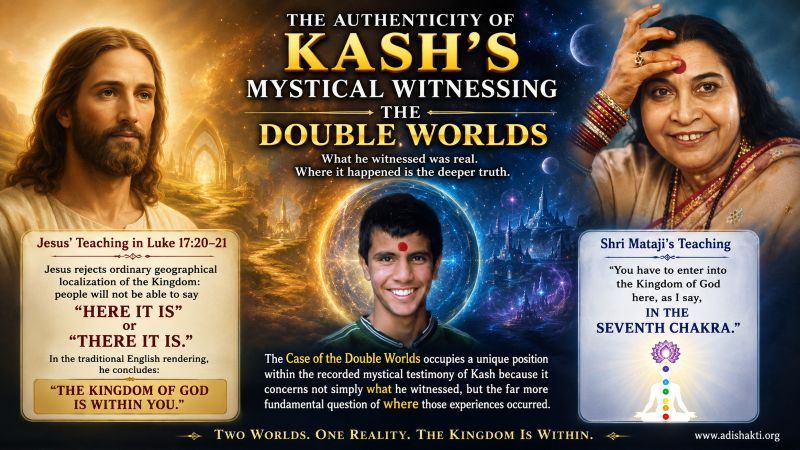
This interpretation gives new force to Jesus’ teaching concerning the Kingdom of God. Within the theological framework adopted by the Authenticity Series, the Kingdom is not fundamentally an astronomical territory requiring physical travel. It is an interior Divine dimension accessible through transformed consciousness.
Lalita’s childhood phrase “in my head” and her later distinction “not in the body but in the soul” can therefore be read as two developmental expressions of the same phenomenological claim. The Sahasrara is “within,” but not anatomically within. The Kingdom is interior, but not reducible to neural tissue. The Light is perceived inwardly, but it is understood as transcending the individual.
This is the paradox of mystical interiority: the deeper one travels within, the less merely private the Reality becomes.
28 · Metaphysics
Microcosm and Macrocosm
This provides perhaps the most coherent philosophical model of the entire testimony. Kash describes the Light as apparently vast and transcendent. Lalita describes it in the Sahasrara. Later she says it belongs to the soul. Shri Mataji describes an Eternal Light within the realized human being. Scriptures describe Divine Light as cosmic.
Are these competing locations? Not necessarily. They can instead be interpreted as two perspectives upon one Reality: macrocosm, Divine Light as the ground of existence, and microcosm, the same Divine Light apprehended within consciousness.
The transcendent and the immanent need not constitute two separate Lights. The Infinite encountered within does not become finite merely because consciousness is the doorway through which it is known.
29 · Critical Method
The Strongest Skeptical Objection: Shared Family Environment
Academic integrity requires confronting the most obvious objection. Kash, Arwinder and Lalita were siblings. They shared a household, religious vocabulary, exposure to Shri Mataji, and opportunities to hear one another’s experiences discussed. Their father questioned them. Therefore their accounts cannot automatically be called completely independent testimony.
The academically responsible description is therefore three related witnesses displaying substantial phenomenological convergence, with some individually obtained and non-identical responses. That is still significant, but it is different from three strangers independently reporting identical phenomena without prior contact.
30 · Alternative Explanation
Why Suggestion Does Not Fully Explain the Evidence
Shared religious environment remains a viable alternative explanation. It does not, however, effortlessly explain every feature. Kash reportedly began by insisting that the phenomenon was the sun, which is not the obvious answer of a child merely parroting “God is Light.” His reported observations progressively destabilized his own interpretation.
Lalita also resisted suggested colour vocabulary. When alternatives such as silver were proposed, she did not obediently adopt them but returned to yellow. Arwinder supplied a similar but non-identical answer, “white, white yellow.” The descriptions also recur across years rather than appearing as a single prompted statement.
Thus suggestion remains possible, but simplistic rehearsal does not provide a complete account of the documentary pattern.
31 · Research Priority
The Documentary Question That Could Strengthen the Case Further
The most important future work is archival. The original diaries, handwritten notes, dated printouts, computer files, correspondence and early publications from 1993–2005 should be assembled chronologically. Every reference to the Light should be indexed according to date, witness, exact wording, question asked, persons present, previous information potentially available to the witness, and date of first documentary preservation.
The crucial question is: Which unusual properties were documented before the younger children reported them? Especially important are coolness, visual tolerability, absence of heat, non-solar character, stationarity, shadowlessness, yellow or white-yellow appearance, and association with Shri Mataji in the Sahasrara.
If original dated records establish that the unusual Kash profile predates Arwinder’s and Lalita’s corresponding testimony, the case for meaningful independent convergence becomes substantially stronger.
32 · Limits of Historical Method
What Historical Evidence Can Establish
It is important not to claim more than the method permits. Historical evidence can investigate whether Lalita actually made the reported statements, whether the statements were recorded close to the events, whether her description remained stable over time, whether other witnesses supplied comparable descriptions, whether earlier records predate later testimony, and whether the scriptural parallels existed before the children’s experiences.
Historical evidence cannot place “God” beneath a microscope, nor can documentary analysis scientifically demonstrate that the ontological referent of Lalita’s experience was the Creator. That distinction should not be viewed as a weakness. It is simply the boundary between history and metaphysics.
Historical inquiry can evaluate authenticity, chronology, stability and convergence without pretending that a private mystical referent becomes a publicly measurable physical object.
33 · Cumulative Evidence
What the Evidence Does Establish with Considerable Force
The cumulative documentary evidence supports several conclusions considerably more strongly. First, the Divine-Light interpretation did not originate with Lalita’s 2005 answer. Second, Kash’s reported experience developed phenomenologically before being interpreted theologically. Third, Lalita repeatedly described a luminous phenomenon before explicitly identifying it as God. Fourth, her descriptions remained substantially stable across time. Fifth, several unusual features overlap with Kash’s earlier testimony. Sixth, Arwinder provides additional corroboration.
There are further contextual convergences. The witnesses’ wording is not mechanically identical. Ancient scriptures independently identify Divine Reality with Light. Shri Mataji explicitly taught that human beings possess an Eternal Light within. Finally, the January 2005 statement locating the Light in the soul is philosophically consonant with longstanding mystical traditions of Divine interiority.
Taken together, these facts create a cumulative case considerably stronger than the simple proposition that a religious child once said that God is Light.
34 · Evidentiary Synthesis
The Convergence
What Lalita reported
Lalita repeatedly reported an extraordinary Light associated with Shri Mataji and the Sahasrara. She described it as extraordinarily bright yet visually tolerable, cool, yellow and different from the terrestrial sun. She ultimately identified it as “God!” and subsequently located it not in the physical body but “in the soul.”
What contemporaneous documentary evidence establishes
The Light appears in a chronological series of dated accounts rather than as a single retrospective recollection. Lalita’s phenomenological descriptions precede her final ontological identification, while the January 2005 record preserves her distinction between physical body and soul.
What independently corroborates it
Kash’s substantially earlier testimony describes an anomalous luminous phenomenon with overlapping properties: extraordinary brightness, coolness, lack of heat, visual tolerability, stationarity and shadowlessness. Arwinder later distinguishes the Light from the terrestrial sun and gives a compatible colour description. Because the witnesses belonged to the same family environment, this is substantial corroboration but not proof of complete informational independence.
What scripture says
Christian scripture declares God is Light. John identifies the true Light with the illumination of humanity. The Qur’an declares Allah is the Light of the heavens and earth. Upanishadic theology describes ultimate Reality as self-luminous, the Light through which all else is known. Sikh theology develops the language of Divine Light and self-existent Reality.
What Shri Mataji had already declared in 1994
On November 6, 1994 in Istanbul, Shri Mataji publicly articulated the very structure that later appears in Lalita’s testimony. She said that the Spirit is Light, that this Light is Eternal and indestructible, that it exists “within you,” and that it is something the seeker can verify and “see for yourself.” This statement predates Lalita’s mature formulation by about a decade and therefore functions as a prior theological declaration rather than a retrospective explanation.
2005 — Lalita: witnessed Light → “God!” → “not in the body but in the soul” → interior but not ordinarily visible.
What theological inference follows
The strongest theological synthesis is not merely that two people happened to use the word Light. It is that Shri Mataji’s prior declaration and Lalita’s later testimony converge upon the same metaphysical structure: the Divine Reality is Light; the Light belongs to Spirit or soul; the Light is interior rather than anatomically material; and it is capable of direct realization. Within this framework, Lalita’s witnessing may be interpreted as experiential confirmation of the spiritual reality Shri Mataji had already declared. Historical method cannot compel that metaphysical conclusion, but the convergence is direct, chronologically ordered and theologically substantial.
35 · Essence
The Essence: “At Last I Do Not Have to Search for Him”
We can now understand the deepest significance of the appended extract. The great realization was not simply that God looks like Light. It was that God is not absent.
God is not confined to a distant heaven. God is not the possession of an institution. God is not waiting exclusively inside a church, owned by a mosque, imprisoned within a temple, limited to a synagogue, or monopolized by a gurdwara. The sacred structures may point toward Him. The scriptures may speak of Him. The prophets may bear witness to Him. The saints may realize Him. But the final sanctuary is deeper.
The sanctuary is within.
That is why the January 2005 reflection carries such emotional force. After centuries of human beings fighting over where God is, who represents Him, which revelation belongs to Him, and which community possesses the true road toward Him, Lalita’s answer reduces the entire dispute to a radically simple proposition:
The Light is in the soul.
36 · Assessment
Theological Verdict
Historical authenticity — Strong. The surviving corpus provides a substantial longitudinal series of dated testimonies and repeated descriptions rather than a single isolated late claim.
Phenomenological authenticity — Strong, subject to final archival reconstruction. The recurrence, specificity, developmental sequence and natural variation of the reports support the conclusion that the children were describing experiences they regarded as real.
Complete informational independence — Not yet demonstrated. Because the witnesses were siblings within a shared religious environment, the original documentary chronology remains indispensable.
Cross-scriptural correspondence — Exceptionally strong. The identification of Ultimate Reality with Light long predates these witnesses across Christianity, Islam, Hinduism, Sikhism and mystical traditions.
Chronological correspondence with Shri Mataji — Direct and unusually strong. Shri Mataji’s November 6, 1994 Istanbul declaration explicitly states that the Spirit is Light, that the Light is Eternal, that human beings carry this Light within, and that it can be verified directly. This declaration predates Lalita’s mature testimony.
Lalita–Shri Mataji convergence — Theologically profound. Shri Mataji says “you have such a unique Light within you”; Lalita later says the Light is “God!” and “not in the body but in the soul.” Their formulations meet at the level of interior Divine Light, Spirit/soul, and direct realization.
Ontological identification — Beyond the strict reach of historical method, but vigorously coherent within the cumulative theological framework. Historical analysis alone cannot scientifically prove the Light = God Almighty. Yet within the documentary chronology and the comparative scriptural framework, Lalita’s identification is not an isolated assertion. It is strongly consonant with prior scripture and, most decisively for this paper, with Shri Mataji’s earlier declaration of the Eternal Light within.
37 · Conclusion
Conclusion: The Immensity of One Word — and the Declaration That Preceded It
Lalita’s answer consisted of one word:
“God!”
Yet that word stands at the end of a remarkable evidentiary sequence. Kash first encountered something overwhelmingly luminous and called it the sun, but his “sun” did not behave like the sun. It remained stationary, produced no ordinary heat, its rays were cool, its extraordinary brilliance could be endured, and according to his repeated testimony its illumination produced no shadows. Arwinder subsequently distinguished the Light from terrestrial sunlight because it could be gazed upon despite its brightness. Lalita later described the Light as cool, extremely bright, yellow and visually tolerable, resisted alternative colour suggestions, and continued to distinguish it from the physical sun.
But the documentary sequence contains another fact of exceptional importance. Before Lalita’s mature testimony, Shri Mataji had already publicly declared the ontology of the Light. In Istanbul on November 6, 1994 she taught that the Spirit “has to give Light” “because it is Light,” that it is an “Eternal Light” that cannot be destroyed, that it is a powerful Light capable of verification, and that the seeker has “such a unique Light within you.”
Shri Mataji — November 6, 1994:
“You have to see for yourself you have such a unique Light within you.”
Lalita — January 2005:
“It’s not in the body but in the soul.”
This is the point at which declaration and witnessing meet. Shri Mataji’s formulation is doctrinal and initiatory: the Spirit is Light, the Light is Eternal, the Light is within, and it is to be verified. Lalita’s formulation is testimonial: she reports the extraordinary Light, identifies it as “God!”, and when asked where it is, places it not in ordinary anatomy but “in the soul.”
The chronological order is indispensable. The Istanbul statement is not a theological explanation constructed after Lalita’s words. It precedes them. Therefore the paper’s cumulative argument becomes stronger than a comparison of similar religious phrases. The prior declaration establishes a specific spiritual claim; the later testimony unexpectedly converges with its central elements. That does not convert private mystical testimony into laboratory proof, but it does create a serious documentary-theological correspondence that deserves to be stated without dilution.
When asked whether the soul itself was in the body, Lalita’s language became hesitant: “No, .... how do i say that? ..... It’s in but not that you can see it.” Here the limits of ordinary spatial language become visible. The Light is interior but not anatomical; present yet not ordinarily visible; associated with Sahasrara yet located in soul; transcendent yet intimate. Shri Mataji’s language resolves the same paradox by locating the Light in Spirit rather than matter.
The major traditions then surround this convergence with an ancient theological vocabulary. Christianity says God is Light. The Qur’an says Allah is the Light of the heavens and the earth. Indian spirituality speaks of the self-luminous Reality by whose Light everything else shines. Sikh spirituality speaks of Divine Light and the self-existent One. Shri Mataji declares that the Spirit is Light and that humanity carries an Eternal Light within. Lalita, when asked what she had repeatedly witnessed, answers: “God!”
The cumulative argument therefore rests upon convergence: prior declaration and later witnessing; earlier witnesses and later witnesses; phenomenology and ontology; Spirit and soul; exterior luminosity and interior realization; ancient scripture and contemporary testimony. Within this convergence, the Istanbul declaration occupies a decisive place because it gives the paper a chronological theological anchor:
What Shri Mataji declared in 1994 as spiritual reality, Lalita later described as witnessed reality: the Spirit is Light, that Light is within the human being, and Lalita identifies that Light as God within the soul.
This produces a theological consequence of immense importance. If God is Light, if the Light is within the soul, and if every human possesses the spiritual ground in which that Light may be realized, then Divine Presence cannot be the proprietary possession of any religious organization.
The temple may point. The church may proclaim. The mosque may call. The synagogue may remember. The gurdwara may sing. The scripture may testify. The prophet may announce. The guru may awaken. But the encounter itself occurs where the religions at their mystical depths have repeatedly directed humanity: within.
And this is why the January 2005 realization remains the most fitting existential conclusion: “At last I do not have to search for Him in temples, churches, mosques, synagogues and gurdwaras.”
For if Lalita’s testimony is interpreted within the cumulative documentary and theological evidence examined here, then the ultimate object of humanity’s millennial religious search was never absent. The Light was already there—not the light of one religion, not the light of one chosen community, not the light of one prophet, and not the property of one institution, but the one Divine Light in whose presence all religious boundaries become secondary:
the Light of God within the soul of humanity.
Source Register
References and Source Register
Singh, Jagbir. Shri Adi Shakti: The Kingdom of God. 1999, p. 669. Primary narrative relating to Kash’s witnessing of the luminous phenomenon and its later interpretation.
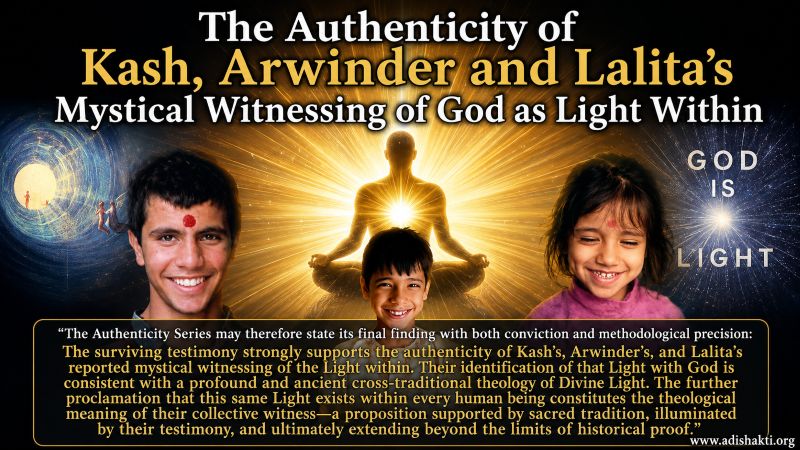
Adishakti.org, “The Authenticity of Kash, Arwinder and Lalita’s Mystical Witnessing of God as Light Within.” Authenticity Series source study.
Jagbir Singh, Yahoo Groups post, January 11, 2005, “At last I do not have to search for Him in temples, churches, mosques, synagogues and gurdwaras.” Entire extract reproduced in this paper from the supplied archival text.
The Holy Bible, 1 John 1:5; John 1:1–9. Divine Light and the Johannine identification of God, life and Light.
The Qur’an, Sūrat al-Nūr 24:35; cf. al-Ṣaff 61:8. Divine Light, revelation and “Light upon Light.”
Sri Guru Granth Sahib, opening Mūl Mantar, especially the doctrine of Saibhaṅg/self-existence; related Sikh traditions of jot/jyoti.
Shri Mataji Nirmala Devi, “Being the Light of Pure Compassion,” Istanbul, November 1994; reproduced and discussed by Adishakti.org in “You have such a unique Light within you.”
Shri Mataji Nirmala Devi, accounts of the opening of the Sahasrara, May 5, 1970, describing overwhelming Chaitanya and tremendous Light.
💬 Interactive Chat
Continue exploring the paper, its scriptures, chronology and theological implications.