From Shri Mataji to the MahaDevi: She Who Eternally Resides as the Self

Shri Mataji’s “Internal Person,” the Johannine Paraclete, the Sahasrara and the Non-Dual Recognition of the Divine Mother as the Self
Abstract
This paper examines a theological transition at the heart of Adishakti.org: from recognition of Shri Mataji Nirmala Devi in historical human form to recognition of the MahaDevi as the eternal Divine Self. The transition need not be understood as replacing Shri Mataji with a more abstract deity. Within a non-dual Śākta framework, it can be read in the opposite direction: the historical form becomes intelligible as a manifestation of a Reality that cannot be confined to that form. Shri Mataji’s reported 2011 epilogue—“You will carry me inside … I will be in you—you will be in me … I will not leave because I am [an] internal Person”—therefore becomes the paper’s hermeneutical center.
The argument is developed across four distinct levels that should not be conflated: what Shri Mataji historically said about herself; what Hindu and Śākta texts say about Devī, Ātman and Brahman; what Christian texts say about the indwelling Paraclete; and what Adishakti.org concludes from the convergence of these materials. Comparative parallels with Shekhinah, rūḥ, Tao and Prajñāpāramitā can illuminate recurring themes of immanence, wisdom and sacred presence, but they do not establish that these traditions secretly teach one identical feminine metaphysics. The deeper thesis is more precise: the movement from external manifestation to indwelling presence is structurally recurrent across traditions, and it gives unusual interpretive force to Shri Mataji’s final words.
1. From Incarnation to Indwelling: What the Transition Actually Means
The phrase “from Shri Mataji to the MahaDevi” can easily be misunderstood as a movement away from Shri Mataji. The more coherent theological reading is that it is a movement through the historical manifestation toward the ontological claim that the manifestation was intended to reveal. If “Adi Shakti” means primordial Divine Power rather than merely an honorific title, then the identity being claimed cannot be exhausted by a biological lifetime, a photograph, an institution, or even the remembered personality of a spiritual teacher. The form is historically particular; the reality claimed through the form is universal.
This distinction between manifestation and identity is fundamental. A person can encounter Shri Mataji historically as Nirmala Srivastava, religiously as the founder of Sahaja Yoga, devotionally as Guru, and theologically as Adi Shakti. Those descriptions operate at different levels. The Adishakti.org thesis makes its strongest claim at the fourth level: Shri Mataji’s human manifestation is interpreted as the temporal self-disclosure of the MahaDevi, the primordial Shakti who, in non-dual Śākta theology, is not merely one divine being among others but the conscious ground and power of manifestation itself.
Once that distinction is made, physical departure no longer creates the theological problem it would create if the Divine were identified exclusively with the historical body. The central question becomes whether Shri Mataji herself directed disciples toward precisely such an interiorization. The 2011 epilogue is important because its language does not merely ask followers to preserve teachings or memories. It speaks in the language of inward presence: “You will carry me inside,” “I will be in you,” and, in the version preserved here, “I am [an] internal Person.”
2. “I Am an Internal Person”: The Epilogue as the Interpretive Key
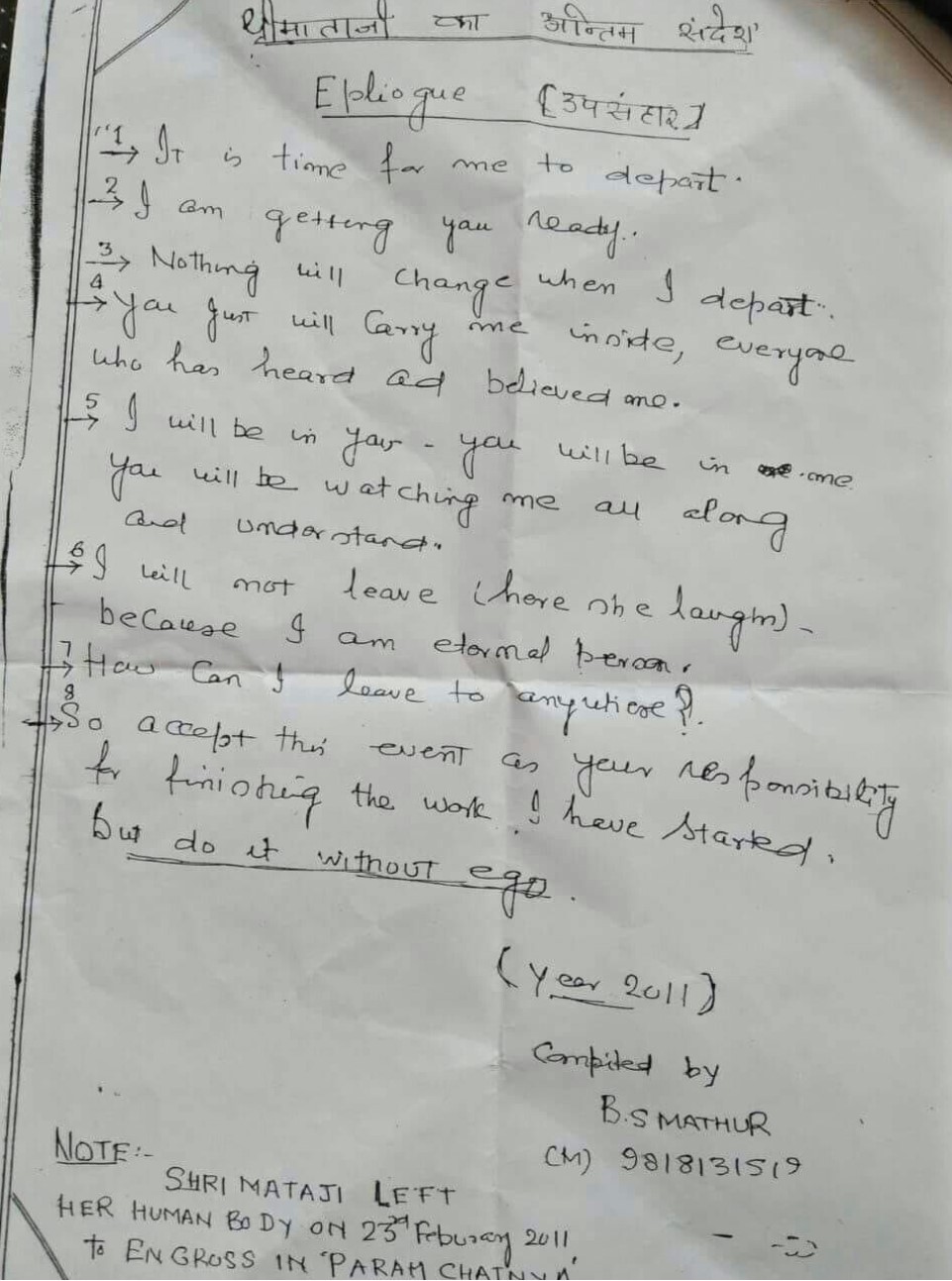
“It is time for me to depart. I am getting you ready. Nothing will change when I depart. You will carry me inside, everyone who has heard and believed me. I will be in you—you will be in me. You will be watching me all along and understand. I will not leave because I am [an] internal Person. How can I leave to anywhere? So accept this event as your responsibility for finishing the work I have started, but do it without ego.”
Three statements form a progression. “You will carry me inside” establishes interiority. “I will be in you—you will be in me” establishes reciprocity rather than mere remembrance. “I will not leave because I am [an] internal Person” supplies the reason physical departure cannot terminate that relationship. Read together, they describe an identity whose decisive locus is no longer the external body but inward spiritual presence.
The wording “internal Person” deserves special attention. If that transcription is correct, it is more conceptually exact than “eternal Person” for the argument of this paper. “Eternal” would describe duration; “internal” describes location or mode of presence. The surrounding sentences repeatedly concern what happens when the physical form departs: disciples will carry her inside; she will be in them; therefore she does not truly leave. The semantic sequence strongly favors an inward-presence reading. Nevertheless, without the underlying audio or another independent transcript, textual coherence cannot by itself prove what syllables were originally spoken.
The epilogue also prevents a purely metaphysical reading from becoming ethically empty. The inward presence is immediately joined to responsibility: “finish the work I have started, but do it without ego.” Interiorization is therefore not withdrawal from the world. It is a transfer of responsibility from the physically present founder to those in whom her work is to continue. The theological movement is simultaneously inward and outward: inward as realized presence, outward as ego-free action.
3. The Johannine Paraclete: Presence That Becomes Interior
The Gospel of John gives the Christian comparison its force because the Paraclete is described through both continuity and indwelling. In John 14:16–17, Jesus promises another Paraclete who will remain with the disciples and be in them. Later passages assign the Paraclete functions of teaching, reminding, witnessing, guiding into truth and glorifying Christ. Mainstream Christian theology identifies this Paraclete with the Holy Spirit and does not ordinarily understand the passages as predicting Shri Mataji. Any Adishakti.org identification must therefore be presented as a particular theological interpretation rather than as the uncontested meaning of the Johannine text.
Within that interpretation, however, the correspondence with the epilogue is deeper than a shared vocabulary of comfort. Jesus’ discourse concerns how divine presence continues when his visible presence is withdrawn. Shri Mataji’s epilogue concerns how her presence continues when she physically departs. Both passages place decisive emphasis on interior presence rather than perpetual physical proximity. The comparison is therefore structural: departure, promised continuity, inward presence, instruction and an unfinished mission entrusted to disciples.
This also clarifies what would count as evidence for the proposed identification. A verbal resemblance between “will be in you” and “I will be in you” is suggestive but insufficient by itself. A cumulative case would have to examine whether Shri Mataji’s teaching and historical mission correspond to the broader Johannine functions attributed to the Paraclete: teaching, remembrance, witness to Christ, guidance into truth, disclosure and continuing divine presence. The argument becomes stronger when the whole functional pattern is examined rather than when one phrase is isolated.
There is also an important theological safeguard. In John, the Paraclete does not erase Jesus; the Spirit bears witness to and glorifies him. Accordingly, an Adishakti.org interpretation is most internally coherent when Shri Mataji is not presented as displacing Christ but as directing consciousness toward the living reality to which Christ points. This is consistent with the wider Authenticity Series narratives in which Shri Mataji reportedly mediates encounters rather than demanding that every sacred figure be absorbed into her historical personality.
4. MahaDevi as Ātman: The Radical Depth of the Śākta Claim
The deepest conceptual foundation of the paper lies not in comparative religion but in non-dual Śākta theology. The supplied text cites the Bahvṛca Upaniṣad for the identification of Devī with Ātman and Brahman-consciousness, and the Bhāvana Upaniṣad for the statement that Lalitā is one’s own blissful Self. Taken within that theological tradition, these are not merely statements that a goddess resides somewhere inside the individual. They collapse the final distinction between the seeker, the consciousness by which the seeker knows, and the Divine Reality sought.
This is why “the MahaDevi as the Self” must be distinguished from psychological self-esteem, personality, ego or autobiographical identity. The empirical “I”—the changing stream of memory, preference, sensation and social identity—is not being deified. The claim concerns the witnessing consciousness by virtue of which changing experiences are known. In non-dual language, Devī is both the power by which the field of experience appears and the consciousness in which that field is disclosed.
The Devī Gītā material cited in the source strengthens this double movement. The Goddess creates and enters the worlds; apparent limitation differentiates the one reality as space appears divided by jars. The metaphor allows transcendence and immanence to coexist. MahaDevi exceeds every individual form because no form contains the whole; yet no form is outside her because manifestation itself occurs through her Shakti. The historical incarnation can therefore be treated as a concentrated disclosure of what is ontologically present throughout creation.
Under this reading, Shri Mataji’s declaration of Adi Shakti and the epilogue’s language of interiority become two ends of one theological arc. The earlier declaration concerns identity: the primordial Mother has appeared in historical form. The later epilogue concerns mode of continuing presence: the physical form departs, but the reality signified by that form is internal. The journey “from Shri Mataji to MahaDevi” is thus not from person to abstraction but from visible manifestation to the universal ground that the manifestation claims to embody.
5. Divine Immanence Across Traditions: Convergence without Collapsing Differences
Comparative religion can deepen this thesis, but only if analogy is not mistaken for identity. The Shekhinah in Jewish tradition, the Holy Spirit in Christianity, rūḥ in Islam, the maternal Tao, Prajñāpāramitā in Mahāyāna Buddhism, Sikh language of the indwelling Divine, and Śākta accounts of Devī arise from different scriptures, metaphysical systems and ritual histories. They cannot responsibly be treated as interchangeable names for one doctrine merely because some are grammatically feminine or employ maternal imagery.
What can be compared is a recurring structural intuition: ultimate reality is not wholly external to the human being. Jewish language of divine indwelling, Christian language of the Spirit within, Sikh insistence on the Divine Light within all, Taoist maternal imagery for the source of heaven and earth, Buddhist personification of liberating wisdom, and Śākta identification of Devī with consciousness each destabilize a simplistic picture of God as only a distant object. The traditions reach that result in importantly different ways.
The Divine Feminine comparison is strongest where femininity is intrinsic to the tradition’s symbolism or theology, and weaker where it is imported retrospectively. In Śāktism, Devī is explicitly supreme and feminine. In Jewish mysticism, Shekhinah acquires strongly feminine symbolism. Prajñāpāramitā is personified as the Mother of Buddhas. The Tao is repeatedly figured maternally. By contrast, grammatical gender or isolated feminine metaphors in Arabic do not by themselves establish an Islamic doctrine of a feminine God. Precision here protects the paper from overstating its case.
The resulting comparative thesis is therefore subtler and more powerful: religions need not secretly teach the same theology for their mystical languages to converge around immanence, inward transformation and a reality deeper than the ordinary ego. Adishakti.org then makes a further theological move—its own move—by interpreting this convergence through MahaDevi and Shri Mataji. That distinction between comparative observation and confessional synthesis should remain visible throughout.
6. Sahasrara: From Metaphysical Doctrine to Claimed Human Experience
If the MahaDevi is the Self, the crucial problem is epistemological: how does a theological proposition become experienced reality? Sahaja Yoga answers through Kundalini and Sahasrara. Within Shri Mataji’s teaching, the Kundalini is not merely symbolic language for personal growth but a living spiritual power whose ascent culminates at the crown, producing Self-realization and the experience of cool vibrations. May 5, 1970 is consequently interpreted within Sahaja Yoga as a decisive opening at the collective level.
The significance of this claim is not simply that Shri Mataji attained a private mystical state. The distinctive proposition is collective accessibility: what had been difficult, rare or dependent upon prolonged discipline could now be awakened spontaneously in ordinary people. That is a historically testable claim at least in part. One can document when the claim was made, the methods used, the number and geographical range of practitioners, recurrent phenomenological reports, and measurable effects associated with the meditation practice. Such evidence can establish a movement and a reproducible human practice even though it cannot, by itself, prove the metaphysical proposition that a cosmic Sahasrara was objectively opened.
This distinction is essential when scientific research is invoked. Studies of Sahaja Yoga meditation may investigate stress, attention, affect, physiology or neural correlates. Positive results would support claims about effects of a practice; they would not establish that Shri Mataji is Adi Shakti or that Kundalini is a transcendent energy. The metaphysical argument requires additional forms of evidence. The Authenticity Series attempts to supply some of them through testimony, information anomalies, reported visions, prophetic correspondences and historical chronology.
The Sahasrara therefore serves as the bridge between ontology and phenomenology. MahaDevi as Self is the ontological claim; Kundalini awakening is the proposed mechanism; thoughtless awareness and vibratory consciousness are the phenomenological claims; mass Self-realization is the historical claim; and identification of Shri Mataji as the unique agent of the collective opening is the theological conclusion. Separating these propositions makes it possible to ask what evidence supports each one.
7. Recognition and Non-Recognition: A More Serious Eschatological Question
The source describes humanity’s failure to recognize Shri Mataji as an “eschatological disaster.” That phrase expresses the confessional urgency of Adishakti.org, but a deeper analysis should explain rather than merely condemn non-recognition. If the claim is that the Paraclete appeared in an unexpected historical form, then failure of recognition is almost built into the hypothesis: inherited Christian expectations, theological doctrines about the Holy Spirit, unfamiliarity with Kundalini, cultural distance from Indian religious language, institutional caution and the extraordinary magnitude of an incarnation claim would all create substantial barriers.
Matthew’s warning concerning blasphemy against the Holy Spirit gives rejection of the Spirit exceptional seriousness within Christianity, but applying that warning specifically to rejection of Shri Mataji requires first establishing the disputed identification. It cannot be used circularly: one cannot prove that Shri Mataji is the Holy Spirit by threatening consequences for failing to accept that she is the Holy Spirit. The passage becomes relevant only after the identification has been argued on independent grounds.
The same principle applies to religious institutions and scholarship. Caution toward extraordinary claims is not necessarily spiritual blindness; it can reflect appropriate standards of evidence. At the same time, institutional categories can indeed prevent serious examination of experiences that do not fit inherited frameworks. The productive question is therefore not why theologians, academics or Sahaja Yogis “failed,” but what evidence would have been necessary for a reasonable observer to recognize the claim, and whether that evidence was publicly available in a form that could be independently assessed.
This reframing turns non-recognition into an epistemological problem. If the Divine enters history without coercing belief, recognition must occur through signs that remain interpretable rather than irresistible. Theologically, that ambiguity may preserve human freedom. Historically, however, it means that the burden falls upon later researchers to reconstruct the evidence carefully instead of treating disbelief itself as proof of blindness.
8. What Would It Mean to Establish Shri Mataji as the MahaDevi?
The claim is so large that no single category of evidence can plausibly settle it. Shri Mataji’s self-declarations establish what she claimed, not that the claim is true. Scriptural correspondences can establish theological compatibility, not historical identity. Transformative effects of meditation can establish efficacy, not incarnation. Mystical testimony can establish what witnesses report experiencing, but its ontological interpretation remains open. Scientific studies can establish measurable correlates, but not divine status. Each category is meaningful precisely when its limits are acknowledged.
A cumulative case becomes more interesting when independent lines of evidence converge without being generated from one another. Particularly important are prospectively documented predictions, concealed-information cases, early records of children’s testimony, independent witnesses, dated letters or faxes, photographs with secure provenance, and scriptural correspondences demonstrably unknown to the witness before the event. Such cases can address the possibility that later theological interpretation merely selected compatible details from a much larger body of material.
The Authenticity Series is therefore strongest when it behaves like an archive before it behaves like an apologetic. Dates, original manuscripts, first tellings, witness identities, publication history, prior exposure and alternative explanations should be made visible. The purpose is not to drain sacred events of meaning. It is to preserve the conditions under which a future reader can distinguish an extraordinary claim from an extraordinary piece of evidence.
Direct Self-realization occupies a different epistemic category. For a practitioner, inward experience may be the most compelling evidence because it transforms the subject who asks the question. For a historian or outside reader, that experience is not transferable in the same way as a dated document. A mature argument can hold both truths simultaneously: spiritual knowledge may require participation, while public claims about history still require public evidence.
9. Conclusion — “I Will Be in You—You Will Be in Me”
The most profound statement in this paper is not the declaration of cosmic status but the quiet language of interiority at the end of a life: “You will carry me inside … I will be in you—you will be in me.” It provides a theological key for understanding why the movement from Shri Mataji to MahaDevi need not signify diminution, disappearance or replacement. If Shri Mataji is interpreted as Adi Shakti, then physical departure must reveal rather than terminate the deeper identity being claimed.
The Śākta texts cited by the paper give that claim its metaphysical grammar: Devī as Ātman, Brahman-consciousness and the blissful Self. The Johannine Paraclete supplies a Christian grammar of continuing inward presence after departure. Sahaja Yoga supplies the proposed experiential mechanism through Kundalini and Sahasrara. Shri Mataji’s historical declarations supply the explicit incarnation claim. The Authenticity Series supplies a growing body of testimony intended to connect those theological propositions with events in lived history.
These materials should not be collapsed into one proof. Their power lies in their different functions. Scripture supplies conceptual possibility and expectation. Historical declarations establish what was claimed. Mystical testimony records what witnesses experienced. Documentary evidence tests chronology and information access. Meditation supplies repeatable practice. Comparative religion identifies structural parallels. Theology asks whether the whole pattern can coherently be interpreted as manifestation of the MahaDevi.
The deepest meaning of “from Shri Mataji to the MahaDevi” is therefore a movement from recognition of the Divine before us to recognition of the Divine within. The historical form remains indispensable because it is the claimed vehicle of revelation; yet the revelation is incomplete if consciousness remains permanently attached to the form. In the logic of the epilogue, the final destination is interior: the Mother who was seen, heard and followed externally is to be discovered as an abiding presence in awakened consciousness.
That is a far more demanding conclusion than memorial devotion. It asks whether the ultimate purpose of the incarnation was to create followers of a sacred personality or to awaken persons capable of directly realizing the Self to which that personality pointed. The epilogue answers in its own language: carry the presence within, continue the work without ego, and understand that physical departure does not exhaust the reality of the “internal Person.” Within the Adishakti.org theological vision, this is where Shri Mataji and MahaDevi finally cease to be two subjects of discussion. The historical manifestation opens into the eternal Self.
References and Primary Sources
Shri Mataji Nirmala Devi. Declaration of Adi Shakti, December 2, 1979, as reproduced in the source paper.
B. S. Mathur. Epilogue attributed to Shri Mataji, 2011; image reproduced by Adishakti.org. The “internal Person” reading should remain textually qualified unless the underlying audio or an independent transcript becomes available.
Christian scripture. John 14–16 for the Paraclete discourses; John 17 for mutual indwelling; Matthew 12:31–32 for the warning concerning blasphemy against the Holy Spirit.
Śākta sources cited in the supplied paper. Devī Gītā; Devī Sūkta (Ṛgveda 10.125); Bahvṛca Upaniṣad; Bhāvana Upaniṣad.
Comparative materials. Tao Te Ching 6 and 52; Jewish Shekhinah traditions; Islamic discussions of rūḥ; Mahāyāna traditions of Prajñāpāramitā. These are treated comparatively, not as evidence that all traditions teach an identical doctrine.
💬 Interactive Chat
Explore the primary texts, theological correspondences, Sahasrara framework and evidentiary distinctions developed in this paper.
Open chat →