AUTHENTICITY SERIES — CHRIST, RESURRECTION AND THE SPIRIT OF TRUTH
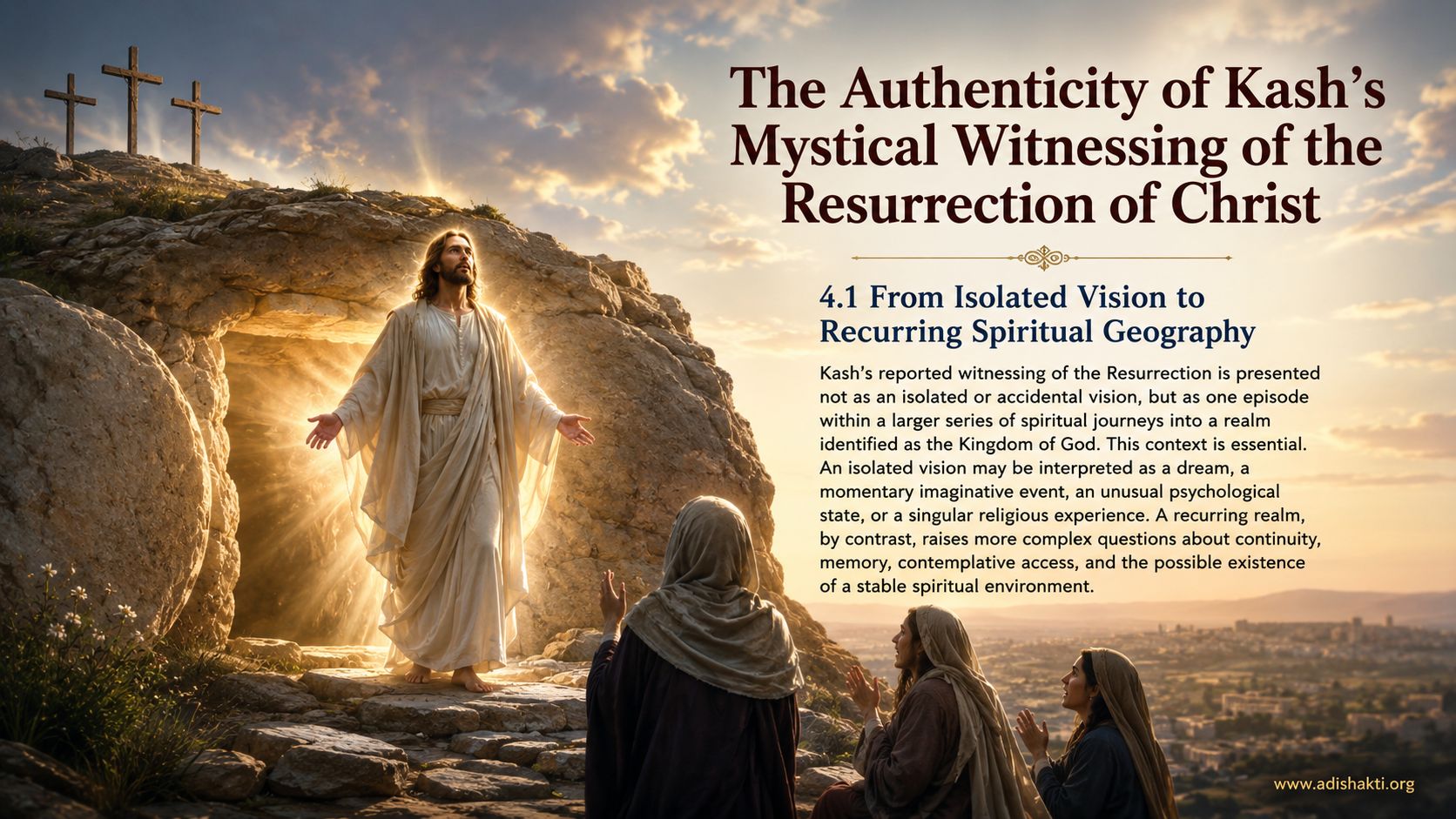
Authenticity of Kash’s Mystical Witnessing of the Resurrection of Christ
A Historical-Critical, Phenomenological and Comparative-Theological Reassessment of the Good Friday 1994 Testimony, Sacred Time, the Risen Christ, the Paraclete and the Interreligious Divine Assembly
Abstract
This paper re-evaluates Kash’s reported mystical witnessing of the Resurrection of Jesus Christ on Good Friday, April 1, 1994. Its method is deliberately layered. It asks first what the surviving narrative actually claims; second, how securely that narrative can be connected to Kash’s earliest report; third, whether the reported experience exhibits a coherent mystical phenomenology; fourth, how its distinctive Christian, Sahaja Yoga and interreligious elements function theologically; and finally, what—if anything—the testimony can establish about an objective transcendent event. These questions are related but cannot responsibly be collapsed into one another.
The central narrative is unusually ambitious. After a discussion about Resurrection, Kash reportedly entered Sahaj Samadhi, asked Shri Mataji Nirmala Devi to show him how Christ rose, travelled with her through a “Time Dimension” to the tomb, witnessed Jesus emerge through the rock in meditation under a descending light, ascended with the Divine Unity into Christ’s heavenly domain, and saw Hindu and Buddhist sacred figures bow before the risen Jesus. The experience therefore combines Resurrection testimony, sacred-time participation, a claim about the spiritual body, a Johannine Paraclete interpretation, and an interreligious Christology. The paper argues that these elements make the account a significant modern mystical testimony, but their evidential weights differ sharply. The fact that Kash was explicitly encouraged to ask to witness the Resurrection is a major prior-suggestion factor; the five-year interval before the cited 1999 publication makes source stratification essential; and later theological language must not automatically be attributed to the fourteen-year-old witness.
The strongest conclusion is graduated. The published account can be studied seriously as a coherent, Christ-centered and non-self-exalting mystical narrative. Its phenomenological and theological authenticity can be argued cumulatively. Historical method, however, cannot establish literal travel to first-century Golgotha or independently verify the celestial assembly. Within the Authenticity Series’ theological framework, the narrative’s most powerful claim is not its quasi-scientific language of superluminal travel but its structure of revelation: Shri Mataji guides rather than replaces Christ; the Spirit’s action culminates in the glorification of Jesus; and the highest sacred figures respond to Resurrection not with rivalry but with tears, silence, humility and reverence.
PRIMARY SOURCE — PUBLISHED RESURRECTION NARRATIVE
“On Good Friday, April 1, 1994 , on the eve of Lalita’s birth, there was a discussion with SY Bhupinder about the Resurrection of Shri Jesus . Kash, who was listening nearby, inquired about the meaning of Resurrection and was explained the little that was known. The Sahaja Yogi suggested that he should ask Shri Mataji if he could witness this unprecedented event, the very heart and soul of Christianity and the cornerstone of Shri Jesus Christ’s Message to humans that they are not this physical body but the eternal Spirit .
Kash went into Sahaj Samadhi and the Mother Kundalini within instantly took him to the Kingdom of God . He emerged through the spiritual clouds and reached the Bridal Chamber that the ancient Gnostics had revealed centuries ago. The Everlasting Light shone ever so dazzlingly from above the Eternal Throne as the Great Holy Spirit sat in Bliss and Joy. She greeted him with a smile as Kash bowed to her.
After the usual exchange of greetings he asked if She could show him exactly how the Resurrection of Lord Jesus took place — a feat possible as “ everything that was in the past since creation resides dormant in the Collective Subconscious. “If Shri Jesus did actually resurrect His corporeal body into the spiritual Self then this supreme feat would still be accessible through the portals of the Time Dimension . The Great Mater Sanctissima agreed to take him two millenniums back!
She stood up, extended Her hands with palms upwards, and told Her child to put his palms above them. As he did so he felt himself being uplifted above the thick, soft carpet of clouds on which they were standing. They started moving and were soon travelling at super light-year speed far beyond human comprehension, back into the past.
At that speed everything became a blur as all familiar celestial landmarks disappeared. The Divine Mother was taking him into a time dimension that the ancients knew existed, and modern scientists acknowledge is possible if one travels faster than time. (The Great Primordial Mother and Kash, both almost weightless spirits in the Kingdom of God, traverse the Universe at far greater light-years per second speeds and cover extremely vast Cosmic ground. Thus travelling centuries into the past just takes seconds.)
Soon they came to the exact spot where Shri Jesus lay buried. About 20-25 Divine Incarnations — Shri Lakshmi, Vishnu, Parvati, Shiva, Sita, Rama, Radha, Krishna, Ganesha, Buddha and others — were already sitting down on the ground in a circle around it. They were all waiting for the arrival of the Supreme Spirit of God, the Great Adi Shakti .
The Spirit of the Living God had taken Kash back into the past to the exact spot and time where one of the most spectacular of God Almighty’s Revelations took place. They were just minutes away from Shri Jesus' Resurrection ! Kash was in Golgotha , outside the walls of Jerusalem, and about to witness and confirm the most profound proof and Truth ever propounded to the human race — that they are in Reality not this physical body but the Spirit . (This deliberate act of supreme sacrifice to provide living proof of immortality stands heads and shoulders above any sacrifice of God Almighty’s Messengers! For this unsurpassed feat Shri Jesus has been bestowed the title of Shri MahaVishnu , the highest honor among the Divine Unity, and no one enters the Kingdom of God without His permission .)
Kash noticed that the burial place consisted of a “ hole in a rock .“The object plugging the entrance to the burial chamber had apparently been removed, exposing a cavity in the knoll. Though he could not see the actual body as it was dark inside, he knew that the Crucified One was within as the entire Divine Unity of God Almighty had encircled it.
The Spirit of God and Her child joined them and sat in the meditative stance. Suddenly a dazzling ray of Light shone diagonally from the heavens, directly on the tomb of Shri Jesus. As they continued sitting in the meditative positions, Shri Jesus emerged through the rock tomb in deep meditation. The Universal Savior was a Spirit again just like His Celestial Brethren!
Then all present joined the Resurrected One in meditation and rose higher and higher into the heavens . The Light continued shining all the way as they ascended into His Dominion, still in deep meditation.
After emerging through the celestial clouds everyone stood up as they had reached the dwelling place of Shri Jesus . Tears of Joy streamed down the cheeks of the Heavenly Hosts as the Divine Unity humbled before the Universal Savior, in deep appreciation and immense respect for the highest sacrifice any Incarnation had voluntarily undertaken to enact His Divine Drama. Ignorant humans had tortured a member of the Divine Family to death, under the most painful and barbaric conditions. Now His ordeal was finally over and He had triumphed not only over Death but, by forgiving humans, also Evil — a supreme sacrifice and matchless humility that no amount of words can ever do justice.
Before leaving Him the Immortal Ones bowed deeply, one after another in Namaskar before the Son of Man . The whole atmosphere was charged with emotion, and no one spoke a word as they lined to pay respects to a gallant giant of a man .
Shri Ganesha , with hands folded in silence, bowed deeply to the Son of God Almighty. Shri Shiva and Parvati , with hands clasped in Namaskar, bowed in obeisance to the Son of the Creator. Shri Radha and Krishna , with hands joined in humility, stooped low in reverence to the Son of Allah. Shri Sita and Rama , with hands held together, bent down in absolute reverence to the Son of Sadashiva. Shri Buddha , with hands embrace together, bowed His head in speechless deference to the Son of The Maker. Shri Mataji and Kash , with hands held together, bent deeply in sheer veneration to the Son of the Supreme Being.
Then slowly everyone dispersed. Kash asked the Holy Mother for leave and bowed to Her. He then closed his spiritual eyes and slowly began descending from Heaven, back to this ordinary human world.” .
Source note. The passage above is preserved as the article’s historical source layer rather than silently rewritten into the academic voice. The analysis below distinguishes the wording of the published narrative from what can presently be attributed securely to Kash’s earliest 1994 report.
Introduction — What Is Actually Being Tested?
The question “Did Kash witness the Resurrection?” contains several different questions. Did Kash undergo an experience on April 1, 1994 and report it sincerely? Does the 1999 narrative preserve the content and sequence of that original report accurately? Did the experience contain information that cannot readily be explained by prior discussion, Sahaja Yoga teaching, family influence or later editorial interpretation? Does its phenomenology resemble other profound contemplative states? And, at the strongest level, did Kash actually gain access to the historical Resurrection through a transcendent mode of consciousness? A persuasive authenticity study must answer these separately rather than allowing confidence at one level to migrate automatically to another.
This separation is especially important because the initiating content was not unprompted. The source states that Kash overheard a discussion of Christ’s Resurrection, asked what Resurrection meant, received an explanation, and was specifically encouraged to ask Shri Mataji whether he could witness the event. fileciteturn44file0L18-L35 In evidential terms, therefore, the fact that the ensuing meditation concerned the Resurrection is expected rather than anomalous. The strongest material must lie in the
form, details, consequences and later correspondences
of the experience, not merely in its subject.
That concession makes the paper stronger. A religious environment can shape the content of mystical experience without demonstrating that the experience was insincere; conversely, sincerity does not demonstrate external veridicality. The proper task is to determine what each evidential layer can bear.
Source History, Chronology and the Levels of Authenticity
The event is dated to Good Friday, April 1, 1994, whereas the cited published narrative appeared in 1999. The source paper itself recognizes that this interval raises questions of memory, oral transmission, editorial interpretation and theological expansion. fileciteturn44file13L1126-L1147 The most important archival evidence would therefore be any handwritten or computer record made in 1994, testimony from persons who heard Kash immediately after the meditation, and later interviews that allow comparison of stable details against later literary development.
Five levels of authenticity are useful here.
Documentary authenticity
concerns whether the surviving text accurately preserves the early report.
Experiential authenticity
asks whether Kash sincerely underwent the experience he described.
Phenomenological authenticity
concerns whether the report displays the structure of a profound altered or mystical state rather than casual invention.
Interpretive authenticity
asks whether the theological meanings assigned to the experience are coherent with the traditions invoked.
Ontological authenticity
is the strongest claim: that the experience disclosed a transcendent reality and the historical Resurrection itself. Evidence that supports the first three does not automatically establish the fifth.
Kash’s age should also be treated symmetrically. Fourteen-year-olds are neither intrinsically reliable nor intrinsically unreliable witnesses. Youth may reduce the likelihood of sophisticated deliberate theological composition, but adolescents are highly capable of imagination and are influenced by suggestion, authority and cultural imagery. What matters is not an abstract “argument from innocence” but the concrete information environment: what Kash knew, what he had just been told, what questions were asked afterward, what was recorded immediately, and what appeared only in later publication.
The Resurrection Scene — Tomb, Light, Emergence and Ascent
The published account has a remarkably clear narrative architecture. Kash and Shri Mataji arrive at a rock burial place surrounded by approximately twenty to twenty-five divine incarnations. The tomb entrance is described as a “hole in a rock.” A dazzling ray of light then descends diagonally onto the tomb, Jesus emerges “through the rock tomb” in deep meditation, the assembly meditates with Him, and all ascend into His heavenly domain. There the emotional climax is not spectacle but homage: tears, silence and a succession of bows before Christ. This progression—burial, light, transformed emergence, ascent and heavenly recognition—forms the narrative’s theological grammar.
Historically, some of these details should not be overstated. The canonical Gospel traditions themselves contain a rock-hewn tomb, a removed stone and appearances of the risen Jesus, so tomb imagery is not intrinsically inaccessible information. Nor does a diagonal heavenly light provide independent historical corroboration. The distinctive claim is the particular visionary synthesis: Jesus does not simply walk from an opened tomb as an ordinary resuscitated body; He emerges in meditation through rock and ascends with a transreligious divine assembly. That is better understood initially as
theological vision
than as archaeological description.
The scene’s restraint nevertheless deserves notice. The risen Jesus gives no triumphal speech in the reported episode. Kash receives no office or power. The witness remains peripheral. The narrative’s emotional focus rests on Christ’s suffering, forgiveness and victory over death and evil. These features can weigh against a crude self-aggrandizing fabrication, although literary and devotional narratives can also be deliberately constructed around humility. Their evidential value is therefore cumulative rather than decisive.
Sacred Time, the “Time Dimension” and the Problem of Scientific Language
The most vulnerable part of the published explanation is its use of physical terminology. It speaks of “super light-year speed,” yet a light-year is a unit of distance rather than velocity, and contemporary physics does not provide empirical support for meditative travel into the past. The source paper correctly cautions that this language should not be presented as technically precise science. fileciteturn44file14L1171-L1184 Retaining it as historical wording is appropriate; using it as scientific validation would weaken the paper.
A more intellectually productive reading asks what the language is trying to express. The narrative claims that past events remain accessible within a Collective Subconscious or divine consciousness. On that model, Kash’s journey could be interpreted in at least three ways: literal travel to a past event, access to an exact spiritual record of the event, or mystical participation in a sacred event that is eternally present to divine consciousness. The source paper itself recognizes the ambiguity between actual temporal transport and access to a living divine memory. fileciteturn44file11L959-L983
This reframing places the testimony within a much older religious problem: how sacred history becomes present to later consciousness. Christian liturgy, mystical recollection and theological accounts of divine eternity all resist the idea that sacred events are merely dead points in an inaccessible past. None of these analogies proves Kash’s claim, but they provide a more defensible conceptual vocabulary than quasi-physics. “Time Dimension” can therefore be retained as the witness tradition’s term while the academic analysis treats it as a metaphysical and phenomenological claim rather than a scientific mechanism.
The Risen Christ, the Spiritual Body and the Meaning of Resurrection
The vision’s Christology is more significant than its mechanics of travel. Jesus is depicted as emerging from death in a transformed mode of embodiment: continuous with the crucified person yet no longer constrained by ordinary matter. Within the narrative, this is interpreted as proof that human identity is ultimately Spirit rather than the mortal physical organism. That claim resonates with the Christian distinction between the perishable body and transformed resurrection existence, particularly the Pauline language of 1 Corinthians 15, while remaining expressed through Sahaja Yoga’s own vocabulary of Spirit.
The account should not be made to settle longstanding Christian debates about the precise nature of the resurrection body. Classical Christianity does not ordinarily understand Resurrection as the abandonment of embodiment for a disembodied spirit; Paul’s “spiritual body” is still a body transformed by divine life. The most careful comparative formulation is therefore that Kash’s vision emphasizes
transformed embodiment and the transcendence of ordinary material limitation
, not that it independently proves one historical theory of what occurred to Jesus’ corpse.
The narrative’s deepest Christological claim appears after the ascent. Christ’s greatness is grounded not simply in supernatural power but in sacrifice and forgiveness. The heavenly assembly responds with tears and reverence because the Crucified One has passed through violence without returning hatred. The Resurrection thus becomes victory over death and evil simultaneously. This ethical interpretation is among the strongest features of the text because it prevents Resurrection from becoming mere thaumaturgy: immortality is inseparable from humility, forgiveness and love.
Shri Mataji as Guide and the Johannine Paraclete Claim
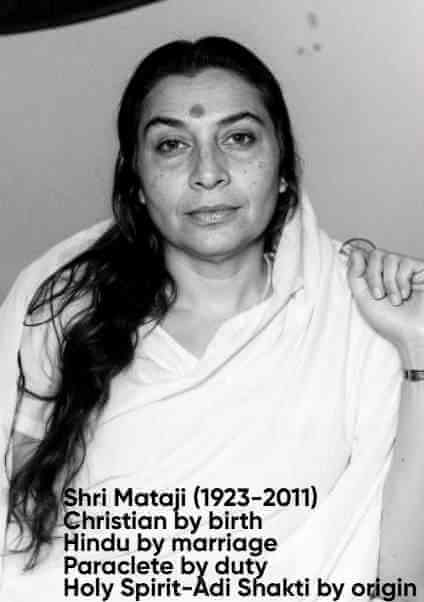
Shri Mataji’s role is structurally central. She does not merely tell Kash what happened. She receives his question, grants the request, guides him through sacred time, joins the assembly at the tomb, participates in meditation, ascends into Christ’s domain and finally bows before Him. The source paper interprets this pattern through the Johannine Paraclete: the Spirit guides into truth, bears witness, teaches and glorifies Christ. fileciteturn44file8L732-L742
The theological force of this pattern is easy to miss. If the narrative were designed simply to magnify Shri Mataji at Christ’s expense, the final scene is strangely constructed: she herself bows before Jesus. Within the paper’s theology, her greatness is expressed through mediation and revelation rather than rivalry. The proposed fulfillment of the Paraclete promise therefore depends not merely on applying the title “Holy Spirit” to Shri Mataji, but on arguing that her reported actions correspond to the functions attributed to the Spirit in John—especially guidance toward truth and the glorification of Christ.
This remains a theological identification, not a conclusion available to neutral historical method. Christian readers may reject the incarnation or personification of the Paraclete in Shri Mataji; Sahaja Yoga theology interprets the same material differently. The academic task is to state the claim accurately and then test its internal coherence. On that narrower question, the Resurrection narrative gives the Paraclete thesis a clear functional structure: the guide does not terminate revelation in herself but brings the witness to Christ.
The Divine Assembly — Interreligious Christology Without Simple Syncretism
The most original element of the vision may be its celestial assembly. Vishnu and Lakshmi, Shiva and Parvati, Sita and Rama, Radha and Krishna, Ganesha and Buddha are reported as gathered around Christ’s tomb and later bowing before the risen Jesus. The scene is neither standard Christian iconography nor a simple declaration that all religions are interchangeable. It preserves distinct sacred identities while placing them in one divine community and giving Christ’s Resurrection a unique position within that community.
This can be described as
Christocentric interreligious universalism
. It rejects exclusivism because Hindu and Buddhist sacred figures are treated as real participants in the divine order. Yet it also rejects symmetrical pluralism because they acknowledge a singular significance in Christ’s sacrifice. The source paper correctly notes that this synthesis is intellectually substantial and doctrinally controversial. fileciteturn44file10L926-L949 It raises genuine comparative-theological problems: whether Christian monotheism can accommodate such a divine assembly, whether “Shri Mahavishnu” clarifies or transforms Christ’s identity, and whether Buddha is being represented in terms alien to Buddhist self-understanding.
Those tensions should remain visible rather than being solved by assertion. Indeed, they give the vision much of its intellectual interest. The scene proposes unity as relationship rather than sameness: the sacred figures remain themselves, yet rivalry disappears. Theologically, hierarchy is grounded in sacrificial love rather than domination. Ethically, the image becomes a critique of sectarian religion: heaven’s sacred figures recognize one another while human communities fight over their names.
Phenomenology, Prior Suggestion and Competing Explanations
As a mystical narrative, the account displays a recognizable cluster of features: absorption in meditation, passivity before a guiding power, a noetic sense of disclosure, altered spatial and temporal experience, numinous light, a coherent sacred geography, strong affect, ego-reduction and a return to ordinary awareness. The source paper identifies a similar constellation and argues that it supports classification as significant mystical testimony. fileciteturn44file10L866-L920 Such classification is reasonable so long as “mystical” describes the phenomenology rather than presupposing supernatural causation.
The strongest ordinary explanation is not cynical fabrication but
sincere contemplative experience shaped by expectation and religious imagery
. Kash had just been told about Resurrection and encouraged to request the experience. He already inhabited a Sahaja Yoga worldview containing Shri Mataji, Kundalini, Sahasrara, divine incarnations and spiritual realms. Those facts provide substantial cognitive material from which a visionary episode could be organized. Memory reconstruction and the five-year path to publication could then deepen the theological and literary structure without requiring conscious dishonesty.
Deliberate fabrication remains logically possible but should not be assumed merely because the narrative is extraordinary. The witness does not elevate himself, obtain authority or become the center of the revelation. Conversely, the absence of obvious motive does not prove veridicality. Editorial shaping by the father or later author is a separate hypothesis and becomes especially important wherever sophisticated language—Gnostic Bridal Chamber, Collective Subconscious, super-light-year travel, comparative titles for Christ, or extended polemical commentary—cannot be securely traced to Kash’s original words.
The decisive falsification test is documentary chronology.
The case becomes substantially stronger if the unusual core details can be shown in dated 1994 records before later theological research and publication. It becomes weaker if those details first appear after relevant doctrines, scriptures or comparative interpretations had entered the family’s discourse. The priority is therefore not to accumulate more analogies, but to establish the textual history of the testimony.
Cumulative Evidential Assessment — What Carries the Most Weight?
Not every element deserves equal evidential weight. The date and initiating conversation establish context but also demonstrate suggestion. The tomb and Resurrection theme have low discriminatory value because they were the subject of the request. The interreligious assembly and the particular pattern of homage are more distinctive, but their value depends heavily on prior Sahaja Yoga concepts and the dating of the earliest record. The non-self-exalting role of the witness, emotional restraint and Christ-centered ethical meaning support sincerity and psychological integration more than historical veridicality. The “Time Dimension” language contributes theological meaning but should not be treated as scientific evidence.
The strongest cumulative case therefore lies in a conjunction rather than a single miracle-proof: a young witness reportedly enters a recurring contemplative mode; the resulting narrative is structured rather than fragmentary; he remains subordinate within it; Shri Mataji functions as guide rather than final object of worship; the climax glorifies the risen Christ; the divine assembly behaves with unusual humility; and the narrative’s ethical center is forgiveness rather than power. This constellation makes “trivial fantasy” an inadequate description. It does not make literal access to first-century history the only explanation.
The strongest historical conclusion remains modest: Kash is reported to have undergone and communicated a Resurrection experience in 1994, but the exact development of the published narrative requires further source analysis. The source paper itself reaches essentially this limitation, noting that earliest written records and independent witness material remain necessary. fileciteturn44file10L913-L920 The strongest phenomenological conclusion is firmer: the narrative can reasonably be studied as a serious mystical testimony. The strongest theological conclusion is conditional: within the Sahaja Yoga/Authenticity Series worldview, it presents a coherent revelation of Christ’s Resurrection mediated by Shri Mataji as Spirit-Paraclete and recognized by a universal Divine Unity.
Conclusion — Resurrection as Eternal Spirit, Forgiveness and Universal Recognition
Kash’s reported witnessing of the Resurrection should neither be inflated into scientific proof nor reduced to an arbitrary adolescent fantasy. Its evidential profile is more interesting than either extreme. The experience was directly suggested in subject matter, which prevents the Resurrection theme itself from functioning as unexpected information. The surviving published account is separated from the reported event by five years, making documentary stratification indispensable. Yet the narrative that emerges is unusually coherent, non-narcissistic and theologically concentrated. Kash asks; Shri Mataji guides; Christ rises; the Divine Unity bows; the witness returns. The revelation does not culminate in Kash’s greatness but in Christ’s.
The paper’s most important methodological achievement is therefore the separation of authenticity into levels. A reader may judge Kash sincere without accepting literal time travel. One may recognize a profound mystical phenomenology without identifying every figure as an objectively present divine being. One may find the Paraclete interpretation internally coherent while remaining unconvinced that Shri Mataji is the promised Spirit of Truth. And one may acknowledge the interreligious scene as a powerful theology of reconciliation without treating it as an ordinary eyewitness record of first-century Jerusalem.
Within the theological framework of Adishakti.org, however, the pieces form a distinctive whole. The Resurrection is presented as the revelation that the human person is more than the mortal body; Shri Mataji’s function is to guide consciousness into that truth and glorify Christ; the sacred figures of multiple traditions recognize the significance of Jesus’ sacrifice; and Christ’s victory is defined not by domination but by passing through death without surrendering to hatred. The celestial bows are therefore not ornamental. They express the paper’s central theological proposition: the highest spiritual authority is recognized through sacrifice, forgiveness and humility.
That is also where the testimony is strongest even for a reader who suspends judgment about its metaphysics. Its enduring question is not simply whether a fourteen-year-old literally travelled two thousand years into the past. It is whether Resurrection can be understood as a living disclosure rather than a remote doctrine—whether sacred history can become present to consciousness, whether the Spirit continues to reveal Christ, and whether religious unity might finally look less like doctrinal conquest than like the scene Kash described: distinct sacred beings gathered without rivalry before the mystery of a life that passed through death and answered violence with forgiveness.
References and Archival Priorities
Primary source.
Shri Adi Shakti: The Kingdom of God
(1999), cited in the uploaded paper as the published source of Kash’s Good Friday 1994 Resurrection narrative. The present edition preserves the primary narrative separately from the academic reassessment.
Christian texts.
Gospel traditions concerning the Resurrection; John 14–16 concerning the Paraclete/Spirit of Truth; and 1 Corinthians 15 concerning Resurrection and the “spiritual body.” These sources should be used to test theological correspondence rather than to convert mystical testimony into historical proof.
Archival priorities.
Locate and authenticate the earliest 1994 handwritten/computer records; identify who heard Kash’s report immediately after meditation; separate Kash’s vocabulary from later editorial commentary; establish his prior exposure to Christian, Gnostic and Sahaja Yoga concepts; compare all surviving versions line by line; and date the first appearance of the interreligious assembly, Time Dimension explanation, Shri Mahavishnu identification and Paraclete interpretation.