How Could Kash Witness Two Worlds Simultaneously Through Third Eye?
Third Eye Witnessing, Being Brahman, and the Inward Locus of Vision
Summary
This paper addresses one focused question: how can Kash be reported to have witnessed an earthly and a spiritual world simultaneously through Third Eye? Its answer has two levels. At the documentary level, the supplied book and its related evidence boards preserve testimony that Kash reported vivid spiritual scenes while seated in meditation. At the level of the contemporary AdiShakti.org confessional synthesis, the reported disclosure is said to have occurred within the Sahasrara, not through bodily departure from the physical world. The decisive theological key is the Devī Gītā formula of being, knowing, and attaining Brahman: consciousness is understood as the field in which the apparent inner and outer are disclosed.[2] [3]
Within the source framework, Third Eye names the reported contemplative faculty through which Kash is said to witness both physical and spiritual fields, while the Sahasrara remains the stated inward locus in which the spiritual disclosure occurs. The Third Eye material is therefore treated as source-specific testimony, not as a scientifically validated visual faculty.[23]
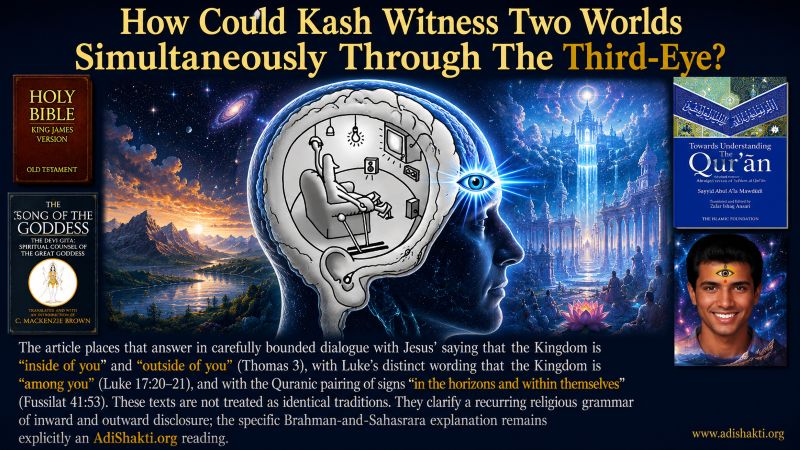
The article places that answer in carefully bounded dialogue with Jesus’ saying that the Kingdom is “inside of you” and “outside of you”, with Luke’s distinct wording that the Kingdom is “among you”, and with the Qur’anic pairing of signs “in the horizons and within themselves”. These texts are not treated as identical traditions. They clarify a recurring religious grammar of inward and outward disclosure; the specific Brahman-and-Sahasrara explanation remains explicitly an AdiShakti.org reading.[4] [5] [6]
Table of Contents
- The question and the evidence boundary
- What the Kash record reports
- The inward locus: Sahasrara, not bodily exit
- Third Eye: the reported faculty of simultaneous witnessing
- Consciousness and being Brahman
- Jesus and the Kingdom “inside” and “outside”
- Qur’anic horizons and selves
- Arwinder and Lalita as companion testimony
- Phenomenology, NDEs, and quantum limits
- A direct answer to the two-world question
- Comparative synthesis: one question, distinct levels
- Conclusion
- References
1. The Question and the Evidence Boundary
The phrase “two worlds” can invite an immediate but imprecise assumption: that the witness physically left one spatial domain and entered another. The source corpus itself complicates that assumption. Its central correction is not that Kash travelled farther than first supposed, but that the reported journeys occurred in his own Sahasrara while the physical body remained where it was. The relevant evidence therefore requires three distinct statements. The book and related records document that the testimony was written and circulated; Kash is reported to have described a vivid, externally seeming spiritual environment; and the AdiShakti.org corpus offers an inward, consciousness-centered interpretation of that report. None of these statements, by itself, proves the external ontology of the perceived environment.[7]
This boundary does not reduce the testimony to insignificance. It identifies precisely what an academic analysis can responsibly ask. Why did an experience reported as inward appear outwardly extensive, populated, and coherent? Why did Kash initially interpret it as travel? And what philosophical vocabulary does the source itself give for revising that interpretation? These are the questions answered below.
2. What the Kash Record Reports
The Kashwinder Evidence Board indexes passages in the supplied book as source material rather than independently verified events. Within those passages, Kash is reported to have entered the Kingdom of God “within his own being,” to have been so thoughtless that he was not ordinarily aware of meditating on Earth, and to have encountered a spiritual world that seemed more vivid and quiet than daily life. The internally crucial feature is simultaneity: ordinary embodied existence did not cease, while another order of perception was reported as present.[8]
The linked Authenticity Series study of the Double Worlds records a reported clarification dated April 28, 1995: Kash’s journeys were said to have occurred within his own Sahasrara, and he never left his physical body. The same article acknowledges the phenomenological difficulty of that correction. The experience continued to seem external enough that it was initially narrated as going out into a universe. This tension is not an embarrassment to the question; it is the question.[9]
3. The Inward Locus: Sahasrara, Not Bodily Exit
The supplied Thousand-Petalled Lotus article expresses the source’s answer with unusual precision: “The world that was within appeared to Kash as though it were outside.” Its interpretation identifies the Seventh Chakra, the Sahasrara, as the locus at which personal attention is said to open into all-pervading spiritual consciousness. This does not describe a private picture in the ordinary sense, nor does it claim a body moving through ordinary space. It proposes a changed mode of disclosure in which the location of the perceiving self is no longer experienced according to ordinary bodily coordinates.[10]
Within the corpus, the correction “within” therefore does not mean trivial, unreal, or merely imaginary. It means that the ultimate locus of the event is consciousness rather than locomotion. The apparent exteriority of the experience explains Kash’s first interpretation; the reported later explanation relocates the event to the Sahasrara. The two descriptions concern different levels: felt spatiality and theological locus.
4. Third Eye: The Reported Faculty of Simultaneous Witnessing
The Authenticity Series study of Kash’s Third Eye witnessing describes a related but distinct report: Kash is said to have perceived activities in his immediate physical surroundings while his ordinary eyes were closed in meditation. In the source’s own explanatory language, physical eyes are closed while “spiritual eyes” remain active within the Sahasrara until meditation begins. This supplies the title’s specific term. Third Eye designates the reported contemplative faculty of witnessing; it does not replace the Sahasrara as the stated inward locus of the two-world disclosure.[23]
The distinction protects the argument from a category error. The Third Eye record concerns claimed perception while the ordinary visual apparatus is unavailable; the Double Worlds record concerns the apparent exteriority of a spiritual environment that the source later identifies as inward. The former names a reported mode of witness; the latter names the reported field and locus of disclosure. Read together within the contemporary AdiShakti.org synthesis, they support a faculty-and-locus account: contemplative perception is said to function through the Third Eye within the Sahasrara, while consciousness realized as Brahman supplies the paper’s primary theological explanation. This remains testimony and devotional interpretation, not laboratory proof.
5. Consciousness and Being Brahman
The Devī Gītā wording supplied for this inquiry supplies the paper’s interpretive pivot: “Being Brahman”, the person who “knows Brahman” “attains Brahman.” The grammar is important. Attainment is not primarily a journey to a remote place; it is a realization congruent with what one already is. In the article’s confessional reading, Kash can witness both worlds because consciousness is not finally a sealed container inside a body. It is Brahman-consciousness, in which bodily and spiritual appearances can be disclosed without requiring two independently occupied locations.[11]
Classical Advaita vocabulary cannot simply be imposed on every Śākta source, but it helps specify this proposition. Scholarly accounts of Śaṅkara describe ātman and brahman in a nondual relation and characterize the essential self as consciousness, while also distinguishing empirical experience from ultimate nonduality. That distinction guards against two errors. First, the source framework need not call the earthly world a subjective illusion. Second, the claim that consciousness is Brahman cannot be turned into a laboratory finding merely by naming it nondual.[12]
6. Jesus and the Kingdom “Inside” and “Outside”
The most pointed Christian textual dialogue arises from Gospel of Thomas, Saying 3: the Kingdom is “inside of you” and “outside of you.” This pairing is critical because it makes conceptual room for an experience that is inward in locus yet outward in presentation. It does not teach the Devī Gītā or identify the Kingdom with the Sahasrara. In this paper, it is a comparative textual parallel, not a claim of historical identity between traditions.[13]
Luke 17:20–21 must remain distinct. In the NRSVUE, Jesus says the Kingdom does not come with observable signs and that it is “among you,” with “within you” noted as an alternative translation. Thus, Luke supplies an important tradition of non-observable or non-spectacular Kingdom language, but it does not reproduce Thomas’s inside-and-outside formula. The paper treats the sayings as different witnesses and finds their relevance in their capacity to frame an inward/outward problem rather than to erase textual difference.[14]
7. Qur’anic Horizons and Selves
Qur’an 41:53 offers another carefully limited bridge. It says that signs will be shown “in the horizons” and “within themselves.” The verse therefore joins cosmic and human dimensions of signs. Its classical interpretive context includes creation, history, and features of the human person; it does not name Brahman, the Sahasrara, or a double-world experience.[15] [16]
Placed alongside the Thomas saying and the Kash corpus, the verse contributes a comparative grammar: disclosure may concern horizons and selves without the two being collapsed. The AdiShakti.org identification of inward signs with the Sahasrara is consequently a present-day devotional synthesis, not standard Qur’anic exegesis. Naming that boundary does not weaken the comparison; it permits the comparison to be exact.
8. Arwinder and Lalita as Companion Testimony
The related family records are relevant as companion testimony, not as independent metaphysical proof. The Arwinder Evidence Board preserves source passages that associate children’s meditation with immediate access to the Sahasrara and with language of consciousness extending beyond ordinary personal boundaries. Those passages show that the book’s explanation was not limited to one isolated narrative, though their evidentiary status remains reported source material.[17]
The Lalita Evidence Board records a child’s statement that Shri Mataji was “in my head” and that she was “not sleeping.” This is useful because it marks an interior, wakeful distinction in the corpus’s own terms. It cannot carry more weight than it has: the same source tradition records possible influence from surrounding family discussion. The appropriate conclusion is not corroborative certainty but a repeated source-internal pattern of interior, wakeful, spiritually interpreted perception.[18]
9. Phenomenology, NDEs, and Quantum Limits
Near-death experiences are included here only as a methodological comparison. Systematic research records recurring reports of altered time, bright light, perceived other environments, and out-of-body viewpoint; it also shows that the interpretation of such reports varies with culture and religious setting. This literature is relevant to one limited proposition: a scene can be experienced as externally located and profoundly real without phenomenology alone deciding whether a person literally travelled outside the body.[19]
Neuro-functional models of NDEs propose altered multisensory integration and changes of self-location as possible explanations for externally seeming perspective. Such models provide a scientific alternative to literal travel; they do not assess Kash’s record, and they do not refute or establish the AdiShakti confessional account. Quantum mechanics is still less suited to serve as a shortcut. Reviews of quantum effects in the brain describe active proposals and unresolved empirical challenges; they do not offer a demonstrated mechanism for Brahman-consciousness, NDEs, or a spiritual geography.[20] [21]
10. A Direct Answer to the Two-World Question
Within the AdiShakti.org consciousness-centered framework, Kash could witness both worlds simultaneously through Third Eye because a reported contemplative faculty of perception is said to function within the Sahasrara, while he did not have to be physically in two places. The reported experience is interpreted as occurring in the Sahasrara, where the ordinary self-location anchored to the body becomes transparent to all-pervading consciousness. The earthly world continues as the empirical setting of the seated witness; the spiritual world is reported as the disclosure of the same consciousness at a different register of appearance. Its apparent distance, movement, and solidity explain why it seemed outside. Its reported inward locus explains why the corpus later says that Kash never left himself.[22]
The Devī Gītā vocabulary completes rather than decorates this answer. If the self is being Brahman, then to know Brahman is to awaken to the consciousness in which both inward and outward phenomena are given. To attain Brahman is therefore not a departure from the world but a transformed participation in its ground. The Thomas saying and Qur’an 41:53 illuminate an inside–outside and horizons–selves pattern; they do not replace the specific Śākta explanation.
11. Comparative Synthesis: One Question, Distinct Levels of Answer
The presentation’s synthesis can now be stated within the paper without dissolving its sources into one undifferentiated claim. The Kash record supplies the reported phenomenon; the Third Eye record names the reported faculty of witnessing; the Devī Gītā supplies the confessional grammar of consciousness and Brahman; the Christian and Qur’anic texts supply carefully delimited inner–outer parallels; and NDE and quantum discussions set methodological limits. The table is therefore not a claim that these traditions teach the same doctrine. It is a map of what each source can contribute to the question of simultaneous witnessing.
| Source or perspective | Decisive formulation | Contribution to the Kash question | Necessary limit |
|---|---|---|---|
| Kash’s Double Worlds record | Reported journeys occurred within his own Sahasrara; he “never left himself.” | Reframes the apparent journey as a change in the locus and mode of disclosure, while the body remains embodied. | This is documented testimony and the source’s interpretation, not independent empirical verification of a spiritual realm. |
| Devī Gītā 7.32 | “Being Brahman, the person who knows Brahman attains Brahman.” | Supplies the paper’s central confessional answer: realization is participatory knowing, not movement of a body between two places. | This is a theological and philosophical key within the relevant Śākta/Advaitic framework; it is not a laboratory explanation. |
| Gospel of Thomas, Saying 3; Luke 17:20–21 | The Kingdom is “inside of you” and “outside of you”; Luke has the distinct “among you,” with “within you” as an alternative. | Clarifies the conceptual possibility that a divine reality may be inward in locus yet outward in appearance or relation. | Thomas and Luke are distinct textual witnesses. Neither is equated with the Sahasrara or made to teach the Devī Gītā. |
| Qur’an 41:53 | Signs appear “in the horizons” and “within themselves.” | Provides a scriptural pairing of outward horizons and inward selves that illuminates, by analogy, the paper’s inner–outer question. | The verse does not identify the horizons and selves with Brahman, the Sahasrara, or Kash’s report; that connection is comparative, not standard tafsir. |
| Third Eye testimony | Physical eyes closed; reported “spiritual eyes” active within the Sahasrara. | Names the source’s claimed contemplative faculty through which physical and spiritual fields may be witnessed. | This is reported source testimony, not a laboratory-validated visual faculty or automatic proof of the Double Worlds account. |
| NDE phenomenology | Externally seeming viewpoint, altered time, luminous imagery, and perceived environments. | Establishes the modest methodological point that apparent externality alone does not settle whether consciousness literally departed from the body. | NDE reports have diverse interpretations and do not independently verify the Kash account or its confessional explanation. |
| Quantum effects in the brain | Active scientific inquiry with unresolved empirical constraints. | Prevents a category error: the discussion identifies what quantum research cannot presently explain or prove about Kash’s report. | Quantum mechanics is not evidence for Brahman, survival, NDE travel, or spiritual geography. |
Direct answer: within the source’s stated confessional ontology, Kash is reported to witness both worlds simultaneously because the witness is not finally confined to ordinary bodily self-location. Through the Sahasrara, consciousness is interpreted as realizing Brahman; the earthly setting remains the condition of embodiment, while the spiritual world is disclosed as another register of the one consciousness. The experience may therefore appear outside without requiring a second body or a physical journey to a second place.
The synthesis is strongest when each line of evidence keeps its proper work. Kash’s account gives the report to be interpreted. The Devī Gītā provides the paper’s primary explanation. Jesus’ sayings and Qur’an 41:53 are illuminating scriptural parallels. NDE studies provide only a limited phenomenological comparison. Quantum research supplies a boundary against pseudo-scientific overreach. This arrangement allows the paper to answer the question directly without asking any source to do more than its evidence warrants.
12. Conclusion
The most coherent answer available from the supplied corpus is not that Kash possessed two bodies or crossed ordinary space. It is that, within the source’s confessional ontology, consciousness realized as Brahman is not exhausted by ordinary bodily self-location. The Sahasrara is the stated inward locus of disclosure, and the Third Eye is the reported contemplative faculty of witness within that framework; the perceived externality is part of the reported phenomenology. Kash could therefore be said to witness the earthly and spiritual worlds simultaneously because both were disclosed in consciousness, while he remained embodied on Earth.
This conclusion is direct but not overextended. The documents establish that a particular testimony and interpretation exist. The Devī Gītā, Thomas, Luke, and the Qur’an contribute distinct textual resources, each with its own historical and theological context. Scholarship on meditation and NDEs clarifies how self-location may shift, but it cannot decide the spiritual ontology of the report. The proposition that Kash’s experience was consciousness awakening to Brahman remains a named, contemporary AdiShakti.org confessional synthesis — one that the cited sources make intelligible, not one that external research independently proves.
References
- [1] “The Goddess as Brahman.” AdiShakti.org, quoting Devī Gītā 7.32. Accessed August 27, 2026.
- [2] “The Authenticity of Kash Witnessing the Double Worlds.” AdiShakti.org Authenticity Series, accessed August 27, 2026.
- [3] “Within the Thousand-Petalled Lotus: A Scientific and Spiritual Answer to Shruti’s Question.” AdiShakti.org, accessed August 27, 2026.
- [4] “Gospel of Thomas, Saying 3.” Translated by Bentley Layton; Early Christian Writings, accessed August 27, 2026.
- [5] “Luke 17:20–21.” New Revised Standard Version Updated Edition, Bible Gateway, accessed August 27, 2026.
- [6] “Qur’an 41:53.” Translation by Mustafa Khattab; Quran.com, accessed August 27, 2026.
- [7] “The Authenticity of Kash Witnessing the Double Worlds.” AdiShakti.org Authenticity Series, documentary and testimonial framing, accessed August 27, 2026.
- [8] “Kashwinder Evidence Board: Chronology of Reported Experiences.” AdiShakti.org, source passages indexed from Shri Adi Shakti: The Kingdom of God, accessed August 27, 2026.
- [9] “The Authenticity of Kash Witnessing the Double Worlds.” AdiShakti.org Authenticity Series, reported April 28, 1995 and later entries, accessed August 27, 2026.
- [10] “Within the Thousand-Petalled Lotus.” AdiShakti.org, consciousness-centered interpretation, accessed August 27, 2026.
- [11] “The Goddess as Brahman.” AdiShakti.org, Devī Gītā quotation and surrounding interpretation, accessed August 27, 2026.
- [12] Deutsch, Eliot. “Śaṅkara.” Stanford Encyclopedia of Philosophy, accessed August 27, 2026.
- [13] “Gospel of Thomas, Saying 3.” Early Christian Writings, accessed August 27, 2026.
- [14] “Luke 17:20–21.” NRSVUE, Bible Gateway, accessed August 27, 2026.
- [15] “Qur’an 41:53.” Quran.com, accessed August 27, 2026.
- [16] Mufti Muhammad Shafi. “Tafsir Ma‘arif al-Qur’an on 41:53.” Quran.com, accessed August 27, 2026.
- [17] “Arwinder: Source Mentions and Reported Contexts.” AdiShakti.org, source passages indexed from Shri Adi Shakti: The Kingdom of God, accessed August 27, 2026.
- [18] “Lalita: Chronology of Reported Experiences.” AdiShakti.org, source passages indexed from Shri Adi Shakti: The Kingdom of God, accessed August 27, 2026.
- [19] Hashemi, Amirhossein, et al. “Explanation of Near-Death Experiences: A Systematic Analysis of Case Reports and Qualitative Research.” Frontiers in Psychology 14 (2023): 1048929.
- [20] Romand, Raymond, and Günter Ehret. “Neuro-Functional Modeling of Near-Death Experiences in Contexts of Altered States of Consciousness.” Frontiers in Psychology 13 (2023): 846159.
- [21] Adams, Betony, and Francesco Petruccione. “Quantum Effects in the Brain: A Review.” AVS Quantum Science 2, no. 2 (2020): 022901.
- [22] “The Authenticity of Kash Witnessing the Double Worlds.” AdiShakti.org Authenticity Series, source conclusion, accessed August 27, 2026.
- [23] “The Authenticity of Kash’s Mystical Witnessing of the Third Eye.” AdiShakti.org Authenticity Series, reported Third Eye testimony and methodological limits, accessed August 27, 2026.
Research Ledger: Kash, Witness-Consciousness, and Brahman
Central question and answer boundary
The paper will answer the user’s question in two layers. At the documentary/testimonial level, the book and related evidence boards record Kash describing meditation in which he remained embodied while reporting a luminous spiritual realm. At the contemporary confessional level, the AdiShakti.org framework interprets that simultaneity as access through the Sahasrara to all-pervading consciousness, with the ordinary self-boundary becoming transparent to Brahman. This theological reading is not presented as a neuroscientific or independently verified conclusion.
User-supplied primary corpus
| Source | Passage / location | Claim class | Permitted use |
|---|---|---|---|
| Shri Adi Shakti: The Kingdom of God (supplied PDF), via Kashwinder board | PDF p. 135: “The Revealed Truths were revealed to Kash ... within his Thousand-Petal Lotus,” and he “entered the Kingdom of God within his own being.” | Documentary / testimonial | Attribute the formulation to the book and use it as the key interiority claim. |
| Same, via Kashwinder board | PDF p. 177: the account states Kash became so thoughtless that he was “not even aware that he was meditating in the Sahasrara, far less that he was meditating on Earth itself.” | Testimonial | Identify an altered relation to ordinary location and bodily awareness; do not claim objective transport. |
| Same, via Kashwinder board | PDF p. 715: the account describes “Paramchaitanya” flowing through Kash during simultaneous meditation. | Testimonial / confessional | Use as the book’s vocabulary of all-pervading consciousness. |
| Same, via Kashwinder board | PDF p. 625: the account differentiates the Shri Mataji on Earth from the form in Kash’s Sahasrara and attributes “infinite awareness” to the latter. | Testimonial / confessional | Present as the source’s internal distinction, not an independently established metaphysical fact. |
| Same, via Kashwinder board | PDF p. 90: the source calls Kash a “reborn jivanmukti” and glosses this as one who has “realized unity with Brahman.” | Confessional | State as the book’s explanation of Kash’s ability, not as historical biography or clinical diagnosis. |
| Same, via Arwinder board | PDF p. 239: the source says Kash, Arwinder, and Lalita entered Samadhi instantly and describes the experience as an “instant instinctive Reality.” | Testimonial / confessional | Use as corroborating family-corpus language on effortless access and witness-consciousness. |
| Same, via Arwinder board | PDF p. 247: the material reports spiritual inhabitants as ethereal yet “solid” and compares this to Kash’s descriptions; it also invokes an “unbroken ocean of consciousness.” | Testimonial / confessional | Use cautiously to explain how an interior realm can be reported as external without treating it as empirical proof. |
| Same, via Lalita board | PDF p. 272: Lalita reports seeing Shri Mataji “in my head,” and says she was “not sleeping.” | Testimonial | Use as a companion testimony delimiting the source’s own distinction between interior experience and ordinary dreaming. |
User-supplied online AdiShakti article
Within the Thousand-Petalled Lotus: A Scientific and Spiritual Answer to Shruti’s Question states: “The world that was within appeared to Kash as though it were outside.” It frames the Seventh Chakra as the Sahasrara, the point at which Kundalini awakening gives access to “an all-pervading spiritual consciousness.” The article explicitly calls its interpretation “a confession of faith, not a conclusion produced by neuroscience,” and uses the language of an “inner resurrection.” It cites a related page titled “The Authenticity of Kash Witnessing the Double Worlds.”
Direct answer, to be developed in the conclusion
Within the supplied AdiShakti confessional framework, Kash is said to witness both worlds simultaneously because consciousness itself is not confined to the perceptual self. When attention becomes thoughtless and enters the Sahasrara, the ordinary distinction between inner and outer is said to loosen: Kash remains in embodied life while consciousness participates in Brahman, understood as all-pervading awareness. The reported “two worlds” are therefore not two disconnected locations but two modes of disclosure within one reality. This is the paper’s confessional answer; the documentary evidence records that Kash and related witnesses reported the experience, while cognitive science can at most discuss altered self-location, absorption, and vivid presence.
Direct Authenticity Series evidence: The Authenticity of Kash Witnessing the Double Worlds
The linked Authenticity Series article provides the central source-specific answer. It records that Kash initially believed he left his physical body during meditation and travelled to meet the Holy Spirit. It identifies a dated reported revelation — April 28, 1995, 7:10 a.m. — in which the Great Adi Shakti is said to have explained that all of his journeys took place within his own Sahasrara and that he never left his physical body. The article records that Kash’s prior experience felt external enough that he continued to describe it as going out into the universe.
The same source makes the key two-world formulation: Kash found it difficult to comprehend that an identical physical world existed outside while he was within the Sahasrara. A later reported exchange dated December 9, 1996, 5:45 a.m. says that he still regarded being within the body as impossible to believe even after the source’s correction. An October 9, 1997, 19:00 report describes the spiritual world as as real as ordinary waking life but “better, quieter and more peaceful.” The article’s own conclusion is: “Kash Never Left Himself.”
Claim classification: These dated episodes are documentary testimony as published in the source; the explanation that the perceived realm is a disclosure within the Sahasrara is a contemporary AdiShakti confessional interpretation. The paper may directly answer the user’s question within this framework, but must not present the supernatural geography as empirically established.
Candidate Authenticity Series sources and verified asset pairs
The Double Worlds page presents an Authenticity Series sidebar and supplies the following topic-relevant page/image pairs. These will be evaluated in the asset-relevance ledger before use:
- The Authenticity of Kash Witnessing the Double Worlds paired with Authenticity-of-Double-Worlds.jpg: directly relevant to the central question.
- The Authenticity of Kash’s Mystical Witnessing of the Reappearance of Shri Mataji paired with Authenticity-of-First-Fax.jpg: potentially relevant only if the paper has a discrete section on documentary timing and testimonial corroboration.
- The Authenticity of the Kingdom of God paired with Authenticity-of-Kingdom-of-God.jpg: relevant to the paper’s interior Kingdom section.
Source-sensitive formulation of the answer
Within the source’s stated devotional ontology, Kash can witness both worlds simultaneously because the two are not treated as spatially separate domains available to a departing body. They are treated as two registers of a single reality disclosed in consciousness: ordinary embodied awareness continues while the Sahasrara is said to reveal Brahman or all-pervading consciousness. The intensity and apparent externality of the experience explain why it was initially interpreted as an outward journey. The series’ correction is therefore neither “Kash travelled farther” nor “nothing happened”; it is that the locus of the reported disclosure was inward and the self that witnessed it was not reducible, within the devotional account, to ordinary sensory self-location.
Additional Authenticity Series source: The Authenticity of Kash’s Mystical Witnessing Shri Mataji’s Opening of the Kingdom of God (Sahasrara)
The Authenticity Series Kingdom of God article identifies its subject as Kash’s mystical witnessing of the opening of the Kingdom of God in the Sahasrara. Its sections explicitly distinguish historical setting, the opening of the Sahasrara, a comparative map of inward divine thresholds, Kash as child witness, recurring spiritual environment, spiritual form and embodiment, and phenomenology and psychology. This makes it a directly relevant contextual source, particularly where the paper must distinguish the source’s theological reading from the status of its historical and testimonial evidence.
The article’s opening narrative reports that Kash entered Sahaj Samadhi and that the Kundalini rose through the Sushumna Nadi into the Sahasrara. It describes the reported experience as a vivid three-dimensional witnessing of past, present, and spiritual forms, a narrative that will be cited as documentary testimony rather than independent proof of a suprasensory event. The article itself uses a comparative map that names Kingdom of God, Sahasrara, Brahmarandhra, Dasam Duar, and other traditions’ interior-divine language; the present paper will use those comparisons only where differences are stated and citation support is present.
Asset pairing verified: Authenticity of the Kingdom of God ↔ Authenticity-of-Kingdom-of-God.jpg. This pair is eligible for a section focused on the source’s Sahasrara/Kingdom explanation.
Lalita companion testimony and its limit
The Lalita evidence board preserves a reported father–child exchange in which Lalita says that Shri Mataji is “in my head” and, when asked whether she was sleeping, answers “Not sleeping,” adding that she sees Shri Mataji during meditation. The testimony is useful because it identifies the experience as interior and wakeful in the corpus’s own vocabulary rather than as an ordinary sleep narrative.
The same evidence-board material also contains an editorial possibility that Lalita may have remembered family members telling her that Shri Mataji existed in her Sahasrara. The paper will therefore describe the exchange as a companion testimony with a recorded interpretive limitation, rather than treating it as independent corroboration of Kash’s reports.
Jesus sayings: primary-text evidence and interpretive boundary
Two distinct textual witnesses are important and will not be conflated.
-
Gospel of Thomas, Saying 3, in the Layton translation reproduced by Early Christian Writings, says: “But the kingdom is inside of you. And it is outside of you.” The saying then connects self-knowledge with being known and knowing oneself as children of the living Father. The older Greek fragment is incomplete; the Coptic form explicitly supplies the “outside” clause. PBS’s translation independently renders the line: “the (Father’s) imperial rule is inside you and outside you.” This is the clearest textual locus for the paper’s inside-and-outside parallel.
-
Luke 17:20–21, NRSVUE says that the kingdom does not come with observable signs and that “the kingdom of God is among you.” The translation footnote identifies “within” as an alternative. The paper will state this translation difference rather than treating Luke as a verbatim equivalent of Thomas Saying 3.
Claim classification: Thomas Saying 3 and Luke 17:20–21 are primary-text statements. Their relationship to Kash’s reports is a comparative proposal. The source corpus’s identification of Sahasrara with the Kingdom is a contemporary confessional interpretation and will be labeled accordingly.
Qur’an 41:53: horizons and selves
Qur’an 41:53 reads in Dr. Mustafa Khattab’s translation: “We will show them Our signs in the universe and within themselves until it becomes clear to them that this Qur’an is the truth.” The Arabic clause joins fī al-āfāq (in the horizons) and fī anfusihim (within themselves). The paper may therefore use the verse as a precise primary-text pairing of outward and inward signs.
A named Maʿārif al-Qurʾān commentary glosses the horizons as the sides of the universe and the inward signs as features of human creation. Towards Understanding the Qur’an gives two interpretive possibilities: historically visible confirmation and signs in cosmic phenomena and human beings. Neither commentary identifies the verse with the Sahasrara, Brahman, or a mystical experience of two worlds. The paper will therefore use Qur’an 41:53 as a comparative bridge — a scriptural pairing of outer horizons and inner selves — while reserving the consciousness/Brahman explanation for the supplied AdiShakti framework.
Scholarly context: nondual awareness and self-boundary dissolution
Nave et al., “Self-Boundary Dissolution in Meditation: A Phenomenological Investigation” (Brain Sciences 11, no. 6, 2021) studies 46 experienced meditators using interviews and phenomenological analysis. Its abstract identifies changes in self-location, agency, first-person perspective, attention, body sensations, and affect during altered self-boundary states. It reports that passive “letting go” and reduced attentional engagement and agency were associated with deeper dissolution. The authors characterize this as empirical phenomenology of the basic sense of being a bounded self; it does not establish a metaphysical realm outside the study’s observable methods.
Hanley, Nakamura, and Garland, “The Nondual Awareness Dimensional Assessment” (Psychological Assessment 30, no. 12, 2018) develops measures for self-transcendence and bliss as dimensions of nondual awareness. The article defines nondual awareness in psychological terms as a background awareness in which self–world distinctions may be experienced as unified or self-boundaries may dissolve. Its findings allow the paper to say that scholarship recognizes reportable shifts in self-location, self–world boundary, and affective tone; it does not permit an inference from such reports to the factual existence of the book’s spiritual geography.
Use in paper: These studies give a modest phenomenological answer to why an experience can be vividly external while occurring within consciousness: the felt boundary that ordinarily locates a person here rather than there can change in meditation. They do not replace, endorse, or disprove the AdiShakti explanation. The article will compare the explanatory levels rather than collapse them.
Verified Devī Gītā anchor
The paper will quote the user-confirmed wording exactly as supplied: “Being Brahman, the person who knows Brahman attains Brahman” — Devī Gītā 7.32, The Goddess as Brahman.
The same source places the line within a longer passage on liberation arising from knowledge and absorption in pure consciousness. In the paper, this verse will function as a confessional philosophical key: it distinguishes realization from travel to a second location. Within the source’s theology, the knower’s “attainment” is a realization of identity with Brahman, the consciousness in which inner and outer appearance are disclosed. This is an interpretation within Śākta/Advaitic language, not a proposition established by documentary testimony alone.
Scholarly Advaita context and verified Devī Gītā formulation
The Stanford Encyclopedia of Philosophy entry on Śaṅkara describes classical Advaita Vedānta as a nondual view in which brahman is the reality of all things, ātman is identified with brahman, and the essential self is pure non-intentional consciousness. It also cautions that Advaita distinguishes conventional empirical reality from ultimate nondual existence and does not reduce the empirical world to a person’s subjective projection. This distinction is crucial: it permits the paper to say that the Brahman-centered account is not simply “imagining another world,” while still recognizing it as a philosophical/theological interpretation rather than a scientific conclusion.
The Stanford Encyclopedia entry on Personhood in Classical Indian Philosophy likewise describes the Upaniṣadic self as a witnessing subject and notes that Advaita understands the self as consciousness itself, the principle by which things are disclosed. These sources will be used only to describe Advaita positions, not to subsume every Śākta source under Śaṅkara’s system.
The relevant Devī Gītā wording, as reproduced in The Goddess as Brahman, is: “Being Brahman, the person who knows Brahman attains Brahman” (Devī Gītā 7.31–32, commonly cited in the supplied source as 7.32). The source’s longer translation frames it with liberation arising from knowledge, realization of the inner self in the heart, and absorption in pure consciousness. This is the paper’s doctrinal anchor for the proposition that knowledge is participatory recognition, not movement from one spatial location to another.
Additional Authenticity Series source and asset decision
The Authenticity of Kash, Arwinder and Lalita’s Mystical Witnessing of God as Light Within is directly relevant because it brings the three named family sources into one explicitly inward-consciousness study. Its title, section structure, and visible primary-witness framing confirm it is suitable as a companion source, not merely decorative support.
Verified asset pair: Authenticity of God as Light Within ↔ Authenticity-of-God-as-Light-within.jpg. The image will appear in the sidebar only, linked to the precise supporting article. It will not be used to make a claim beyond that source’s own reported-testimony framework.
Public evidence-board records
The public Kashwinder Evidence Board confirms that its cards are a page-numbered source index and expressly says that they report document wording rather than independently verified events. The record contains the source’s formulation that Kash’s spiritual journeys were “into his own Sahasrara,” making it directly relevant to the article’s central explanatory question.
The public Arwinder Evidence Board preserves reports of Arwinder’s meditative experiences, including a report of ascent to the Sahasrara and a quoted secondary description of the seventh chakra as a transcendence of individual consciousness. It is relevant as a companion record within the family corpus but does not independently establish Kash’s experience.
The public Lalita Evidence Board preserves the reported statement “In my head” and the reply “Not sleeping” concerning meditation. It supports a source-internal theme of interior, wakeful vision, subject to the editorial caveat noted elsewhere in these research notes.
Near-death experiences: phenomenological comparison, not verification
Hashemi, Oroojan, Rassouli, and Ashrafizadeh’s systematic analysis of NDE case reports and qualitative research reviewed 54 studies and 465 reported experiencers. It identifies recurring descriptions of out-of-body viewpoint, altered time, bright light, heightened senses, and perceived other realms, while emphasizing that the meaning assigned to those reports differs across cultural and religious settings. This permits a narrow comparison with Kash’s report: an experience can be described as vividly external, real, and spatial without that phenomenology alone adjudicating whether consciousness literally travelled.
Romand and Ehret’s neuro-functional model of NDEs in altered states argues that major NDE themes overlap with experiences associated with altered brain states and discusses out-of-body experience in relation to altered multisensory integration and the temporo-parietal junction. The article supplies a live scientific alternative to a literal-travel reading. It neither assesses Kash’s testimony nor proves that all NDE reports are exhausted by one model. In the paper, this source will be used to clarify an evidentiary point: apparent externality does not, by itself, establish bodily departure.
Quantum mechanics: scope boundary
Adams and Petruccione’s review of quantum effects in the brain surveys proposals about quantum effects in neural processing, including the obstacle of decoherence in warm biological systems and the still-developing state of empirical support. It shows that quantum biology is a legitimate research area while also showing why “quantum” cannot be inserted as an established explanation of Kash’s report, NDEs, Brahman, survival after death, or spiritual geography. The paper will cite it only to establish this boundary and will not use quantum mechanics as a rhetorical substitute for evidence.
Comparative formulation to include
The paper may offer the following carefully classified comparison: NDE reports and Kash’s account both describe vivid, externally seeming environments and altered ordinary self-location. The NDE literature leaves open competing explanations; the Kash source offers a particular devotional explanation — inward disclosure in the Sahasrara — rather than literal bodily exit. This is a comparative phenomenological hypothesis and a confessional interpretation, not a universal conclusion about NDEs.
Comparative synthesis added to the paper
The published paper now places a source-linked comparison immediately before its Conclusion. The added table has six rows: Kash’s reported Double Worlds record; Devī Gītā 7.32; Gospel of Thomas Saying 3 and Luke 17:20–21; Qur’an 41:53; NDE phenomenology; and quantum-effects research. The table preserves the analysis’s four explanatory levels: documentary testimony, confessional interpretation, comparative textual analogy, and scientific limit.
The direct conclusion remains unchanged in evidentiary status. Within the stated AdiShakti.org confessional ontology, Kash is interpreted as remaining embodied while consciousness, realized as Brahman through the Sahasrara, discloses an earthly and spiritual register of one reality. Jesus’ inside–outside Kingdom formulation and Qur’an 41:53’s horizons–selves pairing are explicitly marked as comparative parallels. NDE research is treated as a limited phenomenological comparison, and quantum mechanics as a boundary against unsupported explanatory claims. All source links in the new section are configured to open in a separate tab or window.
Third Eye: reported faculty of simultaneous witnessing
The Authenticity of Kash’s Mystical Witnessing of the Third Eye distinguishes a related claim from the Double Worlds record. It reports that Kash perceived physical activities while his ordinary eyes were closed in meditation and interprets the event through the source’s language of spiritual eyes active within the Sahasrara. In the revised paper, this entry supports the title’s word Third Eye as a reported contemplative faculty or mode of witness. It does not replace the Sahasrara as the stated locus of the double-world disclosure, and it is not presented as a laboratory-validated visual capacity. The paper therefore keeps the faculty-and-locus distinction explicit: Third Eye names the reported mode of witnessing; Sahasrara names the reported inward locus; consciousness realized as Brahman remains the confessional explanatory frame.