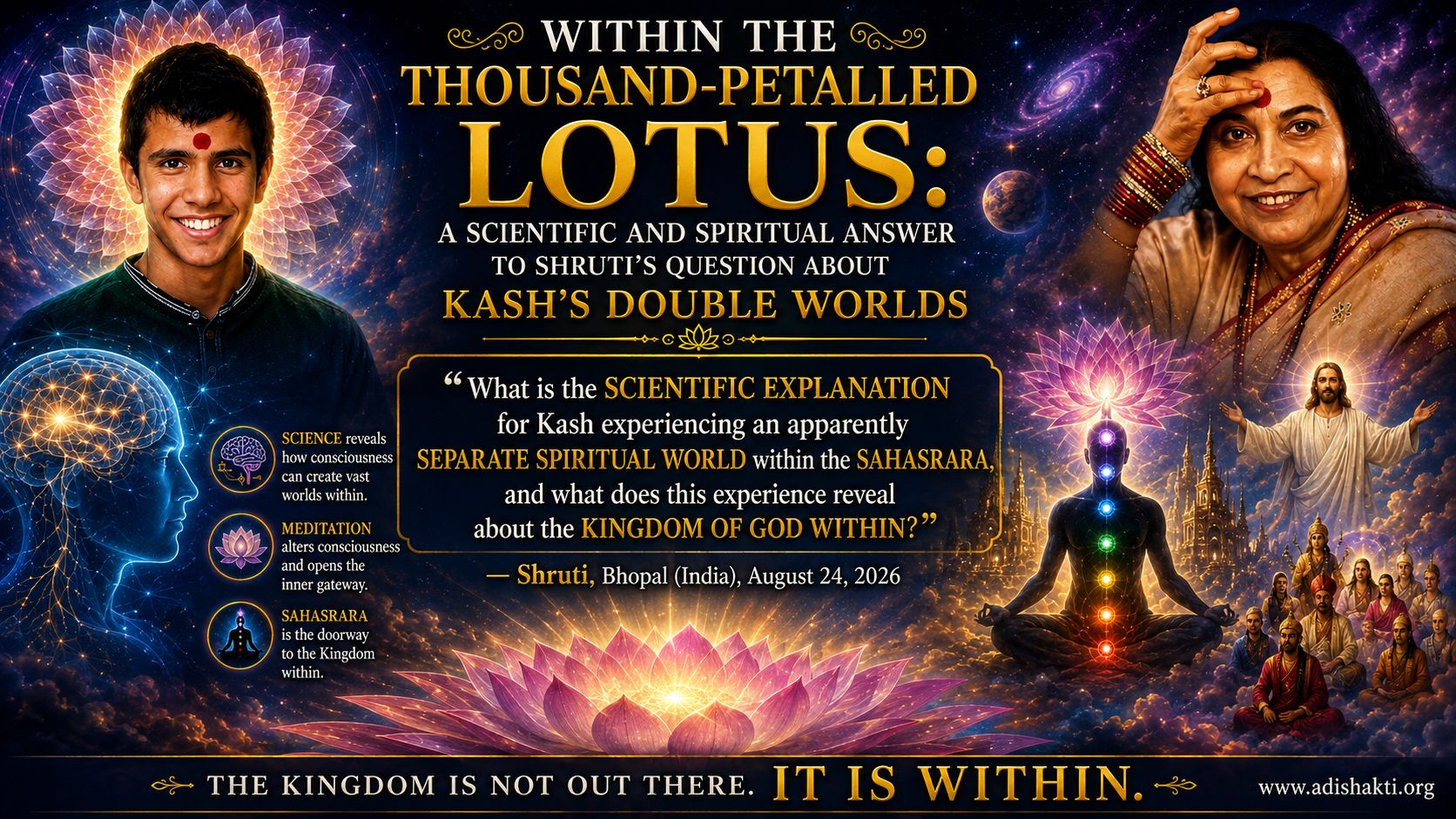
Within the Thousand-Petalled Lotus
A Scientific and Spiritual Answer to Shruti’s Question about Kash’s Double Worlds
Summary: The Direct Answer
The scientific answer is modest but real. Kash’s reported experience of a vast, apparently separate spiritual world can be approached through the science of absorption, meditation, and the ordinarily fluid boundary by which consciousness distinguishes “me, here” from “world, there.” Deep absorption can make inner imagery, felt presence, spaciousness, and meaning startlingly vivid. Research with experienced meditators shows that deliberate practice can alter felt agency, body-location, first-person perspective, time, and the self–world boundary. [2] [3]
The scientific answer is not a dismissal. A neural or psychological account addresses the conditions and form of an experience; it does not, by itself, settle whether the experience has a spiritual referent. Nor does the reported account of Kash establish another realm as a scientific fact. The most careful conclusion is that the testimony describes a coherent, profoundly real world-presence whose ontology remains beyond what current science can adjudicate. [1] [4]
The spiritual answer, within AdiShakti.org’s devotional framework, is that Kash’s apparent outward travel disclosed an inward reality. The Kingdom was not reached by astronomical movement but encountered through a transformation of awareness in the Sahasrara. In this reading, the most important sentence is not “Kash went somewhere,” but “Kash never left himself.” [1] [6]
Table of Contents
- Shruti’s Question and the Discipline of a Two-Level Answer
- What Kash Reported: A World That Felt Outside
- Why a World Can Feel Vast, External, and Real
- Absorption: The Mind’s Capacity for Vivid Sacred Presence
- Self-Boundary Dissolution and the Sense of Location
- NDEs and Out-of-Body Analogies: Similar Form, Different Evidence
- The Kingdom That Is Not Merely “Here” or “There”
- Sahasrara, Inner Resurrection, and the Devotional Reading
- What Would Count as Responsible Inquiry?
- Conclusion: The Nearness of the Kingdom
1. Shruti’s Question and the Discipline of a Two-Level Answer
Shruti’s question contains two different inquiries that should illuminate rather than cancel one another. The first asks for a scientific explanation: how could Kash undergo an experience that seemed to have its own distance, movement, personalities, light, and coherence while he remained physically seated in meditation? The second asks for a spiritual meaning: if the experience occurred “within” the Sahasrara, what does that say about the Kingdom of God within?
A mature answer must not permit science to become a language of contempt, as though identifying experiential mechanisms converts testimony into fraud. Nor should spirituality borrow scientific authority it does not possess, as though intensity itself proves a metaphysical claim. The relevant distinctions are simple: a dated record can document that a report was made; testimony can establish what the witness says was experienced; science can study correlates and recurring forms of experience; and a devotional tradition can interpret the experience in relation to a sacred reality. [10] [9]
2. What Kash Reported: A World That Felt Outside
The Double Worlds source reports that Kash initially believed he left his body during meditation and travelled through an immense spiritual universe. It describes reported movement through celestial environments, encounters with sacred personalities, luminous presences, and a reality-character strong enough to be interpreted as actual travel. The source presents three especially significant dates: April 28, 1995, when Kash was reportedly told that the journeys had occurred within his Sahasrara; December 9, 1996, when the realm still felt external; and October 9, 1997, when he reportedly called it “better, quieter and more peaceful.” [1]
This sequence matters. The later inner-Sahasrara explanation did not simply erase the original sense of travel. The report says that Kash continued to feel located elsewhere even after receiving the interpretation that he had never left his body. That divergence between immediate experience and later explanation is precisely the phenomenon a careful inquiry must address. It is neither a license to declare the testimony objectively verified nor a reason to call the witness insincere.
3. Why a World Can Feel Vast, External, and Real
Ordinary consciousness continuously constructs a lived sense of location: “I am here, the world is there, and my body is the boundary between them.” This is not a mere intellectual judgement; it is a tacit structure of experience. When attention becomes unusually concentrated, sensory input is attenuated, or meditative practice changes the balance of agency and body-awareness, that structure can change. A person may report that the body has become peripheral, that space has opened, that time has altered, or that an interior scene has the sense of a public world. [2]
Science therefore has a plausible account of how an inner experience can take on the phenomenological form of “elsewhere.” The brain and body do not merely record a pre-given map; they maintain a dynamic model of perspective, distance, embodiment, memory, attention, and salience. If the self-model becomes less tightly anchored to ordinary bodily cues, the perspective from which experience is felt may appear to move. This is a scientific hypothesis about the form of consciousness, not an assertion that Kash’s report was mere fantasy.
4. Absorption: The Mind’s Capacity for Vivid Sacred Presence
The psychological construct most relevant to Shruti’s question is absorption: a capacity to become so deeply engaged by inner or outer experience that it acquires unusual vividness, immediacy, and emotional force. Lifshitz, van Elk, and Luhrmann review evidence that people high in absorption report more intense spiritual experiences, felt presences, mystical states, and vividly sensed inner or outer worlds. They propose that absorption may intensify sensory and imaginative experience while engaging prior expectation and present attention. [3]
This is useful because it gives a non-dismissive scientific vocabulary for Kash’s “apparently separate world.” A world-like experience need not be voluntary make-believe. In absorption, experience can possess detail, continuity, affective depth, and the undeniable feeling of presence. Yet absorption does not decide what the presence is. It describes a capacity of consciousness, not the final metaphysical meaning of its contents.
5. Self-Boundary Dissolution and the Sense of Location
Nave and colleagues conducted a detailed phenomenological investigation with experienced meditators and found that self-boundary dissolution could involve shifts in agency, ownership, self-location, bodily sensation, first-person perspective, time, attention, and self–other distinction. Their work is especially relevant because the question is not only “What did Kash see?” but “Where did he feel that he was?” [2]
The study does not test Kash’s experiences and cannot diagnose them. It nevertheless makes one point scientifically intelligible: the felt boundary between inside and outside is not immovable. When it loosens, the ordinary opposition between “my interior” and “an external universe” may no longer organize experience in its usual way. The Double Worlds narrative describes exactly such a paradox: an apparently external cosmos that, within the tradition’s interpretation, was encountered in the interior field of the Sahasrara.
6. NDEs and Out-of-Body Analogies: Similar Form, Different Evidence
Near-death research is relevant only by analogy. Reports associated with near-death states often include altered time, bright light, peace, encounters, life review, and out-of-body perspective. Neuroscientific discussions examine possible roles for brain physiology, temporo-parietal processing, oxygen deprivation, medication, and other mechanisms. [4]
But Kash’s reported meditation experiences were not near-death episodes, and no responsible paper should treat one category as proof of the other. The analogy is narrower: both show that consciousness can report a standpoint seemingly detached from ordinary bodily location. In the language sometimes used by spiritual interpreters, the physical body appears as the “particle” and an apparently mobile subtle self as the “wave.” That is a devotional or metaphoric model, not an established result of quantum physics. Its value lies in naming the felt distinction; its limit is that it cannot substitute for evidence. [4]
7. The Kingdom That Is Not Merely “Here” or “There”
Luke 17:20–21 places an ancient theological challenge alongside Shruti’s question. Jesus says that the Kingdom does not come with things that can be observed in the ordinary way, and denies the simple external pointing gesture: “Look, here it is!” or “There it is!” The NRSVUE renders the final expression “among you,” while recording “within” as an alternate translation. Academic care requires acknowledging that translation question. [5]
The Double Worlds testimony does not settle the Greek phrase, nor does it prove the historical meaning of Jesus’ teaching. It does, however, offer a striking experiential parallel. Kash reportedly began with “there”: the Kingdom seemed distant, external, and reached by travel. The reported correction moved the location inward: the same world was said to be within the Sahasrara. The spiritual lesson is not that the external cosmos is unreal, but that divine nearness may not obey the map of physical distance.
8. Sahasrara, Inner Resurrection, and the Devotional Reading
Within the contemporary AdiShakti confessional synthesis, Shri Mataji’s statement supplies the decisive interpretation: “You have to enter into the Kingdom of God here, as I say, in the Seventh Chakra.” The Seventh Chakra is understood as the Sahasrara, the thousand-petalled lotus and the point at which Kundalini awakening gives access to an all-pervading spiritual consciousness. [6]
In this framework, Kash’s experience is not treated as an escape from embodiment. It is treated as an inner resurrection: a form of being born of the Spirit in which the person remains physically present yet discovers a deeper field of life, light, and peace. The 1970 Sahasrara-opening testimony is offered by the tradition as the theological explanation of why this access could become collective. [7]
This is a confession of faith, not a conclusion produced by neuroscience. Its spiritual power lies in the reversal it asks of the seeker: do not make the Kingdom a distant place; attend to the transformation of consciousness through which the Kingdom is disclosed as nearer than one’s own search. The related Authenticity Series treatment of the Kingdom makes the same broad interpretive move. [8]
9. What Would Count as Responsible Inquiry?
Shruti’s question deserves more than affirmation or dismissal. A responsible inquiry would preserve the earliest available dated notes, compare independent retellings, document the context of each report, distinguish leading questions from spontaneous description, and seek patterns of consistency without demanding impossible certainty. It would also invite first-person phenomenological interview methods: What exactly was seen? How did bodily awareness change? Was there a felt movement, a visual scene, a voice, a change in time, or an emotion of peace? Such granularity honors testimony without prematurely turning it into doctrine.
Science can then ask about cognitive form, attention, memory, absorption, self-location, and neural correlates. Philosophy can ask what testimonial warrant is appropriate. Spiritual tradition can ask about fruits: humility, compassion, moral transformation, freedom from fear, and reverence for truth. William James famously emphasized the importance of the fruits of religious experience; that criterion does not prove metaphysics, but it helps distinguish a merely sensational claim from a life-forming encounter. [9]
10. Conclusion: The Nearness of the Kingdom
The scientific explanation for Kash’s reported experience is therefore neither trivial nor total. The best available research makes it credible that meditative absorption and flexible self-boundary processing can produce an experience that is spatially vast, affectively powerful, coherent across time, and felt as more real than ordinary waking life. These findings explain why an interior experience might appear external. They do not establish that it was only internal, and they do not verify a spiritual universe as an empirical object.
Within AdiShakti.org’s spiritual framework, the testimony reveals a more intimate answer. The Kingdom of God is not a location reached by leaving the body; it is a divine depth encountered through the Sahasrara. Kash’s reported mistake—that he had travelled away—becomes spiritually eloquent. It stages the human habit of seeking God in the far distance, then overturns it: the seeker has not crossed the universe because the deepest universe is disclosed within.
References
- [1] AdiShakti.org “The Authenticity of Kash Witnessing the Double Worlds.” Authenticity Series, accessed August 24, 2026.
- [2] Nave, Ohad, et al. “Self-Boundary Dissolution in Meditation: A Phenomenological Investigation.” Brain Sciences, vol. 11, no. 6, 2021, article 819.
- [3] Lifshitz, Michael, Michiel van Elk, and T. M. Luhrmann “Absorption and Spiritual Experience: A Review of Evidence and Potential Mechanisms.” Consciousness and Cognition, vol. 73, 2019, article 102760.
- [4] Konopka, Lukas M. “Near Death Experience: Neuroscience Perspective.” Croatian Medical Journal, vol. 56, no. 4, 2015, pp. 392–393.
- [5] The Holy Bible “Luke 17:20–21.” New Revised Standard Version Updated Edition; the edition’s note records “within” as an alternate translation of ἐντὸς ὑμῶν.
- [6] Shri Mataji Nirmala Devi “You Have to Enter into the Kingdom of God Here, as I Say, in the Seventh Chakra.” AdiShakti.org, accessed August 24, 2026.
- [7] AdiShakti.org “Bearing Witness to May 5, 1970.” AdiShakti.org, accessed August 24, 2026.
- [8] AdiShakti.org “The Authenticity of the Kingdom of God.” Authenticity Series, accessed August 24, 2026.
- [9] James, William “The Varieties of Religious Experience.” Longmans, Green, 1902; Project Gutenberg edition.
- [10] Coady, C. A. J. “Testimony: A Philosophical Study.” Clarendon Press, 1992.