Authenticity of Kash’s Mystical Witnessing of Shri Mataji’s Opening of the Kingdom of God (Sahasrara)
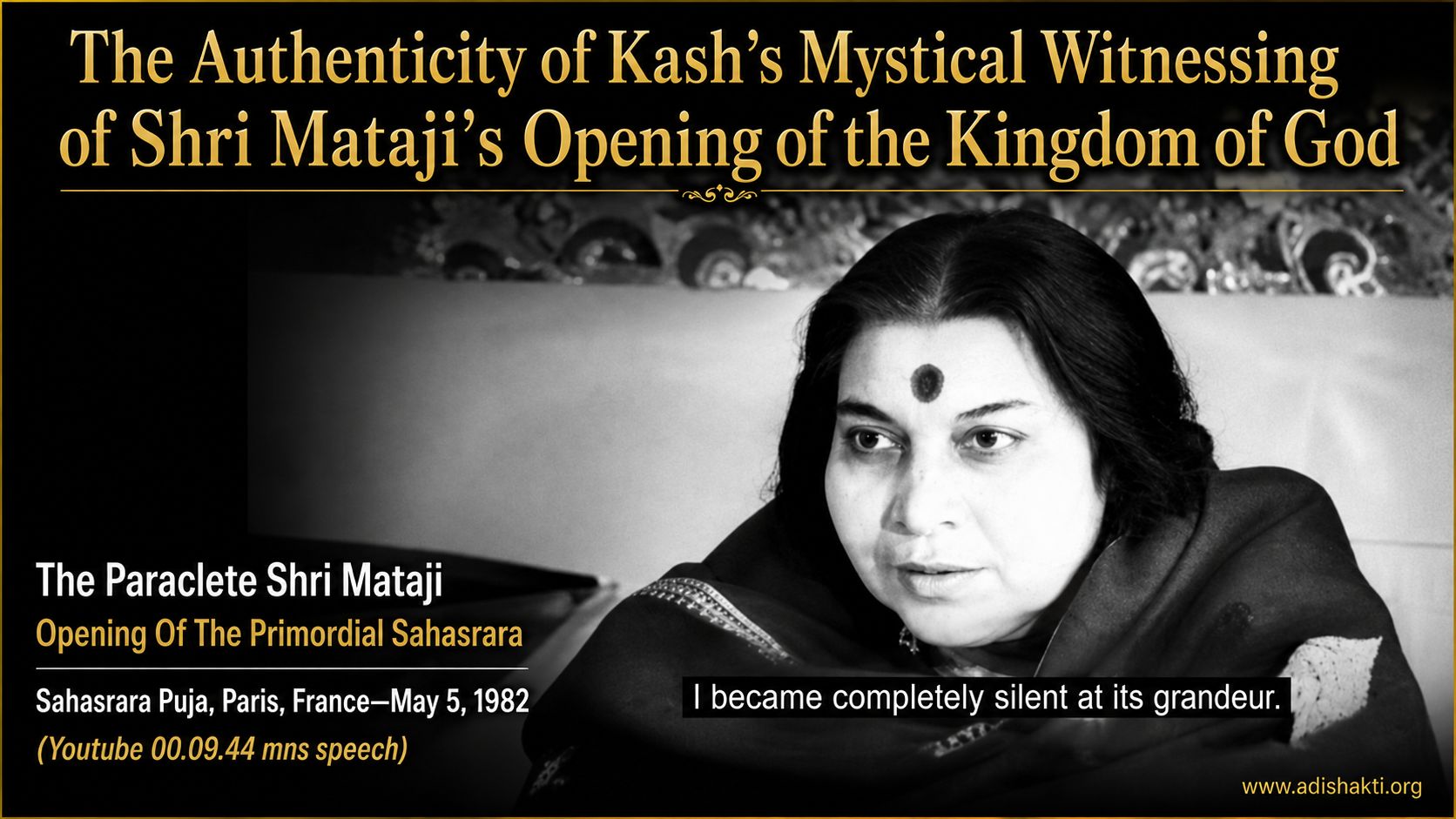
An Interdisciplinary Academic Assessment of the May 5, 1994 Testimony, the Opening of the Sahasrara at Nargol, Sacred Time, Comparative Religion, Phenomenology, Psychology, and Evidential Authenticity
The Opening of the Sahasrara Chakra
May 5, 1970 at Nargol, India
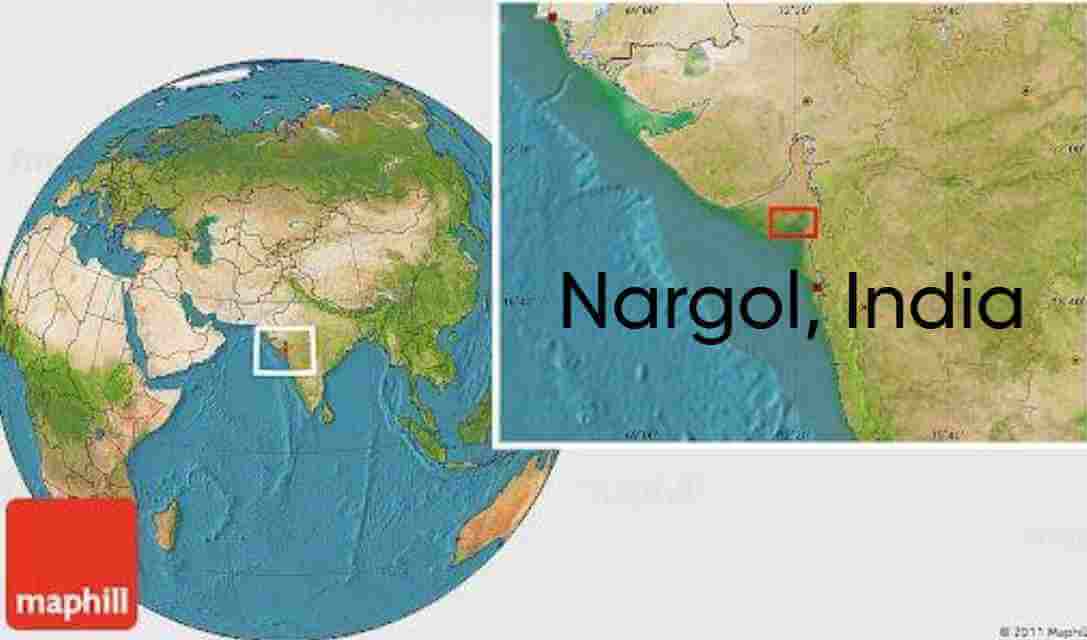
“May 5th, 1994 , was waited with much anticipation. It was on this day that Shri Mataji Nirmala Devi , after a sustained meditation into the early hours of the morning, had opened the Sahasrara Chakra on May 5, 1970 . She accomplished this awesome feat by immersing Her Lotus Feet in the Indian Ocean , off the coast of Nargol (about 150 miles from Mumbai, India), and entering a state of Supreme Samadhi that has no parallel. It is nothing short of a superhuman feat, beyond anything known to humans.
Kash had absolutely no idea of any of the above facts. Neither did his family know any better. Instead of instructing Kash to ask Shri Mataji Nirmala Devi how She opened the Sahasrara Chakra , his father told him to ask Her how She got Self-Realization ! Kash questioned what was the meaning of Self-Realization , but was told to get all his answers from the Great Regina Apostolorum , the Queen of the Apostles. (Actually Kash ’s father just casually wanted to get some facts, expecting a short verbal answer. He was totally unprepared for possibly the most enlightening divine Revelation ever witnessed.)
Kash squatted on the floor in meditation. The state of Sahaj Samadhi was quickly attained as the Kundalini rushed up from the base of the spine into the Sahasrara , the Kingdom of God that Shri Jesus kept repeating to ignorant, hostile humans two thousand years ago. In a flash he transcended the physical limitations that still imprison ignorant, arrogant modern humans.
The Light shone ever so brilliantly from above the Immortal Throne of the Great Celestial Mother as Shri Param-jyotih Shri Nirmala Devi sat in Bliss and Joy . Her child bowed down and exchanged greetings, noticing that all the Divine Beings were already gathered at Her place in advance. He bowed to all of them and exchanged greetings. They did the same in return.
The Great Primordial Guru got down from the Timeless Throne and walked to him. Kash noticed that Shri Maha Avatar Shri Nirmala Devi was wearing a crown. He asked if he could request something from Her. Shri Mataji smiled and told him that She already knew why he had come. Kash , slightly surprised, innocently asked Her what it was. She replied that he wanted to know how She had got Her Self-Realization , exactly as had been discussed a short while ago on Earth.
Shri Mataji then walked back to Her Eternal Throne and sat on it. Kash , who followed behind as instructed, noticed that it was made of solid gold and had a cushion on it. He sat down beside Her on the ground, on the right of Her Throne . Beside him was Shri Hanuman in one of His best dress Kash had seen. The Lord of the Angels smiled at him. He returned the smile. Beside Shri Hanuman was Shri Jesus . On the left side of the Timeless Throne was Shri Ganesha . He noticed that as usual the entire Divine Unity — Shri Buddha , Radha , Krishna , Shiva , Prophet Muhammad , Guru Nanak , and others — were sitting on the ground in a semicircle, with the Great Sacred Mother in the middle. All were in their normal meditative stance; squatting on the soft clouds with both hands at their knees, palms facing upwards — precisely as Sahaja Yogis on Earth. Their spiritual form was of a ‘solid’ state, that is, it had form. For example, the clothes that they were wearing conformed to the contours of their squatting forms.
When all were ready a 3D projection materialized in mid-air before them. It showed the feet of the Great Primordial Mother immersed in water, just above the ankles. The whole visual apparition was suspended in mid-air. It was like a drive-in theater but with a huge difference. Not only was the projection three-dimensional but it was stunningly real and alive. It was alive! It had to be as the past was being projected into the present. The Great Eternal Mother and Her Divine Deities were witnessing what transpired on May 5th, 1970 twenty-four years later on May 5th, 1994 ! In the Kingdom of Sadashiva the most blessed day since creation was being viewed. The Great Adi Shakti was showing the actual past that was still existing in the present, a time dimension way beyond human apprehension. It was even beyond Kash ’s ability to visualize it as a projection, so life-like was this spiritual movie.
After about a minute or so the projection moved up Her form. The face of the Great Divine Mother Shri Adhiparasakthi Shri Nirmala Devi was much younger than the Great Divine Mother Shri Adhiparasakthi Shri Nirmala Devi presently on Earth in human form, but older than the Great Divine Mother Shri Adhiparasakthi Shri Nirmala Devi sitting on the Golden Throne . The spiritual form of the Great Adi Shakti in the Sahasrara of Kash was younger than Her two physical forms of May 5, 1970 (when She opened the Sahasrara at Nargol, India ) and May 5, 1994 (when She was in Cabella, Italy ). Put simply, the Eternal Adi Shakti watching the projection in the Kingdom of God on May 5th, 1994 , was younger than both Her past ( May 5, 1970 ) and present ( May 5, 1994 ) forms.
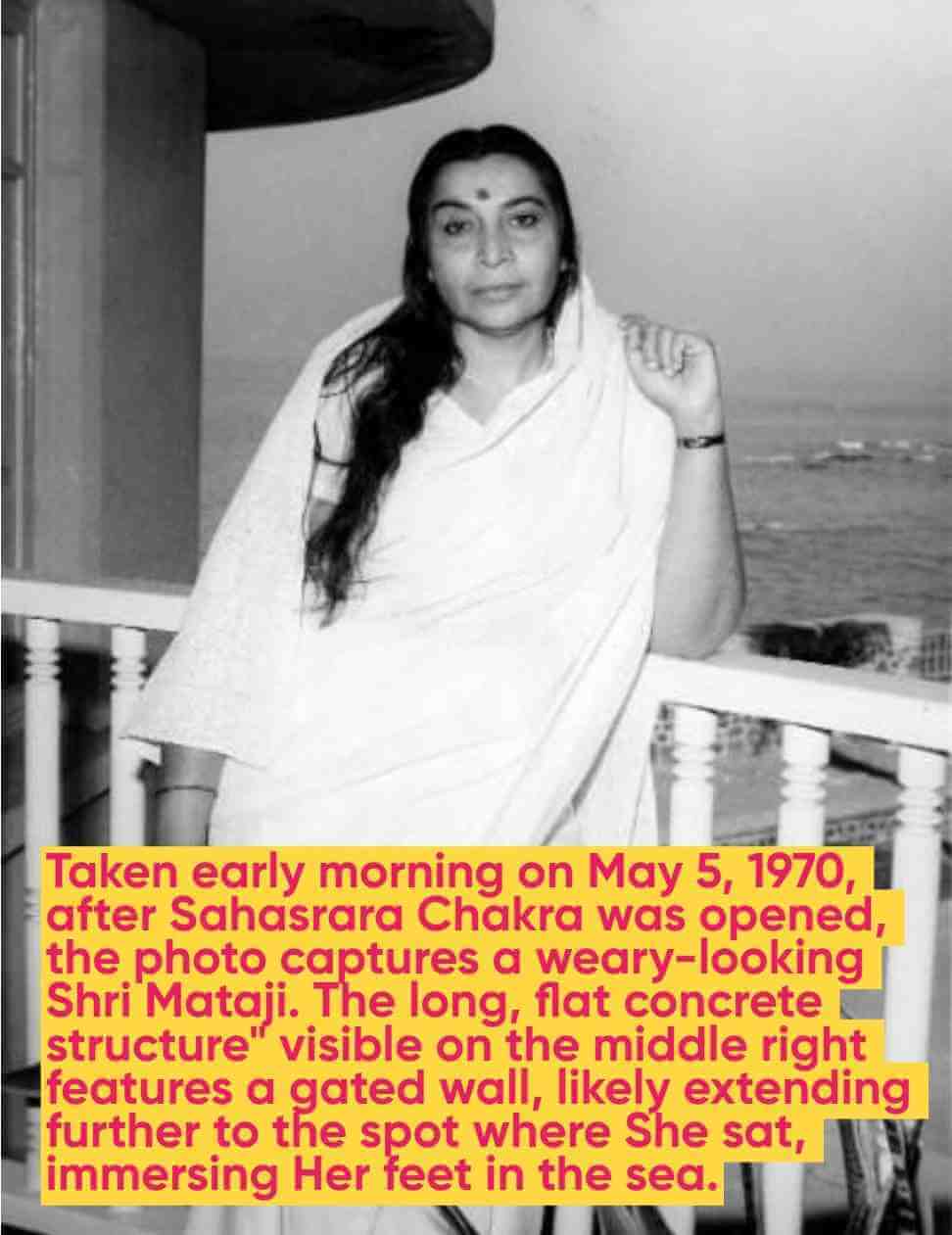
The projection showed Her sitting on a long, flat concrete structure, against a rocky background landscape, and facing the dark watery vastness before Her. Shri Sindura-Tilakancita was wearing a white sari with red borders, and had a bindi on Her forehead. Al-Muzzammil ’s (The Enwrapped) Lotus Feet were submerged in the Indian Ocean . She was in deep meditation.
Suddenly red and yellow sparks of light began spewing out from the top of Her head around the Brahmarandhra , bursting about a foot or two into the air. Kash said that these sparks “looked like fireworks,” “like a volcano erupting and shooting lava into the air.” It came out in a steady stream as if there was a fire blazing inside the head of the Great Primordial Guru . Kash could not see the interior of these “fireworks”, “volcanoes,” or “fire” as only the frontal view of the Great Supreme Goddess was projected. For about 10 minutes these “ tongues of flame ” kept issuing forth from the head of the Great Holy Ghost .
Then the fiery blaze stopped and a fountain of water gushed out of the top of Her Head about three feet into the air. It poured down like rain and the Great Celestial Mother was completely drenched. The Water of Life kept gushing for about 10 minutes. The face of the Great Divine Mother was one of absolute serenity and tranquility as the greatest spiritual feat in the history of this universe — the opening of the Sahasrara Chakra for entering the Kingdom of The Almighty Creator — was undertaken by the Promised Comforter ! The Holy Spirit of God Almighty sat completely motionless as the Water of Life kept gushing forth into the air from the Primordial Kundalini within Her.
All the Divine Messengers were in absolute Bliss and tears of Joy rolled down their cheeks. This was the second time Kash saw tears in their eyes. Their Joy was clearly unrestrained and there was good reason for such an extremely rare display of emotion among these Immortal Beings : The human form of the Promised Comforter had achieved the most important task of any divine incarnation — the opening of the Sahasrara Chakra and the salvation of humanity. The Supreme Spirit had activated the Adi Kundalini that would grant humans the power to baptize themselves, evolve into the eternal spirit, and enter the Kingdom of God . At last the Resurrection , the final evolution of Homo sapiens , had become a Reality.
After a while the Fountain of the Water of Life stopped but the Great Formless Mother continued meditating. For another five minutes they watched this visual projection as Shri Adhiparasakthi Shri Nirmala Devi continued sitting with Her Lotus Feet still immersed in the Indian Ocean .
It was now early dawn on this infinitesimally tiny speck of Cosmic Cell known as Earth. All the Messengers of the Universal Soul had again witnessed that dawn of May 5, 1970 . They were the first to eyewitness the beginning of the Blossom Time that will enable humans to take a giant leap in Cosmic Consciousness .
Then the projection disappeared completely. The Great Holy Spirit then informed everyone that there would be meditation. Everyone raised their Kundalinis collectively and began meditation. After it was over Kash bowed and thanked the Great Universal Mother for probably the most priceless proof that Shri Adhiparasakthi Shri Nirmala Devi is the Promised Messiah . He asked for permission to leave, bowed to the Divine Unity and closed his spiritual eyes. He then sank down through the clouds of the Kingdom of Heaven and awakened to this hellish world of Alice Cooper and Rockbitch.”
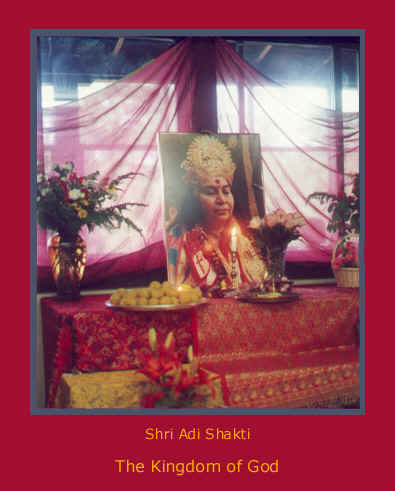
Shri Adi Shakti: The Kingdom of God
Jagbir Singh, 1999, p.
278
Shri Mataji’s Testimony ( YouTube )
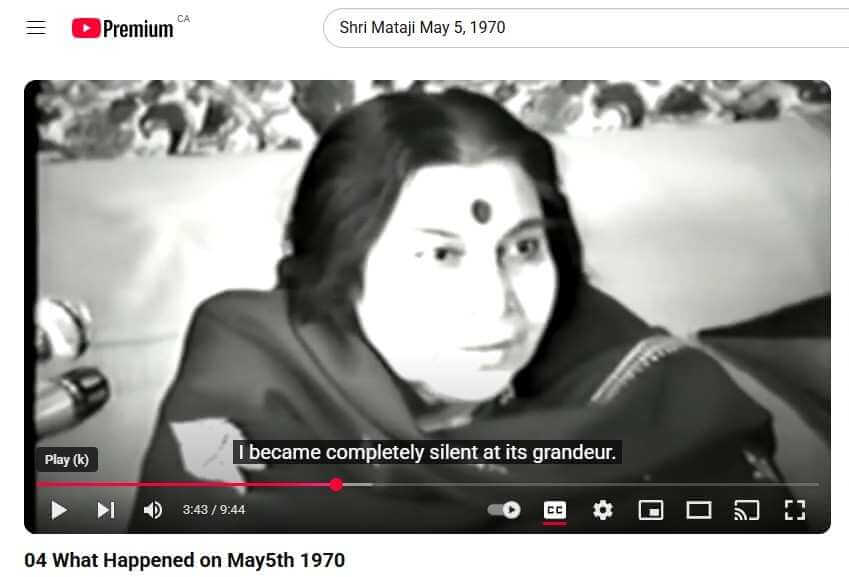
“As soon as the
Sahasrara
(
Kingdom of God within
) was opened the whole atmosphere was filled with tremendous
Chaitanya
. And there was tremendous
Light
in the sky. And the whole thing came on the Earth — as if a torrential rain or a waterfall — with such tremendous force, as if I was unaware and got stupefied. The happening was so tremendous and so unexpected that I was stunned and totally silent at the grandeur. I saw the
Primordial Kundalini
rising like a big furnace, and the furnace was very silent but a burning appearance it had, as if you heat up metal, and it had many colors. In the same way, the
Kundalini
showed up as a furnace, like a tunnel, as you see these plants you have here for coal burning that create electricity. And it stretched like a telescope and came out one after another, Shoo! Shoo! Shoo! Just like that. And the
Deities
came and sat on their seats, golden seats, and then they lifted the whole of the head like a big dome and opened it, and then this torrential rain complete drenched Me. I started seeing all that and got lost in the
Joy
. It was like an artist seeing his own creation, and I felt the
Joy
of great fulfillment. After coming out of this beautiful experience I looked around and saw human beings so blind and I became absolutely silent, and desired that I should get the cups to fill the
Nectar
.
”
Sahasrara Puja, Paris, France—May 5, 1982
Abstract
This paper reassesses Kash’s reported May 5, 1994 mystical witnessing of Shri Mataji Nirmala Devi’s opening of the Sahasrara at Nargol on May 5, 1970. Its central evidential problem is unusually precise. According to the published narrative, Kash was not instructed to visualize Nargol, the Indian Ocean, a fiery eruption from the crown, a subsequent fountain of water, or an assembly of divine figures. His father reportedly asked the much less specific—and in the narrative’s own terms mistaken—question of how Shri Mataji had obtained Self-Realization. The testimony therefore deserves to be analyzed not merely as a visionary narrative but as a claim of informational excess: the reported answer substantially exceeded the content of the prompt.
The paper distinguishes documentary authenticity (how securely the published text preserves the original report), phenomenological authenticity (whether the experience exhibits the structure of a serious, integrated mystical event), and metaphysical authenticity (whether Kash actually perceived an objective spiritual disclosure of the 1970 event). Particular attention is given to the reported fire–water sequence and its correspondence with Shri Mataji’s earlier public account of the Sahasrara opening, because this is potentially the strongest evidential feature and simultaneously the feature most vulnerable to prior-exposure explanations. The conclusion is graduated: the testimony is considerably more interesting than a generic prompted vision, but the strength of its metaphysical claim depends heavily on establishing the earliest record, Kash’s prior knowledge, and the independence of the correspondences.
Keywords: Kash; Shri Mataji Nirmala Devi; Sahasrara; Kingdom of God; Nargol; May 5, 1970; May 5, 1994; mystical testimony; Kundalini; Brahmarandhra; fire and living water; child witness; sacred time; documentary authenticity; phenomenological authenticity; metaphysical authenticity.
Table of Contents
A focused reassessment organized around the testimony’s strongest historical, phenomenological, comparative, and evidential questions.
- Introduction — What Exactly Is Being Claimed?
- Chapter One — The Evidential Core: A Misframed Question and an Unexpected Answer
- Chapter Two — The Fire–Water Sequence and the Problem of Prior Knowledge
- Chapter Three — Sacred Time: What Did Kash Claim to Witness?
- Chapter Four — The Kingdom of God and Sahasrara: Comparison Without Conflation
- Chapter Five — The Divine Assembly and the MahāDevi
- Chapter Six — Psychology, Suggestion, Memory, and the Child Witness
- Chapter Seven — Competing Explanations and the Cumulative Case
- Conclusion — A Graduated Authentication Judgment
- References and Source-Critical Priorities
What Exactly Is Being Claimed?
On May 5, 1994—twenty-four years after the date revered in Sahaja Yoga as the opening of the Sahasrara—Kash reportedly entered Sahaj Samadhi and encountered Shri Mataji in the spiritual realm he had repeatedly described as the Kingdom of God. The published account says that a three-dimensional, living projection then appeared before Shri Mataji, Kash, and an assembly of divine figures. The projection allegedly showed the event at Nargol on May 5, 1970: Shri Mataji seated with her feet in the sea, red and yellow fire-like emissions issuing from the crown, followed by a fountain of water descending over her. The testimony interprets this not simply as an episode in Shri Mataji’s private spiritual biography but as the decisive opening of collective access to the Sahasrara—the threshold through which human Kundalini could thereafter unite with the all-pervading divine power.
That theological interpretation should be distinguished from the narrower historical claim. The academic question is not initially whether the Sahasrara was objectively opened for humanity in 1970. It is whether the 1994 report contains features that are difficult to explain solely from the prompt, Kash’s known environment, ordinary memory, or later editorial construction. This distinction matters because visionary testimony is often assessed too crudely. A critic may observe that Kash belonged to a spiritually saturated family and therefore dismiss everything as suggestion; a believer may observe striking correspondences and treat them as conclusive proof. Neither approach is adequate. The evidential task is to identify precisely what information was available before the experience, what was actually reported afterward, when it was recorded, and which details were subsequently supplied by adult theological interpretation.
Three levels of authenticity therefore govern this reassessment. Documentary authenticity asks whether the surviving publication reliably preserves what Kash said in 1994. Phenomenological authenticity asks whether the report has the coherence, autonomy, emotional integration, noetic force, and bounded structure characteristic of a serious mystical experience. Metaphysical authenticity asks the strongest question: whether the experience disclosed a reality independent of Kash’s mind and, specifically, whether it gave him access to the 1970 event. Evidence can support the first two without establishing the third, but a serious metaphysical argument cannot bypass the first two.
The Evidential Core: A Misframed Question and an Unexpected Answer
The most important feature of the case is not that Kash expected to meet Shri Mataji. That expectation was explicitly created. The important feature is the reported mismatch between the question asked and the answer received. According to the narrative, Kash’s father told him to ask Shri Mataji how she had obtained Self-Realization. The father himself is portrayed as unaware that the historically relevant question was how Shri Mataji had opened the Sahasrara. Kash reportedly did not even understand the meaning of Self-Realization and was told to obtain the explanation from Shri Mataji. If this sequence is historically secure, the prompt supplied a topic—Shri Mataji and Self-Realization—but did not supply the subsequent visual content.
The vision then allegedly moved far beyond a verbal explanation. Shri Mataji was said to know the question before Kash asked it; a living projection appeared; the scene shifted to Nargol; her feet were shown in water; the crown emitted red and yellow fire-like sparks; this was followed by a fountain of water; and divine figures responded with intense joy. The evidential issue is therefore one of specificity beyond suggestion. A prompt can readily explain why a child expects an answer from a revered spiritual figure. It is less successful, by itself, at explaining why the answer should assume this particular sequence unless the child had already encountered the relevant imagery or doctrine.
This makes the case testable in principle. The strongest historical investigation would reconstruct the informational environment before May 5, 1994: family conversations, Sahaja Yoga talks heard in the home, books and photographs available to Kash, anniversary observances, videos or audio recordings, and what other practitioners may have told him. The question is not whether exposure was possible; in a religious household it plainly was. The question is whether there is evidence that the distinctive Nargol/fire/water sequence was actually available to him. Conversely, the case would be strengthened by contemporaneous notes or witnesses showing that the father himself learned the relevant details only after Kash’s report.
The Fire–Water Sequence and the Problem of Prior Knowledge
The fire–water sequence is the paper’s most consequential correspondence. Kash’s published testimony describes red and yellow sparks erupting from the Brahmarandhra “like fireworks” and “like a volcano,” followed after the fiery phase by a fountain of water rising from the crown and descending like rain. Elsewhere, Shri Mataji’s own account of the Sahasrara opening describes the primordial Kundalini rising with many colors and an overwhelming descent likened to torrential rain or a waterfall, together with the opening of the head and the participation of the deities. The parallels are not merely thematic—light, bliss, water—but sequential: energetic ascent or eruption, crown opening, and powerful descent.
Yet correspondence alone is not independence. Shri Mataji’s description predates Kash’s 1994 experience, so the evidential force depends on transmission history. If Kash had heard the discourse, heard adults summarize it, encountered imagery based upon it, or absorbed it indirectly through repeated community conversation, the correspondence could arise through memory even if he did not consciously recall the source. Cryptomnesia is particularly relevant to vivid religious environments: previously encountered material may return as apparently novel imagery without deliberate fabrication. Therefore the correct argument is conditional. If the fire–water sequence can be documented in an early 1994 report and if meaningful prior exposure can be reasonably excluded, the correspondence becomes substantially more evidentially significant. Without those conditions it remains intriguing but underdetermined.
The language itself may preserve clues to transmission. Childlike comparisons such as “fireworks” and “volcano” sound phenomenologically different from elaborate titles such as Great Primordial Mother, Promised Comforter, Regina Apostolorum, or Adhiparasakthi. A critical edition should separate the apparent observational vocabulary from the adult interpretive vocabulary. That distinction would not weaken the testimony; it would strengthen it by preventing later theology from being mistaken for the child’s immediate description. The more clearly the earliest sensory core can be isolated, the more fairly its originality can be assessed.
Sacred Time: What Did Kash Claim to Witness?
The account does not present Kash as physically transported to Nargol in 1970. It describes a different mode of access: the past appears as an extraordinarily vivid, three-dimensional projection within the Kingdom of God. The narrative insists that the projection was not experienced as a film or ordinary memory but as something “alive,” as though the past remained present to divine consciousness. This distinction is conceptually important. The claim is closer to visionary participation in sacred time than to science-fiction time travel.
Religious traditions frequently distinguish chronological time from a sacred or eternal present in which foundational events become experientially accessible. Liturgical remembrance, prophetic vision, mystical recollection, and doctrines of divine eternity all provide conceptual analogues, although none independently verifies Kash’s experience. The testimony can therefore be interpreted at several levels: literal access to an objectively preserved past; revelation through divine memory; symbolic re-presentation of a real spiritual event; or a psychologically generated reconstruction experienced with exceptional realism. These possibilities should not be collapsed prematurely.
The narrative’s unusual distinction among Shri Mataji’s youthful eternal form, her 1970 human appearance, and her 1994 physical age reinforces its own theology of sacred time. Phenomenologically, this gives the vision internal complexity: Kash is not merely imagining one familiar physical figure. Metaphysically, however, complexity is not proof. A richly structured experience may still be internally generated. Its evidential importance increases only when specific features can be shown to correspond to information unavailable to the witness.
The Kingdom of God and Sahasrara: Comparison Without Conflation
The paper’s comparative argument is strongest when it identifies structural convergences rather than claiming that different traditions use interchangeable terminology. In Sahaja Yoga, Sahasrara is the crown center where awakened Kundalini culminates in union with the all-pervading divine power. The Christian Kingdom of God, by contrast, has ethical, communal, eschatological, political, and inward dimensions across the New Testament. Luke 17:20–21 is especially important because translations render the Kingdom as “within,” “among,” or “in the midst” of the hearers. The verse therefore supports an inward dimension but cannot by itself establish the Sahaja identification of Kingdom and Sahasrara.
The deeper comparison is phenomenological. Christian language of spiritual rebirth, indwelling Spirit, living water, and entry into the Kingdom can be placed beside yogic language of Kundalini awakening, the Brahmarandhra, liberation, and the thousand-petaled lotus. Sikh descriptions of the Dasam Duar likewise evoke an interior “tenth gate” beyond the ordinary bodily apertures, while Qur’an 41:53 speaks of signs shown in the horizons and within the human selves. Tantric Buddhist traditions contain their own subtle-body and great-bliss symbolism. These are meaningful resonances, but each belongs to a distinct doctrinal history.
The theological proposal of the testimony is therefore best stated as a claim of convergent interiority: multiple traditions preserve languages of an inner threshold at which ordinary consciousness becomes transparent to a greater divine or transcendent reality. Sahaja Yoga makes the further, tradition-specific claim that the opening of the Sahasrara in 1970 made this threshold collectively accessible. Kash’s testimony matters to that claim because it purports to reveal the opening event itself, not merely to repeat comparative scripture.
The Divine Assembly and the MahāDevi
The reported assembly of Jesus, Muhammad, Guru Nanak, Buddha, Krishna, Shiva, Hanuman, Ganesha, and other sacred figures is not incidental decoration. It functions as a theological statement about the meaning of the Sahasrara opening. The event is represented as trans-religious: the messengers associated with different civilizations gather around a single spiritual transformation affecting humanity as a whole. Their distinct identities are retained, yet they participate in one divine economy. This is recognizably Sahaja Yoga’s theology of successive incarnations and messengers, and that cultural fit must be acknowledged when assessing the vision.
The emotional response of the assembly—especially the reported tears of joy—gives the scene a soteriological center. The divine figures rejoice not because Kash has received a private privilege, but because human beings can now awaken. The testimony therefore resists a common narcissistic pattern in visionary narratives: the witness is not enthroned, commissioned to rule, or elevated above others. He observes an event whose significance lies outside himself. This absence of self-exaltation does not prove supernatural origin, but it is relevant to phenomenological and motivational assessment.
At the center stands Shri Mataji as MahāDevi or Adi Shakti, interpreted in the narrative through several religious vocabularies: Divine Mother, Holy Spirit, Promised Comforter, Rūḥ Allāh, and the One Mother. Academic precision requires distinguishing the traditions from the synthesis. Christianity does not ordinarily identify the Holy Spirit with the Hindu Adi Shakti, Islamic uses of rūḥ do not straightforwardly denote a Divine Mother, and Sikh maternal imagery cannot simply be detached from its scriptural context. The testimony’s claim is therefore not that historical religions already teach an identical doctrine in identical words. It is that their symbols are retrospectively integrated by a revelatory event in which the feminine divine power opens direct spiritual access.
Psychology, Suggestion, Memory, and the Child Witness
Kash’s youth is evidentially ambiguous. A child may possess less theological sophistication and less motive for constructing an elaborate apologetic narrative, but children are also suggestible, imaginative, and highly responsive to authoritative environments. Age therefore cannot function as a shortcut to authenticity. What matters is the relationship between Kash’s actual prior knowledge and the specificity of what he reported. A child who merely reproduces familiar religious material provides weak evidence of anomalous information; a child who reports precise, previously unknown details that can later be independently verified presents a much stronger case.
The experience also arose in meditation, a state associated with high absorption, vivid imagery, altered body awareness, reduced external attention, and intensified salience. These mechanisms can explain how an experience becomes extraordinarily real without deciding whether its content is purely endogenous. Neuropsychological description and metaphysical interpretation answer different questions. Showing that meditation has identifiable cognitive correlates no more settles the truth of a mystical perception than describing the neural correlates of ordinary vision determines whether the object seen exists.
Memory is the more serious historical problem. The published source dates from 1999, five years after the reported 1994 experience. During that interval, repeated family discussion, theological study, later experiences, and editorial composition could sharpen or expand the narrative. This is why the earliest recoverable notes are crucial. A contemporaneous record containing the Nargol setting, fire, water, crown, sequence, and distinctive childlike comparisons would carry substantially greater evidential weight than a polished account reconstructed years later. The source-critical question is not an attack on the witness; it is the necessary method for determining what evidence actually survives.
Competing Explanations and the Cumulative Case
At least four explanatory models deserve comparison. The first is deliberate fabrication. It can explain theological usefulness and retrospective coherence but requires evidence of motive, planning, or textual invention; the narrative’s child-centered observational features and lack of self-aggrandizement do not naturally point in that direction. The second is sincere imaginative construction under religious suggestion. This readily explains why Shri Mataji and familiar deities appear, and it remains a serious naturalistic hypothesis. The third is memory-based reconstruction or cryptomnesia, especially relevant if Kash had previously encountered Shri Mataji’s account of the 1970 event. The fourth is the testimony’s own interpretation: a genuine mystical disclosure of an objective spiritual reality.
No single feature decisively selects among these models. The cumulative case becomes stronger through the conjunction of several features: the reportedly misframed prompt; the amount of specific imagery not contained in that prompt; the fire–water sequence; the stable Kingdom environment described across other episodes; the bounded beginning and ending of the experience; the emotional coherence of the divine assembly; the absence of a self-exalting role for Kash; and the later comparison with Shri Mataji’s prior account. But the same cumulative method must include the cautions: a spiritually saturated family environment, the public availability of Shri Mataji’s discourse, a five-year publication gap, uncertain editorial layering, and the absence of controlled corroboration.
The result is not an evidential stalemate. Some hypotheses fit particular aspects better than others. Simple “fantasy” is too imprecise to explain the structured correspondences; deliberate fraud is possible but requires assumptions not presently demonstrated; suggestion and cryptomnesia have clear explanatory relevance but depend on actual pathways of exposure; metaphysical disclosure explains the testimony on its own terms but carries the greatest ontological commitment. The rational position is therefore proportional rather than binary: increase confidence where provenance and independence can be demonstrated, and withhold stronger conclusions where they cannot.
A Graduated Authentication Judgment
On the evidence preserved in the present document, Kash’s May 5, 1994 account deserves classification as a serious mystical testimony. Its phenomenology is coherent and integrated: rapid meditative absorption, a stable sacred environment, perceived autonomy of other agents, a structured revelatory sequence, strong noetic meaning, emotionally appropriate responses, and a bounded return. The testimony is not merely an abstract theological essay placed in a child’s mouth; at its core are concrete sensory descriptions—water around the feet, red and yellow sparks, a volcanic or firework-like eruption, a fountain, rain, bodily age differences, spatial arrangement, and a three-dimensional projection.
The documentary case is more qualified. The published account is traceable to a specific event date and a named source, but the five-year interval before the 1999 publication and the mixture of childlike observations with sophisticated adult titles make source stratification essential. The single most valuable improvement would be recovery of the earliest written or independently witnessed report. If an early record demonstrates that the distinctive fire–water sequence was reported before the family consulted Shri Mataji’s earlier account—and if credible evidence shows Kash had not previously encountered that material—the case would become substantially stronger.
The metaphysical conclusion must remain conditional. The testimony does not publicly prove that Kash entered an objective Kingdom of God, that he literally accessed May 5, 1970, or that the Sahasrara was cosmically opened for humanity. Yet neither does the present evidence justify dismissing the event as trivial imagination. The most defensible judgment is that the report contains a potentially significant informational anomaly whose force depends on provenance and independence. That is a stronger and more precise conclusion than either devotional certainty or blanket skepticism.
Theologically, the testimony makes an audacious claim: the “Kingdom” sought in Christian eschatology and the Sahasrara sought in yogic ascent converge as an experiential threshold, and the opening of that threshold is attributed to the MahāDevi—the living Divine Mother who makes spiritual rebirth collectively accessible. Whether one accepts that identification or not, the testimony’s intellectual importance lies in moving the comparative question from resemblance of texts to the possibility of a shared transformation of consciousness. Its central proposition is not merely that religions contain similar symbols, but that those symbols may point toward an interior event that can be experienced, investigated, and—at least in part—tested through the disciplined study of testimony.
References and Source-Critical Priorities
Primary source: Jagbir Singh, Shri Adi Shakti: The Kingdom of God (1999), p. 278, as reproduced in the source document.
Comparative scriptural materials used by the source paper: Luke 17:20–21; John 3:3–8; John 7:37–39; John 14–16; Acts 2; 1 Corinthians 15; Qur’an 41:53 and related passages; Sikh materials concerning Dasam Duar; Hindu and Buddhist materials concerning Sahasrara, Brahmarandhra, subtle channels, and great bliss.
Highest-priority archival questions: locate the earliest 1994 written account; identify witnesses to Kash’s immediate report; establish exactly what was said before meditation; determine whether Kash had heard Shri Mataji’s earlier account of May 5, 1970; and separate Kash’s original descriptive vocabulary from later editorial and theological commentary.
💬 Interactive Chat
Explore this article, its sources, and the relationships among its theological and evidentiary claims.
Open chat →