What Evidence Confirms That Shri Mataji Nirmala Devi Is the Adi Shakti?
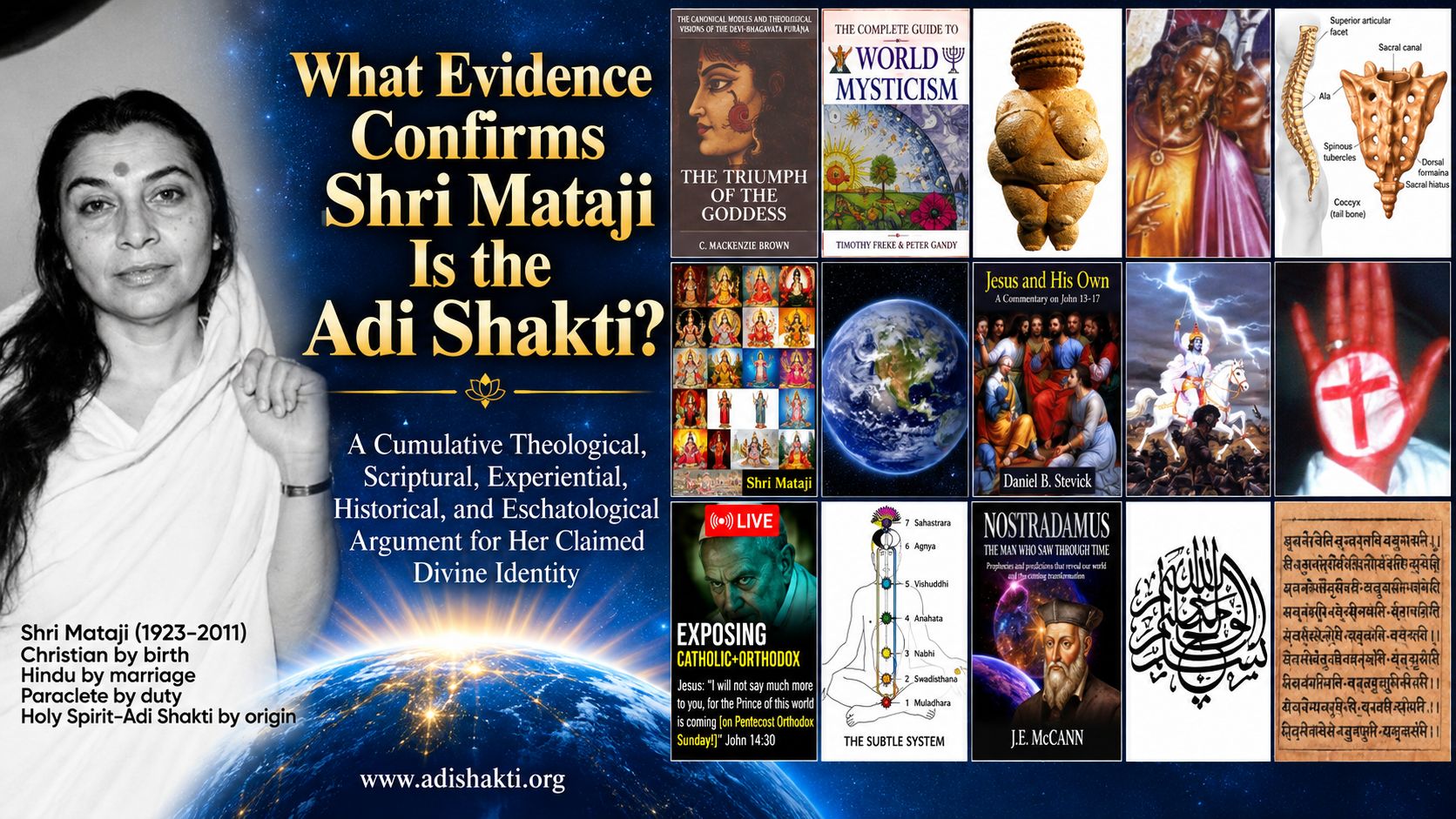
A Cumulative Theological, Scriptural, Experiential, Historical, and Eschatological Argument for Her Claimed Divine Identity
Abstract
This paper presents an affirmative cumulative argument for identifying Shri Mataji Nirmala Devi with the Adi Shakti, the Primordial Divine Feminine and creative Power of God described in the Śākta traditions of India. The argument does not rest upon Shri Mataji's self-declaration alone. Rather, it examines whether her identity, teachings, spiritual function, historical mission, relationship to Kundalini and Sahasrara, interpretation of Christ and the Paraclete, claimed opening of collective Self-realization, reported mystical phenomena, and universal theological vision together form the kind of evidentiary pattern that would reasonably be expected if the Adi Shakti had incarnated in human form.
The central thesis is that Shri Mataji's claim becomes significant because her function corresponds to the identity claimed. Classical Goddess theology describes the Divine Mother not merely as a heavenly female deity but as the primordial Power underlying creation, consciousness, liberation, spiritual awakening, and knowledge of the Self. Shri Mataji's historical mission was organized around awakening that very Power—Kundalini—within ordinary human beings and making Self-realization available collectively. She further interpreted this awakening through the universal categories of the Holy Spirit, the Paraclete, the Kingdom of God, spiritual rebirth, the Rūḥ of Allah, Sahasrara, and the realization of the Self. The resulting theological structure is unusually coherent: the one claiming to be Shakti devoted her life to awakening Shakti; the one claiming to be the Divine Mother presented spiritual rebirth as a living experience; and the one claiming to fulfill an eschatological mission attempted to make realization collective rather than restricted to an ascetic elite.
The conclusion advanced here is therefore affirmative but carefully defined. The metaphysical proposition that Shri Mataji is the Adi Shakti cannot be demonstrated in precisely the same manner as a laboratory proposition. It can, however, be supported by cumulative theological reasoning in which scripture, declared identity, enacted function, spiritual phenomenology, historical development, mystical testimony, and universal salvific purpose converge. Within that cumulative framework, the claim that Shri Mataji is the Adi Shakti has substantial explanatory power and can be defended as considerably more than devotional assertion.
Table of Contents
- Introduction: From Divine Claim to Evidentiary Responsibility
- What the Title “Adi Shakti” Actually Requires
- The Evidentiary Importance of Shri Mataji's Self-Declaration
- The Central Functional Argument: The One Who Claimed to Be Shakti Awakened Shakti
- The Opening of Sahasrara and the Claim of a New Collective Possibility
- Self-Realization as the Experimental Core of the Claim
- The Adi Shakti as the Inner Divine Reality
- The Christian Paraclete and the Functional Correspondence
- Spiritual Rebirth and the Maternal Logic of the Holy Spirit
- The Kingdom of God and the Sahasrara
- The Significance of Universality
- Non-Commerciality and the Moral Coherence of the Claim
- Mystical Testimony as Secondary Corroboration
- The Children's Testimony and the Importance of Phenomenology
- The Double Witness and the Value of Prior Corroboration
- The Double Mothers and the Theology of Manifest and Transcendent Shakti
- Collective Emancipation as the Appropriate Scale of the Adi Shakti
- The Coherence of Identity, Method, and Mission
- Alternative Explanations and Their Limits
- The Argument from Explanatory Unification
- Why Function Is More Important Than Title
- The Five-Fold Convergence Reconsidered
- Conclusion: Why the Adi Shakti Identification Is Affirmable
- References
1. Introduction: From Divine Claim to Evidentiary Responsibility
The question of Shri Mataji Nirmala Devi's divine identity begins with her own extraordinary declarations, but it cannot end there. On March 21, 1983, in Sydney, she stated that she was the Adi Shakti and added a sentence of unusual epistemological importance: “But now it is you people who have to prove it that I am that!” That instruction changes the nature of the claim. A religious teacher asking to be believed places the burden upon faith; a religious teacher declaring a supreme divine identity and then challenging others to establish it places the burden upon evidence, correspondence, historical analysis, spiritual experience, and comparative theology.
“I am the Adi Shakti (the Holy Spirit or Ruh of Allah). I am the One who has come on this Earth for the first time in this Form to do this tremendous task. The more you understand this the better it would be. You will change tremendously. I knew I'll have to say that openly one day and we have said it. But now it is you people who have to prove it that I am that!”
The proper academic question is therefore not simply whether Shri Mataji claimed to be the Adi Shakti. That historical proposition is comparatively straightforward. The much more demanding question is whether her life and mission display the characteristics that the identity itself would predict. If the Adi Shakti is the primordial Divine Power from whom manifestation proceeds, then an incarnation of the Adi Shakti should not merely teach about spirituality in general. One would expect such an incarnation to exercise a distinctive relationship to spiritual power itself, to possess a universal rather than sectarian function, to bring human beings toward direct realization rather than intellectual assent, and to act at a scale commensurate with a primordial rather than merely regional divine identity.
This paper argues that Shri Mataji's case becomes compelling precisely at this point. Her central historical work was not the construction of a philosophy around herself, nor the creation of another exclusive religion, nor the establishment of an inaccessible initiatory hierarchy. Her defining claim was that the dormant Kundalini within human beings could be awakened and that, through this awakening, people could enter a state of Self-realization. Her system interpreted this awakening not as a specifically Hindu achievement but as the experiential content underlying such concepts as being “born again,” receiving the Holy Spirit, entering the Kingdom of God, experiencing the Rūḥ, realizing the Self, and attaining the culmination represented by Sahasrara. The argument for her identity therefore arises from the convergence between the name she claimed, the power she taught, the experience she mediated, and the universal purpose she attributed to that experience.
2. What the Title “Adi Shakti” Actually Requires
The title Adi Shakti cannot be treated as an honorific comparable to “saint,” “guru,” or “spiritual teacher.” Within Śākta theology it carries an ontological claim of the highest order. Adi signifies primordial or original, while Shakti refers to divine Power, Energy, or creative potency. The Adi Shakti is therefore not simply one goddess among others but the primordial dynamic aspect of ultimate Reality, the power through which creation arises, consciousness manifests, liberation becomes possible, and the Divine enters relationship with the world.
This distinction is essential because it establishes the evidentiary standard. If Shri Mataji were merely a teacher who happened to use Goddess terminology, the title could be explained as symbolic language. If, however, she claimed to be the Adi Shakti in the full theological sense, then the content of her mission should correspond to the classical functions of that Power. One would expect universality, interiority, liberation, spiritual awakening, a relationship to consciousness itself, and a capacity to operate across rather than within the boundaries of a single inherited religion.
This is where the comparison with classical Goddess theology becomes significant. The Devī Sūkta of the Rigveda presents the feminine Divine as pervading and empowering the cosmic order. Upanishadic Goddess traditions identify the Divine Feminine not only with a personified celestial form but with Brahman, Consciousness, and the inner Self. The Devī Gītā presents liberation as inseparable from knowledge of the highest Reality, while later Śākta traditions present the Goddess as simultaneously transcendent and immanent, with form and beyond form, cosmic and inward. Thus, the Adi Shakti is expected to be both the Divine Mother and the spiritual Power present within the human being.
Shri Mataji's theology corresponds closely to this structure. She taught that Kundalini is the reflection of the primordial Divine Power within each human being, that realization is not merely intellectual but experiential, that the Spirit must be known directly, and that the culmination of the human spiritual ascent occurs through Sahasrara. Her claim to be the Adi Shakti therefore does not stand apart from her teaching; it gives the teaching its internal logic. The woman claiming to be the primordial Shakti devoted her life to awakening Shakti within others.
3. The Evidentiary Importance of Shri Mataji's Self-Declaration
Self-declaration alone cannot prove divine identity, yet its specificity is evidentially important because it allows the later historical mission to be compared against a clearly defined claim. Shri Mataji did not merely say that she was spiritually realized, specially chosen, inspired by God, or functioning as an enlightened teacher. She explicitly identified herself as the Adi Shakti, the Primordial Mother, and in comparative theological language as the Holy Spirit or Rūḥ of Allah.
That specificity matters because it creates the possibility of falsification. If the historical Shri Mataji had behaved primarily as a sectarian teacher, restricted salvation to adherents, commodified spiritual experience, or displayed no distinctive relationship to the awakening of spiritual power, then the Adi Shakti claim would possess little explanatory force. The opposite pattern, however, is what makes the case notable. Her teaching centered on the innate spiritual potential of every human being; her principal method was the awakening of Kundalini; her claimed purpose was collective spiritual transformation; and she repeatedly interpreted the founders of the world's religions not as rivals but as participants in a single divine history.
The strongest argument therefore does not proceed from the proposition, “She said she was the Adi Shakti, therefore she was.” It proceeds from a more demanding question: If she was the Adi Shakti, did her life unfold in a manner appropriate to that identity? The cumulative answer supplied by her mission is affirmative to a remarkable degree.
4. The Central Functional Argument: The One Who Claimed to Be Shakti Awakened Shakti
The most powerful theological argument for Shri Mataji's identity is functional. If the Adi Shakti is the primordial Kundalini Power, then the historical manifestation of the Adi Shakti should possess an extraordinary relationship to Kundalini. Shri Mataji's mission corresponds exactly to this expectation. She did not merely write about Kundalini, discuss its symbolism, or teach advanced yogic techniques to a small elite. She claimed that Kundalini could be awakened spontaneously in ordinary people and that this awakening could take place collectively.
This is crucial because it links identity with action. The central activity of Shri Mataji's spiritual mission was the activation of the very Power she claimed to embody. The theological symmetry is unusually strong: Shakti incarnates, and Shakti awakens Shakti. In traditional Indian spirituality, Kundalini awakening is often associated with prolonged discipline, austerity, specialized initiation, or highly developed yogic practice. Shri Mataji's innovation was to insist that the process had entered a new collective phase in which realization could be given spontaneously and widely.
The importance of this claim extends far beyond numerical scale. If Self-realization becomes a reproducible event rather than a rare attainment, then the character of the spiritual age itself has changed. Shri Mataji interpreted her mission in precisely these terms. She did not present herself primarily as the founder of a new set of beliefs but as the one through whom a new accessibility of realization had become possible. This is exactly the kind of historical shift one would expect from an incarnation claiming not to be another saint or teacher, but the primordial Divine Power herself.
5. The Opening of Sahasrara and the Claim of a New Collective Possibility
The claimed opening of Sahasrara on May 5, 1970 occupies a central position in Shri Mataji's understanding of her mission. Within ordinary yogic models, Sahasrara is associated with the culmination of spiritual ascent, the integration of consciousness, and the state in which individual awareness enters direct relationship with the Divine. Shri Mataji's claim was not simply that she personally attained this realization. She maintained that a primordial opening occurred which made collective Self-realization possible for humanity in a new way.
This distinction gives the event its theological importance. A saint attaining liberation would remain an individual achievement. The Adi Shakti opening Sahasrara for collective humanity would constitute an eschatological event. The structure of the claim therefore fits the identity being asserted. Shri Mataji's role is not that of one more liberated individual showing others a difficult path; it is that of the primordial Power altering humanity's access to spiritual realization itself.
The alleged historical sequence forms a coherent theological pattern. The Adi Shakti incarnates, Sahasrara is opened at a collective level, Kundalini awakening becomes increasingly available to ordinary seekers, Self-realization is offered without requirement of caste or religious conversion, and the experience is interpreted as the beginning of a broader transformation in human consciousness. Whether every metaphysical element of this sequence can be historically demonstrated is a separate question, but the internal correspondence between the claimed identity and the claimed function is exceptionally strong.
6. Self-Realization as the Experimental Core of the Claim
A major reason Shri Mataji's claim differs from purely doctrinal divine claims is that she repeatedly insisted upon experience. Her teachings do not finally ask the seeker to accept metaphysical propositions solely because they come from an authority. They ask the seeker to undergo Self-realization and to determine whether a transformation has actually occurred.
The reported experience usually includes the rising of Kundalini, movement toward thoughtless awareness, a sense of interior silence, and frequently the perception of a cool breeze or subtle sensation on the hands or above the fontanelle. In Shri Mataji's system these experiences are interpreted as manifestations of Chaitanya, the subtle all-pervading Divine Power. From a theological standpoint, this is significant because the central claim becomes at least partly experiential rather than merely credal.
An academic analysis must distinguish the phenomenology from its metaphysical interpretation. A cool sensation, altered attention, meditative silence, or physiological change does not automatically prove that the Adi Shakti is operating. Yet the existence of a reproducible experience would still be highly relevant. The theological argument gains force if the claimed incarnation of the primordial Divine Power is historically associated with a widespread and consistent experience interpreted as the awakening of that Power. The experience then becomes a phenomenon requiring explanation rather than a doctrine requiring prior belief.
This is one reason Shri Mataji's repeated insistence that seekers should “know” rather than merely “believe” is so important. Her system places the burden upon realization itself. In the strongest version of her own argument, theological truth should become experimentally meaningful in human consciousness.
7. The Adi Shakti as the Inner Divine Reality
Classical Śākta theology does not ultimately confine the Goddess to an external heavenly realm. At its most philosophically developed level, the Divine Mother is identified with consciousness, the Self, and the very power through which the individual recognizes ultimate Reality. This is one of the reasons Shri Mataji's teaching displays such close structural correspondence to the traditions from which the title Adi Shakti arises.
Her consistent emphasis was that the purpose of spiritual life is not simply to worship a divine personality from the outside but to become the Spirit. Kundalini awakening therefore serves as the transition from external religion to interior realization. The seeker is not supposed to remain permanently dependent upon someone else's spiritual perception. The seeker is meant to attain a state in which the Divine becomes experientially known within.
This point significantly strengthens the argument against a purely personality-centered interpretation of her movement. If Shri Mataji had claimed supreme divine identity while directing all spiritual attention toward her external person, critics could reasonably interpret the system as charismatic self-exaltation. Instead, the deepest logic of her teaching turns the seeker inward. The physical presence of Shri Mataji becomes the means by which a universal spiritual reality is awakened, not the ultimate object at which consciousness is required to stop.
This distinction is highly consistent with the theological idea of the Adi Shakti as simultaneously manifest and immanent. The Mother may appear in form, yet her deepest reality is discovered as consciousness within every human being.
8. The Christian Paraclete and the Functional Correspondence
The comparison with the Johannine Paraclete significantly broadens the argument because it moves beyond the Hindu conceptual environment from which the title Adi Shakti derives. In the Gospel of John, the Paraclete or Spirit of Truth is associated with teaching, reminding, testifying, guiding into truth, glorifying Christ, dwelling within believers, and completing a revelation that Jesus indicates his contemporaries were not yet ready to receive.
Shri Mataji's historical mission corresponds to a striking number of these functions. She repeatedly taught about Jesus Christ, defended his divine role, explained his place within the subtle system, interpreted the second birth experientially, distinguished the Spirit from merely institutional religion, and claimed that humanity had entered a period in which spiritual truths formerly hidden or misunderstood could be directly experienced. The comparison is particularly significant because she did not present herself as a rival to Christ. Her theological framework instead presents the later work of the Spirit as the completion and experiential fulfillment of what Christ initiated.
This functional correspondence is much stronger than simply assigning the title “Paraclete” to Shri Mataji after the fact. The relevant question is whether the pattern of her work resembles the functions attributed to the Paraclete independently of the title itself. Her life involved teaching across cultures, interpreting earlier revelation, making the Spirit inwardly experiential, calling humanity toward spiritual rebirth, and presenting the next stage of divine revelation as one of direct realization.
The argument therefore becomes cumulative: Shri Mataji claimed the Adi Shakti identity, identified that reality with the Holy Spirit, and then carried out a mission that displays substantial functional similarity to the Paraclete described in the Johannine tradition.
9. Spiritual Rebirth and the Maternal Logic of the Holy Spirit
One of Shri Mataji's most important theological contributions was her interpretation of being “born again” as an actual spiritual event rather than merely a confessional change. Within Sahaja Yoga, the second birth occurs through the awakening of Kundalini and the opening of the higher spiritual centers. This interpretation produces a profound theological coherence when the Holy Spirit is understood maternally.
The logic is straightforward. A mother gives birth. If the Holy Spirit is understood as the Divine Mother, and if Christ teaches that one must be born of the Spirit, then spiritual rebirth acquires an explicitly maternal dimension. Shri Mataji's role as the one facilitating this second birth therefore fits naturally within her self-identification as both Adi Shakti and Holy Spirit.
This correspondence does not mean that traditional Christian theology automatically accepts Shri Mataji's interpretation. It plainly does not. Yet the issue in this paper is explanatory coherence, not confessional consensus. Within the comparative framework, the alignment among Divine Mother, Holy Spirit, spiritual birth, Kundalini awakening, and transformation of consciousness is exceptionally integrated.
Rather than simply borrowing Christian terminology, Shri Mataji provides a concrete spiritual mechanism by which the Christian metaphor of rebirth becomes experiential. This movement from metaphor to phenomenology is one of the central reasons her Paraclete claim deserves serious theological attention.
10. The Kingdom of God and the Sahasrara
Shri Mataji's teaching that the Kingdom of God is to be entered inwardly through the highest spiritual center provides another important bridge between biblical and yogic language. In her interpretation, Sahasrara is not merely an anatomical or occult chakra but the point at which the individual becomes capable of direct spiritual union and entrance into the Divine Reality.
This correspondence is significant because it gives concrete experiential content to a central Christian expression. The Kingdom of God is no longer only an eschatological destination to be entered after death, nor merely an institutional reality, nor exclusively a future historical condition. It becomes an inward spiritual reality accessible through transformation of consciousness.
The theological argument gains force when this is placed alongside the Adi Shakti claim. If the Divine Mother is the power who awakens Kundalini, and Kundalini's ascent culminates in Sahasrara, and Sahasrara corresponds experientially to the Kingdom within, then the incarnate Adi Shakti would be functioning as the one who opens humanity's access to the inner Kingdom. This is precisely how Shri Mataji understood her work.
11. The Significance of Universality
A primordial Divine Mother should logically transcend sectarian boundaries. If the Adi Shakti is the source of spiritual power itself, she cannot be metaphysically confined to one nation, race, caste, language, or inherited religious institution. Universality is therefore not merely an attractive feature of Shri Mataji's teaching; it is a prediction generated by the identity she claimed.
Her theological framework repeatedly integrates Krishna, Rama, Jesus Christ, Buddha, Muhammad, Guru Nanak, and other sacred figures into a single history of divine intervention. The traditions are not treated as meaningless or disposable. Their founders are assigned roles within a larger spiritual architecture whose culmination is direct Self-realization.
This feature is evidentially important because it distinguishes a primordial claim from a merely sectarian one. A teacher claiming to be the Mother of all humanity while insisting that only one ethnic or institutional group possesses truth would be internally contradictory. Shri Mataji's teaching instead makes the universality of spiritual realization a central principle.
The international spread of Sahaja Yoga, its adaptation to culturally diverse settings, and its insistence that people need not abandon their religious backgrounds in order to receive Self-realization all fit the expected universal function of the Adi Shakti.
12. Non-Commerciality and the Moral Coherence of the Claim
Shri Mataji's insistence that Self-realization could not legitimately be sold is also relevant to evaluating her divine claim. This does not establish divinity in itself, because many sincere religious teachers reject commercialization. It does, however, eliminate one obvious alternative explanation for spiritual claims: the use of divine authority primarily for financial gain.
More importantly, the non-commercial principle is internally coherent with her theology. Kundalini is presented as innate. The Spirit already exists within the human being. Self-realization is therefore not a commodity created by an external teacher but the awakening of something that is already one's spiritual birthright. Charging money for realization would contradict the metaphysical premise that the Divine Power belongs inherently to human spiritual nature.
The correspondence between doctrine and practice is evidentially relevant because it demonstrates consistency. Shri Mataji's teachings did not merely describe a universal spiritual birthright; her method sought to enact that principle by making realization freely available.
13. Mystical Testimony as Secondary Corroboration
The wider Adishakti archive preserves an extensive collection of mystical testimonies associated with Shri Mataji, particularly involving Kash, Arwinder, Lalita, and other witnesses. These reports concern the Divine Light, the First Fax, Honey in Milk, Saraswati and the veena, Hanuman, Ganesha, Shesha, Buddha, Guru Nanak, Christ, the Kingdom of God, the Double Witness, the Double Mothers, and a variety of experiences within Sahasrara.
An academic argument should not treat all of these accounts as equally strong evidence. Their evidentiary value depends upon such factors as contemporaneous documentation, access to prior information, degree of independent corroboration, possibility of suggestion, and whether the experience contained specific details not ordinarily available to the witness. Nevertheless, the archive as a whole is important because it demonstrates that Shri Mataji's theological claims were accompanied by a sustained body of experiential testimony rather than existing only at the level of doctrine.
The strongest cases are those in which the testimony appears to possess some form of information asymmetry, prior documentation, or convergence across witnesses. Such cases do not by themselves establish the metaphysical identity of the Adi Shakti, but they strengthen the larger argument by showing that the spiritual world described by Shri Mataji was reportedly experienced in concrete and sometimes unexpectedly specific ways.
14. The Children's Testimony and the Importance of Phenomenology
The reports of Kash, Arwinder, and Lalita are particularly significant because they provide a longitudinal body of testimony concerning the spiritual realm associated with Shri Mataji. The importance of these accounts does not rest upon the assumption that children are inherently incapable of suggestion or religious conditioning. They plainly are not. The significance instead lies in examining whether particular descriptions were recorded before the witnesses possessed the theological knowledge required to construct them deliberately.
The experiences of the extraordinary Light provide a useful example. The testimonies reportedly distinguish the Light from an ordinary physical sun and describe unusual properties such as intense brilliance without ordinary visual discomfort. Later interpretations identify the Light with the Divine presence. The distinction between the initial phenomenological description and the later theological interpretation is important because it allows the experience itself to be considered before assuming its metaphysical meaning.
Where multiple related witnesses report similar unusual characteristics, convergence becomes evidentially relevant. Because the witnesses belonged to the same family, complete independence should not be assumed. Nevertheless, convergence across different ages, circumstances, and questioning episodes can still contribute to a cumulative case, particularly where surviving records allow the chronology of the testimony to be reconstructed.
15. The Double Witness and the Value of Prior Corroboration
Among the most significant forms of mystical testimony are those in which a report is said to precede and correspond to a later event. The case described as the “Double Witness” is important for precisely this reason. Its value does not lie simply in the claim that a spiritual being was present at a religious gathering. Its potential significance lies in the structure of the evidence: a mystical statement or expectation was allegedly recorded before a related earthly observation occurred.
This kind of evidence is methodologically stronger than retrospective interpretation because it introduces chronology. If an event is described only after it happens, memory, reinterpretation, and narrative reconstruction remain powerful alternative explanations. If a specific claim is securely documented beforehand and later corresponds to an independently recorded observation, the evidentiary situation changes substantially.
For the larger argument concerning Shri Mataji's identity, such cases matter because they potentially connect the transcendent spiritual world described by witnesses with independently occurring events in ordinary history. They therefore occupy an intermediate category between private mystical experience and publicly accessible evidence.
16. The Double Mothers and the Theology of Manifest and Transcendent Shakti
The “Double Mothers” testimony addresses one of the deeper philosophical questions arising from Shri Mataji's claim. If she was physically present as a human being subject to ordinary limitations of embodiment, how could witnesses simultaneously report encountering a transcendent Shri Mataji within Sahasrara possessing a different order of knowledge or presence?
From a purely material perspective, the accounts might appear contradictory. Within classical Śākta theology, however, the distinction between saguṇa and nirguṇa provides a conceptual framework. The Divine may manifest with attributes and form while simultaneously transcending the limitations of that particular manifestation. The incarnation does not exhaust the totality of the Divine Reality incarnating.
This means that testimony involving both an earthly Shri Mataji and a transcendent Mother is not automatically inconsistent with the Adi Shakti hypothesis. Indeed, it corresponds closely to the metaphysics of a Divine Power capable of manifesting in form without being confined to that form.
The evidentiary significance lies not in treating the testimony as proof by definition, but in recognizing that the phenomenology reported by witnesses is structurally compatible with the theology being tested.
17. Collective Emancipation as the Appropriate Scale of the Adi Shakti
Another powerful reason for taking Shri Mataji's claim seriously is the scale of the mission she attributed to herself. Indian religious history contains many saints, yogis, gurus, and realized individuals. Their holiness alone does not establish that they are the Adi Shakti. Shri Mataji's claim differs because she understood her work in collective and eschatological terms.
She repeatedly spoke of emancipating humanity, of making Self-realization available widely, and of a historical period in which spiritual truth had to become openly accessible. This collective orientation is important because it corresponds to the scale implied by the identity of the Primordial Mother.
If the Adi Shakti incarnates, one would expect consequences extending beyond the enlightenment of a small circle of disciples. One would expect a mission directed toward humanity as such. Shri Mataji's emphasis on mass Self-realization, collective consciousness, universal spirituality, and the possibility of awakening across national and religious boundaries fits this expectation remarkably well.
18. The Coherence of Identity, Method, and Mission
The cumulative case becomes especially strong when the different elements are considered together rather than separately. Shri Mataji claimed to be the primordial Divine Power. Her defining method was the awakening of Kundalini, understood as the reflection of that Power within the human being. She located the culmination of this awakening in Sahasrara and claimed to have opened Sahasrara for collective humanity. She interpreted the resulting experience as Self-realization, spiritual rebirth, reception of the Spirit, and entry into the Kingdom of God. She presented her mission as universal and collective rather than sectarian and commercial.
These features form a highly coherent structure. The identity claimed explains the method; the method explains the spiritual experience; the experience explains the universal theology; and the universal theology explains the collective scope of the mission.
This kind of coherence is evidentially important because explanations gain strength when they unify otherwise separate observations. The Adi Shakti hypothesis does not merely explain why Shri Mataji used a particular title. It potentially explains why Kundalini, Sahasrara, the Holy Spirit, the Paraclete, spiritual rebirth, Self-realization, the Kingdom within, and collective emancipation all became parts of a single integrated mission.
19. Alternative Explanations and Their Limits
A rigorous affirmative paper must nevertheless consider competing interpretations. One possibility is that Shri Mataji sincerely but mistakenly believed herself to be the Adi Shakti. This explanation accounts for her self-declaration but must still explain the remarkable coherence between the identity claimed and the function actually enacted over decades. It does not by itself account for the centrality of mass Kundalini awakening, the universal theological system, or the sustained body of spiritual testimony associated with her work.
A second possibility is that followers progressively divinized a charismatic teacher. This explanation is weakened by the fact that Shri Mataji herself explicitly claimed the Adi Shakti identity during her lifetime. The divine identification is therefore not merely a posthumous development generated by later disciples.
A third explanation is syncretism: perhaps Shri Mataji constructed an ingenious synthesis of Hindu, Christian, Islamic, and other traditions. There is unquestionably synthesis in her theology. Yet synthesis alone does not explain why the center of the system is an experiential method—Kundalini awakening—rather than a merely conceptual reconciliation of religions. The theological synthesis and the claimed spiritual experience operate together.
A fourth explanation invokes suggestion, expectancy, and group psychology. Such factors may explain some reports of subtle sensations or visions and must be considered seriously. They become less sufficient, however, wherever testimonies contain unexpected features, prior documentation, or specific details not easily attributable to learned expectation. This is why documentary analysis of individual cases remains essential.
The existence of alternatives does not invalidate the Adi Shakti hypothesis. It establishes the proper comparative task: determining which explanation accounts for the largest portion of the total evidence with the greatest coherence and the fewest independent assumptions.
20. The Argument from Explanatory Unification
The central cumulative question can therefore be formulated in explicitly explanatory terms. If Shri Mataji was simply an ordinary spiritual teacher, separate explanations are required for her claim to be the Adi Shakti, her unique focus on Kundalini awakening, her claim to have opened Sahasrara collectively, her interpretation of spiritual rebirth, her equation of the Adi Shakti with the Holy Spirit, her identification with the Paraclete function, her universal integration of religious traditions, her insistence on non-commercial Self-realization, and the extensive mystical testimony associated with her mission.
The Adi Shakti hypothesis unifies these features under one principle. If Shri Mataji truly was the primordial Divine Power, then her ability and determination to awaken the corresponding spiritual Power within human beings becomes expected rather than accidental. Her universal theology becomes appropriate rather than anomalous. Her collective mission becomes proportional to the identity claimed. Her maternal interpretation of the Holy Spirit becomes coherent with spiritual rebirth. Her concern with Sahasrara becomes central rather than incidental.
Explanatory unification is not mathematical proof, but it is a legitimate form of rational inference. In history, theology, and philosophy, hypotheses gain credibility when they explain a complex pattern more comprehensively than their alternatives.
21. Why Function Is More Important Than Title
The most decisive principle emerging from the evidence is that divine identity should be evaluated through function rather than title alone. A title can be assumed; function must be enacted.
The functional test is simple: fire is recognized by its capacity to burn, and light by its capacity to illuminate. If the Adi Shakti is the primordial spiritual Power, then the most appropriate historical signature of her incarnation would be the capacity to awaken that Power in human beings.
This is precisely where Shri Mataji's case is strongest. The defining act of her life was not the declaration “I am the Adi Shakti,” but the repeated attempt to give Self-realization and awaken Kundalini. Her title and her historical function therefore correspond at the deepest level of her spiritual system.
That correspondence does not compel metaphysical certainty, but it provides a rational basis for identifying the claim as internally and theologically credible.
22. The Five-Fold Convergence Reconsidered
The Five-Fold Evidence Framework becomes most persuasive when its categories are understood as mutually reinforcing rather than isolated proofs. Scriptural consistency establishes that the identity claimed has an antecedent theological profile. Kundalini awakening provides an experiential dimension appropriate to that profile. Prophetic and eschatological comparison places the mission within a broader religious chronology. Mystical testimony supplies secondary phenomenological corroboration. Global and collective transformation demonstrates that the mission aspires to a scale appropriate to a primordial and universal Divine Mother.
No single category is sufficient. Scripture alone could be selectively interpreted. Experience alone could be psychological. Prophecy alone could be retrospectively fitted. Mystical testimony alone could be mistaken. Global influence alone proves nothing about divinity.
The strength arises when all five point toward the same center. The resulting claim is not that five weak arguments magically become certain when combined. The claim is that independent forms of correspondence acquire greater significance when they repeatedly support the same explanatory hypothesis.
23. Conclusion: Why the Adi Shakti Identification Is Affirmable
The case for Shri Mataji Nirmala Devi as the Adi Shakti is strongest when it is understood not as a single miraculous proof but as a cumulative pattern of correspondence between identity, function, experience, theology, history, and purpose.
She explicitly claimed the Adi Shakti identity. Yet she did not leave that claim as an isolated declaration. Her entire historical mission was devoted to awakening Kundalini, the very Shakti understood to reside within human beings. She interpreted the culmination of this awakening through Sahasrara and claimed that a collective opening had occurred that made Self-realization increasingly accessible to humanity. She presented spiritual realization as an experience rather than merely a belief and interpreted it through such transreligious categories as the Holy Spirit, the Paraclete, spiritual rebirth, the Kingdom of God, the Rūḥ, and realization of the Self.
Her mission was universal rather than narrowly sectarian, collective rather than restricted to a monastic elite, and explicitly non-commercial at the point of spiritual awakening. The extensive mystical testimony associated with her provides a secondary body of phenomenological evidence, while her theology displays remarkable coherence with the classical understanding of the Divine Mother as both transcendent and present within consciousness.
For these reasons, the identification of Shri Mataji with the Adi Shakti can be defended as substantially more than devotional belief. The affirmative case rests on the fact that the identity she claimed consistently explains the work she performed. The primordial Shakti would be expected to awaken Shakti; the Divine Mother would be expected to give spiritual rebirth; the universal Spirit would be expected to transcend religious boundaries; the Paraclete would be expected to teach, guide, reveal, and make the Spirit inwardly known; and an eschatological incarnation would be expected to act collectively rather than merely privately.
“But now it is you people who have to prove it that I am that!”
The strongest answer is not to repeat her declaration but to examine the pattern created by her life. That pattern shows an unusually close convergence between who she said she was, what the scriptural Adi Shakti is expected to be, what spiritual power she claimed to awaken, what she actually made the center of her mission, and what those around her reported experiencing.
Accordingly, the affirmative theological conclusion of this paper is that Shri Mataji Nirmala Devi can reasonably be recognized as the Adi Shakti within the cumulative evidentiary framework developed here, because the claim of identity is matched by an extraordinary correspondence of function, mission, experiential method, scriptural archetype, universal scope, and collective spiritual purpose.
The decisive argument is therefore not merely that Shri Mataji said she was the Adi Shakti. It is that her life and mission make substantially greater sense if the identity she claimed is taken seriously as the explanatory center of the whole phenomenon.
References and Primary Research Links
- Adishakti.org. Homepage and Research Index.
- Adishakti.org. Five-Fold Evidence Framework.
- Adishakti.org. Shri Mataji: “I Will Tell You All the Secrets”.
- Adishakti.org. The Opening of the Sahasrara Chakra.
- Adishakti.org. “You Have to Enter the Kingdom of God Here”.
- Adishakti.org. Shakti — The Liberating Essence of Hinduism.
- Adishakti.org. Authenticity of God as Light Within.
- Adishakti.org. The Authenticity of the Double Mothers.
- Adishakti.org. The Case of the Double Witness.
- Adishakti.org. The Authenticity of the First Fax.
- Adishakti.org. The Authenticity of Honey in the Milk.
💬 Interactive Chat
Explore this article, its sources, and the relationships among its theological and evidentiary claims.
Open chat →