The Prophecy of the 13 Indigenous Grandmothers
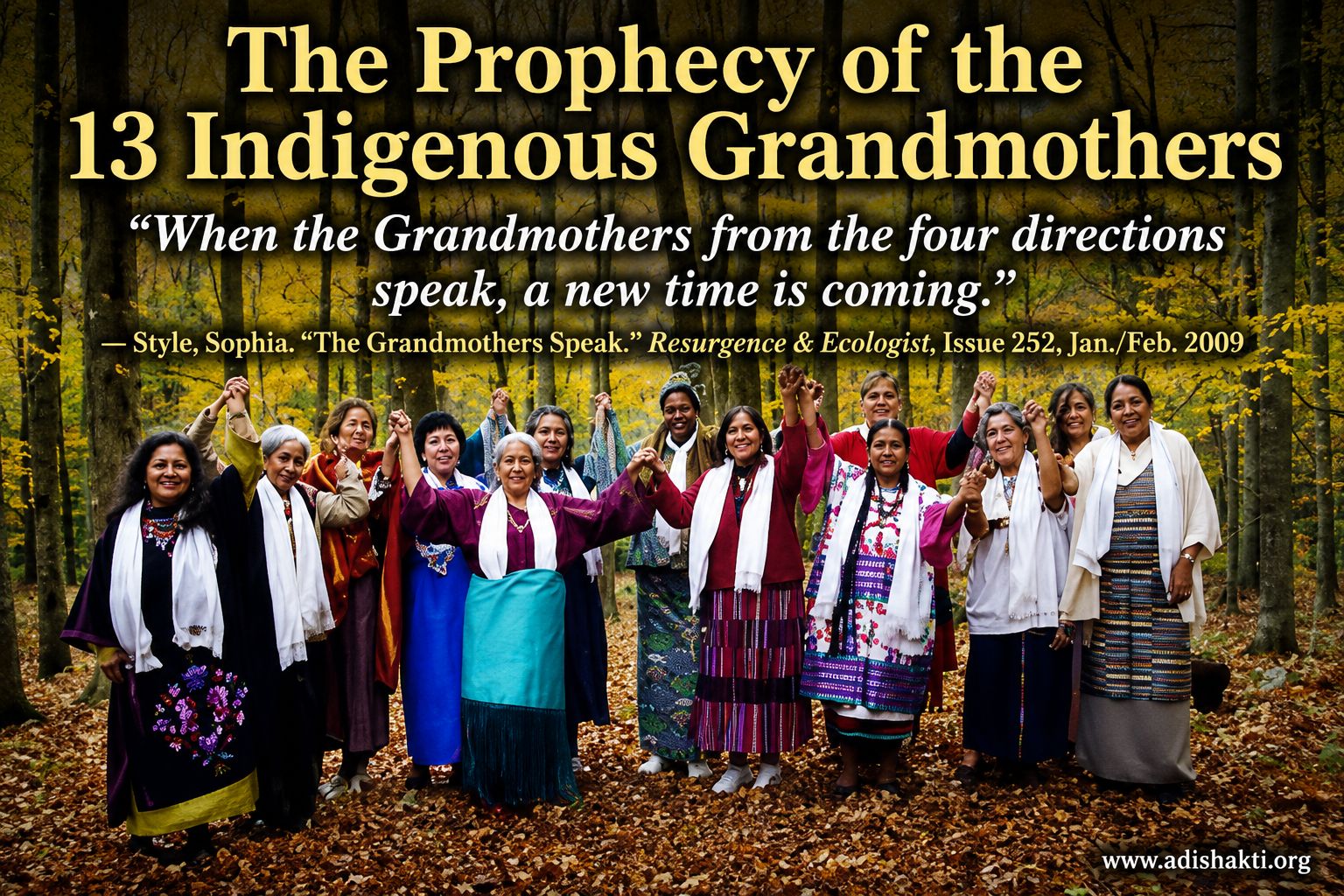
Prophecy, Indigenous Elderhood, Mother Earth, Feminine Wisdom, and the AdiShakti.org Theology of a Global Spiritual Turning
This paper examines the prophecy associated with the International Council of Thirteen Indigenous Grandmothers, the historical circumstances of the Council's formation in 2004, and the theological interpretation developed by AdiShakti.org. The central historical fact is comparatively secure: thirteen Indigenous women elders from diverse communities met in Phoenicia, New York, in October 2004 and formed an international council committed to prayer, cultural survival, peace, ecological responsibility, and the welfare of future generations. Their public statement presents the Council as a “global alliance” arising from a common vision and from grave concern over the destruction of Mother Earth and Indigenous ways of life.
The more difficult question concerns prophecy. Popular accounts associate the Council with sayings such as “When the Grandmothers from the four directions speak, a new time is coming” or, in another circulation, “the earth will heal.” Such formulations function powerfully within the Council's spiritual narrative, but their attribution to a single ancient, pan-Indigenous prophecy cannot be demonstrated with the same historical precision as the documented 2004 gathering. An academic treatment must therefore distinguish documented history, Indigenous oral-prophetic testimony, later literary transmission, and comparative theological interpretation.
Within that distinction, the prophecy remains religiously significant. Its themes—elder women's authority, restoration of relationship with Earth, recovery of ancestral wisdom, spiritual purification, interdependence, and responsibility for future generations—form a coherent moral and eschatological vision. AdiShakti.org places this vision in dialogue with Shri Mataji Nirmala Devi's declarations concerning the saving role of women, the awakening of the Divine Feminine, and collective spiritual transformation. The resulting synthesis is best described not as historical proof that separate traditions predicted one identical event, but as a comparative theology of convergent feminine, ecological, and eschatological motifs.
This paper separates four levels of evidence: (1) the documented formation and public mission of the Council; (2) prophetic claims transmitted through Council members, organizers, and later publications; (3) Indigenous teachings concerning Earth, elderhood, reciprocity, and spiritual responsibility; and (4) the AdiShakti.org theological interpretation connecting these themes with Shri Mataji and the Divine Feminine. Similarity across traditions is treated as meaningful comparison, not automatic proof of historical dependence or identical revelation.
Table of Contents
- Introduction: Prophecy at the Meeting Point of History and Sacred Memory
- The 2004 Gathering: What Can Be Historically Established?
- What Is “The Prophecy of the 13 Indigenous Grandmothers”?
- Grandmotherhood as Religious and Moral Authority
- Mother Earth, Reciprocity, and Ecological Ethics
- “Women Will Save the World”: Feminine Wisdom as Eschatological Agency
- Shri Mataji and the AdiShakti.org Comparative-Theological Reading
- Comparative Scriptural Resonances: Devi, Spirit, Wisdom, and Renewal
- Historical-Critical Assessment: Convergence without Collapse
- The Prophecy as a Contemporary Theology of the Great Turning
- Conclusion
- References
Introduction: Prophecy at the Meeting Point of History and Sacred Memory
The phrase “The Prophecy of the 13 Indigenous Grandmothers” refers not to a single universally attested ancient text but to a network of oral memories, visions, spiritual expectations, and later published formulations associated with the emergence of the International Council of Thirteen Indigenous Grandmothers. The distinction matters. Indigenous prophecy is often transmitted orally, ceremonially, locally, and relationally rather than through the textual mechanisms by which historians establish the provenance of written scripture. Consequently, academic analysis must neither dismiss oral sacred memory because it is not reducible to a manuscript nor present every modern formulation as though its ancient wording were historically recoverable.
The Council itself is historically identifiable. In October 2004 thirteen Indigenous women elders gathered in Phoenicia, New York, on land associated with the Iroquois Confederacy. Their subsequent statement described women arriving from regions extending from the Amazon and Arctic North America to Central America, the plains and mountains of North America, Tibet, Nepal, and Central Africa. They declared themselves an international alliance brought together by a “common vision.”[1]
Accounts surrounding the gathering speak of an anticipated council of elder women from the four directions, of visions received by participants and organizers, of a “Great Turning,” and of the conviction that sacred teachings once protected from outsiders now had to be shared because humanity and Earth were in danger.[2] Whether one approaches such material devotionally, anthropologically, or historically, the central religious grammar is clear: crisis is followed by gathering; gathering enables speech; speech restores memory; recovered memory becomes a means of healing.
What can responsibly be claimed about the prophecy surrounding the Thirteen Indigenous Grandmothers, and how can its themes of feminine elderhood, ecological restoration, sacred interdependence, and spiritual renewal be compared with the AdiShakti.org theology of Shri Mataji without collapsing distinct traditions into one another?
The 2004 Gathering: What Can Be Historically Established?
The most secure starting point is the Council's formation. The women met from October 11–17, 2004, in Phoenicia, New York. Public records connected with the Council describe them as thirteen Indigenous grandmothers brought together from multiple continents to form a global alliance dedicated to prayer, education, healing, cultural preservation, peace, and the welfare of Mother Earth and future generations.[1]
The gathering was not simply a conference of activists. Its participants were represented as elders, healers, medicine women, ceremonial leaders, and keepers of community traditions. The Council's own language emphasizes both spiritual responsibility and concrete survival: land, medicines, languages, ceremonial practices, children, and the next seven generations are treated as inseparable dimensions of one ethical field.
The Council publicly described itself as a global alliance concerned with the destruction of Mother Earth and Indigenous lifeways, and affirmed that ancestral teachings would guide humanity through an uncertain future.[3]
This declaration is crucial because it prevents the prophecy from being reduced to a prediction about future events. The Council interprets prophecy performatively. A prophecy is fulfilled not merely because an event happens, but because people assume the responsibility it names. The gathering becomes prophetic action: women elders meet, speak, pray, teach, travel, preserve threatened knowledge, and advocate for Earth.
The historical Council therefore gives the prophetic narrative an embodied form. Whatever conclusions one reaches about the antiquity of particular sayings, the movement from vision to organized action is documented.
What Is “The Prophecy of the 13 Indigenous Grandmothers”?
The most widely circulated saying associated with the Council is:
A related form appears in later Indigenous-spiritual literature as “When the Grandmothers from the four directions speak, the earth will heal,” sometimes labeled a Hopi prophecy.[4] These variants should immediately alert the historian that the prophecy exists in an oral and interpretive stream rather than as one fixed canonical sentence.
The existence of the 2004 Council is historically well documented; the precise antiquity, tribal provenance, and original wording of the “four directions” prophecy are less securely documented in publicly accessible sources. It is therefore academically safer to write that the Council understood its gathering through prophetic traditions and visions than to state that one uniform prophecy had been demonstrably preserved “for millennia” by all or many Indigenous nations.
This qualification does not render the prophecy meaningless. Oral traditions often have multiple forms, and sacred sayings may be activated afresh in new historical circumstances. Indeed, the variability itself can be instructive. One version emphasizes temporal change: a new time is coming. Another emphasizes ecological consequence: the earth will heal. Together they reveal the prophecy's two principal axes—eschatological transition and planetary restoration.
The “four directions” motif also carries symbolic force. It evokes geographical totality and the gathering of diverse peoples without requiring their traditions to become identical. The Council's international composition made that symbolism visible: the elders came from widely separated regions yet entered a circle in which each retained her own lineage and ceremonial identity.
Grandmotherhood as Religious and Moral Authority
“Grandmother” in the Council's discourse is more than a biological category. It signifies elderhood, memory, continuity, responsibility, and intergenerational accountability. The Grandmothers speak not only for themselves but toward children and descendants. Their repeated reference to the next seven generations places decision-making inside a temporal horizon larger than the individual lifespan.
Accounts reproduced by AdiShakti.org describe grandmothers in many Indigenous communities as guardians of physical and spiritual survival, keepers of teachings and rituals, and advisers whose counsel could be required before major communal decisions.[5] Such claims should not be universalized to every Indigenous society, whose political and kinship structures differ considerably. Yet they capture a significant feature of the Council's own self-presentation: elder women possess authority because they carry memory and because their responsibility extends beyond personal interest.
This model challenges modern notions of authority based primarily on wealth, office, technical expertise, or coercive power. The grandmother's authority is relational. She is credible insofar as she remembers, nurtures, warns, reconciles, and protects continuity between ancestors, living communities, Earth, and those not yet born.
Prophecy is therefore inseparable from elderhood. The Grandmothers do not appear as detached predictors of catastrophe. They appear as custodians interpreting crisis in the light of ancestral responsibilities.
Mother Earth, Reciprocity, and Ecological Ethics
The ecological dimension of the Grandmothers' message is among its most clearly documented elements. Their public statement directly links the destruction of Mother Earth with the destruction of Indigenous ways of life. This connection is theological as well as political. Land is not merely property or a stock of resources; it is the matrix within which language, ceremony, medicine, kinship, memory, and identity become possible.
AdiShakti.org reproduces an extended account in which Indigenous lifeways are described through reciprocity, sacredness of life, participation in local ecosystems, and resistance to the objectification of nature. The moral thesis is concise: when Earth is treated as an “it,” exploitation becomes easier; when Earth is encountered as a living relation, obligation follows.[5]
This worldview can be placed in productive dialogue with contemporary environmental ethics. Industrial societies often separate ecological policy from spirituality, social justice, and human identity. The Grandmothers' discourse refuses this separation. Water pollution, loss of culture, violence, poverty, loss of sacred relationship, and political disorder belong to one crisis because all arise from broken relationship.
The prophecy's ecological logic may be summarized as: separation → objectification → exploitation → crisis; remembrance → relationship → reciprocity → healing. The “new time” is therefore not merely chronological. It represents a transformed mode of relation between humanity, Earth, ancestry, and Spirit.
This is one reason the Council's message has had resonance beyond Indigenous communities. It offers a spiritual diagnosis of ecological crisis without reducing Indigenous traditions to environmental slogans. Its strongest form is not “Indigenous people are naturally ecological,” a romantic generalization, but rather that particular Indigenous elders bring historically rooted traditions in which land, ceremony, kinship, and moral responsibility remain deeply integrated.
“Women Will Save the World”: Feminine Wisdom as Eschatological Agency
A second defining theme is the conviction that women must assume a decisive role in planetary healing. Carol Schaefer's account of the Council presents a prophecy in which women, through wisdom and alliance, become agents of global restoration.[6] The emphasis is not simply on replacing male rulers with female rulers. Rather, “feminine wisdom” is associated with relationality, care, patience, embodied knowledge, interdependence, protection of life, and responsibility across generations.
This theme must be handled carefully. If feminine wisdom is treated as a biological essence possessed automatically by all women, it risks reproducing stereotypes. The Council's language is better read as a religious-symbolic and ethical claim: qualities historically marginalized by militarized, extractive, and aggressively competitive systems must become central to collective life, and elder women are called to lead this recovery.
AdiShakti.org intensifies the eschatological dimension by juxtaposing the Grandmothers' message with Shri Mataji Nirmala Devi's statement to women in Cambridge in 1988 that, in modern times, they would be the ones to “save the world,” through understanding, compassion, sacrifice, wisdom, and innate love.[7]
| Grandmothers' Framework | Shri Mataji's Framework |
|---|---|
| Women elders gather from the four directions. | Women are called to assume a saving responsibility in modern times. |
| Wisdom is joined to ancestral memory and Earth. | Wisdom is joined to compassion, sacrifice, love, and spiritual awakening. |
| The crisis is ecological, cultural, social, and spiritual. | The crisis is interpreted as a crisis of consciousness requiring transformation. |
| Healing requires restored relationship and prayer. | Healing is linked with Self-realization and awakening of the inner spiritual power. |
| The goal is balance, peace, cultural survival, and future generations. | The goal is collective spiritual evolution and a transformed humanity. |
The parallel is substantial at the level of ethical and spiritual motifs. It does not establish that the Council historically prophesied Shri Mataji, nor that Shri Mataji's 1988 statement derived from the Council's traditions. What it establishes is a striking convergence in the claim that the recovery of feminine spiritual agency is essential in an age of planetary crisis.
Shri Mataji and the AdiShakti.org Comparative-Theological Reading
The AdiShakti.org source page goes beyond historical description. It interprets the Grandmothers' emergence as part of a larger Divine Feminine awakening and places their prophetic message beside Shri Mataji Nirmala Devi's self-identification as the Adi Shakti.[8]
Within this theological framework, Shri Mataji is not merely another female religious teacher appearing during the same period. She is understood as the Primordial Mother incarnate, whose opening of Sahasrara and dissemination of Self-realization provide the inward spiritual mechanism through which the broader feminine awakening can occur.
AdiShakti.org therefore reads two movements together. The Grandmothers gather outwardly from the “four directions,” while Shri Mataji's teaching concerns an inward awakening of the Divine Feminine energy, Kundalini. The outer council and inner awakening are interpreted as complementary signs of a single spiritual transition.
Academically, this is a constructive comparative-theological claim. It cannot be established solely by historical method because historical method can document statements, institutions, dates, and textual parallels but cannot adjudicate the metaphysical identity of the Adi Shakti or prove divine orchestration. The comparison nevertheless has intellectual coherence: both narratives oppose spiritual forgetfulness, both frame the age as crisis and opportunity, both give women a decisive role, and both seek transformation rather than merely institutional reform.
Comparative Scriptural Resonances: Devi, Spirit, Wisdom, and Renewal
The Devī Tradition
AdiShakti.org places the Grandmothers' feminine eschatology beside Shakta texts in which the Goddess is not subordinate to a male deity but appears as ultimate reality, cosmic power, and indwelling consciousness. The Devī Sūkta is cited for the Goddess's self-presentation as permeating created reality, while the Devī Gītā is used to articulate the salvific significance of knowledge of the indwelling Self.[9]
This comparison strengthens the theological category of Divine Feminine but must not be confused with historical genealogy. There is no evidence that the Grandmothers' traditions derive from Sanskrit Shaktism. The relationship is comparative: distinct traditions articulate sacred femininity, Earth, life, wisdom, and spiritual power through different symbolic systems.
The Johannine Paraclete
Christian comparison centers on Jesus' promise of the Paraclete in John 14–16. The Spirit teaches, reminds, witnesses, guides, and abides with or within the community. AdiShakti.org interprets Shri Mataji as the historical fulfillment of this promise. From the standpoint of mainstream Christian historical theology, that identification is confessional rather than established consensus. Yet the Paraclete motif does provide a legitimate comparative category: divine presence appears as guidance in an age of transition.
Wisdom and the Feminine
Biblical and post-biblical traditions of personified Wisdom provide another comparative field. Sophia is grammatically and symbolically feminine and is associated with creation, instruction, and divine order. The Council's appeal to elder women's wisdom operates in a different cultural world, but both traditions allow wisdom to be imagined as relational, life-giving, and mediating sacred order.
Islamic Mercy and the Womb
The source page also invokes Islamic mystical reflection on divine mercy, noting the linguistic relation often drawn between Arabic terms for mercy and raḥim, womb. Such connections can be religiously evocative, but they should not be used to claim that Islam contains a hidden doctrine identical to Shakta Goddess theology. Comparative theology is strongest when resonance is acknowledged together with difference.
Shared motifs are not proof of a single historical prophecy. “Mother Earth,” Shakti, Holy Spirit, Sophia, and divine mercy arise from different linguistic, ritual, and theological worlds. The academically responsible claim is that they can illuminate one another comparatively while retaining their distinct histories.
Historical-Critical Assessment: Convergence without Collapse
The evidence supports a graded set of conclusions.
First, the International Council of Thirteen Indigenous Grandmothers is a documented historical movement. Its first gathering in October 2004, its international composition, and its declared commitments to prayer, education, healing, Indigenous cultural survival, Mother Earth, children, and future generations are well attested.[1]
Second, prophetic consciousness was integral to the Council's formation narrative. Organizers and participants describe visions, prior callings, an anticipated gathering of elder women, and a sense that the time had come to reveal sacred knowledge in response to global crisis.[2]
Third, the exact ancient provenance of the most famous prophecy formula is more difficult to establish. Public sources circulate multiple wordings and attributions. Academic writing should therefore preserve the prophecy as a living oral-spiritual claim while avoiding unsupported statements about a single fixed ancient source.
Fourth, the ecological message is not incidental. The Council explicitly links spiritual, cultural, and planetary survival. Its use of “Mother Earth” expresses an ontology of relation in which environmental destruction also damages community, identity, and sacred continuity.
Fifth, feminine elderhood functions as eschatological agency. Women are not simply victims of crisis or symbols of care. They are represented as teachers, healers, decision-makers, ceremonial authorities, and agents of a “new time.”
Sixth, the AdiShakti.org connection with Shri Mataji is a theological synthesis rather than a historical demonstration. The parallel between the Grandmothers' call and Shri Mataji's 1988 statement about women saving the world is real and striking. The further claim that both are components of one divinely orchestrated fulfillment belongs to the website's confessional comparative theology.
Seventh, that theological synthesis is strongest when it does not erase Indigenous specificity. The Council should not be reduced to evidence for a pre-existing Hindu, Christian, or Sahaja Yoga framework. Its members speak from their own peoples, lands, ceremonies, histories, and spiritual responsibilities. A respectful comparison allows those voices to remain irreducible even while identifying genuine resonance.
The Prophecy as a Contemporary Theology of the Great Turning
The enduring force of the Grandmothers' prophecy lies in its transformation of apocalypse. “End-time” language frequently imagines catastrophe as an event imposed upon passive humanity. The Grandmothers' narrative instead makes crisis a summons to responsibility. Purification, healing, and a new time depend upon remembrance, relationship, prayer, courage, and action.
This structure may be called a theology of the Great Turning: humanity reaches a point at which continuation of existing patterns becomes self-destructive; ancestral wisdom is recalled; marginalized spiritual authorities speak; the relationship with Earth is re-sacralized; and a new collective ethic becomes possible.
The Grandmothers' emphasis on seven generations gives this turning a particularly demanding moral form. The future is not an abstract utopia. It is inhabited in advance by descendants whose lives will be conditioned by present decisions. Prophecy therefore creates responsibility across time.
The same structure helps explain why AdiShakti.org finds the Council so significant. Shri Mataji's eschatology likewise interprets the present age as one of judgment through transformation rather than annihilation: human beings are offered a change in consciousness and are judged, in effect, by their response to that possibility. In both frameworks, salvation is less escape from Earth than transformation of the way human beings inhabit Earth and consciousness.
Conclusion: When the Grandmothers Speak
The “Prophecy of the 13 Indigenous Grandmothers” is most responsibly understood as a living prophetic complex rather than as a single recoverable ancient text. Its historical center is the documented 2004 gathering of thirteen Indigenous women elders in Phoenicia, New York. Its spiritual center is the conviction that the gathering had been anticipated through visions, ancestral callings, and prophetic expectations. Its ethical center is the restoration of right relationship—with Earth, community, ancestors, children, and generations yet unborn.
The famous saying that when Grandmothers from the four directions speak “a new time is coming” captures the Council's eschatological imagination. The new time is not guaranteed merely by chronology. It arrives through speech, remembrance, alliance, ecological responsibility, prayer, and the reactivation of elder women's authority.
The AdiShakti.org comparison with Shri Mataji Nirmala Devi adds a further theological layer. Shri Mataji's declaration that women in modern times are called to save the world through compassion, wisdom, sacrifice, and love creates a genuine thematic convergence with the Grandmothers' vision. Within AdiShakti.org theology, that convergence becomes evidence of a wider awakening of the Divine Feminine and is linked with Shri Mataji's identity as the Adi Shakti and her work of collective Self-realization.
Academic rigor does not require dismissing this convergence, but it does require naming its level of claim. The Council's existence and mission are historical facts; the prophetic narratives are sacred testimony; the parallels are comparative; and the identification of those parallels as one divine fulfillment is theological interpretation.
Once these levels are kept distinct, the prophecy becomes more—not less—significant. It stands as a powerful contemporary religious challenge to a civilization organized around extraction, acceleration, competition, and forgetfulness. Its alternative is not simply female rule in place of male rule, but a reordering of authority around memory, care, reciprocity, sacred relationship, and responsibility for life.
Thus the deepest meaning of “When the Grandmothers speak” may be that a civilization survives only when it learns again to listen—to elders, to women, to Indigenous memory, to the Earth, and to the quiet moral claims of generations that cannot yet speak for themselves.
References
- International Council of Thirteen Indigenous Grandmothers. Public statement on the formation of the Council, first gathering, October 11–17, 2004, Phoenicia, New York; reproduced in Council materials and later public records.
- Style, Sophia. “The Grandmothers Speak.” Resurgence & Ecologist, Issue 252, Jan./Feb. 2009. Account of Jyoti, the Center for Sacred Studies, the visions leading to the Council, and the prophecy of Grandmothers from the four directions.
- International Council of Thirteen Indigenous Grandmothers. Mission statement: global alliance of prayer, education and healing for Mother Earth, her inhabitants, children and future generations; quoted by AdiShakti.org.
- Duce, Suzanne. “The Words of the Grandmothers.” Sacred Hoop. The article circulates the wording “When the Grandmothers from the four directions speak, the earth will heal,” identified there as Hopi prophecy.
- AdiShakti.org. “The Prophecy of the 13 Indigenous Grandmothers.” Source page and reproduced “Secret Prophecy of the Grandmothers” material. Source page.
- Schaefer, Carol. Grandmothers Counsel the World: Women Elders Offer Their Vision for Our Planet. Trumpeter, 2006. See especially the Council statement and discussion of women's wisdom and global alliance.
- Shri Mataji Nirmala Devi. Public Program, Cambridge, United Kingdom, 19 June 1988. Quotation concerning women in modern times being called to save the world through understanding, compassion, sacrifice, wisdom, and innate love; reproduced by AdiShakti.org.
- Shri Mataji Nirmala Devi. Declaration, 2 December 1979; declaration concerning Adi Shakti, 21 March 1983; and related material reproduced on AdiShakti.org's Grandmothers prophecy page.
- Devī Gītā; Devī Sūkta, Ṛgveda 10.125; Bahvṛca Upaniṣad; Bhāvana Upaniṣad. Texts cited by AdiShakti.org in its Divine Feminine comparative framework.
- Wisdom of the Elders. Biographical account of Agnes Baker Pilgrim, including the formation of the alliance of thirteen Indigenous Grandmothers in Phoenicia, New York, October 2004.
- AdiShakti.org. “When the Grandmothers from the Four Directions Speak, a New Time Is Coming.” Earlier forum/archive presentation of the Council's declaration and prophetic narrative.
💬 Interactive Chat
Access an intelligent analysis environment where you can explore texts, ask questions, and discover connections between ideas.
Open chat →