The Authenticity of Kash’s Mystical Witnessing and Conversation with Guru Nanak
An Evidence-Based Interdisciplinary Assessment of the August 24, 1994 Testimony, Ekā Māī, and Dhyān Correspondences
Author: Manus AI | Date: August 12, 2026 | Published on:
adishakti.org
Shri Mataji, Who Is This Aykaa Mayee?
Since the day Kash informed his father that Shri Mataji had taken him to meet Guru Nanak an immediate search was undertaken. What connection did the Great Adi Shakti have with Guru Nanak who walked on Earth from AD 1469-1539?
In all his 42 years Kash’s father had never heard anything about Waheguru (God Almighty) being even remotely feminine (though neither was Waheguru masculine either). Waheguru was just Waheguru: Ik Onkar (One God); Satnaam (True Divine Essence); Kartaa Purakh (Supreme Being); Nirbhao (Fearless); Nirvair (Love); Akaal Moorat (Beyond Time); Ajoonee (Unborn); Saibhang (Self-Illumined) and Gur Prasaad (attained by Grace of Enlightener).
All these attributes pointed directly to the Great Primordial Mother whom Kash was visiting in his own Sahasrara. The most awesome sight was that the extremely dazzling Eternal Light always shone above Her, that is, She was Self-illumined at all times. This Absolute Truth was witnessed more than a thousand times by Kash, less by Arwinder (and almost daily by Lalita prior to publication). Kash had also confirmed that this Light was only seen above Her, and nowhere else. All the mightiest of mighty Gods did not possess this Eternal Light. Still, where was the connection between Guru Nanak and the Great Supreme Spirit?
One day a religious Sikh friend Baldave Singh and his even more religious turbaned French wife Lumina came over from NDG, Montreal. They sold him two copies of Nitnaym Banees (Daily Sikh Prayers by Dr. Santokh Singh) that had translations of the Jap Jee Sahib, the opening chapter of the Shri Guru Granth Sahib.
The next day he began reading it and soon discovered an item that startled him, repeatedly reading page 44 (page 7 of the SGGS) to assure himself. Something caught his eye and upon close examination was found to be a priceless pearl. He could not believe his good fortune.
But how was this possible if countless others had also seen it hundreds of millions of times, but yet failed to pick it up? Was he the only Sikh ever to see it? Was he saying that all others were blind, including priests, ragis, theologians, translators and proof-readers? That would be preposterous.
But then, again, his eyes were not deceiving him, and neither was the mind. He knew exactly what he was reading. But then, again, how was it possible that no one talked about it, as if they were visually impaired. But then, again, millions cannot be blind? Or is it possible? But, then, again . . .
The only way of ascertaining the Truth from this seesawing speculation of the agitated mind was through Kash.
On August 24, 1994, he was told to ask Guru Nanak to reveal who is this Aykaa Maaee, the One Mother unveiled by Him in the Jap Jee Sahib, the fountainhead of the Guru Granth Sahib and revered morning prayers of every religious Sikh.
The Aykaa Mayee of the Jap Jee Sahib
The particular verse of the Aykaa Mayee in stanza 29 of Jap Jee Sahib — the Divine Essence from whence springs forth the voluminous Sri Guru Granth Sahib — is translated here:
Aadays, tisai aadays. Aad aneel anaad anaahat, jug jug ayko vays.
Obeisance, obeisance to Her, the Primal, the Immaculate, without beginning, without end, constant through all ages. Aykaa maa-ee, jugat viaaee, tin chalay parvaan.
The One Mother existed Alone in some mysterious way and She created the Three deities. Ik sansaaree, ik bhandaaree, ik laa-ay deeban.
One was the Creator, one the Sustainer and one the Destroyer. Jiv tis bhaavai, tivai chalaavai, jiv havai phurmaan.
The world moves as She ordains and as She pleases. Oh vaykahi, onaa nadar na aavai, buhutaa ayho vidaan.
She sees all, but no one sees Her; this is a great wonder.
“Brahma, Vishnu, and Siva were worshipped as gods; they were known as Trinity. They represented three processes of life going as in nature: creation, preservation and destruction, respectively. . . . they represent certain natural powers that ensue from God.
“O God, Thou art my Father, my Mother, Thou art my kin, my brother, When Thou art my Protector everywhere, why should I fear, O, Dear.”2 “Brahma, Vishnu and Siva, too are contained in Him, the One.”3
And Ask Guru Nanak What Dhyan Means
Kash, who neither spoke, read nor wrote any Punjabi (his mother tongue), was also told to inquire the meaning of dhyan, a word commonly used to mean “attention.”
At 11:40 a.m. Kash sat down and went into Nirvikalpa Samadhi. The Surati (Kundalini) rose from the base of his spine through the Sushumna and opened his Dsam Duar (Brahmarandhra), and he emerged through the blue clouds of the Great Lotus Forest of the Sahasrara.
He hovered in mid-air above the soft cloud cover and saw his spirit self in Samadhi beside the Eternal Throne of the Great Adi Shakti. Gently he floated down into his spiritual body, which was of the exact shape and size of his physical body, and merged into it.
He then got up and bowed to Shri Bhagavati seated on Her Golden Throne. Shri Govind (Krishna) and Shri Ganesha were sitting on both Her sides. Kash bowed to them and offered the honey-flavored milk that his father had prepared and left on the altar.
The Great Adi Shakti, Shri Ganesha, and Shri Gopal (Krishna) got up and picked a glass of milk each before sitting down again. Shri Parvati Mai requested all to meditate first. They raised their Kundalinis and began meditation.
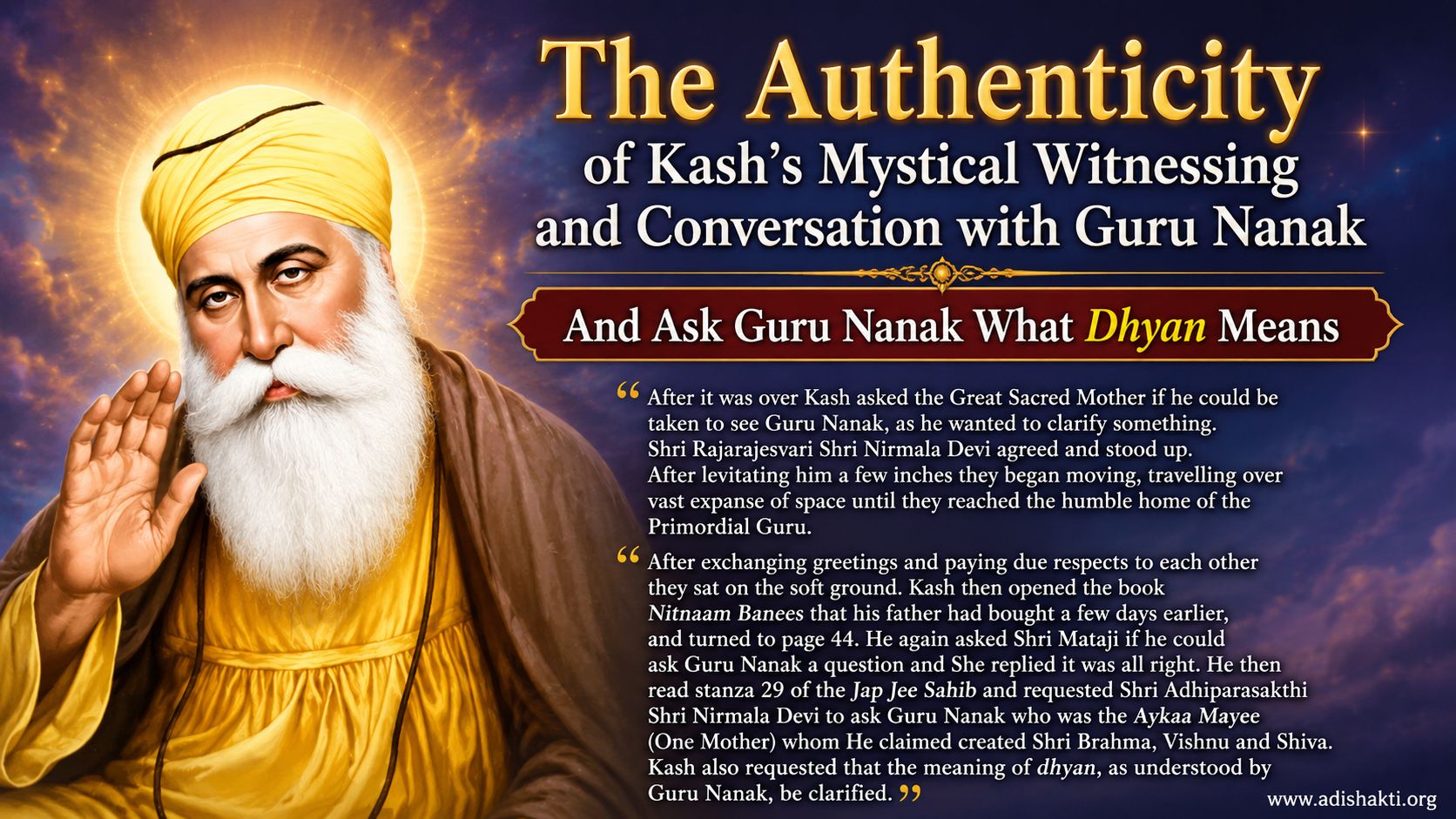
After it was over Kash asked the Great Sacred Mother if he could be taken to see Guru Nanak, as he wanted to clarify something. Shri Rajarajesvari Shri Nirmala Devi1 agreed and stood up. After levitating him a few inches they began moving, travelling over vast expanse of space until they reached the humble home of the Primordial Guru.
After exchanging greetings and paying due respects to each other they sat on the soft ground. Kash then opened the book Nitnaam Banees that his father had bought a few days earlier, and turned to page 44.
He again asked Shri Mataji if he could ask Guru Nanak a question and She replied it was all right. He then read stanza 29 of the Jap Jee Sahib and requested Shri Adhiparasakthi Shri Nirmala Devi to ask Guru Nanak who was the Aykaa Mayee (One Mother) whom He claimed created Shri Brahma, Vishnu and Shiva. Kash also requested that the meaning of dhyan, as understood by Guru Nanak, be clarified.
Shri Mataji discussed these requests with Guru Nanak in a language he did not understand, and read the particular stanza. After She had finished Guru Nanak replied, again in the same language.
Shri Parat-para Shri Nirmala Devi2 then told Kash, “That's Me,” confirming that She is the Aykaa Mayee that Guru Nanak mentioned in the Jap Jee Sahib.
Shri Mataji then informed him that Guru Nanak said that dhyan meant meditation.
Shri Mataji Nirmala Devi is the Aykaa Mayee of the Jap Jee Sahib — This Revealed Truth is Absolute.
With this Revelation all Sikhs reciting the Jap Jee Sahib and uttering the word Aykaa Mayee will be always reminded who this One Mother is, and where She resides within them.
All three then meditated for a short while. Kash then bowed down and thanked Guru Nanak for answering his questions, before leaving with Shri Dhyana-Gamya Shri Nirmala Devi3 back to the Land of Saibhang — the Self-Illumined Land.
There he paid his respects to Shri Aja Shri Nirmala Devi4 and asked for leave. As he closed his spiritual eyes his body descended through the clouds to this separatists world of Bhindrawalas and Khalistans.
Notes
1Rajarajesvari (683rd): Rajas are the eight Dikpalakas and their overlords are Trimurtis — Brahma, Visnu and Mahesvara. She rules over these overlords.
2Parat-para (809th):The Ultimate of the Ultimate. The Trimurtis are the ultimate. She is beyond Them.
3Dhyana-Gamya (641st):To be obtained by Dyana or concentrated meditation.
4Aja (866th):Without birth.
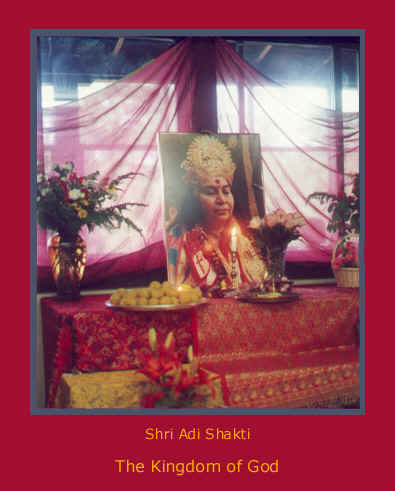
Shri Adi Shakti: The Kingdom of God
Jagbir Singh, 1999, pp.
1249-50
Summary
This paper examines the reported mystical encounter of
Kash with Guru Nanak on August 24, 1994
,
concentrating upon two questions that, according to the surviving
narrative, were deliberately formulated before Kash entered
meditation.
The first concerned the identity of the mysterious
Ekā Māī
, rendered in the source narrative as
Aykaa Mayee ("One Mother")
, described in the
Japjī Sāhib
in connection with the emergence of three
cosmic figures or functions. The second concerned the meaning
of the Indic religious term
dhyān
.
According to the account subsequently published in
Shri Adi Shakti: The Kingdom of God
(1999),
Kash entered Nirvikalpa Samadhi at approximately
11:40 a.m. on August 24, 1994
, encountered
Shri Mataji Nirmala Devi in the transcendent realm he had
repeatedly described during the preceding months, travelled
with Her to Guru Nanak, and presented the questions.
The reported responses were remarkably concise.
Concerning the identity of the One Mother, Shri Mataji,
after communicating with Guru Nanak, reportedly told Kash:
"That's Me."
The second reported answer was that
dhyān meant meditation
.
The historical question addressed by this study is not whether
mystical travel, the Sahasrara, Guru Nanak's continuing spiritual
existence, or the identification of Shri Mataji with the Divine
Mother can be demonstrated by ordinary historical methods.
Historical inquiry cannot independently verify such metaphysical
propositions.
The narrower and more tractable question is whether the
documentary chronology supports the proposition that Kash
reported specific information before he had plausibly acquired
that information through ordinary channels, and whether the
resulting report subsequently corresponded with independently
recoverable Sikh, Punjabi, Sanskrit and comparative-theological
evidence.
Central Research Question
Did Kash reproduce information already available to him through
family, religious or cultural exposure, or did he report answers
to pre-formulated questions whose relevant meanings and
theological correspondences were recognized or verified only
afterward?
This paper does not begin by assuming either that Kash's
reported encounter was supernatural or that it must have been
imaginary. Instead, it evaluates the surviving evidence through
a structured historical and interdisciplinary framework.
The inquiry asks:
What was claimed? What was recorded at the time?
Who knew what? When did they know it? What documentary evidence
survives? What independent witnesses existed? What ordinary
information channels were available? What later correspondences
were discovered? What alternative explanations remain possible?
What can reasonably be concluded—and what cannot?
These questions are especially important because the theological
identification of Shri Mataji with
Ekā Māī
must be
distinguished from the historically testable question of whether
Kash genuinely reported that identification during the claimed
period.
Level
Question
Appropriate Evidence
Historical
Did Kash genuinely report the Guru Nanak experience at
the claimed time?
Contemporaneous records, dated notes, computer files,
publication history and witness testimony.
Evidential
Did the report contain information not plausibly acquired
through ordinary channels?
Prior-knowledge analysis, chronology, linguistic evidence,
questioning history and independent correspondence.
Metaphysical
Did Kash objectively encounter Guru Nanak in a
transcendent realm?
Historical documentation alone cannot conclusively
establish this proposition.
The principal published account records that, after Kash had
previously informed his father that Shri Mataji had taken him
to meet Guru Nanak, his father began searching for a connection
between Guru Nanak's teaching and the Divine Mother whom Kash
reported encountering in the Sahasrara.
A decisive moment occurred after two copies of
Nitnaym Banees
, containing English translations of
Sikh daily prayers and the
Japjī Sāhib
, were acquired
from Sikh acquaintances Baldave Singh and Lumina.
The father encountered the passage concerning
Ekā Māī
, the One Mother, and subsequently
decided that the only way to resolve the question within the
framework of Kash's reported experiences was to ask Kash to
seek clarification from Guru Nanak.
On August 24, 1994, Kash was reportedly instructed to ask
two questions:
First:
Who is the
Ekā Māī
described
in the
Japjī Sāhib
?
Second:
What does
dhyān
mean?
The narrative records that Kash entered meditation at
approximately 11:40 a.m., travelled with Shri Mataji to meet
Guru Nanak, and conveyed the questions.
Shri Mataji reportedly communicated with Guru Nanak in a language
Kash did not understand. She then told Kash concerning
Ekā Māī
:
"That's Me."
She subsequently informed Kash that Guru Nanak said that
dhyān meant meditation
.
Primary source: Jagbir Singh,
Shri Adi Shakti: The Kingdom of God
,
1999, pp. 1249–1250.
[1]
Primary-source discussion links to the full bibliographic entry below.
Select a heading to move directly to it. Every retained chapter, appendix, and subsection is listed below; each major section includes a return link to this Table of Contents.
The principal internal source for this inquiry is Jagbir Singh's
Shri Adi Shakti: The Kingdom of God
(1999),
particularly the account on pages 1249–1250 concerning
Kash's reported August 24, 1994 visit to Guru Nanak.
The published account must nevertheless be distinguished from any
surviving records created during the original 1994 period.
A dated handwritten note, computer record, letter, diary entry or
independent witness statement produced close to the event carries
greater historical weight than a narrative published approximately
five years later.
Throughout this study the terms
reported
,
recorded
,
documented
,
corresponded
,
corroborated
,
verified
, and
confirmed
are therefore used deliberately and are not treated as
interchangeable.
The reported August 24, 1994 encounter between Kash and
Guru Nanak
occupies a particularly useful position
within the wider corpus of Kash's mystical testimony because it
contains not merely a visionary narrative, but a sequence involving
pre-formulated questions and subsequently testable
information
.
Many reports of mystical experience resist historical investigation
because their central contents are intrinsically subjective:
perceptions of sacred light, overwhelming peace, encounters with
spiritual beings, altered states of consciousness, or experiences
of transcendence. Such reports may be profoundly important to the
witness, but their contents are not easily compared with independently
accessible evidence.
The Guru Nanak episode is different.
According to the surviving narrative, two specific questions were
deliberately formulated before Kash entered meditation. One concerned
the identity of the
Ekā Māī
, or "One Mother,"
encountered by Kash's father while reading a translation of
Japjī Sāhib
. The other concerned the meaning of the word
dhyān
.
The first question is predominantly
theological and exegetical
. The second is
predominantly
linguistic and lexical
.
Their combination within a single reported encounter creates a
potentially important evidentiary structure.
1.2 The Claim Under Examination
The primary narrative records that Kash's father had become
intensely interested in the relationship between the Great Adi
Shakti whom Kash described encountering in the Sahasrara and
the teachings of Guru Nanak.
The immediate stimulus was the discovery of a passage in
Japjī Sāhib
concerning a mysterious
One Mother
.
Aykaa maa-ee, jugat viaaee, tin chalay parvaan.
The source translation understood this as describing
the One Mother and the emergence of three cosmic beings
or functions.
This passage was especially striking to Kash's father because
the three figures were interpreted in relation to the familiar
Indic triad of
Brahma, Vishnu and Shiva
,
representing creation, preservation and dissolution.
At the same time, Kash had repeatedly reported encountering a
supreme feminine Divine Being whom he identified with
Shri Mataji Nirmala Devi and above whom an intensely radiant
Eternal Light was said to shine.
This produced the central question:
Who is the Ekā Māī—the One Mother—spoken of in Japjī Sāhib?
A second, simpler question was added:
What does dhyān mean?
The reported answer to the first question was that Shri Mataji
told Kash:
"That's Me."
The reported answer to the second question was:
Dhyān meant meditation.
1.3 Why the Guru Nanak Case Is Evidentially Unusual
The evidentiary significance of this episode does not rest simply
upon the assertion that Kash saw Guru Nanak.
Such an assertion, considered alone, would remain largely
inaccessible to historical testing. Historical scholarship has
no instrument capable of travelling into Kash's meditative
consciousness on August 24, 1994 and independently observing
whether Guru Nanak was objectively present.
What distinguishes this event is the presence of
information targets
.
Before the reported encounter, there was a particular textual
problem. A particular phrase had been identified. A particular
theological question had been formulated. A particular lexical
term was also selected for clarification.
The resulting claims can therefore be placed into a chronology:
Stage
Reported Sequence
1
Nitnaym Banees
is acquired.
2
Kash's father encounters the Ekā Māī passage.
3
The identity of Ekā Māī becomes an unresolved question.
4
A second question concerning
dhyān
is added.
5
Kash enters meditation on August 24, 1994.
6
Kash reports an encounter with Guru Nanak.
7
The answers "That's Me" and
"dhyān means meditation" are reported.
8
The answers become subjects for later textual,
linguistic and comparative-theological investigation.
If early documentation confirms this order, the episode has greater
evidentiary value than a correspondence discovered only after a
narrative had been constructed.
1.4 Authenticity Is Not Metaphysical Proof
The word
authenticity
requires precise definition.
In this study, authentic does not automatically mean
supernaturally proven
.
Several separate propositions must be distinguished.
The first is whether Kash actually reported the experience during
the historical period claimed.
The second is whether the report contained information that Kash
was unlikely to have acquired through ordinary means.
The third is whether the apparent information anomaly is best
explained by an extraordinary or anomalous experience.
The fourth and strongest proposition is whether Kash literally
travelled to an objectively existing spiritual realm and conversed
with the continuing spiritual person of Guru Nanak.
These propositions require different kinds of evidence.
A dated document might strongly establish the first proposition
without establishing the fourth.
Likewise, an unexpectedly accurate answer might strengthen the
second proposition while leaving open several explanations for how
the information was obtained.
Methodological Caution
The argument must therefore never take the circular form:
Kash said he met Guru Nanak.
Guru Nanak gave him a correct answer.
Therefore Kash met Guru Nanak.
The relevant historical question is instead:
What evidence establishes when the answer was reported,
what Kash could reasonably have known beforehand, and whether
ordinary information pathways adequately explain the result?
1.5 Two Questions and Two Evidentiary Tests
The two questions posed in the August 24 narrative belong to
different epistemic categories.
The first asks:
Who is the Ekā Māī described in Japjī Sāhib?
This is principally a question of
religious identity and theological interpretation
.
Whether Shri Mataji Nirmala Devi is ontologically identical with
the One Mother invoked by Guru Nanak cannot be tested in the same
manner as the meaning of a word.
The second asks:
What does dhyān mean?
This is principally a
linguistic question
.
Its answer can be compared against the historical semantic range
of Sanskrit
dhyāna
, its later Indic forms, Punjabi usage,
Sikh religious vocabulary and independent dictionaries or
translations.
Consequently, the two reported answers should not be assigned
identical evidentiary weight.
Question
Reported Answer
Type of Claim
External Testability
Who is Ekā Māī?
"That's Me."
Theological identity
Indirect / comparative
What does dhyān mean?
Meditation
Lexical meaning
Directly testable linguistically
The second question therefore functions as a particularly useful
control datum
within the narrative.
1.6 Observation Before Interpretation
One of the most important principles used throughout the
Authenticity Series is the distinction between
observation and interpretation
.
A witness may report an observation without understanding its
significance. Later research may then reveal a correspondence.
Where such a chronological sequence is securely documented,
evidentiary value may arise precisely from the witness's original
lack of understanding.
The Guru Nanak episode differs somewhat because the initial
question
was formulated by Kash's father rather than
spontaneously discovered by Kash.
Nevertheless, the same principle remains relevant.
The father had encountered the phrase
Ekā Māī
, but according to the narrative he did not know
with certainty how it should be connected with Kash's experiences.
His hypothesis was that the passage might refer to the Great
Divine Mother.
A hypothesis, however, is not equivalent to an answer.
The evidentiary issue therefore becomes:
Did Kash merely repeat his father's expected interpretation,
or was the question genuinely presented without communicating
the desired answer?
This problem will receive detailed attention in the
information-control and suggestion chapters.
1.7 The Prospective Information-Test Structure
The August 24 episode may be conceptualized as a
prospective information test
.
In retrospective correspondence hunting, a narrative already
exists and researchers search large bodies of literature for
similarities. Because enough texts and symbols exist, some
similarities will inevitably be discovered.
A prospective test is methodologically stronger.
The target is specified first.
The response follows.
Verification occurs afterward.
The ideal evidentiary sequence would therefore be:
If surviving dated records demonstrate this sequence, the case
becomes more resistant to explanations based solely upon
retrospective selection or later theological reconstruction.
If, however, the first surviving record of the answers appears only
after extensive later research, the evidentiary strength decreases
substantially.
1.8 Three Levels of Claim
Level
Claim
Evidentiary Requirement
1
Kash genuinely reported the Guru Nanak experience during
the claimed historical period.
Contemporary or near-contemporary documentation and
testimony.
2
Kash reported information not plausibly acquired through
ordinary means.
Prior-knowledge analysis, information-control chronology
and independent correspondence.
3
Kash objectively encountered Guru Nanak and Shri Mataji
in a transcendent realm.
This exceeds what historical documentation alone can
conclusively establish.
1.9 The Mixed Interdisciplinary Method
The present inquiry therefore uses a mixed interdisciplinary
framework.
Historical source criticism
evaluates when the
relevant records were produced and whether later information could
have influenced earlier memories.
Sikh textual studies
examines the relevant
Japjī Sāhib
passage, its language, its interpretive history,
and the wider Sikh insistence upon the sovereignty and unity of
the Divine.
Historical linguistics and lexicography
examine
the semantic range of
dhyān
/
dhyāna
.
Comparative theology
evaluates the proposed
relationship between Ekā Māī, Mahādevī traditions, the Trimūrti,
Shri Mataji and names found in the
Lalitā Sahasranāma
.
Psychology of testimony and memory
requires
serious consideration of suggestion, cultural exposure,
cryptomnesia, source-memory failure, childhood reporting and
retrospective reconstruction.
Finally,
comparative hypothesis testing
examines
which explanatory model best accounts for the total evidence rather
than selecting only those correspondences favorable to one
interpretation.
1.10 Competing Hypotheses
Hypothesis
Explanation
H1 — Prior Knowledge
Kash already knew the relevant Sikh or Indic information
and reproduced it during the reported experience.
H2 — Cultural Transmission
Religious vocabulary or theological concepts were acquired
informally through family, community or religious exposure.
H3 — Cryptomnesia
Kash had previously encountered the information but no
longer consciously remembered its source.
H4 — Suggestion
The wording of the questions or adult expectations
communicated the desired answers.
H5 — Guessing or Coincidence
One or both responses happened to correspond with later
interpretations or lexical evidence.
H6 — Retrospective Reconstruction
Later research influenced the account before publication
in 1999.
H7 — Authentic Anomalous Experience
Kash underwent an experience substantially as reported and
obtained information not adequately explained by ordinary
information channels.
H8 — Metaphysical Encounter
Kash directly encountered Guru Nanak and Shri Mataji in
an objectively existing transcendent reality.
1.11 Standard of Authenticity
In this study, authenticity refers first to whether the surviving
evidence supports the proposition that Kash genuinely reported the
relevant experience during the claimed historical period and that
the account was not substantially created through later fabrication
or retrospective borrowing.
A stronger evidentiary judgment becomes possible if the documentation
demonstrates that specific information was reported before its
significance or independent confirmation was known.
The strongest theological interpretation—that Guru Nanak personally
confirmed Shri Mataji as the One Mother—must nevertheless remain
distinguishable from the historical judgment.
Historical authenticity may support the credibility of the
testimony without converting metaphysical interpretation into an
empirically demonstrated fact.
1.12 Why the Guru Nanak Case Matters
The Guru Nanak episode deserves particular attention because it
combines several features that seldom occur together in a mystical
report.
There is a precise date.
There is a recorded time.
There is an identifiable textual stimulus.
There are two defined questions.
There are two concise reported answers.
One answer concerns a theological proposition.
The other concerns a lexical proposition capable of independent
investigation.
There is also a wider corpus of Kash's reported experiences against
which the internal structure of this episode can be compared.
The evidential issue is therefore not merely whether the narrative
is spiritually impressive.
It is whether the surviving historical sequence demonstrates a
genuine progression from
question to response to later correspondence
.
1.13 Chapter Conclusion
The August 24, 1994 Guru Nanak episode possesses a potentially
strong evidentiary architecture because it contains a defined date,
an identifiable textual stimulus, two pre-formulated questions,
a named religious figure, two reported answers, and at least one
answer capable of independent linguistic testing.
Its evidentiary strength, however, depends upon chronology.
If early records establish that sequence and demonstrate that
relevant ordinary information pathways were limited, the episode
becomes substantially more difficult to explain as simple
retrospective borrowing.
If the sequence cannot be established independently of the 1999
publication, the case remains historically interesting but
evidentially less secure.
Chapter Two therefore turns from methodological principles to the
fundamental historical question:
what exactly survives from August 24, 1994, and when was
it recorded?
Jagbir Singh,
Shri Adi Shakti: The Kingdom of God
,
1999, pp. 1249–1250.
The spelling
Aykaa Mayee
is retained where quoting
or discussing the terminology of the primary source.
Ekā Māī
is used as a normalized transliteration
elsewhere in the academic discussion.
The precise numbering of the relevant
Japjī Sāhib
passage will be discussed in the textual
chapter because numbering conventions and translation
presentation may differ among editions.
The terms "reported," "documented," "corroborated,"
"verified" and "confirmed" are not treated as synonyms.
Their use reflects different levels of evidentiary support.
The evidentiary value of the Guru Nanak episode depends first upon
chronology. Before theological interpretation is attempted, the
investigation must establish as precisely as possible
what was recorded, when it was recorded, and how close that
record stands to the reported event itself
.
The principal published source assigns the experience to
August 24, 1994
and states that Kash entered
meditation at approximately
11:40 a.m.
.
The account was subsequently incorporated into
Shri Adi Shakti: The Kingdom of God
, published in 1999.
A five-year interval between an event and a published book does not,
by itself, invalidate the testimony. Books frequently incorporate
diaries, computer files, handwritten notes, letters and other
documents created much earlier.
It does, however, make the provenance of those underlying records
critically important.
2.2 The Date: August 24, 1994
The specificity of the date distinguishes the account from a vague
recollection such as "sometime in 1994."
A precise date potentially allows the event to be connected with
other evidence: diary entries, handwritten notes, computer
timestamps, correspondence, family recollection, the acquisition
of the cited Sikh prayer book, and later stages of research.
The date is therefore not a decorative detail. It is an
evidentiary anchor
.
Evidentiary Principle
The greater the number of independently recoverable events that
can be placed around August 24, 1994, the more securely the
chronology of the Guru Nanak testimony can be reconstructed.
2.3 The Recorded Time: 11:40 a.m.
The narrative goes further by assigning the beginning of the
meditation to approximately
11:40 a.m.
.
Such precision suggests that the episode may have been recorded
close to the time of occurrence rather than reconstructed solely
from distant memory.
That inference, however, must remain provisional.
A later writer can also supply a precise time from an earlier note,
or in principle introduce precision retrospectively. The evidentiary
question is therefore not merely whether the published text contains
"11:40 a.m.," but whether an earlier surviving record independently
establishes it.
If the time appears in a dated 1994 handwritten or computer record,
that would materially strengthen the documentary chain.
2.4 The Published 1999 Narrative
The principal published version appears in Jagbir Singh's
Shri Adi Shakti: The Kingdom of God
(1999),
pp. 1249–1250.
The importance of this source is not that it is contemporaneous with
August 1994—it is not—but that it fixes in published form a
relatively detailed narrative containing identifiable historical
propositions.
Among them are:
the prior reported visit to Guru Nanak;
the subsequent search for a textual connection;
the acquisition of
Nitnaym Banees
;
the discovery of the passage concerning Aykaa Mayee;
the formulation of the question concerning the One Mother;
the additional question concerning
dhyān
;
the date August 24, 1994;
the time 11:40 a.m.;
Kash's reported encounter with Guru Nanak;
communication between Shri Mataji and Guru Nanak;
the reported response,
"That's Me"
;
and the reported explanation that
dhyān meant meditation
.
The accumulation of specific details increases the number of points
at which the narrative can be tested against surviving records.
2.5 Earlier Underlying Records
For historical purposes, the most valuable evidence would be any
material created during 1994 itself.
The hierarchy of documentary value can be expressed as follows:
Document Type
Potential Evidentiary Value
Dated handwritten notes made immediately after meditation
Very high, if authenticity and date can be established
Dated computer records from August 1994
Very high, especially if original metadata survives
Contemporaneous letters or communications to third parties
High, because transmission outside the household can fix chronology
Independent witness recollection
Moderate to high, depending upon independence and specificity
Later manuscript compilation based upon earlier notes
Moderate
1999 published account without surviving earlier documentation
Historically useful, but substantially weaker for chronology
The authenticity assessment should therefore give priority to the
earliest recoverable version
of the testimony.
2.6 Contemporaneous Versus Retrospective Evidence
A central distinction throughout the Authenticity Series is the
difference between a correspondence documented
before
verification and one noticed
after
verification.
Suppose, for example, that a 1994 record stated only:
Kash saw Guru Nanak.
and the details concerning Ekā Māī and
dhyān
appeared only
in 1999 after extensive research. Such a sequence would provide
relatively weak support for anomalous information acquisition.
By contrast, suppose a dated August 24, 1994 record already stated:
Asked Guru Nanak who Aykaa Mayee is. Shri Mataji said,
"That's Me." Asked meaning of dhyan. Guru Nanak said meditation.
If that record demonstrably predates the later linguistic and
theological research, the evidentiary structure becomes much
stronger.
The difference is not theological. It is chronological.
2.7 Establishing the Documentary Chain
The ideal documentary reconstruction should distinguish at least
five stages.
Stage One:
acquisition of the Sikh prayer book.
Stage Two:
discovery of the Aykaa Mayee passage.
Stage Three:
formulation of the questions before
Kash's meditation.
Stage Four:
recording of Kash's answers.
Stage Five:
subsequent research, comparison,
interpretation and eventual publication.
Where possible, these stages should be reconstructed from documents
rather than memory alone.
The strongest evidence would be a chain in which each stage can be
shown to precede the next.
2.8 Chapter Conclusion
The published Guru Nanak account contains unusually precise
chronological features, including the date August 24, 1994 and the
approximate time 11:40 a.m.
Those details make the testimony potentially highly suitable for
documentary analysis.
Their evidentiary strength, however, ultimately depends upon whether
surviving 1994 records preserve the same information.
The next chapter turns to the ordinary event that reportedly set the
entire inquiry in motion: the acquisition of a Sikh prayer book and
the discovery within
Japjī Sāhib
of the
One Mother
.
The Guru Nanak inquiry did not begin with a theological treatise or
scholarly investigation. According to the primary narrative, it
began with the acquisition of an ordinary volume of Sikh daily
prayers.
That sequence is evidentially important because the question
concerning the One Mother was reportedly generated by a textual
discovery rather than introduced retrospectively after Kash had
already given the relevant answer.
3.2 Baldave Singh and Lumina
According to the published account, a Sikh friend,
Baldave Singh
, and his French wife
Lumina
visited Kash's father in Montreal.
They supplied him with two copies of
Nitnaym Banees
, described as a collection of Sikh daily
prayers translated by Dr. Santokh Singh.
Their role is historically relevant because they represent an
identifiable external link in the chain by which the relevant text
entered the household.
If either person independently remembered the visit, the sale or
transfer of the books, or subsequent discussion of the discovery,
such testimony could potentially corroborate part of the chronology.
3.3 Acquisition of
Nitnaym Banees
The acquisition of the book is important for another reason:
it identifies the specific textual environment from which the
question arose.
Rather than treating all later translations as interchangeable,
a rigorous investigation should recover, if possible, the exact
edition used in 1994.
This would permit comparison of:
the wording of the transliteration;
the English translation;
the numbering of the passage;
the terminology used for the One Mother;
and the wording used for the three cosmic figures.
This matters because English translations of Sikh scripture can
differ substantially in theological nuance.
3.4 Reading
Japjī Sāhib
The narrative states that Kash's father began reading the volume
shortly after receiving it.
He soon encountered a passage that he found startling.
The source account describes him repeatedly examining the page
because he could scarcely believe the implications of the
translation before him.
The passage included the phrase:
Aykaa Maa-ee — The One Mother
For a reader who had not previously conceptualized Waheguru in
explicitly feminine terms, the phrase posed an immediate theological
problem.
3.5 The Unexpected One Mother
The surprise recorded in the primary account deserves careful
analytical treatment.
Surprise can sometimes be evidentially valuable because it indicates
a mismatch between prior expectation and newly encountered
information.
If Kash's father had already constructed an elaborate theology in
which Guru Nanak explicitly proclaimed the Mahādevī as the source of
the Trimūrti, encountering this translation would have been
confirmatory but not unexpected.
The narrative instead presents the discovery as disruptive:
the reader repeatedly questions how such language could have escaped
his notice and the notice of other Sikhs.
That reaction, if accurately preserved from the time, suggests that
the theological connection was still being formed rather than merely
reproduced from an existing system.
3.6 The Father's Previous Understanding of Waheguru
The primary account states that Kash's father had never understood
Waheguru as specifically feminine.
Nor, significantly, did he understand Waheguru as literally
masculine.
His inherited conceptual framework emphasized the attributes
proclaimed in the Sikh opening formula:
the One, Truth, the Supreme Creative Reality, fearless, without
enmity, beyond time, unborn, self-existent and known through grace.
Such language emphasizes transcendence rather than biological sex.
The appearance of the maternal expression
Ekā Māī
therefore introduced not necessarily a
contradiction, but a new symbolic and theological dimension.
3.7 The Problem of Feminine Divine Language
The phrase "One Mother" must be handled with interpretive caution.
Feminine language in scripture does not automatically establish that
ultimate reality is a female deity in the same manner in which a
human being is female.
Religious traditions routinely employ maternal, paternal,
royal, nuptial and other relational metaphors for transcendent
reality.
Consequently, the historical existence of the phrase
Ekā Māī
is one question; its ultimate theological
interpretation is another.
Exegetical Caution
The existence of maternal imagery in
Japjī Sāhib
should not be treated as self-evident proof that Guru Nanak
intended a later Śākta theological system.
What can be investigated is whether the imagery bears meaningful
structural correspondences to that system and whether those
correspondences played a demonstrable role in the 1994 inquiry.
3.8 From Textual Discovery to Testable Question
The transition from reading to questioning is the crucial step.
Kash's father reportedly did not merely decide that the passage
proved his interpretation.
Instead, within the experiential framework already operating in the
household, he sought clarification from the figure whose teaching
appeared to contain the passage:
Guru Nanak
.
Kash was therefore instructed to ask who the One Mother was.
This is important because it establishes a target before the
reported response.
TEXTUAL PROBLEM → SPECIFIC QUESTION → REPORTED ANSWER
The evidentiary strength of this sequence increases substantially if
contemporaneous notes establish that the question existed before
Kash's meditation and that the answer was recorded immediately
afterward.
3.9 Chapter Conclusion
The discovery of Ekā Māī provides the historical trigger for the
August 24, 1994 encounter.
According to the primary narrative, a recently acquired Sikh prayer
book introduced an unexpected expression—the
One Mother
—that appeared to correspond with the
Divine Mother whom Kash had already been reporting.
The key evidentiary fact is not simply that a later reader could
connect the two traditions.
It is the claimed chronological progression from
unexpected textual discovery to deliberately formulated
question
.
Chapter Four therefore examines the Sikh passage itself before
any attempt is made to equate it with Shri Mataji or Mahādevī
theology.
Before the 1994 response can be assessed, the text that generated
the question must be examined on its own terms.
This chapter therefore temporarily brackets the identification of
Shri Mataji with Ekā Māī and asks a more basic question:
what does the relevant passage actually say?
The distinction is essential. If the source text is first interpreted
through the later mystical claim, the argument becomes circular.
4.2 Textual Location and Numbering
The relevant passage occurs in the
Japjī Sāhib
, the foundational composition traditionally
associated with Guru Nanak and placed at the beginning of the
Guru Granth Sahib
.
Modern presentations commonly identify the passage as
Paurī 30
. The historical source used by Kash's
father appears to have employed a different numbering convention
or presentation and is therefore quoted according to the edition
actually consulted in 1994.
This numbering difference is bibliographical rather than doctrinal.
The identity of the passage is established by its wording.
4.3 Ekā Māī / Aykaa Mayee
The central line was rendered in the primary source approximately:
Aykaa maa-ee, jugat viaaee, tin chalay parvaan.
The historical translation consulted by Kash's father understood
this in terms of a
One Mother
from whom three
cosmic figures emerged.
The expression is striking because it combines unity and maternity:
not many mothers, but
one Mother
.
In the context of the 1994 inquiry, this was the feature that drew
immediate attention.
4.4 The Three Cosmic Figures
The following line describes three functions or figures associated
with the ordering of the cosmos.
In the interpretation encountered by Kash's father, these were
associated with:
Cosmic Function
Comparative Indic Association
Creation
Brahmā
Preservation / Sustenance
Viṣṇu
Dissolution / Destruction
Śiva
This triadic correspondence explains why the passage appeared so
significant within the broader Divine Mother framework.
Nevertheless, the Sikh text should not be reduced automatically to
classical Purāṇic theology. Guru Nanak's theological emphasis remains
the sovereignty of the One rather than the independent supremacy of
subordinate cosmic deities.
4.5 Creation, Preservation and Dissolution
Creation, preservation and dissolution constitute one of the most
persistent triadic ways of describing cosmic process in Indian
religious thought.
The interpretive significance of the
Japjī
passage lies
not merely in the existence of three figures but in their
subordination to a higher ordering principle.
The three do not function as absolutely autonomous gods.
They operate within a cosmos whose ultimate sovereignty lies
elsewhere.
This structural pattern—
one transcendent source,
three derivative cosmic functions
—is what later becomes
central to the comparison with Mahādevī theology.
4.6 Divine Sovereignty
The subsequent line emphasizes that cosmic operation proceeds
according to the will or command of the Supreme.
This prevents the triadic figures from being interpreted as three
independent ultimate realities.
This structural hierarchy will later become important when the Sikh
passage is compared with the names
Rājarājeśvarī
and
Parāt-parā
in the
Lalitā Sahasranāma
, where the Divine Mother is represented
as transcending even the highest divine rulers.
4.7 "She Sees Them, but They See Her Not"
The translation preserved in the primary narrative concludes with a
striking asymmetry:
She sees all, but no one sees Her; this is a great wonder.
Within the 1994 interpretation, this was especially significant.
The One Mother is not represented merely as another visible member
of the cosmic hierarchy. She occupies a position of
transcendent awareness
: She sees, while remaining
unseen.
The theological comparison with Kash's testimony is obvious.
Kash repeatedly described a supreme feminine Being whose status
exceeded that of the other divine figures he encountered.
Yet the chronological question remains crucial:
were those earlier descriptions already present before the
Japjī
passage was discovered?
If so, the correspondence has greater evidentiary interest than if
the descriptions arose only afterward.
4.8 Translation and Interpretation
An academically rigorous assessment must distinguish the
Gurmukhi source text
from any single English
translation.
Translation necessarily involves interpretation.
Terms describing the "three," their functions and their relation
to the One may be rendered differently by different translators.
Consequently, the specific 1994 English wording cannot simply be
treated as though Guru Nanak himself wrote an English sentence
declaring that "the Goddess created Brahma, Vishnu and Shiva."
The stronger argument is more careful:
The
Japjī Sāhib
passage contains a maternal expression,
a triadic cosmological structure, and an assertion of ultimate
divine sovereignty. The 1994 translation understood these
elements in a manner that prompted Kash's father to compare them
with the Divine Mother and the Trimūrti.
Comparative theology may then ask whether the resulting structural
correspondence is meaningful.
Historical analysis, however, must not erase the distinction between
text
and
interpretation of text
.
4.9 Chapter Conclusion
The passage that prompted the August 1994 inquiry unquestionably
contains the elements that made the question intelligible within
the religious framework of Kash's family:
a One Mother, a triadic cosmic order, divine command,
and transcendent sovereignty
.
The passage does not, by textual analysis alone, establish the later
proposition that Shri Mataji Nirmala Devi is that One Mother.
That identification belongs to the reported mystical answer and to
subsequent comparative theology.
Before evaluating that identification, however, a more fundamental
historical problem must be addressed:
What did Kash himself know before August 24, 1994?
The single most important question in any claim of anomalous
information acquisition is not whether a reported answer is correct.
It is whether the witness could reasonably have known the answer
beforehand.
Correct information has little evidentiary significance if the
witness had already encountered it through ordinary means.
Conversely, information becomes more significant when the record
establishes that:
the target question was specified in advance;
the witness did not know the expected answer;
ordinary access routes were limited;
the answer was recorded before verification;
and subsequent independent research confirmed the correspondence.
The Guru Nanak case must therefore be examined primarily as an
information-provenance problem
.
5.2 Kash's Age and Educational Context
Kash was thirteen years old during the period under examination.
Age by itself proves very little.
A thirteen-year-old may possess extensive religious knowledge,
especially when raised within a religious household or community.
The argument therefore must never take the simplistic form:
Kash was young; therefore he could not have known the answer.
Instead, the proper question concerns his
actual educational and cultural exposure
.
5.3 Punjabi-Language Competence
The primary narrative states that Kash did not speak, read or write
Punjabi.
If accurate, this fact is relevant but not decisive.
A person may lack literacy in a language while still recognizing
words acquired through family speech, religious ceremonies,
music, television, prayer or community interaction.
Consequently:
Important Distinction
Inability to read Punjabi does not equal inability to
have heard Punjabi religious vocabulary.
The authenticity argument becomes stronger only if the relevant
term itself—
dhyān
—can be shown to have been unfamiliar to
Kash before the questioning.
5.4 Sikh Religious Exposure
Kash's family background makes ordinary Sikh cultural exposure an
obvious alternative explanation that must be considered seriously.
Possible routes include:
family conversations;
visits to gurdwaras;
hearing
Japjī Sāhib
recited;
Sikh devotional recordings;
community gatherings;
school or family religious instruction;
and casual exposure to Punjabi vocabulary.
The presence of such possibilities does not establish that Kash
actually learned the answer through them.
It does mean that they cannot be ignored merely because no conscious
memory of such exposure was reported.
5.5 Knowledge of
Japjī Sāhib
Several different levels of knowledge must be separated.
Kash might have heard
Japjī Sāhib
recited without
understanding its vocabulary.
He might have known that it was an important Sikh prayer without
knowing the Ekā Māī passage.
He might have heard translations without retaining them.
Or he might have been entirely unfamiliar with the specific passage.
The evidentiary question therefore concerns not general Sikh
familiarity but
specific prior access to the information
being tested
.
5.6 Knowledge of Ekā Māī
The first question was not an open request for general Sikh
knowledge.
Kash was reportedly shown or given the relevant material because his
father wanted a particular theological question answered.
This means that Kash necessarily had some exposure to the
question
before meditation.
That fact must be acknowledged.
The evidentiary issue is whether he was also given the
answer
.
These are not the same thing.
Information
Reported Status
The phrase Ekā Māī / Aykaa Mayee
Known because it formed part of the question
Association with a One Mother
Known from the translation being consulted
The father's suspicion of a Divine Mother correspondence
Potentially available through the questioning context
The precise reported answer "That's Me"
Claimed to have been obtained during the encounter
Because the father's own hypothesis pointed toward the Divine
Mother, the possibility of
expectation transfer
must be examined carefully.
This makes the first question less clean as an anomalous-information
test than the second.
5.7 Knowledge of Dhyān
The second question is methodologically different.
Kash was asked what
dhyān
meant.
The primary narrative states that the word was commonly being
understood as "attention," while Guru Nanak's reported answer was
meditation
.
This is valuable because the response can be compared with the
established Indic semantic field of
dhyāna
, which is strongly associated with meditation,
contemplation and sustained meditative concentration.
In classical Yoga terminology,
dhyāna
denotes meditation
and forms part of the sequence of concentration, meditation and
samādhi. This broad lexical background makes
"meditation"
a defensible and conventional rendering.
Preliminary Linguistic Finding
The reported answer
"meditation"
is not an
idiosyncratic theological reinterpretation of
dhyān
.
It corresponds with the established Indic semantic field of
dhyāna
.
This makes the question potentially more evidentially useful than
the Ekā Māī identification because the answer can be checked against
independent linguistic traditions rather than accepted solely as a
revelation. The broader Indic lexical tradition supports
dhyāna
as meditation. :contentReference[oaicite:0]{index=0}
5.8 Potential Ordinary Information Channels
Before assigning anomalous significance to the answer, several
ordinary pathways must be tested.
Possible Pathway
Question to Investigate
Punjabi speech
Was
dhyān
used by family members in Kash's presence?
Sikh devotional practice
Had he heard the word explained in a gurdwara or prayer context?
Sahaja Yoga vocabulary
Was the Sanskrit-derived term
dhyāna
or a cognate
used in teachings available to him?
Parental prompting
Did the wording of the question imply "meditation"?
Contextual inference
Could Kash infer the answer from the context in which the
word was presented?
Prior forgotten exposure
Could cryptomnesia explain apparently novel knowledge?
None of these possibilities should be treated as established merely
because they are conceivable.
Conversely, they cannot be dismissed merely because no direct record
of prior exposure has yet been identified.
The evidentiary task is comparative:
which hypothesis best fits the available chronology?
5.9 Question Exposure Versus Answer Exposure
A particularly important distinction in this case is the difference
between
exposure to a question
and
exposure to its answer
.
Kash obviously had to know what he was supposed to ask.
Therefore, the fact that he had heard the expressions
Aykaa Mayee
and
dhyān
before meditation does not
invalidate the test.
The relevant issue is whether the questioning procedure also
communicated the expected answer.
The ideal procedure would have been:
Question:
"Ask Guru Nanak who Aykaa Mayee is."
rather than:
Suggestive question:
"Ask Guru Nanak whether
Aykaa Mayee is Shri Mataji."
Likewise, asking:
"Ask Guru Nanak what
dhyān
means."
is evidentially cleaner than asking:
"Ask whether
dhyān
really means meditation."
The exact wording of the original questions is therefore of
considerable importance.
If contemporaneous notes preserve that wording, they should be
reproduced verbatim in the final documentary appendix.
5.10 Chapter Conclusion
The prior-knowledge analysis produces a more nuanced result than a
simple claim that Kash "could not have known" the answers.
His reported inability to read or write Punjabi reduces some
pathways of information acquisition, but it does not eliminate oral,
cultural or religious exposure.
The Ekā Māī question also contained an unavoidable element of
theological expectation because Kash's father had already noticed a
possible correspondence with the Divine Mother.
The
dhyān
question is consequently the cleaner evidentiary
test, provided the record can establish that Kash had not previously
been taught its meaning and that the answer "meditation" was recorded
before independent lexical verification.
The analysis has now established the three elements necessary to
examine the encounter itself:
THE TEXTUAL PROBLEM
+
THE PRE-FORMULATED QUESTIONS
+
THE PRIOR-KNOWLEDGE CONDITIONS
Chapter Six can therefore reconstruct the reported
August 24, 1994 journey to Guru Nanak
in detail,
separating each observational element from its later theological
interpretation.
According to the primary account, at approximately
11:40 a.m. on August 24, 1994
, Kash sat down to
meditate with the two questions already formulated.
The narrative states that he entered what the family identified as
Nirvikalpa Samadhi
, a state in which his attention
was understood to have withdrawn from ordinary sensory awareness
and entered the subtle or spiritual dimension he had repeatedly
described during earlier experiences.
Within the phenomenology of the account, the process began with the
ascent of the
Surati
or Kundalini from the base of
the spine through the central channel, the
Sushumna
, and
through the opening described as the
Dasam Duar
or Brahmarandhra.
Historical analysis cannot independently determine whether this
sequence represented an objectively occurring subtle-body process,
an altered state of consciousness, a visionary experience, or some
combination of psychological and spiritual interpretation.
What can be evaluated is whether the sequence is
consistent with descriptions recorded in earlier and later
episodes
.
6.2 The Ascent Through the Sahasrara
Kash reportedly emerged through the characteristic
blue clouds
of the vast region identified in the
narrative as the Great Lotus Forest of the Sahasrara.
He then found himself hovering above a soft layer of cloud and
perceived what he described as his spiritual self already seated
in meditation near the Eternal Throne of the Great Adi Shakti.
He descended toward that spiritual form and merged into it.
This detail is important because the reported experience follows a
recurring internal geography:
PHYSICAL MEDITATION → ASCENT → CLOUD REGION →
SPIRITUAL BODY → DIVINE PRESENCE
Recurrence by itself does not prove objectivity. Repeated visionary
environments can also arise through memory, expectation or stable
internal imagery.
Nevertheless, stable structure across multiple reports is relevant
when assessing whether the Guru Nanak episode was an isolated later
invention or part of an already established experiential pattern.
6.3 The Eternal Throne
After merging with the spiritual body, Kash reportedly stood and
bowed before Shri Mataji, described in the source account in Her
transcendent identity as the Great Adi Shakti seated upon a
Golden Throne
.
The throne is one of the recurring features in Kash's descriptions
of the Sahasrara realm.
The narrative also repeatedly emphasizes an exceptionally intense
and self-existing light associated with the Divine Mother.
This recurrent motif later becomes relevant to the comparison with
the Sikh concept
Saibhaṅg
, commonly understood in
relation to self-existence or self-manifestation.
6.4 Shri Ganesha and Shri Krishna
The primary narrative states that
Shri Ganesha
and
Shri Krishna
were seated on either side of
Shri Mataji.
Kash bowed before them and then offered the honey-flavored milk that
his father had prepared and left upon the physical altar.
According to the account, Shri Mataji, Shri Ganesha and Shri Krishna
each took a glass.
Within the wider Authenticity Series, this detail is noteworthy
because honey-flavored milk had already become associated with
earlier reported encounters involving the Divine Mother.
Thus the Guru Nanak narrative does not introduce an entirely new
ritual environment for the sake of the Sikh episode. It preserves
elements already familiar from the surrounding corpus.
6.5 Meditation Before Departure
Before leaving to meet Guru Nanak, the source states that
Shri Parvati Mai requested that all present meditate.
They raised their Kundalinis and entered meditation.
This is another recurring feature in Kash's testimony:
divine encounters are repeatedly structured around meditation
rather than around spectacle alone.
The pattern commonly includes:
arrival → obeisance → offering → meditation →
conversation or journey → further meditation → leave-taking.
That structural recurrence becomes relevant later when the internal
consistency of the entire corpus is assessed.
6.6 Request to Visit Guru Nanak
After the meditation concluded, Kash reportedly asked Shri Mataji
whether She would take him to Guru Nanak because he wanted to
clarify something.
She agreed.
Within the logic of the narrative, this detail is significant:
Kash does not simply will himself to Guru Nanak's presence.
The journey occurs under the guidance of Shri Mataji.
This fits the broader pattern in which the Divine Mother functions
as intermediary, guide and authorizing presence within Kash's
reported encounters.
6.7 Journey to the Primordial Guru
The account states that Shri Mataji raised Kash slightly above the
ground and that they then moved over a vast expanse of space until
reaching the place where Guru Nanak resided.
The journey is presented as purposeful rather than symbolic in the
original narrative.
Historical inquiry cannot verify the spatial reality of such travel.
It can, however, ask whether the description displays continuity
with the modes of movement Kash reported elsewhere.
6.8 The Humble Dwelling
Guru Nanak was reportedly encountered not in a palace but in a
humble dwelling
.
After greetings and mutual expressions of respect, the participants
sat upon the soft ground.
This simplicity is noteworthy.
The narrative could easily have imagined an overwhelmingly regal or
fantastical setting for the first Guru of Sikhism. Instead, it
emphasizes simplicity and humility.
Such a detail is broadly compatible with the remembered religious
character of Guru Nanak, though compatibility alone cannot establish
authenticity.
6.9 The Book and the Question
Kash reportedly opened the copy of
Nitnaym Banees
that his father had recently obtained and
turned to the page containing the passage.
Within the internal logic of the experience, a physical book known
on Earth was thus represented within the visionary encounter.
Kash then asked Shri Mataji whether he could put the question to
Guru Nanak.
After receiving permission, the relevant passage was read and the
identity of the
Aykaa Mayee
was raised.
The second question concerning the meaning of
dhyān
was also presented.
6.10 Communication in a Language Kash Did Not Understand
One of the most distinctive details in the narrative is that
Shri Mataji and Guru Nanak reportedly communicated in a language
Kash did not understand.
Shri Mataji therefore served as intermediary.
This detail is evidentially interesting because the narrative does
not have Kash directly converse fluently with Guru Nanak in Punjabi
despite the claim that Kash himself did not speak Punjabi.
Instead, his lack of linguistic competence is retained inside the
visionary account.
Internal Consistency Point
The narrative does not solve Kash's language limitation by
suddenly granting him fluent Punjabi. It preserves the limitation
and introduces Shri Mataji as translator or intermediary.
6.11 Chapter Conclusion
The reported August 24 encounter is structurally continuous with
Kash's larger corpus: ascent through the Sahasrara, arrival before
the Divine Mother, obeisance, offering, meditation, guided travel,
encounter with a sacred figure, conversation, further meditation,
and return.
None of these internal consistencies independently establishes the
objective reality of the experience.
Their significance lies in showing that the Guru Nanak narrative was
not constructed as an isolated Sikh episode with an entirely new
mystical architecture.
The evidentiary center now moves to the first answer itself:
who, according to the reported conversation, was
Ekā Māī?
The first question arose directly from the passage that had startled
Kash's father:
Who is the Aykaa Mayee—the One Mother—described in Japjī Sāhib?
The question must be evaluated carefully because it already carried
a theological context.
Kash's father had noticed a possible correspondence between the
One Mother in the Sikh text and the Divine Mother whom Kash had
repeatedly described.
Therefore, unlike a completely blind test, the inquiry arose from
an existing hypothesis.
7.2 Shri Mataji as Intermediary
According to the narrative, Kash did not receive Guru Nanak's
response directly in a language he understood.
Shri Mataji spoke with Guru Nanak, read or discussed the relevant
passage, listened to his response, and then turned to Kash.
This produces an important distinction in the structure of the
testimony:
QUESTION FROM EARTH → KASH → SHRI MATAJI →
GURU NANAK → SHRI MATAJI → KASH
Within the narrative, Shri Mataji is thus not merely the object of
the answer but also the mediator through whom the answer reaches
Kash.
7.3 Guru Nanak's Reported Response
After the exchange with Guru Nanak, Shri Mataji reportedly told
Kash:
"That's Me."
The statement is remarkable for its brevity.
It does not present an elaborate doctrinal explanation.
It does not describe a metaphysical genealogy.
It simply identifies the One Mother with the Being whom Kash had
been encountering as Shri Mataji.
7.4 "That's Me"
Within the faith interpretation of the event, the statement is
absolute:
Shri Mataji Nirmala Devi is the Ekā Māī of Japjī Sāhib.
Within historical methodology, however, the proposition must be
restated more carefully:
On the evidence of the primary narrative, Kash reportedly
returned from meditation stating that Shri Mataji, after
communication with Guru Nanak, identified Herself as the
One Mother referred to in the passage being investigated.
This formulation preserves the historical claim without converting
the theological interpretation into an independently demonstrated
empirical fact.
7.5 Evidentiary Significance
The answer has several evidentiary strengths.
First, it directly addresses the pre-formulated question.
Second, it is highly specific.
Third, it integrates the Sikh textual problem with Kash's existing
corpus of Divine Mother experiences.
Fourth, if recorded immediately in 1994, it would establish that the
identification was not invented for the 1999 publication.
Its principal limitation is equally clear:
the answer is close to the hypothesis already entertained by
Kash's father.
Thus suggestion, expectation transfer or inference must remain
serious alternative explanations.
7.6 Theological Significance
Theologically, the response is profound because it collapses what
might otherwise appear to be two separate religious symbol systems.
The Sikh expression
Ekā Māī
and the Śākta concept
of the supreme Divine Mother become, within the reported revelation,
descriptions of one ultimate feminine Reality.
The triadic cosmology then acquires comparative significance:
Brahmā, Viṣṇu and Śiva—or the functions represented by them—operate
beneath a higher divine sovereignty.
This theme will be examined more fully in Chapters Ten through
Thirteen.
7.7 Historical Limits
The historical evidence can potentially establish that Kash
reported the answer.
It can potentially establish that the answer was recorded at the
claimed time.
It can compare the answer with Sikh and Śākta theological material.
It cannot, through ordinary historical method alone, establish that
Guru Nanak personally intended the twentieth-century figure
Shri Mataji Nirmala Devi when the phrase was originally composed
centuries earlier.
Nor can it independently prove that Guru Nanak continued to exist
in the precise spiritual environment reported by Kash.
Historical Boundary
The strongest historically defensible claim is that the
identification was reportedly made within the August 24, 1994
experience and can be assessed for chronology, prior information
and comparative theological correspondence.
7.8 Chapter Conclusion
The answer
"That's Me"
constitutes the theological
center of the Guru Nanak episode.
Its significance depends heavily upon whether it was recorded before
later interpretive elaboration and upon how much of the father's
expectation had been communicated to Kash.
Because those variables complicate the first question, the second
question becomes especially important.
It asks not for a mystical identity but for the meaning of a word:
dhyān
.
Yet from an evidentiary perspective, this question may be more useful
than the dramatic identification of Ekā Māī.
The reason is straightforward.
The proposition that Shri Mataji is the One Mother is theological.
The meaning of a word is linguistic.
Linguistic claims can be checked against dictionaries, historical
usage, related languages and religious texts independently of the
mystical narrative.
8.2 Indic Origins of Dhyāna
The word
dhyān
belongs to a much older Indic linguistic and
religious family deriving from Sanskrit
dhyāna
.
Across Indian contemplative traditions, the term commonly carries
meanings associated with:
meditation;
contemplation;
deep mental concentration;
sustained inward attention;
and meditative absorption.
The precise semantic range varies with linguistic and doctrinal
context, but
meditation
belongs centrally within
that range.
8.3 Punjabi and Sikh Usage
In North Indian and Punjabi religious language, forms related to
dhyān
retain the semantic relationship with contemplation
and meditation.
The term can also carry the broader sense of attention,
concentration or directing the mind toward something.
Thus translating
dhyān
as "attention" is not necessarily
false.
The stronger point is that
"meditation"
is also a
standard and contextually appropriate meaning, especially within
explicitly spiritual discourse.
8.4 Attention, Contemplation and Meditation
The semantic distinction is important because the primary narrative
presents the question as one in which
dhyān
was commonly
being understood as "attention."
Guru Nanak's reported clarification was:
Dhyān means meditation.
This should not be overstated as though "attention" were entirely
incorrect and "meditation" the only possible lexical meaning.
A more academically precise formulation is:
Dhyān
occupies a semantic field including attention,
concentration, contemplation and meditation; in religious and
yogic contexts, "meditation" is a particularly natural and
well-established rendering.
That distinction strengthens rather than weakens the inquiry because
it avoids constructing an artificial linguistic contrast.
8.5 The Reported Answer
According to the source account, after Shri Mataji communicated
with Guru Nanak, She informed Kash that Guru Nanak said
dhyān meant meditation
.
The answer is concise, non-elaborate and independently interpretable.
It does not depend upon accepting Shri Mataji's identity, the
Sahasrara, Kundalini or the existence of a post-mortem Guru Nanak.
One can simply ask whether the answer is linguistically defensible.
It is.
8.6 Independent Lexical Correspondence
The significance of the answer lies in the relationship between
three propositions:
Proposition A:
Kash was asked the meaning of
dhyān
.
Proposition B:
Kash returned with the answer
"meditation."
Proposition C:
independent Indic linguistic
traditions support "meditation" as a central meaning of
dhyāna/dhyān
.
If all three propositions can be independently documented in the
correct chronological order, the answer constitutes a genuine
correspondence.
The remaining question is provenance:
how did Kash know?
8.7 Evidentiary Weight
The answer should not automatically be classified as paranormal
simply because it is correct.
Several ordinary explanations remain possible:
Kash may previously have heard the term explained;
the word may have been used in Sahaja Yoga discourse;
family or Sikh community exposure may have supplied the meaning;
the context of the question may have suggested the answer;
or the answer may have been inferred.
These alternatives must be compared with the actual evidence rather
than merely imagined.
If no specific prior pathway can be demonstrated and an early record
establishes the response before verification, the evidentiary weight
increases.
8.8 Chapter Conclusion
The
dhyān
response is the most readily testable component
of the August 24, 1994 narrative.
"Meditation" is a legitimate and contextually strong rendering of
the term.
The central evidentiary issue is therefore no longer correctness.
It is
information provenance
.
Chapter Nine examines whether the
dhyān
question can
legitimately function as a linguistic control within the larger
Guru Nanak episode.
Condition 5:
No strong ordinary pathway of prior
knowledge can be demonstrated.
The closer the documentary record comes to satisfying all five
conditions, the greater the evidentiary value.
9.4 Prior Exposure and Cryptomnesia
The strongest ordinary alternative explanation is not necessarily
deliberate fabrication.
It is
prior unnoticed exposure
.
A child may hear a religious term in conversation, prayer, music or
community settings, retain its broad meaning, and later reproduce it
without remembering where it was first encountered.
This phenomenon is generally described as
cryptomnesia
when forgotten source information is
later experienced as novel.
Therefore, absence of conscious recollection does not prove absence
of prior exposure.
But cryptomnesia must also not be used as an unfalsifiable escape
mechanism.
A rigorous analysis asks whether a plausible exposure pathway can
actually be identified.
9.5 Sahaja Yoga as a Possible Information Pathway
Another ordinary route deserves particular attention.
Sahaja Yoga discourse frequently employs Sanskrit-derived spiritual
vocabulary, including concepts relating to meditation, Kundalini,
chakras and samādhi.
Therefore, the investigation should not assume that a Sanskrit-root
word would have been wholly inaccessible merely because Kash lacked
Punjabi literacy.
The relevant historical question is narrower:
Was the particular term
dhyān
, with the specific meaning
"meditation," already familiar to Kash before August 24, 1994?
If documentary or witness evidence shows that it was, the anomalous
significance is reduced.
If no such evidence exists despite examination of the available
information environment, the correspondence becomes more notable.
9.6 Guessing Probability
Could "meditation" simply have been a reasonable guess?
Possibly.
If Kash knew that the word appeared in a religious context, then
terms such as prayer, attention, concentration, contemplation,
worship and meditation would all be plausible guesses.
The answer is therefore not so statistically improbable that
coincidence can be dismissed.
This is precisely why the case should not depend upon the
dhyān
correspondence alone.
Its significance is cumulative rather than absolute.
9.7 The Importance of Pre-Verification Recording
The most important factor is whether the answer was documented
before
anyone checked its linguistic accuracy.
Consider two scenarios.
Scenario A — Weak
Years later, after learning that
dhyān
means
meditation, the published account remembers that Kash had
once given that answer.
Scenario B — Stronger
A dated 1994 note records "dhyan = meditation," and later
linguistic consultation independently confirms the meaning.
The words are identical in both scenarios.
Their evidentiary value is entirely different.
Chronology—not dramatic content—is what determines the difference.
9.8 Convergent Rather Than Stand-Alone Evidence
The proper role of the
dhyān
correspondence is therefore
not to prove the whole mystical narrative.
It functions as one strand within a larger cumulative case.
Other strands include:
the prior textual discovery of Ekā Māī;
the chronology of the two questions;
the detailed August 24 account;
the preservation of Kash's language limitation within the experience;
the consistency of the Sahasrara geography;
the theological correspondence with the One Mother;
the recurring status of the Divine Mother above the Trimūrti;
and later comparative correspondences with other sacred traditions.
No single element should bear more weight than the evidence allows.
The cumulative question is whether these elements together are
better explained by ordinary information transfer, retrospective
construction, coincidence, or an authentic anomalous experience.
9.9 Preliminary Evidentiary Judgment
On linguistic grounds alone, the answer
"meditation"
is sound.
On historical grounds, its significance remains dependent upon the
documentary record.
The strongest defensible preliminary judgment is therefore:
The
dhyān
response represents a genuine lexical
correspondence capable of independent verification. If the
surviving 1994 documentation confirms that the answer was
recorded before verification and if prior ordinary exposure
cannot be demonstrated, it materially strengthens the case for
unusual information acquisition.
9.10 Chapter Conclusion
The
dhyān
question does not prove that Kash met Guru Nanak.
It does something more limited and methodologically useful:
it creates an independently testable component inside an otherwise
metaphysical narrative.
That component becomes significant when combined with chronology,
information control and the wider corpus.
The next stage of the investigation moves from linguistic evidence
back to theology and asks a central comparative question:
how did Guru Nanak understand the relationship between the
One Divine Reality, the three cosmic functions, and the figures
traditionally known as Brahmā, Viṣṇu and Śiva?
The identification of the three cosmic functions in the
Japjī Sāhib
passage with Brahmā, Viṣṇu and Śiva raises an
important comparative-theological question.
Does Guru Nanak's teaching affirm three independent deities, or does
it subordinate all such cosmic functions to the sovereignty of the
One Divine Reality?
The distinction is essential because the theological significance of
Ekā Māī
depends upon the structure of divine agency
presented in the passage.
10.2 Brahmā, Viṣṇu and Śiva as Cosmic Functions
In classical Hindu theology, Brahmā, Viṣṇu and Śiva are conventionally
associated with three fundamental cosmic processes:
Deity
Cosmic Function
Brahmā
Creation
Viṣṇu
Preservation and sustenance
Śiva
Dissolution and transformation
The theological issue is not merely whether these names appear in
Indian religious traditions, but whether they represent ultimate
realities in themselves.
Within Sikh theology, ultimate sovereignty belongs only to the One.
Consequently, even where traditional divine figures or cosmic
functions are acknowledged, they remain subordinate to the Supreme.
10.3 Pritam Singh Gill and the Trinity of Sikhism
The source narrative cites Pritam Singh Gill's
The Trinity of Sikhism
, which presents Brahmā, Viṣṇu and Śiva
as symbolic of the processes of creation, preservation and
destruction and emphasizes that they are contained within the One.
The relevance of this interpretation is substantial.
It means that the three are not being presented as rival ultimate
deities. Their authority is derivative.
THE ONE DIVINE REALITY
↓
CREATIVE POWER — SUSTAINING POWER — DISSOLVING POWER
This structure is compatible with the primary account's
interpretation of the One Mother as transcending the three cosmic
functions.
10.4 Divine Agency and Subordination
The
Japjī
passage does not allow the three cosmic agents
to act independently of divine command.
The world moves according to what the Supreme ordains.
This is the decisive theological point.
Whether the three are interpreted literally as Brahmā, Viṣṇu and
Śiva or more abstractly as cosmic functions, their activity remains
subordinate to the ultimate Divine Will.
The hierarchy therefore resembles a model in which the transcendent
source is prior to, and sovereign over, all differentiated divine
functions.
10.5 Sikh Monotheism and Comparative Theology
Any comparison with Mahādevī theology must preserve Sikh monotheism.
The argument should not be that Sikhism secretly teaches a separate
goddess alongside Waheguru.
A more defensible comparative claim is that Sikh scripture can employ
maternal imagery for the One Divine Reality while maintaining the
absolute unity of that Reality.
In this framework, feminine symbolism does not divide God.
It expresses one dimension of the indivisible Divine.
10.6 The One Mother Above the Three
The theological force of the passage, as interpreted in the primary
source, lies in the relationship:
ONE MOTHER
↓
THREE COSMIC POWERS
↓
THE MANIFEST UNIVERSE
This arrangement bears a notable structural resemblance to Śākta
traditions in which the Supreme Goddess is not merely one deity
among others but the source of the powers through which creation,
preservation and dissolution occur.
Structural resemblance is not the same as historical derivation.
The proper question is whether the correspondence is sufficiently
specific and coherent to merit theological attention.
10.7 Chapter Conclusion
Guru Nanak's theological framework preserves the sovereignty of the
One over all subordinate cosmic functions.
This provides the conceptual basis for the comparison that follows.
The question is no longer merely whether there are three cosmic
functions.
It is whether the supreme source from which those functions derive
can meaningfully be compared with the
Mahādevī
of Śākta theology.
The reported declaration
"That's Me"
places the
August 24, 1994 experience within a much broader comparative
theological field.
It identifies the One Mother of the
Japjī Sāhib
with the
transcendent Divine Mother whom Kash reported encountering as
Shri Mataji Nirmala Devi.
The question for scholarship is not whether the two traditions are
identical in every doctrinal respect.
It is whether their underlying structures display meaningful
correspondences.
11.2 The Meaning of Mahādevī
In Śākta theology,
Mahādevī
means the Great Goddess,
the supreme feminine Divine Reality.
She is not simply one localized goddess among many.
In developed Śākta traditions, the many goddesses may be understood
as manifestations, powers or forms of one supreme Goddess.
The theological structure is therefore simultaneously one and many:
one transcendent Mother expressed through innumerable forms.
11.3 The Mother as Source of the Trimūrti
A recurring Śākta theme presents the Goddess as the power underlying
the Trimūrti.
Brahmā creates through Her power.
Viṣṇu sustains through Her power.
Śiva dissolves through Her power.
The functions remain distinguishable, but their effective power is
dependent upon the supreme Śakti.
This creates an immediate structural parallel with the interpretation
of the
Japjī
passage in which the three cosmic functions
emerge beneath a higher primordial source.
11.4 Structural Correspondence
Japjī Sāhib Structure
Śākta Structure
One primordial source
One Supreme Mahādevī
Three cosmic functions
Trimūrti
Creation
Brahmā
Sustenance
Viṣṇu
Dissolution
Śiva
Ultimate divine sovereignty
Supreme Śakti beyond the Trimūrti
This is a real comparative correspondence, but it must not be
overstated.
Similar structures can occur across religious traditions without
implying direct historical identity.
11.5 Shri Mataji in Kash's Earlier Reports
The evidentiary importance of the comparison depends greatly upon
chronology.
If Kash had already been describing Shri Mataji as superior to the
other divine figures before the discovery of the Ekā Māī passage,
the later textual correspondence becomes more significant.
According to the wider corpus, Kash repeatedly described the Divine
Mother as occupying the central or supreme position in the Sahasrara.
Powerful divine figures appeared around Her, yet She was not
portrayed as subordinate to them.
This pre-existing hierarchy is important because it parallels the
theological pattern later recognized in the Sikh passage.
11.6 One Mother Does Not Mean One Biological Female Deity
The phrase "One Mother" must remain theologically nuanced.
Divine maternity is a metaphysical and symbolic category, not a
statement that ultimate Reality possesses a biological female body.
The same principle applies to scriptural descriptions of God as
Father.
Religious language uses human relational categories to express
realities that traditions simultaneously describe as transcending
ordinary human limitation.
11.7 The Reported Identification
Within the theological interpretation of the August 24 experience,
the identification is unequivocal:
Shri Mataji Nirmala Devi is the Ekā Māī—the One Mother.
Historically, however, the evidence establishes a different level
of proposition:
Kash reportedly returned from meditation with the statement that
Shri Mataji had identified Herself, following consultation with
Guru Nanak, as the One Mother referred to in the passage being
investigated.
The distinction between these two formulations must be preserved
throughout the paper.
11.8 Chapter Conclusion
The comparison between Ekā Māī and Mahādevī is not based merely upon
the presence of the word "Mother."
The stronger correspondence lies in the entire theological structure:
a supreme source, a threefold cosmic order, divine
sovereignty, and transcendence over subordinate powers
.
Chapter Twelve examines another correspondence of particular
importance to Kash's testimony: the relation between
Saibhaṅg
and the repeatedly witnessed
self-luminous Divine Presence.
One of the most striking recurring elements in Kash's testimony is
the description of an intensely radiant, self-existing light
associated uniquely with the Divine Mother.
The primary narrative connects this observation with the Sikh
attribute
Saibhaṅg
, appearing in the
Mūl Mantra
.
This comparison requires caution because
Saibhaṅg
carries a theological meaning broader than visual
luminosity alone.
Nevertheless, the correspondence is important because it concerns
one of the most persistent observations attributed to Kash.
12.2 Saibhaṅg in the Sikh Theological Formula
In the opening theological formula of Sikh scripture, the Divine is
described through a sequence of attributes culminating in
Saibhaṅg
.
The term is commonly understood in relation to
self-existence, self-manifestation or self-subsistence
.
It expresses that the Divine does not derive existence from another
cause.
Ultimate Reality is not created, generated or illuminated by
something external.
12.3 Self-Existence and Self-Illumination
The primary account interprets Saibhaṅg in explicitly luminous
language: the Divine as self-illumined.
This should be treated as a theological interpretation rather than
as the only possible lexical rendering.
Yet self-illumination is an intelligible metaphysical extension of
the broader idea that the Divine depends upon nothing external for
existence or manifestation.
12.4 Kash's Repeated Witnessing of the Eternal Light
According to the primary corpus, Kash repeatedly described an
exceptionally dazzling Eternal Light above Shri Mataji.
The account emphasizes that this was not an occasional or incidental
feature.
It was said to have been witnessed repeatedly across a very large
number of meditative experiences.
The reported observation therefore predates and extends beyond the
Guru Nanak episode itself.
This chronology matters.
If the light motif was already firmly documented before the Sikh
term Saibhaṅg was brought into the comparative framework, the later
theological correspondence is less vulnerable to the charge that the
vision was shaped retrospectively to fit Sikh vocabulary.
12.5 The Uniqueness of the Light
The source narrative makes an especially strong claim:
Kash reportedly stated that the Eternal Light was seen
only above the Divine Mother
.
Other exalted divine figures did not possess the same feature.
This produces a hierarchy of visual symbolism:
ETERNAL LIGHT
↓
THE GREAT DIVINE MOTHER
↓
OTHER DIVINE FIGURES
Within the theology of the narrative, the light functions as a sign
of unsurpassed divine status.
12.6 Kash, Arwinder and Lalita
The primary account states that Kash was not the only child who
reported witnessing the luminous Divine Mother.
Arwinder reportedly described similar experiences less frequently,
while Lalita was also said to have witnessed the Divine Presence
repeatedly.
Such claims raise an important evidentiary question:
were the reports genuinely independent?
If several witnesses were exposed to one another's descriptions,
apparent agreement may result from shared expectation.
If descriptions were recorded separately before comparison, their
corroborative value is substantially greater.
The documentary sequence should therefore be examined wherever
possible.
12.7 Saibhaṅg as Comparative Correspondence
The correspondence can now be stated carefully.
Sikh Attribute
Kash's Reported Observation
Saibhaṅg: self-existent / self-manifesting Divine
Divine Mother associated with an apparently self-existing Eternal Light
Divine ultimacy
Light reportedly unique to Her
No external source required
Light described as inherent rather than externally supplied
The correspondence is theological rather than lexical identity.
Saibhaṅg does not simply mean "a person with light above the head."
Nevertheless, a witness repeatedly describing a supreme Being as
uniquely self-luminous presents an intelligible comparative parallel
with the theological concept of self-manifest divine existence.
12.8 Alternative Explanation: Religious Symbolism
Light is among the most widespread symbols of divinity.
Therefore, a luminous sacred figure is not by itself a highly
improbable religious image.
Christianity, Islam, Hinduism, Buddhism, Sikhism and many mystical
traditions employ imagery of light.
The evidentiary significance lies instead in the
specific pattern and chronology
:
a uniquely luminous supreme Mother repeatedly reported before later
theological correspondences were recognized.
12.9 Evidentiary Assessment
The Saibhaṅg correspondence is therefore not an independent proof of
Kash's experience.
It is best treated as a
secondary cumulative correspondence
.
Its value rises if:
the luminous description is demonstrably early;
it was repeatedly recorded before Sikh comparison;
the light was consistently described as unique to the Divine Mother;
and independent child reports preserve the same feature without prior coordination.
12.10 Chapter Conclusion
Saibhaṅg and Kash's repeated description of an Eternal Light do not
form a simple dictionary equivalence.
Their relevance lies in a deeper theological correspondence:
the self-existing Divine Reality and the witness's repeated
perception of a supreme Being whose luminosity appeared inherent,
unique and unsurpassed.
Chapter Thirteen now examines four names of the Divine Mother cited
directly in the primary Guru Nanak narrative:
Rājarājeśvarī, Parāt-parā, Dhyāna-gamyā and Ajā
.
The primary Guru Nanak narrative does not identify Shri Mataji only
through the expression
Ekā Māī
.
It also invokes four traditional names associated with the Divine
Mother:
Rājarājeśvarī
;
Parāt-parā
;
Dhyāna-gamyā
;
Ajā
.
These names are especially relevant because each corresponds to a
specific feature of the Guru Nanak narrative.
13.2 Rājarājeśvarī
The title
Rājarājeśvarī
may be understood as
"Sovereign of sovereigns" or "Queen of kings."
In the interpretation preserved in the primary source, the title
signifies sovereignty even over the highest divine rulers.
This corresponds directly with the theological structure already
identified:
THE SUPREME MOTHER
↓
THE HIGHEST COSMIC POWERS
↓
THE MANIFEST ORDER
The parallel with the Ekā Māī passage is therefore not merely
maternal.
Both traditions can be interpreted as placing the supreme source
above the differentiated powers responsible for cosmic governance.
13.3 Parāt-parā
Parāt-parā
conveys the sense of
"beyond the beyond" or "higher than the highest."
This title is particularly relevant to the primary account's claim
that the Divine Mother transcends even the Trimūrti.
The theological structure is not:
Mother as one deity among Brahmā, Viṣṇu and Śiva.
Rather, it is:
Mother as the Reality beyond the highest differentiated divine
powers.
This corresponds closely with the reported statement that the
Eternal Light was uniquely associated with Her and not with the
other divine figures.
13.4 Dhyāna-gamyā
The title
Dhyāna-gamyā
is especially significant
within the Guru Nanak episode.
It means, in broad theological terms, that the Divine Mother is
approached, reached or known through
dhyāna—meditation
.
This creates a striking internal correspondence.
The August 24 experience itself is said to have begun through
meditation.
Kash reportedly entered Nirvikalpa Samadhi, encountered the Divine
Mother, travelled with Her to Guru Nanak, and was then told that
dhyān meant meditation
.
The theological name and the reported lexical answer therefore
converge on the same contemplative concept.
DHYĀNA-GAMYĀ
"She who is approached through meditation"
+
GURU NANAK'S REPORTED ANSWER:
"DHYĀN MEANS MEDITATION"
13.5 Why Dhyāna-gamyā Matters Evidentially
This correspondence is important but must be chronologically
controlled.
If the identification of Shri Mataji as Dhyāna-gamyā was introduced
only after researchers had already learned that
dhyān
means meditation, then the correspondence may be
retrospective theological harmonization.
If, however, the name and its meaning were documented independently
before or near the Guru Nanak episode, the convergence becomes more
evidentially interesting.
The historical sequence must therefore be established wherever
surviving records permit.
13.6 Ajā
The title
Ajā
means
unborn
.
This creates another comparative theological correspondence with the
Sikh description of the Divine as
Ajoonī
—not subject to ordinary birth.
The correspondence should again be expressed structurally rather
than polemically.
Sikh Attribute
Śākta Name
Shared Concept
Ajoonī
Ajā
Unborn / beyond ordinary generation
Saibhaṅg
Self-existent Mahādevī theology
Divine self-existence
Ekā Māī
Mahādevī
Primordial Divine Mother
Supreme divine command
Rājarājeśvarī / Parāt-parā
Sovereignty beyond subordinate divine powers
13.7 Multiple Correspondence Versus One Isolated Parallel
The significance of these comparisons lies in their cumulative
structure.
A single verbal resemblance can easily be coincidental.
Several correspondences that address different theological
dimensions are more difficult to dismiss without examination.
In the Guru Nanak case the proposed parallels include:
One Mother / Mahādevī;
supremacy over the three cosmic functions;
Rājarājeśvarī as sovereignty over rulers;
Parāt-parā as beyond the highest;
Dhyāna-gamyā as approachable through meditation;
Ajā as unborn;
Saibhaṅg as self-existing or self-manifesting;
and Kash's recurring description of a uniquely self-luminous Divine Mother.
The cumulative pattern deserves analysis even if none of the
individual correspondences independently proves metaphysical
identity.
13.8 The Risk of Retrospective Harmonization
Comparative theology is especially vulnerable to retrospective
selection.
Once a researcher believes two religious systems refer to the same
Reality, it becomes easy to search selectively for matching terms.
Therefore, the critical questions remain:
Which correspondences were recognized in 1994?
Which were added later?
Which names already formed part of the family's theological vocabulary?
Which meanings were learned only after further research?
Are non-matching or conflicting passages also preserved and discussed?
A strong authenticity argument should openly document this chronology
rather than treating every later theological parallel as though it
had been known from the beginning.
13.9 Evidentiary Matrix
Correspondence
Type
Independent Testability
Preliminary Weight
Ekā Māī / Mahādevī
Theological
Comparative
Moderate
Three cosmic functions / Trimūrti
Structural theological
Comparative textual
Moderate
Dhyān / meditation
Linguistic
Direct
Potentially strong if chronology is secure
Dhyāna-gamyā / meditation
Comparative theological
Textual
Moderate
Ajoonī / Ajā
Conceptual lexical
Directly comparable
Moderate
Saibhaṅg / Eternal Light
Phenomenological-theological
Indirect
Supportive but not decisive
Rājarājeśvarī / Parāt-parā
Hierarchical theological
Comparative
Supportive
13.10 Chapter Conclusion
The four Divine Mother names cited in connection with the Guru Nanak
narrative produce a coherent comparative structure.
Rājarājeśvarī expresses sovereignty.
Parāt-parā expresses transcendence beyond even the highest.
Dhyāna-gamyā links the Divine Mother directly with meditation.
Ajā expresses unborn divine existence.
Taken together with Ekā Māī and Saibhaṅg, these parallels create a
cumulative theological pattern that is substantially more complex
than a single shared word or image.
Yet the pattern becomes evidentially persuasive only if chronology
can distinguish earlier testimony from later interpretation.
The next chapter therefore returns to the phenomenological record
itself and asks whether the Guru Nanak episode fits the
pre-existing mystical geography and protocol repeatedly
reported by Kash
.
One important question in evaluating the Guru Nanak episode is
whether its setting and sequence were invented specifically for the
Sikh encounter or whether they belong to a broader and already
established pattern in Kash's reported experiences.
Internal consistency does not demonstrate that a visionary realm is
objectively real. A person can repeatedly imagine the same place.
Nevertheless, repeated structural continuity has evidentiary value
when assessing whether a later narrative was arbitrarily constructed
to accommodate newly discovered religious material.
The appropriate question is therefore:
Does the August 24, 1994 Guru Nanak narrative preserve the same
geography, figures, procedures and transitions that appear in
Kash's other reported mystical experiences?
14.2 The Recurring Sahasrara Geography
Across the wider corpus, Kash repeatedly described entry into a
transcendent region associated with the
Sahasrara
.
Several features recur:
ascent through the central spiritual channel;
passage through the crown or Dasam Duar;
blue or luminous cloud formations;
a vast elevated realm;
the spiritual body or subtle counterpart;
the Eternal Throne;
the Divine Mother seated centrally;
the presence of other divine figures;
meditation before or after conversation;
and a formal leave-taking before return.
The Guru Nanak episode contains this same architecture.
14.3 The Cloud Layer
The blue cloud region is particularly useful as an internal marker
because it is not required by the Sikh theological problem.
There was no obvious reason for a narrative invented solely to
answer the Ekā Māī question to include the same cloud geography
reported elsewhere.
Its presence therefore supports continuity with the wider corpus.
Again, this does not establish external reality. It establishes
phenomenological continuity
.
14.4 The Eternal Throne
Shri Mataji's Golden or Eternal Throne is another recurrent element.
Kash repeatedly described the Divine Mother as occupying a central
sovereign position rather than appearing merely as one figure among
many.
This motif predates the Guru Nanak theological comparison in the
wider narrative and therefore becomes important when the later
concept of Ekā Māī is introduced.
If the chronology of the earlier records confirms this sequence,
then the hierarchy was not retrofitted simply to resemble the Sikh
passage.
14.5 The Spiritual Body
Another recurring feature is the distinction between Kash's physical
body and the spiritual form he reportedly occupied in the Sahasrara.
In the Guru Nanak account he again perceives the spiritual body,
descends toward it and merges into it before participating in the
encounter.
The consistency of this mechanism across reports suggests that the
August 24 narrative was integrated into an already established model
of mystical experience.
14.6 Divine Figures and Stable Roles
Shri Mataji, Shri Ganesha and Shri Krishna appear in the Guru Nanak
account in roles broadly consistent with other narratives.
Shri Mataji functions as the supreme guide and authority.
Shri Ganesha and Shri Krishna occupy honored but subordinate
positions.
Kash bows before the divine figures, offers food or drink, meditates,
asks permission, and travels only after authorization.
These roles are not rearranged merely to suit Sikh theology.
In the Guru Nanak narrative, meditation occurs before the journey
and again after the questions have been answered.
This pattern is important because the experience is not narrated
simply as a conversation with supernatural beings. It remains
embedded within a contemplative discipline.
Shri Mataji repeatedly functions as mediator between Kash and other
divine or sacred figures.
In the Guru Nanak episode this role becomes especially significant
because Kash does not understand the language spoken between Shri
Mataji and Guru Nanak.
Rather than eliminating this linguistic obstacle, the narrative
preserves it and makes Shri Mataji the intermediary.
This is internally consistent with Her wider role as teacher, guide
and central authority within Kash's reported experiences.
14.9 Repetition: Strength and Limitation
Repetition can be interpreted in two different ways.
From a supportive perspective, stable recurring details suggest a
coherent experiential environment rather than ad hoc invention.
From a skeptical perspective, once a child develops a stable
imaginative framework, later experiences may naturally reproduce it.
Both possibilities must remain in view.
The evidentiary value of repetition becomes stronger when early
records demonstrate that details appeared before later theological
correspondences were discovered.
14.10 Chapter Conclusion
The Guru Nanak encounter is not structurally isolated from Kash's
wider corpus.
Its geography, divine hierarchy, spiritual-body mechanism,
meditative protocol and leave-taking sequence all display substantial
continuity with other reported experiences.
This internal consistency supports the proposition that the
August 24 narrative belongs to an established experiential system
rather than being invented solely to explain the Sikh passage.
Internal consistency, however, cannot by itself determine whether
that system represents objective spiritual reality, stable visionary
imagery, suggestion, imagination or another altered-state process.
Chapter Fifteen therefore turns to one of the most important
alternative explanations: the evidentiary strengths and limitations
of
child testimony
.
Kash was thirteen years old during the period under examination.
The testimony of children and adolescents cannot be dismissed merely
because of age. Young witnesses are capable of accurate perception,
detailed memory and truthful reporting.
At the same time, developmental psychology requires special
attention to suggestion, adult expectations, repeated questioning,
source memory and social reinforcement.
The correct methodological approach is therefore neither
automatic acceptance
nor
automatic rejection
.
15.2 Age Does Not Determine Truthfulness
A thirteen-year-old is not an infant and may possess considerable
intellectual and observational ability.
Kash's age therefore does not make his testimony inherently
unreliable.
Nor does youth automatically make an unusual report more credible.
The evidentiary question is how the testimony was elicited and
recorded.
15.3 Spontaneous Versus Prompted Reports
A crucial distinction exists between spontaneous testimony and
testimony produced in response to a leading question.
For example:
Less suggestive:
"What happened?"
More suggestive:
"Did Shri Mataji tell you She was the One Mother?"
In the Guru Nanak episode, some prompting was unavoidable because
Kash was deliberately sent with two questions.
The key issue is whether the
questions themselves contained the expected answers
.
15.4 Adult Expectation
Kash's father had already formed a hypothesis concerning Ekā Māī.
That expectation creates a genuine methodological challenge.
Children can detect adult enthusiasm, disappointment and expectation
even when no explicit instruction is given.
Consequently, the first question must be assessed for the possibility
of subtle expectation transfer.
The strongest evidence against such transfer would be an early
record showing that the question was neutrally phrased and that the
answer was reported before discussion or elaboration.
15.5 Repeated Questioning
Repeated questioning can sometimes alter testimony, especially when
a witness perceives that the first answer was unsatisfactory.
The Guru Nanak case should therefore distinguish:
the first question asked before meditation;
the first answer Kash gave afterward;
any requests for clarification;
later retellings;
and the final wording used in the 1999 publication.
The earliest recorded version carries the greatest evidentiary value.
15.6 Source Memory
A witness may accurately remember information while misremembering
where it came from.
This is particularly relevant to the
dhyān
question.
Kash could, in principle, have encountered the word's meaning
previously and later experienced the information as though it had
been newly received during meditation.
Such a process would not require deception.
It would represent an ordinary memory phenomenon.
15.7 Narrative Reinforcement
Another possibility is that repeated family discussion reinforced
particular elements of earlier reports.
Once a mystical narrative becomes important within a household,
subsequent retellings can become increasingly organized and
coherent.
This is one reason dated contemporaneous notes are so valuable:
they permit comparison between the earliest report and the later
polished narrative.
15.8 Indicators That Would Strengthen the Testimony
Several factors would materially increase confidence in the
historical reliability of Kash's report:
immediate written recording;
neutral questioning;
minimal repetition;
preservation of Kash's original wording;
independent witnesses to the questioning;
documentation before later research;
and evidence that incorrect or uncertain answers were also preserved rather than discarded.
15.9 Indicators That Would Weaken the Testimony
Conversely, the evidentiary strength would be reduced if:
questions were strongly leading;
the desired theological answer was repeatedly discussed beforehand;
the first written record was created years later;
earlier conflicting versions were discarded;
or the published narrative incorporated later discoveries without identifying them as later additions.
15.10 Child Testimony as Part of a Documentary System
The strongest approach is therefore not to treat Kash's childhood as
either proof of innocence or proof of unreliability.
His testimony should be evaluated as part of a
documentary system
.
The question becomes:
How rapidly was the report recorded, how neutrally was it elicited,
what information was available beforehand, and how faithfully was
the earliest testimony preserved?
15.11 Chapter Conclusion
Kash's age neither authenticates nor invalidates the Guru Nanak
account.
The decisive factors are procedural:
questioning, documentation, information control, preservation of
original wording and chronology.
The possibility of suggestion must be taken seriously, especially
for the Ekā Māī question, because Kash's father already entertained
a particular interpretation.
The next chapter examines a related but distinct possibility:
whether the relevant information could have been acquired through
ordinary cultural exposure or cryptomnesia
.
Prior Exposure, Cultural Transmission and Cryptomnesia
16.1 Introduction
The hypothesis of ordinary prior exposure deserves careful
examination because it can explain correct information without
requiring deliberate fabrication.
In a Sikh family and South Asian cultural environment, religious
vocabulary may be encountered informally through conversation,
music, prayer, television, community gatherings and family history.
The relevant question is therefore not whether exposure was
imaginable, but whether a
specific plausible pathway
can be identified.
16.2 Cultural Background as an Information Source
Kash's family background naturally increased the possibility that he
had encountered Sikh terminology before August 1994.
This matters especially for words such as
Japjī
,
Waheguru
,
dhyan
,
Guru Nanak
and related devotional vocabulary.
General cultural familiarity, however, must be distinguished from
knowledge of a particular theological interpretation.
16.3 The Ekā Māī Information Pathway
The Ekā Māī question is comparatively easy to trace because Kash's
father explicitly introduced the phrase as part of the question.
Therefore, Kash cannot be treated as independently discovering the
words "One Mother."
The only potentially anomalous component is the
identity assigned to the One Mother
.
Because the father himself suspected a connection with Shri Mataji,
ordinary expectation remains a substantial competing explanation.
16.4 The Dhyān Information Pathway
The
dhyān
question is more useful because the target is
lexical.
Potential exposure routes include:
Punjabi-speaking relatives;
gurdwara attendance;
Sikh prayers and religious songs;
South Asian conversation;
Sahaja Yoga terminology;
school or library materials;
and prior family discussion of meditation.
A rigorous investigation should attempt to identify evidence for or
against these routes rather than assuming their absence.
16.5 Cryptomnesia
Cryptomnesia refers to the re-emergence of previously encountered
information without conscious memory of its source.
It provides a psychologically ordinary explanation for apparently
novel knowledge.
For example, Kash might have heard that
dhyān
meant meditation months earlier, forgotten the
circumstances, and later produced the answer during a meditative
experience.
Such an explanation would not require lying, deliberate invention
or conscious borrowing.
16.6 Cryptomnesia Must Not Become Unfalsifiable
Although cryptomnesia is a legitimate hypothesis, it can be misused.
If every unexpected correspondence is explained by saying that the
witness "must have heard it somewhere," the hypothesis becomes
impossible to test.
The proper evidentiary standard is comparative.
One should ask:
Was the information common in Kash's immediate environment?
Can a likely source be identified?
How frequently would he have encountered it?
Did family members remember teaching it?
Was the word used in Sahaja Yoga materials available to him?
Was the answer obvious from context?
The more specific and documented the ordinary pathway, the stronger
the cryptomnesia hypothesis becomes.
16.7 Deliberate Fabrication
Deliberate fabrication must also be considered, but it should not be
assumed merely because the claim is extraordinary.
Fabrication would require evidence that Kash or another participant
knowingly constructed a false report.
Such evidence might include contradictory drafts, admissions,
demonstrably backdated material or a clear sequence in which later
research was inserted into an earlier narrative.
In the absence of such evidence, deliberate deception remains
possible but unproven.
16.8 Inference and Guessing
Some answers may also arise through ordinary inference.
If Kash knew that
dhyān
was a spiritual term used in a
meditative context, "meditation" would be a plausible guess.
Likewise, if he knew that his father believed Shri Mataji to be the
Divine Mother, identifying Her with Ekā Māī would be an obvious
inference.
These considerations mean that neither answer should be treated as
impossibly difficult to produce through ordinary cognition.
The case derives its strength from
cumulative structure and chronology
, not from any
single supposedly impossible answer.
16.9 Information-Control Matrix
Datum
Ordinary Exposure Risk
Evidentiary Value if Early Documentation Survives
Ekā Māī phrase
High — supplied in the question
Low by itself
"That's Me"
Moderate to high — father already suspected correspondence
Moderate
Dhyān = meditation
Moderate — culturally and religiously accessible term
Potentially moderate to strong
Stable Sahasrara geography
Possible through repeated internal imagery
Supportive of continuity
Eternal Light above Divine Mother
Religious light symbolism common
Supportive if clearly predates later comparison
16.10 Chapter Conclusion
Prior exposure, cultural transmission, inference and cryptomnesia
are credible ordinary explanations and must remain in the
evidentiary comparison.
None is automatically sufficient merely because it is possible.
Their explanatory power depends upon whether concrete information
pathways can be established.
The next chapter examines another major possibility:
that the detailed 1999 narrative may have been shaped by
retrospective reconstruction
after years of later
research and theological development.
Retrospective Contamination and the 1999 Publication
17.1 Introduction
The published account appears in a book issued in 1999, several
years after the reported August 24, 1994 event.
This interval creates one of the most important methodological
questions in the entire investigation:
How much of the 1999 narrative derives directly from records created
in 1994, and how much represents later interpretation, research or
editorial expansion?
This distinction does not imply misconduct.
Authors routinely elaborate earlier notes when preparing a book.
The issue is evidentiary provenance.
17.2 The Difference Between Event and Publication
At least three chronological layers may exist:
Layer One:
What Kash said immediately after the
August 24, 1994 meditation.
Layer Two:
What was written or typed in 1994
after discussion and preliminary interpretation.
Layer Three:
The expanded theological narrative
published in 1999.
These layers should not be assumed to contain identical wording.
17.3 Later Theological Elaboration
The published account incorporates several Divine Mother titles and
comparative interpretations.
Such material may have been known in 1994, or it may have been added
during later study.
The distinction matters because later theological correspondences
cannot be treated as independent predictions if they were discovered
after the event.
They may still be valuable as comparative theology, but their
evidentiary category changes.
17.4 The Need for Textual Comparison
Where earlier drafts survive, the strongest method is direct textual
comparison.
The investigator should ask:
Which sentences are present in the earliest record?
Which appear only in later drafts?
When were scriptural citations added?
When were Lalitā Sahasranāma names added?
Was the phrase "That's Me" preserved from the beginning?
Was "dhyān means meditation" preserved from the beginning?
Were later interpretations clearly separated from Kash's original report?
17.5 Retrospective Reconstruction
Retrospective reconstruction occurs when later knowledge influences
the way an earlier event is remembered or described.
This process is often unconscious.
For example, a simple early report such as:
"Shri Mataji said She was the Mother."
might later be remembered and written as a more elaborate doctrinal
statement after extensive theological study.
The only reliable protection against this possibility is early
documentation.
17.6 Why Contemporaneous Computer Records Matter
If dated computer records from 1994 survive, they become especially
important.
Original file dates, backup histories, storage media, printouts or
other contemporaneous evidence can help establish when particular
wording entered the record.
Metadata alone should be handled cautiously because files can be
copied or modified.
The strongest case combines metadata with physical printouts,
independent transmission or other documentary anchors.
17.7 Handwritten Notes
Handwritten notes can be even more valuable where their physical
provenance is secure.
Paper type, ink, surrounding entries, notebooks, dated sequences and
contextual references may help establish relative chronology.
A handwritten note created immediately after meditation and preserved
within a continuous notebook would substantially reduce the danger of
retrospective reconstruction.
17.8 Independent Transmission
Another powerful chronological anchor is transmission to third
parties.
If the Guru Nanak account, or its central answers, were communicated
by letter, fax, telephone memorandum or dated correspondence shortly
after August 24, 1994, the narrative would have existed outside the
immediate household before the 1999 publication.
Such evidence would make later wholesale invention substantially
less plausible.
17.9 The 1999 Publication as a Fixed Terminus
Even if no earlier record survived, the 1999 publication would still
establish a firm terminus by which the narrative was publicly fixed.
It would demonstrate that the account was not created after 1999.
But for claims concerning what was known in August 1994, a 1999
publication remains substantially weaker than a contemporaneous
record.
17.10 Transparent Layering Strengthens the Case
An authenticity paper gains credibility when it openly distinguishes
the layers of evidence.
There is no need to pretend that every theological insight in the
final book existed in identical form on the day of the experience.
The stronger presentation is:
Original report:
what Kash said.
Contemporaneous interpretation:
what the family
understood at the time.
Later research:
correspondences discovered
afterward.
1999 synthesis:
the final published theological
narrative.
This layering enables the reader to determine which correspondences
genuinely have predictive evidentiary force and which function as
retrospective comparative theology.
17.11 Chapter Conclusion
Retrospective contamination is one of the strongest ordinary
alternatives to an anomalous-information interpretation.
Its force depends directly upon the state of the surviving archive.
If the core claims—August 24, 1994, the Ekā Māī question,
"That's Me,"
and
"dhyān means meditation"
—are preserved in dated
contemporaneous records, retrospective reconstruction becomes a much
weaker explanation for those core elements.
Later theological elaboration would remain possible, but the
historical nucleus would be secure.
The next chapter will examine the cumulative significance of the
correspondences themselves:
how much explanatory weight should be assigned to multiple
converging details rather than to any single match considered in
isolation?
Coincidence, Specificity and Cumulative Correspondence
18.1 Introduction
No single correspondence in the Guru Nanak episode should be asked
to carry the entire evidentiary burden.
The more appropriate method is cumulative assessment.
The central question is whether several individually limited
correspondences, when considered together and in their proper
chronology, form a pattern more difficult to explain through
coincidence, ordinary prior knowledge, suggestion or later
reconstruction.
18.2 The Problem of Isolated Matches
Religious traditions contain large vocabularies, extensive symbolic
systems and thousands of scriptural passages.
If researchers search long enough, isolated similarities can often
be found.
Therefore, one correspondence such as
Mother / Divine Mother
is not, by itself,
particularly strong evidence.
The evidentiary value increases when the comparison involves
multiple independent dimensions rather than a single shared word.
18.3 Specificity Matters
Specific correspondences carry more weight than vague ones.
Compare:
Low specificity:
both traditions speak about God.
Greater specificity:
both traditions describe a
supreme divine source associated with maternal imagery and
sovereignty over a threefold cosmic order.
The second correspondence contains more structure and is therefore
less easily reduced to a generic religious similarity.
18.4 The Principal Correspondence Cluster
The Guru Nanak case includes several proposed correspondences:
Reported or Textual Element
Correspondence
Category
Ekā Māī
One Mother / Mahādevī
Theological
Three cosmic figures or functions
Creation, sustenance and dissolution / Trimūrti
Structural theological
Supreme divine command
Mother beyond subordinate divine powers
Hierarchical theological
Dhyān
Meditation
Linguistic
Dhyāna-gamyā
Divine Mother approached through meditation
Comparative theological
Ajoonī
Ajā — unborn
Conceptual
Saibhaṅg
Self-existent / self-manifesting Divine
Theological
Eternal Light above Shri Mataji
Self-luminous Divine Presence
Phenomenological-theological
18.5 Independence of Correspondences
Cumulative evidence is strongest when the individual correspondences
are relatively independent.
If every parallel derives from the same initial interpretation,
counting each as separate evidence would exaggerate the case.
For example, once Ekā Māī is interpreted as Mahādevī, comparisons
involving the Trimūrti may partly follow from that same theological
framework.
By contrast, the lexical meaning of
dhyān
belongs to a
different evidentiary category and is therefore more independent.
18.6 The Dhyān Correspondence as an Independent Strand
This is why the
dhyān
response remains particularly
important.
It does not depend upon identifying Shri Mataji with Ekā Māī.
Even a researcher who rejects that theological identification can
independently examine whether
dhyān
means meditation.
Its evidentiary strength therefore rises or falls primarily with
chronology and prior knowledge rather than theological agreement.
18.7 Coincidence as an Explanation
Coincidence remains a viable explanation for individual
correspondences.
"Meditation" is not an implausible guess for a spiritual term.
"Divine Mother" is not an unusual religious concept.
Light is a widespread symbol of divinity.
The cumulative case therefore depends not on claiming that any one
feature is impossible by chance, but on asking whether the
combined pattern
becomes progressively less
economical under ordinary explanations.
18.8 The Role of Chronology
Chronology transforms the evidentiary meaning of a correspondence.
A match discovered after extensive research is retrospective.
A statement recorded before later verification has prospective
evidentiary value.
The cumulative argument therefore becomes strongest where multiple
correspondences satisfy the sequence:
EARLY REPORT → FIXED DOCUMENTATION →
LATER INDEPENDENT CORRESPONDENCE
18.9 Avoiding Double Counting
A rigorous authenticity assessment must avoid counting closely
related theological parallels as though they were statistically
independent observations.
Ekā Māī, Mahādevī, Rājarājeśvarī and Parāt-parā may represent
different theological dimensions, but they arise within the same
broad interpretive system.
Their cumulative importance is conceptual rather than mathematical.
No precise probability should therefore be assigned to the total
case.
18.10 Chapter Conclusion
The Guru Nanak case is best assessed through
cumulative correspondence
, not through a single
supposedly decisive parallel.
The most significant pattern combines:
a pre-existing textual problem;
two targeted questions;
specific reported answers;
one independently testable linguistic correspondence;
multiple theological parallels;
and continuity with Kash's wider mystical corpus.
Chapter Nineteen now compares the principal competing hypotheses
directly and asks which explanatory model best accounts for this
combination of evidence.
The purpose of hypothesis testing is not to prove one explanation by
ignoring its alternatives.
Each major explanatory model should instead be asked to account for
the same body of evidence.
The central hypotheses considered here are:
prior knowledge;
cultural transmission;
suggestion;
cryptomnesia;
guessing or coincidence;
retrospective reconstruction;
deliberate fabrication;
authentic anomalous experience;
and literal metaphysical encounter.
19.2 H1 — Prior Knowledge
Under the prior-knowledge hypothesis, Kash already possessed the
relevant information before August 24, 1994.
This readily explains a correct answer without invoking any unusual
process.
The hypothesis is strongest if evidence can show that Kash had
previously learned:
the meaning of
dhyān
as meditation;
the relevant interpretation of Ekā Māī;
or the theological identification expected by his father.
Its weakness is that general cultural familiarity does not
automatically establish specific prior knowledge.
19.3 H2 — Cultural Transmission
Cultural transmission is broader than explicit instruction.
Information may pass through family conversation, prayer,
community participation, religious songs, Sahaja Yoga terminology
or informal social exposure.
This is a plausible explanation especially for vocabulary such as
dhyān
.
Its explanatory power depends upon identifying likely channels
rather than merely asserting that such channels must have existed.
19.4 H3 — Suggestion
Suggestion is especially relevant to the Ekā Māī answer.
Kash's father already suspected that the One Mother might correspond
to Shri Mataji.
If the wording of the question communicated this expectation, then
"That's Me"
could have emerged through ordinary
inference or compliance.
Suggestion is therefore one of the stronger ordinary explanations
for the theological component of the narrative.
19.5 H4 — Cryptomnesia
Cryptomnesia explains apparently novel information as previously
encountered information whose source has been forgotten.
It is psychologically plausible and does not require dishonesty.
Its weakness is evidentiary: unless a plausible prior exposure
pathway is identified, it can become difficult to distinguish from
an unfalsifiable assumption that the witness "must have heard it
somewhere."
19.6 H5 — Guessing and Coincidence
Guessing can plausibly account for some elements.
"Meditation" is a reasonable answer for an unfamiliar spiritual
term.
Shri Mataji was already central to Kash's mystical framework, making
Her identification with a Divine Mother concept a plausible
inference.
The weakness of the guessing hypothesis emerges only if several
independent correspondences and early documentary details accumulate
beyond what one or two reasonable guesses can explain economically.
19.7 H6 — Retrospective Reconstruction
This hypothesis proposes that the detailed 1999 account was shaped
by research conducted after the original event.
It is potentially powerful because the published narrative contains
theological interpretations that may have developed over several
years.
The hypothesis becomes much weaker, however, if dated 1994 records
already preserve the central answers and chronology.
19.8 H7 — Deliberate Fabrication
Deliberate fabrication would explain the narrative by conscious
invention.
Such a hypothesis should not be preferred merely because the claim
is extraordinary.
Positive evidence would be needed: falsified dates, contradictory
original records, admissions, demonstrated backdating or deliberate
insertion of later research into purportedly earlier documents.
Without such evidence, deliberate fabrication remains possible but
not established.
19.9 H8 — Authentic Anomalous Experience
Under this hypothesis, Kash genuinely underwent an unusual
experience and obtained information not fully explained by ordinary
channels.
This hypothesis does not require one to decide immediately whether
the experience was supernatural.
It claims only that the testimony and information acquisition may
not be adequately reduced to prior knowledge, suggestion,
cryptomnesia or reconstruction.
Its strength rises substantially if early documentation secures the
chronology and ordinary information pathways remain weak.
19.10 H9 — Literal Metaphysical Encounter
The strongest interpretation is that Kash objectively travelled to
a transcendent realm and personally encountered Guru Nanak and
Shri Mataji.
This interpretation is internally consistent with the faith
framework of the primary source.
Historical documentation, however, cannot independently demonstrate
the existence of the realm or the post-mortem presence of Guru Nanak.
Therefore, even if the anomalous-information hypothesis is favored,
a further inferential step is required before concluding literal
metaphysical encounter.
19.11 Comparative Matrix
Hypothesis
Explains Correct Dhyān Answer
Explains Ekā Māī Identification
Explains Internal Consistency
Main Difficulty
Prior knowledge
Yes
Possibly
Partly
Specific prior knowledge must be established
Suggestion
Possibly
Strongly
Partly
Less explanatory for unrelated lexical details
Cryptomnesia
Yes
Possibly
Partly
Requires plausible prior exposure
Guessing
Possible
Possible
Weakly
Less economical if correspondences accumulate
Retrospective reconstruction
Yes if record is late
Yes
Yes
Weakened by secure 1994 documentation
Deliberate fabrication
Yes
Yes
Yes
Requires evidence of intentional falsification
Anomalous experience
Yes
Yes
Yes
Mechanism remains unexplained
Literal metaphysical encounter
Yes
Yes
Yes
Exceeds direct historical verification
19.12 Provisional Comparative Judgment
On the evidence presently described in the source narrative,
no ordinary hypothesis can be ruled out categorically.
Suggestion remains especially relevant to the Ekā Māī identification.
Prior exposure and cryptomnesia remain especially relevant to the
dhyān
answer.
Retrospective reconstruction remains important wherever the earliest
surviving documentation is later than 1994.
At the same time, if contemporaneous records establish the key
answers before later verification, the anomalous-experience
hypothesis gains substantial comparative strength.
19.13 Chapter Conclusion
Comparative hypothesis testing shows that the authenticity question
cannot be resolved by labeling the experience either "miracle" or
"imagination."
Each hypothesis has explanatory strengths and weaknesses.
The deciding factors are documentary chronology, information control,
independence of correspondences and the availability of ordinary
information pathways.
Chapter Twenty brings those variables together in a formal
evidentiary matrix.
The preceding chapters have separated historical, linguistic,
theological and phenomenological evidence.
This chapter reunites those strands in an explicit evidentiary
matrix.
The purpose is not to assign artificial numerical probabilities,
but to distinguish stronger evidence from weaker evidence and direct
evidence from interpretive correspondence.
20.2 Documentary Evidence
Evidence
Potential Weight
Condition
Precise date: August 24, 1994
Moderate to strong
Stronger if preserved in contemporaneous record
Time: approximately 11:40 a.m.
Moderate
Strongest if original record survives
1999 published narrative
Moderate
Fixes narrative publicly but is retrospective
Dated handwritten notes
Potentially strong
Depends on secure provenance
Dated computer records
Potentially strong
Depends on authenticity and metadata context
20.3 Linguistic Evidence
The strongest independently testable content is:
Dhyān = meditation.
Its linguistic correctness is substantially stronger than its
evidentiary proof of anomalous acquisition.
The remaining issue is whether Kash had access to that meaning
beforehand.
20.4 Theological Evidence
The theological evidence consists primarily of structural
correspondence:
Ekā Māī / One Mother;
three cosmic functions;
supreme sovereignty over those functions;
Mahādevī and the Trimūrti;
Rājarājeśvarī;
Parāt-parā;
Dhyāna-gamyā;
Ajā;
Ajoonī;
and Saibhaṅg.
These correspondences are substantial for comparative theology but
should not be confused with independent historical proof.
20.5 Phenomenological Evidence
Kash's reported experience displays continuity with the wider corpus:
Sahasrara ascent;
blue cloud region;
spiritual body;
Golden or Eternal Throne;
Shri Mataji as central authority;
presence of Shri Ganesha and Shri Krishna;
offerings;
meditation;
guided travel;
and formal return.
This supports internal consistency but does not determine whether the
realm was objective or visionary.
20.6 Evidence Favoring Ordinary Explanations
Several features favor caution:
Kash belonged to a Sikh cultural background;
he was exposed to a religious household;
his father already suspected the Ekā Māī identification;
the question itself supplied part of the theological context;
dhyān
could have been encountered orally;
and the final published account appeared five years later.
These factors prevent the evidence from being treated as a
controlled laboratory demonstration.
20.7 Evidence Favoring Authenticity
Several other features favor authenticity of the underlying report:
the event is assigned a precise date and time;
the questions were reportedly formulated in advance;
the reported answers are concise and specific;
one answer is independently linguistically defensible;
the experience preserves Kash's inability to understand the language spoken;
the mystical geography is continuous with earlier reports;
and the narrative integrates with a larger documentary corpus rather than standing alone.
20.8 Evidentiary Weight Table
Evidence Item
Category
Weight
Primary Limitation
August 24, 1994 date
Documentary
Potentially strong
Depends on early source
11:40 a.m. time
Documentary
Moderate
Could derive from later transcription
"That's Me"
Testimonial / theological
Moderate
Expectation and suggestion
Dhyān = meditation
Linguistic
Moderate to strong
Possible prior exposure
Ekā Māī / Mahādevī
Comparative theological
Moderate
Interpretive flexibility
Saibhaṅg / Eternal Light
Comparative phenomenological
Supportive
Light symbolism is widespread
Stable Sahasrara geography
Internal consistency
Supportive
Stable imagery can also arise psychologically
20.9 The Most Important Unresolved Variable
The most important unresolved variable is not theology.
It is the state of the
contemporaneous documentary archive
.
If the original 1994 notes or computer records preserve the core
questions and answers, the historical authenticity assessment
strengthens substantially.
If those details appear only in the 1999 publication, several
ordinary reconstruction hypotheses retain greater force.
20.10 Overall Evidentiary Assessment
Overall Assessment
The available narrative presents a coherent and potentially
significant case, especially because it contains a pre-formulated
lexical question with an independently defensible answer and
because the broader mystical structure is internally consistent.
The case becomes substantially stronger if the core answers can
be demonstrated in contemporaneous 1994 documentation.
Without that documentary confirmation, the evidence supports the
historical existence of a detailed early account but does not
eliminate suggestion, prior exposure or retrospective
reconstruction.
20.11 Chapter Conclusion
The evidentiary matrix does not produce a simplistic verdict.
It shows instead that different elements of the Guru Nanak narrative
have different evidentiary strengths.
The linguistic correspondence is independently testable.
The theological correspondence is substantial but interpretive.
The phenomenological continuity supports authenticity of the
experiential corpus but cannot establish objective metaphysical
geography.
Chapter Twenty-One therefore addresses the central question directly:
what can reasonably be concluded from the evidence—and what
remains beyond it?
A rigorous authenticity assessment should end not by making the
strongest imaginable claim, but by distinguishing conclusions
according to the evidence actually available.
The Guru Nanak episode supports several levels of conclusion.
21.2 What Can Be Historically Established
At minimum, the 1999 publication establishes that a detailed account
of the Guru Nanak experience existed publicly by that date.
It identifies:
August 24, 1994 as the date of the reported event;
approximately 11:40 a.m. as the beginning of meditation;
Ekā Māī as the principal theological question;
dhyān
as the secondary lexical question;
"That's Me" as the first reported answer;
and "meditation" as the second reported answer.
If dated 1994 records survive containing these same elements, the
historical conclusion becomes substantially stronger:
the core narrative can then be placed securely near the reported
event itself.
21.3 What Can Be Linguistically Established
The answer that
dhyān
means
meditation
is linguistically defensible.
The term belongs to a semantic field that includes meditation,
contemplation, sustained concentration and directed attention.
Therefore, the reported answer is not an arbitrary or erroneous
rendering.
21.4 What Can Be Theologically Compared
Meaningful comparative correspondences can be identified between:
Ekā Māī and Divine Mother theology;
the three cosmic functions and the Trimūrti;
divine sovereignty and Rājarājeśvarī;
transcendence beyond the highest and Parāt-parā;
dhyān and Dhyāna-gamyā;
Ajoonī and Ajā;
and Saibhaṅg and the concept of self-existing Divine Reality.
These parallels are genuine subjects for comparative theology.
They do not, by themselves, establish that Sikh and Śākta traditions
intended exactly the same historical or doctrinal claims.
21.5 What Can Be Said About Kash's Testimony
The Guru Nanak narrative is internally consistent with the broader
corpus attributed to Kash.
Its geography, hierarchy, meditative protocol, spiritual-body
mechanism and role of Shri Mataji as guide recur elsewhere.
This supports the authenticity of the report as part of an
established experiential pattern.
It does not determine whether the experience arose from objective
spiritual perception or from an internally generated altered state.
21.6 What Cannot Be Established by Historical Method Alone
that the Sahasrara is an objectively existing spatial realm;
that Kash physically or spiritually travelled there;
that Guru Nanak was objectively present;
that Shri Mataji literally communicated with Guru Nanak;
or that Shri Mataji is metaphysically identical with Ekā Māī.
These are metaphysical and theological conclusions that go beyond
the direct reach of documentary historical method.
21.7 What May Reasonably Be Inferred
A stronger inferential conclusion becomes possible if the surviving
1994 documentation establishes the sequence claimed throughout this
paper:
QUESTION FORMULATED BEFORE MEDITATION
↓
ANSWER REPORTED IMMEDIATELY AFTERWARD
↓
ANSWER FIXED IN CONTEMPORANEOUS DOCUMENTATION
↓
LATER INDEPENDENT CORRESPONDENCE
Under those conditions, it would be reasonable to conclude that the
episode contains evidence of
unusual information acquisition
.
Such a conclusion still does not uniquely identify the mechanism.
21.8 The Difference Between Authenticity and Explanation
An event can be authentic without its ultimate explanation being
known.
For example, the evidence might strongly support that Kash genuinely
reported a particular experience and genuinely produced information
not known to the investigator at the time.
That does not automatically prove whether the source was:
an extraordinary feature of consciousness;
unrecognized memory;
telepathic or anomalous cognition;
a spiritual encounter;
or some other mechanism.
Authenticity and mechanism must therefore remain separate questions.
21.9 The Strongest Defensible Historical Formulation
Strongest Defensible Historical Formulation
If the contemporaneous documentary record confirms the chronology
represented in the 1999 narrative, the August 24, 1994 Guru Nanak
episode constitutes a significant and internally coherent case in
which Kash reportedly returned from meditation with two specific
answers, one theological and one linguistic, the latter
independently corresponding with the established meaning of
dhyān
as meditation.
The convergence of this lexical correspondence with the
pre-existing Sahasrara narrative, the Ekā Māī inquiry and the
subsequent theological parallels strengthens the authenticity of
the underlying testimony, while not by itself proving the literal
metaphysical interpretation.
21.10 The Theological Conclusion of the Primary Source
The primary source itself goes further.
Within its theological framework, the revelation is unequivocal:
Shri Mataji Nirmala Devi is the Ekā Māī,
the One Mother of Japjī Sāhib.
This is the faith interpretation of the reported event.
The purpose of the present academic assessment is not to erase that
conclusion, but to distinguish clearly the evidence supporting the
historical report from the theological meaning assigned to it.
21.11 Chapter Conclusion
The Guru Nanak case supports a layered conclusion.
Historically, the central issue is whether the original 1994
documentation securely preserves the questions and answers.
Linguistically,
dhyān = meditation
is independently
defensible.
Comparatively, the Ekā Māī passage bears meaningful structural
correspondences with Divine Mother theology.
Phenomenologically, the episode is consistent with Kash's wider
mystical corpus.
Metaphysically, the literal encounter with Guru Nanak remains a
theological interpretation that historical method cannot independently
compel.
Chapter Twenty-Two can therefore present the
Final Assessment of Authenticity
, integrating the
documentary, linguistic, theological, phenomenological and
alternative-explanation analyses into the paper's final judgment.
The purpose of this final assessment is not to decide in advance
whether Kash's reported encounter with Guru Nanak must be accepted
as supernatural or rejected as subjective.
It is to determine how strongly the surviving evidence supports the
authenticity of the reported event and to distinguish that question
from the further metaphysical question of what ultimately caused the
experience.
The analysis has therefore proceeded through several separate
evidentiary domains:
documentary chronology;
information provenance;
linguistic correspondence;
comparative theology;
phenomenological consistency;
child testimony and suggestibility;
prior exposure and cryptomnesia;
retrospective reconstruction;
and competing explanatory hypotheses.
22.2 The Historical Nucleus of the Claim
Stripped of later theological interpretation, the historical nucleus
of the account is comparatively simple.
Kash's father encountered a passage in a Sikh prayer book that he
understood as referring to an enigmatic
One Mother
. He then formulated questions concerning
the identity of this figure and the meaning of
dhyān
.
On August 24, 1994, Kash reportedly entered meditation and afterward
related an encounter in which Shri Mataji took him to Guru Nanak.
Two principal answers emerged from that reported encounter:
Question One:
Who is the Ekā Māī?
Reported answer:
Shri Mataji —
"That's Me."
Question Two:
What does
dhyān
mean?
Reported answer:
"Meditation."
Everything else in the evidentiary assessment must ultimately be
related back to this historical nucleus.
22.3 Authenticity Is Not the Same as Metaphysical Proof
The word
authenticity
requires careful definition.
At least four distinct propositions can be considered:
Kash genuinely reported the experience.
The report was recorded at or near the claimed time.
The report contained information not consciously known to Kash.
The experience was literally an encounter with Guru Nanak in a transcendent realm.
These propositions are not equivalent.
Evidence may strongly support the first two while remaining less
decisive concerning the third and unable, by historical method alone,
to compel the fourth.
22.4 Assessment of the Ekā Māī Identification
The Ekā Māī identification is theologically the most important part
of the episode, but evidentially it is not the strongest controlled
component.
Kash's father had already recognized a possible connection between
the One Mother and the Great Adi Shakti whom Kash described.
Consequently, expectation and suggestion cannot be excluded.
This does not demonstrate that suggestion occurred. It means that
the evidentiary structure does not permit the identification
"That's Me"
to function as a fully blind or
independently generated answer.
Assessment
The Ekā Māī answer is theologically powerful and historically
important, but as an information-control test its weight is
limited by the father's pre-existing hypothesis.
22.5 Assessment of the Dhyān Answer
The
dhyān
answer is evidentially different.
The response
"meditation"
is independently
linguistically defensible.
Its significance therefore does not depend upon accepting the
theological identity of Shri Mataji.
The crucial unresolved issue is prior knowledge.
If Kash had previously encountered the term in Sikh, Punjabi,
Sanskritic or Sahaja Yoga contexts, ordinary memory could explain the
answer.
If careful examination of his information environment fails to
establish such exposure, and if the answer survives in a
contemporaneous 1994 record, its evidentiary significance increases
substantially.
22.6 Assessment of the Theological Correspondences
The comparative theological correspondences are substantial:
Sikh Concept
Comparative Śākta Concept
Ekā Māī
Mahādevī / One Supreme Mother
Three cosmic functions
Trimūrti
Supreme divine sovereignty
Rājarājeśvarī
Beyond the highest
Parāt-parā
Dhyān
Dhyāna-gamyā
Ajoonī
Ajā
Saibhaṅg
Self-existent / self-manifesting Divine
These correspondences establish a coherent field for comparative
theology.
They do not establish that Guru Nanak historically intended all
later Śākta identifications.
22.7 Assessment of Phenomenological Consistency
The Guru Nanak episode fits Kash's wider reported mystical
phenomenology unusually well.
It preserves:
the Sahasrara;
the ascent through the crown;
the blue-cloud environment;
the spiritual body;
the Eternal Throne;
the central position of Shri Mataji;
other divine beings;
meditation;
guided travel;
obeisance;
and return.
This continuity argues against the Guru Nanak narrative being a
completely isolated construction devised solely in response to the
newly discovered Sikh passage.
It does not, however, distinguish objective spiritual geography from
stable recurring visionary imagery.
22.8 Assessment of Deliberate Fabrication
Nothing in the material examined here independently establishes
deliberate fabrication.
The mere extraordinariness of the claim is not evidence of fraud.
A fabrication hypothesis would require positive indicators such as
falsified documents, demonstrably altered dates, contradictory
original records, admissions of invention or evidence that later
research was knowingly backdated.
In the absence of such evidence, deliberate fabrication should
remain a theoretical possibility rather than a finding.
22.9 Assessment of Retrospective Reconstruction
Retrospective reconstruction is more plausible than deliberate fraud
because it can occur unintentionally.
The five-year interval between 1994 and the 1999 publication means
that later theological research could have influenced the final
presentation.
The importance of this alternative depends almost entirely upon the
earliest surviving records.
If dated 1994 notes already contain the core answers, later
reconstruction cannot explain those core elements.
22.10 Overall Authenticity Judgment
Final Evidentiary Judgment
The Guru Nanak episode constitutes a coherent and
evidentially significant component of Kash's wider mystical
testimony. Its internal structure is consistent with the
pre-existing Sahasrara corpus; its central lexical response,
dhyān = meditation
, is independently defensible; and
its theological content exhibits multiple meaningful
correspondences with Sikh and Śākta concepts.
The evidence therefore provides reasonable grounds for treating
the underlying report as a serious historical testimony rather
than dismissing it merely because its subject matter is
extraordinary.
The degree to which it supports anomalous information acquisition
depends principally upon contemporaneous documentation and the
exclusion, as far as the surviving evidence permits, of prior
ordinary exposure.
Historical method alone cannot establish the final metaphysical
proposition that Kash objectively encountered Guru Nanak in a
transcendent realm. That conclusion belongs to a further
theological and metaphysical interpretation of the evidence.
22.11 Conclusion
The authenticity question should therefore not be reduced to a
binary choice between credulity and disbelief.
The historical testimony can be meaningful even where the mechanism
remains unresolved.
The evidence supports continued investigation, particularly of the
original 1994 documentary record.
Chapter Twenty-Three now examines the event through a more formal
hierarchy of evidentiary conclusions, distinguishing what is
documented, corroborated, plausible, anomalous and
metaphysical
.
Extraordinary religious testimony is often discussed as though only
two conclusions were possible: either every metaphysical claim is
literally true or the entire narrative is worthless.
This is methodologically unsatisfactory.
Different conclusions require different levels of evidence.
23.2 Level One — Documentary Claim
Level One
A narrative of the Guru Nanak encounter existed by the
time of its publication in 1999.
This is the least controversial conclusion.
The publication itself establishes the existence of the narrative
by that date.
23.3 Level Two — Contemporaneous Historical Claim
Level Two
Kash reported the core experience on or near
August 24, 1994.
This conclusion becomes strong if dated handwritten or computer
records survive from that period.
23.4 Level Three — Accurate Lexical Correspondence
Level Three
The reported answer that
dhyān
means meditation is
linguistically defensible.
This can be assessed independently of the mystical claim.
23.5 Level Four — Unexplained Information Acquisition
Level Four
Kash produced correct information for which no adequate
ordinary source can presently be demonstrated.
This conclusion requires substantially more than lexical accuracy.
Prior exposure, suggestion, inference and cryptomnesia must first be
investigated.
23.6 Level Five — Authentic Anomalous Cognition
Level Five
The information was obtained through an anomalous mode of
cognition.
This inference becomes reasonable only if ordinary explanations are
substantially weakened by the documentary evidence.
23.7 Level Six — Literal Encounter with Guru Nanak
Kash encountered the continuing spiritual person of Guru Nanak.
This is the interpretation affirmed by the primary source.
It exceeds what documentary and linguistic evidence alone can compel.
Acceptance of this level requires a broader metaphysical framework
in which consciousness can survive bodily death and communication
between spiritual beings and embodied persons is possible.
23.8 Level Seven — Shri Mataji as Ekā Māī
Shri Mataji Nirmala Devi is the Ekā Māī revealed in Japjī Sāhib.
This is the ultimate theological conclusion of the primary account.
It is supported within that framework by the reported statement
"That's Me"
and by the broader comparative pattern.
Historical scholarship can investigate the provenance of the claim
and the coherence of its theological correspondences; it cannot
transform metaphysical identity into a conventional historical fact.
23.9 The Seven-Level Model
Level
Claim
Primary Evidentiary Basis
1
Published narrative existed
1999 publication
2
Core report dates to 1994
Contemporaneous documentation
3
Dhyān = meditation is correct
Linguistic evidence
4
Information source remains unexplained
Information-control analysis
5
Anomalous cognition occurred
Inference after ordinary explanations weakened
6
Literal encounter with Guru Nanak
Metaphysical interpretation
7
Shri Mataji is Ekā Māī
Theological revelation
23.10 Chapter Conclusion
The seven-level model prevents the evidence from being asked to prove
more than it can support.
It also prevents an equally serious error: assuming that inability
to prove Level Seven automatically invalidates Levels One through
Five.
Chapter Twenty-Four turns to the implications of the reported
revelation for Sikh–Śākta comparative theology.
Whatever conclusion is reached concerning the literal nature of
Kash's experience, the Ekā Māī passage raises an important
comparative-theological question.
How should maternal language for ultimate Reality in Sikh scripture
be understood in relation to the highly developed theology of the
Divine Mother found in Śākta traditions?
24.2 Sikh Theology Is Not Goddess Polytheism
The comparison must begin by rejecting a misleading formulation.
Sikh theology does not require the worship of an independent female
deity alongside Waheguru.
The One remains One.
Divine descriptions such as Father and Mother operate within the
unity of ultimate Reality rather than dividing that Reality into
competing gods.
24.3 Śākta Theology Is Not Necessarily Simple Polytheism
The reverse misunderstanding should also be avoided.
Śākta traditions frequently present the many goddesses not as
unrelated independent beings but as manifestations of one supreme
Śakti or Mahādevī.
Thus both systems can sustain theological unity while employing
multiple divine names, forms or functions.
24.4 The One and the Many
The most fruitful comparative point is therefore the relationship
between the One and the many.
Sikh perspective:
the One Divine Reality manifests and governs all cosmic activity.
Śākta perspective:
the one Supreme Śakti manifests through innumerable divine forms
and cosmic powers.
These formulations are not doctrinally identical, but they occupy a
genuine comparative field.
24.5 Maternal Language for the Absolute
Theologically, one of the most important implications of the
Ekā Māī passage is that ultimate Reality cannot be restricted to
masculine imagery.
If the Divine can be addressed as Father and Mother while remaining
beyond biological sex, then feminine theological language is not a
secondary concession.
It can function as a legitimate expression of the Absolute.
24.6 Ekā Māī as a Comparative-Theological Bridge
Within the primary narrative, Ekā Māī becomes a bridge between Sikh
monotheism and the theology of the Supreme Mother.
The bridge consists not merely in the word "Mother," but in the
larger structure:
ONE ULTIMATE REALITY
↓
MATERNAL DIVINE EXPRESSION
↓
THREE COSMIC FUNCTIONS
↓
CREATION, SUSTENANCE AND DISSOLUTION
24.7 The Significance of "She Sees All"
The passage, in the translation used by the primary source,
emphasizes a profound asymmetry:
She sees all, while remaining unseen.
Within comparative mystical theology, this resonates with the
concept of a transcendent Reality that is the ground of perception
yet is not itself ordinarily available as an object of perception.
Kash's reported experiences reverse that ordinary condition:
he claims precisely to have perceived the otherwise hidden Divine
Presence.
This is the theological significance of the narrative, though the
historical authenticity of such perception remains a separate
question.
24.8 Guru Nanak and the Rejection of Religious Exclusivism
Guru Nanak's teachings emerged in a religious environment containing
Hindu and Islamic traditions, yet his message repeatedly emphasized
the sovereignty of the One beyond sectarian possession.
This makes comparative theological inquiry particularly appropriate,
provided it does not erase the distinctiveness of Sikh doctrine.
The reported encounter can therefore be interpreted as presenting
Guru Nanak not as the property of one religious institution but as a
witness to the One Reality transcending sectarian boundaries.
24.9 Implications for the Authenticity Series
The Guru Nanak episode occupies a distinctive place within the
Authenticity Series.
Many episodes concern visual details:
divine forms, sacred objects, iconography, environments or actions.
This episode instead centers upon
theological and linguistic interrogation
.
Kash is not merely asked what he saw.
He is deliberately sent with questions and returns with answers.
This makes the episode especially important for the broader
evidentiary methodology of the series.
24.10 Chapter Conclusion
The Ekā Māī narrative opens a legitimate comparative field between
Sikh theology and traditions of the Supreme Divine Mother without
requiring either tradition to be collapsed into the other.
Its theological importance lies in the possibility that maternal
language refers not to a lesser divine being but to ultimate Reality
itself.
Chapter Twenty-Five now turns from comparative theology back to the
historical archive and specifies the primary-source evidence that
should accompany this study.
The evidentiary value of this study depends upon maintaining a clear
distinction between the original testimony, later recollection,
published synthesis and modern comparative analysis.
The primary-source record should therefore be preserved and presented
wherever possible in its original chronological form.
25.2 Principal Published Primary Source
Jagbir Singh.
Shri Adi Shakti: The Kingdom of God.
1999, pp. 1249–1250.
This source preserves the developed published narrative of the
August 24, 1994 Guru Nanak episode.
It constitutes a primary source for what the author had committed to
print by 1999.
It should not automatically be treated as a verbatim transcript of
what Kash said in 1994 unless earlier records establish that
continuity.
25.3 The Nitnaym Banees Volume
The physical copy of
Nitnaym Banees
reportedly purchased
shortly before the event is potentially important documentary
evidence.
If the original volume survives, useful documentation would include:
title page;
author or translator;
publisher;
publication date;
the relevant page containing the Ekā Māī passage;
any handwritten annotations;
and evidence concerning when the book entered the household.
25.4 Baldave Singh and Lumina
The primary narrative identifies
Baldave Singh
and his wife
Lumina
as the persons who supplied the two copies
of the Sikh prayer book.
Their role is historically relevant because, if independently
corroborated, they could help anchor the chronology of the textual
discovery.
Potentially relevant questions include:
Do they remember providing the books?
Can the approximate date be independently reconstructed?
Was the Ekā Māī passage discussed during their visit?
Was
dhyān
discussed?
Did they communicate with the family after the August 24 experience?
Such testimony could materially clarify the information environment
immediately preceding the event.
25.5 Dated Handwritten Records
Any surviving handwritten notes from August 1994 should be treated
as high-priority documentary evidence.
Ideally they should be reproduced photographically rather than merely
transcribed.
Relevant features include:
the date;
the wording of the questions;
Kash's first reported answers;
the sequence of events;
corrections or additions;
different inks or writing sessions;
and surrounding dated entries.
25.6 Dated Computer Records
Contemporary computer records can also provide important
chronological evidence.
Where original digital files survive, preservation should include:
original file format;
file-system metadata;
backup copies;
original storage media where available;
printouts made near the time;
and comparison between versions.
Metadata should not be relied upon in isolation because copying,
conversion and editing can alter dates.
25.7 The Earliest Version Principle
Where multiple versions exist, the
earliest securely dated version
should receive
priority.
Later versions remain important for tracing interpretive development,
but they should not be used to retroactively enlarge the evidentiary
content of the earliest testimony.
EARLIEST RECORD
↓
LATER NOTES
↓
EDITED MANUSCRIPT
↓
1999 PUBLICATION
↓
PRESENT AUTHENTICITY STUDY
25.8 Primary Testimony Versus Later Correspondence
The study should clearly label later discoveries.
For example, if a particular correspondence involving
Rājarājeśvarī, Parāt-parā, Dhyāna-gamyā, Ajā or Saibhaṅg was
discovered after August 1994, it should be presented as
later comparative evidence
, not as information
originally supplied by Kash.
This distinction materially strengthens the scholarly integrity of
the paper.
25.9 Recommended Documentary Appendix
A documentary appendix accompanying the online paper would ideally
reproduce:
the relevant page of
Nitnaym Banees
;
the earliest handwritten August 1994 record;
the earliest computer record;
any independent dated correspondence mentioning the event;
the relevant pages 1249–1250 of the 1999 publication;
and a transcription showing differences between the versions.
Such an appendix would allow readers to examine the documentary
basis of the authenticity argument directly.
25.10 Documentary Integrity and Falsifiability
A serious authenticity claim should permit the evidence to count
against it as well as for it.
If an early record differs from the later narrative, the difference
should be disclosed.
If a particular correspondence was discovered only years later, that
chronology should be stated.
If evidence of prior exposure to
dhyān = meditation
is
discovered, it should be incorporated rather than omitted.
Such transparency does not weaken the Authenticity Series.
It makes its conclusions testable.
25.11 Chapter Conclusion
The surviving documentary archive is potentially the most important
evidence in the entire Guru Nanak investigation.
The published 1999 narrative fixes the developed account by that
date, but contemporaneous 1994 records would determine how much of
its evidentiary nucleus can be securely traced to the reported event
itself.
The strongest future presentation should therefore place the
original documents beside the academic analysis wherever possible.
The next chapters should complete the study with a
Chronological Reconstruction of August 1994
,
followed by
Research Findings
,
Final Conclusion
, and the
Bibliography and Primary Source Notes
.
Chronological Reconstruction of the August 1994 Inquiry
26.1 Why Chronology Is Decisive
The Guru Nanak episode is unusually dependent upon chronology
because the authenticity argument concerns not merely what Kash
reportedly said, but
when particular information entered
the documentary record
.
The sequence matters because a correspondence discovered before an
answer is reported has very different evidentiary significance from
one discovered afterward.
The entire case can therefore be expressed as a chronological
problem:
WHAT WAS KNOWN BEFORE THE MEDITATION?
WHAT WAS ASKED?
WHAT WAS REPORTED?
WHAT WAS RECORDED?
WHAT WAS DISCOVERED LATER?
26.2 Stage One — Earlier Encounters with Guru Nanak
According to the primary narrative, the August 24, 1994 inquiry was
not Kash's first reported encounter with Guru Nanak.
Kash had already informed his father that Shri Mataji had taken him
to meet Guru Nanak.
This earlier report is important because it reverses a possible
chronology.
The sequence described in the source is not:
The father discovered the Ekā Māī passage and then introduced
Guru Nanak into Kash's mystical narratives.
It is instead:
Kash had already reported meeting Guru Nanak; the father then
began searching for a theological connection between Guru Nanak
and the Divine Mother.
If earlier dated records confirm this ordering, it is an important
defense against the hypothesis that Guru Nanak entered the narrative
only after the Sikh passage was discovered.
26.3 Stage Two — The Search for a Connection
Kash's report that Shri Mataji had taken him to Guru Nanak generated
a theological problem for his father.
What relationship could exist between Guru Nanak and the supreme
Divine Mother whom Kash described encountering in the Sahasrara?
The father reportedly began searching because no obvious answer was
known to him.
This detail is methodologically significant.
The primary narrative presents the research as
problem-driven
rather than as an attempt to decorate
an already completed theological system with supporting citations.
26.4 Stage Three — Acquisition of the Sikh Prayer Books
The next identifiable event is the visit of Baldave Singh and
Lumina, who reportedly supplied two copies of
Nitnaym Banees
.
This event introduced the textual source that would later generate
the Ekā Māī question.
If the books themselves survive, physical examination may help
reconstruct the sequence further through publication details,
annotations, wear, inserted papers or other contextual evidence.
26.5 Stage Four — Discovery of the Ekā Māī Passage
The father began reading the book and encountered the passage
referring to the One Mother.
According to the narrative, the discovery was unexpected and
repeatedly re-read.
At this stage the father had:
a prior report that Kash had met Guru Nanak;
a pre-existing corpus describing the Great Divine Mother;
and a newly discovered Sikh passage concerning a One Mother and three cosmic functions.
The theological hypothesis naturally followed:
could the One Mother be the same Divine Mother Kash had been
reporting?
26.6 Stage Five — Formulation of the Two Questions
On August 24, 1994, the inquiry was reportedly converted into two
specific questions.
Question One:
Who is the Aykaa Mayee / Ekā Māī described in
Japjī Sāhib
?
Question Two:
What does
dhyān
mean?
These questions differ in evidentiary structure.
The first arose from the father's theological hypothesis.
The second could potentially function as a more independent lexical
test.
26.7 Stage Six — Meditation at Approximately 11:40 a.m.
The source places Kash's meditation at approximately
11:40 a.m.
.
The inclusion of a precise time suggests that the event may have
been recorded close to occurrence, though that inference must be
confirmed through the earliest surviving documentation.
Kash then reportedly entered Nirvikalpa Samadhi and followed the
same general Sahasrara sequence described elsewhere in the corpus.
26.8 Stage Seven — The Reported Encounter
Within the reported experience, Kash first encountered Shri Mataji,
Shri Ganesha and Shri Krishna.
After meditation, he requested permission to visit Guru Nanak.
Shri Mataji then reportedly transported him across a vast spiritual
expanse to Guru Nanak's dwelling.
The relevant book and passage were introduced, and the two questions
were conveyed.
26.9 Stage Eight — The Two Reported Answers
The first response was transmitted through Shri Mataji:
"That's Me."
The second was:
Dhyān means meditation.
The historical importance of these answers depends upon whether they
were recorded promptly and whether later research can be shown to
have followed rather than preceded the recording.
26.10 Stage Nine — Subsequent Interpretation
After the event, the answers were incorporated into an expanding
comparative theological framework.
The One Mother was compared with the Mahādevī.
The three cosmic functions were compared with Brahmā, Viṣṇu and
Śiva.
Saibhaṅg was compared with the Divine Mother's reported Eternal
Light.
Names such as Rājarājeśvarī, Parāt-parā, Dhyāna-gamyā and Ajā were
brought into the interpretive structure.
These later correspondences should be dated separately from the
original report wherever the archive permits.
26.11 Chronological Reconstruction Table
Sequence
Event
Evidentiary Importance
1
Kash reportedly meets Guru Nanak on an earlier occasion
Potentially establishes Guru Nanak before the Ekā Māī discovery
2
Father searches for Guru Nanak–Divine Mother connection
Shows unresolved theological problem
3
Nitnaym Banees
acquired
Identifies textual source
4
Ekā Māī passage discovered
Generates first question
5
Two questions formulated
Creates prospective information targets
6
August 24, 1994, approximately 11:40 a.m.
Precise temporal anchor
7
Guru Nanak encounter reported
Core testimonial claim
8
"That's Me"; dhyān = meditation
Core reported answers
9
Later theological comparison and publication
Must be separated from original testimony
26.12 Chapter Conclusion
The chronological reconstruction shows why the Guru Nanak case is
potentially stronger than a purely retrospective theological
comparison.
Its evidentiary architecture depends upon an ordered sequence of
prior report, textual discovery, formulated questions, meditation,
reported answers and subsequent research.
The next chapter consolidates the principal findings of the entire
investigation.
However, adult expectation, repeated questioning, suggestibility and
source-memory effects remain relevant.
The earliest record and exact wording of the questions are therefore
critical to assessing testimonial reliability.
27.9 Finding Eight — Ordinary Information Pathways Remain Possible
Punjabi cultural exposure, Sikh religious life, Sahaja Yoga
terminology, family discussion, inference and cryptomnesia all
provide possible ordinary routes for some information.
Their mere possibility does not establish that they were operative.
The evidentiary task is to determine whether any specific pathway
can actually be demonstrated.
27.10 Finding Nine — Retrospective Reconstruction Is Testable
Because the developed account was published in 1999, retrospective
reconstruction must be considered.
However, this hypothesis can be directly tested against earlier
handwritten and computer records.
If the core answers appear in securely dated 1994 documentation,
later reconstruction cannot explain their initial presence.
27.11 Finding Ten — No Evidence Presented Establishes Deliberate Fraud
Deliberate fabrication remains theoretically possible but is not
established merely by the extraordinary nature of the claim.
Positive evidence of falsification would be required.
The appropriate academic position is therefore to distinguish
unsupported suspicion from demonstrated documentary irregularity.
27.12 Finding Eleven — The Case Is Cumulative
The evidence does not depend upon one spectacular match.
27.13 Finding Twelve — The Metaphysical Conclusion Remains a Further Step
Even a strong historical case for anomalous information acquisition
would not, by itself, uniquely establish that Guru Nanak was the
source.
The literal encounter remains the interpretation favored by the
primary source and its theological framework.
The historical evidence can support that interpretation without
making it compulsory for all readers.
27.14 Consolidated Finding
Consolidated Research Finding
The August 24, 1994 Guru Nanak episode is best characterized as
a structured, internally coherent and potentially evidentially
significant mystical report whose strongest independent feature
is the lexical correspondence
dhyān = meditation
, and
whose larger theological significance derives from the reported
identification of Shri Mataji with Ekā Māī and the resulting
Sikh–Śākta comparative framework.
Its final evidentiary strength depends above all upon the
contemporaneous documentary chain and the degree to which
ordinary prior information pathways can be excluded.
27.15 Chapter Conclusion
The findings permit a final academic conclusion that is neither
dismissive nor uncritical.
Chapter Twenty-Eight states that conclusion in full.
This study began with a narrow but demanding question:
What evidentiary weight should be assigned to Kash's reported
August 24, 1994 mystical witnessing and conversation with Guru Nanak?
The answer requires separating the historical record from the
theological interpretation while allowing both to be examined
seriously.
28.2 The Historical Case
The published account provides a detailed and internally structured
narrative with a precise date, approximate time, identifiable textual
trigger, two pre-formulated questions and two concise answers.
The historical case becomes significantly stronger if surviving
1994 handwritten or computer records preserve these same details.
Such documentation would establish that the nucleus of the narrative
existed at or near the time claimed rather than being created for the
1999 publication.
28.3 The Linguistic Case
The answer that
dhyān
means
meditation
is correct within the established
semantic range of the term.
This provides the most straightforward independently testable element
of the account.
It does not prove the source of the knowledge.
Its evidentiary significance depends upon whether Kash had previously
encountered the meaning through ordinary channels.
28.4 The Theological Case
The reported statement
"That's Me"
identifies
Shri Mataji with the Ekā Māī of the Sikh passage.
That identification is strengthened within the theological framework
by structural correspondences involving:
the One Mother;
the three cosmic functions;
supreme divine sovereignty;
the Trimūrti;
Dhyāna-gamyā;
Ajā and Ajoonī;
Rājarājeśvarī;
Parāt-parā;
and Saibhaṅg.
These parallels are meaningful but comparative.
They do not, by themselves, demonstrate metaphysical identity.
28.5 The Phenomenological Case
The Guru Nanak account is strongly integrated with Kash's wider
mystical corpus.
Its geography, participants, ritual sequence, spiritual-body
mechanism and meditative protocol reproduce features reported in
other experiences.
This continuity weighs against treating the episode as an isolated
narrative created solely to explain the Sikh passage.
28.6 The Alternative Explanations
Several ordinary explanations remain viable to varying degrees:
prior knowledge;
cultural exposure;
suggestion;
cryptomnesia;
inference;
guessing;
and retrospective reconstruction.
None should be dismissed merely because the primary source favors a
supernatural interpretation.
Conversely, none should be accepted merely because supernatural
claims are unusual.
Each explanation must account for the actual chronology and
documentary evidence.
28.7 Final Academic Assessment
Final Academic Assessment
The reported August 24, 1994 encounter with Guru Nanak possesses
greater evidentiary structure than a purely subjective mystical
narrative because it arose from identifiable prior questions and
produced answers capable of later comparison.
The report is internally consistent with Kash's wider mystical
corpus and includes at least one independently defensible lexical
correspondence:
dhyān = meditation
.
The theological identification of Shri Mataji as Ekā Māī is
coherent within the comparative framework developed from the
Sikh passage and Śākta theology, though it remains an
interpretive and metaphysical conclusion rather than an
independently demonstrable historical fact.
If the surviving 1994 records confirm the chronology and wording
represented in the later publication, and if no adequate ordinary
source for the relevant information can be established, the case
provides meaningful evidence for an unusual information-acquisition
event associated with Kash's meditative experience.
28.8 The Primary Source's Theological Judgment
The primary source itself makes a stronger theological claim.
Within that framework, the revelation is stated without ambiguity:
Shri Mataji Nirmala Devi is the Ekā Māī,
the One Mother of Japjī Sāhib.
The academic analysis does not erase that conviction.
It clarifies which parts of the claim are historically documented,
which are linguistically supported, which are theologically
comparative, and which belong to metaphysical interpretation.
28.9 Why the Distinction Strengthens the Authenticity Series
A serious authenticity study should not demand that every reader
accept its strongest theological conclusion before examining the
evidence.
The documentary case should stand independently.
The linguistic case should stand independently.
The comparative-theological case should stand independently.
Only then should the reader decide whether their cumulative force
supports the metaphysical interpretation advanced by the primary
source.
This layered approach gives the Authenticity Series greater
analytical credibility because it makes explicit what can be tested,
what can be inferred and what remains a matter of theological
judgment.
28.10 Final Statement
The strongest responsible conclusion is therefore that the Guru
Nanak episode constitutes a historically serious and
evidentially structured mystical testimony whose documentary,
linguistic and comparative features merit preservation and
further analysis. Its ultimate interpretation as a literal
encounter with Guru Nanak and as confirmation of Shri Mataji
Nirmala Devi as Ekā Māī remains the theological conclusion of
the source tradition, supported by the cumulative pattern but
extending beyond what historical method alone can prove.
Primary Source Notes, Research Notes and Bibliographic Apparatus
29.1 Primary Source
Singh, Jagbir.
Shri Adi Shakti: The Kingdom of God.
1999, pp. 1249–1250.
The cited pages preserve the developed account of Kash's
reported August 24, 1994 encounter with Guru Nanak, the question
concerning Aykaa Mayee / Ekā Māī, the question concerning
dhyān
, and the reported answers.
29.2 Primary Source Terminology
The spelling
Aykaa Mayee
is retained where
reproducing or discussing the wording of the historical source.
Ekā Māī
is used elsewhere as a normalized
transliteration for scholarly discussion.
The paper similarly preserves historically used forms where
necessary while employing more standardized transliterations in
comparative analysis.
29.3 Primary Source Names of Shri Mataji
The source narrative applies several traditional Divine Mother names
to Shri Mataji:
Name
Source Explanation
Relevance to Narrative
Rājarājeśvarī
Sovereign over the rulers
Supremacy over subordinate divine powers
Parāt-parā
The Ultimate beyond the ultimate
Transcendence beyond the Trimūrti
Dhyāna-gamyā
Approached or attained through meditation
Correspondence with the dhyān question
Ajā
Unborn
Comparative correspondence with Ajoonī
29.4 Pritam Singh Gill
The primary narrative cites:
Gill, Pritam Singh.
The Trinity of Sikhism.
Jullundur, India: New Academic Publishing Co., 1990,
pp. 64–65.
Gill's discussion is used in the source narrative to contextualize
Brahmā, Viṣṇu and Śiva as cosmic powers associated with creation,
preservation and dissolution while remaining contained within the
sovereignty of the One.
29.5 Guru Granth Sahib References
The paper refers to the
Japjī Sāhib
passage concerning the
One Mother and three cosmic functions, as well as other scriptural
references cited by the primary narrative.
Because translations vary, the final published online version should
ideally distinguish:
the original Gurmukhi;
transliteration;
the translation used in the 1994 book;
and one or more modern scholarly translations.
This will allow readers to see precisely where translation and
theological interpretation intersect.
29.6 Documentary Materials to Reproduce
The strongest online presentation would include images or
transcriptions of:
the original
Nitnaym Banees
title page;
the exact page containing the One Mother passage;
the earliest handwritten record of August 24, 1994;
the earliest computer record;
any contemporaneous correspondence mentioning the encounter;
and the relevant pages of the 1999 publication.
These should be dated and labeled individually rather than combined
into an undifferentiated source block.
29.7 Recommended Source-Critical Labels
The following labels are recommended throughout the final HTML:
Label
Meaning
Primary testimony
Kash's reported statements
Contemporaneous record
Document produced at or near the event
Later interpretation
Theological meaning added after the initial report
Independent correspondence
Information verified outside the original narrative
Comparative theology
Cross-traditional interpretive analysis
Metaphysical conclusion
Claim exceeding ordinary historical verification
29.8 Suggested Bibliography
Primary and Documentary Sources
Singh, Jagbir.
Shri Adi Shakti: The Kingdom of God.
1999.
Nitnaym Banees: Daily Sikh Prayers.
Translation attributed in the primary narrative to
Dr. Santokh Singh. Exact edition to be verified from the
surviving physical copy.
Sikh Sources
Sri Guru Granth Sahib.
Japjī Sāhib and relevant passages.
Gill, Pritam Singh.
The Trinity of Sikhism.
Jullundur, India: New Academic Publishing Co., 1990.
Comparative Śākta Sources
Lalitā Sahasranāma.
Relevant names including Rājarājeśvarī,
Parāt-parā, Dhyāna-gamyā and Ajā.
Additional critical editions, translations and commentarial
sources should be cited individually in the final consolidated
bibliography.
29.9 Final Source-Critical Note
The evidentiary strength of this paper will ultimately be determined
less by the quantity of theological parallels than by the quality of
the documentary chronology.
The most valuable evidence is therefore the earliest evidence.
EARLY DOCUMENTATION IS MORE IMPORTANT
THAN LATER ELOQUENCE.
Every surviving 1994 document should therefore be preserved,
digitized, dated as carefully as possible and displayed alongside
the corresponding later narrative.
29.10 Closing Statement
The Guru Nanak episode is significant because it combines
documentary history, childhood mystical testimony, Sikh scripture,
linguistic analysis and comparative theology within one tightly
defined event.
Its ultimate theological claim is profound:
"That's Me."
Its most readily testable claim is much simpler:
Dhyān means meditation.
Between those two statements lies the central task of the
Authenticity Series:
to preserve the testimony, reconstruct the chronology, test the
correspondences, examine the alternatives, and state clearly what
the evidence can and cannot establish.
This appendix isolates the chronology underlying the authenticity
assessment. Its purpose is to prevent later theological interpretation
from being inadvertently projected backward into the earliest
documentary stage.
The central methodological principle is:
WHAT WAS KNOWN? →
WHO KNEW IT? →
WHEN WAS IT KNOWN? →
WHEN WAS IT RECORDED?
A.2 Reconstructed Sequence
Stage
Event
Source Status
Importance
1
Kash reportedly informs his father that Shri Mataji
had taken him to meet Guru Nanak.
Reported in later narrative; earliest surviving
documentation should be identified.
Potentially establishes Guru Nanak as part of Kash's
mystical corpus before discovery of the Ekā Māī passage.
2
Kash's father begins searching for a connection between
Guru Nanak and the Great Adi Shakti.
Autobiographical testimony.
Establishes the research question that preceded the
August 24 inquiry.
3
Baldave Singh and Lumina reportedly provide two copies
of
Nitnaym Banees
.
Potentially independently corroborable.
Establishes the textual source from which the
Ekā Māī question arose.
4
The passage concerning Aykaa Mayee / Ekā Māī is
discovered.
Reported by Kash's father.
Generates the principal theological question.
5
The question concerning the meaning of
dhyān
is formulated.
Reported in the narrative.
Creates a second, more directly testable linguistic
question.
6
August 24, 1994, approximately 11:40 a.m.:
Kash enters meditation.
Precise chronology reported in the source.
Temporal anchor of the episode.
7
Kash reportedly encounters Shri Mataji and subsequently
Guru Nanak.
Primary mystical testimony as transmitted in the
surviving narrative.
Core experiential claim.
8
Shri Mataji reportedly identifies Herself as the
Ekā Māī:
"That's Me."
Testimonial claim.
Central theological revelation of the episode.
9
Guru Nanak reportedly explains that
dhyān
means meditation.
Testimonial claim with independently assessable
linguistic content.
Principal lexical correspondence.
10
The experience is subsequently incorporated into the
larger theological and documentary corpus.
Later interpretive stage.
Must be distinguished from the earliest testimony.
11
The developed narrative appears in
Shri Adi Shakti: The Kingdom of God
(1999).
Published primary source.
Establishes a terminus ante quem for the developed
published account.
A.3 The Critical Documentary Question
The decisive archival question is how many of stages 1–9 can be
independently located in documents created during 1994 rather than
reconstructed from the 1999 publication.
The closer the surviving documentary record lies to August 24,
1994, the less explanatory work can be performed by hypotheses of
later memory development or retrospective theological reconstruction.
A.4 Recommended Documentary Presentation
Each surviving document should be displayed with the following
information:
The following audit separates the major claims made in or arising
from the Guru Nanak narrative according to the kind of evidence
capable of supporting them.
This distinction is essential because a linguistic claim, a
historical claim and a metaphysical claim cannot be tested by
precisely the same methods.
Claim
Type
Assessment
Kash reported a mystical encounter involving Guru Nanak.
Historical / testimonial
Supported at minimum by the published 1999 account;
substantially strengthened by contemporaneous 1994 records.
The reported event occurred on August 24, 1994.
Historical
Specific date supplied by the source; strongest if
confirmed by contemporaneous documentation.
The meditation began at approximately 11:40 a.m.
Historical
Precise detail whose evidentiary weight depends upon the
earliest source in which it appears.
Kash did not speak, read or write Punjabi.
Biographical
Potentially corroborable through family testimony,
schooling history and other contemporary witnesses.
Dhyān
can mean meditation.
Linguistic
Strongly defensible as a lexical correspondence.
Kash had never previously learned that meaning.
Information provenance
More difficult to establish; requires reconstruction of
his prior linguistic and religious exposure.
The Japjī passage contains the expression
Aykaa Mayee / Ekā Māī.
Textual
Directly assessable from the relevant text and translation.
Ekā Māī refers to the Supreme Divine Mother.
Theological / exegetical
Requires interpretation and comparison of translations
and Sikh exegetical traditions.
Ekā Māī is Shri Mataji Nirmala Devi.
Metaphysical / theological
Affirmed by the primary narrative; not independently
demonstrable by historical method alone.
Kash objectively encountered Guru Nanak.
Metaphysical
Consistent with the source's interpretation but beyond
direct historical verification.
The experience forms part of a stable recurring
Sahasrara phenomenology.
Comparative testimonial
Assessable by comparison with Kash's other independently
dated reports.
B.2 Evidentiary Classification
Documentable:
dates, texts, publications, surviving records, wording and
chronology.
Corroborable:
witnesses, language ability, possession of books, prior
conversations and contemporaneous reports.
Independently testable:
lexical meanings and textual correspondences.
A defensible authenticity assessment should identify not only
evidence supporting the primary interpretation but also the
strongest ordinary explanations capable of producing the same
observations.
C.2 Prior Knowledge
The prior-knowledge hypothesis would explain the lexical answer if
Kash had already learned that
dhyān
meant meditation.
Relevant evidence would include:
religious instruction received before August 1994;
family use of the word;
Sahaja Yoga discourse employing the term;
Sikh prayers or discussions;
school or community exposure;
and conversations overheard shortly before the inquiry.
C.3 Suggestion
Suggestion is most relevant to the identity of Ekā Māī because
Kash's father already suspected a relationship between the One
Mother and Shri Mataji.
The exact wording of the question is therefore important.
A neutral question such as
"Who is the One Mother?"
would contain less information than a question framed around a
suspected identification.
C.4 Cryptomnesia
Cryptomnesia would allow Kash to reproduce previously encountered
information without consciously remembering its source.
It remains a psychologically plausible alternative where prior
exposure cannot be excluded.
It becomes less persuasive where no credible pathway of exposure can
be identified despite careful investigation.
C.5 Guessing
"Meditation" is not an impossible guess for a spiritual term.
Consequently, the lexical correspondence should not be represented
as something that could never occur by chance.
Its evidentiary importance instead depends upon the larger
combination of chronology, specificity, prior knowledge and
cumulative correspondence.
C.6 Retrospective Reconstruction
Later memory can become more coherent and detailed as an event is
repeatedly discussed, researched and interpreted.
The 1999 publication must therefore be compared line-by-line with
the earliest surviving 1994 account.
Material appearing only in later versions should be explicitly
identified as later elaboration.
C.7 Deliberate Fabrication
Deliberate fabrication is logically possible but should not be
asserted without positive evidence.
Evidence capable of supporting such a conclusion would include:
demonstrably falsified dates;
altered documents;
contradictory contemporaneous records;
admission of invention;
or proof that later discoveries were knowingly presented as earlier testimony.
In the absence of such evidence, fabrication should not be used as a
default explanation merely because the claim is extraordinary.
C.8 Anomalous Information Acquisition
If contemporaneous records establish that Kash produced accurate
information before ordinary acquisition can reasonably be
demonstrated, an anomalous-information hypothesis becomes relevant.
Such a conclusion would remain narrower than the claim that Guru
Nanak was necessarily the source of the information.
C.9 Literal Spiritual Encounter
The primary source interprets the event as a genuine meeting with
Guru Nanak facilitated by Shri Mataji.
This explanation accounts naturally for the experience within the
metaphysical worldview of the source.
Its limitation from a conventional academic standpoint is that the
proposed mechanism is not independently accessible to ordinary
historical observation.
C.10 Comparative Summary
Explanation
Plausibility
Principal Test
Prior knowledge
Plausible
Reconstruct Kash's information environment
Suggestion
Plausible, especially for Ekā Māī
Recover exact pre-meditation wording
Cryptomnesia
Plausible
Identify credible prior exposure
Guessing
Possible
Assess specificity and cumulative pattern
Retrospective reconstruction
Important alternative
Compare 1994 records with 1999 publication
Fabrication
Possible but unestablished
Search for positive documentary evidence
Anomalous cognition
Conditional
Demonstrate early information with ordinary pathways weakened
Research Questions for Future Documentary Verification
D.1 Documentary Questions
What is the earliest surviving written record explicitly
describing Kash's encounter with Guru Nanak?
Does a record predating the discovery of the Ekā Māī passage
establish that Kash had already reported meeting Guru Nanak?
Does an original August 24, 1994 record survive?
Does it contain the precise time of 11:40 a.m.?
Does it contain the words
"That's Me"
?
Does it record
dhyān
as
"meditation"
?
What differences exist between the earliest account and the
1999 published version?
D.2 Information-Control Questions
Had Kash heard the word
dhyān
before August 24, 1994?
Had the meaning of the term been discussed in the household?
Was it used in Sahaja Yoga meditation instructions available to
Kash?
Did Baldave Singh, Lumina or another visitor discuss its meaning?
Was the relevant page of
Nitnaym Banees
shown to Kash
before meditation?
Exactly how was the Ekā Māī question worded?
Exactly how was the
dhyān
question worded?
D.3 Witness Questions
Who was physically present before Kash entered meditation?
Who heard his report immediately afterward?
Did any witness independently record what Kash said?
Were Baldave Singh and Lumina subsequently informed of the
reported answers?
Does any dated correspondence to third parties survive?
D.4 Textual Questions
What exact edition of
Nitnaym Banees
was used?
What is the exact wording of its translation of the relevant
Japjī passage?
How does that translation compare with other Sikh translations?
Does the translation introduce gendered language not explicit
in the underlying grammatical structure?
How have Sikh commentators historically interpreted the passage?
D.5 Why Adverse Evidence Should Also Be Preserved
Evidence that complicates the authenticity argument should be
preserved with the same care as evidence that supports it.
For example, if documentation demonstrates that Kash already knew
the meaning of
dhyān
, that fact would reduce the
information-acquisition significance of the lexical answer.
It would not prove that Kash fabricated the mystical experience.
Likewise, differences between the 1994 and 1999 narratives would
permit the developmental history of the account to be reconstructed
more accurately.
A genuinely evidence-based Authenticity Series becomes stronger,
not weaker, when its hypotheses remain open to correction.
A developed Guru Nanak narrative was published by 1999.
Established
Chronological
The event is assigned to August 24, 1994 at approximately
11:40 a.m.
Reported; contemporaneous confirmation required for
strongest status.
Linguistic
Dhyān
is correctly associated with meditation.
Strong correspondence
Information provenance
Whether Kash knew the meaning beforehand remains crucial.
Requires further reconstruction
Theological
Ekā Māī permits meaningful comparison with Divine Mother
theology.
Substantial comparative correspondence
Phenomenological
The episode is consistent with Kash's wider reported
Sahasrara experiences.
Supportive internal consistency
Alternative explanations
Suggestion, prior exposure, cryptomnesia and reconstruction
remain relevant.
Not eliminated
Fraud hypothesis
No positive evidence of deliberate fabrication has been
established in the material assessed here.
Unestablished
Anomalous cognition
Becomes more plausible if contemporaneous documentation
and information controls are demonstrated.
Conditional inference
Literal Guru Nanak encounter
Affirmed by the primary source.
Metaphysical interpretation
Shri Mataji as Ekā Māī
Central revelation of the narrative.
Theological conclusion
E.2 Final Statement of the Authenticity Assessment
The August 24, 1994 Guru Nanak episode should neither be accepted
uncritically because it is sacred testimony nor rejected
automatically because it reports a transcendent encounter.
Its proper assessment begins with the surviving documents.
The strongest historical evidence would be a contemporaneous
record establishing that the questions and answers were fixed
before later theological research could influence their wording.
The reported answer that
dhyān
means
meditation
constitutes a genuine independently
assessable linguistic correspondence. Its value as evidence of
unusual information acquisition depends upon the prior-knowledge
question.
The identification of Shri Mataji with Ekā Māī possesses
substantial significance within the theological framework of the
source and generates a serious field of Sikh–Śākta comparative
inquiry. Historical method, however, cannot by itself establish
that metaphysical identity as an empirical fact.
Accordingly, the Guru Nanak narrative is best classified as a
historically serious, internally coherent, textually
anchored and evidentially structured mystical testimony
whose strongest claims deserve continued documentary,
linguistic and comparative-theological investigation.
E.3 The Revelation Preserved by the Primary Source
After all historical qualifications have been stated, the
theological meaning of the primary narrative should also be
preserved accurately rather than diluted.
The question was:
Who is this Aykaa Mayee — the One Mother?
The reported answer was:
"That's Me."
And the second question concerned
dhyān
.
The reported answer was:
Meditation.
These two concise answers form the theological and evidentiary
center of the entire Guru Nanak investigation.
E.4 Closing Perspective
The significance of the episode does not finally depend upon the
number of pages written about it.
It depends upon whether the chronology can be demonstrated.
If the original documentary record establishes that Guru Nanak had
already appeared in Kash's testimony before the Ekā Māī discovery,
that the questions were formulated before meditation, that the
answers were reported immediately afterward, and that those answers
were preserved before later verification and theological
elaboration, the evidentiary structure becomes considerably more
significant.
The enduring task is therefore straightforward:
PRESERVE THE ORIGINAL RECORD.
ESTABLISH THE CHRONOLOGY.
IDENTIFY PRIOR KNOWLEDGE.
TEST THE CORRESPONDENCES.
EXAMINE ALTERNATIVE EXPLANATIONS.
DISTINGUISH EVIDENCE FROM INTERPRETATION.
THEN ALLOW THE READER TO JUDGE.
[1]
Singh, Jagbir.
Shri Adi Shakti: The Kingdom of God.
1999, pp. 1249–1250.
Sri Guru Granth Sahib.
Japjī Sāhib.
Relevant passage traditionally identified in the source
narrative as the Aykaa Mayee / Ekā Māī passage.
Santokh Singh, trans.
Nitnaym Banees: Daily Sikh Prayers.
Exact bibliographic details of the copy used in August 1994
should be verified directly from the surviving volume.
Secondary and Comparative Sources
Gill, Pritam Singh.
The Trinity of Sikhism.
Jullundur, India: New Academic Publishing Co., 1990,
pp. 64–65.
Lalitā Sahasranāma.
Relevant names discussed in the primary narrative and
comparative analysis include Rājarājeśvarī,
Parāt-parā, Dhyāna-gamyā and Ajā.
Bibliographic Note
Before final publication, the bibliography should be checked against
the physical editions actually used in the historical record.
Particular care should be taken with the exact edition,
transliteration and translation of
Nitnaym Banees
because
the wording encountered by Kash's father forms part of the
documentary history of the case.
The final online edition should also distinguish the translation
used in 1994 from modern translations consulted for the present
academic assessment.