


1. Introduction
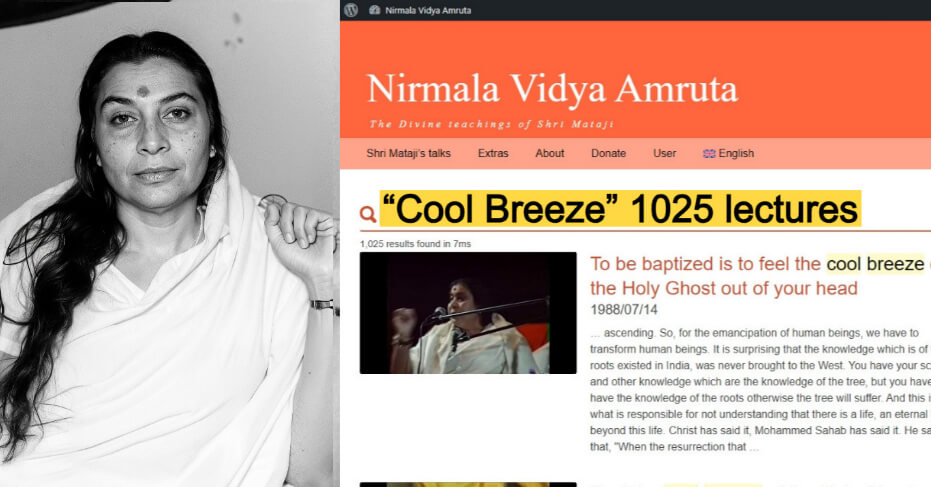
The global study of pneumatology—the doctrine of Spirit—reveals a universal tendency to describe the ultimate divine energy as breath, wind, or subtle life-force. In Christian scripture, Jesus speaks of the Holy Spirit as a perceptible wind (Greek pneuma), while Hindu traditions describe pra?a, and Taoist philosophy describes qi, as the animating divine essence operating within and around the human being. Shri Mataji Nirmala Devi's proclamation that spiritual awakening is accompanied by the Cool Breeze of the Holy Spirit
offers a unique bridge between these traditions. This paper argues that the Cool Breeze,
far from being metaphorical, constitutes a salvific and empirically verifiable manifestation of the same Spirit described in the Gospel of John, the Upanishads, and the Tao Te Ching.
2. Jesus' Teaching to Nicodemus: Rebirth and the Sensory Sign of the Spirit
In John 3:5-8, Jesus declares that one must be born of water and Spirit
to enter the Kingdom of God, and further clarifies: The wind blows where it wills, you hear its sound, but cannot tell whence it comes or whither it goes; so is everyone born of the Spirit
(John 3:8). The analogy is not merely poetic; it functions as a phenomenological description. The pneuma is both spirit
and wind,
implying that the new birth is not abstract doctrine but an experience—a perceptible movement of divine force. This establishes a Christian criterion for authentic spiritual rebirth: it is felt, like a breeze.
3. Chi and Prana: Salvific Life-Forces in Eastern Traditions
In classical Hindu philosophy, prana is the primordial energy sustaining all life, and the Yogic traditions teach that its awakened flow through the susumna nadi leads to liberation (moksa). Similarly, Taoist thought describes qi as the subtle breath-energy that must be refined and harmonized to attain immortality (xian). Both systems attest to a salvific energy, subtle yet perceptible, that elevates human consciousness and restores cosmic alignment. The experiential descriptions—coolness, flow, ascent, movement—parallel the signs described in Christian mysticism and in the Gospel itself.
4. Shri Mataji's Cool Breeze
: A Cross-Cultural Pneumatological Fulfillment
Shri Mataji Nirmala Devi identifies the moment of Kundalini awakening with the perception of a Cool Breeze, often felt above the head or on the palms. She attributes this directly to the Holy Spirit, or Adi Shakti, and explicitly connects this experience to the Christian Pentecostal descent of the Spirit. Unlike metaphorical or symbolic interpretations, the Cool Breeze is presented as a physiological and spiritual verification accessible to all seekers regardless of religious background. The universality of this experience positions it at the intersection of Eastern metaphysics and Biblical pneumatology.
5. Salvific Implications: Uniting Pneuma, Prana, and Chi
The central argument of this paper is that Shri Mataji's Cool Breeze
offers a salvific unification of the world's major spiritual traditions. It provides:
- A Christian confirmation of Jesus' statement that those born of the Spirit will perceive a wind-like experience.
- A Hindu fulfillment, demonstrating the ascent of Kundalini-sakti and the flow of pra?a through the awakened subtle system.
- A Taoist resonance, corresponding to the refined movement of qi in the state of spiritual realization.
Thus, the Cool Breeze stands as a phenomenological convergence point—a shared salvific sign across cultures.
6. Conclusion
Shri Mataji Nirmala Devi's articulation of the Cool Breeze
as the sign of spiritual awakening is not an innovation but a recovery of a universal pneumatological truth embedded in the world's sacred traditions. When viewed through the lens of comparative theology, it becomes evident that chi, prana, and the Holy Spirit represent culturally distinct vocabularies for the same salvific presence. Shri Mataji's contribution lies in making this presence directly experiential, thereby completing Jesus' promise to Nicodemus that the Spirit's rebirth would be known like the wind.
Her terminology thus offers a precise, cross-cultural, and academically defensible interpretation of the universal Spirit as the Cool Breeze—accessible, perceptible, and salvific.
Continue Your Awakening:
NATURE OF THE DIVINE MOTHER OR HOLY SPIRIT
The Goddess is Supreme Feminine Guru
Worshiping Devi is Direct Worship of Brahman
MahaDevi Research Paper (PDF)
The Supremacy of the MahaDevi Across All Faiths
The Divine Feminine in China
The Indian Religion of Goddess Shakti
The Divine Feminine in Biblical Wisdom Literature
Divine Feminine Unity in Taoism and Hinduism
Shekinah: The Image of the Divine Feminine
The Feminine Spirit: Recapturing the Heart of Scripture
Islam and the Divine Feminine
Tao: The Divine Feminine and the Universal Mother
The Tao as the Divine Mother: Embracing All Things
The Tao of Laozi and the Revelation of the Divine Feminine
Doorway of Mysterious Female ... Within Us All the While
The Eternal Tao and the Doorway of the Mysterious Female
Divine Feminine Remains the Esoteric Heartbeat of Islam
Holy Spirit of Christ Is a Feminine Spirit
Divine Feminine and Spirit: A Profound Analysis of Ruha
The Divine Feminine in Sufism
The Primordial Mother of Humanity: Tao Is Brahman
The Divine Feminine in Sahaja Yoga
Shekinah: She Who Dwells Within
Shekinah Theology and Christian Eschatology
Ricky Hoty, The Divine Mother
Centrality of the Divine Feminine in Sufism
A God Who Needed no Temple
Silence on (your) Self
The Literal Breath of Mother Earth
Prophecy of the 13 Grandmothers
Aurobindo: "If there is to be a future"
The Tao Te Ching and Lalita Sahasranama stand alone
New Millennium Religion Ushered by Divine Feminine
He is devoted utterly to the God who is the SelfZimmer
A Comprehensive Comparison of Religions and Gurus