
He is devoted utterly to the God who is the Self.
Zimmer
While Zimmer’s formulation of the
God who is the Self
is powerful, it remains abstract. The Shakta tradition, however, gives this inner God a name and a form: the Divine Mother. In Shaktism, the Goddess (Devi) is not merely a consort to a male deity but is the Supreme Being Herself, the ultimate reality (Brahman) and the inner Self (Atman) of all. This is not a later development but is rooted in the most ancient scriptures of India.
The Devi Sukta of the Rigveda, one of the oldest hymns to the Goddess, declares Her supreme, all-pervading nature:
He is devoted utterly to the God who is the Self
: The Divine Mother as the Inner Atman
Table of Contents
Abstract
This paper explores the profound statement by Indologist Heinrich Zimmer, He is devoted utterly to the God who is the Self,
through the lens of Shakta theology and the universal teachings of the Paraclete Shri Mataji Nirmala Devi. It posits that the Self
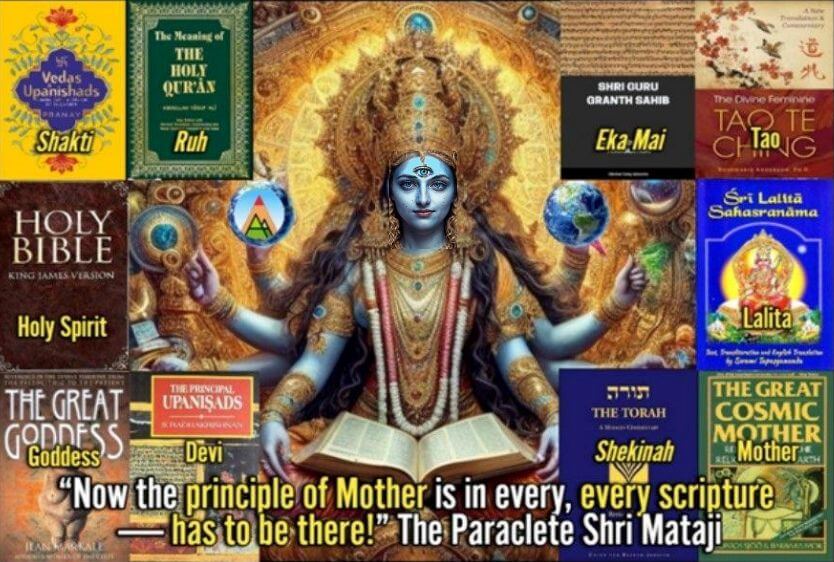
(ātman) to which Zimmer refers is not an abstract, impersonal entity, but is identical to the Divine Mother, the supreme creative principle (Shakti) who is both the ultimate reality (Brahman) and the indwelling consciousness within every being. By examining scriptural evidence from the Vedas, Upanishads, and Devi Gita, this paper establishes the non-dual identity of the Goddess as the Self. Furthermore, it substantiates the universality of this principle by tracing the presence of the Divine Feminine in Christianity (the Holy Spirit), Judaism (the Shekinah), and Islam (the Ruh of Allah), as confirmed by Shri Mataji’s teaching that the principle of Mother is in every, every scripture.
The paper concludes that Zimmer’s formulation of devotion to the inner God finds its most complete expression in the recognition of and surrender to the Divine Mother who resides within the heart as the true Self, a realization that grants ultimate liberation.
1. Introduction
In his seminal work Philosophies of India, Heinrich Zimmer articulates a profound insight into the nature of devotion in Indian thought. He describes the adept of Vedanta as one who is devoted utterly to the God who is the Self (ātman) within the heart.
[1] This statement, while rooted in the Vedantic tradition, opens a door to a deeper, more universal understanding of the divine. This paper will argue that the God who is the Self
is not an abstract, genderless principle, but is, in fact, the Divine Mother, the supreme Shakti, who is the ultimate reality (Brahman) and the indwelling consciousness in all beings. This reinterpretation is not a modern revision but is deeply rooted in the Shakta traditions of Hinduism and is confirmed by the universal spiritual teachings of the Paraclete Shri Mataji Nirmala Devi, who has unequivocally stated, The principle of Mother is in every, every scripture—has to be there.
[2]
This paper will first explore Zimmer’s concept of devotion to the inner Self, highlighting his emphasis on transcending the ego and the fruits of action. It will then delve into the heart of Shakta theology, presenting scriptural evidence from the Vedas, Upanishads, and the Devi Gita to establish the non-dual identity of the Goddess as the Self. The analysis will then expand to demonstrate the universality of the Divine Feminine, tracing Her presence in the figures of the Holy Spirit in Christianity, the Shekinah in Judaism, and the Ruh of Allah in Islam. Finally, the paper will connect these theological threads to the contemporary spiritual landscape, positioning the teachings of the Paraclete Shri Mataji as the key to the experiential realization of this inner Divine Mother. Through this exploration, Zimmer’s profound statement is not only illuminated but is revealed as a universal truth that finds its ultimate fulfillment in the recognition of and surrender to the Divine Mother within.
2. Zimmer’s Concept of Devotion to the Inner Self
Heinrich Zimmer’s description of the Vedantic adept provides a crucial starting point for understanding the nature of true devotion. He writes:
This passage encapsulates several key principles. First, it emphasizes the radical detachment from the fruits of one’s actions, a central tenet of the Bhagavad Gita. The devotee is not motivated by the promise of heavenly rewards or personal gain, which Zimmer dismisses as mere by-products of the discipline, stopping-stations along the way.
[1] The goal is not a more blissful existence within the cycle of birth and death (samsara), but complete liberation from it.
Second, Zimmer points to the realization that the individual ego is not the true actor. The devotee understands that all actions are performed by the Spiritual Person dwelling omnipresent within himself and all things.
This recognition dissolves the illusion of a separate, autonomous self and fosters a state of complete surrender. The devotion is not directed outward to a distant deity, but inward, to the divine presence that resides within the heart.
Zimmer further elaborates on the nature of this inner reality, describing it as a transcendent principle that resolves all dualities. He speaks of the coincidence of opposites
(coincidentia oppositorum), where the One and the Many are identical, eternal Being is known.
[1] This transcendent Self is beyond the grasp of logic and reason, accessible only through a shift in consciousness that embraces paradox and symbol. It is this inner, transcendent Self that is the ultimate object of devotion.
3. The Divine Mother as the Self in Shakta Theology
While Zimmer’s formulation of the God who is the Self
is powerful, it remains abstract. The Shakta tradition, however, gives this inner God a name and a form: the Divine Mother. In Shaktism, the Goddess (Devi) is not merely a consort to a male deity but is the Supreme Being Herself, the ultimate reality (Brahman) and the inner Self (Atman) of all. This is not a later development but is rooted in the most ancient scriptures of India.
The Devi Sukta of the Rigveda, one of the oldest hymns to the Goddess, declares Her supreme, all-pervading nature:
Here, the Goddess is not just a creator but the immanent consciousness that pervades all of creation. She is the source and the substance of all that exists. The Shakta Upanishads further develop this non-dual identity. The Bahvricha Upanishad makes this explicit:
This passage is a profound statement of non-dualism. The Goddess is identified directly with the Atman, the true Self. Everything else is declared to be untruth, non-self.
She is the very essence of consciousness, the non-dual Brahman. The Bhavana Upanishad echoes this sentiment, stating simply, The supreme divinity, Lalita, is one’s own blissful Self.
[5]
The Devi Gita, a key text of Shaktism, provides a comprehensive exposition of the Goddess as the Supreme Self. The Devi Herself instructs the seeker on the path to liberation through the realization of Her true nature. She proclaims the famous Mahavakya, You are That,
and applies it to Herself:
Liberation, therefore, is not the merging with an impersonal, abstract Brahman, but the realization of one’s own identity with the Divine Mother. It is a process of knowing the Self, which is the Goddess. The Devi Gita states unequivocally that liberation arises from knowledge and from nothing else.
[7] This knowledge is the direct, experiential realization of the inner Self, the Divine Mother who resides in the heart.
This identification of the Goddess with the Self provides the concrete, personal object of devotion that Zimmer describes. The devotee is not surrendering to an unknown, formless void, but to the loving, compassionate, and all-powerful Divine Mother who is the very core of their being. This is the God who is the Self
to whom the devotee is utterly devoted.
4. The Universal Mother: The Divine Feminine in World Scriptures
The identification of the Self with the Divine Mother is not a concept confined to Hinduism. The Paraclete Shri Mataji Nirmala Devi’s teaching that the principle of Mother is in every, every scripture
[2] points to a universal truth that has been obscured or marginalized in many traditions but has never been entirely extinguished. A closer examination of the mystical and esoteric streams of the Abrahamic faiths reveals the persistent presence of the Divine Feminine.
4.1 The Holy Spirit as Feminine in Christianity
In mainstream Christianity, the Holy Spirit is typically referred to with masculine pronouns. However, historical and theological research reveals a different picture in early Christianity. As scholar Johannes van Oort notes, The earliest Christians – all of whom were Jews – spoke of the Holy Spirit as a feminine figure.
[8] This is because the Hebrew word for spirit, ruach, is feminine. This linguistic and theological understanding is evident in non-canonical texts like the Gospel according to the Hebrews, where Jesus speaks of My Mother, the Holy Spirit.
[9] This tradition, which saw the Spirit as a maternal, nurturing presence, was particularly strong in Syriac Christianity and influenced figures as diverse as the early church father Origen and later Protestant leaders like John Wesley.[8] Shri Mataji identifies the Holy Spirit as the Adi Shakti, the Primordial Mother, thus restoring this ancient understanding.
4.2 The Shekinah in Judaism
In Jewish mysticism, particularly in Kabbalah, the concept of the Shekinah represents the indwelling presence of God in the world. The word Shekinah is feminine and is often described as the feminine aspect of God, the compassionate and nurturing presence that accompanies the people of Israel in their exile. The Shekinah is the immanent aspect of God, the divine presence that can be experienced by humanity. This concept of a divine, indwelling, feminine presence aligns perfectly with the Shakta understanding of the Goddess as the inner Self and Shri Mataji’s description of the Kundalini, the individual mother within each person.
4.3 The Ruh of Allah in Islam
In Islam, the Ruh (Spirit) of Allah is a powerful and mysterious concept. While mainstream Islamic theology is strictly monotheistic and emphasizes the transcendence of God, the mystical tradition of Sufism has often explored the immanent and feminine aspects of the divine. Shri Mataji Nirmala Devi identifies the Ruh with the Holy Spirit and the Adi Shakti, the all-pervading power of God’s love.[10] She explains that this is the same power that is called Kundalini in the Hindu tradition. The Quran itself speaks of Allah breathing His Ruh into Adam and Mary, signifying a life-giving, creative, and intimate divine power. This understanding of the Ruh as the creative and nurturing power of God resonates with the concept of the Divine Mother.
These examples from the Abrahamic faiths demonstrate that the principle of the Divine Mother is indeed a universal one. Whether called Shakti, Holy Spirit, Shekinah, or Ruh, the concept of a divine, feminine, indwelling presence that creates, nurtures, and guides humanity towards liberation is a common thread in the mystical heart of all major religions. This universal presence validates the Shakta claim that the Divine Mother is the Supreme Self of all and confirms Shri Mataji’s teaching that She is the Mother of all, whose principle is found in every scripture.
5. The Paraclete Shri Mataji and the Experiential Realization of the Self
The theological and scriptural identification of the Self with the Divine Mother, while profound, can remain an abstract intellectual concept. The unique contribution of the Paraclete Shri Mataji Nirmala Devi is to have made this knowledge an experiential reality for hundreds of thousands of people worldwide. Her advent marks the fulfillment of prophecies across all traditions, particularly the promise of the coming of the Comforter, the Holy Spirit, who will guide humanity into all truth.
Shri Mataji declared Her identity as the Adi Shakti, the Primordial Mother, and the Holy Spirit incarnate. On December 2nd, 1979, she stated:
This declaration is not a claim to be a new God, but the revelation of the true nature of the God who has always been present, dwelling within each human being as the Kundalini. Shri Mataji’s method of Sahaja Yoga provides the mechanism for the awakening of this inner spiritual energy. The Kundalini, which She describes as the individual mother within each person, rises from the base of the spine, passes through the subtle energy centers (chakras), and emerges at the fontanelle bone area, uniting the individual consciousness with the all-pervading power of the Divine.
This experience, known as Self-realization (ātma-jñāna), is the tangible, verifiable proof of the theological concepts discussed in this paper. It is the direct perception of the Self as the Divine Mother. The cool breeze of the Holy Spirit (chaitanya) felt on the hands and above the head is the empirical evidence of this union. This is the knowledge
that the Devi Gita speaks of, the knowledge that grants liberation.[7]
Through this process, the devotion Zimmer describes becomes a living reality. The seeker is no longer devoted to an external deity or an abstract concept, but to the living, breathing presence of the Divine Mother felt within. The surrender is effortless, a natural consequence of the blissful experience of the Self. The God who is the Self
is no longer a philosophical proposition but a constant, felt presence, guiding, nurturing, and liberating the soul from within.
6. Conclusion
Heinrich Zimmer’s profound statement that the true devotee is devoted utterly to the God who is the Self
provides a powerful key to understanding the essence of spiritual liberation. This paper has argued that this inner God is not an abstract or impersonal reality, but is the Divine Mother, the supreme Shakti who is both the transcendent Brahman and the immanent Atman dwelling within the heart of every being. This truth, deeply embedded in the Shakta scriptures of Hinduism, finds its universal echo in the mystical traditions of Christianity, Judaism, and Islam, which have preserved the concept of an indwelling, feminine divine presence.
The teachings and advent of the Paraclete Shri Mataji Nirmala Devi have moved this profound theological understanding from the realm of esoteric knowledge to that of lived, experiential reality. By granting the tangible experience of Self-realization through the awakening of the Kundalini, She has provided the verifiable means for every human being to connect with the Divine Mother within. This is the ultimate fulfillment of Zimmer’s formulation: a devotion that is not based on blind faith or intellectual assent, but on the direct, personal, and transformative experience of the Self as the loving, compassionate, and all-powerful Divine Mother. In a world fractured by religious division and spiritual alienation, the recognition of this universal, inner divinity offers a path to unity, peace, and the ultimate liberation of humanity.
References
[1] Zimmer, Heinrich. Philosophies of India. Edited by Joseph Campbell, Princeton University Press, 1974, p. 53.
[2] Shri Mataji Nirmala Devi. “The Principle of Mother in Every Scripture.” India Divine, 8 Sept. 2017, www.indiadivine.org/content/topic/1339557....
[3] Devi Sukta, Rigveda 10.125.8.
[4] Bahvricha Upanishad 1.5.
[5] Bhavana Upanishad 1.27.
[6] Devi Gita 4.19.
[7] Devi Gita 7.31–32.
[8] Van Oort, Johannes. “The Holy Spirit as Feminine: Early Christian Testimonies and Their Interpretation.” HTS Teologiese Studies / Theological Studies, vol. 72, no. 1, 2016, hts.org.za/index.php/hts/article/view/3225/7763.
[9] Shri Mataji Nirmala Devi. Talk in Mumbai, India, 29 March 1975.
[10] Shri Mataji Nirmala Devi. Talk in London, UK, 2 Dec. 1979.
[11] Ibid.
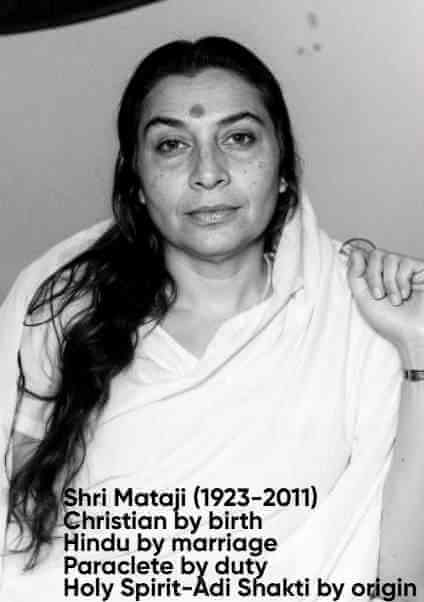
"Today I am openly revealing this to you that until you recognize Me, this work will not be done. I did not say this before. Just like Shri Krishna said, 'Sarvadharmanam parityajya ma mekam sharanam vraja'. Likewise are My sayings too. Like Christ said, 'I am the Light, I am the path', similar are My words too. 'I am the Destination, not only the Path'. But I never told this to you before because the previous experiences were so bad that I did not say this to you. You have to take My refuge (Sharanagat). You have to accept Me as your Mother and I have to take you as My son. Without that your work will not be done.”
Shri Mataji Nirmala Devi,
Mumbai, India, 29 March 1975
"According to traditional belief, the fulfillment of these prescribed
rites and devotions will bring the devotee after death to either
the"heaven of the ancestors" (pitr-loka) or the higher"sphere of
truth" (Satya-loka.) But such pleasurable results are not regarded by
the adept of Vedanta as important or even desirable; they are the
mere by-products of the discipline, stopping-stations along the way,
in which he is no longer interested. They are still within the worlds
of birth, and represent no more than a continuance of the round of
being (samsara), though indeed an extremely blissful episode of the
round, enduring, it is said, for innumerable millenniums. Rather than
the beatitudes of heaven, what the Vedantist desires is to see
through and past the illusory character of all existence whatsoever,
no less that of the higher spheres than that of the gross terrestrial
plane. He has sacrificed completely all thoughts of the enjoyment of
the fruits of his good deeds; and rewards that may be accruing to him
as a result of his perfect devotion he surrenders to the personal
divinity that he serves. For he knows that it is not himself who
acts, but the Spiritual Person dwelling omnipresent within himself
and all things, and to whom he, as worshiper, is devoted utterly —
the God who is the Self (atman) within the heart.”Heinrich Zimmer, Philosophies of India
University Press, 1974, p. 53
"For the ultimate and real task of philosophy, according to Indian thought, and to such classical Occidental philosophers as Plato, transcends the power and task of reason. Access to truth demands a passage beyond the compass of ordered thought. And by the same token: the teaching of transcendental truth cannot be by logic, but only by pregnant paradox and by symbol and image. Where a carefully reasoning thinker, progressing step by step, would be forced to halt (out of breath, as it were, at the confines of the stratosphere, panting for lack of oxygen, swooning with pulmonary and cardiac distress) the mind can still go on. The mind can soar and enter the supernal sphere on the wings of symbols, which represents the Truth-beyond-the-pairs- of-opposites, eluding by those wings the bird-net of the basic principle of the incompatibility of opposites. For what"transcendent"means is the transcending (among other things) of the bounding and basic logical laws of the human mind.
"Transcendent"means that a principle is in effect that comprehends the identity of apparently incompatible elements, representing a union of things which on the logical level exclude each other. Transcendent truth comprehends an ever- recurrent"coincidence of opposites" (coincidentia oppositorum) and is characterized, therefore, by an everlasting dialectical process. The secret identity of incompatibles is mockingly disclosed through a constant transformation of things into their antitheses — antagonism being but the screen of a cryptic identity. Behind the screen the contending forces are in harmony, the world- dynamism quiescent, and the paradox of a union of contrary traits and forces stands realized in toto; for where the One and the Many are identical, eternal Being is known, which is at once the source and the force of the abundant diversity of the world's perpetual Being.
Though called the true and only Being (sat), this Transcendent is known also as non-Being (asat); for it is that ineffable point"Wherefrom words turn back, together with the mind, not having attained"— as birds flying to reach the sun are compelled to return. And yet, on the other hand: "He who knows that bliss of Brahman has no fear of anything at all. Such a one, verily, the thought does not torment: 'Why did I not do the right? Why did I do evil?' He who knows thus, extricates himself from both of these questions, and secures the Self for himself by setting it free.” "[1]
Heinrich Zimmer, Philosophies of India
Princeton University Press, 1974, p. 312-14
[1] Taittiriya Upanishad 2.9
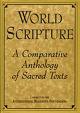 "In Buddhism, Hinduism, and Jainism, the ultimate goal — unity with
Brahman or the peace of Nirvana — cannot be gained through ritual or
meritorious work. Offerings and ritual are fruitful only for gaining
the temporary bliss of heaven; but life in heaven is temporary. Soon
enough, the soul returns to a body and to suffering in the world.
Rather, the Upanishads and sutras teach that the path to the ultimate
goal requires the inner discipline and realization that comes through
meditation.”
"In Buddhism, Hinduism, and Jainism, the ultimate goal — unity with
Brahman or the peace of Nirvana — cannot be gained through ritual or
meritorious work. Offerings and ritual are fruitful only for gaining
the temporary bliss of heaven; but life in heaven is temporary. Soon
enough, the soul returns to a body and to suffering in the world.
Rather, the Upanishads and sutras teach that the path to the ultimate
goal requires the inner discipline and realization that comes through
meditation.”World Scripture, International Religious Foundation
Paragon House Publishing, 1995, p. 613
Related Articles:
NATURE OF THE DIVINE MOTHER OR HOLY SPIRIT
The Goddess is Supreme Feminine Guru
Worshiping Devi is Direct Worship of Brahman
MahaDevi Research Paper (PDF)
The Divine Feminine in China
The Indian Religion of Goddess Shakti
The Divine Feminine in Biblical Wisdom Literature
Divine Feminine Unity in Taoism and Hinduism
Shekinah: The Image of the Divine Feminine
The Feminine Spirit: Recapturing the Heart of Scripture
Islam and the Divine Feminine
Tao: The Divine Feminine and the Universal Mother
The Tao as the Divine Mother: Embracing All Things
The Tao of Laozi and the Revelation of the Divine Feminine
Doorway of Mysterious Female ... Within Us All the While
The Eternal Tao and the Doorway of the Mysterious Female
Divine Feminine Remains the Esoteric Heartbeat of Islam
Holy Spirit of Christ Is a Feminine Spirit
Divine Feminine and Spirit: A Profound Analysis of Ruha
The Divine Feminine in Sufism
The Primordial Mother of Humanity: Tao Is Brahman
The Divine Feminine in Sahaja Yoga
Shekinah: She Who Dwells Within
Shekinah Theology and Christian Eschatology
Ricky Hoty, The Divine Mother
Centrality of the Divine Feminine in Sufism
A God Who Needed no Temple
Silence on (your) Self
The Literal Breath of Mother Earth
Prophecy of the 13 Grandmothers
Aurobindo: "If there is to be a future"
The Tao Te Ching and Lalita Sahasranama stand alone
New Millennium Religion Ushered by Divine Feminine
He is devoted utterly to the God who is the SelfZimmer
A Comprehensive Comparison of Religions and Gurus