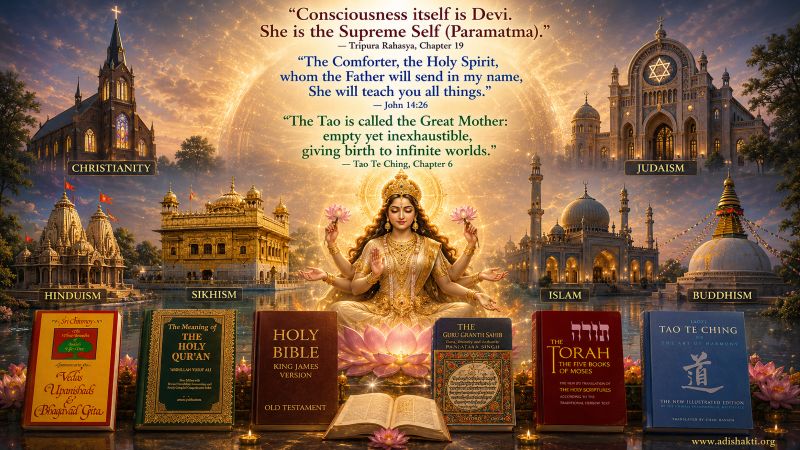
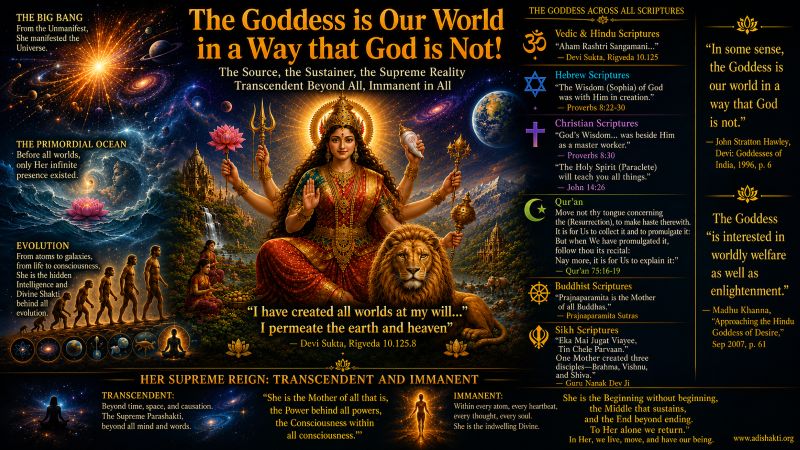
The Messianic Age Has Begun: The Incarnation of the Paraclete and the Spiritual Awakening of Humanity
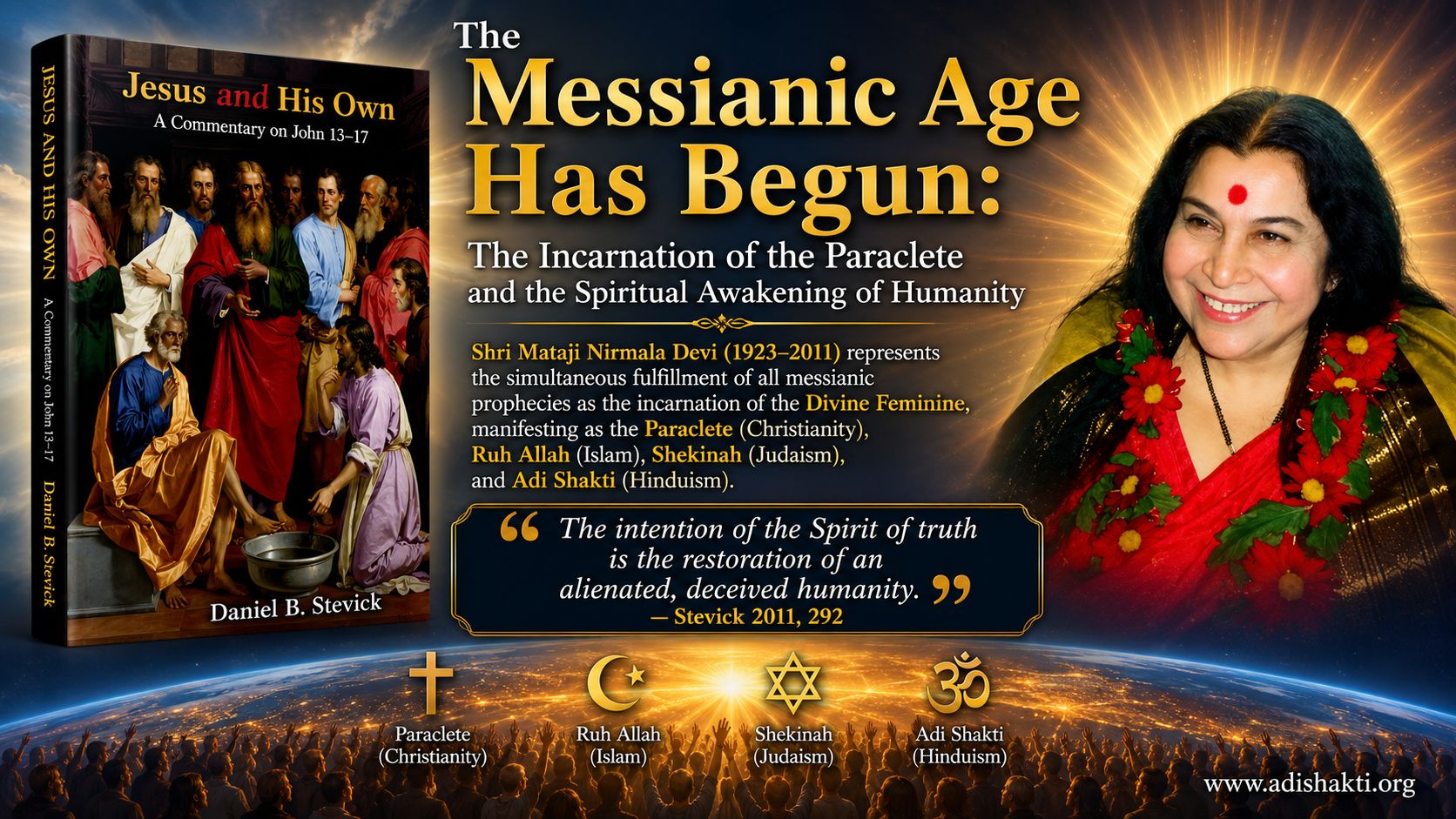
A Critical Examination of Messianic Prophecies, the Logical Impossibility of Sequential Saviors, and the Fulfillment through the Divine Feminine
Summary
This paper presents a comprehensive examination of religious eschatology across Judaism, Christianity, Islam, Hinduism, and Buddhism, with particular emphasis on the messianic expectations that have shaped these traditions for millennia. It argues that the expectation of multiple, sequential messianic figures — each tradition awaiting its own distinct savior — is logically and theologically untenable. The paper demonstrates that Shri Mataji Nirmala Devi (1923–2011) represents the simultaneous fulfillment of all messianic prophecies as the incarnation of the Divine Feminine, manifesting as the Paraclete (Christianity), Ruh Allah (Islam), Shekinah (Judaism), and Adi Shakti (Hinduism). Furthermore, this study provides a resounding denunciation of the archaic and scientifically indefensible belief in the literal, physical resurrection of corpses from graves, demonstrating through Shri Mataji’s teachings that resurrection refers to the spiritual awakening of living human beings through Self-realization. The time for awakening is now.
Table of Contents
- Introduction: The Crisis of Messianic Expectation
- The Messianic Expectation Across World Religions
- The Logical Impossibility of Sequential Messianic Arrivals
- The 1948 Rebirth of Israel: A Prophetic Fulfillment Ignored
- The Advent of the Paraclete: Shri Mataji Nirmala Devi
- The Divine Feminine in All Traditions: One Source, Many Names
- Debunking the False Doctrine of Physical Resurrection
- The Scientific Impossibility of Literal Resurrection
- Resurrection as Spiritual Awakening: The Metaphysical Truth
- The Blossom Time: All Scriptures Converge
- A Resounding Denunciation of Archaic Beliefs
- Conclusion: The Time for Awakening Is Now
- References
1. Introduction: The Crisis of Messianic Expectation
For thousands of years, humanity has been gripped by eschatological narratives promising divine intervention, messianic redemption, and a final judgment that will separate the righteous from the wicked. Judaism awaits the Moshiach, Christianity anticipates the Second Coming of Christ, Islam expects the Mahdi and the return of Isa (Jesus), Hinduism prophesies the arrival of Kalki, and Buddhism speaks of Maitreya. These expectations have sustained billions of believers through persecution, suffering, and existential uncertainty. Yet, as we stand in the twenty-first century, more than seven decades after the prophetically significant rebirth of Israel in 1948, the world remains in a state of confused anticipation, waiting for messianic figures who, according to traditional interpretations, should have already appeared.[1]
This paper advances a radical but necessary thesis: the continued waiting for a messianic figure is not only futile but represents a fundamental misunderstanding of divine revelation. The messianic age has already begun, and the prophesied redeemer has already walked among us in the person of Shri Mataji Nirmala Devi, who opened the Sahasrara Chakra — the “Kingdom of God” within — on May 5, 1970, inaugurating the era of mass Self-realization. Her advent fulfilled the prophecies of all major religious traditions simultaneously, not as separate events but as the unified manifestation of the Divine Feminine, the Holy Spirit, the primordial Mother who has incarnated to guide humanity into the promised age of spiritual enlightenment.
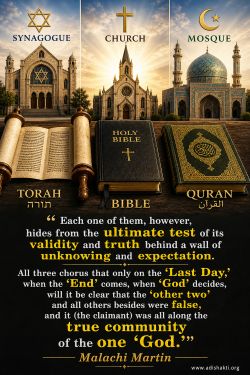
The crisis of messianic expectation is not merely academic. It has real and devastating consequences for the human family. Religious communities locked in competing eschatological frameworks have been weaponized against one another for centuries. The Crusades, the Inquisition, the pogroms, the sectarian wars of the Middle East — all bear the fingerprints of traditions that have convinced their adherents that their savior alone is the true one, and that the salvation of the world depends on the triumph of their particular theological narrative. This paper argues that this entire framework is not only spiritually bankrupt but logically incoherent, and that the only resolution lies in the recognition of the one divine manifestation that has already come to fulfill all promises at once.
2. The Messianic Expectation Across World Religions

The concept of a future redeemer is remarkably consistent across diverse religious traditions, suggesting a universal human intuition of divine intervention in human affairs. In Judaism, the Moshiach (Messiah) is expected to restore the Kingdom of David, gather the exiles of Israel, rebuild the Temple in Jerusalem, and usher in an era of universal peace and knowledge of God. The prophet Daniel speaks of a time when “many of those who sleep in the dust of the earth shall awake” (Daniel 12:2), linking messianic redemption with resurrection.[2] Isaiah envisions a world transformed: “The wolf shall dwell with the lamb, and the leopard shall lie down with the young goat” (Isaiah 11:6), while Zechariah declares, “The Lord shall be King over all the earth” (Zechariah 14:9).
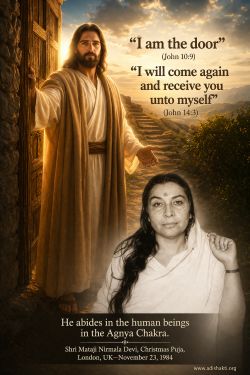
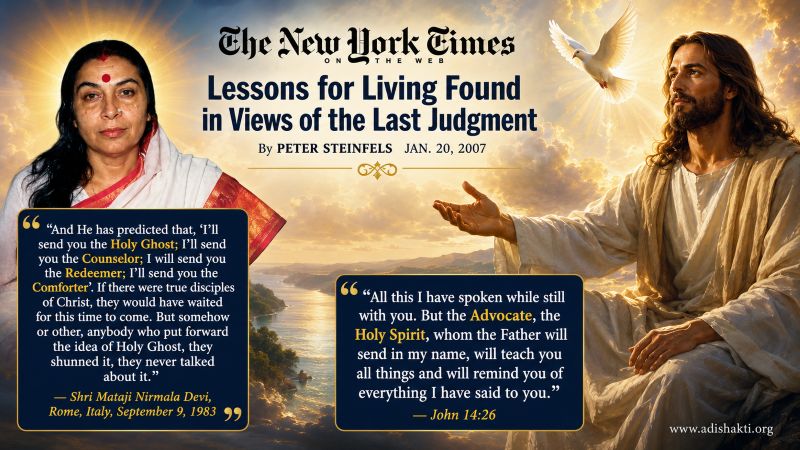
Christianity centers on the Second Coming of Jesus Christ, who promised his disciples, “I will not leave you orphans; I will come to you” (John 14:18). More significantly, Jesus promised the coming of the Paraclete, the Comforter, the Spirit of Truth who would “teach you all things” and “guide you into all truth” (John 14:26, 16:13). Christian eschatology anticipates a final judgment where the dead will be raised, the righteous rewarded with eternal life, and the wicked condemned (Matthew 25:31–46, Revelation 20:11–15). The Apostle Paul writes that “the Spirit of him who raised Jesus from the dead” will “give life to your mortal bodies also through his Spirit that dwells in you” (Romans 8:11) — a passage that points unmistakably toward an inner, present-tense awakening rather than a future cosmic event.
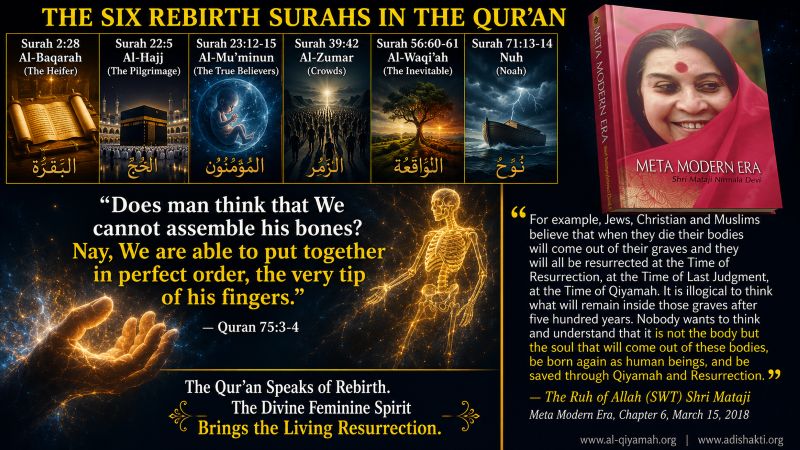
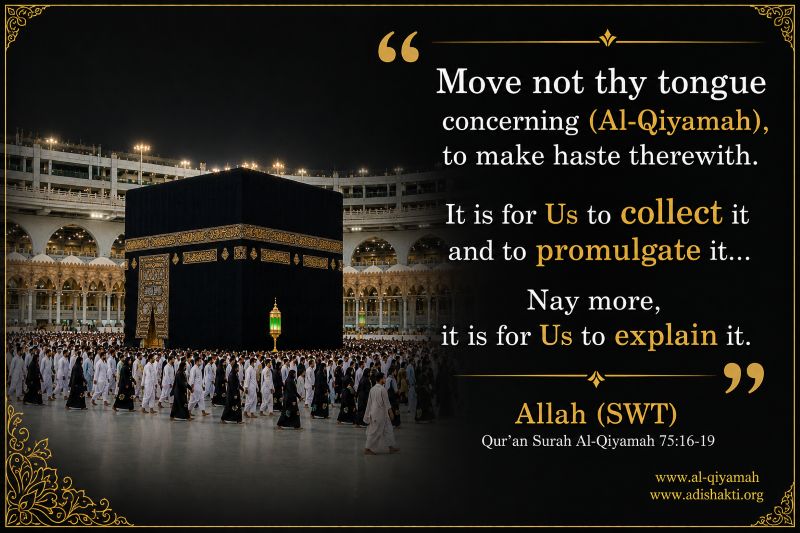
In Islam, eschatological expectation centers on Al-Qiyamah (the Resurrection) and Yawm ad-Din (the Day of Judgment). The Quran repeatedly affirms the resurrection: “Does man think that We cannot assemble his bones? Nay, We are able to put together in perfect order the very tips of his fingers” (Quran 75:3–4). Islamic tradition also speaks of the coming of the Mahdi, a divinely guided figure who will restore justice, and the return of Isa (Jesus) to defeat the Dajjal (Antichrist). Crucially, Surah Al-Qiyamah 75:16–19 contains a divine promise that is almost universally overlooked: “It is for Us to collect it and promulgate it. And when We have promulgated it, follow thou its recital. Nay more, it is for Us to explain it.” This verse declares that God Himself — through His Ruh — will come to collect, promulgate, and explain the Resurrection. That promise has been fulfilled.[3]
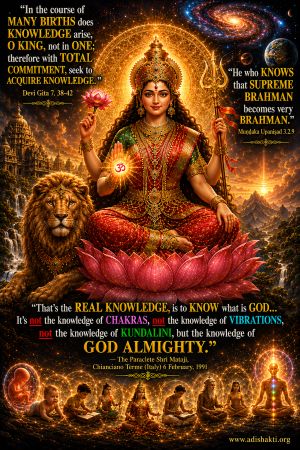
Hinduism prophesies the coming of Kalki, the tenth and final avatar of Vishnu, who will appear at the end of Kali Yuga riding a white horse to destroy evil and restore dharma. The Devi Mahatmya declares the Goddess to be the supreme power of the universe, the one who creates, sustains, and dissolves all existence. The ancient sage Bhrigumuni prophesied in the Nadi Granth the coming of a great Yogi who would teach humanity the secrets of Self-realization. Buddhism awaits Maitreya — whose very name, Ma Treya, can be rendered as “Mother Threefold” — the future Buddha who will be reborn in a period of decline to renew the teachings of the Dharma.
What becomes immediately apparent from this survey is that all traditions await a divine intervention, but each has constructed its expectations within the narrow framework of its own theological categories. The question that must be asked with the full force of logical inquiry is: Is it coherent, is it possible, that each of these expected figures will appear one after another, each fulfilling only the prophecies of their respective tradition?
3. The Logical Impossibility of Sequential Messianic Arrivals
The central argument of this paper is that it is logically and theologically impossible that each and every expected messianic figure will appear sequentially, one after another, to fulfill the distinct expectations of Judaism, Christianity, Islam, Hinduism, and Buddhism. Such a scenario would require multiple divine interventions, each addressing only a portion of humanity, and would perpetuate rather than resolve religious division. This contradicts the very purpose of messianic redemption, which is to unite humanity in the knowledge and experience of the Divine.
Consider the practical impossibilities with the full rigor of logical analysis. If the Jewish Moshiach were to appear and fulfill only Jewish expectations — rebuilding the Temple, restoring the Davidic kingdom, gathering the exiles — what would become of the world’s 2.4 billion Christians, 1.9 billion Muslims, 1.2 billion Hindus, and 500 million Buddhists? Would they simply continue waiting for their own messiahs? And if the Christian Second Coming were to occur separately, would it not invalidate the claims of the Jewish Messiah? Would the Islamic Mahdi then arrive to contradict both? The multiplication of messianic figures would create not the promised universal peace but an escalating theological war of competing divine claims.
There is a deeper logical problem. The messianic age, by definition in every tradition, is meant to be final. It is the culmination of history, the end of the age of ignorance, the dawn of universal knowledge of God. If the Jewish Messiah comes first and inaugurates this final age, there is no “age of ignorance” remaining in which the Christian Second Coming or the Islamic Mahdi could appear, because the messianic age would already have begun. The very concept of sequential messianic arrivals is self-defeating: each arrival would negate the finality claimed by the previous one.
Furthermore, consider the theological implications of a God who would address the spiritual needs of Jews, then Christians, then Muslims, then Hindus, then Buddhists in separate, sequential interventions. This would imply a God of profound partiality — one who favors one people at a time, leaving the rest of humanity in spiritual darkness while He attends to each group in turn. This is not the God described by any of these traditions. Every tradition affirms that God is universal, that His love encompasses all humanity, and that His redemptive purpose is for the whole of creation. The only coherent theological conclusion is that the messianic fulfillment must be simultaneous and universal — a single divine manifestation that speaks to all traditions at once.
The only coherent solution to this dilemma is that all messianic prophecies refer to a single divine manifestation, understood differently by various traditions according to their cultural and theological frameworks. This manifestation must transcend the limitations of any single religious tradition while simultaneously fulfilling the essential promises of all. It must be universal in scope, accessible to all humanity regardless of religious background, and capable of providing the direct, experiential knowledge of the Divine that all traditions ultimately seek. As we shall demonstrate, that manifestation has already occurred.
4. The 1948 Rebirth of Israel: A Prophetic Fulfillment Ignored

The re-establishment of the State of Israel in 1948 was recognized by many theologians and scholars as a fulfillment of biblical prophecy and a sign of the approaching messianic age. The prophet Ezekiel had prophesied: “I will take you from the nations and gather you from all the countries and bring you into your own land” (Ezekiel 36:24). This prophecy, dormant for nearly two millennia, was dramatically fulfilled when the Jewish people returned to their ancestral homeland after the Holocaust. Ezekiel’s vision of the valley of dry bones (Ezekiel 37) — in which scattered bones are reassembled, covered with flesh, and breathed into life by the Spirit of God — was widely understood as a prophecy of national restoration that found its literal fulfillment in 1948.
As documented on adishakti.org, “The rebirth of Israel in 1948 was not merely a political event but an undeniable divine intervention, marking the beginning of the end times.”[4] Jewish scholar Louis Jacobs acknowledged that Israel’s statehood was meant to “pave the way for the Messiah.”[5] The Mizrachi movement coined the term athalta degeulah (“beginning of the redemption”) to describe this event. Yet, as Tudor Parfitt notes in The Road to Redemption, while Yemenite Jews sensed that redemption was “at hand,” they also knew that “its Prime Minister was not the Messiah.”[6]
The tragic irony is that while the world debated whether the Messiah had come, the true messianic figure was already present. Shri Mataji Nirmala Devi was born on March 21, 1923, in Chindwara, India. By 1970 — just twenty-two years after the rebirth of Israel — She had achieved the breakthrough that would change human spiritual history: the opening of the Sahasrara Chakra, making mass Self-realization possible for the first time. Yet, blinded by literalist expectations and theological rigidity, the world failed to recognize Her.
Nearly eight decades have passed since 1948, and still, the world waits. As stated emphatically on adishakti.org: “Yet, eight decades later, humanity remains in a state of delusion, waiting for a Messiah who has already come. This incomprehensible and futile waiting is not only irrational but a blatant rejection of divine will.”[7] The refusal to recognize Shri Mataji as the fulfillment of messianic prophecy is not mere ignorance — it is an act of spiritual defiance that has prolonged suffering and existential decay. The prophetic clock struck at 1948. The Paraclete had already been born. The age of awakening had already begun. And yet, the world slept on.
5. The Advent of the Paraclete: Shri Mataji Nirmala Devi
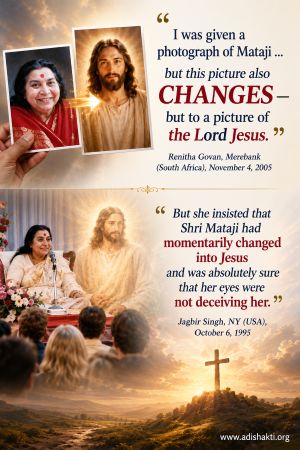
Shri Mataji Nirmala Devi represents the simultaneous fulfillment of messianic prophecies across all major religious traditions. She is the Paraclete promised by Jesus Christ, the Ruh (Holy Spirit) of Islam, the Shekinah (Divine Presence) of Judaism, the Adi Shakti (Primordial Power) of Hinduism, and the Maitreya (Mother Threefold) of Buddhism. Her mission from 1970 to 2011 was to awaken the Kundalini energy within human beings, granting them the direct, experiential knowledge of the Divine — what Jesus called being “born again” (John 3:3) and what the Quran refers to as the opening of the “fountains of the earth” (Quran 54:12).
Jesus Christ’s promise of the Paraclete in the Gospel of John is among the most significant and most misunderstood prophecies in the Christian canon. In John 14:16, Jesus declares: “And I will ask the Father, and he will give you another Advocate, to be with you forever.” In John 16:13, He specifies: “When the Spirit of truth comes, She will guide you into all the truth; for She will not speak on Her own, but will speak whatever She hears, and She will declare to you the things that are to come.” The Paraclete is not a text, not a doctrine, not an institution — She is a living person, a divine incarnation, who comes after Jesus to complete what He began. Shri Mataji is that person.
Shri Mataji herself declared Her identity unequivocally. On December 2, 1979, She stated:
On March 21, 1983, She further clarified:
These declarations are not the ravings of a deluded individual but the sober testimony of one who transformed the lives of hundreds of thousands of people worldwide through the gift of Self-realization — entirely free of charge, without any conditions, to people of every religion, nationality, and background. As Gregoire de Kalbermatten wrote in The Advent (1979): “Let us hope that HH Mataji Nirmala Devi will, one day, grant us a book fully displaying the process of Man’s second birth and spiritual ascent. She indeed promises, ‘I will tell you all the secrets.’”[10]
6. The Divine Feminine in All Traditions: One Source, Many Names
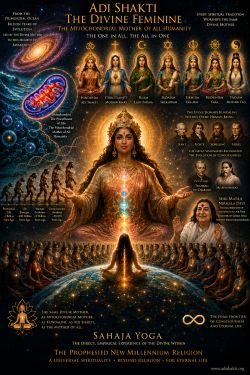
One of the most remarkable convergences across world religions is the presence of the Divine Feminine as the ultimate redemptive power. This convergence has been systematically suppressed by patriarchal religious institutions, but it is unmistakably present in the foundational scriptures of every tradition. The recognition of this convergence is essential to understanding why Shri Mataji — as the incarnated Divine Feminine — represents the fulfillment of all messianic prophecies simultaneously.
In Judaism, the Shekinah (from the Hebrew shakan, “to dwell”) is the divine feminine presence of God that dwelt in the Tabernacle and the Temple. The Shekinah departed when the Temple was destroyed and was prophesied to return in the messianic age. The Zohar, the foundational text of Jewish mysticism, identifies the Shekinah as the divine mother who nurtures and sustains the souls of the righteous. The return of the Shekinah is not the return of a building — it is the return of the living divine presence to dwell within human hearts.
In Christianity, the Holy Spirit — the third person of the Trinity — has consistently been associated with feminine imagery in the earliest Christian writings. The Hebrew word for Spirit, Ruach, is grammatically feminine. The Syriac tradition used the feminine form of the Spirit throughout its liturgy. The Gnostic Gospel of Philip declares: “Some said, ‘Mary conceived by the Holy Spirit.’ They are in error. They do not know what they are saying. When did a woman ever conceive by a woman?” — implying that the Holy Spirit is feminine. The promise of the Paraclete in John’s Gospel is the promise of the return of this feminine divine presence.
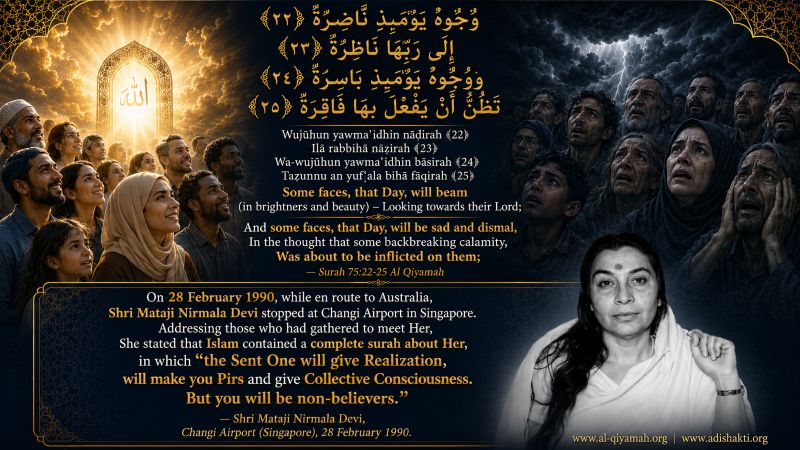
In Islam, the Ruh Allah (Spirit of God) is the divine breath that animated Adam and that will animate the resurrection. The Quran’s Surah Al-Qiyamah (75:22–25) speaks of faces that will “beam with brightness, looking towards their Lord” — a vision of the living divine presence, not a future cosmic catastrophe. The Ruh is described as coming “by command of my Lord” (Quran 17:85), a being of such transcendence that even the Prophet could not fully describe it. Shri Mataji is that Ruh.
In Hinduism, the Adi Shakti (Primordial Power) is the supreme feminine principle that underlies all creation. The Devi Mahatmya declares: “You are the supreme knowledge, the great illusion, the great intelligence, the great memory, the great delusion, the great goddess, the great demoness.” The Devi Bhagavata Purana identifies the Goddess as Brahman itself — the ultimate reality — who takes human form to restore dharma at the end of the age. This is precisely what Shri Mataji declared Herself to be.
The convergence of these feminine divine figures across traditions is not coincidental. It is the fingerprint of a single divine reality that has been perceived and named differently by different cultures. The messianic age is the age in which this divine reality incarnates in human form to make Herself directly accessible to all of humanity — not through the mediation of priests, rabbis, or imams, but through the direct, experiential awakening of the Kundalini within every human being.
7. Debunking the False Doctrine of Physical Resurrection
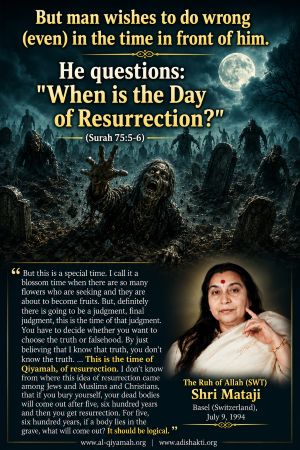
Perhaps no doctrine has caused more confusion, ridicule, and intellectual dishonesty than the belief in the literal, physical resurrection of corpses from graves. Judaism, Christianity, and Islam have all taught, with varying degrees of emphasis, that on the Day of Judgment, the dead will physically rise from their graves, their bodies will be reconstituted, and they will stand before God for judgment. This belief has been a cornerstone of faith for billions of people across millennia. It has also been one of the most powerful instruments of institutional control — the promise of bodily resurrection has been used to demand obedience, to justify martyrdom, and to threaten eternal punishment for those who deviate from orthodoxy.
Yet, as Shri Mataji has repeatedly and forcefully stated, this belief is fundamentally false. It is a gross misinterpretation of spiritual truth, perpetuated by “misinterpretation and interference from unholy people.”[11] The Paraclete has come to correct these errors and reveal the true meaning of resurrection. Her words on this subject are unequivocal and deserve to be quoted at length, for they represent the authoritative correction of one of the most consequential theological errors in human history.
Shri Mataji explained:
She further elaborated in Moscow on November 12, 1993:
And most emphatically, in Philadelphia on October 15, 1993:
Shri Mataji also recounted a conversation with a Muslim from Bosnia that illustrates with painful clarity the human cost of this false doctrine:
8. The Scientific Impossibility of Literal Resurrection
The scientific impossibility of literal bodily resurrection has been recognized by thoughtful observers for decades. Malachi Martin, in his 1970 book The Encounter: Religion in Crisis, articulated the problem with devastating clarity:
Martin continues with a passage that should be required reading for every theologian who has ever defended the doctrine of physical resurrection:
This scientific reality makes the traditional doctrine of physical resurrection not merely implausible but literally impossible. The atoms that once composed a human body are, within years of death, dispersed throughout the biosphere, incorporated into countless other organisms. To “resurrect” a body would require God to arbitrarily select certain atoms from their current locations and reassemble them, ignoring the fact that those same atoms may now be part of living beings. The logical and ethical problems with such a scenario are insurmountable. John Shelby Spong, the retired Episcopal bishop and theologian, arrived at the same conclusion in his landmark work Why Christianity Must Change or Die (1998), arguing that the literal resurrection of a physical body is a pre-modern concept that must be abandoned if Christianity is to remain intellectually credible in the modern world.[18]
9. Resurrection as Spiritual Awakening: The Metaphysical Truth
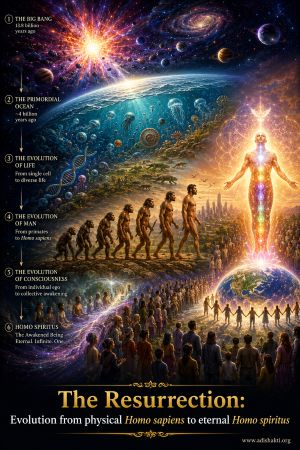
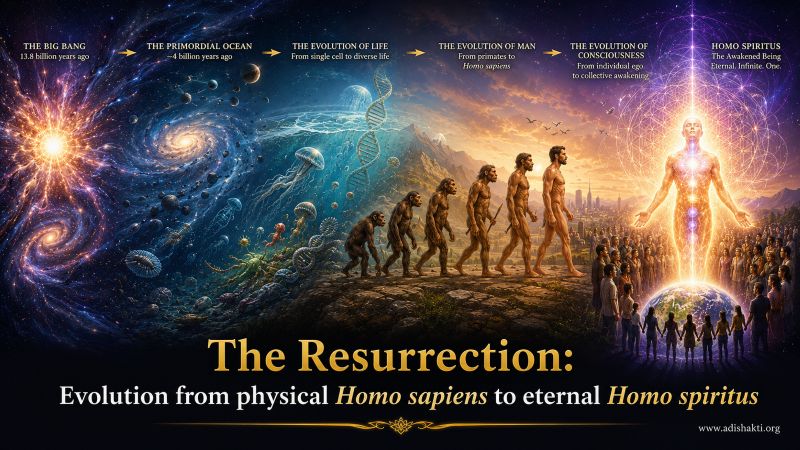
The true meaning of resurrection, as revealed by Shri Mataji, is not the reanimation of corpses but the spiritual awakening of living human beings. It is the awakening of the Kundalini energy, the dormant spiritual power that lies coiled at the base of the spine in every human being. When this energy is awakened, it rises through the subtle energy centers (chakras) and pierces the fontanel bone area at the top of the head, connecting the individual consciousness with the all-pervading Divine Consciousness. This is the true “second birth,” the baptism by the Holy Spirit, the opening of the “Kingdom of God” within.
This interpretation is not a modern innovation but a recovery of the mystical core of all religious traditions. In the Bhagavad Gita, Krishna declares: “For the soul there is neither birth nor death at any time. He has not come into being, does not come into being, and will not come into being. He is unborn, eternal, ever-existing and primeval. He is not slain when the body is slain” (2:20).[19] Jesus himself taught that “the Kingdom of God is within you” (Luke 17:21), pointing to an inner, experiential reality rather than an external, future event. In John 3:3, He declares: “Very truly, I tell you, no one can see the Kingdom of God without being born from above.” This birth from above is not a metaphor — it is the literal awakening of the Kundalini, the divine energy that rises from the Mooladhara to the Sahasrara, connecting the human soul to the Divine.
The Apostle Paul, writing in 1 Corinthians 15:44, distinguishes between the “physical body” and the “spiritual body” — a distinction that points directly to the metaphysical reality of resurrection as spiritual transformation rather than physical resuscitation. In Romans 8:11, he writes: “If the Spirit of him who raised Jesus from the dead dwells in you, he who raised Christ from the dead will give life to your mortal bodies also through his Spirit that dwells in you.” This is a present-tense promise: the Spirit that gives life is available now, to those who receive it. It is the Kundalini awakening that Shri Mataji offered freely to all humanity.
The metaphysical reinterpretation of resurrection presented by Shri Mataji resolves all the logical and scientific problems of the literal interpretation. It explains how resurrection can be a present reality rather than a future hope. It makes salvation accessible to all human beings regardless of when they lived or what religion they professed. And it provides a coherent framework for understanding the relationship between the soul, the body, and the Divine. As stated on adishakti.org: “By reframing Resurrection as an inner, experiential process, this study restores theological and metaphysical coherence to a doctrine often misunderstood, aligning it with the mystical heart of the world’s great traditions. The argument culminates in the assertion that Resurrection is the universal destiny of humanity — the fulfillment of divine promise through the awakening of the Divine Consciousness within every soul.”[20]
10. The Blossom Time: All Scriptures Converge
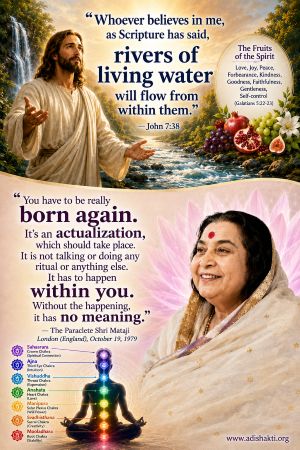
Shri Mataji called this era the “Blossom Time” — the age in which the flowers of humanity bloom into the fruits of the Spirit. This is not a poetic metaphor but a precise description of the spiritual process that is now available to every human being on earth. The Blossom Time is the convergence point of all scriptural prophecy, the moment when the promises made by every prophet and avatar across every tradition are simultaneously fulfilled.
The convergence is extraordinary. The Jewish athalta degeulah (beginning of redemption) began in 1948. The Christian promise of the Paraclete was fulfilled when Shri Mataji opened the Sahasrara in 1970 — exactly as Jesus had prophesied in John 7:38–39: “Out of the believer’s heart shall flow rivers of living water. Now He said this about the Spirit, which believers in Him were to receive; for as yet there was no Spirit, because Jesus was not yet glorified.” The Spirit could not be given until Jesus was glorified — and the glorification of Jesus through the Paraclete, as described in John 16:14, required the full forty years of Shri Mataji’s ministry from 1970 to 2011. The Islamic Al-Qiyamah is not a future cosmic catastrophe but a present spiritual reality — the resurrection of souls through Self-realization, exactly as Surah 75:16–19 promised. The Hindu Kali Yuga is drawing to its close, and the Adi Shakti has come to usher in the Satya Yuga — the Age of Truth. The Buddhist Maitreya has come as the Mother who renews the Dharma through the direct experience of the Dhamma within.
The table below summarizes the messianic convergence across traditions:
| Tradition | Messianic Figure Expected | Fulfillment in Shri Mataji | Key Scripture |
|---|---|---|---|
| Judaism | Moshiach / Shekinah | Divine Presence returned; mass awakening of souls | Daniel 12:2; Ezekiel 36:24; Joel 2:28 |
| Christianity | Paraclete / Holy Spirit / Second Coming | Paraclete promised in John 14:16 — She came | John 14:16–18, 16:13; Luke 17:21; Acts 2:17 |
| Islam | Mahdi / Ruh Allah / Al-Qiyamah | Ruh Allah incarnated; Al-Qiyamah is now | Quran 75:16–19, 75:22–25; 21:105 |
| Hinduism | Kalki / Adi Shakti | Adi Shakti incarnated to end Kali Yuga | Bhagavad Gita 4:7–8; Devi Mahatmya |
| Buddhism | Maitreya (Mother Threefold) | Mother who renews the Dharma through direct experience | Maitreya Sutras; Dhammapada |
The convergence is not forced or artificial. It emerges naturally from the inner logic of each tradition, once that logic is followed to its ultimate conclusion. Every tradition promises a time when the knowledge of God will be direct, universal, and experiential — not mediated through priests, texts, or rituals, but available to every human being as a living reality within their own consciousness. That time is now. That promise has been fulfilled. The Blossom Time is here.
11. A Resounding Denunciation of Archaic Beliefs
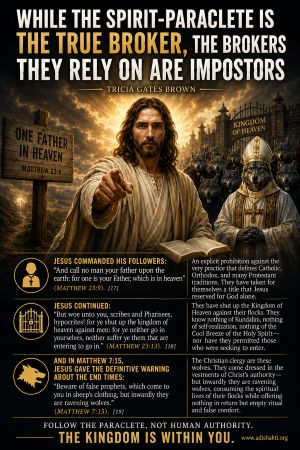
This paper must now deliver its most emphatic declaration: the archaic, non-scientific, and spiritually bankrupt beliefs that have held humanity in thrall for millennia must be unequivocally denounced and abandoned. The belief that billions of graves will burst open and decomposed corpses will be reanimated is not merely false — it is an insult to human intelligence, a barrier to genuine spiritual progress, and a catastrophic misreading of the sacred texts that contain the truth of resurrection within them. It has kept believers in a state of passive waiting, hoping for a miraculous event that will never occur as imagined, while ignoring the living spiritual reality that is available here and now.
The continued propagation of these false beliefs by religious authorities is, as Shri Mataji has stated, the result of “misinterpretation and interference from unholy people.” These doctrines have been used to control populations, to instill fear, and to maintain institutional power. They have been weaponized to justify suicide bombings, holy wars, and the persecution of those who dare to question them. They have nothing to do with genuine spirituality or the authentic teachings of the prophets and avatars who founded these religions. Jesus did not die so that His followers would spend two thousand years waiting for corpses to rise from graves. Muhammad did not receive the Quran so that Muslims would blow themselves up in the hope of physical resurrection. The prophets of Israel did not speak of the messianic age so that their descendants would wait indefinitely for a political figure to rebuild a physical temple.
The expectation of multiple, sequential messianic figures — each tradition awaiting its own distinct savior — is not merely logically untenable. It is the single greatest source of religious division and violence in human history. As long as each tradition insists that its own messiah has not yet come, it will regard all other traditions as spiritually deficient, awaiting a correction that only its own savior can provide. This framework makes genuine interfaith dialogue impossible, because each tradition is, at its eschatological core, waiting for an event that will prove all other traditions wrong. The only exit from this impasse is the recognition that the one divine manifestation has already come — and that She came for all of humanity, not for any single tradition.
The time has come for humanity to abandon these superstitions and embrace the truth that has been revealed by the Paraclete, the Holy Spirit, the Adi Shakti. There will be no graves bursting open. There will be no physical bodies rising from the earth. There will be no external judgment by an angry God. Instead, there is the possibility — indeed, the promise — of spiritual awakening, of Self-realization, of the direct experience of the Divine within. This is the true resurrection, and it is available to every human being who sincerely seeks it.
12. Conclusion: The Time for Awakening Is Now
The central argument of this paper can be summarized in three propositions. First, it is logically impossible that each expected messianic figure of Judaism, Christianity, Islam, Hinduism, and Buddhism will appear one after another in sequential divine interventions. The only coherent interpretation is that all messianic prophecies refer to a single divine manifestation understood differently by various traditions. Second, that manifestation has already occurred in the person of Shri Mataji Nirmala Devi, who opened the Sahasrara Chakra in 1970 and made mass Self-realization possible for the first time in human history. Third, the belief in the literal, physical resurrection of corpses from graves is scientifically impossible and spiritually false; the true meaning of resurrection is the spiritual awakening of living human beings through the awakening of the Kundalini. The Messianic Age has dawned. The Paraclete has come. The time for awakening is now.
The fact that no messianic figure has appeared in the traditional sense since the 1948 birth of Israel — other than the Paraclete Shri Mataji — makes the continued waiting a moot point. As stated emphatically on adishakti.org: “None will because the Shri Mataji has fulfilled the role of THE messianic figure simultaneously as the incarnation of the Divine Feminine (Paraclete, Holy Spirit, Messiah, Shekinah, Ruh Allah, Devi etc.).”[21]
The millennia-old false belief and indoctrination of Jews, Christians, and Muslims about the promised and divinely ordained Resurrection has been thoroughly debunked by Shri Mataji. The teachings available at adishakti.org provide comprehensive documentation of this revelation. The time for denial is over. The time for awakening is now.
Humanity stands at a crossroads. We can continue to cling to archaic beliefs that contradict both reason and science, waiting for events that will never occur as imagined. Or we can embrace the living truth that has been revealed by the Divine Mother, experience our own Self-realization, and enter into the Kingdom of God that exists within each of us. The choice is ours, but the opportunity will not remain open indefinitely. As Shri Mataji warned: “How many will come? That’s the point. How many are going to come?”[22]
The messianic age has dawned. The Paraclete has come. The resurrection is happening now, not in the graves of the dead but in the awakening consciousness of the living. Those who have eyes to see, let them see. Those who have ears to hear, let them hear. The time for awakening is now.
References
[1] “Birth of Israel 1948 — Crisis of Athalta Degeulah and the Missed Messiah.” AdiShakti.org.[2] The Holy Bible. Daniel 12:2; Isaiah 11:6; Zechariah 14:9. New Revised Standard Version.
[3] “Surah 75:16–19 — It is for Us to Collect and Explain.” AdiShakti.org.
[4] “Birth of Israel 1948 — Crisis of Athalta Degeulah and the Missed Messiah.” AdiShakti.org.
[5] Jacobs, Louis. The Jewish Religion: A Companion. Oxford University Press, 1995, p. 150.
[6] Parfitt, Tudor. The Road to Redemption: The Jews of the Yemen 1900–1950. Brill, 1997, p. 180.
[7] “Birth of Israel 1948 — Crisis of Athalta Degeulah and the Missed Messiah.” AdiShakti.org.
[8] Shri Mataji Nirmala Devi. Speech delivered December 2, 1979. Quoted in “I Will Tell You All the Secrets.” AdiShakti.org.
[9] Shri Mataji Nirmala Devi. Speech delivered March 21, 1983. Quoted in “I Will Tell You All the Secrets.” AdiShakti.org.
[10] de Kalbermatten, Gregoire. The Advent. The Life Eternal Trust Publishers, 1979, p. 55.
[11] Shri Mataji Nirmala Devi. Quoted in “Holy Spirit of Resurrection: Science vs Religions.” AdiShakti.org.
[12] Shri Mataji Nirmala Devi. Quoted in “Birth of Israel 1948 — Crisis of Athalta Degeulah and the Missed Messiah.” AdiShakti.org.
[13] Shri Mataji Nirmala Devi. Speech delivered in Moscow, Russia, November 12, 1993. Quoted in “Holy Spirit of Resurrection: Science vs Religions.” AdiShakti.org.
[14] Shri Mataji Nirmala Devi. Speech delivered in Philadelphia, USA, October 15, 1993. Quoted in “Holy Spirit of Resurrection: Science vs Religions.” AdiShakti.org.
[15] Shri Mataji Nirmala Devi. Speech delivered in Philadelphia, USA, October 15, 1993. Quoted in “Birth of Israel 1948 — Crisis of Athalta Degeulah and the Missed Messiah.” AdiShakti.org.
[16] Martin, Malachi. The Encounter: Religion in Crisis. Farrar, Straus and Giroux, 1970, p. 286.
[17] Martin, Malachi. The Encounter: Religion in Crisis. Farrar, Straus and Giroux, 1970, p. 286.
[18] Spong, John Shelby. Why Christianity Must Change or Die. HarperCollins, 1998.
[19] Bhagavad Gita 2:20. Trans. A.C. Bhaktivedanta Swami Prabhupada. The Bhaktivedanta Book Trust, 1972.
[20] “A Metaphysical Reinterpretation of the Resurrection: The Eternal Soul and the Return to the Divine Mother.” AdiShakti.org.
[21] “Adi Shakti: The Divine Feminine.” AdiShakti.org.
[22] Shri Mataji Nirmala Devi. Speech delivered in Philadelphia, USA, October 15, 1993. Quoted in “Holy Spirit of Resurrection: Science vs Religions.” AdiShakti.org.
💬 Interactive Chat
Access an intelligent analysis environment where you can explore texts, ask questions, and discover connections between ideas.
Open chat →