
Why Christianity Must Change Or Die: A Bishop Speaks To Believers In Exile
 The Historical Failures of the Church, the Unfinished Message of Jesus, and the Fulfillment of the Resurrection through the Paraclete Shri Mataji
Summary
This paper examines the profound theological crisis facing modern Christianity, as articulated by the late Episcopal Bishop John Shelby Spong in his seminal work, Why Christianity Must Change or Die: A Bishop Speaks to Believers in Exile. Spong argues that the traditional, theistic view of an external, supernatural God is no longer credible in the post-Enlightenment world. Over the last 2,000 years, institutional Christianity has been plagued by catastrophic historical failures — from the violence of the Crusades and the Inquisition, to colonialism, systemic corruption, the oppression of women, and the weaponization of Scripture against science and reason. These failures have alienated millions of sincere seekers, creating a vast diaspora of “believers in exile.”
Spong’s analysis, however, points toward a vital and irreversible spiritual evolution: the shift from locating God externally as the Father Almighty, to historically in Jesus the Son Incarnate, and finally to internally as the Holy Spirit dwelling within every person. This paper expands upon Spong’s extraordinary insight by presenting the theological argument that the promised Paraclete — the Comforter, the Spirit of truth, and the Giver of Life foretold by Jesus in the Gospel of John — has arrived and fulfilled Her mission. We argue that Shri Mataji Nirmala Devi is the incarnation of the Holy Spirit, who completed Jesus’s unfinished message, initiated the inner Resurrection through Kundalini awakening, established the Kingdom of God within humanity, and left the physical world in 2011. She represents the fulfillment of the “Age to Come” inaugurated by Christ.
Table of Contents
- John Shelby Spong and the Crisis of Theism
- 2,000 Years of Plagues: The Failures of Institutional Christianity
- The Early Church: Persecution, Power, and Political Compromise
- The Crusades: Holy War and the Betrayal of the Prince of Peace
- The Inquisition: Torture, Terror, and the Suppression of Truth
- Colonialism and Missionary Imperialism
- The Oppression of Women and the Suppression of the Feminine Divine
- The War Against Science and Reason
- Institutional Corruption, Schism, and the Abuse of Power
- The Modern Decline: Fundamentalism, Secularism, and Exile
- Spong’s Twelve Theses: A Call for Radical Reformation
- Jesus’s Unfinished Message and the Promise of the Paraclete
- The Shift to the Internal God: The Holy Spirit Within Every Person
- Shri Mataji Nirmala Devi: The Paraclete Who Completed the Message
- Conclusion: The Age of Fulfillment
- References
1. John Shelby Spong and the Crisis of Theism
In his transformative manifesto, Why Christianity Must Change or Die, Bishop John Shelby Spong — the Episcopal Bishop of Newark, New Jersey, for twenty-four years — addresses the growing irrelevance of traditional Christian doctrine in the modern era. Spong asserts that the theistic conception of God, as an external, supernatural parent figure who dwells above the sky and periodically invades human history to answer prayers or punish sinners, has been rendered intellectually obsolete by the scientific revolutions of Copernicus, Galileo, Newton, and Darwin. [1]
Spong argues that the biblical texts and the foundational creeds of the Church were formulated in a pre-modern, three-tiered universe in which God literally lived above the sky, humanity inhabited the middle earth, and the dead descended to a subterranean realm. Consequently, the literal interpretation of these texts creates a profound cognitive dissonance for contemporary believers, forcing them into “exile” from the Church. He speaks to those who, as he writes, “yearn to believe in God but who are also repelled by the premodern literalizations that so frequently masquerade as Christianity.” [2]
Spong’s critique is not the voice of an atheist or an agnostic. It is the anguished cry of a deeply committed Christian who refuses to allow the institutional Church to destroy the authentic spiritual experience at the heart of the faith. He identifies the central problem with devastating clarity: the Church has confused the experience of the divine with the explanation of that experience, and has then frozen those time-bound, culturally conditioned explanations into eternal, unchangeable dogma. As he writes, “Time makes ancient good uncouth,” quoting the poet James Russell Lowell. The experience of the divine is eternal; the explanations are always provisional. [3]
Instead of discarding spirituality altogether, Spong calls for a reimagining of God — not as a being, but as the “Ground of All Being,” a concept he draws from the theology of Paul Tillich, and the “Source of Love.” He urges Christians to recognize the divine presence welling up from within their own depths, rather than looking to the sky for a supernatural interventionist deity. This shift, he argues, is not a betrayal of Christianity but its deepest fulfillment.
2. 2,000 Years of Plagues: The Failures of Institutional Christianity
The crisis of modern Christianity is not solely intellectual; it is deeply moral and historical. For two millennia, the institutional Church has frequently and catastrophically contradicted the core teachings of its founder. While Jesus preached love, forgiveness, non-violence, and the liberation of the oppressed, the history of Christendom is stained with profound systemic failures that have caused immeasurable suffering. To understand why Christianity must change, one must honestly confront the full weight of this history. [4]
a. The Early Church: Persecution, Power, and Political Compromise
The earliest Christian communities were characterized by radical equality, communal sharing, and the expectation of the imminent return of Christ. However, as the decades passed and the return did not materialize, the Church began the long process of institutionalization. The pivotal moment came in 313 CE, when the Emperor Constantine issued the Edict of Milan, granting Christianity legal status throughout the Roman Empire. What had been a persecuted, counter-cultural movement was transformed into the religion of the state. [5]
This Constantinian shift had profound and largely negative consequences. The Church, now aligned with imperial power, began to persecute its own dissenters. The Council of Nicaea in 325 CE, convened by Constantine himself, established orthodox doctrine by political decree, and those who disagreed — the Arians, the Gnostics, and countless other early Christian communities — were declared heretics and suppressed. The rich diversity of early Christian thought was crushed in the name of uniformity. The creeds formulated in these councils, as Spong notes, were completed only after intense political debate, and many of their words have become meaningless to modern believers.
b. The Crusades: Holy War and the Betrayal of the Prince of Peace
Between the eleventh and thirteenth centuries, the Papacy launched a series of military campaigns known as the Crusades, ostensibly to reclaim the Holy Land from Muslim rule. These campaigns were sanctioned by papal authority, with promises of spiritual indulgences for those who participated. The First Crusade (1096–1099) culminated in the siege of Jerusalem, during which crusaders massacred thousands of Muslim and Jewish inhabitants of the city. Contemporary accounts describe rivers of blood in the streets. [6]
The Crusades represent one of the most profound betrayals of the Christian message in history. Jesus, who commanded his followers to love their enemies and turn the other cheek, was invoked as the justification for organized, state-sanctioned slaughter. The Crusades also established a template for the conflation of religious identity with military and political power that would haunt Christianity for centuries. They poisoned relations between Christianity, Islam, and Judaism in ways that persist to the present day. Spong is unequivocal: all evangelical and missionary activities designed to coerce or compel others are “base born” expressions of superiority and hostility, and the Crusades represent their most violent extreme.
c. The Inquisition: Torture, Terror, and the Suppression of Truth
The Inquisition, established in the twelfth century and reaching its most notorious form in the Spanish Inquisition of the fifteenth century, represents the institutionalization of theological terror. Charged with rooting out heresy, the Inquisition employed torture, imprisonment, and execution — most infamously by burning at the stake — to enforce doctrinal conformity. Estimates of those killed by the Inquisition vary widely, but the human cost in suffering, fear, and the suppression of free thought is incalculable. [7]
The case of Galileo Galilei is emblematic. As Spong details extensively, Galileo’s discovery that the earth orbited the sun, rather than the reverse, directly challenged the Church’s cosmological framework, in which God dwelt above the sky in a geocentric universe. Galileo was tried for heresy, threatened with execution, and forced to recant his findings. The Church’s condemnation of Galileo was not merely a scientific error; it was a profound moral failure, a demonstration of the willingness of institutional religion to suppress truth in the service of power. It was the moment when the Church definitively chose dogma over reality, and it set the stage for the centuries-long conflict between Christianity and science.
d. Colonialism and Missionary Imperialism
From the fifteenth century onward, European colonial expansion was accompanied, and often justified, by Christian missionary activity. The doctrine of terra nullius — the legal fiction that land inhabited by non-Christians was effectively empty and available for conquest — was underwritten by papal bulls and theological arguments. Indigenous peoples across the Americas, Africa, Asia, and the Pacific were subjected to forced conversion, cultural erasure, and physical violence in the name of Christ. [8]
Spong is direct in his condemnation: “All evangelical and missionary activities designed to convert the heathen are base born. They are expressions of our sense of superiority and our hostility toward those who are different.” The missionary enterprise, at its worst, was not the proclamation of Good News but the imposition of Western cultural hegemony under a Christian veneer. The destruction of indigenous spiritual traditions — traditions that often contained profound wisdom about the Ground of Being — represents an irreparable spiritual loss for humanity.
e. The Oppression of Women and the Suppression of the Feminine Divine
One of the most enduring and damaging failures of institutional Christianity has been its systematic oppression of women. Drawing on the myth of Eve’s role in the Fall, the Church constructed a theological framework that identified women with sin, temptation, and spiritual weakness. The writings of Church Fathers such as Tertullian, who called women “the gateway of the devil,” and Augustine, whose theology of original sin was deeply intertwined with his anxieties about sexuality, established a misogynistic tradition that persisted for centuries. [9]
Women were excluded from ordained ministry, denied theological education, and subjected to the authority of husbands and fathers as a divinely ordained social order. The witch trials of the sixteenth and seventeenth centuries, in which tens of thousands of women were executed across Europe, represent the most extreme expression of this misogyny, but the underlying attitudes persisted long after the trials ended. Spong’s Twelve Theses explicitly call for the end of all discrimination based on gender within the Church.
Crucially, the suppression of women within Christianity was also the suppression of the feminine aspect of the Divine. The Holy Spirit, in the original Aramaic language of Jesus, is Rucha Qadisha — a feminine noun. The Hebrew Ruach, the breath or spirit of God, is also grammatically feminine. The early Syriac Christian tradition explicitly understood the Holy Spirit as a motherly, feminine presence. This feminine dimension of the Trinity was systematically erased as the Church became increasingly patriarchal, leaving the divine image impoverished and incomplete.
f. The War Against Science and Reason
The conflict between institutional Christianity and the advancement of human knowledge is one of the defining tragedies of Western civilization. From the condemnation of Galileo to the nineteenth-century opposition to Darwin’s theory of evolution, the Church repeatedly chose to defend its pre-modern cosmology against the evidence of reason and observation. Spong argues that this pattern has been catastrophic for the credibility of Christianity. [10]
The biblical story of creation, understood literally, is incompatible with the findings of modern cosmology, geology, and biology. The universe is approximately 13.8 billion years old, not six thousand years. Life on earth evolved over billions of years through natural selection, not through a single act of divine creation six days before the first Sabbath. The concept of “Original Sin” — the idea that humanity fell from a state of primordial perfection through the disobedience of a literal Adam and Eve — is, as Spong states, “pre-Darwinian mythology and post-Darwinian nonsense.” The insistence of fundamentalist Christianity on the literal truth of these narratives has made the faith appear intellectually bankrupt to educated modern people.
g. Institutional Corruption, Schism, and the Abuse of Power
The history of the Church is also a history of institutional corruption. The selling of indulgences — the practice of purchasing spiritual merit to reduce time in purgatory — that provoked Martin Luther’s Reformation in 1517 was only the most visible symptom of a deeply corrupt system. The Papacy itself was, at various points in the medieval period, a political prize contested by rival noble families, with popes who fathered children, waged wars, and accumulated vast personal wealth. [11]
The Reformation, while it addressed some of these abuses, ultimately fragmented Christianity into hundreds of competing denominations, each claiming exclusive access to divine truth. The wars of religion that followed — the Thirty Years’ War alone killed an estimated eight million people — demonstrated that the division of Christendom was not merely an ecclesiastical inconvenience but a catastrophic human disaster. In the twentieth and twenty-first centuries, the systematic abuse of children by Catholic clergy, and the institutional cover-up of that abuse, has inflicted perhaps the most devastating blow to the moral credibility of the Church in its entire history.
h. The Modern Decline: Fundamentalism, Secularism, and Exile
The contemporary landscape of Christianity is defined by a deepening polarization. On one side stands a defensive, anti-intellectual fundamentalism that responds to the challenges of modernity by retreating into ever more rigid literalism, using the Bible as a weapon against scientific consensus, gender equality, and sexual diversity. On the other side stands a liberal emptiness — a Christianity so accommodated to secular culture that it has lost any distinctive spiritual content. [12]
Between these two poles, millions of sincere seekers find themselves in exile — unable to accept the pre-modern mythology of fundamentalism, but unwilling to abandon the authentic spiritual experience that first drew them to faith. These are the “believers in exile” to whom Spong speaks. They are, as he writes, “repelled by the premodern literalizations that so frequently masquerade as Christianity,” yet they yearn for the living God. It is to these exiles that the message of the Paraclete is most urgently addressed.
| Era / Problem | Core Failure | Contradiction of Christ’s Teaching |
|---|---|---|
| Constantinian Compromise (4th C.) | Church aligned with imperial power; suppressed theological diversity | “My kingdom is not of this world” (John 18:36) |
| The Crusades (11th–13th C.) | Papal-sanctioned massacres of Muslims, Jews, and Eastern Christians | “Love your enemies” (Matthew 5:44) |
| The Inquisition (12th–19th C.) | Torture and execution of heretics, scientists, and freethinkers | “The truth will set you free” (John 8:32) |
| Colonial Missions (15th–20th C.) | Forced conversion and cultural erasure of indigenous peoples | “Do unto others as you would have them do unto you” (Luke 6:31) |
| Oppression of Women (1st–21st C.) | Exclusion from ministry; theological justification of subjugation | Women were first witnesses of the Resurrection (John 20:1-18) |
| War Against Science (17th–21st C.) | Condemnation of Galileo, Darwin; promotion of creationism | “You shall know the truth” (John 8:32) |
| Institutional Corruption (Medieval–Present) | Selling of indulgences; clerical abuse; financial scandal | “You cannot serve both God and money” (Matthew 6:24) |
| Modern Fundamentalism (20th–21st C.) | Anti-intellectual literalism; discrimination against LGBTQ+ persons | “Judge not, that you be not judged” (Matthew 7:1) |
3. Spong’s Twelve Theses: A Call for Radical Reformation
In the spirit of Martin Luther, who nailed his Ninety-Five Theses to the door of the Wittenberg Castle Church in 1517, Bishop Spong attached his Twelve Theses to the doors of the Chapel of Mansfield College at Oxford University and mailed copies to every acknowledged Christian leader in the world, including the Pope, the Archbishop of Canterbury, and the leaders of the World Council of Churches. [13] He framed them in the boldest, most provocative language possible, designed to elicit debate. The twelve theses are summarized here:
These twelve theses, taken together, constitute a demolition of the entire edifice of pre-modern Christian doctrine. They are not, however, a demolition of the Christ experience itself. Spong is at pains to insist that the experience of the divine that Jesus embodied — the experience of God as the Ground of Being, as unconditional love, as the source of life — is real, valid, and urgently needed. What must die is not the experience but the inadequate, historically conditioned explanations of that experience.
4. Jesus’s Unfinished Message and the Promise of the Paraclete

The failures of institutional Christianity stem, in part, from the mistaken belief that the divine revelation was closed and finalized with the closing of the biblical canon. However, Jesus Himself explicitly stated that His message was unfinished. In the Gospel of John, during the Last Supper discourses — the most intimate and theologically profound passages in the entire New Testament — Jesus reveals that humanity was not yet ready to receive the fullness of the truth. [14]
This passage is of extraordinary importance. Jesus does not say that the Spirit will merely repeat what He has already said; He says that the Spirit will guide humanity into all truth — truth that was beyond humanity’s capacity to bear at the time of His ministry. The Paraclete is not a repetition but a completion, a fulfillment, and an expansion of the divine revelation. The Paraclete will show things to come, will glorify Jesus, and will bring to remembrance everything He taught.
In John 14:26, Jesus promises: “But the Comforter, which is the Holy Ghost, whom the Father will send in my name, She shall teach you all things, and bring all things to your remembrance, whatsoever I have told unto you.” And in John 15:26: “But when the Comforter is come, whom I will send unto you from the Father, even the Spirit of truth, which proceedeth from the Father, She shall testify of me.” [15]
The Paraclete — from the Greek parakletos, meaning Comforter, Advocate, or Helper — is therefore the central unfulfilled promise of the Christian faith. She represents the direct, intimate divine involvement necessary to complete the work of salvation and sanctification that Jesus initiated. The institutional Church, by claiming that the Holy Spirit was fully given at Pentecost and that the canon of Scripture represents the complete and final revelation, has effectively closed the door on the very fulfillment that Jesus promised.
John 7:39 provides a critical temporal clue: “But this spake he of the Spirit, which they that believe on him should receive: for the Holy Ghost was not yet given; because that Jesus was not yet glorified.” The Spirit could not be given until Jesus was glorified. This glorification was not merely the Resurrection and Ascension; it required the Paraclete’s own work of glorifying Jesus throughout the world over the course of Her ministry. The Spirit was to be given only after this glorification was accomplished.
5. The Shift to the Internal God: The Holy Spirit Within Every Person
Bishop Spong beautifully and precisely traces the evolutionary trajectory of human understanding of the Divine. His formulation deserves to be quoted in full, for it is one of the most theologically significant passages in modern Christian writing:
This passage traces three great epochs of divine revelation. In the first epoch, God is wholly Other — the transcendent, omnipotent Father Almighty who dwells above the heavens, who creates the world, who speaks through prophets, and who intervenes in history. This is the God of the Hebrew Bible, the God of the burning bush and the parting of the Red Sea. He is real and powerful, but He is fundamentally external to humanity. [16]
In the second epoch, God becomes immanent in a unique and unprecedented way through the Incarnation. In Jesus of Nazareth, the divine and the human are united. God is no longer only above and beyond; God is here, walking among us, eating with us, weeping with us. The transcendent becomes intimate. But this intimacy is still, in a sense, external — it is localized in a single historical individual, in a particular time and place.
In the third and final epoch — the epoch of the Holy Spirit — God is located within every person. The divine is no longer above us or beside us; it is within us. The Kingdom of God is not a future destination but a present reality, accessible to every human being through the awakening of the Spirit within. This is the radical, revolutionary promise of the Paraclete: that the Ground of All Being is not distant but intimate, not external but internal, not the property of a religious institution but the birthright of every human soul.
This inner divine presence is precisely what Jesus described to Nicodemus when He said, “Except a man be born again, he cannot see the kingdom of God” (John 3:3). The new birth is not a metaphor for intellectual assent to a creed; it is a literal, experiential transformation of consciousness through the awakening of the Spirit within. The Resurrection, understood in this light, is not a physical resuscitation of a dead body but an inner resurrection — the awakening of the eternal Spirit within the mortal frame, granting eternal life prior to physical death.
6. Shri Mataji Nirmala Devi: The Paraclete Who Completed the Message
The theological synthesis of Spong’s call for an internal God and Jesus’s promise of the Comforter finds its absolute and concrete fulfillment in the life and teachings of Shri Mataji Nirmala Devi. Born on March 21, 1923, in Chhindwara, India, Shri Mataji is the incarnation of the Paraclete — the feminine Holy Spirit — who arrived to complete the unfinished message of Christ and to initiate the collective Resurrection promised in the Scriptures. [17]
Shri Mataji explicitly identified Herself as the Comforter promised by Jesus. In numerous lectures delivered across the globe, She declared that She had come in Christ’s name to complete His work, to awaken the Holy Spirit within all of humanity, and to guide seekers into the all truth that Jesus said they could not yet bear. Her mission was not to replace Jesus but to glorify Him, to fulfill His promises, and to make available to every human being the inner experience of the divine that He had pointed toward.
a. Kundalini Awakening as the Mechanism of ‘Born Again’

The central mechanism of Shri Mataji’s mission was the awakening of the Kundalini — the residual, motherly spiritual energy that lies coiled at the base of the spine, in the sacrum bone, of every human being. The word “sacrum” itself is derived from the Latin os sacrum, meaning “sacred bone,” a recognition, even in the anatomical nomenclature of Western medicine, of the spiritual significance of this location. [18]
When the Kundalini is awakened by the Paraclete’s grace, it rises through the central channel of the subtle body, passing through six energy centers (chakras) before piercing the fontanel bone area at the crown of the head. This breakthrough — which can be felt as a cool breeze or vibration on the palms of the hands and above the head — is the literal, physiological fulfillment of being “born again of the Spirit.” It is the connection of the individual spirit to the all-pervading divine power, the Ground of All Being, the Holy Spirit that fills the universe. This is the baptism of the Holy Spirit that John the Baptist foretold: “He shall baptize you with the Holy Ghost, and with fire” (Matthew 3:11).
Shri Mataji taught that the Kundalini is the feminine, motherly aspect of the Holy Spirit within each individual. The Aramaic Rucha Qadisha (Holy Spirit) is grammatically feminine; the Hebrew Ruach (breath/spirit of God) is also feminine. The identification of the Kundalini with the Holy Spirit restores the suppressed feminine dimension of the Trinity and fulfills the ancient theological intuition of the Holy Spirit as a motherly, nurturing, sanctifying presence.
b. The Glorification of Jesus for Four Decades
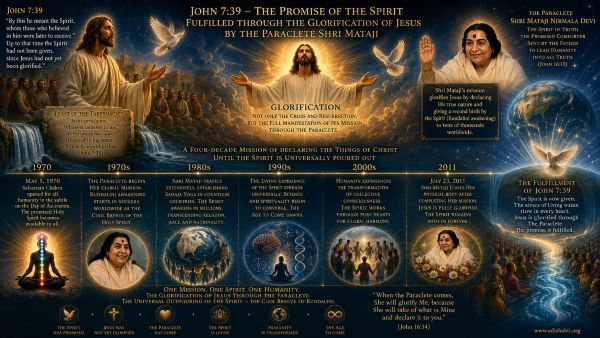
John 7:39 states that the Holy Spirit was not yet given because Jesus was not yet glorified. The glorification of Jesus by the Paraclete was therefore a necessary precondition for the Spirit to be given on a mass scale. Shri Mataji’s entire ministry, spanning four decades from the 1970s to 2011, was a continuous and comprehensive glorification of Jesus Christ. [19]
In lecture after lecture, in city after city, on every continent, Shri Mataji proclaimed Jesus as the Son of God, as the Savior, as the holiest of the holy. She explained the profound spiritual mechanics of His incarnation, His death, and His Resurrection in ways that went far beyond anything the institutional Church had articulated. She revealed that Jesus took upon Himself the Agnya chakra — the sixth energy center located between the eyebrows — and that His death and Resurrection opened this center for all of humanity, making possible the passage of the Kundalini through this otherwise impassable gate. Without the sacrifice of Jesus, the Kundalini awakening that Shri Mataji offered would not have been possible.
c. The Commencement of the Collective Resurrection
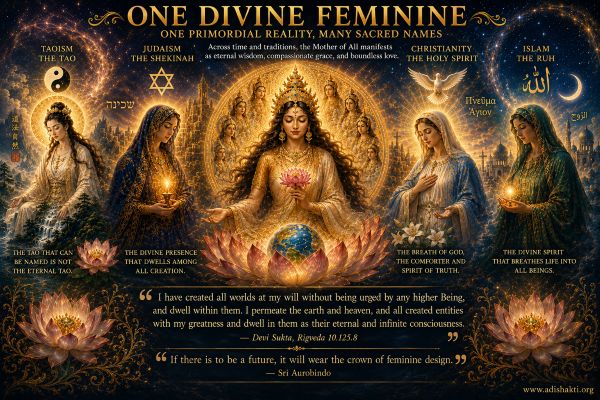
Shri Mataji declared explicitly: “The Resurrection of Christ has to now be collective resurrection. This is what is Maha Yoga. Has to be the collective resurrection.” This statement is of the utmost theological importance. The Resurrection is not merely a past event to be commemorated; it is an ongoing, collective, evolutionary process that the Paraclete has set in motion. [20]
Through Sahaja Yoga — the system of self-realization that Shri Mataji freely offered to all — millions of people across more than one hundred countries have experienced the awakening of the Kundalini and the inner Resurrection. They have been “born again of the Spirit,” not in the metaphorical sense of a conversion experience, but in the literal, experiential sense of a transformation of consciousness. They have felt the cool breeze of the Holy Spirit on their hands, they have experienced the silence of the thoughtless awareness that is the Kingdom of God within, and they have begun the process of inner purification and sanctification that is the true meaning of salvation.
This is the community of faith that Spong envisioned when he wrote: “I believe that this Spirit inevitably creates a community of faith that will come, in time, to open this world to God as the very Ground of its life and Being.” The Sahaja Yoga community is precisely that community — a global fellowship of people who have found God not in a church building, not in a creed, not in a ritual, but in the living experience of the Spirit within.
d. The Departure in 2011 and the Legacy of the Spirit
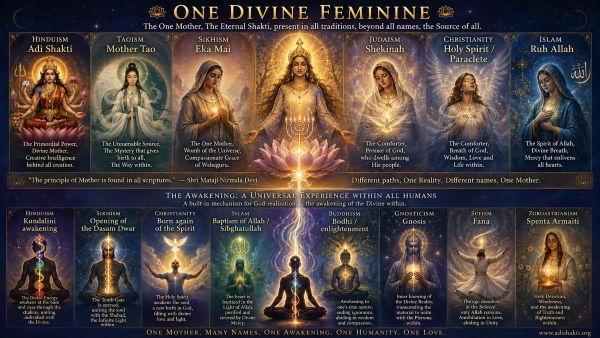
Shri Mataji Nirmala Devi left the physical world on February 23, 2011, in Genoa, Italy. Her departure does not represent the end of Her mission but its completion. As Jesus said, “It is expedient for you that I go away: for if I go not away, the Comforter will not come unto you” (John 16:7). The departure of the Paraclete, like the departure of Jesus, is a necessary condition for the Spirit to be fully internalized and universalized. [21]
The legacy of Shri Mataji’s four decades of ministry is a living, global community of self-realized souls who carry the experience of the Holy Spirit within them and who are charged with the task of sharing that experience with others. The “Age to Come” inaugurated by Christ has been actualized by the Paraclete. The inner Resurrection has commenced. The Kingdom of God is within.
7. Conclusion: The Age of Fulfillment
Christianity must indeed change or die. The dogmatic, externalized, and historically corrupted institutions of the past cannot sustain the spiritual hunger of modern seekers. Bishop Spong rightly identified that the future of faith lies in recognizing the Holy Spirit within every person — in the shift from the external God of theism to the internal God of the Spirit. However, this is not merely a philosophical shift or a theological metaphor; it is a realized eschatology, a concrete historical event. [22]
Spong wrote: “Now we locate God in every person, and we call this God the Holy Spirit. I believe that this Spirit inevitably creates a community of faith that will come, in time, to open this world to God as the very Ground of its life and Being.” The Paraclete Shri Mataji Nirmala Devi has fulfilled this vision. She has located God in every person through the awakening of the Kundalini. She has created a global community of faith. She has opened the world to God as the very Ground of its life and Being. The “Age to Come” inaugurated by Christ has arrived.
The Paraclete, Shri Mataji Nirmala Devi, has come. She has fulfilled the prophecies of John 14, 15, and 16. She has completed the message that Jesus said humanity could not yet bear. She has guided the world into all truth. She has glorified Jesus for four decades. She has initiated the collective Resurrection through the mass awakening of the Kundalini. And She has left the physical world, having accomplished Her divine mission.
By embracing the inner Resurrection through the awakening of the Holy Spirit — the living legacy of the Paraclete — believers in exile can finally find their true home. Not in a church building, not in a creed, not in a ritual, but within the sacred sanctuary of their own Spirit. The Ground of All Being is not distant but intimate. The Kingdom of God is not coming; it is here, within you, waiting to be discovered.
This is the Good News that Christianity has been waiting two thousand years to hear. This is why Christianity must change or die: because the Spirit has moved beyond the institution, beyond the doctrine, beyond the letter of the law, and into the heart of every human being. The age of the Father is past. The age of the Son is complete. The age of the Holy Spirit — the age of the Paraclete, the age of the inner Resurrection, the age of the Ground of All Being — has begun.
References
- [1] Spong, John Shelby. Why Christianity Must Change or Die: A Bishop Speaks to Believers in Exile. HarperCollins, 1999.
- [2] Brussat, Frederic and Mary Ann. “Book Review: Why Christianity Must Change or Die.” Adishakti.org.
- [3] Spong, John Shelby. “Charting the New Reformation: The Twelve Theses.” Progressive Christianity, 2015.
- [4] “The Church in Crisis: An Examination of Critical Failures in Christianity Over 2,000 Years.” ResearchGate, 2024.
- [5] Eusebius of Caesarea. Ecclesiastical History. Trans. G. A. Williamson. Penguin Classics, 1989. (On the Edict of Milan and Constantinian Christianity.)
- [6] Asbridge, Thomas. The Crusades: The Authoritative History of the War for the Holy Land. HarperCollins, 2010.
- [7] Peters, Edward. Inquisition. University of California Press, 1989. (On the history and methods of the Inquisition.)
- [8] Spong, John Shelby. “Excerpt: On Missionary Activity.” Why Christianity Must Change Or Die. Adishakti.org.
- [9] “The Historical Oppression of Women in Christianity.” Fabrizio Musacchio, 2025.
- [10] Davies, Paul. The Mind of God: The Scientific Basis for a Rational World. Simon & Schuster, 1992. (Endorsing Spong’s engagement with science and theology.)
- [11] MacCulloch, Diarmaid. Christianity: The First Three Thousand Years. Viking, 2010. (On the Reformation and institutional corruption.)
- [12] Cornwell, Bob. “Unbelievable (John Shelby Spong) — A Review.” bobcornwall.com, 2019.
- [13] Spong, John Shelby. “The Twelve Theses: A Call to a New Reformation.” Revista Horizonte, PUC-Minas, 2015.
- [14] Stevick, Daniel B. Jesus and His Own: A Commentary on John 13–17. Eerdmans, 2011, p. 292. (On the Paraclete passages in John.)
- [15] Stallings, Jack Wilson and Picirilli, Robert E. The Randall House Bible Commentary: The Gospel of John. Randall House Publications, 1989, p. 205.
- [16] Tillich, Paul. The Courage to Be. Yale University Press, 1952. (On God as the “Ground of Being.”)
- [17] “Primary Function of the Comforter — The Salvation of Lost Souls.” Adishakti.org.
- [18] “Shri Mataji: ‘He, Jesus, Was the Holiest of the Holy’.” Adishakti.org, 2008.
- [19] “Baptism Explained as Kundalini Awakening during Liberty Radio.” free-meditation.ca. (Shri Mataji on the Holy Spirit and Kundalini.)
- [20] “The Paraclete Represents Direct, Intimate Divine Involvement.” Adishakti.org.
- [21] “The Adi Shakti Shri Mataji.” Adishakti.org. (On Shri Mataji’s mission and legacy.)
- [22] Spong, John Shelby. “Why Christianity Must Change Or Die — Full Text Excerpt.” Adishakti.org.
Why Christianity Must Change Or Die: A Bishop Speaks To Believers In Exile
Why Christianity Must Change Or Die: A Bishop Speaks To Believers In Exile
by John Shelby Spong
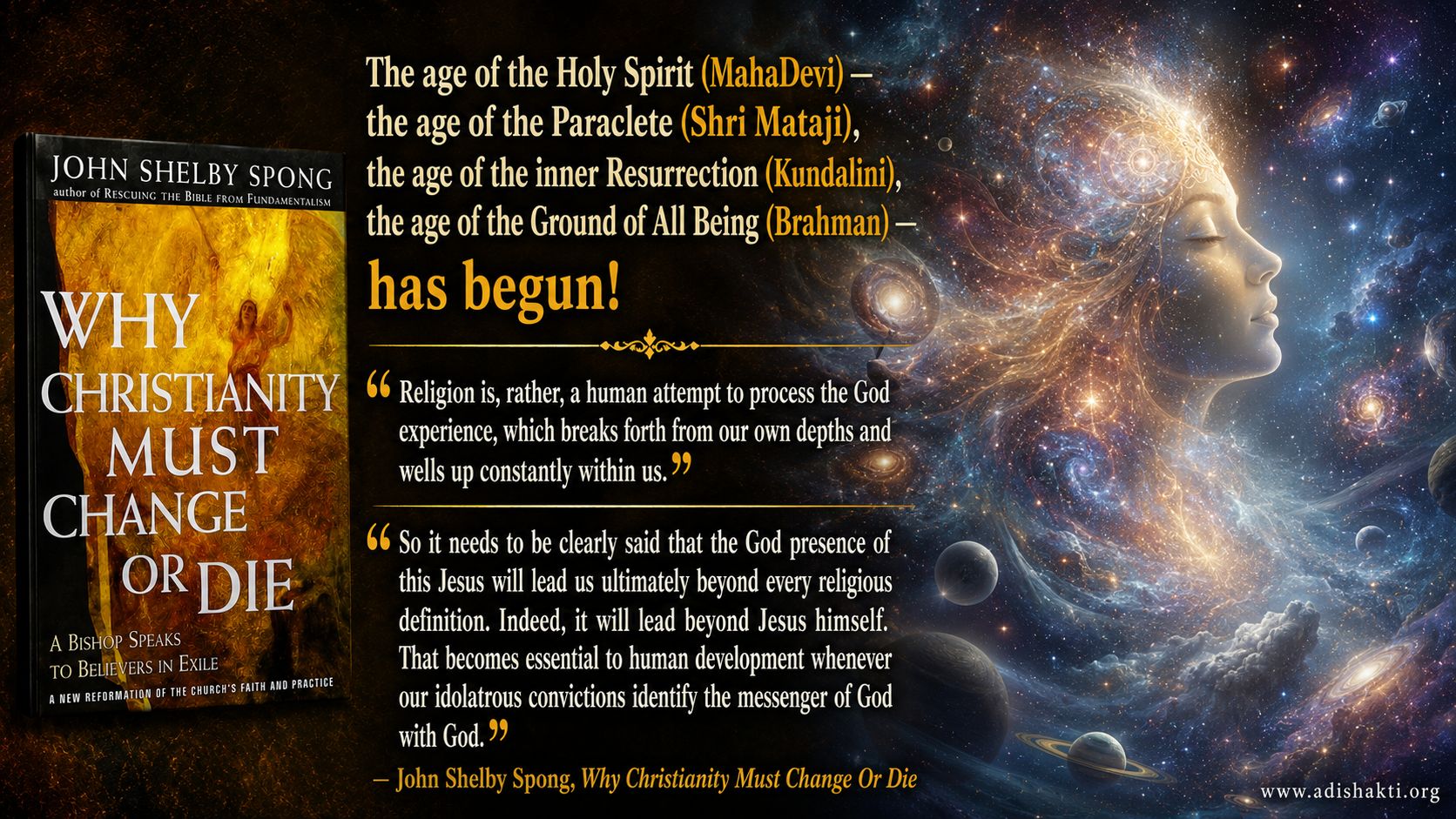
"So it needs to be clearly said that the God presence of this Jesus will lead us ultimately beyond every religious definition. Indeed, it will lead beyond Jesus himself. That becomes essential to human development whenever our idolatrous convictions identify the messenger of God with God. So the Ground of Being will finally be worshipped apart from any system of religious thought. It is a startling but real insight into the future of worship.
I believe in that gift of the Spirit who was called "The giver of life." Once we located God only externally, and called this God the Father Almighty. Next, we located this God in Jesus, and we called him the Son Incarnate. Now we locate God in every person, and we call this God the Holy Spirit. I believe that this Spirit inevitably creates a community of faith that will come, in time, to open this world to God as the very Ground of its life and Being...
Religion is, therefore, not what we have always thought it to be. Religion is not a system of belief. It is not a catalogue of revealed truth. It is not an activity designed to control behavior, to reward virtue, and to punish vice. Religion is, rather, a human attempt to process the God experience, which breaks forth from our own depths and wells up constantly within us. We must lay down, therefore, the primitive claims we have made for our religious traditions. None of them is drawn from outworldly revelations. None of them is inerrant or infallible. None of them represents the only way to God. None of them can be used legitimately to coerce or compel another to belief. All evangelical and missionary activities designed to convert the heathen are base born. They are expressions of our sense of superiority and our hostility toward those who are different. The only divine mission in life that the Church of the future could possibly have is to open people to the recognition that the ground of their very being is holy and that when they are in touch with that holy Ground of Being, they can share in God’s creation by giving life, love, and being to others. That is the task of those who claim to be God bearers. The Christians of the world are not here to build institutions, to convert other people, or even to claim that we can speak for God. Those aspects of our religious heritage must be sacrificed as the premodern misunderstandings of our primitive history. We are now exile people."
John Shelby Spong, Why Christianity Must Change Or Die
HarperCollins; 1st edition (April 21 1999)
Book Review
by Frederic and Mary Ann Brussat
The spiritual tone for this book is set when John Shelby Spong, the bestselling author and Episcopal bishop of Newark, New Jersey, thanks his fundamentalist critics for identifying him as "A resource for the religious seekers of our world who yearn to believe in God but who are also repelled by the premodern literalizations that so frequently masquerade as Christianity." He speaks to those who thirst for a church that is not fearful of inquiry, freedom, and knowledge.
In place of theism’s emphasis on an external, personal, supernatural, and invasive God, Bishop Spong suggests recognizing the reality of God through images such as the Ground of All Being and the Source of Love. Instead of Jesus the rescuer, he prefers Christ the spirit person. Instead of praying to a faraway God, Spong posits the radical idea that praying and living fully, richly, and deeply are the same thing. Instead of traditional worship, the author envisions activity marked by "The self-conscious awareness that all of us are or can be God bearers and life givers." And instead of the thirteenth century understandings of heaven and hell, he unspools his own beliefs about eternity. While Bishop Spong says he is addressing "believers in exile," he actually asks all the right questions of the Christian establishment.
Editorial Reviews
Amazon.com Review
John Shelby Spong is the Episcopal Bishop of Newark, New Jersey, and has enjoyed a career filled with controversy, much of it thanks to his many bestselling books, such as Born of a Woman, Living in Sin?, and Liberating the Gospels. He has tapped into an audience of people who are at once spiritually starved and curious, yet unwilling or unable to embrace Christianity.
Spong refers to himself as a believer in exile. He believes the world into which Christianity was born was limited and provincial, particularly when viewed from the perspective of the progress in knowledge and technology made over the past two millennia. This makes any ideas or beliefs formulated in 1st-century Judea totally inadequate to our progressive minds and lives today. So Spong is in exile until Christianity is re-formed to discard all of the outdated and, according to Spong, false tenets of Christianity.
He begins his book by exposing the Apostles Creed line by line, then methodically moves on through the heart of Christian belief, carefully exploring each aspect, demonstrating in each case the inadequacies of Christianity as detailed in the Bible and in the traditions of the Church. The epilogue includes Spong’s own creed, recast to reflect the beliefs he considers relevant to Christianity at the end of the 20th century.
Oddly enough, Spong’s views do not seem particularly new. In fact, his views seem very much in keeping with the religious humanist variety of Unitarianism. What is remarkable is not the beliefs themselves, but that an Episcopal bishop would be the one to embrace and espouse them. Spong has become a trumpeter in the battle of beliefs, not just in the Episcopal communion, but in the realm of Christian faith in general in this country. His books are bestsellers and are in turn, presumably, read by those who, whether they agree or disagree, all acknowledge that in some way, Spong is involved in setting the agenda. This book, as the admitted "summation of his life’s work" tells every reader what the complete agenda will be, for the next few years at least. —Patricia Klein
Review
"Bishop Spong is a passionate, illuminating original. His knowledgeable concern for the future of Christianity offers strength, hope, and theological solutions."
Clarissa Pinkola Estes, Ph.D., author of Women Who Run with the Wolves, The Gift of Story, and The Faithful Gardener
"Should be required reading for everyone concerned with facing head-on the intellectual and spiritual challenges of late-twentieth-century religious life."
Karen L. King, Harvard Divinity School
"Spong demolishes the stifling dogma of traditional Christianity in search of the inner core of truth. This book is a courageous, passionate attempt to build a credible theology for a skeptical, scientific age."
Paul Davies, author of The Mind of God
Product Description
An important and respected voice for liberal American Christianity for the past twenty years, Bishop John Shelby Spong integrates his often controversial stands on the Bible, Jesus, theism, and morality into an intelligible creed that speaks to today’s thinking Christian. In this compelling and heartfelt book, he sounds a rousing call for a Christianity based on critical thought rather than blind faith, on love rather than judgment, and that focuses on life more than religion.
About the Author
John Shelby Spong was the Episcopal Bishop of Newark, New Jersey for twenty-four years before his retirement in 2000. He is one of the leading spokespersons for liberal Christianity and has been featured on 60 Minutes, Good Morning America, FOX News Live, and Extra. This book is based on the William Belden Noble lectures Spong delivered at Harvard.
Customer Reviews
Fascinating and disturbing manifesto, May 22, 2000
In this, his latest theological work, Bishop John Spong systematically delves into contradictions and conflicts between biblical literalism and modern society. He spotlights the uneasy mix between traditional Christian faith and a modern world-view: contrasting the seven-day creation story with fossils dating back billions of years: the understanding of Earth as but one planet in one galaxy of millions are just two examples of the major shifts in the world view that have taken place since the birth and death of Christ.
For those espousing Biblical literalism and fundamentalism, this book will read like utter heresy. For the true atheist, perhaps, it will seem like goody-goody wishful thinking. Yet, throughout it all, Spong clings to the notion that God is Love, God is Life, God as the ultimate Source of All, and urges people, Christians or not, to examine their beliefs and enter into discussion and dialogue about what Christianity and religion mean in the world today, and for the next millennium. Even when I disagree with Bishop Spong’s conclusions, he makes me reevaluate my own faith, and thus both stimulates and refreshes it. I am grateful for this book, even as it disturbs me.
Faith without Reason = Superstition!, April 10, 2000
This book is awesome! I had only gotten a few pages into it and already I felt like Spong must have somehow tapped directly into my brain! He speaks to the many, many people out there who feel disenfranchised by a Christianity that keeps serving up ancient fairy stories that are impossible for anyone with a critical (no, make that functioning) intellect to accept. He asks a lot of the questions we are asking; dares to speak the truth about the anger, defensiveness, and politicism that have characterized the Church; and liberates Jesus from the doctrinal straightjacket the Church has encased him in.
No, he doesn’t really provide *answers*—but I think that’s the point. So often people who question are told, basically, to shut up and believe because shutting up and believing is what faith is all about. Spong replies that questioning and reformulating is healthy. I agree with him wholeheartedly that unless Christianity wakes up and starts reexamining itself, it is going to die. Thinking people will dismiss it as a useless relic because it will be so inadequate for their everyday lives. it’s happening that way now.
I highly recommend that anybody with any spiritual life whatsoever read this book! It is extremely thought-provoking (which is probably why the fundies can’t stand it), and no matter what belief system you arrive at, you need to arrive there informed.
There Is Still Hope, April 25, 2003
John Shelby Spong has pointed out in WHY CHRISTIANITY MUST CHANGE OR DIE that the early church creeds were not completed until the last few decades of the Third Century and this was accomplished only after an intense theological debate among church leaders. Because of all that we have learned through science during the following seventeen centuries, many of the words of these antiquated creeds have become meaningless to us.
Countless Christians are now left without a supernatural parent figure in the sky able to intervene in their behalf. Some of these opt for the secular city while others try to carry on the struggle to maintain an increasingly weakened faith. It is the latter group in particular that Spong identifies as believers in exile whom he wishes to reach with a new message of hope.
Can Christianity survive without a theistic God and a theistic Jesus? Spong tries to answer this question by first examining some of the Christian images of Jesus. The favorite candidate for elimination by the author is that of Jesus as Redeemer. Since we are constantly evolving out of our more primitive past it does not make sense to assume that humans need to be rescued from a fall into sin from a previous state of perfection.
Spong does see Jesus, however, as a Spirit person and a God presence. There is a divine presence within all of us. Spong regards this presence as Spirit and believes that it was in Jesus in a most profound way. The author views God as a universal presence which undergirds all of life.
Spong looks upon himself as a believer who is now living in exile. When he dies he expects to enter into another existence. Meanwhile he wants to invite other believers in exile to explore with him new possibilities of Christian worship and faith.
Great references, January 22, 2003
Nice book for its host of theological references. He has a huge library of books in his bibliography and lots of bible verses next to what he says to back up his arguments. This makes it a wonderful book for stickies!
Some of his interrogative sentences can be confusing at times, but you just need to reread them one or two more times before you get it.
I don’t think his books can rescue people from fundamentalism. My mom is a fundamentalist and I know that when I argued with her in the past and got her to a vulnerable point she started using subconscious psychological defenses, such as semantic literalism, bogus questions, absolute truths, and questioning the reality of the five senses. The Freudian analysis he talks about I’ve witnessed through my mom and others as being quite real.
If you are aware of the damage caused by theistic belief systems, then you know how much this matters. The challenge is to temper our anger with compassion, somehow. If we really do believe in something that transcends pain and pleasure, then love, after all, is all that we have. Plus we need psychologists to help us find ways to free people from these traps, because they really are traps. it’s heartbreaking that so many Christian fundamentalists don’t know who they are in life and that causes them to be so destructive towards others.
Read this book, but be careful. The facts stated here will be more hazardous to some fundamentalists than drinking hemlock.
Finally, an alternative to reluctant athiesm..., November 2, 2002
It is impossible to calculate what the legacy of Bishop John Shelby Spong will be, but I suspect he will be remembered as one of the great Christian reformers of history. In all his books, including Why Christianity Must Change or Die, he writes to an audience of "Believers in exile"—those who have fallen away from their faith due to disappointment, disenfranchisement, and increasing disbelief in the doctines of the church.
How can intelligent religious people—those with a knowledge of evolution, science, and an awareness of life’s complexities, continue to profess a faith that has been disproven on many levels? How can people get meaning out of a religious tradition so hopelessly out of date that it doesn’t speak to its audience? The fact is, Spong writes, many people (himself included) profess a faith that they no longer believe, and still others fall away from their faith into a kind of reluctant athiesm, unable any longer to believe the dogma they were raised with.
What Spong offers in this book is a bridge between outdated theism and the spiritual vacuum of athiesm. Spong details the alternative of "nontheism"—a religious belief that incorporates what we have come to know about science and the world with a strong belief in God and Christ. He does this through his trademark style of debunking biblical literalism and church bigotry. What emerges is a philosophy far more suited to the times than the outdated dogma that damages so many Christians today.
This book is brilliant, really. Spong seeks a spirituality that deanthropormophizes God—that appreciates the amazing complexity of the universe and human history without being threatened by the fact that much of the Bible has been disproven, that the church is too hierarchical and corrupt, and that there are no easy answers. His viewpoint is inclusive and intelligent, and he writes wonderfully.
The Good News Indeed!, August 29, 2002
Some time ago, I wrote the following. Having re-read the book, I would like to repeat it. I truly hope my path crosses the Bishop’s some day, and I can tell him in person how much he has done for me: I loved this book. I was brought up in the Episcopal Church, but have not attended church for years. When I have found myself in church over the years, I have felt, just as Bishop Spong describes, hypocritical and rather numb, saying words that do not, in truth, hold meaning for me, yet yearning to find a home for my own spirituality. Reading the Bishop’s book, I find someone expressing, and supporting with scholarship, what I feel. I am inspired by the idea of God as the Ground of Being of which we all partake; of Jesus, not as unattainable perfection, but as the model for passionate expression of that Being, which is available to all of us. Clearing all the paths for its expression is the task, but it’s there, and it’s ours. This is the true message of the Gospels. This is truly the Good News.
Even a reader who disagreed with Bishop Spong would acknowledge that Spong’s documentation and conclusions as presented in this book are well conceived. As usual for this author, in this book he gives straightforward and honest commentary on subjects that often receive tongue-in-cheek treatment. Spong is a person of great vision and promotes an understanding of Christianity that enlightened people can use as a template for modern and post-modern eras. As revolutionary in his concepts as Luther or Calvin, Spong calls us into an understanding of Christian love as a subset of all human love, discarding the fictional legends of Christianity, while recognizing the genesis of these legends. Refreshingly different from Luther or Calvin, however, Spong makes this call in an effort to unite, rather than to encourage a schism. His efforts are universal rather than tribal. Every one of Spong’s books has been astonishingly consistent with my own personal beliefs and, I strongly suspect, those of many others. If this book is his best, it is only because it is his latest. Invariably, Spong’s points are clearly documented. Most importantly, they are correct. The world is blessed that Bishop Spong is willing to share his visions with us, and to explicate them so convincingly.
Nice book for its host of theological references. He has a huge library of books in his bibliography and lots of bible verses next to what he says to back up his arguments. This makes it a wonderful book for stickies!
Some of his interrogative sentences can be confusing at times, but you just need to reread them one or two more times before you get it.
I don’t think his books can rescue people from fundamentalism. My mom is a fundamentalist and I know that when I argued with her in the past and got her to a vulnerable point she started using subconscious psychological defenses, such as semantic literalism, bogus questions, absolute truths, and questioning the reality of the five senses. The Freudian analysis he talks about I’ve witnessed through my mom and others as being quite real.
If you are aware of the damage caused by theistic belief systems, then you know how much this matters. The challenge is to temper our anger with compassion, somehow. If we really do believe in something that transcends pain and pleasure, then love, after all, is all that we have. Plus we need psychologists to help us find ways to free people from these traps, because they really are traps. it’s heartbreaking that so many Christian fundamentalists don’t know who they are in life and that causes them to be so destructive towards others.
Read this book, but be careful. The facts stated here will be more hazardous to some fundamentalists than drinking hemlock.
This is a very moving and wise book. It is strong spiritual meat for those who are ready to give up "childish things," as St. Paul said. Bishop Spong refreshingly realizes that Christianity has a credibility problem. The Church has to start over again. It must stop thinking in terms of an old man in the sky, a supernatural Santa Claus who will swoop down to save us from natural disasters, illness, death, and the consequences of our own stupidity. It has to stop trying to impose moral prohibitions that have nothing to do with the truths of human biology and psychology, or with true justice and compassion. Freedom, knowledge, and wisdom must be our new commandments; our knowledge of God will based upon the truths revealed in our humanity, in which God truly exists. His style is powerful, clear, and sometimes lyrical. This is a great book by someone who speaks compassionately in a language we non-Christians can understand. I hoped to find in it some common ground from which believers and non-believers could begin a dialogue, and I was not disappointed.
I made the mistake of reading this book before reading Rescuing the Bible From Fundamentalism. Now this book makes much more sense. Bp. Spong does his homework, builds his themes carefully and provides references as one reads along. I suggest that his books be read in order of their publication date for the full impact.
Some may argue that Bp. Spong is no longer Christian. I would argue that he demonstrates in his every thought and action that he is a true Christ-follower and it is integrated into his very being. He is a thinker who encourages others to do the same.
💬 Interactive Chat
Access an intelligent analysis environment where you can explore texts, ask questions, and discover connections between ideas.
Open chat →