
Goddess as Brahman | Divine Feminine in All Scriptures | Primordial Feminine | Cosmic Immanence
The Goddess as Our World in a Way that God is Not
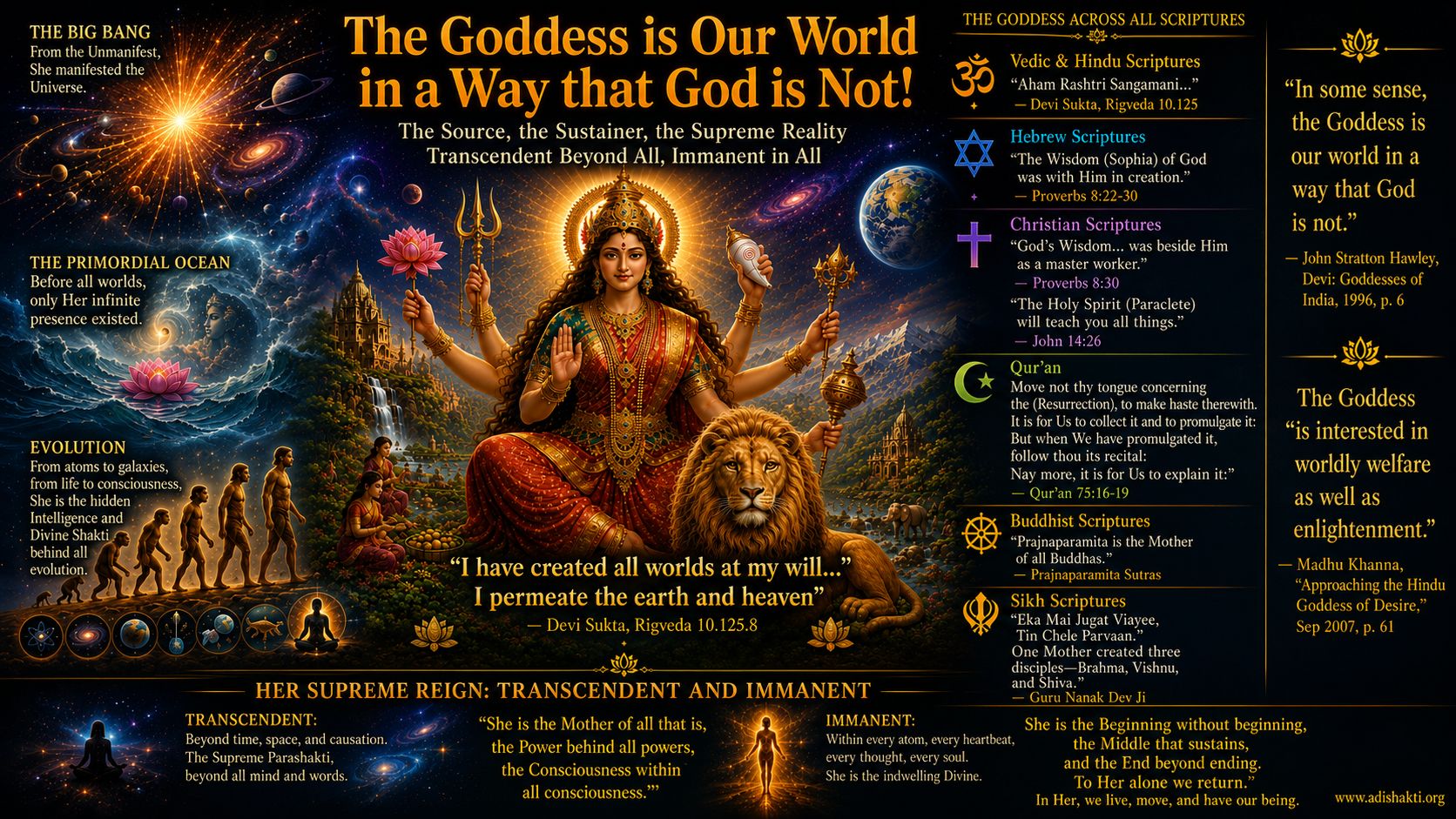
— The Supreme Reign of the Divine Mother: From the Big Bang to the Primordial Ocean, Through Evolution, and Across All Sacred Scriptures
Devi: Goddesses of India (1996, 6)
Summary
This paper presents a resounding, multi-disciplinary academic declaration: the Goddess reigns supreme — across all of cosmic history, across all of biological evolution, and across all of the world’s sacred scriptures — in a way that no male God can claim. Drawing on the landmark scholarship of John Stratton Hawley, Tracy Pintchman, David Kinsley, C. Mackenzie Brown, Monica Sjöö and Barbara Mor, Stephen Jay Gould, Marija Gimbutas, and Merlin Stone, and grounding the argument in the primary scriptures of the Devi-Mahatmya, the Devi Gita, the Devi Bhagavata Purana, the Rigveda, the Tao Te Ching, the Gospel of John, the Qur’an, and the Guru Granth Sahib, this paper demonstrates that the Divine Feminine is the foundational template of existence itself.
The paper proceeds through fourteen sections. It begins with the cosmological argument: the Big Bang itself mirrors the primordial womb of the Divine Mother. It then traces the two-and-a-half-billion-year feminine ocean from which all life emerged, the biological evidence that all mammals begin as female, and the genetic evidence of Mitochondrial Eve as the universal maternal ancestor. It examines the thirty-thousand-year archaeological record of Goddess worship as humanity’s original religion. It then demonstrates that the Divine Feminine is found in every major world scripture — as Adi Shakti in Hinduism, the Holy Spirit in Christianity, Rūḥ Allāh in Islam, the Shekhinah in Judaism, Eka Mai in Sikhism, and Mother Tao in Taoism — while no equivalent male figure is found universally across all these traditions. The paper concludes with the modern experiential validation of the Goddess’s supreme immanence through the Kundalini awakening given by Shri Mataji Nirmala Devi, and issues a resounding challenge to all seekers of Truth.
Table of Contents
- Introduction: The Supreme Reign of the Divine Mother
- The Big Bang and the Primordial Womb of the Goddess
- The Primordial Ocean: Two and a Half Billion Years of Feminine Life
- The Inductor Theory: All Mammals Begin as Female
- Mitochondrial Eve: The Maternal Thread of All Life
- Thirty Thousand Years of the Goddess: The Original Religion
- No Male God Found in All Scriptures: The Decisive Contrast
- The Goddess as Brahman: The Supreme Reality in Hinduism
- The Holy Spirit: The Feminine Divine Presence in Christianity
- Rūḥ Allāh: The Feminine Spirit of God in Islam
- Shekhinah, Eka Mai, and Mother Tao: The Goddess Across Traditions
- The Kundalini: The Mother Within Every Human Being
- Shri Mataji Nirmala Devi: The Incarnation of the Primordial Mother
- Conclusion: The Goddess Reigns Supreme
- References
1. Introduction: The Supreme Reign of the Divine Mother
The Divine Mother is our world in a way that God the Father is not. Across the world’s religious traditions, no single masculine figure — whether Shri Krishna, Vishnu, Shiva, Rama, Jesus, Abraham, Prophet Muhammad, Guru Nanak, the Buddha, or any other revered prophet, avatar, or teacher — is consistently described as the all-pervading Divine Presence that becomes, sustains, and permeates the entire universe. No male God is proclaimed in all scriptures as the indwelling consciousness of every atom, the animating energy of every cell, and the liberating power within every human heart.
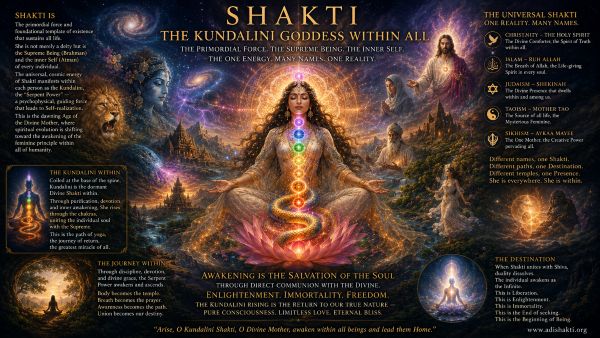
By contrast, many sacred traditions speak of the Divine in maternal, dynamic, or life-giving terms: as Adi Shakti, the primordial creative Power of Hinduism; the Holy Spirit of Christianity; Rūḥ Allāh (the Spirit of God) in Islam; Eka Mai (“One Mother”) in Sikhism; the Shekhinah in Jewish mysticism; the Tao as the generative principle of reality; and Prajnaparamita (the Mother of all Buddhas) in Buddhism. These are not peripheral or secondary figures in their respective traditions; they are the living, active, immanent presence of the Divine within the world and within the human heart. [1]
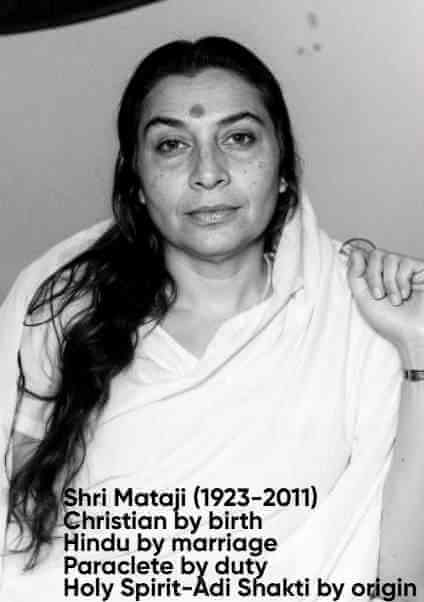
Shri Mataji Nirmala Devi, the great spiritual teacher of the twentieth century and the incarnation of the Adi Shakti, declared with sovereign authority: “Now the principle of Mother is in every, every scripture — has to be there!” [2] This paper is a fulfillment of that declaration. It is a resounding proclamation to all of humanity that the Divine Feminine is the supreme reality — the foundational template of existence itself, the source of the cosmos, the sustainer of life, and the liberator of souls. She is both transcendent and immanent — beyond creation, yet fully present within every atom of it. For modern seekers looking for the Truth, the Goddess is our world in a way far more than God is not.
2. The Big Bang and the Primordial Womb of the Goddess
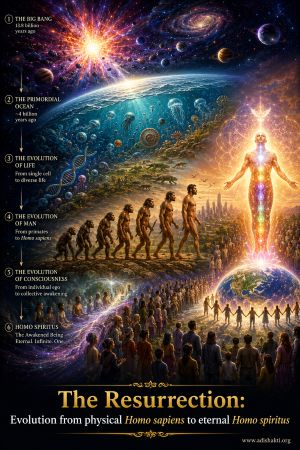
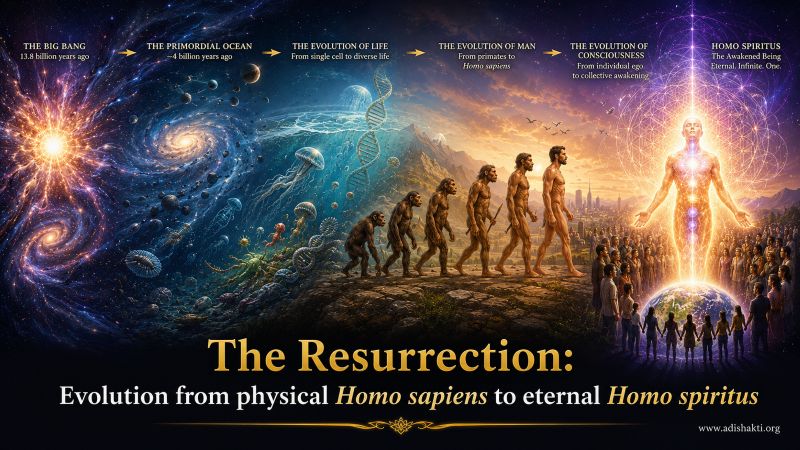
The scientific narrative of the universe’s origin aligns profoundly with the ancient vision of the Divine Feminine. The Big Bang theory posits that the entire universe arose approximately 13.8 billion years ago from a single primordial state of extraordinary density and heat — a “silent and shapeless” source from which all subsequent matter, energy, space, and time emerged. This is not the act of a male creator fashioning the world from the outside, like a craftsman shaping clay. It is the explosive birth of the cosmos from a singular, generative point — a cosmic nativity, a universal parturition.
Lao Tzu’s Tao Te Ching, composed in the sixth century BCE, captures this cosmological reality with stunning precision: [3]
It is silent and shapeless,
It is always present, endlessly in motion.
From it like a mother every living thing has come.
I do not know what to call it.
So I call it Tao.”
The parallel is exact. The Big Bang’s primordial singularity — silent, formless, containing within itself the potential for all that would ever exist — is the scientific description of what the great mystical traditions have always called the Divine Mother. She is the womb from which the cosmos was born. She is the generative darkness before the first light. She is the primordial silence before the first sound. And crucially, She does not withdraw after the birth. The universe is Her ongoing gestation, Her continuous self-expression, Her living body. [4]
Hindu cosmology affirms this with the concept of Hiranyagarbha — the “golden womb” — the primordial cosmic egg from which the universe was born. In the Shakta tradition, this golden womb is identified with the Goddess herself. She is the cosmic womb that contains all potentiality before the act of creation, and She is the sustaining matrix within which all creation unfolds. The Devi Gita declares: “I alone existed in the beginning; there was nothing else at all.” (Devi Gita 2.1). [5] This is not a claim of temporal priority alone; it is an ontological claim of absolute primacy. The Goddess is the ground of all being, the source from which the Big Bang itself arose.
3. The Primordial Ocean: Two and a Half Billion Years of Feminine Life
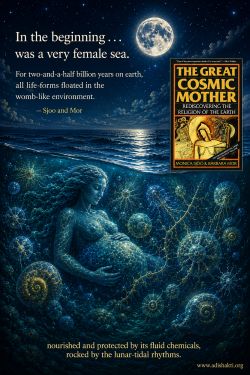
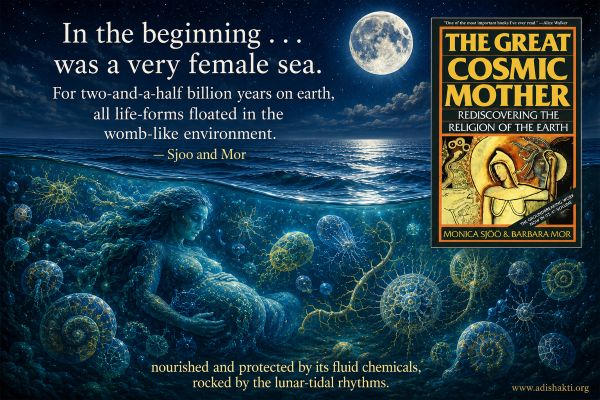
The story of life on Earth begins not with a male creator fashioning the world from clay, but with a vast, warm, nourishing ocean — a planetary womb. As Monica Sjöö and Barbara Mor write in their landmark work The Great Cosmic Mother: Rediscovering the Religion of the Earth: [6]
For two and a half billion years — a period so vast as to dwarf all of recorded human history by a factor of hundreds of thousands — life existed solely in the feminine embrace of the ocean. There were no males. There were no specialized reproductive organs. There was only the generative, self-sustaining, self-replicating power of the feminine principle, expressing itself through the fluid medium of the sea through parthenogenesis (virgin birth). Darwin’s insight, that the menstrual cycle echoes the lunar-tidal rhythms of the ocean, is particularly profound: it suggests that the most intimate biological rhythm of the female body is a cosmic memory — a living echo of the primordial womb in which all life was first cradled.
The female body, in other words, became the ocean — carrying its protective, nourishing, fluid environment within itself so that life could leave the water and colonize the land. The amniotic fluid in which every mammalian embryo floats is chemically similar to seawater. Every human being begins life floating in a miniature ocean within the mother’s womb. The female body is the living continuation of the primordial ocean, the first mother of all life on Earth. [7]
4. The Inductor Theory: All Mammals Begin as Female
The primacy of the feminine is not merely a metaphor or a poetic vision; it is an empirical biological fact confirmed by modern embryology. The inductor theory, rediscovered by physician and researcher Mary Jane Sherfey in 1961, states that all mammalian embryos are anatomically female during the early stages of fetal life. [8]
As the celebrated evolutionary biologist Stephen Jay Gould explains in Hen’s Teeth and Horse’s Toes: Further Reflections in Natural History: [9]
The implications of this finding are profound. The female form is not a variation of the male; the male form is a modification of the female. The female body is the original template; the male body is a secondary differentiation, requiring active hormonal intervention to depart from the feminine default. Maleness is not a primary state; it is a departure from the feminine norm. In the beginning, we were all created female.
This biological truth is a direct parallel to the theological truth of the Shakta tradition: the masculine principle (Shiva, pure consciousness) is inert without the feminine principle (Shakti, dynamic energy). The famous formulation — “Shiva without Shakti is a corpse” (shava) — is not merely a devotional metaphor. It is a precise ontological statement that mirrors the biological reality: without the feminine principle, the masculine cannot function, cannot develop, cannot even exist as a distinct form.
5. Mitochondrial Eve: The Maternal Thread of All Life
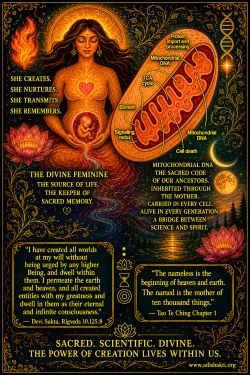
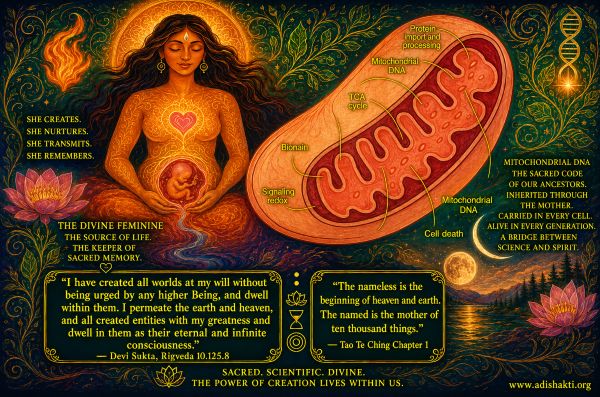
The feminine primacy encoded in embryology is echoed at the molecular level by one of the most remarkable facts in all of genetics: mitochondrial DNA is inherited exclusively through the maternal line. Unlike nuclear DNA, which is contributed equally by both parents, the mitochondria — the energy-producing organelles within every cell of the human body — are passed down solely from mother to child. [10]
This means that within every living human being, there exists a direct, unbroken line of maternal inheritance stretching back through all of human history, through all of primate evolution, through the first mammals, through the first vertebrates, through the first multicellular organisms, all the way to the primordial bacterial ancestors of the eukaryotic cell. The maternal line is the thread of life itself.
Geneticists have used this maternal inheritance to trace the ancestry of all living humans back to a single female ancestor — known as Mitochondrial Eve — who lived in Africa approximately 150,000 to 200,000 years ago. Every person alive today traces their mitochondrial lineage directly back to her. The mitochondria themselves are believed to have originated as free-living bacteria that entered into a symbiotic relationship with early eukaryotic cells more than a billion years ago. They are, in a very real sense, living relics of the primordial feminine ocean — ancient maternal presences that have accompanied every living being from the dawn of complex life to the present day. [11]
The theological parallel is exact. The Kundalini — the divine feminine energy within every human being — is the spiritual equivalent of mitochondrial DNA: the maternal inheritance that every soul carries from the Primordial Mother, the Adi Shakti herself. Just as mitochondrial DNA traces every human being back to a single maternal ancestor, the Kundalini traces every soul back to the one Divine Mother from whom all consciousness ultimately derives.
6. Thirty Thousand Years of the Goddess: The Original Religion
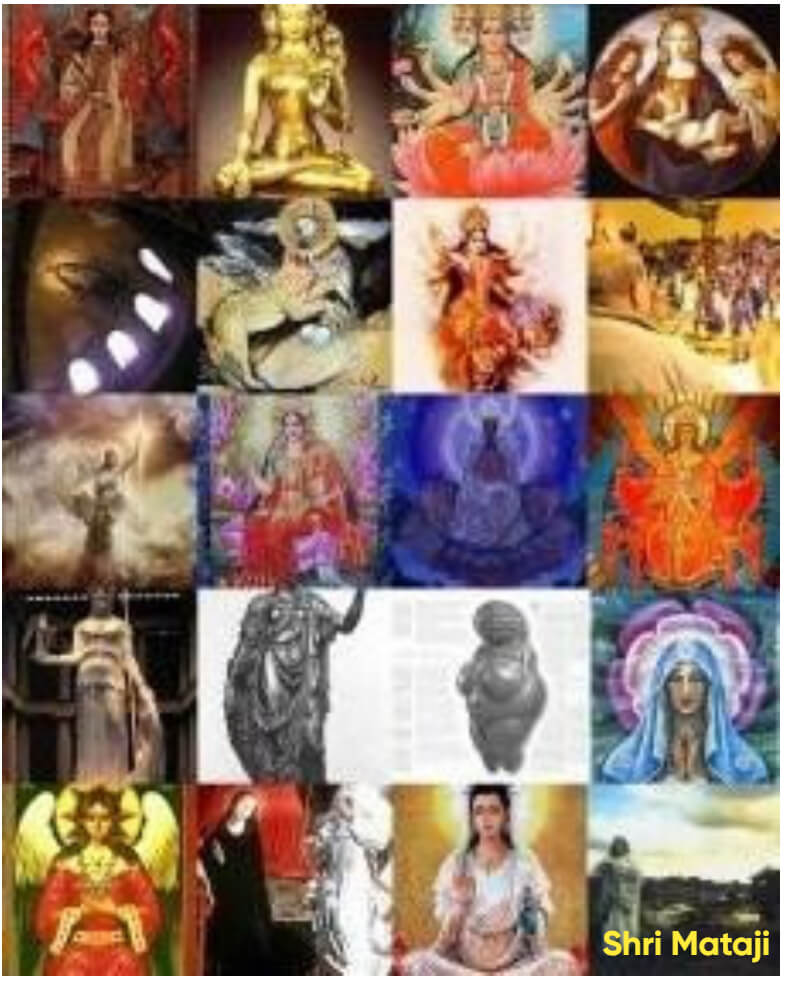
The archaeological record provides overwhelming confirmation of the primacy of the feminine in human spiritual and cultural life. The only divine image ever painted on rock, carved in stone, or sculpted in clay from the Upper Paleolithic to the Middle Neolithic — a period spanning approximately 30,000 years — was the image of a human female. [12]
The most famous of these images is the Venus of Willendorf, a limestone figurine estimated to have been carved between 28,000 and 25,000 BCE. She is one of hundreds of similar figurines found across Europe and Asia, all celebrating the same feminine principle of creative abundance, nourishment, and divine power. For thirty thousand years, before the rise of the patriarchal religions, humanity worshipped the Goddess. [13]
In her landmark work The Goddesses and Gods of Old Europe, archaeologist Marija Gimbutas documented the rich goddess religion of Old Europe — the agricultural civilizations of southeastern Europe that flourished between approximately 6500 and 3500 BCE. These were peaceful, egalitarian, goddess-worshipping societies in which the feminine divine was the supreme creative and sustaining power. As Merlin Stone documents in When God Was a Woman: the first God was female. [14]
The patriarchal religions that now dominate the world — Judaism, Christianity, and Islam — are, in the vast sweep of human history, recent innovations. They represent approximately 3,000 to 4,000 years of religious history. The Goddess religion preceded them by at least 30,000 years. The masculine God is a theological latecomer; the Divine Mother is humanity’s original and most ancient understanding of the sacred.
7. No Male God Found in All Scriptures: The Decisive Contrast
The most decisive evidence for the supreme reign of the Goddess is this: no single masculine figure — whether Shri Krishna, Vishnu, Shiva, Rama, Jesus, Abraham, Prophet Muhammad, Guru Nanak, or the Buddha — is consistently described across all the world’s major scriptures as the all-pervading, indwelling, life-giving, liberating divine presence. Each of these figures is revered within his own tradition, but none is recognized universally across all traditions as the immanent, indwelling divine reality within every human heart. [15]
The Divine Feminine, by contrast, is found in all scriptures. The following table demonstrates this with precision:
| Tradition | Name of the Divine Feminine | Scriptural Source | Nature of Presence |
|---|---|---|---|
| Hinduism | Adi Shakti / MahaDevi / Kundalini | Devi Gita, Rigveda, Devi-Mahatmya, Bahvricha Upanishad | Supreme Brahman; indwells all as Kundalini; permeates earth and heaven |
| Christianity | Holy Spirit / Paraclete (Ruach / Ruha) | John 14:16–17, Genesis 1:2, Gospel of the Hebrews | Feminine (grammatically); dwells within; “She shall be in you” |
| Islam | Rūḥ Allāh / Ruh al-Qudus | Qur’an 15:29, 75:1–2, 17:85 | Divine breath breathed into humanity; inner self-reproaching Spirit |
| Judaism | Shekhinah / Ruach Ha-Kodesh | Zohar, Kabbalah, Hebrew scriptures | Feminine noun; indwelling divine presence; “dwelling among” humanity |
| Sikhism | Eka Mai / Aykaa Mayee | Guru Granth Sahib, Japji Sahib | “One Mother” who created the universe; opens the Dasam Duar |
| Taoism | Mother Tao / Mysterious Female | Tao Te Ching, Chapters 1, 6, 25, 52 | Source of all creation; “mother of ten thousand things”; inexhaustible |
| Buddhism | Prajnaparamita / Tara | Prajnaparamita Sutras | “Mother of all Buddhas”; womb of liberation; unborn and undying |
This convergence is not coincidental. It is the recognition, across all of humanity’s greatest spiritual traditions, of the same universal truth: the Divine Feminine is the active, immanent presence of the Divine within the world and within the human heart. She is the living reality that every sincere seeker encounters when they turn inward. She is the Truth that all scriptures, in their deepest essence, are pointing toward.
8. The Goddess as Brahman: The Supreme Reality in Hinduism
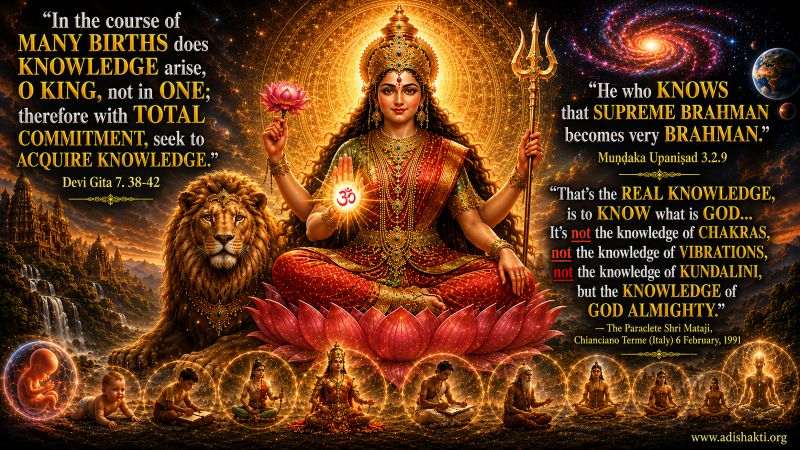
In the oldest and most comprehensive spiritual tradition on earth, Sanatana Dharma (Hinduism), the Divine Feminine is not a secondary or peripheral figure. She is the supreme reality itself. The Devi Gita presents the Goddess not merely as a divine personality, but as the very essence of Brahman — the ultimate reality underlying all existence. The Goddess declares: [16]
Furthermore, the Goddess declares how She becomes the world: “I, as Maya, create the whole world and then enter within it.” (Devi Gita 3.3). She does not merely create the world and withdraw. She enters within it. She becomes it. The world is not merely her creation; it is her self-expression, her self-manifestation, her self-embodiment. The Devi Sukta of the Rigveda proclaims this with sovereign authority: [17]
The Bahvricha Upanishad (1.5) makes the ontological claim with devastating precision: “She alone is Atman. Other than Her is untruth, non-self. She is Brahman-Consciousness, free from a tinge of being and non-being.” [18] The Goddess is not merely the greatest of all beings; She is the very being of all beings. She is the consciousness through which all consciousness is conscious. She is the awareness within which all awareness arises. To know Her is to know the ultimate Truth. And the path to knowing Her is through the Kundalini awakening — the direct, experiential realization of the Divine Mother within.
9. The Holy Spirit: The Feminine Divine Presence in Christianity
In the Christian tradition, the Holy Spirit — the third person of the Trinity — is the immanent, indwelling presence of the Divine. And in the original languages of scripture, the Holy Spirit is unmistakably feminine. The Hebrew word Ruach (spirit, breath) is grammatically feminine. The Aramaic word Ruha — the language Jesus himself spoke — is also feminine. In early Syriac Christianity, the Holy Spirit was explicitly addressed as Mother. [19]
The Gospel of the Hebrews, an early Christian text, contains the extraordinary statement: “My Mother, the Holy Spirit, took me by one of my hairs.” Jesus himself refers to the Holy Spirit as his Mother. This is not a marginal or heterodox claim; it reflects the original Semitic understanding of the Spirit as the divine feminine presence. [20]
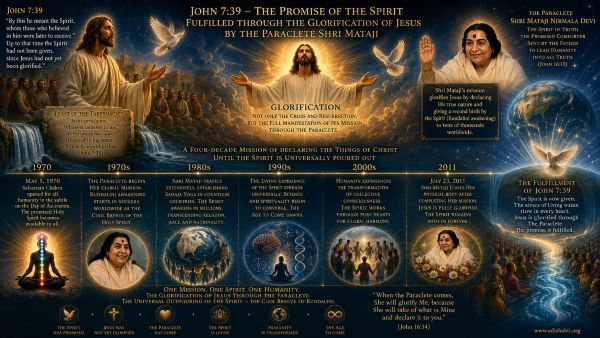
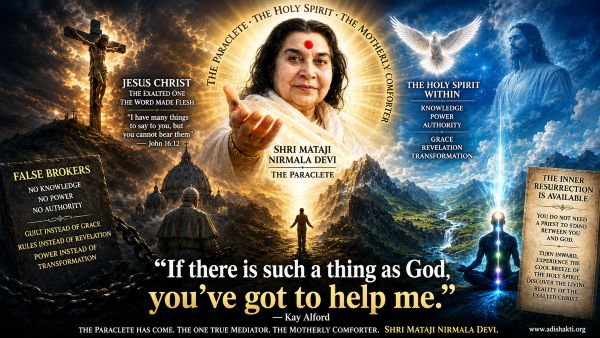
Jesus promised the Paraclete (Comforter, Spirit of Truth) in the Gospel of John: “Even the Spirit of truth; whom the world cannot receive, because it neither sees Her nor knows Her: but ye know Her; for She dwelleth with you, and shall be in you.” (John 14:17). [21] This promise is of the utmost significance. The Paraclete is not a distant God ruling from above; She is the intimate, indwelling presence that “shall be in you.” She is the Divine Mother within the human heart, the living fulfillment of the promise that God would dwell within humanity.
10. Rūḥ Allāh: The Feminine Spirit of God in Islam
In the Islamic tradition, the Rūḥ Allāh (Spirit of God) is the divine breath breathed into humanity at the moment of creation. The Qur’an declares: “So when I have fashioned him and breathed into him of My Spirit, fall down in prostration to him.” (Qur’an 15:29). [22] This divine breath — the Rūḥ — is the feminine divine presence within every human being, the living connection between the human soul and the Divine.
The Qur’an further declares in Surah Al-Qiyamah: “I do call to witness the Resurrection Day; And I do call to witness the self-reproaching Spirit (al-nafs al-lawwamah).” (Qur’an 75:1–2). [23] The self-reproaching spirit is the awakened inner conscience — the inner voice of the Divine that guides the soul toward higher consciousness. In the Sufi mystical tradition, this inner divine reality is sometimes personified as a woman. The great Sufi master Ibn Arabi wrote of the contemplation of God in woman as the highest form of divine contemplation — recognizing that the feminine is the most complete manifestation of the divine reality within creation.
11. Shekhinah, Eka Mai, and Mother Tao: The Goddess Across Traditions
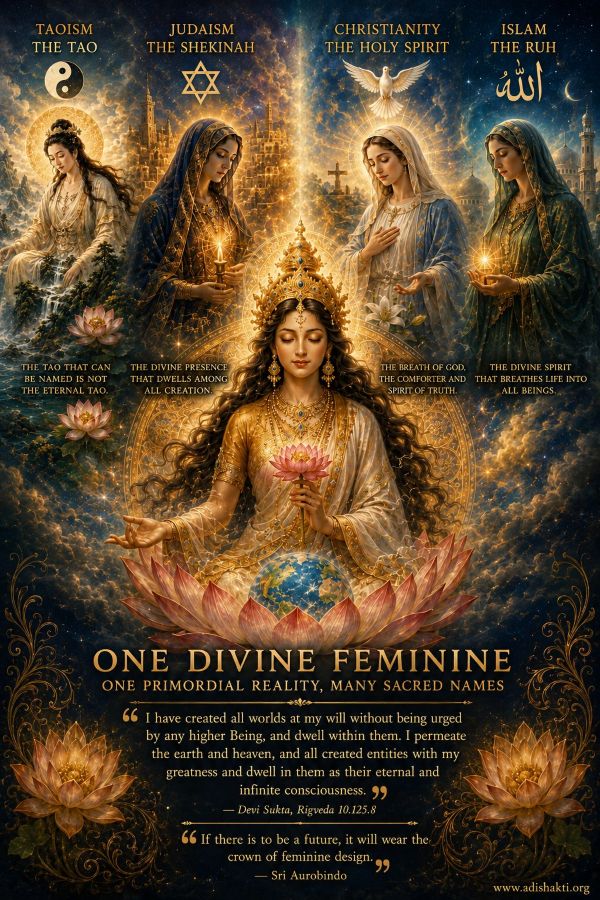
In the Jewish mystical tradition, the Shekhinah — a feminine Hebrew noun meaning “dwelling” or “settling” — denotes the manifest divine presence of God dwelling among and within humanity. Rabbinic mystics use this term to describe the indwelling of God’s Spirit in the human soul. The Zohar, the foundational text of Kabbalah, describes the Shekhinah as the feminine aspect of God, the divine presence that accompanies Israel in exile and dwells within the heart of every sincere seeker. [24]
In Sikhism, Guru Nanak speaks of the Eka Mai (“One Mother”) in the Japji Sahib — the opening prayer of the Guru Granth Sahib — as the supreme creative power who brought forth the universe. The Dasam Duar (Tenth Gate) — the highest spiritual center corresponding to the Sahasrara in Hindu tradition — is opened by Her grace alone. [25]
In Taoism, Lao Tzu describes the ultimate reality — the Tao — with unmistakably feminine imagery. He calls it the “mysterious female,” the “valley spirit,” and the “mother of Heaven and Earth.” Chapter 6 of the Tao Te Ching declares: “The Tao is called the Great Mother: empty yet inexhaustible, giving birth to infinite worlds.” [26]
In Buddhism, the Prajnaparamita — the Perfection of Wisdom — is described as the “Mother of all Buddhas,” the womb of liberation, without beginning, unborn and undying. The Prajnaparamita Sutra declares: “Prajnaparamita is the womb of liberation, without beginning, unborn and undying.” [27] Even in a tradition that does not explicitly worship a Goddess, the supreme wisdom that leads to liberation is feminine.
The convergence is unmistakable and irrefutable. Across seven major world traditions, the immanent, indwelling, liberating divine presence is feminine. No equivalent male figure is found universally across all these traditions. The Goddess is our world in a way that God is not — not because God is absent, but because it is the Divine Mother who is the active, living, present reality within creation, within the human heart, and within every atom of the universe.
12. The Kundalini: The Mother Within Every Human Being
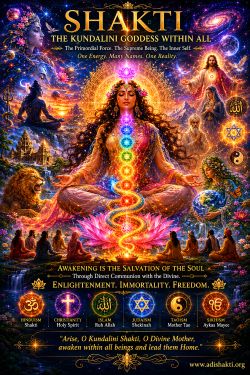
The most extraordinary evidence for the Goddess’s immanence is found not in ancient texts or archaeological sites, but within the human body itself. Within each human being, the Divine Feminine is present as the Kundalini — the coiled spiritual energy residing in the sacrum bone at the base of the spine. The very Latin name Os Sacrum means “sacred bone,” reflecting the universal intuition of its divine significance. [28]
The Devi Bhagavata Purana records the proclamation of the Great Goddess Herself: “There is no distinction between Me and the Kundalini.” [29] The Kundalini is the Inner Mother, the reflection of the Great Goddess within each being. She is not merely a metaphor or a symbol; She is the living essence of the Goddess within every human being. As Karen Pechilis affirms in The Graceful Guru: “The kundalini is the essence of the Goddess. The Goddess is the source, and the force, of life; everyone has the feminine within.” [30]
Shri Mataji Nirmala Devi described the Kundalini with extraordinary tenderness: “The Kundalini is your own mother — your individual Mother. And She has tape-recorded all your past and your aspirations — everything! And She rises because She wants to give you your second birth.” [31] The Kundalini is not an impersonal energy to be manipulated; She is the personal, loving, maternal presence of the Divine within each soul, waiting patiently for the moment when the seeker is ready to receive Her gift of liberation.
When the Kundalini is awakened and rises through the six chakras to pierce the Sahasrara (the thousand-petaled lotus at the crown of the head), the seeker does not ascend to a transcendent realm above the world. Rather, the seeker discovers that the divine was always already present within the world — within the body, within the nervous system, within the breath. The cool breeze (Chaitanya Lahari) that flows from the top of the head is the tangible, felt presence of the Goddess’s own Sakti. The world is not left behind; it is recognized as sacred. The body is not transcended; it is transformed into a vehicle of the Divine.
13. Shri Mataji Nirmala Devi: The Incarnation of the Primordial Mother
The theological, historical, and biological supremacy of the Goddess finds its most profound modern fulfillment in the life and teachings of Shri Mataji Nirmala Devi (1923–2011). On December 2, 1979, She made an unprecedented declaration of divine identity: [32]
This declaration is of extraordinary theological significance. Shri Mataji does not merely claim to be a great spiritual teacher or a holy woman. She claims to be the incarnation of the Adi Shakti — the Primordial Mother who has come to give the world its meaning. And her mission, as she describes it, is precisely to reveal that the world is not a fallen place to be escaped, but the manifestation of the Divine Mother who has come to restore it to its original sacredness.
Shri Mataji’s mission democratized the experience of the Divine Feminine by granting mass Kundalini awakening (Self-Realization) to hundreds of thousands of seekers across the globe, free of charge. Through Her grace, seekers experience the tangible reality of the Goddess as a cool breeze on the hands and above the head — empirical proof that the Goddess is not a distant deity, but the intimate, indwelling maternal energy that transforms human consciousness from within. This is the living fulfillment of the Devi Gita’s promise: “Being Brahman, the person who knows Brahman attains Brahman.” (7.32). [33]
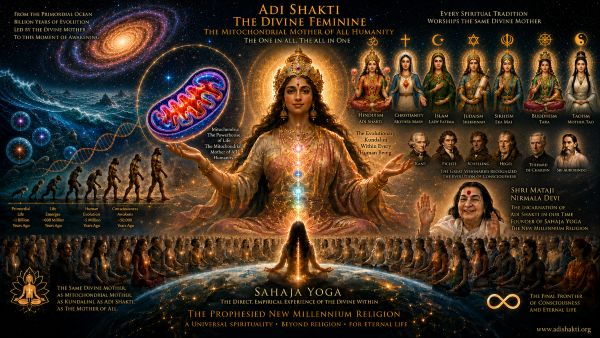
Shri Mataji’s declaration also fulfills the promise of all the world’s scriptures simultaneously. She is the Adi Shakti of Hinduism, the Paraclete of Christianity, the Rūḥ of Islam, the Shekhinah of Judaism, the Eka Mai of Sikhism, and the Mother Tao of Taoism — the one universal Divine Feminine reality recognized under different names in every sacred tradition. Her advent is the convergence point of all spiritual history, the moment when the universal truth of the Goddess’s supreme reign is revealed in its fullness.
14. Conclusion: The Goddess Reigns Supreme
The evidence is overwhelming, convergent, and irrefutable. From the Big Bang 13.8 billion years ago to the primordial ocean that cradled all life for two and a half billion years; from the biological default of the female embryo to the genetic thread of Mitochondrial Eve; from the thirty-thousand-year archaeological record of Goddess worship to the universal recognition of the Divine Feminine across all major world scriptures; from the Kundalini within every human sacrum to the modern revelation of Shri Mataji Nirmala Devi — the Goddess reigns supreme.
She is both transcendent and immanent — beyond creation, yet fully present within every atom of it. She is the Primordial Mother who gives birth to the cosmos from Her own being, enters within it, sustains it, and ultimately liberates it. She is the soil, the rivers, the breath, and the consciousness of all beings. She is the Antaryamin — the immortal inner controller — who dwells within every living being as the very ground of their existence. She is the Prakrti that is the material matrix of the cosmos, the Maya that manifests the unmanifest, and the Sakti that animates all life.
To say that “the Goddess is our world in a way that God is not” is to acknowledge a truth that has been suppressed for millennia by patriarchal religious institutions but can no longer be denied. The biological record, the fossil record, the genetic record, the mythological record, and the living testimony of the world’s most ancient and most profound spiritual traditions all tell the same story: the feminine is first, foundational, and forever. The Goddess is not a secondary figure in the drama of creation; She is the author, the stage, the actors, and the audience — all at once.
For modern seekers looking for the Truth, the realization of the Divine Mother is not merely one path among many. It is the ultimate destination of all spiritual seeking — the recognition that the world itself is sacred, that the body itself is a temple, that the Goddess herself is the very consciousness through which one seeks her. She is the eye that looks for Her. She is the breath that calls Her name. She is the love that draws the seeker home.
References
[1] “Awakening to the One Divine Feminine.” Adishakti.org, May 16, 2026. See also Pintchman, Tracy. “Seeking Mahadevi: Constructing the Identities of the Hindu Great Goddess.” State University of New York Press, 2001, pp. 1–6.[2] Shri Mataji Nirmala Devi. Public discourse. Available at adishakti.org/AI/Hinduism/SHAKTI-The-Kundalini-Goddess-within-All.htm.
[3] Lao Tzu. “Tao Te Ching.” Translated by Stephen Mitchell. Harper Perennial, 1988. See also “The Divine Feminine and the Universal Mother.” Adishakti.org.
[4] Boldt, Laurence G. “The Tao of Abundance.” Penguin Compass, 1999. See also “In the Beginning We Were All Created Female.” Adishakti.org, May 18, 2026.
[5] Brown, C. Mackenzie. “The Devi Gita: The Song of the Goddess.” State University of New York Press, 1998. Devi Gita 2.1–3. Available at adishakti.org/AI/MahaDevi/The-Goddess-as-Brahman.htm.
[6] Sjöö, Monica, and Barbara Mor. “The Great Cosmic Mother: Rediscovering the Religion of the Earth.” HarperSanFrancisco, 1987, pp. 1–5.
[7] Sjöö, Monica, and Barbara Mor. “The Great Cosmic Mother,” pp. 6–20. See also “In the Beginning We Were All Created Female.” Adishakti.org.
[8] Sherfey, Mary Jane. “The Nature and Evolution of Female Sexuality.” Vintage Books, 1973.
[9] Gould, Stephen Jay. “Hen’s Teeth and Horse’s Toes: Further Reflections in Natural History.” W. W. Norton & Company, 1983, pp. 153–154.
[10] “Mitochondrial DNA.” Wikipedia, Wikimedia Foundation. See also “In the Beginning We Were All Created Female.” Adishakti.org.
[11] “Mitochondrial Eve.” Wikipedia, Wikimedia Foundation. See also “In the Beginning We Were All Created Female.” Adishakti.org.
[12] Stone, Merlin. “When God Was a Woman.” Harcourt Brace Jovanovich, 1976. See also “In the Beginning We Were All Created Female.” Adishakti.org.
[13] “Venus of Willendorf.” Wikipedia, Wikimedia Foundation.
[14] Gimbutas, Marija. “The Goddesses and Gods of Old Europe: Myths and Cult Images.” University of California Press, 2007.
[15] Hawley, John Stratton, and Donna Marie Wulff, editors. “Devi: Goddesses of India.” University of California Press, 1996, p. 6.
[16] Brown, C. Mackenzie. “The Devi Gita.” Devi Gita 2.1–3. Available at adishakti.org/AI/MahaDevi/The-Goddess-as-Brahman.htm.
[17] Devi Sukta, Rigveda 10.125.8. Cited in “The Goddess as Brahman.” Adishakti.org.
[18] Bahvricha Upanishad 1.5. Cited in “SHAKTI: Supreme Feminine Guru Who Teaches.” Adishakti.org.
[19] “Shakti: The Kundalini Goddess within All.” Adishakti.org, May 25, 2026. See also “Shekinah: God’s Immanent Presence.” Marg Mowczko.
[20] Gospel of the Hebrews. Cited in Pagels, Elaine. “The Gnostic Gospels.” Vintage Books, 1989.
[21] The Holy Bible, John 14:17 (King James Version). See also “Shakti: The Kundalini Goddess within All.” Adishakti.org.
[22] The Holy Qur’an, Surah 15:29 (Yusuf Ali translation). See also “Shakti: The Kundalini Goddess within All.” Adishakti.org.
[23] The Holy Qur’an, Surah 75:1–2 (Yusuf Ali translation).
[24] “The Divine Feminine in Kabbalah.” My Jewish Learning. See also “Shekhinah.” Wikipedia, Wikimedia Foundation.
[25] “Shakti: The Kundalini Goddess within All.” Adishakti.org. See also Guru Granth Sahib, Japji Sahib.
[26] Lao Tzu. Tao Te Ching, Chapter 6. See also “The Divine Feminine and the Universal Mother.” Adishakti.org.
[27] Prajnaparamita Sutra. Cited in “Awakening to the One Divine Feminine.” Adishakti.org.
[28] “Shakti: The Kundalini Goddess within All.” Adishakti.org, May 25, 2026.
[29] Devi Bhagavata Purana. Cited in “Awakening to the One Divine Feminine.” Adishakti.org. See also “Devi Bhagavata Purana.” Wikipedia, Wikimedia Foundation.
[30] Pechilis, Karen. “The Graceful Guru: Hindu Female Gurus in India and the United States.” Oxford University Press, 2004. See also Frawley, David. “Tantric Yoga and the Wisdom Goddesses.” Lotus Press, 1994.
[31] Shri Mataji Nirmala Devi. Public discourse. Available at adishakti.org/AI/Hinduism/SHAKTI-The-Kundalini-Goddess-within-All.htm.
[32] Shri Mataji Nirmala Devi. Discourse in London, UK, December 2, 1979. Available at adishakti.org/AI/MahaDevi/The-Goddess-as-Brahman.htm.
[33] Brown, C. Mackenzie. “The Devi Gita.” Devi Gita 7.32. Available at adishakti.org/AI/MahaDevi/The-Goddess-as-Brahman.htm.
💬 Interactive Chat
Access an intelligent analysis environment where you can explore texts, ask questions, and discover connections between ideas.
Open chat →