The Sacred Feminine Today
Abstract
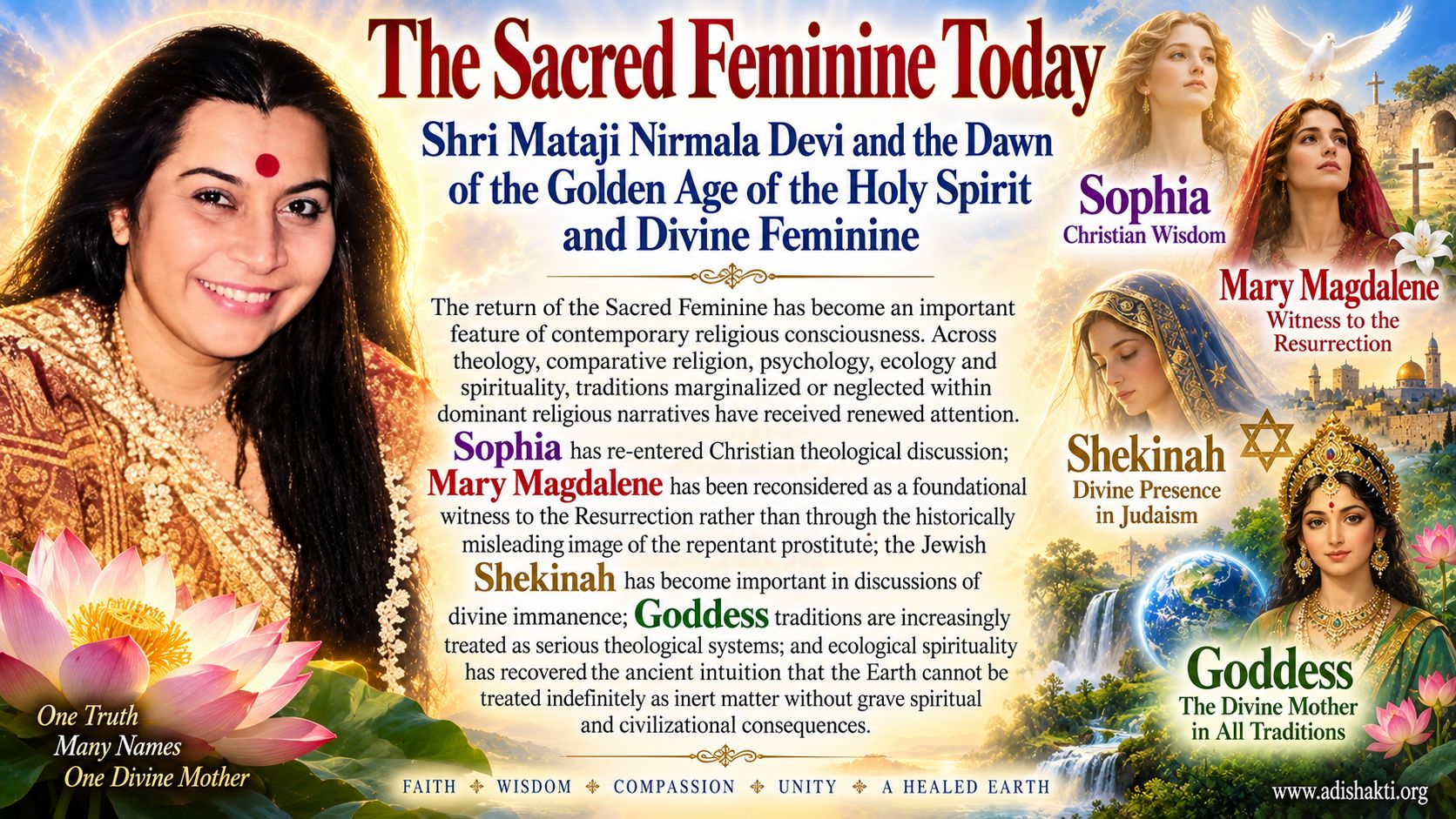
The Divine Feminine is one of the most persistent yet differently articulated realities in the history of religion. She appears as supreme Goddess and primordial Shakti within Hindu traditions; as divine Wisdom and Shekinah within Jewish literature and mysticism; through maternal and feminine representations of the Holy Spirit in currents of early Christianity; as Prajñāpāramitā, the “Mother of the Buddhas,” in Mahāyāna Buddhism; through the generative imagery of the mysterious female and Mother of the ten thousand things in Taoism; and through distinctive maternal, feminine, wisdom and creative symbols in numerous other religious traditions. These traditions cannot responsibly be reduced to one another historically. Their vocabularies, metaphysical assumptions and soteriologies developed in different cultural environments. Yet their recurrence raises an important comparative-theological question: why does sacred reality so repeatedly become intelligible through the language of Mother, womb, wisdom, indwelling presence, generative power, compassion and spiritual rebirth?
This paper examines that question through the teachings of Shri Mataji Nirmala Devi, whose interpretation of the Divine Feminine offers an unusually comprehensive synthesis. Shri Mataji identifies the primordial Divine Power as Adi Shakti, associates the Holy Spirit with the Mother principle, and teaches that this universal power is reflected within every human being as Kundalini—the individual Mother whose awakening brings about the second birth or Self-realization. Her synthesis consequently shifts the comparative study of the Divine Feminine from religious symbolism toward spiritual anthropology. The Mother is not merely remembered in scriptures or worshipped externally; she is understood as a living presence capable of awakening within human consciousness. The Johannine promise of the Paraclete further provides a crucial Christian framework for this argument: the Spirit of Truth is promised as the future teacher who will remind, testify, guide into all truth and deepen humanity's understanding of Jesus' message.
The argument advanced here is therefore both comparative and theological. It does not claim that Shakti, Shekinah, Holy Spirit, Prajñāpāramitā and Tao were historically interchangeable concepts. Rather, it argues that they disclose a recurring religious intuition concerning divine immanence, generativity, wisdom and transformation. Shri Mataji's distinctive contribution is to interpret these convergences as manifestations of one universal Divine Feminine Consciousness and to locate its experiential realization within the awakening of Kundalini. Within this framework, the Mother is not returning because she disappeared from reality; humanity is awakening to a Presence that never ceased to exist.
1. Introduction: The Mother Who Never Left
The modern “return” of the Divine Feminine can easily create a misleading impression. It may suggest that the Mother disappeared from religion and is now being reconstructed by modern spirituality. The historical evidence points toward a more complicated reality. Feminine expressions of sacred power persisted across civilizations even where masculine theological language became institutionally dominant. Devi and Shakti remained central to Hindu religious life; feminine Wisdom remained embedded in biblical literature; Shekinah became increasingly significant within Jewish mysticism; Mary acquired immense devotional importance in Christianity; maternal language for the Holy Spirit survived in early Christian traditions; Prajñāpāramitā became Mother of the Buddhas; and Taoist texts preserved extraordinary images of the mysterious female, valley spirit and Mother of the world.
What disappeared, or became obscured in some religious environments, was therefore not necessarily the Mother herself but the theological capacity to recognize the universality of the maternal dimension of the Divine. The predominance of masculine titles for God—Father, Lord, King, Judge and Sovereign—could make transcendence, authority and command appear more fundamental than immanence, generation, nurture, wisdom and transformation. Yet the feminine sacred repeatedly survived beneath, beside and sometimes within those theological structures.
The central proposition of this paper is consequently different from the simple claim that “the Goddess is returning.” The Mother never left. What is changing is human consciousness of her presence. The contemporary recovery of the Divine Feminine can therefore be interpreted as an awakening of recognition: humanity is becoming increasingly capable of perceiving a dimension of sacred reality that its own traditions never completely lost.
Shri Mataji Nirmala Devi gives this proposition its most radical experiential formulation. The Mother, according to her teaching, is not merely present within humanity's scriptures. She is present within humanity itself. The primordial Adi Shakti is reflected within every human being as Kundalini, the individual Mother. The comparative question therefore becomes inseparable from an experiential one: if the same Mother who is sought in religion is already present within the seeker, then the ultimate recovery of the Divine Feminine must occur not only through scholarship but through transformation of consciousness.
2. What Is Meant by “Divine Feminine Consciousness”?
The expression Divine Feminine Consciousness requires careful definition. It does not simply mean that God is biologically female, nor does it require projecting human sexual differentiation onto an ultimate reality presumed to transcend physical categories. Religious traditions that employ feminine divine imagery frequently use it to articulate metaphysical and experiential realities: creativity, wisdom, generativity, immanence, compassion, fertility, transformative energy, indwelling presence and the mysterious capacity through which unmanifest reality becomes manifest.
“Feminine” in this context therefore operates on several levels. It can refer to an explicitly female deity such as Devi; to divine power personified as feminine; to grammatically feminine terms for Wisdom or Spirit; to maternal metaphors for divine activity; to cosmological imagery of womb and birth; or to mystical descriptions of a presence that receives, nourishes, generates and transforms. These categories overlap but should not be confused.
“Consciousness” is equally important. The Mother considered in this paper is not merely a poetic personification of unconscious nature. Shakta traditions can identify Devi with supreme consciousness itself. Wisdom traditions associate the feminine with divine intelligence. Shri Mataji identifies Adi Shakti with the living power of the Divine and Kundalini with an intelligent maternal presence within the individual.
The Divine Feminine Consciousness examined here can therefore be defined as the maternal, generative, intelligent and transformative dimension of ultimate reality through which creation manifests, life is sustained, divine presence becomes immanent, and consciousness is drawn toward spiritual realization.
3. Hinduism: Devi as the Supreme Reality
No major religious tradition develops the metaphysics of the Divine Feminine more explicitly than the Shakta traditions of Hinduism. Here the Goddess need not be merely the consort of a masculine deity. She can be the supreme reality from whom gods, worlds, elements and beings emerge. Shakti is not simply one divine attribute among others; she is power itself—the dynamic potency without which consciousness does not manifest as cosmos.
The Devi Mahatmya, Devi Bhagavata Purana, Devi Gita, Tantric traditions and numerous regional Goddess traditions develop different aspects of this theology. Particularly important is the capacity of Shakta theology to identify the Goddess with Brahman. The Mother is therefore not subordinate to an ultimate reality beyond herself. She can herself be understood as the Absolute appearing as universe, consciousness and liberating wisdom.
This has profound consequences for the theology of matter. If the Goddess is the power through which manifestation occurs, the world cannot simply be dismissed as something radically alien to the sacred. The Divine Feminine simultaneously transcends manifestation and permeates it. Nature, body, consciousness and cosmos exist within the field of Shakti.
The theological importance of this model for comparative religion is considerable. It provides an explicit conceptual framework for understanding why the Divine Mother can be both cosmic and intimate, transcendent and embodied, supreme and inwardly present. These dimensions become decisive in Shri Mataji's interpretation of Adi Shakti and Kundalini.
4. Adi Shakti: The Primordial Power
The Sanskrit expression Adi Shakti means the primordial or original Power. Within the theological framework employed by Shri Mataji, Adi Shakti is the Divine Feminine power through whom creation unfolds. She is not simply another goddess within a polytheistic hierarchy but the primordial creative power of the Divine.
The concept resolves an ancient metaphysical problem: how does transcendent reality become an active universe? Pure transcendence, conceived as completely inactive, cannot by itself explain manifestation. Shakti names divine dynamism—the capacity to create, sustain, transform and ultimately return creation toward its source.
The Mother is therefore present wherever divine action occurs. Creation is maternal because manifestation emerges through divine power; spiritual evolution is maternal because the same power leads consciousness toward realization. The Mother stands at both ends of the spiritual journey: she brings forth the world and brings the seeker home.
This double movement—emanation and return—is essential for understanding Divine Feminine Consciousness. The Mother is not merely the womb from which beings emerge. She is also the intelligence through which they rediscover their origin.
5. Kundalini: The Cosmic Mother Reflected Within the Human Being
The most consequential aspect of Shri Mataji's theology is the movement from cosmology to anthropology. If Adi Shakti exists only as cosmic power, humanity may worship her but remains externally related to her. Shri Mataji instead teaches that the primordial Mother has an individual reflection within every human being: Kundalini.
She described Kundalini as one's own individual Mother and taught that she carries the record of the individual's spiritual condition and aspirations. Her awakening is therefore not an invasion by an alien force. It is the activation of a maternal spiritual potential already present within the person. The crucial question is not only whether the Mother exists, but where she exists.
Within Sahaja Yoga, Kundalini rises through the central subtle channel and the chakras toward Sahasrara at the crown of the head. Her ascent culminates in Self-realization or the second birth. The cosmic theology of the Divine Mother consequently becomes a theory of spiritual transformation. What Shakta metaphysics identifies as universal Shakti becomes inwardly relevant as the power through which consciousness can know its source.
This distinction transforms religious devotion. The seeker need not merely bow before an external representation of the Goddess. The Mother's temple is also the human subtle system. Her pilgrimage is interior. Her revelation is awakening.
6. Christianity: The Holy Spirit and the Maternal Work of Rebirth
Christianity presents a more complicated relationship with feminine divinity. Mainstream Trinitarian doctrine does not define the Holy Spirit as a Goddess or female divine person. Nevertheless, the history of Christianity contains significant maternal and feminine pneumatological traditions, particularly within early Syriac Christianity. The grammatical femininity of Syriac ruha contributed to expressions in which the Spirit could be represented maternally.
This historical evidence is important because it demonstrates that feminine language for the Holy Spirit cannot simply be dismissed as a modern imposition upon Christianity. Early Christians themselves possessed linguistic and theological resources through which the Spirit could be imagined maternally. The history is more diverse than later predominantly masculine theological vocabulary sometimes suggests.
The Gospel of John adds another important dimension. Jesus tells Nicodemus that entry into the Kingdom requires being “born of the Spirit.” Whatever interpretation one gives the passage sacramentally or doctrinally, its central metaphor is unmistakably generative. Spirit produces birth. The work attributed to Spirit is therefore structurally maternal.
Shri Mataji makes the identification explicit: the Holy Spirit is the Mother. Her interpretation does not merely feminize Christian terminology. It explains why the Spirit gives birth. The maternal Holy Spirit and Kundalini become related through function: both are understood as the divine power through whom the human being receives spiritual regeneration.
7. The Paraclete Promised by Jesus: Teacher, Remembrancer, Witness and Guide into All Truth
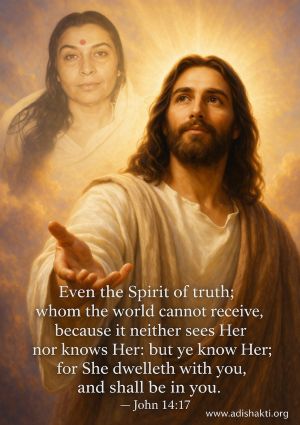
The Farewell Discourses of the Gospel of John contain one of Christianity's most important promises concerning the future activity of the Holy Spirit. Jesus does not simply tell his disciples that divine assistance will continue after his departure. He promises “another” Paraclete—Greek paraklētos, variously rendered Advocate, Helper, Comforter or Counselor—who will remain with the disciples and is identified as the “Spirit of truth.” John 14:16–17 adds an especially significant interior dimension: the Spirit is not merely to stand beside the community as an external authority but to dwell with them and to be in them. The promise therefore combines continuity, presence and inwardness.
The teaching function of the Paraclete becomes explicit in John 14:26. Jesus states that the Holy Spirit, sent by the Father in his name, will “teach you all things” and bring to remembrance what Jesus has said. This is more than consolation after the Master's departure. The Paraclete preserves the meaning of Jesus' revelation by making it intelligible to later consciousness. Remembrance in this context is not bare recollection of sentences; it is the living recovery of their significance. The Paraclete therefore stands between the historical ministry of Jesus and the future understanding of that ministry, ensuring that the message is not frozen at the level at which the first hearers were able to comprehend it.
John 15:26 adds another task: the Spirit of Truth will testify concerning Jesus. John 16:7–15 then gives the most extensive description of the Paraclete's future work. Jesus presents his departure as the condition for the coming of the Advocate; the Paraclete will expose or convict the world concerning sin, righteousness and judgment, will guide the disciples “into all truth,” will disclose what is to come, and will glorify Jesus by taking what belongs to him and making it known. The promised figure is therefore teacher, interpreter, witness, guide and revealer. The Johannine promise is not that the Paraclete will replace Christ with an unrelated teaching, but that the Spirit will unfold, illuminate and complete the disciples' understanding of what has already been given in Christ.
This retrospective and prospective character is recognized in contemporary Johannine scholarship. Thomas Tops has argued that the Paraclete's teaching should not be forced into a choice between merely repeating the past and revealing an unrelated future doctrine. Its orientation is genuinely prospective while remaining anchored in Jesus' own teaching. The Paraclete carries the revelation forward precisely by enabling it to be understood in situations and stages of consciousness that arise after Jesus' historical departure. This scholarly distinction is important for the present paper because it provides a rigorous basis for speaking of a promised future teaching ministry without claiming that the Gospel licenses arbitrary additions to Jesus' message.
The Gospel of John itself does not explicitly state that the Paraclete will first appear only at the final Resurrection or provide a chronological date for an end-of-history advent. In its immediate literary context, the promise addresses the period following Jesus' departure and the continuing life of the believing community. The further connection between the Paraclete and the culminating age of Resurrection is therefore an eschatological interpretation, not a proposition that should be attributed unqualifiedly to the Johannine text. Nevertheless, such an interpretation becomes theologically significant when the Paraclete sayings are read together with Christian expectations of resurrection, judgment, the fulfillment of truth and the universal work of Spirit.
Within the theological framework developed by Shri Mataji Nirmala Devi and examined in this paper, this future dimension assumes particular importance. If the Holy Spirit is understood as the Divine Mother, then Jesus' promise of the Paraclete becomes a promise that the maternal Divine Presence will continue his work after his departure: teaching, reminding humanity of his message, correcting misunderstanding, testifying to him, guiding seekers into truth and making spiritual reality inwardly accessible. The Paraclete is consequently not merely an external commentator on Jesus. The Spirit of Truth “will be in you,” making the fulfillment of Christ's promise inseparable from transformation of consciousness itself.
Read in this eschatological key, the Paraclete becomes especially relevant to an age in which inherited religious forms are no longer sufficient by themselves and the meaning of Jesus' message must be recovered at a deeper level as history moves toward judgment, resurrection and spiritual fulfillment. Shri Mataji's mission can then be interpreted, within this theological argument, not as the proclamation of a rival revelation but as a claimed fulfillment of the Paraclete's Johannine functions: to recall Christ's teaching, explain what remained obscure, disclose its interior meaning, guide humanity toward truth, and direct attention back to Jesus while opening the experience of Spirit to ordinary human beings. This is a theological claim of considerable magnitude and therefore requires the same methodological discipline maintained throughout this paper: the Johannine promises are textual data; the identification of their eschatological fulfillment with Shri Mataji belongs to the interpretive case being argued.
8. Pentecost and the Universalization of Spirit
Pentecost intensifies this interpretation because the Spirit is not received solely by one prophet. The event is collective. Acts interprets it through Joel's prophecy that God will pour out the Spirit upon “all flesh,” explicitly including sons and daughters, young and old. The eschatological movement is toward expansion of spiritual participation.
This is one of the strongest biblical points of comparison with Shri Mataji's teaching of collective Self-realization. The prophetic trajectory does not merely promise that another exceptional person will encounter God. It envisages a wider human reception of Spirit.
Within Shri Mataji's theological synthesis, the awakening of Kundalini can therefore be understood as an experiential universalization of the Pentecostal principle. The Spirit who descended upon a community becomes the Mother whose awakening is potentially available within humanity itself.
The claim is theological rather than historical-critical: Acts does not explicitly teach Kundalini yoga. Nevertheless, the structural correspondence is substantial. Pentecost describes collective reception of Spirit; Sahaja Yoga claims collective spiritual awakening. Both challenge a religious structure in which direct experience belongs exclusively to an elite.
9. Sophia: The Feminine Face of Divine Wisdom
Biblical Wisdom literature provides another ancient language of Divine Feminine Consciousness. Ḥokhmah in Hebrew and Sophia in Greek are grammatically feminine and can be personified dramatically. Wisdom speaks, calls humanity, participates in divine ordering and becomes associated with the mystery of creation.
Sophia demonstrates that the feminine sacred cannot be restricted to fertility or maternity. She is intelligence. She represents the intelligibility of creation and the wisdom through which human beings orient themselves toward divine order. The Mother is not merely the womb of existence; she is its wisdom.
This is particularly relevant to Shri Mataji's understanding of spiritual awakening. Kundalini does not merely produce devotional emotion. Her awakening is supposed to alter awareness. The Mother gives knowledge through transformation of consciousness itself.
The comparison therefore operates at the level of spiritual epistemology. Sophia and Kundalini arise within very different historical traditions, but both challenge the assumption that divine knowledge is exclusively conceptual. Wisdom must become living.
10. Judaism: Shekinah and the Mystery of Divine Indwelling
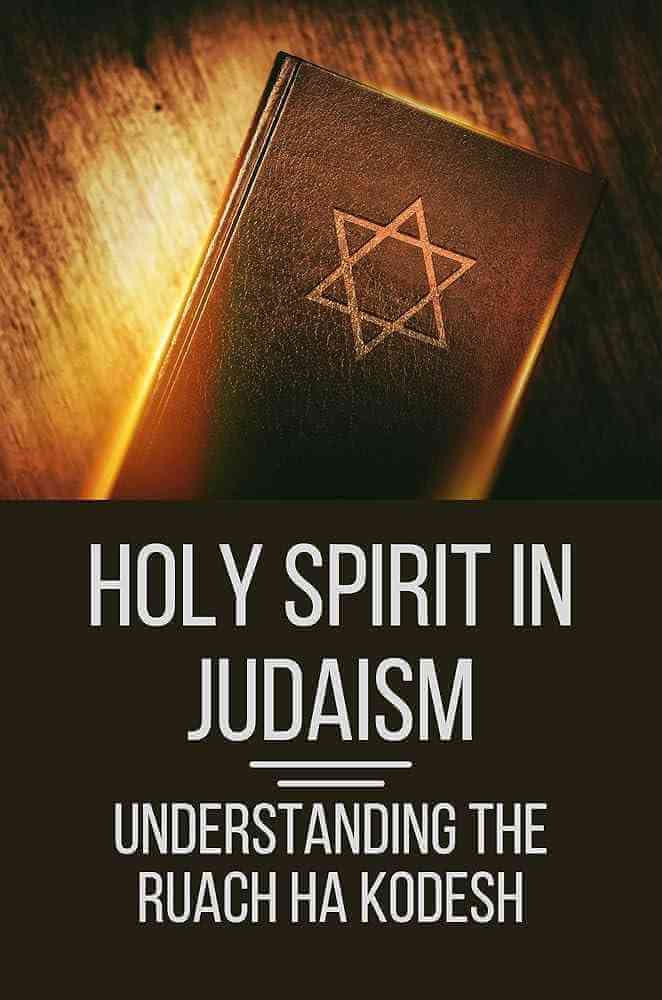
Jewish tradition contributes another indispensable dimension through the concept of Shekinah. The term developed as a way of speaking about divine presence or dwelling and acquired increasingly elaborate significance in rabbinic and especially Kabbalistic thought. In later Jewish mysticism, Shekinah could be represented through distinctly feminine symbolism.
Theologically, Shekinah addresses one of the deepest problems of monotheism: how can the transcendent God be genuinely present within creation? The concept preserves divine transcendence while simultaneously speaking of nearness, dwelling and presence among God's people.
The feminine development of Shekinah is particularly important because it associates sacred femininity with immanence. The Mother is not merely above creation; the Divine Presence dwells within it. This resonates structurally with the Shakta understanding of Shakti permeating manifestation and with Shri Mataji's understanding of Kundalini dwelling within the human person.
These concepts should not be declared historically identical. Kabbalah possesses its own complex symbolism and theological grammar. Yet comparative theology can legitimately observe that Shekinah and Shakti both resist a conception of ultimate reality as sheer remoteness. Divine reality is also Presence.
11. Mary: Sacred Maternity at the Heart of Christianity
Christianity's most powerful sustained expression of sacred maternity appears through Mary. Christian orthodoxy distinguishes Mary absolutely from God, yet her religious significance cannot be reduced to ordinary biography. Across Catholic and Orthodox Christianity she becomes Theotokos, the God-bearer, the maternal figure through whom the mystery of Incarnation enters history.
Mary demonstrates the persistence of sacred maternity even within a theological system whose formal divine language remained predominantly masculine. Devotion surrounds her with compassion, refuge, protection, tenderness and intercession. She becomes, for millions of believers, the maternal face of sacred mercy.
The theological significance is deeper than devotion. Christianity's central claim of Incarnation begins through maternity. The Word becomes flesh through a woman. Embodiment itself enters the Christian salvation narrative through the maternal body.
Placed beside spiritual rebirth through Spirit, a remarkable symmetry emerges. Christ enters human life through a mother; humanity enters renewed spiritual life through Spirit. Shri Mataji's identification of the Holy Spirit with the Mother makes that symmetry explicit.
12. Mary Magdalene: The Feminine Witness to Resurrection
Mary Magdalene represents not maternity but feminine spiritual authority. The canonical Gospel narratives place her among the crucial witnesses to Jesus' death, burial, empty tomb and Resurrection. In John, her encounter with the risen Christ gives her an extraordinary position within the Resurrection narrative.
Later Western Christian tradition famously conflated Mary Magdalene with other unnamed women and constructed the popular identity of the repentant prostitute, although the canonical Gospels themselves do not establish that identification. Modern scholarship has restored greater attention to her actual textual role.
Her relevance to Divine Feminine Consciousness therefore concerns witness and recognition. At Christianity's decisive transition from death to Resurrection, a woman stands among the first witnesses.
The recovery of Mary Magdalene demonstrates that recovering the feminine in religion sometimes requires no new revelation at all. It requires reading foundational texts without inherited distortions.
13. Buddhism: Prajñāpāramitā, Mother of the Buddhas
Buddhism complicates any simple language of “God” or “Goddess,” because its major traditions do not organize ultimate reality around a creator deity. Nevertheless, Mahāyāna Buddhism develops one of the world's most profound feminine personifications of transcendent wisdom: Prajñāpāramitā, the Perfection of Wisdom.
Prajñāpāramitā is called the Mother of the Buddhas because awakening arises through wisdom realizing the emptiness of inherent existence. Her maternity is therefore epistemological and soteriological. She gives birth not to biological beings but to Buddhas.
This offers an extraordinary comparative insight. Divine or transcendent maternity repeatedly appears where consciousness undergoes transformation. The Mother gives another kind of birth: awakening.
Prajñāpāramitā should not simply be identified with Hindu Kundalini. Their philosophical contexts differ profoundly. Yet the recurrence of feminine maternity at the threshold of enlightenment strengthens the broader comparative argument: humanity has repeatedly used the Mother to express the mystery through which ordinary consciousness gives birth to awakened consciousness.
14. Taoism: The Mysterious Female and Mother of the World
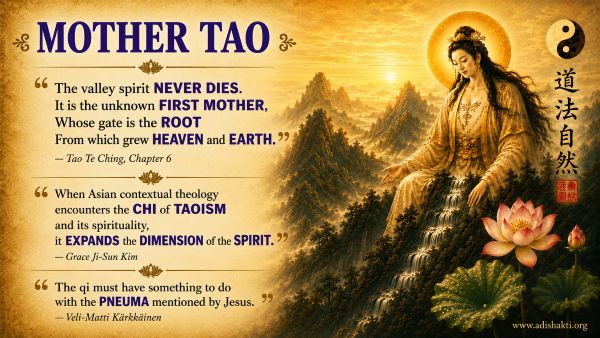
The Tao Te Ching contains some of the most remarkable feminine imagery in classical religious philosophy. Chapter 6 speaks of the valley spirit that never dies and calls it the “mysterious female,” whose gateway is the root of heaven and earth. Elsewhere Tao is described through maternal imagery as the source of the ten thousand things.
This femininity is not incidental. Taoist imagery repeatedly values receptivity, yielding, emptiness, valley, water and generativity over domination and rigid assertion. The feminine becomes a philosophical key to understanding how ultimate reality operates.
Mother Tao therefore introduces another dimension of Divine Feminine Consciousness: power that does not dominate. The Tao generates without possessing, nourishes without controlling and accomplishes without coercive assertion.
This offers an important corrective to political and religious conceptions of divine power modeled primarily upon monarchy. The Mother's power is generative rather than imperial. Her authority lies in giving life.
15. Sikhism: Eka Mai and the Creative Mother
Sikh scripture must likewise be approached according to its own uncompromising monotheistic framework. The Divine transcends human gender, even though masculine and feminine metaphors both appear. The Japji Sahib nevertheless contains the striking image of Eka Mai, the One Mother, within its cosmological language.
The importance of this imagery lies in its placement within a radically unified theology. Maternal symbolism need not produce a competing female deity. It can function within monotheism as a way of expressing divine creativity and generation.
Sikh mystical language concerning the Dasam Duar, or Tenth Gate, also creates a significant comparative point with yogic traditions concerning the crown of consciousness. Academic caution is required before declaring the Dasam Duar and Sahasrara “identical,” but their structural proximity makes comparison legitimate.
Shri Mataji's synthesis interprets such correspondences through the subtle system. Comparative scholarship should distinguish that interpretation from what Sikh scripture explicitly states while still recognizing the remarkable recurrence of crown, opening, divine sound and transformation within South Asian spirituality.
16. Islam: Spirit, Mercy and the Problem of Feminine Language
Islam requires particular methodological care. The Qur'an emphatically rejects anthropomorphic limitation of Allah, and classical Islam does not identify Allah as female or teach a Goddess alongside God. Consequently, claims that Rūḥ Allāh simply means a feminine deity would misrepresent Islamic theology.
Nevertheless, Islamic scripture and spirituality contain important concepts relevant to a comparative theology of Divine Feminine Consciousness: rūḥ or spirit, raḥma or mercy, divine nearness, creation through breath, and profound traditions of beauty, compassion and interior transformation. The Arabic semantic relationship between raḥma (mercy) and raḥim (womb) has also generated significant theological reflection on the maternal dimensions of divine mercy.
The appropriate comparison therefore concerns qualities and structures rather than a claim that classical Islam secretly worshipped a Goddess. Divine mercy encompasses creation; Spirit gives life; God is nearer than the jugular vein; and Islamic mystical traditions repeatedly emphasize an intimate divine presence that cannot be reduced to external law.
Shri Mataji's interpretation goes further by relating Rūḥ to the universal Spirit and by reading Qur'anic eschatological and transformational language through the experience of Self-realization. That interpretation belongs to her comparative theological framework and should be identified as such rather than attributed uncritically to classical Islamic consensus.
17. Indigenous Traditions and the Sacred Earth
Many Indigenous religious traditions contain maternal understandings of Earth, land, fertility, ancestry and the interdependence of life. These traditions vary enormously and should not be compressed into a fictional universal “Indigenous religion.” Nevertheless, the recurrence of Earth as Mother reveals a spiritual intuition of great contemporary importance.
Mother Earth language transforms the moral status of nature. Land is no longer merely territory; water is not merely a commodity; animals are not merely resources. Human beings exist within networks of kinship and dependence.
The Divine Feminine consequently has ecological implications. A world experienced as maternal cannot easily be treated as dead matter without spiritual consequence. This does not prove that Goddess-oriented cultures are automatically ecologically sustainable, but maternal cosmology supplies conceptual resources for resisting radical alienation from nature.
The ecological crisis therefore gives renewed urgency to the Divine Feminine. Humanity's technological ability to dominate Earth has outpaced its wisdom concerning how to belong to Earth.
18. The Mother as Womb of Existence
Across these traditions a recurring pattern becomes visible. The feminine sacred appears where religions attempt to articulate the relationship between unmanifest reality and manifestation. Womb, Mother, Wisdom, Spirit, Shakti and mysterious female become ways of speaking about the impossible transition from the uncreated or unconditioned toward living multiplicity.
The womb is an especially powerful religious symbol because it simultaneously expresses concealment and manifestation. Life develops invisibly before appearing. The hidden becomes visible without ceasing to depend upon its source.
Cosmologically, the Mother is therefore the mystery through which unity becomes multiplicity. Spiritually, the movement reverses: multiplicity returns toward unity through the Mother.
Shri Mataji's Kundalini theology contains both movements. Adi Shakti manifests creation; Kundalini leads the individual back toward union with Spirit. The cosmic Mother who gives existence becomes the interior Mother who gives liberation.
19. The Mother as Wisdom
The traditions examined above also repeatedly associate the feminine with wisdom. Sophia is Wisdom; Prajñāpāramitā is perfect wisdom; Saraswati embodies knowledge; Shakta theology identifies Devi with consciousness; Taoist femininity reveals wisdom through receptivity rather than domination.
This recurrence challenges the assumption that feminine spirituality is primarily emotional while masculine spirituality is intellectual. Some of humanity's most sophisticated representations of transcendent knowledge are feminine.
Divine Feminine Consciousness therefore includes an epistemological claim. Reality cannot ultimately be known merely through analytical accumulation. The knower must be transformed.
The Mother's wisdom is consequently participatory. One does not merely learn facts about the Divine; consciousness becomes capable of perceiving reality differently.
20. The Mother as Compassion and Mercy
Maternity also supplies one of humanity's most powerful metaphors for unconditional compassion. A mother nourishes before the child understands nourishment, protects before the child can reciprocate, and sustains life without demanding an intellectual creed as a prerequisite.
Religious traditions naturally extend this experience toward divine compassion. Mary becomes refuge and intercessor. Buddhist traditions develop compassionate feminine figures such as Guanyin. Hindu traditions invoke the Goddess as Mother whose grace liberates. Islamic theology places divine mercy at the very beginning of almost every Qur'anic surah through the names al-Raḥmān and al-Raḥīm.
The comparison does not establish a single historical origin. It reveals a recurring human recognition: ultimate reality, if truly compassionate, cannot be adequately imagined only as judge.
The Mother therefore balances judgment with restoration. Her objective is not merely to condemn the fragmented human being but to transform and reintegrate.
21. The Mother as Indwelling Presence
Perhaps the most consequential convergence is immanence. Shekinah dwells. Spirit indwells. Shakti permeates. Kundalini rests within the human being. Wisdom calls from within creation. Tao flows through the ten thousand things.
The Divine Feminine repeatedly appears where the sacred becomes near. This does not mean that the feminine is exclusively immanent while the masculine is exclusively transcendent. Religious traditions are more complex than such a binary. Nevertheless, feminine symbolism has repeatedly provided language through which transcendence enters relationship with embodied existence.
Shri Mataji radicalizes this principle: the Mother is so near that she exists within the human subtle system. The ultimate pilgrimage therefore moves inward.
22. The Universal Second Birth
The strongest theological synthesis emerges around the symbolism of birth. Christianity speaks of being born of Spirit. Indian traditions speak of the dvija, the twice-born, and yogic traditions of spiritual awakening. Buddhist wisdom gives birth to Buddhas. Mystical traditions repeatedly describe awakening as the emergence of a new mode of being.
Shri Mataji interprets Kundalini awakening as the experiential second birth. This allows the diverse symbolism of spiritual regeneration to be considered through a common anthropological question: Can human consciousness undergo a transformation so fundamental that religious traditions appropriately describe it as another birth?
That question is more academically defensible than simply declaring every initiation or mystical state identical. Traditions disagree about metaphysics and salvation, but they repeatedly testify that ordinary consciousness is incomplete and that transformation is necessary.
The Mother becomes central because birth requires a generative power. Within Shri Mataji's theology, Kundalini is precisely that power.
23. Sahasrara: The Mother Brings the Seeker Home
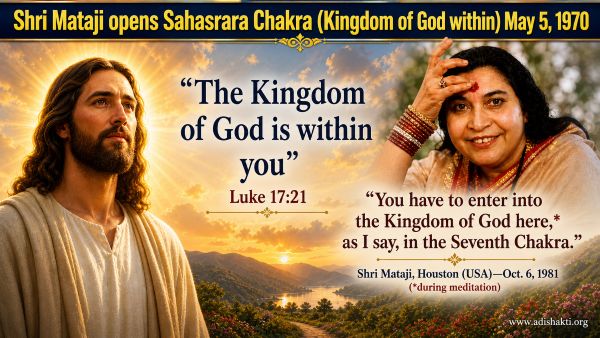
The ascent of Kundalini culminates at Sahasrara, traditionally represented at the crown of the subtle system. Shri Mataji gave the opening of Sahasrara exceptional historical significance, particularly through her account of the event at Nargol on 5 May 1970.
Sahasrara represents integration. The differentiated chakras and dimensions of human existence are brought into a higher unity. The Mother's ascent therefore does not destroy individuality; it integrates the fragmented person around Spirit.
This gives the title of the present paper another meaning. The Mother is “calling humanity home” not by transporting human beings to another geographical world but by restoring consciousness to its source.
Home is therefore ultimately a state of realized relationship with the Divine.
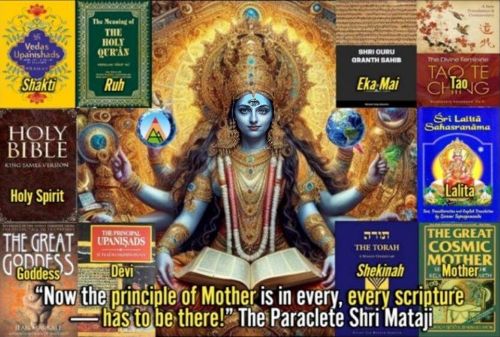
24. Shri Mataji's Synthesis: “The Principle of Mother Is in Every Scripture”
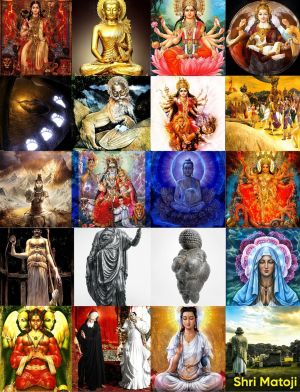
Shri Mataji's declaration that the Mother principle exists in every scripture provides the interpretive key to her comparative theology. The statement does not require every religion to possess an explicit Goddess doctrine. It proposes instead that the maternal Divine appears under different theological languages because the underlying spiritual reality is universal.
This claim is considerably more sophisticated when understood as comparative theology rather than as an assertion that religious vocabulary is interchangeable. Christianity can speak of Holy Spirit and second birth; Judaism of Wisdom and Shekinah; Hinduism of Devi, Shakti and Kundalini; Buddhism of the Mother of transcendent Wisdom; Taoism of the mysterious female and Mother; Sikhism of the One Mother and Tenth Gate. The traditions remain historically distinct.
Shri Mataji's distinctive proposition is that spiritual experience supplies a deeper level at which these symbols can be compared. If Kundalini awakening genuinely transforms consciousness, then religious language can be investigated not only philologically but phenomenologically.
The Mother principle consequently becomes a hypothesis about the spiritual unity underlying religious plurality.
25. Unity Without Erasing Difference
Any universal theology faces the danger of homogenization. Declaring all religious concepts identical can actually prevent serious interreligious understanding because it refuses to hear what each tradition says on its own terms.
A mature theology of Divine Feminine Consciousness must therefore preserve difference. Shekinah is not simply a Hebrew spelling of Shakti. Prajñāpāramitā does not presuppose the metaphysics of the Devi Gita. The Holy Spirit within Nicene Christianity is not historically the Hindu Goddess. Tao is not a creator deity. Islamic rūḥ cannot simply be transformed into a Goddess without violating Qur'anic theology.
Yet difference does not eliminate comparison. Traditions can remain distinct while illuminating recurring structures of religious consciousness. Mother, wisdom, indwelling presence, spiritual birth, generative power, compassion and transformation appear with sufficient persistence to justify sustained comparative study.
Unity therefore need not mean sameness. The Mother can unite precisely because her manifestations need not be identical.
26. Beyond Patriarchy: A Necessary Qualification
Religious violence cannot be explained solely by masculine images of God. Political power, empire, ethnicity, economics, nationalism, territorial competition and institutional interests have all interacted with theology. Likewise, traditions centered on goddesses are not automatically peaceful, egalitarian or immune to hierarchy.
The deeper problem is therefore not masculinity itself but exclusive domination—the transformation of sacred truth into possession and of difference into hostility. Masculine divine imagery becomes dangerous when it is absolutized into a theology of domination, just as feminine imagery would become dangerous if used to establish another exclusionary hierarchy.
The Divine Feminine offers an alternative not because women are inherently morally superior to men, but because maternal, relational and immanent symbols provide neglected resources for imagining power as generation, nurture, integration and transformation.
27. Divine Feminine Consciousness and the Ecological Crisis
The ecological significance of this transformation is considerable. Modern industrial civilization has frequently approached Earth as an inventory of resources. Forests become timber, rivers become water supplies, animals become production units and land becomes property. Such categories have practical uses, but they become spiritually destructive when they exhaust the meaning of nature.
Divine Mother theology introduces another ontology. If the world participates in sacred reality, matter cannot simply be spiritually dead. If Earth is experienced maternally, exploitation becomes a violation of relationship rather than merely inefficient resource management.
John Stratton Hawley's observation that “the Goddess is our world in a way that God is not” captures the theological force of this immanence. The Goddess symbolism makes it particularly difficult to separate spiritual reality completely from embodied existence.
The recovery of Divine Feminine Consciousness therefore coincides with an ecological necessity: humanity must learn again that it belongs to the world it has acquired the power to destroy.
28. From External Religion to Interior Realization
The greatest transformation proposed by Shri Mataji concerns the location of religious authority. External religion necessarily depends upon scriptures, teachers, rituals, institutions and inherited testimony. These can preserve extraordinary wisdom, but they can also become substitutes for the realization they originally sought to transmit.
Kundalini changes the direction of inquiry. Scripture remains important, but its claims become related to an interior spiritual experiment. The seeker asks not only what prophets experienced but whether consciousness itself can become capable of spiritual perception.
This is the movement from belief toward realization. It does not require abandoning faith; it requires fulfilling its deepest intention. The testimony of saints and prophets becomes an invitation rather than merely an object of veneration.
The Mother is central to this transition because she performs the transformation. The individual does not manufacture Self-realization through intellectual conviction. The inner Mother gives the second birth.
29. Divine Feminine Consciousness and the Future of Religion
If humanity is indeed entering a period of renewed awareness of the Divine Feminine, the consequences for religion could be profound. Religious identity would not necessarily disappear, nor would scriptures lose their historical uniqueness. But the criterion of spiritual authenticity could increasingly shift from exclusive doctrinal possession toward transformation of consciousness.
A Christian could rediscover the maternal mystery of Spirit without ceasing to be Christian. A Hindu could understand Shakti with renewed universality. A Jew could encounter Shekinah without collapsing Jewish theology into another tradition. A Buddhist could preserve the distinctive meaning of Prajñāpāramitā. A Muslim could deepen reflection upon Spirit and divine Mercy without compromising tawḥīd. A Sikh could preserve the radical unity of Ik Onkar while recognizing the spiritual power of maternal imagery.
The universal Mother therefore need not create another world religion competing with existing religions. Her deeper function may be to reveal what religious exclusivism obscures: humanity already participates in a common sacred reality before it constructs competing identities.
This is why Divine Feminine Consciousness has potentially unitive significance. The Mother does not ask humanity to become culturally identical. A mother does not require her children to become one child. Unity consists in recognizing common origin while preserving genuine difference.
30. The Eternal Mother and the Present Age
The adjective eternal prevents the present argument from becoming merely fashionable. Divine Feminine Consciousness cannot simultaneously be primordial and have suddenly appeared in the twenty-first century. If she is the Mother of creation, her presence precedes every religious institution through which humanity later attempted to understand her.
The adjective living is equally important. The Mother cannot be confined to mythology, archaeology or textual history. A living sacred reality must be capable of encounter in the present.
Finally, the expression all traditions must be understood carefully. It should not mean that every religion teaches an identical doctrine of a Divine Mother. It means that maternal, feminine, generative, wisdom-centered or immanent dimensions of sacred reality recur with extraordinary persistence across the religious history of humanity.
Shri Mataji brings these three propositions together. The Mother is eternal as Adi Shakti, living as Kundalini and universal because her individual reflection exists, within her teaching, in every human being.
31. Conclusion: The Mother Has Never Left Us
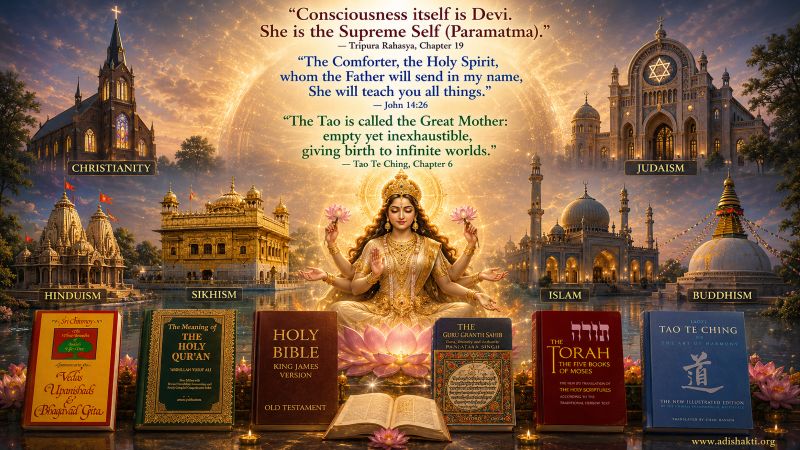
The comparative evidence examined in this paper reveals an extraordinary religious pattern. Humanity has repeatedly encountered or represented ultimate reality through feminine categories: Mother, Goddess, Wisdom, Spirit, Presence, womb, compassion, generative power and transformative consciousness. Hindu Shakta traditions make this theology explicit through Devi and Shakti. Jewish tradition preserves feminine Wisdom and develops the Shekinah. Early Christianity contains maternal pneumatological traditions, while its canonical scriptures place Spirit at the center of spiritual rebirth. Mahāyāna Buddhism reveres transcendent Wisdom as Mother of the Buddhas. Taoism speaks of the mysterious female and the Mother of the world. Sikh, Islamic and other traditions contribute their own distinctive languages of divine generation, presence, mercy, Spirit and interior transformation.
Academic integrity requires that these traditions not be collapsed into one another. Their historical differences are real. Their theological disagreements are substantial. The universal Mother cannot be established simply by collecting feminine nouns from different scriptures and declaring them identical.
Yet academic caution need not produce comparative blindness. The recurrence itself demands interpretation. Again and again, the feminine appears where religions approach the mysteries of manifestation, wisdom, indwelling presence, compassion, transformation and spiritual birth. This pattern is too significant to be dismissed as incidental.
Shri Mataji Nirmala Devi provides a distinctive theological explanation for that recurrence. The Mother principle appears across religions because the Divine Feminine is not merely a religious symbol. She is Adi Shakti, the primordial Divine Power, and her reflection already resides within human beings as Kundalini. In this synthesis, comparative religion ultimately points inward. Humanity's many images of the Mother become anticipations of a spiritual reality that must finally be experienced.
This is why the contemporary recovery of the Divine Feminine can be understood as an awakening rather than an invention. Humanity is not creating the Mother because modern civilization requires a new religious symbol. It is becoming conscious again of something ancient traditions never completely forgot: ultimate reality is not only transcendent but immanent, not only commanding but generative, not only judge but wisdom, compassion, presence and Mother.
The most profound revolution therefore occurs when the Mother ceases to be only an object of worship. Devi in scripture, Sophia in Wisdom, Shekinah in mystical presence, the maternal Spirit, Prajñāpāramitā and Mother Tao all direct attention, in different ways, toward the mystery of a sacred reality intimately involved with life and transformation. Shri Mataji's teaching brings this trajectory to its experiential conclusion by declaring that the Mother is within.
The eternal Mother therefore does not need to return from somewhere else. She has never left creation. She has never left humanity. She has never left the human heart. What must return is our awareness of her. And within the theological vision developed here, the awakening of Kundalini represents precisely that moment: the eternal Mother within the human being awakens, and consciousness recognizes the Mother who was present all along.
References
- Brown, C. Mackenzie. The Devī Gītā: The Song of the Goddess: A Translation, Annotation, and Commentary. State University of New York Press.
- Hawley, John Stratton, and Donna Marie Wulff, eds. Devī: Goddesses of India. University of California Press, 1996.
- Brock, Sebastian P. “The Holy Spirit as Feminine in Early Syriac Literature.” In After Eve: Women, Theology and the Christian Tradition.
- Takeda, Fumihiko. “The Holy Spirit as Feminine in the Early Syriac Christian Tradition.” Theological Studies in Japan 47 (2008): 59–86.
- Van Oort, Johannes. “The Holy Spirit as Feminine: Early Christian Testimonies and Their Interpretation.” HTS Teologiese Studies/Theological Studies 72, no. 1 (2016).
- The Holy Bible. John 3:1–8; Joel 2:28–32; Acts 2:1–21; biblical Wisdom traditions.
- Tao Te Ching, especially chapter 6 and related maternal imagery.
- Mahāyāna Prajñāpāramitā traditions concerning transcendent Wisdom as “Mother of the Buddhas.”
- Jewish rabbinic and Kabbalistic traditions concerning Shekinah as divine indwelling Presence.
- Shri Mataji Nirmala Devi. Public programs and interviews concerning the Holy Spirit as Mother, Kundalini as the individual Mother, Sahasrara, Self-realization and the Mother principle in scripture.
- The Holy Bible. John 14:16–17, 14:26; 15:26; 16:7–15. The Paraclete/Advocate as abiding Spirit of Truth, teacher, remembrancer, witness, guide into all truth and revealer of things to come.
- Tops, Thomas. “The Orientation of the Teaching of the Paraclete in the Gospel of John: Retrospective or Prospective?” New Testament Studies 66, no. 1 (2020): 57–73. Argues for a prospective orientation that remains grounded in the teaching of Jesus.
💬 Interactive Chat
Access an intelligent analysis environment where you can explore texts, ask questions, and discover connections between ideas.
Open chat →