Authenticity of Kash, Arwinder and Lalita’s Mystical Witnessing of God as Light Within
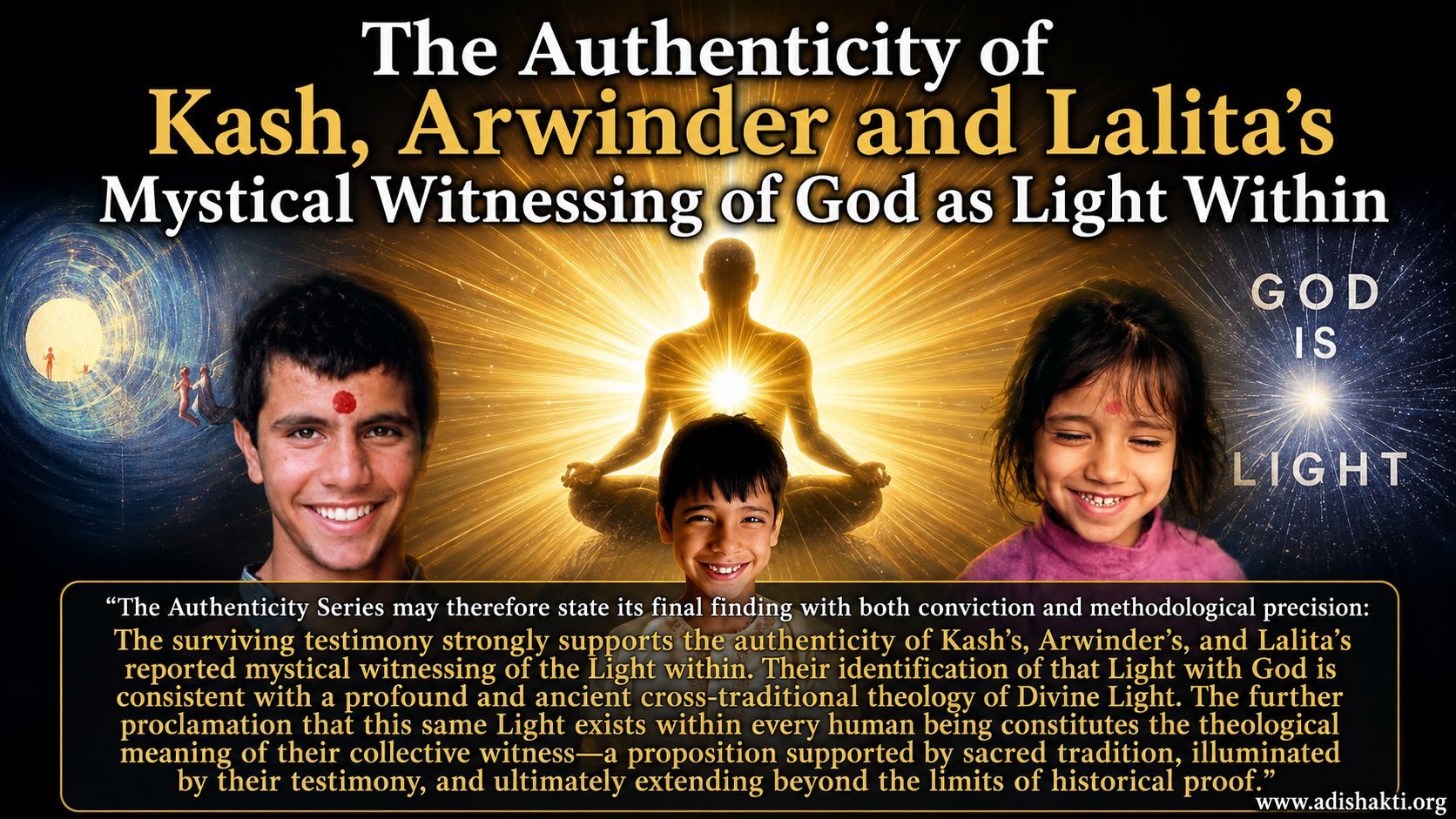
A Focused Historical Assessment of Three Sibling Witnesses, the Initial “Sun” Misidentification, Later Convergence, and the Distinction Between Experiential Authenticity and the Identification of the Light as God
God Almighty Is Light!
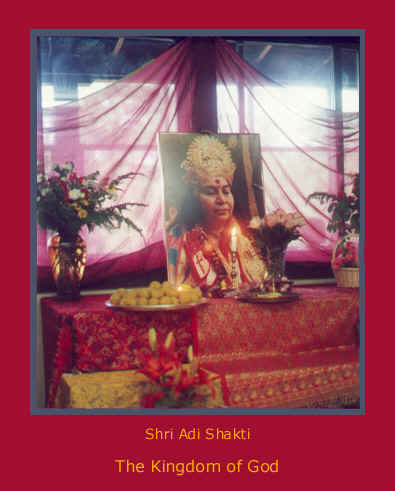
“Since Self-Realization the Light fascinated Kash. On the very first day itself he had stood alone on the endless cover of clouds, trying to understand where was this incredible, utterly peaceful Shangri-La that he had stumbled upon. There was one distinguishing Reality of this celestial landscape that held him spellbound — The Light! It was shining high above at a distance. He had kept gazing at it, spellbound by its indescribable uniqueness and infinite luminosity. It was an extremely bright globe, much brighter than many suns. In spite of its dazzling brightness it never ever hurt the eyes. Since Kash had never seen anything that bright he thought it must be the sun, but at a much closer proximity. His father, finding no other logical explanation, also agreed.
After months of Self-Transcendence it began to slowly dawn that what Kash was seeing could not possibly be the sun. But Kash kept on insisting that it had to be as nothing he had seen on Earth shone so bright. Uncertainty came into his father inquisitive mind. He had this peculiar habit of not believing anything unknown or speculative unless proven beyond a shadow of reasonable doubt. The sun that his son was seeing disturbed. Not only was it just above the Great Adi Shakti but it did not emit heat! But the lingering question was why was it visible only at Her place and nowhere else in the Kingdom of The Almighty Creator? If it was indeed the sun then it had to be seen at all the dwellings of all the Immortal Messengers that Shri Mataji used to take Kash to.
On September 11, 1994, at 13:05 p.m., after reading the word Shaibhang (Self-illumined) at the opening stanza of the Sri Guru Granth Sahib, the consciousness of Self-Realization indicated that there was more to this Truth than met the mind. If Guru Nanak had described the Divine World of Reality (Lahut) to be Shaibhang, or Self-Illumined, then the “very bright sun” that Kash spoke about could not be true. If the Spirit of the Living God was the Ultimate Reality (Al-Haqqah) then this “sun” at Her Abode was an inferior object. Moreover, Kash’s extraordinary observation of this “sun” created more questions and doubts. He maintained that:
- This Sun is always behind Her at an angle but is not directly above, that is, at about 45 degrees.
- It did not rise and fall like the earthly sun. The Sun above Shri Mataji Nirmala Devi was fixed and stationary.
- This Sun illuminates the entire Supreme Abode of the Great Celestial Mother. Every thing is seen very clearly and in fine detail, down to the different hues of skin tone. (That is why Kash was absolutely sure that Shri Jesus had a light brown skin, and wearing whitish gray clothes stretched taut by the sheer size of His muscular body.)
- Kash could not ascertain the exact size and distance of this Sun despite his numerous visits.
- In spite of its intense brightness this Sun emitted no heat. On the contrary, Kash said that the rays are cool!
Then one day he dropped a bombshell by claiming that there are no shadows from the rays of this Sun! In all his journeys Kash never saw any shadow in the Kingdom of The Spirit. Though questioned many times he maintained that this Sun does not produce any shadow, physical properties that are ubiquitous in our universal sun. Kash was told by his father to clarify this issue with Shri Viswamata Nirmala Devi. There was something strange about this sun that Kash daily witnessed.
Kash meditated and the Divine Kundalini at the sacrum bone took him up the Tree of Life into the Bridal Chamber. He burst through the clouds and reached His Dominion. The Infinite Light shone ever so brilliantly from above the Eternal Throne of the Great Mater Divinae Gratiae (Mother of Divine Grace) as She sat in Bliss and Joy. Shri Lok Mata met him and the question was put forward. The Great Primordial Guru explained that it was not the sun that he was seeing but the Light. They then meditated, after which Kash returned back to this hate-filled world of Louis Farrakhans and Osama bin Ladins.[1]
His Divine Light exists within all human beings — This Revealed Truth is Absolute.
His Divine Light emits cool rays — This Revealed Truth is Absolute.
His Inner Light cast no shadows — This Revealed Truth is Absolute.
His Divine Beings have no shadows — This Revealed Truth is Absolute.
This Revelation of the Light is the Ultimate Truth of all the Holy Scriptures. This Light has been announced by all His Messengers, Prophets and Incarnations. Since the dawn of civilization highly evolved souls have been searching relentlessly for this Light. This is the Light of Shri Krishna. This is the Light of Shri Jesus. This is the Light of Shri Buddha. This is the Light of Allah, of Yahweh, of Brahman or any other name that humans give to Him. God Almighty is Light!
Thousands have seen this Light, especially those who have undergone near-death-experiences. Just like Kash, they also gazed at it with utter awe and tranquility at their first sight of this Divine Wonder. These experiences of His Light are from within. Upon physical death they will experience His Light in His Dominion without. This is the Reality of the Microcosm and the Macrocosm. We all live within God and He lives within us as Light.”
Jagbir Singh, 1999, 669
Central Authenticity Question
The strongest authenticity argument in this case does not begin with the declaration that “God is Light.” It begins with the development of the testimony. Kash initially interpreted the extraordinary luminous phenomenon as the sun, even though it behaved unlike an ordinary sun: it was fixed, intensely bright yet visually tolerable, without perceptible heat, described as cool, and reportedly associated with a realm in which he saw no shadows. Years later, Lalita independently described a Light that was “cool,” extremely bright yet possible to look at, and different from the terrestrial sun; Arwinder described its colour as “white, white yellow.” Lalita later identified the phenomenon as “God.” The key historical question is therefore whether these descriptions were genuinely recorded when claimed and whether the unusual characteristics were documented before later witnesses could have absorbed them.
Table of Contents
- Introduction — Why This Case Is Strongest as a Witness-Convergence Study
- 1. Kash’s Original “Sun” Interpretation
- 2. The Unusual Light Profile
- 3. Why the Initial Error Matters
- 4. Lalita’s Later Testimony
- 5. Arwinder’s Compatible but Non-Identical Description
- 6. What the Three Witnesses Actually Share
- 7. The Independence Problem
- 8. Suggestion, Memory Contamination and Psychological Explanation
- 9. From Phenomenology to “God”
- 10. Documentary Chronology: The Decisive Test
- 11. Graded Authenticity Assessment
- 12. What Evidence Would Strengthen the Case?
- Conclusion
- References
Introduction — Why This Case Is Strongest as a Witness-Convergence Study
The testimony of Kash, Arwinder, and Lalita concerns an extraordinary luminous phenomenon associated with Shri Mataji and the Sahasrara. The source contains extensive comparative theology, but the authenticity question is more precise. Before asking whether the Light was objectively God, one must ask whether the children actually gave the reports attributed to them, whether they appear to have been describing experiences they regarded as genuine, how closely their accounts converge, and how much independence can reasonably be assigned to sibling witnesses raised in the same spiritual household.
This distinction is essential because the evidence operates at several levels. Historical documentation can assess chronology and reported statements. Witness comparison can assess convergence and variation. Psychology can propose ordinary mechanisms. Comparative theology can show that Divine Light is an ancient religious category. But none of those steps, taken alone, turns a private mystical perception into a laboratory-measured object. The paper is therefore strongest when it first establishes the authenticity of the testimony and only afterward addresses its theological meaning.
1. Kash’s Original “Sun” Interpretation
The earliest and most important feature of Kash’s testimony is that he reportedly did not begin by calling the phenomenon Divine Light. He described an extraordinarily bright source above or behind Shri Mataji and concluded that it must be the sun, perhaps seen from unusually close range. His father initially accepted the same ordinary explanation.
That first interpretation is evidentially valuable because it is not doctrinally convenient. If Kash had merely been repeating a developed religious teaching, one might expect an immediate identification such as “God,” “Brahman,” “Divine Light,” or another explicitly theological term. Instead, the source preserves a naturalistic first explanation that later became difficult to sustain. The development is therefore not theology first and observation second, but observation first, ordinary interpretation second, anomaly accumulation third, and theological reinterpretation later.
2. The Unusual Light Profile
Kash’s descriptions gradually produced a profile that did not behave like ordinary sunlight. The source states that the Light appeared at a fixed angle behind Shri Mataji rather than traversing a sky; it did not rise or set; it illuminated the realm with extraordinary clarity; its size and distance could not be determined; it produced no perceptible heat; its rays were described as cool; and, most unusually, Kash repeatedly stated that he saw no shadows produced by the illumination.
These properties should be treated as reported phenomenology, not as measured physics. No instrument accompanied Kash into the claimed mystical environment. The historically defensible proposition is therefore that Kash repeatedly reported a luminous phenomenon with this cluster of unusual characteristics. The stronger proposition that Divine Light objectively has these properties belongs to theological interpretation.
The Core Kash Profile
Extraordinary brightness · visually tolerable · stationary · non-solar · no perceptible heat · cool rays · reported absence of shadows.
3. Why the Initial Error Matters
The initial “sun” mistake is one of the strongest authenticity features in the record. From an evidentiary perspective, a mistaken identification can be more informative than an immediately correct theological answer. It shows that the witness’s interpretation developed rather than arriving fully formed.
The sequence preserved by the source is especially important: experience → ordinary interpretation → accumulating anomalies → questioning → theological reinterpretation. Kash reportedly resisted abandoning the solar explanation because brightness was the closest terrestrial analogy available to him. Only later, after questioning, was the phenomenon reportedly identified as “the Light.” This does not establish supernatural causation, but it complicates a simple parroting hypothesis in which the child merely repeats the doctrine expected of him.
4. Lalita’s Later Testimony
The case becomes more significant when the testimony moves beyond Kash. On March 23, 2003, eight-year-old Lalita reportedly began by counting ordinary physical lights in her room. After seven visible sources had been counted, she said that there was an eighth: the Light above Shri Mataji in her Sahasrara. The relevance lies in the way the topic arose. According to the record, the conversation began with ordinary lights rather than with a direct request to describe a mystical Light.
When questioned, Lalita described the Light as cool, very bright, yet possible to look at directly, and yellow. The interview is particularly important because her father then suggested alternative colour terminology such as silver and metallic silver. Lalita did not simply accept the adult vocabulary. She repeatedly asked what he meant, rejected the proposed silver comparison, and returned to her own word: “Yellow.”
This resistance does not establish complete independence, but it is methodologically useful. It shows that within this exchange she was not simply agreeing with every suggestion supplied by the interviewer. That makes the strongest version of a straightforward compliance explanation less satisfactory.
5. Arwinder’s Compatible but Non-Identical Description
The following day, Arwinder was reportedly asked one direct question without being given Lalita’s answer: what colour was Shri Mataji’s Light? His answer was “Like white, white yellow.” The importance of this response is that it converges without duplicating. Lalita said yellow; Arwinder said white-yellow; Kash’s earlier reports emphasized extraordinary brilliance rather than a simple colour term.
Exact verbal identity across three siblings would raise concerns about rehearsal or shared phrasing. Partial convergence accompanied by natural variation is more consistent with separate attempts to describe an unusual experience, although it still does not prove informational independence. The family relationship must remain part of the analysis.
6. What the Three Witnesses Actually Share
The cumulative case is stronger than any one statement. Kash reported extraordinary luminosity, non-solar behaviour, visual tolerability, coolness or absence of heat, stationarity, and lack of shadows. Lalita later described a Light that was extremely bright yet could be looked at directly, cool, distinct from the terrestrial sun, and yellow. Arwinder supplied a compatible but non-identical white-yellow colour description. Lalita repeatedly continued to identify the phenomenon as “the Light” and later gave the theological identification “God.”
The most important convergence is not colour by itself. It is the conjunction of extreme brightness with direct visual tolerability and coolness or absence of ordinary heat. This is a more distinctive cluster than the generic statement that several children saw something bright. The source also records longitudinal consistency, since Lalita was questioned again in May 2004 and continued to describe the Light as unusually bright, non-blinding, and different from the sun.
Strongest Shared Pattern
Extraordinary brightness + ability to look directly + non-solar character + coolness/no ordinary heat. Kash adds stationarity and shadowlessness; Lalita adds repeated yellow description; Arwinder adds the compatible “white, white yellow” formulation.
7. The Independence Problem
The three witnesses were siblings living within the same devotional environment. That fact prevents the paper from simply calling them independent witnesses without qualification. They could have heard one another’s stories, absorbed shared vocabulary, seen common religious imagery, or been influenced by family conversations over many years. Such information pathways do not require deliberate coaching.
The academically defensible formulation is therefore narrower: three related witnesses whose testimonies display substantial phenomenological convergence, including some instances of non-identical responses obtained through individual questioning. That statement recognizes the evidentiary value of the convergence without claiming a level of independence that the present record has not yet demonstrated.
8. Suggestion, Memory Contamination and Psychological Explanation
Religious suggestion is an obvious alternative because the children lived in a household where Shri Mataji, Sahasrara, meditation, Divine Light, and mystical realities were discussed. Expectations can shape perception and interpretation. Yet Kash’s original insistence that the phenomenon was the sun does not fit neatly with the simplest model of doctrinal repetition, and Lalita’s resistance to suggested colour terminology complicates the claim that the children merely repeated whatever an adult supplied.
Memory contamination is a more serious issue. Siblings discussing unusual experiences over years can influence one another’s recollections unconsciously. Later convergence is therefore only as strong as the chronology showing what was recorded before each later witness was questioned. If coolness, non-solar brightness, direct visual tolerability, stationarity, or shadowlessness were already committed to writing before Lalita and Arwinder gave their descriptions, the convergence carries more weight. If those details appear only after years of family discussion, the evidentiary value decreases.
Neurological or psychological explanation is also possible. A mystical experience can be psychologically genuine while being explained through altered states, neural processing, imagination, or other natural mechanisms. Identifying a neural correlate, however, would not by itself decide the metaphysical status of the experience. The authenticity question is first whether the children sincerely experienced and reported what they described, not whether neuroscience can settle what ultimately caused it.
9. From Phenomenology to “God”
The source is strongest when it distinguishes observation from interpretation. “Bright,” “cool,” “yellow,” “white-yellow,” “stationary,” “doesn’t blind,” and “no shadows” are descriptions of perceived properties. Lalita’s later answer “God” is different: it identifies what she understood the phenomenon to be.
This distinction matters because ancient religious traditions already contain extensive theology of Divine Light. The Gospel of John speaks of the “true Light”; Islamic scripture speaks of the Light of Allah; Sikh traditions use language of self-existent divine reality; Hindu and Upanishadic traditions repeatedly employ self-luminosity and divine effulgence. These correspondences show that the witnesses’ interpretation is not religiously unprecedented. They do not, by themselves, establish that the phenomenon the children perceived was objectively God.
The theological argument is therefore cumulative rather than historical in the narrow sense. The historical record can support the proposition that the witnesses reported an extraordinary luminous phenomenon. Comparative theology can show that identifying ultimate reality with Light is ancient and cross-traditional. The final identification of the perceived Light as God belongs to the witnesses’ theological interpretation of their experience.
10. Documentary Chronology: The Decisive Test
The single most important research task is to reconstruct the chronology of the unusual descriptive features. The earliest diaries, handwritten sheets, computer files, correspondence, dated notes, and printed records should be examined to determine exactly when each characteristic first entered the record. The critical question is not simply whether all three children eventually described similar things; it is whether the unusual features were documented before later witnesses could have learned them from family discussion.
For example, if Kash’s descriptions of coolness, non-solar luminosity, visual tolerability, stationarity, and shadowlessness are demonstrably preserved in records created years before Lalita’s 2003 testimony, then later convergence becomes materially more significant. Likewise, if Lalita’s responses were documented before Arwinder was asked his colour question, the sequence is more probative than a later reconstructed summary that simply says all three agreed.
11. Graded Authenticity Assessment
The case should be assessed in layers because historical authenticity, experiential sincerity, witness independence, theological correspondence, and metaphysical identity are different propositions requiring different levels of evidence.
Authenticity Verdict
Historical authenticity — Strong: there is substantial reason, on the surviving record, to accept that Kash, Arwinder, and Lalita gave the luminous reports attributed to them, subject to final comparison with the earliest primary documents.
Experiential authenticity — Strong: the specificity, recurrence, developmental character, and partially convergent testimony support the conclusion that the witnesses were describing experiences they regarded as genuine rather than simply constructing a coordinated fabrication.
Initial-error evidence — Strong: Kash’s “sun” interpretation is particularly important because it preserves a naturalistic mistake rather than immediate theological correctness.
Sibling convergence — Meaningful but qualified: the accounts share distinctive features and retain natural variation, but the witnesses were members of the same household and complete informational independence has not been established.
Suggestion / memory contamination — Plausible alternatives: these remain serious because of the shared devotional environment; their explanatory force depends heavily on what the earliest records show.
Cross-traditional Divine Light correspondence — Strong: Christian, Islamic, Sikh, and Hindu traditions contain developed Light theology that predates the children’s experiences.
Identification of the Light as God — Theologically coherent but historically underdetermined: the evidence strongly supports the authenticity of the reports more than it can empirically establish the ultimate ontological identity of the phenomenon.
12. What Evidence Would Strengthen the Case?
The first priority is to digitize and publish the earliest 1993–2005 documentary record in chronological order. Every dated note concerning the Light should be preserved verbatim, including imperfect wording, corrections, uncertainty, and changes in interpretation. Particular attention should be paid to when the unusual properties—coolness, no heat, direct visual tolerability, fixed location, non-solar character, and shadowlessness—first appear.
The second priority is to establish information pathways. Researchers should document what Lalita and Arwinder could reasonably have heard from Kash, their parents, Sahaja Yoga meetings, devotional materials, or one another before their individual statements. The third priority is to retain leading questions as part of the evidence rather than hiding them. Lalita’s 2003 colour interview is valuable precisely because the adult suggestion is visible and her resistance to it can therefore be assessed directly.
Finally, the archive should distinguish each witness’s exact words from the father’s later theological interpretation. That separation will allow future readers to judge phenomenological convergence without having to accept the metaphysical conclusion in advance.
Conclusion — What the Three Witnesses Establish Most Strongly
The strongest conclusion of the Light case is not that three children scientifically proved the existence of God. Its real evidentiary force lies in the development and convergence of the testimony. Kash began with the ordinary explanation that he was seeing the sun. Repeated anomalies made that explanation increasingly difficult to sustain. Years later, Lalita described an extraordinarily bright yet visually tolerable and cool Light, resisted suggested colour terminology, and retained her own description. Arwinder supplied a compatible but non-identical white-yellow description. Lalita later identified the phenomenon as “God.”
Those elements create a substantially stronger authenticity pattern than the proposition that one child once reported seeing something bright. At the same time, the sibling relationship requires caution. Complete informational independence cannot be assumed, and the entire case ultimately depends on documentary chronology: what was recorded first, what later witnesses could have known, and which details genuinely predated subsequent questioning.
The most defensible conclusion is therefore clear and focused: the surviving record strongly supports the authenticity of Kash’s, Arwinder’s, and Lalita’s reports that they experienced and witnessed what they understood as an extraordinary Divine Light associated with the Sahasrara. Their accounts show meaningful convergence while retaining natural differences. The further identification of that Light as God is deeply coherent with their theological framework and with ancient traditions of Divine Light, but it remains a metaphysical conclusion beyond what historical method alone can demonstrate.
References
- Primary narrative: Jagbir Singh, Shri Adi Shakti: The Kingdom of God (1999), especially the Light testimony preserved around p. 669.
- Later witness records: Lalita, March 23, 2003; Arwinder, March 24, 2003; Lalita, May 4, 2004; Lalita identification recorded March 15, 2005.
- Comparative scriptural context: Johannine Light theology; Qur’anic Light language; Sikh and Hindu traditions of self-luminous Divine Reality.
- Archival priority: earliest diaries, handwritten sheets, computer records, correspondence, dated notes, and other primary materials establishing when each unusual characteristic first entered the record.
💬 Interactive Chat
Examine the three sibling witnesses, Kash’s initial “sun” misidentification, Lalita’s resistance to suggested terminology, witness independence, and the documentary chronology needed to assess authenticity.
Open chat →