The Prophecies of Suppression
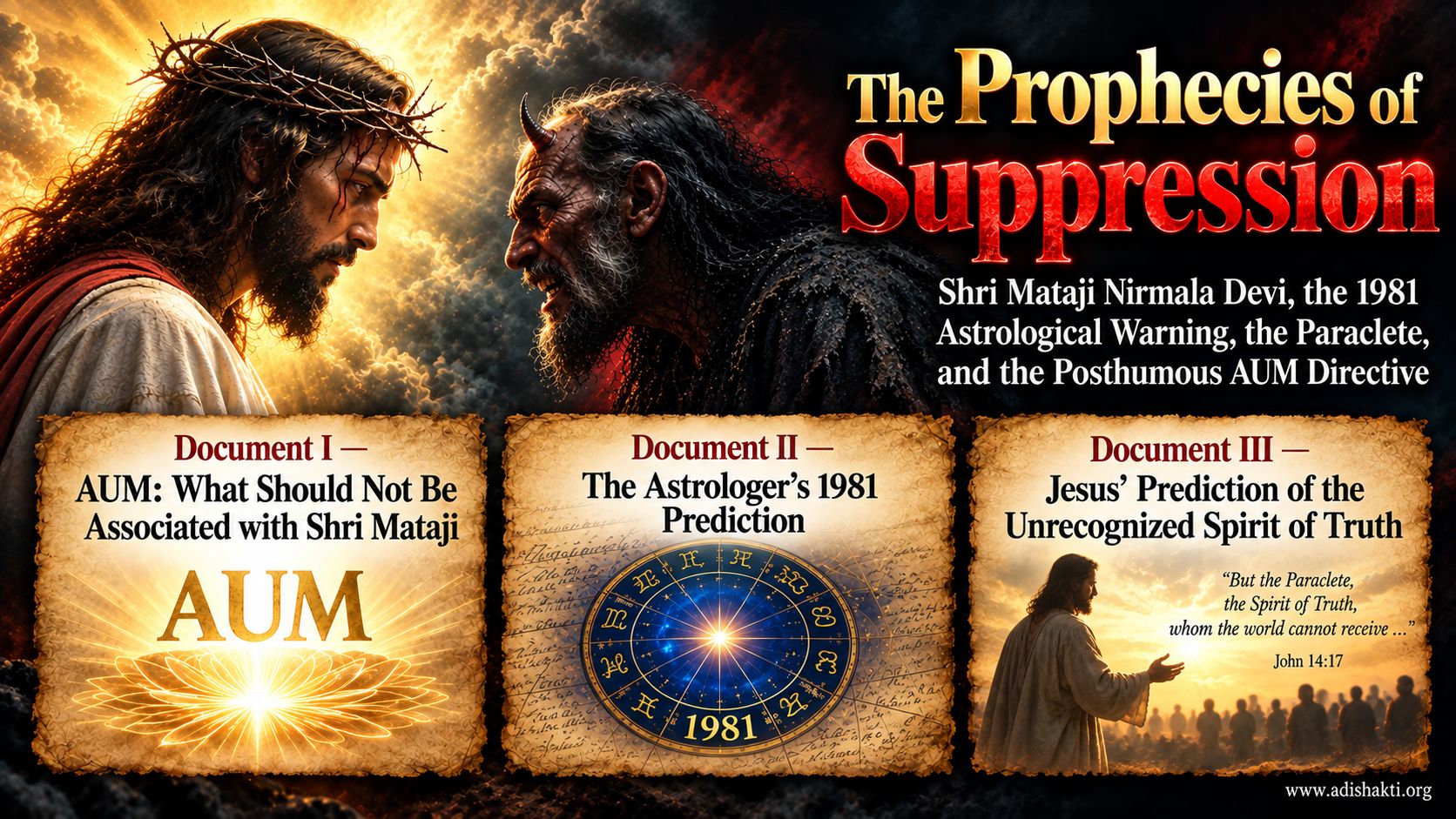
Shri Mataji Nirmala Devi, the 1981 Astrological Warning, the Paraclete, and the Posthumous AUM Directive
Three documents stand at the center of this investigation. They come from radically different sources and periods, and they should be read before their relationship is interpreted: the February 2012 AUM Internet communications directive, an astrological assessment published in Nirmala Yoga in January–February 1981, and Jesus’ prediction in John 14:16–17 concerning the world’s failure to receive the Spirit of Truth.
Document I — AUM: What Should Not Be Associated with Shri Mataji
Primary source: AUM, Preserving the image of Shri Mataji and Sahaja Yoga online, Version Feb 2012, §9.0. The surviving PDF identifies itself as “Version Feb 2012”; it does not itself establish a specific February 21 date.
9.0 Reference to Shri Mataji on Blogs, Public forums, Sites and Groups
Shri Mataji is simplicity personified. Her language, Her demeanor and Her nature reinforce the simplicity aspect, which is why even communication about Her needs to be easy to read.
When describing Shri Mataji, care should be taken to avoid any kind of association of the following terminology
. Goddess
. Incarnation
. Religious or cult leader
. Religious leanings / ideas
. Any viewpoint or statement of ShriMataji against any known figure or event or any popular practice.Shri Mataji’s reference and description is solely for the purposes of conveying our love for our Mother between yogis. But for non-yogis such terminology can be considered as blasphemy and thus should be avoided.
The problem is it that not all are ready for the real knowledge and we face the risk of repelling them even before they have a chance to find out about Sahaja Yoga and Self-Realization.
Document II — The Astrologer’s 1981 Prediction
Primary source: Nirmala Yoga Magazine, Jan–Feb 1981. Reproduced from the historical text preserved in the source page.
MATAJI was born at Nagpur at 12.09 p.m., I.S.T. (noon time) on 21st March 1923. At this moment, taking into consideration the local time of Nagpur, the Sun was exactly on the Meridian in full glory, and being in the zero degree of Aries or the 30th degree of Pisces, the Sun in that position made a Rajayoga (i.e. an aspect for leadership and prominence in life), which has endowed her with the Sun's glamour and power.
Her rising sign is Cancer and the Ascendent is in the 8th degree. The Ascendant in Cancer makes her a Mother of the Universe, a Jaganmata, as the Ascendant is strongly aspected by five planets, Jupiter, Mercury, Uranus, Mars and the Moon, while it is occupied by Pluto, which itself forms grand trines with three of the five planets and sextiles with the other two. Her spiritual powers arise mainly from this combination of aspects in the angles of the chart, also, the position of the planet of spiritual life viz. Neptune in the second house indicates that her wealth accumulation is spiritual. It is interesting to note that the current position of Neptune in the transit is near the cusp of the sixth house. This shows that her main work in the years to come will be solely in this field.
The Lord of the Ascendant Moon, is exalted in Taurus strongly posited in the 11th house, conjunct Mars, which is Lakshmi-Yoga and invest her with divinity. She is thus the incarnation of Mahalaxmi. She is destined to live richly like a Goddess. Her aristocratic origin is further indicated by the exalted Saturn in the 4th house, who being the lord of the 7th house (Capricorn) has brought her into matrimonial union with an eminent official. This same Saturn makes for vairagya, i.e. distaste for worldly life and renunciation.
Jupiter strongly aspected in the 5th house, makes her a Mother- Teacher and as he is trined by three powerful planets and squared by two and opposed by two, Mataji will have a most eventful life as a World Teacher. It will all bring a great renown, an enormous following all over the world, a lot of conflict with evil.
Saturn, strong in the 4th house, gives much longevity, great distinction towards the end of life, a lot of power both spiritual and temporal, although it inclines her to some solitude also in old age.
International fame is indicated by the presence of a strong Uranus in the 9th house, trined by Jupiter, Pluto and sextiled by Mars and Moon. Also, the Mercury-Uranus conjunction gives Mataji great eloquence and invincibility as a debater.
The T-square formations between Moon, Mars, Venus, Jupiter, and Neptune indicate that some of the plans of Mataji might be hindered by obstructive activities of evil and negative forces. Also Mataji might have to steer through conflicting loyalties and aims of some of her so-called followers who are enemies in disguise. But despite all this, she will find her way to the goal of her life, viz., universal Self-Realisation!
Altogether, a great and powerful chart of a truly Divine personality.
Nirmala Yoga Magazine — Jan-Feb 1981
1981: “incarnation of Mahalaxmi” → 2012 AUM: avoid “Incarnation.”
1981: “like a Goddess” → 2012 AUM: avoid “Goddess.”
1981: predicts “conflicting loyalties and aims” among some followers → 2012: a documented communications policy regulates how Shri Mataji’s divine identity and religious ideas are presented to outsiders.
Document III — Jesus’ Prediction of the Unrecognized Spirit of Truth
“And I will ask the Father, and he will give you another Advocate to be with you always, the Spirit of truth, which the world cannot accept, because it neither sees nor knows it.” — John 14:16–17
The Johannine text predicts a problem of recognition: the world cannot receive the Spirit of Truth because it neither sees nor knows the Spirit. The verse does not name Shri Mataji, and mainstream Christian interpretation does not identify John 14:17 as a prediction of Shri Mataji Nirmala Devi. That identification is the theological thesis investigated here.
The surviving Greek has to pneuma tēs alētheias, “the Spirit of Truth.” Pneuma is grammatically neuter; therefore the conventional masculine English “He” cannot by itself prove that the promised Spirit must manifest in biologically masculine form. Within the theological interpretation advanced here, the verse may therefore be rendered explicitly in feminine form:
John 14:17 — interpretive feminine rendering, not a claim that the surviving Greek text contains a feminine pronoun.
Syriac Christian tradition also developed feminine imagery for the Holy Spirit. That Semitic background is relevant to the theological possibility of feminine imagery, but it does not establish that the Gospel of John was originally composed in Aramaic.
Abstract
This paper investigates an unusual documentary sequence surrounding Shri Mataji Nirmala Devi and the identity she claimed for herself. AUM’s February 2012 Internet directive advised those describing Shri Mataji to outsiders to avoid “Goddess,” “Incarnation” and “Religious leanings / ideas,” while explaining that “not all are ready for the real knowledge.” More than thirty years earlier, a horoscope published in Nirmala Yoga had described Shri Mataji as the “incarnation of Mahalaxmi,” said she would live “like a Goddess,” predicted that she would become a “World Teacher” with “an enormous following all over the world,” and warned of obstruction and “conflicting loyalties and aims” among some followers. John 14:16–17 supplies a still older theological frame: Jesus promises the Spirit of Truth while predicting that the world will fail to receive and recognize that promised presence.
The argument distinguishes three levels throughout: documented evidence, historical inference, and theological interpretation. The documents establish what was said and when. They do not scientifically prove astrology, establish malicious motives, or by themselves prove Shri Mataji’s identity as the Paraclete. The theological question is whether these independent strands converge in the subsequent history of her mission.
Shri Mataji’s Mandate: “You Have to Prove It That I Am That”
The strongest criticism of AUM begins not with astrology but with Shri Mataji’s own recorded understanding of her mission. On 2 December 1979 she declared herself the Adi Shakti, the Mother of all Mothers and the Primordial Mother. Whatever theological judgment is made about that declaration, it cannot easily be reconciled with a retrospective portrayal of Shri Mataji as merely a teacher of meditation.
“I am the Adi Shakti (the Holy Spirit or Ruh of Allah). I am the One who has come on this Earth for the first time in this Form to do this tremendous task… I knew I'll have to say that openly one day and we have said it. But now it is you people who have to prove it that I am that!”
— Shri Mataji, March 21, 1983
The distinction between declaring and proving is crucial. Proof is unnecessary for those who already accept a proposition. The command becomes meaningful at the boundary between believer and non-believer: evidence must be presented, objections confronted, and people who do not already believe must be allowed to examine the claim.
“Now the Time has come to start talking, announcing, telling about it to everyone. Otherwise the world would say that we never knew about it.... You must have that vision before you that I have put many a times before you people that you have to emancipate the humanity.”
— Shri Mataji, May 6, 1990
The chronological progression is difficult to miss: declaration, then proof, then announcement. By 1990 Shri Mataji explicitly anticipated the future objection that the world had never been informed.
AUM and the Problem of “Religious Leanings / Ideas”
The most immediately striking AUM terms are “Goddess” and “Incarnation,” but “Religious leanings / ideas” may be the most consequential phrase in the directive. Shri Mataji’s public teaching over approximately four decades addressed Jesus Christ, Crucifixion, Resurrection, Last Judgment, the Comforter or Paraclete, Holy Spirit, Kingdom of God, second birth, salvation, divine incarnation, Muhammad, Qur’an, Ruh of Allah, Al-Qiyāmah, An-Naba, Adi Shakti, Kundalini, Sahasrara, moksha, dharma, karma, reincarnation, the Divine Mother, the Hindu deities and scriptures, Buddha, Mahavira, Guru Nanak and Sikhism, Judaism, Taoism, Zoroaster, Sufism, saints, prophets, mystics, organized religion, ritualism and the claimed spiritual unity of the world’s authentic traditions.
AUM does not explicitly say that disciples must never discuss every one of these subjects. The phrase is not defined in §9.0, and it would be improper to transform three words into a detailed prohibition the document itself does not articulate. Yet its breadth creates a profound problem because Shri Mataji’s religious teachings were not detachable ornamentation surrounding a secular meditation program. They formed part of the explanatory architecture through which she interpreted Self-Realization and her own mission.
The claim that Shri Mataji fulfills the Comforter cannot be investigated without Jesus and John 14–16. Her identification with the Holy Spirit cannot be investigated without Christian theology. Her teaching concerning Resurrection and Last Judgment cannot be investigated without eschatology. Her statements concerning An-Naba and Al-Qiyāmah cannot be examined without Islam and the Qur’an. Her declaration that she is the Adi Shakti cannot be understood without Shakti theology and the Divine Mother traditions. Remove the religious questions and the possibility of testing the religious identity largely disappears with them.
Preservation Is Not Proclamation
Sahaja Yoga has preserved an enormous amount of Shri Mataji’s legacy. Her talks have been recorded, digitized, transcribed and translated; meditation centers have operated internationally; and Kundalini awakening and Self-Realization have been introduced across cultures. The argument is therefore not that Shri Mataji disappeared from Sahaja Yoga. It is that preservation of a founder is not equivalent to proclamation of what the founder claimed to be.
An institution can preserve a video in which Shri Mataji says “I am the Adi Shakti” without itself declaring to humanity that Shri Mataji is the Adi Shakti. It can archive her identification with the Holy Spirit without making the case that she fulfills Christ’s promise of the Paraclete. It can preserve the command “prove it that I am that” without undertaking the systematic theological, historical, scriptural and experiential demonstration that such a command appears to require.
More than fifty-six years have passed since 1970. Nearly forty-seven years have passed since the 1979 Adi Shakti declaration. More than forty-three years have passed since the 1983 instruction to prove who she was, and thirty-six years have passed since the 1990 instruction to begin announcing and telling everyone. A gradual introduction to extraordinary theological claims can be reasonable. But “gradual” must eventually arrive somewhere. After more than half a century, the question is whether preparation has become a permanent substitute for proclamation.
An Extraordinary Historical Reversal
Religious traditions have repeatedly institutionalized, reinterpreted and selectively transmitted the teachings of their founders, so an absolute claim that nothing remotely comparable has ever occurred would go beyond what historical evidence can establish. The particular combination here is nevertheless extraordinary: a founder makes explicit claims concerning divine identity, leaves thousands of recorded teachings explaining their religious significance, instructs disciples to prove and announce that identity, and is followed by a posthumous communications directive discouraging public association with “Goddess,” “Incarnation” and “Religious leanings / ideas.”
Across very different religious traditions, believers have sometimes accepted ostracism, persecution, imprisonment and death rather than renounce what they understood to be sacred truth. Their circumstances should not be collapsed into a single story, nor does this paper suggest that Sahaja Yogis should seek martyrdom. The narrower comparison is that religious communities have repeatedly accepted rejection as a possible cost of public witness. AUM presents the inverse problem: the risk of repelling outsiders is explicitly offered as a reason for discretion concerning what the document itself calls “the real knowledge.”
The circumstances make the contrast more striking because Shri Mataji left an enormous first-person audiovisual record and lived into the age of global electronic communication. Her followers did not inherit only fragmentary manuscripts or traditions reconstructed centuries later. They inherited her own voice and image—and eventually an Internet capable of transmitting those teachings globally.
Jesus and the Unknown Paraclete
Within mainstream Christian theology, John 14:16–17 is ordinarily understood through the Church’s doctrine of the Holy Spirit, not as a prediction naming Shri Mataji Nirmala Devi. That must remain explicit. Yet if the identification of Shri Mataji with the Paraclete is entertained as a hypothesis, the subsequent correspondence becomes striking: Jesus predicts external non-recognition; the astrologer predicts internal obstruction and conflicting aims; and the later institutional record contains a policy of discretion regarding some of the concepts necessary to present the claim.
This does not make rejection self-authenticating evidence. Countless religious figures have been rejected. The argument must instead be cumulative: what was predicted about the Paraclete; what Shri Mataji said about herself; what functions she claimed to fulfill; the worldwide mission of Self-Realization; the religious and experiential framework she supplied; the independently published 1981 prediction; and the later pattern of non-recognition and institutional caution.
The Astrologer’s “Conflicting Loyalties and Aims”
The most analytically useful language in the 1981 prediction is not the metaphysical language of “evil” or “enemies in disguise,” but the phrase “conflicting loyalties and aims.” The later documentary record permits a conflict of aims to be identified without claiming knowledge of anyone’s motives.
Shri Mataji’s stated aim was that her followers prove and announce her identity. AUM’s stated aim was to prevent potential seekers from being repelled before discovering Sahaja Yoga and Self-Realization. These objectives need not arise from opposite loyalties; the authors of AUM may have sincerely believed that discretion was the best way to serve Shri Mataji. Yet sincere motives do not make the strategies identical.
One strategy asks: What must humanity be told so that it can understand and evaluate who Shri Mataji claimed to be? The other asks: What should initially be withheld so that humanity is not driven away before experiencing what Shri Mataji brought? Those aims can coexist temporarily. The problem arises if the second ceases to function as a pathway toward the first.
Was Humanity Ever Given the Opportunity to Decide?
The ultimate issue is not whether humanity accepted Shri Mataji as the Adi Shakti or Paraclete. Humanity is entitled to reject that proposition. Christians may conclude that the Johannine Paraclete is adequately understood through Pentecost and the continuing presence of the Holy Spirit. Muslims may reject theological identifications incompatible with their understanding of revelation. Hindus may dispute Shri Mataji’s identification with the Adi Shakti. Historians may classify her declarations as religious self-understanding without accepting their metaphysical truth.
Those judgments are legitimate outcomes of investigation. The more fundamental question is whether the investigation has ever occurred on a scale commensurate with Shri Mataji’s claim. If humanity primarily encounters her as the founder of Sahaja Yoga and a teacher of meditation while her declarations concerning the Adi Shakti, Holy Spirit, Paraclete, Resurrection, Judgment and universal emancipation remain principally in archives or devotional contexts, then humanity has not collectively rejected the strongest proposition after examining it.
Jesus predicts that the Spirit of Truth will confront a world that does not receive or know that promised presence. In 1981 an astrologer predicts that Shri Mataji will become a World Teacher, acquire an enormous following, encounter conflict and face obstruction and “conflicting loyalties and aims” among some followers. Shri Mataji subsequently declares herself the Adi Shakti, Holy Spirit and Ruh of Allah, tells her followers to prove that identity, and later tells them to announce and tell everyone. After her death, AUM advises those communicating with outsiders to avoid association with “Goddess,” “Incarnation” and “Religious leanings / ideas,” explaining that outsiders may regard such language as blasphemous and that “not all are ready for the real knowledge.”
None of these facts, separately or together, scientifically proves astrology or establishes Shri Mataji’s divine identity. Nor do they establish malicious intent on the part of those who developed AUM. They establish something narrower but historically significant: a remarkable documentary correspondence between prediction, proclamation and later institutional restraint.
If the theological interpretation advanced by Adishakti.org is correct, the deepest tragedy is not that humanity rejected Shri Mataji. Rejection would at least mean that humanity had heard the case. The far more consequential possibility is that humanity has spent more than five decades largely unaware that the case existed.
A Christian cannot seriously investigate whether Christ’s promised Spirit of Truth has appeared without encountering the claim. A Muslim cannot examine Shri Mataji’s statements concerning the Ruh of Allah, Al-Qiyāmah and An-Naba without knowing that she made them. Scholars cannot evaluate the proposed theological significance of collective Self-Realization if Shri Mataji enters academic consciousness primarily as the founder of a meditation movement. Humanity cannot accept or reject the claimed advent of the Adi Shakti if that claimed advent is not unequivocally placed before it.
References and Primary Sources
- Nirmala Yoga Magazine, Jan–Feb 1981, astrological assessment of Shri Mataji Nirmala Devi, reproduced in the historical source page “Shri Mataji’s Astrology Chart.”
- AUM, Preserving the image of Shri Mataji and Sahaja Yoga online, Version Feb 2012, especially §§1.1, 9.0 and 10.0. Official surviving PDF: sahajayoga.org/swan/download/swan961_0.pdf.
- John 14:16–17, with the Greek text to pneuma tēs alētheias; see SBL Greek New Testament and NABRE textual note concerning grammatical gender.
- Shri Mataji Nirmala Devi, declaration of Adi Shakti identity, 2 December 1979.
- Shri Mataji Nirmala Devi, “I am the Adi Shakti (the Holy Spirit or Ruh of Allah) … you people have to prove it that I am that!”, 21 March 1983.
- Shri Mataji Nirmala Devi, “Now the Time has come to start talking, announcing, telling about it to everyone,” 6 May 1990.