Authenticity of Kash's Mystical Witnessing of the Contents of the First Fax
A Focused Historical Assessment of the December 1993 Fax as the Earliest Documentary Record of Kash’s Reported Mystical Experiences

The First Fax is best understood as an authentic contemporaneous primary historical document that faithfully preserves what Jagbir Singh sincerely believed his son Kash had experienced during December 1993. Its provenance, chronology, identifiable recipients, internal consistency, admissions against interest, preservation of ordinary human misunderstandings, and progressive documentary development collectively provide substantial historical evidence supporting its authenticity as a documentary source.
Jagbir Singh, 1999
Central Authenticity Question
The First Fax matters because it is not a memory written decades after the events. It is a private communication sent in December 1993, while Kash’s reported experiences were still unfolding and before the later theological system presented in Shri Adi Shakti: The Kingdom of God had taken shape. The central historical question is therefore precise: does the fax show that detailed mystical reports attributed to Kash were already being recorded and privately communicated at the time, before later interpretation could reshape them?
Table of Contents
- Introduction — Why the First Fax Matters
- 1. What the First Fax Actually Establishes
- 2. Provenance, Recipients, and Private Transmission
- 3. Contemporaneity: Observation Before Theology
- 4. The Father’s Skepticism as Evidence
- 5. What the Fax Records About Kash
- 6. Preserved Errors and Corrections
- 7. Testing Alternative Explanations
- 8. Graded Authenticity Assessment
- 9. What Would Strengthen the Case Further?
- Conclusion
- References
Introduction — Why the First Fax Matters
The First Fax is important because it changes the nature of the authenticity question. Without it, a critic could argue that the detailed stories later published about Kash were gradually constructed from memory, altered by later beliefs, or shaped after the family had already developed a mature theology concerning Shri Mataji and the Adi Shakti. The fax places at least part of the testimony firmly inside the historical period itself. It shows that descriptions of Krishna, Shiva, Hanuman, Ganesha, Vishnu, Mahalakshmi, Shesha, meditation, and unusual inner experiences were already being communicated to named recipients in December 1993.
This does not prove that the beings Kash described objectively existed in a transcendent realm. Historical method cannot demonstrate that. What the fax can establish is more limited but still highly significant: the experiences were not merely invented for the 1999 book. They were already being reported, recorded, and transmitted privately years earlier. That documentary fact is the proper foundation for any later theological or metaphysical argument.
1. What the First Fax Actually Establishes
The Historical Core
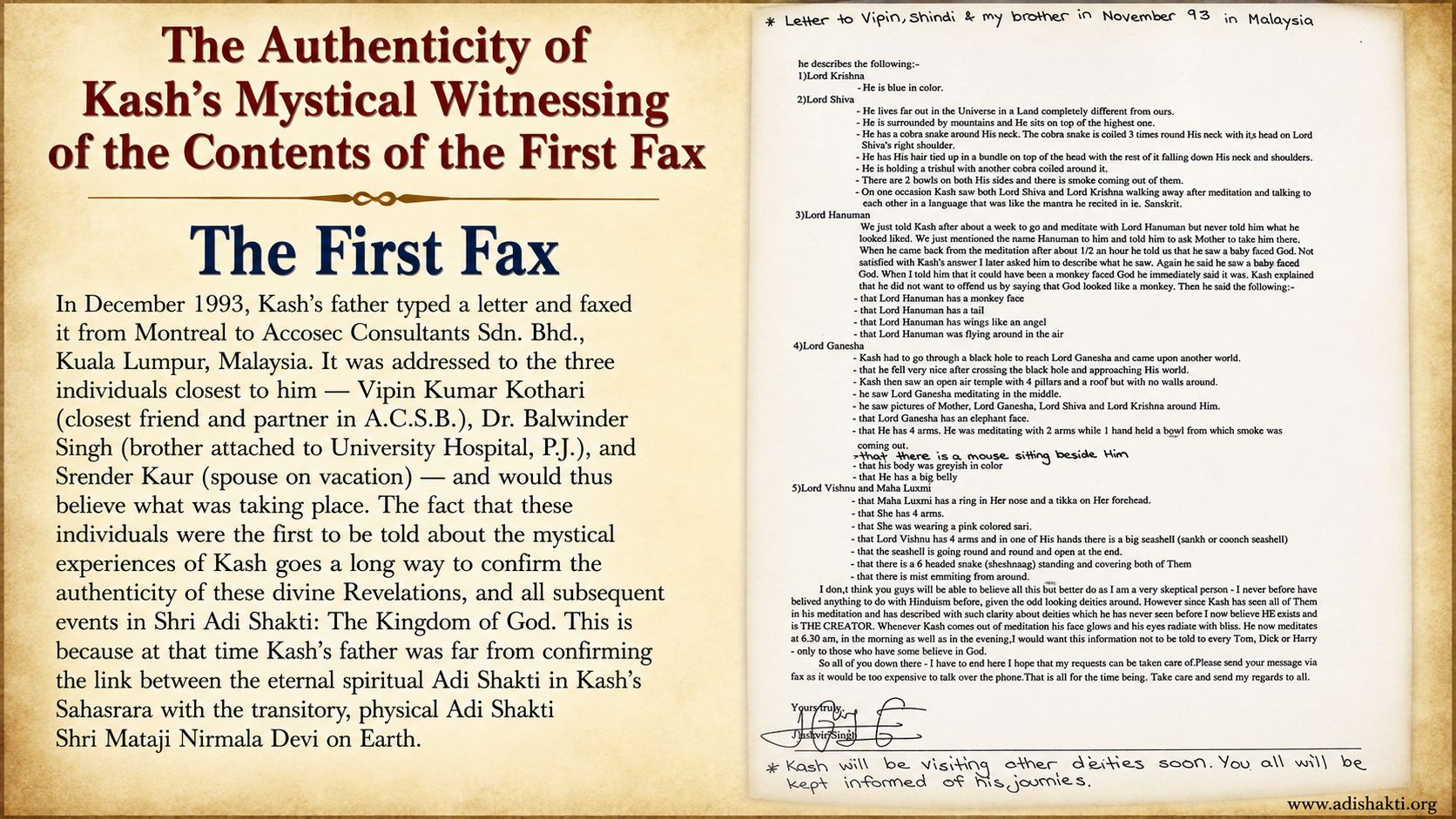
In December 1993, Jagbir Singh typed a letter in Montreal and transmitted it by fax to Accosec Consultants Sdn. Bhd. in Kuala Lumpur. It was intended for three named people close to him: Vipin Kumar Kothari, Dr. Balwinder Singh, and Surender Kaur. The letter describes what Kash had reportedly been seeing and saying during meditation. It includes details concerning several Hindu deities, specific physical features, locations, objects, and conversations, together with the father’s own uncertainty and skepticism.
The First Fax therefore establishes four historically testable facts if the surviving document is genuine: a document existed in December 1993; it was sent to identifiable recipients; it contained detailed reports attributed to Kash; and those reports predated the later publication of Shri Adi Shakti: The Kingdom of God by several years. These points are independent of whether one accepts the spiritual interpretation.
The paper should therefore avoid language such as “irrefutable proof” when discussing metaphysical claims. The strongest historical statement is different: the fax is potentially irrefutable evidence that these reports were already being documented by December 1993, provided the document’s date, transmission, and preservation are authenticated. That distinction makes the argument both clearer and stronger.
2. Provenance, Recipients, and Private Transmission
Authenticity begins with provenance: who wrote the document, when it was written, where it was sent, who received it, and how it was preserved. The First Fax is unusually useful because it is not anonymous. The source identifies the author, origin in Montreal, destination in Kuala Lumpur, recipient organization, named intended readers, and even the practical reason for communicating by fax rather than long-distance telephone.
The named recipients matter because they potentially convert the fax from a solitary family claim into an externally checkable communication. Vipin Kumar Kothari, Dr. Balwinder Singh, and Surender Kaur were not an anonymous later audience; they were specific people who could have received the information at the time. If surviving fax sheets, transmission headers, business records, recipient recollections, or copies retained in Malaysia exist, they would independently strengthen the document’s chain of custody.
The private character of the fax is also significant. It was not written as a public manifesto, fundraising appeal, religious advertisement, or published apologetic. Its intended audience was a small circle of trusted people. Private correspondence is not automatically truthful, but it generally carries fewer incentives for public performance or institutional self-promotion. That makes the document especially valuable for reconstructing what the family believed and reported at that moment.
3. Contemporaneity: Observation Before Theology
The greatest strength of the First Fax is its timing. It belongs to the earliest phase of the reported experiences. The father later stated that it took many months before he became fully convinced that the spiritual Adi Shakti encountered in Kash’s meditations and Shri Mataji Nirmala Devi were one and the same. The fax therefore preserves a stage in which observations were being recorded before the later theological conclusion had fully crystallized.
This is precisely why contemporaneous documentation matters. Later beliefs can reorganize memory. Once a person becomes convinced of a theological interpretation, earlier experiences may be unconsciously remembered in ways that fit the mature worldview. A document written beforehand helps control that problem because it freezes an earlier stage of understanding. It allows later readers to compare what was actually said then with what was believed later.
In authenticity terms, the First Fax is therefore not valuable merely because it is old. It is valuable because it captures epistemic development: the movement from puzzling observations toward later conviction. That sequence is much harder to explain as a single retrospective construction if the early document can be independently authenticated.
4. The Father’s Skepticism as Evidence
One of the most revealing statements in the fax is the father’s admission that he was skeptical and had previously found Hindu deities difficult to believe. He writes, in substance, that he did not expect the recipients to believe the account easily because he himself had been skeptical. This matters because the document does not present a narrator who begins with complete theological certainty and simply records what he already expected to find.
Skepticism is not proof of accuracy. A skeptical person can still be mistaken. But it does affect the authenticity analysis because it weakens a simple explanation in which the father deliberately imposed a fully formed religious program onto the child from the beginning. The document instead portrays someone whose beliefs were being changed by what he thought he was observing.
The strongest evidentiary value therefore lies not in the claim “a skeptic must be right,” but in the chronological sequence: skepticism → reports → questioning → gradual conviction. If that progression is supported by dated records, it is more consistent with an evolving investigation than with a finished story projected backward onto the past.
5. What the Fax Records About Kash
The fax preserves a surprisingly specific set of descriptions. Krishna is described as blue. Shiva is located in a distant mountainous realm, with matted hair, cobras, and a trishul. Hanuman is described as monkey-faced, tailed, and able to fly. Ganesha is described with an elephant face, four arms, a large belly, and a mouse nearby. Vishnu and Mahalakshmi are described with four arms, a conch, ornaments, and a many-headed serpent above them. The historical importance of these details is not that each one is unprecedented; many are traditional iconographic features. Their importance lies in the claim that they were being attributed to Kash and recorded at this early date.
Prior knowledge must therefore be handled carefully. A child raised in a culturally Hindu environment might have encountered images, stories, calendars, television scenes, temple art, or family conversations without consciously remembering them. Consequently, iconographic accuracy by itself cannot prove mystical perception. The stronger question is whether particular details can be shown to have been genuinely unknown to Kash and his father before the reports occurred.
The First Fax is most powerful when used as a chronological benchmark. It tells us what had already entered the record by December 1993. Later discoveries can then be compared against this benchmark. If later research uncovered textual, iconographic, or theological correspondences that neither father nor son demonstrably knew in 1993, those later findings may carry independent evidentiary weight. The fax therefore functions as a timestamp against which subsequent knowledge can be tested.
6. Preserved Errors and Corrections
One of the most useful features of the First Fax is that it preserves mistakes rather than presenting a flawlessly harmonized retrospective narrative. The Hanuman example is especially important. The original fax said that Hanuman had wings. The later explanation states that Kash had actually described Hanuman flying “as if” he had wings, while the father—conditioned by familiar images of winged angels—converted that description into literal wings when writing the fax.
This correction is evidentially valuable because it exposes the mechanism by which testimony can be distorted even when no deception is intended. The father heard an unusual description, interpreted it through his own conceptual framework, and wrote down something more definite than Kash had apparently said. Rather than weakening the archive, preserving the error improves its credibility because it demonstrates willingness to distinguish the child’s report from the adult’s interpretation.
It also provides a methodological warning. Every statement in the fax should be analyzed at three levels: what Kash reportedly said, what the father understood him to mean, and what the father actually wrote. Authenticity becomes clearer when those layers are separated. The Hanuman correction shows why this distinction matters.
7. Testing Alternative Explanations
Several ordinary explanations must be considered. Retrospective fabrication becomes less plausible if the fax can be independently dated to December 1993 and shown to have been received then. Parental prompting remains possible for individual descriptions, especially where questions were leading or corrective. Cultural exposure is a serious explanation for traditional iconographic details. Childhood imagination can explain vivid internal narratives without implying dishonesty. Finally, misinterpretation of genuine inner experience remains possible: Kash may have sincerely experienced something while identifying it through religious categories available to him.
None of these hypotheses should be dismissed merely because the family later regarded the experiences as divine. The authenticity question is better framed comparatively: which explanation best accounts for the document’s early date, private transmission, skepticism, preserved errors, progressive development, and the specific content recorded? A serious paper should distinguish explanations of how the reports arose from the narrower historical question of whether the reports genuinely existed at the time.
The Key Distinction
Even if a reader ultimately explains Kash’s experiences through imagination, cultural memory, altered states, or psychology, the First Fax may still be an authentic historical record of sincere reports made in December 1993. Historical authenticity and metaphysical truth are separate questions.
8. Graded Authenticity Assessment
The strongest conclusion concerns the document, not the supernatural interpretation. If the surviving fax can be authenticated as a December 1993 transmission, it becomes a highly significant primary source because it fixes detailed testimony at the beginning of the chronology. The named recipients, private purpose, skeptical tone, and preservation of later-corrected mistakes all strengthen the argument that this was a developing record rather than a polished narrative invented for publication.
Authenticity Verdict
Documentary authenticity — Very strong, subject to physical verification: the fax is presented as a dated December 1993 communication to named recipients and predates the 1999 publication by years.
Chronological value — Very strong: it establishes a benchmark showing what descriptions and claims were already in circulation during the earliest period.
Sincerity of the father’s testimony — Strong: the skeptical language, private audience, uncertainty, and preserved corrections are more consistent with evolving belief than with a fully formed promotional narrative.
Sincerity of Kash’s reports — Supported but not independently proven: the fax demonstrates that his father was recording such reports at the time; it does not independently establish the child’s internal state or every detail attributed to him.
Evidence for supernatural causation — Undetermined by the fax alone: the document can authenticate the existence and chronology of the reports without proving the objective reality of the beings described.
9. What Would Strengthen the Case Further?
The single most important task is to make the original document auditable. High-resolution scans of every surviving fax page should be published, including transmission headers, timestamps, page numbers, handwriting, annotations, and any machine-generated routing information. If recipient copies survive in Malaysia, those should be compared with the sender’s copy. Statements from the original recipients should be preserved separately, identifying when they received the fax and what they remember about its contents.
The second priority is chronological comparison. Later diaries, letters, computer files, faxes, and the 1999 book should be aligned against the First Fax to show exactly which details appeared when. This would allow researchers to distinguish information already present in December 1993 from material learned or interpreted later. Such a chronology is far more persuasive than simply asserting that later evidence confirms the earlier testimony.
Finally, leading questions and adult interpretations should be marked wherever they occur. The Hanuman example demonstrates why. A transparent archive should not hide suggestive questioning or mistaken adult assumptions; it should preserve them. That transparency allows genuine anomalies to stand out more clearly because readers can distinguish what may have been supplied by the interviewer from what appears to have arisen independently from Kash.
Conclusion — Why the First Fax Is Foundational
The First Fax is foundational because it answers one question with unusual clarity: were detailed reports attributed to Kash already being documented during the earliest period, or were they constructed only years later? If the fax is authentically dated to December 1993, the answer is that such reports were already being privately recorded and communicated at that time. That sharply limits any theory that the entire narrative originated as a retrospective literary creation surrounding the 1999 publication.
Its strongest features are cumulative: contemporaneous timing, identifiable author and recipients, private transmission, skeptical language, observation preceding mature theology, preservation of mistakes, and the possibility of comparing later developments against an early documentary benchmark. None of these proves that Kash objectively encountered Krishna, Shiva, Hanuman, Ganesha, Vishnu, Mahalakshmi, or Shesha. They establish something different and historically important: the testimony has a documented history beginning close to the reported events themselves.
The most defensible conclusion is therefore affirmative and focused. The First Fax provides strong evidence for the historical authenticity of the early Kash testimony as testimony. It shows that extraordinary experiences were already being reported, recorded, questioned, and communicated privately in December 1993 before the later theological synthesis had matured. Whether those experiences were psychological, imaginative, symbolic, or encounters with an objective spiritual reality remains a separate interpretive question. By keeping those levels distinct, the First Fax becomes a stronger—not weaker—foundation for the wider Authenticity Series.
References
- Primary document: December 1993 fax from Jagbir Singh in Montreal to Accosec Consultants Sdn. Bhd., Kuala Lumpur, addressed to Vipin Kumar Kothari, Dr. Balwinder Singh, and Surender Kaur.
- Published source: Jagbir Singh, Shri Adi Shakti: The Kingdom of God (1999), especially the reproduced First Fax material.
- Related archival methodology: subsequent Authenticity Series studies comparing early documents, witness chronology, later discoveries, and theological interpretation.
💬 Interactive Chat
Examine the December 1993 First Fax, its provenance, recipients, skeptical framing, preserved corrections, chronology, and what it can—and cannot—establish about authenticity.
Open chat →