Authenticity of Kash’s Mystical Witnessing of the MahaDevi Tasting Honey in Milk
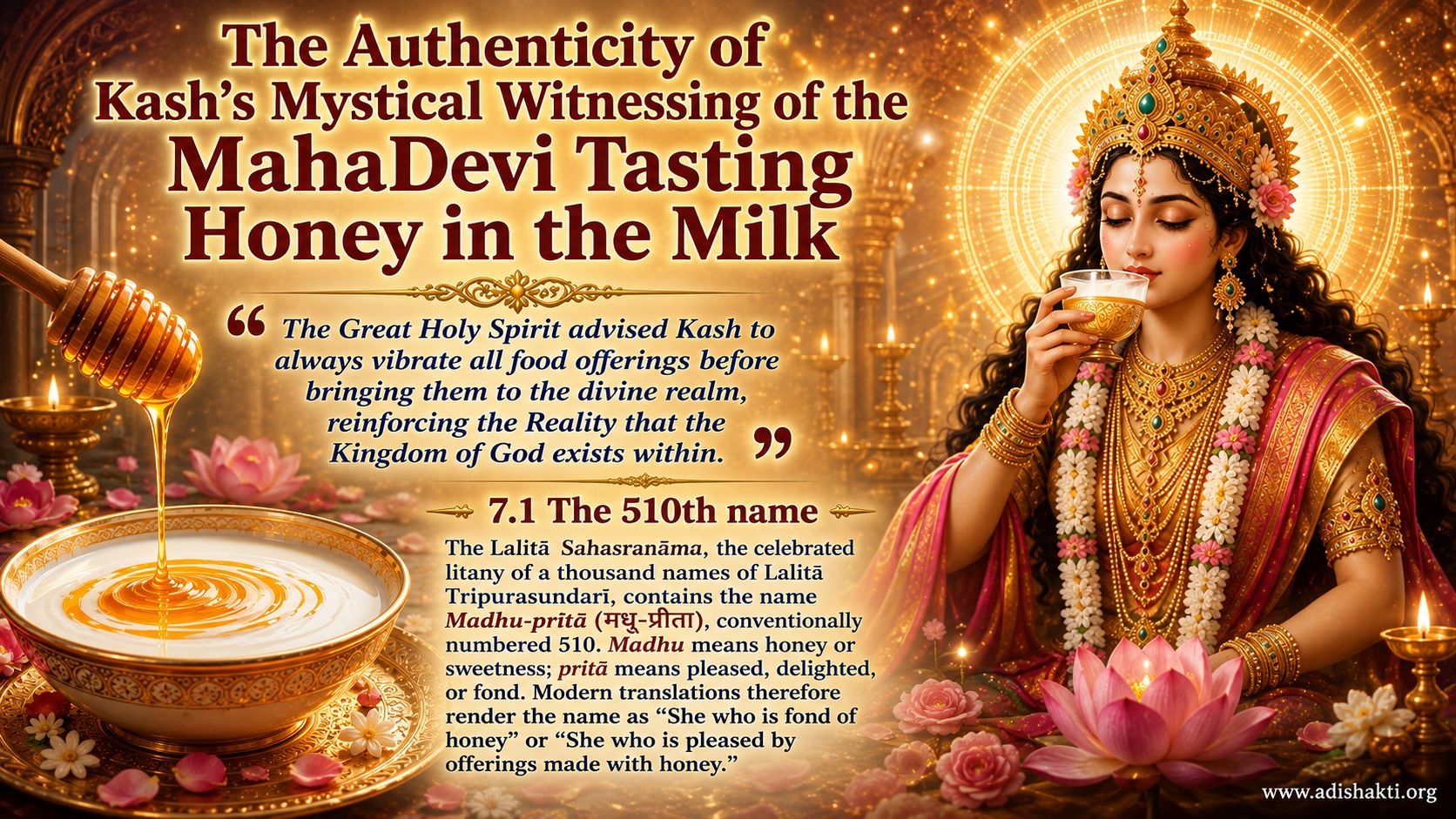
A Focused Examination of the April 27, 1994 Concealed-Honey Episode and What It Contributes to the Authenticity of Kash’s Mystical Testimony
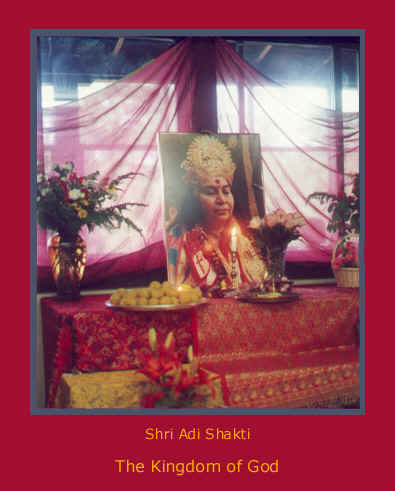
Honey In The Milk
In the beginning plain milk was offered to the Great Divine Mother two or three times a day. This went on for about a week. After being assured that the Supreme Ancient Mother accepted and drank the milk, it was felt that pleasant things should be added. Plain milk was just not good enough.
On April 27, 1994, for the first time honey was added but Kash was not told about it. He meditated and offered the milk to Shri Mataji Nirmala Devi. She took a sip and asked if there was honey in it. Kash replied spontaneously there must be. She then thanked him and said that just one glass per day would be sufficient, preferably in the morning. There was no need for two or three glasses to be offered. They then meditated.
When Kash returned he asked his father if he had put some honey in the milk, and was asked how he knew. Kash replied that Shri Madhu-prita Shri Nirmala Devi[1] had asked him the same question. His father explained that it was done without his knowledge. Kash then admitted that he was surprised by Her question about honey, but answered affirmatively on the assumption that his father must have added it.
It has to be pointed out that only if Shri Mataji had actually tasted the milk was it possible to ask Kash if there was honey in it. The fact that She already knew there was honey and yet asked Kash seems puzzling and petty — unless one considers that this seemingly small talk confirms and establishes Reality. Kash only knew that the milk was sweetened with honey after She had taken a sip and questioned him. Had the Great Lalita Devi not done so he would not have known, and neither his father absolutely assured that She actually drank it. So human ignorance and doubt had to be removed by questioning the presence of honey, a fact only determinable by taste.
Moreover, the Great Adi Shakti told Kash that there was no need of making two or three offerings per day. How was it possible for him to know this fact when he spent most of his time in school?
To understand this Reality the whole incident must be examined a few times. Shri Mataji Nirmala Devi did taste the honey in the milk inside his Sahasraras. The Great Adi Shakti never does anything frivolously or pretends to be ignorant. Every incident is part of the Divine Drama to help humanity realize that the Kingdom of Sadashiva does exist within. All seekers of the Ultimate Reality (Al-Haqqah) have to “know that in the Realm of Divine there are all kinds of miraculous things.”
The most enlightened Zen masters, Buddhists monks, Hindu yogis, Christian gnostics, Muslim sufis or Jewish kaballists have never been able to reach this state of Reality. One may question, “Why?” The answer is simple: The seventh and last Chakra was only opened on May 5, 1970 by the Great World Soul. None of them will ever reach this state of Reality until and unless their Kundalinis burst open the Sahasrara Chakra and reveal a Reality Realm that none of their predecessors ever exprienced.
After a few weeks of offerings Kash requested Shri Adhiparasakthi Shri Nirmala Devi that Shri Krishna and Shri Ganesha should be invited to join them for morning meditation. The Great Divine Goddess happily agreed and told that they would do so from the next day onwards. Since Shri Mataji was always given honey-flavored milk with cardamom and saffron, the same was done for Shri Krishna and Shri Ganesha.
Next morning three glasses were prepared and laid on the altar. Kash went within his own Templum Spiritus Sanctus and found both Shri Krishna and Shri Ganesha already present, just as the Great Divine Mother had said so. He bowed to them and exchanged greetings. Shri Mataji, Ganesha, and Krishna then walked to the altar to pick the glasses. They returned and sat on the soft clouds. After taking a few sips of the milk Shri Adi Shakti requested that all meditate. Everyone raised their Kundalinis and Shri Krishna, Ganesha and Kash then meditated on the Great Primeval Mother sitting before them on the Timeless Throne.
It has to be made clear that our material eyes will probably never see such spiritual realms of food being consumed by the Spirit People. All offerings of the devotees are accepted but consumption takes place in the spiritual dimension that is invisible to human eyes — the microcosm. The fact that the Great Holy Spirit also advised Kash to always vibrate all food offerings before bring it to them only further strengthens this Reality.
Note: Kash was specifically requested on May 1, 1994, to ask the Great Formless Mother how offerings by devotees reach Her and the Universal Beings. At 2:40 p.m. he went into Sahaj Samadhi and the Ruh of Allah took him up the Olive Tree to the Land of the Clear White Light. After bowing down and exchanging greetings he posed that question to the Great Adi Shakti. The Great Primordial Mother replied that She personally takes all offerings and distributes them to the Heavenly Hosts accordingly.
Jagbir Singh, 1999, p. 773
[1] Madhu-prita (510th): Fond of honey.
Central Authenticity Question
On April 27, 1994, honey was reportedly added to Kash’s usual milk offering without telling him. During meditation, Kash then reported that Shri Mataji Nirmala Devi tasted the milk and asked whether it contained honey. If the non-disclosure occurred as reported, the episode contains something more evidentially significant than a general mystical image: Kash’s experience referred specifically to a physical alteration made outside his awareness. The central authenticity question is therefore whether the surviving testimony gives good reason to believe that Kash genuinely reported information he was not ordinarily expected to know.
Table of Contents
- Introduction — Why This Case Matters
- 1. The April 27, 1994 Event
- 2. The Core Authenticity Test: Did Kash Know?
- 3. Why the Word “Honey” Matters
- 4. Documentary Provenance and the 1999 Record
- 5. Testing Ordinary Explanations
- 6. Madhu-prītā: Secondary Corroboration
- 7. Authenticity Assessment
- 8. Evidence That Would Strengthen the Case
- Conclusion
- References
Introduction — Why This Case Matters
Most reports of mystical experience are difficult to evaluate historically because their central content is private: a light, a sacred presence, an inner voice, or a transcendent state. The honey-in-the-milk episode is different because it joins a private experience to a simple physical fact outside the experience. According to the family narrative, the established offering had been plain milk. Honey was introduced for the first time on April 27, 1994, and Kash was deliberately not told. He then entered meditation and reported that Shri Mataji tasted the milk and specifically asked whether honey was present. The evidentiary importance of the event therefore rests on a potential information barrier: the person preparing the milk knew what had changed, while Kash allegedly did not.
This paper focuses on that information barrier because it is the strongest part of the case. It does not require the reader to begin by accepting the Adi Shakti identity claim, the objective existence of the Sahasrara realm, or communication with divine beings. Those are later theological questions. The first historical question is simpler: did Kash report a specific fact about the altered milk that had not been disclosed to him? If he did, and if ordinary routes of learning or inferring that fact can reasonably be excluded, the episode becomes evidence for the authenticity of his reported mystical experience in a meaningful evidentiary sense.
1. The April 27, 1994 Event
For an authenticity inquiry, the surrounding devotional material is secondary. The evidential core consists of four propositions: plain milk was the established baseline; honey was introduced as a new ingredient; Kash was not told; and Kash’s meditative report contained a direct question about honey. If any proposition fails, the case weakens. If all four are historically accurate, the episode has a genuine blind-information structure even though it was not designed as a scientific experiment.
2. The Core Authenticity Test: Did Kash Know?
The entire case turns on Kash’s prior knowledge. The statement “Kash was not told about it” is not a minor detail; it is the evidentiary hinge. If Kash saw honey being added, overheard discussion, had already been told that honey would soon be used, or could readily infer the change from sensory cues, the apparent anomaly diminishes sharply. Conversely, if the milk was prepared outside his awareness, no discussion of honey occurred, and his report was given before he encountered the physical milk, the information barrier becomes substantially more significant.
This also clarifies what “authenticity” means. Documentary authenticity asks whether the episode genuinely belongs to the early record rather than being a recent invention. Testimonial authenticity asks whether Kash sincerely reported the experience. Informational authenticity asks whether the honey detail was genuinely unavailable to him through ordinary means. Only then comes the metaphysical interpretation: whether the information was communicated by Shri Mataji or the MahaDevi in an objectively real transcendent realm. The first three can be investigated historically; the fourth goes beyond what historical method alone can prove.
3. Why the Word “Honey” Matters
The strength of the reported correspondence lies not merely in saying that the milk was “different.” Honey is a particular ingredient. “The milk tastes unusual” could fit many alterations, and even “it is sweeter” could result from several sweeteners. The narrative instead reports a question specifically concerning honey—the very substance newly added. Specific matches carry more evidentiary weight than broad ones because they leave less room for retrospective interpretation.
There is another notable feature. Kash is not portrayed as entering meditation and announcing hidden knowledge. Rather, the information is attributed to Shri Mataji within the experience: She tastes the offering and asks whether honey is present; Kash responds that there must be. This is consistent with the family’s broader claim that Kash was reporting encounters rather than consciously constructing tests. It does not establish the objective source of the information, but it makes the episode more interesting as testimony because the concealed fact appears naturally inside the reported interaction.
4. Documentary Provenance and the 1999 Record
The episode is preserved in a named published source: Jagbir Singh’s Shri Adi Shakti: The Kingdom of God (1999), p. 773. That publication fixes the story in documentary history and prevents it from being treated as a narrative first created decades later. It appeared approximately five years after the reported event, which is relatively early in the wider testimony but is not equivalent to a contemporaneous record made on April 27, 1994.
The distinction is crucial. The 1999 publication establishes that the honey episode was part of the documented corpus by that date. It does not by itself establish the exact 1994 wording or prove that every detail remained unchanged during the intervening years. Any surviving diary entry, handwritten note, computer file, letter, fax, recording, calendar notation, or independent recollection closer to April 1994 would materially strengthen the case. The evidentiary priority is therefore to move backward toward the earliest recoverable record.
5. Testing Ordinary Explanations
A serious authenticity study should test the strongest ordinary explanations. Deliberate fabrication is logically possible, but the extraordinary nature of a claim is not evidence that fabrication occurred. More important are ordinary forms of information leakage. Kash might have seen the honey or its container, overheard a conversation, noticed preparation cues, or already expected honey to be introduced. Sensory access also matters: if he physically handled, smelled, or tasted the prepared milk before reporting the meditation, the ingredient might have been detected or inferred. The exact sequence of preparation, meditation, report, and physical contact is therefore central.
Retrospective sharpening is another possibility. Human memory can become more definite through repeated retelling. An early statement about sweetness might later be remembered as an explicit reference to honey. The best answer is documentary: locate the earliest surviving wording. If an early record already contains the direct honey question, retrospective sharpening becomes substantially less persuasive.
Why These Alternatives Matter
These alternatives do not disprove the episode. They identify what must be established for the authenticity argument to become stronger: chronology, genuine non-disclosure, the sequence of events, specificity of the original wording, and early records or witnesses. The case is unusually useful because these questions are concrete and potentially auditable.
6. Madhu-prītā: A Secondary Corroborative Correspondence
The Lalitā Sahasranāma contains the traditional name Madhu-prītā, conventionally numbered 510, meaning “fond of honey,” “pleased by honey,” or closely equivalent wording. Within the Adishakti.org theological framework, which identifies Shri Mataji with Lalitā and the MahaDevi, this creates a striking correspondence: the Divine Mother encountered by Kash is reported to have immediately noticed honey, while the traditional litany describes Lalitā as fond of or pleased by honey.
This correspondence strengthens the authenticity argument only in a carefully defined way. It is strongest if the family did not know the epithet Madhu-prītā before the 1994 incident and discovered it later. It would then be a later-found correspondence between an earlier experience and an older tradition. If the epithet was already known, it remains theologically meaningful but loses much of its force as independent corroboration. The chronology of when the family first encountered Madhu-prītā is therefore an important archival question.
7. Authenticity Assessment
The episode has concrete strengths: a precise reported date; a simple physical alteration rather than an ambiguous symbol; alleged non-disclosure of that alteration; a meditative report specifically concerning the altered ingredient; preservation in a named 1999 publication; and a later Śākta correspondence concerning honey. Together these features make the case more evidentially structured than a typical retrospective mystical anecdote.
The limitations are equally specific. The public record presented here does not demonstrate a same-day written protocol, an independent observer controlling preparation, or documented exclusion of every sensory and behavioral cue. The 1999 source is important but retrospective. The chronology of the family’s knowledge of Madhu-prītā must also be established before the textual parallel can be treated as independent corroboration. These limitations do not erase the event; they determine the degree of confidence that can responsibly be assigned to it.
Graded Verdict on Authenticity
Documentary authenticity — Strong: the episode is anchored to a precise reported date and preserved in a named 1999 publication.
Experiential authenticity — Strong but not independently demonstrated: the narrative is coherent with Kash’s wider meditative testimony and no evidence of deliberate fabrication is supplied in the present record.
Informational anomaly — Potentially strong, conditionally: if Kash genuinely had no prior knowledge or sensory access to the honey, the specific honey question is the most important evidentiary feature.
Scriptural correspondence — Potentially significant: Madhu-prītā becomes evidentially stronger if its discovery can be shown to postdate the 1994 event.
Metaphysical conclusion — Beyond historical proof alone: the evidence can strengthen the authenticity of Kash’s testimony without by itself compelling the conclusion that the MahaDevi objectively consumed the offering in a transcendent realm.
8. Evidence That Would Strengthen the Case
The most valuable next evidence is material that closes the remaining gaps. Locate the earliest written or recorded reference to April 27, 1994 and determine whether it already contains the explicit word “honey.” Identify who prepared the milk and obtain a separate statement confirming that Kash was not told and did not observe the preparation. Reconstruct whether he touched, smelled, tasted, or inspected the milk before meditation and when he first reported the honey question. Identify anyone who heard the report immediately afterward. Finally, determine when the family first learned of Madhu-prītā. Each point addresses a specific alternative explanation and therefore adds more evidentiary value than a general assertion that the event was miraculous.
If contemporaneous records survive, they should be reproduced or transcribed verbatim with dates, provenance, and custody. If witnesses remain available, their recollections should ideally be recorded separately before comparing accounts. Differences should be preserved rather than harmonized. An authenticity archive becomes more persuasive when readers can see the raw evidence, uncertainties, and reasoning that connect them.
Conclusion — Why the Honey Episode Matters
The authenticity of this episode does not depend primarily on the symbolism of honey or milk or even on the later discovery of Goddess traditions. Its central force is simpler: a physical fact was reportedly concealed from Kash, yet that same fact appeared specifically within the content of his meditative experience. That is the point around which the paper should turn. If the information barrier can be historically substantiated, the event becomes difficult to reduce to an ordinary devotional vision whose contents were already supplied by the witness’s conscious knowledge.
The 1999 publication gives the episode a documentary anchor, but the strongest possible case would move closer to April 27, 1994 through contemporaneous notes and independent testimony. The later Madhu-prītā correspondence adds a potentially striking second dimension, especially if knowledge of that epithet can be shown to have arisen after the event. Yet it should remain corroborative rather than carry the historical argument itself. The historical case begins with what was hidden, what Kash reported, when it was recorded, and whether ordinary information transfer can account for the match.
The resulting judgment is focused but substantial. The honey-in-the-milk episode is a strong candidate for authentic mystical testimony containing apparently veridical information, provided the claimed non-disclosure is accurate. The surviving public evidence does not convert that judgment into laboratory proof of supernatural causation, but neither should the episode be reduced to an unconstrained mystical anecdote. Its unusual value lies in the claimed bridge between an inner experience and a concealed external fact. Within the wider Authenticity Series, that makes April 27, 1994 a case particularly deserving of archival reconstruction and independent corroboration.
References
- Primary source: Jagbir Singh, Shri Adi Shakti: The Kingdom of God (1999), p. 773, “Honey in the Milk,” as reproduced by Adishakti.org.
- Śākta correspondence: Lalitā Sahasranāma, Madhu-prītā (510), traditionally rendered “fond of honey” or “pleased by honey.”
- Related ritual context: Devī Bhāgavata Purāṇa, passages concerning offerings to the World Mother, including milk and honey.
💬 Interactive Chat
Examine the April 27, 1994 concealed-honey episode, its documentary provenance, information barrier, alternative explanations, and the later Madhu-prītā correspondence.
Open chat →