Authenticity of Kash’s Mystical Witnessing of the Divine Musicians of Jagjit Singh’s Maa
A Focused Examination of the External Witnesses, Physical Musical Anchor, Documentary Record, and Reported Synchrony That Bear on the Authenticity of Kash’s Experience
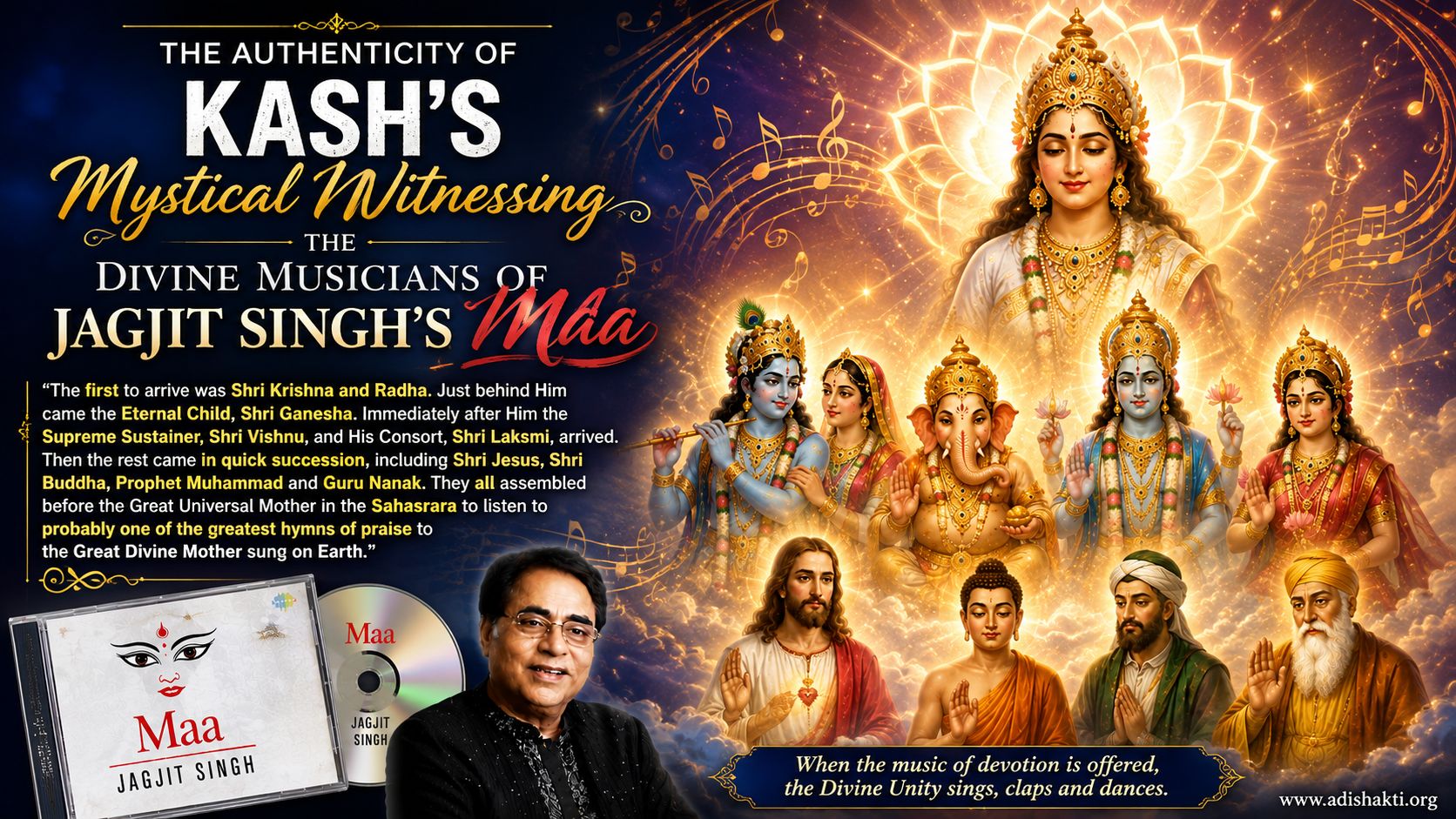
Just a few months after Self-Realization Kash’s father purchased a new CD entitled Maa, commissioned by the Aurobindo Society of Pondicherry. Jagjit Singh rendered this priceless offering to the Great Universal Mother, an extremely deep and touching expression of bhakti. Kash’s father was immensely pleased with the penetrating spiritual songs that touched the depth of his heart and revealed the eternal vigilance of the Great Divine Mother over Her ever-protected devotees. It slowly expanded his narrow consciousness to begin grasping Her infinite Cosmic Consciousness. The human search for Truth was portrayed as that of insects searching for nectar from countless flowers of so many different varieties — each flower representing one lifetime — rebirth after rebirth after rebirth in countless ages, species, families, religions, races, and countries!
One evening while Kash was studying this Maa CD was played. He stopped immediately and told his father that the music was just overwhelming, and wanted to just listen to it. Although Kash could not understand the lyrics his father was not surprised by the request — Maa was a very special spiritual classic and spoke the universal language of Truth, Bliss and Consciousness. The vibrations that began flowing whenever it was played confirmed its spiritual depth beyond question.
Kash was told to sit on the sofa and listen to his heart's content. He did so, raised his Kundalini, closed his eyes, and went into Nirvikalpa Samadhi.
The songs played one after another but Kash sat motionless. He was completely in another Realm. His father waited patiently in anticipation of the outcome of this thoughtless state. Kash always met the Great Adi Shakti even during the shortest of all meditations and this particular one had gone on long enough. He should be coming out of meditation at any moment with, perhaps, another incredible experience or Revelation.
After a while he began to get uneasy, as Kash was completely oblivious to the material world, and motionless. Normally Kash meditated alone and unobserved in his room but this time it was right in the sitting room; and he was not moving.
Half an hour passed and his mother, who was doing her chores, kept glancing nervously and noticed that something was wrong. She could see that Kash was looking lifeless, with his body slumped backwards on the sofa. She was visibly shaken and looked at her husband with fear and apprehension written all over her face. That, in return, rattled her spouse. Maybe Kash had gone too far this time. Maybe he might not be able to return from this thoughtless state. Maybe he pushed himself to the extreme and had lapsed into a spiritual coma.
Kash’s agitated father began to prance up and down slowly, observing him more intensely. He even tried to see if he was breathing, but there were hardly any signs of life. His son was not moving at all and looked comatosed, even quite dead. Soon fear gave way to panic. How do we bring him back to this world? Will it be a blunder if we shake him out of it? Will his mind remain in the other world? Will he become mad? Will he be retarded? Will there be any brain damage? Will his spiritual body remain in perpetual astral travel? Will he have a furious epileptic fit if aroused? Will the ambulance arrive in time?
In the end, after much confusion and fear, it was decided to just gently touch him. It was rationalized that this procedure would result in minimal mental damage. Even to execute this strategy took a few agonizing minutes as the frightened mind paralyzed all actions. Every minute of delay would only make the situation worse. Kash had to be touched and awakened. If he did not respond then he would be shaken more vigorously. If he still did not respond then the ambulance, normally parked about three hundred meters at the 24-hour Provi-Soir retail outlet, would be summoned. There were no other options.
The father very gingerly touched his son’s shoulders and whispered, “Kaaasssh.” Immediately he opened his eyes and exclaimed that he had one of the best and most incredible spiritual experience of his life. The parents sighed in relief.
After observing that he was completely normal and sane, Kash was requested to enlighten them.
He explained that upon attaining Sahaj Samadhi he met Shri MahaShakti. After exchanging greetings Shri Mataji told him that there were a lot of vibrations coming from the songs. Kash agreed. For the first time ever the Great Adi Shakti did not request any meditation but instead just listened to the deep spiritual lyrics devoted to Her.
As they sat in bliss the Spirit Beings of the Holy One began descending on their own to join the Great Supreme Goddess. Even they were eager to listen to these gems of praise and bhakti, so powerful was the Message of Truth in Maa.
The first to arrive was Shri Krishna and Radha. Just behind Him came the Eternal Child, Shri Ganesha. Immediately after Him the Supreme Sustainer, Shri Vishnu, and His Consort, Shri Laksmi, arrived. Then the rest came in quick succession, including Shri Jesus, Shri Buddha, Prophet Muhammad and Guru Nanak. They all assembled before the Great Universal Mother in the Sahasrara to listen to probably one of the greatest hymns of praise to the Great Divine Mother sung on Earth.
Shri Vishnu produced a tabla (Indian drum) and began to play. Shri Laksmi took out a pair of small cymbals and joined in. The rest then began to sing and clap along. Shri Ganesha sang and clapped. Shri Jesus sang and clapped. Shri Buddha sang and clapped. Shri Brahma sang and clapped. Shri Saraswati sang and clapped. Guru Nanak sang and clapped. Prophet Muhammad sang and clapped. Shri Rama sang and clapped. Shri Sita sang and clapped. The Divine Unity sang and clapped.
As the tempo picked up the songs turned into a spiritual ecstasy, and the dense Spiritual Energy swirled from everywhere. Shri Ganesha then walked into the center of the circle and began His one-step-forward-and-two-steps-back dance. Despite His short stumpy legs and a big belly, Shri Ganesha moved around with great grace, balance and fluidity. Shri Krishna then joined in and executed a series of such dazzling dances that the eye could not keep track of the movements. His limbs moved swiftly in various mudra poses, narrating the story of the song in this timeless Vedic tradition. It was a scene beyond description, a spiritual Reality of Truth, Consciousness and Bliss.
The Divine Unity in the Kingdom of The Almighty Creator clapped, danced, sang, and played in perfect synchronism with the Maa CD playing in the Pioneer stereo system on Mother Earth. But they did not clap and sing with the vigor and excitement of humans, but with a divine dignity and measured manners, a hallmark of all the inhabitants of the Spirit World. It was a flawless performance perfect to the closing vocal tone, last cymbal percussion, and final tabla tap.
When the song ended both Shri Krishna and Shri Ganesha walked back to the circle as the next song was of a slower beat. The musical feast continued, There was an occasional laughter and gestures of appreciation. The Great Sacred Mother sat on the Eternal Throne in Bliss, blissfully saturated with the words of Praise and Glory from the Divine Unity and Jagjit Singh.
Kash was fully conscious of the Sacred Dance in the Sahasrara, yet absolutely unaware that he was still in a body. He also was in Divine Ecstasy, as were the rest of the Divine Beings, in the Kingdom of God. That was when his father lightly tapped him on the shoulder. Instantly he came out of Samadhi and became fully conscious.
This spiritual experience provides irrefutable proof to Sri Aurobindo’s fundamental belief that the Great Primordial Mother “is the sign of a power which itself has founded and constituted life, mind and body and is now emerging as a spiritual being in a living and thinking body.” May all seekers of this Divine World of Reality (Lahut) reach the Sanctuary of Her Lotus Feet and take their first spiritual step towards Life Eternal.
Jagbir Singh, 1999, p. 606
Central Authenticity Question
The Maa episode is evidentially important because Kash’s reported mystical experience did not occur in isolation. A physical recording was playing in the room; both parents reportedly observed his prolonged motionless condition; his father physically touched him and witnessed his immediate return to ordinary awareness; and Kash then described a detailed celestial musical event that he said had unfolded while the same recording was playing. The central question is therefore not initially whether every divine figure he described can be historically proved to have been present. It is whether the surviving evidence supports the authenticity of Kash’s claim that he underwent an extraordinary experience corresponding in real time with an externally observable musical event.
Table of Contents
- Introduction — Why This Case Is Different
- 1. What Happened
- 2. The Parents as External Witnesses
- 3. The Maa Recording as an External Anchor
- 4. The Claim of Musical Synchrony
- 5. Documentary Provenance
- 6. Prior Knowledge and What It Can—and Cannot—Explain
- 7. Testing Ordinary Explanations
- 8. Authenticity Assessment
- 9. Evidence That Would Strengthen the Case
- Conclusion
- References
Introduction — Why This Case Is Different
Many mystical testimonies are almost entirely private. A witness reports seeing a sacred figure, hearing a voice, or entering another realm, but there is little outside the testimony against which the event can be examined. The Divine Musicians of Maa episode has a more useful evidentiary structure. Kash’s inner experience was accompanied by three externally accessible features: a known physical recording playing continuously in the room, two parents observing his unusual bodily condition, and a subsequent narrative preserved within the family’s documentary corpus. These elements do not prove the metaphysical content of the vision, but they allow the authenticity of the experience to be investigated more seriously than a purely private recollection.
The strongest question is therefore narrower than the original paper sometimes allowed it to become. Did Kash genuinely enter an extraordinary altered or mystical state, remain deeply unresponsive while the Maa recording continued, return immediately when touched, and then report a coherent musical experience that he understood to have unfolded in correspondence with the music still playing in the physical room? If those points are well supported, the authenticity of the experience is strengthened independently of whether a reader accepts the later theological conclusion that the figures encountered were objectively present in the Sahasrara.
1. What Happened
Core Narrative
According to the published account, Kash was studying when Jagjit Singh’s devotional recording Maa was played. He stopped studying, said that the music was overwhelming, and asked to listen. He reportedly did not understand the lyrics. He raised his Kundalini, closed his eyes, and entered meditation. As the songs continued, he remained motionless for an unusually long period. His parents became increasingly alarmed. His father eventually touched his shoulder and called his name, whereupon Kash immediately opened his eyes and said that he had undergone one of the most extraordinary spiritual experiences of his life.
Kash then reported that he had met Shri Mataji in the Sahasrara and that divine and prophetic figures assembled around Her while the Maa music played. Among those named were Shri Krishna and Radha, Shri Ganesha, Shri Vishnu and Lakshmi, Shri Jesus, Shri Buddha, Prophet Muhammad, Guru Nanak, Shri Brahma and Saraswati, and Shri Rama and Sita. He described Vishnu playing tabla, Lakshmi playing cymbals, others singing and clapping, and Ganesha and Krishna dancing. The most important authenticity claim is that this celestial performance remained in “perfect synchronism” with the physical recording playing on the stereo.
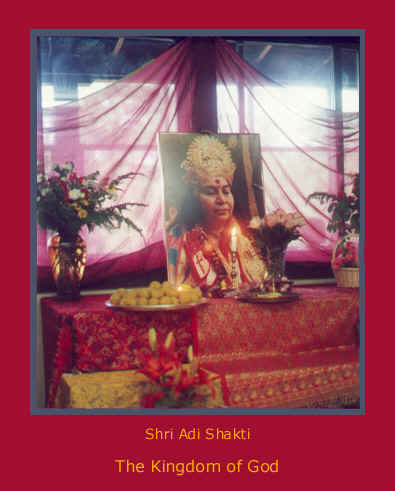
Published source: Jagbir Singh, Shri Adi Shakti: The Kingdom of God (1999), p. 606.
For an authenticity analysis, the event should be separated into observable and reported components. The parents could observe Kash’s posture, immobility, duration, apparent unresponsiveness, the music playing in the room, the father’s intervention, and Kash’s immediate awakening. They could not observe the celestial assembly. That portion depends on Kash’s testimony. Keeping this distinction explicit makes the case stronger, because it prevents external evidence from being asked to prove more than it actually can.
2. The Parents as External Witnesses
The parents’ role is one of the strongest features of the case. The narrative states that Kash remained motionless for approximately half an hour, slumped backward on the sofa and apparently oblivious to his surroundings. His mother repeatedly looked at him and became frightened. His father likewise became alarmed, attempted to determine whether he was breathing, considered the possibility that Kash was in a coma or some dangerous state, and contemplated calling an ambulance. Whatever one thinks of the parents’ spiritual interpretation, their reported fear is evidence that Kash’s physical condition appeared sufficiently unusual to them that they considered medical intervention.
The father’s eventual intervention creates a particularly clear transition point. He reportedly touched Kash’s shoulder and softly called his name; Kash immediately opened his eyes and returned to ordinary awareness. The parents then observed that he appeared normal before asking him what had happened. This sequence is important because it gives the testimony an externally witnessed beginning-and-ending structure: music and meditation, prolonged immobility, parental concern, physical touch, immediate awakening, then the report of the experience.
The parents cannot independently authenticate what Kash saw. They can, however, corroborate that something unusual was occurring behaviorally while the music played. Their evidence therefore supports state authenticity: Kash was not merely telling a story later about an ordinary listening session. According to the family record, he visibly entered a condition that caused both parents genuine concern.
3. The Maa Recording as an External Anchor
The physical recording is the second major evidentiary feature. Unlike a vision occurring in silence with no external temporal structure, the Maa experience unfolded while a fixed sequence of recorded songs continued to play in ordinary time. The recording therefore existed independently of Kash’s inner report. It had its own tempo, changes of rhythm, instrumental passages, beginnings, endings, and sequence of songs. Kash’s experience was not reported as unrelated imagery occurring beside the music; it was described as a celestial participation in the same music.
This distinction matters. The CD does not independently verify the presence of divine beings, but it provides a potential comparison object. If the original account or contemporaneous notes preserve specific claims about what happened during identifiable passages of particular tracks—when the tempo accelerated, when a slower song began, when percussion changed, or when the final notes sounded—those claims could in principle be compared with the actual recording. That makes the Maa episode more evidentially promising than an experience with no external temporal anchor.
4. The Claim of Musical Synchrony
The most distinctive statement in the narrative is that the Divine Unity “clapped, danced, sang, and played in perfect synchronism” with the Maa CD. The account goes further, describing the performance as matching the recording through the closing vocal tone, final cymbal percussion, and last tabla tap. It also says that when one song ended, Krishna and Ganesha returned to the circle because the next song had a slower beat. These are not merely claims that music inspired a religious vision. They are claims of temporal correspondence between the physical recording and the content of the experience.
At present, however, the evidentiary value of this synchrony depends on the precision of the earliest records. If Kash simply heard the physical music while in an absorbed state, a naturalistic explanation could readily account for internal imagery moving with the sound. The case becomes more unusual if the early record contains detailed correspondences that Kash could not have consciously tracked or anticipated, or if he later identified exact musical transitions while claiming complete bodily unawareness. The authenticity argument should therefore emphasize the synchrony while also defining what additional documentation would be needed to make it more than an internally coherent feature of the experience.
5. Documentary Provenance
The uploaded paper states that dated handwritten and computer records from 1994 survive in the Singh family archive, while the full narrative was later published in Shri Adi Shakti: The Kingdom of God in 1999. If the 1994 records contain the essential features of the Maa experience, they are potentially the most important evidence in the entire case. Contemporaneous documentation sharply reduces the possibility that the elaborate account developed only through years of retrospective retelling.
The evidentiary hierarchy should therefore be explicit. A record written during or immediately after 1994 is more probative for the original content than the 1999 publication; the 1999 publication is in turn more probative than recollections made decades later. The strongest reconstruction would place the 1994 handwritten record, the 1994 computer record, and the 1999 published text side by side and identify which details are present in each. If the same core elements—prolonged meditation, parental intervention, the named divine figures, instruments, dances, and synchrony with Maa—already appear in the earliest documents, the documentary authenticity of the narrative becomes substantially stronger.
6. Prior Knowledge and What It Can—and Cannot—Explain
The source states that Kash did not understand the lyrics of Maa. That is relevant but should not be overstated. Lack of lyrical comprehension does not mean lack of musical information. Rhythm, tempo, percussion, emotional tone, pauses, crescendos, and changes between songs can all be perceived without understanding words. Nor was Kash religiously uninformed: the wider family testimony shows that he was already familiar with Shri Mataji and numerous sacred figures. Prior religious knowledge can therefore explain why known figures might appear within a music-induced mystical experience.
What prior knowledge does not automatically explain is the depth of the observed state or the sincerity of the subsequent report. Nor does it by itself settle whether the experience was internally generated or transcendent. The correct authenticity question is not whether Kash had ever heard of Krishna, Ganesha, Jesus, Buddha, Muhammad, or Guru Nanak. He clearly existed within a religious environment. The stronger questions concern the timing, structure, specificity, and earliest documentation of the reported experience.
7. Testing Ordinary Explanations
The strongest ordinary explanation is music-induced absorption or trance. Music can narrow attention, alter subjective time, evoke vivid imagery, and reduce awareness of the surrounding environment. A deeply absorbed child could conceivably incorporate the continuing music into an elaborate religious experience. Dreamlike or hypnagogic imagery, dissociation, expectation, and culturally supplied symbolism are related possibilities. These explanations should be taken seriously because the external music itself provides a straightforward mechanism by which internal imagery could remain synchronized with sound.
Yet such explanations do not make the testimony inauthentic. They are alternative explanations of its cause. If Kash genuinely entered the observed state and sincerely reported the celestial concert immediately afterward, the experience can be phenomenologically authentic even if a reader interprets it neurologically. The more difficult question is metaphysical authenticity: whether the reported figures existed independently of Kash’s mind. Historical evidence alone cannot resolve that question. What it can do is determine whether the testimony is early, stable, specific, externally contextualized, and resistant to simple claims of fabrication or late invention.
The Crucial Distinction
A naturalistic explanation of a genuine experience is not the same as evidence that the experience was fabricated. The first authenticity task is therefore to establish that Kash really underwent and reported the extraordinary state attributed to him. Only after that should competing explanations of what the experience ultimately was be compared.
8. Authenticity Assessment
On the evidence presented in the source, the strongest case concerns the authenticity of the event as an extraordinary experience rather than proof of every metaphysical detail. The parents reportedly witnessed a prolonged and alarming alteration in Kash’s outward condition. The physical Maa recording supplies an external temporal anchor. Kash reportedly returned immediately when touched and then described an elaborate experience centered on the same music. The paper further states that dated 1994 handwritten and computer records survive, potentially anchoring the account close to the event rather than only in the 1999 publication.
Graded Verdict on Authenticity
Documentary authenticity — Potentially very strong: if the cited 1994 handwritten and computer records can be produced and shown to contain the essential features of the published narrative, they would provide unusually early documentation.
External witness evidence — Strong for the altered state: both parents reportedly observed Kash’s prolonged immobility and unusual appearance, and his father directly witnessed his immediate awakening after physical contact.
Experiential authenticity — Strong: the observed state, immediate post-event report, detailed internal narrative, and continuity with Kash’s wider testimony support the conclusion that he sincerely experienced something extraordinary.
Synchronization evidence — Interesting but not yet independently probative: the physical CD provides a real external timeline, but the evidentiary force of “perfect synchronism” depends on how precisely the earliest record can be compared with identifiable moments in the recording.
Metaphysical authenticity — Theologically affirmative within the Adishakti framework, but beyond historical demonstration alone: the evidence can strongly support the authenticity of Kash’s testimony without independently proving that the divine and prophetic beings he named were objectively present in the Sahasrara.
9. Evidence That Would Strengthen the Case
The most important next step is archival rather than theological. The surviving 1994 handwritten and computer records should be digitized, dated, and reproduced verbatim. Their provenance should be explained, and their wording compared with the 1999 publication. The comparison should identify exactly when the names of the divine figures, Vishnu’s tabla, Lakshmi’s cymbals, Ganesha’s and Krishna’s dances, the change to the slower song, and the claim of perfect synchronism first appear. Stable detail across the earliest documents would significantly strengthen the case against retrospective elaboration.
The parents’ evidence should also be separated. Each parent’s recollection of Kash’s posture, approximate duration, responsiveness, breathing, the father’s intervention, and Kash’s first words after awakening should ideally be recorded independently. Finally, the actual Maa recording should be identified by edition and track sequence. Any early notes tying specific reported actions to particular musical transitions could then be compared with the recording itself. Such work would turn the strongest features of the case—external witness, chronology, and synchrony—into evidence that readers can directly inspect.
Conclusion — What the Evidence Actually Establishes
The strongest argument for the authenticity of the Divine Musicians of Maa is not that a devotional recording was spiritually powerful, nor that Sri Aurobindo wrote about the Divine Mother, nor that the reported gathering symbolically unites several religions. Those matters provide theological context. The authenticity argument rests on a more concrete sequence: Kash entered an unusual state while a fixed recording played; both parents reportedly observed his prolonged immobility and became sufficiently alarmed to consider medical intervention; his father touched him and witnessed his immediate return; Kash then reported an elaborate musical experience centered on the same recording; and the source states that dated 1994 documentary records survive.
That sequence strongly supports treating the episode as a serious piece of mystical testimony rather than as an unconstrained story created long afterward. The physical recording and parental observations do not prove the celestial content, but they independently anchor important parts of the event in ordinary reality. The reported synchrony is especially important because it creates a bridge between Kash’s private experience and an external temporal sequence. Its full evidentiary potential will depend on the specificity of the surviving 1994 records.
The most defensible overall judgment is therefore affirmative but precise. The surviving account strongly supports the authenticity of Kash’s Maa experience as a genuine, unusually deep, externally witnessed mystical or altered-state event. If the cited 1994 records confirm the essential details now found in the published narrative, documentary authenticity would become stronger still. Whether Kash’s experience was generated by extraordinary states of consciousness or constituted an actual encounter with the Great Divine Mother and the assembled divine beings remains a second-order interpretive question. Within the theological framework of the Authenticity Series, the latter interpretation can be affirmed; historical method by itself can establish the testimony and its evidentiary structure, but cannot compel the metaphysical conclusion.
References
- Singh family archive: cited dated handwritten records concerning Kash’s early mystical experiences, 1994.
- Singh family archive: cited dated computer records concerning Kash’s early mystical experiences, 1994.
- Singh, Jagbir. Shri Adi Shakti: The Kingdom of God (1999), p. 606.
- Jagjit Singh. Maa, devotional recording described in the primary narrative as commissioned by or associated with the Sri Aurobindo Society of Pondicherry.
💬 Interactive Chat
Explore this article, its sources, and the relationships among its theological and evidentiary claims.
Open chat →