MYSTICAL TESTIMONY · FAMILY ETHICS · DIVINE IMMANENCE

The Authenticity of Kash’s Mystical Witnessing of the Celibacy Fallacy
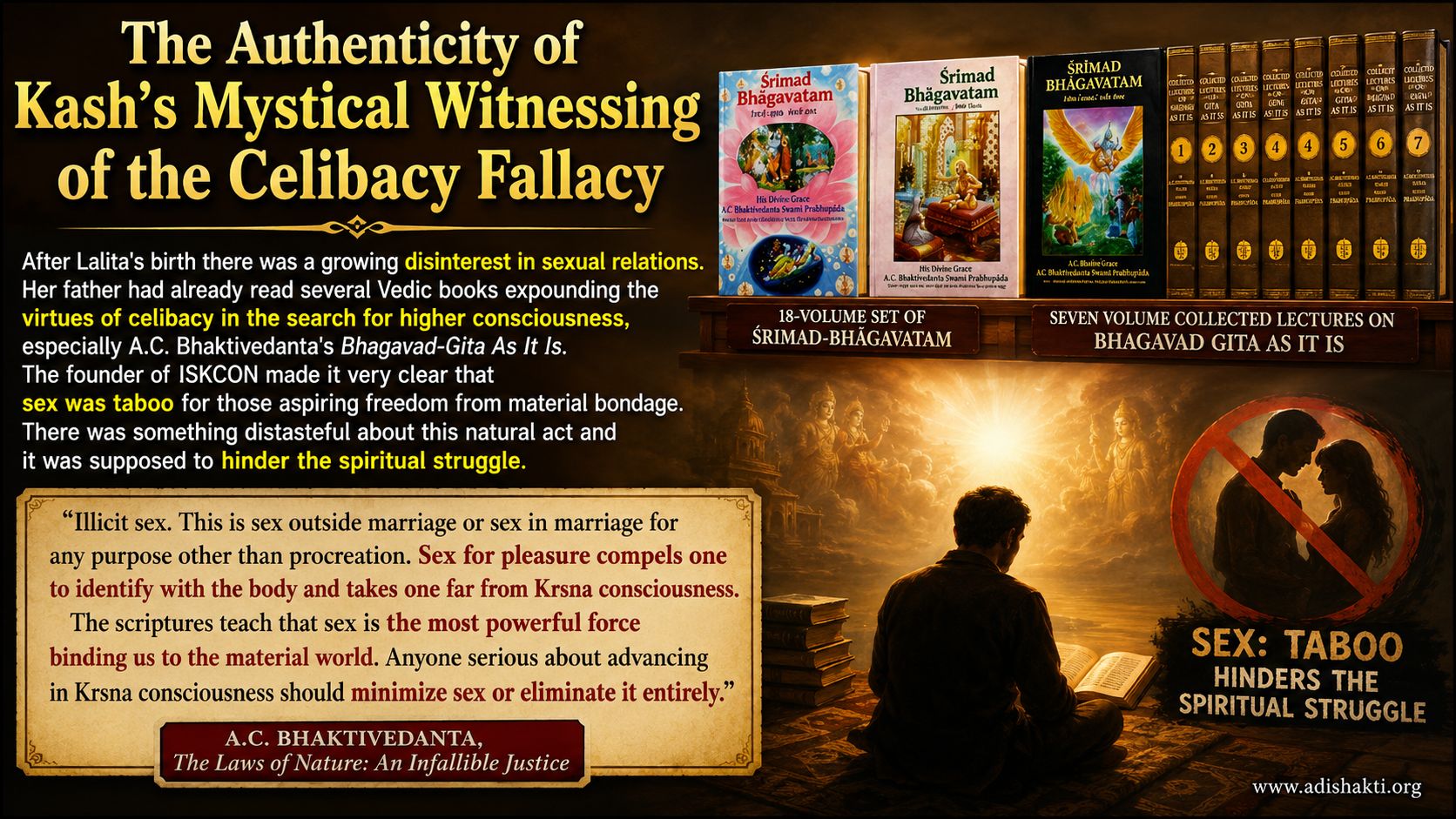
Author: Manus AI  |  Date: August 18, 2026  |  Published on: adishakti.org

Summary

This study examines an unusual episode in the reported mystical experiences of Kash, a fourteen-year-old boy whose meditative experiences formed part of a larger body of family testimony recorded during the 1990s. The episode concerns a private decision by Kash’s father to practice prolonged marital celibacy, the termination of that practice on January 10, 1995, and an apparently unsolicited statement reportedly communicated to Kash during meditation on the following day: the family was “normal again.”

The evidential importance of the episode lies not primarily in its teaching concerning sexuality but in its information structure. According to the surviving account, Kash had not been informed that his father had adopted celibacy, did not know that marital relations had resumed, did not initially understand what “normal again” meant, and asked his father for an explanation. The subject itself belonged to an area of adult marital privacy that was not discussed with the children. Yet the reported statement occurred immediately after the concealed condition had changed.

This paper evaluates the episode through source criticism, temporal correspondence, information-access analysis, coincidence, retrospective reconstruction, psychological inference, theological coherence, and competing-hypothesis analysis. It argues that the evidential question must be carefully distinguished from the theological one. Historical analysis can assess whether Kash genuinely reported an experience containing information unexpectedly corresponding to a concealed family event. It cannot independently demonstrate that a transcendent being possessed supernatural knowledge.

On that more disciplined formulation, the episode provides substantial grounds for regarding Kash’s report as an authentic mystical experience rather than an obvious fabrication or ordinary inference. Its most striking feature is the conjunction of secrecy, specificity, temporal proximity, Kash’s apparent ignorance, and his initial failure to understand the message he himself reported. Within the theological framework in which Kash understood his experiences, the event was naturally interpreted as evidence that the MahaDevi knew both of his father’s celibacy and of its termination. That interpretation cannot be established by historical method alone, but it constitutes a coherent theological explanation of the reported sequence.


Table of Contents

  1. 1. Introduction
  2. 2. The Religious Background of the Celibacy Decision
  3. 3. From Discipline to Spiritual Absolutism
  4. 4. Nine Months of Concealed Celibacy
  5. 5. January 10, 1995
  6. 6. January 11, 1995: “The Family Was Normal Again”
  7. 7. Kash Apparently Did Not Understand His Own Message
  8. 8. Why “Normal Again?” Was a Natural Question
  9. 9. Could Kash Have Known Through Ordinary Means?
  10. 10. Hypothesis One: Deliberate Fabrication by Kash
  11. 11. Hypothesis Two: Parental Coaching
  12. 12. Hypothesis Three: Coincidence
  13. 13. Hypothesis Four: Unconscious Inference
  14. 14. Hypothesis Five: Genuine Mystical Experience
  15. 15. Why the Experience Cannot Be Interpreted Without the Hidden Celibacy
  16. 16. The MahaDevi’s Alleged Knowledge
  17. 17. Sahaja Yoga and the Householder Ideal
  18. 18. Marriage Rather Than Sexual Repression
  19. 19. What Exactly Was the Fallacy?
  20. 20. Celibacy and Non-Attachment Are Not Identical
  21. 21. Why Was Kash Not Corrected Earlier?
  22. 22. Informational Minimalism
  23. 23. Criterion One: Temporal Proximity
  24. 24. Criterion Two: Restricted Information
  25. 25. Criterion Three: Semantic Correspondence
  26. 26. Criterion Four: Experiencer Ignorance
  27. 27. Criterion Five: Absence of Obvious Motive for Fabrication
  28. 28. Criterion Six: Theological Coherence
  29. 29. Criterion Seven: Psychological Plausibility of the Reported Reaction
  30. 30. What the Evidence Cannot Establish
  31. 31. What the Evidence Can Establish More Strongly
  32. 32. Explanatory Matrix
  33. 33. Why the Timing Matters So Much
  34. 34. The Difference Between Prediction and Recognition
  35. 35. The MahaDevi as Knower of the Inner Life
  36. 36. Correction Without Humiliation
  37. 37. Authenticity of Experience Versus Proof of Interpretation
  38. 38. Overall Evidential Judgment
  39. 39. Conclusion

1. Introduction

Among accounts of mystical experience, some are evidentially more significant than others.

A vision containing only familiar religious imagery may be psychologically profound without providing substantial historical evidence concerning anything beyond the visionary’s own consciousness. By contrast, an experience becomes more evidentially interesting when it apparently contains information that:

  1. was unknown to the experiencer;
  2. concerned a concealed state of affairs;
  3. was communicated before its significance was understood;
  4. corresponded closely to an independently known event; and
  5. occurred at a temporally significant moment.

The episode examined here possesses, according to the surviving narrative, all five characteristics.

For approximately nine months Kash’s father had voluntarily abstained from sexual relations with his wife. The decision arose from his interpretation of ascetic teachings concerning sexuality and spiritual development. Eventually he became increasingly doubtful about the spiritual value of this practice. During a visit to Malaysia he sought advice concerning the matter and was informed that Sahaja Yoga did not require such marital celibacy.

After returning to Canada, he abandoned the practice on January 10, 1995.

According to the family account, on the following day Kash emerged from meditation and reported that the Great Mother had told him that the family was “normal again.”

Kash reportedly did not understand the statement.

He therefore asked his father what it meant.

That detail is critical.

If the account is substantially accurate, the evidential phenomenon is not merely that Kash produced an appropriate statement. He reportedly produced an appropriate statement without comprehending why it was appropriate.

The central question of this study is consequently:

How adequately can ordinary information transfer, inference, coincidence, retrospective reconstruction, or fabrication explain Kash’s reported statement that the family was “normal again,” given that it followed immediately upon the termination of a private nine-month period of marital celibacy?

The analysis concludes that the episode constitutes significant evidence for the authenticity of Kash’s reported experience. It does not, by historical method alone, establish the metaphysical identity or omniscience of the being whom Kash experienced as the MahaDevi. Nevertheless, within the theological interpretation of the experience, intimate knowledge of the father’s concealed celibacy and its termination is precisely what would be required to explain the timing and semantic relevance of the message.


Part I — Historical Context

2. The Religious Background of the Celibacy Decision

The episode cannot be understood apart from the father’s religious environment. [3]

His decision was not presented as marital rejection, sexual dysfunction, interpersonal hostility, or loss of affection. It arose instead from an ascetic interpretation of spirituality in which sexual desire was regarded as an impediment to liberation. [4]

A.C. Bhaktivedanta Swami Prabhupada represented sexual restraint as important to liberation from material identification. In the literature being read by Kash’s father, sexual activity undertaken for pleasure rather than procreation could consequently be interpreted as strengthening identification with the material body.

This position was not historically unique.

Christianity also developed powerful ascetic traditions in which consecrated celibacy became associated with exceptional religious dedication. The Catechism of the Catholic Church, for example, associates the consecrated life with celibacy undertaken “for the sake of the Kingdom.”

The historical point is not that Catholic consecrated celibacy and Vaishnava sexual discipline are identical. They are not. Their theological foundations and institutional contexts differ considerably.

The relevant similarity is narrower: both demonstrate the longstanding religious tendency to interpret voluntary sexual abstinence as potentially conducive to spiritual advancement.

Kash’s father therefore did not invent the association between celibacy and holiness. He radicalized an already existing ascetic ideal and applied it to his own married life.


3. From Discipline to Spiritual Absolutism

According to the account, abstinence gradually became something more than discipline. [5]

Sexual desire came to represent attachment to the body. Expressions such as “lust,” “pleasures of the flesh,” and “lower drives” acquired increasingly negative significance. Since the family had simultaneously become convinced of the reality of a transcendent spiritual world through Kash’s experiences, renunciation appeared not merely reasonable but spiritually logical.

The reasoning may be reconstructed approximately as follows:

Premise 1: attachment to bodily pleasure obstructs spiritual liberation.

Premise 2: sexual pleasure is among the strongest bodily attachments.

Premise 3: liberation requires overcoming attachment.

Conclusion: complete sexual abstinence should accelerate spiritual advancement.

The father consequently adopted celibacy while remaining married.

The importance of this background is substantial. If he later resumed marital relations merely because desire overwhelmed his discipline, Kash’s subsequent statement might be interpreted as little more than an affirmation of ordinary domestic life.

But the narrative explicitly presents something more psychologically complex.

The father reportedly believed that he had successfully extinguished the sexual urge. The eventual abandonment of celibacy therefore arose not principally from irresistible desire but from a growing conviction that the ascetic principle itself was mistaken.

The episode was thus experienced as theological correction rather than capitulation.


4. Nine Months of Concealed Celibacy

The duration of the practice is evidentially important.

According to the primary narrative, approximately nine months elapsed during which the father maintained sexual abstinence within his marriage.

During that period, the matter was not discussed with Kash.

This is entirely plausible within the cultural setting described by the source. Sexual relations between parents would ordinarily have been considered intensely private and inappropriate for discussion with children.

Consequently, three different levels of knowledge must be distinguished:

4.1 Knowledge possessed by the parents

They necessarily knew that the marital relationship had changed.

4.2 Knowledge potentially possessed by other adults

Some adult religious associates may eventually have known that the father was wrestling with the issue, particularly when he sought advice.

4.3 Knowledge attributed to Kash

The surviving account states that Kash was not informed of the celibacy and did not know that it had ended.

This distinction is fundamental.

The authenticity argument becomes substantially weaker if Kash already knew the relevant facts.

It becomes substantially stronger if he did not.

Therefore the entire case depends heavily upon the credibility of the assertion that the sexual arrangements of his parents were outside Kash’s informational world.


Part II — The Critical Event

5. January 10, 1995

Upon returning to Canada, Kash’s father abandoned the nine-month experiment in marital celibacy.

The source dates this event to:

January 10, 1995.

This date represents the hidden change of state around which the evidential analysis revolves.

Before January 10:

prolonged marital abstinence.

After January 10:

resumption of ordinary marital relations.

From Kash’s supposed perspective, however, nothing observable had necessarily changed.

There was no announced doctrinal conversion.

There was no family meeting.

There was no publicly visible ritual.

There was no change of residence.

There was no birth, death, marriage, illness, employment change, or other obvious event that would naturally cause a fourteen-year-old child to declare the family suddenly “normal again.”

The relevant event occurred privately between husband and wife.


6. January 11, 1995: “The Family Was Normal Again”

The following day, according to the account, Kash meditated and subsequently told his father that the Great Mother had said that the family was now “normal again.”

The timing deserves emphasis:

January 10: concealed condition ends.

January 11: Kash reports that the family is “normal again.”

Temporal proximity alone cannot prove causation.

Nevertheless, temporal proximity becomes evidentially significant when accompanied by semantic correspondence.

The word again implies restoration.

Something had previously ceased to be normal.

Something had now changed.

And the change restored a prior condition.

That semantic structure corresponds remarkably well to the event described by the father:

normal marital relations → prolonged celibacy → resumption of marital relations.

The reported message therefore does considerably more than describe the family as “normal.”

It describes a transition back to normality.

That is the more evidentially significant feature.


Part III — The Most Important Evidential Detail

7. Kash Apparently Did Not Understand His Own Message

Perhaps the strongest feature of the narrative is one easily overlooked.

Kash reportedly asked his father what the statement meant.

If true, this creates an unusual evidential structure.

A person inventing a message ordinarily knows why he invented it.

A person deliberately constructing a meaningful statement normally understands its intended referent.

But Kash allegedly functioned as the transmitter of information whose significance was clearer to its recipient than to himself.

This distinction may be expressed as:

possession of a statement ≠ comprehension of the statement.

Kash possessed the words.

His father possessed the interpretive key.

This phenomenon can be called semantic asymmetry.

The child reportedly knew the message but not its referent; the father knew the referent but had not supplied the message.

If the testimony is reliable, this is one of the strongest arguments against deliberate fabrication by Kash.


8. Why “Normal Again?” Was a Natural Question

Kash reportedly found the statement puzzling because, from his perspective, the family was already normal.

His father had undergone substantial lifestyle changes after embracing spiritual practice. According to the narrative, he had abandoned smoking, drinking, partying, profanity, and other previous behaviors and had become intensely devoted to spiritual and family life.

Nothing obvious had happened on January 10 that Kash would necessarily have classified as restoration.

His question therefore makes psychological sense:

What had been abnormal before yesterday?

The father knew.

Kash apparently did not.

That asymmetry lies at the center of the case.


Part IV — Information-Access Analysis

9. Could Kash Have Known Through Ordinary Means?

Before invoking any extraordinary explanation, ordinary information channels must be examined. [11]

Possible channels include: [12]

  1. direct disclosure by the father;
  2. direct disclosure by the mother;
  3. overheard adult conversation;
  4. inference from parental behavior;
  5. knowledge of the Malaysian consultation;
  6. accidental observation;
  7. retrospective reconstruction of the narrative.

Each deserves consideration. [13]

9.1 Direct disclosure

The source explicitly denies that the matter had been discussed with Kash.

If this is accurate, direct disclosure fails as an explanation.

9.2 Disclosure by his mother

Again, no such disclosure is reported.

Moreover, the cultural sensitivity surrounding parental sexuality makes such a conversation comparatively unlikely.

9.3 Overheard conversation

This remains possible in principle.

Historical analysis cannot prove that Kash never overheard anything.

But possibility is not evidence.

To explain the episode through overhearing, one would need evidence that a conversation occurred within his hearing and contained enough information for him to know both that celibacy existed and that it had ended.

No such evidence is presently identified in the narrative.

9.4 Behavioral inference

Could Kash have inferred the change from his parents’ behavior?

This is theoretically possible but insufficiently specific.

A child might detect improved affection or reduced tension between parents. But moving from such observations to the temporally precise proposition that “the family is normal again” immediately following the termination of a concealed sexual discipline requires substantially more explanatory steps.

Moreover, the account does not describe marital conflict caused by the celibacy. The father presents his wife as accepting the spiritual discipline rather than publicly resisting it.

9.5 The Malaysian consultation

The father reportedly sought advice from SY Tan while in Malaysia.

If Kash knew the purpose and outcome of that conversation, the mystery would be reduced considerably.

The evidential claim therefore requires that the consultation’s sexual subject matter was not disclosed to Kash.

9.6 Accidental observation

This cannot be categorically excluded.

But again, there is no positive evidence for it.

9.7 Retrospective reconstruction

This is the most important naturalistic alternative and must be taken seriously.

Human memory is reconstructive. Narratives can become sharpened through repetition. Dates may become more precise retrospectively, ambiguous statements can acquire significance after subsequent events, and witnesses can unconsciously harmonize recollections.

Consequently, the strength of the case increases dramatically if contemporaneous notes survive documenting:

Where such contemporaneous documentation exists, it should receive greater evidential weight than recollections recorded years later.


Part V — Competing-Hypothesis Analysis

10. Hypothesis One: Deliberate Fabrication by Kash

Under this hypothesis, Kash knowingly invented the statement.

Several difficulties arise.

First, he would need some reason to choose precisely that moment to announce that the family was “normal again.”

Second, if he knew what he was implying, his subsequent request for an explanation would itself need to be fabricated.

Third, he would effectively be staging a sophisticated evidential performance:

produce an ambiguous but relevant statement → profess ignorance → force the informed adult to supply its meaning.

Such behavior is not impossible.

But it is considerably more complex than merely telling a false mystical story.

Without independent evidence of such manipulation, deliberate fabrication is not the most economical explanation of the reported behavior.


11. Hypothesis Two: Parental Coaching

Perhaps the father supplied the information and later represented Kash as having obtained it mystically.

This possibility must be acknowledged because the father is both participant and recorder.

However, it creates its own difficulties.

The episode was embarrassing rather than self-aggrandizing. The father portrays himself as having embraced an excessive ascetic practice, imposed its consequences upon his marriage, misunderstood spirituality, and required correction.

That does not eliminate the possibility of embellishment, but it reduces one obvious motive for invention.

The story is not:

“The father was spiritually advanced.”

It is closer to:

“The father became spiritually misguided, and the child’s experience exposed the mistake.”

That self-critical structure gives the testimony a degree of credibility, though it cannot independently prove it.


12. Hypothesis Three: Coincidence

Perhaps Kash happened to report “normal again” one day after his father resumed marital relations.

Coincidences occur.

Academic reasoning must never treat improbability as impossibility.

But coincidence becomes less persuasive as independent correspondences accumulate.

The relevant conjunction is not merely:

Kash said something about the family.

It is:

No responsible historical analysis can calculate a meaningful numerical probability from this single narrative. Nevertheless, the conjunction is plainly more evidentially interesting than the isolated phrase “the family is normal.”


13. Hypothesis Four: Unconscious Inference

A psychologically sophisticated alternative is that Kash unconsciously detected subtle changes in his parents.

Human beings perceive tone, affection, body language, facial expression, interpersonal distance, and emotional atmosphere without consciously analyzing them.

Perhaps Kash sensed some change and his religious imagination translated that intuition into a message from the Divine Mother.

This hypothesis deserves serious consideration.

It explains why Kash himself might not consciously know the source of his statement.

But it remains incomplete.

The narrative describes no dramatic marital tension during celibacy and no dramatic behavioral transformation after it. More importantly, the statement reportedly appeared within approximately one day of the concealed change.

Unconscious inference is therefore possible, but the available account does not provide affirmative evidence that observable cues sufficient to generate the statement existed.


14. Hypothesis Five: Genuine Mystical Experience

The final hypothesis takes Kash’s own interpretation seriously.

On this account, during meditation he genuinely experienced the presence of the Great Mother and received the information that his family was “normal again.”

This hypothesis has considerable explanatory economy within the religious worldview presupposed by Kash’s experiences.

It explains:

The principal limitation is methodological rather than internal.

Historical inquiry cannot directly observe the transcendent source.

Therefore the academically defensible conclusion is not:

“Historical science has proven that the MahaDevi supernaturally observed the parents’ sexual relations.”

Rather:

“The reported sequence is consistent with Kash having received information through the mystical agency he identified as the MahaDevi, and ordinary alternatives presently available do not obviously explain all features of the account better.”

This distinction is essential to the credibility of the Authenticity Series.


Part VI — The Intimate-Knowledge Problem

15. Why the Experience Cannot Be Interpreted Without the Hidden Celibacy

The words “normal again” become evidentially significant only when placed beside the concealed history.

Without that history, the statement is vague.

With it, the statement becomes strikingly specific.

The episode therefore contains two informational layers.

Public layer

Kash reports:

the family is normal again.

Hidden layer

His father knows:

after approximately nine months of marital celibacy, ordinary marital relations resumed yesterday.

The second layer transforms the first.

This is why any assessment that omits the father’s celibacy misses the principal evidential feature of the experience.

The extraordinary claim is not simply that Kash saw or heard the MahaDevi.

The extraordinary claim is that the being experienced by Kash apparently commented upon a private adult reality whose significance Kash himself did not understand.


16. The MahaDevi’s Alleged Knowledge

Within the theological interpretation accepted by the family, the logical implication is straightforward.

If:

A. Kash did not know about the celibacy;

B. Kash did not know that it ended;

C. the message referred to that ending;

D. the message came from the MahaDevi;

then:

E. the MahaDevi possessed knowledge unavailable to Kash.

The argument is valid in form.

What historical inquiry cannot independently establish is premise D.

That premise belongs ultimately to mystical and theological interpretation.

Nevertheless, the episode provides an evidential reason why the family interpreted D as true. The information allegedly communicated through Kash corresponded to something that, according to the testimony, existed outside his ordinary knowledge.

Thus the father’s conviction that the MahaDevi knew of his private celibacy was not based merely upon theological doctrine. It arose from what he perceived as an informational anomaly.


Part VII — Theological Coherence

17. Sahaja Yoga and the Householder Ideal

The content of the message also fits a broader pattern in Shri Mataji Nirmala Devi’s recorded teaching. [6]

Publicly available Sahaja Yoga materials repeatedly present marriage and family life as compatible with spiritual development. One introductory Sahaja Yoga publication explicitly describes deep spiritual life as attainable while living the “normal life of a householder.” [8]

In a recorded discussion concerning asceticism, Shri Mataji is represented as rejecting the notion that spiritual realization requires abandoning family life, invoking married spiritual figures such as Guru Nanak and emphasizing family, marriage, and children.

Elsewhere she describes the mature Sahaja practitioner as living a normal life, marrying, having children, and not abandoning family life in pursuit of asceticism.

This provides an important external coherence test.

The “normal again” message was not an isolated doctrine conveniently created to explain the father’s behavior. It accords broadly with an independently documented Sahaja Yoga emphasis upon spiritual realization within ordinary family life.


18. Marriage Rather Than Sexual Repression

Shri Mataji’s recorded teachings on marriage are particularly relevant. [7]

In a 2002 address to bridegrooms she emphasized responsibility toward wife and children, kindness within marriage, and the importance of happy family life. [9]

Sahaja Yoga marriage materials likewise describe marriage as conducive to spiritual growth and family life rather than inherently antagonistic to it. [10]

Another Sahaja Yoga source attributes to Shri Mataji the statement that marriage is a normal human institution serving a proper purpose and describes marriage as something intended to produce joy and happiness.

These sources do not establish that every married person has a religious obligation to engage in sexual relations, nor do they demonstrate that voluntary celibacy is universally pathological.

That would go beyond the evidence.

They establish something narrower and more relevant:

the Sahaja Yoga framework represented by these teachings does not treat withdrawal from ordinary married life as a necessary condition of spiritual realization.

This makes the reported January 1995 message doctrinally coherent with Shri Mataji’s wider teaching.


Part VIII — The “Celibacy Fallacy”

19. What Exactly Was the Fallacy?

The title requires careful definition.

The “Celibacy Fallacy” should not be understood as the proposition:

Celibacy is always spiritually wrong.

Such a conclusion would be historically, philosophically, and theologically indefensible.

Millions have voluntarily chosen celibacy as an authentic religious vocation.

The fallacy in this particular narrative is more specific:

that suppressing marital sexuality is intrinsically necessary for higher spiritual realization and that ordinary married sexuality is inherently incompatible with spiritual ascent.

It was this proposition that Kash’s father had effectively adopted.

His experience ultimately led him to reject it.


20. Celibacy and Non-Attachment Are Not Identical

This distinction is central.

Physical abstinence does not necessarily produce inward detachment.

Conversely, participation in ordinary married life does not necessarily imply enslavement to desire.

One can renounce an object physically while remaining psychologically obsessed with it.

One can also participate in ordinary life without making its pleasures the foundation of identity.

The deeper spiritual principle is therefore not necessarily:

absence of sexuality

but:

absence of bondage.

Within the Sahaja framework, this distinction is particularly significant because spiritual transformation is expected to occur within ordinary human life rather than through compulsory external renunciation.

The father had confused renunciation of attachment with renunciation of marital life.

The episode is presented as correcting that confusion.


Part IX — Innocence and the Silence of the Nine Months

21. Why Was Kash Not Corrected Earlier?

The narrative raises a subtle theological question.

If the MahaDevi knew that the father had adopted an erroneous discipline, why did she not simply tell Kash nine months earlier:

Tell your father to stop practicing celibacy?

The family’s interpretation provides an internally coherent answer: doing so would have required introducing a child into the intimate sexual relationship of his parents.

According to the account, Kash was deliberately not given such information.

Whether one accepts the theological explanation or not, the narrative contains a striking informational restraint.

The alleged mystical source did not explain:

Only after the adult himself abandoned the practice was Kash reportedly given the highly compressed statement:

the family was normal again.

The child’s innocence was thereby preserved within the logic of the narrative.


22. Informational Minimalism

This feature may be described as informational minimalism.

If the purpose were simply to manufacture evidence of supernatural knowledge, a far more spectacular statement could have been invented:

“Your father has resumed sexual relations with your mother after nine months of celibacy.”

Instead, the reported message was indirect:

normal again.

Paradoxically, its indirectness strengthens one aspect of the account.

It is appropriate to the child’s level of understanding while remaining intelligible to the adult whose private behavior supplied its referent.

The same words therefore operate differently for two listeners:

for Kash: a mystery;

for his father: recognition.

This double-level communication is one of the most distinctive characteristics of the episode.


Part X — Criteria of Authenticity

23. Criterion One: Temporal Proximity

The concealed change occurred January 10.

The reported mystical comment followed January 11.

This is exceptionally close temporal correspondence.

Assessment: Strong.


24. Criterion Two: Restricted Information

The relevant fact concerned private marital sexuality.

If the source account is correct that Kash had not been informed, ordinary information access was severely restricted.

Assessment: Potentially very strong, dependent upon witness reliability.


25. Criterion Three: Semantic Correspondence

The phrase “normal again” implies restoration following abnormality.

That corresponds closely to the father’s interpretation of nine months of self-imposed celibacy followed by restored married life.

Assessment: Strong.


26. Criterion Four: Experiencer Ignorance

Kash reportedly asked what the statement meant.

This is especially significant because it separates transmission from interpretation.

Assessment: Very strong if contemporaneously documented or independently corroborated.


27. Criterion Five: Absence of Obvious Motive for Fabrication

The story exposes an intimate and potentially embarrassing error by the father.

It does not straightforwardly glorify him.

Nor is the message particularly dramatic when removed from its hidden context.

Assessment: Moderately supportive.


28. Criterion Six: Theological Coherence

The message accords broadly with documented Sahaja Yoga teachings favoring spiritual realization within marriage and ordinary family life rather than compulsory ascetic withdrawal.

Assessment: Strong as a coherence criterion, but not independent proof of supernatural causation.


29. Criterion Seven: Psychological Plausibility of the Reported Reaction

Kash’s confusion is psychologically congruent with ignorance.

Had he understood the hidden sexual referent, asking his father what “normal again” meant would be unnecessary unless he was deliberately staging ignorance.

There is presently no affirmative evidence of such staging.

Assessment: Strong, subject to source reliability.


Part XI — Evidential Limitations

30. What the Evidence Cannot Establish

An academically serious authenticity study must state its limitations explicitly.

The evidence does not permit us to prove experimentally that:

Nor can one infer from this episode alone that every theological proposition associated with Kash’s experiences is therefore true.

Such conclusions exceed historical evidence.


31. What the Evidence Can Establish More Strongly

The historical question is narrower.

If the source chronology is accurate, we have:

  1. a prolonged concealed adult practice;
  2. its termination on a specific date;
  3. a closely subsequent mystical report;
  4. restoration language semantically appropriate to that termination;
  5. an experiencer reportedly unaware of the underlying facts;
  6. an experiencer reportedly unable to interpret his own message;
  7. and an informed recipient immediately capable of interpreting it.

That combination deserves explanation.

It cannot responsibly be dismissed merely by labeling the experience imagination.

“Imagination” identifies a possible psychological category; it does not explain why the imagined content corresponded temporally and semantically to concealed information.

That is the evidential problem any alternative explanation must address.


Part XII — Comparative Explanatory Assessment

32. Explanatory Matrix

Hypothesis Explains timing Explains wording Explains Kash’s ignorance Explains private correspondence Requires additional assumptions
Deliberate fabrication Weakly Yes No Requires prior knowledge High
Parental coaching Yes Yes Apparent ignorance must be staged Yes High
Coincidence Possible Possible Yes Weakly Moderate
Unconscious inference Possible Possible Yes Partially Moderate
Retrospective reconstruction Yes Yes Yes Yes Depends upon documentary history
Genuine mystical experience Yes Yes Yes Yes Requires transcendent agency

This table demonstrates why the case cannot be resolved simply by counting explanatory boxes.

The naturalistic hypotheses carry lower metaphysical commitments.

The mystical hypothesis possesses greater internal explanatory completeness but carries the greatest ontological commitment.

Consequently, the appropriate academic conclusion depends upon the level of claim being evaluated.

For the proposition:

“Kash authentically reported an unusual mystical experience that corresponded to concealed information,”

the evidence may be substantial.

For the proposition:

“The MahaDevi objectively possessed supernatural knowledge,”

the same evidence is suggestive within a theological framework but cannot constitute scientific proof.

That distinction should remain explicit.


Part XIII — The Significance of January 11

33. Why the Timing Matters So Much

Suppose Kash had made the statement six months later.

Its evidential value would be considerably weaker.

Suppose he had said it during the nine months of celibacy.

It would apparently be wrong.

Suppose he had repeatedly said every few weeks that the family was “normal again.”

One successful correspondence could be selection bias.

But according to the narrative, the statement occurred immediately after the relevant change.

The temporal sequence therefore has the structure:

hidden condition → termination → mystical statement.

That sequence is one of the strongest features of the case.


34. The Difference Between Prediction and Recognition

The episode is not prophecy.

Kash did not predict that his father would abandon celibacy.

Instead, the experience functions as what might be termed hidden-state recognition.

Something changed outside Kash’s alleged knowledge.

The mystical message then appeared to recognize that change.

This is evidentially different from vague prediction because the relevant state already existed and was known independently to another participant.


Part XIV — Theological Interpretation

35. The MahaDevi as Knower of the Inner Life

Within Shakta theology, the Divine Mother is not merely an external supernatural personality. She is understood as the divine power immanent within consciousness and creation.

Within that framework, knowledge of a devotee’s inner condition would not constitute surveillance in the ordinary sense.

It would follow from divine immanence.

Theologically, therefore, the father’s eventual interpretation was not:

“Someone secretly watched us.”

It was:

the Divine already knew the state of the devotee whom She was guiding.

Historical scholarship cannot authenticate that metaphysical proposition independently.

But it can determine whether the reported event is coherent with it.

In this case, it is.


36. Correction Without Humiliation

The form of the alleged correction is also noteworthy.

The father was not denounced.

Kash was not instructed to condemn him.

No sexual details were disclosed.

No doctrinal lecture was delivered.

The message simply indicated restoration:

normal again.

The theological character of the event is therefore corrective rather than punitive.

The father’s ascetic experiment had run its course. He had independently recognized its inadequacy, sought advice, and abandoned it.

Only then came the reported confirmation.

Within the spiritual interpretation of the episode, guidance had permitted the lesson to become Self-realized rather than externally imposed.


Part XV — Assessment of Authenticity

37. Authenticity of Experience Versus Proof of Interpretation

A fundamental distinction must be maintained throughout the Authenticity Series:

Experiential authenticity

Did Kash genuinely report what he believed he experienced?

Informational authenticity

Did the experience contain information unexpectedly corresponding to external circumstances?

Metaphysical interpretation

Was the source of that information actually the MahaDevi?

The present case provides substantial grounds for the first proposition and, assuming the chronology and non-disclosure are reliable, meaningful evidence for the second.

The third remains a theological inference.

This three-level distinction does not diminish the experience.

It protects the argument from overstatement.


38. Overall Evidential Judgment

On the evidence presented, the episode possesses several mutually reinforcing features:

First, the underlying fact was unusually private.

Second, it persisted for approximately nine months.

Third, its termination was temporally identifiable.

Fourth, Kash’s reported statement followed immediately.

Fifth, the wording implied restoration rather than merely describing a static condition.

Sixth, Kash reportedly did not understand the statement.

Seventh, his father possessed precisely the concealed knowledge necessary to understand it.

Eighth, the interpretation is coherent with documented Sahaja Yoga teachings concerning marriage, family life, and spiritual development.

No single feature establishes supernatural causation.

Together, however, they make the episode significantly more difficult to reduce to a generic childhood religious fantasy.


Part XVI — Final Finding

39. Conclusion

The authenticity of Kash’s mystical witnessing of what may appropriately be termed “The Celibacy Fallacy” rests upon an unusually intimate convergence between concealed adult behavior and an apparently uncomprehended mystical communication.

For approximately nine months, according to the source narrative, Kash’s father practiced marital celibacy under the conviction that sexual abstinence represented a higher form of spiritual discipline. Kash was not informed of this decision. The matter belonged to the private sexual relationship of his parents and, according to the testimony, remained outside his knowledge.

On January 10, 1995, his father abandoned that discipline and resumed ordinary married life.

The following day Kash reportedly communicated that the Great Mother had said that the family was “normal again.”

The evidential significance lies not simply in those words but in their informational architecture.

Kash allegedly did not know:

what had been abnormal;

what had changed;

or

why the family had suddenly become “normal again.”

His father did.

Thus the person who transmitted the message reportedly lacked the knowledge necessary to interpret it, while the person possessing the concealed information immediately possessed the interpretive key.

This semantic asymmetry, combined with the privacy of the underlying fact and the approximately one-day temporal correspondence, constitutes the strongest evidential feature of the case.

Ordinary explanations remain possible. Information could theoretically have been overheard. Subtle behavioral changes could have been unconsciously perceived. Memories could have been reconstructed retrospectively. The chronology could have become sharpened through later narration. These possibilities must remain part of any academically responsible assessment, particularly where contemporaneous documentation and independent witness corroboration are incomplete.

Yet merely identifying possible alternatives is not equivalent to demonstrating them.

On the surviving account, no ordinary information channel presently explains the complete conjunction of restricted information, immediate timing, restoration language, Kash’s apparent ignorance, and his request for clarification as economically as the narrative’s own mystical interpretation.

The wider theological context strengthens coherence without independently proving causation. Shri Mataji’s recorded teachings repeatedly situate spiritual development within marriage, family responsibility, and ordinary life rather than making external asceticism a prerequisite for realization. The content attributed to the MahaDevi in Kash’s experience is therefore consistent with, rather than anomalous to, that broader teaching.

The expression “Celibacy Fallacy” should consequently be understood precisely. The episode does not demonstrate that all celibacy is false, unhealthy, or spiritually meaningless. Voluntary celibacy has occupied an honored place in numerous religious traditions. What the narrative rejects is the more absolute proposition that sexual abstinence within marriage is inherently necessary for spiritual advancement, or that normal married sexuality is intrinsically incompatible with Self-Realization.

The experience is remarkable precisely because Kash himself was apparently incapable of constructing its adult meaning.

If the chronology and non-disclosure testimony are accepted, the episode strongly supports the authenticity of Kash’s report as a genuine mystical experience containing an anomalous correspondence to a concealed family event. Within the theological interpretation adopted by Kash and his father, the implication is more specific: the MahaDevi was understood to possess intimate knowledge of the father’s prolonged celibacy and to have been immediately aware when that celibacy ended.

Historical method cannot convert that theological inference into empirical proof of divine omniscience. But neither should responsible scholarship erase the very feature that generated the inference. Without the MahaDevi’s apparent knowledge of the concealed celibacy and its termination, the phrase “normal again” loses precisely the contextual correspondence that makes the episode extraordinary.

Accordingly, the final assessment of the Authenticity Series may be stated as follows:

The surviving account strongly supports the authenticity of Kash’s reported mystical experience of January 11, 1995. Its evidential force derives from the convergence of a concealed nine-month period of marital celibacy, its termination on January 10, Kash’s immediately subsequent report that the family was “normal again,” and his apparent inability to understand the private adult meaning of the message he had transmitted. No supernatural conclusion can be established by historical method alone; nevertheless, if the chronology and non-disclosure testimony are reliable, the episode constitutes a significant anomalous-information case. Within the theological framework of Kash’s experiences, it coherently supports the family’s interpretation that the MahaDevi knew of the father’s celibacy, knew when it ended, and communicated that restoration through Kash without compromising the child’s innocence.

The deepest significance of the episode therefore lies not in sexuality itself.

It lies in the distinction between external repression and inward freedom.

The father believed that holiness required the elimination of ordinary married sexuality. The lesson he ultimately drew was different: spiritual detachment did not require abandoning normal human life. The renunciation required was inward—the relinquishment of bondage, obsession, ego, and attachment—not necessarily the renunciation of marriage, family, or embodied existence.

In that sense, the words attributed to the MahaDevi—

“The family is normal again.”

—constitute, within the narrative, not merely an observation about one marriage but the resolution of an entire spiritual misunderstanding.


References

  1. [1] The Celibacy Fallacy. AdiShakti.org. Primary witness record; reports the nine-month vow, its cessation on January 10, 1995, and Kash’s reported “normal again” message.
  2. [2] Shri Adi Shakti: The Kingdom of God. AdiShakti.org. 1999, p. 519, as identified in the primary record; source for the quoted teaching on normal life and non-attachment.
  3. [3] The Laws of Nature. Bhaktivedanta Book Trust. Publisher catalogue entry for the work cited in the primary record.
  4. [4] Forms of Consecrated Life. United States Conference of Catholic Bishops. Catechism of the Catholic Church, §§915–916.
  5. [5] The Vocation to Chastity. Vatican. Catechism of the Catholic Church, §§2337–2350.
  6. [6] Interview, 6 December 1989. Learn Sahaja Yoga. Reviewed transcript; discusses normal family life and not giving up family life as a condition of Sahaja Yoga.
  7. [7] Talk to Bridegrooms, 15 September 2002. Nirmal Mata. Recorded address on marriage, family responsibility, and happy married life.
  8. [8] You Are To Be Resurrected, 31 October 1980. Learn Sahaja Yoga. Verified transcript; cited for the theological teaching on actualization and the inner Kundalini.
  9. [9] Questions and Answers. Sahaja Yoga. Official informational material; consulted for contemporary community context.
  10. [10] Marriage in Sahaja Yoga. SahajBooks. Collection of marriage-related Sahaja Yoga material; used only for limited contextual comparison.
  11. [11] Authenticity of Honey in the Milk. AdiShakti.org Authenticity Series. Contemporary source-aware case study of an alleged blind-information event.
  12. [12] The Authenticity of Kash, Arwinder and Lalita’s Mystical Witnessing of God as Light Within. AdiShakti.org Authenticity Series. Contemporary source-aware case study used for method, not as independent proof of the present event.
  13. [13] Authenticity of Maya of MahaMaya. AdiShakti.org Authenticity Series. Contemporary source-aware case study of corrective devotional interpretation.

💬 Interactive Chat

Access an intelligent analysis environment where you can explore texts, ask questions, and discover connections between ideas.

Open chat →
It may include source panels and analysis tools for deeper exploration of the content.