Authenticity of Kash’s Mystical Witnessing of Mūṣikavāhana, the Vāhana of Shri Ganesha
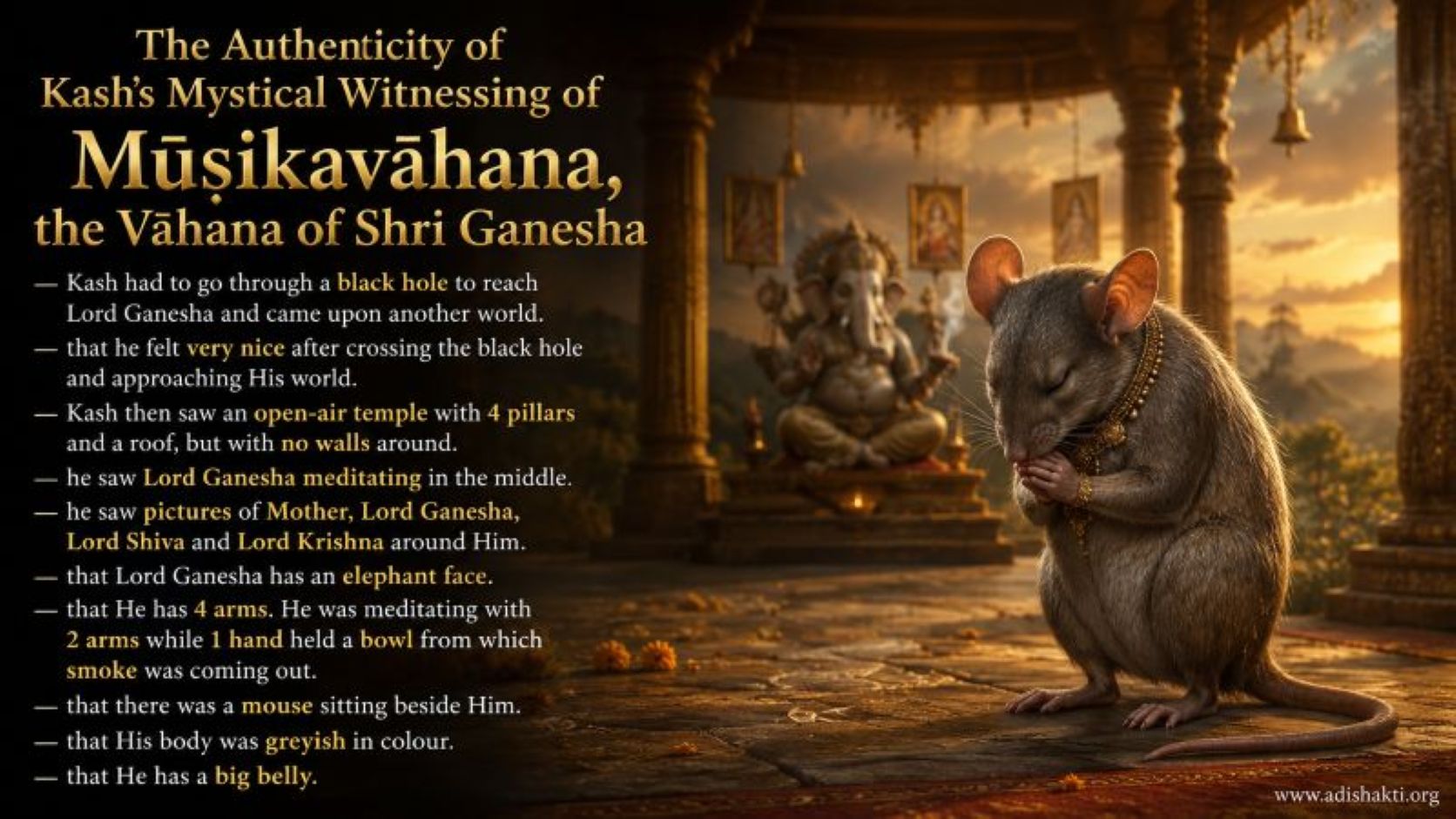
A cumulative documentary case that Kash authentically witnessed Mūṣikavāhana, the vāhana of Shri Ganesha
 4) Lord Ganesha
— Kash had to go through a black hole to reach Lord Ganesha and came upon another world.
— that he felt very nice after crossing the black hole and approaching His world.
— Kash then saw an open-air temple with 4 pillars and a roof, but with no walls around.
— he saw Lord Ganesha meditating in the middle.
— he saw pictures of Mother, Lord Ganesha, Lord Shiva and Lord Krishna around Him.
— that Lord Ganesha has an elephant face.
— that He has 4 arms. He was meditating with 2 arms while 1 hand held a bowl from which smoke was coming out.
— that there was a mouse sitting beside Him.
— that His body was greyish in colour.
— that He has a big belly.
Note: Kash was also repeatedly asked whether he was sure that there was a mouse beside Shri Ganesha. He insisted there was and had even seen this mouse standing on its hind legs.
Yet, the mind still refused to believe. What did a mouse and one of the most revered of Deities have in common? In the first place, what was a mouse doing in the Spiritual World? Although Kash could give no answer to these logical questions, he steadfastly stood by what he saw.
Only after checking at the Saul Bellow Library, Lachine, Montreal, did the mind settle down. The Encyclopaedia Britannica confirmed the presence of a mouse as a vehicle of Shri Ganesha.
Jagbir Singh, 1999, p. 143
Mūṣikavāhanāya: Adoration to Him Who Rides a Mouse
The very first day Kash visited Shri Ganesha in His small, open-air temple he noticed that there was a mouse beside Him. It even stood up on its hind legs and held the forelegs together, with head bowed in Namaskar.
Kash never inquired what this mouse was doing there in Shri Ganesha’s temple, although his father had initially found it difficult to believe the existence, and even less the usefulness, of such an animal.
One day, as Kash went with the Divine Mother to invite Shri Ganesha for the food offering, the mystery of His mouse reportedly became apparent.
After extending the invitation there was a short meditation. Then, as they were leaving, Shri Ganesha was seen mounting His mouse.
Kash’s father questioned how a heavy, large-bellied Shri Ganesha could sit on such a small mouse. Kash replied that it was a large mouse, approximately one and one-half feet long, unlike mice found on Earth.
He further explained that Shri Ganesha would first sit on His mouse and then fold His legs into a squatting position before beginning to travel.
On the morning of September 16, 1998, at approximately 6:25 a.m., Kash was again asked to describe Shri Ganesha’s mouse. He again said that it was approximately one and one-half feet long and about one foot wide. He again explained that Shri Ganesha squatted on its back rather than mounting it like a horse.
“There’s so many qualities of Shri Ganesh which I have described. One of them is that He is a Child and He’s very humble. He’s very playful. He’s very interesting and He’s extremely humble. And, despite His weight, He’s very lightweight because He can sit on a small little mouse. He doesn’t try to show off. He doesn’t have His vahannas as great as Vishnu’s or anything. His vahanna is very simple, the simplest, or we can say the smallest creature which can really crawl is a mouse and He uses this mouse. With this mouse, He expresses His own Power that He doesn’t need any other vehicle. His vehicle is His simplicity. He moves. He penetrates and it affects the lives of people through very, very simple, sweet methods.”
Shri Unmesa-Nimisot-Panna-Vipanna-Bhuvanavali Shri Nirmala DeviThe Source Of Wisdom, Shri Ganesha Puja, Berlin, Germany, July 21, 1993
Jagbir Singh, 1999, p. 637
Summary
This paper concludes that Kash’s Mūṣikavāhana experience is authentic. The conclusion rests not on a single resemblance to Hindu iconography, but on the cumulative force of the chronology: Kash saw a mouse beside Shri Ganesha; the detail appeared so implausible that his father repeatedly challenged it; Kash refused to withdraw what he had seen; neither father nor son could explain why a mouse belonged in Shri Ganesha’s presence; only afterward was the traditional correspondence deliberately checked; and the mouse was found to be Shri Ganesha’s established vāhana.
The evidentiary force becomes stronger because the testimony did not stop with a static image. In a later encounter Kash saw Shri Ganesha actually use the mouse as His vehicle. What had first appeared to be an inexplicable animal beside the deity subsequently performed precisely the function attributed to Mūṣika in Hindu tradition. The sequence therefore moves from uninterpreted observation to skeptical resistance, then to external confirmation, and finally to functional correspondence.
Kash’s persistence is central. He did not solve the puzzle by supplying learned Sanskrit terminology, theological explanation, or familiar iconographic doctrine. He simply maintained that the mouse was there. The father’s disbelief is consequently part of the evidence rather than an embarrassment to it: it records the fact that the observation was initially experienced as anomalous and contrary to expectation.
The later library inquiry is equally important. According to the preserved account, the reference search was undertaken because the mouse detail had already been reported and doubted. The direction of information is therefore crucial: the testimony generated the research; the research did not generate the testimony. This is the central reason the episode cannot adequately be reduced to a later attempt to fit an experience to known Hindu imagery.
The paper accordingly treats prior exposure, cryptomnesia, suggestion and retrospective reconstruction as hypotheses that must explain the entire sequence rather than merely the final correspondence. None is impossible in the abstract. But an explanation becomes weaker when it must account simultaneously for the initial puzzlement, the skeptical questioning, Kash’s stable insistence, the delayed recognition of the vāhana relationship, and the later functional observation.
The cumulative conclusion of this study is therefore affirmative: the documentary pattern strongly supports the authenticity of Kash’s experience. Historical analysis can distinguish this conclusion from the further metaphysical question of how a transcendent encounter is philosophically demonstrated; nevertheless, within the testimony examined here, the Mūṣikavāhana episode presents a coherent and unusually structured case of observation preceding conscious interpretation.
Keywords: Kash; Shri Ganesha; Mūṣika; Mūṣikavāhana; vāhana; authenticity; blind information; skeptical questioning; documentary chronology; Hindu iconography; prior knowledge; Saul Bellow Library; mystical testimony.
Table of Contents
Select a heading to move directly to it. Each major section includes a return link to this Table of Contents.
- Summary
- Introduction
- Chapter One — The Primary Testimony and Its Transmission
- Chapter Two — Mūṣikavāhana in Hindu Tradition
- Chapter Three — From an Unexplained Mouse to a Functional Vāhana
- Chapter Four — The Saul Bellow Library Verification
- Chapter Five — Documentary Chronology: What Was Recorded, and When?
- Chapter Six — Who Knew What, and When?
- Chapter Seven — Ganesha and the Mouse in Iconography
- Chapter Eight — Shri Mataji’s July 21, 1993 Ganesha Puja
- Chapter Nine — The Eighteen-Inch Mouse and Squatting Posture
- Chapter Ten — The September 16, 1998 Re-Examination
- Chapter Eleven — Child Testimony, Suggestion, and Memory
- Chapter Twelve — Alternative Explanations
- Chapter Thirteen — Comparative Assessment of Alternative Explanations
- Chapter Fourteen — Theological Significance of Mūṣikavāhana
- Chapter Fifteen — Cumulative Assessment of Authenticity
- Critical Synthesis — Why the Information Sequence Matters
- Chapter Sixteen — Conclusion
- Appendix A — Primary Source and Chronological Notes
- Bibliography
Introduction
The Claim and the Evidential Question
This study examines a reported mystical experience in which thirteen-year-old Kash described an encounter with Shri Ganesha and reported seeing a mouse sitting beside Him.
Considered in isolation, this correspondence cannot establish extraordinary knowledge. Shri Ganesha is widely represented with a mouse or rat, and ordinary prior cultural exposure must therefore be considered.
The evidentiary question becomes considerably more specific, however, because the primary account states that Kash was repeatedly asked whether he was certain that the mouse was present. He reportedly insisted that it was, despite being unable to explain why a mouse should be associated with Shri Ganesha.
The same account states that the relationship was investigated only afterward through reference material at the Saul Bellow Library in Lachine, Montreal, where an encyclopedia reportedly confirmed that the mouse functions as Shri Ganesha’s vehicle.
Did Kash already possess the traditional knowledge that Shri Ganesha is associated with a mouse vāhana, or did he first maintain an apparently inexplicable observation under skeptical questioning and only afterward encounter external confirmation of its traditional significance?
Three Levels of Authenticity
| Level | Question |
|---|---|
| Documentary authenticity | Does the surviving record accurately preserve what Kash reported, the skeptical questioning, and the later verification? |
| Phenomenological authenticity | Does the testimony support the conclusion that Kash sincerely experienced what he described? |
| Metaphysical authenticity | Did Kash objectively encounter Shri Ganesha and Mūṣikavāhana within a transcendent reality? |
These are related but distinct questions. Evidence supporting the historical authenticity of the testimony does not automatically prove its strongest metaphysical interpretation.
Method and Sources
The inquiry employs a mixed interdisciplinary method combining historical source criticism, documentary chronology, Hindu textual and iconographic study, Sanskrit terminology, child-testimony research, memory psychology, comparative theology, and explicit testing of alternative hypotheses.
The principal internal source is Shri Adi Shakti: The Kingdom of God (1999), particularly pp. 143 and 637. Independent materials are used to establish whether the religious correspondences actually predate Kash’s testimony.
Particular care is taken to distinguish what Kash reportedly observed, what was asked of him, what was not understood at the time, and what was discovered through later research.
Standard of Evidence
The strongest evidentiary structure in this case would be:
↓
SKEPTICAL QUESTIONING
↓
PERSISTENT TESTIMONY
↓
NO KNOWLEDGE OF THE MEANING
↓
INDEPENDENT REFERENCE CHECKING
↓
PRE-EXISTING TRADITIONAL CORRESPONDENCE
If this chronology is supported by records created near the time of the events, it carries substantially greater evidentiary weight than a later retrospective discovery that a mystical narrative resembles Hindu tradition.
Chapter One — The Primary Testimony and Its Transmission
1.1 The Reported Encounter
According to the published testimony, Kash reported passing through what he called a “black hole” before reaching another world associated with Shri Ganesha.
He described feeling particularly pleasant after crossing this region and approaching the destination.
He then reported seeing an open-air temple consisting of four pillars and a roof but no enclosing walls, with Shri Ganesha meditating in the center.
Around Him were reportedly representations of the Mother, Shri Ganesha, Shri Shiva and Shri Krishna.
Kash described Shri Ganesha as having an elephant face, four arms, a greyish body and a large belly. Two hands were described as engaged in meditation while another held a bowl or vessel from which smoke emerged.
1.2 The Mouse Beside Shri Ganesha
Among these observations was the detail central to this study: a mouse was sitting beside Shri Ganesha.
Its first appearance in the narrative is notable because Kash is not reported to have identified it as Mūṣika, a vāhana, or a traditional attribute of Shri Ganesha.
The mouse initially appears merely as an animal whose presence required explanation.
The distinction between observation without interpretation and repetition of known doctrine is fundamental to the evidentiary question.
1.3 Repeated Skeptical Questioning
The primary account states that Kash was repeatedly asked whether he was certain that a mouse had been beside Shri Ganesha.
This feature deserves close attention because repeated questioning can operate in different directions. It can sometimes introduce suggestion; but it can also test whether a witness will retract an observation under challenge.
According to the narrative, the questioning here was skeptical: the adult recorder found the presence of a mouse beside so revered a deity difficult to accept.
The account does not portray Kash as being prompted to introduce the mouse. It portrays him as being asked whether he was mistaken about an animal he had already reported.
1.4 Kash’s Persistence Under Challenge
Kash reportedly did not retract the observation. He continued to insist that the mouse had been present.
He further stated that he had seen the mouse standing upon its hind legs. Elsewhere in the same narrative the animal is described as bringing its forelegs together and bowing its head in a gesture interpreted as Namaskar.
Persistence under skeptical questioning does not establish that the observation was objectively correct. A sincere witness can remain confident and still be mistaken.
It does, however, contribute to an assessment of the stability and sincerity of the testimonial claim.
1.5 The Father’s Initial Disbelief
The published account describes an explicit problem of comprehension: what relationship could possibly exist between a mouse and Shri Ganesha?
The objection went further. If the reported environment represented a spiritual realm, why should an ordinary-seeming animal such as a mouse be there at all?
Kash reportedly provided no doctrinal explanation. He simply maintained that the animal was what he had seen.
This lack of explanation is potentially evidentially significant. A child consciously reproducing known Ganesha doctrine might be expected to associate the mouse with the deity’s traditional vehicle. Instead, the narrative portrays observation preceding understanding.
That point becomes substantially stronger if the father’s skepticism and Kash’s inability to explain the animal can be established in records created before subsequent reference research.
1.6 The Library Verification
The account states that the question was subsequently investigated at the Saul Bellow Library in Lachine, Montreal.
The existence and location of the library are independently verifiable. The present-day City of Montréal identifies Bibliothèque Saul-Bellow as a public library in the borough of Lachine.
According to the primary narrative, reference material in the Encyclopaedia Britannica was consulted and identified a mouse as Shri Ganesha’s vehicle.
The historical importance of the episode lies in the claimed order of events: the reference search was reportedly undertaken because the earlier testimony appeared implausible.
Thus the library information is presented not as the source of the mouse claim but as its subsequent comparator.
1.7 Why the Sequence Matters
The strongest authenticity argument in the present case is therefore not:
Kash said that Ganesha had a mouse.
Hinduism teaches that Ganesha has a mouse.
Therefore Kash must have encountered Ganesha.
That argument would be inadequate because it fails to consider prior cultural exposure.
The stronger historical argument is instead:
↓
the report is repeatedly challenged
↓
Kash maintains the claim but cannot explain its significance
↓
the recorder remains skeptical
↓
external reference research is undertaken
↓
the mouse is discovered to have an established vāhana relationship with Shri Ganesha
If this ordering can be securely anchored by contemporaneous or near-contemporaneous documentation, it constitutes meaningful evidence against straightforward retrospective fabrication or conscious borrowing.
It does not eliminate prior incidental exposure or cryptomnesia, nor does it prove a metaphysical encounter. But it creates an evidentiary problem that those alternative explanations must genuinely address rather than merely assume away.
Chapter Two — Mūṣikavāhana in Hindu Tradition
2.1 Mūṣika: Mouse or Rat
The Sanskrit term mūṣika is conventionally translated as mouse or rat. English-language treatments of Shri Ganesha therefore vary between describing His animal companion as a mouse and describing it as a rat.
For the purposes of the present investigation, that lexical variation is not significant. The essential point is that Hindu tradition independently associates Shri Ganesha with a small rodent known as Mūṣika.
This distinction matters because the original testimony under examination uses the ordinary English word “mouse”. Kash is not reported initially to have supplied a Sanskrit term or a theological explanation. The Sanskrit identification belongs to the comparative religious analysis undertaken afterward.
The evidentiary question is therefore not whether Kash pronounced the traditional name correctly. It is whether the animal he described corresponds to an established feature of Ganesha tradition.
2.2 Vāhana: The Divine Vehicle
The Sanskrit term vāhana denotes a vehicle, carrier, or mount. Within Hindu iconography, many deities are conventionally associated with particular animals or beings that function as their vāhanas.
The concept describes more than physical proximity. An animal may appear beside a deity as an identifying attribute, beneath the deity as a symbolic support, or as the being upon which the deity travels.
This distinction is central to the present case because Kash’s testimony reportedly developed in two stages.
First stage:
A mouse is observed sitting beside Shri Ganesha.
Second stage:
Shri Ganesha is reportedly seen sitting upon the mouse in preparation for travel.
The later observation therefore corresponds not merely to the traditional presence of Mūṣika but to its more specific vāhana function.
2.3 Mūṣikavāhana as an Epithet of Ganesha
The compound Mūṣikavāhana may be rendered “He whose vehicle is the mouse” or “He who has the mouse as His vāhana.”
The grammatical form Mūṣikavāhanāya carries the devotional sense “to Him whose vehicle is the mouse”, as in a salutation or offering of reverence.
The title is therefore highly relevant to the authenticity inquiry. The animal Kash reportedly described is not merely a creature occasionally associated with Ganesha. Its traditional relationship with the deity is important enough to be incorporated into devotional naming.
That fact strengthens the external correspondence while simultaneously making the question of prior knowledge more important. If Kash already knew the epithet or its meaning, the correspondence could be explained ordinarily. If he did not, the chronological sequence becomes more evidentially interesting.
2.4 Textual Tradition
The Ganesha–mouse relationship is preserved across Hindu devotional, mythological, and iconographic traditions. Different narratives explain the origin of the relationship in different ways, but the association between Ganesha and Mūṣika became one of the deity’s characteristic identifying features.
For the present paper, the existence of multiple explanatory traditions is less important than the historical independence of the basic correspondence.
The religious tradition plainly predates Kash’s reported experience. Consequently, the later discovery that the mouse functions as Ganesha’s vehicle cannot reasonably be regarded as a religious association invented in response to Kash’s testimony.
What remains open is a different question: when and how did Kash or his father first acquire knowledge of that pre-existing tradition?
2.5 Historical Development of the Mouse Vāhana
Historical Hindu art provides independent evidence for the relationship between Shri Ganesha and Mūṣika. Sculptural and painted representations show the rodent positioned near the deity or functioning explicitly as His mount.
Modern archaeological and museum documentation continues to identify Mūṣika as Ganesha’s vāhana. A scholarly study of a Ganesha sculpture in the collection of the Prambanan Temple Museum, for example, explicitly describes a mouse in the composition as a vāhana or vehicle.
Likewise, the National Gallery of Modern Art in New Delhi catalogs a work under the title Ganesha Riding on the Mouse, explicitly identifying the mouse as Ganesha’s vāhana and as a characteristic element of His iconography.
These independent sources establish the external side of the correspondence: the mouse–vehicle relationship is genuinely part of Ganesha tradition.
They do not, by themselves, establish how Kash learned—or did not learn—that tradition. That requires examination of the chronology of the testimony itself.
Chapter Three — From an Unexplained Mouse to a Functional Vāhana
3.1 The First Observation
The earliest mouse detail in the published testimony is strikingly uncomplicated: there was a mouse sitting beside Shri Ganesha.
No explanation accompanies the first observation. The mouse is not immediately identified as a vehicle. Kash reportedly does not explain its religious significance and does not appear to understand why it is there.
Instead, its presence generates skepticism. Kash is repeatedly questioned about whether he is certain that he saw such an animal.
The lack of immediate interpretation is potentially important because it creates an evidentiary distinction between seeing an unexplained feature and repeating a known religious teaching.
3.2 The Food-Offering Visit
A later reported encounter changes the meaning of the animal. Kash reportedly accompanied the Divine Mother to invite Shri Ganesha for a food offering.
Following the invitation there was a short meditation. As they were leaving, Kash reportedly observed Shri Ganesha preparing to depart.
It is at this point that the mouse ceases to be merely an unexplained animal sitting beside the deity.
According to the narrative, Shri Ganesha mounted the mouse.
3.3 Shri Ganesha Mounts the Mouse
The later observation represents one of the strongest specific correspondences in the case because it assigns the mouse precisely the function attributed to Mūṣika within established Ganesha tradition.
The sequence can therefore be expressed as follows:
↓
NO INITIAL EXPLANATION
↓
LATER OBSERVATION OF GANESHA SITTING UPON IT
↓
TRADITIONAL IDENTIFICATION OF MOUSE AS VĀHANA
The progression is evidentially more significant than a single static image because the mouse is assigned a specific function.
3.4 Visual Versus Functional Correspondence
A distinction should therefore be made between visual correspondence and functional correspondence.
| Type of Correspondence | Kash’s Report | Traditional Parallel |
|---|---|---|
| Visual | Elephant-headed deity | Characteristic Ganesha iconography |
| Visual | Large belly | Characteristic Ganesha iconography |
| Visual | Mouse beside Shri Ganesha | Characteristic Ganesha iconography |
| Functional | Shri Ganesha sits upon the mouse for travel | Mouse functions as His vāhana |
The functional correspondence is potentially more probative than the basic visual features because it concerns the relationship between Shri Ganesha and the animal rather than their mere co-presence.
Nevertheless, its significance remains dependent upon prior-access analysis. An image of Ganesha riding a mouse could transmit the same information without formal religious instruction.
Chapter Four — The Saul Bellow Library Verification
4.1 The Reason for the Library Search
According to the primary narrative, the library investigation was not undertaken as general research into Shri Ganesha. It was prompted by a specific difficulty: the mouse in Kash’s testimony appeared implausible.
Kash had reportedly been asked repeatedly whether he was certain that the animal had been present. He maintained that it was, yet neither he nor his father could initially explain what relationship a mouse could have with Shri Ganesha.
This claimed sequence is important because it portrays the reference research as a response to the testimony rather than as its source.
The historical value of the episode therefore depends upon whether that ordering can be reliably established.
4.2 External Reference Checking
The account states that reference checking was undertaken at the Saul Bellow Library in Lachine, Montreal.
The importance of the library episode is methodological. A claim that appears irrational or culturally incongruous is not simply accepted; an external source is consulted.
This introduces a potentially valuable separation between:
Primary testimony:
What Kash said he saw.
Initial interpretation:
The father’s disbelief and inability to understand the mouse.
External comparison:
Reference research undertaken afterward.
Such separation is valuable in authenticity analysis because evidence is stronger when observation and verification can be chronologically distinguished.
4.3 Encyclopaedia Britannica
The primary source states that the Encyclopaedia Britannica was consulted and that it confirmed the presence of a mouse as a vehicle of Shri Ganesha.
The significance of this statement lies in the type of source being described. An encyclopedia functions as an external reference work rather than as part of the family’s own developing narrative.
If the relevant edition and entry can be identified, the claim becomes more readily testable: one may determine exactly what the reference work stated and whether the wording available at that time indeed described the mouse as Ganesha’s vehicle.
Until the particular edition and page are documented, however, academic precision requires describing this as a reported library verification rather than claiming that the exact Britannica passage has already been recovered.
4.4 Evidentiary Significance
If the chronology is accurate, the library episode creates an unusual evidentiary pattern:
↓
ADULT DISBELIEVES THE DETAIL
↓
CHILD IS REPEATEDLY QUESTIONED
↓
CHILD MAINTAINS THE OBSERVATION
↓
NEITHER CAN EXPLAIN THE MOUSE’S SIGNIFICANCE
↓
REFERENCE SOURCE IS CONSULTED
↓
MOUSE–VĀHANA ASSOCIATION IS RECOGNIZED
This is stronger evidence than a later retrospective statement that a vision happened to resemble Hindu mythology.
The potentially significant feature is epistemic sequence: the testimony allegedly came first, understanding came later.
4.5 Limitations of Retrospective Documentation
The library episode nevertheless requires the same source-critical caution as every other part of the case.
The published account appeared in 1999. If no contemporaneous note records the library visit or the state of knowledge immediately before it, the sequence may depend partly upon later memory.
Several questions are therefore important: When exactly was the library visit made? Was the mouse report already written down before the visit? Was the father’s skepticism documented at the time? Which edition of the Encyclopaedia Britannica was consulted? What precise wording did the entry contain? Did any other person know of the search or see the reference material?
Answers to these questions would materially strengthen the historical analysis.
The absence of some of these details does not invalidate the account, but it limits the degree of certainty that can be assigned to the chronology.
Chapter Five — Documentary Chronology: What Was Recorded, and When?
5.1 Contemporaneous Evidence
The historical strength of the Mūṣikavāhana case ultimately depends upon the surviving documentary chronology.
A recollection published several years after an event can preserve genuine testimony, but it is more vulnerable to memory reconstruction and later knowledge than a document created at or near the time of the original experience.
The strongest possible evidence would therefore be a dated record containing the mouse detail before the library verification.
Such a record would demonstrate that the unusual observation was not introduced only after the traditional Ganesha–mouse relationship had become known.
5.2 The First Fax and the 1993 Context
The broader documentary history includes the First Fax, sent from Montreal to Kuala Lumpur during the early phase of Kash’s reported mystical experiences.
The importance of that document within the wider Authenticity Series lies in its ability to establish that extraordinary claims concerning Kash were already being communicated outside the immediate household during the earliest period of the experiences.
For the present case, however, a distinction must be maintained between general chronological context and direct documentary confirmation.
The First Fax supports the broader chronology only to the extent that it documents the early existence of the reported experiences. Unless the surviving fax itself contains the Ganesha and mouse material, it should not be represented as direct proof of the Mūṣikavāhana episode.
5.3 Handwritten and Computer Records
Dated handwritten notes and computer records from the period are therefore potentially more important for the specific question under investigation.
Ideally, those records would permit the following chronology to be reconstructed:
1. Kash reports the mouse beside Shri Ganesha.
2. The observation is recorded.
3. Kash is questioned about whether he is certain.
4. Neither Kash nor his father understands the mouse’s significance.
5. The Saul Bellow Library reference search occurs.
6. The mouse–vāhana relationship is discovered.
7. Later experiences include Shri Ganesha actually using the mouse for travel.
If surviving documents substantiate this ordering, the authenticity argument becomes considerably stronger.
5.4 The 1999 Publication
Shri Adi Shakti: The Kingdom of God, published in 1999, provides the principal fixed textual form of the narrative examined here.
The publication is therefore an important primary source for the history of the claim, but it should not automatically be treated as equivalent to a contemporaneous 1993 record.
Several years separated the initial experience from final publication. During that interval the testimony could have been discussed, interpreted, compared with religious sources, and integrated into a coherent theological narrative.
None of this demonstrates that the account was altered. It simply means that the historian must distinguish the date of publication from the date of the underlying observations.
5.5 Evidentiary Hierarchy
| Evidence | Function | Relative Historical Weight |
|---|---|---|
| Dated contemporaneous notes or computer records | Establish what was recorded before later research | Highest |
| Early correspondence or third-party testimony | Shows that the claim existed outside later publication | High |
| Documented library investigation | Establishes timing of external verification | High if independently dated |
| Independent Hindu textual and iconographic sources | Establish that the external correspondence is genuine and pre-existing | High for correspondence, not transmission |
| September 1998 re-examination | Tests stability of later memory | Moderate |
| 1999 published narrative | Preserves the complete retrospective account | Important but chronologically later |
The strongest authenticity case therefore arises where early testimony demonstrably precedes external verification.
The next chapter addresses the question that follows directly from this chronology: what did Kash and his father know before the mouse–vāhana relationship was recognized?
Chapter Six — Who Knew What, and When?
6.1 Kash’s Prior Knowledge
The most obvious ordinary explanation for the Ganesha–mouse correspondence is prior knowledge. Shri Ganesha is among the most recognizable deities in Hindu religious culture, and representations frequently include a mouse or rat near His feet or as His vehicle.
Accordingly, the question is not simply whether Kash had ever encountered an image of Shri Ganesha. The more specific issue is whether he had already learned that the mouse had a defined religious function as Ganesha’s vāhana.
Prior knowledge could have been explicit, such as through a book, conversation, temple explanation, or devotional teaching. It could also have been incidental, through calendars, statues, photographs, festival images, household objects, or television.
The evidential value of Kash’s testimony therefore depends not upon an absolute claim that he had never seen any Ganesha imagery, but upon whether the specific mouse–vāhana relationship can be shown to have been unknown to him at the time he first reported the animal.
6.2 The Father’s Prior Knowledge
The father’s prior knowledge is equally important because he was the principal recorder and questioner of Kash’s testimony.
If he already knew that Shri Ganesha traditionally rides a mouse, then his questions, reactions, or later reconstruction could potentially have introduced the association into the narrative.
The published account instead portrays the father as genuinely puzzled by the mouse and as repeatedly asking Kash whether he was certain of what he had seen.
If contemporaneous records confirm that skepticism, it would reduce the likelihood that the father knowingly prompted Kash toward a conventional Ganesha–mouse answer.
However, a later statement that the father had once been puzzled is weaker than a dated note actually showing that puzzlement before the library search. The distinction between contemporaneous evidence and retrospective memory must therefore remain explicit.
6.3 Initial Puzzlement as Evidence
The most distinctive feature of the knowledge chronology is the claimed period of initial puzzlement.
Kash reportedly insisted that the mouse was there but could not explain why. His father reportedly found the idea difficult to accept and could not see what relationship such an animal might have with Shri Ganesha.
This apparent lack of understanding is evidentially relevant because ignorance can sometimes be historically informative.
If a witness reports a detail, cannot interpret it, is challenged about it, and only later discovers that the detail has an established traditional meaning, the sequence differs substantially from simple repetition of known doctrine.
↓
NO EXPLANATION AVAILABLE
↓
SKEPTICAL CHALLENGE
↓
PERSISTENCE
↓
LATER DISCOVERY OF TRADITIONAL MEANING
The evidentiary strength of this structure depends entirely upon whether the ordering can be reliably documented.
6.4 Cultural Exposure
Cultural exposure remains a serious alternative explanation even if neither Kash nor his father consciously remembered the Ganesha–mouse association.
Religious imagery can be absorbed without formal teaching. A child may see a mouse beside Ganesha many times without ever being told explicitly that it is a vāhana.
Later, that visual association can reappear in a dream, meditative image, or visionary experience without the witness remembering the original source.
For this reason, claims such as “Kash was never taught this” are weaker than “no plausible prior exposure can be identified.”
The first concerns formal instruction; the second concerns the much broader question of informational access.
6.5 Information Sequence
The case therefore turns on information sequence rather than iconographic accuracy alone.
The strongest reconstruction would be:
1. Kash reports the mouse.
2. The report is written down.
3. Kash is repeatedly challenged.
4. Neither Kash nor his father understands the mouse’s role.
5. Independent reference research is conducted.
6. The mouse is identified as Shri Ganesha’s vehicle.
If this sequence can be anchored by dated documents, it becomes one of the strongest elements of the authenticity argument because it makes straightforward conscious borrowing considerably less likely.
It would not fully exclude cryptomnesia, but it would raise the evidentiary burden on that explanation.
Chapter Seven — Ganesha and the Mouse in Iconography
7.1 Historical Art
The association between Shri Ganesha and the mouse is firmly embedded in Hindu visual culture.
Sculptures, temple reliefs, devotional paintings, manuscript illustrations, and modern religious images frequently depict the mouse near Ganesha or as His mount.
This independent visual tradition establishes that the mouse correspondence did not originate in the Kash narrative.
At the same time, widespread imagery increases the plausibility of prior visual exposure. Iconographic confirmation therefore supports the accuracy of the correspondence while simultaneously strengthening the need for a careful prior-knowledge analysis.
7.2 The Mouse at Ganesha’s Feet
One of the most common arrangements places the mouse below or beside Shri Ganesha, often near His feet.
This has direct relevance to Kash’s first reported observation because he described the mouse as simply sitting beside Shri Ganesha.
The visual match is therefore genuine.
However, because this arrangement is relatively common in Ganesha imagery, it cannot be assigned high evidentiary weight unless prior exposure can be made unlikely.
The more probative part of the testimony remains the later functional use of the mouse.
7.3 Ganesha Riding the Mouse
Historical and modern representations also depict Shri Ganesha riding or seated upon the mouse.
This visual tradition directly parallels Kash’s later report that Shri Ganesha mounted the animal before traveling.
The correspondence is more specific than the mouse’s mere presence because it assigns the animal a recognizable function.
Accordingly, the evidentiary pattern may be expressed as:
Traditional iconography:
Ganesha + mouse + riding or vehicle relationship.
Kash’s testimony:
Ganesha + mouse + later mounting of the mouse for travel.
Again, the strength of the match depends on whether Kash could have seen such imagery before the reported experience.
7.4 Comparison with Kash’s Description
| Feature | Kash’s Report | Traditional Correspondence |
|---|---|---|
| Elephant face | Yes | Characteristic of Shri Ganesha |
| Large belly | Yes | Characteristic of Shri Ganesha |
| Multiple arms | Four arms reported | Common in Ganesha iconography |
| Mouse beside deity | Yes | Strong traditional correspondence |
| Mouse used for travel | Yes | Strong vāhana correspondence |
| Mouse standing on hind legs | Yes | Not a core traditional feature |
| Mouse about eighteen inches long | Yes | No exact external match established |
| Ganesha squatting upon mouse | Yes | Requires separate iconographic comparison |
The comparison shows why the paper must distinguish between well-established correspondences and distinctive but unverified details.
Chapter Eight — Shri Mataji’s July 21, 1993 Ganesha Puja
8.1 The Berlin Discourse
A notable comparative source is the discourse attributed to Shri Mataji Nirmala Devi at Shri Ganesha Puja in Berlin, Germany, on July 21, 1993.
The date is important because it predates the late-1993 period in which Kash’s mystical experiences are reported to have begun.
In that discourse, Shri Mataji emphasizes Ganesha’s humility, simplicity, playfulness, and childlike nature.
She also discusses the apparent paradox of His large body and tiny mouse vehicle.
8.2 “He Can Sit on a Small Little Mouse”
The most relevant element is Shri Mataji’s statement that, despite His weight, Ganesha can sit upon a “small little mouse.”
This closely parallels the later difficulty reportedly raised by Kash’s father: how could a large, big-bellied Shri Ganesha sit upon such a small animal?
The comparison is therefore unusually specific. It concerns not merely the existence of the mouse but the apparent physical disproportion between deity and vehicle.
8.3 The Paradox of Weight and Vehicle
The father’s objection in the Kash narrative is essentially physical: the mouse appears too small to carry the deity.
Shri Mataji’s discourse treats the same apparent contradiction as a theological feature rather than a problem.
Ganesha’s ability to use so modest a vehicle becomes evidence, within the religious interpretation, of His extraordinary lightness and humility.
This creates a potentially significant correspondence between:
Kash narrative:
The large Ganesha / small mouse relationship appears puzzling.
Shri Mataji discourse:
The same relationship is explicitly highlighted and interpreted.
8.4 Simplicity and Humility
Shri Mataji explains the mouse through the principles of simplicity and humility.
Unlike deities associated with imposing vehicles, Shri Ganesha does not require grandeur. The smallest creature is sufficient.
The mouse therefore functions symbolically as well as practically. It expresses the idea that true divine power does not require outward display.
This theological interpretation should be distinguished from the historical question of whether Kash knew the discourse.
8.5 Chronological Priority and Prior Access
The July 21, 1993 date establishes that the discourse predates the reported Ganesha experience.
That makes it an independently pre-existing source. It cannot have been produced in response to Kash’s later testimony.
However, chronological priority is not enough by itself. The decisive issue is whether Kash or his father could have encountered the discourse, a recording of it, a transcript, or someone familiar with its content before the reported experience.
If prior access occurred, the correspondence may be explained ordinarily. If prior access can be reasonably excluded, the parallel becomes more evidentially significant.
The responsible academic conclusion is therefore conditional: the Berlin discourse provides a genuine pre-existing correspondence, but its evidential force depends upon the history of access.
Chapter Nine — The Eighteen-Inch Mouse and Squatting Posture
9.1 The Father’s Physical Objection
When Kash reported seeing Shri Ganesha sit upon the mouse, his father reportedly raised an immediate practical objection.
How could a large, heavy, big-bellied deity possibly ride a mouse of ordinary size?
This question elicited two of the most distinctive details in the account: the unusual dimensions of the mouse and Shri Ganesha’s posture upon it.
9.2 Kash’s Size Estimate
Kash reportedly explained that the mouse was not comparable to ordinary mice found on Earth.
He estimated it at approximately one and one-half feet long.
During the September 1998 re-questioning, he reportedly described it again as approximately one and one-half feet long and around one foot wide.
The stability of the estimate is noteworthy, but the dimension itself should not be described as independently corroborated unless a specific earlier source establishes a comparable scale.
9.3 The Squatting Position
Kash further explained that Shri Ganesha did not ride the mouse in the same manner that a person rides a horse.
Instead, Shri Ganesha reportedly first sat upon its back and then folded His legs into a squatting position.
This posture is distinctive because it provides a concrete mechanical solution to the problem raised by the father.
Its specificity makes it useful for later comparison with historical iconography, but specificity alone does not establish truth.
9.4 Elicited Versus Spontaneous Details
The size and posture details differ evidentially from the earliest mouse observation because they appear to have been elicited by a specific question.
The initial statement, “there was a mouse sitting beside Shri Ganesha,” appears to be a spontaneous report.
The later explanation of the animal’s size and of Shri Ganesha’s squatting posture emerged in response to the objection that the scene appeared physically impossible.
Elicited details are not necessarily unreliable, but they should be assigned somewhat less weight because questioning can stimulate elaboration.
Chapter Ten — The September 16, 1998 Re-Examination
10.1 The Later Questioning
The published account records that on the morning of September 16, 1998, at approximately 6:25 a.m., Kash was again asked to describe Shri Ganesha’s mouse.
This later questioning is important because it provides evidence concerning the stability of the narrative over time.
By 1998, however, several years had passed since the original experience. The testimony must therefore be treated as a later consistency check rather than as an independent contemporaneous confirmation of what Kash knew in 1993.
10.2 Repeated Dimensions
According to the published account, Kash again described the mouse as approximately one and one-half feet long.
He additionally described it as approximately one foot wide.
The repeated length estimate is noteworthy because it concerns a detail that is not necessary to establish the general Ganesha–mouse association.
Its persistence suggests that the unusual scale of the animal formed a stable part of Kash’s memory of the experience.
It does not, however, independently verify that the animal actually possessed those dimensions.
10.3 Repeated Posture
Kash reportedly also repeated that Shri Ganesha squatted upon the mouse’s back rather than riding it astride like a horse.
The stability of this particular detail is significant because it is more distinctive than the general statement that Ganesha rides a mouse.
The repeated posture therefore strengthens the conclusion that the narrative had a stable internal form by 1998.
But stability must be distinguished from independence. A repeatedly remembered detail may remain stable because it derives from a genuine experience, from a learned narrative, or from a memory that has been rehearsed over time.
10.4 Consistency Versus Independent Corroboration
The September 1998 re-examination should therefore be classified primarily as consistency evidence.
It supports the proposition that Kash did not radically alter the unusual size and posture descriptions over time.
It does not constitute independent corroboration in the strict historical sense because the later statement comes from the same witness and belongs to the same testimonial chain.
Original report:
Evidence of what Kash first claimed.
1998 repetition:
Evidence that distinctive details remained stable.
Independent Hindu tradition:
Evidence that the mouse–vāhana correspondence existed outside Kash’s account.
This distinction is essential to avoid counting multiple retellings of one claim as though they were independent sources.
Chapter Eleven — Child Testimony, Suggestion, and Memory
11.1 A Thirteen-Year-Old Witness
Kash was thirteen years old during the initial period of the reported experience. His age is relevant because an adolescent is capable of detailed observation, description, memory, and resistance to questioning, while still being susceptible to some of the same reconstructive and social influences that affect testimony at other ages.
Academic analysis should therefore avoid two opposite errors. The testimony should not be dismissed simply because it came from a young witness, nor should youth itself be treated as evidence that the testimony must be free from error, suggestion, or prior cultural influence.
The proper question is more specific: what features of the testimony were spontaneous, what features were elicited, how stable were they, and what information was available to the witness before the report was made?
11.2 Repeated Questioning
Repeated questioning is a central feature of the mouse episode. Kash was reportedly asked several times whether he was certain that the mouse had been present beside Shri Ganesha.
Repeated interviews can sometimes influence memory, particularly where the questioner communicates an expected answer.
Yet the direction of the questioning matters. According to the primary narrative, the adult recorder did not encourage Kash to report a mouse. He found the mouse difficult to believe and questioned whether Kash was certain about it.
If that description accurately preserves the original exchange, the questioning functioned principally as a challenge to an already existing claim rather than as a suggestion that generated it.
This does not eliminate all concerns about interview influence, but it makes the evidentiary structure materially different from one in which a child simply accepts an adult’s proposed religious interpretation.
11.3 Open Versus Leading Questions
The reliability of the earliest testimony would be easier to assess if the exact wording of the original questions were preserved.
| Question Type | Illustrative Example | Relative Suggestive Risk |
|---|---|---|
| Open | “What did you see?” | Lower |
| Focused but neutral | “Was anything beside Shri Ganesha?” | Moderate |
| Leading | “Was there a mouse beside Him?” | Higher |
| Interpretive | “Did you see Ganesha’s mouse vāhana?” | Highest because both object and interpretation are supplied |
Without verbatim early interview records, the precise degree of suggestive influence cannot be reconstructed with certainty.
Nevertheless, the published primary account explicitly presents the mouse as part of Kash’s report before the repeated skeptical challenges concerning whether he was sure of it. That claimed ordering is therefore the feature that requires documentary testing.
11.4 Cryptomnesia and Source Memory
One of the strongest ordinary explanations is cryptomnesia: previously encountered information may later return to consciousness without the person remembering where it was originally acquired.
Kash could theoretically have encountered an image of Shri Ganesha with a mouse in a book, calendar, temple, household object, religious gathering, or other cultural setting and later failed to remember the source.
Such an explanation does not require deception. A person may sincerely experience imagery as spontaneous even when some of its elements derive from forgotten prior exposure.
For this reason, evidence that Kash sincerely believed his account does not by itself eliminate a memory-based explanation.
11.5 Retrospective Reconstruction
Retrospective reconstruction must also be considered because the principal published account appeared in 1999, several years after the earliest reported experiences.
Once the family had learned that the mouse was traditionally Shri Ganesha’s vāhana, later recollection of the original puzzlement could have been influenced by that knowledge.
Such reconstruction need not be deliberate. Human memory is not a literal recording; later information can become integrated into recollection of earlier events.
The strongest safeguard against this alternative is therefore dated contemporaneous or near-contemporaneous documentation showing the mouse report and the state of puzzlement before the relevant traditional information was deliberately researched.
Chapter Twelve — Alternative Explanations
12.1 Prior Cultural Exposure
The simplest alternative explanation is that Kash had previously encountered the Ganesha–mouse association through ordinary cultural exposure.
Because Shri Ganesha is widely represented in Hindu visual culture, such exposure is possible even in the absence of formal instruction.
A single remembered or forgotten image showing a mouse beside Ganesha could explain the basic visual correspondence. An image showing Ganesha riding the mouse could potentially explain the later functional correspondence as well.
The strength of this explanation therefore depends upon evidence concerning Kash’s actual informational environment before the experience.
12.2 Cryptomnesia
Cryptomnesia extends the prior-exposure explanation by allowing the original source of information to have been forgotten.
Under this explanation, Kash need not have consciously reproduced religious knowledge. He could sincerely experience remembered imagery without recognizing it as memory.
The possibility is difficult to exclude completely because forgotten exposure may leave no documentary trace.
Its explanatory force becomes weaker, however, if the documentary record shows not only the mouse but an extended sequence of observation, puzzlement, skeptical questioning, persistence, and subsequent discovery of the traditional correspondence.
12.3 Suggestion
A suggestion explanation proposes that adult questioning helped shape the content of the narrative.
This explanation would be strengthened if the mouse appeared only after an adult introduced the idea, or if questions supplied the expected religious answer.
The published account presents the opposite sequence: the mouse was reportedly described first and challenged afterward.
If that ordering is historically secure, suggestion becomes substantially less successful as an explanation for the initial mouse observation.
It remains more relevant to later elaborations, particularly details supplied in response to questions concerning the animal’s dimensions or how Shri Ganesha could sit upon it.
12.4 Meditative Imagery
Another possibility is that Kash experienced vivid internally generated imagery during meditation.
Meditative and altered states can involve elaborate scenes, unusual bodily sensations, powerful emotions, and experiences of presence that are subjectively compelling.
Under this interpretation, Kash could have sincerely experienced the encounter substantially as described without the scene necessarily corresponding to an objectively external spiritual realm.
This explanation addresses the phenomenological vividness of the experience, but it does not independently explain the acquisition of any religious information that can be shown to have been genuinely unknown beforehand.
12.5 Coincidence
Coincidence can explain individual correspondences. A mouse could theoretically appear by chance in a visionary scene involving Shri Ganesha.
The explanation becomes less complete, however, when the animal is later described as performing precisely the broad function traditionally assigned to it: carrying Shri Ganesha as His vehicle.
Even so, no numerical probability should be assigned to the correspondence. The relevant background rates—such as exposure to Ganesha imagery and the dependence of one reported feature upon another—cannot be established with sufficient precision.
12.6 Retrospective Contamination
Retrospective contamination proposes that information discovered through later research became incorporated into the account before its final publication.
This explanation is particularly relevant because Shri Adi Shakti: The Kingdom of God appeared in 1999, several years after the earliest reported encounters.
Its explanatory strength depends upon how much of the Mūṣikavāhana narrative can be traced to earlier dated records.
If the core mouse observation, skepticism, inability to explain the animal, and subsequent library investigation are all independently preserved in early documentation, retrospective contamination becomes less capable of explaining the central sequence.
If those elements are recoverable only from the later publication, greater caution is required.
Chapter Thirteen — Comparative Assessment of Alternative Explanations
13.1 Prior Knowledge
Prior knowledge provides the most straightforward ordinary explanation for the central correspondence.
If Kash already knew that Shri Ganesha was associated with a mouse, then the presence of the animal in his reported experience requires no anomalous acquisition of information.
This explanation is especially plausible because the Ganesha–mouse association is visually widespread and does not require formal theological instruction to be encountered.
Its principal difficulty is the reported lack of recognition of the mouse’s significance. Kash reportedly insisted that the animal was present but could not explain why, while his father reportedly regarded the association as sufficiently implausible to question it repeatedly and later seek reference information.
If that state of ignorance is supported by documentation created before the library research, conscious prior knowledge becomes a substantially weaker explanation.
13.2 Cryptomnesia
Cryptomnesia remains a stronger naturalistic possibility because it does not require Kash consciously to remember having learned the Ganesha–mouse association.
He could have encountered the imagery previously, forgotten its source, and later experienced the association as novel during meditation.
This explanation is compatible with both sincerity and genuine puzzlement. It therefore cannot be eliminated merely because Kash steadfastly maintained that he had seen the mouse.
At present, however, cryptomnesia remains a possible mechanism rather than a demonstrated transmission history. No particular prior image, text, teaching, or conversation has been established here as the source of the mouse information.
13.3 Suggestion
Suggestion is capable of explaining testimony when a questioner supplies information that the witness subsequently adopts.
The primary narrative does not describe such a sequence for the original mouse observation. Instead, Kash reportedly mentioned the mouse and was then repeatedly challenged because the adult questioner doubted it.
If this ordering is correct, suggestion is a relatively weak explanation for the origin of the mouse detail.
It remains more plausible as an influence upon later elaboration, particularly where questions about physical size and riding posture required Kash to provide additional descriptive information.
13.4 Retrospective Reconstruction
Retrospective reconstruction is methodologically important because the principal published narrative was completed after the religious significance of the mouse had become known.
Later knowledge could have made the earlier sequence appear clearer and more coherent in memory than it originally was.
This explanation becomes particularly strong if the sequence of mouse report, skepticism, library verification, and later vāhana observation exists only in the 1999 publication.
Conversely, its explanatory force decreases substantially wherever dated earlier documents independently preserve those stages.
The documentary archive is therefore decisive in determining how much weight should be assigned to retrospective reconstruction.
13.5 Coincidence
Coincidence can plausibly account for a single isolated correspondence. A mouse appearing beside an elephant-headed deity is not logically impossible as a spontaneous imaginative construction.
The explanation becomes less satisfying when the correspondence develops from simple proximity to function: the animal initially sits beside Shri Ganesha and is later reportedly used by Him for travel.
That sequence corresponds to the distinction between an animal merely being present and an animal functioning as a vāhana.
Coincidence cannot be excluded, but it provides a less complete explanation of the combined pattern than it does of the first mouse observation alone.
13.6 Authentic Anomalous Experience
An anomalous-experience interpretation proposes that Kash sincerely experienced the episode substantially as reported and that some component of the correspondence cannot presently be traced to an identifiable ordinary informational source.
Several features support taking this possibility seriously: the mouse is reported as part of the original scene; its presence reportedly generated disbelief rather than immediate recognition; Kash reportedly maintained the observation under repeated challenge; he reportedly could not explain why the mouse was there; external research was subsequently undertaken because of that puzzlement; the animal was discovered to possess an established traditional relationship with Shri Ganesha; and a later experience reportedly portrayed the mouse performing the function of a vāhana.
Taken cumulatively, these features provide a stronger authenticity argument than the simple fact that Kash described a mouse.
The anomalous interpretation would become materially stronger if early documentation securely establishes that the report and puzzlement preceded the acquisition of the traditional information.
13.7 Metaphysical Interpretation
The theological interpretation goes further: Kash actually encountered Shri Ganesha and Mūṣikavāhana within an objectively existing spiritual realm.
The testimony is compatible with that interpretation. Indeed, within the religious framework of Shri Adi Shakti: The Kingdom of God, that is the interpretation given to the experience.
Historical and interdisciplinary analysis, however, must distinguish compatibility with a metaphysical interpretation from independent demonstration of metaphysical reality.
Documentary evidence may establish with varying degrees of confidence what Kash reported, when it was reported, what was known beforehand, and whether the details correspond to traditions that predate the experience.
Those methods cannot by themselves establish beyond dispute that the spiritual world perceived by Kash exists objectively.
13.8 Comparative Explanatory Weight
The alternative explanations do not carry equal explanatory weight. Each accounts for some features of the case better than others.
| Explanation | What It Explains Well | Principal Difficulty |
|---|---|---|
| Prior knowledge | The established Ganesha–mouse correspondence | Reported lack of recognition and adult skepticism |
| Cryptomnesia | Sincere testimony despite forgotten prior exposure | No specific forgotten source has been demonstrated |
| Suggestion | Possible later elaboration under questioning | Mouse reportedly preceded skeptical questioning |
| Retrospective reconstruction | Coherence of the later published narrative | Weakened wherever earlier dated documentation preserves the sequence |
| Coincidence | An isolated mouse correspondence | Less satisfactory for the later functional vāhana correspondence |
| Authentic anomalous experience | Observation, puzzlement, persistence, later correspondence | Requires stronger documentation of the information chronology |
| Metaphysical encounter | The complete experience as understood within its theological framework | Not independently demonstrable by historical method alone |
On the presently stated evidence, the case therefore supports a graded rather than absolute conclusion.
The testimony provides meaningful evidence for phenomenological authenticity—that Kash consistently reported an experience he understood as real—and potentially significant evidence for an unusual information sequence if the chronology of observation before verification can be established from early records.
The most important unresolved historical question is not whether Hindu tradition associates Shri Ganesha with a mouse; that correspondence is well established. The crucial question is whether Kash demonstrably reported the mouse before he had access, conscious or otherwise, to knowledge of its traditional significance.
It is upon that chronological question that the strongest evidentiary assessment of authenticity ultimately rests.
Chapter Fourteen — Theological Significance of Mūṣikavāhana
14.1 The Great Deity and the Small Vehicle
One of the most striking features of Shri Ganesha’s iconography is the contrast between His substantial form and the relative smallness of His vāhana.
Shri Ganesha is traditionally depicted with a large abdomen and imposing divine presence, yet His vehicle is the mouse or rat, one of the smallest creatures regularly associated with a major Hindu deity.
The contrast is not merely visual. Within theological interpretation, it communicates the principle that divine power does not require outward grandeur.
The apparent disproportion therefore becomes meaningful rather than absurd: the greatness of the deity is expressed through His mastery of simplicity.
14.2 Humility and Simplicity
Shri Mataji’s July 21, 1993 discourse explicitly interprets the mouse in terms of humility and simplicity.
She contrasts Shri Ganesha’s modest vāhana with the grander vehicles associated with other deities. His mouse is presented as an expression of the fact that He does not need to display power through magnificence.
This interpretation gives theological meaning to precisely the feature that appeared puzzling in Kash’s account: how could a large, revered deity use such a small animal?
Within the theology of the discourse, the answer is that the smallness of the vehicle is itself part of the symbolism.
14.3 Symbolic Mastery
The mouse has also been interpreted symbolically within later Hindu commentarial traditions.
Its restless movement, tendency to enter small spaces, and instinct to gnaw have been associated with uncontrolled desire, acquisitiveness, or the wandering mind.
Under such interpretations, Shri Ganesha seated upon Mūṣika represents mastery over restless impulses. The vāhana becomes an image of powers brought under divine control.
This symbolic layer should not be confused with historical evidence for Kash’s experience. It belongs to the theological meaning of the mouse within the wider tradition.
14.4 Shri Mataji’s Interpretation
Shri Mataji’s interpretation places particular emphasis on the idea that Shri Ganesha works through “very, very simple, sweet methods.”
The mouse therefore represents more than a physical conveyance. It becomes a theological symbol of unobtrusive power, humility, and penetration through simplicity.
This interpretation is important to the present study because the father’s initial disbelief concerned the very point later given theological meaning: the apparent incompatibility between a large deity and a tiny vehicle.
If the father’s skepticism genuinely preceded his awareness of this interpretation, the parallel becomes more striking.
The theological correspondence remains distinct from the historical question of information access, but it helps explain why the mouse is not an incidental feature in Ganesha tradition. It is symbolically integrated into the deity’s character.
Chapter Fifteen — Cumulative Assessment of Authenticity
15.1 Factors Supporting Authenticity
Several features of the Mūṣikavāhana account support the authenticity of Kash’s testimony in a qualified historical and phenomenological sense.
- The mouse appears as an apparently uninterpreted observation.
- Kash was reportedly repeatedly questioned about whether the animal was really present.
- He reportedly maintained the observation under skeptical challenge.
- Neither Kash nor his father is portrayed as initially understanding the mouse’s traditional role.
- The father reportedly sought external reference information because the mouse seemed implausible.
- The external religious tradition independently identifies the mouse as Shri Ganesha’s vāhana.
- A later reported experience assigns the mouse precisely that functional role.
- The distinctive size and squatting details were reportedly repeated in 1998.
Taken together, these features create a substantially stronger evidentiary pattern than a simple retrospective statement that Kash saw Ganesha with a mouse.
15.2 Factors Requiring Caution
At the same time, several limitations prevent the case from being treated as conclusive proof of extraordinary perception.
- Shri Ganesha’s mouse is a relatively widespread feature of Hindu visual culture.
- Prior incidental exposure cannot presently be ruled out.
- Cryptomnesia remains possible even if Kash sincerely believed the image was new.
- The precise wording of the earliest questions is not fully preserved in the published account.
- The principal published source appeared in 1999, years after the earliest reported experience.
- The exact edition and wording of the Encyclopaedia Britannica consulted at the Saul Bellow Library still require documentary identification.
- The 1998 repetition supports consistency but is not independent corroboration.
- The eighteen-inch dimensions and squatting posture are specific but not yet independently verified by a closely matching earlier source.
These limitations do not erase the correspondences. They define the proper level of confidence that can be assigned to them.
15.3 Evidentiary Matrix
| Evidentiary Factor | Assessment |
|---|---|
| Mouse traditionally associated with Shri Ganesha | Independently established |
| Mouse functions as Shri Ganesha’s vāhana | Independently established |
| Tradition predates Kash’s experience | Established |
| Kash reports mouse beside Shri Ganesha | Primary testimonial claim |
| Kash reportedly challenged repeatedly about mouse | Potentially important sincerity and chronology evidence |
| Kash reportedly unable to explain mouse’s meaning | Potentially significant evidence of non-interpretation |
| Father reportedly skeptical | Potentially significant if independently dated |
| Saul Bellow Library investigation | Important claimed verification event |
| Encyclopaedia Britannica confirmation | Reported external verification; exact historical entry should be recovered |
| Later observation of Shri Ganesha riding mouse | Strong functional correspondence |
| Mouse dimensions repeated in 1998 | Supports testimonial stability |
| Squatting posture repeated in 1998 | Supports testimonial stability |
| Prior cultural exposure excluded | No |
| Cryptomnesia excluded | No |
| Metaphysical encounter proven | No |
| Overall evidence supports authenticity | Yes, cumulatively and with stated qualifications |
15.4 Overall Weight of the Evidence
The cumulative weight of the evidence supports an affirmative conclusion: Kash’s Mūṣikavāhana experience should be regarded as authentic within the documentary record examined here. The strength of the case lies in the convergence of several features that are difficult to dismiss when considered together.
First, the mouse entered the testimony as a puzzling observation rather than as an explained religious symbol. Second, the father reacted with disbelief and repeatedly challenged the detail. Third, Kash remained consistent even though he could not explain what a mouse had to do with Shri Ganesha. Fourth, external investigation was reportedly undertaken only after this disagreement. Fifth, the investigation identified the mouse as Shri Ganesha’s traditional vehicle. Sixth, a later experience supplied the more specific functional correspondence of Shri Ganesha actually sitting upon the mouse for travel.
This is substantially stronger than a retrospective statement that a visionary account happens to resemble mythology. The chronology records observation before interpretation and verification after skepticism. That order is the evidentiary heart of the case.
Prior exposure or cryptomnesia can always be proposed as abstract possibilities, but merely naming them does not explain the documented pattern. To displace the authenticity conclusion, such an alternative would need to account for why both witness and recorder initially treated the mouse as inexplicable, why Kash persisted under challenge, and why the traditional meaning emerged through later deliberate checking rather than through the original explanation of the experience.
Critical Synthesis — Why the Information Sequence Matters
1. Observation
The earliest reported detail is concrete but uninterpreted: a mouse is present beside Shri Ganesha. Its evidentiary interest increases if the record shows that this detail preceded conscious knowledge of the vāhana tradition.
2. Skeptical challenge
The father’s reported disbelief matters because the mouse was not treated as an expected religious attribute. Repeated questioning can affect testimony, however, so the wording and timing of the earliest questions remain important.
3. External correspondence
Hindu tradition independently establishes the mouse or rat as Ganesha’s vāhana. This confirms that the reported detail corresponds to a pre-existing tradition; it does not by itself establish how Kash acquired the information.
4. Chronological test
The strongest historical version of the case depends on records showing that observation and skeptical questioning occurred before deliberate reference checking. The closer those records are to the event, the less room remains for retrospective reconstruction.
Chapter Sixteen — Conclusion
16.1 What Can Be Established
The evidence establishes a substantial cumulative case. The Ganesha–mouse association is an ancient and independently existing feature of Hindu tradition. The primary narrative places Kash’s observation of the mouse before his conscious explanation of that association, records his father’s skepticism, and records Kash’s refusal to retract the observation.
Most importantly, the testimony preserves an intelligible direction of discovery: Kash’s observation produced the puzzle; the puzzle produced the questioning; the questioning produced the external search; and the search disclosed the traditional vāhana correspondence. A later experience then supplied the functional detail of Shri Ganesha actually using the mouse as His vehicle.
Within the documentary framework of this paper, these elements strongly support the authenticity of Kash’s experience rather than the hypothesis of conscious fabrication or simple retrospective borrowing.
16.2 What Cannot Be Established
No historical investigation of a private mystical experience can reconstruct every influence in a witness’s prior life. Absolute proof that Kash had never encountered any Ganesha image is therefore unavailable, just as absolute exclusion of cryptomnesia is unavailable in most memory research.
Those logical possibilities, however, should not be confused with demonstrated explanations. The relevant question is comparative: which explanation best accounts for the actual sequence preserved in the testimony? An appeal to unknown prior exposure must explain not only the correct mouse correspondence but also the father’s disbelief, Kash’s inability to explain the animal, his persistence under skeptical questioning, the later library verification, and the subsequent functional vāhana observation.
The paper therefore acknowledges the formal limits of historical method without allowing hypothetical alternatives to erase positive evidence. Metaphysical demonstration and documentary authenticity are distinct questions; the latter can be strongly supported even where the former exceeds what ordinary historical method is designed to prove.
16.3 The Strongest Academic Formulation
The strongest formulation is direct: the cumulative documentary sequence strongly supports Kash’s account as an authentic mystical experience.
The decisive structure is not “Ganesha has a mouse, and Kash mentioned a mouse.” It is the much more specific progression in which an unexplained observation precedes conscious interpretation:
↓
SKEPTICAL CHALLENGE
↓
KASH PERSISTS
↓
NO EXPLANATION OF THE MOUSE IS AVAILABLE
↓
EXTERNAL REFERENCE CHECK
↓
MOUSE IDENTIFIED AS GANESHA’S VĀHANA
↓
LATER WITNESSING OF GANESHA USING THE MOUSE AS HIS VEHICLE
That chronology gives the case its evidentiary force. It places the anomalous detail before the discovery of its traditional meaning and makes the later correspondence explanatory rather than merely decorative.
16.4 Final Conclusion
Final conclusion: the evidence examined in this paper strongly supports the authenticity of Kash’s mystical witnessing of Mūṣikavāhana, the vāhana of Shri Ganesha.
Kash did not merely repeat a familiar doctrinal formula. He described an animal whose presence beside Shri Ganesha initially made no sense to the adults evaluating his testimony. When challenged, he did not retreat. When asked for an explanation, he had none. The very feature that seemed to count against his report—the apparently absurd mouse—later proved to be one of the most distinctive traditional attributes of Shri Ganesha.
The case then developed beyond simple iconographic correspondence. Kash later described Shri Ganesha sitting upon the mouse before travel, thereby assigning the animal precisely the function contained in the concept of vāhana. The testimony thus contains both a visual correspondence and a functional correspondence, joined by a chronology of skepticism and later verification.
For that reason, the experience deserves to be treated as more than an interesting resemblance to Hindu tradition. Its evidentiary structure is internally coherent, resistant to the initial expectations of the recorder, and progressively confirmed by information that gives meaning to details originally reported without explanation.
Alternative hypotheses remain logically imaginable, as they do for virtually every historical testimony. But possibility alone is not explanatory adequacy. On the evidence assembled here, the cumulative pattern favors the authenticity of Kash’s experience: he reported what he experienced first, and the religious significance of what he had seen became intelligible afterward.
The Mūṣikavāhana episode therefore stands within the Adishakti.org Authenticity Series as a particularly clear example of the central evidentiary principle running through the Kash corpus: unexpected information appearing in testimony before its significance is consciously known, followed by later recognition of an independently existing correspondence.
Appendix A — Primary Source and Chronological Notes
A.1 Core Primary Testimony
The principal internal source for this study is:
Jagbir Singh, Shri Adi Shakti: The Kingdom of God, 1999, especially pp. 143 and 637.
The account attributes the following core observations to Kash: passage through what he described as a “black hole”; arrival in another world; an open-air temple with four pillars and a roof but no walls; Shri Ganesha meditating within the structure; an elephant face; four arms; a large belly; a greyish body; a bowl or vessel from which smoke emerged; and a mouse sitting beside Shri Ganesha.
A.2 Repeated Skeptical Questioning
The published account further states that Kash was repeatedly asked whether he was certain that a mouse was present beside Shri Ganesha.
He reportedly maintained that it was and added that he had seen the mouse standing upon its hind legs.
The testimony also presents the father as unable initially to understand why such an animal would be associated with Shri Ganesha.
This phase of disbelief is central to the paper because it separates the reported observation from the later theological interpretation.
A.3 Saul Bellow Library Verification
According to the primary source, external reference checking was subsequently undertaken at the Saul Bellow Library in Lachine, Montreal.
The account states that the Encyclopaedia Britannica was consulted and confirmed a mouse as a vehicle of Shri Ganesha.
For source-critical purposes, the exact edition, volume, entry, and wording of the encyclopedia should be identified where possible. Doing so would strengthen the historical documentation of the verification event.
A.4 Later Functional Observation
The published account also describes a later encounter during which Kash reportedly saw Shri Ganesha mount the mouse after being invited for a food offering.
This observation is significant because it transforms the mouse from an unexplained presence into a functional vāhana.
The father then questioned how such a large deity could ride so small an animal, and Kash reportedly replied that the mouse was approximately one and one-half feet long.
He further explained that Shri Ganesha sat upon the mouse and folded His legs into a squatting position.
A.5 September 16, 1998 Re-Examination
The account records a later questioning on September 16, 1998, at approximately 6:25 a.m.
Kash reportedly again described the mouse as approximately one and one-half feet long and about one foot wide.
He also reportedly repeated that Shri Ganesha squatted upon its back rather than riding it astride like a horse.
This material is best classified as later consistency evidence rather than independent corroboration.
A.6 Source Layers
For purposes of historical analysis, the narrative should be understood as containing several distinguishable layers: Kash’s reported observations; questions posed by his father; clarifications elicited through questioning; the father’s state of disbelief or puzzlement; external reference research; later theological interpretation; the 1998 re-examination; and the final 1999 published synthesis.
Where dated handwritten or computer records survive, those earlier sources should take precedence over the later literary synthesis when reconstructing chronology.
References
Primary and Traditional Sources
Nirmala Devi, Shri Mataji. The Source of Wisdom. Shri Ganesha Puja, Berlin, Germany, July 21, 1993.
[1] Singh, Jagbir. Shri Adi Shakti: The Kingdom of God. 1999.
Ganesha, Mūṣika, and Iconographic Studies
Brown, Robert L., ed. Ganesh: Studies of an Asian God. Albany: State University of New York Press, 1991.
Courtright, Paul B. Gaṇeśa: Lord of Obstacles, Lord of Beginnings. New York: Oxford University Press, 1985.
Getty, Alice. Gaṇeśa: A Monograph on the Elephant-Faced God. Oxford: Clarendon Press, 1936.
Krishan, Yuvraj. Gaṇeśa: Unravelling an Enigma. Delhi: Motilal Banarsidass, 1999.
National Gallery of Modern Art, New Delhi. Catalog material concerning Ganesha Riding on the Mouse.
Archaeological and museum studies of Ganesha sculptures identifying Mūṣika as the deity’s vāhana should be cited directly where specific objects are discussed in the published version.
Memory, Suggestibility, and Testimony
Ceci, Stephen J., and Maggie Bruck. Research on child suggestibility, memory, and testimony.
Loftus, Elizabeth F. Research on reconstructive memory and misinformation effects.
Roediger, Henry L., and Kathleen B. McDermott. Research concerning memory reconstruction, false recall, and source memory.
Additional specialist works on source monitoring, autobiographical memory, and repeated interviewing should be added where directly cited in the final publication.
Reference and Documentary Sources
Encyclopaedia Britannica. Historical entry concerning Shri Ganesha and the mouse as His vehicle. The exact edition, volume, page, and wording consulted at the Saul Bellow Library should be identified where possible.
City of Montréal. Bibliothèque Saul-Bellow, Lachine. Official municipal listing.
💬 Interactive Chat
Explore this article, its sources, and the relationships among its theological and evidentiary claims.
Open chat →